Earth’s History
Introduction  As we already learned the earth is always changing  The history of the earth is told by the Earth’s Geological events  It is up to the scientist to figure out the puzzle of these geological events.
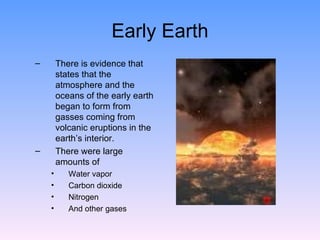
Early Earth There is evidence that states that the atmosphere and the oceans of the early earth began to form from gasses coming from volcanic eruptions in the earth’s interior.  There were large amounts of  Water vapor  Carbon dioxide  Nitrogen  And other gases
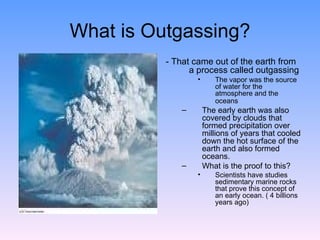
What is Outgassing? - That came out of the earth from a process called outgassing The vapor was the source of water for the atmosphere and the oceans   The early earth was also covered by clouds that formed precipitation over millions of years that cooled down the hot surface of the earth and also formed oceans.  What is the proof to this? Scientists have studies sedimentary marine rocks that prove this concept of an early ocean. ( 4 billions years ago)
???? Question????? Today’s atmosphere is made up of 21% oxygen but the gases of the volcanic eruptions do not contain oxygen  SO WHERE DID WE GET THE OXYGEN FROM? Scientists believe that the early oceans contained green plants. These green plants as we know get their food from photosynthesis.  Photosynthesis produces extra oxygen that went into the atmosphere over millions of years.
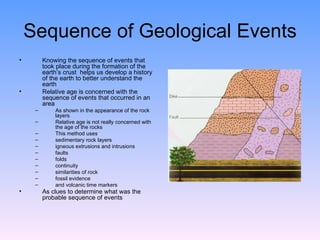
Sequence of Geological Events Knowing the sequence of events that took place during the formation of the earth’s crust  helps us develop a history of the earth to better understand the earth Relative age is concerned with the sequence of events that occurred in an area  As shown in the appearance of the rock layers Relative age is not really concerned with the age of the rocks  This method uses  sedimentary rock layers igneous extrusions and intrusions faults  folds  continuity  similarities of rock  fossil evidence  and volcanic time markers  As clues to determine what was the probable sequence of events
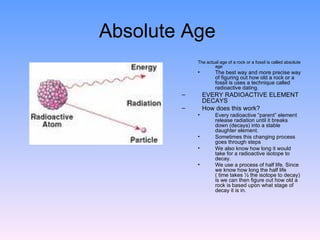
Absolute Age  The actual age of a rock or a fossil is called absolute age The best way and more precise way of figuring out how old a rock or a fossil is uses a technique called radioactive dating.  EVERY RADIOACTIVE ELEMENT DECAYS  How does this work?  Every radioactive “parent” element release radiation until it breaks down (decays) into a stable daughter element.  Sometimes this changing process goes through steps  We also know how long it would take for a radioactive isotope to decay.  We use a process of half life. Since we know how long the half life ( time takes ½ the isotope to decay) is we can then figure out how old a rock is based upon what stage of decay it is in.
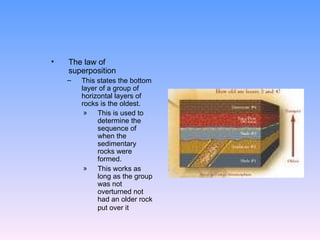
The law of superposition  This states the bottom layer of a group of horizontal layers of rocks is the oldest.  This is used to determine the sequence of when the sedimentary rocks were formed.  This works as long as the group was not overturned not had an older rock put over it
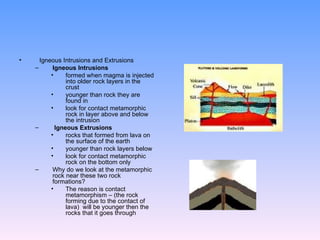
Igneous Intrusions and Extrusions  Igneous Intrusions   formed when magma is injected into older rock layers in the crust  younger than rock they are found in  look for contact metamorphic rock in layer above and below the intrusion Igneous Extrusions   rocks that formed from lava on the surface of the earth younger than rock layers below look for contact metamorphic rock on the bottom only Why do we look at the metamorphic rock near these two rock formations? The reason is contact metamorphism – (the rock forming due to the contact of lava)  will be younger then the rocks that it goes through
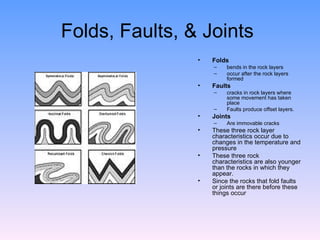
Folds, Faults, & Joints  Folds   bends in the rock layers occur after the rock layers formed Faults   cracks in rock layers where some movement has taken place  Faults produce offset layers. Joints  Are immovable cracks  These three rock layer characteristics occur due to changes in the temperature and pressure These three rock characteristics are also younger than the rocks in which they appear.  Since the rocks that fold faults or joints are there before these things occur
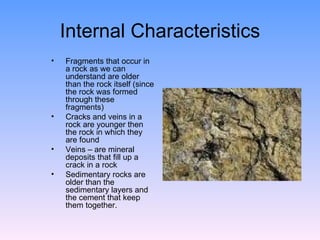
Internal Characteristics Fragments that occur in a rock as we can understand are older than the rock itself (since the rock was formed through these fragments)  Cracks and veins in a rock are younger then the rock in which they are found  Veins – are mineral deposits that fill up a crack in a rock  Sedimentary rocks are older than the sedimentary layers and the cement that keep them together.
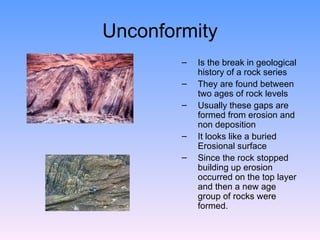
Unconformity Is the break in geological  history of a rock series  They are found between two ages of rock levels Usually these gaps are formed from erosion and non deposition  It looks like a buried Erosional surface Since the rock stopped building up erosion occurred on the top layer and then a new age group of rocks were formed.
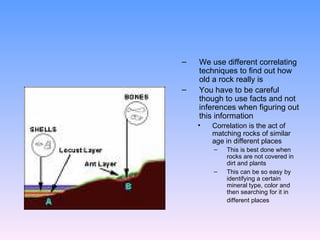
We use different correlating techniques to find out how old a rock really is  You have to be careful though to use facts and not inferences when figuring out this information  Correlation is the act of matching rocks of similar age in different places  This is best done when rocks are not covered in dirt and plants  This can be so easy by identifying a certain mineral type, color and then searching for it in different places
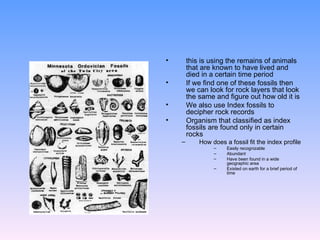
this is using the remains of animals that are known to have lived and died in a certain time period  If we find one of these fossils then we can look for rock layers that look the same and figure out how old it is  We also use Index fossils to decipher rock records Organism that classified as index fossils are found only in certain rocks How does a fossil fit the index profile  Easily recognizable Abundant  Have been found in a wide geographic area  Existed on earth for a brief period of time
Volcanic Time Marker When a volcano erupts it leaves a layer of volcanic ash is deposited over the area  This may be a time marker if we find a layer of ash in the layers of the rocks and the time of the volcanic eruption is known  This time marker will be very helpful determined the ages of rocks below and above it
Problems with Correlation  It seems based upon what we have just learned that figuring out a geological time line is very simple.  However, it can lead to misinformation  With very careful study of 2 like rock formation they might still be different ages.  Also , in the same rock formation their might be rocks of different ages
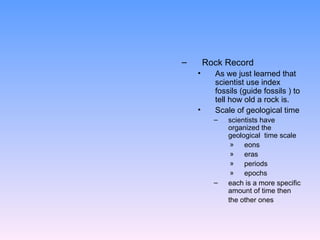
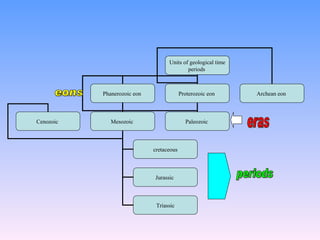
Rock Record  As we just learned that scientist use index fossils (guide fossils ) to tell how old a rock is.  Scale of geological time  scientists have organized the geological  time scale eons  eras  periods  epochs each is a more specific amount of time then the other ones
Units of geological time periods  Phanerozoic eon  Proterozoic eon  Cenozoic  Archean eon  Mesozoic  Paleozoic  cretaceous Jurassic  Triassic eons  eras periods
epochs are more based on fossil evidence  However, most of the geological time is void of fossil records
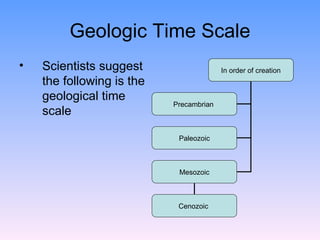
Geologic Time Scale Scientists suggest the following is the geological time scale  In order of creation Precambrian  Paleozoic Mesozoic Cenozoic
Precambrian/ Pre Paleozoic Makes up 85% of the earth’s history  Very little fossil evidence from this time period  This is because the organisms that were around had soft bodies , simple, and small ( ex; algae bacteria)
Paleozoic  Much shorter time period  Has an abundant of fossils  The first vertebrates, land plants and animals developed in this era
Mesozoic Was even shorter  Fossils of dinosaurs  and the earliest birds and mammals formed  Included three periods Triassic Jurassic  Cretaceous
Cenozoic  Most recent era  Includes the fossils of many modern plants and mammals, even the appearance of humans Plate motions and mountain buildings may also be identified in this time sequence by using the reference table

Earth’s history

  • 1.
  • 2.
    Introduction Aswe already learned the earth is always changing The history of the earth is told by the Earth’s Geological events It is up to the scientist to figure out the puzzle of these geological events.
  • 3.
    Early Earth Thereis evidence that states that the atmosphere and the oceans of the early earth began to form from gasses coming from volcanic eruptions in the earth’s interior. There were large amounts of Water vapor Carbon dioxide Nitrogen And other gases
  • 4.
    What is Outgassing?- That came out of the earth from a process called outgassing The vapor was the source of water for the atmosphere and the oceans The early earth was also covered by clouds that formed precipitation over millions of years that cooled down the hot surface of the earth and also formed oceans. What is the proof to this? Scientists have studies sedimentary marine rocks that prove this concept of an early ocean. ( 4 billions years ago)
  • 5.
    ???? Question????? Today’satmosphere is made up of 21% oxygen but the gases of the volcanic eruptions do not contain oxygen SO WHERE DID WE GET THE OXYGEN FROM? Scientists believe that the early oceans contained green plants. These green plants as we know get their food from photosynthesis. Photosynthesis produces extra oxygen that went into the atmosphere over millions of years.
  • 6.
    Sequence of GeologicalEvents Knowing the sequence of events that took place during the formation of the earth’s crust helps us develop a history of the earth to better understand the earth Relative age is concerned with the sequence of events that occurred in an area As shown in the appearance of the rock layers Relative age is not really concerned with the age of the rocks This method uses sedimentary rock layers igneous extrusions and intrusions faults folds continuity similarities of rock fossil evidence and volcanic time markers As clues to determine what was the probable sequence of events
  • 7.
    Absolute Age The actual age of a rock or a fossil is called absolute age The best way and more precise way of figuring out how old a rock or a fossil is uses a technique called radioactive dating. EVERY RADIOACTIVE ELEMENT DECAYS How does this work? Every radioactive “parent” element release radiation until it breaks down (decays) into a stable daughter element. Sometimes this changing process goes through steps We also know how long it would take for a radioactive isotope to decay. We use a process of half life. Since we know how long the half life ( time takes ½ the isotope to decay) is we can then figure out how old a rock is based upon what stage of decay it is in.
  • 8.
    The law ofsuperposition This states the bottom layer of a group of horizontal layers of rocks is the oldest. This is used to determine the sequence of when the sedimentary rocks were formed. This works as long as the group was not overturned not had an older rock put over it
  • 9.
    Igneous Intrusions andExtrusions Igneous Intrusions formed when magma is injected into older rock layers in the crust younger than rock they are found in look for contact metamorphic rock in layer above and below the intrusion Igneous Extrusions rocks that formed from lava on the surface of the earth younger than rock layers below look for contact metamorphic rock on the bottom only Why do we look at the metamorphic rock near these two rock formations? The reason is contact metamorphism – (the rock forming due to the contact of lava) will be younger then the rocks that it goes through
  • 10.
    Folds, Faults, &Joints Folds bends in the rock layers occur after the rock layers formed Faults cracks in rock layers where some movement has taken place Faults produce offset layers. Joints Are immovable cracks These three rock layer characteristics occur due to changes in the temperature and pressure These three rock characteristics are also younger than the rocks in which they appear. Since the rocks that fold faults or joints are there before these things occur
  • 11.
    Internal Characteristics Fragmentsthat occur in a rock as we can understand are older than the rock itself (since the rock was formed through these fragments) Cracks and veins in a rock are younger then the rock in which they are found Veins – are mineral deposits that fill up a crack in a rock Sedimentary rocks are older than the sedimentary layers and the cement that keep them together.
  • 12.
    Unconformity Is thebreak in geological history of a rock series They are found between two ages of rock levels Usually these gaps are formed from erosion and non deposition It looks like a buried Erosional surface Since the rock stopped building up erosion occurred on the top layer and then a new age group of rocks were formed.
  • 13.
    We use differentcorrelating techniques to find out how old a rock really is You have to be careful though to use facts and not inferences when figuring out this information Correlation is the act of matching rocks of similar age in different places This is best done when rocks are not covered in dirt and plants This can be so easy by identifying a certain mineral type, color and then searching for it in different places
  • 14.
    this is usingthe remains of animals that are known to have lived and died in a certain time period If we find one of these fossils then we can look for rock layers that look the same and figure out how old it is We also use Index fossils to decipher rock records Organism that classified as index fossils are found only in certain rocks How does a fossil fit the index profile Easily recognizable Abundant Have been found in a wide geographic area Existed on earth for a brief period of time
  • 15.
    Volcanic Time MarkerWhen a volcano erupts it leaves a layer of volcanic ash is deposited over the area This may be a time marker if we find a layer of ash in the layers of the rocks and the time of the volcanic eruption is known This time marker will be very helpful determined the ages of rocks below and above it
  • 16.
    Problems with Correlation It seems based upon what we have just learned that figuring out a geological time line is very simple. However, it can lead to misinformation With very careful study of 2 like rock formation they might still be different ages. Also , in the same rock formation their might be rocks of different ages
  • 17.
    Rock Record As we just learned that scientist use index fossils (guide fossils ) to tell how old a rock is. Scale of geological time scientists have organized the geological time scale eons eras periods epochs each is a more specific amount of time then the other ones
  • 18.
    Units of geologicaltime periods Phanerozoic eon Proterozoic eon Cenozoic Archean eon Mesozoic Paleozoic cretaceous Jurassic Triassic eons eras periods
  • 19.
    epochs are morebased on fossil evidence However, most of the geological time is void of fossil records
  • 20.
    Geologic Time ScaleScientists suggest the following is the geological time scale In order of creation Precambrian Paleozoic Mesozoic Cenozoic
  • 21.
    Precambrian/ Pre PaleozoicMakes up 85% of the earth’s history Very little fossil evidence from this time period This is because the organisms that were around had soft bodies , simple, and small ( ex; algae bacteria)
  • 22.
    Paleozoic Muchshorter time period Has an abundant of fossils The first vertebrates, land plants and animals developed in this era
  • 23.
    Mesozoic Was evenshorter Fossils of dinosaurs and the earliest birds and mammals formed Included three periods Triassic Jurassic Cretaceous
  • 24.
    Cenozoic Mostrecent era Includes the fossils of many modern plants and mammals, even the appearance of humans Plate motions and mountain buildings may also be identified in this time sequence by using the reference table