The document summarizes plate tectonics and the structure and dynamics of the Earth. It describes the four main layers of the Earth and explains that plate tectonics involves the constant motion of tectonic plates due to convection currents in the mantle. It provides evidence that supported the theory of continental drift and discusses how sea floor spreading and subduction at trenches cause the plates to move over time.
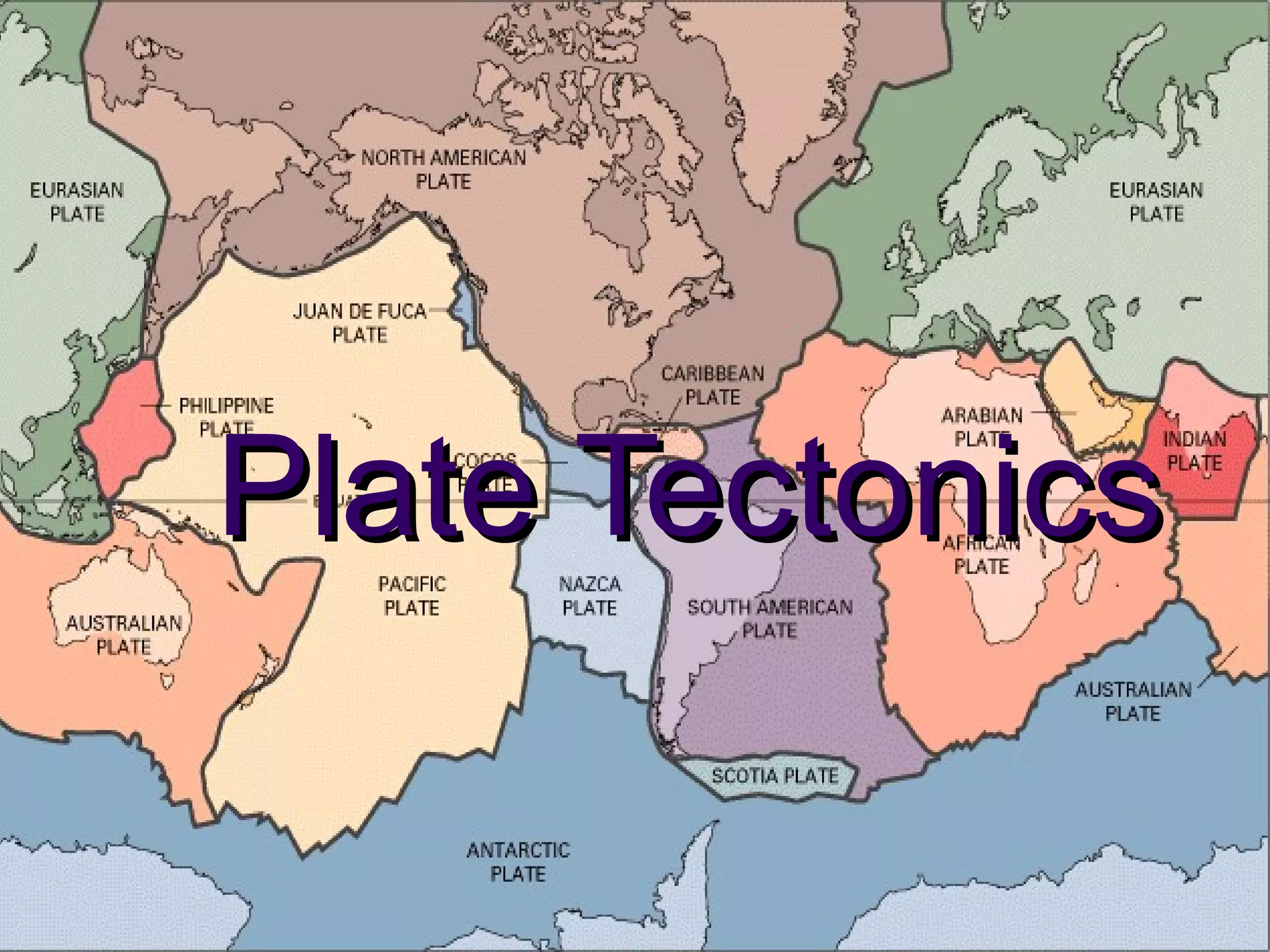
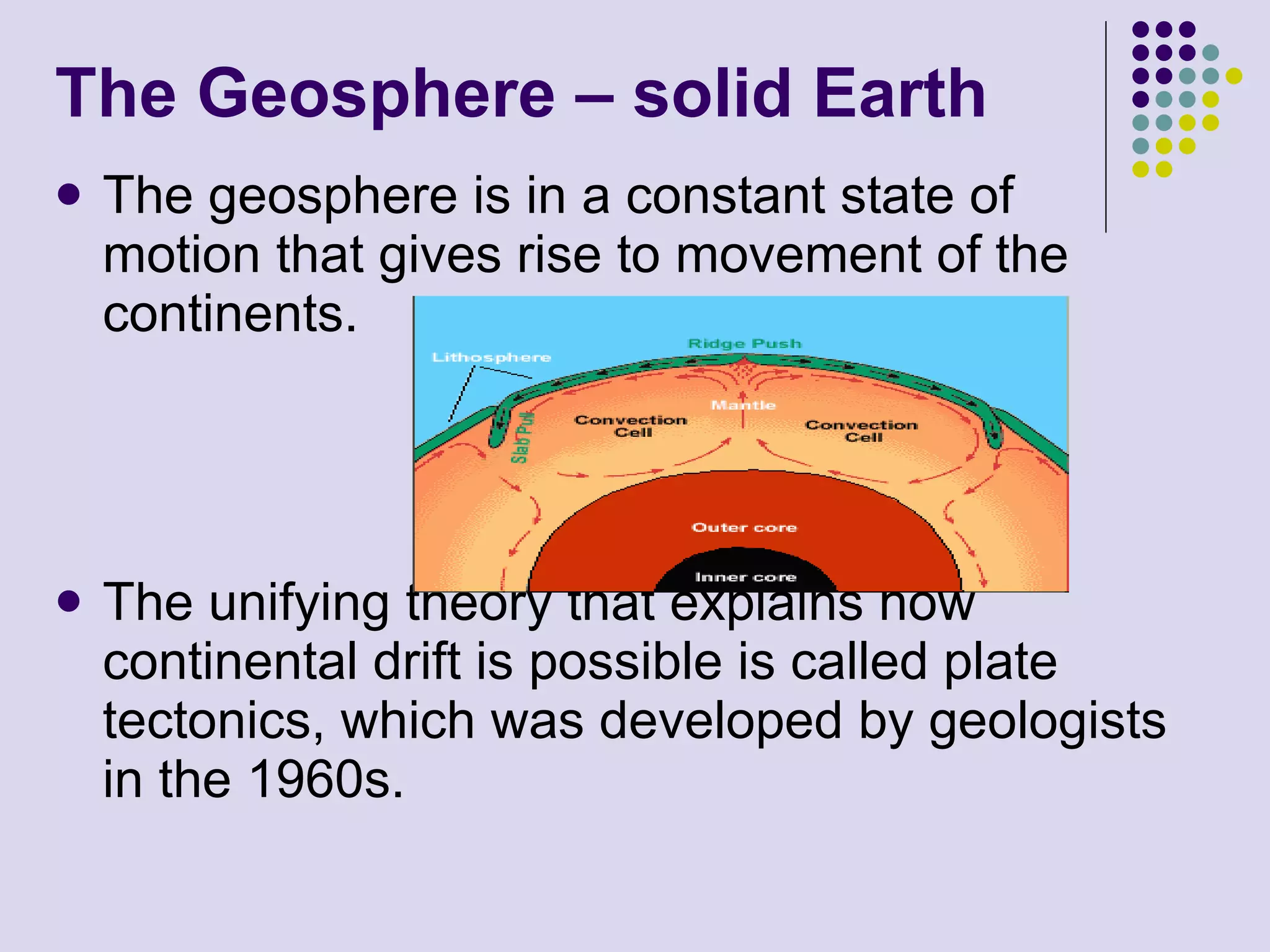
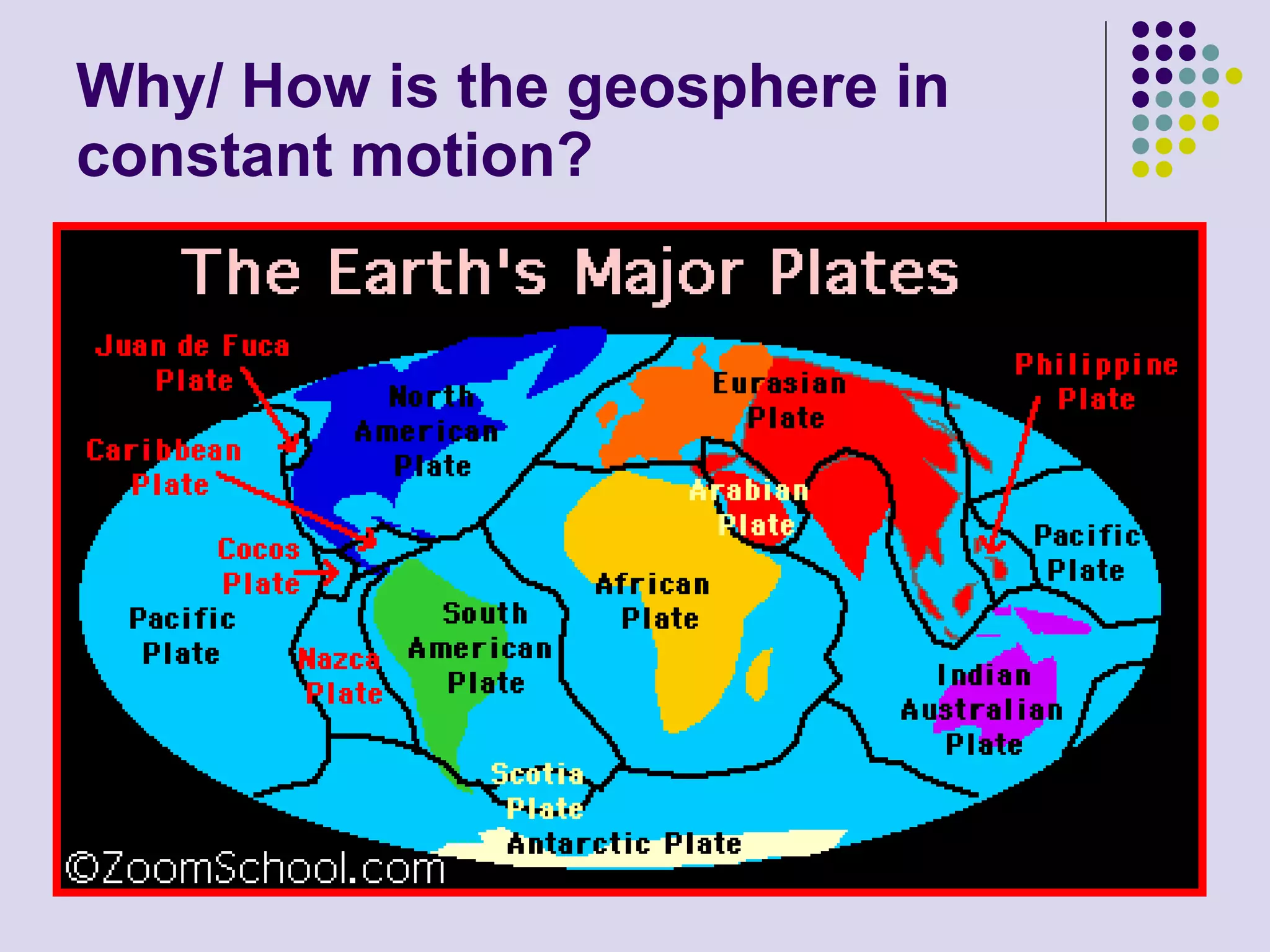
The Geosphere –solid Earth The geosphere is in a constant state of motion that gives rise to movement of the continents. The unifying theory that explains how continental drift is possible is called plate tectonics, which was developed by geologists in the 1960s.
5.
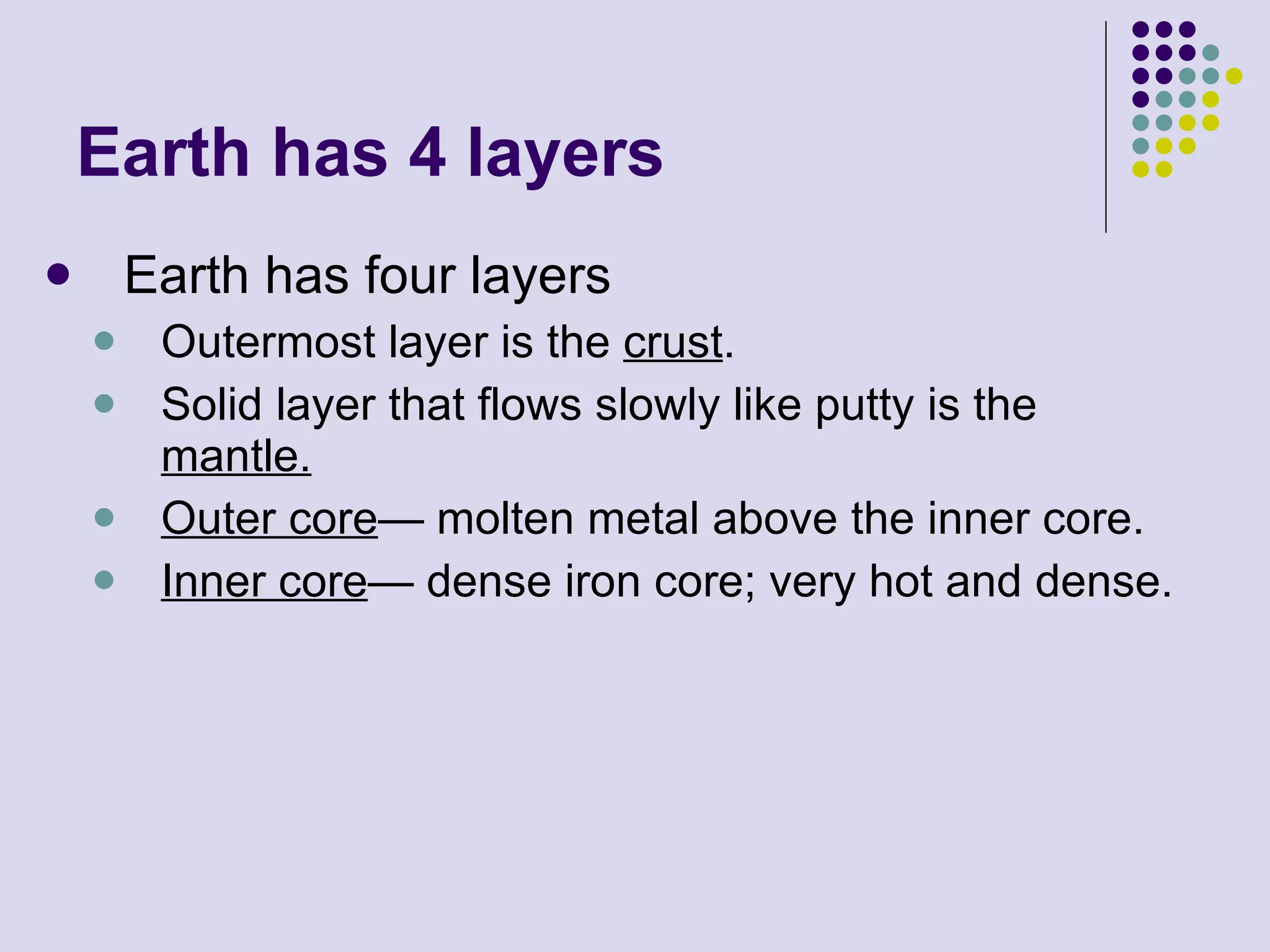
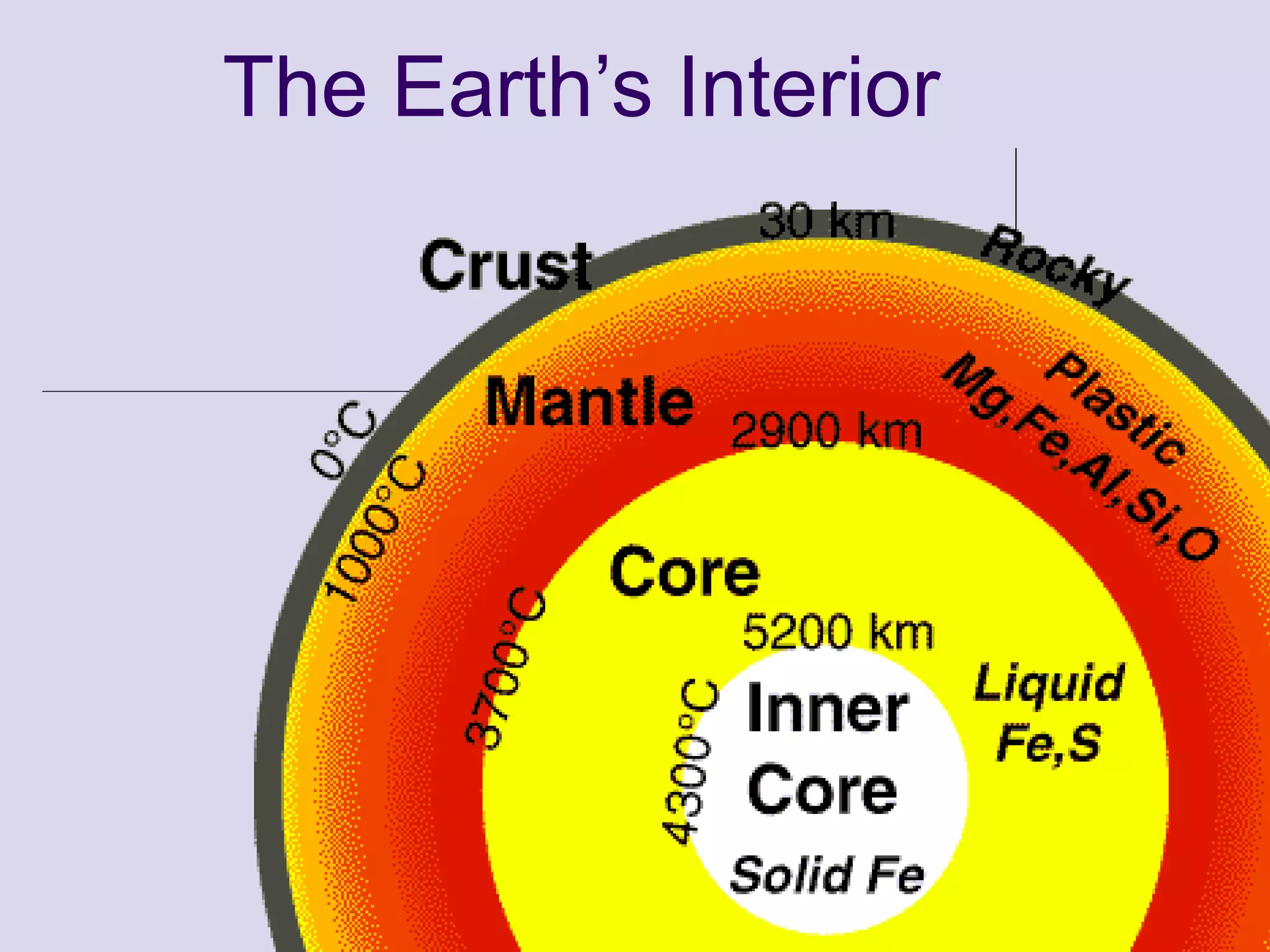
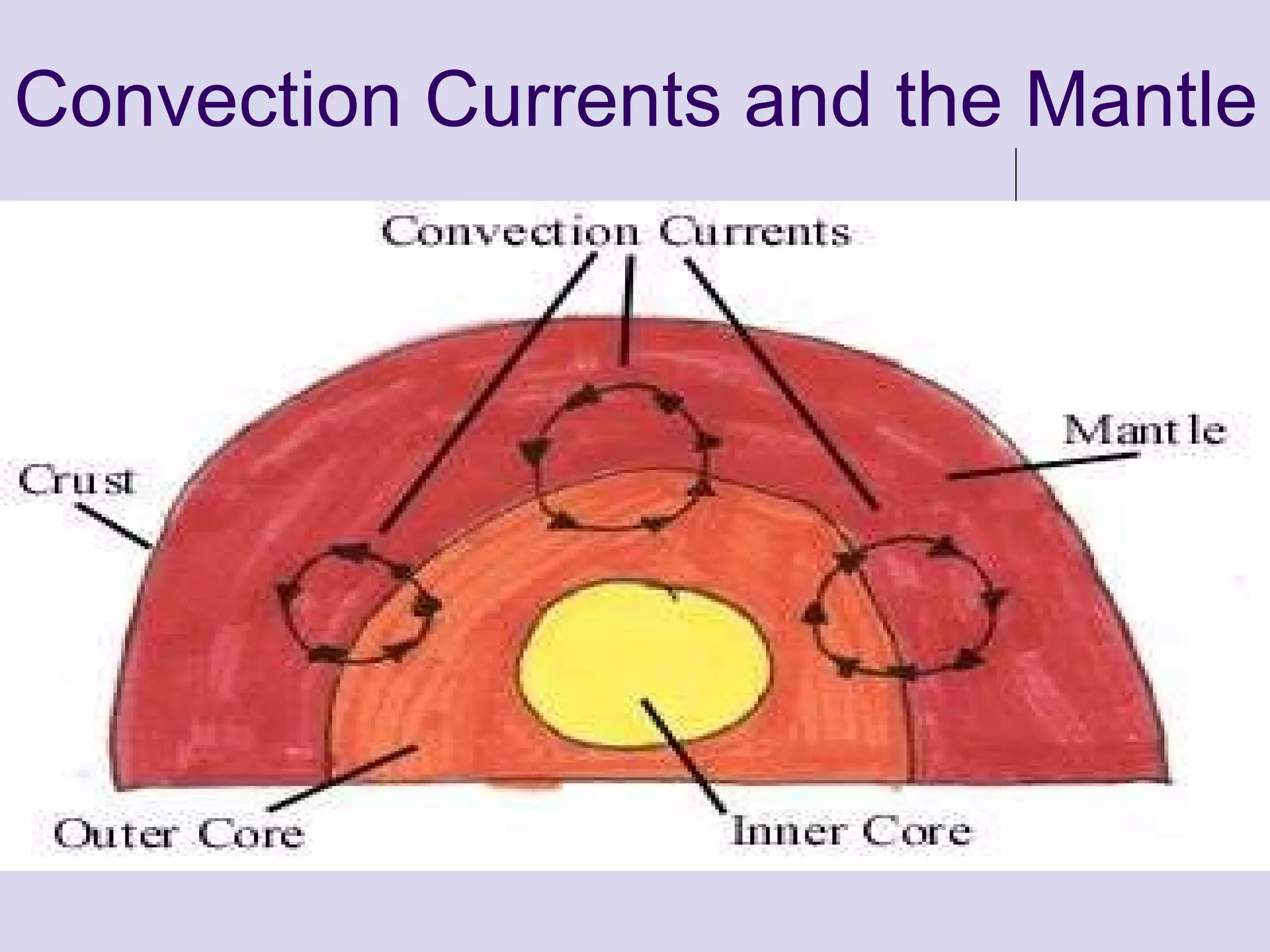
Earth has 4layers Earth has four layers Outermost layer is the crust . Solid layer that flows slowly like putty is the mantle. Outer core — molten metal above the inner core. Inner core — dense iron core; very hot and dense.
The Science ofGeology Geologists – scientists who study the forces that make and shape planet Earth Landforms – features formed in rock and soil by water, wind and waves
10.
Geology – thestudy of planet Earth Studying surface changes Constructive forces – shape the surface by building up mountains and landmasses. Ex: land is made Destructive forces – slowly wear away mountains and other land features. Ex: land is destroyed
11.
A Journey tothe Center of the Earth – Temperature – at a depth of about 20m the temperature gets warmer as you go deeper into the earth’s interior. For every 40 m, the temperature rises 1degree C, then it eventually increases more slowly. Pressure – the deeper you go the greater the pressure (force pushing on a surface of area)
12.
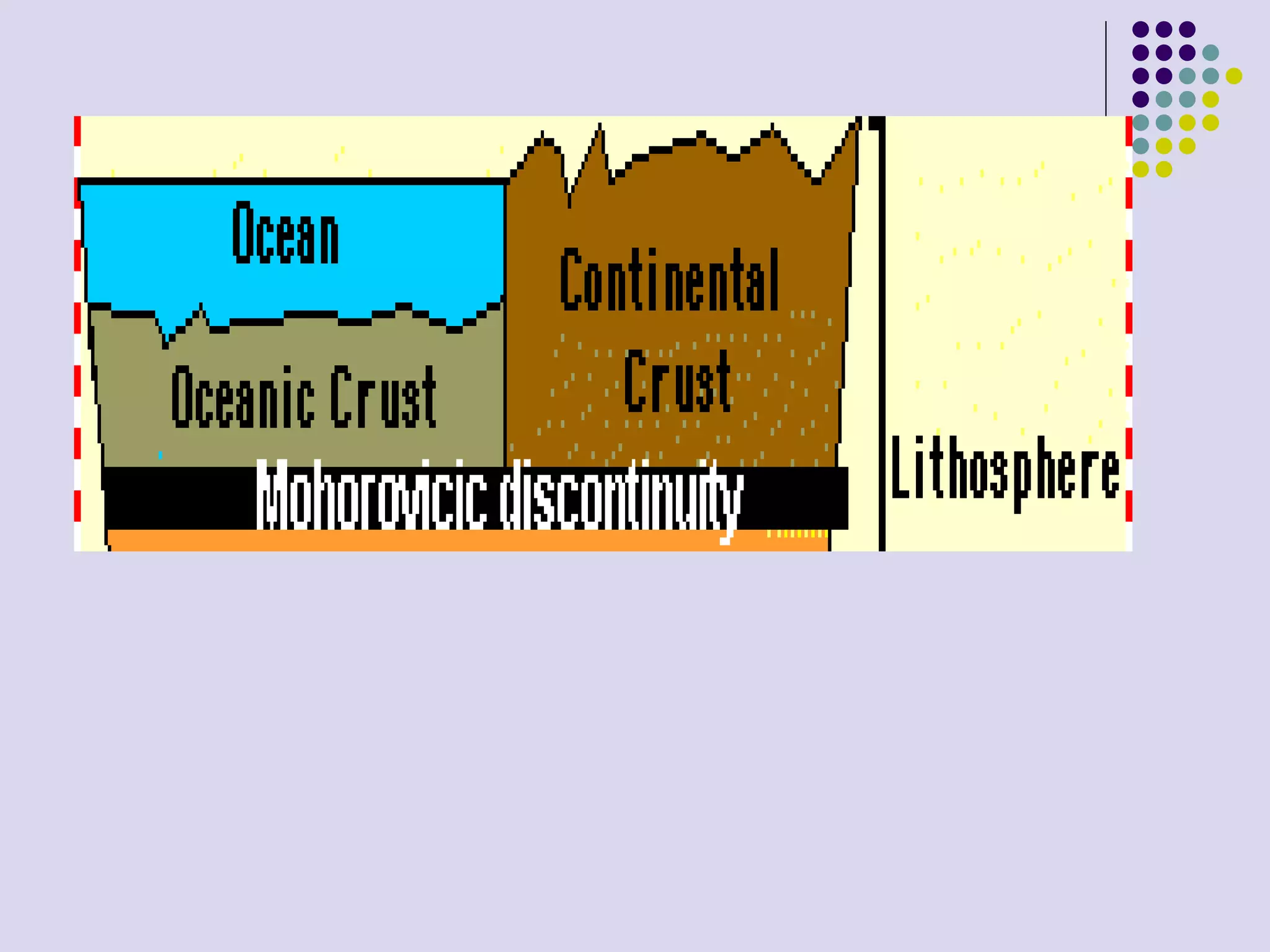
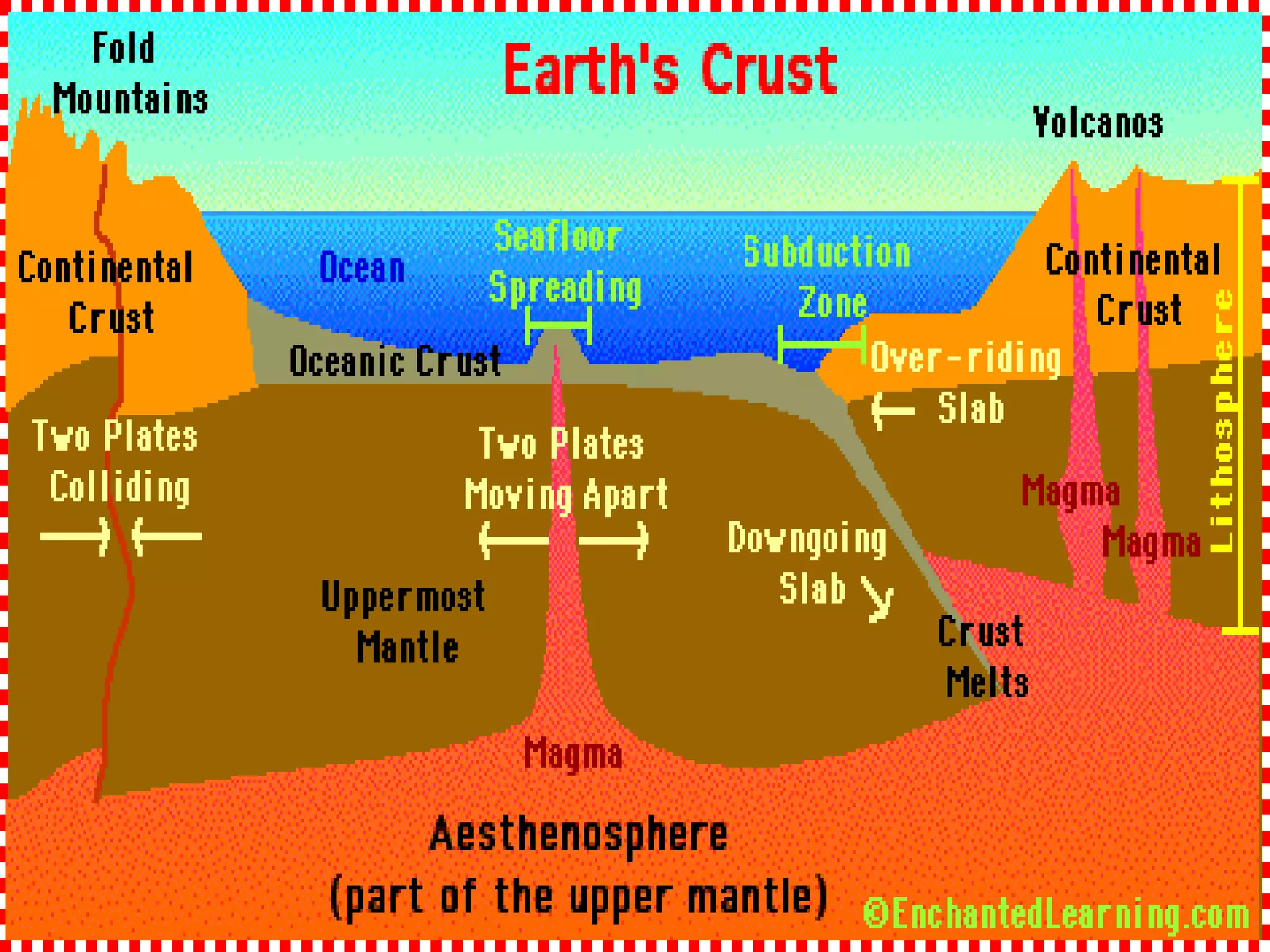
The Crust –layer of rock that forms the Earth’s outer skin. Includes soil, water, mountains, etc. It is the thinnest layer – thinner beneath the oceans than beneath the continents (5 – 40 km thick) Oceanic Crust – the crust beneath the oceans. Consists mostly of basalt rock. Continental crust – the crust beneath the continents. Consists mostly of granite rock.
13.
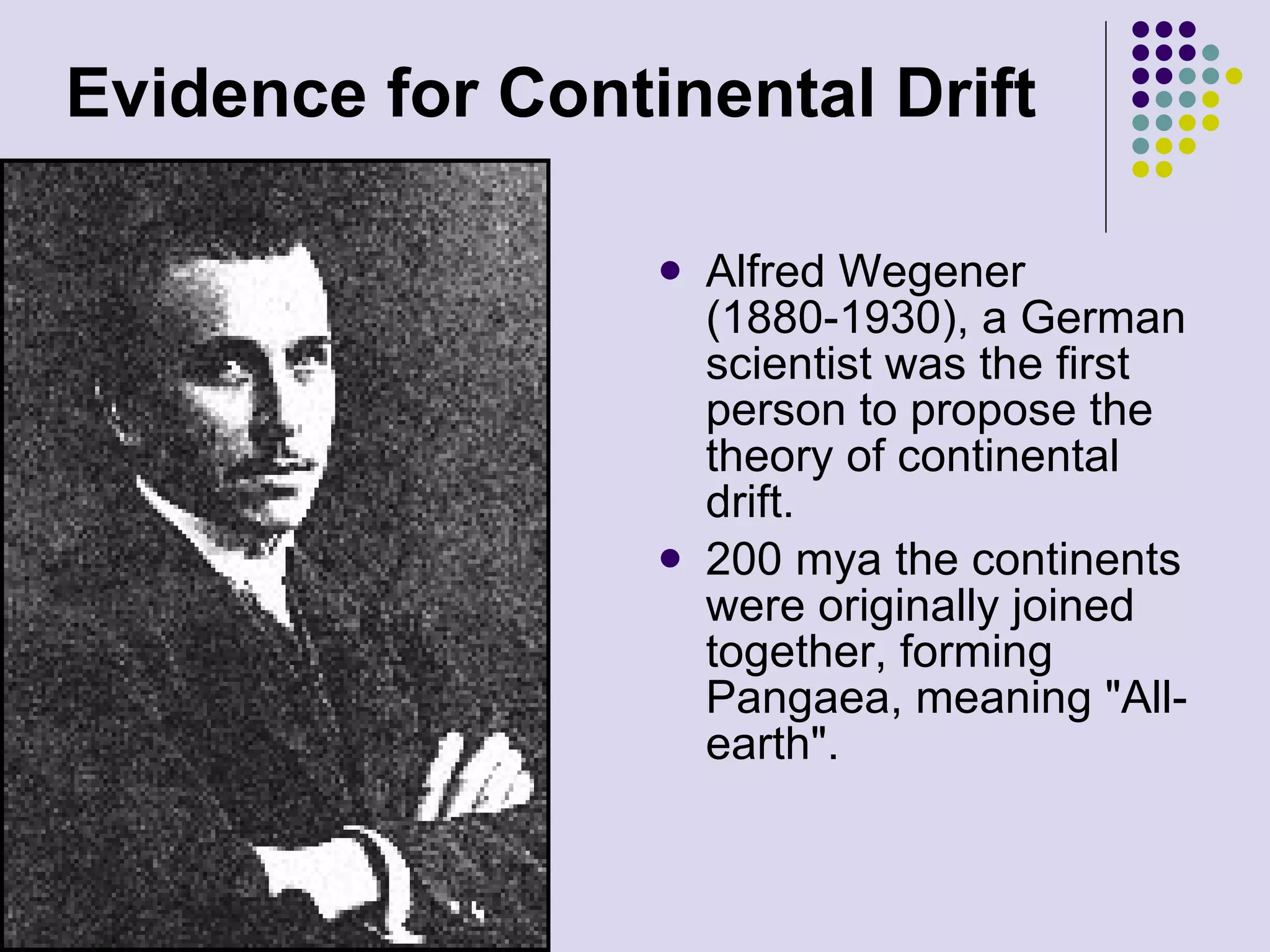
Evidence for Continental Drift Alfred Wegener (1880-1930), a German scientist was the first person to propose the theory of continental drift. 200 mya the continents were originally joined together, forming Pangaea, meaning "All-earth".
14.
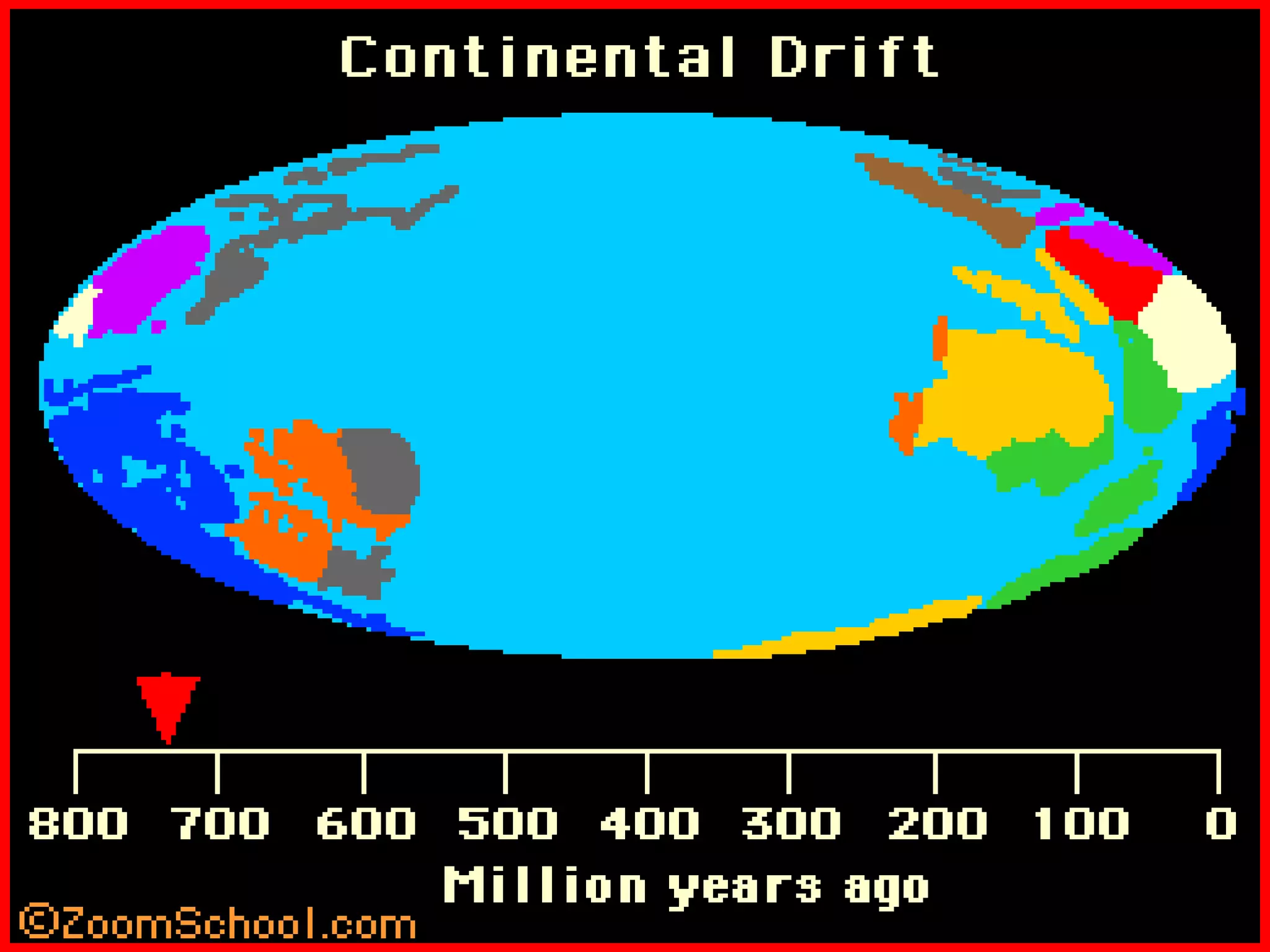
Continental Drift –theory that the continents had once been joined together in a single landmass and have since drifted apart. Theory first proposed by Alfred Wegener Pangaea – the one supercontinent believed to have existed 300 million years ago
Evidence for ContinentalDrift Evidence from landforms Mountain range – in Africa matched a mountain range in South America European coal fields match coal fields in North America
17.
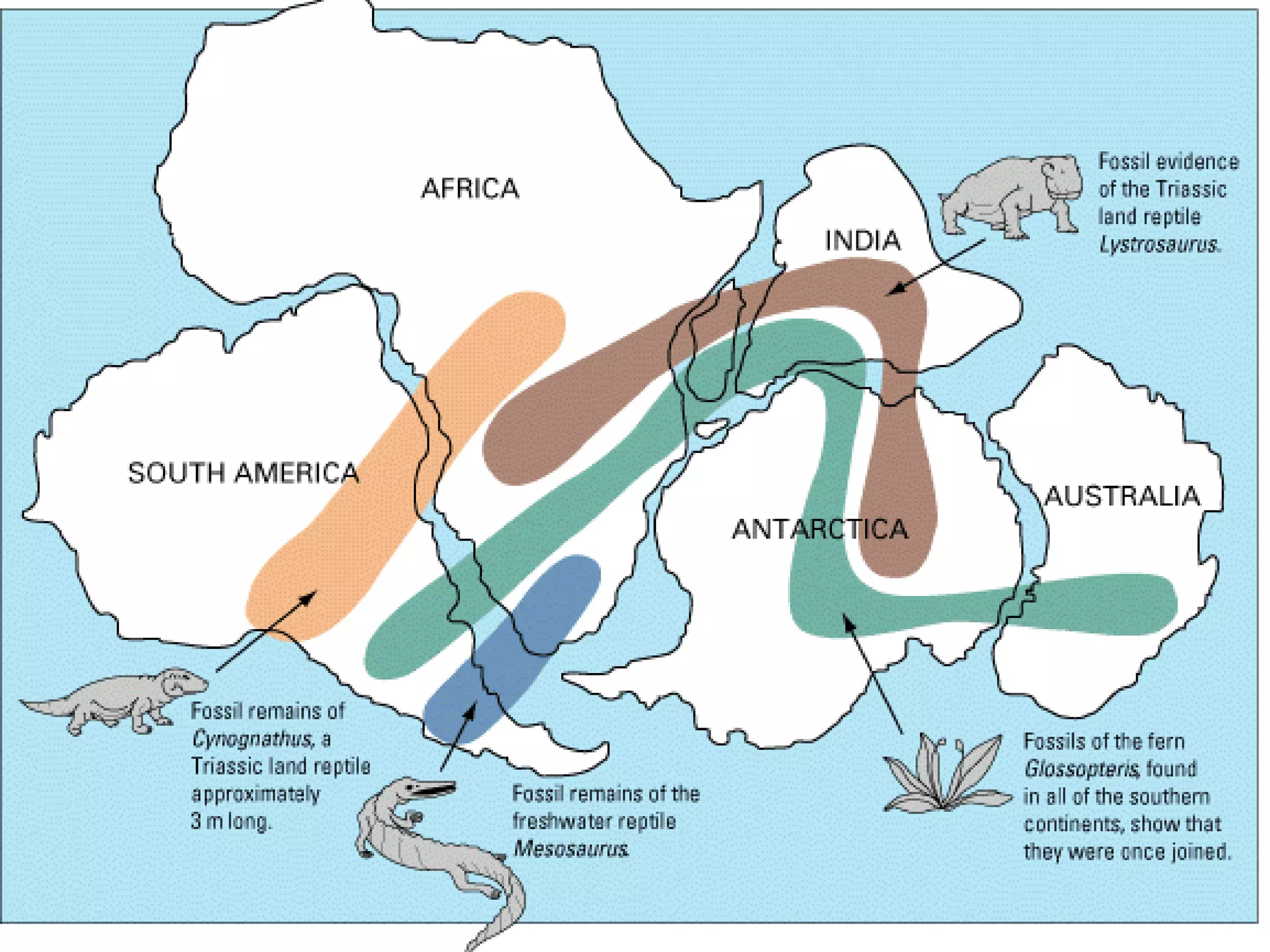
Evidence for ContinentalDrift Evidence from Fossils Fossi l – trace of an organism that has been preserved in rock Mesosaurus – reptile whose fossils were found in S. America and Africa. This organism could not have swum long distances in salt water,
18.
19.
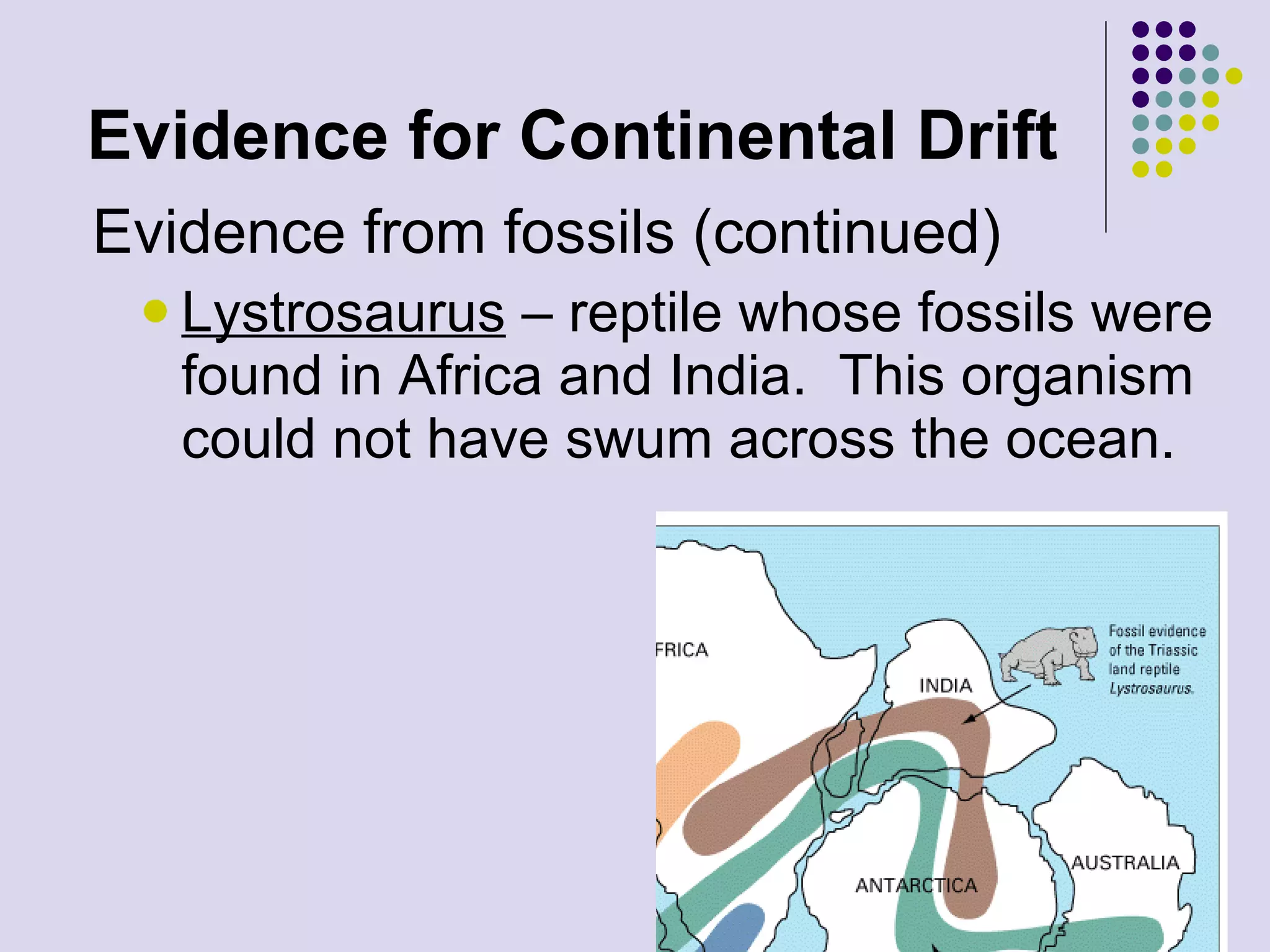
Evidence for ContinentalDrift Evidence from fossils (continued) Lystrosaurus – reptile whose fossils were found in Africa and India. This organism could not have swum across the ocean.
20.
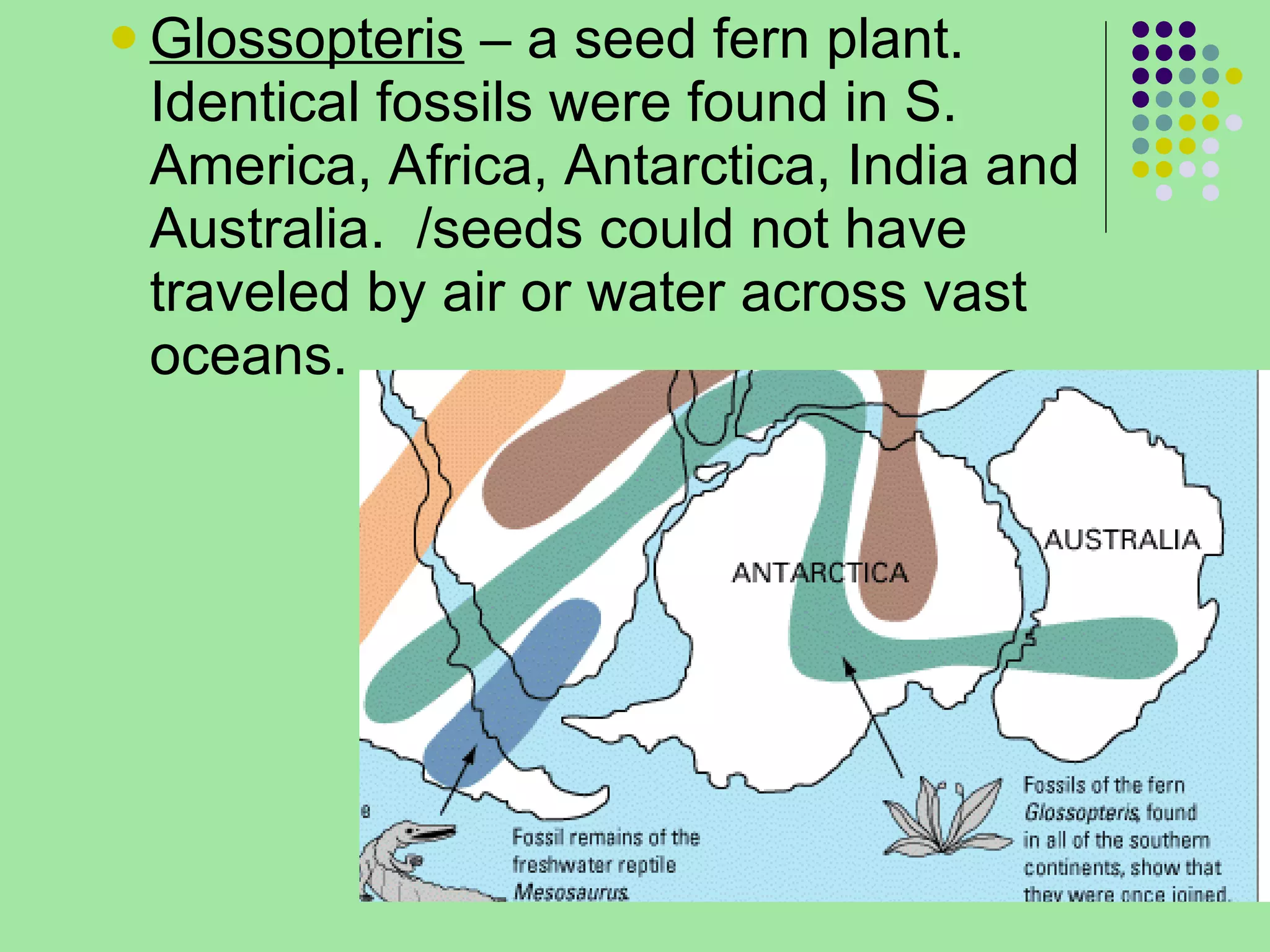
Glossopteris –a seed fern plant. Identical fossils were found in S. America, Africa, Antarctica, India and Australia. /seeds could not have traveled by air or water across vast oceans.
21.
Evidence for ContinentalDrift Evidence from climate Spitsbergen island – located in the Arctic Ocean, north of Norway. Fossils of tropical plants have been found there. Evidence that continental glaciers once covered S. Africa
22.
Scientists Reject Hypothesis Wegener could not provide a satisfactory explanation for the force that pushes or pulls continents geologists rejected the theory (until new evidence was discovered later.)
23.
The answer to“WHY” We know today that the reason plates do move as in the theory of continental drift is due to convection currents.
Methods of HeatTransfer Convection – heat transfer by currents moving through a heated fluid (liquid or gas). Ex: Warm air rises and cool air sinks in a room. http:// www.solarviews.com/eng/edu/convect.htm
26.
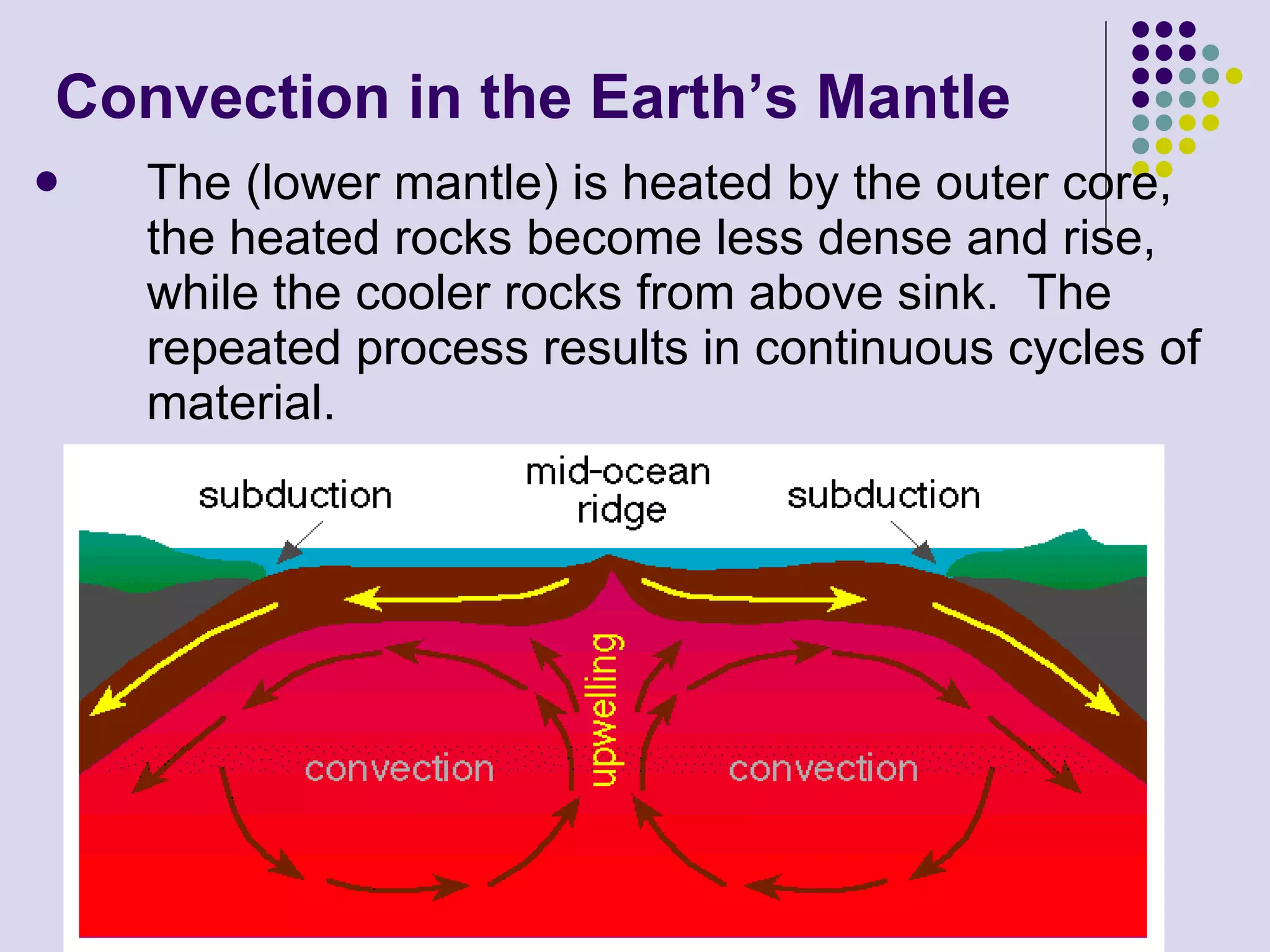
Convection in theEarth’s Mantle The (lower mantle) is heated by the outer core, the heated rocks become less dense and rise, while the cooler rocks from above sink. The repeated process results in continuous cycles of material.
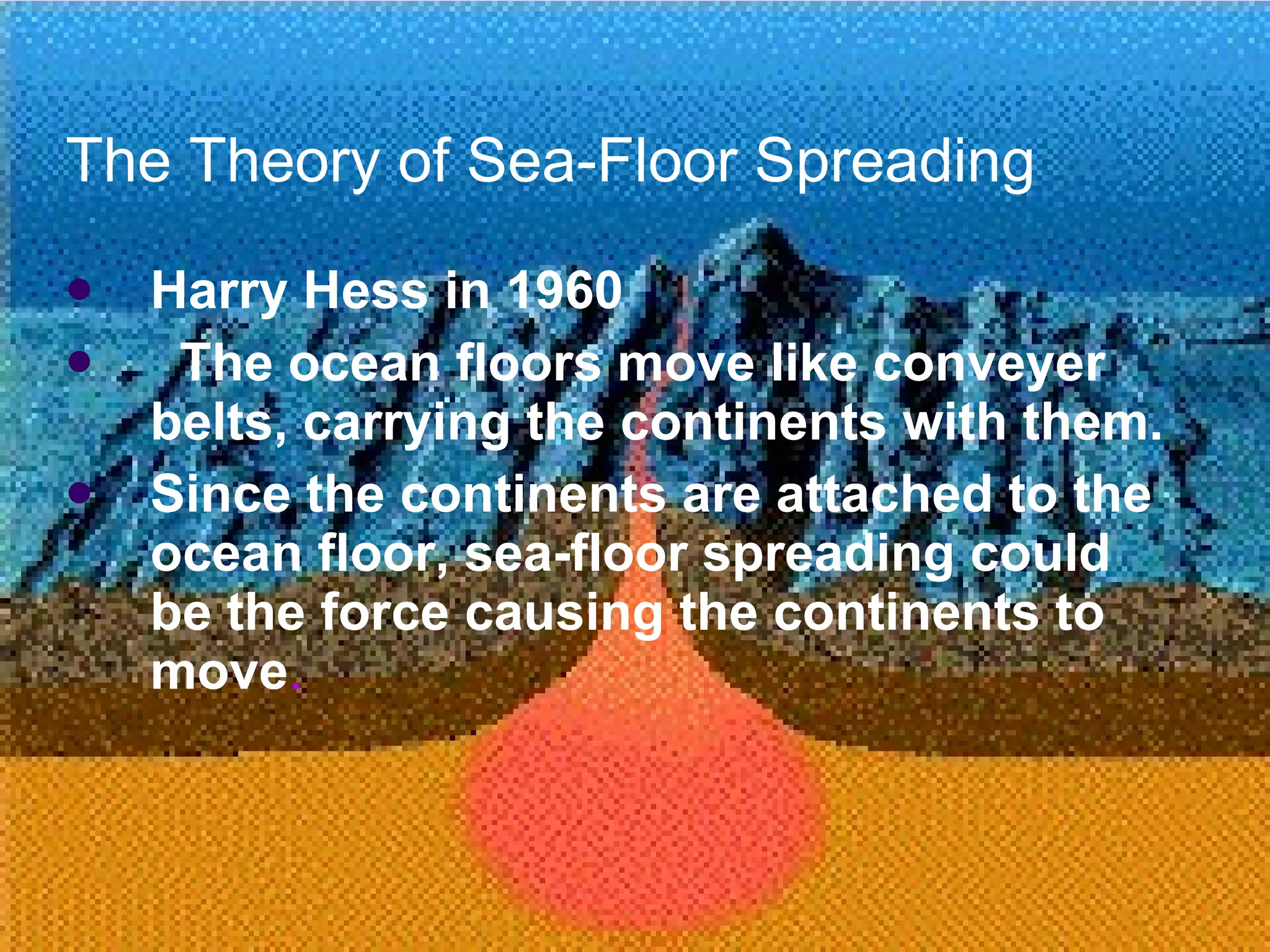
The Theory ofSea-Floor Spreading Harry Hess in 1960 The ocean floors move like conveyer belts, carrying the continents with them. Since the continents are attached to the ocean floor, sea-floor spreading could be the force causing the continents to move .
29.
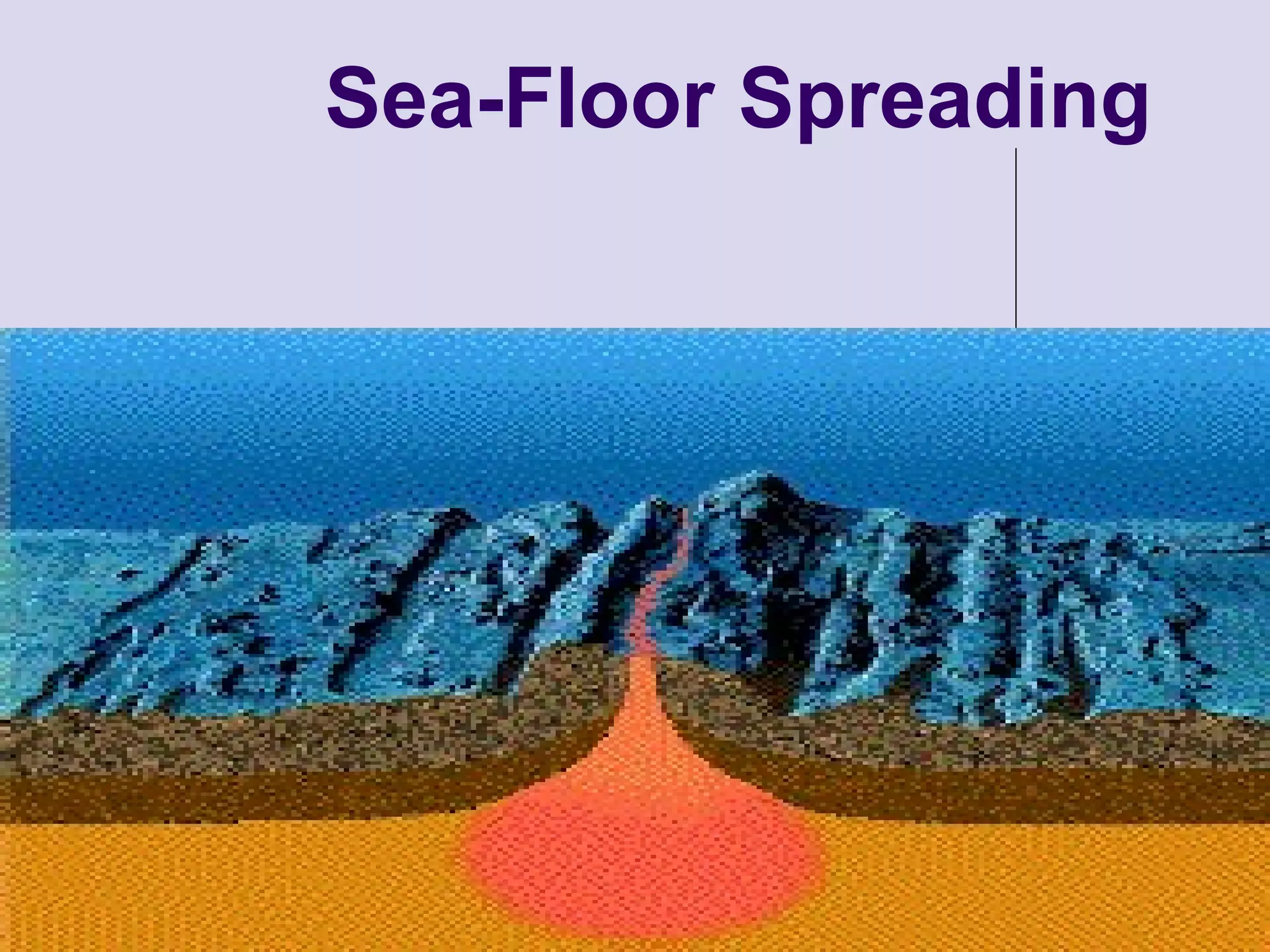
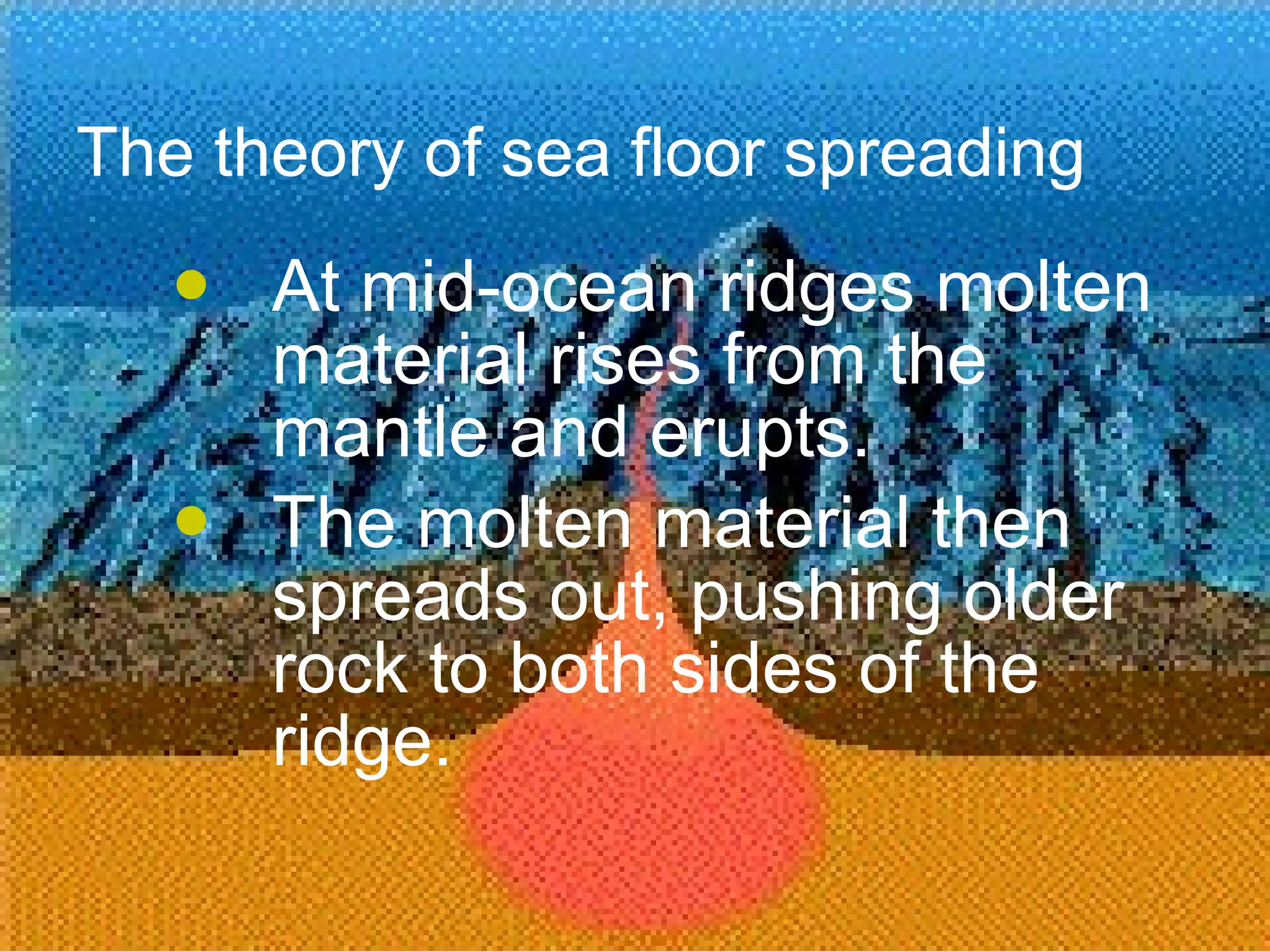
The theory ofsea floor spreading At mid-ocean ridges molten material rises from the mantle and erupts. The molten material then spreads out, pushing older rock to both sides of the ridge.
30.
Evidence from MoltenMaterial – scientists discovered “pillow lava” forming along the mid-ocean ridge. These rocks form when molten material hardens quickly after erupting under water. Evidence from Magnetic Stripes – patterns of magnetic stripes match on either side of the mid-ocean ridge, suggesting that the ocean floor is spreading evenly in opposite directions.
31.
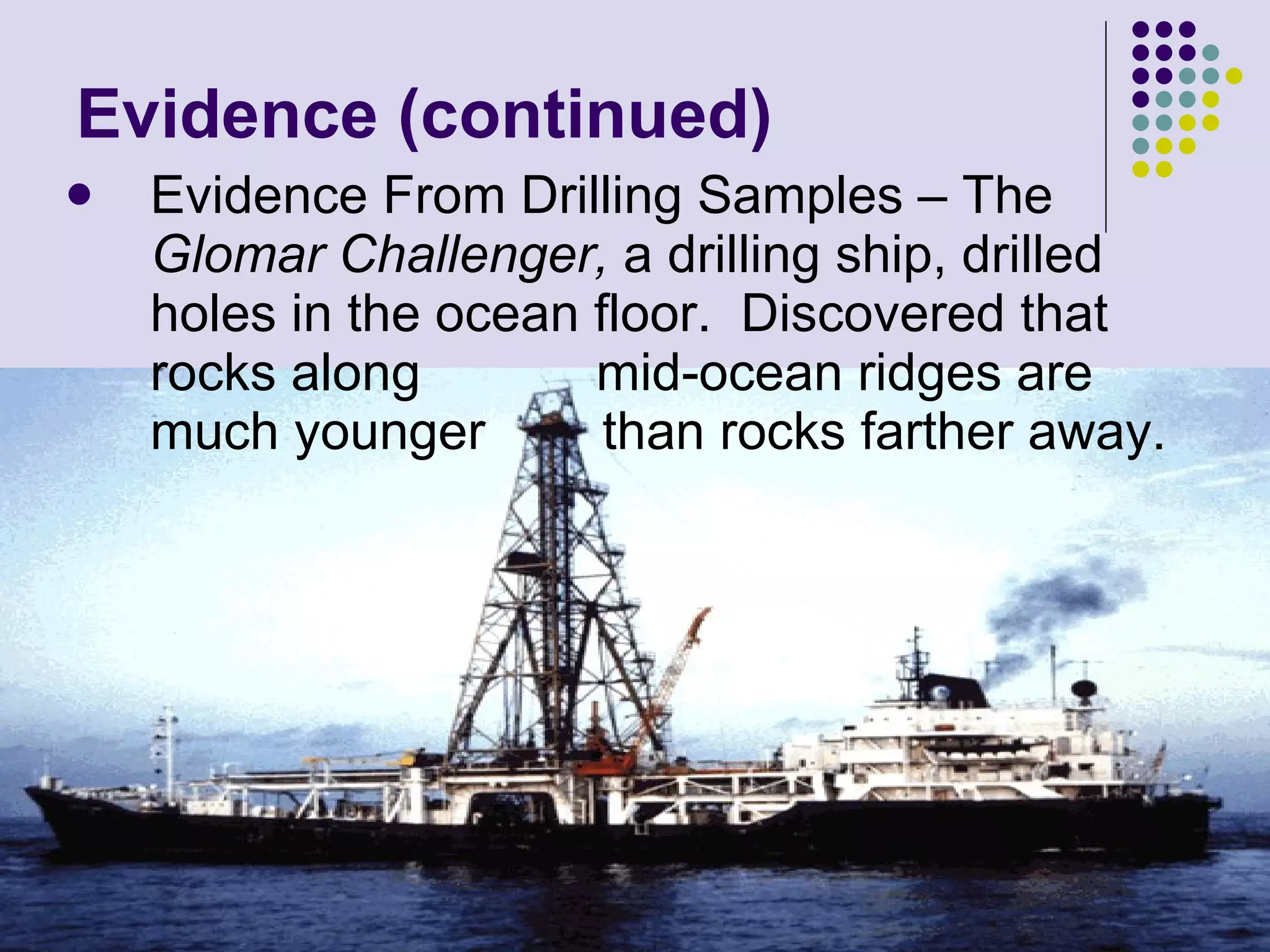
Evidence (continued) EvidenceFrom Drilling Samples – The Glomar Challenger, a drilling ship, drilled holes in the ocean floor. Discovered that rocks along mid-ocean ridges are much younger than rocks farther away.
32.
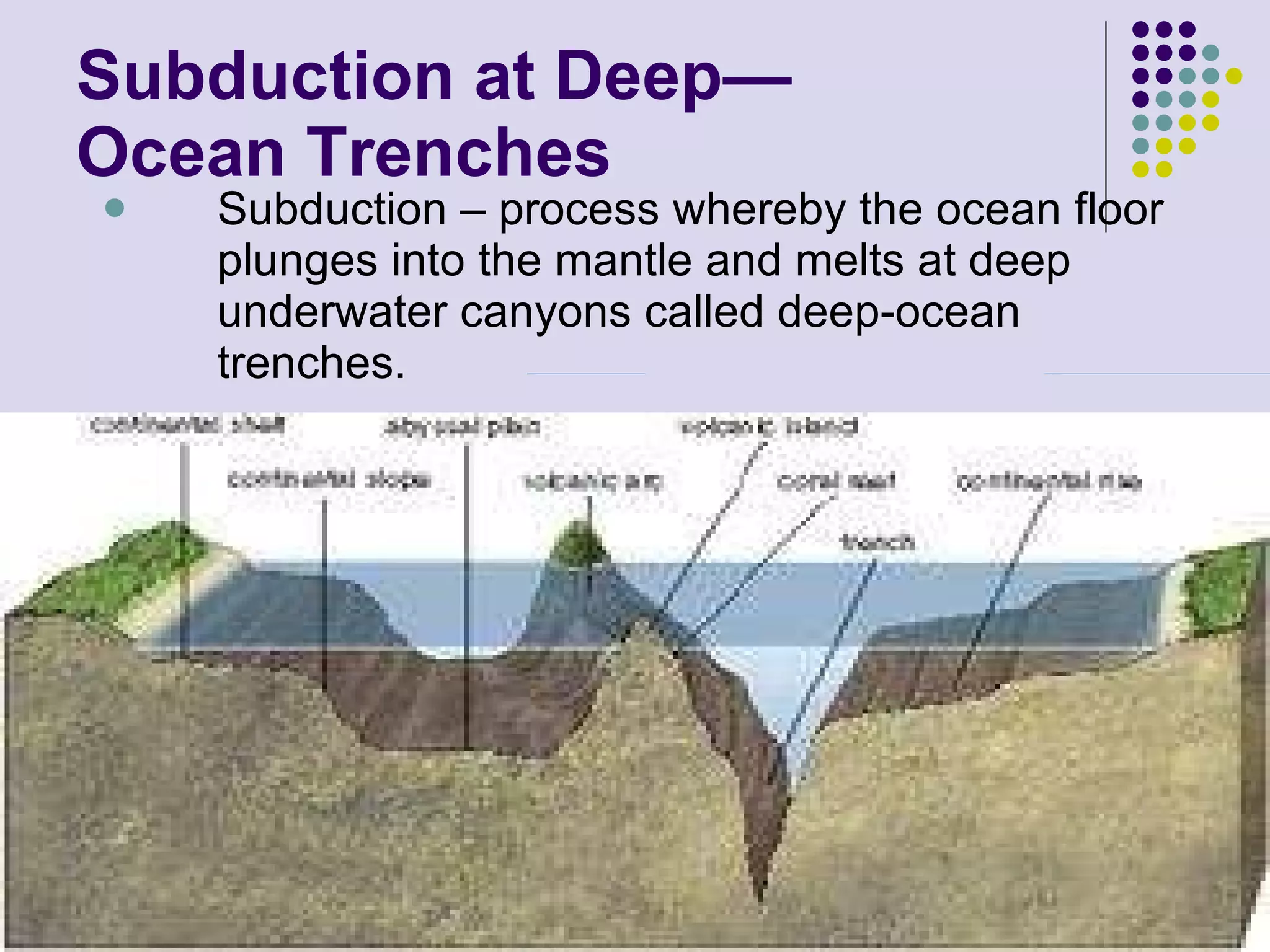
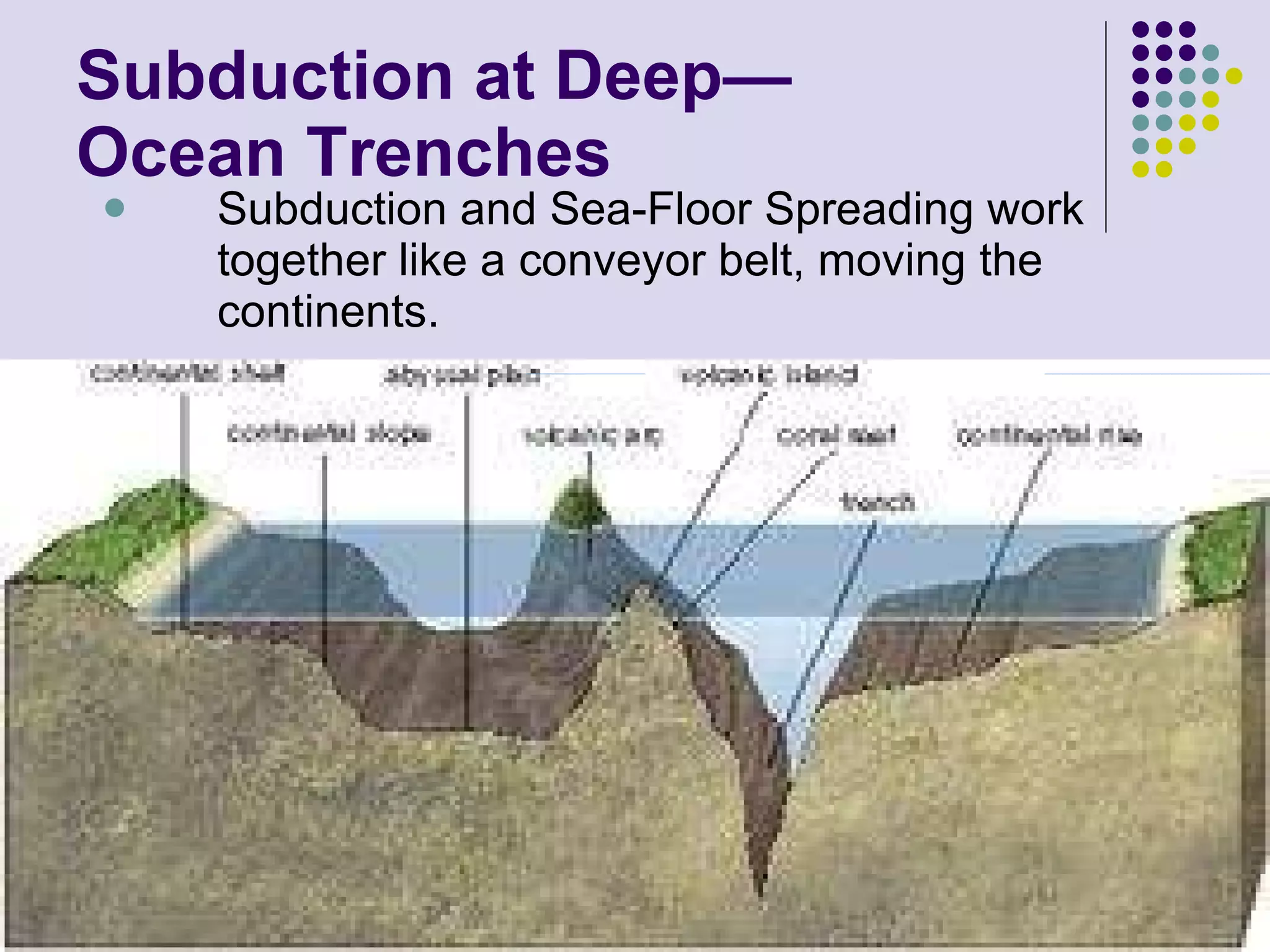
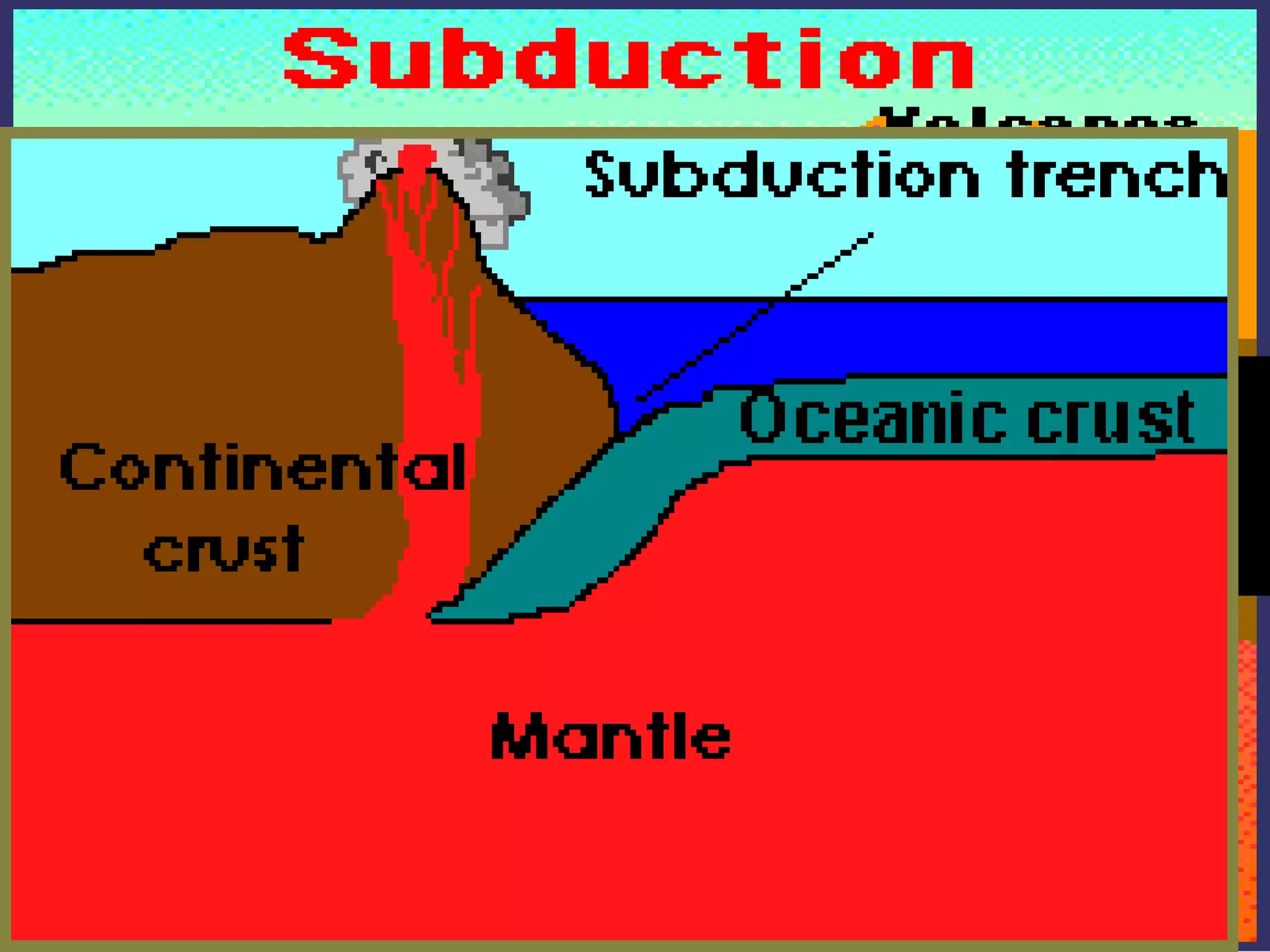
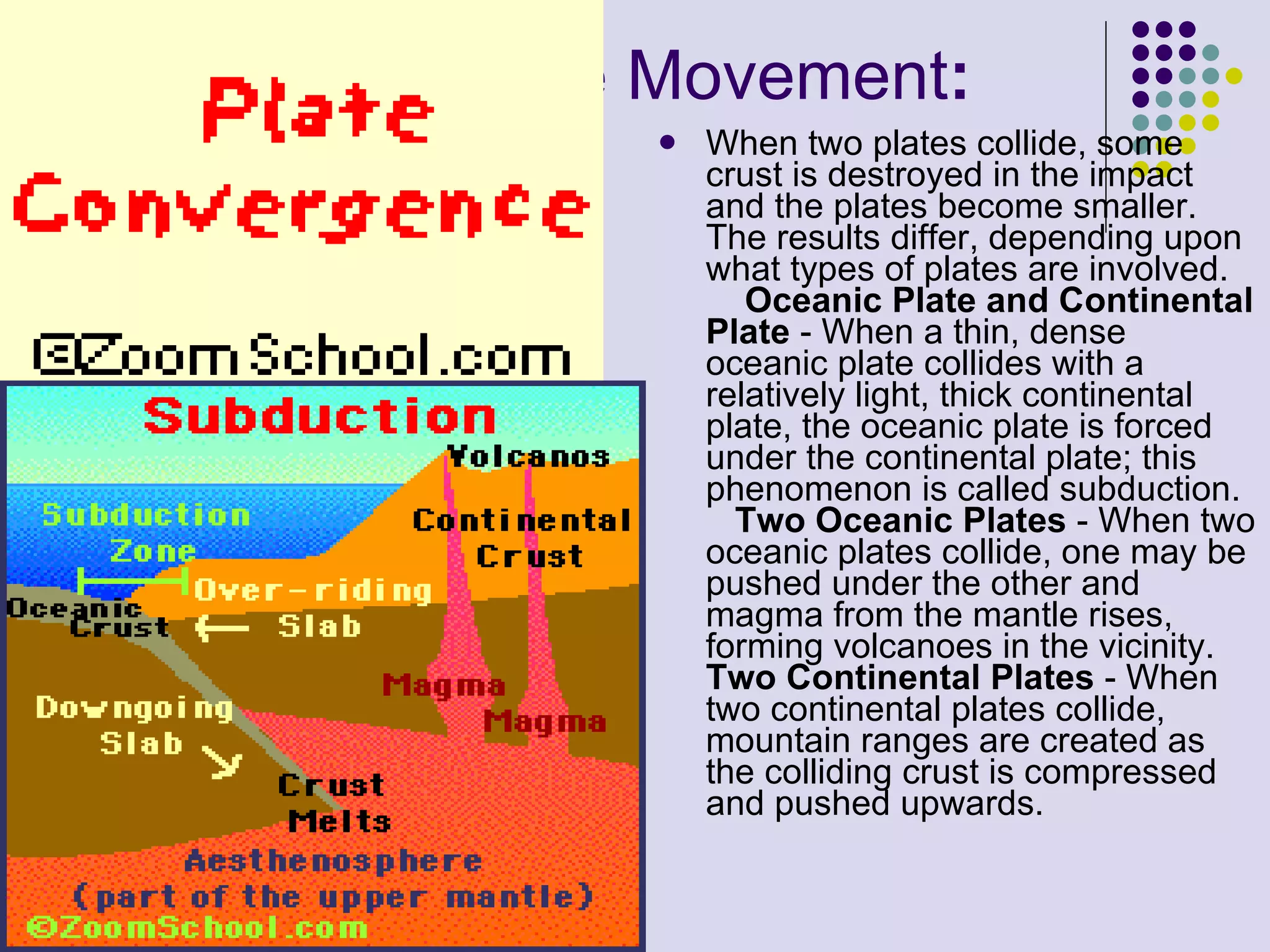
Subduction at Deep—Ocean Trenches Subduction – process whereby the ocean floor plunges into the mantle and melts at deep underwater canyons called deep-ocean trenches.
33.
Subduction at Deep—Ocean Trenches Subduction and Sea-Floor Spreading work together like a conveyor belt, moving the continents.
34.
Subduction at Deep—Ocean Trenches (cont.) Subduction and the Earth’s Oceans Subduction in the Pacific Ocean – the deep trenches surrounding the Pacific Ocean result in more subduction that sea-floor spreading. The result is that the Pacific Ocean floor is getting smaller. Subduction in the Atlantic Ocean – the Atlantic Ocean floor is becoming
35.
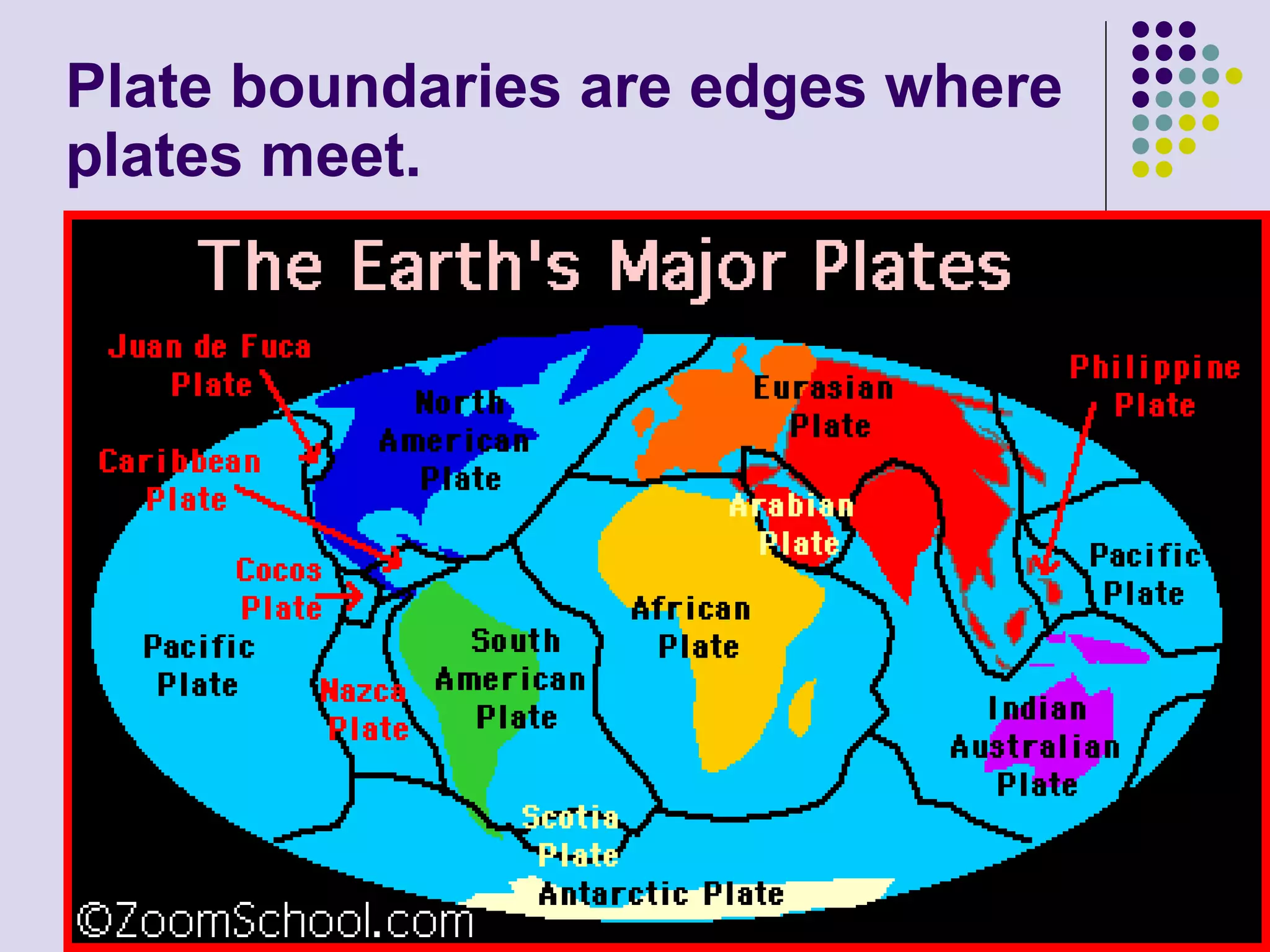
TYPES OF PLATEMOVEMENT Divergence, Convergence, and Transform At the boundaries of the plates, various deformations occur as the plates interact; they separate from one another (seafloor spreading), collide (forming mountain ranges), slip past one another (subduction zones, in which plates undergo destruction and remelting), and slip laterally.
36.
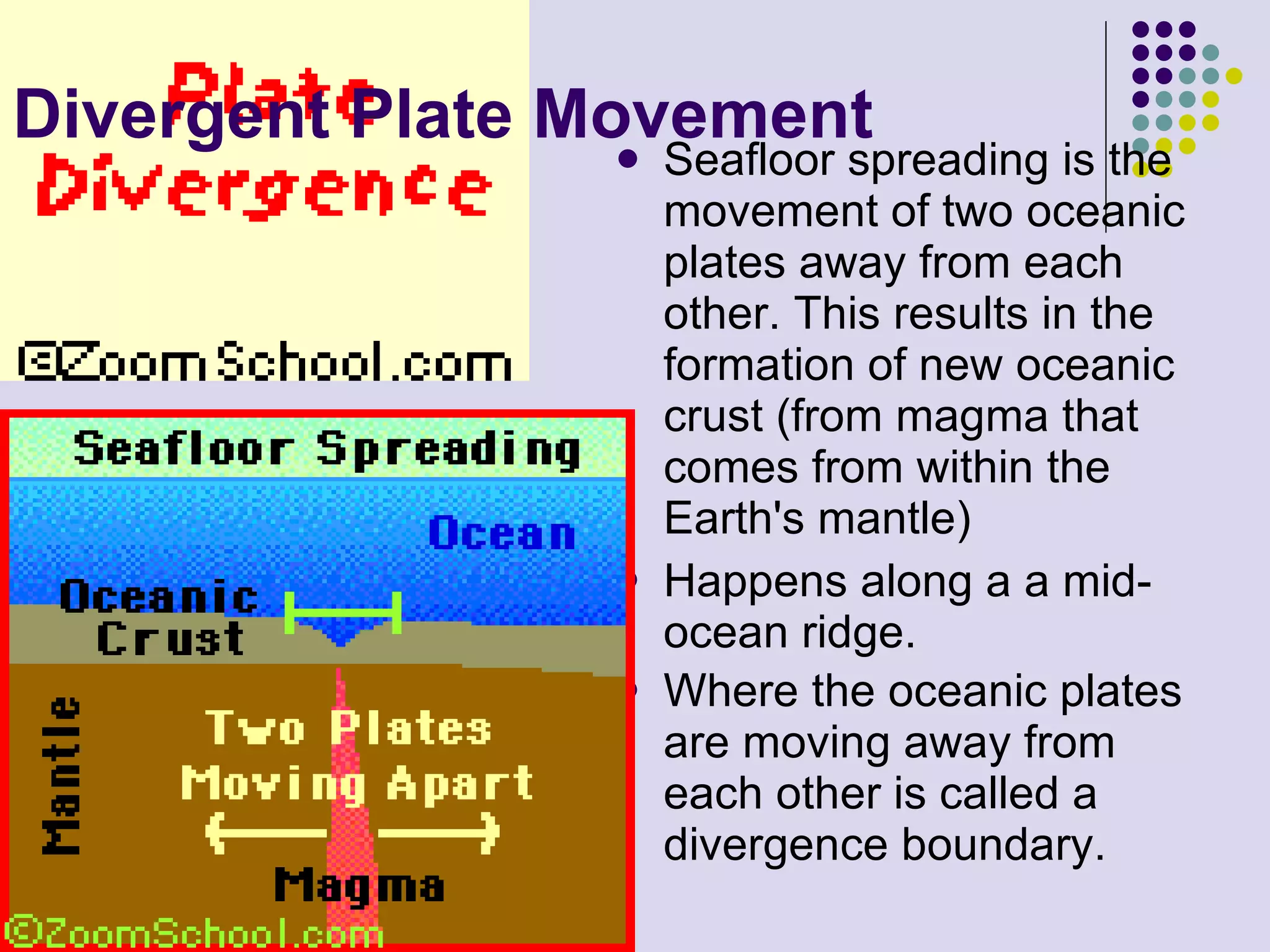
Divergent Plate MovementSeafloor spreading is the movement of two oceanic plates away from each other. This results in the formation of new oceanic crust (from magma that comes from within the Earth's mantle) Happens along a a mid-ocean ridge. Where the oceanic plates are moving away from each other is called a divergence boundary.
37.
Convergent Plate Movement: When two plates collide, some crust is destroyed in the impact and the plates become smaller. The results differ, depending upon what types of plates are involved. Oceanic Plate and Continental Plate - When a thin, dense oceanic plate collides with a relatively light, thick continental plate, the oceanic plate is forced under the continental plate; this phenomenon is called subduction. Two Oceanic Plates - When two oceanic plates collide, one may be pushed under the other and magma from the mantle rises, forming volcanoes in the vicinity. Two Continental Plates - When two continental plates collide, mountain ranges are created as the colliding crust is compressed and pushed upwards.
38.
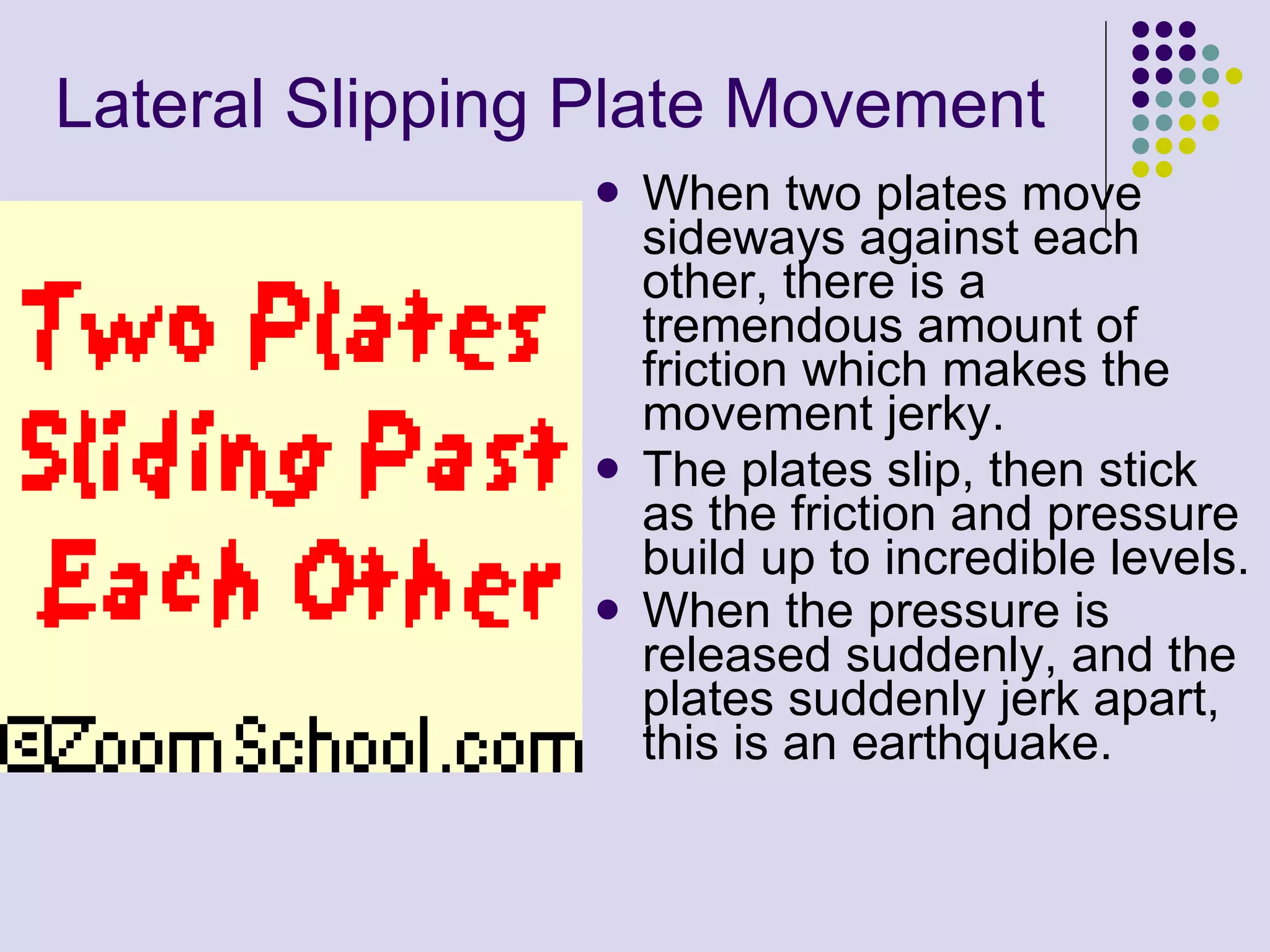
Lateral Slipping PlateMovement When two plates move sideways against each other, there is a tremendous amount of friction which makes the movement jerky. The plates slip, then stick as the friction and pressure build up to incredible levels. When the pressure is released suddenly, and the plates suddenly jerk apart, this is an earthquake.