420
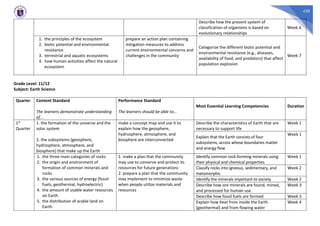
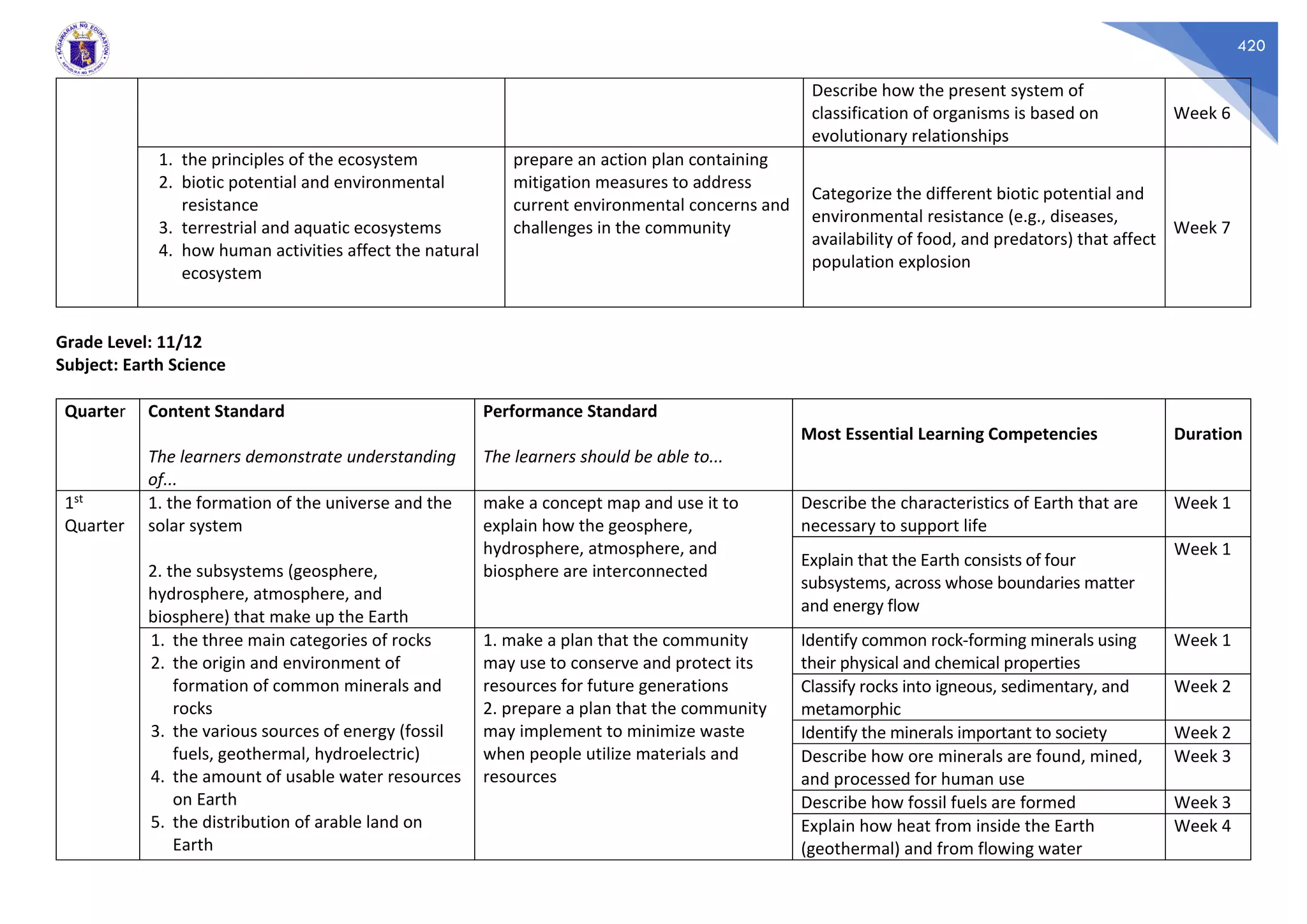
Describe how the present system of
classification of organisms is based on
evolutionary relationships
Week 6
1. the principles of the ecosystem
2. biotic potential and environmental
resistance
3. terrestrial and aquatic ecosystems
4. how human activities affect the natural
ecosystem
prepare an action plan containing
mitigation measures to address
current environmental concerns and
challenges in the community
Categorize the different biotic potential and
environmental resistance (e.g., diseases,
availability of food, and predators) that affect
population explosion
Week 7
Grade Level: 11/12
Subject: Earth Science
Quarter Content Standard
The learners demonstrate understanding
of...
Performance Standard
The learners should be able to...
Most Essential Learning Competencies Duration
1st
Quarter
1. the formation of the universe and the
solar system
2. the subsystems (geosphere,
hydrosphere, atmosphere, and
biosphere) that make up the Earth
make a concept map and use it to
explain how the geosphere,
hydrosphere, atmosphere, and
biosphere are interconnected
Describe the characteristics of Earth that are
necessary to support life
Week 1
Explain that the Earth consists of four
subsystems, across whose boundaries matter
and energy flow
Week 1
1. the three main categories of rocks
2. the origin and environment of
formation of common minerals and
rocks
3. the various sources of energy (fossil
fuels, geothermal, hydroelectric)
4. the amount of usable water resources
on Earth
5. the distribution of arable land on
Earth
1. make a plan that the community
may use to conserve and protect its
resources for future generations
2. prepare a plan that the community
may implement to minimize waste
when people utilize materials and
resources
Identify common rock-forming minerals using
their physical and chemical properties
Week 1
Classify rocks into igneous, sedimentary, and
metamorphic
Week 2
Identify the minerals important to society Week 2
Describe how ore minerals are found, mined,
and processed for human use
Week 3
Describe how fossil fuels are formed Week 3
Explain how heat from inside the Earth
(geothermal) and from flowing water
Week 4
421
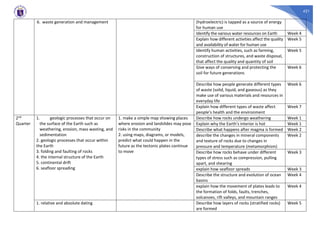
6. waste generation and management (hydroelectric) is tapped as a source of energy
for human use
Identify the various water resources on Earth Week 4
Explain how different activities affect the quality
and availability of water for human use
Week 5
Identify human activities, such as farming,
construction of structures, and waste disposal,
that affect the quality and quantity of soil
Week 5
Give ways of conserving and protecting the
soil for future generations
Week 6
Describe how people generate different types
of waste (solid, liquid, and gaseous) as they
make use of various materials and resources in
everyday life
Week 6
Explain how different types of waste affect
people’s health and the environment
Week 7
2nd
Quarter
1. geologic processes that occur on
the surface of the Earth such as
weathering, erosion, mass wasting, and
sedimentation
2. geologic processes that occur within
the Earth
3. folding and faulting of rocks
4. the internal structure of the Earth
5. continental drift
6. seafloor spreading
1. make a simple map showing places
where erosion and landslides may pose
risks in the community
2. using maps, diagrams, or models,
predict what could happen in the
future as the tectonic plates continue
to move
Describe how rocks undergo weathering Week 1
Explain why the Earth’s interior is hot Week 1
Describe what happens after magma is formed Week 2
describe the changes in mineral components
and texture of rocks due to changes in
pressure and temperature (metamorphism)
Week 2
Describe how rocks behave under different
types of stress such as compression, pulling
apart, and shearing
Week 3
explain how seafloor spreads Week 3
Describe the structure and evolution of ocean
basins
Week 4
explain how the movement of plates leads to
the formation of folds, faults, trenches,
volcanoes, rift valleys, and mountain ranges
Week 4
1. relative and absolute dating Describe how layers of rocks (stratified rocks)
are formed
Week 5
422
2. the major subdivisions of geologic time
(including index fossils)
3. how the planet Earth evolved in the
last 4.6 billion years
describe the possible events that
occurred in a certain area based on the
rock layers found therein
Describe the different methods (relative and
absolute dating) of determining the age of
stratified rocks
Week 5
Explain how relative and absolute dating were
used to determine the subdivisions of geologic
time
Week 6
Describe how index fossils (also known as
guide fossils) are used to define and identify
subdivisions of the geologic time scale
Week 6
Describe the history of the Earth through
geologic time
Week 7
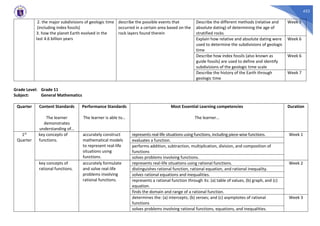
Grade Level: Grade 11
Subject: General Mathematics
Quarter Content Standards
The learner
demonstrates
understanding of…
Performance Standards
The learner is able to…
Most Essential Learning competencies
The learner…
Duration
1st
Quarter
key concepts of
functions.
accurately construct
mathematical models
to represent real-life
situations using
functions.
represents real-life situations using functions, including piece-wise functions. Week 1
evaluates a function.
performs addition, subtraction, multiplication, division, and composition of
functions
solves problems involving functions.
key concepts of
rational functions.
accurately formulate
and solve real-life
problems involving
rational functions.
represents real-life situations using rational functions. Week 2
distinguishes rational function, rational equation, and rational inequality.
solves rational equations and inequalities.
represents a rational function through its: (a) table of values, (b) graph, and (c)
equation.
finds the domain and range of a rational function.
determines the: (a) intercepts; (b) zeroes; and (c) asymptotes of rational
functions
Week 3
solves problems involving rational functions, equations, and inequalities.

MELC EARTH SCIENCE.pdf

  • 1.
    420 Describe how thepresent system of classification of organisms is based on evolutionary relationships Week 6 1. the principles of the ecosystem 2. biotic potential and environmental resistance 3. terrestrial and aquatic ecosystems 4. how human activities affect the natural ecosystem prepare an action plan containing mitigation measures to address current environmental concerns and challenges in the community Categorize the different biotic potential and environmental resistance (e.g., diseases, availability of food, and predators) that affect population explosion Week 7 Grade Level: 11/12 Subject: Earth Science Quarter Content Standard The learners demonstrate understanding of... Performance Standard The learners should be able to... Most Essential Learning Competencies Duration 1st Quarter 1. the formation of the universe and the solar system 2. the subsystems (geosphere, hydrosphere, atmosphere, and biosphere) that make up the Earth make a concept map and use it to explain how the geosphere, hydrosphere, atmosphere, and biosphere are interconnected Describe the characteristics of Earth that are necessary to support life Week 1 Explain that the Earth consists of four subsystems, across whose boundaries matter and energy flow Week 1 1. the three main categories of rocks 2. the origin and environment of formation of common minerals and rocks 3. the various sources of energy (fossil fuels, geothermal, hydroelectric) 4. the amount of usable water resources on Earth 5. the distribution of arable land on Earth 1. make a plan that the community may use to conserve and protect its resources for future generations 2. prepare a plan that the community may implement to minimize waste when people utilize materials and resources Identify common rock-forming minerals using their physical and chemical properties Week 1 Classify rocks into igneous, sedimentary, and metamorphic Week 2 Identify the minerals important to society Week 2 Describe how ore minerals are found, mined, and processed for human use Week 3 Describe how fossil fuels are formed Week 3 Explain how heat from inside the Earth (geothermal) and from flowing water Week 4
  • 2.
    421 6. waste generationand management (hydroelectric) is tapped as a source of energy for human use Identify the various water resources on Earth Week 4 Explain how different activities affect the quality and availability of water for human use Week 5 Identify human activities, such as farming, construction of structures, and waste disposal, that affect the quality and quantity of soil Week 5 Give ways of conserving and protecting the soil for future generations Week 6 Describe how people generate different types of waste (solid, liquid, and gaseous) as they make use of various materials and resources in everyday life Week 6 Explain how different types of waste affect people’s health and the environment Week 7 2nd Quarter 1. geologic processes that occur on the surface of the Earth such as weathering, erosion, mass wasting, and sedimentation 2. geologic processes that occur within the Earth 3. folding and faulting of rocks 4. the internal structure of the Earth 5. continental drift 6. seafloor spreading 1. make a simple map showing places where erosion and landslides may pose risks in the community 2. using maps, diagrams, or models, predict what could happen in the future as the tectonic plates continue to move Describe how rocks undergo weathering Week 1 Explain why the Earth’s interior is hot Week 1 Describe what happens after magma is formed Week 2 describe the changes in mineral components and texture of rocks due to changes in pressure and temperature (metamorphism) Week 2 Describe how rocks behave under different types of stress such as compression, pulling apart, and shearing Week 3 explain how seafloor spreads Week 3 Describe the structure and evolution of ocean basins Week 4 explain how the movement of plates leads to the formation of folds, faults, trenches, volcanoes, rift valleys, and mountain ranges Week 4 1. relative and absolute dating Describe how layers of rocks (stratified rocks) are formed Week 5
  • 3.
    422 2. the majorsubdivisions of geologic time (including index fossils) 3. how the planet Earth evolved in the last 4.6 billion years describe the possible events that occurred in a certain area based on the rock layers found therein Describe the different methods (relative and absolute dating) of determining the age of stratified rocks Week 5 Explain how relative and absolute dating were used to determine the subdivisions of geologic time Week 6 Describe how index fossils (also known as guide fossils) are used to define and identify subdivisions of the geologic time scale Week 6 Describe the history of the Earth through geologic time Week 7 Grade Level: Grade 11 Subject: General Mathematics Quarter Content Standards The learner demonstrates understanding of… Performance Standards The learner is able to… Most Essential Learning competencies The learner… Duration 1st Quarter key concepts of functions. accurately construct mathematical models to represent real-life situations using functions. represents real-life situations using functions, including piece-wise functions. Week 1 evaluates a function. performs addition, subtraction, multiplication, division, and composition of functions solves problems involving functions. key concepts of rational functions. accurately formulate and solve real-life problems involving rational functions. represents real-life situations using rational functions. Week 2 distinguishes rational function, rational equation, and rational inequality. solves rational equations and inequalities. represents a rational function through its: (a) table of values, (b) graph, and (c) equation. finds the domain and range of a rational function. determines the: (a) intercepts; (b) zeroes; and (c) asymptotes of rational functions Week 3 solves problems involving rational functions, equations, and inequalities.