INTRODUCTION TO LIFE
SCIENCE
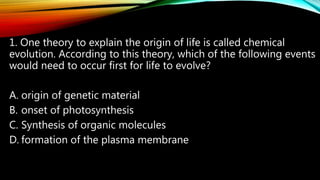
1. One theory to explain the origin of life is called chemical
evolution. According to this theory, which of the following events
would need to occur first for life to evolve?
A. origin of genetic material
B. onset of photosynthesis
C. Synthesis of organic molecules
D. formation of the plasma membrane
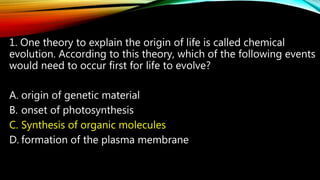
1. One theory to explain the origin of life is called chemical
evolution. According to this theory, which of the following events
would need to occur first for life to evolve?
A. origin of genetic material
B. onset of photosynthesis
C. Synthesis of organic molecules
D. formation of the plasma membrane
2. Which of the following describes why the Miller-Urey theory
is widely accepted today?
A. The process of synthesizing organic molecules from a mixture
of gases has been successfully modeled in the laboratory.
B. Organic molecules are present today in extremely high
concentrations.
C. No other alternative hypotheses have been introduced.
D. Amino acids spontaneously form from molecules in the
atmosphere today.
2. Which of the following describes why the Miller-Urey theory
is widely accepted today?
A. The process of synthesizing organic molecules from a mixture
of gases has been successfully modeled in the laboratory.
B. Organic molecules are present today in extremely high
concentrations.
C. No other alternative hypotheses have been introduced.
D. Amino acids spontaneously form from molecules in the
atmosphere today.
3. Who among the following first discarded the theory of
spontaneous creation and gave that life originates from
pre-existing life ?
A. Stanley Miller
B. Louis Pasteur
C. Lamarck
D. Charles Darwin
3. Who among the following first discarded the theory of
spontaneous creation and gave that life originates from
pre-existing life ?
A. Stanley Miller
B. Louis Pasteur
C. Lamarck
D. Charles Darwin
4. Panspermia is the name given to the theory that life come
from where?
A. the ocean
B. undersea thermal vents
C. an extraterrestrial source
D. a primordial soup
4. Panspermia is the name given to the theory that life come
from where?
A. the ocean
B. undersea thermal vents
C. an extraterrestrial source
D. a primordial soup
5. Which theory of the origin of life proposed that all different
forms of life are created by God?
A. Theory of Panspermia
B. Theory of Special Creation
C. Theory of Biochemical Evolution
D. Theory of spontaneous generation
5. Which theory of the origin of life proposed that all different
forms of life are created by God?
A. Theory of Panspermia
B. Theory of Special Creation
C. Theory of Biochemical Evolution
D. Theory of spontaneous generation
Have you ever wondered how the first life on earth came
into existence?
Theories of the Origin of Life
Objectives:
1. Identify the different theories of Origin of Life.
2. Explain the evolving concept of life based on emerging
pieces of evidence.
3. Appreciate the contribution of the proponents towards
their ideas about the origin of life and the importance of
life.
THEORY OF SPECIAL CREATIONS
• The theory of special creation is proposed that life
on earth is created by a supernatural power, the GOD.
A. All living organisms were created same day
[NO DIFFERENCE IN THEIR APPEARANCE]
B. They were created in the present form
[NO EVOLUTION]
C. Their bodies and organs are fully developed to meet the
requirement to run the life
[NO ADAPTATION]
Comparison to other theories.:
•It was purely based on religious belief.
•There was no experimental evidences to support the
assumptions.
•The age of different fossils proves that living organism
appear on earth in different time frame.
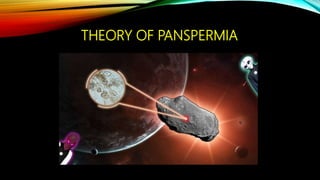
THEORY OF PANSPERMIA
•Life had come to earth from other planets of the universe,
in the form of resistant spores.
•British astronomers Fred Hoyle and Chandra
Wickramasinghe proposed:
•interstellar dust and comets contain organic
compounds.
•comets, which are largely made of water-ice,
carry bacterial life across galaxies and protect
it from radiation damage along the way.
THEORY OF SPONTANEOUS
GENERATIONS
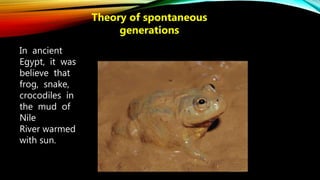
In ancient
Egypt, it was
believe that
frog, snake,
crocodiles in
the mud of
Nile
River warmed
with sun.
Theory of spontaneous
generations
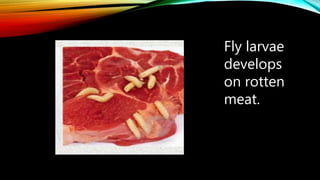
Fly larvae
develops
on rotten
meat.
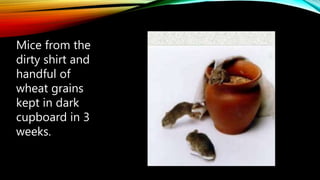
Mice from the
dirty shirt and
handful of
wheat grains
kept in dark
cupboard in 3
weeks.
The theory of spontaneous generation or
abiogenesis assumes that non-living material in
a spontaneous manner give rise to life.
Is spontaneous generation similar to abiogenesis?
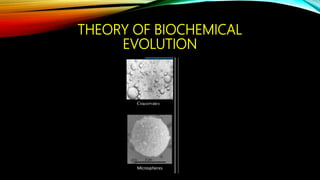
THEORY OF BIOCHEMICAL
EVOLUTION
Alexander Oparin (in 1924), and John Haldane (in 1929)
Oparin-Haldane Hypothesis
independently suggested that if the primitive atmosphere was
reducing (as opposed to oxygen-rich), and if there was an
appropriate supply of energy, such as lightning or ultraviolet
light, then a wide range of organic compounds might be
synthesised.
Stanley L. Miller and Harold C. Urey
Miller-Urey experiment
was an experiment that simulated hypothetical conditions
present on the early Earth in order to test what kind of
environment would be needed to allow life to begin.
Guide Questions:
1. What was he idea of spontaneous generation?
2. How Charles Darwin explain the existence of rats, maggots, and
microbes?
Choose one theory that you think the most
acceptable for you. Explain why.

Introduction to life science

  • 1.
  • 2.
    1. One theoryto explain the origin of life is called chemical evolution. According to this theory, which of the following events would need to occur first for life to evolve? A. origin of genetic material B. onset of photosynthesis C. Synthesis of organic molecules D. formation of the plasma membrane
  • 3.
    1. One theoryto explain the origin of life is called chemical evolution. According to this theory, which of the following events would need to occur first for life to evolve? A. origin of genetic material B. onset of photosynthesis C. Synthesis of organic molecules D. formation of the plasma membrane
  • 4.
    2. Which ofthe following describes why the Miller-Urey theory is widely accepted today? A. The process of synthesizing organic molecules from a mixture of gases has been successfully modeled in the laboratory. B. Organic molecules are present today in extremely high concentrations. C. No other alternative hypotheses have been introduced. D. Amino acids spontaneously form from molecules in the atmosphere today.
  • 5.
    2. Which ofthe following describes why the Miller-Urey theory is widely accepted today? A. The process of synthesizing organic molecules from a mixture of gases has been successfully modeled in the laboratory. B. Organic molecules are present today in extremely high concentrations. C. No other alternative hypotheses have been introduced. D. Amino acids spontaneously form from molecules in the atmosphere today.
  • 6.
    3. Who amongthe following first discarded the theory of spontaneous creation and gave that life originates from pre-existing life ? A. Stanley Miller B. Louis Pasteur C. Lamarck D. Charles Darwin
  • 7.
    3. Who amongthe following first discarded the theory of spontaneous creation and gave that life originates from pre-existing life ? A. Stanley Miller B. Louis Pasteur C. Lamarck D. Charles Darwin
  • 8.
    4. Panspermia isthe name given to the theory that life come from where? A. the ocean B. undersea thermal vents C. an extraterrestrial source D. a primordial soup
  • 9.
    4. Panspermia isthe name given to the theory that life come from where? A. the ocean B. undersea thermal vents C. an extraterrestrial source D. a primordial soup
  • 10.
    5. Which theoryof the origin of life proposed that all different forms of life are created by God? A. Theory of Panspermia B. Theory of Special Creation C. Theory of Biochemical Evolution D. Theory of spontaneous generation
  • 11.
    5. Which theoryof the origin of life proposed that all different forms of life are created by God? A. Theory of Panspermia B. Theory of Special Creation C. Theory of Biochemical Evolution D. Theory of spontaneous generation
  • 13.
    Have you everwondered how the first life on earth came into existence?
  • 14.
    Theories of theOrigin of Life
  • 15.
    Objectives: 1. Identify thedifferent theories of Origin of Life. 2. Explain the evolving concept of life based on emerging pieces of evidence. 3. Appreciate the contribution of the proponents towards their ideas about the origin of life and the importance of life.
  • 16.
  • 17.
    • The theoryof special creation is proposed that life on earth is created by a supernatural power, the GOD.
  • 18.
    A. All livingorganisms were created same day [NO DIFFERENCE IN THEIR APPEARANCE] B. They were created in the present form [NO EVOLUTION] C. Their bodies and organs are fully developed to meet the requirement to run the life [NO ADAPTATION]
  • 19.
    Comparison to othertheories.: •It was purely based on religious belief. •There was no experimental evidences to support the assumptions. •The age of different fossils proves that living organism appear on earth in different time frame.
  • 20.
  • 21.
    •Life had cometo earth from other planets of the universe, in the form of resistant spores. •British astronomers Fred Hoyle and Chandra Wickramasinghe proposed: •interstellar dust and comets contain organic compounds. •comets, which are largely made of water-ice, carry bacterial life across galaxies and protect it from radiation damage along the way.
  • 22.
  • 23.
    In ancient Egypt, itwas believe that frog, snake, crocodiles in the mud of Nile River warmed with sun. Theory of spontaneous generations
  • 24.
  • 25.
    Mice from the dirtyshirt and handful of wheat grains kept in dark cupboard in 3 weeks.
  • 26.
    The theory ofspontaneous generation or abiogenesis assumes that non-living material in a spontaneous manner give rise to life.
  • 27.
    Is spontaneous generationsimilar to abiogenesis?
  • 28.
  • 29.
    Alexander Oparin (in1924), and John Haldane (in 1929) Oparin-Haldane Hypothesis independently suggested that if the primitive atmosphere was reducing (as opposed to oxygen-rich), and if there was an appropriate supply of energy, such as lightning or ultraviolet light, then a wide range of organic compounds might be synthesised.
  • 30.
    Stanley L. Millerand Harold C. Urey Miller-Urey experiment was an experiment that simulated hypothetical conditions present on the early Earth in order to test what kind of environment would be needed to allow life to begin.
  • 31.
    Guide Questions: 1. Whatwas he idea of spontaneous generation? 2. How Charles Darwin explain the existence of rats, maggots, and microbes?
  • 32.
    Choose one theorythat you think the most acceptable for you. Explain why.

Editor's Notes

  • #19 There are believes in the theory of special creation. These points are as follows:
  • #21 • The 2005 Deep Impact mission to Comet Tempel 1 discovered a mixture of organic and clay particles inside the comet. Credit: Hoover/Journal of Cosmology Dr. Richard B. Hoover, an astrobiologist with NASA’s Marshall Space Flight Center published a paper on March 4, 2011, claiming to have found fossil evidence for cyanobacteria in an extremely rare class of meteorites, called CI1 carbonaceous chondrites . Cyanobacteria- phylum of bacteria that obtain their energy through photosynthesis, and are the only prokaryotes able to produce oxygen
  • #22 Resistant spores that are very resistant to harsh conditions
  • #28 Spontaneous generation and abiogenesis are a pair of theories involving the emergence of life from non-living material. The difference is that spontaneous generation is an obsolete theory of how certain forms of life commonly emerge from non-living matter, whereas abiogenesis is the ongoing study of how the first life on Earth emerged through a chain of increasingly complex organic chemical reactions, but did so only once (or a few times) before giving rise to hundreds of millions of years of subsequent, increasingly complicated life forms.
  • #29 In the warm primordial ocean, aggregates of amino acids, proteins, and other hydrocarbons came together into a form called *coacervates*. Amino acids will spontaneously form coacervates in the same way that beads of vinegar in oil come together. The Miller-Ureyexperiment showed that amino acids form under conditions similar to the Earth's primordial environment.