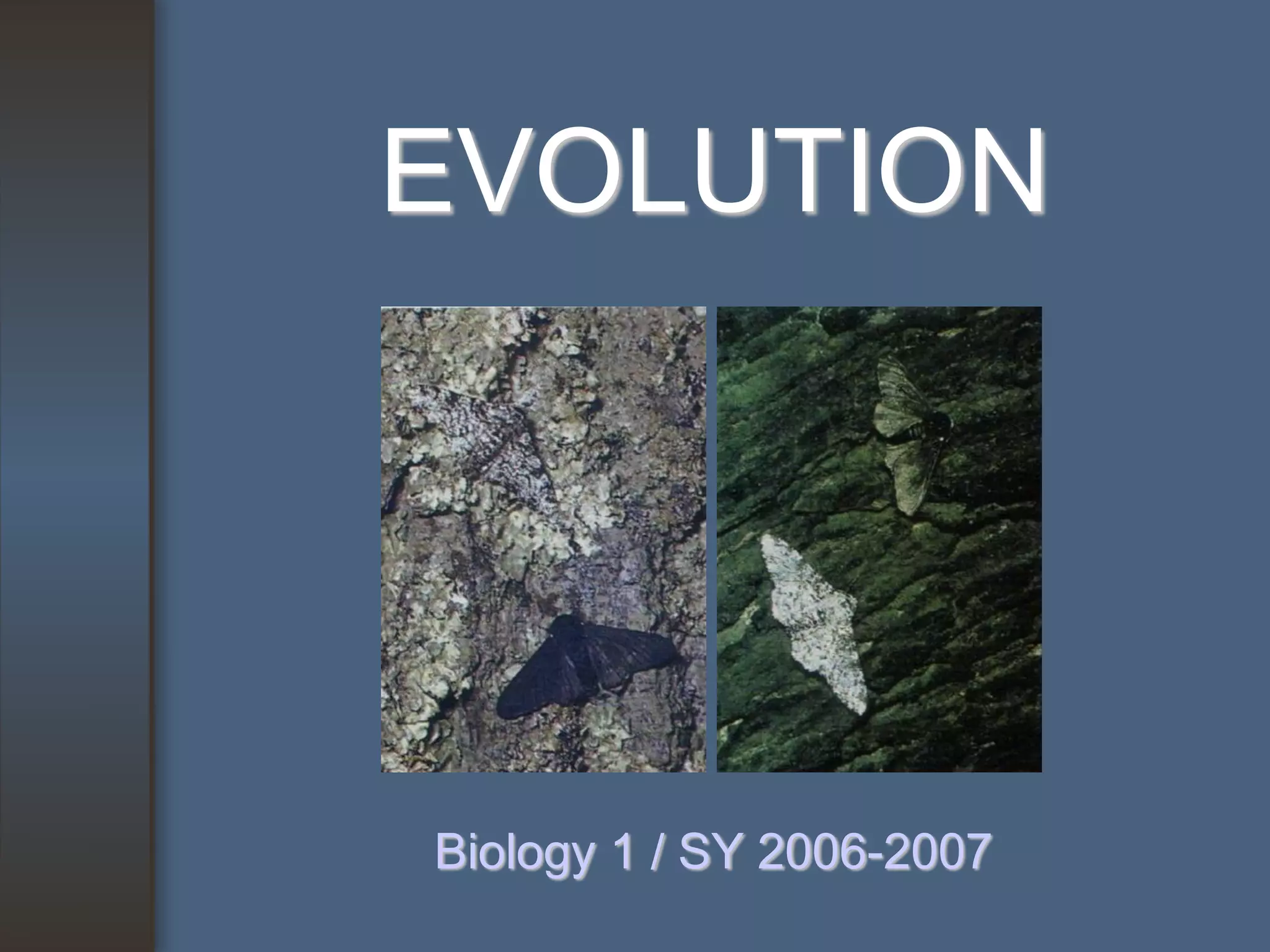
1) Evolution is defined as gradual change over time. Charles Darwin proposed the theory of evolution by natural selection, where heritable traits that increase an organism's chances of survival are passed on to offspring.
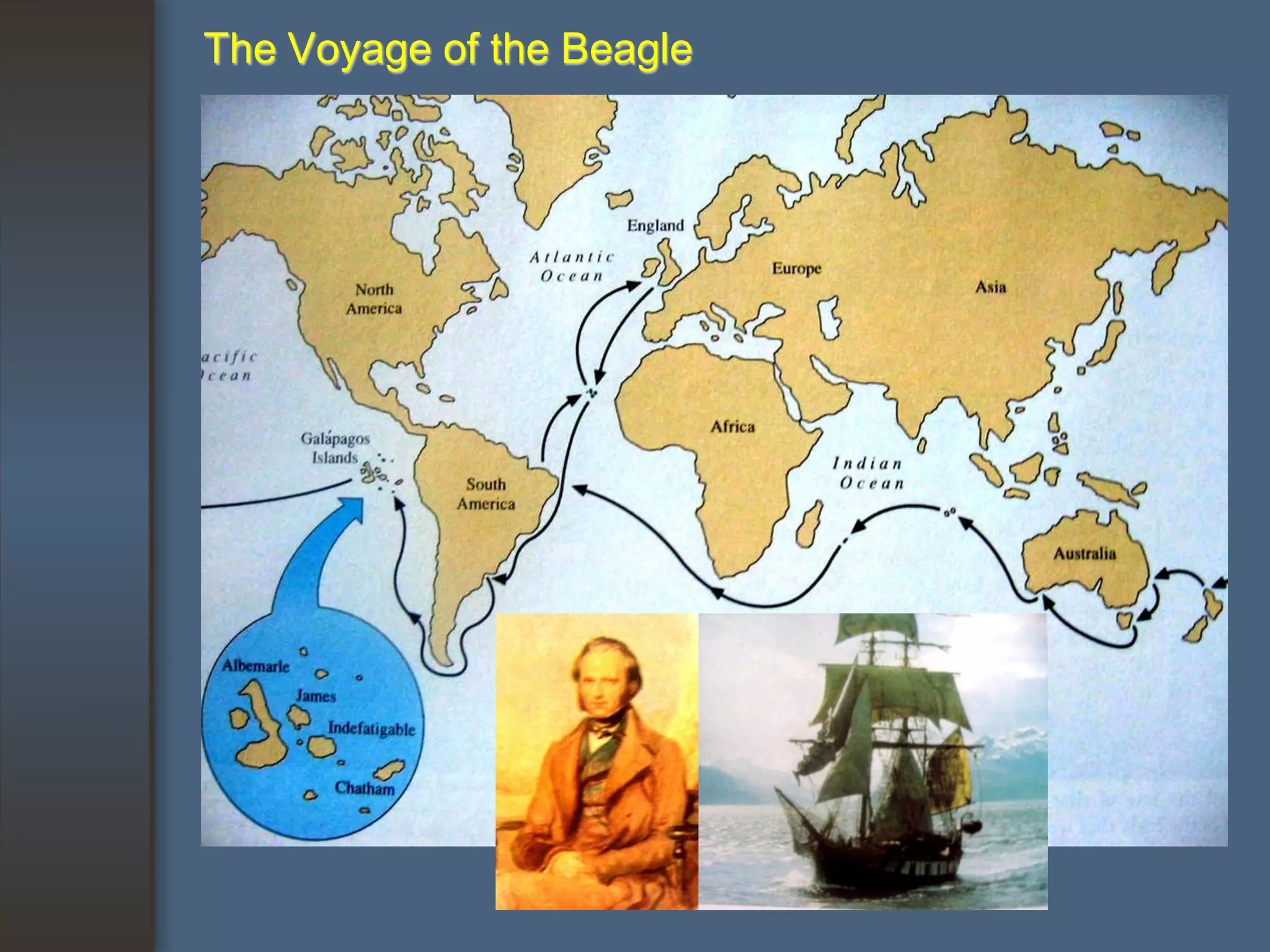
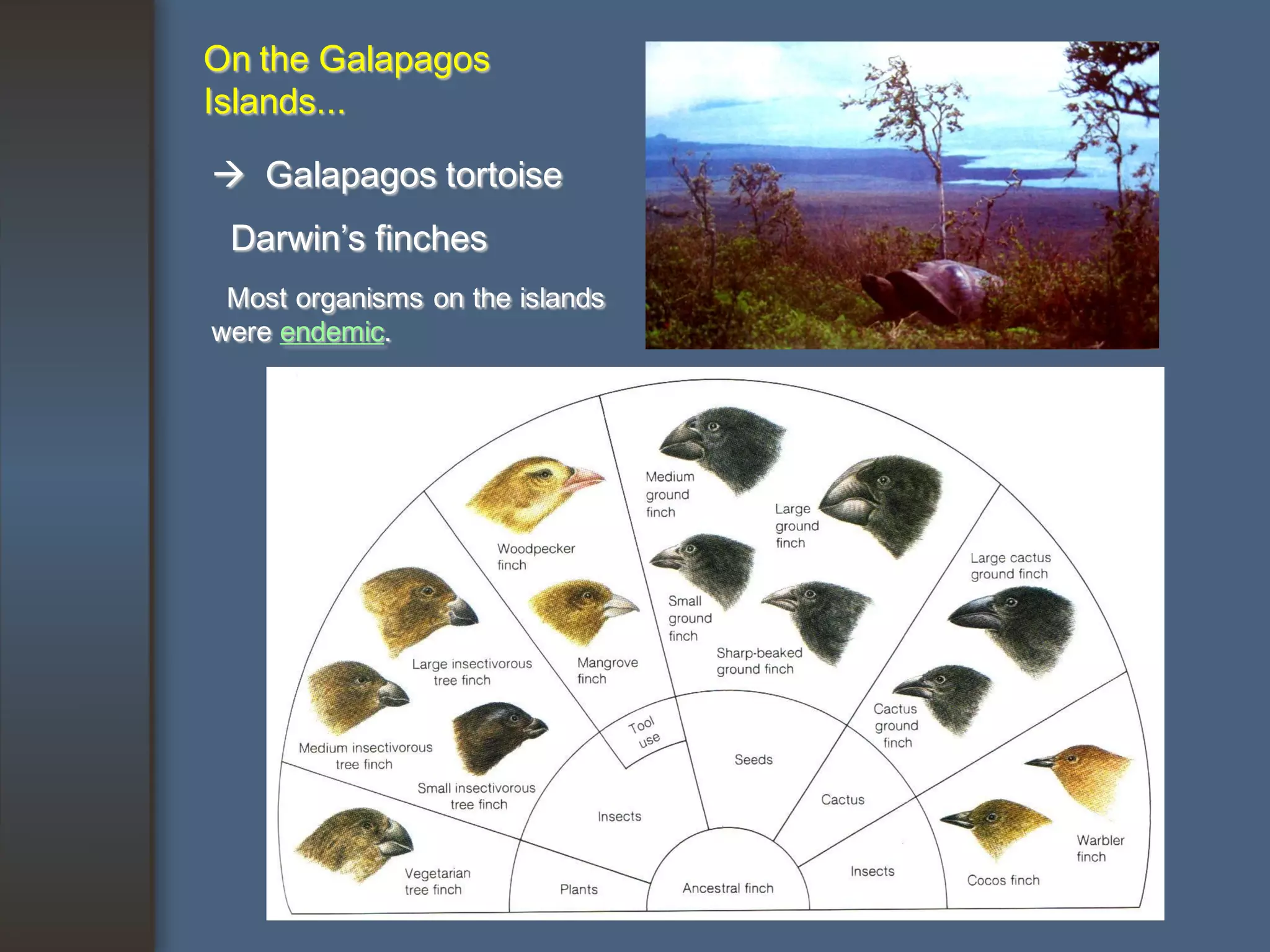
2) Darwin observed variations among species on the Galapagos Islands that supported his theory of evolution from common ancestry.
3) Darwin's theory combined Mendel's principles of heredity with Malthus' population principles to explain evolution through natural selection acting upon inherited variation.
Introduction to evolution; defines gradual change over time; types include geologic and biological; Charles Darwin as a foundational figure.
Overview of pre-Darwinian theories, emphasizing the ideas of Greek philosophers, Linnaeus, Malthus, and Lamarck regarding species origin and adaptation.
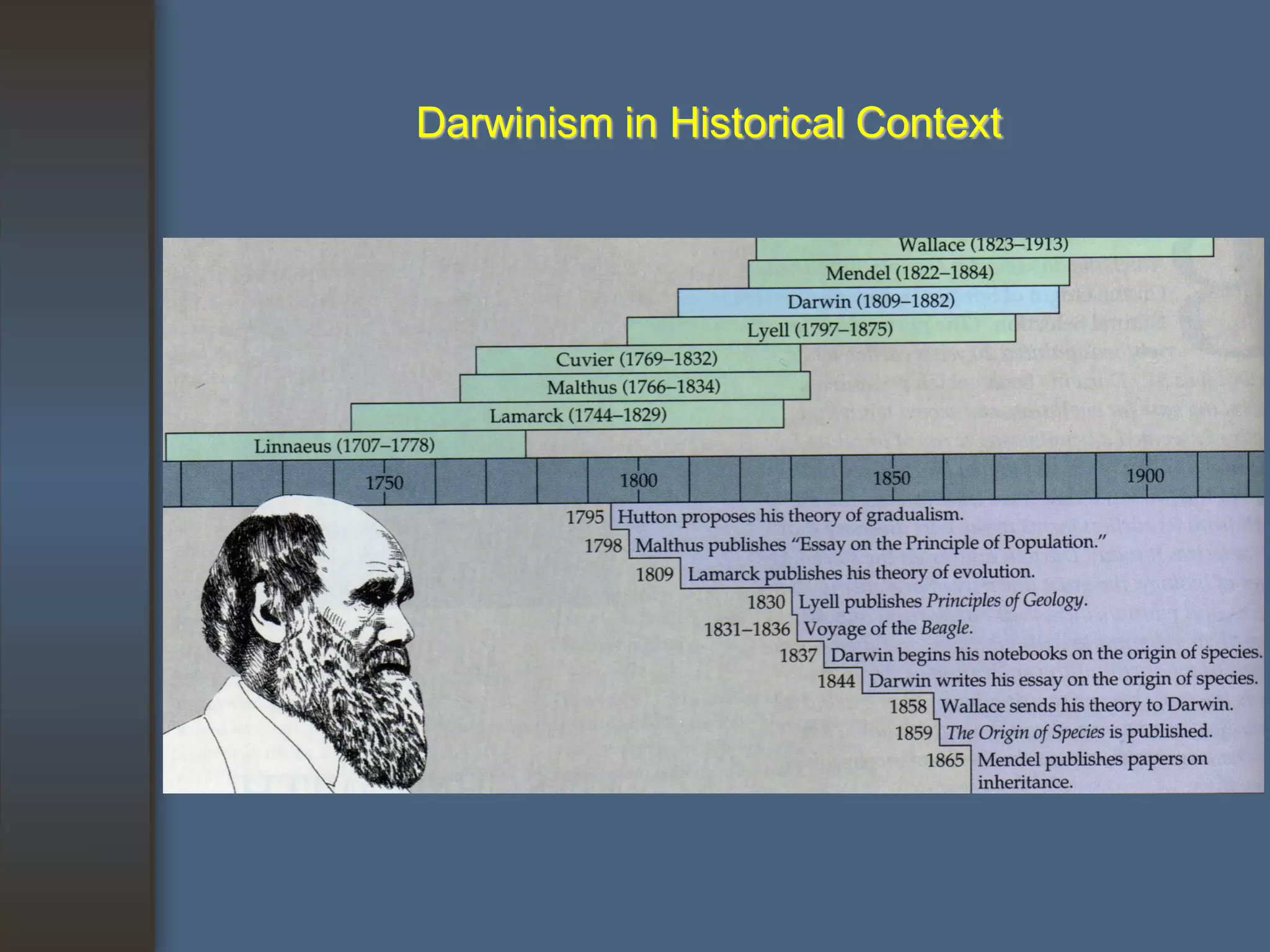
Contributions from Cuvier (catastrophism), Hutton (gradualism), Lyell (uniformitarianism), emphasizing geological changes and the ancient age of Earth.
Mendel's principles of heredity; Darwin’s voyage and theory of natural selection; Wallace's similar contributions highlighting evolutionary change.
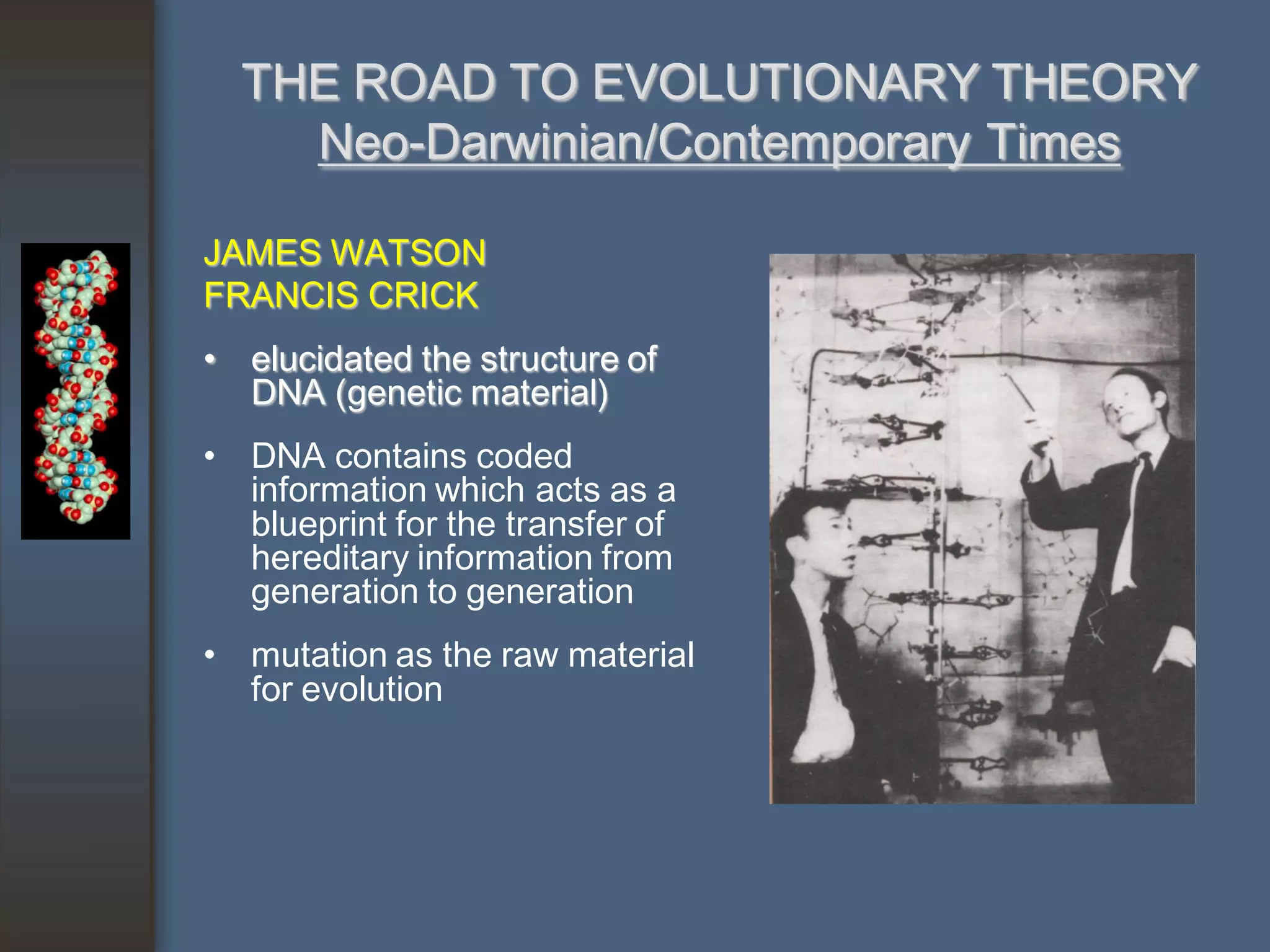
Neo-Darwinian advancements rediscovering Mendelian genetics; Watson and Crick's DNA structure elucidation linking genetics to evolutionary processes.
Evolution
Definition
- gradual change over time
- L. e-, out + volvere, to roll
Types
GEOLOGIC EVOLUTION
BIOLOGICAL or ORGANIC EVOLUTION
The foundation of modern evolutionary thought was
described by Charles Darwin
3.
THE ROAD TOEVOLUTIONARY THEORY
Evolution Before Darwin
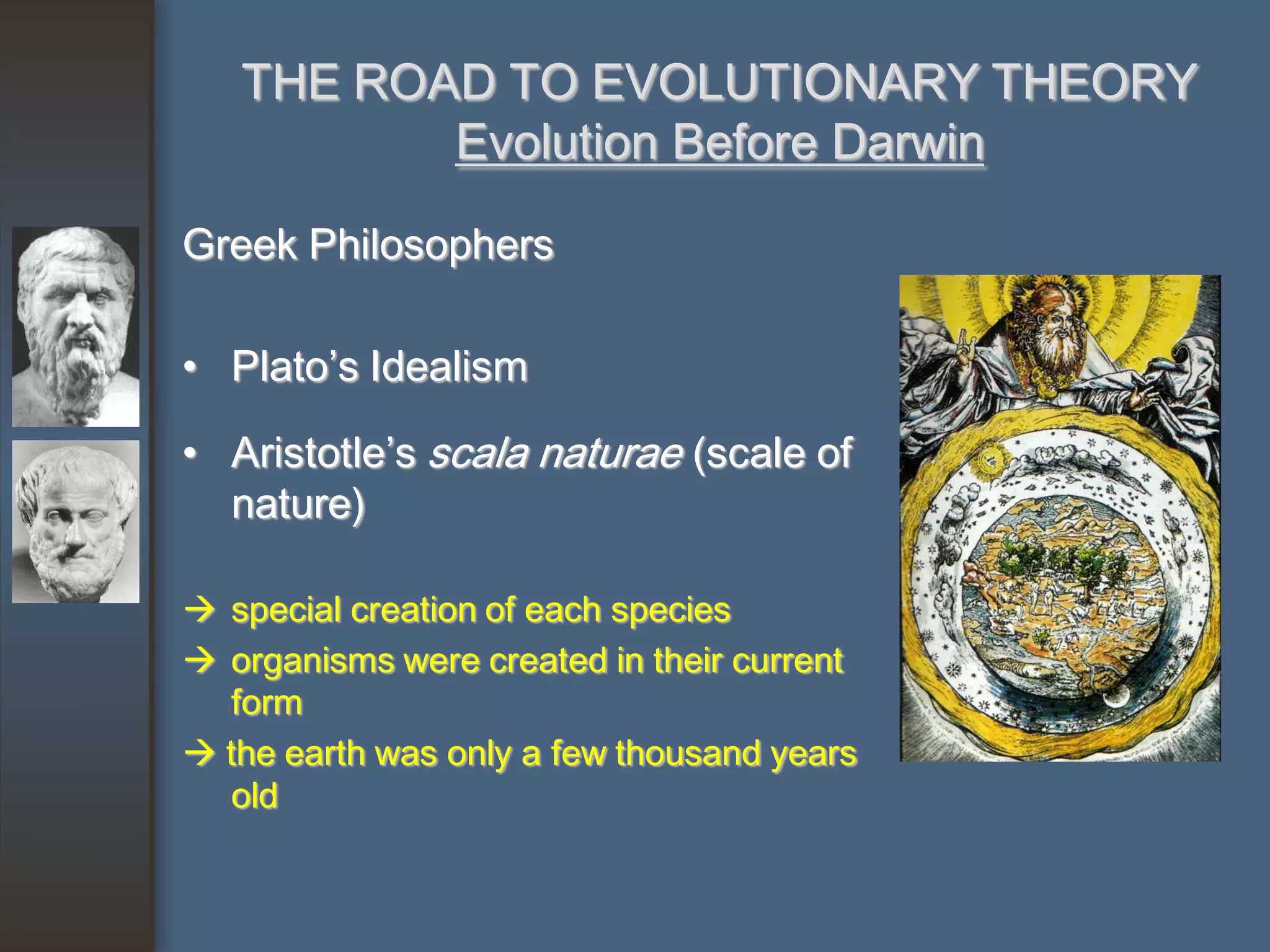
Greek Philosophers
• Plato’s Idealism
• Aristotle’s scala naturae (scale of
nature)
special creation of each species
organisms were created in their current
form
the earth was only a few thousand years
old
4.
THE ROAD TOEVOLUTIONARY THEORY
Evolution Before Darwin
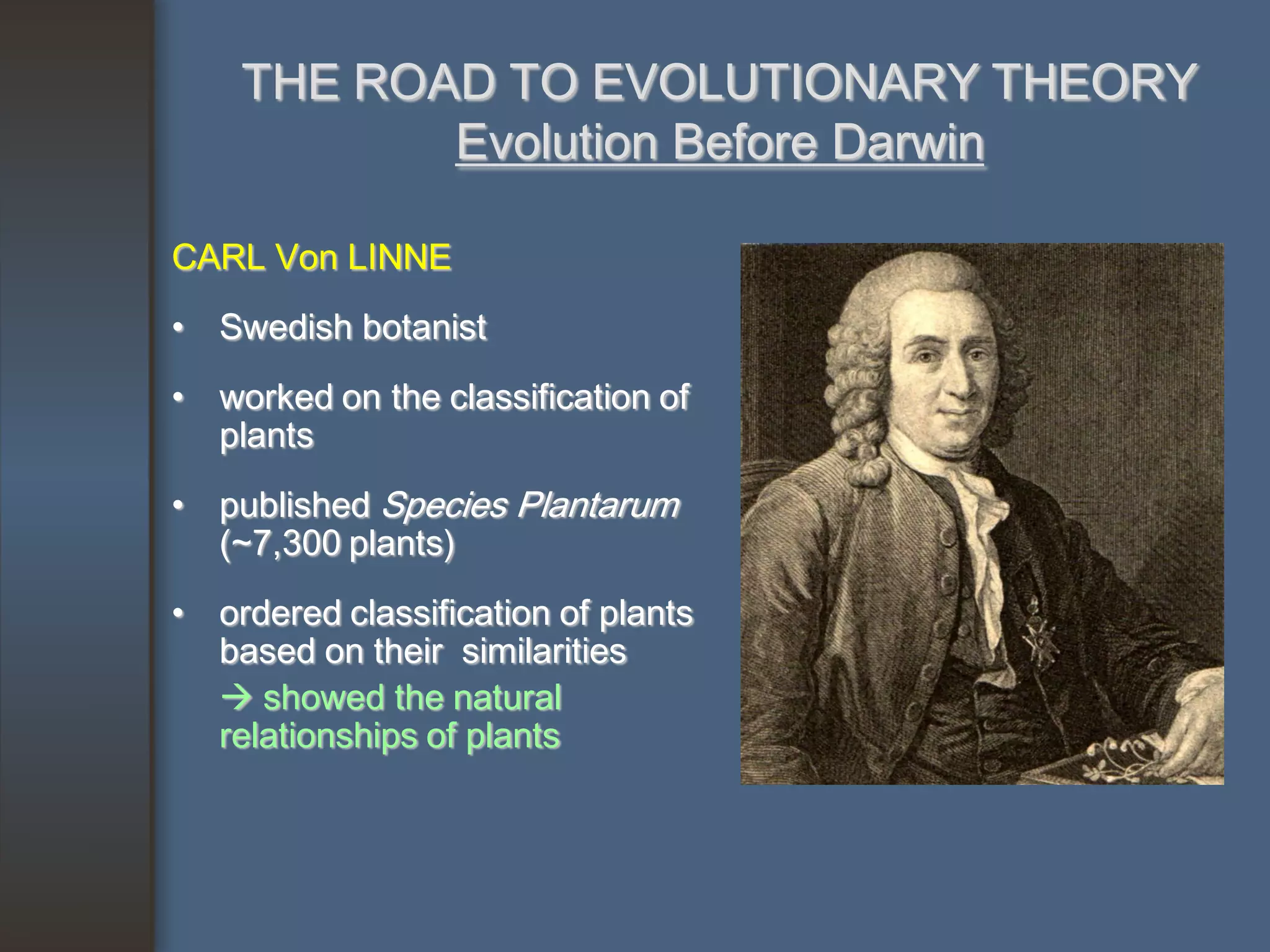
CARL Von LINNE
• Swedish botanist
• worked on the classification of
plants
• published Species Plantarum
(~7,300 plants)
• ordered classification of plants
based on their similarities
showed the natural
relationships of plants
5.
THE ROAD TOEVOLUTIONARY THEORY
Evolution Before Darwin
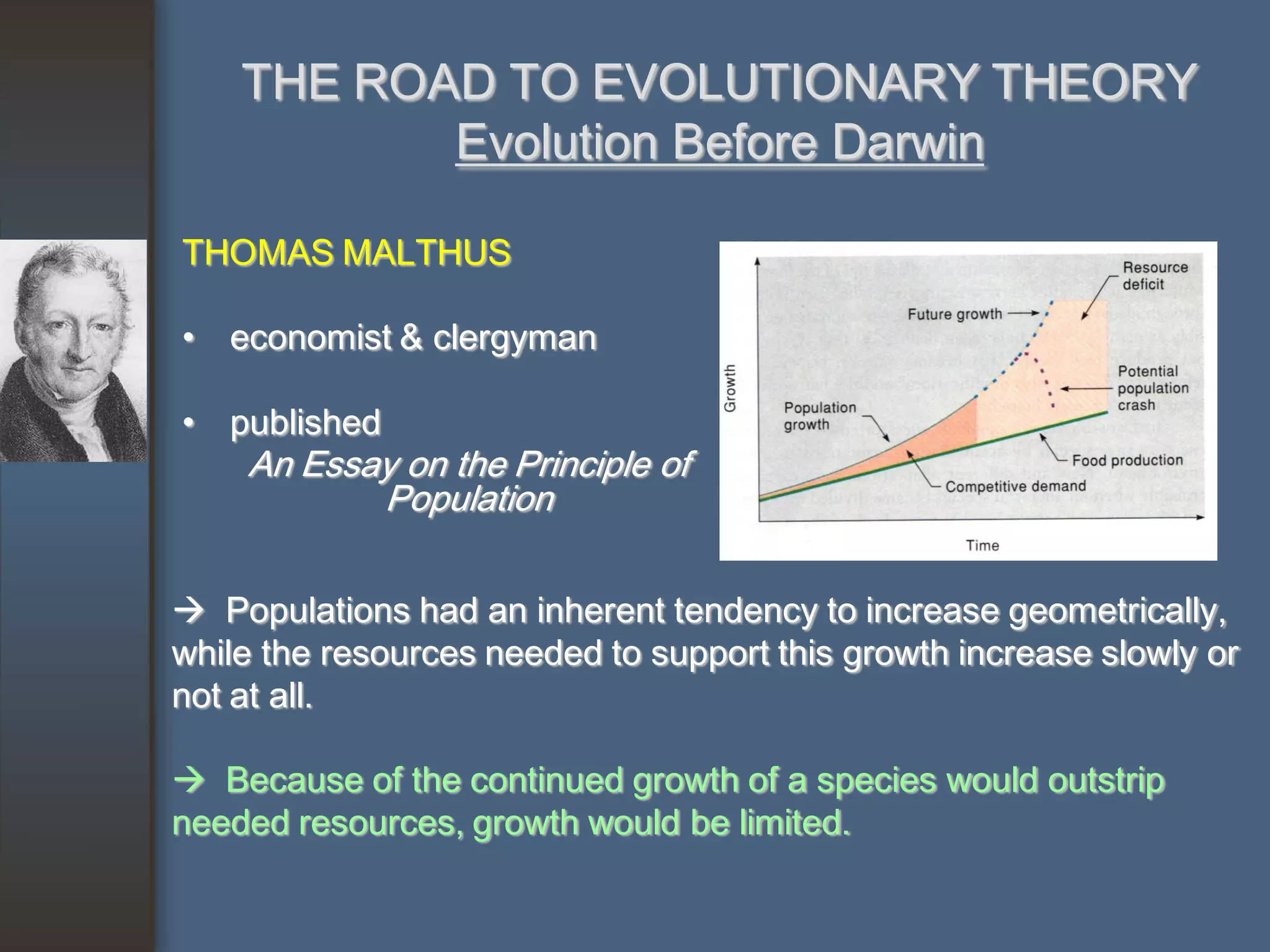
THOMAS MALTHUS
• economist & clergyman
• published
An Essay on the Principle of
Population
Populations had an inherent tendency to increase geometrically,
while the resources needed to support this growth increase slowly or
not at all.
Because of the continued growth of a species would outstrip
needed resources, growth would be limited.
6.
THE ROAD TOEVOLUTIONARY THEORY
Evolution Before Darwin
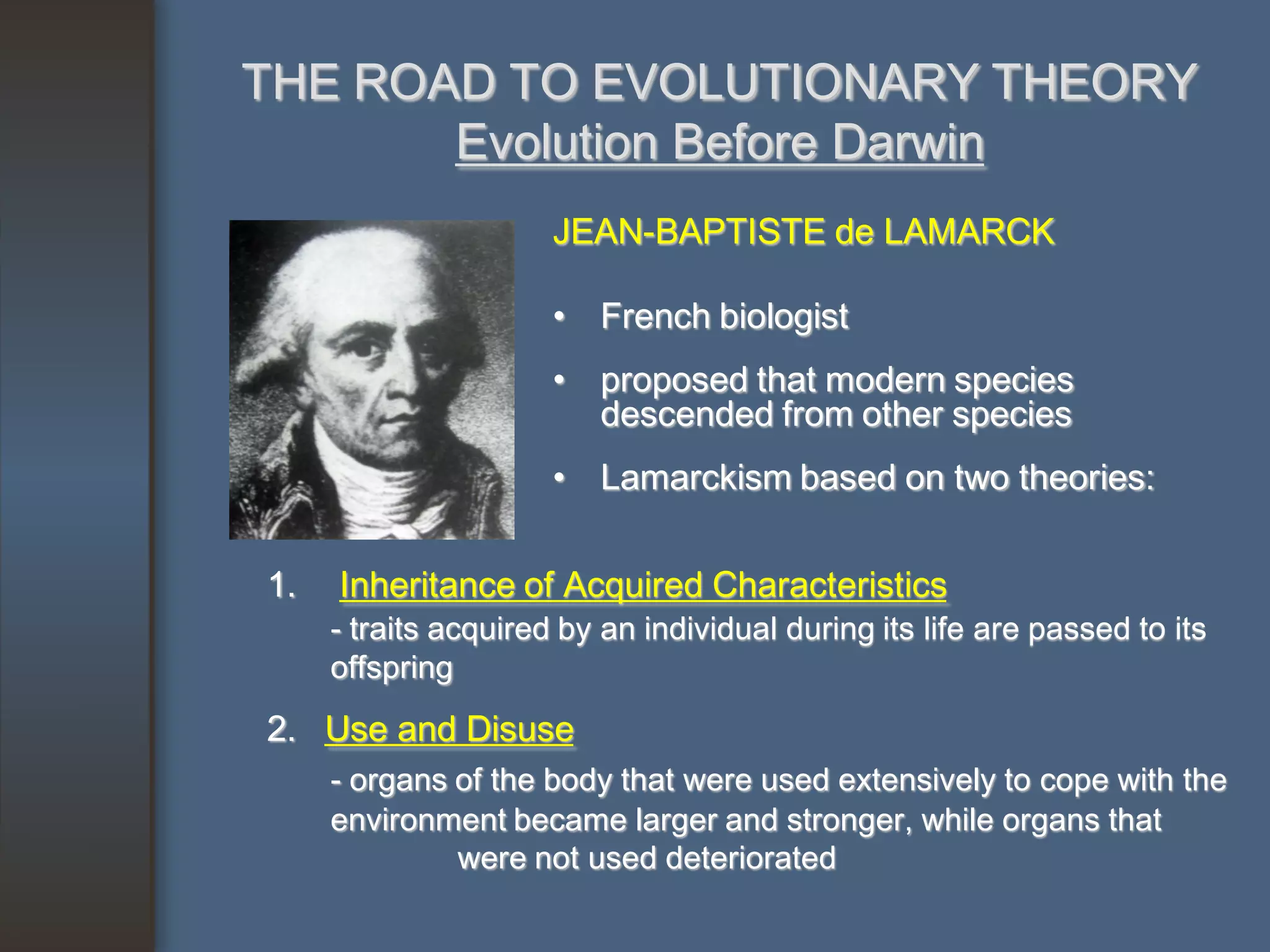
JEAN-BAPTISTE de LAMARCK
• French biologist
• proposed that modern species
descended from other species
• Lamarckism based on two theories:
1. Inheritance of Acquired Characteristics
- traits acquired by an individual during its life are passed to its
offspring
2. Use and Disuse
- organs of the body that were used extensively to cope with the
environment became larger and stronger, while organs that
were not used deteriorated
7.
THE ROAD TOEVOLUTIONARY THEORY
Evolution Before Darwin
Example:
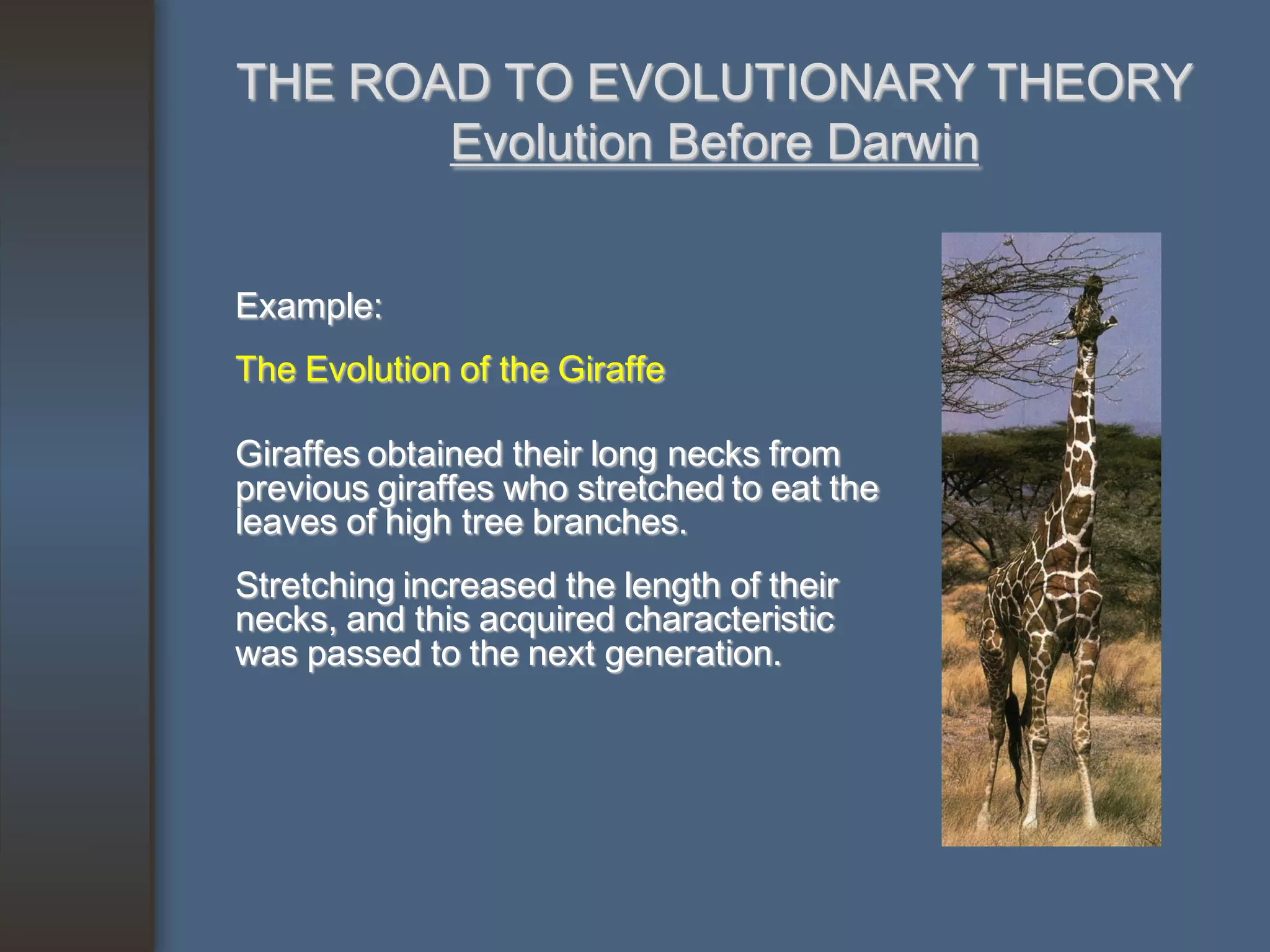
The Evolution of the Giraffe
Giraffes obtained their long necks from
previous giraffes who stretched to eat the
leaves of high tree branches.
Stretching increased the length of their
necks, and this acquired characteristic
was passed to the next generation.
8.
THE ROAD TOEVOLUTIONARY THEORY
Evolution Before Darwin
Lamarckism
• first to present a unified theory that attempted to explain the
changes in organisms from one generation to the next
• although mechanisms proposed for change was wrong, since
acquired characteristics are not heritable!!!
origin of species from preexisting species
ability of organisms to adapt
9.
THE ROAD TOEVOLUTIONARY THEORY
Darwin’s Time (1800s)
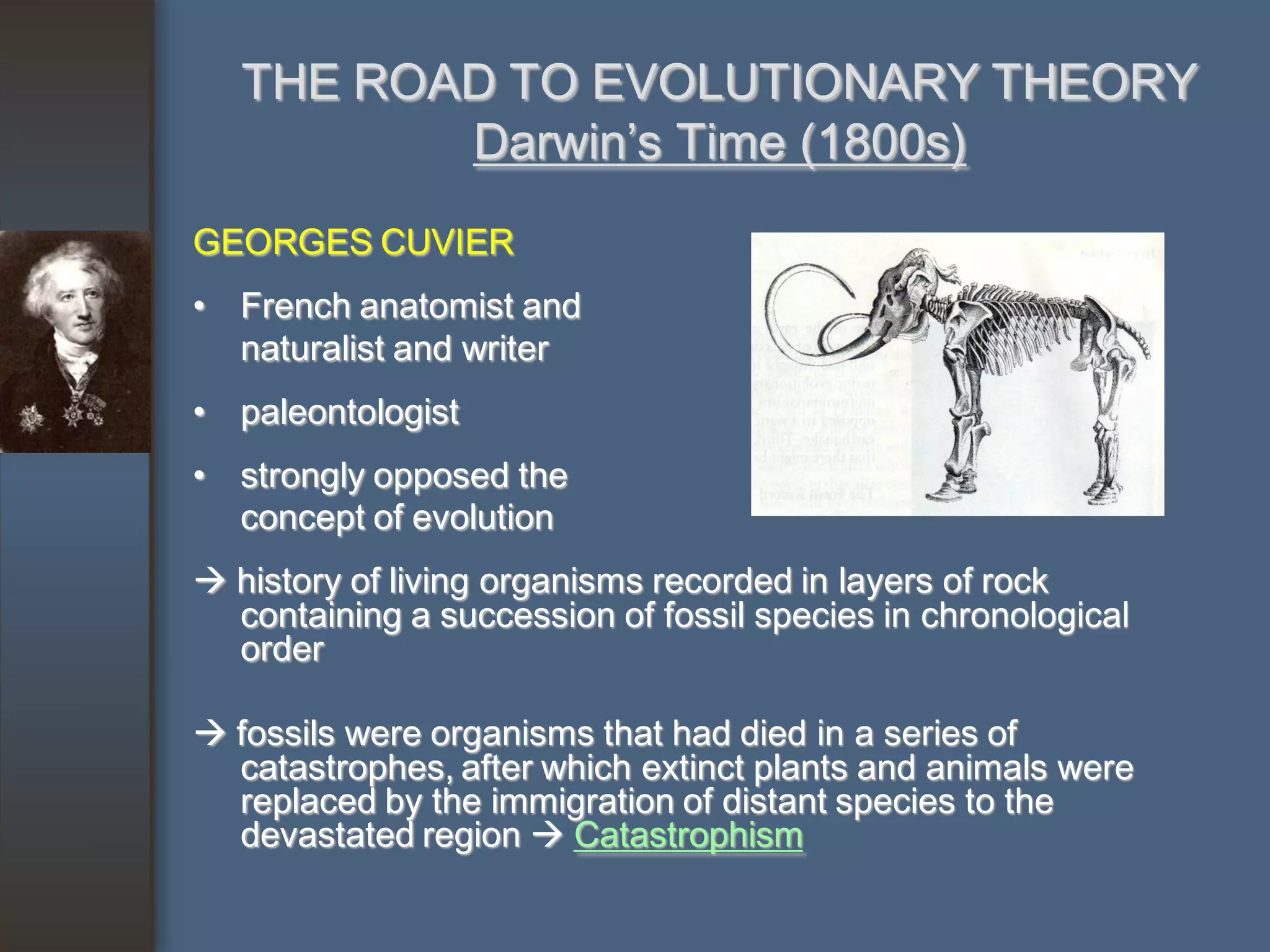
GEORGES CUVIER
• French anatomist and
naturalist and writer
• paleontologist
• strongly opposed the
concept of evolution
history of living organisms recorded in layers of rock
containing a succession of fossil species in chronological
order
fossils were organisms that had died in a series of
catastrophes, after which extinct plants and animals were
replaced by the immigration of distant species to the
devastated region Catastrophism
10.
THE ROAD TOEVOLUTIONARY THEORY
Darwin’s Time (1800s)
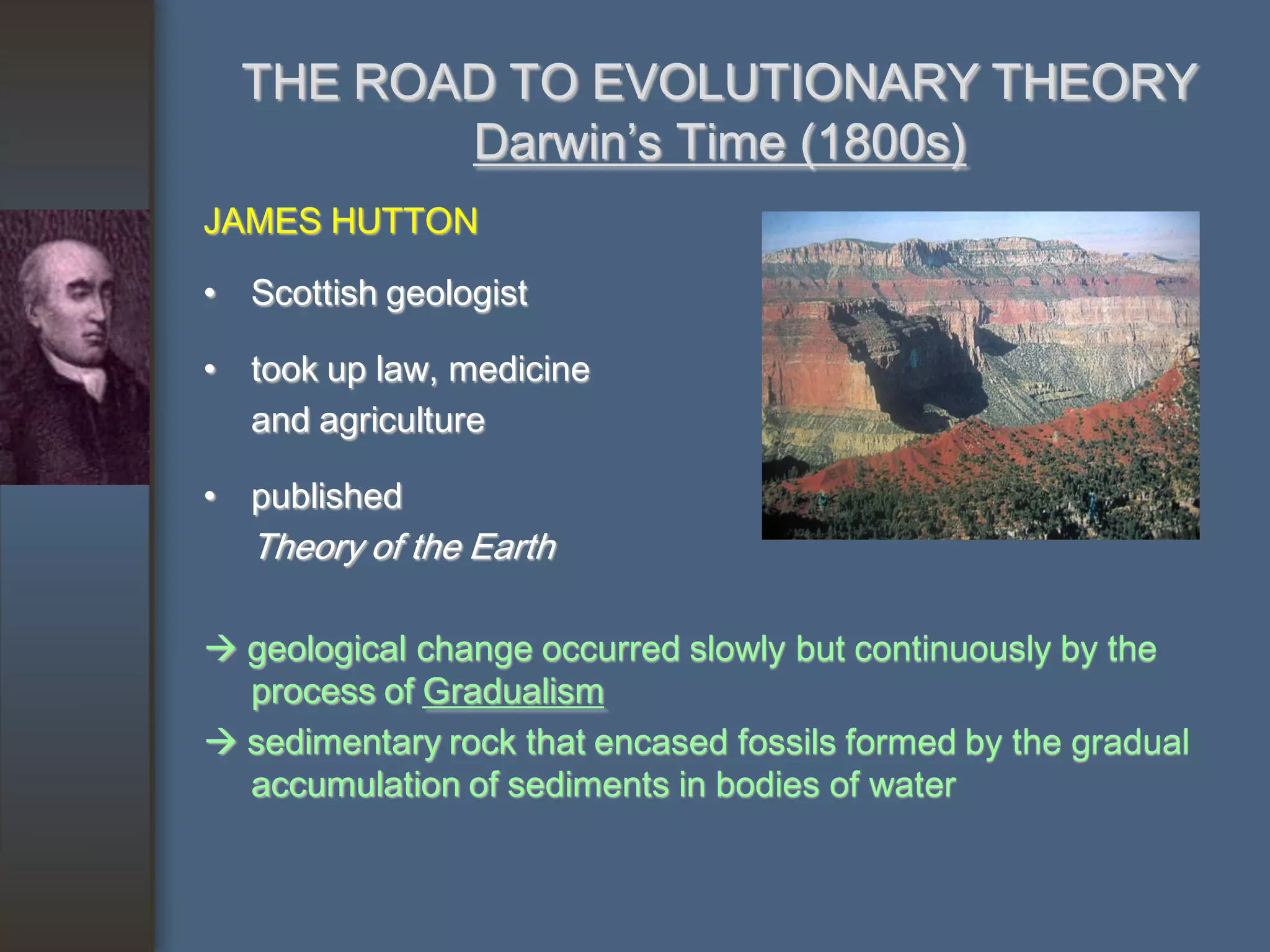
JAMES HUTTON
• Scottish geologist
• took up law, medicine
and agriculture
• published
Theory of the Earth
geological change occurred slowly but continuously by the
process of Gradualism
sedimentary rock that encased fossils formed by the gradual
accumulation of sediments in bodies of water
11.
THE ROAD TOEVOLUTIONARY THEORY
Darwin’s Time (1800s)
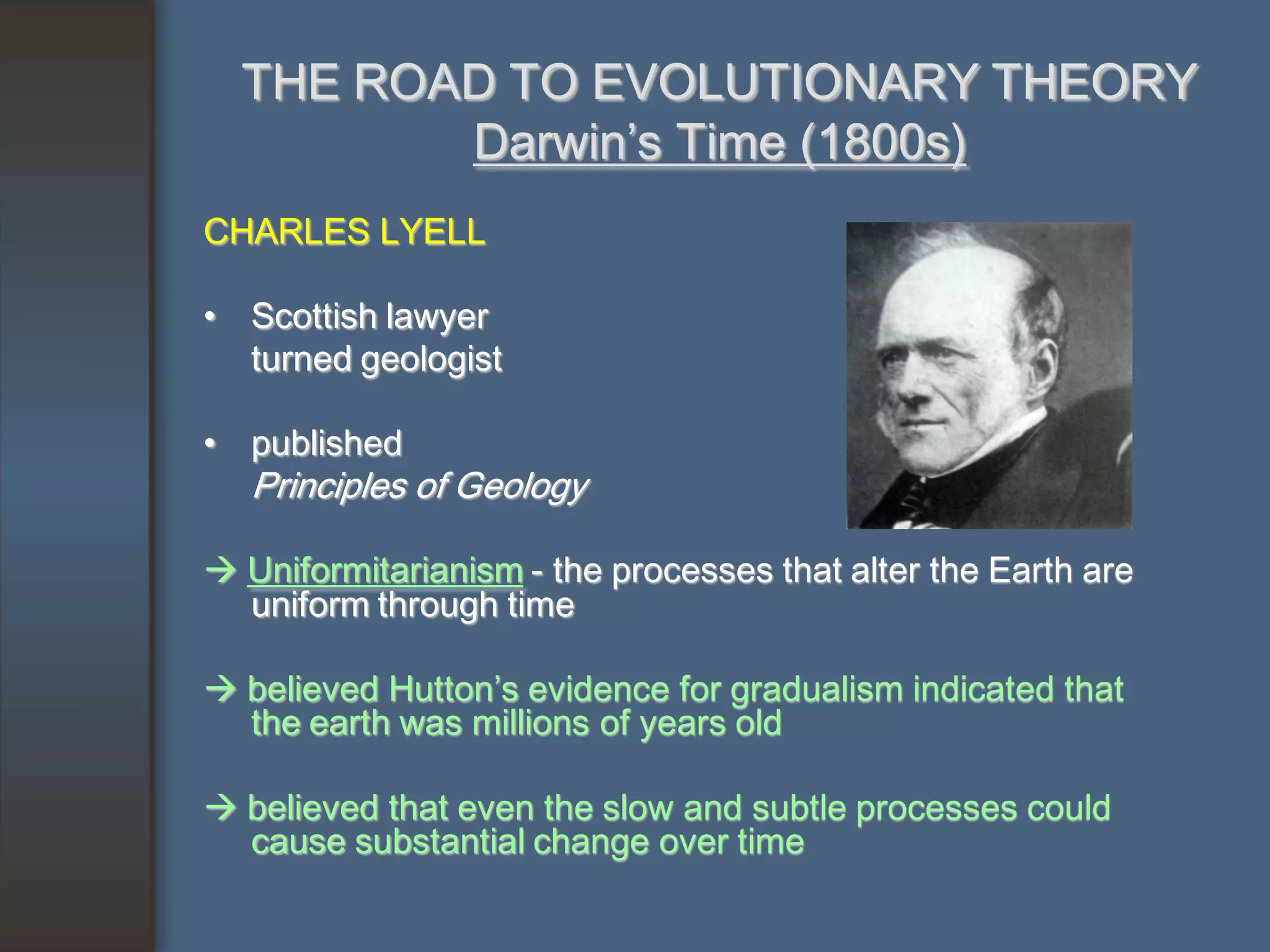
CHARLES LYELL
• Scottish lawyer
turned geologist
• published
Principles of Geology
Uniformitarianism - the processes that alter the Earth are
uniform through time
believed Hutton’s evidence for gradualism indicated that
the earth was millions of years old
believed that even the slow and subtle processes could
cause substantial change over time
12.
THE ROAD TOEVOLUTIONARY THEORY
Darwin’s Time (1800s)
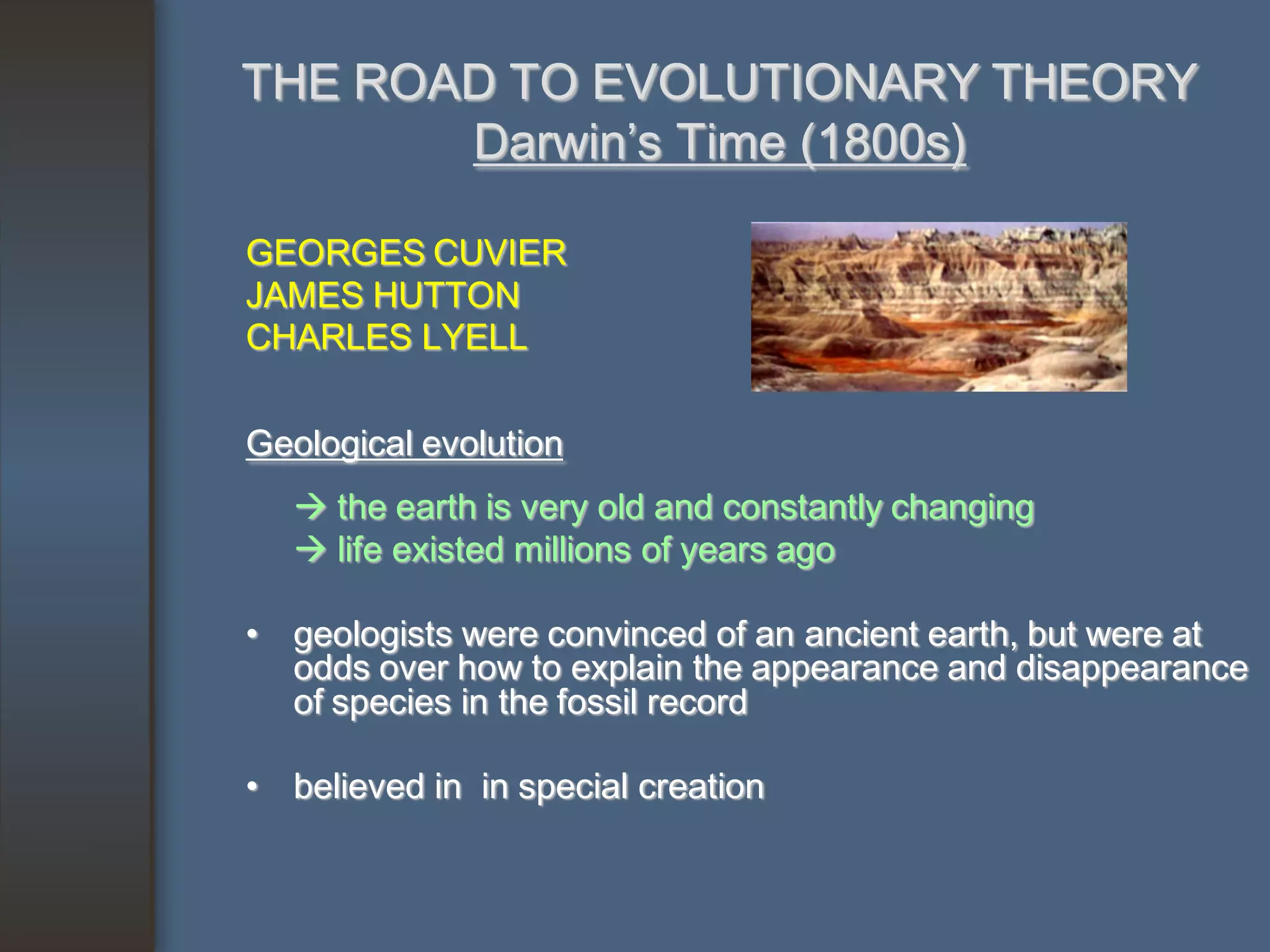
GEORGES CUVIER
JAMES HUTTON
CHARLES LYELL
Geological evolution
the earth is very old and constantly changing
life existed millions of years ago
• geologists were convinced of an ancient earth, but were at
odds over how to explain the appearance and disappearance
of species in the fossil record
• believed in in special creation
13.
THE ROAD TOEVOLUTIONARY THEORY
Darwin’s Time (1800s)
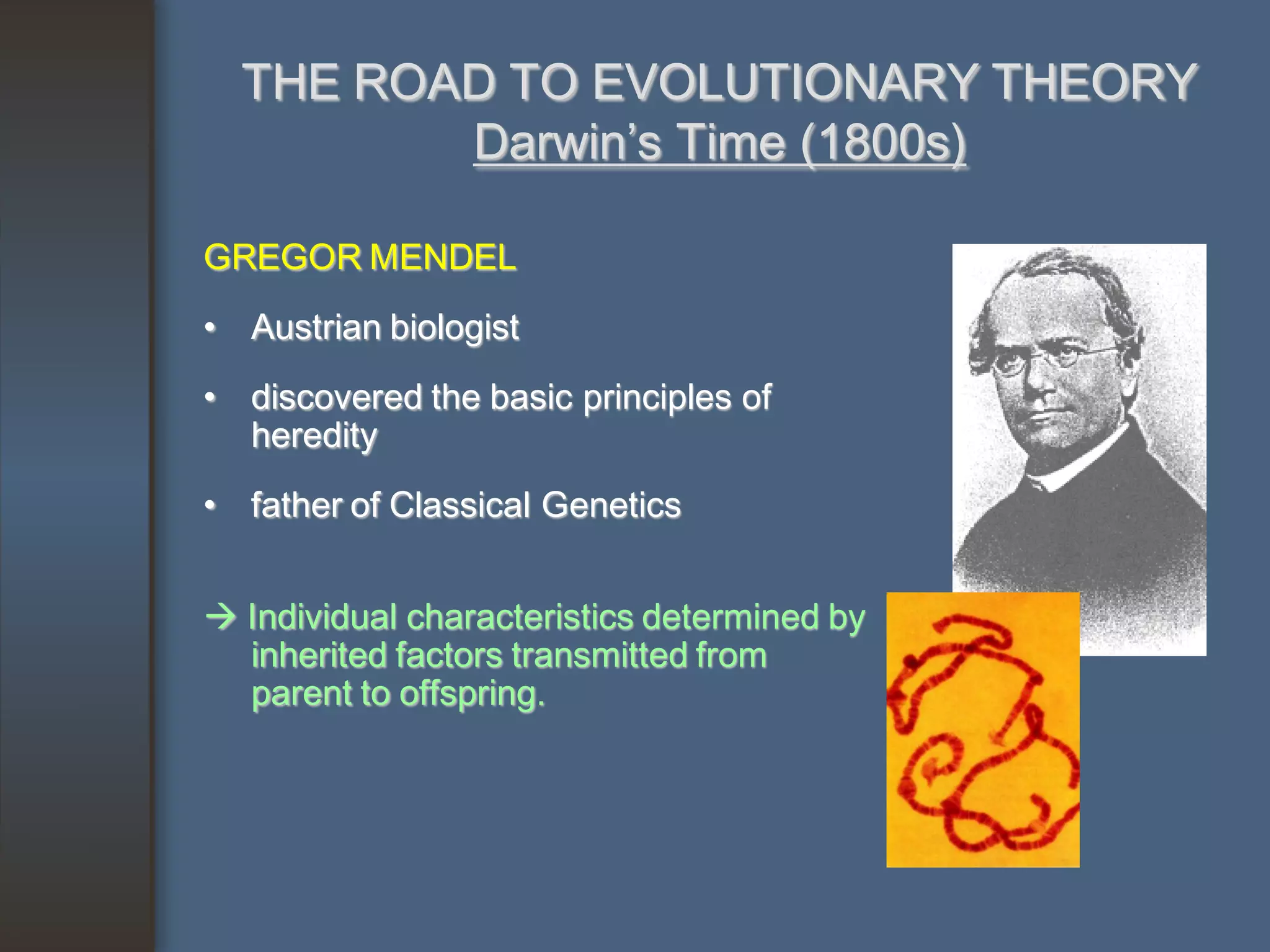
GREGOR MENDEL
• Austrian biologist
• discovered the basic principles of
heredity
• father of Classical Genetics
Individual characteristics determined by
inherited factors transmitted from
parent to offspring.
14.
THE ROAD TOEVOLUTIONARY THEORY
Darwin’s Time (1800s)
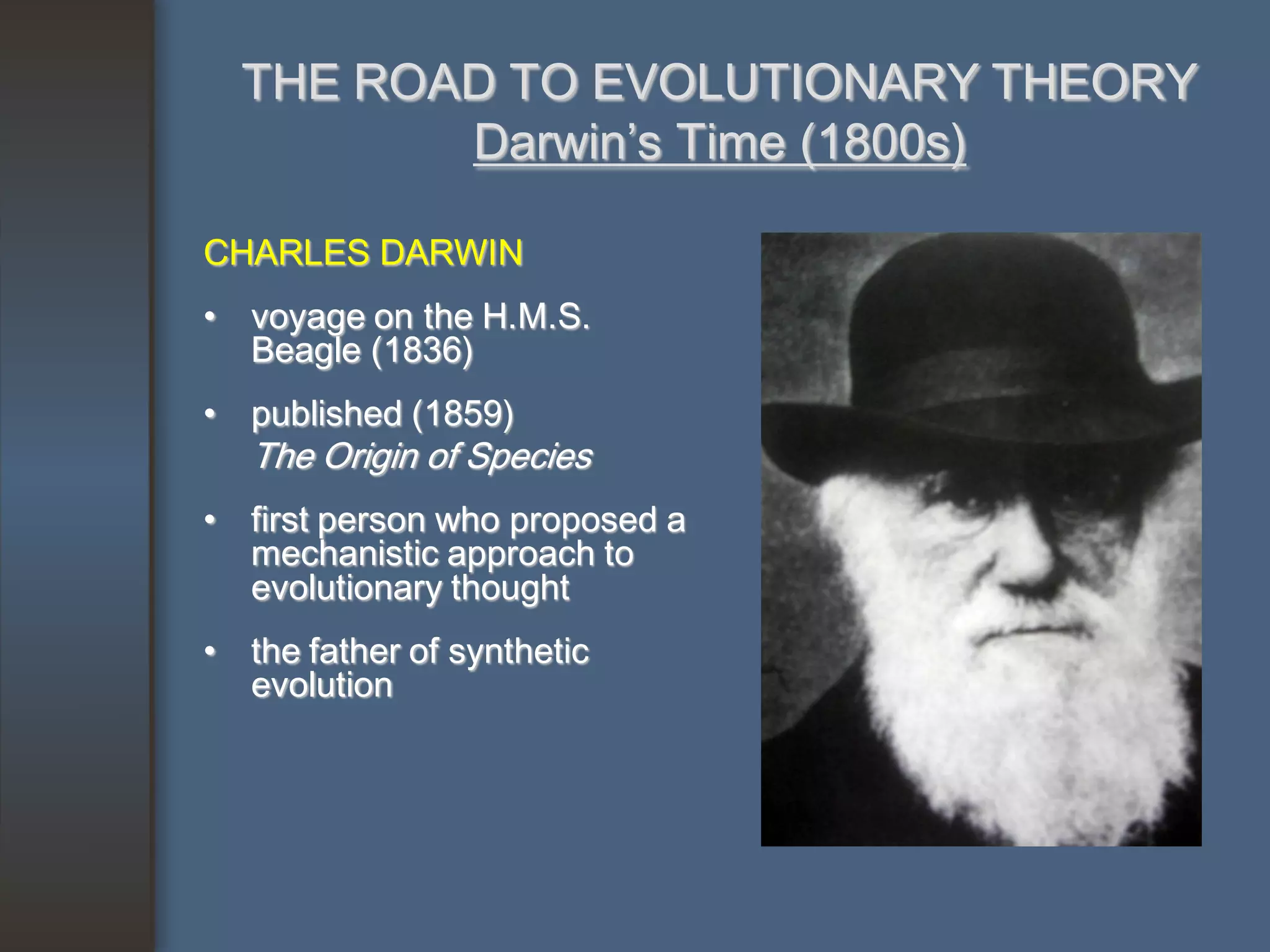
CHARLES DARWIN
• voyage on the H.M.S.
Beagle (1836)
• published (1859)
The Origin of Species
• first person who proposed a
mechanistic approach to
evolutionary thought
• the father of synthetic
evolution
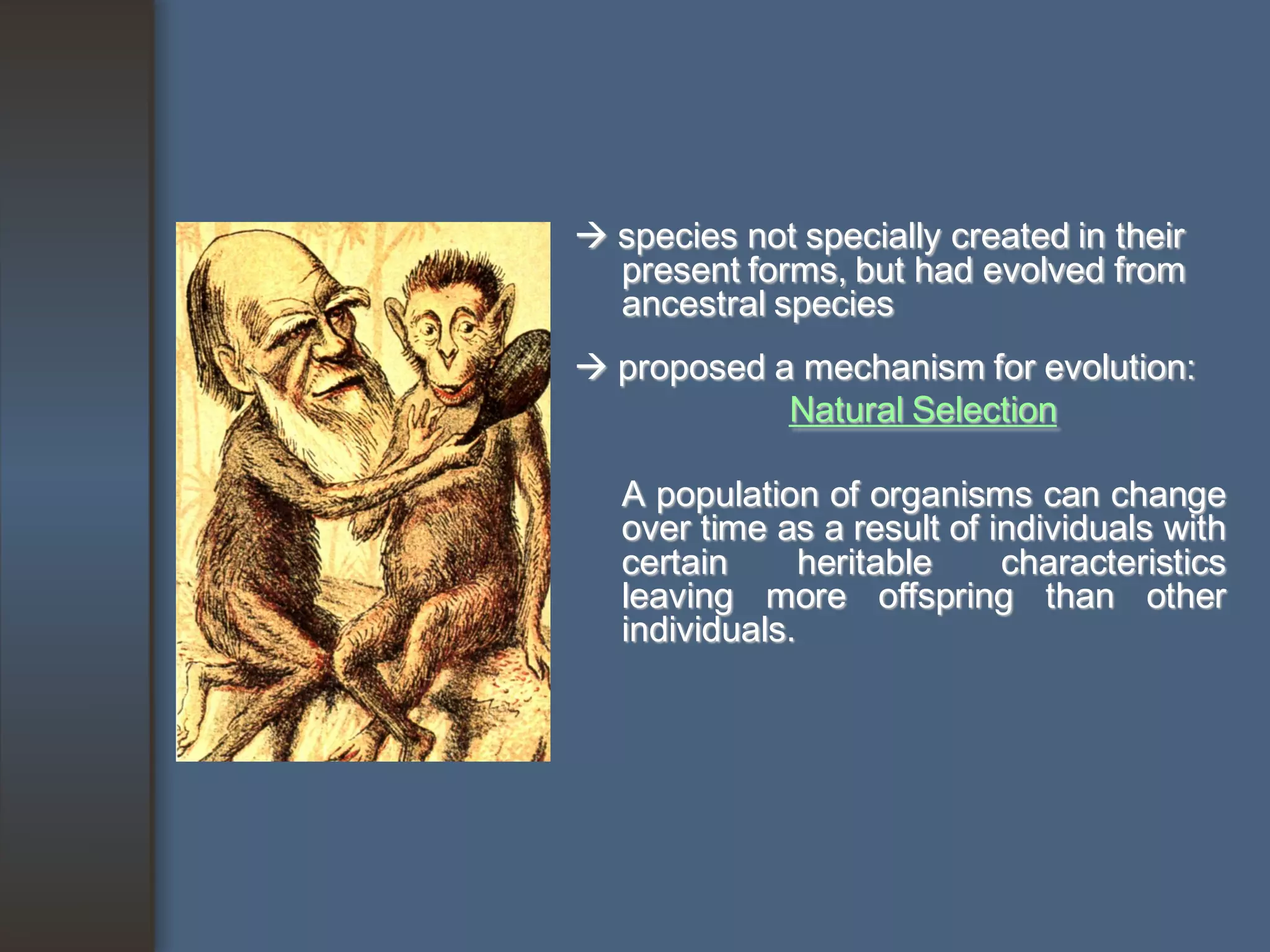
species notspecially created in their
present forms, but had evolved from
ancestral species
proposed a mechanism for evolution:
Natural Selection
A population of organisms can change
over time as a result of individuals with
certain heritable characteristics
leaving more offspring than other
individuals.
18.
THE ROAD TOEVOLUTIONARY THEORY
Darwin’s Time (1800s)
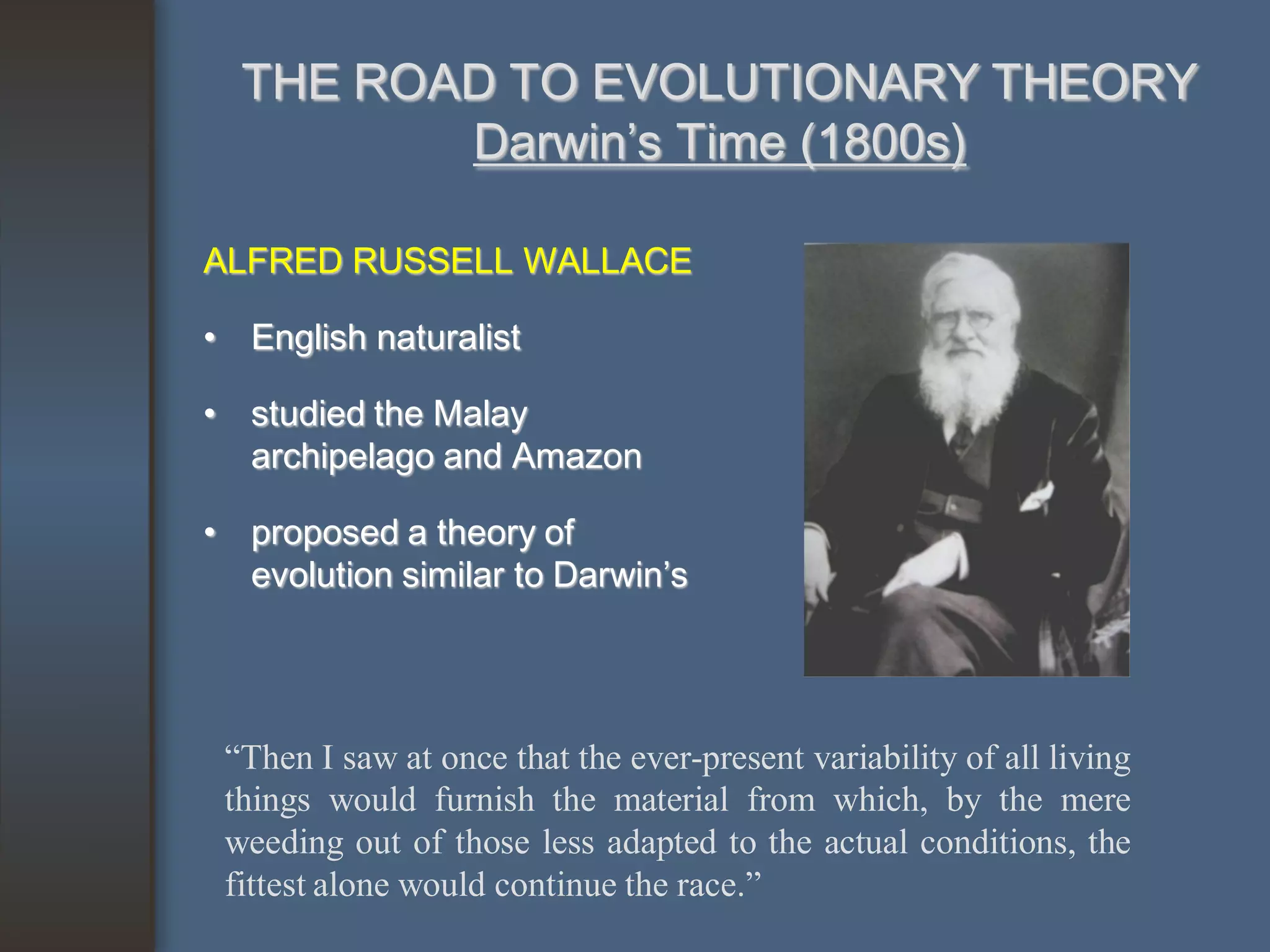
ALFRED RUSSELL WALLACE
• English naturalist
• studied the Malay
archipelago and Amazon
• proposed a theory of
evolution similar to Darwin’s
“Then I saw at once that the ever-present variability of all living
things would furnish the material from which, by the mere
weeding out of those less adapted to the actual conditions, the
fittest alone would continue the race.”
THE ROAD TOEVOLUTIONARY THEORY
Neo-Darwinian/Contemporary Times
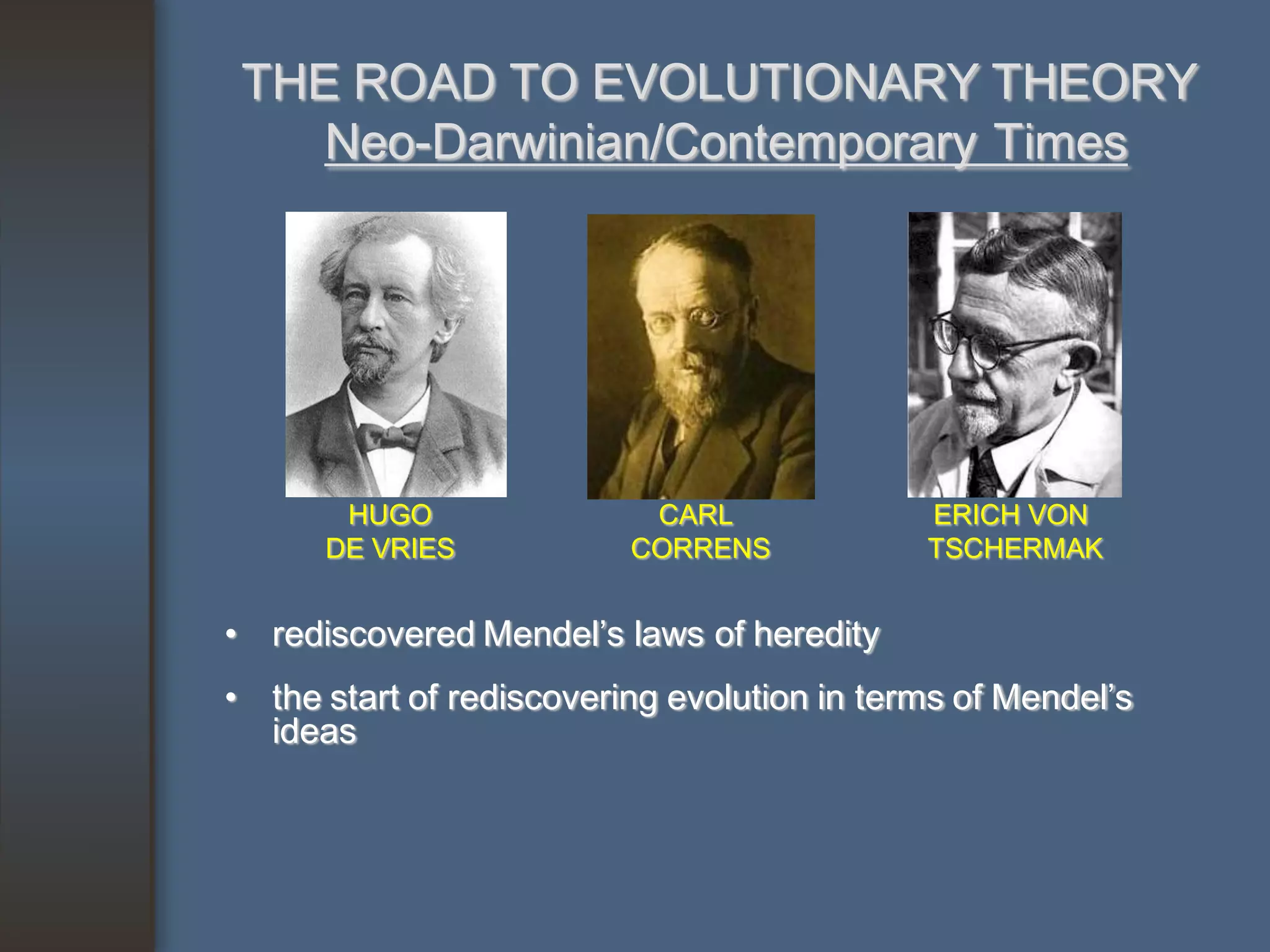
HUGO CARL ERICH VON
DE VRIES CORRENS TSCHERMAK
• rediscovered Mendel’s laws of heredity
• the start of rediscovering evolution in terms of Mendel’s
ideas
21.
THE ROAD TOEVOLUTIONARY THEORY
Neo-Darwinian/Contemporary Times
JAMES WATSON
FRANCIS CRICK
• elucidated the structure of
DNA (genetic material)
• DNA contains coded
information which acts as a
blueprint for the transfer of
hereditary information from
generation to generation
• mutation as the raw material
for evolution