Archaea (Archeabacteria)
Charde’ja Doulas
Lily McCormack
Luis Gonzalez
Hudson Redl
Defining Characteristics
• Archaea are simple unicellular organisms that often live in extreme
environments.
• The size of achaebacteria ranges from one-tenth of a micrometer to
more than 15 micrometer. Some of archaebacteria have flagella.
• Like all prokaryotes, archaebacteria don't possess the membrane-
bound organelles. They don't have nuclei, endoplasmic reticula ,Golgi
complexes, mitochondria, chloroplasts, or lysosomes.
Where it lives and how it reproduces
• Most Archaebacteria live in extreme environments such as hot
springs, very salty water, or black mud.
• Asexual reproduction by binary fission, budding or fragmentations.
How it gets nutrients and the cell type
Autotroph that uses chemosynthesis. (Chemical energy instead of light)
Prokaryotic cell
These microbes used to be considered bacteria, which gave them the
name.
The cell surrounding, cellular organization
and the importance to us
Has a cell wall and a cell membrane.
Bacteria
By: Sam, Sean, Elisa, and Eden
Bacteria cellular organization
Bacteria are simple unicellular organisms they are very small and all
around us. Bacteria can live in soil, water, and other living things.
Bacteria reproduces asexually by fission. Most bacterium is
heterotroph, but cyano bacteria make their food through photosythesis
Bacteria unicellular continued
The cell type of bacteria is Prokaryote. The cell surrounding is a cell
wall. The cellular organization is unicellular.
Examples of Bacteria are:
Aerobic- Bacteria that needs oxygen to survive.
Bacteria is important to us because it kills other organisms to fight off
other viruses.
Bioluminescence/Secretion Bacteria
A few bacteria have chemical
Systems That generate light. This
bioluminescence (which is the
production and emission of light
in a creature.) often occurs in
Bacteria with fish, and the light
Serves to attract Fish and other
large animals.
• Bacteria frequently secretes
(secretion is the movement of
chemicals.) chemicals into their
enviroment.
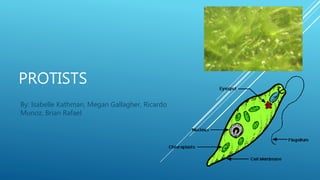
PROTISTS
By: Isabelle Kathman, Megan Gallagher, Ricardo
Munoz, Brian Rafael
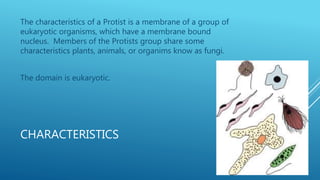
CHARACTERISTICS
The characteristics of a Protist is a membrane of a group of
eukaryotic organisms, which have a membrane bound
nucleus. Members of the Protists group share some
characteristics plants, animals, or organims know as fungi.
The domain is eukaryotic.
WHERE IT CAN LIVE, HOW IT REPRODUCES
HOW IT GETS IT NUTRIENTS
 Plant like can live in beaches and aquariums, animal like live
in wet environments, and fungus like live in parasites or
feed on dead organisms.
 Protists reproduce with asexual reproduction
 Plant like protists get nutrients by autotroph, animal like
protist get nutrients by heterotroph, and fungus like protist
get nutrients by heterotroph
CELL TYPE,CELL SURROUNDING,CELL
ORGANIZATION AND EXAMPLES OF
ORGANIMS
 The cell type is eukaryote
 Cell surrounding is a membrane
 Cell organization is unicellular
 Example, amoeba, diatom, euglena, algae, paramecium
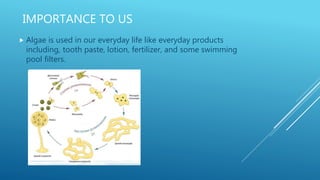
IMPORTANCE TO US
 Algae is used in our everyday life like everyday products
including, tooth paste, lotion, fertilizer, and some swimming
pool filters.
Kingdom Fungi
BY JIMMY FORWAY, BELLA HARDIN, SERGIO TORIBIO, ROSIE WOLFF
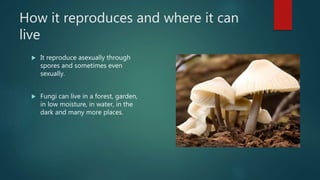
How it reproduces and where it can
live
 It reproduce asexually through
spores and sometimes even
sexually.
 Fungi can live in a forest, garden,
in low moisture, in water, in the
dark and many more places.
Domains and Food
 Fungi is in domain eukarya. It's
defining characteristics are: it
reproduces by spores And , has
cell walls. Fungi are heterotrophs
They get nutrients from feeding
on living or dead organisms.
Examples and Cell Information
 Examples are mushrooms , yeast,
morel, shelf fungus, mold, bracket
fungi, puffballs , and mildew
 Fungi can be uni or multicellular but
are always eukaryotic and the cells
have walls.
Importance of Fungi
 Fungi are involved in the
production of many foods and
other products. Some fungi are
used in meat substitute because
they are high in protein and low
cholesterol.
🌱THE PLANT KINGDOM
MARCO PEREZ | MITZI ESCALANTE | AVRIA |
MARTIN DZYR.
PLANT CELLS
• The Plants have eukaryotic cells. Bound organelles convert light
energy into chemical energy.
• The cell wall provides support and protection. The cell wall is
composed of cellulose and other compounds.
• The cell contains cell wall, cytoplasm, chloroplasts, a vacuole And a
cell membrane.
WHERE IT CAN LIVE & HOW IT REPRODUCES :
Where it can live – land and water depending on oxegen , sunlight , and water
How it reproduces – produce sexually or asexually. Asexually reproduces when
abortion of a plant develops into a separate new plant. sexually = plants sperm
combines with a plant egg. A resulting zygot can grow into this new plant is
genetic.
PLANT DOMAIN & CHARACTERISTICS
Plants are infhfjf domaing
eukaria. Some characteristics of
plants can be leaves, flowers,
stems, food. Little hairs ect.
HOW IT GETS NUTRIENTS : AUTOTROPH HERTER R &
EXAMPLE OF ORGANISMS
• Plants are producers. They make
their own food. A simple sugar
called gulcose, during a process
called photosynthesis
Examples of organisms
- moss
-ginko
-ferns
-club mosses
-horse tails
-tulips
-cycaas
-magnolla
-pine tree
-conifers
-hornwort
-grass flowers
-Liverwort
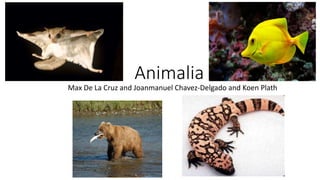
Animalia
Max De La Cruz and Joanmanuel Chavez-Delgado and Koen Plath
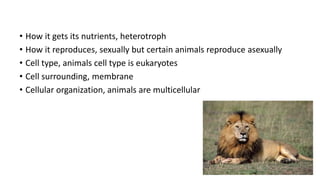
• How it gets its nutrients, heterotroph
• How it reproduces, sexually but certain animals reproduce asexually
• Cell type, animals cell type is eukaryotes
• Cell surrounding, membrane
• Cellular organization, animals are multicellular
Defining chraracteristics
• Animals are multicellular
• The domain is eukaryote
• Animal cells are specialized for differ functions,such as digestion,
reproduction,vision and taste
• Animals have proetin ,called collagen, that surrounds the cells and
help them keep their shape
Where it can live?
Animals can live in many places such as coral reef, air, buildings,
bushes, sea, and underground
Examples and importance
For examples Animalia is basically any living thing that has a nucleus.
But to be specific mammals, birds, fish, reptiles, insects, and many
more.
For importance there are many examples such as certain animals are
used as a food source, there are service animals that rescue humans,
we also study animal biology to better understand ourselves, and
finally we test medical procedures and cosmetics to make sure there
safe for us.

Period 5 2016

  • 1.
    Archaea (Archeabacteria) Charde’ja Doulas LilyMcCormack Luis Gonzalez Hudson Redl
  • 2.
    Defining Characteristics • Archaeaare simple unicellular organisms that often live in extreme environments. • The size of achaebacteria ranges from one-tenth of a micrometer to more than 15 micrometer. Some of archaebacteria have flagella. • Like all prokaryotes, archaebacteria don't possess the membrane- bound organelles. They don't have nuclei, endoplasmic reticula ,Golgi complexes, mitochondria, chloroplasts, or lysosomes.
  • 3.
    Where it livesand how it reproduces • Most Archaebacteria live in extreme environments such as hot springs, very salty water, or black mud. • Asexual reproduction by binary fission, budding or fragmentations.
  • 4.
    How it getsnutrients and the cell type Autotroph that uses chemosynthesis. (Chemical energy instead of light) Prokaryotic cell These microbes used to be considered bacteria, which gave them the name.
  • 5.
    The cell surrounding,cellular organization and the importance to us Has a cell wall and a cell membrane.
  • 6.
    Bacteria By: Sam, Sean,Elisa, and Eden
  • 7.
    Bacteria cellular organization Bacteriaare simple unicellular organisms they are very small and all around us. Bacteria can live in soil, water, and other living things. Bacteria reproduces asexually by fission. Most bacterium is heterotroph, but cyano bacteria make their food through photosythesis
  • 8.
    Bacteria unicellular continued Thecell type of bacteria is Prokaryote. The cell surrounding is a cell wall. The cellular organization is unicellular. Examples of Bacteria are: Aerobic- Bacteria that needs oxygen to survive. Bacteria is important to us because it kills other organisms to fight off other viruses.
  • 9.
    Bioluminescence/Secretion Bacteria A fewbacteria have chemical Systems That generate light. This bioluminescence (which is the production and emission of light in a creature.) often occurs in Bacteria with fish, and the light Serves to attract Fish and other large animals. • Bacteria frequently secretes (secretion is the movement of chemicals.) chemicals into their enviroment.
  • 11.
    PROTISTS By: Isabelle Kathman,Megan Gallagher, Ricardo Munoz, Brian Rafael
  • 12.
    CHARACTERISTICS The characteristics ofa Protist is a membrane of a group of eukaryotic organisms, which have a membrane bound nucleus. Members of the Protists group share some characteristics plants, animals, or organims know as fungi. The domain is eukaryotic.
  • 13.
    WHERE IT CANLIVE, HOW IT REPRODUCES HOW IT GETS IT NUTRIENTS  Plant like can live in beaches and aquariums, animal like live in wet environments, and fungus like live in parasites or feed on dead organisms.  Protists reproduce with asexual reproduction  Plant like protists get nutrients by autotroph, animal like protist get nutrients by heterotroph, and fungus like protist get nutrients by heterotroph
  • 14.
    CELL TYPE,CELL SURROUNDING,CELL ORGANIZATIONAND EXAMPLES OF ORGANIMS  The cell type is eukaryote  Cell surrounding is a membrane  Cell organization is unicellular  Example, amoeba, diatom, euglena, algae, paramecium
  • 15.
    IMPORTANCE TO US Algae is used in our everyday life like everyday products including, tooth paste, lotion, fertilizer, and some swimming pool filters.
  • 16.
    Kingdom Fungi BY JIMMYFORWAY, BELLA HARDIN, SERGIO TORIBIO, ROSIE WOLFF
  • 17.
    How it reproducesand where it can live  It reproduce asexually through spores and sometimes even sexually.  Fungi can live in a forest, garden, in low moisture, in water, in the dark and many more places.
  • 18.
    Domains and Food Fungi is in domain eukarya. It's defining characteristics are: it reproduces by spores And , has cell walls. Fungi are heterotrophs They get nutrients from feeding on living or dead organisms.
  • 19.
    Examples and CellInformation  Examples are mushrooms , yeast, morel, shelf fungus, mold, bracket fungi, puffballs , and mildew  Fungi can be uni or multicellular but are always eukaryotic and the cells have walls.
  • 20.
    Importance of Fungi Fungi are involved in the production of many foods and other products. Some fungi are used in meat substitute because they are high in protein and low cholesterol.
  • 21.
    🌱THE PLANT KINGDOM MARCOPEREZ | MITZI ESCALANTE | AVRIA | MARTIN DZYR.
  • 22.
    PLANT CELLS • ThePlants have eukaryotic cells. Bound organelles convert light energy into chemical energy. • The cell wall provides support and protection. The cell wall is composed of cellulose and other compounds. • The cell contains cell wall, cytoplasm, chloroplasts, a vacuole And a cell membrane.
  • 23.
    WHERE IT CANLIVE & HOW IT REPRODUCES : Where it can live – land and water depending on oxegen , sunlight , and water How it reproduces – produce sexually or asexually. Asexually reproduces when abortion of a plant develops into a separate new plant. sexually = plants sperm combines with a plant egg. A resulting zygot can grow into this new plant is genetic.
  • 24.
    PLANT DOMAIN &CHARACTERISTICS Plants are infhfjf domaing eukaria. Some characteristics of plants can be leaves, flowers, stems, food. Little hairs ect.
  • 25.
    HOW IT GETSNUTRIENTS : AUTOTROPH HERTER R & EXAMPLE OF ORGANISMS • Plants are producers. They make their own food. A simple sugar called gulcose, during a process called photosynthesis Examples of organisms - moss -ginko -ferns -club mosses -horse tails -tulips -cycaas -magnolla -pine tree -conifers -hornwort -grass flowers -Liverwort
  • 26.
    Animalia Max De LaCruz and Joanmanuel Chavez-Delgado and Koen Plath
  • 27.
    • How itgets its nutrients, heterotroph • How it reproduces, sexually but certain animals reproduce asexually • Cell type, animals cell type is eukaryotes • Cell surrounding, membrane • Cellular organization, animals are multicellular
  • 28.
    Defining chraracteristics • Animalsare multicellular • The domain is eukaryote • Animal cells are specialized for differ functions,such as digestion, reproduction,vision and taste • Animals have proetin ,called collagen, that surrounds the cells and help them keep their shape
  • 29.
    Where it canlive? Animals can live in many places such as coral reef, air, buildings, bushes, sea, and underground
  • 30.
    Examples and importance Forexamples Animalia is basically any living thing that has a nucleus. But to be specific mammals, birds, fish, reptiles, insects, and many more. For importance there are many examples such as certain animals are used as a food source, there are service animals that rescue humans, we also study animal biology to better understand ourselves, and finally we test medical procedures and cosmetics to make sure there safe for us.