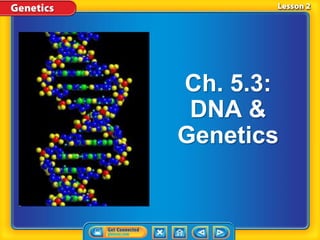
Ch. 5.3:
DNA &
Genetics
Before the 1950s, we knew that:
 Inherited characteristics are determine by
genes.
 Genes are passed from one generation to the
next.
 Genes are part of a chromosome.
 Cells divide. Before they divide, they have to
copy their structures, organelles, & their genetic
information.
1. What scientists contributed to our
understanding of DNA?
1. What scientists contributed to our
understanding of DNA?
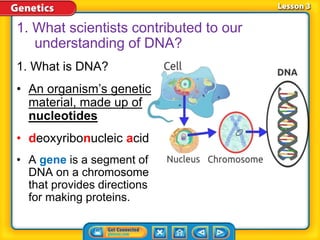
1. What is DNA?
• An organism’s genetic
material, made up of
nucleotides
• deoxyribonucleic acid
• A gene is a segment of
DNA on a chromosome
that provides directions
for making proteins.
1. What scientists contributed to our
understanding of DNA?
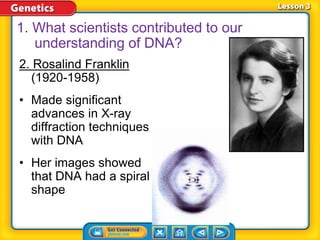
2. Rosalind Franklin
(1920-1958)
• Made significant
advances in X-ray
diffraction techniques
with DNA
• Her images showed
that DNA had a spiral
shape
1. What scientists contributed to our
understanding of DNA?
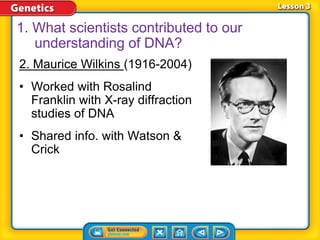
2. Maurice Wilkins (1916-2004)
• Worked with Rosalind
Franklin with X-ray diffraction
studies of DNA
• Shared info. with Watson &
Crick
1. What scientists contributed to our
understanding of DNA?
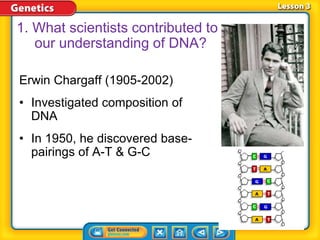
Erwin Chargaff (1905-2002)
• Investigated composition of
DNA
• In 1950, he discovered base-
pairings of A-T & G-C
1. What scientists contributed to
our understanding of DNA?
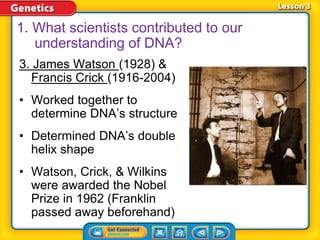
3. James Watson (1928) &
Francis Crick (1916-2004)
• Worked together to
determine DNA’s structure
• Determined DNA’s double
helix shape
• Watson, Crick, & Wilkins
were awarded the Nobel
Prize in 1962 (Franklin
passed away beforehand)
1. What scientists contributed to our
understanding of DNA?
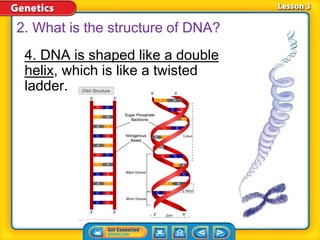
4. DNA is shaped like a double
helix, which is like a twisted
ladder.
2. What is the structure of DNA?
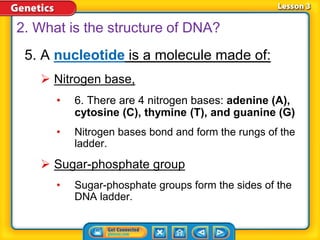
5. A nucleotide is a molecule made of:
 Nitrogen base,
• 6. There are 4 nitrogen bases: adenine (A),
cytosine (C), thymine (T), and guanine (G)
• Nitrogen bases bond and form the rungs of the
ladder.
 Sugar-phosphate group
• Sugar-phosphate groups form the sides of the
DNA ladder.
2. What is the structure of DNA?
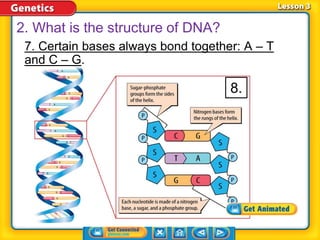
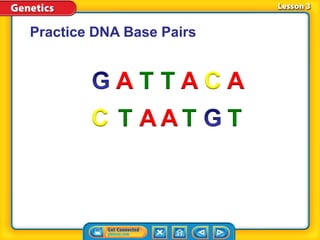
7. Certain bases always bond together: A – T
and C – G.
2. What is the structure of DNA?
8.
DNA – What does my code look like?
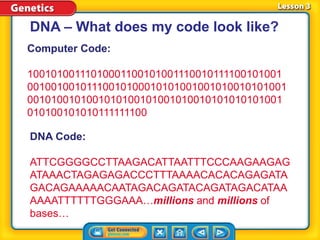
Computer Code:
10010100111010001100101001110010111100101001
00100100101110010100010101001001010010101001
0010100101001010100101001010010101010101001
010100101010111111100
DNA Code:
ATTCGGGGCCTTAAGACATTAATTTCCCAAGAAGAG
ATAAACTAGAGAGACCCTTTAAAACACACAGAGATA
GACAGAAAAACAATAGACAGATACAGATAGACATAA
AAAATTTTTTGGGAAA…millions and millions of
bases…
Practice DNA Base Pairs
A T T A C A
C TT A A T
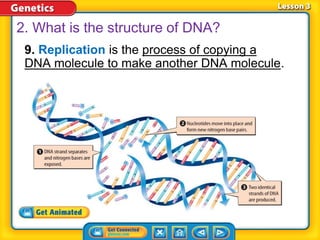
9. Replication is the process of copying a
DNA molecule to make another DNA molecule.
2. What is the structure of DNA?
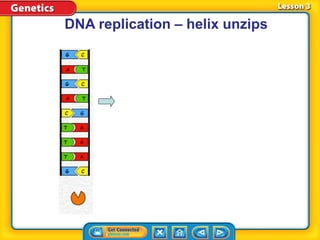
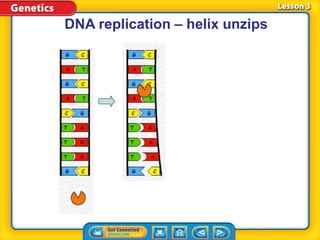
DNA replication – helix unzips
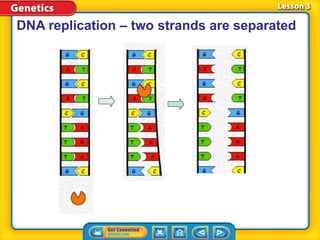
DNA replication – two strands are separated
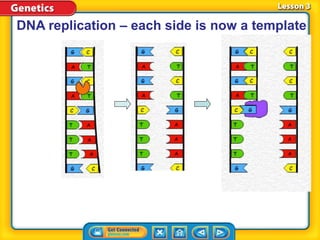
DNA replication – each side is now a template
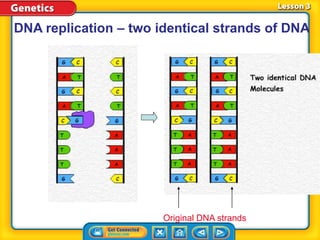
DNA replication – two identical strands of DNA
Original DNA strands
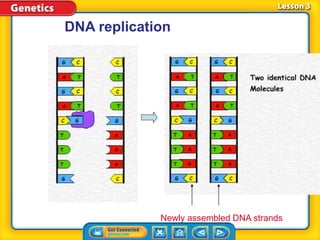
DNA replication
Newly assembled DNA strands
10. Mutation occurs when the sequence
of nucleotides is changed in a gene.
 Insertion – more added
 Deletion – some deleted
 Substitution – some swapped
mutation
from Latin mutare, means “to
change”
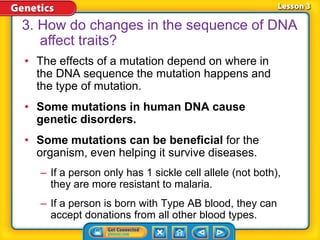
3. How do changes in the sequence of DNA
affect traits?
• The 46 human chromosomes contain
between 20,000 and 25,000 genes that
are copied during replication.
• Mutations can be triggered by exposure
to X-rays, ultraviolet light, radioactive
materials, and some kinds of chemicals.
3. How do changes in the sequence of DNA
affect traits?
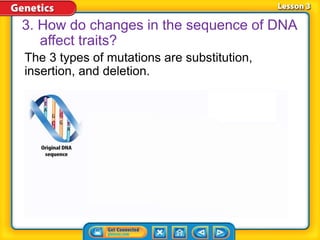
The 3 types of mutations are substitution,
insertion, and deletion.
3. How do changes in the sequence of DNA
affect traits?
Which of the following describes the
mutation that occurs when three
base pairs are added?
a. b. c. d.
0 000
a. Insertion
b. Substitution
c. Transgression
d. Deletion
45
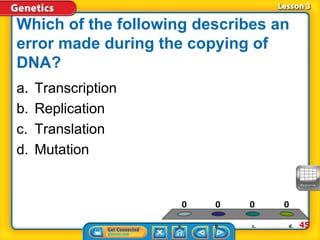
Which of the following describes an
error made during the copying of
DNA?
a. b. c. d.
0 000
a. Transcription
b. Replication
c. Translation
d. Mutation
45
• The effects of a mutation depend on where in
the DNA sequence the mutation happens and
the type of mutation.
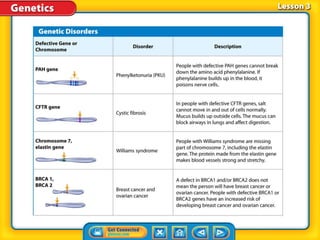
• Some mutations in human DNA cause
genetic disorders.
• Some mutations can be beneficial for the
organism, even helping it survive diseases.
– If a person only has 1 sickle cell allele (not both),
they are more resistant to malaria.
– If a person is born with Type AB blood, they can
accept donations from all other blood types.
3. How do changes in the sequence of DNA
affect traits?
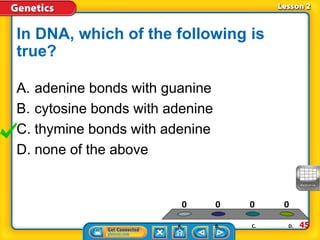
In DNA, which of the following is
true?
A. B. C. D.
0 000
A. adenine bonds with guanine
B. cytosine bonds with adenine
C. thymine bonds with adenine
D. none of the above
45

Ch. 5.3 DNA

  • 1.
  • 2.
    Before the 1950s,we knew that:  Inherited characteristics are determine by genes.  Genes are passed from one generation to the next.  Genes are part of a chromosome.  Cells divide. Before they divide, they have to copy their structures, organelles, & their genetic information. 1. What scientists contributed to our understanding of DNA?
  • 3.
    1. What scientistscontributed to our understanding of DNA?
  • 4.
    1. What isDNA? • An organism’s genetic material, made up of nucleotides • deoxyribonucleic acid • A gene is a segment of DNA on a chromosome that provides directions for making proteins. 1. What scientists contributed to our understanding of DNA?
  • 5.
    2. Rosalind Franklin (1920-1958) •Made significant advances in X-ray diffraction techniques with DNA • Her images showed that DNA had a spiral shape 1. What scientists contributed to our understanding of DNA?
  • 6.
    2. Maurice Wilkins(1916-2004) • Worked with Rosalind Franklin with X-ray diffraction studies of DNA • Shared info. with Watson & Crick 1. What scientists contributed to our understanding of DNA?
  • 7.
    Erwin Chargaff (1905-2002) •Investigated composition of DNA • In 1950, he discovered base- pairings of A-T & G-C 1. What scientists contributed to our understanding of DNA?
  • 8.
    3. James Watson(1928) & Francis Crick (1916-2004) • Worked together to determine DNA’s structure • Determined DNA’s double helix shape • Watson, Crick, & Wilkins were awarded the Nobel Prize in 1962 (Franklin passed away beforehand) 1. What scientists contributed to our understanding of DNA?
  • 9.
    4. DNA isshaped like a double helix, which is like a twisted ladder. 2. What is the structure of DNA?
  • 10.
    5. A nucleotideis a molecule made of:  Nitrogen base, • 6. There are 4 nitrogen bases: adenine (A), cytosine (C), thymine (T), and guanine (G) • Nitrogen bases bond and form the rungs of the ladder.  Sugar-phosphate group • Sugar-phosphate groups form the sides of the DNA ladder. 2. What is the structure of DNA?
  • 11.
    7. Certain basesalways bond together: A – T and C – G. 2. What is the structure of DNA? 8.
  • 12.
    DNA – Whatdoes my code look like? Computer Code: 10010100111010001100101001110010111100101001 00100100101110010100010101001001010010101001 0010100101001010100101001010010101010101001 010100101010111111100 DNA Code: ATTCGGGGCCTTAAGACATTAATTTCCCAAGAAGAG ATAAACTAGAGAGACCCTTTAAAACACACAGAGATA GACAGAAAAACAATAGACAGATACAGATAGACATAA AAAATTTTTTGGGAAA…millions and millions of bases…
  • 13.
    Practice DNA BasePairs A T T A C A C TT A A T
  • 14.
    9. Replication isthe process of copying a DNA molecule to make another DNA molecule. 2. What is the structure of DNA?
  • 15.
    DNA replication –helix unzips
  • 16.
    DNA replication –helix unzips
  • 17.
    DNA replication –two strands are separated
  • 18.
    DNA replication –each side is now a template
  • 19.
    DNA replication –two identical strands of DNA Original DNA strands
  • 20.
  • 21.
    10. Mutation occurswhen the sequence of nucleotides is changed in a gene.  Insertion – more added  Deletion – some deleted  Substitution – some swapped mutation from Latin mutare, means “to change” 3. How do changes in the sequence of DNA affect traits?
  • 22.
    • The 46human chromosomes contain between 20,000 and 25,000 genes that are copied during replication. • Mutations can be triggered by exposure to X-rays, ultraviolet light, radioactive materials, and some kinds of chemicals. 3. How do changes in the sequence of DNA affect traits?
  • 23.
    The 3 typesof mutations are substitution, insertion, and deletion. 3. How do changes in the sequence of DNA affect traits?
  • 24.
    Which of thefollowing describes the mutation that occurs when three base pairs are added? a. b. c. d. 0 000 a. Insertion b. Substitution c. Transgression d. Deletion 45
  • 25.
    Which of thefollowing describes an error made during the copying of DNA? a. b. c. d. 0 000 a. Transcription b. Replication c. Translation d. Mutation 45
  • 26.
    • The effectsof a mutation depend on where in the DNA sequence the mutation happens and the type of mutation. • Some mutations in human DNA cause genetic disorders. • Some mutations can be beneficial for the organism, even helping it survive diseases. – If a person only has 1 sickle cell allele (not both), they are more resistant to malaria. – If a person is born with Type AB blood, they can accept donations from all other blood types. 3. How do changes in the sequence of DNA affect traits?
  • 28.
    In DNA, whichof the following is true? A. B. C. D. 0 000 A. adenine bonds with guanine B. cytosine bonds with adenine C. thymine bonds with adenine D. none of the above 45