Evolution and Change
By iTutor.com
T- 1-855-694-8886
Email- info@iTutor.com
Chapter 1 • Evidence for Evolution
Evolution and Change
• Evidence for EvolutionChapter 1
Chapter 2
Chapter 3
• How Evolution Works
• Natural Selection
Evidence for Evolution
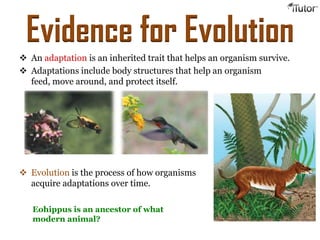
 An adaptation is an inherited trait that helps an organism survive.
 Adaptations include body structures that help an organism
feed, move around, and protect itself.
 Evolution is the process of how organisms
acquire adaptations over time.
Eohippus is an ancestor of what
modern animal?
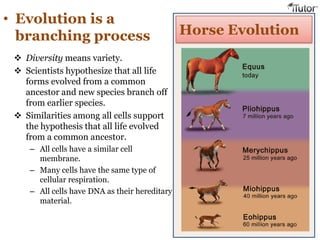
• Evolution is a
branching process Horse Evolution
 Diversity means variety.
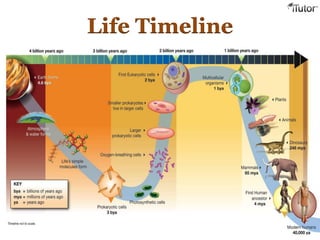
 Scientists hypothesize that all life
forms evolved from a common
ancestor and new species branch off
from earlier species.
 Similarities among all cells support
the hypothesis that all life evolved
from a common ancestor.
– All cells have a similar cell
membrane.
– Many cells have the same type of
cellular respiration.
– All cells have DNA as their hereditary
material.
Life Timeline
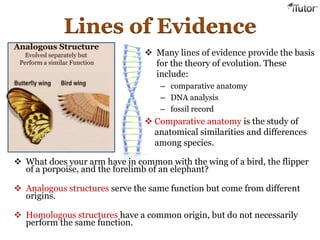
Lines of Evidence
Analogous Structure
Evolved separately but
Perform a similar Function
 Many lines of evidence provide the basis
for the theory of evolution. These
include:
– comparative anatomy
– DNA analysis
– fossil record
 Comparative anatomy is the study of
anatomical similarities and differences
among species.
 What does your arm have in common with the wing of a bird, the flipper
of a porpoise, and the forelimb of an elephant?
 Analogous structures serve the same function but come from different
origins.
 Homologous structures have a common origin, but do not necessarily
perform the same function.
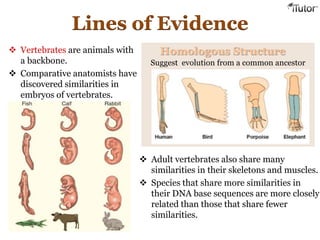
Homologous Structure
Suggest evolution from a common ancestor
Lines of Evidence
 Vertebrates are animals with
a backbone.
 Comparative anatomists have
discovered similarities in
embryos of vertebrates.
 Adult vertebrates also share many
similarities in their skeletons and muscles.
 Species that share more similarities in
their DNA base sequences are more closely
related than those that share fewer
similarities.
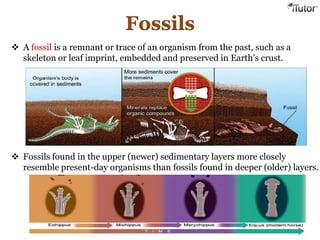
Fossils
 A fossil is a remnant or trace of an organism from the past, such as a
skeleton or leaf imprint, embedded and preserved in Earth’s crust.
 Fossils found in the upper (newer) sedimentary layers more closely
resemble present-day organisms than fossils found in deeper (older) layers.
The End
www.iTutor.com

Evolution and Changes

  • 1.
    Evolution and Change ByiTutor.com T- 1-855-694-8886 Email- info@iTutor.com Chapter 1 • Evidence for Evolution
  • 2.
    Evolution and Change •Evidence for EvolutionChapter 1 Chapter 2 Chapter 3 • How Evolution Works • Natural Selection
  • 3.
    Evidence for Evolution An adaptation is an inherited trait that helps an organism survive.  Adaptations include body structures that help an organism feed, move around, and protect itself.  Evolution is the process of how organisms acquire adaptations over time. Eohippus is an ancestor of what modern animal?
  • 4.
    • Evolution isa branching process Horse Evolution  Diversity means variety.  Scientists hypothesize that all life forms evolved from a common ancestor and new species branch off from earlier species.  Similarities among all cells support the hypothesis that all life evolved from a common ancestor. – All cells have a similar cell membrane. – Many cells have the same type of cellular respiration. – All cells have DNA as their hereditary material.
  • 5.
  • 6.
    Lines of Evidence AnalogousStructure Evolved separately but Perform a similar Function  Many lines of evidence provide the basis for the theory of evolution. These include: – comparative anatomy – DNA analysis – fossil record  Comparative anatomy is the study of anatomical similarities and differences among species.  What does your arm have in common with the wing of a bird, the flipper of a porpoise, and the forelimb of an elephant?  Analogous structures serve the same function but come from different origins.  Homologous structures have a common origin, but do not necessarily perform the same function.
  • 7.
    Homologous Structure Suggest evolutionfrom a common ancestor Lines of Evidence  Vertebrates are animals with a backbone.  Comparative anatomists have discovered similarities in embryos of vertebrates.  Adult vertebrates also share many similarities in their skeletons and muscles.  Species that share more similarities in their DNA base sequences are more closely related than those that share fewer similarities.
  • 8.
    Fossils  A fossilis a remnant or trace of an organism from the past, such as a skeleton or leaf imprint, embedded and preserved in Earth’s crust.  Fossils found in the upper (newer) sedimentary layers more closely resemble present-day organisms than fossils found in deeper (older) layers.
  • 9.