Chapter 05
Lecture and
Animation Outline
Copyright © The McGraw-Hill Companies, Inc. Permission required for reproduction or display.
To run the animations you must be in Slideshow View. Use
the buttons on the animation to play, pause, and turn
audio/text on or off.
Please Note: Once you have used any of the animation
functions (such as Play or Pause), you must first click on the
slide’s background before you can advance to the next slide.
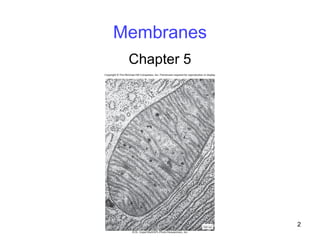
Membranes
Chapter 5
2
3
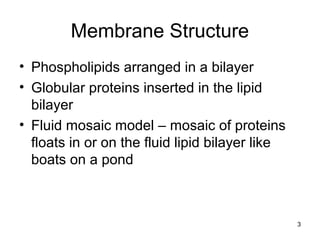
Membrane Structure
• Phospholipids arranged in a bilayer
• Globular proteins inserted in the lipid
bilayer
• Fluid mosaic model – mosaic of proteins
floats in or on the fluid lipid bilayer like
boats on a pond
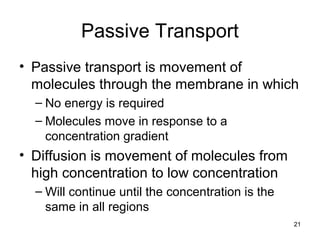
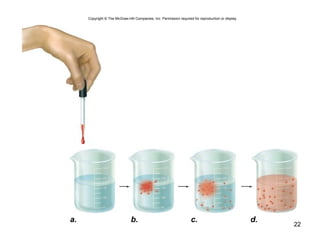
4
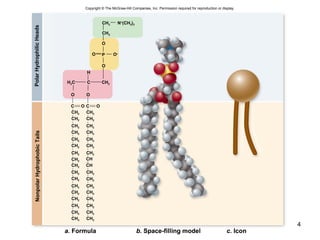
PolarHydrophilicHeadsNonpolarHydrophobicTails
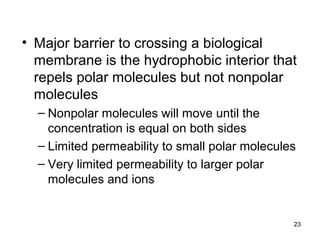
CH2
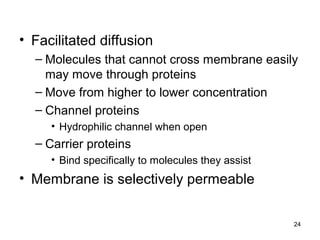
CH2
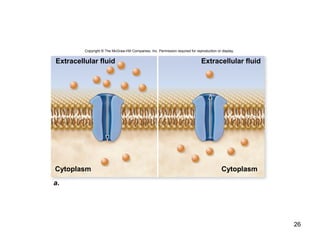
N+
(CH3)3
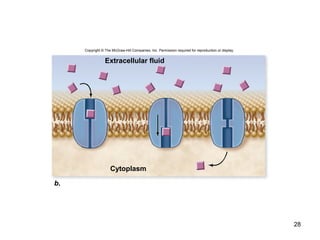
O
P
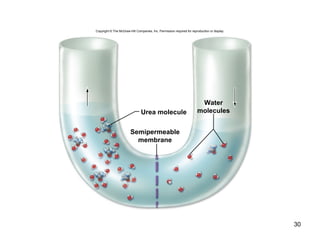
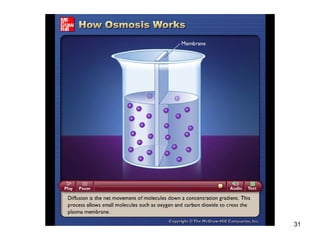
O
O–O
CH2H2C C
O O
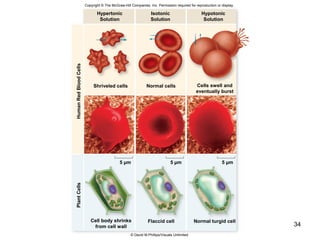
O OC C
CH2 CH2
CH2 CH2
CH2 CH2
CH2 CH2
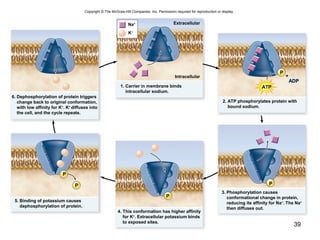
CH2 CH2
CH2 CH2
CH2 CH2
CH2
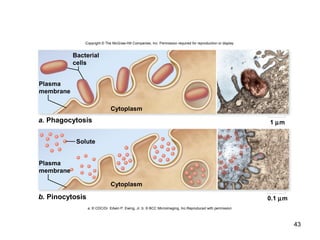
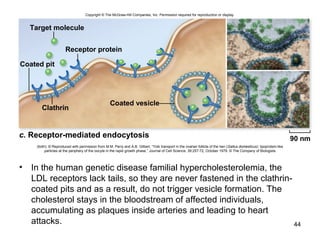
CH
CH2 CH
CH2 CH2
CH2 CH2
CH2 CH2
CH2 CH2
CH2 CH2
CH2 CH2
CH2 CH2
CH3 CH3
H
b. Space-filling modela. Formula c. Iconb. Space-filling modela. Formula c. Icon
Copyright © The McGraw-Hill Companies, Inc. Permission required for reproduction or display.
5
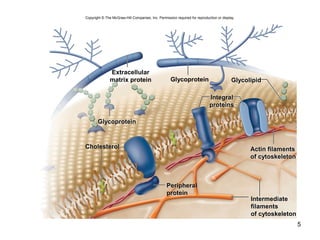
Copyright © The McGraw-Hill Companies, Inc. Permission required for reproduction or display.
Glycoprotein
Extracellular
matrix protein Glycolipid
Cholesterol
Glycoprotein
Integral
proteins
Actin filaments
of cytoskeleton
Intermediate
filaments
of cytoskeleton
Peripheral
protein
Peripheral
protein
Glycolipid
Cholesterol
Glycoprotein
Integral
proteins
Actin filaments
of cytoskeleton
Intermediate
filaments
of cytoskeleton
6
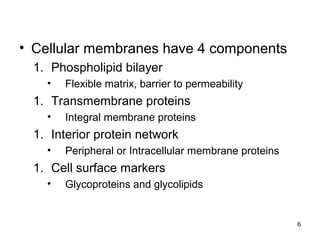
• Cellular membranes have 4 components
1. Phospholipid bilayer
• Flexible matrix, barrier to permeability
1. Transmembrane proteins
• Integral membrane proteins
1. Interior protein network
• Peripheral or Intracellular membrane proteins
1. Cell surface markers
• Glycoproteins and glycolipids
7
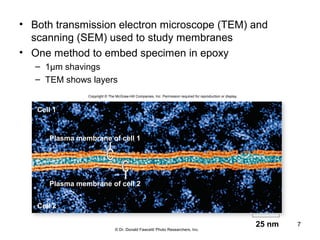
• Both transmission electron microscope (TEM) and
scanning (SEM) used to study membranes
• One method to embed specimen in epoxy
– 1µm shavings
– TEM shows layers
Copyright © The McGraw-Hill Companies, Inc. Permission required for reproduction or display.
Plasma membrane of cell 1
Plasma membrane of cell 2
Cell 1
Cell 2
25 nm
© Dr. Donald Fawcett/ Photo Researchers, Inc.
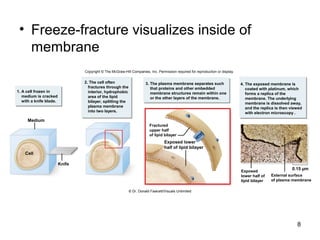
• Freeze-fracture visualizes inside of
membrane
8
Knife
Cell
Medium
2. The cell often
fractures through the
interior, hydrophobic
area of the lipid
bilayer, splitting the
plasma membrane
into two layers.
3. The plasma membrane separates such
that proteins and other embedded
membrane structures remain within one
or the other layers of the membrane.
4. The exposed membrane is
coated with platinum, which
forms a replica of the
membrane. The underlying
membrane is dissolved away,
and the replica is then viewed
with electron microscopy .
Fractured
upper half
of lipid bilayer
Exposed lower
half of lipid bilayer
Exposed
lower half of
lipid bilayer
External surface
of plasma membrane
0.15 µm
1. A cell frozen in
medium is cracked
with a knife blade.
Copyright © The McGraw-Hill Companies, Inc. Permission required for reproduction or display.
© Dr. Donald Fawcett/Visuals Unlimited
9
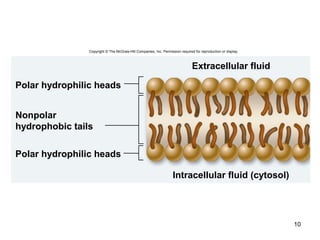
Phospholipids
• Structure consists of
– Glycerol – a 3-carbon polyalcohol
– 2 fatty acids attached to the glycerol
• Nonpolar and hydrophobic (“water-fearing”)
– Phosphate group attached to the glycerol
• Polar and hydrophilic (“water-loving”)
• Spontaneously forms a bilayer
– Fatty acids are on the inside
– Phosphate groups are on both surfaces
10
Copyright © The McGraw-Hill Companies, Inc. Permission required for reproduction or display.
Plasma membrane of cell 1
Cell 1
Cell 2
Polar hydrophilic heads
Extracellular fluid
Intracellular fluid (cytosol)
Nonpolar
hydrophobic tails
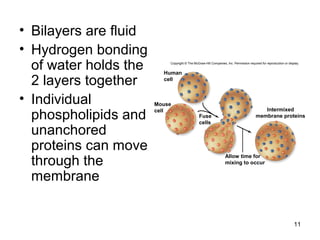
• Bilayers are fluid
• Hydrogen bonding
of water holds the
2 layers together
• Individual
phospholipids and
unanchored
proteins can move
through the
membrane
11
Copyright © The McGraw-Hill Companies, Inc. Permission required for reproduction or display.
Mouse
cell
Fuse
cells
Intermixed
membrane proteins
Allow time for
mixing to occur
Human
cell
• Environmental influences on fluidity
– Saturated fatty acids make the membrane
less fluid than unsaturated fatty acids
• “Kinks” introduced by the double bonds keep them
from packing tightly
• Most membranes also contain sterols such as
cholesterol, which can either increase or decrease
membrane fluidity, depending on the temperature
– Warm temperatures make the membrane
more fluid than cold temperatures
• Cold tolerance in bacteria due to fatty acid
desaturases
12
13
Membrane Proteins
• Various functions:
1. Transporters
2. Enzymes
3. Cell-surface receptors
4. Cell-surface identity markers
5. Cell-to-cell adhesion proteins
6. Attachments to the cytoskeleton
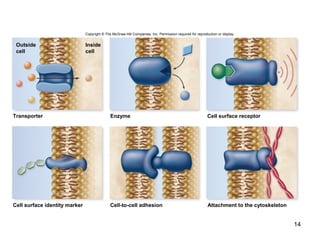
14
Copyright © The McGraw-Hill Companies, Inc. Permission required for reproduction or display.
Enzyme Cell surface receptor
Cell surface identity marker Cell-to-cell adhesion Attachment to the cytoskeleton
Outside
cell
Inside
cell
Transporter
15
Structure relates to function
• Diverse functions arise from the diverse
structures of membrane proteins
• Have common structural features related
to their role as membrane proteins
• Peripheral proteins
– Anchoring molecules attach membrane
protein to surface
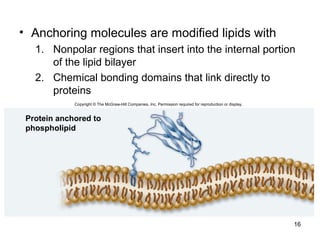
• Anchoring molecules are modified lipids with
1. Nonpolar regions that insert into the internal portion
of the lipid bilayer
2. Chemical bonding domains that link directly to
proteins
16
Protein anchored to
phospholipid
Copyright © The McGraw-Hill Companies, Inc. Permission required for reproduction or display.
17
• Integral membrane proteins
– Span the lipid bilayer (transmembrane
proteins)
• Nonpolar regions of the protein are embedded in
the interior of the bilayer
• Polar regions of the protein protrude from both
sides of the bilayer
– Transmembrane domain
• Spans the lipid bilayer
• Hydrophobic amino acids arranged in α helices
Membrane Proteins
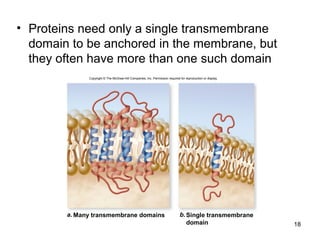
• Proteins need only a single transmembrane
domain to be anchored in the membrane, but
they often have more than one such domain
18
a. b.
Copyright © The McGraw-Hill Companies, Inc. Permission required for reproduction or display.
Single transmembrane
domain
Many transmembrane domains
19
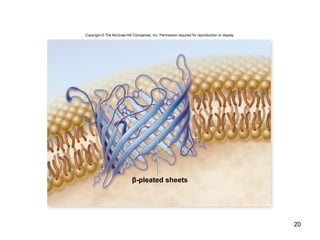
• Pores
– Extensive nonpolar regions within a
transmembrane protein can create a pore
through the membrane
– Cylinder of β sheets in the protein secondary
structure called a β-barrel
• Interior is polar and allows water and small polar
molecules to pass through the membrane
20
Copyright © The McGraw-Hill Companies, Inc. Permission required for reproduction or display.
β-pleated sheets
21
Passive Transport
• Passive transport is movement of
molecules through the membrane in which
– No energy is required
– Molecules move in response to a
concentration gradient
• Diffusion is movement of molecules from
high concentration to low concentration
– Will continue until the concentration is the
same in all regions
22
Copyright © The McGraw-Hill Companies, Inc. Permission required for reproduction or display.
a. b. c. d.
23
• Major barrier to crossing a biological
membrane is the hydrophobic interior that
repels polar molecules but not nonpolar
molecules
– Nonpolar molecules will move until the
concentration is equal on both sides
– Limited permeability to small polar molecules
– Very limited permeability to larger polar
molecules and ions
• Facilitated diffusion
– Molecules that cannot cross membrane easily
may move through proteins
– Move from higher to lower concentration
– Channel proteins
• Hydrophilic channel when open
– Carrier proteins
• Bind specifically to molecules they assist
• Membrane is selectively permeable
24
25
Channel proteins
• Ion channels
– Allow the passage of ions
– Gated channels – open or close in response
to stimulus (chemical or electrical)
– 3 conditions determine direction
• Relative concentration on either side of membrane
• Voltage differences across membrane
• Gated channels – channel open or closed
26
Copyright © The McGraw-Hill Companies, Inc. Permission required for reproduction or display.
Extracellular fluid Extracellular fluid
Cytoplasm
a.
Cytoplasm
27
Carrier proteins
• Can help transport both ions and other
solutes, such as some sugars and amino
acids
• Requires a concentration difference
across the membrane
• Must bind to the molecule they transport
– Saturation – rate of transport limited by
number of transporters
28
Copyright © The McGraw-Hill Companies, Inc. Permission required for reproduction or display.
b.
Extracellular fluid
Cytoplasm
29
Osmosis
• Cytoplasm of the cell is an aqueous
solution
– Water is solvent
– Dissolved substances are solutes
• Osmosis – net diffusion of water across a
membrane toward a higher solute
concentration
30
Urea molecule
Semipermeable
membrane
Water
molecules
Copyright © The McGraw-Hill Companies, Inc. Permission required for reproduction or display.
31
Please note that due to differing
operating systems, some animations
will not appear until the presentation is
viewed in Presentation Mode (Slide
Show view). You may see blank slides
in the “Normal” or “Slide Sorter” views.
All animations will appear after viewing
in Presentation Mode and playing each
animation. Most animations will require
the latest version of the Flash Player,
which is available at
http://get.adobe.com/flashplayer.
32
Osmotic concentration
• When 2 solutions have different osmotic
concentrations
– Hypertonic solution has a higher solute concentration
– Hypotonic solution has a lower solute concentration
• When two solutions have the same osmotic
concentration, the solutions are isotonic
• Aquaporins facilitate osmosis
Osmotic pressure
• Force needed to stop osmotic flow
• Cell in a hypotonic solution gains water causing
cell to swell – creates pressure
• If membrane strong enough, cell reaches
counterbalance of osmotic pressure driving
water in with hydrostatic pressure driving water
out
– Cell wall of prokaryotes, fungi, plants, protists
• If membrane is not strong, may burst
– Animal cells must be in isotonic environments
33
34
HumanRedBloodCellsPlantCells
Shriveled cells Normal cells
Flaccid cell Normal turgid cell
Hypertonic
Solution
Isotonic
Solution
Hypotonic
Solution
Cells swell and
eventually burst
Cell body shrinks
from cell wall
© David M.Phillips/Visuals Unlimited
Copyright © The McGraw-Hill Companies, Inc. Permission required for reproduction or display.
5 µm 5 µm 5 µm
35
Maintaining osmotic balance
• Some cells use extrusion in which water is
ejected through contractile vacuoles
• Isosmotic regulation involves keeping cells
isotonic with their environment
– Marine organisms adjust internal
concentration to match sea water
– Terrestrial animals circulate isotonic fluid
• Plant cells use turgor pressure to push the
cell membrane against the cell wall and
keep the cell rigid
36
Active Transport
• Requires energy – ATP is used directly or
indirectly to fuel active transport
• Moves substances from low to high
concentration
• Requires the use of highly selective carrier
proteins
37
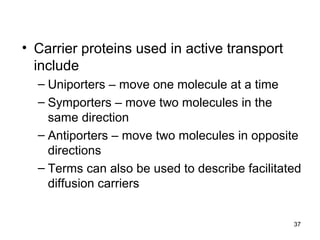
• Carrier proteins used in active transport
include
– Uniporters – move one molecule at a time
– Symporters – move two molecules in the
same direction
– Antiporters – move two molecules in opposite
directions
– Terms can also be used to describe facilitated
diffusion carriers
38
Sodium–potassium (Na+
–K+
) pump
• Direct use of ATP for active transport
• Uses an antiporter to move 3 Na+
out of
the cell and 2 K+
into the cell
– Against their concentration gradient
• ATP energy is used to change the
conformation of the carrier protein
• Affinity of the carrier protein for either Na+
or K+
changes so the ions can be carried
across the membrane
39
Copyright © The McGraw-Hill Companies, Inc. Permission required for reproduction or display.
Na+
K+
6. Dephosphorylation of protein triggers
change back to original conformation,
with low affinity for K+
. K+
diffuses into
the cell, and the cycle repeats.
1. Carrier in membrane binds
intracellular sodium.
2. ATP phosphorylates protein with
bound sodium.
5. Binding of potassium causes
dephosphorylation of protein.
4. This conformation has higher affinity
for K+
. Extracellular potassium binds
to exposed sites.
3. Phosphorylation causes
conformational change in protein,
reducing its affinity for Na+
. The Na+
then diffuses out.
P
P
P
P
P
ATP
+
ADP
Extracellular
Intracellular
40
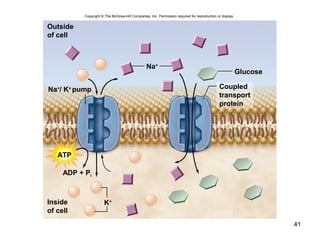
Coupled transport
• Uses ATP indirectly
• Uses the energy released when a
molecule moves by diffusion to supply
energy to active transport of a different
molecule
• Symporter is used
• Glucose–Na+
symporter captures the
energy from Na+
diffusion to move glucose
against a concentration gradient
41
Na+
/ K+
pump
Na+
Glucose
K+
Outside
of cell
ATP
ADP + Pi
Inside
of cell
Copyright © The McGraw-Hill Companies, Inc. Permission required for reproduction or display.
Coupled
transport
protein
Bulk Transport
• Endocytosis
– Movement of substances into the cell
– Phagocytosis – cell takes in particulate matter
– Pinocytosis – cell takes in only fluid
– Receptor-mediated endocytosis – specific
molecules are taken in after they bind to a receptor
• Exocytosis
– Movement of substances out of cell
– Requires energy
42
43
Cytoplasm
Cytoplasm
0.1 µm
1 µm
Solute
Bacterial
cells
Plasma
membrane
a. Phagocytosis
Plasma
membrane
b. Pinocytosis
Copyright © The McGraw-Hill Companies, Inc. Permission required for reproduction or display.
a: © CDC/Dr. Edwin P. Ewing, Jr. b: © BCC Microimaging, Inc.Reproduced with permission
• In the human genetic disease familial hypercholesterolemia, the
LDL receptors lack tails, so they are never fastened in the clathrin-
coated pits and as a result, do not trigger vesicle formation. The
cholesterol stays in the bloodstream of affected individuals,
accumulating as plaques inside arteries and leading to heart
attacks. 44
Receptor protein
Coated pit
Clathrin
Coated vesicle
90 nm
Target molecule
c. Receptor-mediated endocytosis
Copyright © The McGraw-Hill Companies, Inc. Permission required for reproduction or display.
(both): © Reproduced with permission from M.M. Perry and A.B. Gilbert, “Yolk transport in the ovarian follicle of the hen (Gallus domesticus): lipoprotein-like
particles at the periphery of the oocyte in the rapid growth phase,” Journal of Cell Science, 39:257-72, October 1979. © The Company of Biologists
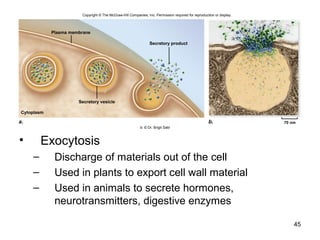
• Exocytosis
– Discharge of materials out of the cell
– Used in plants to export cell wall material
– Used in animals to secrete hormones,
neurotransmitters, digestive enzymes
45
a. b.
Plasma membrane
Secretory vesicle
Secretory product
Cytoplasm
70 nm
Copyright © The McGraw-Hill Companies, Inc. Permission required for reproduction or display.
b: © Dr. Brigit Satir

Ch 5 PowerPoint Biology 201

  • 1.
    Chapter 05 Lecture and AnimationOutline Copyright © The McGraw-Hill Companies, Inc. Permission required for reproduction or display. To run the animations you must be in Slideshow View. Use the buttons on the animation to play, pause, and turn audio/text on or off. Please Note: Once you have used any of the animation functions (such as Play or Pause), you must first click on the slide’s background before you can advance to the next slide.
  • 2.
  • 3.
    3 Membrane Structure • Phospholipidsarranged in a bilayer • Globular proteins inserted in the lipid bilayer • Fluid mosaic model – mosaic of proteins floats in or on the fluid lipid bilayer like boats on a pond
  • 4.
    4 PolarHydrophilicHeadsNonpolarHydrophobicTails CH2 CH2 N+ (CH3)3 O P O O–O CH2H2C C O O OOC C CH2 CH2 CH2 CH2 CH2 CH2 CH2 CH2 CH2 CH2 CH2 CH2 CH2 CH2 CH2 CH CH2 CH CH2 CH2 CH2 CH2 CH2 CH2 CH2 CH2 CH2 CH2 CH2 CH2 CH2 CH2 CH3 CH3 H b. Space-filling modela. Formula c. Iconb. Space-filling modela. Formula c. Icon Copyright © The McGraw-Hill Companies, Inc. Permission required for reproduction or display.
  • 5.
    5 Copyright © TheMcGraw-Hill Companies, Inc. Permission required for reproduction or display. Glycoprotein Extracellular matrix protein Glycolipid Cholesterol Glycoprotein Integral proteins Actin filaments of cytoskeleton Intermediate filaments of cytoskeleton Peripheral protein Peripheral protein Glycolipid Cholesterol Glycoprotein Integral proteins Actin filaments of cytoskeleton Intermediate filaments of cytoskeleton
  • 6.
    6 • Cellular membraneshave 4 components 1. Phospholipid bilayer • Flexible matrix, barrier to permeability 1. Transmembrane proteins • Integral membrane proteins 1. Interior protein network • Peripheral or Intracellular membrane proteins 1. Cell surface markers • Glycoproteins and glycolipids
  • 7.
    7 • Both transmissionelectron microscope (TEM) and scanning (SEM) used to study membranes • One method to embed specimen in epoxy – 1µm shavings – TEM shows layers Copyright © The McGraw-Hill Companies, Inc. Permission required for reproduction or display. Plasma membrane of cell 1 Plasma membrane of cell 2 Cell 1 Cell 2 25 nm © Dr. Donald Fawcett/ Photo Researchers, Inc.
  • 8.
    • Freeze-fracture visualizesinside of membrane 8 Knife Cell Medium 2. The cell often fractures through the interior, hydrophobic area of the lipid bilayer, splitting the plasma membrane into two layers. 3. The plasma membrane separates such that proteins and other embedded membrane structures remain within one or the other layers of the membrane. 4. The exposed membrane is coated with platinum, which forms a replica of the membrane. The underlying membrane is dissolved away, and the replica is then viewed with electron microscopy . Fractured upper half of lipid bilayer Exposed lower half of lipid bilayer Exposed lower half of lipid bilayer External surface of plasma membrane 0.15 µm 1. A cell frozen in medium is cracked with a knife blade. Copyright © The McGraw-Hill Companies, Inc. Permission required for reproduction or display. © Dr. Donald Fawcett/Visuals Unlimited
  • 9.
    9 Phospholipids • Structure consistsof – Glycerol – a 3-carbon polyalcohol – 2 fatty acids attached to the glycerol • Nonpolar and hydrophobic (“water-fearing”) – Phosphate group attached to the glycerol • Polar and hydrophilic (“water-loving”) • Spontaneously forms a bilayer – Fatty acids are on the inside – Phosphate groups are on both surfaces
  • 10.
    10 Copyright © TheMcGraw-Hill Companies, Inc. Permission required for reproduction or display. Plasma membrane of cell 1 Cell 1 Cell 2 Polar hydrophilic heads Polar hydrophilic heads Extracellular fluid Intracellular fluid (cytosol) Nonpolar hydrophobic tails
  • 11.
    • Bilayers arefluid • Hydrogen bonding of water holds the 2 layers together • Individual phospholipids and unanchored proteins can move through the membrane 11 Copyright © The McGraw-Hill Companies, Inc. Permission required for reproduction or display. Mouse cell Fuse cells Intermixed membrane proteins Allow time for mixing to occur Human cell
  • 12.
    • Environmental influenceson fluidity – Saturated fatty acids make the membrane less fluid than unsaturated fatty acids • “Kinks” introduced by the double bonds keep them from packing tightly • Most membranes also contain sterols such as cholesterol, which can either increase or decrease membrane fluidity, depending on the temperature – Warm temperatures make the membrane more fluid than cold temperatures • Cold tolerance in bacteria due to fatty acid desaturases 12
  • 13.
    13 Membrane Proteins • Variousfunctions: 1. Transporters 2. Enzymes 3. Cell-surface receptors 4. Cell-surface identity markers 5. Cell-to-cell adhesion proteins 6. Attachments to the cytoskeleton
  • 14.
    14 Copyright © TheMcGraw-Hill Companies, Inc. Permission required for reproduction or display. Enzyme Cell surface receptor Cell surface identity marker Cell-to-cell adhesion Attachment to the cytoskeleton Outside cell Inside cell Transporter
  • 15.
    15 Structure relates tofunction • Diverse functions arise from the diverse structures of membrane proteins • Have common structural features related to their role as membrane proteins • Peripheral proteins – Anchoring molecules attach membrane protein to surface
  • 16.
    • Anchoring moleculesare modified lipids with 1. Nonpolar regions that insert into the internal portion of the lipid bilayer 2. Chemical bonding domains that link directly to proteins 16 Protein anchored to phospholipid Copyright © The McGraw-Hill Companies, Inc. Permission required for reproduction or display.
  • 17.
    17 • Integral membraneproteins – Span the lipid bilayer (transmembrane proteins) • Nonpolar regions of the protein are embedded in the interior of the bilayer • Polar regions of the protein protrude from both sides of the bilayer – Transmembrane domain • Spans the lipid bilayer • Hydrophobic amino acids arranged in α helices Membrane Proteins
  • 18.
    • Proteins needonly a single transmembrane domain to be anchored in the membrane, but they often have more than one such domain 18 a. b. Copyright © The McGraw-Hill Companies, Inc. Permission required for reproduction or display. Single transmembrane domain Many transmembrane domains
  • 19.
    19 • Pores – Extensivenonpolar regions within a transmembrane protein can create a pore through the membrane – Cylinder of β sheets in the protein secondary structure called a β-barrel • Interior is polar and allows water and small polar molecules to pass through the membrane
  • 20.
    20 Copyright © TheMcGraw-Hill Companies, Inc. Permission required for reproduction or display. β-pleated sheets
  • 21.
    21 Passive Transport • Passivetransport is movement of molecules through the membrane in which – No energy is required – Molecules move in response to a concentration gradient • Diffusion is movement of molecules from high concentration to low concentration – Will continue until the concentration is the same in all regions
  • 22.
    22 Copyright © TheMcGraw-Hill Companies, Inc. Permission required for reproduction or display. a. b. c. d.
  • 23.
    23 • Major barrierto crossing a biological membrane is the hydrophobic interior that repels polar molecules but not nonpolar molecules – Nonpolar molecules will move until the concentration is equal on both sides – Limited permeability to small polar molecules – Very limited permeability to larger polar molecules and ions
  • 24.
    • Facilitated diffusion –Molecules that cannot cross membrane easily may move through proteins – Move from higher to lower concentration – Channel proteins • Hydrophilic channel when open – Carrier proteins • Bind specifically to molecules they assist • Membrane is selectively permeable 24
  • 25.
    25 Channel proteins • Ionchannels – Allow the passage of ions – Gated channels – open or close in response to stimulus (chemical or electrical) – 3 conditions determine direction • Relative concentration on either side of membrane • Voltage differences across membrane • Gated channels – channel open or closed
  • 26.
    26 Copyright © TheMcGraw-Hill Companies, Inc. Permission required for reproduction or display. Extracellular fluid Extracellular fluid Cytoplasm a. Cytoplasm
  • 27.
    27 Carrier proteins • Canhelp transport both ions and other solutes, such as some sugars and amino acids • Requires a concentration difference across the membrane • Must bind to the molecule they transport – Saturation – rate of transport limited by number of transporters
  • 28.
    28 Copyright © TheMcGraw-Hill Companies, Inc. Permission required for reproduction or display. b. Extracellular fluid Cytoplasm
  • 29.
    29 Osmosis • Cytoplasm ofthe cell is an aqueous solution – Water is solvent – Dissolved substances are solutes • Osmosis – net diffusion of water across a membrane toward a higher solute concentration
  • 30.
    30 Urea molecule Semipermeable membrane Water molecules Copyright ©The McGraw-Hill Companies, Inc. Permission required for reproduction or display.
  • 31.
    31 Please note thatdue to differing operating systems, some animations will not appear until the presentation is viewed in Presentation Mode (Slide Show view). You may see blank slides in the “Normal” or “Slide Sorter” views. All animations will appear after viewing in Presentation Mode and playing each animation. Most animations will require the latest version of the Flash Player, which is available at http://get.adobe.com/flashplayer.
  • 32.
    32 Osmotic concentration • When2 solutions have different osmotic concentrations – Hypertonic solution has a higher solute concentration – Hypotonic solution has a lower solute concentration • When two solutions have the same osmotic concentration, the solutions are isotonic • Aquaporins facilitate osmosis
  • 33.
    Osmotic pressure • Forceneeded to stop osmotic flow • Cell in a hypotonic solution gains water causing cell to swell – creates pressure • If membrane strong enough, cell reaches counterbalance of osmotic pressure driving water in with hydrostatic pressure driving water out – Cell wall of prokaryotes, fungi, plants, protists • If membrane is not strong, may burst – Animal cells must be in isotonic environments 33
  • 34.
    34 HumanRedBloodCellsPlantCells Shriveled cells Normalcells Flaccid cell Normal turgid cell Hypertonic Solution Isotonic Solution Hypotonic Solution Cells swell and eventually burst Cell body shrinks from cell wall © David M.Phillips/Visuals Unlimited Copyright © The McGraw-Hill Companies, Inc. Permission required for reproduction or display. 5 µm 5 µm 5 µm
  • 35.
    35 Maintaining osmotic balance •Some cells use extrusion in which water is ejected through contractile vacuoles • Isosmotic regulation involves keeping cells isotonic with their environment – Marine organisms adjust internal concentration to match sea water – Terrestrial animals circulate isotonic fluid • Plant cells use turgor pressure to push the cell membrane against the cell wall and keep the cell rigid
  • 36.
    36 Active Transport • Requiresenergy – ATP is used directly or indirectly to fuel active transport • Moves substances from low to high concentration • Requires the use of highly selective carrier proteins
  • 37.
    37 • Carrier proteinsused in active transport include – Uniporters – move one molecule at a time – Symporters – move two molecules in the same direction – Antiporters – move two molecules in opposite directions – Terms can also be used to describe facilitated diffusion carriers
  • 38.
    38 Sodium–potassium (Na+ –K+ ) pump •Direct use of ATP for active transport • Uses an antiporter to move 3 Na+ out of the cell and 2 K+ into the cell – Against their concentration gradient • ATP energy is used to change the conformation of the carrier protein • Affinity of the carrier protein for either Na+ or K+ changes so the ions can be carried across the membrane
  • 39.
    39 Copyright © TheMcGraw-Hill Companies, Inc. Permission required for reproduction or display. Na+ K+ 6. Dephosphorylation of protein triggers change back to original conformation, with low affinity for K+ . K+ diffuses into the cell, and the cycle repeats. 1. Carrier in membrane binds intracellular sodium. 2. ATP phosphorylates protein with bound sodium. 5. Binding of potassium causes dephosphorylation of protein. 4. This conformation has higher affinity for K+ . Extracellular potassium binds to exposed sites. 3. Phosphorylation causes conformational change in protein, reducing its affinity for Na+ . The Na+ then diffuses out. P P P P P ATP + ADP Extracellular Intracellular
  • 40.
    40 Coupled transport • UsesATP indirectly • Uses the energy released when a molecule moves by diffusion to supply energy to active transport of a different molecule • Symporter is used • Glucose–Na+ symporter captures the energy from Na+ diffusion to move glucose against a concentration gradient
  • 41.
    41 Na+ / K+ pump Na+ Glucose K+ Outside of cell ATP ADP+ Pi Inside of cell Copyright © The McGraw-Hill Companies, Inc. Permission required for reproduction or display. Coupled transport protein
  • 42.
    Bulk Transport • Endocytosis –Movement of substances into the cell – Phagocytosis – cell takes in particulate matter – Pinocytosis – cell takes in only fluid – Receptor-mediated endocytosis – specific molecules are taken in after they bind to a receptor • Exocytosis – Movement of substances out of cell – Requires energy 42
  • 43.
    43 Cytoplasm Cytoplasm 0.1 µm 1 µm Solute Bacterial cells Plasma membrane a.Phagocytosis Plasma membrane b. Pinocytosis Copyright © The McGraw-Hill Companies, Inc. Permission required for reproduction or display. a: © CDC/Dr. Edwin P. Ewing, Jr. b: © BCC Microimaging, Inc.Reproduced with permission
  • 44.
    • In thehuman genetic disease familial hypercholesterolemia, the LDL receptors lack tails, so they are never fastened in the clathrin- coated pits and as a result, do not trigger vesicle formation. The cholesterol stays in the bloodstream of affected individuals, accumulating as plaques inside arteries and leading to heart attacks. 44 Receptor protein Coated pit Clathrin Coated vesicle 90 nm Target molecule c. Receptor-mediated endocytosis Copyright © The McGraw-Hill Companies, Inc. Permission required for reproduction or display. (both): © Reproduced with permission from M.M. Perry and A.B. Gilbert, “Yolk transport in the ovarian follicle of the hen (Gallus domesticus): lipoprotein-like particles at the periphery of the oocyte in the rapid growth phase,” Journal of Cell Science, 39:257-72, October 1979. © The Company of Biologists
  • 45.
    • Exocytosis – Dischargeof materials out of the cell – Used in plants to export cell wall material – Used in animals to secrete hormones, neurotransmitters, digestive enzymes 45 a. b. Plasma membrane Secretory vesicle Secretory product Cytoplasm 70 nm Copyright © The McGraw-Hill Companies, Inc. Permission required for reproduction or display. b: © Dr. Brigit Satir