Cells
Structure and Function
ทนพ. สุวิทย์ คล่องทะเล
วท.บ. (เทคนิคการแพทย์) เกียรตินิยม
มหาวิทยาลัยมหิดล
1
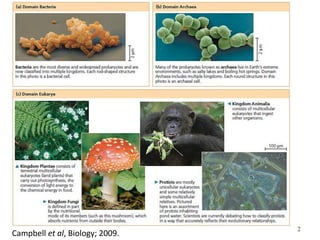
2Campbell et al, Biology; 2009.
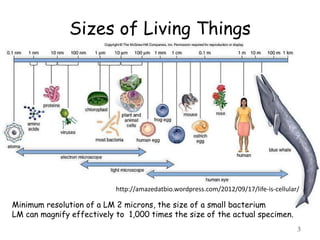
Sizes of Living Things
3
Minimum resolution of a LM 2 microns, the size of a small bacterium
LM can magnify effectively to 1,000 times the size of the actual specimen.
http://amazedatbio.wordpress.com/2012/09/17/life-is-cellular/
Properties of life
 Reproduction :
o sexual : genetic variation, fertilization
o asexual : genetically identical, e.g. sporulation, budding,
regeneration, binary fission
 Metabolism : anabolism Vs. catabolism
 Growth and Development
 Response to environment
 Homeostasis : regulated via organ system
 Organization : Cell, tissue, organ, organ system, organism
o acellular
o unicellular : bacteria, yeast
o multicellular : plant, animal
4
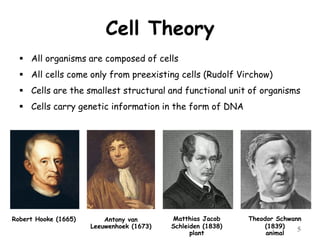
Cell Theory
 All organisms are composed of cells
 All cells come only from preexisting cells (Rudolf Virchow)
 Cells are the smallest structural and functional unit of organisms
 Cells carry genetic information in the form of DNA
5
Robert Hooke (1665) Matthias Jacob
Schleiden (1838)
plant
Theodor Schwann
(1839)
animal
Antony van
Leeuwenhoek (1673)
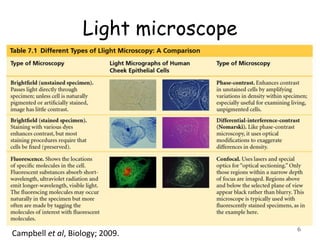
Light microscope
6Campbell et al, Biology; 2009.
Electron microscope
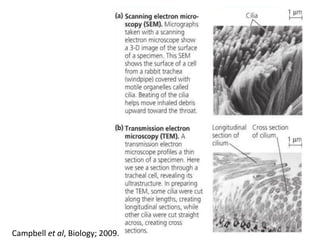
 To resolve smaller structures we use EM, which focuses a beam
of electrons through the specimen (TEM) or onto its surface
(SEM)
 TEM are used to study the internal ultrastructure of cells.
 A TEM aims an electron beam through a thin section of the
specimen.
o The image is focused and magnified by electromagnets.
o To enhance contrast, the thin sections are stained with
atoms of heavy metals.
 SEM are useful for studying surface structures.
 The SEM has great depth of field, resulting in an image that
seems three-dimensional.
7
8Campbell et al, Biology; 2009.
Prokaryotic and eukaryotic cells
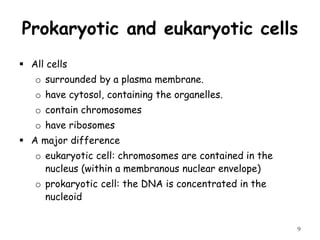
 All cells
o surrounded by a plasma membrane.
o have cytosol, containing the organelles.
o contain chromosomes
o have ribosomes
 A major difference
o eukaryotic cell: chromosomes are contained in the
nucleus (within a membranous nuclear envelope)
o prokaryotic cell: the DNA is concentrated in the
nucleoid
9
A major difference...
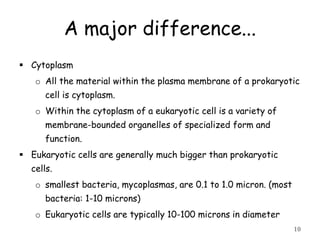
 Cytoplasm
o All the material within the plasma membrane of a prokaryotic
cell is cytoplasm.
o Within the cytoplasm of a eukaryotic cell is a variety of
membrane-bounded organelles of specialized form and
function.
 Eukaryotic cells are generally much bigger than prokaryotic
cells.
o smallest bacteria, mycoplasmas, are 0.1 to 1.0 micron. (most
bacteria: 1-10 microns)
o Eukaryotic cells are typically 10-100 microns in diameter
10
11
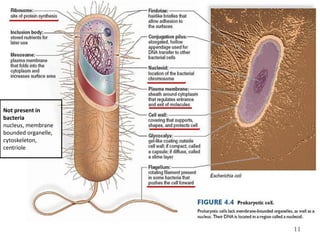
Not present in
bacteria
nucleus, membrane
bounded organelle,
cytoskeleton,
centriole
12
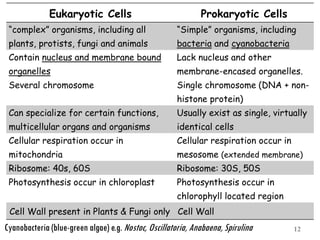
Eukaryotic Cells Prokaryotic Cells
“complex” organisms, including all
plants, protists, fungi and animals
“Simple” organisms, including
bacteria and cyanobacteria
Contain nucleus and membrane bound
organelles
Several chromosome
Lack nucleus and other
membrane-encased organelles.
Single chromosome (DNA + non-
histone protein)
Can specialize for certain functions,
multicellular organs and organisms
Usually exist as single, virtually
identical cells
Cellular respiration occur in
mitochondria
Cellular respiration occur in
mesosome (extended membrane)
Ribosome: 40s, 60S Ribosome: 30S, 50S
Photosynthesis occur in chloroplast Photosynthesis occur in
chlorophyll located region
Cell Wall present in Plants & Fungi only Cell Wall
Cyanobacteria (blue-green algae) e.g. Nostoc, Oscillatoria, Anabaena, Spirulina
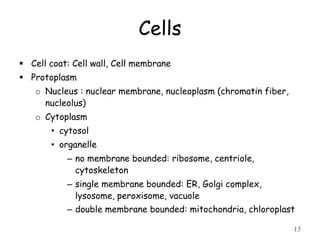
Cells
 Cell coat: Cell wall, Cell membrane
 Protoplasm
o Nucleus : nuclear membrane, nucleoplasm (chromatin fiber,
nucleolus)
o Cytoplasm
• cytosol
• organelle
– no membrane bounded: ribosome, centriole,
cytoskeleton
– single membrane bounded: ER, Golgi complex,
lysosome, peroxisome, vacuole
– double membrane bounded: mitochondria, chloroplast
13
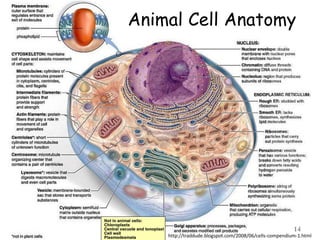
Animal Cell Anatomy
14
http://traddude.blogspot.com/2008/06/cells-compendium-1.html
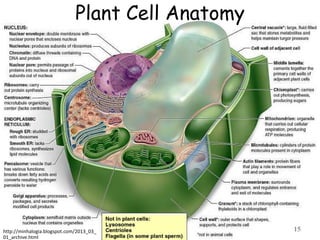
Plant Cell Anatomy
15http://minhalogia.blogspot.com/2013_03_
01_archive.html
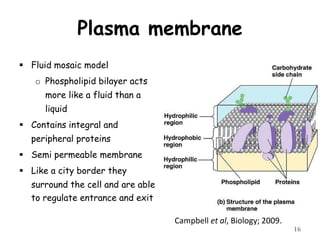
Plasma membrane
 Fluid mosaic model
o Phospholipid bilayer acts
more like a fluid than a
liquid
 Contains integral and
peripheral proteins
 Semi permeable membrane
 Like a city border they
surround the cell and are able
to regulate entrance and exit
16
Campbell et al, Biology; 2009.
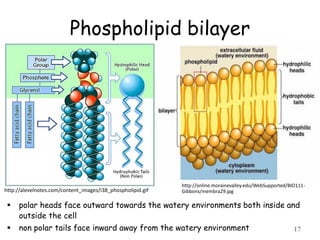
Phospholipid bilayer
 polar heads face outward towards the watery environments both inside and
outside the cell
 non polar tails face inward away from the watery environment 17
http://alevelnotes.com/content_images/i38_phospholipid.gif
http://online.morainevalley.edu/WebSupported/BIO111-
Gibbons/membra29.jpg
18
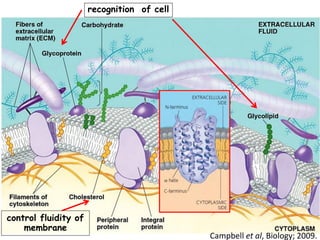
control fluidity of
membrane
recognition of cell
Campbell et al, Biology; 2009.
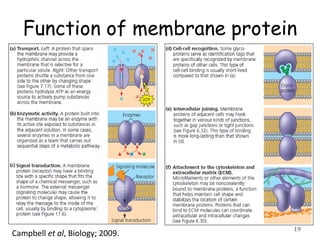
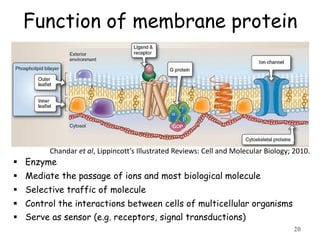
Function of membrane protein
19Campbell et al, Biology; 2009.
Function of membrane protein
 Enzyme
 Mediate the passage of ions and most biological molecule
 Selective traffic of molecule
 Control the interactions between cells of multicellular organisms
 Serve as sensor (e.g. receptors, signal transductions)
20
Chandar et al, Lippincott’s Illustrated Reviews: Cell and Molecular Biology; 2010.
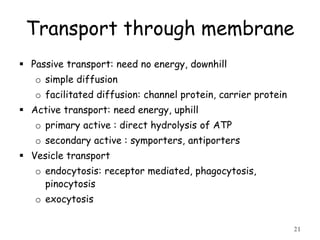
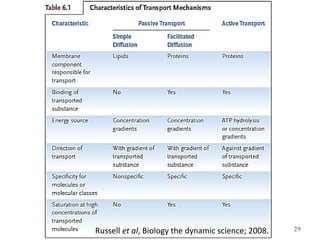
Transport through membrane
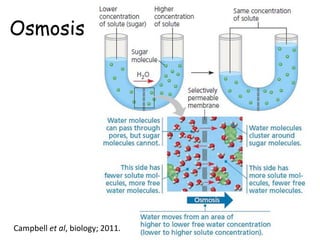
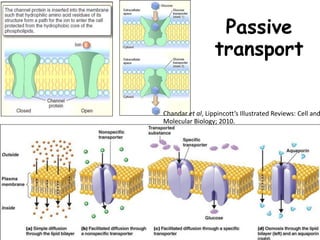
 Passive transport: need no energy, downhill
o simple diffusion
o facilitated diffusion: channel protein, carrier protein
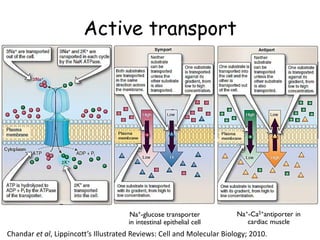
 Active transport: need energy, uphill
o primary active : direct hydrolysis of ATP
o secondary active : symporters, antiporters
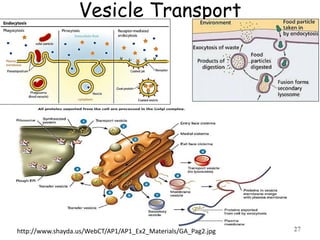
 Vesicle transport
o endocytosis: receptor mediated, phagocytosis,
pinocytosis
o exocytosis
21
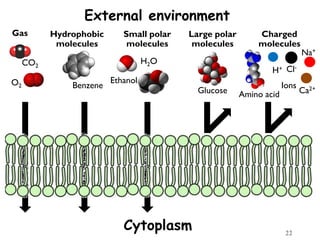
External environment
22
Gas Hydrophobic
molecules
Small polar
molecules
Large polar
molecules
Charged
molecules
CO2
O2 Benzene
H2O
Ethanol
Glucose Amino acid
Ions
H+ Cl-
Na+
Ca2+
Cytoplasm
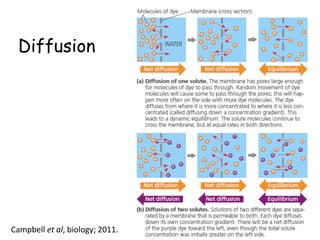
Diffusion
23Campbell et al, biology; 2011.
Osmosis
24Campbell et al, biology; 2011.
Passive
transport
25
Chandar et al, Lippincott’s Illustrated Reviews: Cell and
Molecular Biology; 2010.
Active transport
26
Na+-Ca2+antiporter in
cardiac muscle
Na+-glucose transporter
in intestinal epithelial cell
Chandar et al, Lippincott’s Illustrated Reviews: Cell and Molecular Biology; 2010.
Vesicle Transport
27http://www.shayda.us/WebCT/AP1/AP1_Ex2_Materials/GA_Pag2.jpg
28
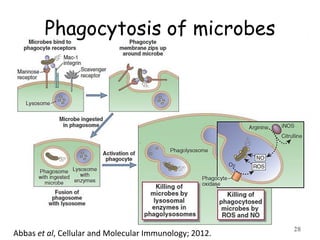
Phagocytosis of microbes
Abbas et al, Cellular and Molecular Immunology; 2012.
29Russell et al, Biology the dynamic science; 2008.

Cell : Structure and Function Part 01

  • 1.
    Cells Structure and Function ทนพ.สุวิทย์ คล่องทะเล วท.บ. (เทคนิคการแพทย์) เกียรตินิยม มหาวิทยาลัยมหิดล 1
  • 2.
    2Campbell et al,Biology; 2009.
  • 3.
    Sizes of LivingThings 3 Minimum resolution of a LM 2 microns, the size of a small bacterium LM can magnify effectively to 1,000 times the size of the actual specimen. http://amazedatbio.wordpress.com/2012/09/17/life-is-cellular/
  • 4.
    Properties of life Reproduction : o sexual : genetic variation, fertilization o asexual : genetically identical, e.g. sporulation, budding, regeneration, binary fission  Metabolism : anabolism Vs. catabolism  Growth and Development  Response to environment  Homeostasis : regulated via organ system  Organization : Cell, tissue, organ, organ system, organism o acellular o unicellular : bacteria, yeast o multicellular : plant, animal 4
  • 5.
    Cell Theory  Allorganisms are composed of cells  All cells come only from preexisting cells (Rudolf Virchow)  Cells are the smallest structural and functional unit of organisms  Cells carry genetic information in the form of DNA 5 Robert Hooke (1665) Matthias Jacob Schleiden (1838) plant Theodor Schwann (1839) animal Antony van Leeuwenhoek (1673)
  • 6.
  • 7.
    Electron microscope  Toresolve smaller structures we use EM, which focuses a beam of electrons through the specimen (TEM) or onto its surface (SEM)  TEM are used to study the internal ultrastructure of cells.  A TEM aims an electron beam through a thin section of the specimen. o The image is focused and magnified by electromagnets. o To enhance contrast, the thin sections are stained with atoms of heavy metals.  SEM are useful for studying surface structures.  The SEM has great depth of field, resulting in an image that seems three-dimensional. 7
  • 8.
    8Campbell et al,Biology; 2009.
  • 9.
    Prokaryotic and eukaryoticcells  All cells o surrounded by a plasma membrane. o have cytosol, containing the organelles. o contain chromosomes o have ribosomes  A major difference o eukaryotic cell: chromosomes are contained in the nucleus (within a membranous nuclear envelope) o prokaryotic cell: the DNA is concentrated in the nucleoid 9
  • 10.
    A major difference... Cytoplasm o All the material within the plasma membrane of a prokaryotic cell is cytoplasm. o Within the cytoplasm of a eukaryotic cell is a variety of membrane-bounded organelles of specialized form and function.  Eukaryotic cells are generally much bigger than prokaryotic cells. o smallest bacteria, mycoplasmas, are 0.1 to 1.0 micron. (most bacteria: 1-10 microns) o Eukaryotic cells are typically 10-100 microns in diameter 10
  • 11.
    11 Not present in bacteria nucleus,membrane bounded organelle, cytoskeleton, centriole
  • 12.
    12 Eukaryotic Cells ProkaryoticCells “complex” organisms, including all plants, protists, fungi and animals “Simple” organisms, including bacteria and cyanobacteria Contain nucleus and membrane bound organelles Several chromosome Lack nucleus and other membrane-encased organelles. Single chromosome (DNA + non- histone protein) Can specialize for certain functions, multicellular organs and organisms Usually exist as single, virtually identical cells Cellular respiration occur in mitochondria Cellular respiration occur in mesosome (extended membrane) Ribosome: 40s, 60S Ribosome: 30S, 50S Photosynthesis occur in chloroplast Photosynthesis occur in chlorophyll located region Cell Wall present in Plants & Fungi only Cell Wall Cyanobacteria (blue-green algae) e.g. Nostoc, Oscillatoria, Anabaena, Spirulina
  • 13.
    Cells  Cell coat:Cell wall, Cell membrane  Protoplasm o Nucleus : nuclear membrane, nucleoplasm (chromatin fiber, nucleolus) o Cytoplasm • cytosol • organelle – no membrane bounded: ribosome, centriole, cytoskeleton – single membrane bounded: ER, Golgi complex, lysosome, peroxisome, vacuole – double membrane bounded: mitochondria, chloroplast 13
  • 14.
  • 15.
  • 16.
    Plasma membrane  Fluidmosaic model o Phospholipid bilayer acts more like a fluid than a liquid  Contains integral and peripheral proteins  Semi permeable membrane  Like a city border they surround the cell and are able to regulate entrance and exit 16 Campbell et al, Biology; 2009.
  • 17.
    Phospholipid bilayer  polarheads face outward towards the watery environments both inside and outside the cell  non polar tails face inward away from the watery environment 17 http://alevelnotes.com/content_images/i38_phospholipid.gif http://online.morainevalley.edu/WebSupported/BIO111- Gibbons/membra29.jpg
  • 18.
    18 control fluidity of membrane recognitionof cell Campbell et al, Biology; 2009.
  • 19.
    Function of membraneprotein 19Campbell et al, Biology; 2009.
  • 20.
    Function of membraneprotein  Enzyme  Mediate the passage of ions and most biological molecule  Selective traffic of molecule  Control the interactions between cells of multicellular organisms  Serve as sensor (e.g. receptors, signal transductions) 20 Chandar et al, Lippincott’s Illustrated Reviews: Cell and Molecular Biology; 2010.
  • 21.
    Transport through membrane Passive transport: need no energy, downhill o simple diffusion o facilitated diffusion: channel protein, carrier protein  Active transport: need energy, uphill o primary active : direct hydrolysis of ATP o secondary active : symporters, antiporters  Vesicle transport o endocytosis: receptor mediated, phagocytosis, pinocytosis o exocytosis 21
  • 22.
    External environment 22 Gas Hydrophobic molecules Smallpolar molecules Large polar molecules Charged molecules CO2 O2 Benzene H2O Ethanol Glucose Amino acid Ions H+ Cl- Na+ Ca2+ Cytoplasm
  • 23.
  • 24.
  • 25.
    Passive transport 25 Chandar et al,Lippincott’s Illustrated Reviews: Cell and Molecular Biology; 2010.
  • 26.
    Active transport 26 Na+-Ca2+antiporter in cardiacmuscle Na+-glucose transporter in intestinal epithelial cell Chandar et al, Lippincott’s Illustrated Reviews: Cell and Molecular Biology; 2010.
  • 27.
  • 28.
    28 Phagocytosis of microbes Abbaset al, Cellular and Molecular Immunology; 2012.
  • 29.
    29Russell et al,Biology the dynamic science; 2008.