Chapter 1
What is the mechanism by which a function is
accomplished?
Origin: How did that mechanism come to be?
 Natural Selection: the increase in frequency of genes that produce phenotypes that
raise the likelihood that animals will survive and reproduce
 Adaptation: a physiological mechanism or other trait that is a product of evolution
by natural selection
 Adaptive Significance: Why the trait is an asset – why natural selection favored the
evolution of a trait
Mechanisms and adaptive significance are distinct concepts that do not imply each
other
The mechanisms by which animals perform their life
sustaining functions.
The evolution and adaptive significance of physiological
traits
The ways in which diverse phylogenetic groups of animals
both resemble each other and differ
The ways in which physiology and ecology interact, in the
present and during evolutionary time
The importance of all levels of organization – from genes to
proteins, and tissues to organs-for the full understanding of
physiological systems
Animals
Environments
Evolutionary Processes
1. Structurally dynamic
2. Organized systems that
require energy to maintain
organization
3. Both time and body size are
fundamental significance in
the lives of all animals
The atoms of their bodies
are in dynamic exchange
with the atoms in their
environments (isotope
studies)
Although the particular
atoms change the overall
structure stays the same-
energy required
Changes in response to the external environment:
1. Acute Changes – short term, reversible, in individuals
2. Chronic Changes – long term, reversible, in individuals
3. Evolutionary Changes – alteration of gene frequencies (genotypes) over
the course of multiple generations in population exposed to new
environments
Changes in response to the internal environment:
4. Developmental changes – programmed changes from conception to
senescence
5. Changes controlled by periodic biological clocks-changes that occur in
repeating patterns
Acclimation – chronic response to a laboratory
environment – controlled environment with just a few
changes
Acclimatization – chronic response to a natural
environment (winter/summer, high/low elevation)
Norm of Reaction – Correspondences between
phenotypes and environments (high melanin & high sun),
can be adaptations
Developmental changes – programmed changes
from conception to senescence
Changes controlled by periodic biological clocks-
changes that occur in repeating patterns
Body Size – Many traits vary in regular ways with
their body size among related species – brain size,
heart rate, energy use etc. Scaling – the study of
these relationships
Are Mountain Reedbuck and Bushbucks Specialized or Ordinary?
1. Animals
2. Environments
3. Evolutionary Processes
1. Temperature
2. Oxygen
3. Water
A measure of intensity of the random
motions that the atoms and molecules in
the material undergo (high temps=lots of
movement)
Decline in Diversity Towards the Poles
Need for oxygen due to need for
metabolic energy.
Releasing energy from organic
compounds (food) release hydrogen.
This is combined with oxygen to form
water.
The suitability of an environment
depends on availability of O2.
 High elevations
have less
oxygen in them
due to air
pressure being
low
Universal solvent in biological systems
Required for blood and all other body
fluids to have their proper compositions
Water bound to proteins and other
macromolecules as water of hydration
required for proper chemical and
functional properties
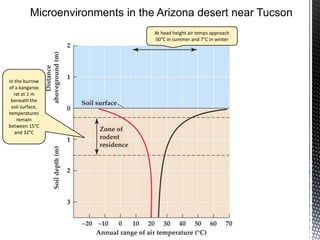
At head height air temps approach
50°C in summer and 7°C in winter
In the burrow
of a kangaroo
rat at 1 m
beneath the
soil surface,
temperatures
remain
between 15°C
and 32°C
1. Animals
2. Environments
3. Evolutionary Processes
A change in gene frequencies over time
in a population of organisms
Not necessarily due to adaptation which
occurs due to natural selection
Nonadaptive evolution occurs when
gene frequencies change but does not
confer a survival or reproductive
advantage.
 Natural Selection: the increase in frequency of genes that produce phenotypes that
raise the likelihood that animals will survive and reproduce
 Adaptation: a physiological mechanism or other trait that is a product of evolution
by natural selection
 Adaptive Significance: Why the trait is an asset – why natural selection favored the
evolution of a trait
Processes in which chance assumes a
preeminent role in altering gene
frequencies.
-Random deaths
-Founder effects
The control of an allele of a single gene of
two or more distinct and seemingly
unrelated traits- can lead to nonadaptive
outcomes
Direct observation
The comparative method – how a function is carried
out by related and unrelated species
Study lab populations over many generations – fruit
flies
Single-generation studies of individual variation
Creation of variation for study – knock out animals,
RNA interference, allometric engineering
Studies of the genetic structures of natural
populations - clines
Phylogenetic reconstruction-making family trees
from molecular data
There must be genetic diversity of
a trait for it to evolve
Animal Physiology chapter 1

Animal Physiology chapter 1

  • 1.
  • 9.
    What is themechanism by which a function is accomplished? Origin: How did that mechanism come to be?
  • 13.
     Natural Selection:the increase in frequency of genes that produce phenotypes that raise the likelihood that animals will survive and reproduce  Adaptation: a physiological mechanism or other trait that is a product of evolution by natural selection  Adaptive Significance: Why the trait is an asset – why natural selection favored the evolution of a trait
  • 15.
    Mechanisms and adaptivesignificance are distinct concepts that do not imply each other
  • 17.
    The mechanisms bywhich animals perform their life sustaining functions. The evolution and adaptive significance of physiological traits The ways in which diverse phylogenetic groups of animals both resemble each other and differ The ways in which physiology and ecology interact, in the present and during evolutionary time The importance of all levels of organization – from genes to proteins, and tissues to organs-for the full understanding of physiological systems
  • 18.
  • 19.
    1. Structurally dynamic 2.Organized systems that require energy to maintain organization 3. Both time and body size are fundamental significance in the lives of all animals
  • 20.
    The atoms oftheir bodies are in dynamic exchange with the atoms in their environments (isotope studies)
  • 21.
    Although the particular atomschange the overall structure stays the same- energy required
  • 25.
    Changes in responseto the external environment: 1. Acute Changes – short term, reversible, in individuals 2. Chronic Changes – long term, reversible, in individuals 3. Evolutionary Changes – alteration of gene frequencies (genotypes) over the course of multiple generations in population exposed to new environments Changes in response to the internal environment: 4. Developmental changes – programmed changes from conception to senescence 5. Changes controlled by periodic biological clocks-changes that occur in repeating patterns
  • 27.
    Acclimation – chronicresponse to a laboratory environment – controlled environment with just a few changes Acclimatization – chronic response to a natural environment (winter/summer, high/low elevation) Norm of Reaction – Correspondences between phenotypes and environments (high melanin & high sun), can be adaptations
  • 28.
    Developmental changes –programmed changes from conception to senescence Changes controlled by periodic biological clocks- changes that occur in repeating patterns
  • 29.
    Body Size –Many traits vary in regular ways with their body size among related species – brain size, heart rate, energy use etc. Scaling – the study of these relationships
  • 30.
    Are Mountain Reedbuckand Bushbucks Specialized or Ordinary?
  • 31.
    1. Animals 2. Environments 3.Evolutionary Processes
  • 32.
  • 33.
    A measure ofintensity of the random motions that the atoms and molecules in the material undergo (high temps=lots of movement)
  • 35.
    Decline in DiversityTowards the Poles
  • 37.
    Need for oxygendue to need for metabolic energy. Releasing energy from organic compounds (food) release hydrogen. This is combined with oxygen to form water. The suitability of an environment depends on availability of O2.
  • 38.
     High elevations haveless oxygen in them due to air pressure being low
  • 40.
    Universal solvent inbiological systems Required for blood and all other body fluids to have their proper compositions Water bound to proteins and other macromolecules as water of hydration required for proper chemical and functional properties
  • 44.
    At head heightair temps approach 50°C in summer and 7°C in winter In the burrow of a kangaroo rat at 1 m beneath the soil surface, temperatures remain between 15°C and 32°C
  • 46.
    1. Animals 2. Environments 3.Evolutionary Processes
  • 47.
    A change ingene frequencies over time in a population of organisms Not necessarily due to adaptation which occurs due to natural selection Nonadaptive evolution occurs when gene frequencies change but does not confer a survival or reproductive advantage.
  • 48.
     Natural Selection:the increase in frequency of genes that produce phenotypes that raise the likelihood that animals will survive and reproduce  Adaptation: a physiological mechanism or other trait that is a product of evolution by natural selection  Adaptive Significance: Why the trait is an asset – why natural selection favored the evolution of a trait
  • 49.
    Processes in whichchance assumes a preeminent role in altering gene frequencies. -Random deaths -Founder effects
  • 50.
    The control ofan allele of a single gene of two or more distinct and seemingly unrelated traits- can lead to nonadaptive outcomes
  • 51.
    Direct observation The comparativemethod – how a function is carried out by related and unrelated species
  • 53.
    Study lab populationsover many generations – fruit flies Single-generation studies of individual variation
  • 55.
    Creation of variationfor study – knock out animals, RNA interference, allometric engineering Studies of the genetic structures of natural populations - clines Phylogenetic reconstruction-making family trees from molecular data
  • 56.
    There must begenetic diversity of a trait for it to evolve

Editor's Notes

  • #3 AnPhys3e-Chapter-01-Opener.jpg
  • #4 AnPhys3e-Fig-01-01-0.jpg
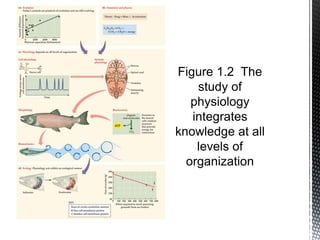
  • #5 AnPhys3e-Fig-01-02-0R.jpg
  • #6 b) The laws of chemistry and physics must be considered
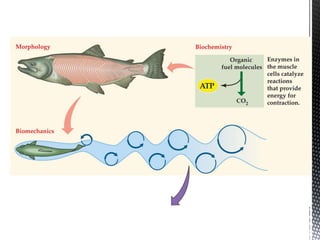
  • #7 Multiple levels of animal organization must be considered. Nerve impulses travel to swimming muscles.
  • #8 ATP is utilized from food molecules and the fish is propelled forward.
  • #9 The fish can alter ion-pumps on it’s gills depending on whether it’s in salt or fresh water. Traveling far to spawning grounds reduced the size of female fish ovaries.
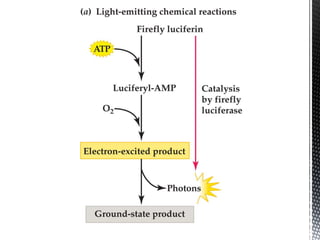
  • #11 AnPhys3e-Fig-01-03-0.jpg
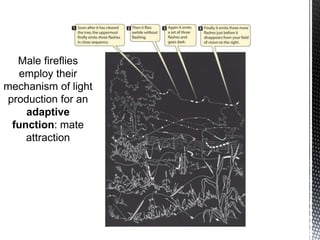
  • #12 A chemical compound (luciferin) reacts with ATP to form luciferyl-AMP. Then if oxygen can reach the luciferyl-AMP the two react to form a chemical product in which electrons are boosted to an excited state and emits photons. This requires the enzyme catalyst called firefly luciferase.
  • #13 b) When a firefly is not producing light any O2 that reaches the insect’s light cells via its gas-transport tubules is intercepted by mitochondria between the case tubules and the sites of the luciferin rxns. c) The light cells produce light when the nervous system of the firefly is stimulated causing the mitochondria to be bathed in nitric oxide and therefore unable to absorb O2
  • #15 AnPhys3e-Fig-01-04-0.jpg
  • #16 AnPhys3e-Fig-01-05-1R.jpg
  • #17 AnPhys3e-Fig-01-05-2R.jpg
  • #21 Adults people resynthesize 2-3% of their body protein each day and 10% of the amino acids come from food
  • #22 Adults people resynthesize 2-3% of their body protein each day and 10% of the amino acids come from food
  • #23 AnPhys3e-Fig-01-06-0.jpg
  • #24 AnPhys3e-Fig-01-07-0.jpg
  • #25 Home heating example, Neg feedback – the system opposes deviations from the set point, pros and cons of regulation and conformity: reg costs energy but allows cells to fxn independently of outside condition. Conf: energetically cheap but must conform to outside conditions
  • #27 Heat acclimation in humans – 3.5 miles per hour, 49 degrees C, 20% humidity, the passage of time permits biochemical or anatomical restructuring i.e. weight lifting
  • #31 Ordinary Least Squares Regression on a log scale to see the relationship between gestation length and body size.
  • #36 AnPhys3e-Fig-01-11-0.jpg
  • #37 Thermophilic (heat-loving) lizard common in N. American deserts can survive in temps as high as 48.5 degrees C
  • #38 An adult liberates 1/5 pound of oxygen each day.
  • #39 AnPhys3e-Fig-01-13-0.jpg
  • #40 Density Layering in Lakes
  • #42 Life began in water. Most oceanic invertebrates come from ancestors that never left the seas so their bodies have similar [salt] to sea water
  • #43 AnPhys3e-Fig-01-16-0.jpg
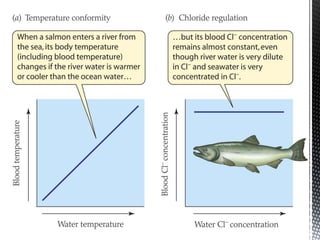
  • #45 AnPhys3e-Fig-01-16-0R.jpg
  • #50 Founder effect: a species enters an a new area and founds a new population there that may reflects the founder’s genes rather than the gene pool it came from
  • #51 Mosquitos become resistance to organophosphate insecticides but also more sensitive to cold
  • #52 Mosquitos become resistance to organophosphate insecticides but also more sensitive to cold
  • #53 Terrestrial vertebrates representing 3 phyla that separately colonized land have independently evolved breathing organs that invaginated the body suggesting that these are adaptive for living on land
  • #54 Mosquitos become resistance to organophosphate insecticides but also more sensitive to cold
  • #55 Trap several hundred mice and measure maximal rate at which they can take in and us O2
  • #56 Clines-a progressive change in allele frequencies or gene-controlled phenotype frequencies along an environmental gradient
  • #57 Clines-a progressive change in allele frequencies or gene-controlled phenotype frequencies along an environmental gradient