Because learning changes everything.®
Chapter 16
Digestive System
Lecture Outline
Seeley’s ESSENTIALS OF
ANATOMY & PHYSIOLOGY
Eleventh Edition
Cinnamon VanPutte
Jennifer Regan
Andrew Russo
Copyright 2022 © McGraw Hill LLC. All rights reserved. No reproduction or distribution without the prior written consent of McGraw Hill LLC.
Digestive System Functions
1. Ingestion and mastication – ingestion is the
consumption of solid or liquid food. Mastication is
chewing.
2. Propulsion and mixing - Propulsion is the movement of
food from one end of the digestive tract to the other.
Mixing is the movement of food back and forth in the
digestive tract to mix it with enzymes and facilitate
absorption.
2
Copyright 2022 © McGraw Hill LLC. All rights reserved. No reproduction or distribution without the prior written consent of McGraw Hill LLC.
Digestive System Functions
3. Digestion and secretion - Digestion is the mechanical
and chemical breakdown of large molecules into smaller
molecules that can be absorbed. Secretion is the addition
of liquids, enzymes, and mucus to the ingested food.
4. Absorption - the movement of molecules out of the
digestive tract and into the blood or lymphatic system.
5. Elimination - Elimination is the removal of undigested
material, such as fiber from food, plus other waste
products from the body as feces.
3
Copyright 2022 © McGraw Hill LLC. All rights reserved. No reproduction or distribution without the prior written consent of McGraw Hill LLC.
Anatomy of the Digestive System
The digestive tract consists of the:
• oral cavity (mouth)
• pharynx
• esophagus
• stomach
• small intestines
• large intestines
• anus
4
Copyright 2022 © McGraw Hill LLC. All rights reserved. No reproduction or distribution without the prior written consent of McGraw Hill LLC.
Associated Organs
The digestive system includes some associated organs,
not directly in the digestive tract, that have ducts that lead
into the tract.
These associated organs are the:
• salivary glands
• liver
• gallbladder
• pancreas
5
Copyright 2022 © McGraw Hill LLC. All rights reserved. No reproduction or distribution without the prior written consent of McGraw Hill LLC.
Layers of Digestive Tract Wall
The layers of the tract wall are also termed tunics.
1. Mucosa:
• innermost layer
• secretes mucus
2. Submucosa:
• above mucosa
• contains blood vessels, nerves, small glands
6
Copyright 2022 © McGraw Hill LLC. All rights reserved. No reproduction or distribution without the prior written consent of McGraw Hill LLC.
Layers of Digestive Tract Wall
3. Muscularis:
• above submucosa
• longitudinal, circular, and oblique muscles
4. Serosa/adventitia:
• outermost layer
• If peritoneum is present- serosa
• If no peritoneum- adventitia
7
Copyright 2022 © McGraw Hill LLC. All rights reserved. No reproduction or distribution without the prior written consent of McGraw Hill LLC.
Peritoneum and Mesentery
Visceral peritoneum - or serosa, is the serous membrane
that covers the organs.
Parietal peritoneum - is the serous membrane that lines the
wall of the abdominal cavity
Mesenteries - connective tissue sheets that hold organs in
place in the abdominal cavity
Lesser omentum - mesentery connecting lesser curvature
of stomach to liver and diaphragm
Greater omentum - mesentery connecting greater curvature
of stomach to transverse colon and posterior body wall
8
Copyright 2022 © McGraw Hill LLC. All rights reserved. No reproduction or distribution without the prior written consent of McGraw Hill LLC.
Salivary Glands
Produce saliva which is a mixture of serous (watery) and
mucous fluids:
• Keeps the oral cavity moist
• Needed for normal speech
• Dissolves food particles so they can be tasted
• Protects against bacteria and neutralizes pH
• Begins the process of digestion
9
Copyright 2022 © McGraw Hill LLC. All rights reserved. No reproduction or distribution without the prior written consent of McGraw Hill LLC.
Salivary Glands
Salivary Glands:
• Parotid - serous glands anterior to each ear.
• Submandibular - found along the inferior border of the
mandible; produce more serous than mucous secretions
• Sublingual - produce primarily mucous and lie below
the mucous membrane in the floor of the oral cavity.
10
Copyright 2022 © McGraw Hill LLC. All rights reserved. No reproduction or distribution without the prior written consent of McGraw Hill LLC.
Salivary Glands
 Serous (liquid) portion of saliva contains enzymes
 Mucous portion of saliva contains mucin for lubrication
Amylase - digestive enzyme that breaks down
carbohydrates
Lysozyme - enzymes that are active against bacteria
11
Copyright 2022 © McGraw Hill LLC. All rights reserved. No reproduction or distribution without the prior written consent of McGraw Hill LLC.
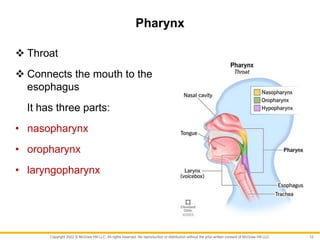
Pharynx
 Throat
 Connects the mouth to the
esophagus
It has three parts:
• nasopharynx
• oropharynx
• laryngopharynx
12
Copyright 2022 © McGraw Hill LLC. All rights reserved. No reproduction or distribution without the prior written consent of McGraw Hill LLC.
Esophagus
 Tube that connects the pharynx to the stomach
 Transports food to the stomach
 Joins stomach at cardiac opening
Heartburn:
• occurs when gastric juices regurgitate into esophagus
• caused by caffeine, smoking, or eating or drinking in
excess
13
Copyright 2022 © McGraw Hill LLC. All rights reserved. No reproduction or distribution without the prior written consent of McGraw Hill LLC.
Phases of Swallowing
Voluntary phase:
• bolus (mass of food) formed in mouth and pushed into
oropharynx
Pharyngeal phase:
• swallowing reflex initiated when bolus stimulates
receptors in oropharynx
Esophageal phase:
• moves food from pharynx to stomach
14
Copyright 2022 © McGraw Hill LLC. All rights reserved. No reproduction or distribution without the prior written consent of McGraw Hill LLC.
Stomach
• Located in the abdomen
• Storage tank for food
• Can hold up to 2 liters of food
• Produces mucus, hydrochloric acid, protein digesting
enzymes
• Contains a thick mucus layer that lubricates and protects
epithelial cells on stomach wall from acidic pH (3)
15
Copyright 2022 © McGraw Hill LLC. All rights reserved. No reproduction or distribution without the prior written consent of McGraw Hill LLC.
Regions of the Stomach
• The esophagus opens into the cardiac part.
• The fundus is to the left of, and superior to the cardiac
part.
• The body is largest part of the stomach.
• The body turns to the right, creating a greater
curvature and a lesser curvature.
• The body narrows inferiorly to form the funnel-shaped
pyloric part of the stomach.
16
Copyright 2022 © McGraw Hill LLC. All rights reserved. No reproduction or distribution without the prior written consent of McGraw Hill LLC.
Stomach
Muscularis has 3 layers:
• outer longitudinal
• middle circular
• inner oblique to produce churning action
Rugae:
• large folds that allow stomach to stretch
Chyme
• paste-like substance that forms when food begins to be
broken down
17
Copyright 2022 © McGraw Hill LLC. All rights reserved. No reproduction or distribution without the prior written consent of McGraw Hill LLC.
Stomach
Pyloric opening:
• opening between stomach and small intestine
Pyloric sphincter:
• thick, ring of smooth muscle around pyloric opening
which regulates movement of food into the small
intestine
18
Copyright 2022 © McGraw Hill LLC. All rights reserved. No reproduction or distribution without the prior written consent of McGraw Hill LLC.
Epithelial Cells in the Stomach
Surface mucous cells - produce mucus that coats and
protects the stomach
Mucous neck cells - produce mucus
Parietal cells - produce hydrochloric acid and intrinsic factor
Endocrine cells - produce hormones and paracrine
molecules
Chief cells - produce pepsinogen, a precursor of the
protein-digesting enzyme pepsin
19
Copyright 2022 © McGraw Hill LLC. All rights reserved. No reproduction or distribution without the prior written consent of McGraw Hill LLC.
Secretions of the Stomach
Hydrochloric acid
• Produces a pH of about 2.0 in the stomach.
• Kills microorganisms, activates pepsin.
Pepsin
• breaks covalent bonds of proteins to form smaller peptide chains
Mucus
• A thick layer, which lubricates the mucosa of the stomach
• Protects mucosa from acidic chyme and pepsin
Intrinsic factor
• Binds with vitamin B12 making it more readily absorbed by small
intestine
20
Copyright 2022 © McGraw Hill LLC. All rights reserved. No reproduction or distribution without the prior written consent of McGraw Hill LLC.
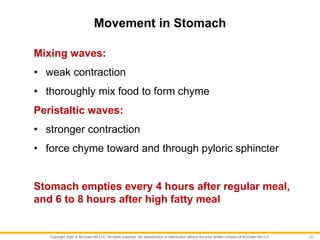
Movement in Stomach
Mixing waves:
• weak contraction
• thoroughly mix food to form chyme
Peristaltic waves:
• stronger contraction
• force chyme toward and through pyloric sphincter
Stomach empties every 4 hours after regular meal,
and 6 to 8 hours after high fatty meal
21
Copyright 2022 © McGraw Hill LLC. All rights reserved. No reproduction or distribution without the prior written consent of McGraw Hill LLC.
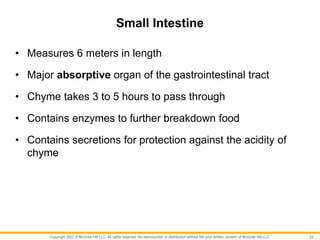
Small Intestine
• Measures 6 meters in length
• Major absorptive organ of the gastrointestinal tract
• Chyme takes 3 to 5 hours to pass through
• Contains enzymes to further breakdown food
• Contains secretions for protection against the acidity of
chyme
22
Copyright 2022 © McGraw Hill LLC. All rights reserved. No reproduction or distribution without the prior written consent of McGraw Hill LLC.
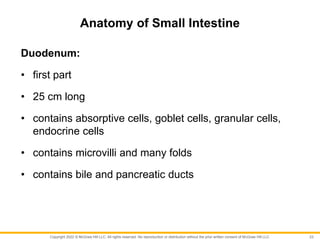
Anatomy of Small Intestine
Duodenum:
• first part
• 25 cm long
• contains absorptive cells, goblet cells, granular cells,
endocrine cells
• contains microvilli and many folds
• contains bile and pancreatic ducts
23
Copyright 2022 © McGraw Hill LLC. All rights reserved. No reproduction or distribution without the prior written consent of McGraw Hill LLC.
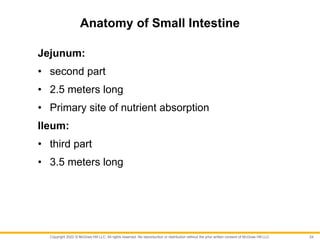
Anatomy of Small Intestine
Jejunum:
• second part
• 2.5 meters long
• Primary site of nutrient absorption
Ileum:
• third part
• 3.5 meters long
24
Copyright 2022 © McGraw Hill LLC. All rights reserved. No reproduction or distribution without the prior written consent of McGraw Hill LLC.
Mucosa of the Small Intestine
The mucosa of the small intestine is simple columnar
epithelium with four major cell types.
1. Absorptive cells, which have microvilli, produce digestive
enzymes, and absorb digested food
2. Goblet cells, which produce a protective mucus
3. Granular cells, which may help protect the intestinal
epithelium from bacteria; and
4. Endocrine cells, which produce regulatory hormones.
25
Copyright 2022 © McGraw Hill LLC. All rights reserved. No reproduction or distribution without the prior written consent of McGraw Hill LLC.
Secretions of the Small Intestine
Secretions of mucus, ions, and water lubricate and protect
the intestinal wall from the acidic chyme and digestive
enzymes.
• Peptidases enzymatically breakdown proteins into amino
acids for absorption.
• Disaccharidases enzymatically breakdown disaccharides
into monosaccharides for absorption.
26
Copyright 2022 © McGraw Hill LLC. All rights reserved. No reproduction or distribution without the prior written consent of McGraw Hill LLC.
Movement in the Small Intestine
• Peristaltic contractions along the length of the intestine
cause the chyme to move along the small intestine.
• Segmental contractions are propagated for only short
distances and mix intestinal contents.
27
Copyright 2022 © McGraw Hill LLC. All rights reserved. No reproduction or distribution without the prior written consent of McGraw Hill LLC.
Liver Anatomy
Weighs about 3 lbs.
Located in the right upper quadrant of the abdomen under
the diaphragm
Consists of right, left, caudate, and quadrate lobes
Porta:
• gate where blood vessels, ducts, nerves enter and exit
• Receives blood from the hepatic artery and hepatic
portal vein
28
Copyright 2022 © McGraw Hill LLC. All rights reserved. No reproduction or distribution without the prior written consent of McGraw Hill LLC.
Liver Ducts
Hepatic duct:
• transports bile out of liver
Common hepatic duct:
• formed from left and right hepatic duct
Cystic duct:
• joins common hepatic duct
• drains gallbladder
Common bile duct:
• formed from common hepatic duct and cystic duct
29
Copyright 2022 © McGraw Hill LLC. All rights reserved. No reproduction or distribution without the prior written consent of McGraw Hill LLC.
Functions of the Liver
 Digestive and excretory functions
 Stores and processes nutrients
 Detoxifies harmful chemicals
 Synthesizes new molecules
 Secretes 700 milliliters of bile each day
Bile:
• dilutes and neutralizes stomach acid and breaks down
fats
30
Copyright 2022 © McGraw Hill LLC. All rights reserved. No reproduction or distribution without the prior written consent of McGraw Hill LLC.
Pancreas
• Located posterior to stomach in inferior part of left upper
quadrant
• Head near midline of body
• Tail extends to left and touches spleen
• Endocrine tissues have pancreatic islets that produce
insulin and glucagon
• Exocrine tissues produce digestive enzymes that travel
through ducts to duodenum
31
Copyright 2022 © McGraw Hill LLC. All rights reserved. No reproduction or distribution without the prior written consent of McGraw Hill LLC.
Pancreatic Secretions
The major protein-digesting enzymes are:
1. Trypsin
2. Chymotrypsin
3. Carboxypeptidase
32
Copyright 2022 © McGraw Hill LLC. All rights reserved. No reproduction or distribution without the prior written consent of McGraw Hill LLC.
Pancreatic Secretions
• Pancreatic amylase continues the polysaccharide
digestion that began in the oral cavity.
• The pancreatic enzyme lipase is a lipid-digesting enzyme.
• The pancreatic nuclease enzymes degrade DNA and
RNA to their component ucleotides.
33
Copyright 2022 © McGraw Hill LLC. All rights reserved. No reproduction or distribution without the prior written consent of McGraw Hill LLC.
Large Intestine
 Absorbs water from indigestible food and create
compact feces
 Contains cecum, colon, rectum, anal canal
Cecum:
• joins small intestine at ileocecal junction
• has appendix attached
Appendix:
• 9 cm structure that is often removed
34
Copyright 2022 © McGraw Hill LLC. All rights reserved. No reproduction or distribution without the prior written consent of McGraw Hill LLC.
Large Intestine
Colon:
• 1.5 meters long
• contains ascending, transverse, descending, sigmoid
regions
Rectum:
• straight tube that begins at sigmoid colon and ends at
anal canal
35
Copyright 2022 © McGraw Hill LLC. All rights reserved. No reproduction or distribution without the prior written consent of McGraw Hill LLC.
Large Intestine
Anal canal:
• last 2 to 3 cm of digestive tract
Food takes 18 to 24 hours to pass through large
intestine
36
Copyright 2022 © McGraw Hill LLC. All rights reserved. No reproduction or distribution without the prior written consent of McGraw Hill LLC.
Large Intestine
• Feces formation is due to absorption of water and salts,
secretion of mucus, and action of microorganisms.
• The colon stores the feces until defecation.
• Every 8 to 12 hours strong contractions, called mass
movements propel the colon contents toward the anus.
• Movement of feces into the rectum distends the rectal wall
and stimulates the defecation reflex.
37
Copyright 2022 © McGraw Hill LLC. All rights reserved. No reproduction or distribution without the prior written consent of McGraw Hill LLC.
Digestive Process
1. Digestion:
• Chemical and mechanical breakdown of food
2. Absorption:
• Most absorption occurs in the duodenum and jejunum,
although some occurs in the stomach and ileum
3. Transport:
• moves food through digestive tract, includes swallowing
and peristalsis
38

Anatomy and Physiology Chapter-16_Digestive-System.pptx

  • 1.
    Because learning changeseverything.® Chapter 16 Digestive System Lecture Outline Seeley’s ESSENTIALS OF ANATOMY & PHYSIOLOGY Eleventh Edition Cinnamon VanPutte Jennifer Regan Andrew Russo Copyright 2022 © McGraw Hill LLC. All rights reserved. No reproduction or distribution without the prior written consent of McGraw Hill LLC.
  • 2.
    Copyright 2022 ©McGraw Hill LLC. All rights reserved. No reproduction or distribution without the prior written consent of McGraw Hill LLC. Digestive System Functions 1. Ingestion and mastication – ingestion is the consumption of solid or liquid food. Mastication is chewing. 2. Propulsion and mixing - Propulsion is the movement of food from one end of the digestive tract to the other. Mixing is the movement of food back and forth in the digestive tract to mix it with enzymes and facilitate absorption. 2
  • 3.
    Copyright 2022 ©McGraw Hill LLC. All rights reserved. No reproduction or distribution without the prior written consent of McGraw Hill LLC. Digestive System Functions 3. Digestion and secretion - Digestion is the mechanical and chemical breakdown of large molecules into smaller molecules that can be absorbed. Secretion is the addition of liquids, enzymes, and mucus to the ingested food. 4. Absorption - the movement of molecules out of the digestive tract and into the blood or lymphatic system. 5. Elimination - Elimination is the removal of undigested material, such as fiber from food, plus other waste products from the body as feces. 3
  • 4.
    Copyright 2022 ©McGraw Hill LLC. All rights reserved. No reproduction or distribution without the prior written consent of McGraw Hill LLC. Anatomy of the Digestive System The digestive tract consists of the: • oral cavity (mouth) • pharynx • esophagus • stomach • small intestines • large intestines • anus 4
  • 5.
    Copyright 2022 ©McGraw Hill LLC. All rights reserved. No reproduction or distribution without the prior written consent of McGraw Hill LLC. Associated Organs The digestive system includes some associated organs, not directly in the digestive tract, that have ducts that lead into the tract. These associated organs are the: • salivary glands • liver • gallbladder • pancreas 5
  • 6.
    Copyright 2022 ©McGraw Hill LLC. All rights reserved. No reproduction or distribution without the prior written consent of McGraw Hill LLC. Layers of Digestive Tract Wall The layers of the tract wall are also termed tunics. 1. Mucosa: • innermost layer • secretes mucus 2. Submucosa: • above mucosa • contains blood vessels, nerves, small glands 6
  • 7.
    Copyright 2022 ©McGraw Hill LLC. All rights reserved. No reproduction or distribution without the prior written consent of McGraw Hill LLC. Layers of Digestive Tract Wall 3. Muscularis: • above submucosa • longitudinal, circular, and oblique muscles 4. Serosa/adventitia: • outermost layer • If peritoneum is present- serosa • If no peritoneum- adventitia 7
  • 8.
    Copyright 2022 ©McGraw Hill LLC. All rights reserved. No reproduction or distribution without the prior written consent of McGraw Hill LLC. Peritoneum and Mesentery Visceral peritoneum - or serosa, is the serous membrane that covers the organs. Parietal peritoneum - is the serous membrane that lines the wall of the abdominal cavity Mesenteries - connective tissue sheets that hold organs in place in the abdominal cavity Lesser omentum - mesentery connecting lesser curvature of stomach to liver and diaphragm Greater omentum - mesentery connecting greater curvature of stomach to transverse colon and posterior body wall 8
  • 9.
    Copyright 2022 ©McGraw Hill LLC. All rights reserved. No reproduction or distribution without the prior written consent of McGraw Hill LLC. Salivary Glands Produce saliva which is a mixture of serous (watery) and mucous fluids: • Keeps the oral cavity moist • Needed for normal speech • Dissolves food particles so they can be tasted • Protects against bacteria and neutralizes pH • Begins the process of digestion 9
  • 10.
    Copyright 2022 ©McGraw Hill LLC. All rights reserved. No reproduction or distribution without the prior written consent of McGraw Hill LLC. Salivary Glands Salivary Glands: • Parotid - serous glands anterior to each ear. • Submandibular - found along the inferior border of the mandible; produce more serous than mucous secretions • Sublingual - produce primarily mucous and lie below the mucous membrane in the floor of the oral cavity. 10
  • 11.
    Copyright 2022 ©McGraw Hill LLC. All rights reserved. No reproduction or distribution without the prior written consent of McGraw Hill LLC. Salivary Glands  Serous (liquid) portion of saliva contains enzymes  Mucous portion of saliva contains mucin for lubrication Amylase - digestive enzyme that breaks down carbohydrates Lysozyme - enzymes that are active against bacteria 11
  • 12.
    Copyright 2022 ©McGraw Hill LLC. All rights reserved. No reproduction or distribution without the prior written consent of McGraw Hill LLC. Pharynx  Throat  Connects the mouth to the esophagus It has three parts: • nasopharynx • oropharynx • laryngopharynx 12
  • 13.
    Copyright 2022 ©McGraw Hill LLC. All rights reserved. No reproduction or distribution without the prior written consent of McGraw Hill LLC. Esophagus  Tube that connects the pharynx to the stomach  Transports food to the stomach  Joins stomach at cardiac opening Heartburn: • occurs when gastric juices regurgitate into esophagus • caused by caffeine, smoking, or eating or drinking in excess 13
  • 14.
    Copyright 2022 ©McGraw Hill LLC. All rights reserved. No reproduction or distribution without the prior written consent of McGraw Hill LLC. Phases of Swallowing Voluntary phase: • bolus (mass of food) formed in mouth and pushed into oropharynx Pharyngeal phase: • swallowing reflex initiated when bolus stimulates receptors in oropharynx Esophageal phase: • moves food from pharynx to stomach 14
  • 15.
    Copyright 2022 ©McGraw Hill LLC. All rights reserved. No reproduction or distribution without the prior written consent of McGraw Hill LLC. Stomach • Located in the abdomen • Storage tank for food • Can hold up to 2 liters of food • Produces mucus, hydrochloric acid, protein digesting enzymes • Contains a thick mucus layer that lubricates and protects epithelial cells on stomach wall from acidic pH (3) 15
  • 16.
    Copyright 2022 ©McGraw Hill LLC. All rights reserved. No reproduction or distribution without the prior written consent of McGraw Hill LLC. Regions of the Stomach • The esophagus opens into the cardiac part. • The fundus is to the left of, and superior to the cardiac part. • The body is largest part of the stomach. • The body turns to the right, creating a greater curvature and a lesser curvature. • The body narrows inferiorly to form the funnel-shaped pyloric part of the stomach. 16
  • 17.
    Copyright 2022 ©McGraw Hill LLC. All rights reserved. No reproduction or distribution without the prior written consent of McGraw Hill LLC. Stomach Muscularis has 3 layers: • outer longitudinal • middle circular • inner oblique to produce churning action Rugae: • large folds that allow stomach to stretch Chyme • paste-like substance that forms when food begins to be broken down 17
  • 18.
    Copyright 2022 ©McGraw Hill LLC. All rights reserved. No reproduction or distribution without the prior written consent of McGraw Hill LLC. Stomach Pyloric opening: • opening between stomach and small intestine Pyloric sphincter: • thick, ring of smooth muscle around pyloric opening which regulates movement of food into the small intestine 18
  • 19.
    Copyright 2022 ©McGraw Hill LLC. All rights reserved. No reproduction or distribution without the prior written consent of McGraw Hill LLC. Epithelial Cells in the Stomach Surface mucous cells - produce mucus that coats and protects the stomach Mucous neck cells - produce mucus Parietal cells - produce hydrochloric acid and intrinsic factor Endocrine cells - produce hormones and paracrine molecules Chief cells - produce pepsinogen, a precursor of the protein-digesting enzyme pepsin 19
  • 20.
    Copyright 2022 ©McGraw Hill LLC. All rights reserved. No reproduction or distribution without the prior written consent of McGraw Hill LLC. Secretions of the Stomach Hydrochloric acid • Produces a pH of about 2.0 in the stomach. • Kills microorganisms, activates pepsin. Pepsin • breaks covalent bonds of proteins to form smaller peptide chains Mucus • A thick layer, which lubricates the mucosa of the stomach • Protects mucosa from acidic chyme and pepsin Intrinsic factor • Binds with vitamin B12 making it more readily absorbed by small intestine 20
  • 21.
    Copyright 2022 ©McGraw Hill LLC. All rights reserved. No reproduction or distribution without the prior written consent of McGraw Hill LLC. Movement in Stomach Mixing waves: • weak contraction • thoroughly mix food to form chyme Peristaltic waves: • stronger contraction • force chyme toward and through pyloric sphincter Stomach empties every 4 hours after regular meal, and 6 to 8 hours after high fatty meal 21
  • 22.
    Copyright 2022 ©McGraw Hill LLC. All rights reserved. No reproduction or distribution without the prior written consent of McGraw Hill LLC. Small Intestine • Measures 6 meters in length • Major absorptive organ of the gastrointestinal tract • Chyme takes 3 to 5 hours to pass through • Contains enzymes to further breakdown food • Contains secretions for protection against the acidity of chyme 22
  • 23.
    Copyright 2022 ©McGraw Hill LLC. All rights reserved. No reproduction or distribution without the prior written consent of McGraw Hill LLC. Anatomy of Small Intestine Duodenum: • first part • 25 cm long • contains absorptive cells, goblet cells, granular cells, endocrine cells • contains microvilli and many folds • contains bile and pancreatic ducts 23
  • 24.
    Copyright 2022 ©McGraw Hill LLC. All rights reserved. No reproduction or distribution without the prior written consent of McGraw Hill LLC. Anatomy of Small Intestine Jejunum: • second part • 2.5 meters long • Primary site of nutrient absorption Ileum: • third part • 3.5 meters long 24
  • 25.
    Copyright 2022 ©McGraw Hill LLC. All rights reserved. No reproduction or distribution without the prior written consent of McGraw Hill LLC. Mucosa of the Small Intestine The mucosa of the small intestine is simple columnar epithelium with four major cell types. 1. Absorptive cells, which have microvilli, produce digestive enzymes, and absorb digested food 2. Goblet cells, which produce a protective mucus 3. Granular cells, which may help protect the intestinal epithelium from bacteria; and 4. Endocrine cells, which produce regulatory hormones. 25
  • 26.
    Copyright 2022 ©McGraw Hill LLC. All rights reserved. No reproduction or distribution without the prior written consent of McGraw Hill LLC. Secretions of the Small Intestine Secretions of mucus, ions, and water lubricate and protect the intestinal wall from the acidic chyme and digestive enzymes. • Peptidases enzymatically breakdown proteins into amino acids for absorption. • Disaccharidases enzymatically breakdown disaccharides into monosaccharides for absorption. 26
  • 27.
    Copyright 2022 ©McGraw Hill LLC. All rights reserved. No reproduction or distribution without the prior written consent of McGraw Hill LLC. Movement in the Small Intestine • Peristaltic contractions along the length of the intestine cause the chyme to move along the small intestine. • Segmental contractions are propagated for only short distances and mix intestinal contents. 27
  • 28.
    Copyright 2022 ©McGraw Hill LLC. All rights reserved. No reproduction or distribution without the prior written consent of McGraw Hill LLC. Liver Anatomy Weighs about 3 lbs. Located in the right upper quadrant of the abdomen under the diaphragm Consists of right, left, caudate, and quadrate lobes Porta: • gate where blood vessels, ducts, nerves enter and exit • Receives blood from the hepatic artery and hepatic portal vein 28
  • 29.
    Copyright 2022 ©McGraw Hill LLC. All rights reserved. No reproduction or distribution without the prior written consent of McGraw Hill LLC. Liver Ducts Hepatic duct: • transports bile out of liver Common hepatic duct: • formed from left and right hepatic duct Cystic duct: • joins common hepatic duct • drains gallbladder Common bile duct: • formed from common hepatic duct and cystic duct 29
  • 30.
    Copyright 2022 ©McGraw Hill LLC. All rights reserved. No reproduction or distribution without the prior written consent of McGraw Hill LLC. Functions of the Liver  Digestive and excretory functions  Stores and processes nutrients  Detoxifies harmful chemicals  Synthesizes new molecules  Secretes 700 milliliters of bile each day Bile: • dilutes and neutralizes stomach acid and breaks down fats 30
  • 31.
    Copyright 2022 ©McGraw Hill LLC. All rights reserved. No reproduction or distribution without the prior written consent of McGraw Hill LLC. Pancreas • Located posterior to stomach in inferior part of left upper quadrant • Head near midline of body • Tail extends to left and touches spleen • Endocrine tissues have pancreatic islets that produce insulin and glucagon • Exocrine tissues produce digestive enzymes that travel through ducts to duodenum 31
  • 32.
    Copyright 2022 ©McGraw Hill LLC. All rights reserved. No reproduction or distribution without the prior written consent of McGraw Hill LLC. Pancreatic Secretions The major protein-digesting enzymes are: 1. Trypsin 2. Chymotrypsin 3. Carboxypeptidase 32
  • 33.
    Copyright 2022 ©McGraw Hill LLC. All rights reserved. No reproduction or distribution without the prior written consent of McGraw Hill LLC. Pancreatic Secretions • Pancreatic amylase continues the polysaccharide digestion that began in the oral cavity. • The pancreatic enzyme lipase is a lipid-digesting enzyme. • The pancreatic nuclease enzymes degrade DNA and RNA to their component ucleotides. 33
  • 34.
    Copyright 2022 ©McGraw Hill LLC. All rights reserved. No reproduction or distribution without the prior written consent of McGraw Hill LLC. Large Intestine  Absorbs water from indigestible food and create compact feces  Contains cecum, colon, rectum, anal canal Cecum: • joins small intestine at ileocecal junction • has appendix attached Appendix: • 9 cm structure that is often removed 34
  • 35.
    Copyright 2022 ©McGraw Hill LLC. All rights reserved. No reproduction or distribution without the prior written consent of McGraw Hill LLC. Large Intestine Colon: • 1.5 meters long • contains ascending, transverse, descending, sigmoid regions Rectum: • straight tube that begins at sigmoid colon and ends at anal canal 35
  • 36.
    Copyright 2022 ©McGraw Hill LLC. All rights reserved. No reproduction or distribution without the prior written consent of McGraw Hill LLC. Large Intestine Anal canal: • last 2 to 3 cm of digestive tract Food takes 18 to 24 hours to pass through large intestine 36
  • 37.
    Copyright 2022 ©McGraw Hill LLC. All rights reserved. No reproduction or distribution without the prior written consent of McGraw Hill LLC. Large Intestine • Feces formation is due to absorption of water and salts, secretion of mucus, and action of microorganisms. • The colon stores the feces until defecation. • Every 8 to 12 hours strong contractions, called mass movements propel the colon contents toward the anus. • Movement of feces into the rectum distends the rectal wall and stimulates the defecation reflex. 37
  • 38.
    Copyright 2022 ©McGraw Hill LLC. All rights reserved. No reproduction or distribution without the prior written consent of McGraw Hill LLC. Digestive Process 1. Digestion: • Chemical and mechanical breakdown of food 2. Absorption: • Most absorption occurs in the duodenum and jejunum, although some occurs in the stomach and ileum 3. Transport: • moves food through digestive tract, includes swallowing and peristalsis 38