Welcome
Physiological role of Na, Cl & Si
CHLORINE
• Chlorine (Cl) occurs predominantly as Cl- in
soil and plant.
• It is an essential micronutrient of higher plants
and participates in several physiological
metabolism processes.
• Its functions in plant growth and development
include osmotic and stomatal regulation,
evolution of oxygen in photosynthesis, and
disease resistance and tolerance.
Physiological functions
 Chlorine has been shown to be involved in the
oxygen evolution in photo system II in
photosynthesis ( Cl and Mn are important for this
reaction).
 Chlorine accelerates the activation of amylase
which converts starch into soluble sugars.
 Stomatal Regulation.
 Photosynthetic O2 Evolution Cl− Anion.
 Osmoregulation.
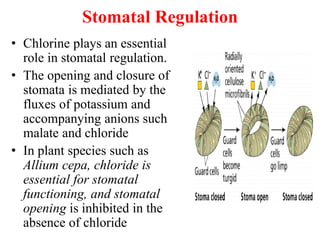
Stomatal Regulation
• Chlorine plays an essential
role in stomatal regulation.
• The opening and closure of
stomata is mediated by the
fluxes of potassium and
accompanying anions such
malate and chloride
• In plant species such as
Allium cepa, chloride is
essential for stomatal
functioning, and stomatal
opening is inhibited in the
absence of chloride
Photosynthetic O2 Evolution Cl− Anion
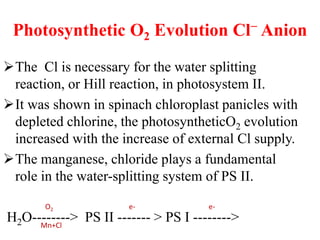
The Cl is necessary for the water splitting
reaction, or Hill reaction, in photosystem II.
It was shown in spinach chloroplast panicles with
depleted chlorine, the photosyntheticO2 evolution
increased with the increase of external Cl supply.
The manganese, chloride plays a fundamental
role in the water-splitting system of PS II.
H2O--------> PS II ------- > PS I -------->Mn+Cl
O2 e- e-
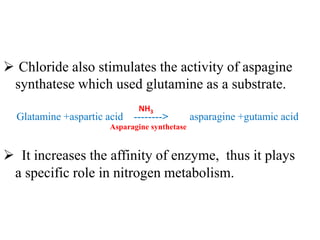
 Chloride also stimulates the activity of aspagine
synthatese which used glutamine as a substrate.
Glatamine +aspartic acid --------> asparagine +gutamic acid
 It increases the affinity of enzyme, thus it plays
a specific role in nitrogen metabolism.
NH3
Asparagine synthetase
Osmoregulation
 The Cl concentrations in plants generally exceed this
critical deficiency level by two orders of magnitude and
become important in osmotic adjustment and plant
water relations. In this concentration range Cl− becomes
the dominant inorganic anion in the vacuole.
 In the phloem sap Cl− concentrations may be in the
order of 120 mm and seem to play a role in phloem
loading and unloading of sugars. Chloride, together
with potassium (K+), has a particularfunction in
osmoregulation in the grass stigma. The stigma of
grasses such as Pennisetum americium L. often extend
within minutes at anthesis by cell elongation and this is
mainly mediated by the rapid transfer of K+ and Cl−
from the surrounding tissue into the stigma primordium.
SODIUM
The best known role of sodium is in the
maintenance of osmotic relations of the cell.
 Sodium has beneficial effect on growth and
water relations of sugar beet.
 Sodium has been shown to be an essential element
for plants that use C4 or CAM photosynthetic
pathways.
 These C4/CAM plants use phosphoenolpyruvate
(PEP) to fix atmospheric carbon for photosynthesis,
and Na is needed for the regeneration of PEP from
pyruvate.
 In certain halophytes (salt-loving plants, e.g. Atriplex)
Na is accumulated to high levels in the vacuoles,
contributing substantially to plant osmotic potential.
This allows the plant to take up water from salty or dry
soils, which have low water potential. Some aquatic
halophytes have also been reported to use Na to
facilitate nitrate uptake, via aNa+/NO3 co transporter.
Parasites generally have a higher Na concentration than
their host plants, and hypothesized that osmoregulatory
dynamics may contribute to the extraction of water and
nutrients from hosts.
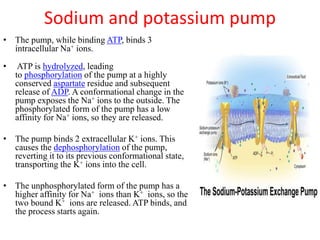
Sodium and potassium pump
• The pump, while binding ATP, binds 3
intracellular Na+ ions.
• ATP is hydrolyzed, leading
to phosphorylation of the pump at a highly
conserved aspartate residue and subsequent
release of ADP. A conformational change in the
pump exposes the Na+ ions to the outside. The
phosphorylated form of the pump has a low
affinity for Na+ ions, so they are released.
• The pump binds 2 extracellular K+ ions. This
causes the dephosphorylation of the pump,
reverting it to its previous conformational state,
transporting the K+ ions into the cell.
• The unphosphorylated form of the pump has a
higher affinity for Na+ ions than K+ ions, so the
two bound K+ ions are released. ATP binds, and
the process starts again.
SILICON
• The effect of Si is especially important in the
yield and quantity of the rice crop.
• Recent studies have shown that, Silicon
imparts disease resistance and lodging
resistance in paddy
• The grain yield of the plants with Si is twice
more than the plants without Si.
• The concentration of Si in rice will be around
100 mg g-1
Physiological Functions of Silica on Rice Crop
 Increasing canopy photosynthetic efficiency by
keeping leaves erect and compact.
 Increasing resistance to Fungi, Bacteria, and Insect
Pests.
 Reducing the Toxicity of Heavy metals.
 Improving Water Use efficiency by Reducing
Cuticular Transpiration.
 Silicon Enhances Rice plant’s Resistance to Lodging.
 Silicon act as a structural component of cell.
 Si is deposited as amorphous silica (SiO2-nH2O)
throughout the plant, mainly in the cell walls, where it
interacts with pectins and polyphenals, and enhances
cell wall rigidity and strength Mono silicic acid is the
form of silicon which it is taken up by plants.
 Silicon act as a structural component of cell.
 In cell wall silicon was deposited in the outer
epidermal cells as amorphous silica or opal phytoliths
with distinct three dimensional shapes
Increasing canopy photosynthetic efficiency by keeping leaves erect and
compact.
• Rice uses chlorophyll to fix atmospheric carbon
dioxide and water to form carbohydrate.
• Rice yield is directly proportional to the
accumulation of photosynthates formed in the
process of photosynthesis.
• The manufacturing of photosynthates are closely
related to leaf surface and leaf’s efficiency in
trapping solar energy.
Increasing resistance to Fungi, Bacteria,
and Insect Pests.
• Silicon helps to strengthen cells of rice leaf, stem,
and roots. Epidermal cells accumulate the most
amount of silicon absorbed from the soil.
• In the intercellular spaces, silicon is oxidized to
form silicon dioxide (silica gel). Silicon can also
exist as amorphous silicon dioxide in the plant
tissues. Their presence enhances the plant’s
resistance towards insect pests and disease
pathogens.
Improving Water Use efficiency by Reducing
Cuticular Transpiration
• The cuticle on the leaf surface plays an
important role in reducing transpiration loss
and also prevents pests and diseases attack.
• Accumulation of silicon will form a thick
silicated layer on the leaf surface and this will
effectively reduce cuticular transpiration.
• The findings from Japanese researchers
revealed that the application of silica will
reduce transpiration loss by as much as 30%.
Silicon Enhances Rice plant’s Resistance to Lodging.
• Lodging is one of he major causes of yield loss.
Lodged plants stack upon one another reduces
photosynthetic efficiency.
• Under normal condition, Phosphorous is usually
adsorbed by clay particles and not readily available
to the plant. With the help of silicon, more
phosphorous become available to be absorbed by
the plants. Phosphorous is essential for root
formation, thereby strengthening the root system.
A stronger and more extensive root system will lead
to better anchorage and reduce lodging.
• Increased absorption of phosphorous due to the
presence of silica will provide more energy for
the plant to absorb other elements such as
Calcium and Potassium. These elements help
to strengthen the rice plant against lodging and
reduce pest and disease attacks.
Phsiological role na si cl

Phsiological role na si cl

  • 1.
  • 2.
  • 3.
    CHLORINE • Chlorine (Cl)occurs predominantly as Cl- in soil and plant. • It is an essential micronutrient of higher plants and participates in several physiological metabolism processes. • Its functions in plant growth and development include osmotic and stomatal regulation, evolution of oxygen in photosynthesis, and disease resistance and tolerance.
  • 4.
    Physiological functions  Chlorinehas been shown to be involved in the oxygen evolution in photo system II in photosynthesis ( Cl and Mn are important for this reaction).  Chlorine accelerates the activation of amylase which converts starch into soluble sugars.  Stomatal Regulation.  Photosynthetic O2 Evolution Cl− Anion.  Osmoregulation.
  • 5.
    Stomatal Regulation • Chlorineplays an essential role in stomatal regulation. • The opening and closure of stomata is mediated by the fluxes of potassium and accompanying anions such malate and chloride • In plant species such as Allium cepa, chloride is essential for stomatal functioning, and stomatal opening is inhibited in the absence of chloride
  • 6.
    Photosynthetic O2 EvolutionCl− Anion The Cl is necessary for the water splitting reaction, or Hill reaction, in photosystem II. It was shown in spinach chloroplast panicles with depleted chlorine, the photosyntheticO2 evolution increased with the increase of external Cl supply. The manganese, chloride plays a fundamental role in the water-splitting system of PS II. H2O--------> PS II ------- > PS I -------->Mn+Cl O2 e- e-
  • 7.
     Chloride alsostimulates the activity of aspagine synthatese which used glutamine as a substrate. Glatamine +aspartic acid --------> asparagine +gutamic acid  It increases the affinity of enzyme, thus it plays a specific role in nitrogen metabolism. NH3 Asparagine synthetase
  • 8.
    Osmoregulation  The Clconcentrations in plants generally exceed this critical deficiency level by two orders of magnitude and become important in osmotic adjustment and plant water relations. In this concentration range Cl− becomes the dominant inorganic anion in the vacuole.  In the phloem sap Cl− concentrations may be in the order of 120 mm and seem to play a role in phloem loading and unloading of sugars. Chloride, together with potassium (K+), has a particularfunction in osmoregulation in the grass stigma. The stigma of grasses such as Pennisetum americium L. often extend within minutes at anthesis by cell elongation and this is mainly mediated by the rapid transfer of K+ and Cl− from the surrounding tissue into the stigma primordium.
  • 9.
    SODIUM The best knownrole of sodium is in the maintenance of osmotic relations of the cell.  Sodium has beneficial effect on growth and water relations of sugar beet.
  • 10.
     Sodium hasbeen shown to be an essential element for plants that use C4 or CAM photosynthetic pathways.  These C4/CAM plants use phosphoenolpyruvate (PEP) to fix atmospheric carbon for photosynthesis, and Na is needed for the regeneration of PEP from pyruvate.
  • 11.
     In certainhalophytes (salt-loving plants, e.g. Atriplex) Na is accumulated to high levels in the vacuoles, contributing substantially to plant osmotic potential. This allows the plant to take up water from salty or dry soils, which have low water potential. Some aquatic halophytes have also been reported to use Na to facilitate nitrate uptake, via aNa+/NO3 co transporter. Parasites generally have a higher Na concentration than their host plants, and hypothesized that osmoregulatory dynamics may contribute to the extraction of water and nutrients from hosts.
  • 12.
    Sodium and potassiumpump • The pump, while binding ATP, binds 3 intracellular Na+ ions. • ATP is hydrolyzed, leading to phosphorylation of the pump at a highly conserved aspartate residue and subsequent release of ADP. A conformational change in the pump exposes the Na+ ions to the outside. The phosphorylated form of the pump has a low affinity for Na+ ions, so they are released. • The pump binds 2 extracellular K+ ions. This causes the dephosphorylation of the pump, reverting it to its previous conformational state, transporting the K+ ions into the cell. • The unphosphorylated form of the pump has a higher affinity for Na+ ions than K+ ions, so the two bound K+ ions are released. ATP binds, and the process starts again.
  • 13.
    SILICON • The effectof Si is especially important in the yield and quantity of the rice crop. • Recent studies have shown that, Silicon imparts disease resistance and lodging resistance in paddy • The grain yield of the plants with Si is twice more than the plants without Si. • The concentration of Si in rice will be around 100 mg g-1
  • 14.
    Physiological Functions ofSilica on Rice Crop  Increasing canopy photosynthetic efficiency by keeping leaves erect and compact.  Increasing resistance to Fungi, Bacteria, and Insect Pests.  Reducing the Toxicity of Heavy metals.  Improving Water Use efficiency by Reducing Cuticular Transpiration.  Silicon Enhances Rice plant’s Resistance to Lodging.
  • 15.
     Silicon actas a structural component of cell.  Si is deposited as amorphous silica (SiO2-nH2O) throughout the plant, mainly in the cell walls, where it interacts with pectins and polyphenals, and enhances cell wall rigidity and strength Mono silicic acid is the form of silicon which it is taken up by plants.  Silicon act as a structural component of cell.  In cell wall silicon was deposited in the outer epidermal cells as amorphous silica or opal phytoliths with distinct three dimensional shapes
  • 16.
    Increasing canopy photosyntheticefficiency by keeping leaves erect and compact. • Rice uses chlorophyll to fix atmospheric carbon dioxide and water to form carbohydrate. • Rice yield is directly proportional to the accumulation of photosynthates formed in the process of photosynthesis. • The manufacturing of photosynthates are closely related to leaf surface and leaf’s efficiency in trapping solar energy.
  • 17.
    Increasing resistance toFungi, Bacteria, and Insect Pests. • Silicon helps to strengthen cells of rice leaf, stem, and roots. Epidermal cells accumulate the most amount of silicon absorbed from the soil. • In the intercellular spaces, silicon is oxidized to form silicon dioxide (silica gel). Silicon can also exist as amorphous silicon dioxide in the plant tissues. Their presence enhances the plant’s resistance towards insect pests and disease pathogens.
  • 18.
    Improving Water Useefficiency by Reducing Cuticular Transpiration • The cuticle on the leaf surface plays an important role in reducing transpiration loss and also prevents pests and diseases attack. • Accumulation of silicon will form a thick silicated layer on the leaf surface and this will effectively reduce cuticular transpiration. • The findings from Japanese researchers revealed that the application of silica will reduce transpiration loss by as much as 30%.
  • 19.
    Silicon Enhances Riceplant’s Resistance to Lodging. • Lodging is one of he major causes of yield loss. Lodged plants stack upon one another reduces photosynthetic efficiency. • Under normal condition, Phosphorous is usually adsorbed by clay particles and not readily available to the plant. With the help of silicon, more phosphorous become available to be absorbed by the plants. Phosphorous is essential for root formation, thereby strengthening the root system. A stronger and more extensive root system will lead to better anchorage and reduce lodging.
  • 20.
    • Increased absorptionof phosphorous due to the presence of silica will provide more energy for the plant to absorb other elements such as Calcium and Potassium. These elements help to strengthen the rice plant against lodging and reduce pest and disease attacks.