Chapter 04
Lecture Outline
Copyright © The McGraw-Hill Companies, Inc. Permission required for reproduction or display.
1
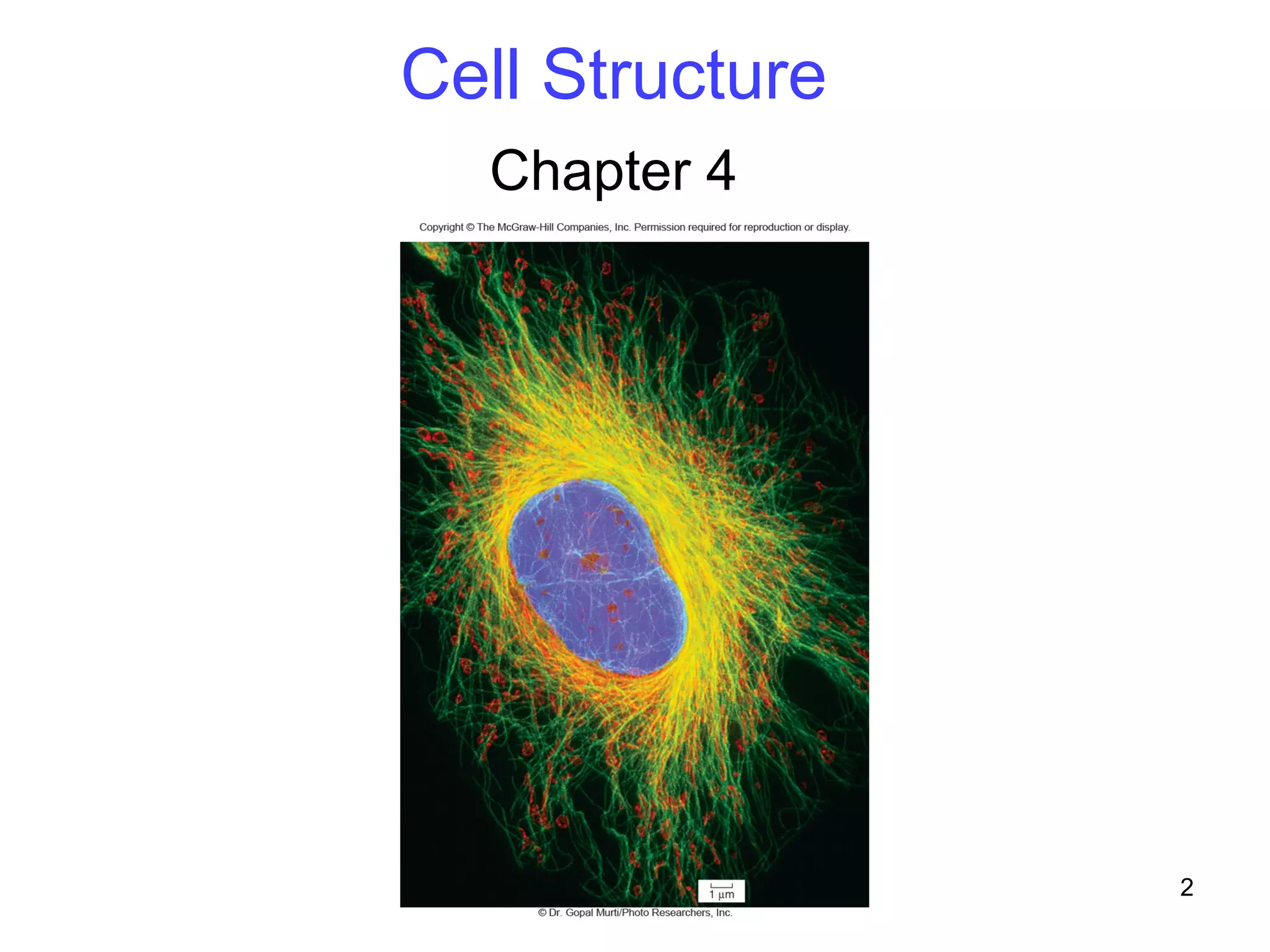
Cell Structure
Chapter 4
2
3
Cells
• Cells were discovered in 1665 by Robert
Hooke
• Early studies of cells were conducted by
– Mathias Schleiden (1838)
– Theodor Schwann (1839)
• Schleiden and Schwann proposed the Cell
Theory
4
Cell Theory
1. All organisms are composed of cells
2. Cells are the smallest living things
3. Cells arise only from pre-existing cells
• All cells today represent a continuous line
of descent from the first living cells
5
Cell size is limited
• Most cells are relatively small due reliance
on diffusion of substances in and out of
cells
• Rate of diffusion affected by
– Surface area available
– Temperature
– Concentration gradient
– Distance
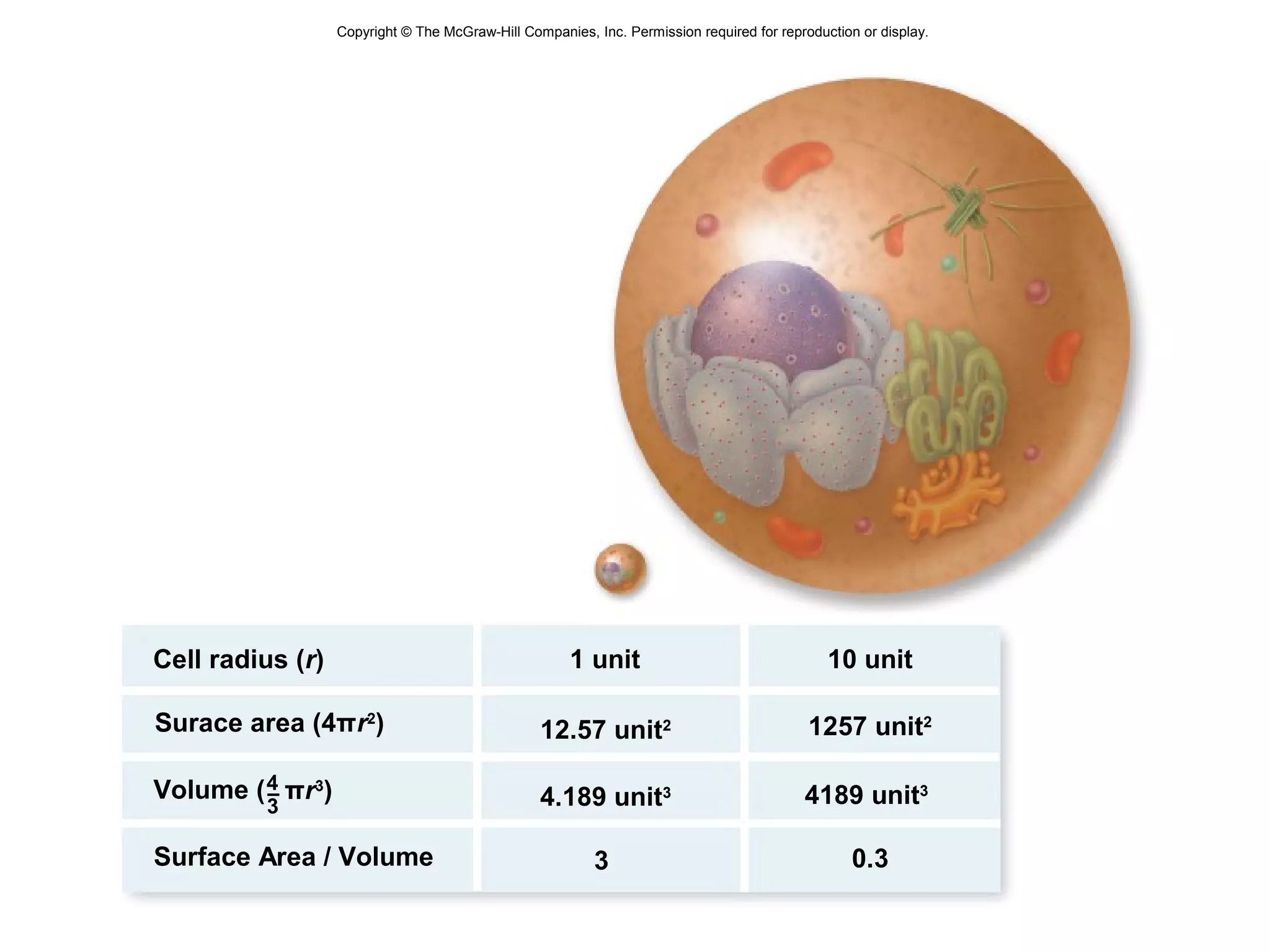
Copyright © The McGraw-Hill Companies, Inc. Permission required for reproduction or display.
4–
3
πr3
)
3
Cell radius (r)
Surface Area / Volume
Surace area (4πr2
)
Volume ( 4.189 unit3
12.57 unit2
1 unit 10 unit
1257 unit2
4189 unit3
0.3
Surface area-to-volume ratio
• Organism made of many small cells has
an advantage over an organism
composed of fewer, larger cells
• As a cell’s size increases, its volume
increases much more rapidly than its
surface area
• Some cells overcome limitation by being
long and skinny – like neurons
7
8
Microscopes
• Not many cells are visible to the naked
eye
– Most are less than 50 μm in diameter
• Resolution – minimum distance two points
can be apart and still be distinguished as
two separate points
– Objects must be 100 μm apart for naked eye
to resolve them as two objects rather than
one
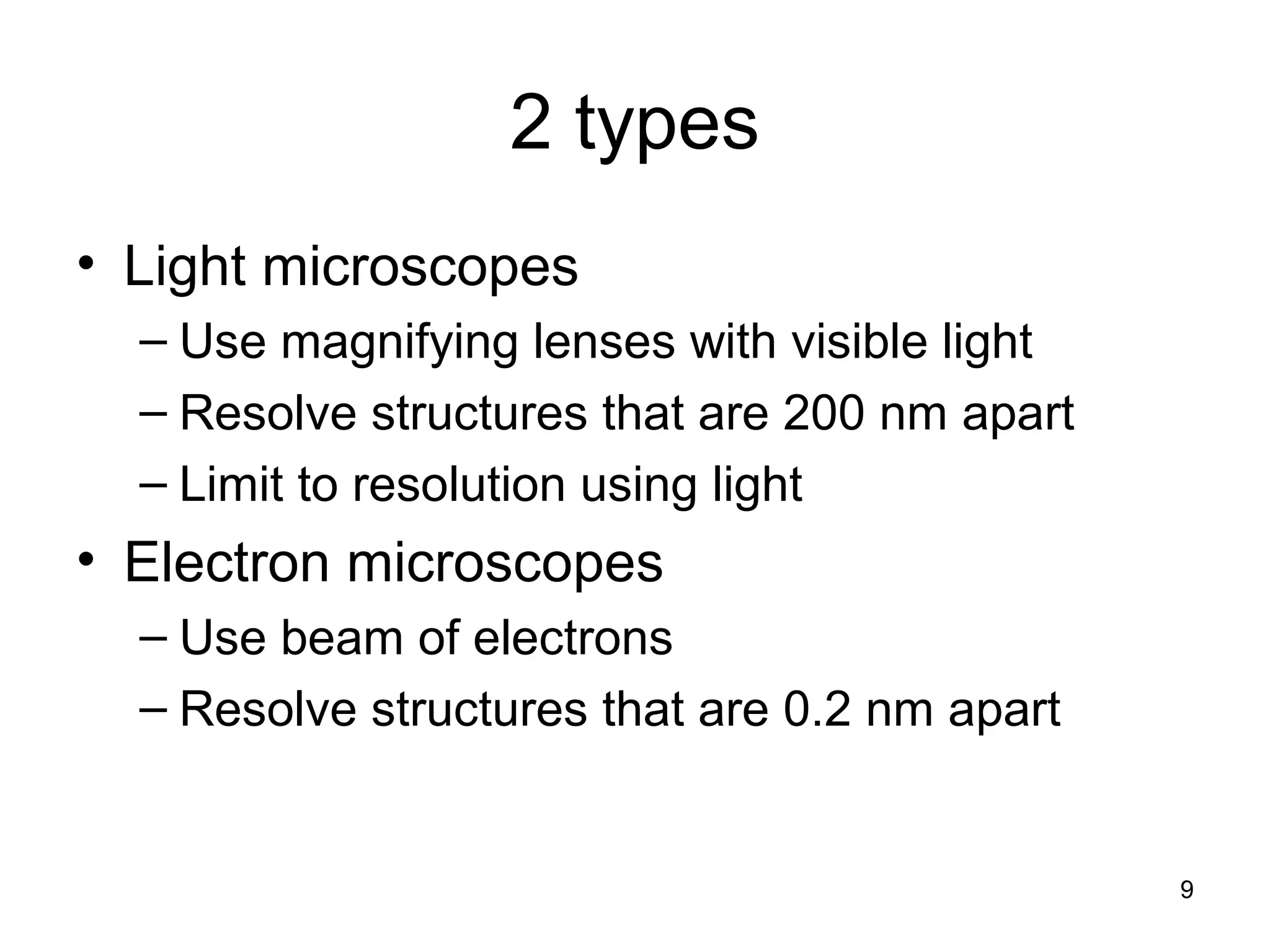
2 types
• Light microscopes
– Use magnifying lenses with visible light
– Resolve structures that are 200 nm apart
– Limit to resolution using light
• Electron microscopes
– Use beam of electrons
– Resolve structures that are 0.2 nm apart
9
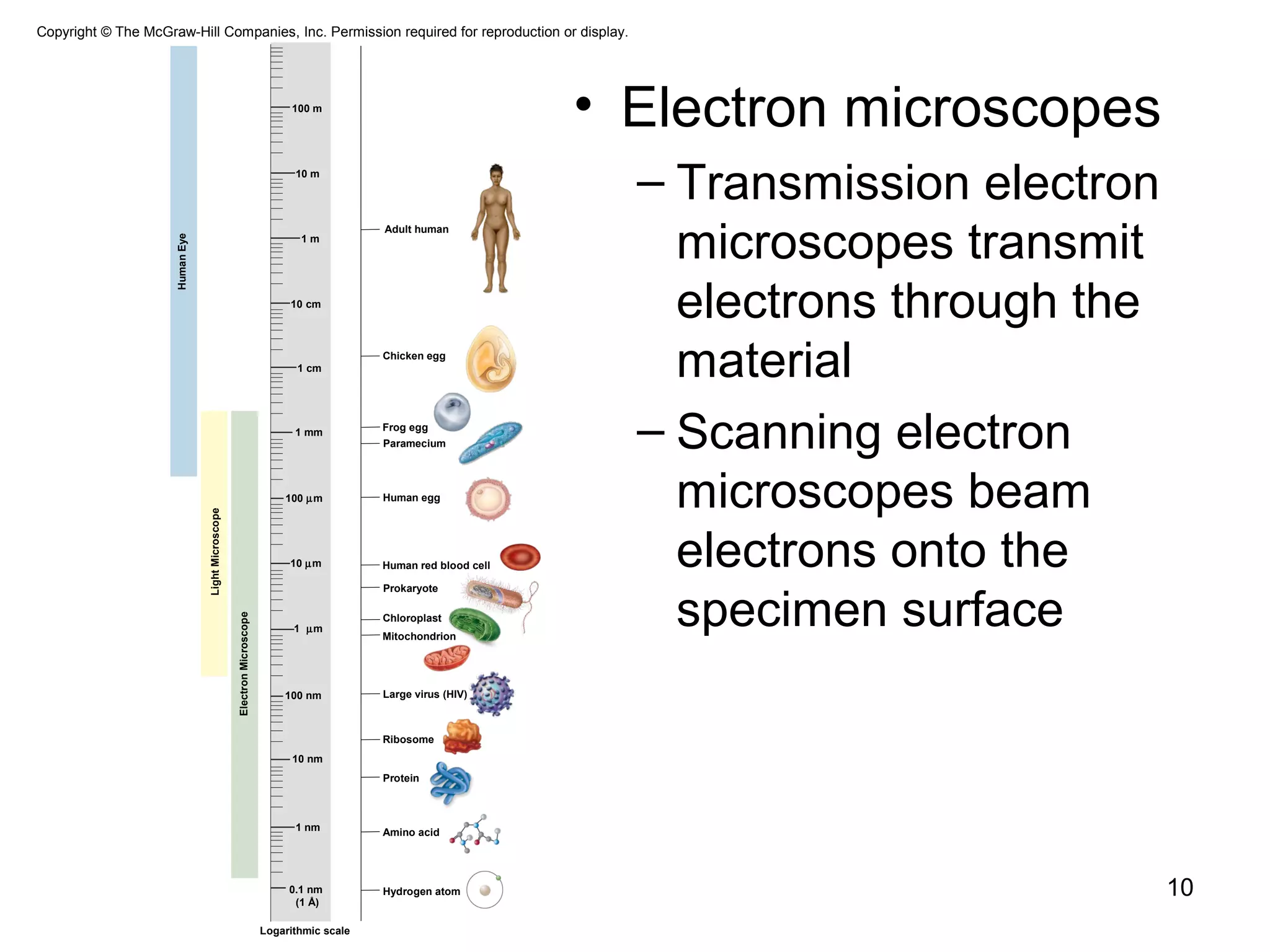
• Electron microscopes
– Transmission electron
microscopes transmit
electrons through the
material
– Scanning electron
microscopes beam
electrons onto the
specimen surface
10
Copyright © The McGraw-Hill Companies, Inc. Permission required for reproduction or display.
HumanEye
LightMicroscope
ElectronMicroscope
Hydrogen atom
Amino acid
Logarithmic scale
Protein
Ribosome
Large virus (HIV)
Human red blood cell
Prokaryote
Human egg
Paramecium
Chicken egg
Adult human
Frog egg
Chloroplast
Mitochondrion
1 m
10 cm
1 cm
1 mm
1 nm
0.1 nm
(1 Å)
10 nm
100 nm
1 µm
10 µm
100 µm
10 m
100 m
11
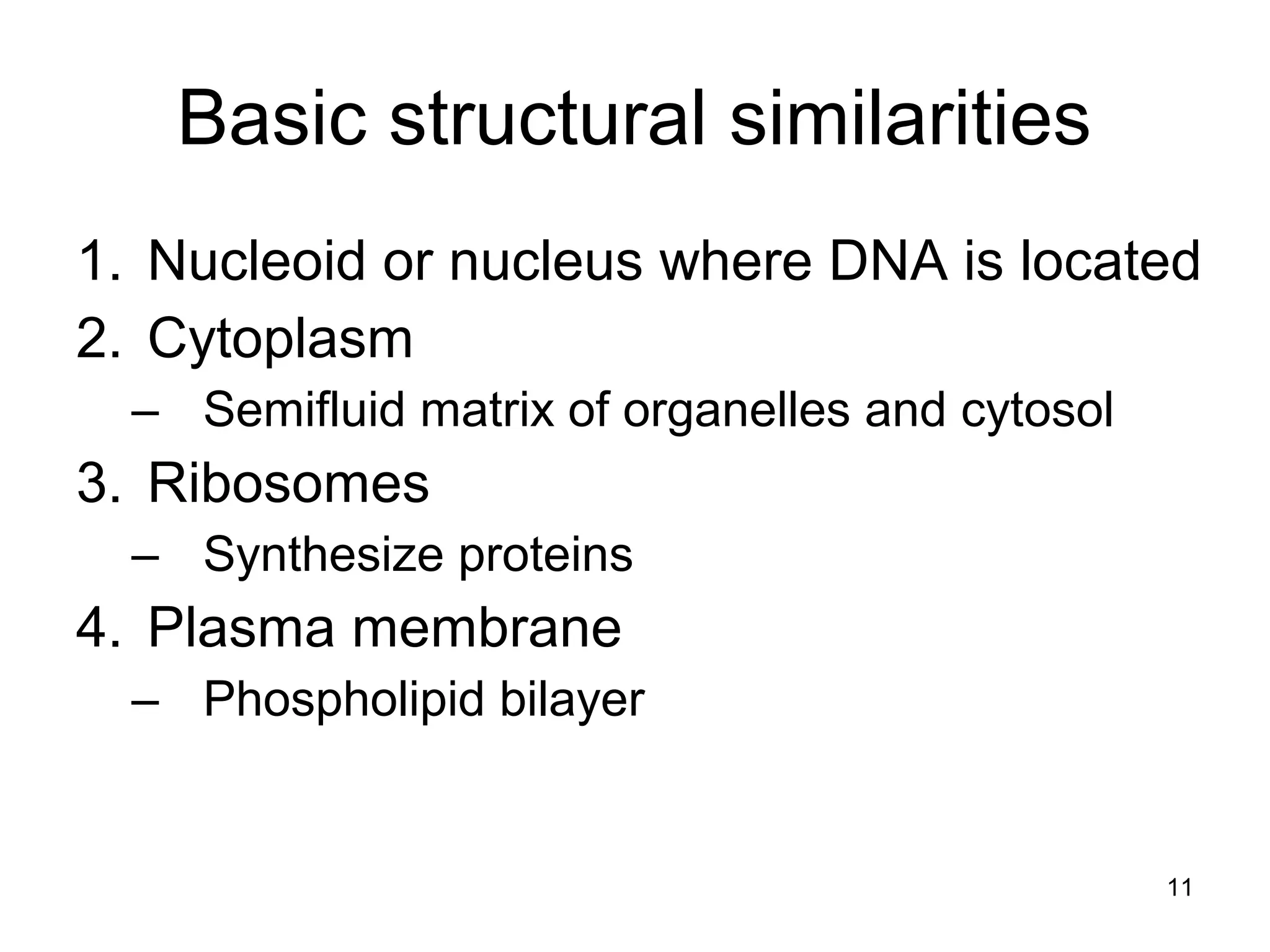
Basic structural similarities
1. Nucleoid or nucleus where DNA is located
2. Cytoplasm
– Semifluid matrix of organelles and cytosol
3. Ribosomes
– Synthesize proteins
4. Plasma membrane
– Phospholipid bilayer
12
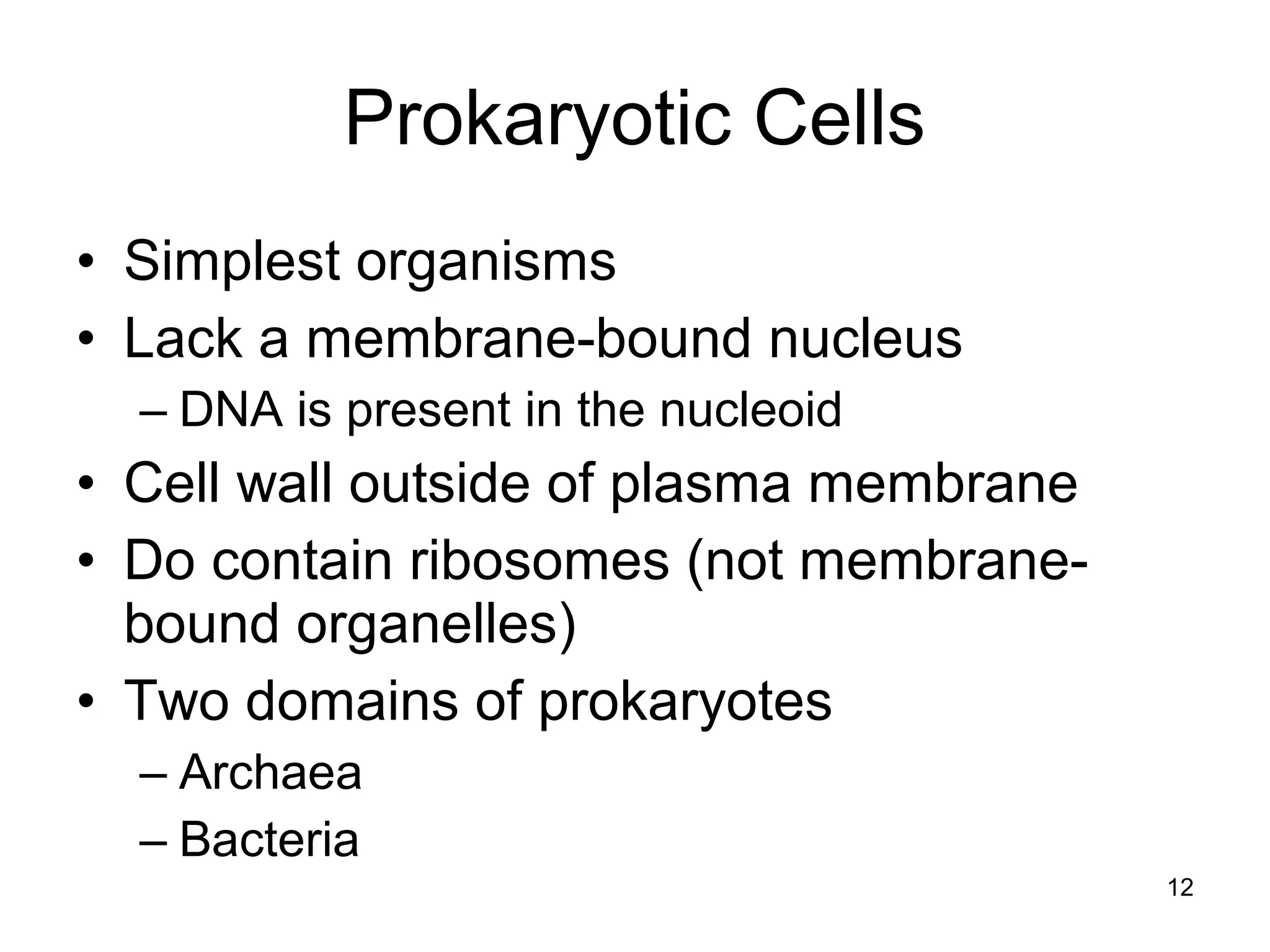
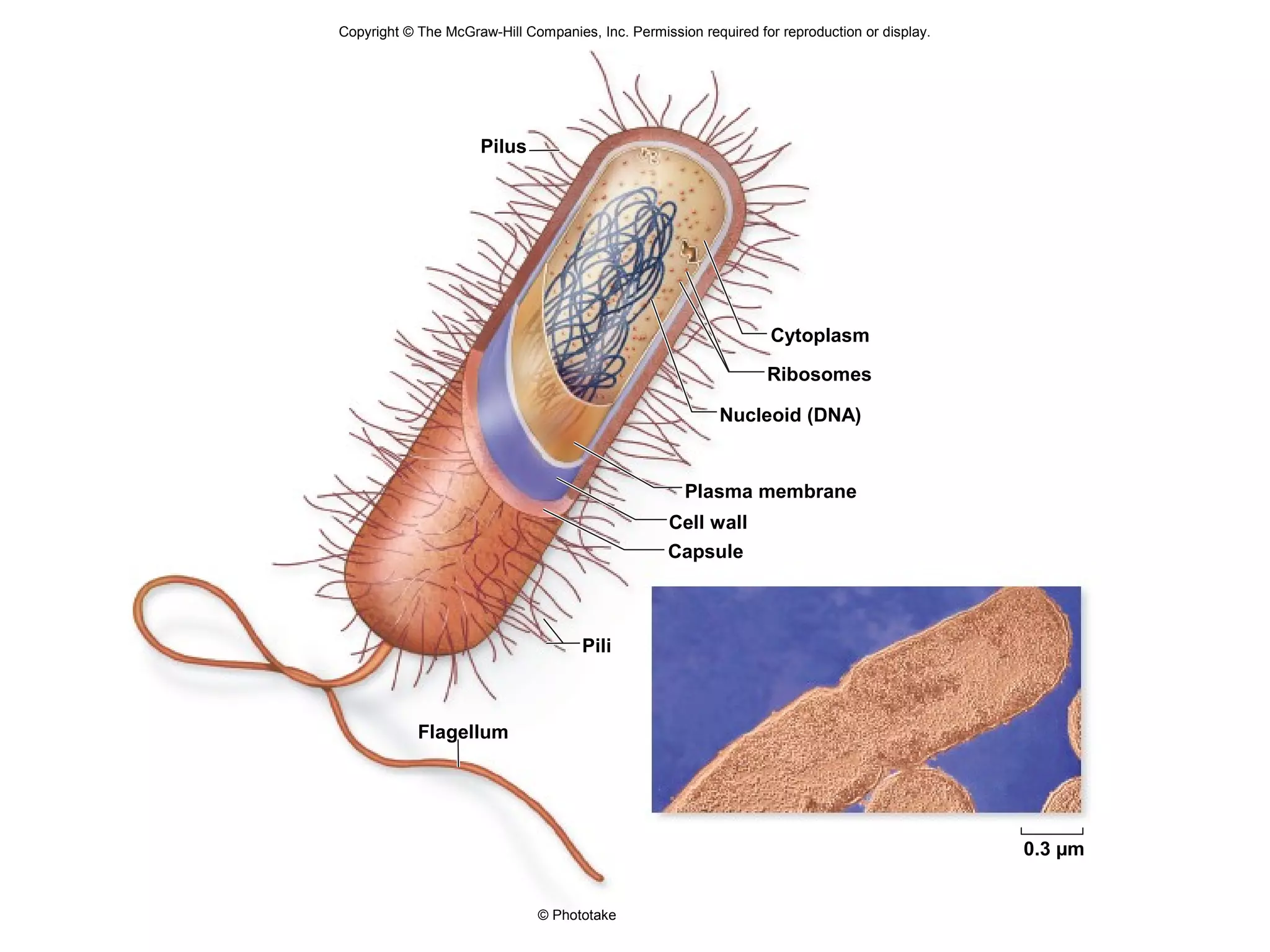
Prokaryotic Cells
• Simplest organisms
• Lack a membrane-bound nucleus
– DNA is present in the nucleoid
• Cell wall outside of plasma membrane
• Do contain ribosomes (not membrane-
bound organelles)
• Two domains of prokaryotes
– Archaea
– Bacteria
Copyright © The McGraw-Hill Companies, Inc. Permission required for reproduction or display.
Cytoplasm
Ribosomes
Nucleoid (DNA)
Plasma membrane
Capsule
Cell wall
Pili
Flagellum
Pilus
0.3 µm
© Phototake
Bacterial cell walls
• Most bacterial cells are encased by a strong cell
wall
– composed of peptidoglycan
– Cell walls of plants, fungi, and most protists different
• Protect the cell, maintain its shape, and prevent
excessive uptake or loss of water
• Susceptibility of bacteria to antibiotics often
depends on the structure of their cell walls
• Archaea lack peptidoglycan
14
15
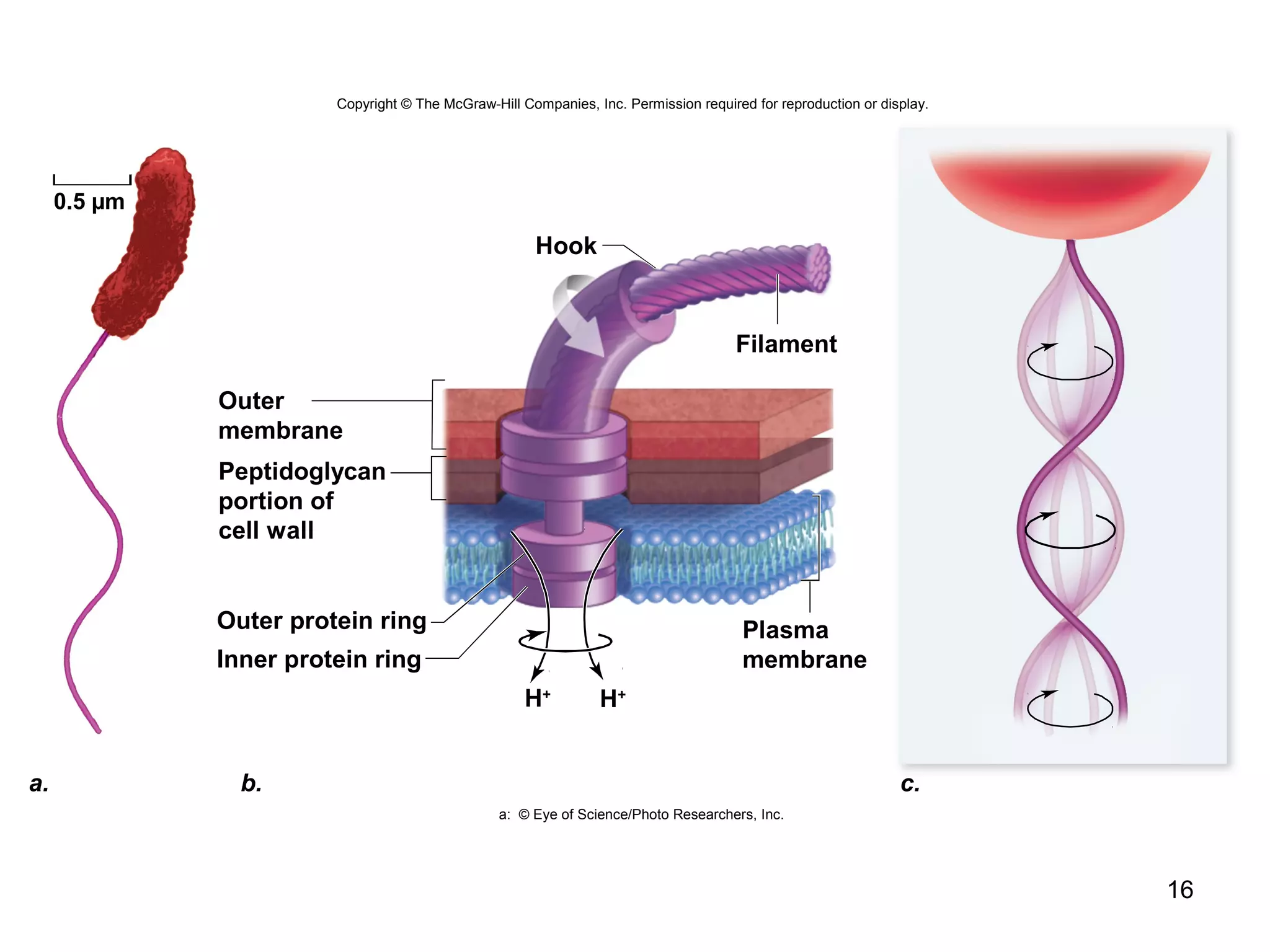
Flagella
• Present in some prokaryotic cells
– May be one or more or none
• Used for locomotion
• Rotary motion propels the cell
16
Copyright © The McGraw-Hill Companies, Inc. Permission required for reproduction or display.
Outer protein ring
Hook
Filament
Inner protein ring
H+
H+
Peptidoglycan
portion of
cell wall
Outer
membrane
Plasma
membrane
a. b. c.
0.5 µm
a: © Eye of Science/Photo Researchers, Inc.
17
Eukaryotic Cells
• Possess a membrane-bound nucleus
• More complex than prokaryotic cells
• Hallmark is compartmentalization
– Achieved through use of membrane-bound
organelles and endomembrane system
• Possess a cytoskeleton for support and to
maintain cellular structure
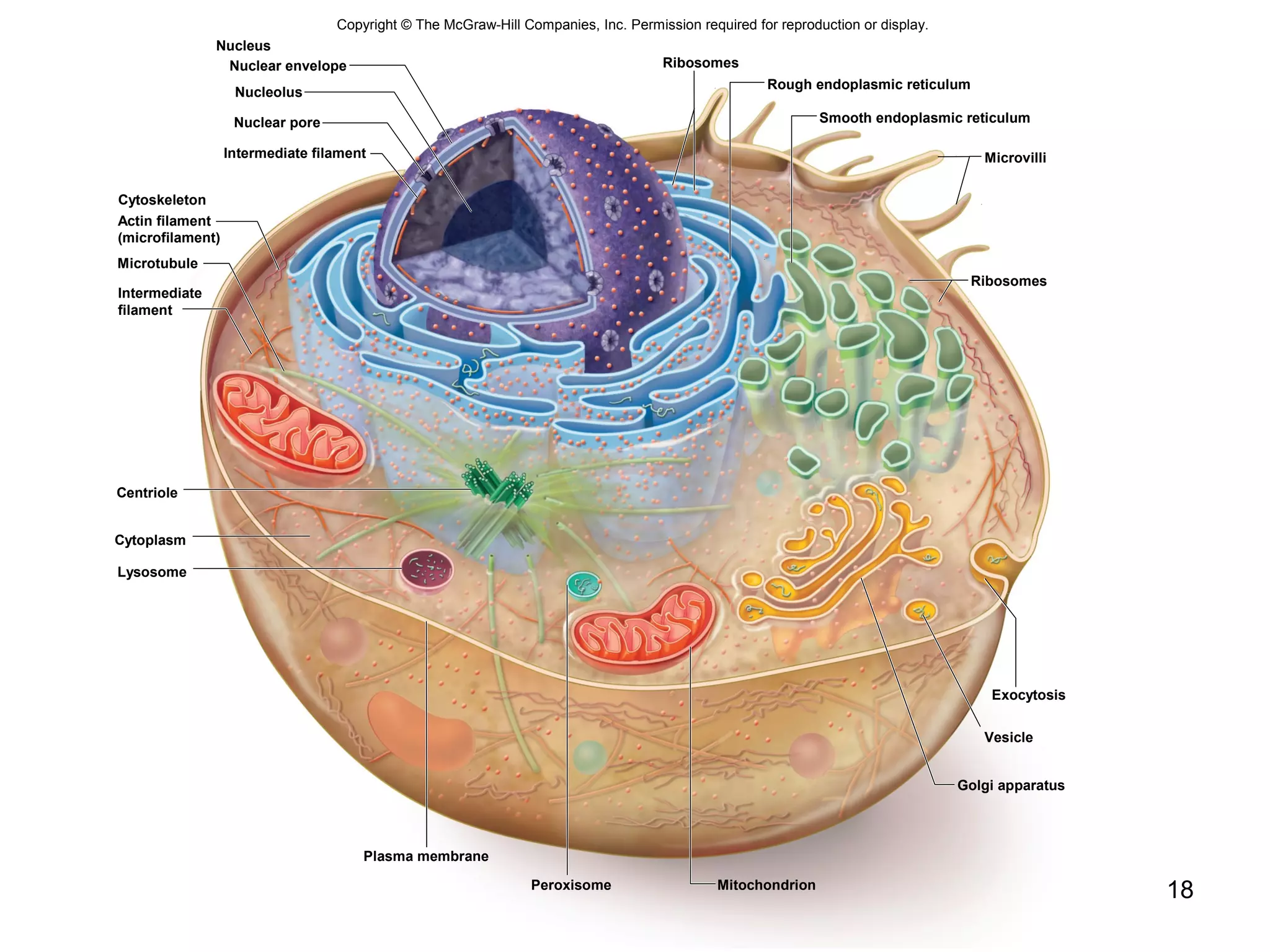
18
Copyright © The McGraw-Hill Companies, Inc. Permission required for reproduction or display.
Nucleus
Nucleolus
Nuclear pore
Intermediate filament
Ribosomes
Ribosomes
Cytoplasm
Cytoskeleton
Microtubule
Centriole
Plasma membrane
Mitochondrion
Golgi apparatus
Exocytosis
Peroxisome
Smooth endoplasmic reticulum
Rough endoplasmic reticulum
Microvilli
Nuclear envelope
Actin filament
(microfilament)
Intermediate
filament
Lysosome
Vesicle
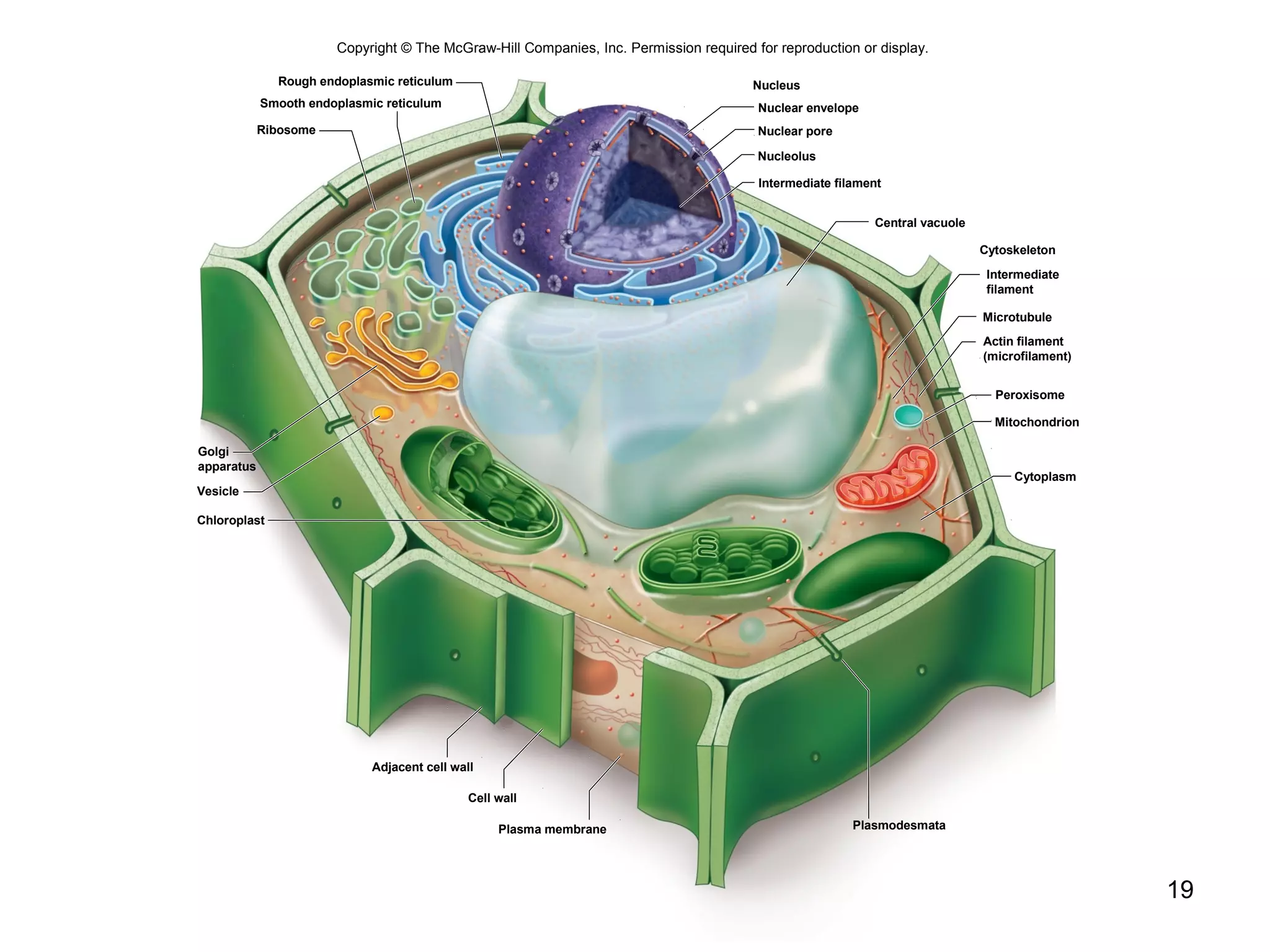
19
Copyright © The McGraw-Hill Companies, Inc. Permission required for reproduction or display.
Nucleus
Nucleolus
Nuclear pore
Intermediate filament
Ribosome
Cytoplasm
Cytoskeleton
Microtubule
Plasma membrane
Mitochondrion
Peroxisome
Smooth endoplasmic reticulum
Rough endoplasmic reticulum
Nuclear envelope
Central vacuole
Plasmodesmata
Adjacent cell wall
Cell wall
Chloroplast
Golgi
apparatus
Vesicle
Actin filament
(microfilament)
Intermediate
filament
20
Nucleus
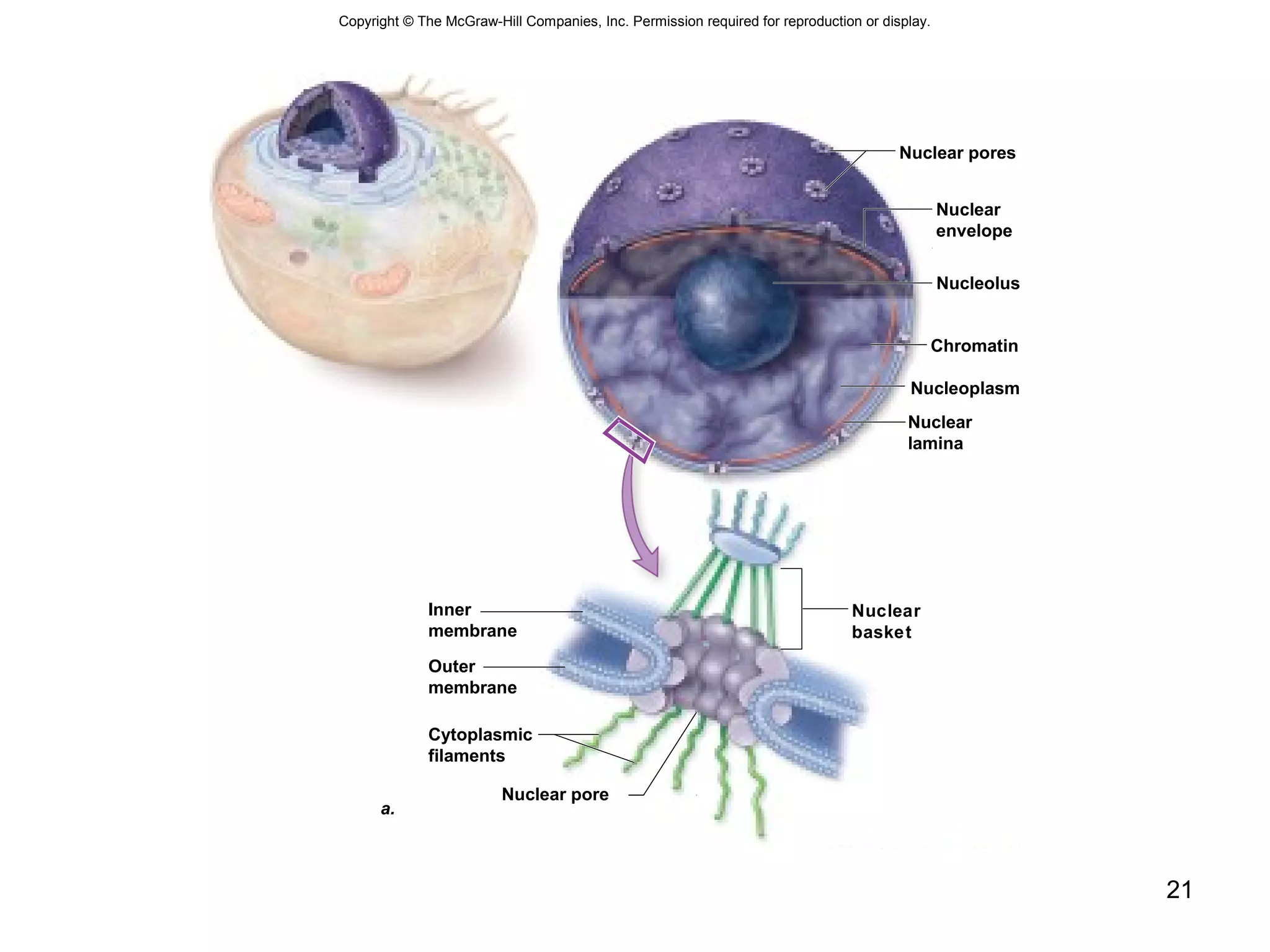
• Repository of the genetic information
• Most eukaryotic cells possess a single nucleus
• Nucleolus – region where ribosomal RNA
synthesis takes place
• Nuclear envelope
– 2 phospholipid bilayers
– Nuclear pores – control passage in and out
• In eukaryotes, the DNA is divided into multiple
linear chromosomes
– Chromatin is chromosomes plus protein
21
Copyright © The McGraw-Hill Companies, Inc. Permission required for reproduction or display.
Nuclear
basket
Nuclear pores
Nuclear
envelope
Nucleolus
Chromatin
Nucleoplasm
Nuclear
lamina
Inner
membrane
Outer
membrane
Cytoplasmic
filaments
Nuclear pore
a.
Ribosomes
• Cell’s protein synthesis machinery
• Found in all cell types in all 3 domains
• Ribosomal RNA (rRNA)-protein complex
• Protein synthesis also requires messenger
RNA (mRNA) and transfer RNA (tRNA)
• Ribosomes may be free in cytoplasm or
associated with internal membranes
22
23
Endomembrane System
• Series of membranes throughout the
cytoplasm
• Divides cell into compartments where
different cellular functions occur
• One of the fundamental distinctions
between eukaryotes and prokaryotes
24
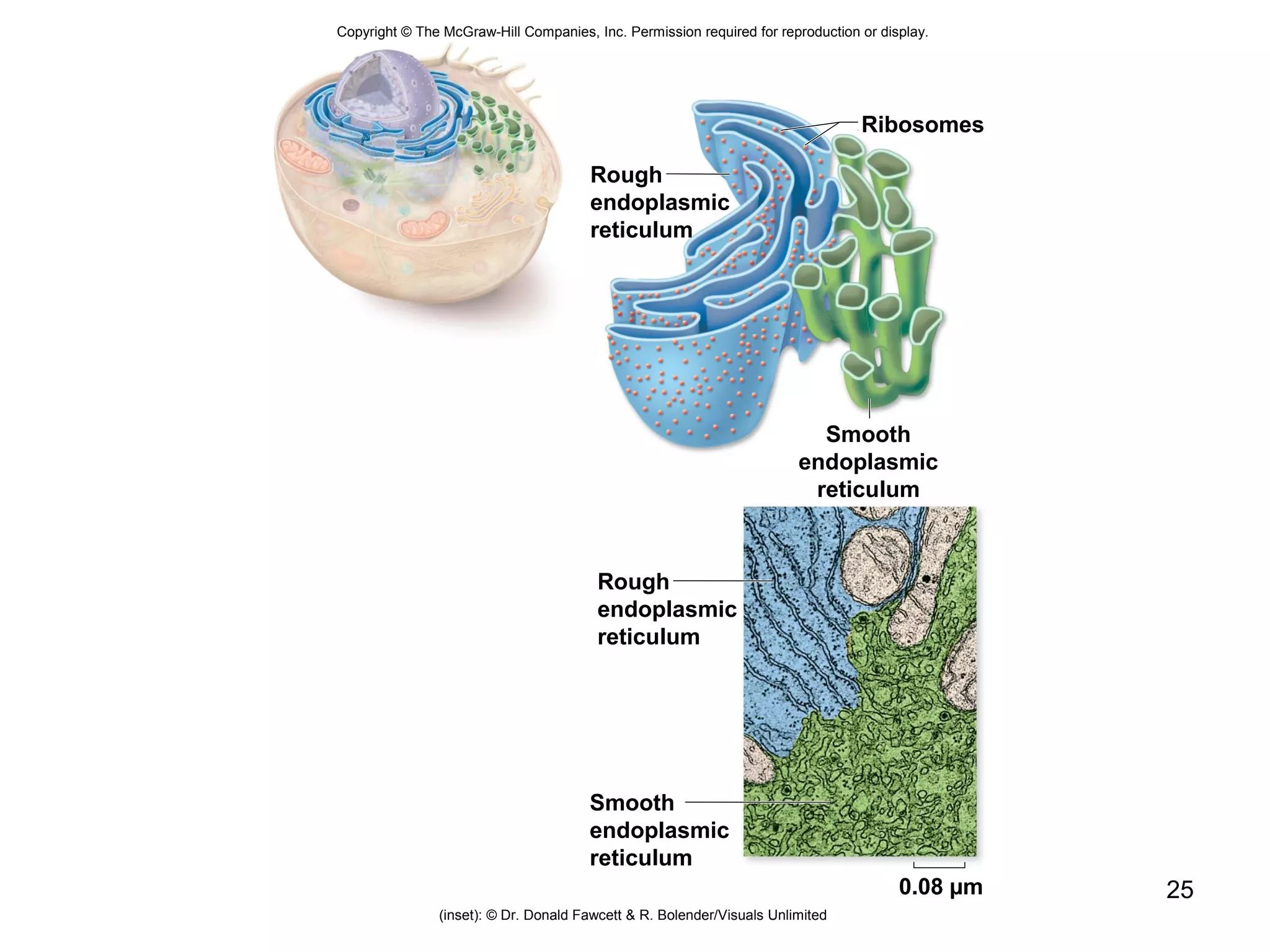
Endoplasmic reticulum
• Rough endoplasmic reticulum (RER)
– Attachment of ribosomes to the membrane gives a
rough appearance
– Synthesis of proteins to be secreted, sent to
lysosomes or plasma membrane
• Smooth endoplasmic reticulum (SER)
– Relatively few bound ribosomes
– Variety of functions – synthesis, store Ca2+
,
detoxification
• Ratio of RER to SER depends on cell’s function
25
Copyright © The McGraw-Hill Companies, Inc. Permission required for reproduction or display.
Ribosomes
Smooth
endoplasmic
reticulum
Smooth
endoplasmic
reticulum
0.08 µm
(inset): © Dr. Donald Fawcett & R. Bolender/Visuals Unlimited
Rough
endoplasmic
reticulum
Rough
endoplasmic
reticulum
26
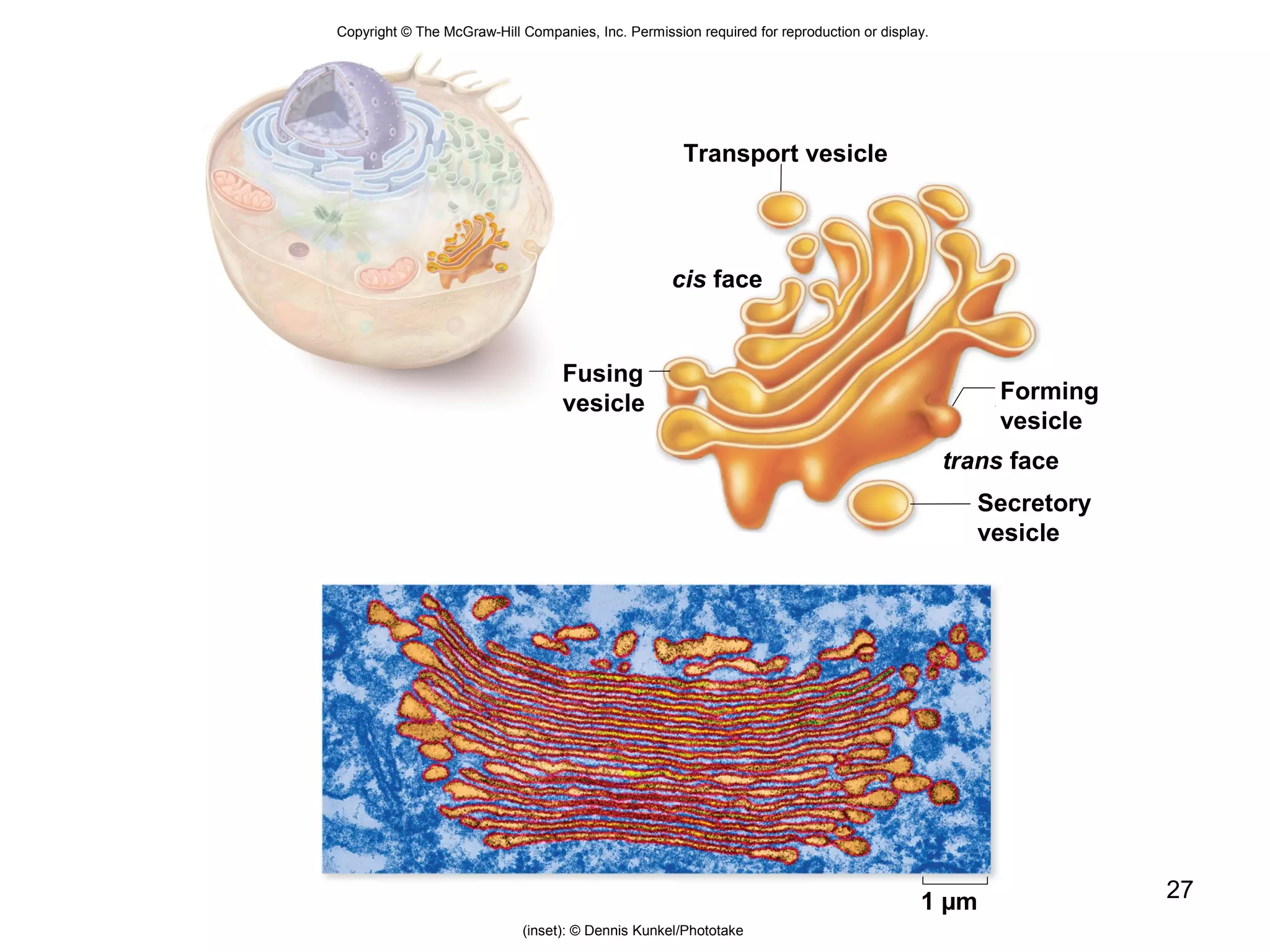
Golgi apparatus
• Flattened stacks of interconnected
membranes (Golgi bodies)
• Functions in packaging and distribution of
molecules synthesized at one location and
used at another within the cell or even
outside of it
• Has cis and trans faces
• Vesicles transport molecules to
destination
27
Copyright © The McGraw-Hill Companies, Inc. Permission required for reproduction or display.
1 µm
Secretory
vesicle
Forming
vesicle
trans face
cis face
Fusing
vesicle
Transport vesicle
(inset): © Dennis Kunkel/Phototake
28
Copyright © The McGraw-Hill Companies, Inc. Permission required for reproduction or display.
1.
2.
3.
Golgi membrane protein
Cisternae
Secretory vesicle
Cell membrane
Extracellular fluid
Rough
endoplasmic
reticulum
Membrane
protein
Newly
synthesized
protein
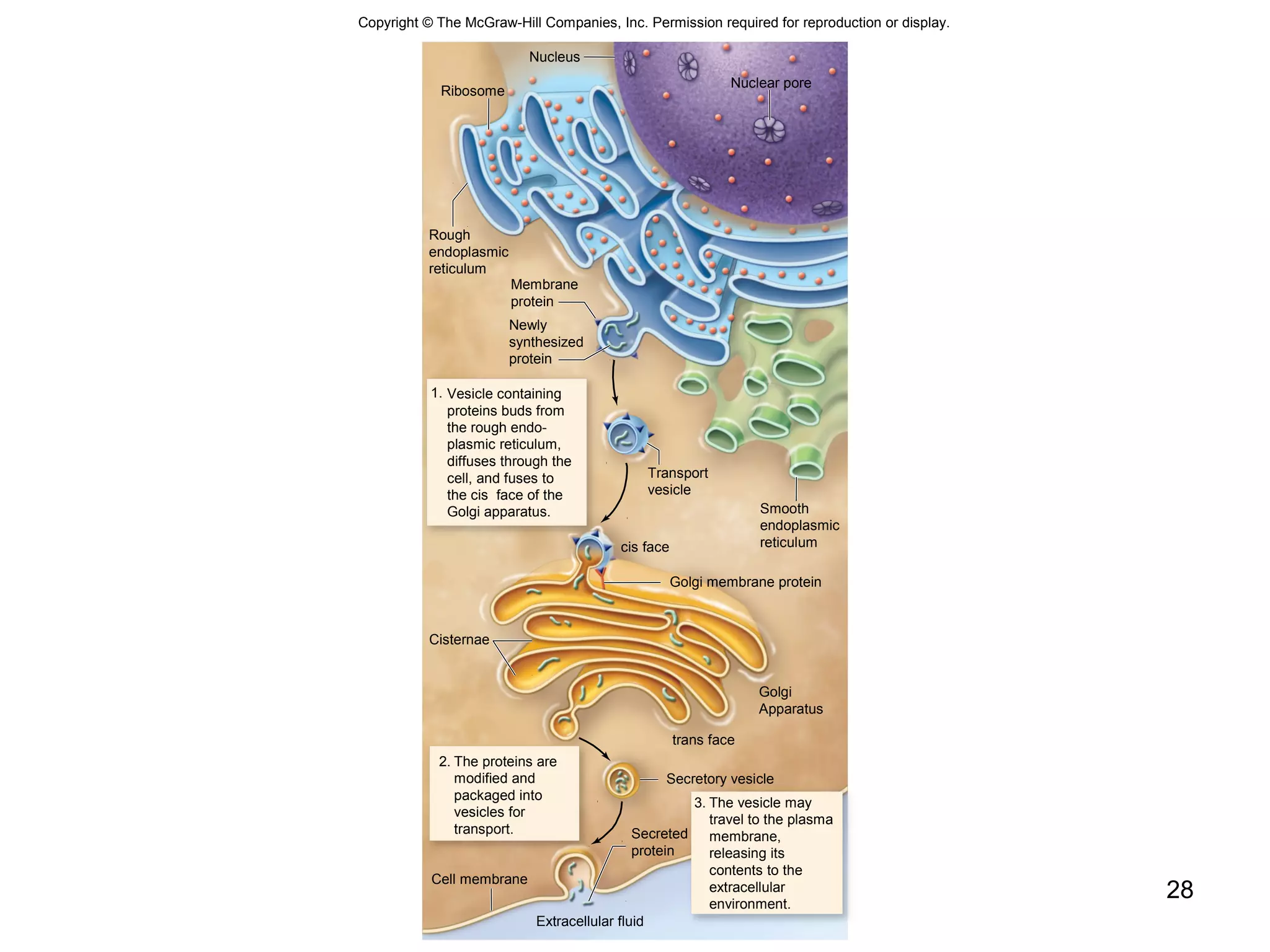
Vesicle containing
proteins buds from
the rough endo-
plasmic reticulum,
diffuses through the
cell, and fuses to
the cis face of the
Golgi apparatus. Smooth
endoplasmic
reticulumcis face
Golgi
Apparatus
trans face
The proteins are
modified and
packaged into
vesicles for
transport. Secreted
protein
The vesicle may
travel to the plasma
membrane,
releasing its
contents to the
extracellular
environment.
Transport
vesicle
Nucleus
Nuclear pore
Ribosome
Copyright © The McGraw-Hill Companies, Inc. Permission required for reproduction or display.
29
Lysosomes
• Membrane-bounded digestive vesicles
• Arise from Golgi apparatus
• Enzymes catalyze breakdown of
macromolecules
• Destroy cells or foreign matter that the cell
has engulfed by phagocytosis
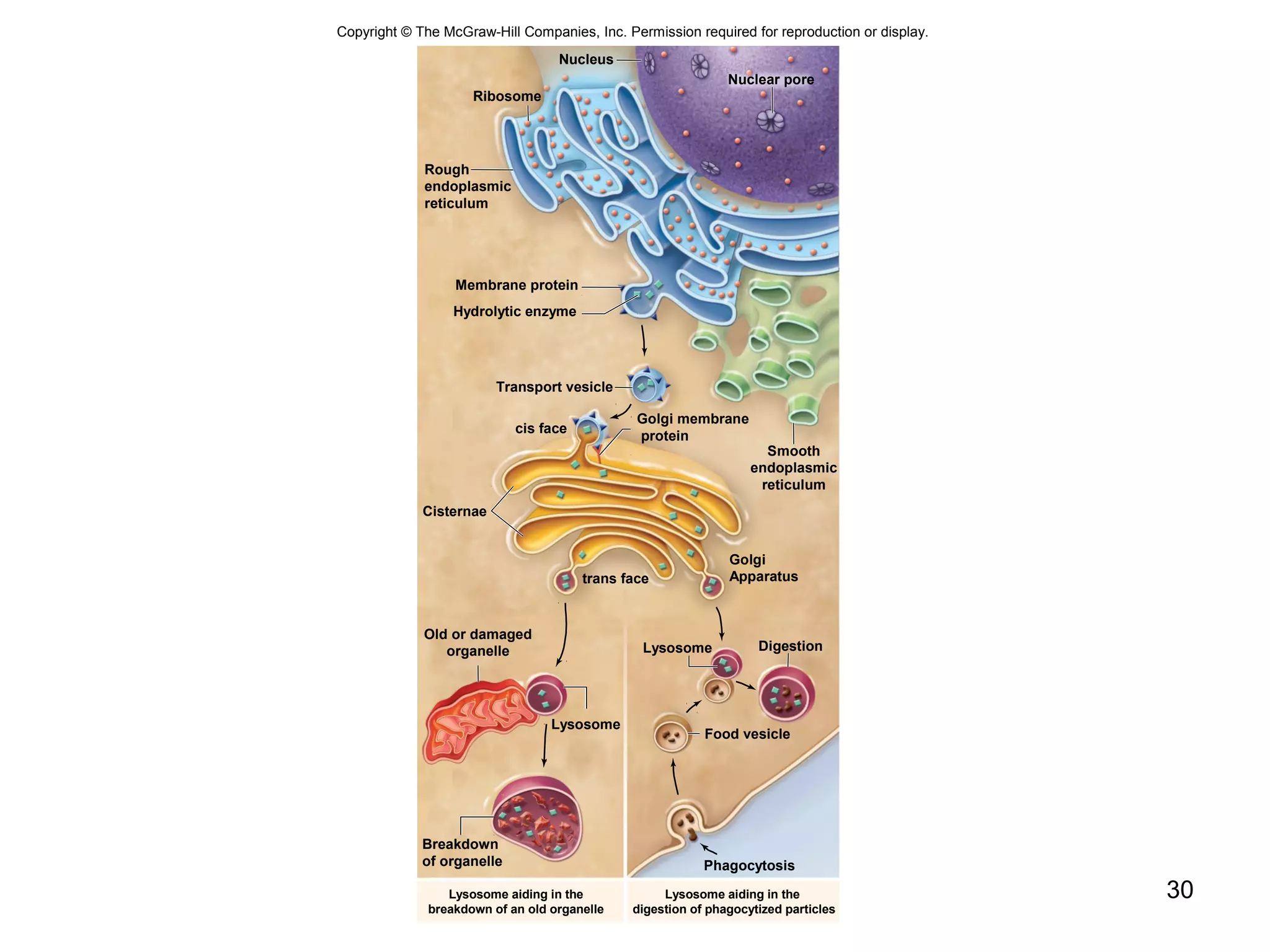
30
Copyright © The McGraw-Hill Companies, Inc. Permission required for reproduction or display.
Lysosome aiding in the
breakdown of an old organelle
Lysosome aiding in the
digestion of phagocytized particles
Golgi membrane
protein
Cisternae
Rough
endoplasmic
reticulum
Smooth
endoplasmic
reticulum
cis face
Golgi
Apparatustrans face
Nucleus
Ribosome
Membrane protein
Hydrolytic enzyme
Transport vesicle
Breakdown
of organelle
Lysosome
Lysosome Digestion
Old or damaged
organelle
Food vesicle
Phagocytosis
Nuclear pore
Microbodies
• Variety of enzyme-
bearing, membrane-
enclosed vesicles
• Peroxisomes
– Contain enzymes
involved in the
oxidation of fatty acids
– Hydrogen peroxide
produced as by-
product – rendered
harmless by catalase
31
Copyright © The McGraw-Hill Companies, Inc. Permission required for reproduction or display.
0.2 µm
(inset): From S.E. Frederick and E.H. Newcomb, “Microbody-like organelles in leaf cells,” Science,
163:1353-5. © 21 March 1969. Reprinted with permission from AAAS
32
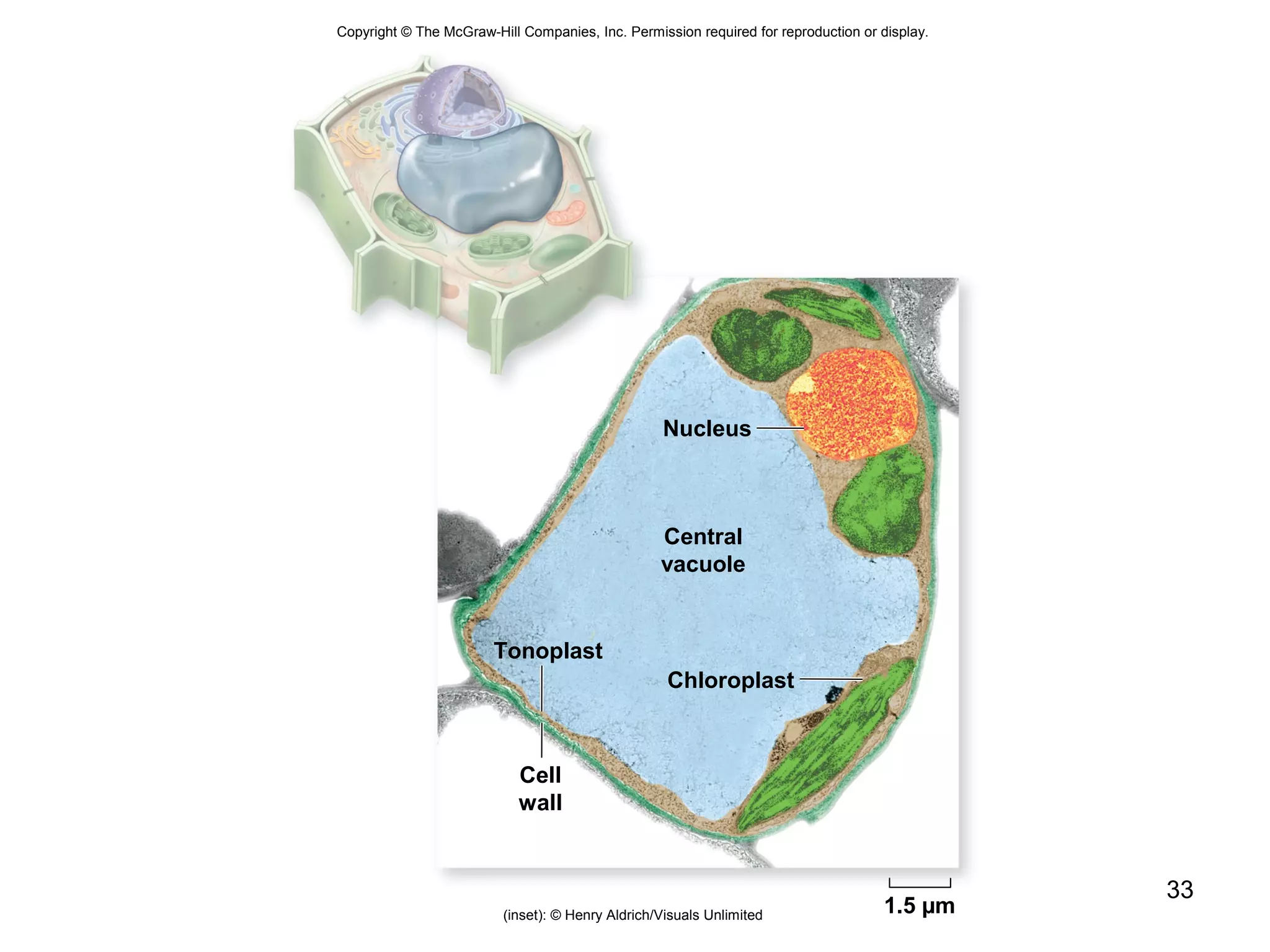
Vacuoles
• Membrane-bounded structures in plants
• Various functions depending on the cell
type
• There are different types of vacuoles:
– Central vacuole in plant cells
– Contractile vacuole of some fungi and protists
– Storage vacuoles
33
Copyright © The McGraw-Hill Companies, Inc. Permission required for reproduction or display.
(inset): © Henry Aldrich/Visuals Unlimited
Nucleus
Chloroplast
Tonoplast
Central
vacuole
1.5 µm
Cell
wall
34
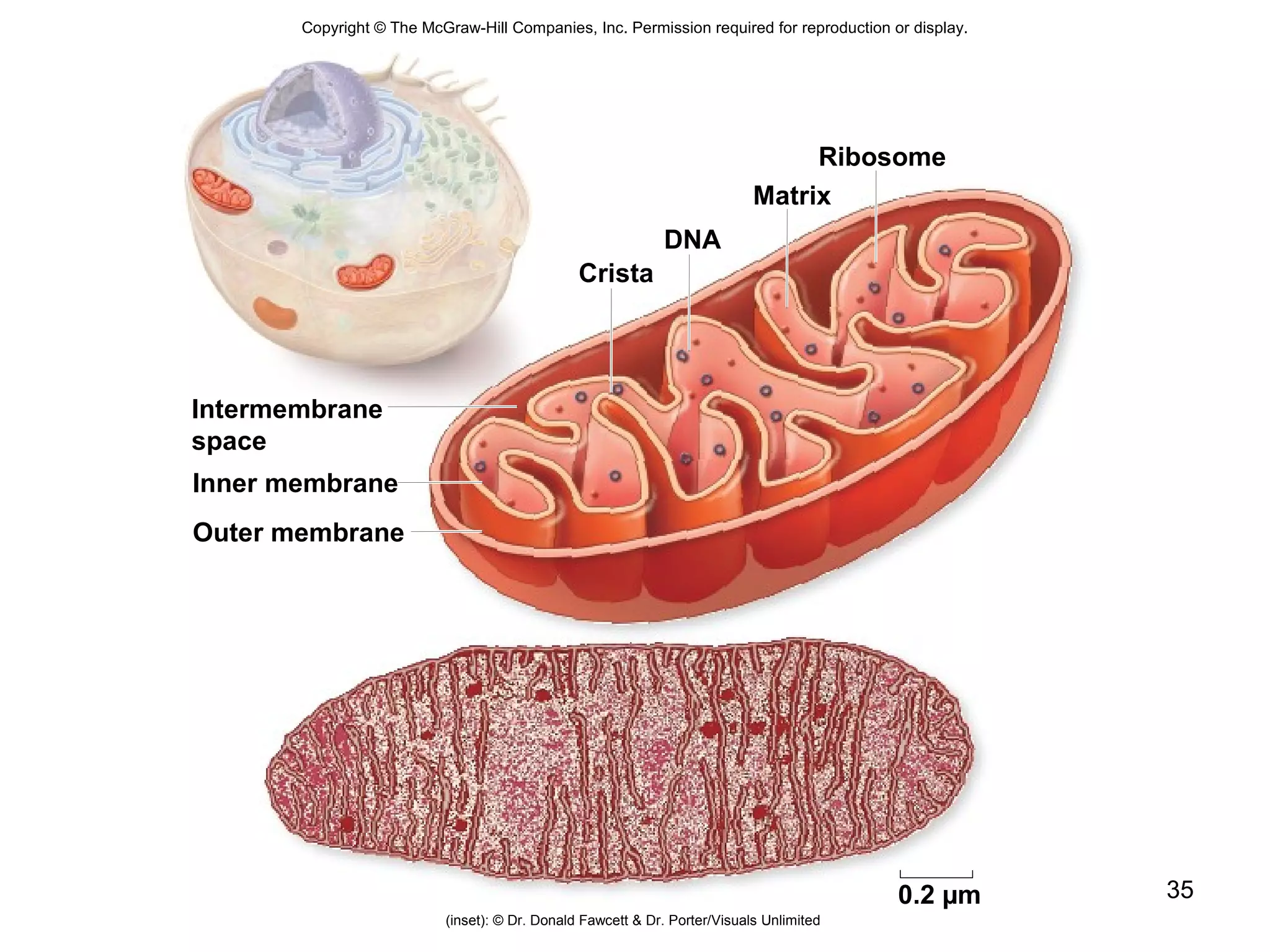
Mitochondria
• Found in all types of eukaryotic cells
• Bound by membranes
– Outer membrane
– Intermembrane space
– Inner membrane has cristae
– Matrix
• On the surface of the inner membrane, and also
embedded within it, are proteins that carry out
oxidative metabolism
• Have their own DNA
35
Copyright © The McGraw-Hill Companies, Inc. Permission required for reproduction or display.
Intermembrane
space
Inner membrane
Outer membrane
Ribosome
Matrix
DNA
Crista
0.2 µm
(inset): © Dr. Donald Fawcett & Dr. Porter/Visuals Unlimited
36
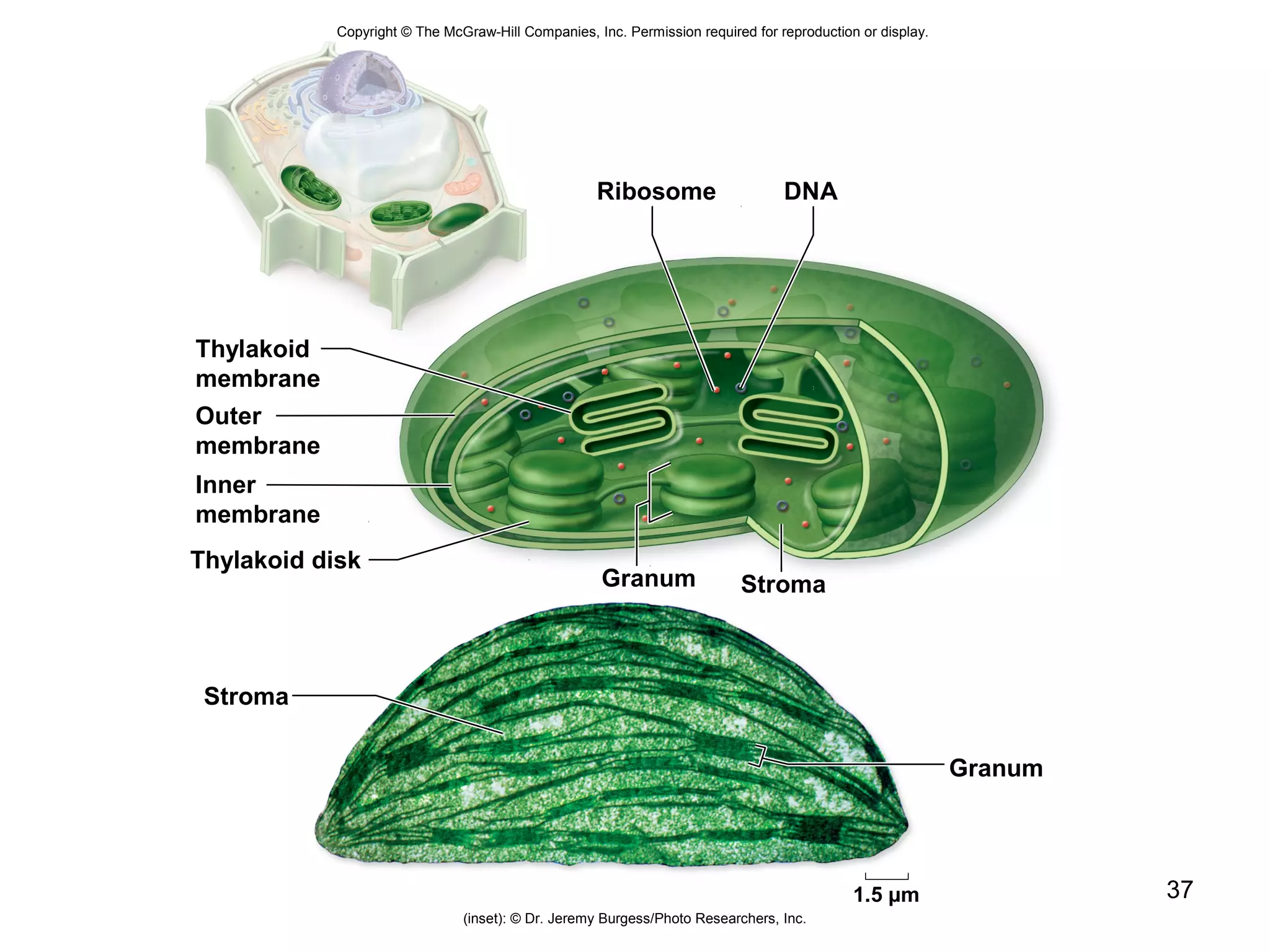
Chloroplasts
• Organelles present in cells of plants and
some other eukaryotes
• Contain chlorophyll for photosynthesis
• Surrounded by 2 membranes
• Thylakoids are membranous sacs within
the inner membrane
– Grana are stacks of thylakoids
• Have their own DNA
37
Copyright © The McGraw-Hill Companies, Inc. Permission required for reproduction or display.
Ribosome DNA
Stroma
Stroma
Thylakoid
membrane
Outer
membrane
Inner
membrane
Thylakoid disk
Granum
Granum
1.5 µm
(inset): © Dr. Jeremy Burgess/Photo Researchers, Inc.
38
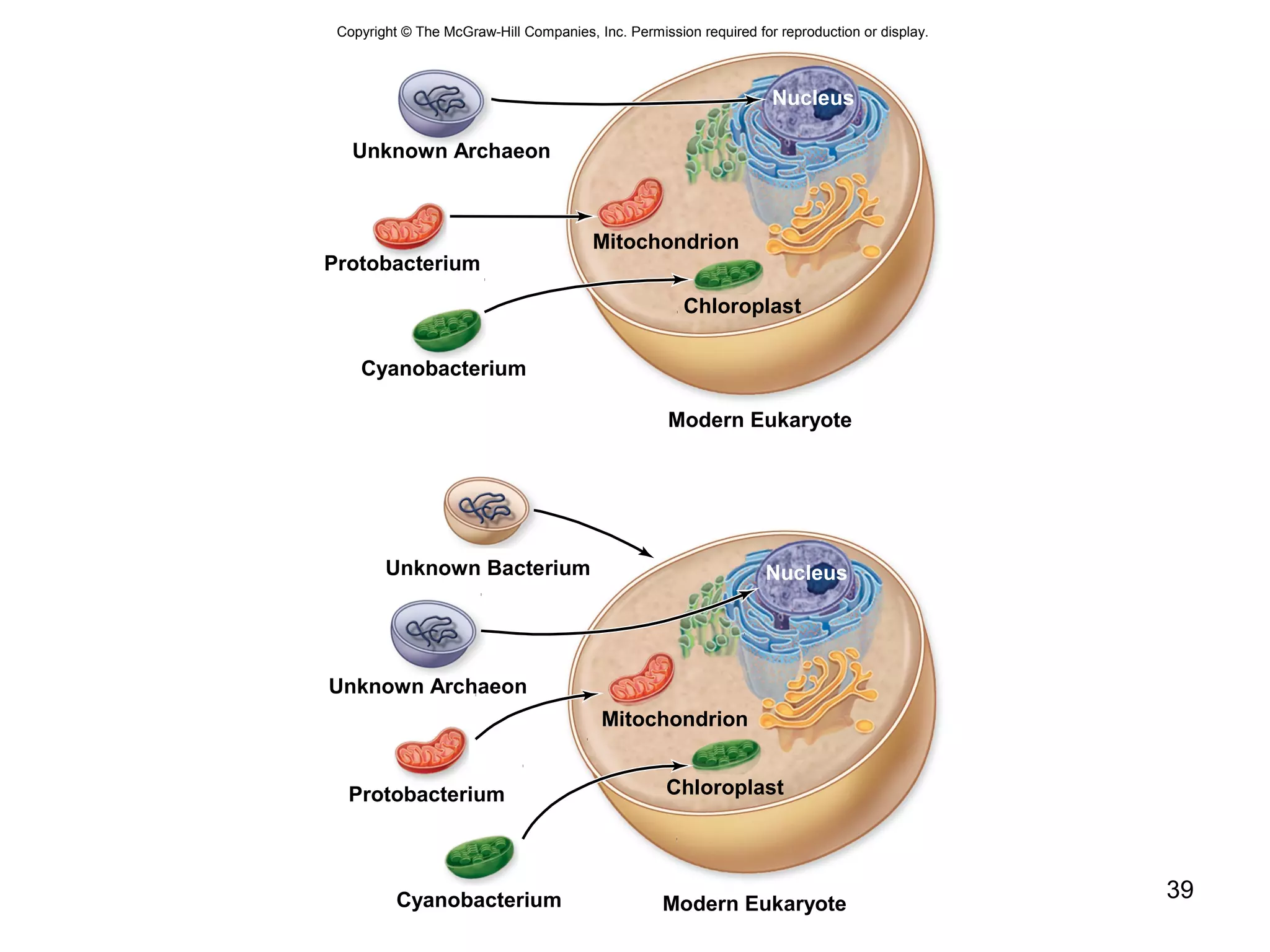
Endosymbiosis
• Proposes that some of today’s eukaryotic
organelles evolved by a symbiosis arising
between two cells that were each free-
living
• One cell, a prokaryote, was engulfed by
and became part of another cell, which
was the precursor of modern eukaryotes
• Mitochondria and chloroplasts
39
Copyright © The McGraw-Hill Companies, Inc. Permission required for reproduction or display.
Chloroplast
Chloroplast
Modern Eukaryote
Unknown Bacterium
Unknown Archaeon
Mitochondrion
Protobacterium
Modern EukaryoteCyanobacterium
Cyanobacterium
Unknown Archaeon
Protobacterium
Mitochondrion
Nucleus
Nucleus
40
Cytoskeleton
• Network of protein fibers found in all
eukaryotic cells
– Supports the shape of the cell
– Keeps organelles in fixed locations
• Dynamic system – constantly forming and
disassembling
41
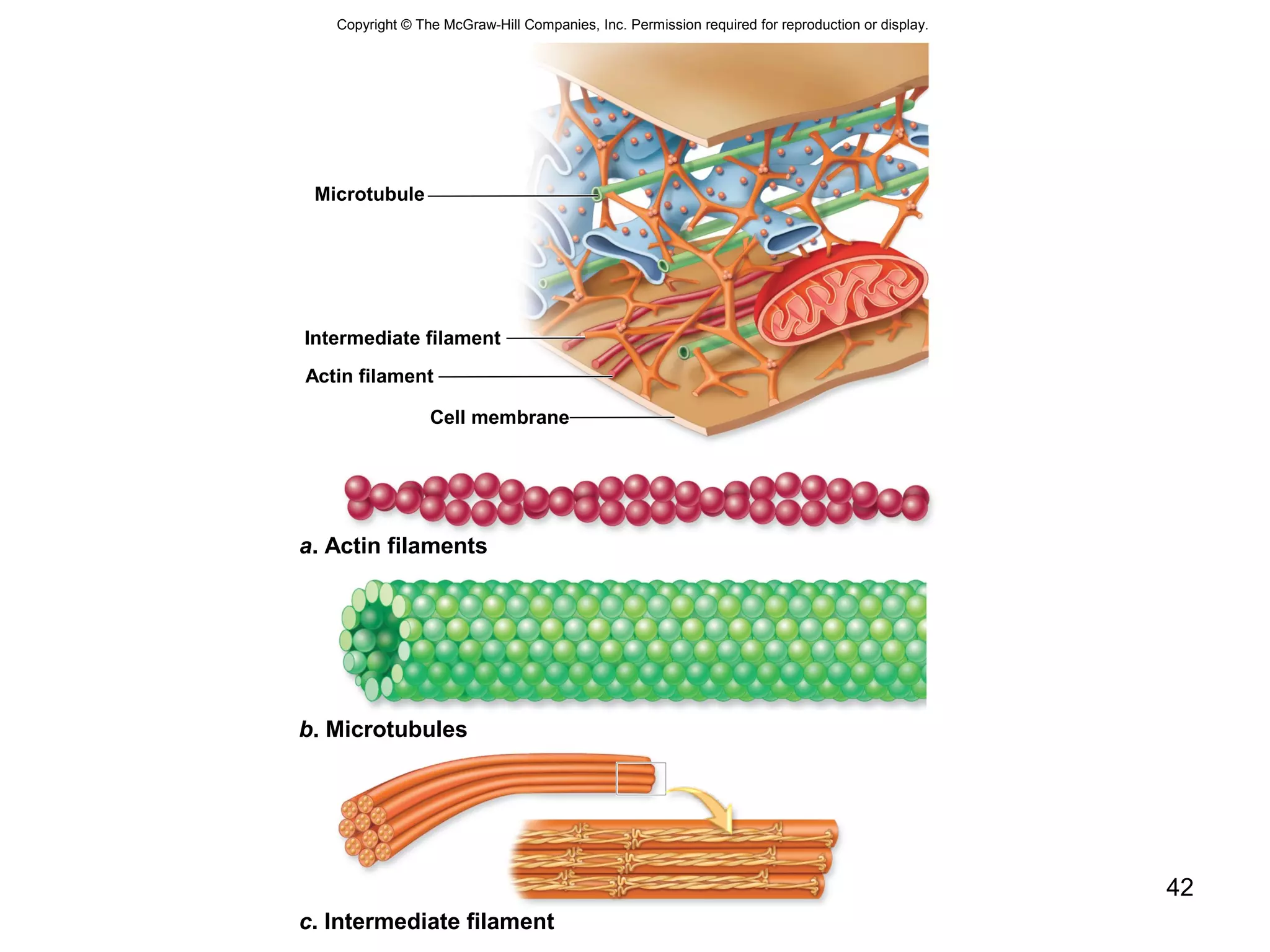
3 types of fibers
• Microfilaments (actin filaments)
– Two protein chains loosely twined together
– Movements like contraction, crawling, “pinching”
• Microtubules
– Largest of the cytoskeletal elements
– Dimers of α- and β-tubulin subunits
– Facilitate movement of cell and materials within cell
• Intermediate filaments
– Between the size of actin filaments and microtubules
– Very stable – usually not broken down
42
Copyright © The McGraw-Hill Companies, Inc. Permission required for reproduction or display.
Microtubule
Intermediate filament
Actin filament
Cell membrane
a. Actin filaments
b. Microtubules
c. Intermediate filament
Centrosomes
• Region surrounding centrioles in almost all
animal cells
• Microtubule-organizing center
– Can nucleate the assembly of microtubules
• Animal cells and most protists have
centrioles – pair of organelles
• Plants and fungi usually lack centrioles
43
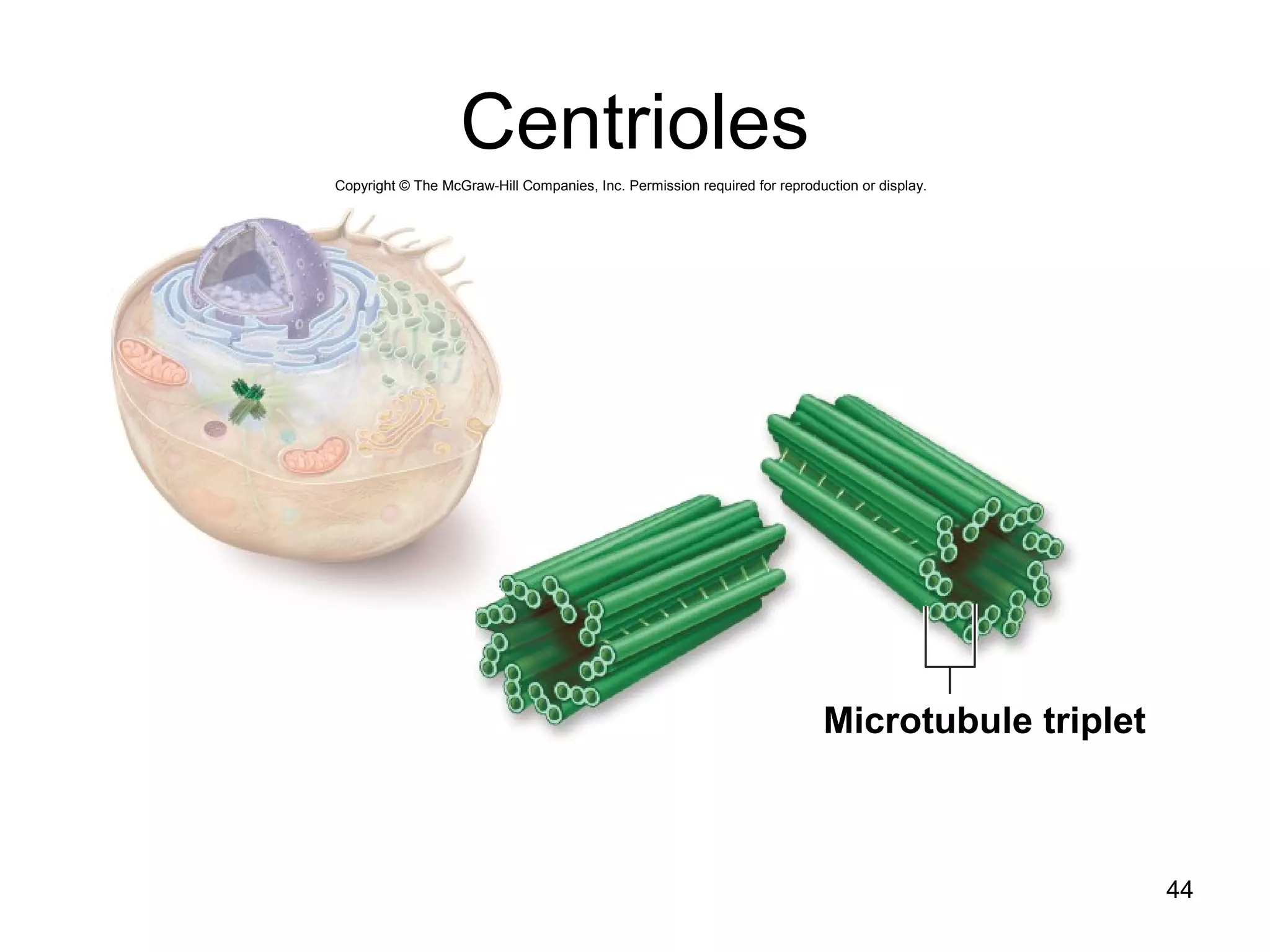
Centrioles
44
Copyright © The McGraw-Hill Companies, Inc. Permission required for reproduction or display.
Microtubule triplet
45
Cell Movement
• Essentially all cell motion is tied to the
movement of actin filaments, microtubules,
or both
• Some cells crawl using actin
microfilaments
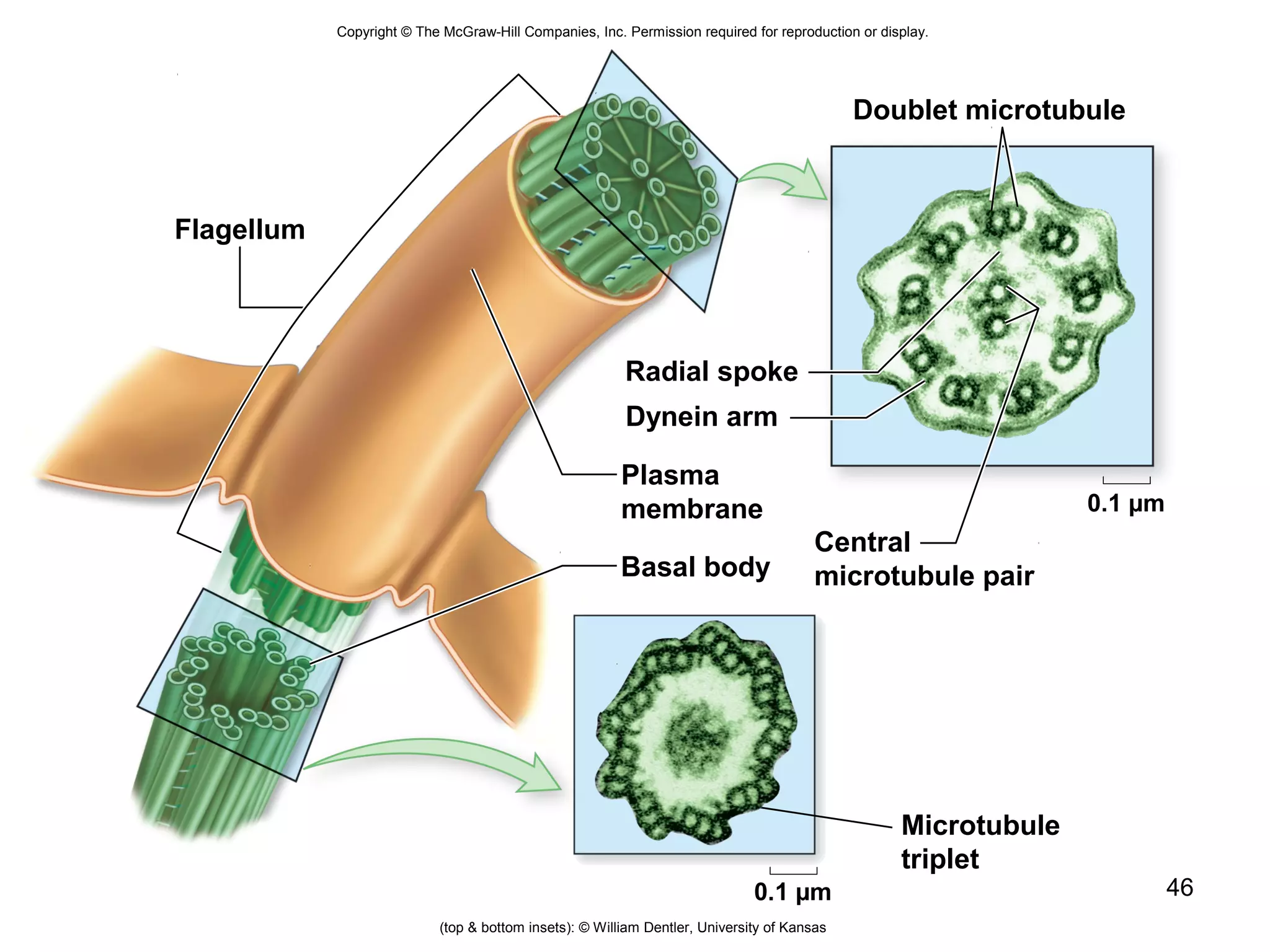
• Flagella and cilia have 9 + 2 arrangement
of microtubules
– Not like prokaryotic flagella
– Cilia are shorter and more numerous
46
Copyright © The McGraw-Hill Companies, Inc. Permission required for reproduction or display.
Flagellum
Basal body
Microtubule
triplet
Central
microtubule pair
Plasma
membrane
Radial spoke
Dynein arm
Doublet microtubule
0.1 µm
0.1 µm
(top & bottom insets): © William Dentler, University of Kansas
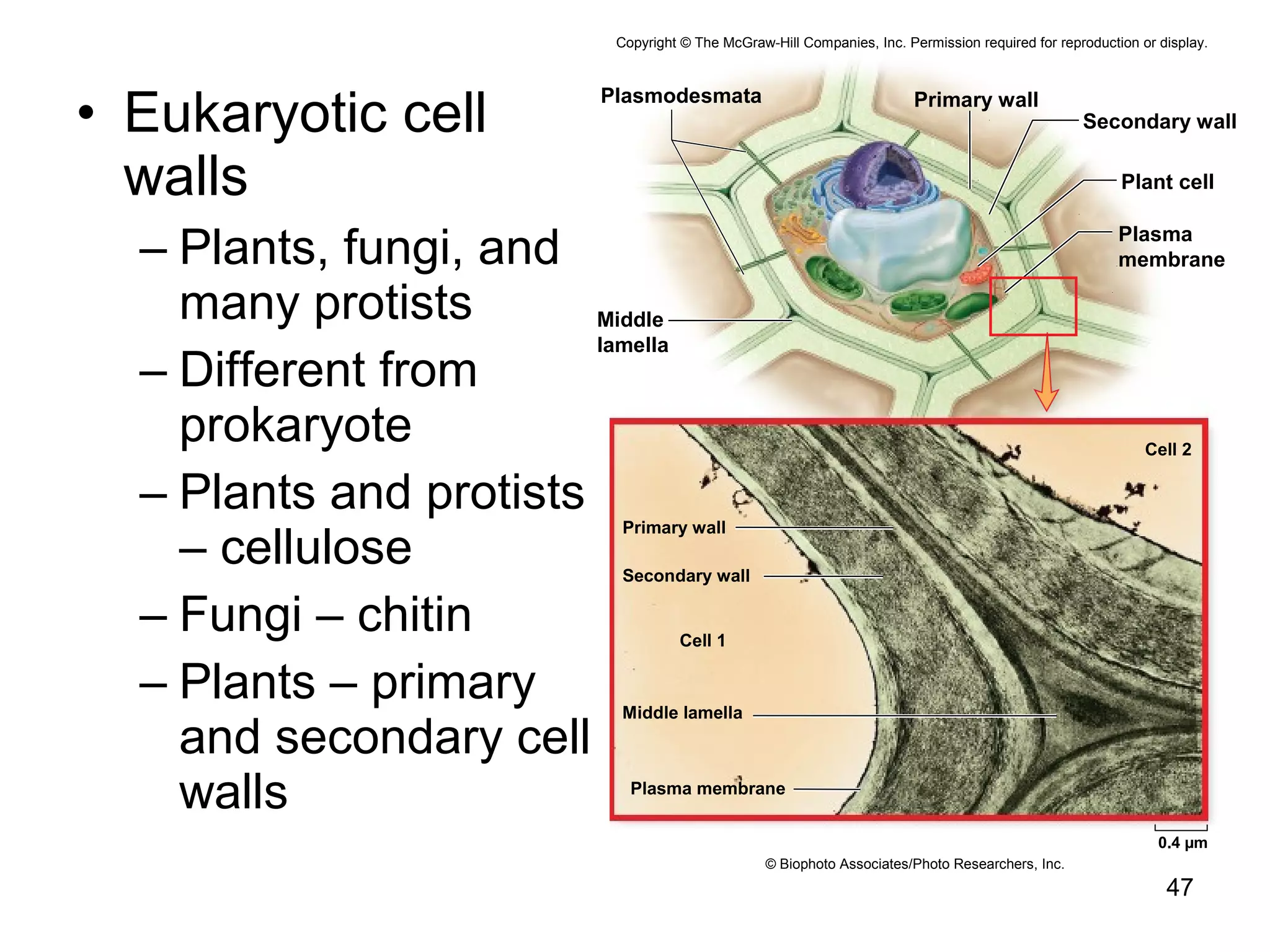
• Eukaryotic cell
walls
– Plants, fungi, and
many protists
– Different from
prokaryote
– Plants and protists
– cellulose
– Fungi – chitin
– Plants – primary
and secondary cell
walls
47
Copyright © The McGraw-Hill Companies, Inc. Permission required for reproduction or display.
Plant cell
Plasmodesmata Primary wall
Secondary wall
Cell 1
Cell 2
Primary wall
Secondary wall
Plasma membrane
Middle lamella
Middle
lamella
Plasma
membrane
© Biophoto Associates/Photo Researchers, Inc.
0.4 µm
48
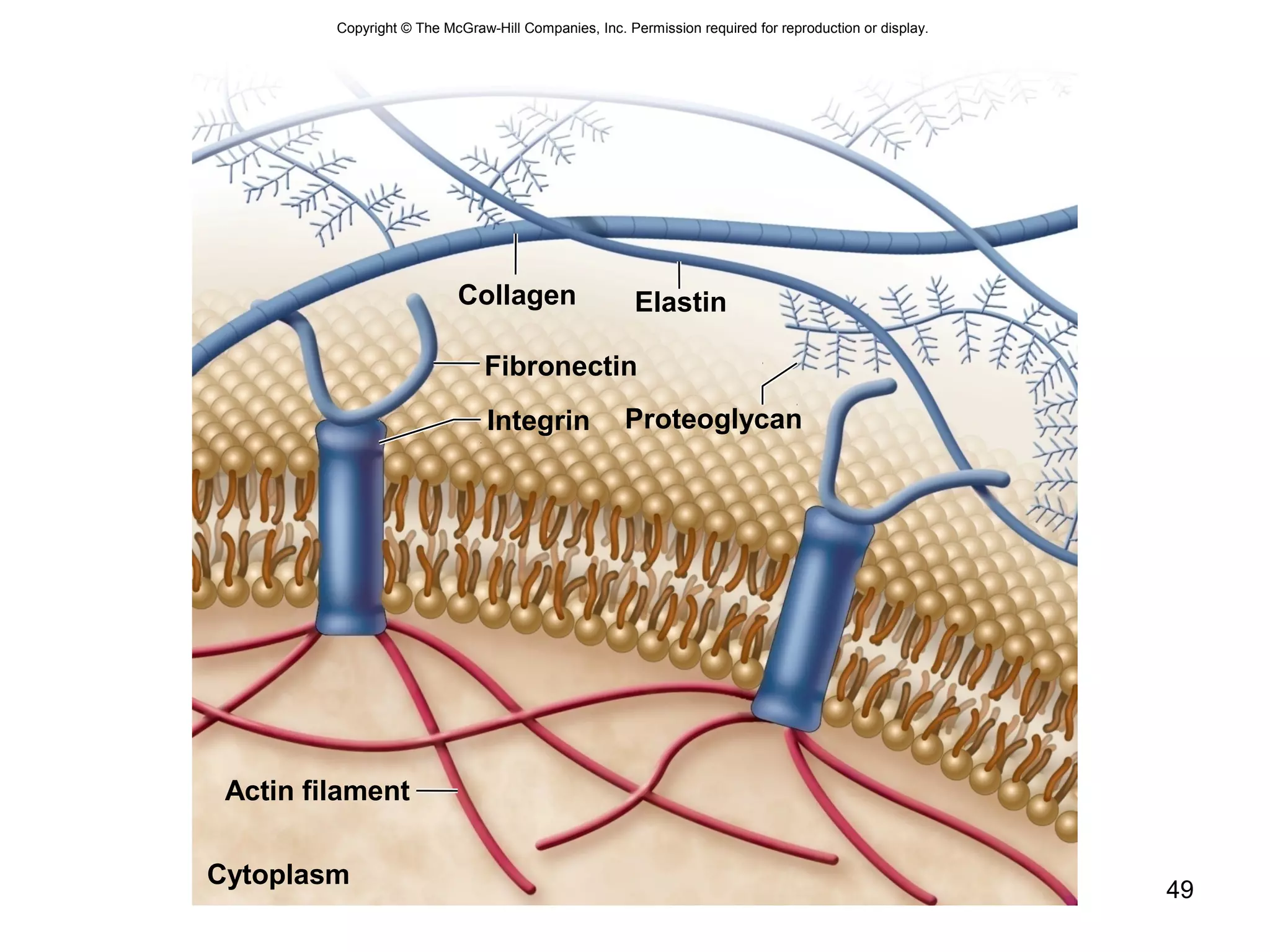
Extracellular matrix (ECM)
• Animal cells lack cell walls
• Secrete an elaborate mixture of
glycoproteins into the space around them
• Collagen may be abundant
• Form a protective layer over the cell
surface
• Integrins link ECM to cell’s cytoskeleton
– Influence cell behavior
49
Copyright © The McGraw-Hill Companies, Inc. Permission required for reproduction or display.
Cytoplasm
Actin filament
Integrin
Fibronectin
Collagen Elastin
Proteoglycan
50
Cell-to-cell interactions
• Surface proteins give cells identity
– Cells make contact, “read” each other, and
react
– Glycolipids – most tissue-specific cell surface
markers
– MHC proteins – recognition of “self” and
“nonself” cells by the immune system
51
Cell connections
• 3 categories based on function
1.Tight junction
– Connect the plasma membranes of adjacent cells in a
sheet – no leakage
2.Anchoring junction
– Mechanically attaches cytoskeletons of neighboring
cells (desmosomes)
3.Communicating junction
– Chemical or electrical signal passes directly from one
cell to an adjacent one (gap junction,
plasmodesmata)
52
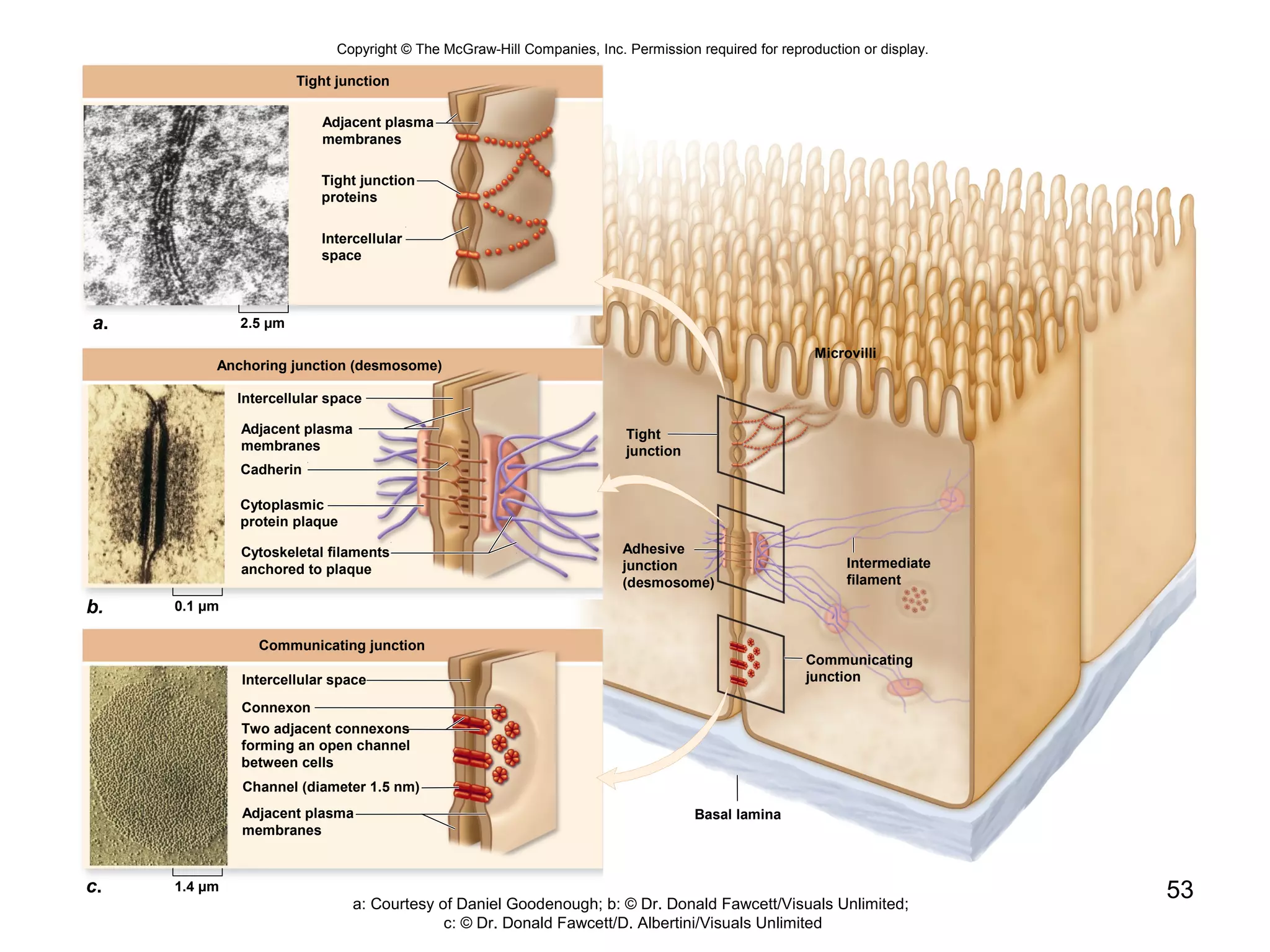
53
a.
Tight junction
Adjacent plasma
membranes
Tight junction
proteins
Intercellular
space
Microvilli
Basal lamina
Adhesive
junction
(desmosome)
Tight
junction
Intermediate
filament
Communicating
junction
2.5 µm
Intercellular space
b.
Adjacent plasma
membranes
Cadherin
Cytoplasmic
protein plaque
Cytoskeletal filaments
anchored to plaque
Anchoring junction (desmosome)
0.1 µm
c.
Intercellular space
Channel (diameter 1.5 nm)
Communicating junction
Connexon
Two adjacent connexons
forming an open channel
between cells
Adjacent plasma
membranes
1.4 µm
Copyright © The McGraw-Hill Companies, Inc. Permission required for reproduction or display.
a: Courtesy of Daniel Goodenough; b: © Dr. Donald Fawcett/Visuals Unlimited;
c: © Dr. Donald Fawcett/D. Albertini/Visuals Unlimited
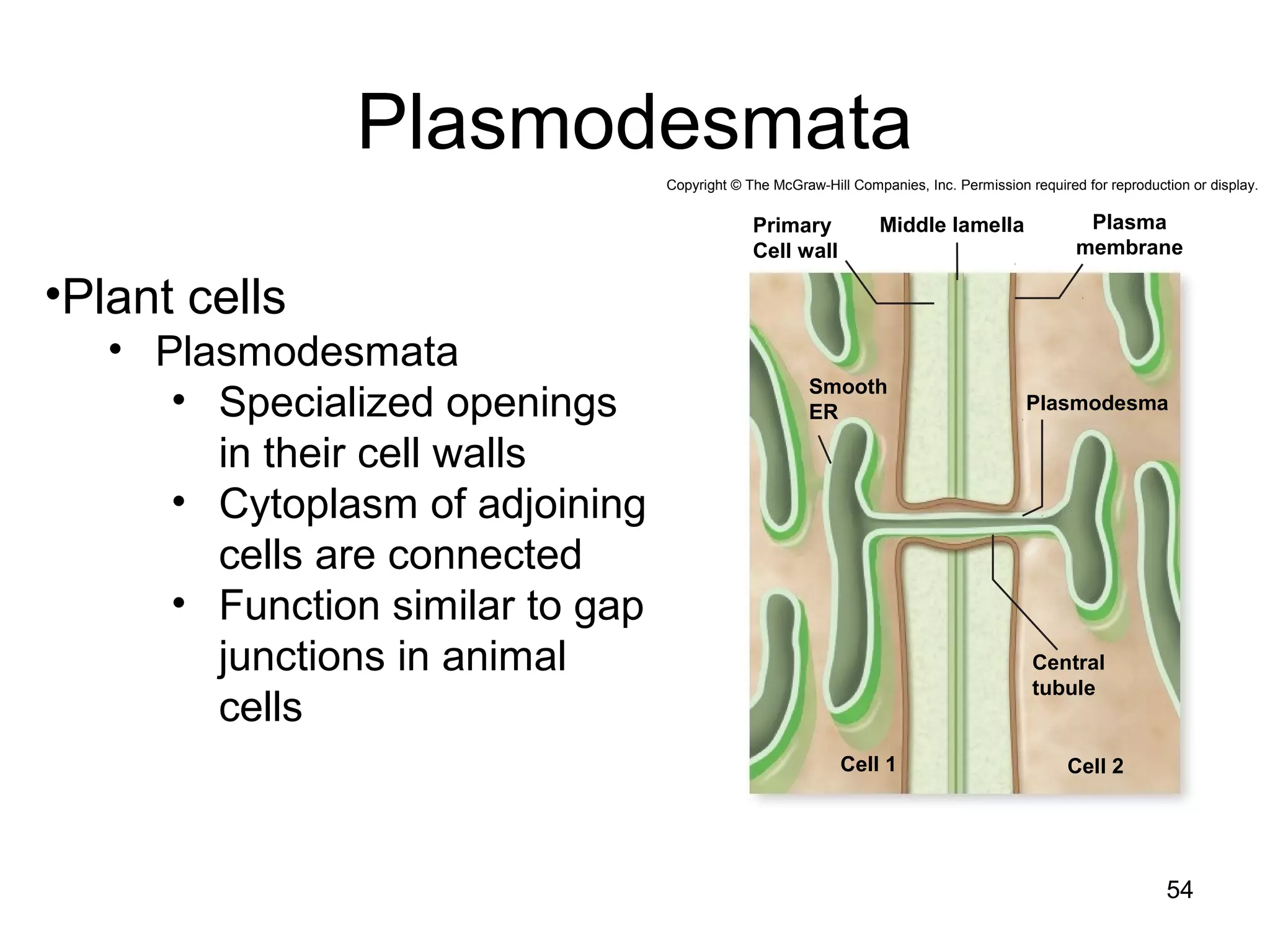
Plasmodesmata
54
•Plant cells
• Plasmodesmata
• Specialized openings
in their cell walls
• Cytoplasm of adjoining
cells are connected
• Function similar to gap
junctions in animal
cells
Copyright © The McGraw-Hill Companies, Inc. Permission required for reproduction or display.
Primary
Cell wall
Middle lamella Plasma
membrane
Plasmodesma
Smooth
ER
Central
tubule
Cell 2Cell 1

Bio 201 chapter 4 powerpoint

  • 1.
    Chapter 04 Lecture Outline Copyright© The McGraw-Hill Companies, Inc. Permission required for reproduction or display. 1
  • 2.
  • 3.
    3 Cells • Cells werediscovered in 1665 by Robert Hooke • Early studies of cells were conducted by – Mathias Schleiden (1838) – Theodor Schwann (1839) • Schleiden and Schwann proposed the Cell Theory
  • 4.
    4 Cell Theory 1. Allorganisms are composed of cells 2. Cells are the smallest living things 3. Cells arise only from pre-existing cells • All cells today represent a continuous line of descent from the first living cells
  • 5.
    5 Cell size islimited • Most cells are relatively small due reliance on diffusion of substances in and out of cells • Rate of diffusion affected by – Surface area available – Temperature – Concentration gradient – Distance
  • 6.
    Copyright © TheMcGraw-Hill Companies, Inc. Permission required for reproduction or display. 4– 3 πr3 ) 3 Cell radius (r) Surface Area / Volume Surace area (4πr2 ) Volume ( 4.189 unit3 12.57 unit2 1 unit 10 unit 1257 unit2 4189 unit3 0.3
  • 7.
    Surface area-to-volume ratio •Organism made of many small cells has an advantage over an organism composed of fewer, larger cells • As a cell’s size increases, its volume increases much more rapidly than its surface area • Some cells overcome limitation by being long and skinny – like neurons 7
  • 8.
    8 Microscopes • Not manycells are visible to the naked eye – Most are less than 50 μm in diameter • Resolution – minimum distance two points can be apart and still be distinguished as two separate points – Objects must be 100 μm apart for naked eye to resolve them as two objects rather than one
  • 9.
    2 types • Lightmicroscopes – Use magnifying lenses with visible light – Resolve structures that are 200 nm apart – Limit to resolution using light • Electron microscopes – Use beam of electrons – Resolve structures that are 0.2 nm apart 9
  • 10.
    • Electron microscopes –Transmission electron microscopes transmit electrons through the material – Scanning electron microscopes beam electrons onto the specimen surface 10 Copyright © The McGraw-Hill Companies, Inc. Permission required for reproduction or display. HumanEye LightMicroscope ElectronMicroscope Hydrogen atom Amino acid Logarithmic scale Protein Ribosome Large virus (HIV) Human red blood cell Prokaryote Human egg Paramecium Chicken egg Adult human Frog egg Chloroplast Mitochondrion 1 m 10 cm 1 cm 1 mm 1 nm 0.1 nm (1 Å) 10 nm 100 nm 1 µm 10 µm 100 µm 10 m 100 m
  • 11.
    11 Basic structural similarities 1.Nucleoid or nucleus where DNA is located 2. Cytoplasm – Semifluid matrix of organelles and cytosol 3. Ribosomes – Synthesize proteins 4. Plasma membrane – Phospholipid bilayer
  • 12.
    12 Prokaryotic Cells • Simplestorganisms • Lack a membrane-bound nucleus – DNA is present in the nucleoid • Cell wall outside of plasma membrane • Do contain ribosomes (not membrane- bound organelles) • Two domains of prokaryotes – Archaea – Bacteria
  • 13.
    Copyright © TheMcGraw-Hill Companies, Inc. Permission required for reproduction or display. Cytoplasm Ribosomes Nucleoid (DNA) Plasma membrane Capsule Cell wall Pili Flagellum Pilus 0.3 µm © Phototake
  • 14.
    Bacterial cell walls •Most bacterial cells are encased by a strong cell wall – composed of peptidoglycan – Cell walls of plants, fungi, and most protists different • Protect the cell, maintain its shape, and prevent excessive uptake or loss of water • Susceptibility of bacteria to antibiotics often depends on the structure of their cell walls • Archaea lack peptidoglycan 14
  • 15.
    15 Flagella • Present insome prokaryotic cells – May be one or more or none • Used for locomotion • Rotary motion propels the cell
  • 16.
    16 Copyright © TheMcGraw-Hill Companies, Inc. Permission required for reproduction or display. Outer protein ring Hook Filament Inner protein ring H+ H+ Peptidoglycan portion of cell wall Outer membrane Plasma membrane a. b. c. 0.5 µm a: © Eye of Science/Photo Researchers, Inc.
  • 17.
    17 Eukaryotic Cells • Possessa membrane-bound nucleus • More complex than prokaryotic cells • Hallmark is compartmentalization – Achieved through use of membrane-bound organelles and endomembrane system • Possess a cytoskeleton for support and to maintain cellular structure
  • 18.
    18 Copyright © TheMcGraw-Hill Companies, Inc. Permission required for reproduction or display. Nucleus Nucleolus Nuclear pore Intermediate filament Ribosomes Ribosomes Cytoplasm Cytoskeleton Microtubule Centriole Plasma membrane Mitochondrion Golgi apparatus Exocytosis Peroxisome Smooth endoplasmic reticulum Rough endoplasmic reticulum Microvilli Nuclear envelope Actin filament (microfilament) Intermediate filament Lysosome Vesicle
  • 19.
    19 Copyright © TheMcGraw-Hill Companies, Inc. Permission required for reproduction or display. Nucleus Nucleolus Nuclear pore Intermediate filament Ribosome Cytoplasm Cytoskeleton Microtubule Plasma membrane Mitochondrion Peroxisome Smooth endoplasmic reticulum Rough endoplasmic reticulum Nuclear envelope Central vacuole Plasmodesmata Adjacent cell wall Cell wall Chloroplast Golgi apparatus Vesicle Actin filament (microfilament) Intermediate filament
  • 20.
    20 Nucleus • Repository ofthe genetic information • Most eukaryotic cells possess a single nucleus • Nucleolus – region where ribosomal RNA synthesis takes place • Nuclear envelope – 2 phospholipid bilayers – Nuclear pores – control passage in and out • In eukaryotes, the DNA is divided into multiple linear chromosomes – Chromatin is chromosomes plus protein
  • 21.
    21 Copyright © TheMcGraw-Hill Companies, Inc. Permission required for reproduction or display. Nuclear basket Nuclear pores Nuclear envelope Nucleolus Chromatin Nucleoplasm Nuclear lamina Inner membrane Outer membrane Cytoplasmic filaments Nuclear pore a.
  • 22.
    Ribosomes • Cell’s proteinsynthesis machinery • Found in all cell types in all 3 domains • Ribosomal RNA (rRNA)-protein complex • Protein synthesis also requires messenger RNA (mRNA) and transfer RNA (tRNA) • Ribosomes may be free in cytoplasm or associated with internal membranes 22
  • 23.
    23 Endomembrane System • Seriesof membranes throughout the cytoplasm • Divides cell into compartments where different cellular functions occur • One of the fundamental distinctions between eukaryotes and prokaryotes
  • 24.
    24 Endoplasmic reticulum • Roughendoplasmic reticulum (RER) – Attachment of ribosomes to the membrane gives a rough appearance – Synthesis of proteins to be secreted, sent to lysosomes or plasma membrane • Smooth endoplasmic reticulum (SER) – Relatively few bound ribosomes – Variety of functions – synthesis, store Ca2+ , detoxification • Ratio of RER to SER depends on cell’s function
  • 25.
    25 Copyright © TheMcGraw-Hill Companies, Inc. Permission required for reproduction or display. Ribosomes Smooth endoplasmic reticulum Smooth endoplasmic reticulum 0.08 µm (inset): © Dr. Donald Fawcett & R. Bolender/Visuals Unlimited Rough endoplasmic reticulum Rough endoplasmic reticulum
  • 26.
    26 Golgi apparatus • Flattenedstacks of interconnected membranes (Golgi bodies) • Functions in packaging and distribution of molecules synthesized at one location and used at another within the cell or even outside of it • Has cis and trans faces • Vesicles transport molecules to destination
  • 27.
    27 Copyright © TheMcGraw-Hill Companies, Inc. Permission required for reproduction or display. 1 µm Secretory vesicle Forming vesicle trans face cis face Fusing vesicle Transport vesicle (inset): © Dennis Kunkel/Phototake
  • 28.
    28 Copyright © TheMcGraw-Hill Companies, Inc. Permission required for reproduction or display. 1. 2. 3. Golgi membrane protein Cisternae Secretory vesicle Cell membrane Extracellular fluid Rough endoplasmic reticulum Membrane protein Newly synthesized protein Vesicle containing proteins buds from the rough endo- plasmic reticulum, diffuses through the cell, and fuses to the cis face of the Golgi apparatus. Smooth endoplasmic reticulumcis face Golgi Apparatus trans face The proteins are modified and packaged into vesicles for transport. Secreted protein The vesicle may travel to the plasma membrane, releasing its contents to the extracellular environment. Transport vesicle Nucleus Nuclear pore Ribosome Copyright © The McGraw-Hill Companies, Inc. Permission required for reproduction or display.
  • 29.
    29 Lysosomes • Membrane-bounded digestivevesicles • Arise from Golgi apparatus • Enzymes catalyze breakdown of macromolecules • Destroy cells or foreign matter that the cell has engulfed by phagocytosis
  • 30.
    30 Copyright © TheMcGraw-Hill Companies, Inc. Permission required for reproduction or display. Lysosome aiding in the breakdown of an old organelle Lysosome aiding in the digestion of phagocytized particles Golgi membrane protein Cisternae Rough endoplasmic reticulum Smooth endoplasmic reticulum cis face Golgi Apparatustrans face Nucleus Ribosome Membrane protein Hydrolytic enzyme Transport vesicle Breakdown of organelle Lysosome Lysosome Digestion Old or damaged organelle Food vesicle Phagocytosis Nuclear pore
  • 31.
    Microbodies • Variety ofenzyme- bearing, membrane- enclosed vesicles • Peroxisomes – Contain enzymes involved in the oxidation of fatty acids – Hydrogen peroxide produced as by- product – rendered harmless by catalase 31 Copyright © The McGraw-Hill Companies, Inc. Permission required for reproduction or display. 0.2 µm (inset): From S.E. Frederick and E.H. Newcomb, “Microbody-like organelles in leaf cells,” Science, 163:1353-5. © 21 March 1969. Reprinted with permission from AAAS
  • 32.
    32 Vacuoles • Membrane-bounded structuresin plants • Various functions depending on the cell type • There are different types of vacuoles: – Central vacuole in plant cells – Contractile vacuole of some fungi and protists – Storage vacuoles
  • 33.
    33 Copyright © TheMcGraw-Hill Companies, Inc. Permission required for reproduction or display. (inset): © Henry Aldrich/Visuals Unlimited Nucleus Chloroplast Tonoplast Central vacuole 1.5 µm Cell wall
  • 34.
    34 Mitochondria • Found inall types of eukaryotic cells • Bound by membranes – Outer membrane – Intermembrane space – Inner membrane has cristae – Matrix • On the surface of the inner membrane, and also embedded within it, are proteins that carry out oxidative metabolism • Have their own DNA
  • 35.
    35 Copyright © TheMcGraw-Hill Companies, Inc. Permission required for reproduction or display. Intermembrane space Inner membrane Outer membrane Ribosome Matrix DNA Crista 0.2 µm (inset): © Dr. Donald Fawcett & Dr. Porter/Visuals Unlimited
  • 36.
    36 Chloroplasts • Organelles presentin cells of plants and some other eukaryotes • Contain chlorophyll for photosynthesis • Surrounded by 2 membranes • Thylakoids are membranous sacs within the inner membrane – Grana are stacks of thylakoids • Have their own DNA
  • 37.
    37 Copyright © TheMcGraw-Hill Companies, Inc. Permission required for reproduction or display. Ribosome DNA Stroma Stroma Thylakoid membrane Outer membrane Inner membrane Thylakoid disk Granum Granum 1.5 µm (inset): © Dr. Jeremy Burgess/Photo Researchers, Inc.
  • 38.
    38 Endosymbiosis • Proposes thatsome of today’s eukaryotic organelles evolved by a symbiosis arising between two cells that were each free- living • One cell, a prokaryote, was engulfed by and became part of another cell, which was the precursor of modern eukaryotes • Mitochondria and chloroplasts
  • 39.
    39 Copyright © TheMcGraw-Hill Companies, Inc. Permission required for reproduction or display. Chloroplast Chloroplast Modern Eukaryote Unknown Bacterium Unknown Archaeon Mitochondrion Protobacterium Modern EukaryoteCyanobacterium Cyanobacterium Unknown Archaeon Protobacterium Mitochondrion Nucleus Nucleus
  • 40.
    40 Cytoskeleton • Network ofprotein fibers found in all eukaryotic cells – Supports the shape of the cell – Keeps organelles in fixed locations • Dynamic system – constantly forming and disassembling
  • 41.
    41 3 types offibers • Microfilaments (actin filaments) – Two protein chains loosely twined together – Movements like contraction, crawling, “pinching” • Microtubules – Largest of the cytoskeletal elements – Dimers of α- and β-tubulin subunits – Facilitate movement of cell and materials within cell • Intermediate filaments – Between the size of actin filaments and microtubules – Very stable – usually not broken down
  • 42.
    42 Copyright © TheMcGraw-Hill Companies, Inc. Permission required for reproduction or display. Microtubule Intermediate filament Actin filament Cell membrane a. Actin filaments b. Microtubules c. Intermediate filament
  • 43.
    Centrosomes • Region surroundingcentrioles in almost all animal cells • Microtubule-organizing center – Can nucleate the assembly of microtubules • Animal cells and most protists have centrioles – pair of organelles • Plants and fungi usually lack centrioles 43
  • 44.
    Centrioles 44 Copyright © TheMcGraw-Hill Companies, Inc. Permission required for reproduction or display. Microtubule triplet
  • 45.
    45 Cell Movement • Essentiallyall cell motion is tied to the movement of actin filaments, microtubules, or both • Some cells crawl using actin microfilaments • Flagella and cilia have 9 + 2 arrangement of microtubules – Not like prokaryotic flagella – Cilia are shorter and more numerous
  • 46.
    46 Copyright © TheMcGraw-Hill Companies, Inc. Permission required for reproduction or display. Flagellum Basal body Microtubule triplet Central microtubule pair Plasma membrane Radial spoke Dynein arm Doublet microtubule 0.1 µm 0.1 µm (top & bottom insets): © William Dentler, University of Kansas
  • 47.
    • Eukaryotic cell walls –Plants, fungi, and many protists – Different from prokaryote – Plants and protists – cellulose – Fungi – chitin – Plants – primary and secondary cell walls 47 Copyright © The McGraw-Hill Companies, Inc. Permission required for reproduction or display. Plant cell Plasmodesmata Primary wall Secondary wall Cell 1 Cell 2 Primary wall Secondary wall Plasma membrane Middle lamella Middle lamella Plasma membrane © Biophoto Associates/Photo Researchers, Inc. 0.4 µm
  • 48.
    48 Extracellular matrix (ECM) •Animal cells lack cell walls • Secrete an elaborate mixture of glycoproteins into the space around them • Collagen may be abundant • Form a protective layer over the cell surface • Integrins link ECM to cell’s cytoskeleton – Influence cell behavior
  • 49.
    49 Copyright © TheMcGraw-Hill Companies, Inc. Permission required for reproduction or display. Cytoplasm Actin filament Integrin Fibronectin Collagen Elastin Proteoglycan
  • 50.
  • 51.
    Cell-to-cell interactions • Surfaceproteins give cells identity – Cells make contact, “read” each other, and react – Glycolipids – most tissue-specific cell surface markers – MHC proteins – recognition of “self” and “nonself” cells by the immune system 51
  • 52.
    Cell connections • 3categories based on function 1.Tight junction – Connect the plasma membranes of adjacent cells in a sheet – no leakage 2.Anchoring junction – Mechanically attaches cytoskeletons of neighboring cells (desmosomes) 3.Communicating junction – Chemical or electrical signal passes directly from one cell to an adjacent one (gap junction, plasmodesmata) 52
  • 53.
    53 a. Tight junction Adjacent plasma membranes Tightjunction proteins Intercellular space Microvilli Basal lamina Adhesive junction (desmosome) Tight junction Intermediate filament Communicating junction 2.5 µm Intercellular space b. Adjacent plasma membranes Cadherin Cytoplasmic protein plaque Cytoskeletal filaments anchored to plaque Anchoring junction (desmosome) 0.1 µm c. Intercellular space Channel (diameter 1.5 nm) Communicating junction Connexon Two adjacent connexons forming an open channel between cells Adjacent plasma membranes 1.4 µm Copyright © The McGraw-Hill Companies, Inc. Permission required for reproduction or display. a: Courtesy of Daniel Goodenough; b: © Dr. Donald Fawcett/Visuals Unlimited; c: © Dr. Donald Fawcett/D. Albertini/Visuals Unlimited
  • 54.
    Plasmodesmata 54 •Plant cells • Plasmodesmata •Specialized openings in their cell walls • Cytoplasm of adjoining cells are connected • Function similar to gap junctions in animal cells Copyright © The McGraw-Hill Companies, Inc. Permission required for reproduction or display. Primary Cell wall Middle lamella Plasma membrane Plasmodesma Smooth ER Central tubule Cell 2Cell 1