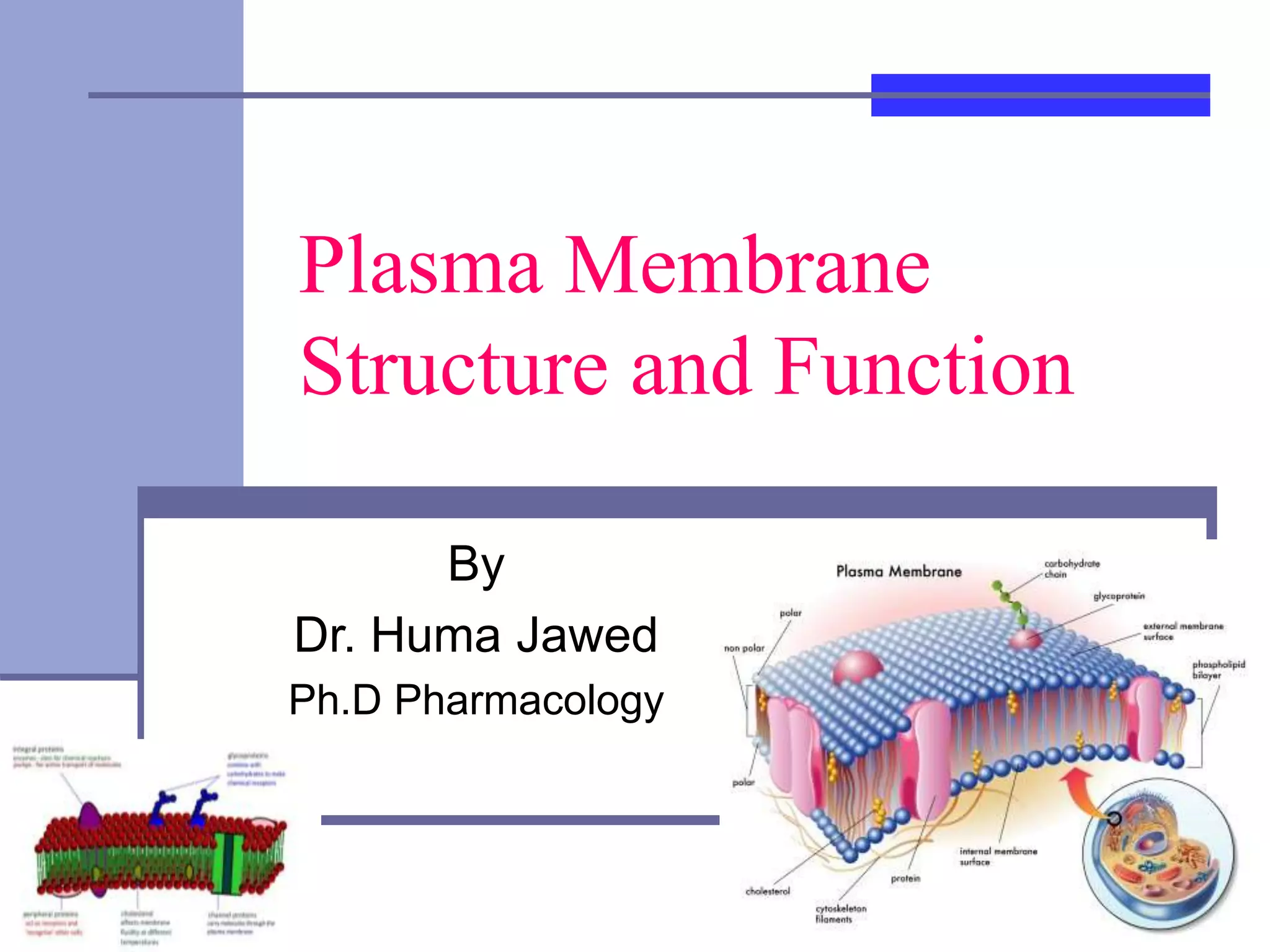
Plasma Membrane
Structure and Function
By
Dr. Huma Jawed
Ph.D Pharmacology
Membrane Structure and Function
 Cells must contain a cell membrane, cytoplasm
and genetic material.
 The cell membrane is the EDGE, “boundary of
life”, while the cytoplasm is the site of all the
reactions of life and the genetic material is the
information required for life.
 SELECTIVELY PERMEABLE means that the cell
membrane allows some substances across more
easily than others… some it helps and some it
inhibits or rejects all together.
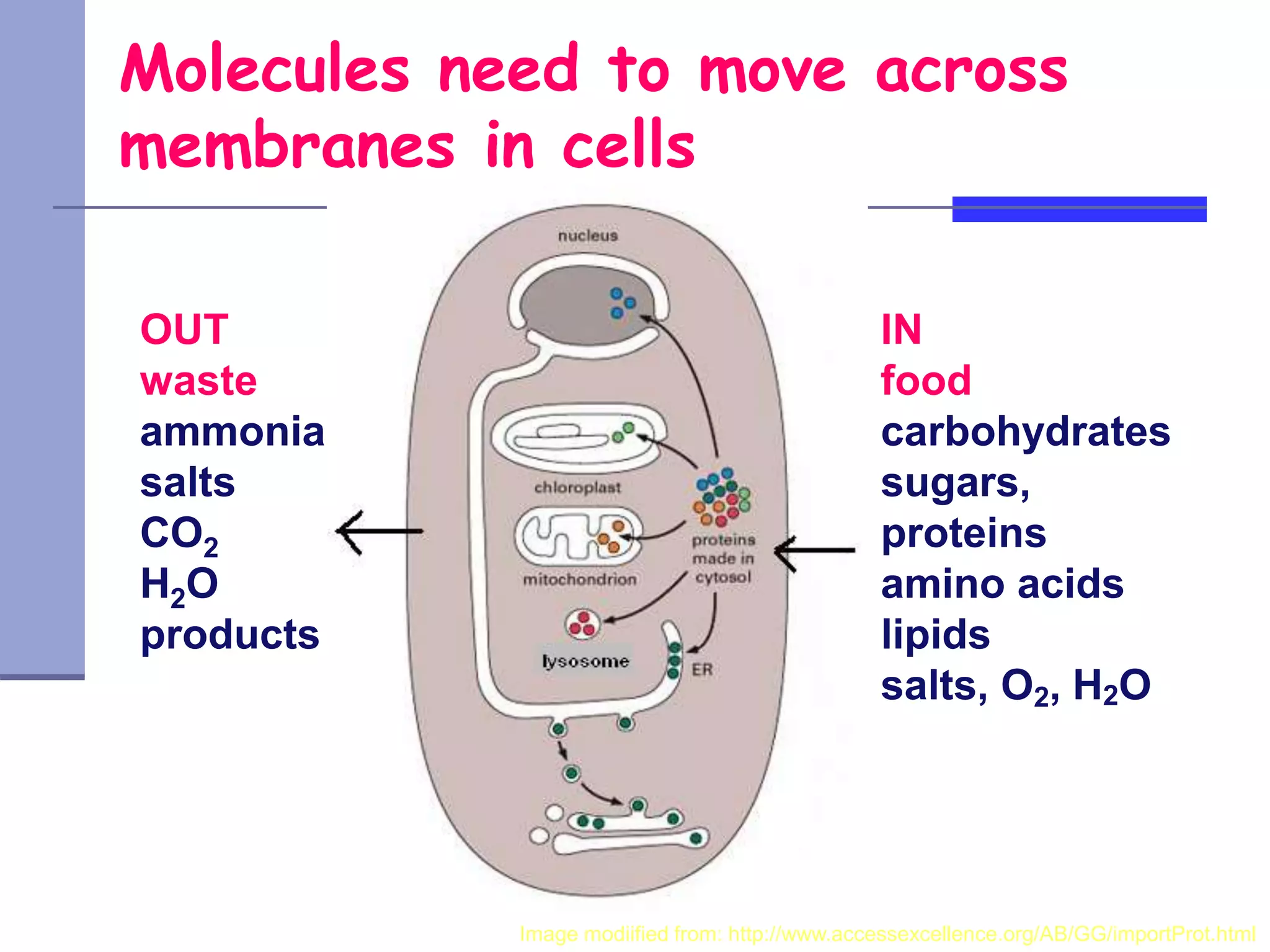
Molecules need to move across
membranes in cells
Image modiified from: http://www.accessexcellence.org/AB/GG/importProt.html
IN
food
carbohydrates
sugars,
proteins
amino acids
lipids
salts, O2, H2O
OUT
waste
ammonia
salts
CO2
H2O
products
Membrane Structure
 Development of models as a scientific
process
 Models include
 Overton – proposed lipid base
 Langmuir (phospholipids) – made membrane
 Gorter and Grendel (two layers)
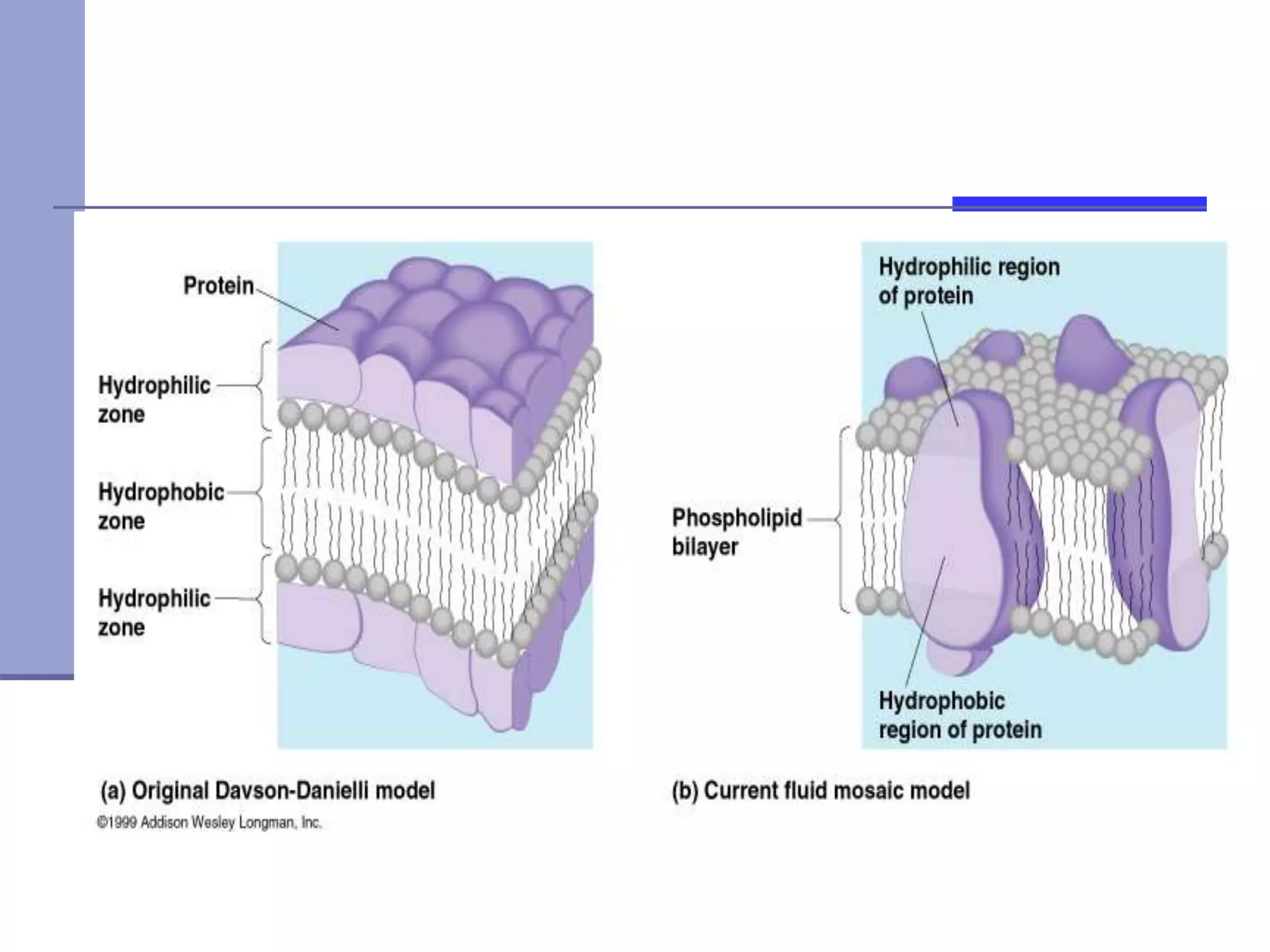
 Davson and Danielli (sandwich image, protein outside)
 Singer and Nicolson = Fluid Mosaic Model
 Required electron microscopy
 1972
MEMBRANE MODELS
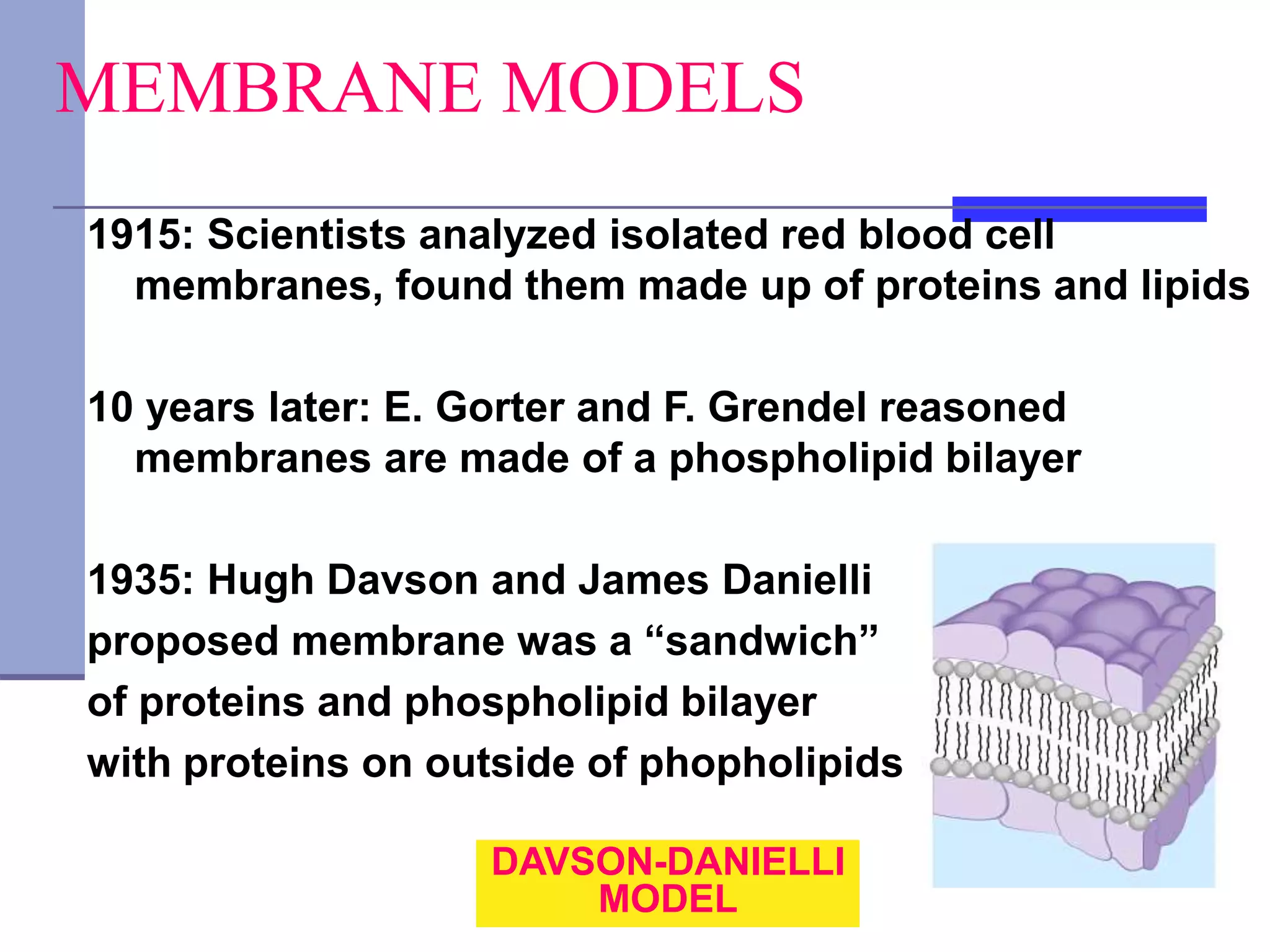
1915: Scientists analyzed isolated red blood cell
membranes, found them made up of proteins and lipids
10 years later: E. Gorter and F. Grendel reasoned
membranes are made of a phospholipid bilayer
1935: Hugh Davson and James Danielli
proposed membrane was a “sandwich”
of proteins and phospholipid bilayer
with proteins on outside of phopholipids
DAVSON-DANIELLI
MODEL
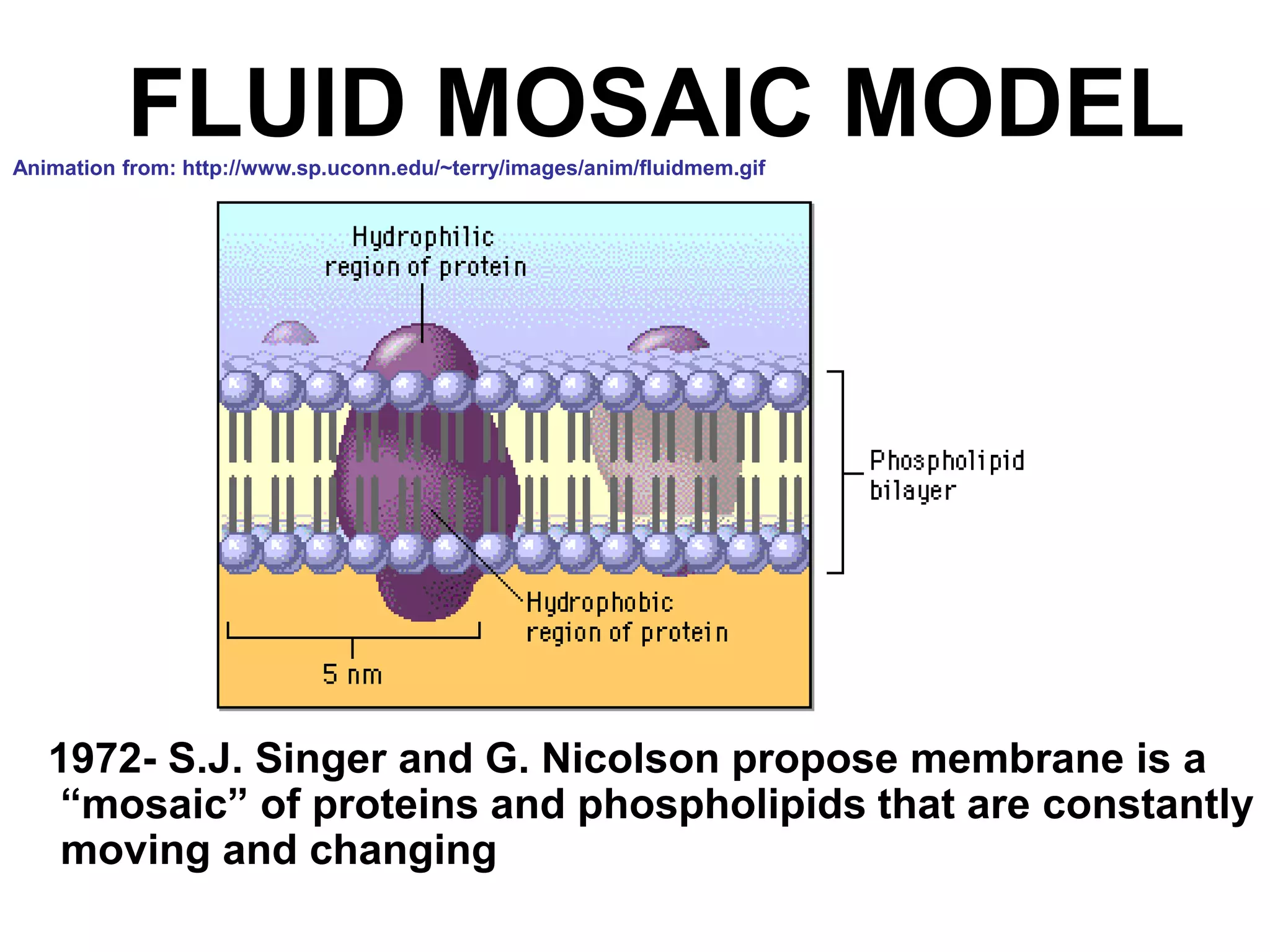
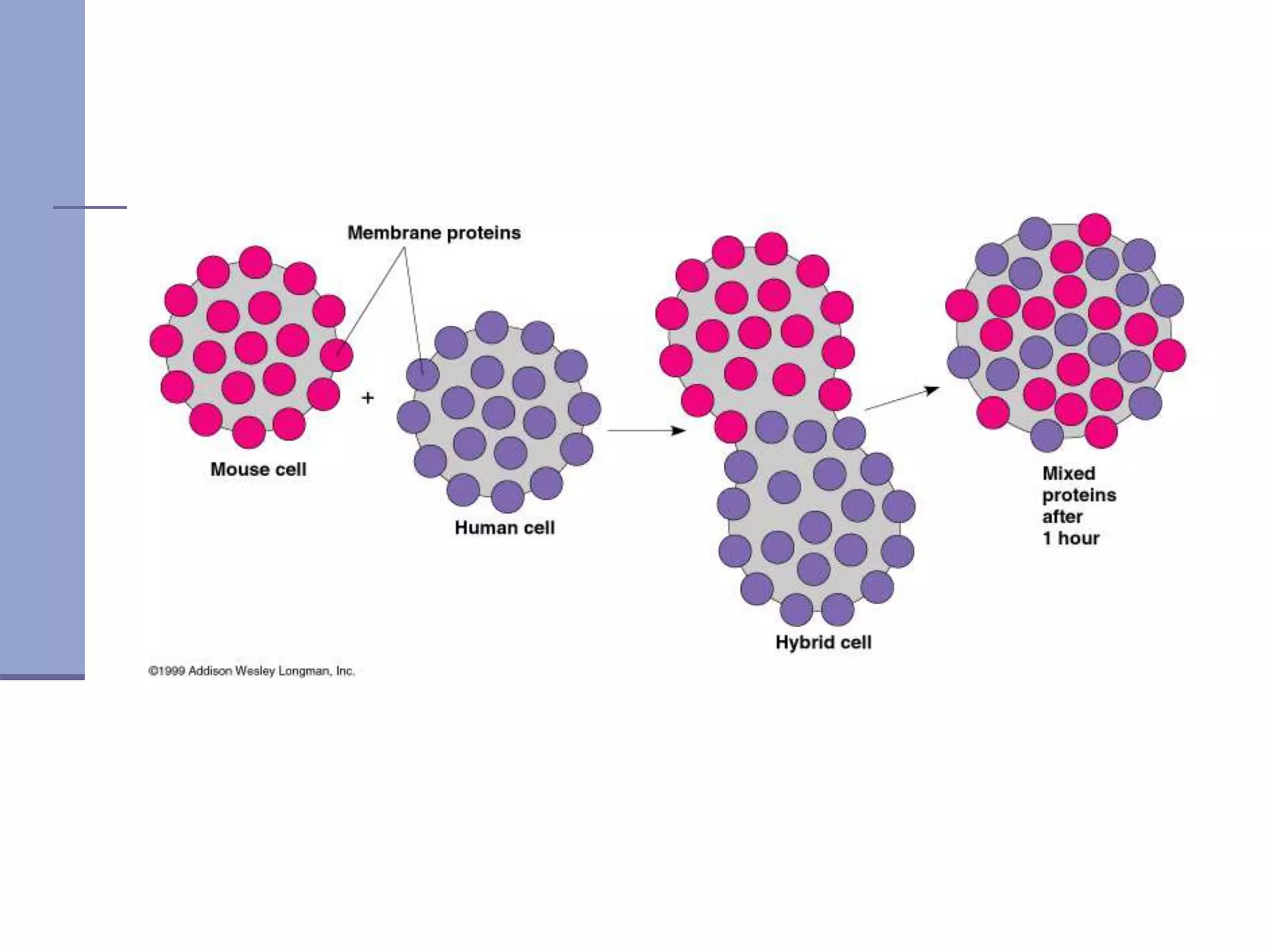
FLUID MOSAIC MODEL
1972- S.J. Singer and G. Nicolson propose membrane is a
“mosaic” of proteins and phospholipids that are constantly
moving and changing
Animation from: http://www.sp.uconn.edu/~terry/images/anim/fluidmem.gif
Membrane Structure
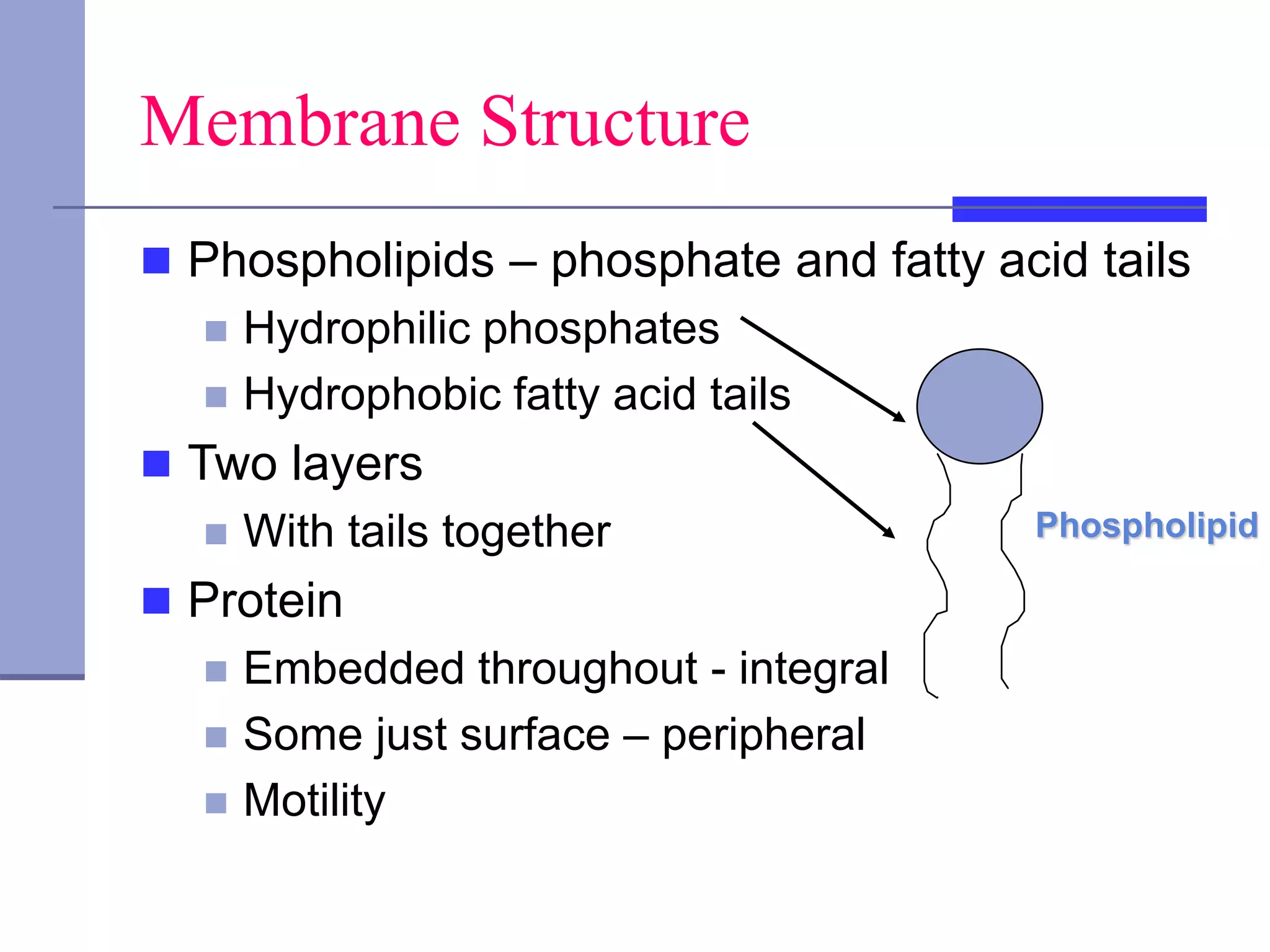
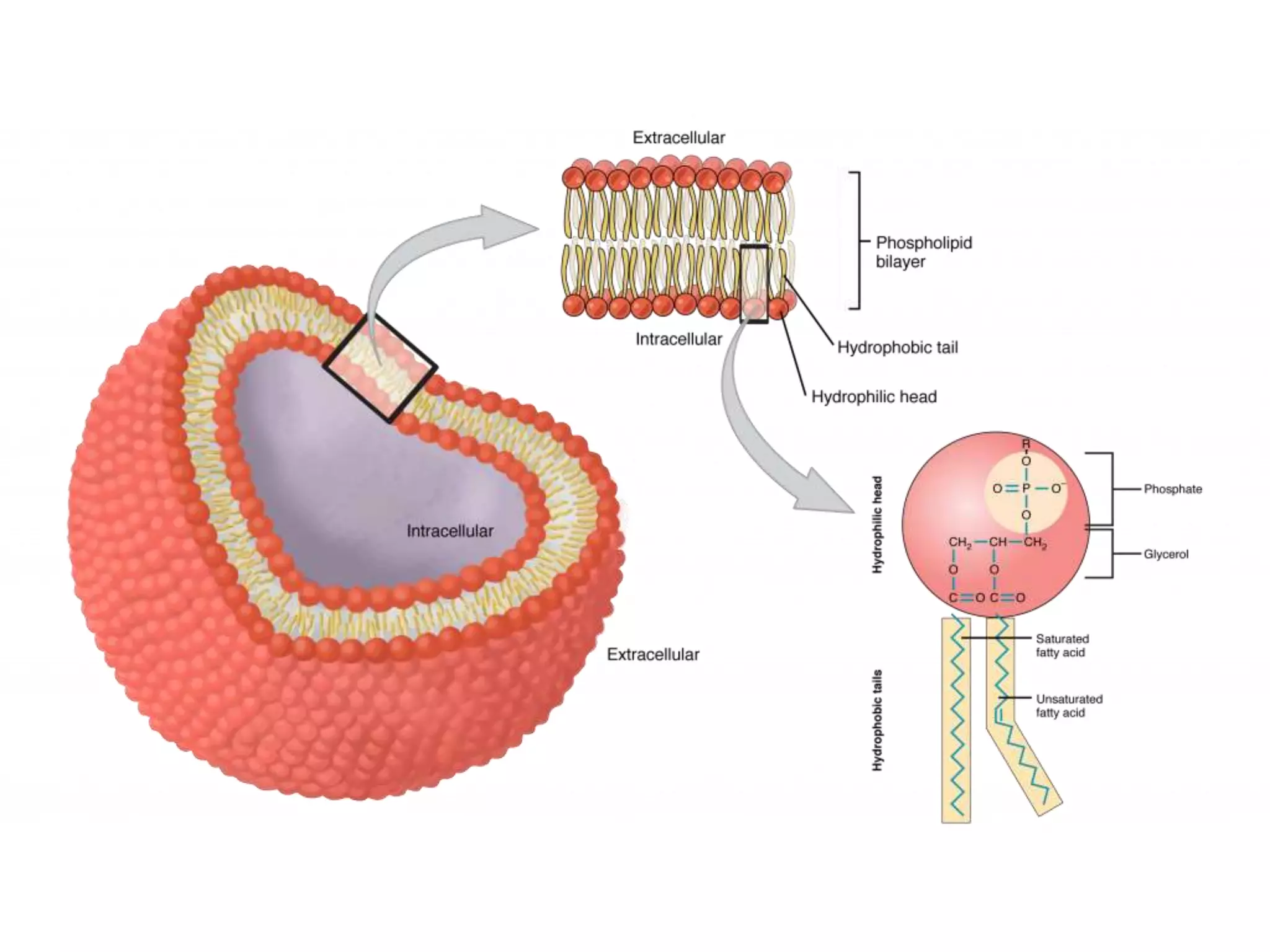
 Phospholipids – phosphate and fatty acid tails
 Hydrophilic phosphates
 Hydrophobic fatty acid tails
 Two layers
 With tails together
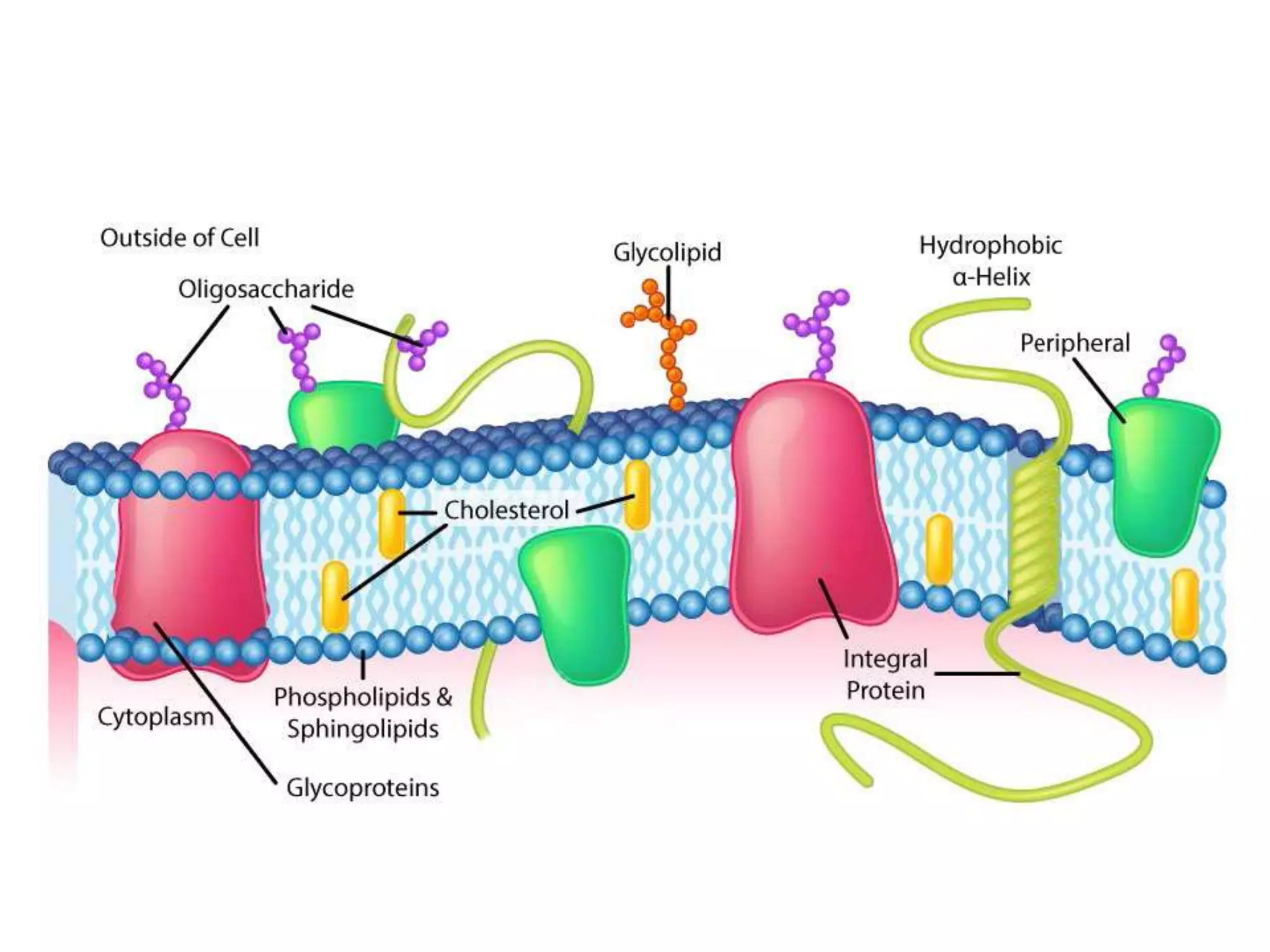
 Protein
 Embedded throughout - integral
 Some just surface – peripheral
 Motility
Phospholipid
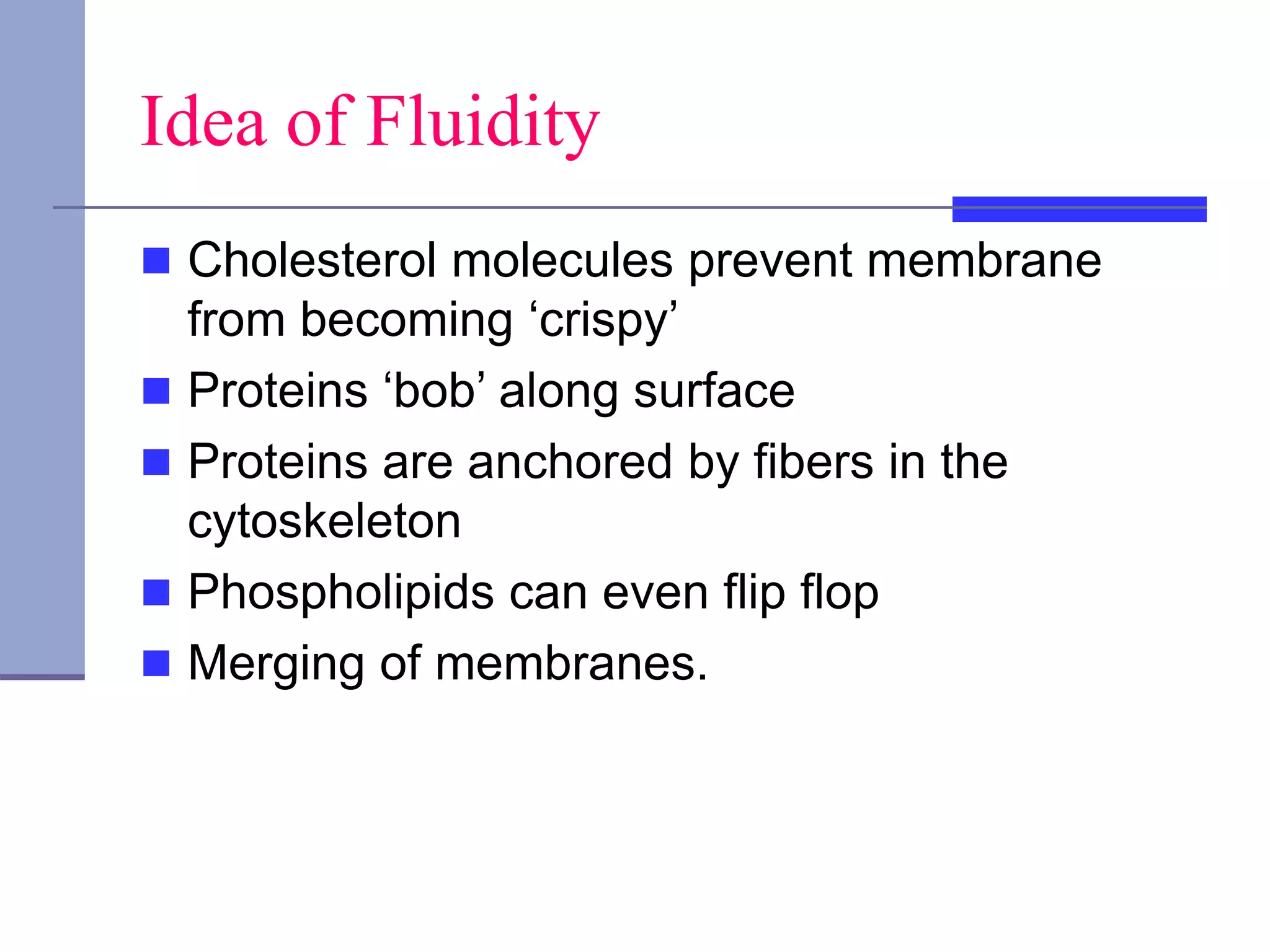
Idea of Fluidity
 Cholesterol molecules prevent membrane
from becoming ‘crispy’
 Proteins ‘bob’ along surface
 Proteins are anchored by fibers in the
cytoskeleton
 Phospholipids can even flip flop
 Merging of membranes.
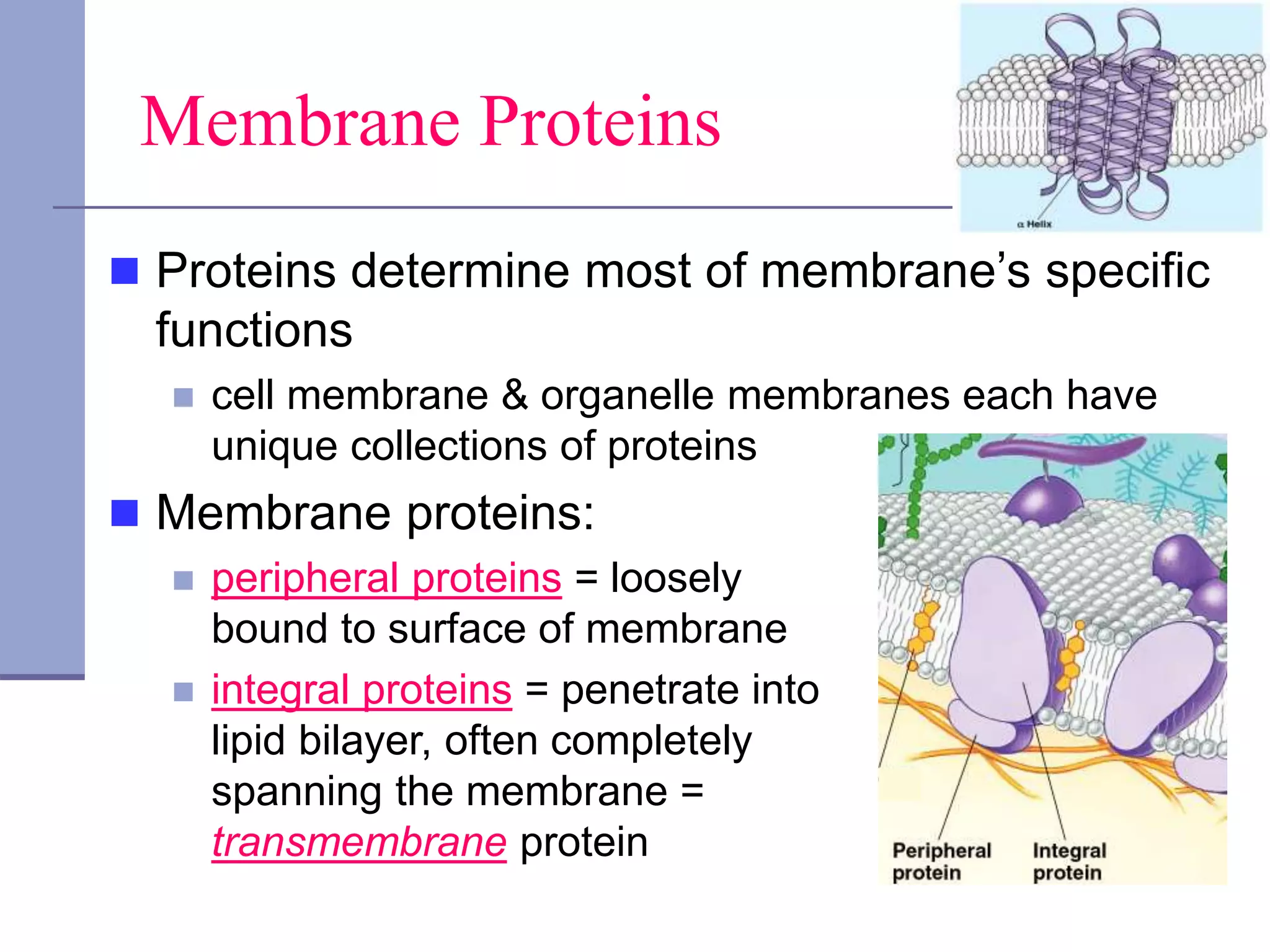
Membrane Proteins
 Proteins determine most of membrane’s specific
functions
 cell membrane & organelle membranes each have
unique collections of proteins
 Membrane proteins:
 peripheral proteins = loosely
bound to surface of membrane
 integral proteins = penetrate into
lipid bilayer, often completely
spanning the membrane =
transmembrane protein
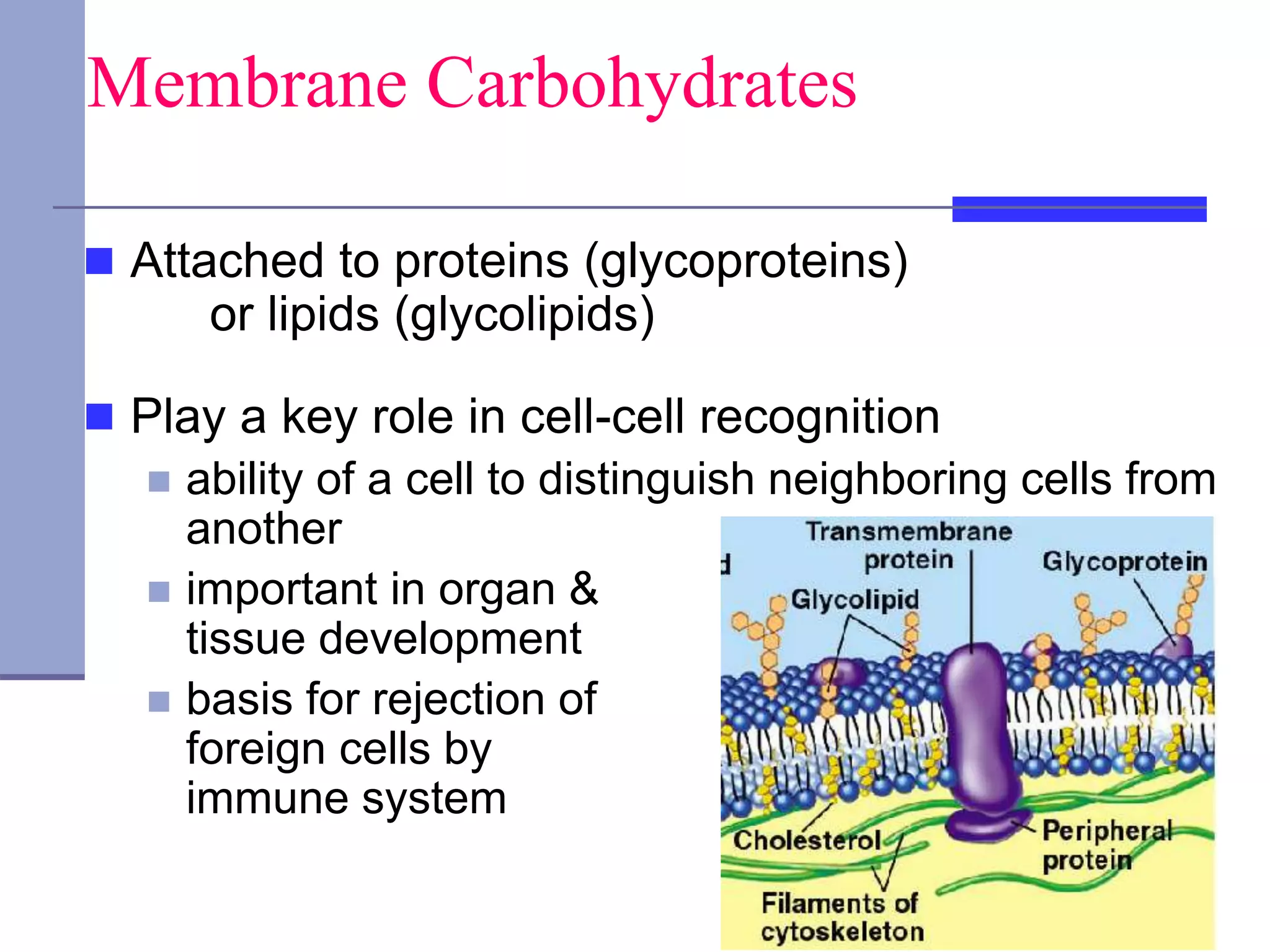
Membrane Carbohydrates
 Attached to proteins (glycoproteins)
or lipids (glycolipids)
 Play a key role in cell-cell recognition
 ability of a cell to distinguish neighboring cells from
another
 important in organ &
tissue development
 basis for rejection of
foreign cells by
immune system
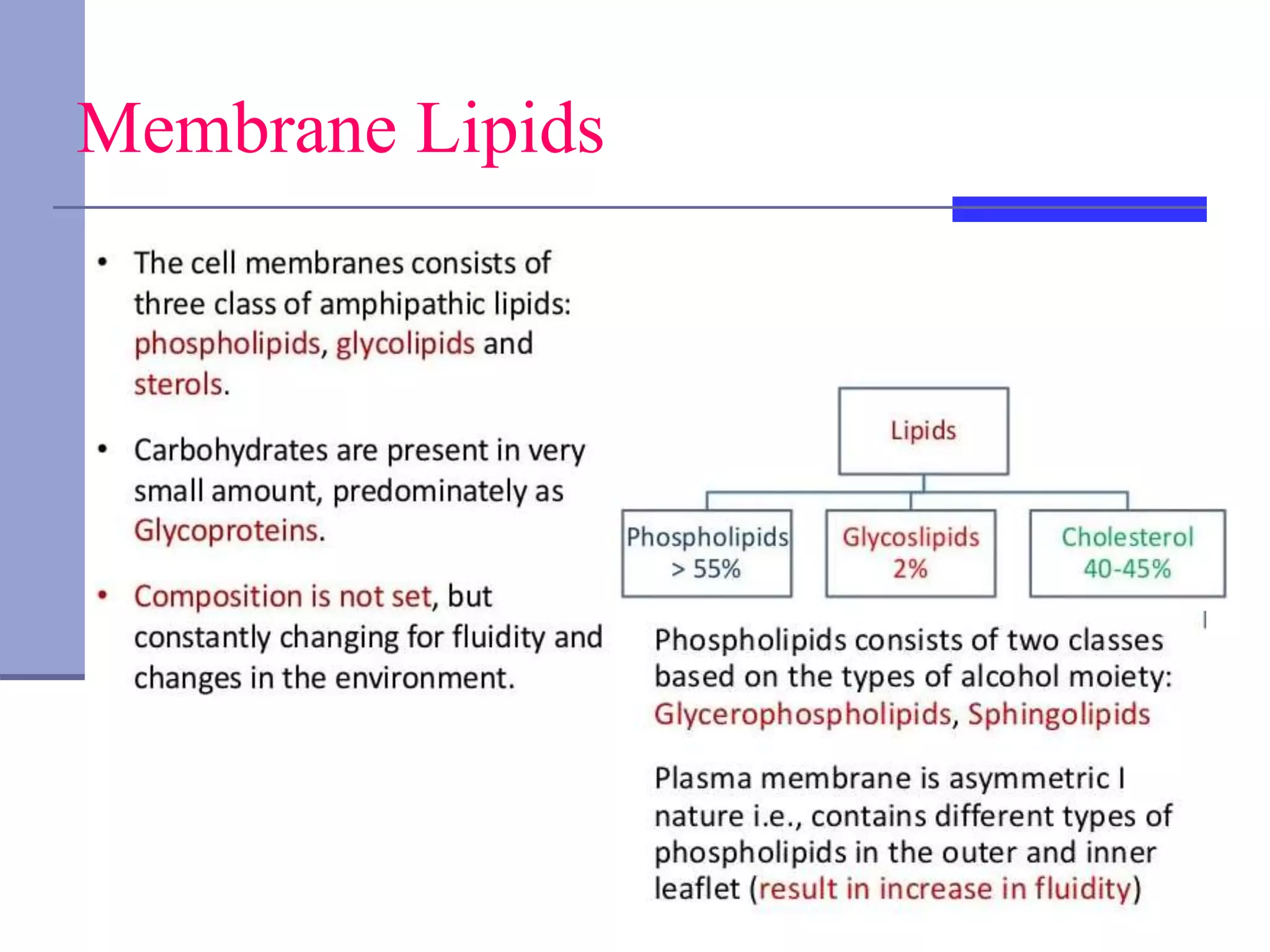
Membrane Lipids
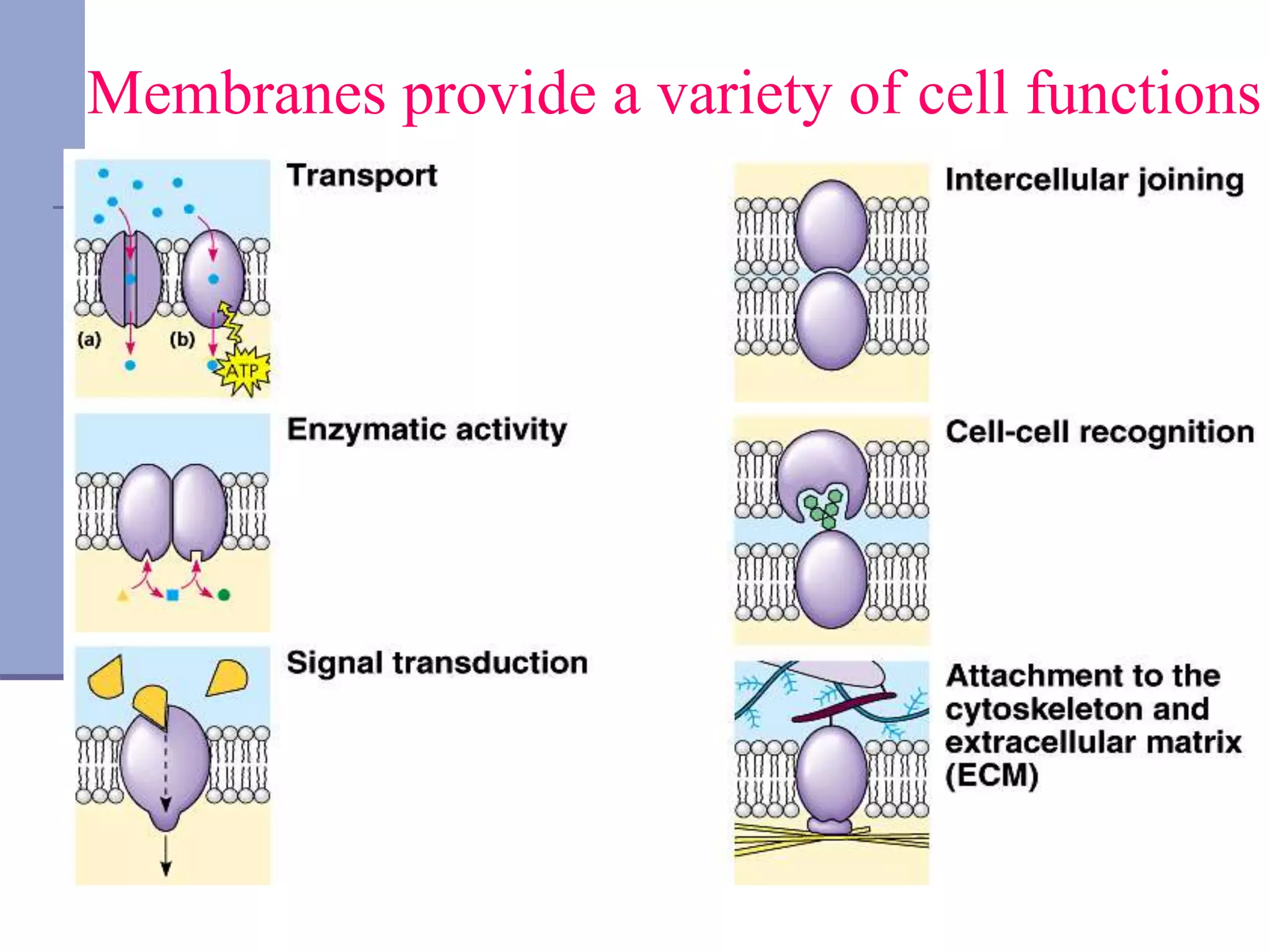
Membranes provide a variety of cell functions
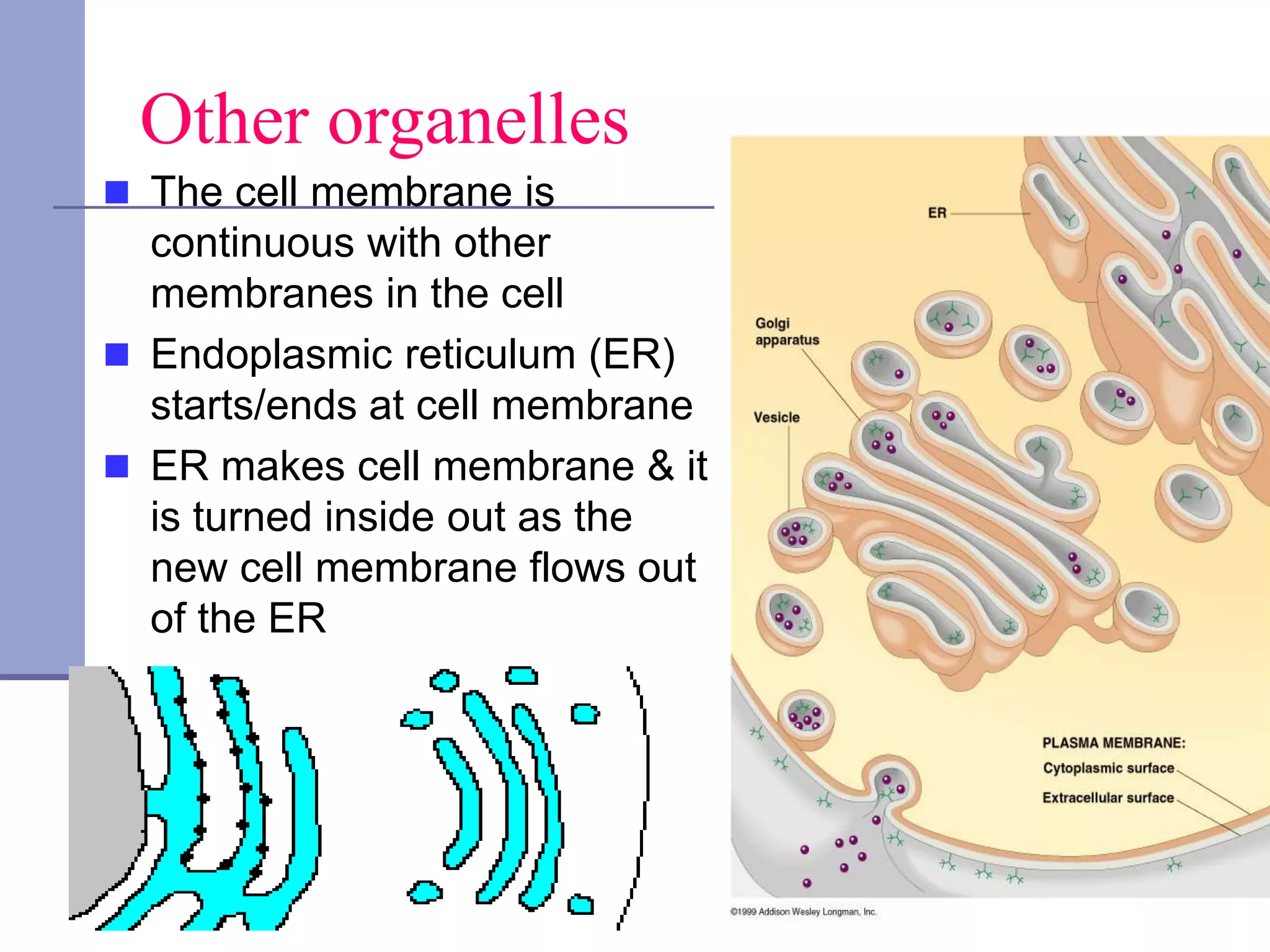
Other organelles
 The cell membrane is
continuous with other
membranes in the cell
 Endoplasmic reticulum (ER)
starts/ends at cell membrane
 ER makes cell membrane & it
is turned inside out as the
new cell membrane flows out
of the ER
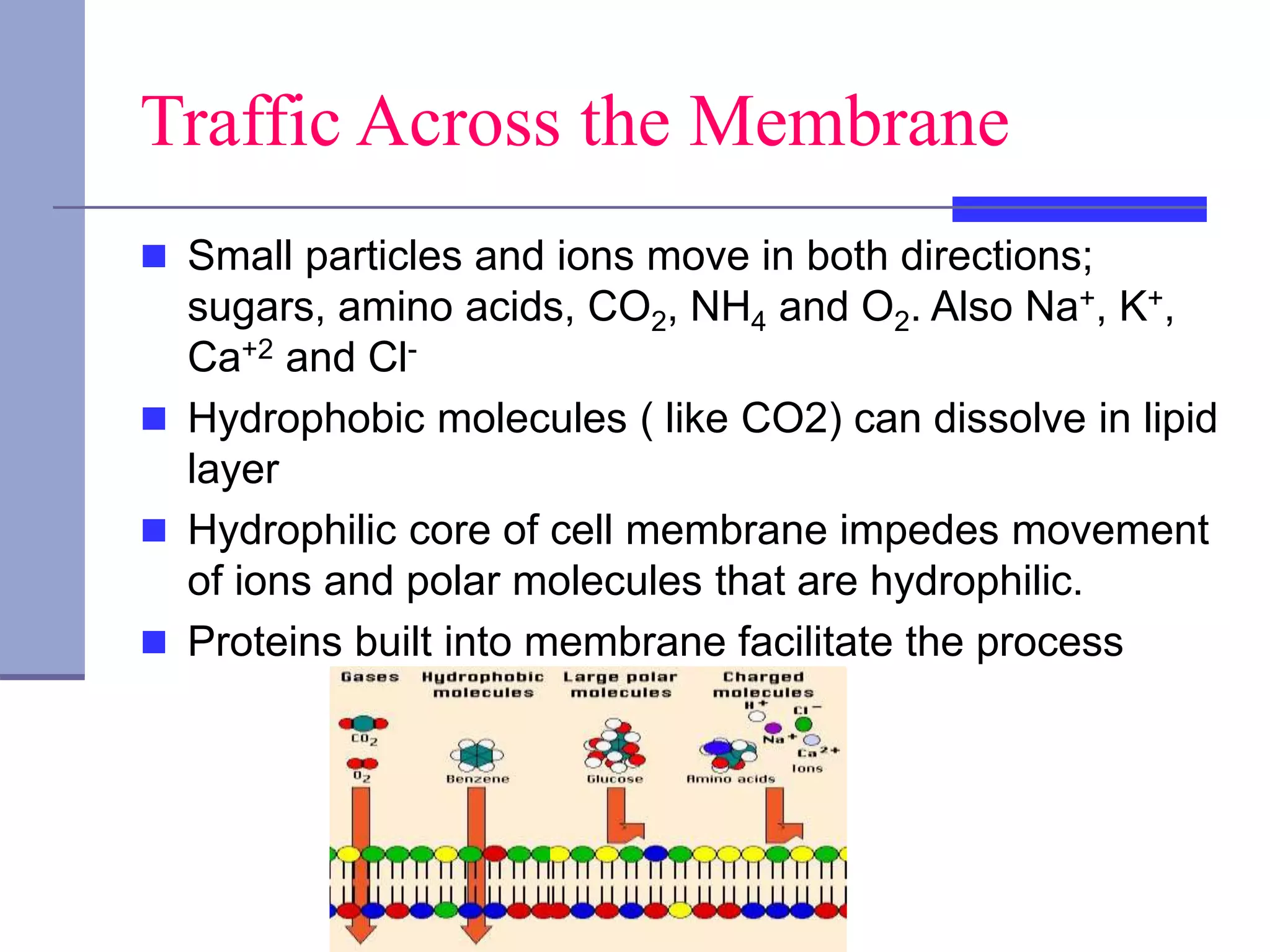
Traffic Across the Membrane
 Small particles and ions move in both directions;
sugars, amino acids, CO2, NH4 and O2. Also Na+, K+,
Ca+2 and Cl-
 Hydrophobic molecules ( like CO2) can dissolve in lipid
layer
 Hydrophilic core of cell membrane impedes movement
of ions and polar molecules that are hydrophilic.
 Proteins built into membrane facilitate the process
Transport Proteins
Span the Cell membrane
Function as a channel
Some also physically move
passengers
Specificity of fit allows for membrane
selectivity.
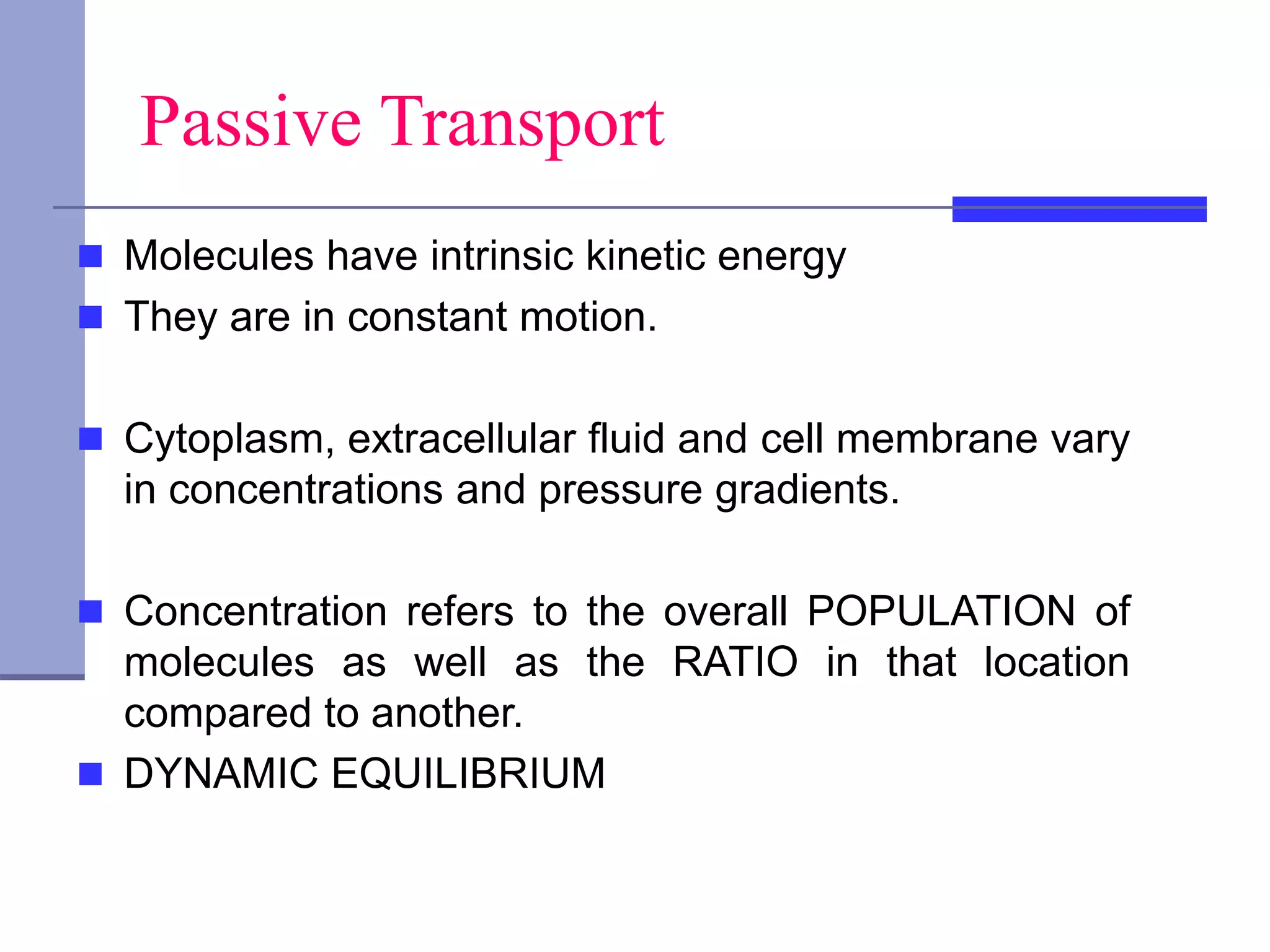
Passive Transport
 Molecules have intrinsic kinetic energy
 They are in constant motion.
 Cytoplasm, extracellular fluid and cell membrane vary
in concentrations and pressure gradients.
 Concentration refers to the overall POPULATION of
molecules as well as the RATIO in that location
compared to another.
 DYNAMIC EQUILIBRIUM
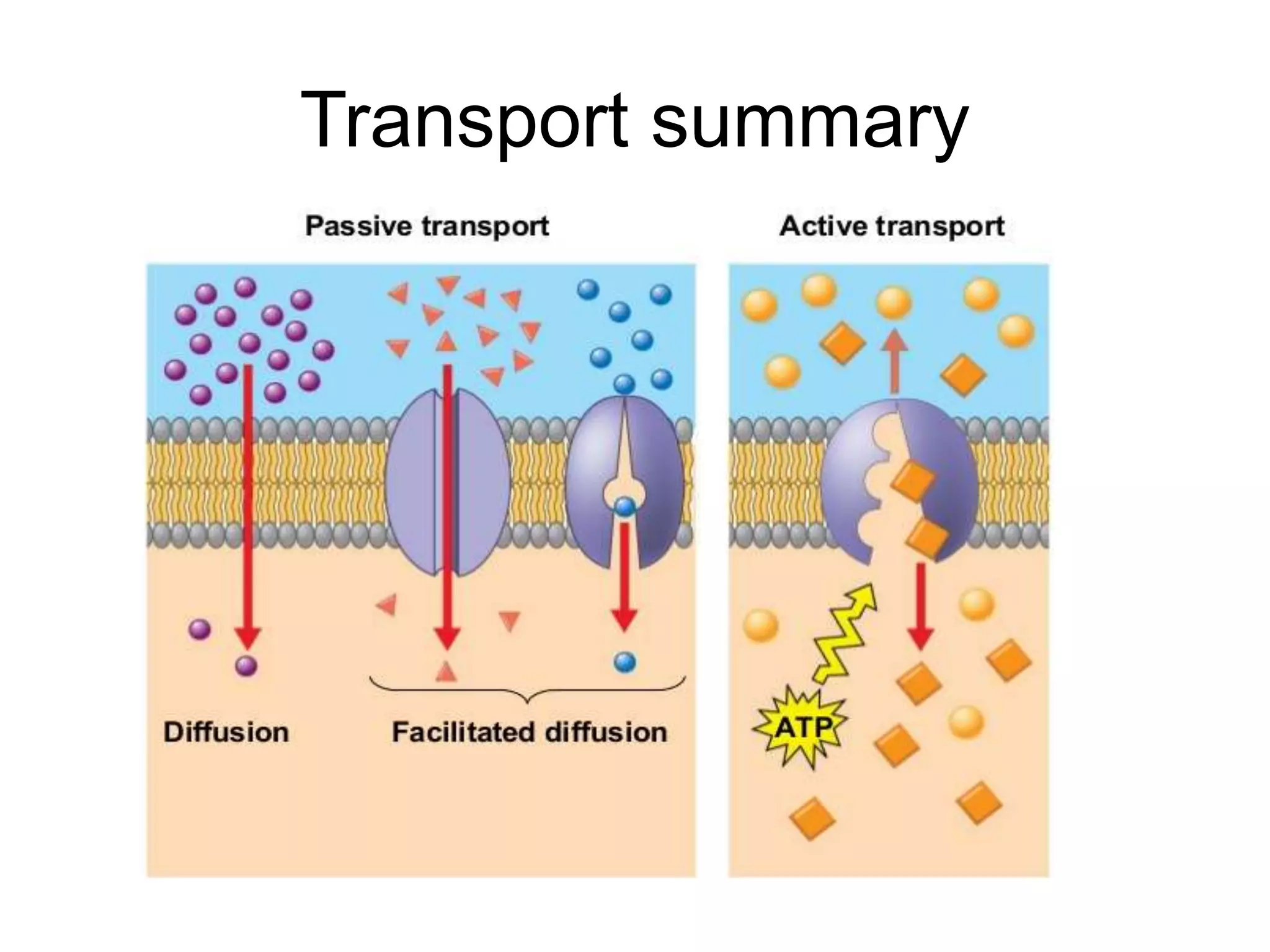
Passive transport includes
 Diffusion
 Tendency of molecules of any substance to spread out
into the available space. Substances will diffuse
DOWN their concentration gradient.
 Osmosis
 The diffusion of water molecules across a selectively
permeable membrane.
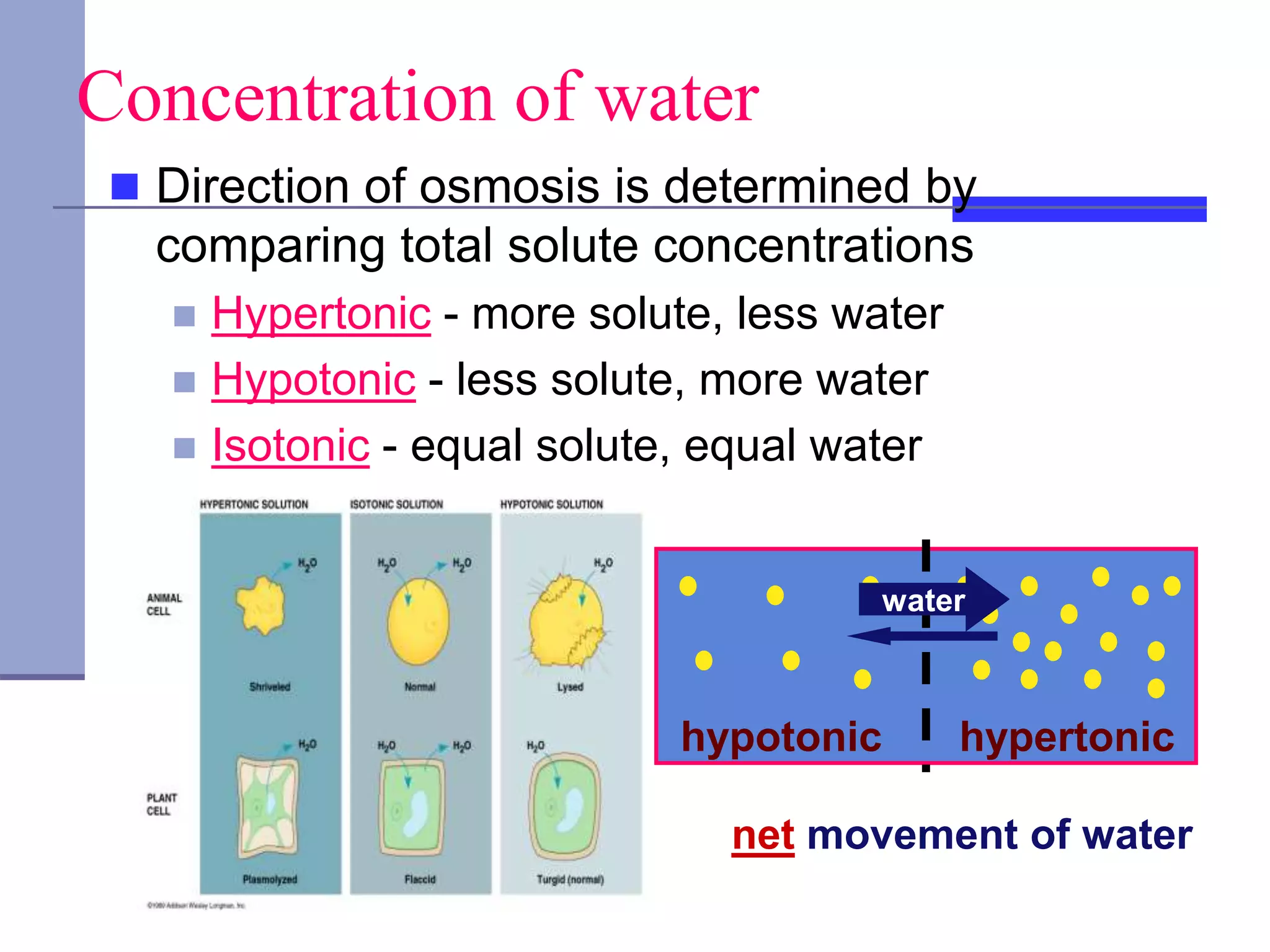
 Hypertonic = solution with higher [conc.] of solutes
 Hypotonic = solution with lower [conc.] of solutes
 Isotonic = solutions are equal in solute concentration
 Facilitative Diffusion
 Transport proteins are helping molecules to cross
membrane, but still diffusion (lowering overall free
energy) thus doesn’t require energy from cell.
Concentration of water
 Direction of osmosis is determined by
comparing total solute concentrations
 Hypertonic - more solute, less water
 Hypotonic - less solute, more water
 Isotonic - equal solute, equal water
hypotonic hypertonic
water
net movement of water
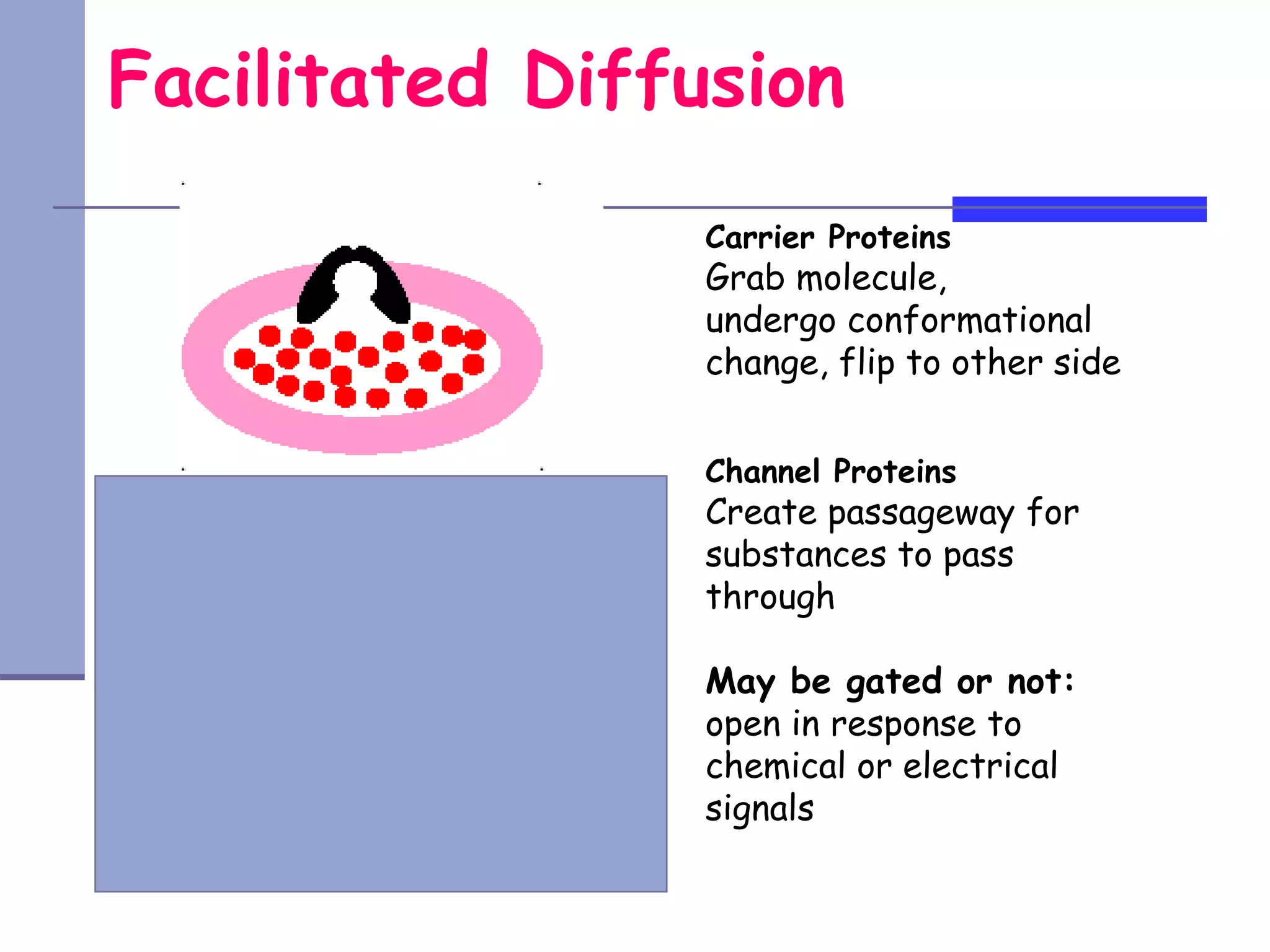
Facilitated Diffusion
Carrier Proteins
Grab molecule,
undergo conformational
change, flip to other side
Channel Proteins
Create passageway for
substances to pass
through
May be gated or not:
open in response to
chemical or electrical
signals
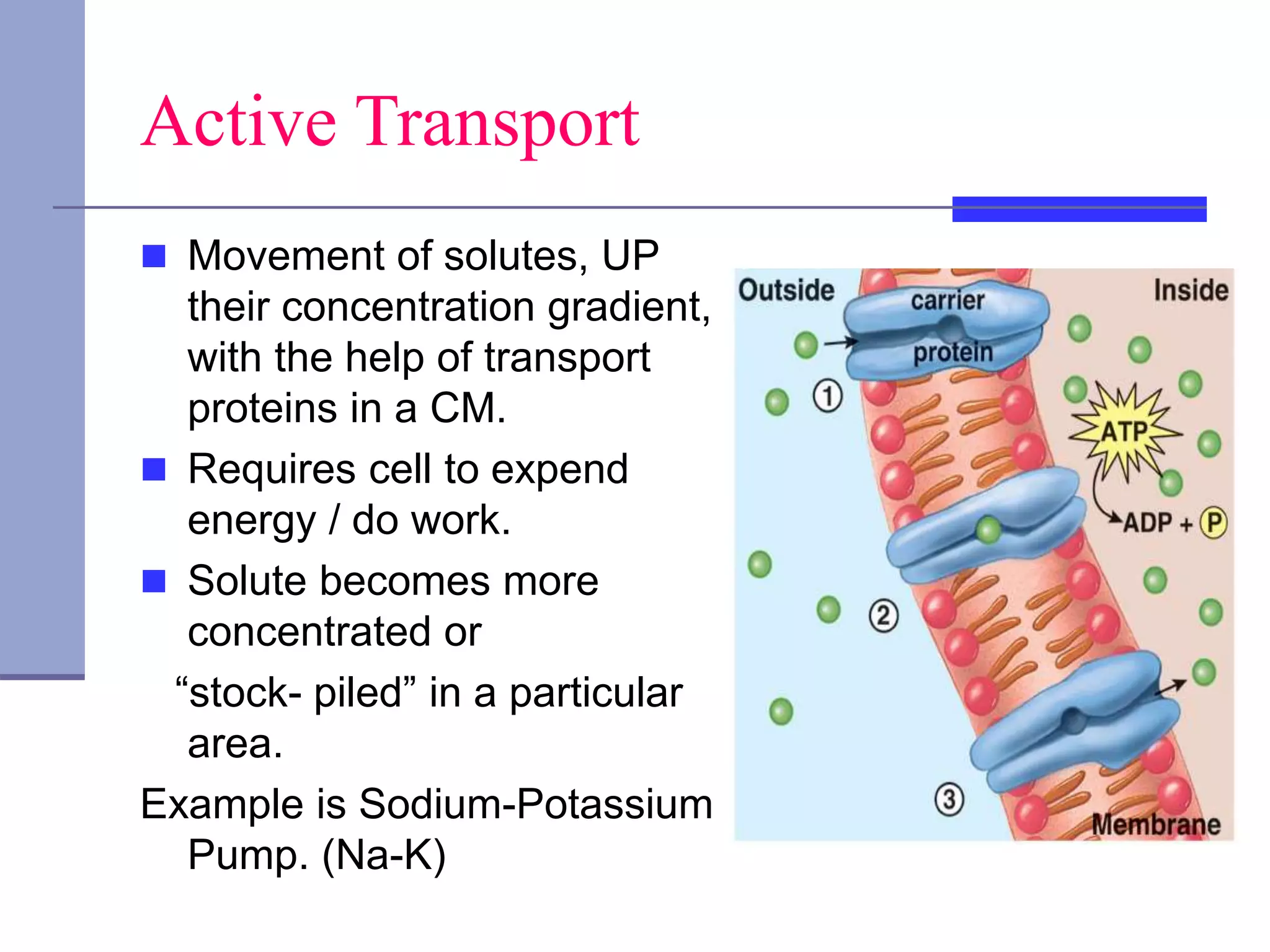
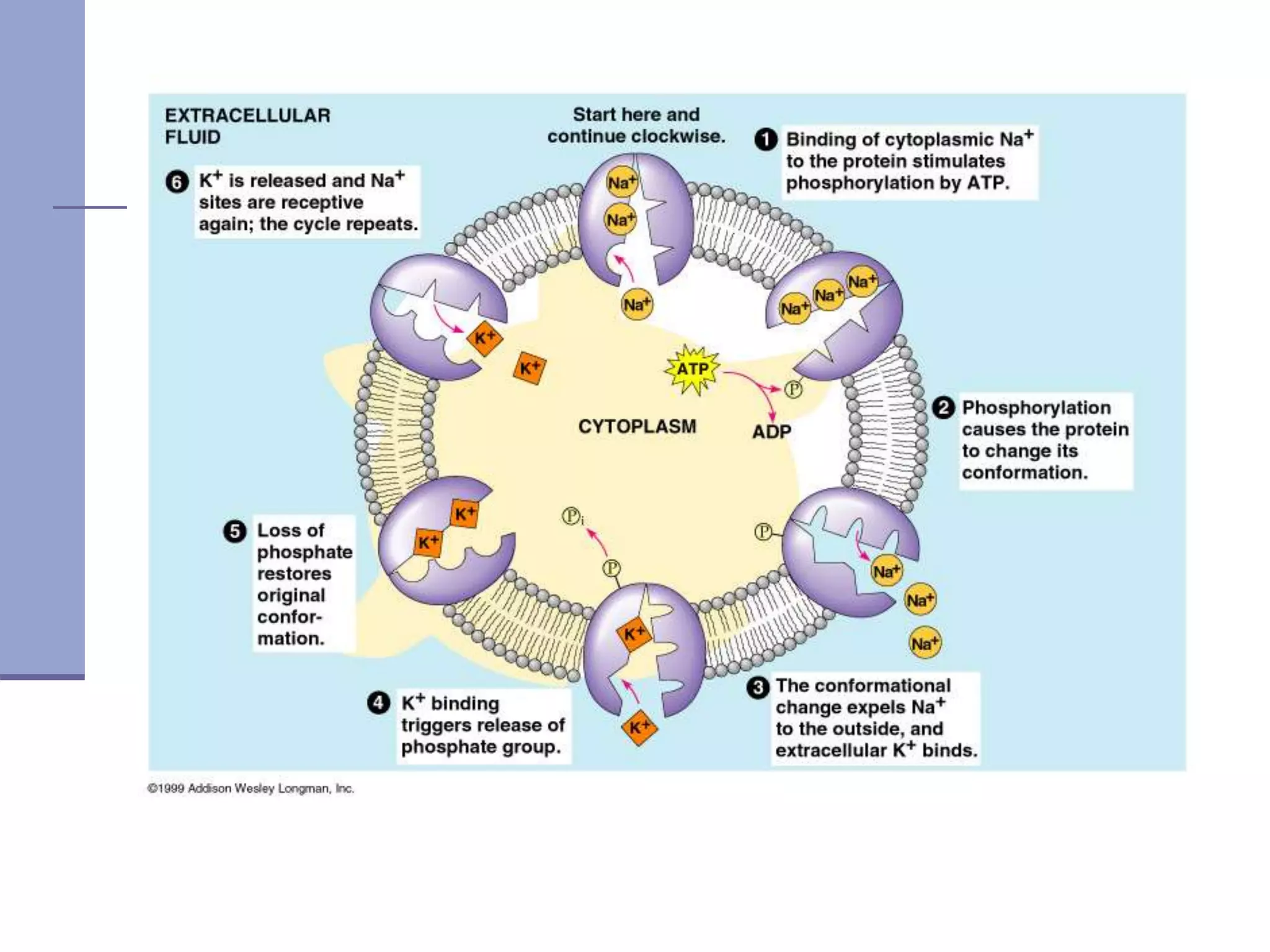
Active Transport
 Movement of solutes, UP
their concentration gradient,
with the help of transport
proteins in a CM.
 Requires cell to expend
energy / do work.
 Solute becomes more
concentrated or
“stock- piled” in a particular
area.
Example is Sodium-Potassium
Pump. (Na-K)
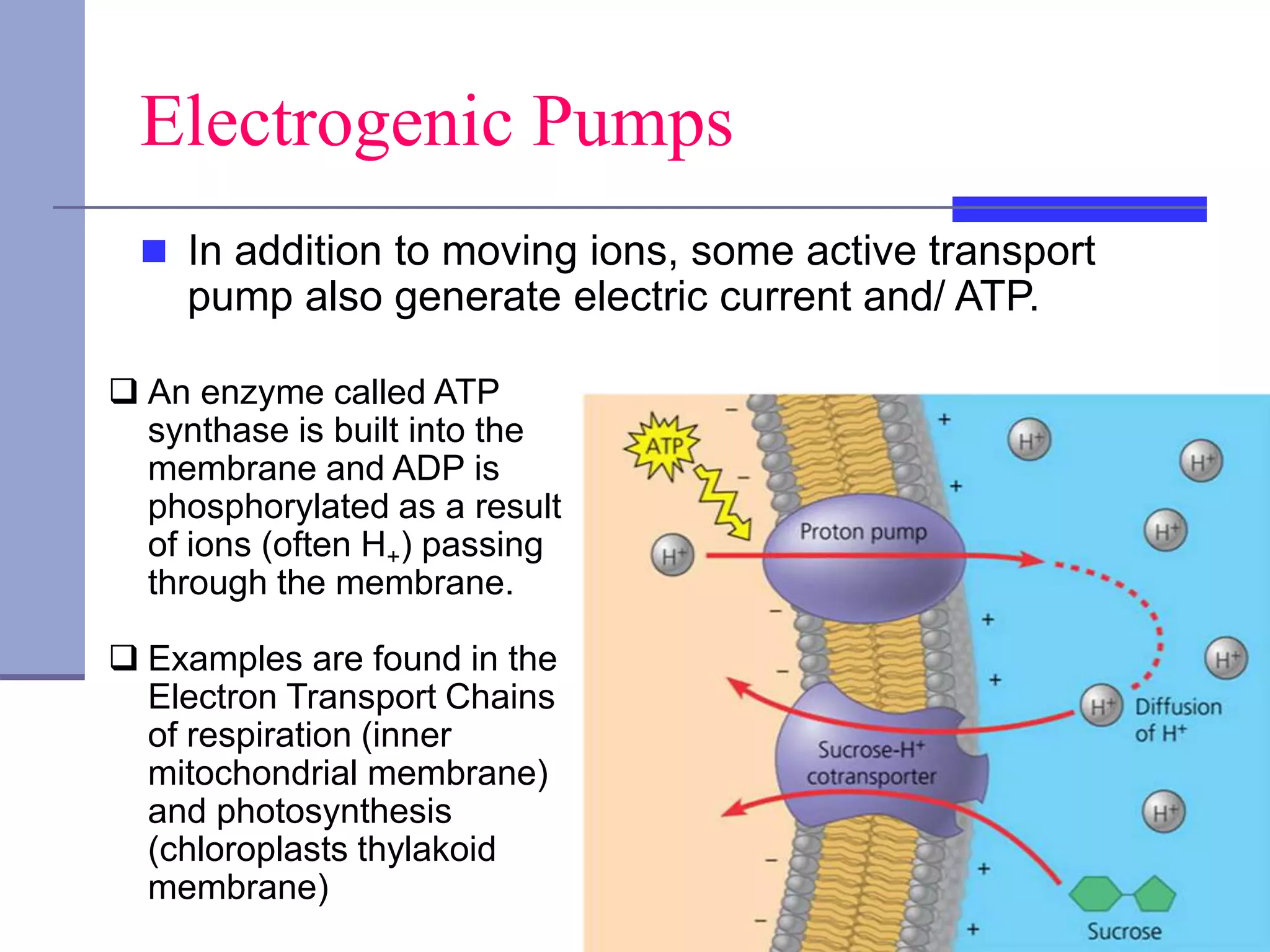
Electrogenic Pumps
 In addition to moving ions, some active transport
pump also generate electric current and/ ATP.
 An enzyme called ATP
synthase is built into the
membrane and ADP is
phosphorylated as a result
of ions (often H+) passing
through the membrane.
 Examples are found in the
Electron Transport Chains
of respiration (inner
mitochondrial membrane)
and photosynthesis
(chloroplasts thylakoid
membrane)
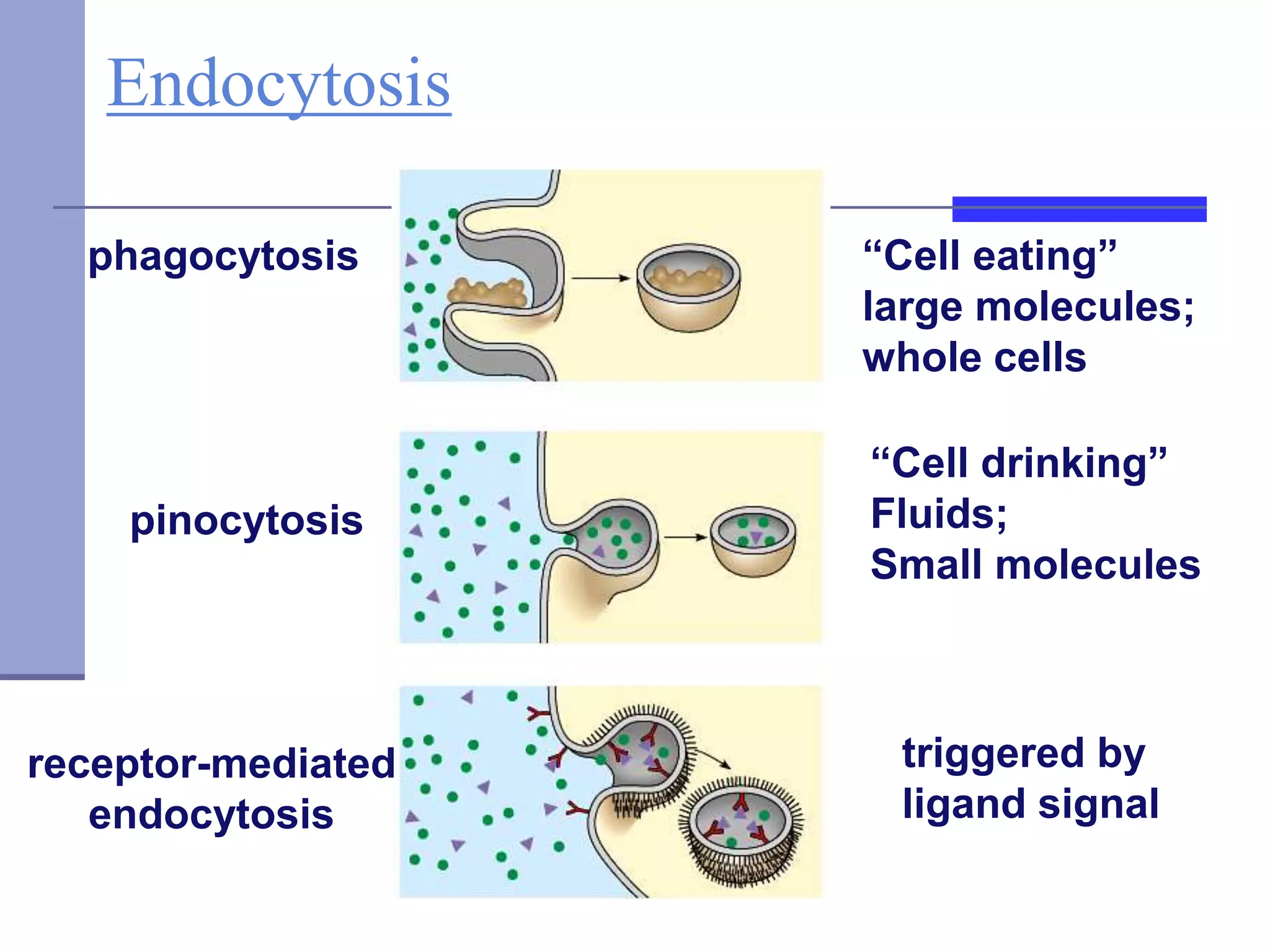
Endocytosis
phagocytosis
pinocytosis
receptor-mediated
endocytosis
“Cell eating”
large molecules;
whole cells
“Cell drinking”
Fluids;
Small molecules
triggered by
ligand signal
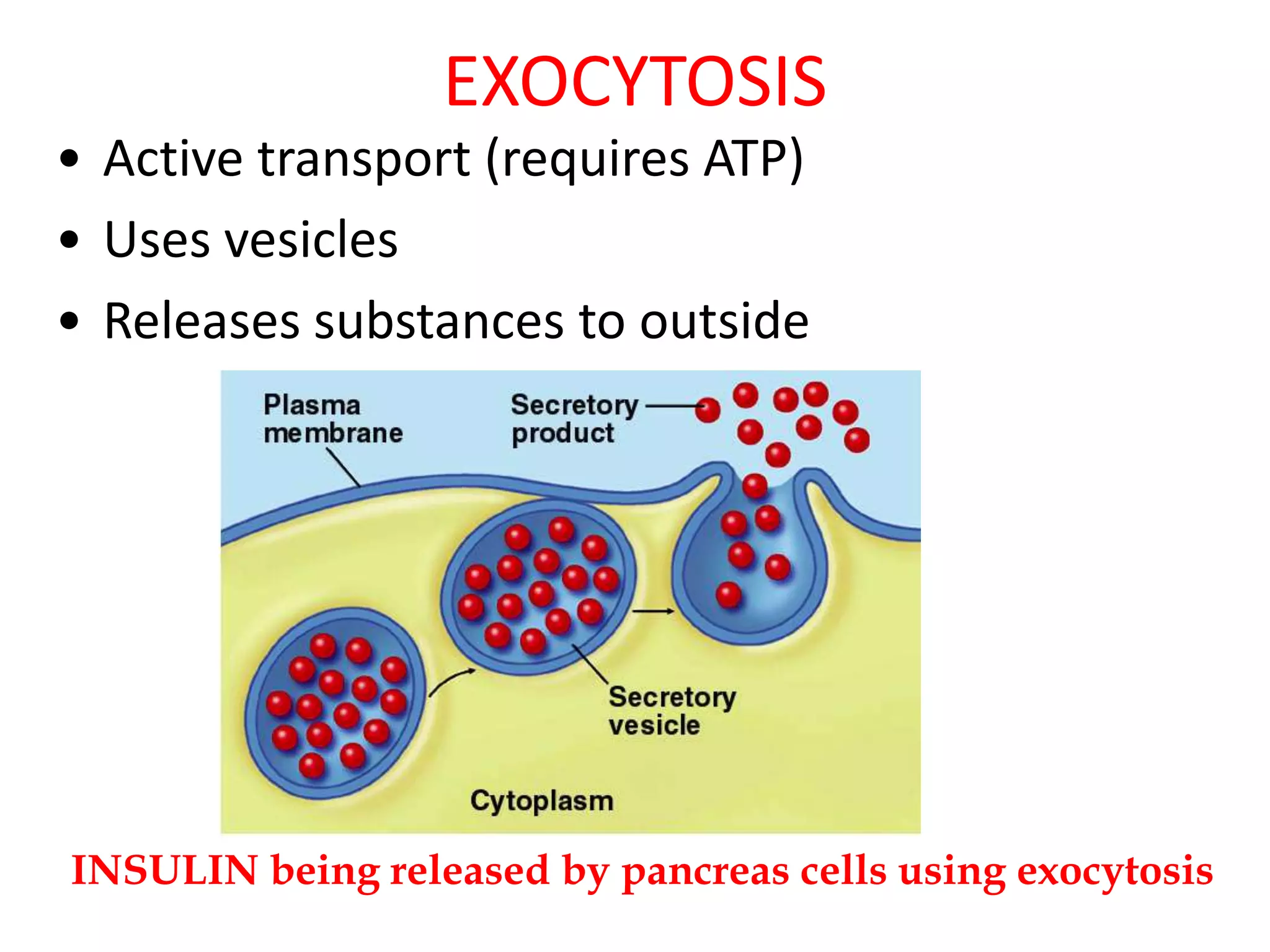
EXOCYTOSIS
• Active transport (requires ATP)
• Uses vesicles
• Releases substances to outside
INSULIN being released by pancreas cells using exocytosis
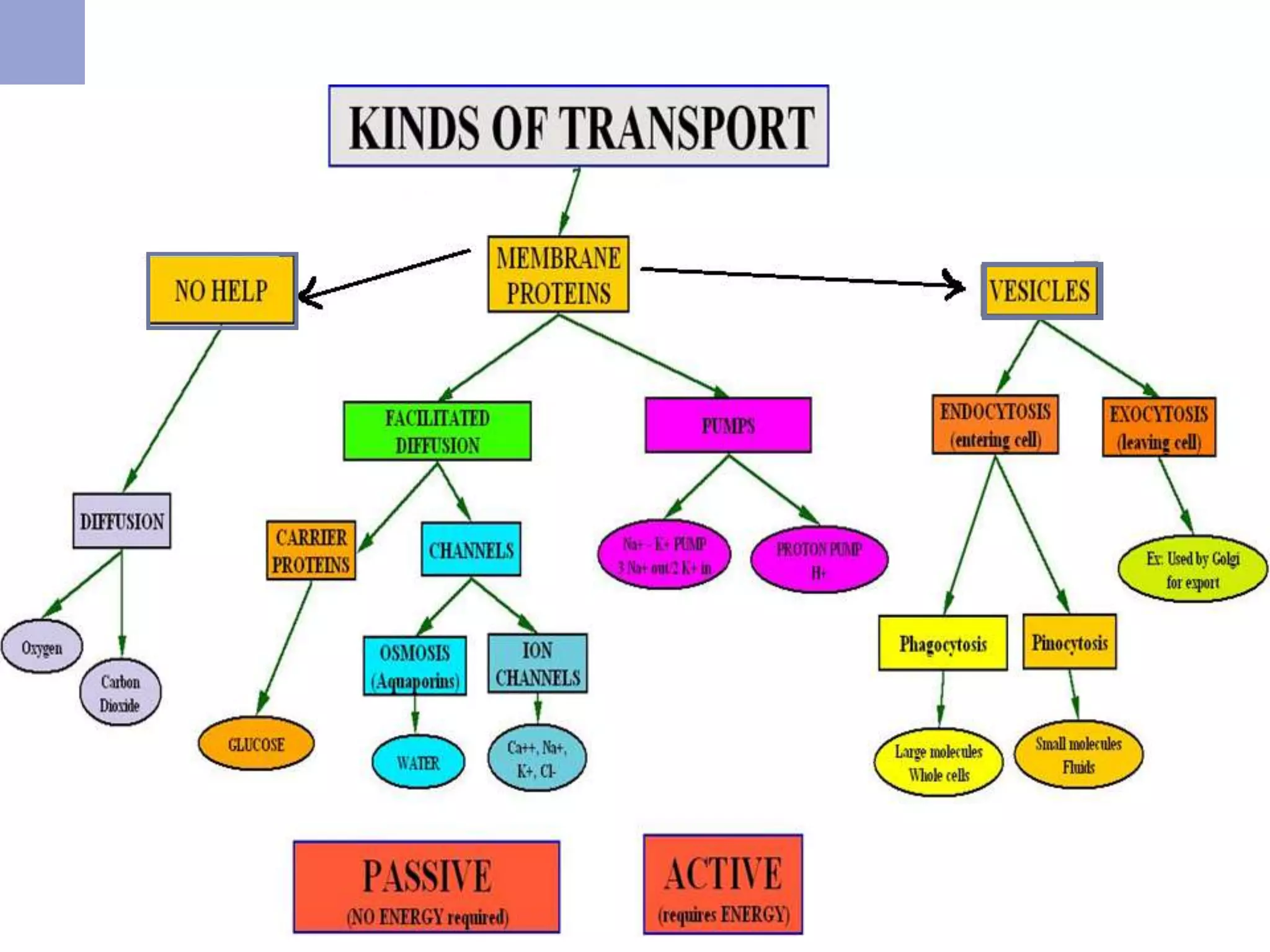
Transport summary

Cell Membrane Structure and Function.ppt

  • 1.
    Plasma Membrane Structure andFunction By Dr. Huma Jawed Ph.D Pharmacology
  • 2.
    Membrane Structure andFunction  Cells must contain a cell membrane, cytoplasm and genetic material.  The cell membrane is the EDGE, “boundary of life”, while the cytoplasm is the site of all the reactions of life and the genetic material is the information required for life.  SELECTIVELY PERMEABLE means that the cell membrane allows some substances across more easily than others… some it helps and some it inhibits or rejects all together.
  • 3.
    Molecules need tomove across membranes in cells Image modiified from: http://www.accessexcellence.org/AB/GG/importProt.html IN food carbohydrates sugars, proteins amino acids lipids salts, O2, H2O OUT waste ammonia salts CO2 H2O products
  • 4.
    Membrane Structure  Developmentof models as a scientific process  Models include  Overton – proposed lipid base  Langmuir (phospholipids) – made membrane  Gorter and Grendel (two layers)  Davson and Danielli (sandwich image, protein outside)  Singer and Nicolson = Fluid Mosaic Model  Required electron microscopy  1972
  • 5.
    MEMBRANE MODELS 1915: Scientistsanalyzed isolated red blood cell membranes, found them made up of proteins and lipids 10 years later: E. Gorter and F. Grendel reasoned membranes are made of a phospholipid bilayer 1935: Hugh Davson and James Danielli proposed membrane was a “sandwich” of proteins and phospholipid bilayer with proteins on outside of phopholipids DAVSON-DANIELLI MODEL
  • 6.
    FLUID MOSAIC MODEL 1972-S.J. Singer and G. Nicolson propose membrane is a “mosaic” of proteins and phospholipids that are constantly moving and changing Animation from: http://www.sp.uconn.edu/~terry/images/anim/fluidmem.gif
  • 8.
    Membrane Structure  Phospholipids– phosphate and fatty acid tails  Hydrophilic phosphates  Hydrophobic fatty acid tails  Two layers  With tails together  Protein  Embedded throughout - integral  Some just surface – peripheral  Motility Phospholipid
  • 11.
    Idea of Fluidity Cholesterol molecules prevent membrane from becoming ‘crispy’  Proteins ‘bob’ along surface  Proteins are anchored by fibers in the cytoskeleton  Phospholipids can even flip flop  Merging of membranes.
  • 13.
    Membrane Proteins  Proteinsdetermine most of membrane’s specific functions  cell membrane & organelle membranes each have unique collections of proteins  Membrane proteins:  peripheral proteins = loosely bound to surface of membrane  integral proteins = penetrate into lipid bilayer, often completely spanning the membrane = transmembrane protein
  • 14.
    Membrane Carbohydrates  Attachedto proteins (glycoproteins) or lipids (glycolipids)  Play a key role in cell-cell recognition  ability of a cell to distinguish neighboring cells from another  important in organ & tissue development  basis for rejection of foreign cells by immune system
  • 15.
  • 16.
    Membranes provide avariety of cell functions
  • 17.
    Other organelles  Thecell membrane is continuous with other membranes in the cell  Endoplasmic reticulum (ER) starts/ends at cell membrane  ER makes cell membrane & it is turned inside out as the new cell membrane flows out of the ER
  • 18.
    Traffic Across theMembrane  Small particles and ions move in both directions; sugars, amino acids, CO2, NH4 and O2. Also Na+, K+, Ca+2 and Cl-  Hydrophobic molecules ( like CO2) can dissolve in lipid layer  Hydrophilic core of cell membrane impedes movement of ions and polar molecules that are hydrophilic.  Proteins built into membrane facilitate the process
  • 20.
    Transport Proteins Span theCell membrane Function as a channel Some also physically move passengers Specificity of fit allows for membrane selectivity.
  • 21.
    Passive Transport  Moleculeshave intrinsic kinetic energy  They are in constant motion.  Cytoplasm, extracellular fluid and cell membrane vary in concentrations and pressure gradients.  Concentration refers to the overall POPULATION of molecules as well as the RATIO in that location compared to another.  DYNAMIC EQUILIBRIUM
  • 22.
    Passive transport includes Diffusion  Tendency of molecules of any substance to spread out into the available space. Substances will diffuse DOWN their concentration gradient.  Osmosis  The diffusion of water molecules across a selectively permeable membrane.  Hypertonic = solution with higher [conc.] of solutes  Hypotonic = solution with lower [conc.] of solutes  Isotonic = solutions are equal in solute concentration  Facilitative Diffusion  Transport proteins are helping molecules to cross membrane, but still diffusion (lowering overall free energy) thus doesn’t require energy from cell.
  • 23.
    Concentration of water Direction of osmosis is determined by comparing total solute concentrations  Hypertonic - more solute, less water  Hypotonic - less solute, more water  Isotonic - equal solute, equal water hypotonic hypertonic water net movement of water
  • 24.
    Facilitated Diffusion Carrier Proteins Grabmolecule, undergo conformational change, flip to other side Channel Proteins Create passageway for substances to pass through May be gated or not: open in response to chemical or electrical signals
  • 25.
    Active Transport  Movementof solutes, UP their concentration gradient, with the help of transport proteins in a CM.  Requires cell to expend energy / do work.  Solute becomes more concentrated or “stock- piled” in a particular area. Example is Sodium-Potassium Pump. (Na-K)
  • 27.
    Electrogenic Pumps  Inaddition to moving ions, some active transport pump also generate electric current and/ ATP.  An enzyme called ATP synthase is built into the membrane and ADP is phosphorylated as a result of ions (often H+) passing through the membrane.  Examples are found in the Electron Transport Chains of respiration (inner mitochondrial membrane) and photosynthesis (chloroplasts thylakoid membrane)
  • 28.
    Endocytosis phagocytosis pinocytosis receptor-mediated endocytosis “Cell eating” large molecules; wholecells “Cell drinking” Fluids; Small molecules triggered by ligand signal
  • 29.
    EXOCYTOSIS • Active transport(requires ATP) • Uses vesicles • Releases substances to outside INSULIN being released by pancreas cells using exocytosis
  • 30.