Chapter 07
Lecture and
Animation Outline
See separate PowerPoint slides for all figures and
tables pre-inserted into PowerPoint without notes and
animations.
To run the animations you must be in Slideshow View. Use
the buttons on the animation to play, pause, and turn
audio/text on or off.
Please Note: Once you have used any of the animation
functions (such as Play or Pause), you must first click on the
slide’s background before you can advance to the next slide.
2
Respiration
• Organisms can be classified based on
how they obtain energy:
• Autotrophs
– Able to produce their own organic molecules
through photosynthesis
• Heterotrophs
– Live on organic compounds produced by
other organisms
• All organisms use cellular respiration to
extract energy from organic molecules
3
Cellular respiration
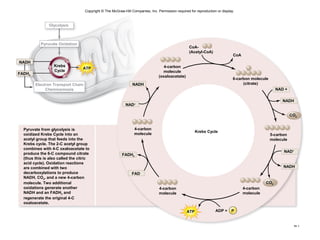
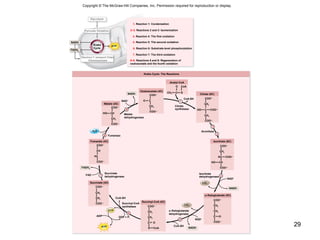
• Cellular respiration is a series of reactions
• Oxidized – loss of electrons
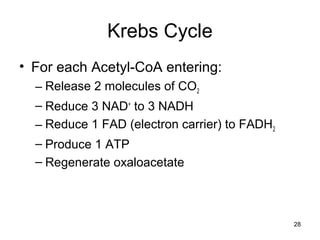
• Reduced – gain of electron
• Dehydrogenation – lost electrons are
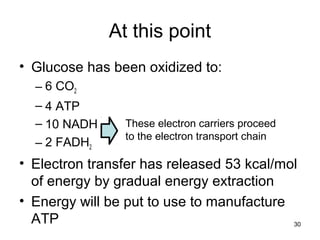
accompanied by protons
– A hydrogen atom is lost (1 electron, 1 proton)
4
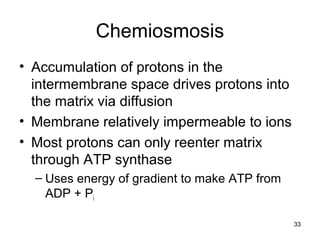
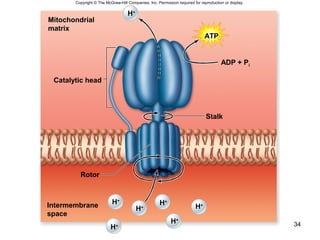
Redox
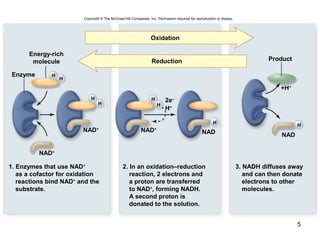
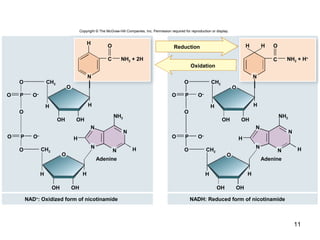
• During redox reactions, electrons carry
energy from one molecule to another
• Nicotinamide adenosine dinucleotide
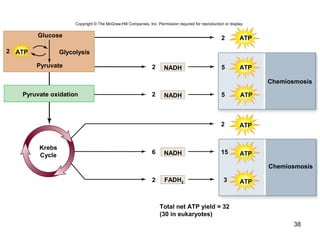
(NAD+)
– An electron carrier
– NAD+
accepts 2 electrons and 1 proton to
become NADH
– Reaction is reversible
5
Copyright © The McGraw-Hill Companies, Inc. Permission required for reproduction or display.
Product
Enzyme
NAD+
NAD+
NAD NAD
2e–
H+
+H+
Energy-rich
molecule
NAD+
1. Enzymes that use NAD+
as a cofactor for oxidation
reactions bind NAD+
and the
substrate.
2. In an oxidation–reduction
reaction, 2 electrons and
a proton are transferred
to NAD+
, forming NADH.
A second proton is
donated to the solution.
3. NADH diffuses away
and can then donate
electrons to other
molecules.
Reduction
Oxidation
H
H
H
H
H
H
H H
• In overall cellular energy harvest
– Dozens of redox reactions take place
– Number of electron acceptors including NAD+
• In the end, high-energy electrons from
initial chemical bonds have lost much of
their energy
• Transferred to a final electron acceptor
6
7
• Aerobic respiration
– Final electron receptor is oxygen (O2)
• Anaerobic respiration
– Final electron acceptor is an inorganic
molecule (not O2)
• Fermentation
– Final electron acceptor is an organic molecule
8
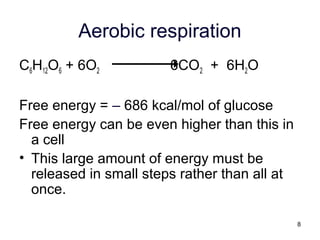
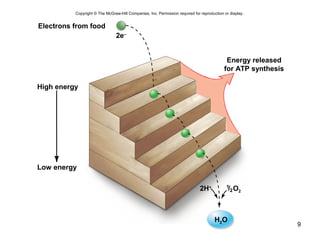
Aerobic respiration
C6H12O6 + 6O2 6CO2 + 6H2O
Free energy = – 686 kcal/mol of glucose
Free energy can be even higher than this in
a cell
• This large amount of energy must be
released in small steps rather than all at
once.
9
2e–
Electrons from food
High energy
Low energy
2H+ 1/2O2
Energy released
for ATP synthesis
H2O
Copyright © The McGraw-Hill Companies, Inc. Permission required for reproduction or display.
Electron carriers
• Many types of carriers used
– Soluble, membrane-bound, move within
membrane
• All carriers can be easily oxidized and
reduced
• Some carry just electrons, some electrons
and protons
• NAD+ acquires 2 electrons and a proton
to become NADH
10
11
Copyright © The McGraw-Hill Companies, Inc. Permission required for reproduction or display.
H H
O
NH2 + 2H
CH2O
O
O
H
H
NH2
H
H
N
N
N
CH2O
O
O
H
H
NH2
O–
H
H
N
N
N
H H O
N
N
H H
H
C C
O P
O PO–
O P
O–
O P
N
N
OH
CH2
NADH: Reduced form of nicotinamide
O
O O
O
NAD+
: Oxidized form of nicotinamide
Reduction
Oxidation
Adenine Adenine
OH OH
OH OHOH
OHOH
NH2 + H+
CH2
O–
12
ATP
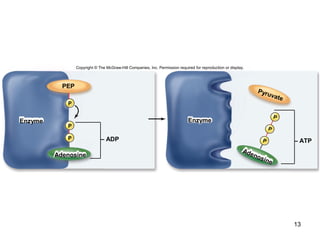
• Cells use ATP to drive endergonic
reactions
– ΔG (free energy) = –7.3 kcal/mol
• 2 mechanisms for synthesis
1. Substrate-level phosphorylation
• Transfer phosphate group directly to ADP
• During glycolysis
2. Oxidative phosphorylation
• ATP synthase uses energy from a proton gradient
13
PEP
– ADP
Enzyme Enzyme
– ATP
Adenosine
Pyruvate
P
PP
P
P
Adenosine
P
Copyright © The McGraw-Hill Companies, Inc. Permission required for reproduction or display.
14
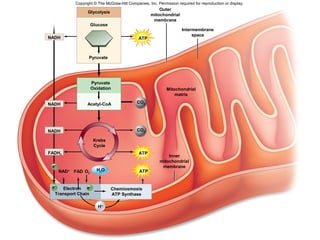
Oxidation of Glucose
The complete oxidation of glucose proceeds
in stages:
1. Glycolysis
2. Pyruvate oxidation
3. Krebs cycle
4. Electron transport chain & chemiosmosis
15
Outer
mitochondrial
membrane
Intermembrane
space
Mitochondrial
matrix
FAD O2
Inner
mitochondrial
membrane
Electron
Transport Chain
Chemiosmosis
ATP Synthase
NAD+
Glycolysis
Pyruvate
Glucose
Pyruvate
Oxidation
Acetyl-CoA
Krebs
Cycle
CO2
ATPH2O
ATP
e–
e–
NADH
NADH
CO2
ATP
NADH
FADH2
Copyright © The McGraw-Hill Companies, Inc. Permission required for reproduction or display.
H+
e–
16
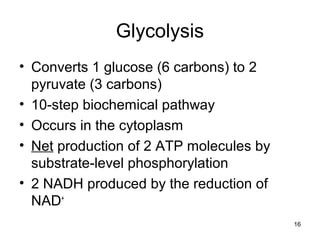
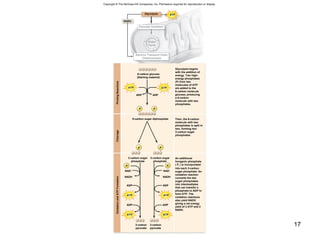
Glycolysis
• Converts 1 glucose (6 carbons) to 2
pyruvate (3 carbons)
• 10-step biochemical pathway
• Occurs in the cytoplasm
• Net production of 2 ATP molecules by
substrate-level phosphorylation
• 2 NADH produced by the reduction of
NAD+
17
Copyright © The McGraw-Hill Companies, Inc. Permission required for reproduction or display.
Glycolysis
NADH
Pyruvate Oxidation
ATP
Electron Transport Chain
Chemiosmosis
Krebs
Cycle
6-carbon sugar diphosphate
NAD+
NAD+
PrimingReactionsCleavageOxidationandATPFormation
NADH NADH
P P
P P
ATP ATP
ADP ADP
3-carbon sugar
phosphate
3-carbon sugar
phosphate
PiPi
ADP ADP
ATP ATP
ATP
ADP ADP
ATP
3-carbon
pyruvate
3-carbon
pyruvate
6-carbon glucose
(Starting material)
Glycolysis begins
with the addition of
energy. Two high-
energy phosphates
(P) from two
molecules of ATP
are added to the
6-carbon molecule
glucose, producing
a 6-carbon
molecule with two
phosphates.
Then, the 6-carbon
molecule with two
phosphates is split in
two, forming two
3-carbon sugar
phosphates.
An additional
Inorganic phosphate
( Pi ) is incorporated
into each 3-carbon
sugar phosphate. An
oxidation reaction
converts the two
sugar phosphates
into intermediates
that can transfer a
phosphate to ADP to
form ATP. The
oxidation reactions
also yield NADH
giving a net energy
yield of 2 ATP and 2
NADH.
18
Copyright © The McGraw-Hill Companies, Inc. Permission required for reproduction or display.
NADH
NAD+
NADH
Pi
NAD+
Glucose
Hexokinase
Phosphofructokinase
Glucose 6-phosphate
Fructose 6-phosphate
Fructose 1,6-bisphosphate
Isomerase
Aldolase
Pyruvate Pyruvate
Enolase
Pyruvate kinase
ADP
10
Glucose
Glyceraldehyde
3-phosphate
Pyruvate
Glycolysis: The ReactionsGlycolysis
NADH
Pyruvate Oxidation
H2O
ATP
ADP
Electron Transport Chain
Chemiosmosis
Krebs
Cycle
ATP
ATP
Phosphoglucose
isomerase
Glyceraldehyde 3-
phosphate (G3P)
Dihydroxyacetone
phosphate
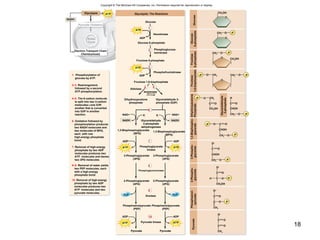
1. Phosphorylation of
glucose by ATP.
2–3. Rearrangement,
followed by a second
ATP phosphorylation.
4–5. The 6-carbon molecule
is split into two 3-carbon
molecules—one G3P,
another that is converted
into G3P in another
reaction.
6. Oxidation followed by
phosphorylation produces
two NADH molecules and
two molecules of BPG,
each with one
high-energy phosphate
bond.
7. Removal of high-energy
phosphate by two ADP
molecules produces two
ATP molecules and leaves
two 3PG molecules.
8–9. Removal of water yields
two PEP molecules, each
with a high-energy
phosphate bond.
10. Removal of high-energy
phosphate by two ADP
molecules produces two
ATP molecules and two
pyruvate molecules.
1,3-Bisphosphoglycerate
(BPG)
1,3-Bisphosphoglycerate
(BPG)
Glyceraldehyde
3-phosphate
dehydrogenase
Pi
ADP
Phosphoglycerate
kinase
ADP
ATP
3-Phosphoglycerate
(3PG)
3-Phosphoglycerate
(3PG)
2-Phosphoglycerate
(2PG)
2-Phosphoglycerate
(2PG)
H2O
ATP
Phosphoenolpyruvate
(PEP)
Phosphoenolpyruvate
(PEP)
ADP ADP
ATP ATP
Phosphoenol-
pyruvate
3-Phospho-
glycerate
1,3-Bisphospho-
glycerate
Glucose
6-phosphate
Fructose
6-phosphate
Fructose
1,6-bisphosphate
Dihydroxyacetone
Phosphate
2-Phospho-
glycerate
CH2OH
O
CH2 O
O
P
CH2 O
O
P
CH2OH
O CH2 CH2
O
O
P P
CHOH
H
C O
CH2 O P
C O
O CH2P
CH2OH
CHOH
O C O
CH2 O
P
P
CHOH
O–
C O
CH2 O P
H C O
O–
C O
CH2OH
P
C O
O–
C O
CH2
P
C O
O–
C O
CH3
8
9
10
7
4 5
3
2
1
6
Phosphoglyceromutase
19
Please note that due to differing
operating systems, some animations
will not appear until the presentation is
viewed in Presentation Mode (Slide
Show view). You may see blank slides
in the “Normal” or “Slide Sorter” views.
All animations will appear after viewing
in Presentation Mode and playing each
animation. Most animations will require
the latest version of the Flash Player,
which is available at
http://get.adobe.com/flashplayer.
20
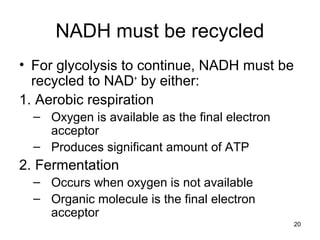
NADH must be recycled
• For glycolysis to continue, NADH must be
recycled to NAD+
by either:
1. Aerobic respiration
– Oxygen is available as the final electron
acceptor
– Produces significant amount of ATP
2. Fermentation
– Occurs when oxygen is not available
– Organic molecule is the final electron
acceptor
21
Fate of pyruvate
• Depends on oxygen availability.
– When oxygen is present, pyruvate is oxidized
to acetyl-CoA which enters the Krebs cycle
• Aerobic respiration
– Without oxygen, pyruvate is reduced in order
to oxidize NADH back to NAD+
• Fermentation
22
Copyright © The McGraw-Hill Companies, Inc. Permission required for reproduction or display.
Without oxygen
NAD+
O2 NADH
ETC in mitochondria
Acetyl-CoA
Ethanol
NAD+
CO2
NAD+
H2O
Lactate
Pyruvate
AcetaldehydeNADH
NADH
With oxygen
Krebs
Cycle
23
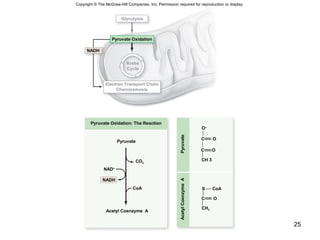
Pyruvate Oxidation
• In the presence of oxygen, pyruvate is
oxidized
– Occurs in the mitochondria in eukaryotes
• multienzyme complex called pyruvate
dehydrogenase catalyzes the reaction
– Occurs at the plasma membrane in
prokaryotes
24
• For each 3-carbon pyruvate molecule:
– 1 CO2
• Decarboxylation by pyruvate dehydrogenase
– 1 NADH
– 1 acetyl-CoA which consists of 2 carbons
from pyruvate attached to coenzyme A
• Acetyl-CoA proceeds to the Krebs cycle
Products of pyruvate oxidation
25
Copyright © The McGraw-Hill Companies, Inc. Permission required for reproduction or display.
Glycolysis
Pyruvate Oxidation
NADH
Krebs
Cycle
Electron Transport Chain
Chemiosmosis
Pyruvate Oxidation: The Reaction
NAD+
CO2
CoA
Acetyl Coenzyme A
Pyruvate
PyruvateAcetylCoenzymeA
O
CH 3
C
O–
C O

S CoA
CH3
OC 
NADH
26
Krebs Cycle
• Oxidizes the acetyl group from pyruvate
• Occurs in the matrix of the mitochondria
• Biochemical pathway of 9 steps in three
segments
1. Acetyl-CoA + oxaloacetate → citrate
2. Citrate rearrangement and decarboxylation
3. Regeneration of oxaloacetate
27
Copyright © The McGraw-Hill Companies, Inc. Permission required for reproduction or display.
CoA-
(Acetyl-CoA)
CoA
4-carbon
molecule
(oxaloacetate)
6-carbon molecule
(citrate)
NAD +
NADH
CO2
5-carbon
molecule
NAD+
NADH
CO2
4-carbon
molecule
ADP + P
Krebs Cycle
FAD
FADH2
4-carbon
molecule
NAD+
NADH
ATP
Glycolysis
Pyruvate Oxidation
Electron Transport Chain
Chemiosmosis
ATP
4-carbon
molecule
Pyruvate from glycolysis is
oxidized Krebs Cycle into an
acetyl group that feeds into the
Krebs cycle. The 2-C acetyl group
combines with 4-C oxaloacetate to
produce the 6-C compound citrate
(thus this is also called the citric
acid cycle). Oxidation reactions
are combined with two
decarboxylations to produce
NADH, CO2, and a new 4-carbon
molecule. Two additional
oxidations generate another
NADH and an FADH2 and
regenerate the original 4-C
oxaloacetate.
NADH
FADH2
Krebs
Cycle
28
Krebs Cycle
• For each Acetyl-CoA entering:
– Release 2 molecules of CO2
– Reduce 3 NAD+
to 3 NADH
– Reduce 1 FAD (electron carrier) to FADH2
– Produce 1 ATP
– Regenerate oxaloacetate
29
Copyright © The McGraw-Hill Companies, Inc. Permission required for reproduction or display.
Glycolysis
NADH
FADH2
Pyruvate Oxidation
ATP
Krebs Cycle: The Reactions
Citrate
synthetase
NAD+
NADH
H2O
NAD+
NADH
CO2
Isocitrate
dehydrogenase
Fumarase
CoA-SH
1
2
Aconitase
3
4
8
9
7
CoA-SH
NAD+
CO2
5
6
NADH
CoA-SH
GDP + Pi
Acetyl-CoA
═
CH3
— C— S
O CoA
—
Krebs
Cycle
Malate
dehydrogenase
α-Ketoglutarate
dehydrogenase
Succinyl-CoA
synthetase
GTP
ATP
ADP
Succinate
dehydrogenase
FADH2
8–9. Reactions 8 and 9: Regeneration of
oxaloacetate and the fourth oxidation
7. Reaction 7: The third oxidation
6. Reaction 6: Substrate-level phosphorylation
5. Reaction 5: The second oxidation
4. Reaction 4: The first oxidation
2–3. Reactions 2 and 3: Isomerization
1. Reaction 1: Condensation
Electron T ransport Chain
Chemiosmosis
Oxaloacetate (4C)
CH2
O ═ C
COO—
COO—
———
Citrate (6C)
HO—C—COO—
COO—
COO—
CH2
CH2
————
Isocitrate (6C)
HC—COO—
COO—
COO—
CH2
HO—CH
————
α-Ketoglutarate (5C)
CH2
COO—
COO—
CH2
C—O
————
Succinyl-CoA (4C)
CH2
COO—
S—CoA
CH2
C═ O
————
Succinate (4C)
COO—
CH2
COO—
CH2
———
Fumarate (4C)
HC
CH
═
COO—
COO—
——
Malate (4C)
HO— CH
COO—
CH2
COO—
———
FAD
30
At this point
• Glucose has been oxidized to:
– 6 CO2
– 4 ATP
– 10 NADH
– 2 FADH2
• Electron transfer has released 53 kcal/mol
of energy by gradual energy extraction
• Energy will be put to use to manufacture
ATP
These electron carriers proceed
to the electron transport chain
31
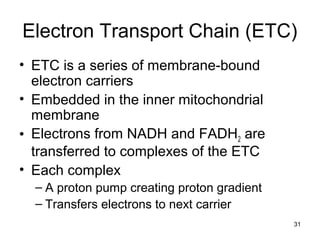
Electron Transport Chain (ETC)
• ETC is a series of membrane-bound
electron carriers
• Embedded in the inner mitochondrial
membrane
• Electrons from NADH and FADH2 are
transferred to complexes of the ETC
• Each complex
– A proton pump creating proton gradient
– Transfers electrons to next carrier
32
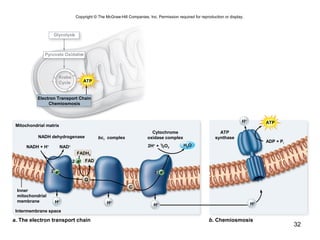
Copyright © The McGraw-Hill Companies, Inc. Permission required for reproduction or display.
Mitochondrial matrix
NADH + H+
ADP + Pi
H2O
H+
H+
2H+
+ 1/2O2
Glycolysis
Pyruvate Oxidation
2
Krebs
Cycle ATP
Electron Transport Chain
Chemiosmosis
NADH dehydrogenase bc1 complex
Cytochrome
oxidase complex
Inner
mitochondrial
membrane
Intermembrane space
a. The electron transport chain
ATP
synthase
b. Chemiosmosis
NAD+
Q
C
e–
FADH2
H+
H+
H+
H+
e–22 e–
22
ATP
FAD
33
Chemiosmosis
• Accumulation of protons in the
intermembrane space drives protons into
the matrix via diffusion
• Membrane relatively impermeable to ions
• Most protons can only reenter matrix
through ATP synthase
– Uses energy of gradient to make ATP from
ADP + Pi
34
ADP + Pi
Catalytic head
Stalk
Rotor
H+
H+
Mitochondrial
matrix
Intermembrane
space
H+
H+
H+
H+
H+
ATP
Copyright © The McGraw-Hill Companies, Inc. Permission required for reproduction or display.
35
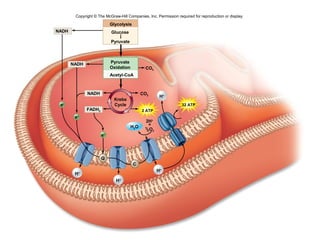
Copyright © The McGraw-Hill Companies, Inc. Permission required for reproduction or display.
H2O
CO2
CO2
H+
H+
2H+
+
1
/2O2
H+
e–
H+
32 ATP
Krebs
Cycle
2 ATP
NADH
NADH
FADH2
NADH
Pyruvate
Oxidation
Acetyl-CoA
e–
Q
C
e–
Glycolysis
Glucose
Pyruvate
36
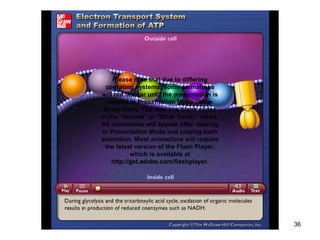
Please note that due to differing
operating systems, some animations
will not appear until the presentation is
viewed in Presentation Mode (Slide
Show view). You may see blank slides
in the “Normal” or “Slide Sorter” views.
All animations will appear after viewing
in Presentation Mode and playing each
animation. Most animations will require
the latest version of the Flash Player,
which is available at
http://get.adobe.com/flashplayer.
37
Energy Yield of Respiration
• Theoretical energy yield
– 38 ATP per glucose for bacteria
– 36 ATP per glucose for eukaryotes
• Actual energy yield
– 30 ATP per glucose for eukaryotes
– Reduced yield is due to
• “Leaky” inner membrane
• Use of the proton gradient for purposes other than
ATP synthesis
38
Chemiosmosis
Chemiosmosis
2 5
2 3
6 15
2
2
2 5NADH
NADH
NADH
Total net ATP yield = 32
(30 in eukaryotes)
ATP
ATP
ATP
ATP
ATP
ATP
Krebs
Cycle
Pyruvate oxidation
FADH2
Glycolysis2
Glucose
Pyruvate
ATP
Copyright © The McGraw-Hill Companies, Inc. Permission required for reproduction or display.
39
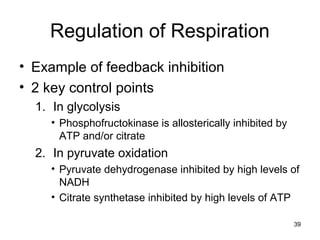
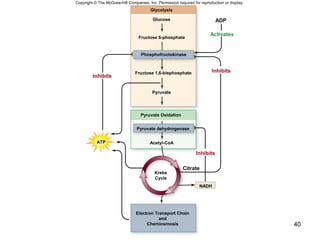
Regulation of Respiration
• Example of feedback inhibition
• 2 key control points
1. In glycolysis
• Phosphofructokinase is allosterically inhibited by
ATP and/or citrate
2. In pyruvate oxidation
• Pyruvate dehydrogenase inhibited by high levels of
NADH
• Citrate synthetase inhibited by high levels of ATP
40
Glucose
Acetyl-CoA
Fructose 6-phosphate
Fructose 1,6-bisphosphate
Pyruvate
Pyruvate Oxidation
Krebs
Cycle
Electron Transport Chain
and
Chemiosmosis
Citrate
ATP
NADH
Inhibits
Inhibits
Inhibits
Phosphofructokinase
Pyruvate dehydrogenase
Glycolysis
Copyright © The McGraw-Hill Companies, Inc. Permission required for reproduction or display.
ADP
Activates
41
Oxidation Without O2
1. Anaerobic respiration
– Use of inorganic molecules (other than O2) as
final electron acceptor
– Many prokaryotes use sulfur, nitrate, carbon
dioxide or even inorganic metals
2. Fermentation
– Use of organic molecules as final electron
acceptor
42
Anaerobic respiration
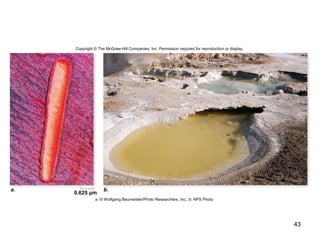
• Methanogens
– CO2 is reduced to CH4 (methane)
– Found in diverse organisms including cows
• Sulfur bacteria
– Inorganic sulphate (SO4) is reduced to
hydrogen sulfide (H2S)
– Early sulfate reducers set the stage for
evolution of photosynthesis
43
a: © Wolfgang Baumeister/Photo Researchers, Inc.; b: NPS Photo
Copyright © The McGraw-Hill Companies, Inc. Permission required for reproduction or display.
b.a.
0.625 µm
44
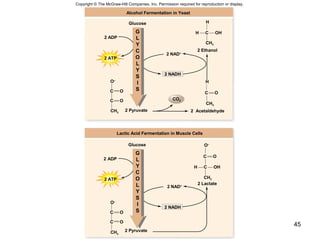
Fermentation
• Reduces organic molecules in order to
regenerate NAD+
1. Ethanol fermentation occurs in yeast
– CO2, ethanol, and NAD+
are produced
2. Lactic acid fermentation
– Occurs in animal cells (especially muscles)
– Electrons are transferred from NADH to
pyruvate to produce lactic acid
45
CO2
2 Acetaldehyde
2 ADP
2 Lactate
Alcohol Fermentation in Yeast
2 ADP
Lactic Acid Fermentation in Muscle Cells
2 NAD+
2 NAD+
2 NADH
2 NADH
2 ATP
2 ATP
C O
C O
O–
CH3
C O
H
CH3
C O
C O
CH3
O–
CH3
H C OH
C O
O–
H
2 Ethanol
H C OH
CH3
2 Pyruvate
2 Pyruvate
Glucose
Glucose
G
L
Y
C
O
L
Y
S
I
S
G
L
Y
C
O
L
Y
S
I
S
Copyright © The McGraw-Hill Companies, Inc. Permission required for reproduction or display.
46
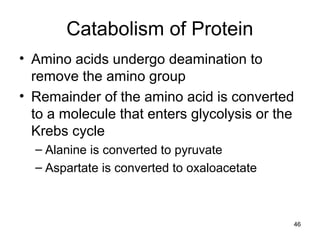
Catabolism of Protein
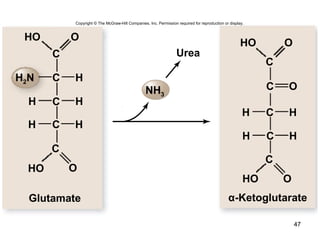
• Amino acids undergo deamination to
remove the amino group
• Remainder of the amino acid is converted
to a molecule that enters glycolysis or the
Krebs cycle
– Alanine is converted to pyruvate
– Aspartate is converted to oxaloacetate
47
C
HO O
HO O
C
C
HO O
O
C
C O
CH H
CH H
CH H
CH H
CH2N H
NH3
HO
Urea
Glutamate α-Ketoglutarate
Copyright © The McGraw-Hill Companies, Inc. Permission required for reproduction or display.
48
Catabolism of Fat
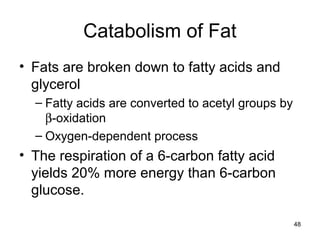
• Fats are broken down to fatty acids and
glycerol
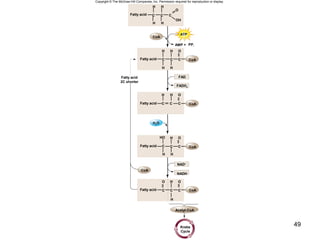
– Fatty acids are converted to acetyl groups by
β-oxidation
– Oxygen-dependent process
• The respiration of a 6-carbon fatty acid
yields 20% more energy than 6-carbon
glucose.
49
Copyright © The McGraw-Hill Companies, Inc. Permission required for reproduction or display.
CoA
Fatty acid
OO
—C —C —C —
═
H
H
—
═
—
ATP
NADH
H2O
Krebs
Cycle
PPiAMP +
FADH2
Fatty acid
2C shorter
CoA
CoA
Fatty acid
OH
H
—C —C—C—
——
H
H
—
═
—
Fatty acid
OH
O
H
H
—C —C— C
═
—
——
H
H
——
CoA
FAD
Fatty acid
OH
—C ═ C —C —
—
H
—
═
CoA
Fatty acid
OHO
H
—C —C —C —
——
H
H
—
═
—
CoA
NAD+
Acetyl-CoA
50
Cell building blocks
Deamination β-oxidation
Glycolysis
Oxidative respiration
Ultimate metabolic products
Acetyl-CoA
Pyruvate
Macromolecule
degradation
Krebs
Cycle
Nucleic acids Polysaccharides
Nucleotides Amino acids Fatty acidsSugars
Proteins Lipids and fats
NH3
H2O CO2
Copyright © The McGraw-Hill Companies, Inc. Permission required for reproduction or display.
51
Evolution of Metabolism
• Hypothetical timeline
1. Ability to store chemical energy in ATP
2. Evolution of glycolysis
• Pathway found in all living organisms
3. Anaerobic photosynthesis (using H2S)
4. Use of H2O in photosynthesis (not H2S)
• Begins permanent change in Earth’s atmosphere
5. Evolution of nitrogen fixation
6. Aerobic respiration evolved most recently

Biology 201 Chapter 7

  • 1.
    Chapter 07 Lecture and AnimationOutline See separate PowerPoint slides for all figures and tables pre-inserted into PowerPoint without notes and animations. To run the animations you must be in Slideshow View. Use the buttons on the animation to play, pause, and turn audio/text on or off. Please Note: Once you have used any of the animation functions (such as Play or Pause), you must first click on the slide’s background before you can advance to the next slide.
  • 2.
    2 Respiration • Organisms canbe classified based on how they obtain energy: • Autotrophs – Able to produce their own organic molecules through photosynthesis • Heterotrophs – Live on organic compounds produced by other organisms • All organisms use cellular respiration to extract energy from organic molecules
  • 3.
    3 Cellular respiration • Cellularrespiration is a series of reactions • Oxidized – loss of electrons • Reduced – gain of electron • Dehydrogenation – lost electrons are accompanied by protons – A hydrogen atom is lost (1 electron, 1 proton)
  • 4.
    4 Redox • During redoxreactions, electrons carry energy from one molecule to another • Nicotinamide adenosine dinucleotide (NAD+) – An electron carrier – NAD+ accepts 2 electrons and 1 proton to become NADH – Reaction is reversible
  • 5.
    5 Copyright © TheMcGraw-Hill Companies, Inc. Permission required for reproduction or display. Product Enzyme NAD+ NAD+ NAD NAD 2e– H+ +H+ Energy-rich molecule NAD+ 1. Enzymes that use NAD+ as a cofactor for oxidation reactions bind NAD+ and the substrate. 2. In an oxidation–reduction reaction, 2 electrons and a proton are transferred to NAD+ , forming NADH. A second proton is donated to the solution. 3. NADH diffuses away and can then donate electrons to other molecules. Reduction Oxidation H H H H H H H H
  • 6.
    • In overallcellular energy harvest – Dozens of redox reactions take place – Number of electron acceptors including NAD+ • In the end, high-energy electrons from initial chemical bonds have lost much of their energy • Transferred to a final electron acceptor 6
  • 7.
    7 • Aerobic respiration –Final electron receptor is oxygen (O2) • Anaerobic respiration – Final electron acceptor is an inorganic molecule (not O2) • Fermentation – Final electron acceptor is an organic molecule
  • 8.
    8 Aerobic respiration C6H12O6 +6O2 6CO2 + 6H2O Free energy = – 686 kcal/mol of glucose Free energy can be even higher than this in a cell • This large amount of energy must be released in small steps rather than all at once.
  • 9.
    9 2e– Electrons from food Highenergy Low energy 2H+ 1/2O2 Energy released for ATP synthesis H2O Copyright © The McGraw-Hill Companies, Inc. Permission required for reproduction or display.
  • 10.
    Electron carriers • Manytypes of carriers used – Soluble, membrane-bound, move within membrane • All carriers can be easily oxidized and reduced • Some carry just electrons, some electrons and protons • NAD+ acquires 2 electrons and a proton to become NADH 10
  • 11.
    11 Copyright © TheMcGraw-Hill Companies, Inc. Permission required for reproduction or display. H H O NH2 + 2H CH2O O O H H NH2 H H N N N CH2O O O H H NH2 O– H H N N N H H O N N H H H C C O P O PO– O P O– O P N N OH CH2 NADH: Reduced form of nicotinamide O O O O NAD+ : Oxidized form of nicotinamide Reduction Oxidation Adenine Adenine OH OH OH OHOH OHOH NH2 + H+ CH2 O–
  • 12.
    12 ATP • Cells useATP to drive endergonic reactions – ΔG (free energy) = –7.3 kcal/mol • 2 mechanisms for synthesis 1. Substrate-level phosphorylation • Transfer phosphate group directly to ADP • During glycolysis 2. Oxidative phosphorylation • ATP synthase uses energy from a proton gradient
  • 13.
    13 PEP – ADP Enzyme Enzyme –ATP Adenosine Pyruvate P PP P P Adenosine P Copyright © The McGraw-Hill Companies, Inc. Permission required for reproduction or display.
  • 14.
    14 Oxidation of Glucose Thecomplete oxidation of glucose proceeds in stages: 1. Glycolysis 2. Pyruvate oxidation 3. Krebs cycle 4. Electron transport chain & chemiosmosis
  • 15.
    15 Outer mitochondrial membrane Intermembrane space Mitochondrial matrix FAD O2 Inner mitochondrial membrane Electron Transport Chain Chemiosmosis ATPSynthase NAD+ Glycolysis Pyruvate Glucose Pyruvate Oxidation Acetyl-CoA Krebs Cycle CO2 ATPH2O ATP e– e– NADH NADH CO2 ATP NADH FADH2 Copyright © The McGraw-Hill Companies, Inc. Permission required for reproduction or display. H+ e–
  • 16.
    16 Glycolysis • Converts 1glucose (6 carbons) to 2 pyruvate (3 carbons) • 10-step biochemical pathway • Occurs in the cytoplasm • Net production of 2 ATP molecules by substrate-level phosphorylation • 2 NADH produced by the reduction of NAD+
  • 17.
    17 Copyright © TheMcGraw-Hill Companies, Inc. Permission required for reproduction or display. Glycolysis NADH Pyruvate Oxidation ATP Electron Transport Chain Chemiosmosis Krebs Cycle 6-carbon sugar diphosphate NAD+ NAD+ PrimingReactionsCleavageOxidationandATPFormation NADH NADH P P P P ATP ATP ADP ADP 3-carbon sugar phosphate 3-carbon sugar phosphate PiPi ADP ADP ATP ATP ATP ADP ADP ATP 3-carbon pyruvate 3-carbon pyruvate 6-carbon glucose (Starting material) Glycolysis begins with the addition of energy. Two high- energy phosphates (P) from two molecules of ATP are added to the 6-carbon molecule glucose, producing a 6-carbon molecule with two phosphates. Then, the 6-carbon molecule with two phosphates is split in two, forming two 3-carbon sugar phosphates. An additional Inorganic phosphate ( Pi ) is incorporated into each 3-carbon sugar phosphate. An oxidation reaction converts the two sugar phosphates into intermediates that can transfer a phosphate to ADP to form ATP. The oxidation reactions also yield NADH giving a net energy yield of 2 ATP and 2 NADH.
  • 18.
    18 Copyright © TheMcGraw-Hill Companies, Inc. Permission required for reproduction or display. NADH NAD+ NADH Pi NAD+ Glucose Hexokinase Phosphofructokinase Glucose 6-phosphate Fructose 6-phosphate Fructose 1,6-bisphosphate Isomerase Aldolase Pyruvate Pyruvate Enolase Pyruvate kinase ADP 10 Glucose Glyceraldehyde 3-phosphate Pyruvate Glycolysis: The ReactionsGlycolysis NADH Pyruvate Oxidation H2O ATP ADP Electron Transport Chain Chemiosmosis Krebs Cycle ATP ATP Phosphoglucose isomerase Glyceraldehyde 3- phosphate (G3P) Dihydroxyacetone phosphate 1. Phosphorylation of glucose by ATP. 2–3. Rearrangement, followed by a second ATP phosphorylation. 4–5. The 6-carbon molecule is split into two 3-carbon molecules—one G3P, another that is converted into G3P in another reaction. 6. Oxidation followed by phosphorylation produces two NADH molecules and two molecules of BPG, each with one high-energy phosphate bond. 7. Removal of high-energy phosphate by two ADP molecules produces two ATP molecules and leaves two 3PG molecules. 8–9. Removal of water yields two PEP molecules, each with a high-energy phosphate bond. 10. Removal of high-energy phosphate by two ADP molecules produces two ATP molecules and two pyruvate molecules. 1,3-Bisphosphoglycerate (BPG) 1,3-Bisphosphoglycerate (BPG) Glyceraldehyde 3-phosphate dehydrogenase Pi ADP Phosphoglycerate kinase ADP ATP 3-Phosphoglycerate (3PG) 3-Phosphoglycerate (3PG) 2-Phosphoglycerate (2PG) 2-Phosphoglycerate (2PG) H2O ATP Phosphoenolpyruvate (PEP) Phosphoenolpyruvate (PEP) ADP ADP ATP ATP Phosphoenol- pyruvate 3-Phospho- glycerate 1,3-Bisphospho- glycerate Glucose 6-phosphate Fructose 6-phosphate Fructose 1,6-bisphosphate Dihydroxyacetone Phosphate 2-Phospho- glycerate CH2OH O CH2 O O P CH2 O O P CH2OH O CH2 CH2 O O P P CHOH H C O CH2 O P C O O CH2P CH2OH CHOH O C O CH2 O P P CHOH O– C O CH2 O P H C O O– C O CH2OH P C O O– C O CH2 P C O O– C O CH3 8 9 10 7 4 5 3 2 1 6 Phosphoglyceromutase
  • 19.
    19 Please note thatdue to differing operating systems, some animations will not appear until the presentation is viewed in Presentation Mode (Slide Show view). You may see blank slides in the “Normal” or “Slide Sorter” views. All animations will appear after viewing in Presentation Mode and playing each animation. Most animations will require the latest version of the Flash Player, which is available at http://get.adobe.com/flashplayer.
  • 20.
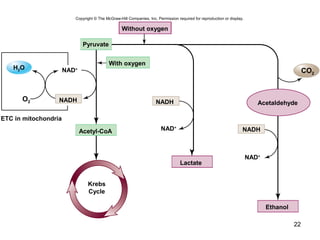
    20 NADH must berecycled • For glycolysis to continue, NADH must be recycled to NAD+ by either: 1. Aerobic respiration – Oxygen is available as the final electron acceptor – Produces significant amount of ATP 2. Fermentation – Occurs when oxygen is not available – Organic molecule is the final electron acceptor
  • 21.
    21 Fate of pyruvate •Depends on oxygen availability. – When oxygen is present, pyruvate is oxidized to acetyl-CoA which enters the Krebs cycle • Aerobic respiration – Without oxygen, pyruvate is reduced in order to oxidize NADH back to NAD+ • Fermentation
  • 22.
    22 Copyright © TheMcGraw-Hill Companies, Inc. Permission required for reproduction or display. Without oxygen NAD+ O2 NADH ETC in mitochondria Acetyl-CoA Ethanol NAD+ CO2 NAD+ H2O Lactate Pyruvate AcetaldehydeNADH NADH With oxygen Krebs Cycle
  • 23.
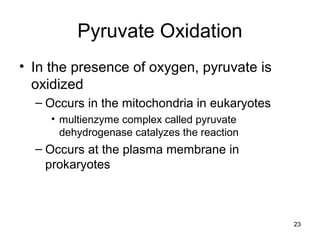
    23 Pyruvate Oxidation • Inthe presence of oxygen, pyruvate is oxidized – Occurs in the mitochondria in eukaryotes • multienzyme complex called pyruvate dehydrogenase catalyzes the reaction – Occurs at the plasma membrane in prokaryotes
  • 24.
    24 • For each3-carbon pyruvate molecule: – 1 CO2 • Decarboxylation by pyruvate dehydrogenase – 1 NADH – 1 acetyl-CoA which consists of 2 carbons from pyruvate attached to coenzyme A • Acetyl-CoA proceeds to the Krebs cycle Products of pyruvate oxidation
  • 25.
    25 Copyright © TheMcGraw-Hill Companies, Inc. Permission required for reproduction or display. Glycolysis Pyruvate Oxidation NADH Krebs Cycle Electron Transport Chain Chemiosmosis Pyruvate Oxidation: The Reaction NAD+ CO2 CoA Acetyl Coenzyme A Pyruvate PyruvateAcetylCoenzymeA O CH 3 C O– C O  S CoA CH3 OC  NADH
  • 26.
    26 Krebs Cycle • Oxidizesthe acetyl group from pyruvate • Occurs in the matrix of the mitochondria • Biochemical pathway of 9 steps in three segments 1. Acetyl-CoA + oxaloacetate → citrate 2. Citrate rearrangement and decarboxylation 3. Regeneration of oxaloacetate
  • 27.
    27 Copyright © TheMcGraw-Hill Companies, Inc. Permission required for reproduction or display. CoA- (Acetyl-CoA) CoA 4-carbon molecule (oxaloacetate) 6-carbon molecule (citrate) NAD + NADH CO2 5-carbon molecule NAD+ NADH CO2 4-carbon molecule ADP + P Krebs Cycle FAD FADH2 4-carbon molecule NAD+ NADH ATP Glycolysis Pyruvate Oxidation Electron Transport Chain Chemiosmosis ATP 4-carbon molecule Pyruvate from glycolysis is oxidized Krebs Cycle into an acetyl group that feeds into the Krebs cycle. The 2-C acetyl group combines with 4-C oxaloacetate to produce the 6-C compound citrate (thus this is also called the citric acid cycle). Oxidation reactions are combined with two decarboxylations to produce NADH, CO2, and a new 4-carbon molecule. Two additional oxidations generate another NADH and an FADH2 and regenerate the original 4-C oxaloacetate. NADH FADH2 Krebs Cycle
  • 28.
    28 Krebs Cycle • Foreach Acetyl-CoA entering: – Release 2 molecules of CO2 – Reduce 3 NAD+ to 3 NADH – Reduce 1 FAD (electron carrier) to FADH2 – Produce 1 ATP – Regenerate oxaloacetate
  • 29.
    29 Copyright © TheMcGraw-Hill Companies, Inc. Permission required for reproduction or display. Glycolysis NADH FADH2 Pyruvate Oxidation ATP Krebs Cycle: The Reactions Citrate synthetase NAD+ NADH H2O NAD+ NADH CO2 Isocitrate dehydrogenase Fumarase CoA-SH 1 2 Aconitase 3 4 8 9 7 CoA-SH NAD+ CO2 5 6 NADH CoA-SH GDP + Pi Acetyl-CoA ═ CH3 — C— S O CoA — Krebs Cycle Malate dehydrogenase α-Ketoglutarate dehydrogenase Succinyl-CoA synthetase GTP ATP ADP Succinate dehydrogenase FADH2 8–9. Reactions 8 and 9: Regeneration of oxaloacetate and the fourth oxidation 7. Reaction 7: The third oxidation 6. Reaction 6: Substrate-level phosphorylation 5. Reaction 5: The second oxidation 4. Reaction 4: The first oxidation 2–3. Reactions 2 and 3: Isomerization 1. Reaction 1: Condensation Electron T ransport Chain Chemiosmosis Oxaloacetate (4C) CH2 O ═ C COO— COO— ——— Citrate (6C) HO—C—COO— COO— COO— CH2 CH2 ———— Isocitrate (6C) HC—COO— COO— COO— CH2 HO—CH ———— α-Ketoglutarate (5C) CH2 COO— COO— CH2 C—O ———— Succinyl-CoA (4C) CH2 COO— S—CoA CH2 C═ O ———— Succinate (4C) COO— CH2 COO— CH2 ——— Fumarate (4C) HC CH ═ COO— COO— —— Malate (4C) HO— CH COO— CH2 COO— ——— FAD
  • 30.
    30 At this point •Glucose has been oxidized to: – 6 CO2 – 4 ATP – 10 NADH – 2 FADH2 • Electron transfer has released 53 kcal/mol of energy by gradual energy extraction • Energy will be put to use to manufacture ATP These electron carriers proceed to the electron transport chain
  • 31.
    31 Electron Transport Chain(ETC) • ETC is a series of membrane-bound electron carriers • Embedded in the inner mitochondrial membrane • Electrons from NADH and FADH2 are transferred to complexes of the ETC • Each complex – A proton pump creating proton gradient – Transfers electrons to next carrier
  • 32.
    32 Copyright © TheMcGraw-Hill Companies, Inc. Permission required for reproduction or display. Mitochondrial matrix NADH + H+ ADP + Pi H2O H+ H+ 2H+ + 1/2O2 Glycolysis Pyruvate Oxidation 2 Krebs Cycle ATP Electron Transport Chain Chemiosmosis NADH dehydrogenase bc1 complex Cytochrome oxidase complex Inner mitochondrial membrane Intermembrane space a. The electron transport chain ATP synthase b. Chemiosmosis NAD+ Q C e– FADH2 H+ H+ H+ H+ e–22 e– 22 ATP FAD
  • 33.
    33 Chemiosmosis • Accumulation ofprotons in the intermembrane space drives protons into the matrix via diffusion • Membrane relatively impermeable to ions • Most protons can only reenter matrix through ATP synthase – Uses energy of gradient to make ATP from ADP + Pi
  • 34.
    34 ADP + Pi Catalytichead Stalk Rotor H+ H+ Mitochondrial matrix Intermembrane space H+ H+ H+ H+ H+ ATP Copyright © The McGraw-Hill Companies, Inc. Permission required for reproduction or display.
  • 35.
    35 Copyright © TheMcGraw-Hill Companies, Inc. Permission required for reproduction or display. H2O CO2 CO2 H+ H+ 2H+ + 1 /2O2 H+ e– H+ 32 ATP Krebs Cycle 2 ATP NADH NADH FADH2 NADH Pyruvate Oxidation Acetyl-CoA e– Q C e– Glycolysis Glucose Pyruvate
  • 36.
    36 Please note thatdue to differing operating systems, some animations will not appear until the presentation is viewed in Presentation Mode (Slide Show view). You may see blank slides in the “Normal” or “Slide Sorter” views. All animations will appear after viewing in Presentation Mode and playing each animation. Most animations will require the latest version of the Flash Player, which is available at http://get.adobe.com/flashplayer.
  • 37.
    37 Energy Yield ofRespiration • Theoretical energy yield – 38 ATP per glucose for bacteria – 36 ATP per glucose for eukaryotes • Actual energy yield – 30 ATP per glucose for eukaryotes – Reduced yield is due to • “Leaky” inner membrane • Use of the proton gradient for purposes other than ATP synthesis
  • 38.
    38 Chemiosmosis Chemiosmosis 2 5 2 3 615 2 2 2 5NADH NADH NADH Total net ATP yield = 32 (30 in eukaryotes) ATP ATP ATP ATP ATP ATP Krebs Cycle Pyruvate oxidation FADH2 Glycolysis2 Glucose Pyruvate ATP Copyright © The McGraw-Hill Companies, Inc. Permission required for reproduction or display.
  • 39.
    39 Regulation of Respiration •Example of feedback inhibition • 2 key control points 1. In glycolysis • Phosphofructokinase is allosterically inhibited by ATP and/or citrate 2. In pyruvate oxidation • Pyruvate dehydrogenase inhibited by high levels of NADH • Citrate synthetase inhibited by high levels of ATP
  • 40.
    40 Glucose Acetyl-CoA Fructose 6-phosphate Fructose 1,6-bisphosphate Pyruvate PyruvateOxidation Krebs Cycle Electron Transport Chain and Chemiosmosis Citrate ATP NADH Inhibits Inhibits Inhibits Phosphofructokinase Pyruvate dehydrogenase Glycolysis Copyright © The McGraw-Hill Companies, Inc. Permission required for reproduction or display. ADP Activates
  • 41.
    41 Oxidation Without O2 1.Anaerobic respiration – Use of inorganic molecules (other than O2) as final electron acceptor – Many prokaryotes use sulfur, nitrate, carbon dioxide or even inorganic metals 2. Fermentation – Use of organic molecules as final electron acceptor
  • 42.
    42 Anaerobic respiration • Methanogens –CO2 is reduced to CH4 (methane) – Found in diverse organisms including cows • Sulfur bacteria – Inorganic sulphate (SO4) is reduced to hydrogen sulfide (H2S) – Early sulfate reducers set the stage for evolution of photosynthesis
  • 43.
    43 a: © WolfgangBaumeister/Photo Researchers, Inc.; b: NPS Photo Copyright © The McGraw-Hill Companies, Inc. Permission required for reproduction or display. b.a. 0.625 µm
  • 44.
    44 Fermentation • Reduces organicmolecules in order to regenerate NAD+ 1. Ethanol fermentation occurs in yeast – CO2, ethanol, and NAD+ are produced 2. Lactic acid fermentation – Occurs in animal cells (especially muscles) – Electrons are transferred from NADH to pyruvate to produce lactic acid
  • 45.
    45 CO2 2 Acetaldehyde 2 ADP 2Lactate Alcohol Fermentation in Yeast 2 ADP Lactic Acid Fermentation in Muscle Cells 2 NAD+ 2 NAD+ 2 NADH 2 NADH 2 ATP 2 ATP C O C O O– CH3 C O H CH3 C O C O CH3 O– CH3 H C OH C O O– H 2 Ethanol H C OH CH3 2 Pyruvate 2 Pyruvate Glucose Glucose G L Y C O L Y S I S G L Y C O L Y S I S Copyright © The McGraw-Hill Companies, Inc. Permission required for reproduction or display.
  • 46.
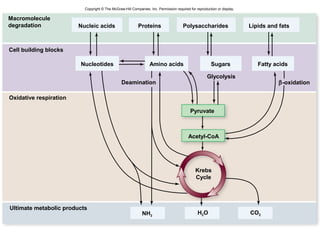
    46 Catabolism of Protein •Amino acids undergo deamination to remove the amino group • Remainder of the amino acid is converted to a molecule that enters glycolysis or the Krebs cycle – Alanine is converted to pyruvate – Aspartate is converted to oxaloacetate
  • 47.
    47 C HO O HO O C C HOO O C C O CH H CH H CH H CH H CH2N H NH3 HO Urea Glutamate α-Ketoglutarate Copyright © The McGraw-Hill Companies, Inc. Permission required for reproduction or display.
  • 48.
    48 Catabolism of Fat •Fats are broken down to fatty acids and glycerol – Fatty acids are converted to acetyl groups by β-oxidation – Oxygen-dependent process • The respiration of a 6-carbon fatty acid yields 20% more energy than 6-carbon glucose.
  • 49.
    49 Copyright © TheMcGraw-Hill Companies, Inc. Permission required for reproduction or display. CoA Fatty acid OO —C —C —C — ═ H H — ═ — ATP NADH H2O Krebs Cycle PPiAMP + FADH2 Fatty acid 2C shorter CoA CoA Fatty acid OH H —C —C—C— —— H H — ═ — Fatty acid OH O H H —C —C— C ═ — —— H H —— CoA FAD Fatty acid OH —C ═ C —C — — H — ═ CoA Fatty acid OHO H —C —C —C — —— H H — ═ — CoA NAD+ Acetyl-CoA
  • 50.
    50 Cell building blocks Deaminationβ-oxidation Glycolysis Oxidative respiration Ultimate metabolic products Acetyl-CoA Pyruvate Macromolecule degradation Krebs Cycle Nucleic acids Polysaccharides Nucleotides Amino acids Fatty acidsSugars Proteins Lipids and fats NH3 H2O CO2 Copyright © The McGraw-Hill Companies, Inc. Permission required for reproduction or display.
  • 51.
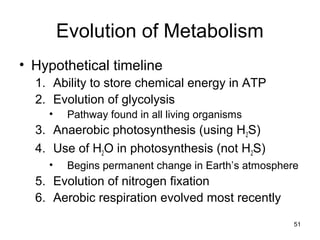
    51 Evolution of Metabolism •Hypothetical timeline 1. Ability to store chemical energy in ATP 2. Evolution of glycolysis • Pathway found in all living organisms 3. Anaerobic photosynthesis (using H2S) 4. Use of H2O in photosynthesis (not H2S) • Begins permanent change in Earth’s atmosphere 5. Evolution of nitrogen fixation 6. Aerobic respiration evolved most recently