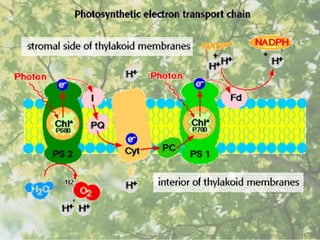
Non – Cyclic Electron Transport
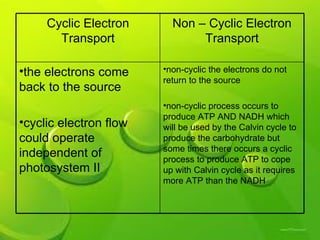
non-cyclic the electrons do not return to the source  non-cyclic process occurs to produce ATP AND NADH which will be used by the Calvin cycle to produce the carbohydrate but some times there occurs a cyclic process to produce ATP to cope up with Calvin cycle as it requires more ATP than the NADH  the electrons come back to the source cyclic electron flow could operate independent of photosystem II  Non – Cyclic Electron Transport Cyclic Electron Transport
Non-cyclic Electron Transport in Photosynthesis
DIFFICULT words and terms..! ...Be   AWARE!
Photophosphorylation refers to the use of light energy from photosynthesis to ultimately provide the energy to convert ADP to ATP, thus replenishing the universal energy currency in living things.
Photosystem I the light energy complex for the cyclic electron transport process used in some photosynthetic prokaryotes.  makes use of an antenna complex to collect light energy for the second stage of non-cyclic electron transport. It collects energetic electrons from the first stage process which is powered through Photosystem II and uses the light energy to further boost the energy of the electrons toward accomplishing the final goal of providing energy in the form of reduced coenzymes to the Calvin cycle.
Photosystem II makes use of an antenna complex to collect light energy for the first stages of non-cyclic electron transport contains the same kind of chlorophyll a as Photosystem I but in a different protein environment
present in every living cell is NAD+. It participates in electron transport reactions in cell metabolism processes like glycolysis  Coenzymes
Pheophytin is a chemical compound that serves as the first electron carrier intermediate in the electron transfer pathway of photosystem II
Plastocyanin   an important copper-containing protein involved in electron-transfer
thylakoid   a membrane-bound compartment inside chloroplasts and cyanobacteria  the site of the light-dependent reactions of photosynthesis consist of a  thylakoid membrane  surrounding a  thylakoid lumen
Plastoquinone  ( PQ )   a molecule involved in the electron transport chain in the light-dependent reactions of photosynthesis.  Plastoquinone is reduced (accepts two protons (H+) from the stromal matrix of the chloroplast, coupled to two electrons (e-) from photosystem II), forming plastoquinol.  transports the protons to the lumen of thylakoid discs, while the electrons continue through the electron transport chain into the cytochrome  b 6 f  protein complex
Ferredoxins   are iron-sulfur proteins that mediate electron transfer in a range of metabolic reactions
Nicotinamide adenine dinucleotide phosphate  ( NADP) a coenzyme used in anabolic reactions, such as lipid and nucleic acid synthesis, which require NADPH as a reducing agent.
Adenosine  ( ATP )  a multifunctional nucleotide used in cells as a coenzyme transports chemical energy within cells for metabolism
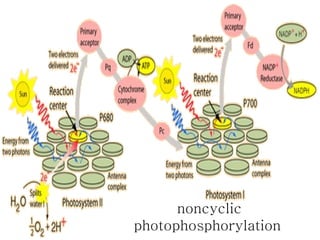
noncyclic photophosphorylation
a two-stage process involving two different chlorophyll photosystems  occurs on thylakoid membranes inside chloroplasts  noncyclic photophosphorylation
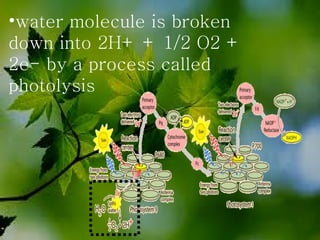
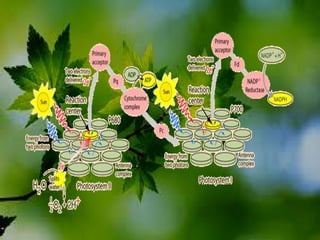
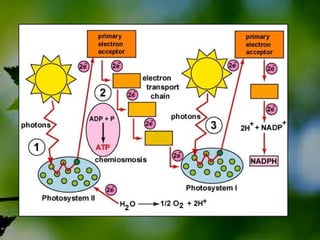
water molecule is broken down into 2H+ + 1/2 O2 + 2e- by a process called photolysis
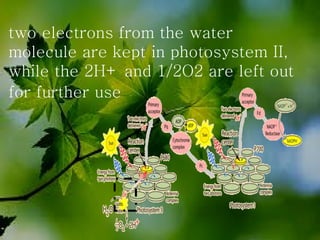
two electrons from the water molecule are kept in photosystem II, while the 2H+ and 1/2O2 are left out for further use
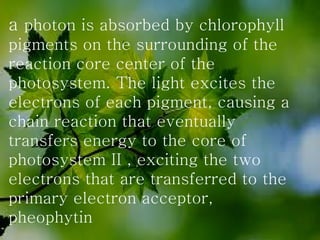
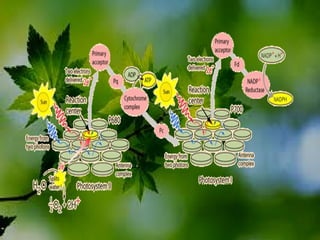
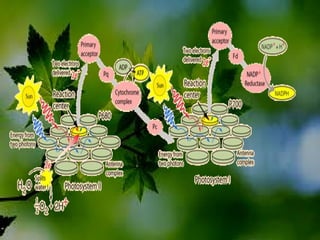
a  photon is absorbed by chlorophyll pigments on the surrounding of the reaction core center of the photosystem. The light excites the electrons of each pigment, causing a chain reaction that eventually transfers energy to the core of photosystem II , exciting the two electrons that are transferred to the primary electron acceptor, pheophytin
 
The deficit of electrons is replenished by taking electrons from another molecule of water. The electrons transfer from pheophytin to plastoquinone, then to plastocyanin, providing the energy for hydrogen ions (H+) to be pumped into the thylakoid space. This creates a gradient, making H+ ions flow back into the stroma of the chloroplast, providing the energy for the regeneration of  ATP.
 
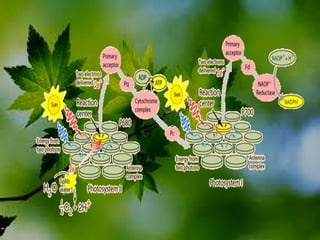
The photosystem II complex replaced its lost electrons from an external source; however, the two other electrons are not returned to photosystem II as they would in the analogous cyclic pathway. Instead, the still-excited electrons are transferred to a photosystem I complex, which boosts their energy level to a higher level using a second solar photon.
The highly excited electrons are transferred to the acceptor molecule, but this time is passed on to an enzyme called Ferredoxin- NADP + reductase, for short FNR, which uses them to catalyse the reaction (as shown): NADP+ + 2H+ + 2e- -> NADPH + H+
 
The concentration of NADPH in the chloroplast may help regulate which pathway electrons take through the light reactions. When the chloroplast runs low on ATP for the Calvin cycle, NADPH will accumulate and the plant may shift from noncyclic to cyclic electron flow.


Thank you for listening
GROUP 9 MILTEOFE S. DAYANDAYAN CHEDIROSE SALAZAR MICHAEL ANDREW YGNACIO FERNANDO SARDIDO

Non Cyclic Transport

  • 1.
    Non – CyclicElectron Transport
  • 2.
    non-cyclic the electronsdo not return to the source non-cyclic process occurs to produce ATP AND NADH which will be used by the Calvin cycle to produce the carbohydrate but some times there occurs a cyclic process to produce ATP to cope up with Calvin cycle as it requires more ATP than the NADH the electrons come back to the source cyclic electron flow could operate independent of photosystem II Non – Cyclic Electron Transport Cyclic Electron Transport
  • 3.
  • 4.
    DIFFICULT words andterms..! ...Be AWARE!
  • 5.
    Photophosphorylation refers tothe use of light energy from photosynthesis to ultimately provide the energy to convert ADP to ATP, thus replenishing the universal energy currency in living things.
  • 6.
    Photosystem I thelight energy complex for the cyclic electron transport process used in some photosynthetic prokaryotes. makes use of an antenna complex to collect light energy for the second stage of non-cyclic electron transport. It collects energetic electrons from the first stage process which is powered through Photosystem II and uses the light energy to further boost the energy of the electrons toward accomplishing the final goal of providing energy in the form of reduced coenzymes to the Calvin cycle.
  • 7.
    Photosystem II makesuse of an antenna complex to collect light energy for the first stages of non-cyclic electron transport contains the same kind of chlorophyll a as Photosystem I but in a different protein environment
  • 8.
    present in everyliving cell is NAD+. It participates in electron transport reactions in cell metabolism processes like glycolysis Coenzymes
  • 9.
    Pheophytin is achemical compound that serves as the first electron carrier intermediate in the electron transfer pathway of photosystem II
  • 10.
    Plastocyanin an important copper-containing protein involved in electron-transfer
  • 11.
    thylakoid a membrane-bound compartment inside chloroplasts and cyanobacteria the site of the light-dependent reactions of photosynthesis consist of a thylakoid membrane surrounding a thylakoid lumen
  • 12.
    Plastoquinone (PQ ) a molecule involved in the electron transport chain in the light-dependent reactions of photosynthesis. Plastoquinone is reduced (accepts two protons (H+) from the stromal matrix of the chloroplast, coupled to two electrons (e-) from photosystem II), forming plastoquinol. transports the protons to the lumen of thylakoid discs, while the electrons continue through the electron transport chain into the cytochrome b 6 f protein complex
  • 13.
    Ferredoxins are iron-sulfur proteins that mediate electron transfer in a range of metabolic reactions
  • 14.
    Nicotinamide adenine dinucleotidephosphate ( NADP) a coenzyme used in anabolic reactions, such as lipid and nucleic acid synthesis, which require NADPH as a reducing agent.
  • 15.
    Adenosine (ATP ) a multifunctional nucleotide used in cells as a coenzyme transports chemical energy within cells for metabolism
  • 16.
  • 17.
    a two-stage processinvolving two different chlorophyll photosystems occurs on thylakoid membranes inside chloroplasts noncyclic photophosphorylation
  • 18.
    water molecule isbroken down into 2H+ + 1/2 O2 + 2e- by a process called photolysis
  • 19.
    two electrons fromthe water molecule are kept in photosystem II, while the 2H+ and 1/2O2 are left out for further use
  • 20.
    a photonis absorbed by chlorophyll pigments on the surrounding of the reaction core center of the photosystem. The light excites the electrons of each pigment, causing a chain reaction that eventually transfers energy to the core of photosystem II , exciting the two electrons that are transferred to the primary electron acceptor, pheophytin
  • 21.
  • 22.
    The deficit ofelectrons is replenished by taking electrons from another molecule of water. The electrons transfer from pheophytin to plastoquinone, then to plastocyanin, providing the energy for hydrogen ions (H+) to be pumped into the thylakoid space. This creates a gradient, making H+ ions flow back into the stroma of the chloroplast, providing the energy for the regeneration of ATP.
  • 23.
  • 24.
    The photosystem IIcomplex replaced its lost electrons from an external source; however, the two other electrons are not returned to photosystem II as they would in the analogous cyclic pathway. Instead, the still-excited electrons are transferred to a photosystem I complex, which boosts their energy level to a higher level using a second solar photon.
  • 25.
    The highly excitedelectrons are transferred to the acceptor molecule, but this time is passed on to an enzyme called Ferredoxin- NADP + reductase, for short FNR, which uses them to catalyse the reaction (as shown): NADP+ + 2H+ + 2e- -> NADPH + H+
  • 26.
  • 27.
    The concentration ofNADPH in the chloroplast may help regulate which pathway electrons take through the light reactions. When the chloroplast runs low on ATP for the Calvin cycle, NADPH will accumulate and the plant may shift from noncyclic to cyclic electron flow.
  • 28.
  • 29.
  • 30.
  • 31.
    Thank you forlistening
  • 32.
    GROUP 9 MILTEOFES. DAYANDAYAN CHEDIROSE SALAZAR MICHAEL ANDREW YGNACIO FERNANDO SARDIDO