Chapter 10
Identifying Market Segments
and Selecting Target
Markets
“Don’t buy
market share.
Figure out how
to earn it.”
Chapter Objectives
 We focus on the following questions:
 How can a company identify the segments that
make up a market?
 What criteria can a company use to choose the
most attractive target markets?
Target Marketing
 Target marketing requires marketers to take three
major steps:
 Identify and profile distinct groups of buyers who
differ in their needs and preferences (market
segmentation).
 Select one or more market segments to enter (market
targeting).
 For each target segment, establish and communicate
the key distinctive benefit(s) of the company’s market
offering (market positioning).
Levels and Patterns of Market
Segmentation
 Levels of Market Segmentation
 Mass marketing: mass production, mass distribution, and mass
promotion of one product for all buyers.
 Micromarketing: four levels of marketing – segments, niches,
local areas, and individuals.
Segment marketing
Market segment: Group of customers who share a
similar set of wants.
Sector: Young, middle income car buyers is a sector rather
than a segment.
Flexible market offering
 Naked solution: products & services that all segment
members value.
 Discretionary options: some segment members value.
Niche Marketing
 Niche: more narrowly defined group seeking a distinctive mix of
benefits. By dividing segments into sub segments.
Characteristics of Niches:
 Customer in the niche have a distinct set of needs.
 Customer will pay a premium to the firm that best satisfies
their needs.
 Niche is not likely to attract other competitors.
 Nicher gains certain economies through specialization
 Niche has size, profit, and growth potential.
Local Marketing
Needs and wants of local customer groups – trading areas,
neighborhoods, even individual stores.
Levels and Patterns of Market
Segmentation
Levels and Patterns of Market
Segmentation
Individual Customer Marketing
Ultimate level of segmentation.
 Mass-customization: Mass basis individually designed
products, services, programs, and communications to meet
each customer’s requirements.
 Choiceboard: Interactive online system allowing customers
designing their own products and services.
 Customerization: operationally driven mass customization
with customized marketing empowering customers to design
the product and service offering. Products or services for -
 Segments or
 Individuals
Levels and Patterns of Market
Segmentation
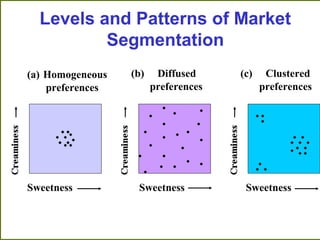
 Patterns for Market Segmentation
 Preference segments: According to buyers’ preferences.
 Homogeneous preferences: consumers have roughly the
same preferences.
 Diffused preferences: consumers may be scattered
throughout the space, indicating variation in preferences.
 Clustered preferences
 Natural market segments: distinct preference cluster.
 Concentrated marketing: largest market segment.
 Center position: hoping to appeal to all groups.
 In largest market segment.
 Several brands in different positions.
Levels and Patterns of Market
Segmentation
Sweetness Sweetness Sweetness
(a) Homogeneous
preferences
(b) Diffused
preferences
(c) Clustered
preferences
Levels and Patterns of Market
Segmentation
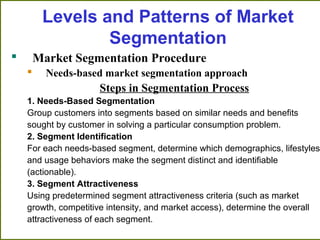
 Market Segmentation Procedure
 Needs-based market segmentation approach
Steps in Segmentation Process
1. Needs-Based Segmentation
Group customers into segments based on similar needs and benefits
sought by customer in solving a particular consumption problem.
2. Segment Identification
For each needs-based segment, determine which demographics, lifestyles,
and usage behaviors make the segment distinct and identifiable
(actionable).
3. Segment Attractiveness
Using predetermined segment attractiveness criteria (such as market
growth, competitive intensity, and market access), determine the overall
attractiveness of each segment.
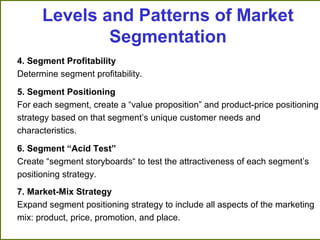
4. Segment Profitability
Determine segment profitability.
5. Segment Positioning
For each segment, create a “value proposition” and product-price positioning
strategy based on that segment’s unique customer needs and
characteristics.
6. Segment “Acid Test”
Create “segment storyboards“ to test the attractiveness of each segment’s
positioning strategy.
7. Market-Mix Strategy
Expand segment positioning strategy to include all aspects of the marketing
mix: product, price, promotion, and place.
Levels and Patterns of Market
Segmentation
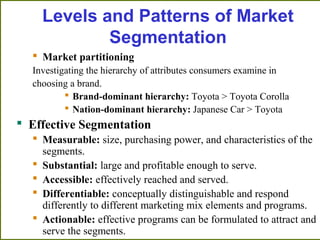
 Market partitioning
Investigating the hierarchy of attributes consumers examine in
choosing a brand.
 Brand-dominant hierarchy: Toyota > Toyota Corolla
 Nation-dominant hierarchy: Japanese Car > Toyota
 Effective Segmentation
 Measurable: size, purchasing power, and characteristics of the
segments.
 Substantial: large and profitable enough to serve.
 Accessible: effectively reached and served.
 Differentiable: conceptually distinguishable and respond
differently to different marketing mix elements and programs.
 Actionable: effective programs can be formulated to attract and
serve the segments.
Levels and Patterns of Market
Segmentation
Segmenting Consumer and
Business Markets
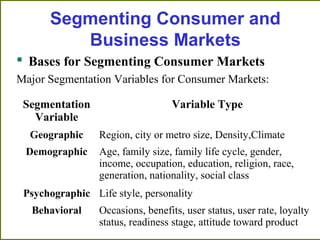
 Bases for Segmenting Consumer Markets
Major Segmentation Variables for Consumer Markets:
Segmentation
Variable
Variable Type
Geographic Region, city or metro size, Density,Climate
Demographic Age, family size, family life cycle, gender,
income, occupation, education, religion, race,
generation, nationality, social class
Psychographic Life style, personality
Behavioral Occasions, benefits, user status, user rate, loyalty
status, readiness stage, attitude toward product
Segmenting Consumer and
Business Markets
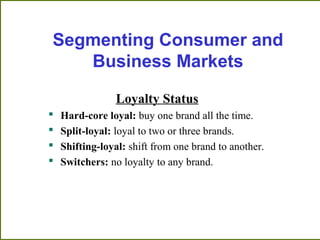
Loyalty Status
 Hard-core loyal: buy one brand all the time.
 Split-loyal: loyal to two or three brands.
 Shifting-loyal: shift from one brand to another.
 Switchers: no loyalty to any brand.
Segmenting Consumer and
Business Markets
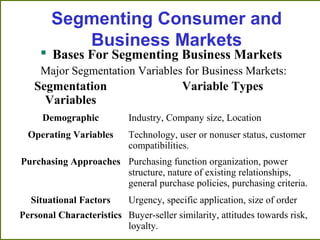
 Bases For Segmenting Business Markets
Major Segmentation Variables for Business Markets:
Segmentation
Variables
Variable Types
Demographic Industry, Company size, Location
Operating Variables Technology, user or nonuser status, customer
compatibilities.
Purchasing Approaches Purchasing function organization, power
structure, nature of existing relationships,
general purchase policies, purchasing criteria.
Situational Factors Urgency, specific application, size of order
Personal Characteristics Buyer-seller similarity, attitudes towards risk,
loyalty.
Segmenting Consumer and
Business Markets
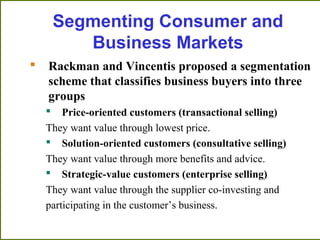
 Rackman and Vincentis proposed a segmentation
scheme that classifies business buyers into three
groups
 Price-oriented customers (transactional selling)
They want value through lowest price.
 Solution-oriented customers (consultative selling)
They want value through more benefits and advice.
 Strategic-value customers (enterprise selling)
They want value through the supplier co-investing and
participating in the customer’s business.
Market Targeting
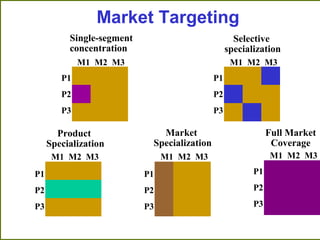
 Evaluating and Selecting the Market Segments
 Single-Segment Concentration: mini pack chips.
 Selective Specialization: BAT, gold leaf for A,B&H for
B, Star for C.
 Product Specialization : Otobi, products for Univ, office,
home … all segments. ISP, PDB.
 Market Specialization: Firms sell products only to
university labs.
 Full Market Coverage: Coca cola, IBM, GM.
 Undifferentiated marketing
 Differentiated marketing
Market Targeting
M1 M2 M3
M1 M2 M3M1 M2 M3M1 M2 M3
M1 M2 M3
P1
P2
P3
P1
P2
P3
P1
P2
P3
P1
P2
P3
P1
P2
P3
Single-segment
concentration
Market
Specialization
Full Market
Coverage
Product
Specialization
Selective
specialization
 Higher costs using differentiated marketing include
 Product modification cost: R&D, engineering, and
special tooling costs.
 Manufacturing cost: less economies of scale.
 Administrative cost: separate marketing plans, research,
forecasting, sales analysis, promotion, and channel
management.
 Inventory cost: different inventories to meet different
requirements.
 Promotion cost: increased promotion planning and media
costs.
Market Targeting
Market Targeting
 Super segment: set of segments sharing
some exploitable similarity. Orchestra targets
broad cultural interests.
 Mega marketing: strategic coordination of
economic, psychological, political, and public-
relations skills, to gain the cooperation of a
number of parties in order to enter or operate in
a given market. Pepsi in India.
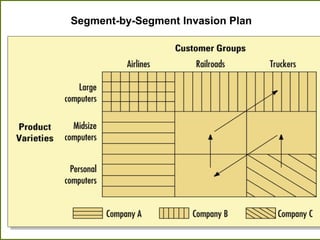
Segment-by-Segment Invasion Plan

Ch 10

  • 1.
    Chapter 10 Identifying MarketSegments and Selecting Target Markets
  • 2.
  • 3.
    Chapter Objectives  Wefocus on the following questions:  How can a company identify the segments that make up a market?  What criteria can a company use to choose the most attractive target markets?
  • 4.
    Target Marketing  Targetmarketing requires marketers to take three major steps:  Identify and profile distinct groups of buyers who differ in their needs and preferences (market segmentation).  Select one or more market segments to enter (market targeting).  For each target segment, establish and communicate the key distinctive benefit(s) of the company’s market offering (market positioning).
  • 5.
    Levels and Patternsof Market Segmentation  Levels of Market Segmentation  Mass marketing: mass production, mass distribution, and mass promotion of one product for all buyers.  Micromarketing: four levels of marketing – segments, niches, local areas, and individuals. Segment marketing Market segment: Group of customers who share a similar set of wants. Sector: Young, middle income car buyers is a sector rather than a segment. Flexible market offering  Naked solution: products & services that all segment members value.  Discretionary options: some segment members value.
  • 6.
    Niche Marketing  Niche:more narrowly defined group seeking a distinctive mix of benefits. By dividing segments into sub segments. Characteristics of Niches:  Customer in the niche have a distinct set of needs.  Customer will pay a premium to the firm that best satisfies their needs.  Niche is not likely to attract other competitors.  Nicher gains certain economies through specialization  Niche has size, profit, and growth potential. Local Marketing Needs and wants of local customer groups – trading areas, neighborhoods, even individual stores. Levels and Patterns of Market Segmentation
  • 7.
    Levels and Patternsof Market Segmentation Individual Customer Marketing Ultimate level of segmentation.  Mass-customization: Mass basis individually designed products, services, programs, and communications to meet each customer’s requirements.  Choiceboard: Interactive online system allowing customers designing their own products and services.  Customerization: operationally driven mass customization with customized marketing empowering customers to design the product and service offering. Products or services for -  Segments or  Individuals
  • 8.
    Levels and Patternsof Market Segmentation  Patterns for Market Segmentation  Preference segments: According to buyers’ preferences.  Homogeneous preferences: consumers have roughly the same preferences.  Diffused preferences: consumers may be scattered throughout the space, indicating variation in preferences.  Clustered preferences  Natural market segments: distinct preference cluster.  Concentrated marketing: largest market segment.  Center position: hoping to appeal to all groups.  In largest market segment.  Several brands in different positions.
  • 9.
    Levels and Patternsof Market Segmentation Sweetness Sweetness Sweetness (a) Homogeneous preferences (b) Diffused preferences (c) Clustered preferences
  • 10.
    Levels and Patternsof Market Segmentation  Market Segmentation Procedure  Needs-based market segmentation approach Steps in Segmentation Process 1. Needs-Based Segmentation Group customers into segments based on similar needs and benefits sought by customer in solving a particular consumption problem. 2. Segment Identification For each needs-based segment, determine which demographics, lifestyles, and usage behaviors make the segment distinct and identifiable (actionable). 3. Segment Attractiveness Using predetermined segment attractiveness criteria (such as market growth, competitive intensity, and market access), determine the overall attractiveness of each segment.
  • 11.
    4. Segment Profitability Determinesegment profitability. 5. Segment Positioning For each segment, create a “value proposition” and product-price positioning strategy based on that segment’s unique customer needs and characteristics. 6. Segment “Acid Test” Create “segment storyboards“ to test the attractiveness of each segment’s positioning strategy. 7. Market-Mix Strategy Expand segment positioning strategy to include all aspects of the marketing mix: product, price, promotion, and place. Levels and Patterns of Market Segmentation
  • 12.
     Market partitioning Investigatingthe hierarchy of attributes consumers examine in choosing a brand.  Brand-dominant hierarchy: Toyota > Toyota Corolla  Nation-dominant hierarchy: Japanese Car > Toyota  Effective Segmentation  Measurable: size, purchasing power, and characteristics of the segments.  Substantial: large and profitable enough to serve.  Accessible: effectively reached and served.  Differentiable: conceptually distinguishable and respond differently to different marketing mix elements and programs.  Actionable: effective programs can be formulated to attract and serve the segments. Levels and Patterns of Market Segmentation
  • 13.
    Segmenting Consumer and BusinessMarkets  Bases for Segmenting Consumer Markets Major Segmentation Variables for Consumer Markets: Segmentation Variable Variable Type Geographic Region, city or metro size, Density,Climate Demographic Age, family size, family life cycle, gender, income, occupation, education, religion, race, generation, nationality, social class Psychographic Life style, personality Behavioral Occasions, benefits, user status, user rate, loyalty status, readiness stage, attitude toward product
  • 14.
    Segmenting Consumer and BusinessMarkets Loyalty Status  Hard-core loyal: buy one brand all the time.  Split-loyal: loyal to two or three brands.  Shifting-loyal: shift from one brand to another.  Switchers: no loyalty to any brand.
  • 15.
    Segmenting Consumer and BusinessMarkets  Bases For Segmenting Business Markets Major Segmentation Variables for Business Markets: Segmentation Variables Variable Types Demographic Industry, Company size, Location Operating Variables Technology, user or nonuser status, customer compatibilities. Purchasing Approaches Purchasing function organization, power structure, nature of existing relationships, general purchase policies, purchasing criteria. Situational Factors Urgency, specific application, size of order Personal Characteristics Buyer-seller similarity, attitudes towards risk, loyalty.
  • 16.
    Segmenting Consumer and BusinessMarkets  Rackman and Vincentis proposed a segmentation scheme that classifies business buyers into three groups  Price-oriented customers (transactional selling) They want value through lowest price.  Solution-oriented customers (consultative selling) They want value through more benefits and advice.  Strategic-value customers (enterprise selling) They want value through the supplier co-investing and participating in the customer’s business.
  • 17.
    Market Targeting  Evaluatingand Selecting the Market Segments  Single-Segment Concentration: mini pack chips.  Selective Specialization: BAT, gold leaf for A,B&H for B, Star for C.  Product Specialization : Otobi, products for Univ, office, home … all segments. ISP, PDB.  Market Specialization: Firms sell products only to university labs.  Full Market Coverage: Coca cola, IBM, GM.  Undifferentiated marketing  Differentiated marketing
  • 18.
    Market Targeting M1 M2M3 M1 M2 M3M1 M2 M3M1 M2 M3 M1 M2 M3 P1 P2 P3 P1 P2 P3 P1 P2 P3 P1 P2 P3 P1 P2 P3 Single-segment concentration Market Specialization Full Market Coverage Product Specialization Selective specialization
  • 19.
     Higher costsusing differentiated marketing include  Product modification cost: R&D, engineering, and special tooling costs.  Manufacturing cost: less economies of scale.  Administrative cost: separate marketing plans, research, forecasting, sales analysis, promotion, and channel management.  Inventory cost: different inventories to meet different requirements.  Promotion cost: increased promotion planning and media costs. Market Targeting
  • 20.
    Market Targeting  Supersegment: set of segments sharing some exploitable similarity. Orchestra targets broad cultural interests.  Mega marketing: strategic coordination of economic, psychological, political, and public- relations skills, to gain the cooperation of a number of parties in order to enter or operate in a given market. Pepsi in India.
  • 21.