Business Strategy - the GE/ McKinsey Matrix
The GE/ McKinsey Matrix 
• This is a form of portfolio analysis used for 
classifying product lines or strategic business units 
within a large company 
• It was developed by McKinsey for the US General 
Electric Company 
• It assesses areas of the business in terms of two 
criteria: 
– The attractiveness of the industry/market concerned 
– The strength of the business 
Business Strategy - the GE/ McKinsey Matrix
How does it differ from the Boston Matrix? 
• There are similarities: 
– Two dimensions are used to create a matrix 
– Each cell suggests an appropriate strategy 
– In both cases we are concerned with the future strategy for a 
particular area (eg a division) within the firm 
• There are major differences 
– The GE matrix involves a wider analysis of the firm’s operations 
– The dimensions of the GE matrix are industry attractiveness and 
business strength (rather than market share and market growth) 
– There are nine cells and a wider choice of strategies 
– The Boston Matrix focuses on products within the firms product 
range The GE matrix can be extended to look at strategic business 
units 
Business Strategy - the GE/ McKinsey Matrix
Strategic Business Units (SBUs) 
• Definitions of a SBU: 
• A particular product market combination that typically 
requires its own business plan 
• A part of a company that is large enough to have its own 
well defined markets, attract its own set of competitors and 
demand tangible resources and capabilities from the 
overall corporation 
• A discrete grouping within an organisation with delegated 
responsibility for strategically managing a product/ service 
or group of product of services 
• A division within a large national or multinational company 
is a SBU 
Business Strategy - the GE/ McKinsey Matrix
Industry attractiveness 
• The vertical axis of the matrix is industry 
attractiveness 
• This concerns the attractiveness to a firm of 
entering, or remaining, in a particular industry 
• Industry attractiveness is assessed by considering 
a range of factors each of which is given a 
weighting to produce a composite picture 
Business Strategy - the GE/ McKinsey Matrix
Criteria which makes a market attractive 
• Market size 
• Growth rate 
• Overall returns in the 
industry 
• Industry profitability 
• Intensity of competition 
• Profit margins 
• Differentiation 
• Industry fluctuations 
• Customer/supplier 
relations 
• Variability of demand 
• Rate of technological 
change 
• Volatility 
• Availability of market 
intelligence 
• Availability of work force 
• Global opportunities 
• PEST factors 
• Entry and exit barrier 
• Government regulation 
Business Strategy - the GE/ McKinsey Matrix
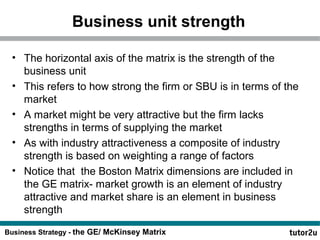
Business unit strength 
• The horizontal axis of the matrix is the strength of the 
business unit 
• This refers to how strong the firm or SBU is in terms of the 
market 
• A market might be very attractive but the firm lacks 
strengths in terms of supplying the market 
• As with industry attractiveness a composite of industry 
strength is based on weighting a range of factors 
• Notice that the Boston Matrix dimensions are included in 
the GE matrix- market growth is an element of industry 
attractive and market share is an element in business 
strength 
Business Strategy - the GE/ McKinsey Matrix
Assessing internal strengths 
• Production capacity 
• Production flexibility 
• Unit costs 
• R and D capabilities 
• Quality 
• Reliability 
• Company image 
• Product uniqueness 
• Cost and profitability 
• Profit margins relative to 
competitors 
• Manufacturing capability 
• Organisational skills 
• Market share 
• Growth in market share 
• Marketing capabilities 
• Management competence 
• Skills of workforce 
• Distribution network 
• Size and quality of sales force 
• Service quality 
• Customer loyalty 
• Brand recognition 
Business Strategy - the GE/ McKinsey Matrix
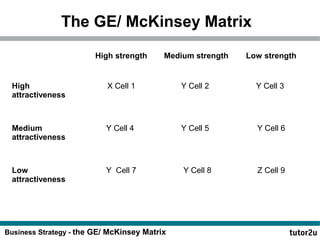
The GE/ McKinsey Matrix 
High strength Medium strength Low strength 
High 
attractiveness 
X Cell 1 Y Cell 2 Y Cell 3 
Medium 
attractiveness 
Y Cell 4 Y Cell 5 Y Cell 6 
Low 
attractiveness 
Y Cell 7 Y Cell 8 Z Cell 9 
Business Strategy - the GE/ McKinsey Matrix
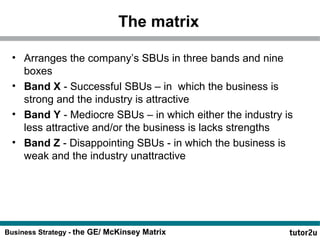
The matrix 
• Arranges the company’s SBUs in three bands and nine 
boxes 
• Band X - Successful SBUs – in which the business is 
strong and the industry is attractive 
• Band Y - Mediocre SBUs – in which either the industry is 
less attractive and/or the business is lacks strengths 
• Band Z - Disappointing SBUs - in which the business is 
weak and the industry unattractive 
Business Strategy - the GE/ McKinsey Matrix
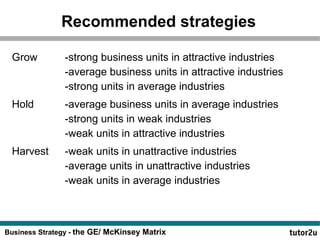
Recommended strategies 
Grow -strong business units in attractive industries 
-average business units in attractive industries 
-strong units in average industries 
Hold -average business units in average industries 
-strong units in weak industries 
-weak units in attractive industries 
Harvest -weak units in unattractive industries 
-average units in unattractive industries 
-weak units in average industries 
Business Strategy - the GE/ McKinsey Matrix
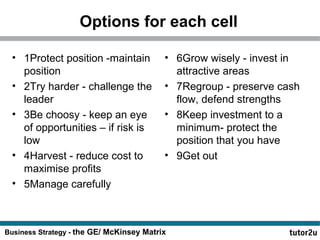
Options for each cell 
• 1Protect position -maintain 
position 
• 2Try harder - challenge the 
leader 
• 3Be choosy - keep an eye 
of opportunities – if risk is 
low 
• 4Harvest - reduce cost to 
maximise profits 
• 5Manage carefully 
• 6Grow wisely - invest in 
attractive areas 
• 7Regroup - preserve cash 
flow, defend strengths 
• 8Keep investment to a 
minimum- protect the 
position that you have 
• 9Get out 
Business Strategy - the GE/ McKinsey Matrix
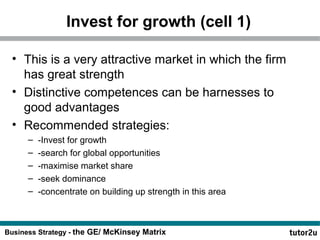
Invest for growth (cell 1) 
• This is a very attractive market in which the firm 
has great strength 
• Distinctive competences can be harnesses to 
good advantages 
• Recommended strategies: 
– -Invest for growth 
– -search for global opportunities 
– -maximise market share 
– -seek dominance 
– -concentrate on building up strength in this area 
Business Strategy - the GE/ McKinsey Matrix
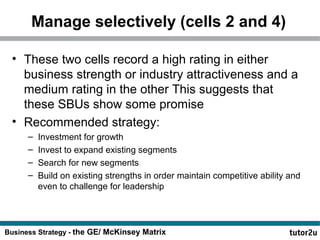
Manage selectively (cells 2 and 4) 
• These two cells record a high rating in either 
business strength or industry attractiveness and a 
medium rating in the other This suggests that 
these SBUs show some promise 
• Recommended strategy: 
– Investment for growth 
– Invest to expand existing segments 
– Search for new segments 
– Build on existing strengths in order maintain competitive ability and 
even to challenge for leadership 
Business Strategy - the GE/ McKinsey Matrix
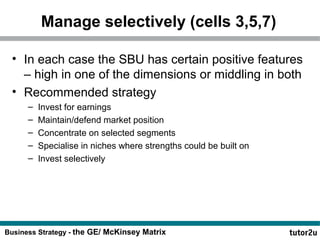
Manage selectively (cells 3,5,7) 
• In each case the SBU has certain positive features 
– high in one of the dimensions or middling in both 
• Recommended strategy 
– Invest for earnings 
– Maintain/defend market position 
– Concentrate on selected segments 
– Specialise in niches where strengths could be built on 
– Invest selectively 
Business Strategy - the GE/ McKinsey Matrix
Harvest (cells 6 and 8) 
• In each case either market attractiveness or 
business strength is low and other one is only 
medium 
• Recommended strategies: 
– Manage for cash 
– Avoid unnecessary investment 
– Move to the most profitable segments 
– Prune product lines 
– Specialise in profitable niches 
– Consider exit 
Business Strategy - the GE/ McKinsey Matrix
Divest (Cell 9) 
• This is an unattractive market in which the firm has 
no strength 
• Recommended strategy: 
– Exit the market 
– Time the exit in order to sell at a time that will maximize cash 
value 
– In the meantime, cut fixed costs and avoid investment 
Business Strategy - the GE/ McKinsey Matrix

Ge matrix

  • 1.
    Business Strategy -the GE/ McKinsey Matrix
  • 2.
    The GE/ McKinseyMatrix • This is a form of portfolio analysis used for classifying product lines or strategic business units within a large company • It was developed by McKinsey for the US General Electric Company • It assesses areas of the business in terms of two criteria: – The attractiveness of the industry/market concerned – The strength of the business Business Strategy - the GE/ McKinsey Matrix
  • 3.
    How does itdiffer from the Boston Matrix? • There are similarities: – Two dimensions are used to create a matrix – Each cell suggests an appropriate strategy – In both cases we are concerned with the future strategy for a particular area (eg a division) within the firm • There are major differences – The GE matrix involves a wider analysis of the firm’s operations – The dimensions of the GE matrix are industry attractiveness and business strength (rather than market share and market growth) – There are nine cells and a wider choice of strategies – The Boston Matrix focuses on products within the firms product range The GE matrix can be extended to look at strategic business units Business Strategy - the GE/ McKinsey Matrix
  • 4.
    Strategic Business Units(SBUs) • Definitions of a SBU: • A particular product market combination that typically requires its own business plan • A part of a company that is large enough to have its own well defined markets, attract its own set of competitors and demand tangible resources and capabilities from the overall corporation • A discrete grouping within an organisation with delegated responsibility for strategically managing a product/ service or group of product of services • A division within a large national or multinational company is a SBU Business Strategy - the GE/ McKinsey Matrix
  • 5.
    Industry attractiveness •The vertical axis of the matrix is industry attractiveness • This concerns the attractiveness to a firm of entering, or remaining, in a particular industry • Industry attractiveness is assessed by considering a range of factors each of which is given a weighting to produce a composite picture Business Strategy - the GE/ McKinsey Matrix
  • 6.
    Criteria which makesa market attractive • Market size • Growth rate • Overall returns in the industry • Industry profitability • Intensity of competition • Profit margins • Differentiation • Industry fluctuations • Customer/supplier relations • Variability of demand • Rate of technological change • Volatility • Availability of market intelligence • Availability of work force • Global opportunities • PEST factors • Entry and exit barrier • Government regulation Business Strategy - the GE/ McKinsey Matrix
  • 7.
    Business unit strength • The horizontal axis of the matrix is the strength of the business unit • This refers to how strong the firm or SBU is in terms of the market • A market might be very attractive but the firm lacks strengths in terms of supplying the market • As with industry attractiveness a composite of industry strength is based on weighting a range of factors • Notice that the Boston Matrix dimensions are included in the GE matrix- market growth is an element of industry attractive and market share is an element in business strength Business Strategy - the GE/ McKinsey Matrix
  • 8.
    Assessing internal strengths • Production capacity • Production flexibility • Unit costs • R and D capabilities • Quality • Reliability • Company image • Product uniqueness • Cost and profitability • Profit margins relative to competitors • Manufacturing capability • Organisational skills • Market share • Growth in market share • Marketing capabilities • Management competence • Skills of workforce • Distribution network • Size and quality of sales force • Service quality • Customer loyalty • Brand recognition Business Strategy - the GE/ McKinsey Matrix
  • 9.
    The GE/ McKinseyMatrix High strength Medium strength Low strength High attractiveness X Cell 1 Y Cell 2 Y Cell 3 Medium attractiveness Y Cell 4 Y Cell 5 Y Cell 6 Low attractiveness Y Cell 7 Y Cell 8 Z Cell 9 Business Strategy - the GE/ McKinsey Matrix
  • 10.
    The matrix •Arranges the company’s SBUs in three bands and nine boxes • Band X - Successful SBUs – in which the business is strong and the industry is attractive • Band Y - Mediocre SBUs – in which either the industry is less attractive and/or the business is lacks strengths • Band Z - Disappointing SBUs - in which the business is weak and the industry unattractive Business Strategy - the GE/ McKinsey Matrix
  • 11.
    Recommended strategies Grow-strong business units in attractive industries -average business units in attractive industries -strong units in average industries Hold -average business units in average industries -strong units in weak industries -weak units in attractive industries Harvest -weak units in unattractive industries -average units in unattractive industries -weak units in average industries Business Strategy - the GE/ McKinsey Matrix
  • 12.
    Options for eachcell • 1Protect position -maintain position • 2Try harder - challenge the leader • 3Be choosy - keep an eye of opportunities – if risk is low • 4Harvest - reduce cost to maximise profits • 5Manage carefully • 6Grow wisely - invest in attractive areas • 7Regroup - preserve cash flow, defend strengths • 8Keep investment to a minimum- protect the position that you have • 9Get out Business Strategy - the GE/ McKinsey Matrix
  • 13.
    Invest for growth(cell 1) • This is a very attractive market in which the firm has great strength • Distinctive competences can be harnesses to good advantages • Recommended strategies: – -Invest for growth – -search for global opportunities – -maximise market share – -seek dominance – -concentrate on building up strength in this area Business Strategy - the GE/ McKinsey Matrix
  • 14.
    Manage selectively (cells2 and 4) • These two cells record a high rating in either business strength or industry attractiveness and a medium rating in the other This suggests that these SBUs show some promise • Recommended strategy: – Investment for growth – Invest to expand existing segments – Search for new segments – Build on existing strengths in order maintain competitive ability and even to challenge for leadership Business Strategy - the GE/ McKinsey Matrix
  • 15.
    Manage selectively (cells3,5,7) • In each case the SBU has certain positive features – high in one of the dimensions or middling in both • Recommended strategy – Invest for earnings – Maintain/defend market position – Concentrate on selected segments – Specialise in niches where strengths could be built on – Invest selectively Business Strategy - the GE/ McKinsey Matrix
  • 16.
    Harvest (cells 6and 8) • In each case either market attractiveness or business strength is low and other one is only medium • Recommended strategies: – Manage for cash – Avoid unnecessary investment – Move to the most profitable segments – Prune product lines – Specialise in profitable niches – Consider exit Business Strategy - the GE/ McKinsey Matrix
  • 17.
    Divest (Cell 9) • This is an unattractive market in which the firm has no strength • Recommended strategy: – Exit the market – Time the exit in order to sell at a time that will maximize cash value – In the meantime, cut fixed costs and avoid investment Business Strategy - the GE/ McKinsey Matrix