TARGET MARKETING 
TARGET MARKET 
1
MARKET SEGMENTATION AND SELECTING 
TARGET MARKETS 
At the end of this module the learning 
outcomes are. 
1. Why there is a need to segment 
markets? 
2. What are the various levels of 
market segmentation? 
3. What are bases for segmenting 

consumer markets? 
4. How the markets are targeted? 
TARGET MARKET 
2
MARKET SEGMENTATION AND SELECTING 
TARGET MARKETS 
SUGGESTED READINGS 
1. Marketing Management by 
Philip Kotler, chapter 9 &10th 
edition. 
2. Marketing Management by 
Ramaswami and Namkumari, 
Chapter 6. 
TARGET MARKET 
3
MARKET SEGMENTATION AND SELECTING 
TARGET MARKETS 
MARKET SEGMENTATION 
The need 
 Cannot serve all customers of this 
universe. 
 No company has that kind of resources. 
 Customers 
 Too numerous 
 Diverse in their buying requirement 
 Need to identify the market segments 
that it can serve more effectively 
TARGET MARKET 
4
MARKET SEGMENTATION AND SELECTING 
TARGET MARKETS 
MARKET SEGMENTATION. 
- The universe is heterogeneous. 
- Divide the universe into market 
segments, where buying or need 
requirements is same i.e. 
homogenous. 
- Attack one or few market segments. 
- This is target marketing. 
TARGET MARKET 
5
TARGET MARKETING 
TARGET MARKET 
6 
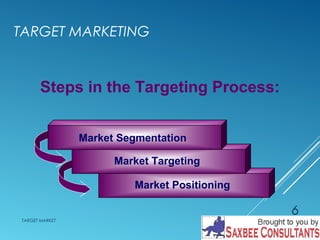
Steps in the Targeting Process: 
Market Segmentation 
Market Targeting 
Market Positioning
TARGET MARKETING 
 Target marketing requires marketers to take three 
major steps: 
 Identify and profile distinct groups of buyers who differ 
in their needs and preferences (market segmentation). 
 Select one or more market segments to enter (market 
targeting). 
 For each target segment, establish and communicate 
the key distinctive benefit(s) of the company’s market 
offering (market positioning). 
TARGET MARKET 
7
MARKET Mass Marketing 
SEGMENTATION AND SELECTING 
TARGET MARKETS 
 Seller engages in mass production. 
 Mass distribution. 
 Mass promotion of one product for all buyers. 
Example 
Coke in 60 & 70s, 
 Sold in India 
 One size 200 ml. 
TARGET MARKET 
8
MARKET SEGMENTATION AND SELECTING 
TARGET MARKETS 
Arguments for mass market. 
 Creates largest potential market 
 Leads to lower cost 
 Lead to lower prices. 
 Higher margins 
Why criticised 
 Market fragmentation 
 Splintering of the market 
 Mass media proliferation. 
 Distribution channel proliferation 
Difficult to practice “one size fits all’’ marketing. 
TARGET MARKET 
9
USING MARKET SEGMENTATION 
TARGET MARKET 
10 
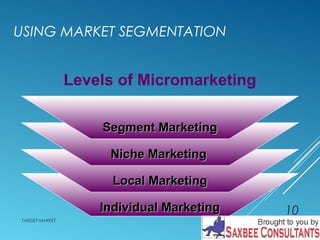
Levels of Micromarketing 
SSeeggmmeenntt MMaarrkkeettiinngg 
NNiicchhee MMaarrkkeettiinngg 
LLooccaall MMaarrkkeettiinngg 
IInnddiivviidduuaall MMaarrkkeettiinngg
MARKET SEGMENTATION AND SELECTING 
TARGET MARKETS 
MARKET SEGMENTATION LEVELS 
1. Segment Marketing 
 Consists of a large identifiable group within a market 
with similar wants, purchasing power, attitudes or 
buying habits 
 Each segment’s buyers are assumed to be quite 
similar in needs /wants 
 No two buyers all alike 
 Flexible market offerings 
TARGET MARKET 
11
MARKET SEGMENTATION AND SELECTING 
TARGET MARKETS 
Flexible market offering consists of two parts 
1. Naked solution 
- Consists of products and service 
elements that all segment members 
value 
1. Options 
- That some segment members value 
- Each option carries additional prices. 
TARGET MARKET 
12
MARKET SEGMENTATION AND SELECTING 
TARGET MARKETS 
Example – Segment Marketing 
Delta Airlines 
· Economy Class passenger 
- Seat 
- Food 
- Soft Drink 
All of them – naked solution 
· Charges extra 
- Alcoholic beverages 
- Earphones 
TARGET MARKET 
13
MARKET SEGMENTATION AND SELECTING 
TARGET MARKETS 
Segment marketing – benefits 
- More fine tuned product 
- Price it appropriately for the target 
audience 
- Fewer competitors 
- Easier choice of 
• Distribution channels 
• Communication channels 
TARGET MARKET 
14
MARKET SEGMENTATION AND SELECTING 
TARGET MARKETS 
Niche marketing 
- Narrowly defined group 
- Needs are not well serviced 
- Seeking a distinctive mix of benefits 
- Fairly small market size 
- Normally attract one or two players 
- Customers willing to pay a 
premium price. 
TARGET MARKET 
15
MARKET SEGMENTATION AND 
SELECTING TARGET MARKETS 
 1. High end designer wear like Gucci, Chanel, 
Tarun Tahiliani etc. 
 2. Automobiles like Ferrari, Maserati, Lamborghini 
etc. 
 WHAT IS A NICHE TODAY MAY BECOME A 
SEGMENT TOMORROW AND VICE VERSA!! 
TARGET MARKET 
16
2. Ostrichesonline.com 
- Selling Ostrich derived products 
- On line 
- 2 million $ sales in 1998 
- Visitors can buy 
· Ostrich meat 
· Feathers 
· Leather jackets 
· Videos 
· Eggshells 
· Skin care products derived from ostrich 
· Body oil 
TARGET MARKET 
17
MARKET SEGMENTATION AND SELECTING 
TARGET MARKETS 
3. Local marketing 
- Needs of local customer groups 
Example Kraft Cheese 
· Helps supermarket chains 
· Identify cheese assortment and shelf 
layout 
· Optimise cheese sales in 
- Low 
- Middle 
- High income stores 
- Different ethnic groups 
TARGET MARKET 
18
MARKET SEGMENTATION AND SELECTING 
TARGET MARKETS 
4. Individual marketing 
- Ultimate level of segmentation 
- Segment of one. 
- One-to-one marketing. 
- Customised to individuals 
- Tailor made 
- Cobbler designed shoes. 
- Customised industrial products 
Use of new technologies 
- Computers. 
- Databases 
Customised offering. 
TARGET MARKET 
19
MARKET SEGMENTATION AND SELECTING 
TARGET MARKETS 
Example 
1. Dilip Chhabria -Designer cars 
- Customised cars 
- Small market 
- About 500 a year 
- Each car is unique, high prices 
TARGET MARKET 
20
MARKET SEGMENTATION AND SELECTING 
TARGET MARKETS 
Turning to Mass customisation 
It is the ability to prepare on a mass basis 
individually designed products and 
communication to meet each 
customer’s requirements. 
Example. 
Levi’s Jeans 
- Customer measurements. 
- Jeans ready in 8 hrs. 
Mattel 
Barbie com 
Design your own Barbie doll. 
TARGET MARKET 
21
MARKET SEGMENTATION AND SELECTING 
TARGET MARKETS 
- Choose Doll’s 
• Skin tone 
• Eye colour 
• Haircolor. 
• Clothes 
• Accessories 
• Her likes and dislikes. 
- When Barbie delivered. 
• Doll’s name on the package 
• Computer generated paragraph about her 
personality 
TARGET MARKET 
22
USING MARKET SEGMENTATION 
TARGET MARKET 
23 
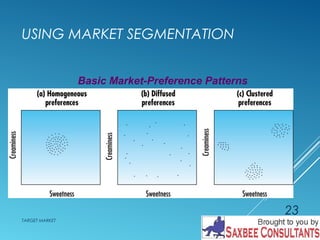
Basic Market-Preference Patterns
USING MARKET SEGMENTATION 
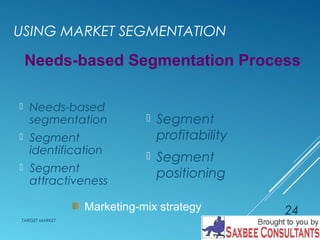
Needs-based Segmentation Process 
 Segment 
profitability 
 Segment 
positioning 
 Needs-based 
segmentation 
 Segment 
identification 
 Segment 
attractiveness 
TARGET MARKET 
Marketing-mix strategy 24
SEGMENTATION 
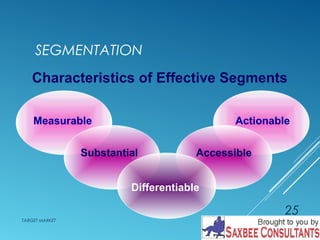
Characteristics of Effective Segments 
Measurable Actionable 
TARGET MARKET 
25 
Substantial Accessible 
Differentiable
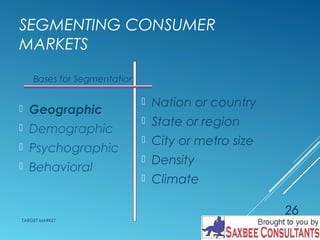
SEGMENTING CONSUMER 
MARKETS 
 Nation or country 
 State or region 
 City or metro size 
 Density 
 Climate 
Bases for Segmentation 
 Geographic 
 Demographic 
 Psychographic 
 Behavioral 
TARGET MARKET 
26
MARKET SEGMENTATION AND SELECTING 
TARGET MARKETS 
Example Geographic 
Ford Ikon in India 
1. World car 
2. Changes for India 
1. Higher suspension 
2. Larger size air conditioner, higher ambient 
temperature 
3. Lower average speeds 
4. Handle adulterated fuel 
5. Petrol / diesel adulterated with kerosene 
TARGET MARKET 
27
SEGMENTING CONSUMER 
MARKETS 
 Age, race, gender 
 Income, education 
 Family size 
 Family life cycle 
 Occupation 
 Religion, nationality 
 Generation 
 Social class 
Bases for Segmentation 
 Geographic 
 Demographic 
 Psychographic 
 Behavioral 
TARGET MARKET 
28
SEGMENTING CONSUMER 
MARKETS 
 Lifestyle 
 Activities 
 Interests 
 Opinions 
 Personality 
 Core values 
Bases for Segmentation 
 Geographic 
 Demographic 
 Psychographic 
 Behavioral 
TARGET MARKET 
29
MARKET SEGMENTATION AND SELECTING 
TARGET MARKETS 
a. Lifestyle 
Nestle Classic 
- Pleasure of making coffee 
· Adding milk, sugar, coffee in hot 
milk 
Nestle “3 in 1 
- Office goers 
- Paucity of time 
- Espresso feeling 
- Milk sugar coffee premixed 
TARGET MARKET 
30
b. Personality 
- Targeting consumer personality 
- Customer of Ford 
 Independent 
 Impulsive 
 Masculine 
 Alert to change 
 Self confident 
- Customers of Chevrolet 
 Conservative. 
 Thrifty 
 Prestige. 
 Conscious. 
 Avoid extremes 
TARGET MARKET 
31
MARKET SEGMENTATION AND SELECTING 
TARGET MARKETS 
C. VALUES 
Tourists to Disneyland 
• Fun seekers 
• Families visit 
Tourists to Udayan child welfare unit at Kolkatta 
• Stay and meet poor children 
• Share thoughts 
• Donate 
TARGET MARKET 
32
SEGMENTING CONSUMER 
MARKETS 
 Occasions 
 Benefits 
 User status 
 Usage rate 
 Loyalty status 
 Buyer-readiness 
 Attitude 
Bases for Segmentation 
 Geographic 
 Demographic 
 Psychographic 
 Behavioral 
TARGET MARKET 
33
SEGMENTING CONSUMER 
MARKETS 
 Multi-attribute segmentation via 
geoclustering combines multiple 
variables to identify smaller, better-defined 
target groups 
TARGET MARKET 
34
MARKET TARGETING STRATEGIES 
 Evaluating and selecting market 
segments requires assessing the 
segment’s overall attractiveness in 
light of company’s objectives and 
resources. 
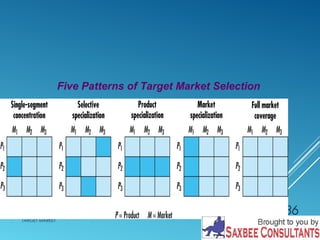
 Five patterns of target market 
selection can then be considered. 
TARGET MARKET 
35
MARKET TARGETING STRATEGIES 
TARGET MARKET 
36 
Five Patterns of Target Market Selection
MARKET TARGETING STRATEGIES 
 Targeting multiple segments may result 
in cost economies 
 Higher costs using differentiated 
marketing include: 
 Product modification cost 
 Manufacturing cost 
 Administrative cost 
 Inventory cost 
 Promotion cost 
TARGET MARKET 
37
For details and bookings contact:- 
Parveen Kumar Chadha… THINK TANK 
(Founder and C.E.O of Saxbee Consultants) 
Email :-saxbeeconsultants@gmail.com 
Mobile No. +91-9818308353 
Address:-First Floor G-20(A), Kirti Nagar, New 
Delhi India Postal Code-110015

Target marketing

  • 1.
  • 2.
    MARKET SEGMENTATION ANDSELECTING TARGET MARKETS At the end of this module the learning outcomes are. 1. Why there is a need to segment markets? 2. What are the various levels of market segmentation? 3. What are bases for segmenting consumer markets? 4. How the markets are targeted? TARGET MARKET 2
  • 3.
    MARKET SEGMENTATION ANDSELECTING TARGET MARKETS SUGGESTED READINGS 1. Marketing Management by Philip Kotler, chapter 9 &10th edition. 2. Marketing Management by Ramaswami and Namkumari, Chapter 6. TARGET MARKET 3
  • 4.
    MARKET SEGMENTATION ANDSELECTING TARGET MARKETS MARKET SEGMENTATION The need  Cannot serve all customers of this universe.  No company has that kind of resources.  Customers  Too numerous  Diverse in their buying requirement  Need to identify the market segments that it can serve more effectively TARGET MARKET 4
  • 5.
    MARKET SEGMENTATION ANDSELECTING TARGET MARKETS MARKET SEGMENTATION. - The universe is heterogeneous. - Divide the universe into market segments, where buying or need requirements is same i.e. homogenous. - Attack one or few market segments. - This is target marketing. TARGET MARKET 5
  • 6.
    TARGET MARKETING TARGETMARKET 6 Steps in the Targeting Process: Market Segmentation Market Targeting Market Positioning
  • 7.
    TARGET MARKETING Target marketing requires marketers to take three major steps:  Identify and profile distinct groups of buyers who differ in their needs and preferences (market segmentation).  Select one or more market segments to enter (market targeting).  For each target segment, establish and communicate the key distinctive benefit(s) of the company’s market offering (market positioning). TARGET MARKET 7
  • 8.
    MARKET Mass Marketing SEGMENTATION AND SELECTING TARGET MARKETS  Seller engages in mass production.  Mass distribution.  Mass promotion of one product for all buyers. Example Coke in 60 & 70s,  Sold in India  One size 200 ml. TARGET MARKET 8
  • 9.
    MARKET SEGMENTATION ANDSELECTING TARGET MARKETS Arguments for mass market.  Creates largest potential market  Leads to lower cost  Lead to lower prices.  Higher margins Why criticised  Market fragmentation  Splintering of the market  Mass media proliferation.  Distribution channel proliferation Difficult to practice “one size fits all’’ marketing. TARGET MARKET 9
  • 10.
    USING MARKET SEGMENTATION TARGET MARKET 10 Levels of Micromarketing SSeeggmmeenntt MMaarrkkeettiinngg NNiicchhee MMaarrkkeettiinngg LLooccaall MMaarrkkeettiinngg IInnddiivviidduuaall MMaarrkkeettiinngg
  • 11.
    MARKET SEGMENTATION ANDSELECTING TARGET MARKETS MARKET SEGMENTATION LEVELS 1. Segment Marketing  Consists of a large identifiable group within a market with similar wants, purchasing power, attitudes or buying habits  Each segment’s buyers are assumed to be quite similar in needs /wants  No two buyers all alike  Flexible market offerings TARGET MARKET 11
  • 12.
    MARKET SEGMENTATION ANDSELECTING TARGET MARKETS Flexible market offering consists of two parts 1. Naked solution - Consists of products and service elements that all segment members value 1. Options - That some segment members value - Each option carries additional prices. TARGET MARKET 12
  • 13.
    MARKET SEGMENTATION ANDSELECTING TARGET MARKETS Example – Segment Marketing Delta Airlines · Economy Class passenger - Seat - Food - Soft Drink All of them – naked solution · Charges extra - Alcoholic beverages - Earphones TARGET MARKET 13
  • 14.
    MARKET SEGMENTATION ANDSELECTING TARGET MARKETS Segment marketing – benefits - More fine tuned product - Price it appropriately for the target audience - Fewer competitors - Easier choice of • Distribution channels • Communication channels TARGET MARKET 14
  • 15.
    MARKET SEGMENTATION ANDSELECTING TARGET MARKETS Niche marketing - Narrowly defined group - Needs are not well serviced - Seeking a distinctive mix of benefits - Fairly small market size - Normally attract one or two players - Customers willing to pay a premium price. TARGET MARKET 15
  • 16.
    MARKET SEGMENTATION AND SELECTING TARGET MARKETS  1. High end designer wear like Gucci, Chanel, Tarun Tahiliani etc.  2. Automobiles like Ferrari, Maserati, Lamborghini etc.  WHAT IS A NICHE TODAY MAY BECOME A SEGMENT TOMORROW AND VICE VERSA!! TARGET MARKET 16
  • 17.
    2. Ostrichesonline.com -Selling Ostrich derived products - On line - 2 million $ sales in 1998 - Visitors can buy · Ostrich meat · Feathers · Leather jackets · Videos · Eggshells · Skin care products derived from ostrich · Body oil TARGET MARKET 17
  • 18.
    MARKET SEGMENTATION ANDSELECTING TARGET MARKETS 3. Local marketing - Needs of local customer groups Example Kraft Cheese · Helps supermarket chains · Identify cheese assortment and shelf layout · Optimise cheese sales in - Low - Middle - High income stores - Different ethnic groups TARGET MARKET 18
  • 19.
    MARKET SEGMENTATION ANDSELECTING TARGET MARKETS 4. Individual marketing - Ultimate level of segmentation - Segment of one. - One-to-one marketing. - Customised to individuals - Tailor made - Cobbler designed shoes. - Customised industrial products Use of new technologies - Computers. - Databases Customised offering. TARGET MARKET 19
  • 20.
    MARKET SEGMENTATION ANDSELECTING TARGET MARKETS Example 1. Dilip Chhabria -Designer cars - Customised cars - Small market - About 500 a year - Each car is unique, high prices TARGET MARKET 20
  • 21.
    MARKET SEGMENTATION ANDSELECTING TARGET MARKETS Turning to Mass customisation It is the ability to prepare on a mass basis individually designed products and communication to meet each customer’s requirements. Example. Levi’s Jeans - Customer measurements. - Jeans ready in 8 hrs. Mattel Barbie com Design your own Barbie doll. TARGET MARKET 21
  • 22.
    MARKET SEGMENTATION ANDSELECTING TARGET MARKETS - Choose Doll’s • Skin tone • Eye colour • Haircolor. • Clothes • Accessories • Her likes and dislikes. - When Barbie delivered. • Doll’s name on the package • Computer generated paragraph about her personality TARGET MARKET 22
  • 23.
    USING MARKET SEGMENTATION TARGET MARKET 23 Basic Market-Preference Patterns
  • 24.
    USING MARKET SEGMENTATION Needs-based Segmentation Process  Segment profitability  Segment positioning  Needs-based segmentation  Segment identification  Segment attractiveness TARGET MARKET Marketing-mix strategy 24
  • 25.
    SEGMENTATION Characteristics ofEffective Segments Measurable Actionable TARGET MARKET 25 Substantial Accessible Differentiable
  • 26.
    SEGMENTING CONSUMER MARKETS  Nation or country  State or region  City or metro size  Density  Climate Bases for Segmentation  Geographic  Demographic  Psychographic  Behavioral TARGET MARKET 26
  • 27.
    MARKET SEGMENTATION ANDSELECTING TARGET MARKETS Example Geographic Ford Ikon in India 1. World car 2. Changes for India 1. Higher suspension 2. Larger size air conditioner, higher ambient temperature 3. Lower average speeds 4. Handle adulterated fuel 5. Petrol / diesel adulterated with kerosene TARGET MARKET 27
  • 28.
    SEGMENTING CONSUMER MARKETS  Age, race, gender  Income, education  Family size  Family life cycle  Occupation  Religion, nationality  Generation  Social class Bases for Segmentation  Geographic  Demographic  Psychographic  Behavioral TARGET MARKET 28
  • 29.
    SEGMENTING CONSUMER MARKETS  Lifestyle  Activities  Interests  Opinions  Personality  Core values Bases for Segmentation  Geographic  Demographic  Psychographic  Behavioral TARGET MARKET 29
  • 30.
    MARKET SEGMENTATION ANDSELECTING TARGET MARKETS a. Lifestyle Nestle Classic - Pleasure of making coffee · Adding milk, sugar, coffee in hot milk Nestle “3 in 1 - Office goers - Paucity of time - Espresso feeling - Milk sugar coffee premixed TARGET MARKET 30
  • 31.
    b. Personality -Targeting consumer personality - Customer of Ford  Independent  Impulsive  Masculine  Alert to change  Self confident - Customers of Chevrolet  Conservative.  Thrifty  Prestige.  Conscious.  Avoid extremes TARGET MARKET 31
  • 32.
    MARKET SEGMENTATION ANDSELECTING TARGET MARKETS C. VALUES Tourists to Disneyland • Fun seekers • Families visit Tourists to Udayan child welfare unit at Kolkatta • Stay and meet poor children • Share thoughts • Donate TARGET MARKET 32
  • 33.
    SEGMENTING CONSUMER MARKETS  Occasions  Benefits  User status  Usage rate  Loyalty status  Buyer-readiness  Attitude Bases for Segmentation  Geographic  Demographic  Psychographic  Behavioral TARGET MARKET 33
  • 34.
    SEGMENTING CONSUMER MARKETS  Multi-attribute segmentation via geoclustering combines multiple variables to identify smaller, better-defined target groups TARGET MARKET 34
  • 35.
    MARKET TARGETING STRATEGIES  Evaluating and selecting market segments requires assessing the segment’s overall attractiveness in light of company’s objectives and resources.  Five patterns of target market selection can then be considered. TARGET MARKET 35
  • 36.
    MARKET TARGETING STRATEGIES TARGET MARKET 36 Five Patterns of Target Market Selection
  • 37.
    MARKET TARGETING STRATEGIES  Targeting multiple segments may result in cost economies  Higher costs using differentiated marketing include:  Product modification cost  Manufacturing cost  Administrative cost  Inventory cost  Promotion cost TARGET MARKET 37
  • 38.
    For details andbookings contact:- Parveen Kumar Chadha… THINK TANK (Founder and C.E.O of Saxbee Consultants) Email :-saxbeeconsultants@gmail.com Mobile No. +91-9818308353 Address:-First Floor G-20(A), Kirti Nagar, New Delhi India Postal Code-110015