Establishing Objectives 
and Budgeting for the 
Promotional Program 
7 
McGraw-Hill/Irwin Copyright © 2009 by The McGraw-Hill Companies, Inc. All rights reserved.
Starbucks 
• Core competencies 
– Third Place 
– Neighborhood coffee shop 
• Failed Ventures 
– Joe magazine 
– Café Starbucks 
– Circadia 
• Losing focus 
– Hear Music 
– Akeelah and the Bee 
• Closing down stores
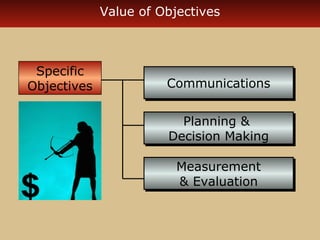
Value of Objectives 
CCoommmmuunniiccaattiioonnss 
Planning & 
Decision Making 
Measurement 
& Evaluation 
Specific 
Objectives
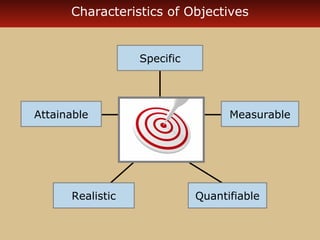
Characteristics of Objectives 
Specific 
Measurable 
Quantifiable 
Attainable 
Realistic
Measurable Results
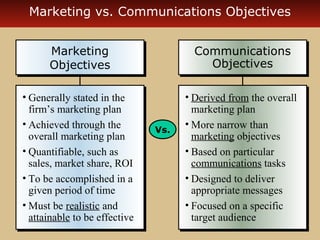
Marketing vs. Communications Objectives 
Marketing 
Objectives 
Marketing 
Objectives 
• Generally stated in the 
firm’s marketing plan 
• Achieved through the 
overall marketing plan 
• Quantifiable, such as 
sales, market share, ROI 
• To be accomplished in a 
given period of time 
•Must be realistic and 
attainable to be effective 
• Generally stated in the 
firm’s marketing plan 
• Achieved through the 
overall marketing plan 
• Quantifiable, such as 
sales, market share, ROI 
• To be accomplished in a 
given period of time 
•Must be realistic and 
attainable to be effective 
Communications 
Communications 
Objectives 
Objectives 
• Derived from the overall 
marketing plan 
•More narrow than 
marketing objectives 
• Based on particular 
communications tasks 
• Designed to deliver 
appropriate messages 
• Focused on a specific 
target audience 
• Derived from the overall 
marketing plan 
•More narrow than 
marketing objectives 
• Based on particular 
communications tasks 
• Designed to deliver 
appropriate messages 
• Focused on a specific 
target audience 
Vs.
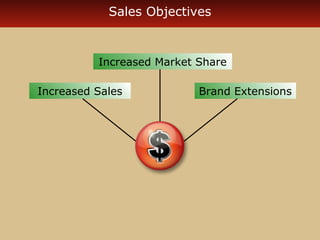
Sales Objectives 
Increased Market Share 
Increased Sales 
Brand Extensions
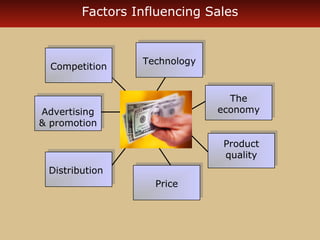
Factors Influencing Sales 
Competition Technology 
The 
economy 
Product 
quality 
Price 
Advertising 
& promotion 
Distribution
Where Sales Objectives are Appropriate
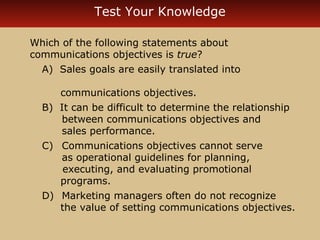
Test Your Knowledge 
Which of the following statements about 
communications objectives is true? 
A) Sales goals are easily translated into 
communications objectives. 
B) It can be difficult to determine the relationship 
between communications objectives and 
sales performance. 
C) Communications objectives cannot serve 
as operational guidelines for planning, 
executing, and evaluating promotional 
programs. 
D) Marketing managers often do not recognize 
the value of setting communications objectives.
IMC perspective Geico 
• Increases in Advertising 
– Sell via internet & direct sales 
– In 2005, increased advertising expenditures 75% 
to $403 million 
– In 2006, spent twice as much as nearest 
competitor 
– Also spent in more places 
• Increases in Sales 
– 5.8% new customer acquisition (2.1% is industry 
average) 
– 91% ad message recognition 
– Only brand to have double digit market share 
growth 13.1%
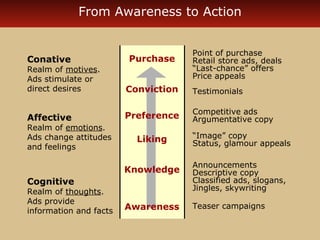
From Awareness to Action 
Conative 
Realm of motives. 
Ads stimulate or 
direct desires 
Affective 
Realm of emotions. 
Ads change attitudes 
and feelings 
Cognitive 
Realm of thoughts. 
Ads provide 
information and facts 
Point of purchase 
Retail store ads, deals 
“Last-chance” offers 
Price appeals 
Testimonials 
Competitive ads 
Argumentative copy 
“Image” copy 
Status, glamour appeals 
Announcements 
Descriptive copy 
Classified ads, slogans, 
Jingles, skywriting 
Teaser campaigns 
Purchase 
Conviction 
Preference 
Liking 
Knowledge 
Awareness
Creating an Image
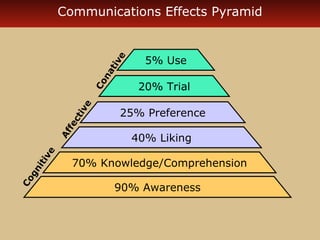
Communications Effects Pyramid 
20% Trial 
Conative 
25% Preference 
40% Liking 
Affective 
90% Awareness 
Cognitive 
5% Use 
70% Knowledge/Comprehension
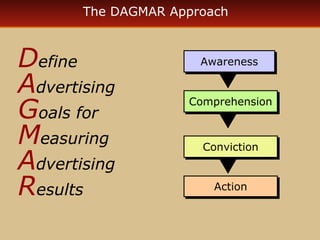
The DAGMAR Approach 
Define 
Advertising 
Goals for 
Measuring 
Advertising 
Results AAccttiioonn 
AAwwaarreenneessss 
CCoommpprreehheennssiioonn 
CCoonnvviiccttiioonn
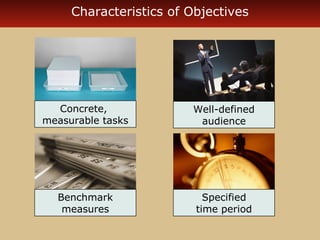
Characteristics of Objectives 
Concrete, 
measurable tasks 
Benchmark 
measures 
Well-defined 
audience 
Specified 
time period
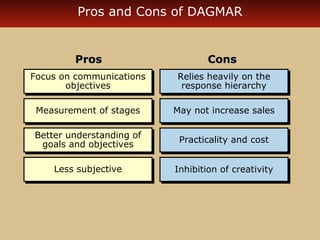
Pros and Cons of DAGMAR 
CCoonnss 
Relies heavily on the 
response hierarchy 
Relies heavily on the 
response hierarchy 
MMaayy nnoott iinnccrreeaassee ssaalleess 
PPrraaccttiiccaalliittyy aanndd ccoosstt 
IInnhhiibbiittiioonn ooff ccrreeaattiivviittyy 
PPrrooss 
Focus on communications 
objectives 
objectives 
MMeeaassuurreemmeenntt ooff ssttaaggeess 
Better understanding of 
goals and objectives 
Better understanding of 
goals and objectives 
LLeessss ssuubbjjeeccttiivvee
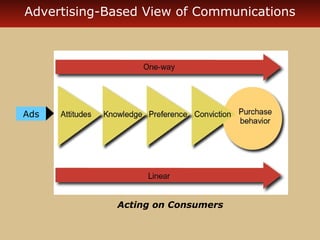
Advertising-Based View of Communications 
Acting on Consumers 
Ads
Utilizing a Variety of Media
San Diego Zoo Protect Endangered Species 
*Click outside of the video screen to advance to the next slide
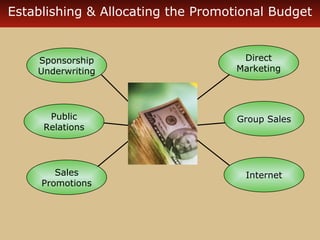
Establishing & Allocating the Promotional Budget 
Sponsorship 
Underwriting 
Public 
Relations 
Sales 
Promotions 
Direct 
Marketing 
Group Sales 
Internet
Test Your Knowledge 
In marginal analysis, all of the following should be 
considered except: 
A) Sales 
B) Fixed costs of advertising 
C) Advertising expenditures and other 
variable costs 
D) Gross margin 
E) Net worth
Establishing a Budget
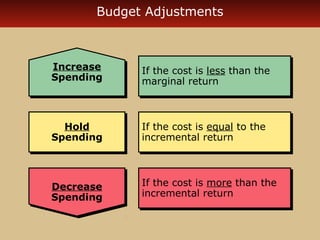
Budget Adjustments 
Increase 
Spending If the cost is less than the 
Increase 
Spending 
If the cost is less than the 
marginal return 
marginal return 
Hold 
Hold 
Spending 
Spending 
If the cost is equal to the 
incremental return 
If the cost is equal to the 
incremental return 
Decrease 
Spending 
Decrease 
Spending 
If the cost is more than the 
incremental return 
If the cost is more than the 
incremental return
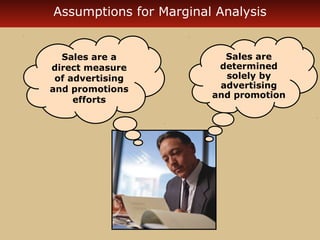
Assumptions for Marginal Analysis 
Sales are 
determined 
solely by 
advertising 
and promotion 
Sales are a 
direct measure 
of advertising 
and promotions 
efforts
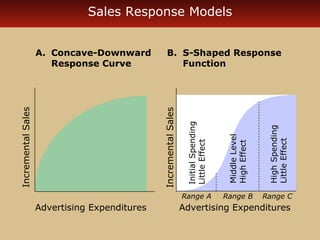
Sales Response Models 
Incremental Sales 
A. Concave-Downward 
Response Curve 
Advertising Expenditures 
B. S-Shaped Response 
Incremental Sales 
Function 
High Spending 
Little Effect 
Initial Spending 
Little Effect 
Middle Level 
High Effect 
Range A Range B Range C 
Advertising Expenditures
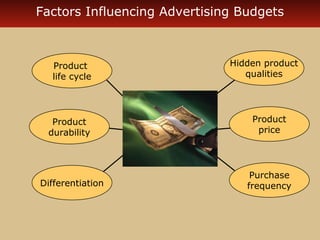
Factors Influencing Advertising Budgets 
Hidden product 
qualities 
Purchase 
frequency 
Product 
life cycle 
Product 
durability 
Differentiation 
Product 
price
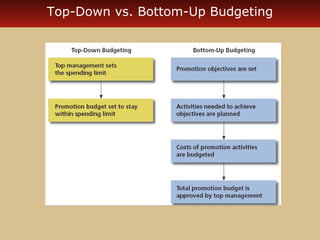
Top-Down vs. Bottom-Up Budgeting
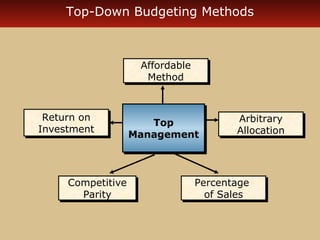
Top-Down Budgeting Methods 
Affordable 
Method 
Affordable 
Method 
Top 
Top 
Management 
Management 
Return on 
Investment 
Competitive 
Competitive 
Parity 
Parity 
Arbitrary 
Allocation 
Percentage 
of Sales 
Percentage 
of Sales 
Return on 
Investment 
Arbitrary 
Allocation
Test Your Knowledge 
Well known brand name products do not receive 
incremental advantages from increased dollar 
expenditures on advertising. Once the ad hits the 
market, subsequent budget increases result in little or 
no incremental gains. This is best explained by: 
A) Arbitrary allocation 
B) The objective and task method 
C) Competitive parity 
D) An S-shaped response 
E) Rapidly diminishing returns
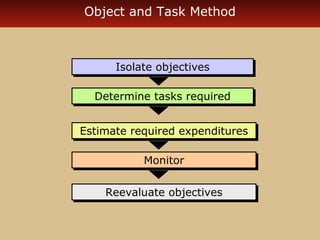
Object and Task Method 
IIssoollaattee oobbjjeeccttiivveess 
DDeetteerrmmiinnee ttaasskkss rreeqquuiirreedd 
EEssttiimmaattee rreeqquuiirreedd eexxppeennddiittuurreess 
MMoonniittoorr 
RReeeevvaalluuaattee oobbjjeeccttiivveess
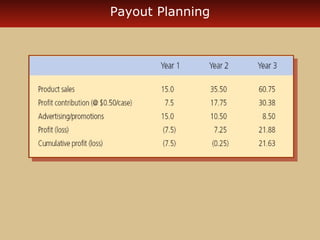
Payout Planning
Quantitative Models
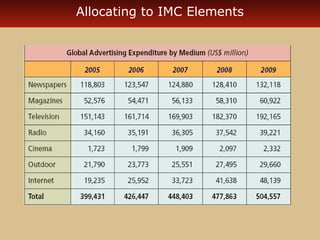
Allocating to IMC Elements
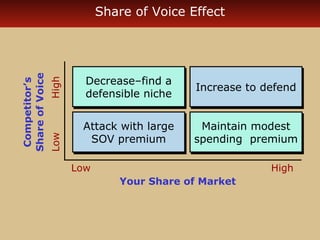
Share of Voice Effect 
Decrease–find a 
defensible niche IInnccrreeaassee ttoo ddeeffeenndd 
Decrease–find a 
defensible niche 
Attack with large 
SOV premium 
Attack with large 
SOV premium 
Maintain modest 
spending premium 
Maintain modest 
spending premium 
Competitor’s 
Share of Voice 
Low High 
Low High 
Your Share of Market
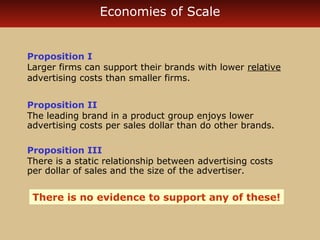
Economies of Scale 
Proposition I 
Larger firms can support their brands with lower relative 
advertising costs than smaller firms. 
Proposition II 
The leading brand in a product group enjoys lower 
advertising costs per sales dollar than do other brands. 
Proposition III 
There is a static relationship between advertising costs 
per dollar of sales and the size of the advertiser. 
There is no evidence to support any of these!
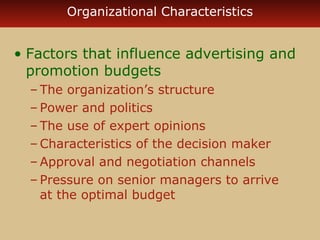
Organizational Characteristics 
• Factors that influence advertising and 
promotion budgets 
– The organization’s structure 
– Power and politics 
– The use of expert opinions 
–Characteristics of the decision maker 
–Approval and negotiation channels 
– Pressure on senior managers to arrive 
at the optimal budget

Chapter07

  • 1.
    Establishing Objectives andBudgeting for the Promotional Program 7 McGraw-Hill/Irwin Copyright © 2009 by The McGraw-Hill Companies, Inc. All rights reserved.
  • 2.
    Starbucks • Corecompetencies – Third Place – Neighborhood coffee shop • Failed Ventures – Joe magazine – Café Starbucks – Circadia • Losing focus – Hear Music – Akeelah and the Bee • Closing down stores
  • 3.
    Value of Objectives CCoommmmuunniiccaattiioonnss Planning & Decision Making Measurement & Evaluation Specific Objectives
  • 4.
    Characteristics of Objectives Specific Measurable Quantifiable Attainable Realistic
  • 5.
  • 6.
    Marketing vs. CommunicationsObjectives Marketing Objectives Marketing Objectives • Generally stated in the firm’s marketing plan • Achieved through the overall marketing plan • Quantifiable, such as sales, market share, ROI • To be accomplished in a given period of time •Must be realistic and attainable to be effective • Generally stated in the firm’s marketing plan • Achieved through the overall marketing plan • Quantifiable, such as sales, market share, ROI • To be accomplished in a given period of time •Must be realistic and attainable to be effective Communications Communications Objectives Objectives • Derived from the overall marketing plan •More narrow than marketing objectives • Based on particular communications tasks • Designed to deliver appropriate messages • Focused on a specific target audience • Derived from the overall marketing plan •More narrow than marketing objectives • Based on particular communications tasks • Designed to deliver appropriate messages • Focused on a specific target audience Vs.
  • 7.
    Sales Objectives IncreasedMarket Share Increased Sales Brand Extensions
  • 8.
    Factors Influencing Sales Competition Technology The economy Product quality Price Advertising & promotion Distribution
  • 9.
    Where Sales Objectivesare Appropriate
  • 10.
    Where Sales Objectivesare Appropriate
  • 11.
    Test Your Knowledge Which of the following statements about communications objectives is true? A) Sales goals are easily translated into communications objectives. B) It can be difficult to determine the relationship between communications objectives and sales performance. C) Communications objectives cannot serve as operational guidelines for planning, executing, and evaluating promotional programs. D) Marketing managers often do not recognize the value of setting communications objectives.
  • 12.
    IMC perspective Geico • Increases in Advertising – Sell via internet & direct sales – In 2005, increased advertising expenditures 75% to $403 million – In 2006, spent twice as much as nearest competitor – Also spent in more places • Increases in Sales – 5.8% new customer acquisition (2.1% is industry average) – 91% ad message recognition – Only brand to have double digit market share growth 13.1%
  • 13.
    From Awareness toAction Conative Realm of motives. Ads stimulate or direct desires Affective Realm of emotions. Ads change attitudes and feelings Cognitive Realm of thoughts. Ads provide information and facts Point of purchase Retail store ads, deals “Last-chance” offers Price appeals Testimonials Competitive ads Argumentative copy “Image” copy Status, glamour appeals Announcements Descriptive copy Classified ads, slogans, Jingles, skywriting Teaser campaigns Purchase Conviction Preference Liking Knowledge Awareness
  • 14.
  • 15.
    Communications Effects Pyramid 20% Trial Conative 25% Preference 40% Liking Affective 90% Awareness Cognitive 5% Use 70% Knowledge/Comprehension
  • 16.
    The DAGMAR Approach Define Advertising Goals for Measuring Advertising Results AAccttiioonn AAwwaarreenneessss CCoommpprreehheennssiioonn CCoonnvviiccttiioonn
  • 17.
    Characteristics of Objectives Concrete, measurable tasks Benchmark measures Well-defined audience Specified time period
  • 18.
    Pros and Consof DAGMAR CCoonnss Relies heavily on the response hierarchy Relies heavily on the response hierarchy MMaayy nnoott iinnccrreeaassee ssaalleess PPrraaccttiiccaalliittyy aanndd ccoosstt IInnhhiibbiittiioonn ooff ccrreeaattiivviittyy PPrrooss Focus on communications Focus on communications objectives objectives MMeeaassuurreemmeenntt ooff ssttaaggeess Better understanding of goals and objectives Better understanding of goals and objectives LLeessss ssuubbjjeeccttiivvee
  • 19.
    Advertising-Based View ofCommunications Acting on Consumers Ads
  • 20.
  • 21.
    San Diego ZooProtect Endangered Species *Click outside of the video screen to advance to the next slide
  • 22.
    Establishing & Allocatingthe Promotional Budget Sponsorship Underwriting Public Relations Sales Promotions Direct Marketing Group Sales Internet
  • 23.
    Test Your Knowledge In marginal analysis, all of the following should be considered except: A) Sales B) Fixed costs of advertising C) Advertising expenditures and other variable costs D) Gross margin E) Net worth
  • 24.
  • 25.
    Budget Adjustments Increase Spending If the cost is less than the Increase Spending If the cost is less than the marginal return marginal return Hold Hold Spending Spending If the cost is equal to the incremental return If the cost is equal to the incremental return Decrease Spending Decrease Spending If the cost is more than the incremental return If the cost is more than the incremental return
  • 26.
    Assumptions for MarginalAnalysis Sales are determined solely by advertising and promotion Sales are a direct measure of advertising and promotions efforts
  • 27.
    Sales Response Models Incremental Sales A. Concave-Downward Response Curve Advertising Expenditures B. S-Shaped Response Incremental Sales Function High Spending Little Effect Initial Spending Little Effect Middle Level High Effect Range A Range B Range C Advertising Expenditures
  • 28.
    Factors Influencing AdvertisingBudgets Hidden product qualities Purchase frequency Product life cycle Product durability Differentiation Product price
  • 29.
  • 30.
    Top-Down Budgeting Methods Affordable Method Affordable Method Top Top Management Management Return on Investment Competitive Competitive Parity Parity Arbitrary Allocation Percentage of Sales Percentage of Sales Return on Investment Arbitrary Allocation
  • 31.
    Test Your Knowledge Well known brand name products do not receive incremental advantages from increased dollar expenditures on advertising. Once the ad hits the market, subsequent budget increases result in little or no incremental gains. This is best explained by: A) Arbitrary allocation B) The objective and task method C) Competitive parity D) An S-shaped response E) Rapidly diminishing returns
  • 32.
    Object and TaskMethod IIssoollaattee oobbjjeeccttiivveess DDeetteerrmmiinnee ttaasskkss rreeqquuiirreedd EEssttiimmaattee rreeqquuiirreedd eexxppeennddiittuurreess MMoonniittoorr RReeeevvaalluuaattee oobbjjeeccttiivveess
  • 33.
  • 34.
  • 35.
  • 36.
    Share of VoiceEffect Decrease–find a defensible niche IInnccrreeaassee ttoo ddeeffeenndd Decrease–find a defensible niche Attack with large SOV premium Attack with large SOV premium Maintain modest spending premium Maintain modest spending premium Competitor’s Share of Voice Low High Low High Your Share of Market
  • 37.
    Economies of Scale Proposition I Larger firms can support their brands with lower relative advertising costs than smaller firms. Proposition II The leading brand in a product group enjoys lower advertising costs per sales dollar than do other brands. Proposition III There is a static relationship between advertising costs per dollar of sales and the size of the advertiser. There is no evidence to support any of these!
  • 38.
    Organizational Characteristics •Factors that influence advertising and promotion budgets – The organization’s structure – Power and politics – The use of expert opinions –Characteristics of the decision maker –Approval and negotiation channels – Pressure on senior managers to arrive at the optimal budget

Editor's Notes

  • #4 Relation to textThis slide relates to material on pp. 209-210 of the text. Summary OverviewThis chapter examines the nature and purpose of objects and the role they play in guiding the development, implementation, and evaluation of an IMC program. The value of setting objectives include the following: Communications – setting objectives facilitates the coordination of the various groups working on the campaign. Many problems can be avoided if all parties have written, approved objectives to guide their actions and serve as a common base for discussing issues related to the promotional program. Planning and decision-making – specific promotional objectives guide the development of the integrated marketing communications plan. Objectives also guide decisions regarding strategic and tactical issues, such as creative options, media selection, and budget allocation. Choices should be made based on how well a particular strategy matches the firm’s promotional objectives. Measurement and control – objectives provide a benchmark against which the success or failure of the promotional campaign can be measured. Most organizations are concerned about the return on their promotional investment; comparing actual performance against measurable objectives is the best way to determine if the return justifies the expense. Use of this slideThis slide can be used to introduce the importance of setting advertising and promotion objectives.
  • #5 Relation to textThis slide relates to material on p. 210 of the text. Summary OverviewThis slide summarizes the characteristics of good objectives, which should be specific, measurable, quantifiable (delineates target market and notes time frame), realistic, and attainable. Use of this slideThis slide can be used to discuss the various characteristics of good communication and promotional objectives. While the task of setting good objectives can be complex and difficult, it must be done properly as specific objectives are the foundation upon which all advertising and promotional decisions are made.
  • #6 Relation to textThis slide relates to page 209 and Exhibit 7-1 of the text. Summary OverviewMost organizations are concerned about the return on their promotional investment. However, this does not mean that the return is always higher sales. This ad, for instance, is designed to improve the public image of Ford by promoting its support in the fight against breast cancer. Use of this slideThis slide can be used as part of a discussion about the objectives of specific advertising campaigns and how ROI isn’t always measurable.
  • #7 Relation to textThis slide relates to material on pp. 210-211 of the text. Summary OverviewCommunications objects are not the same as marketing objectives. This slide summarizes the differences between the two. Marketing objectives Stated in the firm’s marketing plan Statements of what is to be accomplished by the overall marketing plan Measurable outcomes such as sales, market share, ROI over a specific period of time Must be realistic and attainable Communications objectives Derived from the overall marketing plan Generally more narrow than marketing objectives Based on the particular communications task required to deliver the appropriate messages to the target audience Are focused on a specific target audience Use of this slideThis slide can be used to discuss the differences between marketing and communications objectives.
  • #8 Relation to textThis slide relates to pp. 211-212 of the text. Summary OverviewThis slide shows that sales objectives, such as increased sales, increased market share, and resulting brand extensions, all have the overriding objective of increasing sales and profits. Use of this slideUse this slide to point out that sales objectives focus on a measurable objective, making more money, versus communications objectives, which may seek intangible results, such as improving the company’s image.
  • #9 Relation to textThis slide relates to material on pp. 212-214 and Figure 7-1. Summary OverviewIt is generally accepted that advertisers need to think about how a promotional program will influence sales. However, sales are a function of many factors, not just advertising and promotion. This chart shows the various factors that can affect sales. Use of this slideThis slide can be used to discuss marketers’ use of sales as a communications objective and how such sales are affected by more than the advertising campaign.
  • #10 Relation to textThis slide relates to pp. 214-215 of the text. Summary OverviewAlthough there can be many problems in using sales as an objective for a promotional campaign, in certain situations it is appropriate. To promote sales of the MINI automobile in the United States, MINIs were stacked on top of SUVs that toured the country to bring attention to the brand. Seats were also removed from sports stadiums, and MINIs were placed on display. Wallet cards were also handed out that encouraged interested parties to visit the MINIUSA.com website to create a personalized MINI and sign up to become a “MINI Insider.” These nontraditional, integrated advertising efforts translated into higher sales and thousands of pre-orders. Use of this slideUse this slide to facilitate a discussion of nontraditional, integrated advertising campaigns.
  • #11 Relation to textThis slide relates to pp. 214-215 of the text. Summary OverviewDirect response and retail ads often have sales objectives as well. Marketing and brand managers under pressure to show sales results often take a short-term perspective in evaluating advertising and sales promotion programs. They are often looking for a quick fix for declining sales or loss of market share. Campaigns and ad agencies may be changed if sales expectations are not being met, and many companies want agencies to accept incentive-based compensation systems tied to sales performance. Use of this slideThis slide can be used as part of a discussion about direct response and retail ads, as well as the consequences of not meeting sales expectations.
  • #12 Ans: B
  • #14 Relation to textThis slide relates to material on pp. 215-217 and Figure 7-2 of the text. Summary OverviewMarketers realize that they must provide relevant information and create favorable predispositions toward their brand before purchase behavior will occur. This slide shows the “hierarchy of effects” advertising model, which was developed by Lavidge and Steiner. The model shows the steps that consumers must move through before making a purchase. Examples of various types of promotion or advertising relevant to each step are shown on the right side of the slide. The left side of the slide shows the behavioral dimensions of a purchase decision, from thoughts to emotions to motives. Use of this slideThis slide can be used to explain the hierarchy of effects model and show the various steps consumers move through before making a purchase. The examples of the various types of promotion or advertising relevant to the various steps are included to show the promotional programs that can influence the consumers’ movement.
  • #15 Relation to textThis slide relates to material on pp. 215-217 and Figure 7-7 of the text. Summary OverviewThis ad for Philips is designed to inform consumers of the company’s focus on technology that makes sense and is simple. While there is no call for immediate action, the ad creates favorable impressions about the company by creating a distinct image. Consumers will consider this image when they enter the market for products in this category. Use of this slideThis slide can be used to discuss how some advertisements do not require immediate action on the part of the consumer, but encourage consumers to consider the brand when they enter the market for products in this category.
  • #16 Relation to textThis slide relates to material on pp. 217-218 and Figure 7-3 of the text. Summary OverviewThis slide shows the communications effects pyramid. It shows that advertising and promotion perform communications tasks in the same way a pyramid is built, by first accomplishing lower-level objectives, such as increasing consumer awareness and knowledge. Subsequent tasks involve moving consumers who are aware of or knowledgeable about the product or service to higher levels in the pyramid. The stages at the base of the pyramid are easier to accomplish than those toward the top, such as trial and repurchase or regular use. Thus, the percentage of prospective customers declines as they move up the pyramid. Use of this slideThis slide can be used to discuss the effects of communications. Marketing communications are designed to move customers from awareness to purchase, but it will not happen immediately. Therefore, advertisers set their communications objectives in relation to where the target audience lies, with respect to the various blocks of the pyramid. Refer to Figure 7-4 of the text for an example of how the communications effects pyramid can be used to set objectives.
  • #17 Relation to textThis slide relates to material on p. 220 of the text, which discusses the DAGMAR approach to setting objectives. Summary OverviewIn 1961, Russell Colley prepared a report for the Association of National Advertisers titled Defining Advertising Goals for Measured Advertising Results. In it, Colley developed a model for setting advertising objectives and measuring the results of an ad campaign that became known by its acronym. Colley proposed that the communications task be based on a hierarchical model of the communications process, with four stages: Awareness… making the consumer aware of the existence of the brand or company. Comprehension… developing an understanding of what the product is and what it will do for the consumer Conviction… developing a mental disposition in the consumer to buy the product. Action… getting the consumer to purchase the product. Many promotional planners use this model as a basis for setting objectives and assessing the effectiveness of promotional campaigns. Use of this slideThis slide can be used to introduce the DAGMAR model and the value of setting specific communications objectives.
  • #18 Relation to textThis slide relates to pp. 220-222 of the text. Summary OverviewThe DAGMAR model argues that advertising objectives should be stated in terms of: Concrete and measurable communications tasks A specific target audience A benchmark starting point and degree of change sought, and A specified time period for accomplishing the objectives Use of this slideUse this slide to introduce the second major contribution of DAGMAR to the advertising planning process… a definition of what constitutes a good objective.
  • #19 Relation to textThis slide relates to material on pp. 222-207 of the text. Summary OverviewThis slide summarizes the positive influence DAGMAR has had on the advertising industry, plus the criticisms by some in the advertising field. From a positive standpoint, DAGMAR focuses advertisers’ attention on the value of using communications-based objectives, rather than sales-based objectives, to measure advertising effectiveness. It also encourages the measurement of stages in the response hierarchy to assess a campaign’s impact, and provides a better understanding of the goals and objectives toward which planners’ efforts should be directed. This results in less subjectivity and leads to better communication and relationships between client and agency. From a negative standpoint, the DAGMAR approach relies heavily on the hierarchy of the effect model, and consumers do not ways follow this sequence of communications effects before making a purchase. Further, some argue that the only relevant measure of advertising objectives is sales; they have little tolerance for ad campaigns that achieve communications objectives but fail to stimulate sales. Other critics argue that DAGMAR is practical only for large companies with large advertising budgets, because it takes expensive research to establish quantitative benchmarks and measure changes in the response hierarchy. A final criticism is that DAGMAR inhibits advertising creativity by imposing too much structure. Use of this slideThis slide can be used to discuss the pros and cons of using DAGMAR. The DAGMAR process has considerable influence on the advertising planning process, but it has not been totally accepted by everyone in the advertising field.
  • #20 Relation to textThis slide relates to material on pp. 224-226 and Figure 7-7 of the text. Summary OverviewThis slide is a chart showing a traditional advertising-based view of marketing communications. This approach is based on a hierarchical response model and considers how marketers can develop and disseminate advertising messages to move consumers along an effects path. It is also known as inside-out planning. The focus is on what the marketer wants to say, when the marketer wants to say it, about things the marketer believes are important about the brand, and in the media forms the marketer wants to use. Use of this slideThis slide can be used to discuss the traditional advertising-based view of marketing communications. The focus of this planning process is communicating with the target audience by using the traditional hierarchy of response model, with the goal of moving the consumer along the pathway towards purchase. An alternative to this approach is called zero-based communications planning, which involves determining what tasks need to be done, which marketing communications functions should be used, and to what extent.
  • #21 Relation to textThis slide relates to pp. 224-226 of the text. Summary OverviewA promotional planner should determine what role various promotion techniques, publicity, public relations, direct marketing, and personal selling will play in the overall marketing program, and how they will interact with advertising, as well as with one another. The marketing communications program for the San Diego Zoological Society has multiple objectives. First, it must provide funding for the society’s programs and maintain a large and powerful base of supporters for financial and political strength. It must educate the public about the society’s programs, and maintain a favorable image on a local, regional, national, and international level. Another major objective is to draw visitors. To achieve these objectives, the society’s IMC program employs a variety of integrated marketing communication tools, including the website shown on this slide. Use of this slideUse this slide and the next to facilitate a discussion of how the San Diego Zoological Society uses a variety of IMC tools to promote its two major attractions.
  • #22 Relation to text This slide relates to pp. 224-226 of the text. Summary Overview This slide contains a commercial for the San Diego Zoological Society, the organization that operates the San Diego Zoo and Wild Animal Park. The Society’s extensive IMC program includes public relations and cause-related marketing. This commercial is part of the Society’s support of the cause to save endangered species by creating public awareness of the problem. The TV spot was actually run as a PSA (public service announcement) and supported by print and radio PSAs as well. Use of this slide This slide can be used to demonstrate the type of public relations efforts engaged in by a major organization, such as the San Diego Zoological Society. The protection of endangered species is obviously an appropriate cause for the Society to promote, and they have been very successful in increasing the public’s awareness of this important issue.
  • #23 Relation to textThis slide relates to material on p. 226 and Figure 7-8 of the text. Summary OverviewThis slide introduces the topic of promotional budget allocation. Promotional programs are often thought of only in terms of how much money is going to be spent. We don’t often think of how the monies will be allocated, or about the recipients of these dollars. Use of this slideThis slide can be used as an introduction to the budgeting process.
  • #24 Ans: E
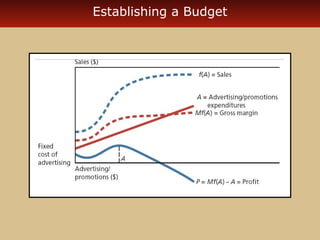
  • #25 Relation to textThis slide relates to material on pp. 226-228 and Figure 7-9 of the text. Summary OverviewThis slide shows a graphical representation of the concept of marginal analysis. As advertising and promotion expenditures increase, sales and gross margins also increase to a point, but then level off. Profits are a result of the gross margin minus advertising expenditures. According to this concept, a firm would continue to spend advertising dollars as long as the revenues created by the expenditures exceeded the advertising costs. As shown on the graph, the optimal expenditure level is the point at which costs equal the revenues they generate (point A). Use of this slideThis slide can be used to introduce the concept of marginal analysis and how it relates to the advertising budgeting process.
  • #26 Relation to textThis slide relates to material on pp. 226-228 and Figure 7-9 of the text. Summary OverviewIf advertising expenditures are greater than the revenues generated by the ads, the budget should be scaled down. If revenues are higher, a larger budget may be in order. Although this budgeting method seems logical, certain weaknesses limit its usefulness. These weaknesses include the assumptions that: Sales are a direct result of advertising and promotional expenditures and can be measured Advertising and promotion are solely responsible for sales The difficulty of determining the effects of the promotional effort on sales and revenues also limits its applicability. Use of this slideThis slide can be used as a continuation of the discussion on establishing and adjusting advertising budgets.
  • #27 Relation to textThis material relates to material on pp. 227-228 of the text. Summary OverviewThis slide summarizes two basic assumptions of marginal analysis that must be considered when using the concept to determine the advertising budget. These assumptions are as follows: Sales are a direct result of advertising and promotional expenditures and nothing else. Many marketers feel that it is very difficult to measure the influence of advertising on sales which limits the value of marginal analysis. Advertising and promotion are rarely the only factors that are responsible for sales as other elements of the marketing mix including product/service factors, price, and distribution all contribute to the success of the company. Sales are the principal objective of advertising and promotion. Marginal analysis assumes that sales are the principal objective of advertising and promotion. As discussed in this chapter, marketers can have a variety of other objectives for their advertising and promotion programs. Use of this slideThis slide can be used to show the basic assumptions related to the use of marginal analysis as an advertising budgeting method. Because of the difficulties associated with marginal analysis, it is seldom used as a basis for budgeting (except for direct-response advertising).
  • #28 Relation to textThis slide relates to material on page 228-229 and Figure 7-10 of the text. Summary OverviewThis slide show two models of the advertising/sales response function. A lot of research and discussion has gone into trying to determine the true relationship between advertising and sales and the shape of the response curve. Most advertisers subscribe to one of two models of the advertising/sales response function: The concave-downward function, which assumes that the effects of advertising spending follow the microeconomic law of diminishing returns. That is, as the amount of advertising increases, its incremental value decreases. The logic is that those with the greatest potential to buy will likely act on the first (or earliest) exposures, while those less likely to buy are not likely to change as a result of the advertising. The S-shaped response function, which assumes that initial outlays of the advertising budget have little impact (range A). However, after a certain budget level has been reached (range B) advertising and promotional efforts begin to have an effect, and additional increments of expenditures result in increased sales. When advertising expenditures enter range C, however, incremental spending will have little additional impact on sales. Use of this slideThis slide can be used to explain the two models of the advertising sales/response function. Although there are some weaknesses associated with these models, they do provide managers with a theoretical basis of how the relationship between advertising spending and sales might work.
  • #29 Relation to textThis slide relates to pp. 229-230 of the text, and Figure 7-11. Summary OverviewThis slide shows some of the additional factors that should be considered when establishing ad advertising budget. In one comprehensive study, more than 20 variables were shown to affect the advertising/sales ratio. For example, products characterized as large-dollar purchase and those in the maturity or decline stages of the product would be less likely to benefit from an advertising campaign. Use of this slideUse this slide to introduce some of the additional factors that should be considered when making budget appropriation decisions.
  • #30 Relation to textThis slide relates to pp. 230-231 of the text, and Figure 7-13. Summary OverviewThis slide outlines the top-down and bottom-up approaches to budgeting. In the top-down approach, a budget is established by management and then the monies are allocated to the various departments. The goal of this method is usually to insure that the promotional budget stays within the limits set by upper management. Spending levels are essentially predetermined and have no true theoretical basis. With a bottom-up approach, the budget is based on consideration of the firm’s pre-determined communications objectives. The primary advantage of this approach is that the budget is driven by the objectives to be attained, rather than the predetermined amount management is willing to spend. Use of this slideThis slide can be used to introduce top-down and bottom-up budgeting methods.
  • #31 Relation to textThis slide relates to material on pp. 231-237 of the text. Summary OverviewThis slide shows the various top-down budgeting methods. They are: Affordable method – the firm determines the amount to be spent on the various areas such as production and operations and then allocates what is left to advertising and promotion. Arbitrary allocation – budget is set by management based on what is felt to be necessary. No theoretical basis underlies the budgeting process. Percentage of sales – advertising and promotion budget is based on the sales of product. Determined by taking either a percentage of actual sales, or anticipated revenue from sales. Competitive parity – setting budgets on the basis of what competitors spend. Usually accomplished by matching the same percentage of sales expenditures as competitors. Return on investment – advertising and promotions are considered investments, and the budget appropriation is based on the returns the company feels it will generate from advertising Studies have shown the percentage of sales and arbitrary method to be most popular. Use of this slideThis slide can be used to discuss top-down budgeting methods. Although these methods have advantages and disadvantages, they are popular because of tradition and top managements’ desire for control.
  • #32 Ans: E
  • #33 Relation to textThis slide relates to material on pp. 237-240 of the text. Summary OverviewThis slide outlines the steps of the objective and task method of budgeting, which reflects a bottom-up approach. The specific steps include: Isolate objectives – a company will have two sets of objective to accomplish… the marketing objectives and the communications objectives. After the marketing objectives are established, the specific communications objectives that will accomplish the marketing objectives must be determined. Determine specific tasks – determine the specific tasks needed to accomplish the communication objectives. May include advertising in various media, sales promotions, and/or other elements of the promotional mix. Estimate required expenditures – using build-up analysis, determine the estimated costs associated with the tasks developed in the previous step. Monitor – performance should be monitored and evaluated in light of the budget appropriated. Reevaluate objectives – once specific objectives have been attained, monies may be better spent on new goals. Use of this slideThis slide can be used to discuss the objective and task method of setting the advertising and promotion budget. The main advantage of using this approach is that the budget is driven by the objectives to be attained rather than some predetermined amount management is willing to spend. A disadvantage of this method is the difficulty in determining which tasks will be required and the costs associated with each.
  • #34 Relation to textThis slide relates to page 240 of the text, and Figure 7-21. Summary OverviewThe first months of a new product’s introduction typically require heavier-than-normal advertising and promotion to stimulate product awareness and subsequent trial. To determine how much to spend, marketers often develop a payout plan that projects the revenues the product will generate, as well as the costs it will incur, over two to three years. A three-year payout plan is shown on this slide. The product will lose money in year 1, almost break even in year 2, and show a profit by the end of year 3. Note that the cost of advertising and promotion is highest in year 1, and declines in years 2 and 3. Use of this slideThis slide can be used to introduce the topic of payout planning.
  • #35 Relation to textThis slide relates to pp. 240-241 of the text. Summary OverviewAttempts to apply quantitative models to budgeting have had limited success. Generally, these methods employ computer simulation models involving statistical techniques, such as multiple regression analysis, to determine the relative contribution that the advertising budget is making to sales. Because of problems associated with these methods, their acceptance has been limited. As these methods are improved and refined, they may achieve more widespread success. Use of this slideUse this slide to point out that quantitative budgeting models are available, but are not in widespread use.
  • #36 Relation to textThis slide relates to material on pp. 242-243 and Figure 7-23 of the text. Summary OverviewThis slide shows how advertising expenditures were allocated in 2005, with projections through 2009. Note that while various media will experience gains and losses, all are expected to gain in total dollars spent. Rapidly rising media costs, the ability of sales promotions to motivate product trial, maturing of the product and/or brand, and the need for more aggressive promotional tools can also lead to shifts in strategy and expenditures. Other factors that may influence budget allocation include client/agency policies, market size, market potential, and market share goals. Use of this slideThis slide can be used to discuss how advertisers distribute their funds among the various advertising venues, and how those allocations are expected to shift over time.
  • #37 Relation to textThis slide relates to material on pp. 244-245 and Figure 7-25 of the text. Summary OverviewThis chart outlines strategies for advertising spending based on a company or brand’s market share and a competitor’s share-of-voice (SOV). Share-of-voice refers to a company or brand’s percentage of the advertising messages, compared to all of the advertising messages for that product or service. Recommended spending strategies shown in the chart are based on different market share and share of voice scenarios, and suggest the following: When market share is high and competitor’s SOV is high, increase to defend market share When market share is high and competitor’s SOV is low, maintain a modest spending premium to hold market share When market share is low and a competitor’s SOV is high, decrease overall spending and find a defensible market niche When market share is low and competitor’s SOV is low, attack with a large SOV premium to increase market share Use of this slideThis slide can be used to discuss the various ad spending strategies available to marketers given their market share and competitor’s share-of voice.
  • #38 Relation to textThis slide relates to material on p. 245 of the text. Summary OverviewSome studies propose that firms and/or brands maintaining a large share of the market have an advantage over smaller competitors. Thus, they can spend less money on advertising and realize a better return. Larger advertisers get better advertising rates, have declining production costs, and can advertise several products jointly. They are also more likely to enjoy more favorable time and space positions, cooperation of middlepersons, and favorable publicity. Kent Lancaster found that this theory does not hold true, and that larger brand share products might actually be at a disadvantage. The leading brands spend on average of 2.5% more than their brand share on advertising. Use of this slideThis slide can be used to introduce the concept of economies of scale in advertising. Despite some evidence supporting the notion of economies of scale in advertising, most research has concluded that there are no real economies of scale to be accrued from the size of the firm or the market share of the brand.
  • #39 Relation to textThis slide relates to pp. 245-246 of the text. Summary OverviewIn a review of the literature on how allocation decisions are made between advertising and sales promotion, George Low and Jakki Mohr concluded that organizational factors play a role in how communications dollars are spent. These factors vary from one organization to another, and each influences the amount assigned to advertising and promotion. Use of this slideUse this slide to present the organizational characteristics that have an impact on the allocation of an advertising and communications budget.