Identifying Market
Segments and Targets
Chapter Objectives
• ‘Market Segmentation and its benefits/ limitations
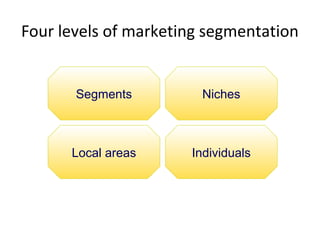
• Four levels of marketing segmentation
• Segmenting Consumer market
• Segmenting business market
• Steps in Segmentation Process
• Requirements for Effective Segmentation
• Target marketing
• Market Targeting Strategies
• Managing multiple segments
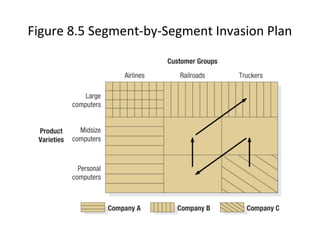
• Segment-by-Segment Invasion PlanCopyright © 2011 Pearson Education,
Inc. Publishing as Prentice Hall
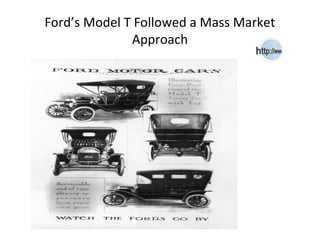
Ford’s Model T Followed a Mass Market
Approach
Baby Boomers: A Lucrative Market
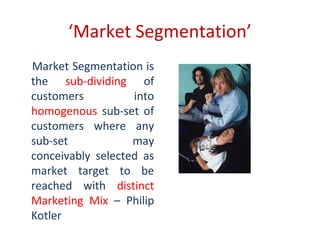
‘Market Segmentation’
Market Segmentation is
the sub-dividing of
customers into
homogenous sub-set of
customers where any
sub-set may
conceivably selected as
market target to be
reached with distinct
Marketing Mix – Philip
Kotler
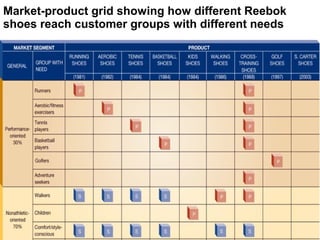
Market-product grid showing how different Reebok
shoes reach customer groups with different needs
Benefits and Limitations
Benefits:
The Organisation gets to know its customers better.
Provides guidelines for resource allocation.
It helps focus the strategy of the organisation.
Limitations:
Targeting multiple segments increases marketing
costs.
Segmentation can lead to proliferation of products.
Narrowly segmenting a market can hamper the
development of broad-brand equity.
When to Segment Markets
When the expected gain in sales is larger
than the expense of the process
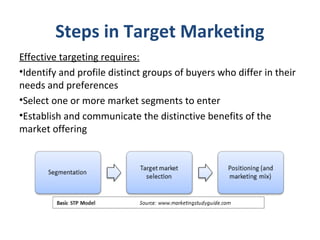
Steps in Target Marketing
Effective targeting requires:
•Identify and profile distinct groups of buyers who differ in their
needs and preferences
•Select one or more market segments to enter
•Establish and communicate the distinctive benefits of the
market offering
Mass Marketing
Companies have not always practiced
target marketing.
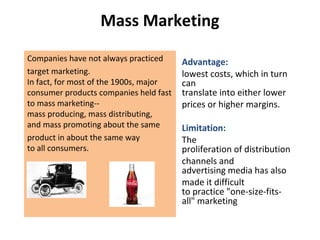
In fact, for most of the 1900s, major
consumer products companies held fast
to mass marketing--
mass producing, mass distributing,
and mass promoting about the same
product in about the same way
to all consumers.
Advantage:
lowest costs, which in turn
can
translate into either lower
prices or higher margins.
Limitation:
The
proliferation of distribution
channels and
advertising media has also
made it difficult
to practice "one-size-fits-
all" marketing
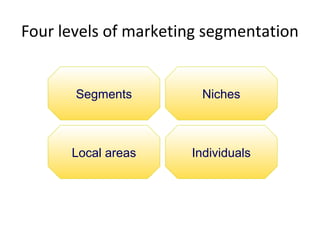
Four levels of marketing segmentation
Segments
Local areas Individuals
Niches
Segment Marketing
A company that practices segment
marketing isolates broad segments that
make up a
market and adapts its offers to more
closely match the needs of one or more
segments.
Marriott markets to
a variety of segments
business travelers, families, and
others--
with packages adapted to their varying
needs.
Advantage:
•can market more efficiently,
Targeting
its products or services,
channels, and
communications programs towa
rd only
consumers that it can serve best
and most profitably.
• fewer competitors.
Examples of Segmented Marketing
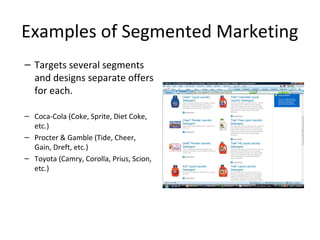
– Targets several segments
and designs separate offers
for each.
– Coca-Cola (Coke, Sprite, Diet Coke,
etc.)
– Procter & Gamble (Tide, Cheer,
Gain, Dreft, etc.)
– Toyota (Camry, Corolla, Prius, Scion,
etc.)
Niche marketing
Niche marketing focuses on 
subgroups within these segments. A niche is 
a more narrowly defined group, usually 
identified by dividing a segment into sub segments 
or  by defining a group with a distinctive set of 
traits who may seek a special combination of benefits. 
Whereas segments are fairly large and 
normally attract several competitors, niches are smaller a
nd normally attract only one  or  a few 
competitors. Niche marketers presumably 
understand their niches' needs so well that their 
customers willingly pay a price premium
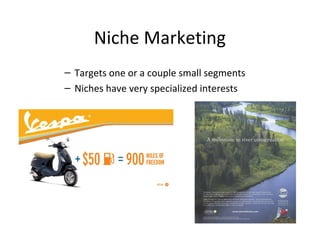
Niche Marketing
– Targets one or a couple small segments
– Niches have very specialized interests
Example of niche marketing
• For example, there is a sales training expert in America who 
teaches  financial  planners  how  to  generate  referrals  from 
customer  at  the  close  of  the  selling  process.  Therefore,  he 
specializes in one minor part of the sales process only.
• Some non-traditional schools and other education providers 
could  be  considered  niche  marketers.  For  example,  the 
Montessori school  system  appeals  to  a  small  proportion  of 
parents,  and  the  Montessori  offering  is  virtually  the  only 
alternative  for  parents  who  do  not  want  a 
structured/traditional education process for their kids.
• Restaurant for gun holder.
 Micro Marketing
Micro marketing  is the practice of tailoring products and 
marketing programs to suit the tastes of specific individuals and locations. 
Micro marketing includes local marketing  and Individual marketing.
Local Marketing:
Local marketing involves tailoring bran
ds and promotions to the needs 
and wants  of  local  customer groups--
cities, neighborhoods, and even specif
ic stores. 
Progoti  Exchange 
provides different mixes of 
exchange services in 
its branches depending on 
neighborhood demographics
Individual Marketing:
individual marketing refers 
to tailoring products and 
marketing programs to the 
needs and preferences of
 individual customers.
Example: IKEA home 
renovation, consultancy 
services.
Four levels of marketing segmentation
Segments
Local areas Individuals
Niches
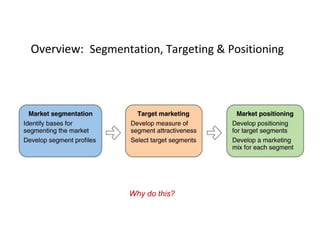
Why do this?
Overview:  Segmentation, Targeting & Positioning
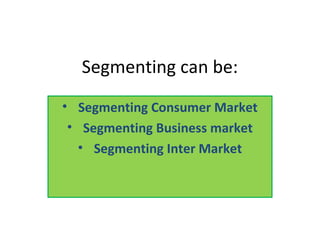
Segmenting can be:
• Segmenting Consumer Market
• Segmenting Business market
• Segmenting Inter Market
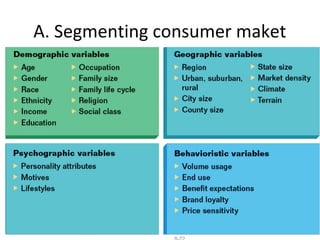
A. Segmenting consumer maket
Copyright © 2011 Pearson Education,
Inc. Publishing as Prentice Hall
Geographic Segmentation: 
Geographic  segmentation 
divides  the  market  into 
geographical units such as 
nations,  states,  regions, 
counties,  cities,  or 
neighborhoods.  The 
company  can  operate  in 
one  or  a  few  areas,  or  it 
can operate in all but pay 
attention  to  local 
variations. 
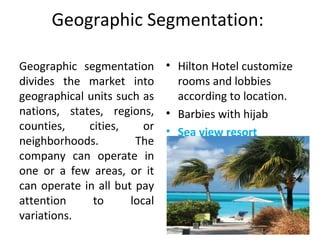
• Hilton Hotel customize 
rooms and lobbies 
according to location.
• Barbies with hijab
• Sea view resort
2. Demographic Segmentation
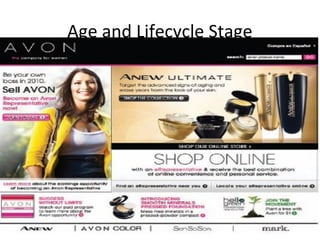
• Age and life cycle: Crystler
• Life stage: Newlyweds
• Gender: cosmetics, tv channels, magazines.
• Income: Mobile, clothing, financial services
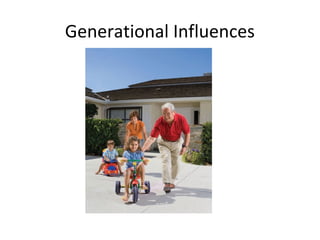
• Generation: Toyota Scion targets Gen Y customers
• Social class: Tiffany, Burberry, Tag Huere.
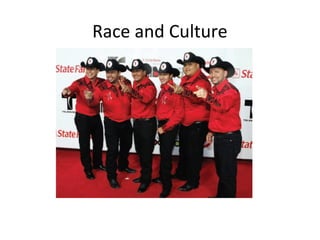
• Race and Culture: Alam, Ritaz.
Age and Lifecycle Stage
Gender and Income
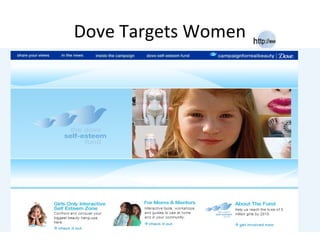
Dove Targets Women
Women above 30 years
Generational Influences
Race and Culture
3. Psychographic Segmentation
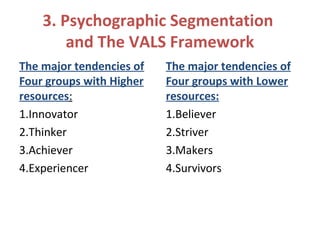
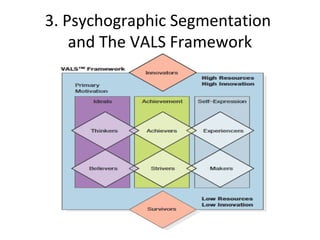
and The VALS Framework
The major tendencies of
Four groups with Higher
resources:
1.Innovator
2.Thinker
3.Achiever
4.Experiencer
The major tendencies of
Four groups with Lower
resources:
1.Believer
2.Striver
3.Makers
4.Survivors
3. Psychographic Segmentation
and The VALS Framework
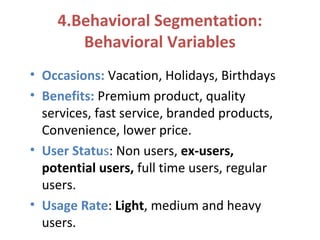
4.Behavioral Segmentation:
Behavioral Variables
• Occasions: Vacation, Holidays, Birthdays
• Benefits: Premium product, quality
services, fast service, branded products,
Convenience, lower price.
• User Status: Non users, ex-users,
potential users, full time users, regular
users.
• Usage Rate: Light, medium and heavy
users.
4. Behavioral Segmentation:
Behavioral Variables
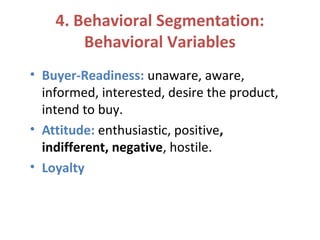
• Buyer-Readiness: unaware, aware,
informed, interested, desire the product,
intend to buy.
• Attitude: enthusiastic, positive,
indifferent, negative, hostile.
• Loyalty
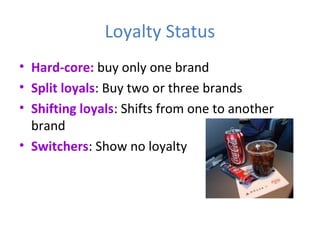
Loyalty Status
• Hard-core: buy only one brand
• Split loyals: Buy two or three brands
• Shifting loyals: Shifts from one to another
brand
• Switchers: Show no loyalty
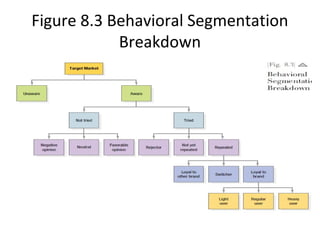
Figure 8.3 Behavioral Segmentation
Breakdown
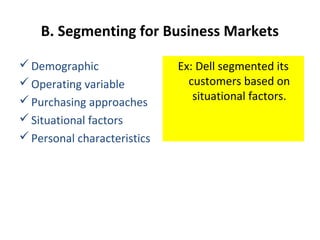
B. Segmenting for Business Markets
Demographic
Operating variable
Purchasing approaches
Situational factors
Personal characteristics
Ex: Dell segmented its
customers based on
situational factors.
Market Segmentation
Intermarket segmentation divides consumers
into groups with similar needs and
buying behaviors even though they
are located in different countries
Example: Economy and luxury cars.
7-23
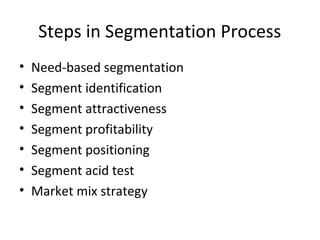
Steps in Segmentation Process
• Need-based segmentation
• Segment identification
• Segment attractiveness
• Segment profitability
• Segment positioning
• Segment acid test
• Market mix strategy
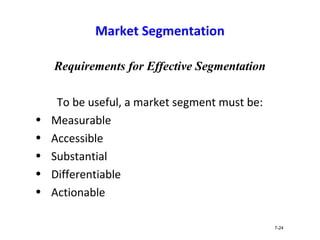
Market Segmentation
Requirements for Effective Segmentation
To be useful, a market segment must be:
• Measurable
• Accessible
• Substantial
• Differentiable
• Actionable
7-24
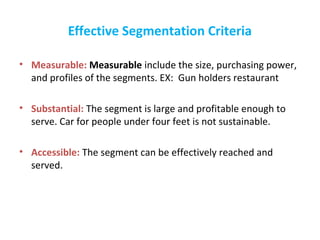
Effective Segmentation Criteria
• Measurable: Measurable include the size, purchasing power,
and profiles of the segments. EX: Gun holders restaurant
• Substantial: The segment is large and profitable enough to
serve. Car for people under four feet is not sustainable.
• Accessible: The segment can be effectively reached and
served.
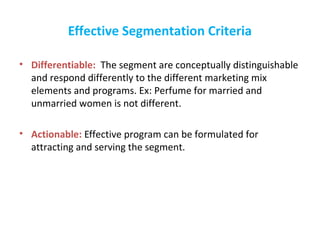
Effective Segmentation Criteria
• Differentiable: The segment are conceptually distinguishable
and respond differently to the different marketing mix
elements and programs. Ex: Perfume for married and
unmarried women is not different.
• Actionable: Effective program can be formulated for
attracting and serving the segment.
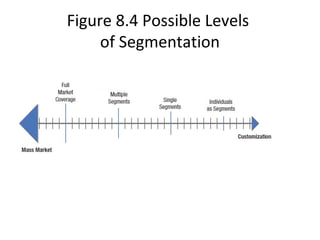
Figure 8.4 Possible Levels
of Segmentation
• Target Marketing-
• Is a market segmentation and market coverage strategy
whereby a product is developed and marketed for a
very well-defined, specific segment of the consumer
population.
• Target marketing is particularly effective for small
companies with limited resources because it enables
the company to achieve a strong market position in the
specific market segment it serves without mass
production, mass distribution, or mass advertising. It
enables firms to capitalize on the respective serve
market share
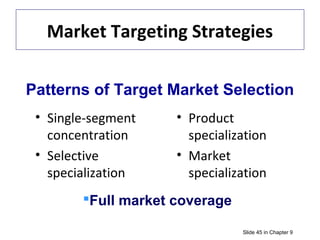
Market Targeting Strategies
• Single-segment
concentration
• Selective
specialization
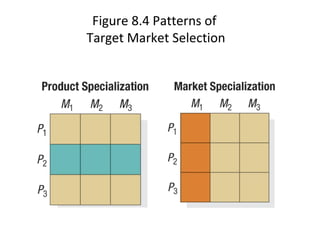
• Product
specialization
• Market
specialization
Slide 45 in Chapter 9
Patterns of Target Market Selection
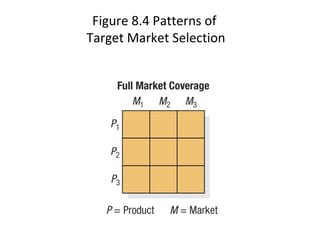
Full market coverage
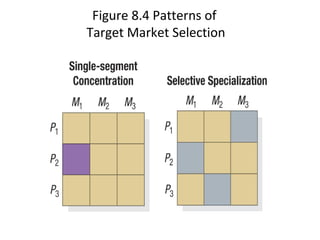
Figure 8.4 Patterns of
Target Market Selection
Crest Whitestrips Follows a Multisegment
Strategy
Figure 8.4 Patterns of
Target Market Selection
Figure 8.4 Patterns of
Target Market Selection
Managing multiple segments
• The best way to manage multiple segments is
to appoint segment manager with sufficient
authority and responsibility for building a
segments business.
Market Targeting Strategies
• Targeting multiple segments may result in
cost economies
• Supersegment targeting may be appropriate
• Blocked markets often require
megamarketing countermeasures
• Be aware of ethical concerns
Slide 51 in Chapter 9
Figure 8.5 Segment-by-Segment Invasion Plan
For Review
1. What is market segmentation. Describe its benefits
and limitations.
2. Describe Four levels of marketing segmentation
1. Describe the criteria necessary for effective
segmentation.
2. Explain each of the four bases for segmenting
consumer markets.
3. Identify the steps in the market segmentation
process.
4. Define target marketing. Discuss four basic strategies
for reaching target markets.
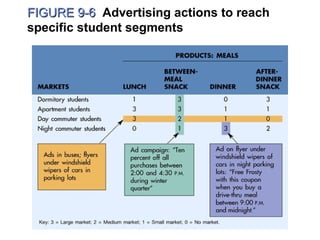
FIGURE 9-6FIGURE 9-6 Advertising actions to reach
specific student segments

Segmentation and targeting

Editor's Notes

  • #5 1946 – 1964 baby boomers are now the senior and rich people who mainly emphasise on travelling. So they are the lucrative market for tourism. Which strategy is good?
  • #6 Market segmentation divides a market into well-defined slices. A market segment consists of a group of customers who share a similar set of needs and wants. The marketer’s task is to identify the appropriate number and nature of market segments and decide which one(s) to target. We use two broad groups of variables to segment consumer markets. Some researchers try to define segments by looking at descriptive characteristics: geographic, demographic, and psychographic. Then they examine whether these customer segments exhibit different needs or product responses. For example, they might examine the differing attitudes of “professionals,”“blue collars,” and other groups toward, say, “safety” as a car benefit. Other researchers try to define segments by looking at behavioral considerations, such as consumer responses to benefits, usage occasions, or brands.
  • #24 Geographic segmentation divides the market into geographical units such as nations, states, regions, counties, cities, or neighborhoods. The company can operate in one or a few areas, or it can operate in all but pay attention to local variations. In that way it can tailor marketing programs to the needs and wants of local customer groups in trading areas, neighborhoods, even individual stores.
  • #25 In demographic segmentation, we divide the market on variables such as age, family size, family life cycle, gender, income, occupation, education, religion, race, generation, nationality, and social class. One reason demographic variables are so popular with marketers is that they’re often associated with consumer needs and wants. Another is that they’re easy to measure. Even when we describe the target market in nondemographic terms (say, by personality type), we may need the link back to demographic characteristics in order to estimate the size of the market and the media we should use to reach it efficiently.
  • #26 Consumer wants and abilities change with age. People in the same part of the life cycle may still differ in their life stage. Life stage defines a person’s major concern, such as going through a divorce, going into a second marriage, taking care of an older parent, deciding to cohabit with another person, deciding to buy a new home, and so on. These life stages present opportunities for marketers who can help people cope with their major concerns
  • #27 Men and women have different attitudes and behave differently, based partly on genetic makeup and partly on socialization. Women tend to be more communal-minded and men more self-expressive and goal-directed; women tend to take in more of the data in their immediate environment and men to focus on the part of the environment that helps them achieve a goal. A research study examining how men and women shop found that men often need to be invited to touch a product, whereas women are likely to pick it up without prompting. Men often like to read product information; women may relate to a product on a more personal level. Victoria’s Secret studied women and learned that while women need underwear, they want lingerie. It went on to develop the retail chain very successfully based on this insight. Income segmentation is a long-standing practice in such categories as automobiles, clothing, cosmetics, financial services, and travel. However, income does not always predict the best customers for a given product. Blue-collar workers were among the first purchasers of color television sets; it was cheaper for them to buy these sets than to go to movies and restaurants.
  • #30 Each generation or cohort is profoundly influenced by the times in which it grows up—the music, movies, politics, and defining events of that period. Members share the same major cultural, political, and economic experiences and have similar outlooks and values. Marketers often advertise to a cohort by using the icons and images prominent in its experiences. Millennials are also known as the Echo Boomers, these consumers have been “wired” almost from birth— playing computer games, navigating the Web, downloading music, connecting with friends via instant messaging and mobile phones. They have a sense of entitlement and abundance from growing up during the economic boom and being pampered by their boomer parents. Yet they are highly socially conscious and concerned about environmental issues. They are selective, confident, and impatient. Gen Xers feel self-sufficiency and the ability to handle any circumstance are key. Technology is an enabler for them, not a barrier. Unlike the more optimistic, team oriented Gen Yers, Gen Xers are more pragmatic and individualistic. With many baby boomers moving into their 60s and even the last and youngest wave bearing down on 50, demand has exploded for products to turn back the hands of time. According to one survey, nearly one in five boomers was actively resisting the aging process, driven by the mantra, “Fifty is the new thirty.”
  • #31 Multicultural marketing is an approach recognizing that different ethnic and cultural segments have sufficiently different needs and wants to require targeted marketing activities, and that a mass market approach is not refined enough for the diversity of the marketplace. The Hispanic American, African American, and Asian American markets are all growing at two to three times the rate of nonmulticultural populations, with numerous submarkets, and their buying power is expanding. Multicultural markets also vary in whether they are first and second (or more) generation, and whether they are immigrants or born and raised in the United States. The norms, language nuances, buying habits, and business practices of multicultural markets need to be factored into the initial formulation of a marketing strategy, rather than added as an afterthought. State Farm decided to make its Hispanic American marketing a priority in 2008. The firm sponsored local Latino community events, soccer matches, the Latin Music Awards, and Univision’s highly rated Saturday night variety show, Sabádo Gigante. Perhaps State Farm’s most original marketing activity, however, was the support and sponsorship of a new band. Los Felinos de la Noche (The Felines of the Night), as the six men (primarily Hispanic immigrants) are called, play the percussion heavy pop-rock sound of Norteño or Northern Mexico regional music. With State Farm’s support, the band recorded singles, shot music videos, and played live concerts to make a name for themselves.
  • #32 Psychographics is the science of using psychology and demographics to better understand consumers. In psychographic segmentation, buyers are divided into different groups on the basis of psychological/personality traits, lifestyle, or values. People within the same demographic group can exhibit very different psychographic profiles. One of the most popular commercially available classification systems based on psychographic measurements is Strategic Business Insight’s (SBI) VALS™ framework. VALS, signifying values and lifestyles, classifies U.S. adults into eight primary groups 1. Innovators—Successful, sophisticated, active, “take-charge” people with high self-esteem. 2. Thinkers—Mature, satisfied, and reflective people motivated by ideals and who value order, knowledge, and responsibility. They seek durability, functionality, and value in products. 3. Achievers—Successful, goal-oriented people who focus on career and family. They favor premium products that demonstrate success to their peers. 4. Experiencers—Young, enthusiastic, impulsive people who seek variety and excitement. They spend a comparatively high proportion of income on fashion, entertainment, and socializing. 5. Believers—Conservative, conventional, and traditional people with concrete beliefs. They prefer familiar, U.S.-made products and are loyal to established brands. 6. Strivers—Trendy and fun-loving people who are resource-constrained. They favor stylish products that emulate the purchases of those with greater material wealth. 7. Makers—Practical, down-to-earth, self-sufficient people who like to work with their hands. They seek U.S.-made products with a practical or functional purpose. 8. Survivors—Elderly, passive people concerned about change and loyal to their favorite brands
  • #33 Psychographics is the science of using psychology and demographics to better understand consumers. In psychographic segmentation, buyers are divided into different groups on the basis of psychological/personality traits, lifestyle, or values. People within the same demographic group can exhibit very different psychographic profiles. One of the most popular commercially available classification systems based on psychographic measurements is Strategic Business Insight’s (SBI) VALS™ framework. VALS, signifying values and lifestyles, classifies U.S. adults into eight primary groups 1. Innovators—Successful, sophisticated, active, “take-charge” people with high self-esteem. 2. Thinkers—Mature, satisfied, and reflective people motivated by ideals and who value order, knowledge, and responsibility. They seek durability, functionality, and value in products. 3. Achievers—Successful, goal-oriented people who focus on career and family. They favor premium products that demonstrate success to their peers. 4. Experiencers—Young, enthusiastic, impulsive people who seek variety and excitement. They spend a comparatively high proportion of income on fashion, entertainment, and socializing. 5. Believers—Conservative, conventional, and traditional people with concrete beliefs. They prefer familiar, U.S.-made products and are loyal to established brands. 6. Strivers—Trendy and fun-loving people who are resource-constrained. They favor stylish products that emulate the purchases of those with greater material wealth. 7. Makers—Practical, down-to-earth, self-sufficient people who like to work with their hands. They seek U.S.-made products with a practical or functional purpose. 8. Survivors—Elderly, passive people concerned about change and loyal to their favorite brands
  • #34 Many marketers believe variables related to various aspects of users or their are good starting points for constructing market segments. Occasions mark a time of day, week, month, year, or other well-defined temporal aspects of a consumer’s life. We can distinguish buyers according to the occasions when they develop a need, purchase a product, or use a product. Every product has its nonusers, ex-users, potential users, first-time users, and regular users. We can segment markets into light, medium, and heavy product users. Heavy users are often a small slice but account for a high percentage of total consumption. Some people are unaware of the product, some are aware, some are informed, some are interested, some desire the product, and some intend to buy. Marketers usually envision four groups based on brand loyalty status. Five consumer attitudes about products are: enthusiastic, positive, indifferent, negative, and hostile.
  • #35 Many marketers believe variables related to various aspects of users or their are good starting points for constructing market segments. Occasions mark a time of day, week, month, year, or other well-defined temporal aspects of a consumer’s life. We can distinguish buyers according to the occasions when they develop a need, purchase a product, or use a product. Every product has its nonusers, ex-users, potential users, first-time users, and regular users. We can segment markets into light, medium, and heavy product users. Heavy users are often a small slice but account for a high percentage of total consumption. Some people are unaware of the product, some are aware, some are informed, some are interested, some desire the product, and some intend to buy. Marketers usually envision four groups based on brand loyalty status. Five consumer attitudes about products are: enthusiastic, positive, indifferent, negative, and hostile.
  • #36 Loyalty Status Marketers usually envision four groups based on brand loyalty status: 1. Hard-core loyals—Consumers who buy only one brand all the time 2. Split loyals—Consumers who are loyal to two or three brands 3. Shifting loyals—Consumers who shift loyalty from one brand to another 4. Switchers—Consumers who show no loyalty to any brand A company can learn a great deal by analyzing degrees of brand loyalty: Hard-core loyals can help identify the products’ strengths; split loyals can show the firm which brands are most competitive with its own; and by looking at customers dropping its brand, the company can learn about its marketing weaknesses and attempt to correct them. One caution: What appear to be brand-loyal purchase patterns may reflect habit, indifference, a low price, a high switching cost, or the unavailability of other brands. People tend to be loyal to their favorite soda brand but less so to airline brands.
  • #37 Combining different behavioral bases can provide a more comprehensive and cohesive view of a market and its segments. Figure 8.3 depicts one possible way to break down a target market by various behavioral segmentation bases.
  • #38 We can segment business markets with some of the same variables we use in consumer markets, such as geography, benefits sought, and usage rate, but business marketers also use other variables. Table 8.5 shows one set of these. The demographic variables are the most important, followed by the operating variables—down to the personal characteristics of the buyer. The table lists major questions that business marketers should ask in determining which segments and customers to serve.
  • #40 There are many statistical techniques for developing market segments.53 Once the firm has identified its market-segment opportunities, it must decide how many and which ones to target. Marketers are increasingly combining several variables in an effort to identify smaller, better-defined target groups. Thus, a bank may not only identify a group of wealthy retired adults but within that group distinguish several segments depending on current income, assets, savings, and risk preferences. This has led some market researchers to advocate a needs-based market segmentation approach, as introduced previously. Roger Best proposed the seven-step approach shown in Table 8.6.
  • #42 To be useful, market segments must rate favorably on five key criteria: The size, purchasing power, and characteristics of the segments can be measured. The segments are large and profitable enough to serve. A segment should be the largest possible homogeneous group worth going after with a tailored marketing program. The segments can be effectively reached and served. The segments are conceptually distinguishable and respond differently to different marketing-mix elements and programs. If married and unmarried women respond similarly to a sale on perfume, they do not constitute separate segments. Effective programs can be formulated for attracting and serving the segments.
  • #43 To be useful, market segments must rate favorably on five key criteria: The size, purchasing power, and characteristics of the segments can be measured. The segments are large and profitable enough to serve. A segment should be the largest possible homogeneous group worth going after with a tailored marketing program. The segments can be effectively reached and served. The segments are conceptually distinguishable and respond differently to different marketing-mix elements and programs. If married and unmarried women respond similarly to a sale on perfume, they do not constitute separate segments. Effective programs can be formulated for attracting and serving the segments.
  • #44 Marketers have a range or continuum of possible levels of segmentation that can guide their target market decisions. As Figure 8.4 shows, at one end is a mass market of essentially one segment; at the other are individuals or segments of one person. Between lie multiple segments and single segments. We describe each of the four approaches next. With full market coverage, a firm attempts to serve all customer groups with all the products they might need. With selective specialization, a firm selects a subset of all the possible segments, each objectively attractive and appropriate. With single-segment concentration, the firm markets to only one particular segment. The ultimate level of segmentation leads to “segments of one,” “customized marketing,” or “one-to-one marketing.
  • #54 In this chapter we have reviewed answers to these questions.