BY H A M I Z A N A B D U L K A R I M
1 5 M G 0 2 0 0 1 P | S YA R I A H ( M A N A G E M E N T )
S E S S I O N 2 , 2 0 1 6 / 2 0 1 7
M A R K E T I N G M A N A G E M E N T
SUB-TOPIC
What Is Brand Equity
Managing Brand Equity
Building Brand Equity
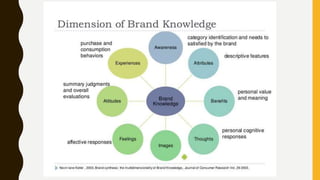
Measuring Brand Equity
Devising a Branding Strategy
Customer Equity
WHAT IS A ?
A brand as “a name, term, sign, symbol or
design, or a combination of them intended to
identify the goods or services of one seller or a
group of sellers and to differentiate them from
those of competitors.”
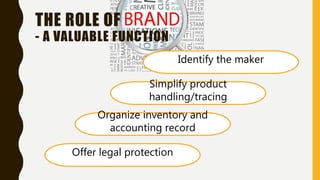
Offer legal protection
Organize inventory and
accounting record
Simplify product
handling/tracing
THE ROLE OF
- A VALUABLE FUNCTION
Identify the maker
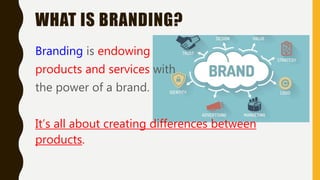
WHAT IS BRANDING?
Branding is endowing
products and services with
the power of a brand.
It’s all about creating differences between
products.
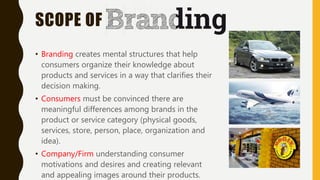
SCOPE OF
• Branding creates mental structures that help
consumers organize their knowledge about
products and services in a way that clarifies their
decision making.
• Consumers must be convinced there are
meaningful differences among brands in the
product or service category (physical goods,
services, store, person, place, organization and
idea).
• Company/Firm understanding consumer
motivations and desires and creating relevant
and appealing images around their products.
WHAT IS ?
Brand equity is the added value endowed on
products and services.
It may be reflected in the way consumers think,
feel and act with respect to the brand, as well as
in the prices, market share and profitability the
brand commands.
CUSTOMER BASED
Customer-based brand equity is thus the differential effect brand
knowledge has on consumer response to the marketing of that
brand. There are three key ingredients:
 Arises from differences in consumer response
 Differences in response are a result of consumers’ brand
knowledge
 Brand equity is reflected in perceptions, preferences, and
behaviour related to all aspects of the marketing of a brand.
Brand promise is the marketer’s vision of what the brand must be
and do for consumers.
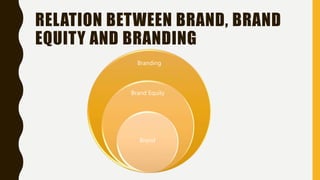
RELATION BETWEEN BRAND, BRAND
EQUITY AND BRANDING
Branding
Brand Equity
Brand
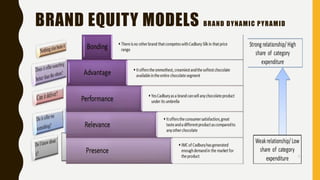
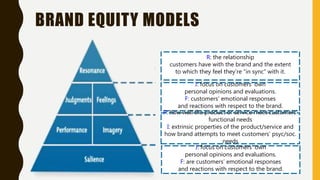
BRAND EQUITY MODELS BRAND DYNAMIC PYRAMID
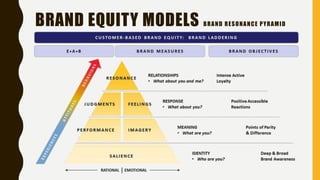
BRAND EQUITY MODELS BRAND RESONANCE PYRAMID
BRAND EQUITY MODELS
R: the relationship
customers have with the brand and the extent
to which they feel they’re “in sync” with it.
J: focus on customers’ own
personal opinions and evaluations.
F: customers’ emotional responses
and reactions with respect to the brand.
P: how well the product or service meet customers’
functional needs
I: extrinsic properties of the product/service and
how brand attempts to meet customers’ psyc/soc.
needs
J: focus on customers’ own
personal opinions and evaluations.
F: are customers’ emotional responses
and reactions with respect to the brand.
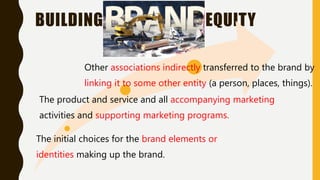
BUILDING EQUITY
The initial choices for the brand elements or
identities making up the brand.
The product and service and all accompanying marketing
activities and supporting marketing programs.
Other associations indirectly transferred to the brand by
linking it to some other entity (a person, places, things).
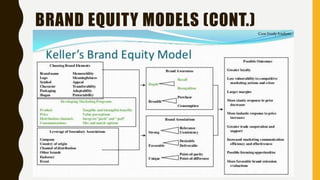
BRAND EQUITY MODELS (C0NT.)
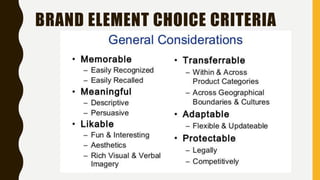
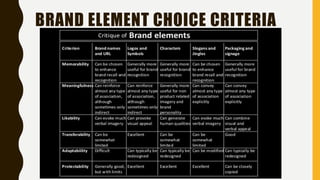
BRAND ELEMENT CHOICE CRITERIA
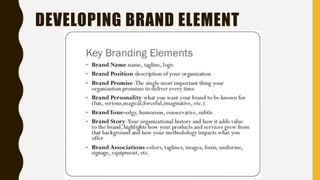
DEVELOPING BRAND ELEMENT
DESIGNING HOLISTIC
A brand contact is any information-bearing experience,
whether positive or negative, a customer or prospect has
with the brand, its product category, or its market. The
company must put as much effort into managing these
experiences as into producing its ads.
Integrated marketing is about mixing and matching these
marketing activities to maximize their individual and
collective effects. To achieve it, marketers need a variety of
different marketing activities that consistently reinforce the
brand promise.
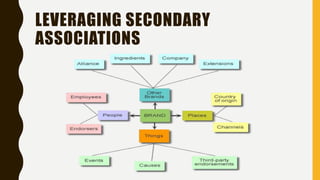
LEVERAGING SECONDARY
ASSOCIATIONS
INTERNAL BRANDING
Internal branding consists of activities and processes that help
inform and inspire employees about brands. Holistic marketers
must go even further and train and encourage distributors and
dealers to serve their customers well.
Brand bonding occurs when customers experience the
company as delivering on its brand promise. All the customers’
contacts with company employees and communications must
be positive. The brand promise will not be delivered unless
everyone in the company lives the brand.
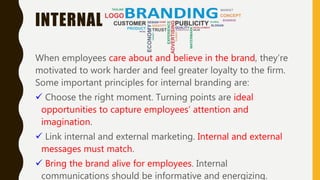
INTERNAL
When employees care about and believe in the brand, they’re
motivated to work harder and feel greater loyalty to the firm.
Some important principles for internal branding are:
 Choose the right moment. Turning points are ideal
opportunities to capture employees’ attention and
imagination.
 Link internal and external marketing. Internal and external
messages must match.
 Bring the brand alive for employees. Internal
communications should be informative and energizing.
COMMUNITY
A brand community is a specialized community of consumers
and employees whose identification and activities focus around
the brand. Brand communities come in many different forms.
Three characteristics identify brand communities:
 A “consciousness of kind” or sense of felt connection to the
brand, company, product, or other community members;
 Shared rituals, stories, and traditions that help to convey the
meaning of the community; and
 A shared moral responsibility or duty to both the community
as a whole and individual community members.
MEASURING EQUITY
Two basic approaches to measuring brand equity:
 A direct approach assesses the actual impact of brand knowledge on
consumer response to different aspects of the marketing.
 An indirect approach assesses potential sources of brand equity by
identifying and tracking consumer brand knowledge structures.
For brand equity to perform a useful strategic function and guide
marketing decisions, marketers need to fully understand:
 The sources of brand equity and how they affect outcomes of
interest,
How these sources and outcomes change, if at all, over time.
MEASURING EQUITY
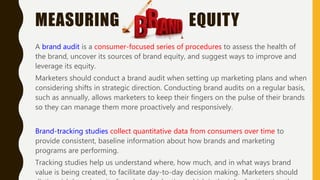
A brand audit is a consumer-focused series of procedures to assess the health of
the brand, uncover its sources of brand equity, and suggest ways to improve and
leverage its equity.
Marketers should conduct a brand audit when setting up marketing plans and when
considering shifts in strategic direction. Conducting brand audits on a regular basis,
such as annually, allows marketers to keep their fingers on the pulse of their brands
so they can manage them more proactively and responsively.
Brand-tracking studies collect quantitative data from consumers over time to
provide consistent, baseline information about how brands and marketing
programs are performing.
Tracking studies help us understand where, how much, and in what ways brand
value is being created, to facilitate day-to-day decision making. Marketers should
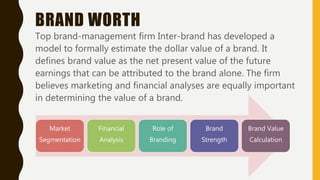
BRAND WORTH
Top brand-management firm Inter-brand has developed a
model to formally estimate the dollar value of a brand. It
defines brand value as the net present value of the future
earnings that can be attributed to the brand alone. The firm
believes marketing and financial analyses are equally important
in determining the value of a brand.
Market
Segmentation
Financial
Analysis
Role of
Branding
Brand
Strength
Brand Value
Calculation
MANAGING BRAND EQUITY
Why? Because consumer responses to marketing activity depend on
what they know and remember about a brand, short-term marketing
actions, by changing brand knowledge, necessarily increase or
decrease the long-term success of future marketing actions.
Marketers can reinforce brand equity by consistently conveying the
brand’s meaning in terms of:
 What products it represents, what core benefits it supplies, and
what needs it satisfies; and
 How the brand makes products superior, and which strong,
favourable, and unique brand associations should exist in
consumers’ minds.
MANAGING BRAND EQUITY
 Reinforcing brand equity requires that the brand always be
moving forward — in the right direction and with new and
compelling offerings and ways to market them.
 An important part of reinforcing brands is providing
consistent marketing support.
 Many tactical changes may be necessary to maintain the
strategic thrust and direction of the brand. When change is
necessary, marketers should vigorously preserve and defend
sources of brand equity.
DEVISING A BRANDING STRATEGY
A firm’s branding strategy—often called the brand
architecture—reflects the number and nature
of both common and distinctive brand elements. Deciding how
to brand new products is especially critical. A firm has three
main choices:
 It can develop new brand elements for the new product.
 It can apply some of its existing brand elements.
 It can use a combination of new and existing brand elements.
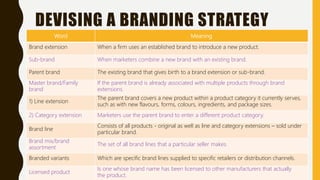
DEVISING A BRANDING STRATEGY
Word Meaning
Brand extension When a firm uses an established brand to introduce a new product.
Sub-brand When marketers combine a new brand with an existing brand.
Parent brand The existing brand that gives birth to a brand extension or sub-brand.
Master brand/Family
brand
If the parent brand is already associated with multiple products through brand
extensions.
1) Line extension
The parent brand covers a new product within a product category it currently serves,
such as with new flavours, forms, colours, ingredients, and package sizes.
2) Category extension Marketers use the parent brand to enter a different product category.
Brand line
Consists of all products - original as well as line and category extensions – sold under
particular brand.
Brand mix/brand
assortment
The set of all brand lines that a particular seller makes.
Branded variants Which are specific brand lines supplied to specific retailers or distribution channels.
Licensed product
Is one whose brand name has been licensed to other manufacturers that actually
the product.
BRANDING DECISIONS ALTERNATIVE BRANDING
STRATEGIES
Today, branding is such a strong force that hardly anything goes
unbranded. Assuming a firm decides to brand its products or services, it
must choose which brand names to use. Three general strategies are
popular:
 Individual or separate family brand names. Consumer packaged-goods
companies have a long tradition of branding different products by
different names.
 Corporate umbrella or company brand name. Many firms, use their
corporate brand as an umbrella brand across their entire range of
products.
 Sub-brand name, sub-brands combine two or more of the corporate
brand, family brand, or individual product brand names.
HOUSE OF BRANDS VERSUS A
BRANDED HOUSE
The use of individual or separate family brand names has been
referred to as a “house of brands” strategy, whereas the use of
an umbrella corporate or company brand name has been
referred to as a “branded house” strategy. These two branding
strategies represent two ends of a brand relationship
continuum.
BRAND PORTFOLIOS
The brand portfolio is the set of all brands and brand lines a particular
firm offers for sale in a particular category or market segment. Marketers
often need multiple brands in order to pursue these multiple segments.
Some other reasons for introducing multiple brands in a category include:
 Increasing shelf presence and retailer dependence in the store
 Attracting consumers seeking variety who may otherwise have switched
to another brand
 Increasing internal competition within the firm
 Yielding economies of scale in advertising, sales, merchandising, and
physical distribution
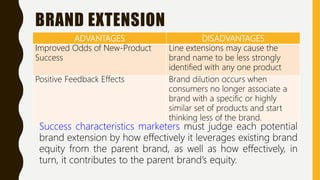
BRAND EXTENSION
ADVANTAGES DISADVANTAGES
Improved Odds of New-Product
Success
Line extensions may cause the
brand name to be less strongly
identified with any one product
Positive Feedback Effects Brand dilution occurs when
consumers no longer associate a
brand with a specific or highly
similar set of products and start
thinking less of the brand.
Success characteristics marketers must judge each potential
brand extension by how effectively it leverages existing brand
equity from the parent brand, as well as how effectively, in
turn, it contributes to the parent brand’s equity.
CUSTOMER EQUITY
• Achieving brand equity should be a top priority for any
organization.
• They must relate brand equity to one other important marketing
concept, customer equity.
• The brand equity and customer equity perspectives certainly
share many common themes. Both emphasize the importance of
customer loyalty and the notion that we create value by having
as many customers as possible pay as high a price as possible.
• Brand equity, on the other hand, tends to emphasize strategic
issues in managing brands and creating and leveraging brand
awareness and image with customers. It provides much practical
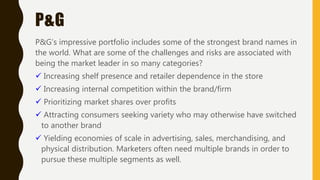
P&G
P&G’s impressive portfolio includes some of the strongest brand names in
the world. What are some of the challenges and risks are associated with
being the market leader in so many categories?
 Increasing shelf presence and retailer dependence in the store
 Increasing internal competition within the brand/firm
 Prioritizing market shares over profits
 Attracting consumers seeking variety who may otherwise have switched
to another brand
 Yielding economies of scale in advertising, sales, merchandising, and
physical distribution. Marketers often need multiple brands in order to
pursue these multiple segments as well.
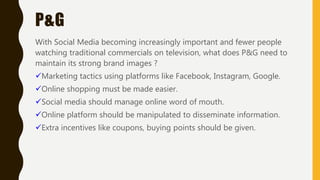
P&G
With Social Media becoming increasingly important and fewer people
watching traditional commercials on television, what does P&G need to
maintain its strong brand images ?
Marketing tactics using platforms like Facebook, Instagram, Google.
Online shopping must be made easier.
Social media should manage online word of mouth.
Online platform should be manipulated to disseminate information.
Extra incentives like coupons, buying points should be given.
P&G
What risks do you feel that P&G will face going forward?
 Cut throat competition from Nestle, ITC, Hindustan Unilever Limited.
 Relative prices & Performance from unbranded local products.
 Risk of Brand Equity.
 Legal Barriers
 Limited room for expansion & growth
MC DONALD’S
What are McDonald’s core brand values? Have these changed
over the years?
 The core values of the brand have included quality,
cleanliness, service and value.
 Their core values are reflected in their outlets, the pricing of
their products and their employees.
 Although the company lost focus during expansion in the
80s, the company has learnt from its mistakes.
 Even after so many years, the company does try its best to
stick to their core values which is the centre of their business
model.
MC DONALD’S
McDonald’s did very well during the recession in the late 2000s. With the
economy turning around for the better, should McDonald’s change its
strategy? Why or why not?
The company did exceptionally well in the recession especially
when compared to its peers.
The reason it did well was because of its cheap offerings which
attracted customers in times of financial troubles.
The company should definitely stick with their strategy even now
because if it has done well in financially trying times, it is favoured
to do well when the situation eases.
Certain changes can be made to the existing strategy after in-
depth study of the current markets.
MC DONALD’S
What risks do you feel McDonald’s will face going
forward?
 Health conscious consumers might move to brands offering
healthier options.
 Changing tastes and lifestyles pose a big threat. The
company will need to adapt to changes to be able to tackle
such problems effectively
 Competition from local fast food chains as they have to focus
only on a small area .
 Training employees rapidly and effectively during expansion

Chapter 8 - Creating Branding Equity

  • 1.
    BY H AM I Z A N A B D U L K A R I M 1 5 M G 0 2 0 0 1 P | S YA R I A H ( M A N A G E M E N T ) S E S S I O N 2 , 2 0 1 6 / 2 0 1 7 M A R K E T I N G M A N A G E M E N T
  • 2.
    SUB-TOPIC What Is BrandEquity Managing Brand Equity Building Brand Equity Measuring Brand Equity Devising a Branding Strategy Customer Equity
  • 3.
    WHAT IS A? A brand as “a name, term, sign, symbol or design, or a combination of them intended to identify the goods or services of one seller or a group of sellers and to differentiate them from those of competitors.”
  • 4.
    Offer legal protection Organizeinventory and accounting record Simplify product handling/tracing THE ROLE OF - A VALUABLE FUNCTION Identify the maker
  • 5.
    WHAT IS BRANDING? Brandingis endowing products and services with the power of a brand. It’s all about creating differences between products.
  • 6.
    SCOPE OF • Brandingcreates mental structures that help consumers organize their knowledge about products and services in a way that clarifies their decision making. • Consumers must be convinced there are meaningful differences among brands in the product or service category (physical goods, services, store, person, place, organization and idea). • Company/Firm understanding consumer motivations and desires and creating relevant and appealing images around their products.
  • 7.
    WHAT IS ? Brandequity is the added value endowed on products and services. It may be reflected in the way consumers think, feel and act with respect to the brand, as well as in the prices, market share and profitability the brand commands.
  • 8.
    CUSTOMER BASED Customer-based brandequity is thus the differential effect brand knowledge has on consumer response to the marketing of that brand. There are three key ingredients:  Arises from differences in consumer response  Differences in response are a result of consumers’ brand knowledge  Brand equity is reflected in perceptions, preferences, and behaviour related to all aspects of the marketing of a brand. Brand promise is the marketer’s vision of what the brand must be and do for consumers.
  • 10.
    RELATION BETWEEN BRAND,BRAND EQUITY AND BRANDING Branding Brand Equity Brand
  • 11.
    BRAND EQUITY MODELSBRAND DYNAMIC PYRAMID
  • 12.
    BRAND EQUITY MODELSBRAND RESONANCE PYRAMID
  • 13.
    BRAND EQUITY MODELS R:the relationship customers have with the brand and the extent to which they feel they’re “in sync” with it. J: focus on customers’ own personal opinions and evaluations. F: customers’ emotional responses and reactions with respect to the brand. P: how well the product or service meet customers’ functional needs I: extrinsic properties of the product/service and how brand attempts to meet customers’ psyc/soc. needs J: focus on customers’ own personal opinions and evaluations. F: are customers’ emotional responses and reactions with respect to the brand.
  • 14.
    BUILDING EQUITY The initialchoices for the brand elements or identities making up the brand. The product and service and all accompanying marketing activities and supporting marketing programs. Other associations indirectly transferred to the brand by linking it to some other entity (a person, places, things).
  • 15.
  • 16.
  • 17.
  • 18.
  • 19.
    DESIGNING HOLISTIC A brandcontact is any information-bearing experience, whether positive or negative, a customer or prospect has with the brand, its product category, or its market. The company must put as much effort into managing these experiences as into producing its ads. Integrated marketing is about mixing and matching these marketing activities to maximize their individual and collective effects. To achieve it, marketers need a variety of different marketing activities that consistently reinforce the brand promise.
  • 20.
  • 21.
    INTERNAL BRANDING Internal brandingconsists of activities and processes that help inform and inspire employees about brands. Holistic marketers must go even further and train and encourage distributors and dealers to serve their customers well. Brand bonding occurs when customers experience the company as delivering on its brand promise. All the customers’ contacts with company employees and communications must be positive. The brand promise will not be delivered unless everyone in the company lives the brand.
  • 22.
    INTERNAL When employees careabout and believe in the brand, they’re motivated to work harder and feel greater loyalty to the firm. Some important principles for internal branding are:  Choose the right moment. Turning points are ideal opportunities to capture employees’ attention and imagination.  Link internal and external marketing. Internal and external messages must match.  Bring the brand alive for employees. Internal communications should be informative and energizing.
  • 23.
    COMMUNITY A brand communityis a specialized community of consumers and employees whose identification and activities focus around the brand. Brand communities come in many different forms. Three characteristics identify brand communities:  A “consciousness of kind” or sense of felt connection to the brand, company, product, or other community members;  Shared rituals, stories, and traditions that help to convey the meaning of the community; and  A shared moral responsibility or duty to both the community as a whole and individual community members.
  • 24.
    MEASURING EQUITY Two basicapproaches to measuring brand equity:  A direct approach assesses the actual impact of brand knowledge on consumer response to different aspects of the marketing.  An indirect approach assesses potential sources of brand equity by identifying and tracking consumer brand knowledge structures. For brand equity to perform a useful strategic function and guide marketing decisions, marketers need to fully understand:  The sources of brand equity and how they affect outcomes of interest, How these sources and outcomes change, if at all, over time.
  • 25.
    MEASURING EQUITY A brandaudit is a consumer-focused series of procedures to assess the health of the brand, uncover its sources of brand equity, and suggest ways to improve and leverage its equity. Marketers should conduct a brand audit when setting up marketing plans and when considering shifts in strategic direction. Conducting brand audits on a regular basis, such as annually, allows marketers to keep their fingers on the pulse of their brands so they can manage them more proactively and responsively. Brand-tracking studies collect quantitative data from consumers over time to provide consistent, baseline information about how brands and marketing programs are performing. Tracking studies help us understand where, how much, and in what ways brand value is being created, to facilitate day-to-day decision making. Marketers should
  • 26.
    BRAND WORTH Top brand-managementfirm Inter-brand has developed a model to formally estimate the dollar value of a brand. It defines brand value as the net present value of the future earnings that can be attributed to the brand alone. The firm believes marketing and financial analyses are equally important in determining the value of a brand. Market Segmentation Financial Analysis Role of Branding Brand Strength Brand Value Calculation
  • 27.
    MANAGING BRAND EQUITY Why?Because consumer responses to marketing activity depend on what they know and remember about a brand, short-term marketing actions, by changing brand knowledge, necessarily increase or decrease the long-term success of future marketing actions. Marketers can reinforce brand equity by consistently conveying the brand’s meaning in terms of:  What products it represents, what core benefits it supplies, and what needs it satisfies; and  How the brand makes products superior, and which strong, favourable, and unique brand associations should exist in consumers’ minds.
  • 28.
    MANAGING BRAND EQUITY Reinforcing brand equity requires that the brand always be moving forward — in the right direction and with new and compelling offerings and ways to market them.  An important part of reinforcing brands is providing consistent marketing support.  Many tactical changes may be necessary to maintain the strategic thrust and direction of the brand. When change is necessary, marketers should vigorously preserve and defend sources of brand equity.
  • 29.
    DEVISING A BRANDINGSTRATEGY A firm’s branding strategy—often called the brand architecture—reflects the number and nature of both common and distinctive brand elements. Deciding how to brand new products is especially critical. A firm has three main choices:  It can develop new brand elements for the new product.  It can apply some of its existing brand elements.  It can use a combination of new and existing brand elements.
  • 30.
    DEVISING A BRANDINGSTRATEGY Word Meaning Brand extension When a firm uses an established brand to introduce a new product. Sub-brand When marketers combine a new brand with an existing brand. Parent brand The existing brand that gives birth to a brand extension or sub-brand. Master brand/Family brand If the parent brand is already associated with multiple products through brand extensions. 1) Line extension The parent brand covers a new product within a product category it currently serves, such as with new flavours, forms, colours, ingredients, and package sizes. 2) Category extension Marketers use the parent brand to enter a different product category. Brand line Consists of all products - original as well as line and category extensions – sold under particular brand. Brand mix/brand assortment The set of all brand lines that a particular seller makes. Branded variants Which are specific brand lines supplied to specific retailers or distribution channels. Licensed product Is one whose brand name has been licensed to other manufacturers that actually the product.
  • 31.
    BRANDING DECISIONS ALTERNATIVEBRANDING STRATEGIES Today, branding is such a strong force that hardly anything goes unbranded. Assuming a firm decides to brand its products or services, it must choose which brand names to use. Three general strategies are popular:  Individual or separate family brand names. Consumer packaged-goods companies have a long tradition of branding different products by different names.  Corporate umbrella or company brand name. Many firms, use their corporate brand as an umbrella brand across their entire range of products.  Sub-brand name, sub-brands combine two or more of the corporate brand, family brand, or individual product brand names.
  • 32.
    HOUSE OF BRANDSVERSUS A BRANDED HOUSE The use of individual or separate family brand names has been referred to as a “house of brands” strategy, whereas the use of an umbrella corporate or company brand name has been referred to as a “branded house” strategy. These two branding strategies represent two ends of a brand relationship continuum.
  • 33.
    BRAND PORTFOLIOS The brandportfolio is the set of all brands and brand lines a particular firm offers for sale in a particular category or market segment. Marketers often need multiple brands in order to pursue these multiple segments. Some other reasons for introducing multiple brands in a category include:  Increasing shelf presence and retailer dependence in the store  Attracting consumers seeking variety who may otherwise have switched to another brand  Increasing internal competition within the firm  Yielding economies of scale in advertising, sales, merchandising, and physical distribution
  • 34.
    BRAND EXTENSION ADVANTAGES DISADVANTAGES ImprovedOdds of New-Product Success Line extensions may cause the brand name to be less strongly identified with any one product Positive Feedback Effects Brand dilution occurs when consumers no longer associate a brand with a specific or highly similar set of products and start thinking less of the brand. Success characteristics marketers must judge each potential brand extension by how effectively it leverages existing brand equity from the parent brand, as well as how effectively, in turn, it contributes to the parent brand’s equity.
  • 35.
    CUSTOMER EQUITY • Achievingbrand equity should be a top priority for any organization. • They must relate brand equity to one other important marketing concept, customer equity. • The brand equity and customer equity perspectives certainly share many common themes. Both emphasize the importance of customer loyalty and the notion that we create value by having as many customers as possible pay as high a price as possible. • Brand equity, on the other hand, tends to emphasize strategic issues in managing brands and creating and leveraging brand awareness and image with customers. It provides much practical
  • 36.
    P&G P&G’s impressive portfolioincludes some of the strongest brand names in the world. What are some of the challenges and risks are associated with being the market leader in so many categories?  Increasing shelf presence and retailer dependence in the store  Increasing internal competition within the brand/firm  Prioritizing market shares over profits  Attracting consumers seeking variety who may otherwise have switched to another brand  Yielding economies of scale in advertising, sales, merchandising, and physical distribution. Marketers often need multiple brands in order to pursue these multiple segments as well.
  • 37.
    P&G With Social Mediabecoming increasingly important and fewer people watching traditional commercials on television, what does P&G need to maintain its strong brand images ? Marketing tactics using platforms like Facebook, Instagram, Google. Online shopping must be made easier. Social media should manage online word of mouth. Online platform should be manipulated to disseminate information. Extra incentives like coupons, buying points should be given.
  • 38.
    P&G What risks doyou feel that P&G will face going forward?  Cut throat competition from Nestle, ITC, Hindustan Unilever Limited.  Relative prices & Performance from unbranded local products.  Risk of Brand Equity.  Legal Barriers  Limited room for expansion & growth
  • 39.
    MC DONALD’S What areMcDonald’s core brand values? Have these changed over the years?  The core values of the brand have included quality, cleanliness, service and value.  Their core values are reflected in their outlets, the pricing of their products and their employees.  Although the company lost focus during expansion in the 80s, the company has learnt from its mistakes.  Even after so many years, the company does try its best to stick to their core values which is the centre of their business model.
  • 40.
    MC DONALD’S McDonald’s didvery well during the recession in the late 2000s. With the economy turning around for the better, should McDonald’s change its strategy? Why or why not? The company did exceptionally well in the recession especially when compared to its peers. The reason it did well was because of its cheap offerings which attracted customers in times of financial troubles. The company should definitely stick with their strategy even now because if it has done well in financially trying times, it is favoured to do well when the situation eases. Certain changes can be made to the existing strategy after in- depth study of the current markets.
  • 41.
    MC DONALD’S What risksdo you feel McDonald’s will face going forward?  Health conscious consumers might move to brands offering healthier options.  Changing tastes and lifestyles pose a big threat. The company will need to adapt to changes to be able to tackle such problems effectively  Competition from local fast food chains as they have to focus only on a small area .  Training employees rapidly and effectively during expansion