Segmentation, Targeting,
Positioning,
Differentiation(STPD)
Dr. Parveen Nagpal
Market Segmentation
Market segmentation is defined as:
• the process of dividing the potential market into groups of people who have
similar or relative needs,
• the act of subdividing a market into distinct, meaningful, and identifiable
but possibly overlapping subsets, with the aim of targeting by utilizing a
distinct marketing mix.
Market segmentation is a consumer-oriented process and can be applied to
almost any type of market.
A market segment is a group of individuals, groups or organizations who may
share the same interests, traits and characteristics.
By dividing the market into segments, marketing managers can acquire a
better understanding of the needs and wants of customers.
Market Segmentation
This enables them to customize or to ā€˜tailor’ the company’s marketing
activities more accurately and responsibly to the individual customers’ likings.
Segmentation enables marketers to adopt a more systematic approach
when planning ahead for the future.
This leads to better utilization of marketing resources, resulting in the
development of a more finely-tuned marketing programme.
Segmentation is the process of dividing a heterogenous market into
homogenous sub – units for effective marketing.
Advantages of Market Segmentation
• Helps distinguish one customer group from another within a given market
• Facilitates proper choice of target market.
• Facilitates effective tapping of the market.
• Helps divide the markets and conquer them.
• Promotes sales and profitability
• Optimum utilization of firms resources
• Makes the marketing effort more efficient and economic
• Facilitates suitable marketing mix
• Helps identify the less satisfied segments and satisfying them
Bases of Market Segmentation
Demographic Segmentation
It involves dividing the market into groups that are identifiable in terms of
physical and factual data.
The demographic variables include age, gender, income, occupation, marital
status, family size, religion etc.
This segmentation method is a popular way of segmenting the customer
markets as the demographic variables are relatively easy to measure
Bases of Market Segmentation
Geographic Segmentation
It involves selecting potential markets according to where they are located.
This segmentation approach may consider variables such as climate, terrain,
natural resources and population density, among other geographic variables.
Markets can be divided into regions because one or more of these variables
could differentiate customers from one region to the next.
For example, those individuals who are living in wet and cold climates will
favour warm, sunny destinations for their holidays.
Bases of Market Segmentation
Psychographic Segmentation
Psychographic segmentation could be used to segment markets according to
personality traits, values, motives, interests and lifestyles.
A psychographic dimension can be used by itself to segment a market, or it
can be combined with other segmentation variables.
The psychographic variables are used when purchasing behaviors correlate
with the personality or lifestyles of consumers.
Bases of Market Segmentation
Behavioral Segmentation
Behavioral segmentation is defined as the segmentation of the market
according to individual purchase behaviors.
Behavior-based segmentation is conspicuous with the benefits sought from
the product, with the identification of specific buying behaviors, in terms of
shopping frequency and volumes of purchase etc.
For example, a customer relationship management system could include
customer profiles of frequent-flyer travelers and could reveal valuable
information on their past transactions.
Bases of Market Segmentation
Social Cultural Segmentation
Culture and social class are the two main bases of segmentation here.
Culture: Culture influence consumer behavior, deeply. A given culture brings
in its own unique pattern of social conduct. A person usually acquires his
cultural attributes right at his childhood. Culture includes religious, caste,
traditional, language, pattern of social behavior
Social Factor: Social group of varying types exert influenced on the consumer.
Social group include family, peer group, close colleges. They adopt their
common life style
Culture, religion, race, region, language, education and economic class is part
of socio-cultural factors which influence consumers needs and markets are
segmented on these basis.
Targeting
The segments that the company wants to serve are called the target market,
and the process of selecting the target market is referred as market targeting.
Market targeting refers to picking a specific group or small set of groups to
which a business will advertise.
Target market consists of group/groups of buyers to whom the company
wants to satisfy or for whom product is manufactured, price is set, promotion
efforts are made, and distribution network is prepared.
It is based on the idea that, because it is not possible to make or do
something that will please everyone, a firm has to specialize.
Targeting involves basically two actions – evaluation of segments and
selection of the appropriate market segments.
In this relation, market targeting can be defined as an act of evaluating and
selecting market segments.
Types of Targeting
Undifferentiated Marketing
There may be no strong differences in customer characteristics. Alternatively,
the cost of developing a separate marketing mix for separate segments may
outweigh the potential gains of meeting customer needs more exactly.
Under these circumstances a company will decide to develop a single
marketing mix for the whole market. There is absence of segmentation.
Companies which lack a marketing orientation may practice this strategy
because of lack of customer knowledge.
A company using this strategy adopts a mass-market philosophy, views the
market as one big market with no individual segments, uses one marketing
mix for the entire market.
The company assumes that individual customers have similar needs that can
be met with a common marketing mix.
Types of Targeting
Differentiated Marketing or Multi-segment Targeting
When market segmentation reveals several potential target segments that
the company can serve profitably, specific marketing mixes can be developed
to appeal to all or some of the segments.
A differentiated marketing strategy exploits the differences between
marketing segments by designing a specific marketing mix for each segment.
A company following multi-segment targeting strategy serves two or more
well- defined segments and develops a distinct marketing mix for each one of
them. Separate brands are developed to serve each of the segments.
This strategy has the potential to generate sales volume, higher profits, larger
market share and economies of scale in manufacturing and marketing.
Types of Targeting
Focus or Concentrated Marketing
Several segments may be identified but a company may not serve all of them as
some may be unattractive
A company may target just one segment with a single marketing mix. It
understands the needs, and motives of the segment’s customers and designs a
specialized marketing mix.
Companies have discovered that concentrating resources and meeting the needs of
a narrowly defined market segment is more profitable than spreading resources
over several different segments.
This strategy is suited for companies with limited resources as these resources may
be too stretched if it competes in many segments.
Focused marketing allows R&D expenditure to be concentrated on meeting needs
of one set of customers and managerial activities are devoted to understanding
and catering to their needs.
Types of Targeting
Customized Marketing
In some markets, the requirements of individual customers are unique and
their purchasing power is sufficient to make designing a separate marketing
mix for each customer a viable option.
Many service providers such as advertising, marketing research firms,
architects and solicitors vary their offerings on a customer to customer basis.
They will discuss face to face with each customer their requirements and
tailor their services accordingly.
Customized marketing is also found within organizational markets because of
high value of orders and special needs of customers.
It is associated with close relationships between the supplier and customer
because the high value of an order justifies large marketing and sales efforts
being focused on each buyer
Types of Targeting
Product Specialization
Marketing firms concentrate on making a certain product that it sells to several
segments
For example, a manufacturer of lab equipment sells its equipment to specific
colleges and school laboratories. It manufactures different equipment for
these different customer groups.
Product specialization promises strong market recognition of customers
within the product areas.
Product Positioning
Product positioning refers to the place that a brand occupies in the minds of
the customers and how it is distinguished from the products of the
competitors.
It is the process marketers use to determine how to best communicate their
products' attributes to their target customers based on customer needs,
competitive pressures, available communication channels and carefully
crafted key messages.
Effective product positioning ensures that marketing messages resonate with
target consumers and compel them to take action.
Product positioning is a form of marketing that presents the benefits of
product to a particular target audience.
Positioning is something done to the mind of potential customers. E.g. Volvo
says ā€˜we produce the most secure car’; Porsche - 'worlds best small sport car’
Product Positioning
There are several types of positioning strategies:
Product attributes and benefits: Associating the brand/product with certain
characteristics or with certain beneficial value
Product price: Associating the brand/product with competitive pricing
Product quality: Associating the brand/product with high quality
Product use and application: Associating the brand/product with a specific
use
Competitors: Making consumers think that the brand/product is better than
competitors
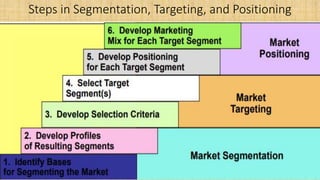
Steps in Segmentation, Targeting, and Positioning
Differentiation
Differentiation is the process of distinguishing the differences of a product or
offering from others, to make it more attractive to a particular target market.
It is an important source of competitive advantage
The objective of differentiation is to develop a position that potential
customers see as unique.
Kotler defines differentiation as the ā€œprocess of adding meaningful and
valued differences to distinguish the product from the competitionā€
There are a number of differentiation dimensions and strategies for their
accomplishment.
STPD
Example: FROOTI
Segmentation: Pan India, People who prefer fruit drink against soft drinks
Targeting: Youth
Positioning: A mango drink that is ā€œFresh-n-juicyā€
Differentiation: First Tetrapack fruit juice in India, ā€œGreen mangoā€ variant
References
1. Kotler Philip, Keller Kevin, Marketing Management, 15e, Pearson.
2. John Fahy & David Jobber, Foundations of Marketing, 4th Edition, Tata
McGraw Hill
3. Saxena, Rajan. Marketing Management 4th Edition, Tata McGraw Hill
4. http://www.yourarticlelibrary.com/marketing/target-marketing-four-
generic-target-marketing-strategies/13400

3. STPD

  • 1.
  • 2.
    Market Segmentation Market segmentationis defined as: • the process of dividing the potential market into groups of people who have similar or relative needs, • the act of subdividing a market into distinct, meaningful, and identifiable but possibly overlapping subsets, with the aim of targeting by utilizing a distinct marketing mix. Market segmentation is a consumer-oriented process and can be applied to almost any type of market. A market segment is a group of individuals, groups or organizations who may share the same interests, traits and characteristics. By dividing the market into segments, marketing managers can acquire a better understanding of the needs and wants of customers.
  • 3.
    Market Segmentation This enablesthem to customize or to ā€˜tailor’ the company’s marketing activities more accurately and responsibly to the individual customers’ likings. Segmentation enables marketers to adopt a more systematic approach when planning ahead for the future. This leads to better utilization of marketing resources, resulting in the development of a more finely-tuned marketing programme. Segmentation is the process of dividing a heterogenous market into homogenous sub – units for effective marketing.
  • 4.
    Advantages of MarketSegmentation • Helps distinguish one customer group from another within a given market • Facilitates proper choice of target market. • Facilitates effective tapping of the market. • Helps divide the markets and conquer them. • Promotes sales and profitability • Optimum utilization of firms resources • Makes the marketing effort more efficient and economic • Facilitates suitable marketing mix • Helps identify the less satisfied segments and satisfying them
  • 5.
    Bases of MarketSegmentation Demographic Segmentation It involves dividing the market into groups that are identifiable in terms of physical and factual data. The demographic variables include age, gender, income, occupation, marital status, family size, religion etc. This segmentation method is a popular way of segmenting the customer markets as the demographic variables are relatively easy to measure
  • 6.
    Bases of MarketSegmentation Geographic Segmentation It involves selecting potential markets according to where they are located. This segmentation approach may consider variables such as climate, terrain, natural resources and population density, among other geographic variables. Markets can be divided into regions because one or more of these variables could differentiate customers from one region to the next. For example, those individuals who are living in wet and cold climates will favour warm, sunny destinations for their holidays.
  • 7.
    Bases of MarketSegmentation Psychographic Segmentation Psychographic segmentation could be used to segment markets according to personality traits, values, motives, interests and lifestyles. A psychographic dimension can be used by itself to segment a market, or it can be combined with other segmentation variables. The psychographic variables are used when purchasing behaviors correlate with the personality or lifestyles of consumers.
  • 8.
    Bases of MarketSegmentation Behavioral Segmentation Behavioral segmentation is defined as the segmentation of the market according to individual purchase behaviors. Behavior-based segmentation is conspicuous with the benefits sought from the product, with the identification of specific buying behaviors, in terms of shopping frequency and volumes of purchase etc. For example, a customer relationship management system could include customer profiles of frequent-flyer travelers and could reveal valuable information on their past transactions.
  • 9.
    Bases of MarketSegmentation Social Cultural Segmentation Culture and social class are the two main bases of segmentation here. Culture: Culture influence consumer behavior, deeply. A given culture brings in its own unique pattern of social conduct. A person usually acquires his cultural attributes right at his childhood. Culture includes religious, caste, traditional, language, pattern of social behavior Social Factor: Social group of varying types exert influenced on the consumer. Social group include family, peer group, close colleges. They adopt their common life style Culture, religion, race, region, language, education and economic class is part of socio-cultural factors which influence consumers needs and markets are segmented on these basis.
  • 10.
    Targeting The segments thatthe company wants to serve are called the target market, and the process of selecting the target market is referred as market targeting. Market targeting refers to picking a specific group or small set of groups to which a business will advertise. Target market consists of group/groups of buyers to whom the company wants to satisfy or for whom product is manufactured, price is set, promotion efforts are made, and distribution network is prepared. It is based on the idea that, because it is not possible to make or do something that will please everyone, a firm has to specialize. Targeting involves basically two actions – evaluation of segments and selection of the appropriate market segments. In this relation, market targeting can be defined as an act of evaluating and selecting market segments.
  • 11.
    Types of Targeting UndifferentiatedMarketing There may be no strong differences in customer characteristics. Alternatively, the cost of developing a separate marketing mix for separate segments may outweigh the potential gains of meeting customer needs more exactly. Under these circumstances a company will decide to develop a single marketing mix for the whole market. There is absence of segmentation. Companies which lack a marketing orientation may practice this strategy because of lack of customer knowledge. A company using this strategy adopts a mass-market philosophy, views the market as one big market with no individual segments, uses one marketing mix for the entire market. The company assumes that individual customers have similar needs that can be met with a common marketing mix.
  • 12.
    Types of Targeting DifferentiatedMarketing or Multi-segment Targeting When market segmentation reveals several potential target segments that the company can serve profitably, specific marketing mixes can be developed to appeal to all or some of the segments. A differentiated marketing strategy exploits the differences between marketing segments by designing a specific marketing mix for each segment. A company following multi-segment targeting strategy serves two or more well- defined segments and develops a distinct marketing mix for each one of them. Separate brands are developed to serve each of the segments. This strategy has the potential to generate sales volume, higher profits, larger market share and economies of scale in manufacturing and marketing.
  • 13.
    Types of Targeting Focusor Concentrated Marketing Several segments may be identified but a company may not serve all of them as some may be unattractive A company may target just one segment with a single marketing mix. It understands the needs, and motives of the segment’s customers and designs a specialized marketing mix. Companies have discovered that concentrating resources and meeting the needs of a narrowly defined market segment is more profitable than spreading resources over several different segments. This strategy is suited for companies with limited resources as these resources may be too stretched if it competes in many segments. Focused marketing allows R&D expenditure to be concentrated on meeting needs of one set of customers and managerial activities are devoted to understanding and catering to their needs.
  • 14.
    Types of Targeting CustomizedMarketing In some markets, the requirements of individual customers are unique and their purchasing power is sufficient to make designing a separate marketing mix for each customer a viable option. Many service providers such as advertising, marketing research firms, architects and solicitors vary their offerings on a customer to customer basis. They will discuss face to face with each customer their requirements and tailor their services accordingly. Customized marketing is also found within organizational markets because of high value of orders and special needs of customers. It is associated with close relationships between the supplier and customer because the high value of an order justifies large marketing and sales efforts being focused on each buyer
  • 15.
    Types of Targeting ProductSpecialization Marketing firms concentrate on making a certain product that it sells to several segments For example, a manufacturer of lab equipment sells its equipment to specific colleges and school laboratories. It manufactures different equipment for these different customer groups. Product specialization promises strong market recognition of customers within the product areas.
  • 16.
    Product Positioning Product positioningrefers to the place that a brand occupies in the minds of the customers and how it is distinguished from the products of the competitors. It is the process marketers use to determine how to best communicate their products' attributes to their target customers based on customer needs, competitive pressures, available communication channels and carefully crafted key messages. Effective product positioning ensures that marketing messages resonate with target consumers and compel them to take action. Product positioning is a form of marketing that presents the benefits of product to a particular target audience. Positioning is something done to the mind of potential customers. E.g. Volvo says ā€˜we produce the most secure car’; Porsche - 'worlds best small sport car’
  • 17.
    Product Positioning There areseveral types of positioning strategies: Product attributes and benefits: Associating the brand/product with certain characteristics or with certain beneficial value Product price: Associating the brand/product with competitive pricing Product quality: Associating the brand/product with high quality Product use and application: Associating the brand/product with a specific use Competitors: Making consumers think that the brand/product is better than competitors
  • 18.
    Steps in Segmentation,Targeting, and Positioning
  • 19.
    Differentiation Differentiation is theprocess of distinguishing the differences of a product or offering from others, to make it more attractive to a particular target market. It is an important source of competitive advantage The objective of differentiation is to develop a position that potential customers see as unique. Kotler defines differentiation as the ā€œprocess of adding meaningful and valued differences to distinguish the product from the competitionā€ There are a number of differentiation dimensions and strategies for their accomplishment.
  • 20.
    STPD Example: FROOTI Segmentation: PanIndia, People who prefer fruit drink against soft drinks Targeting: Youth Positioning: A mango drink that is ā€œFresh-n-juicyā€ Differentiation: First Tetrapack fruit juice in India, ā€œGreen mangoā€ variant
  • 21.
    References 1. Kotler Philip,Keller Kevin, Marketing Management, 15e, Pearson. 2. John Fahy & David Jobber, Foundations of Marketing, 4th Edition, Tata McGraw Hill 3. Saxena, Rajan. Marketing Management 4th Edition, Tata McGraw Hill 4. http://www.yourarticlelibrary.com/marketing/target-marketing-four- generic-target-marketing-strategies/13400