Market Targeting
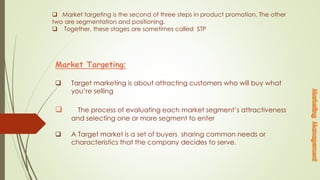
 Market targeting is the second of three steps in product promotion. The other
two are segmentation and positioning.
 Together, these stages are sometimes called STP
Market Targeting:
 Target marketing is about attracting customers who will buy what
you’re selling
 The process of evaluating each market segment’s attractiveness
and selecting one or more segment to enter
 A Target market is a set of buyers sharing common needs or
characteristics that the company decides to serve.
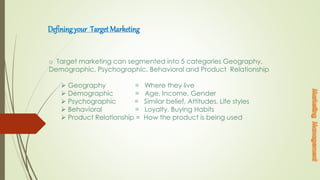
Defining your Target Marketing
o Target marketing can segmented into 5 categories Geography,
Demographic, Psychographic, Behavioral and Product Relationship
 Geography = Where they live
 Demographic = Age, Income, Gender
 Psychographic = Similar belief, Attitudes, Life styles
 Behavioral = Loyalty, Buying Habits
 Product Relationship = How the product is being used
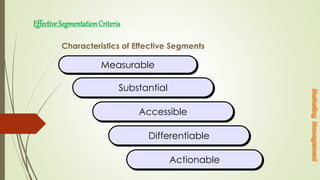
Effective SegmentationCriteria
Characteristics of Effective Segments
Measurable
Substantial
Accessible
Differentiable
Actionable
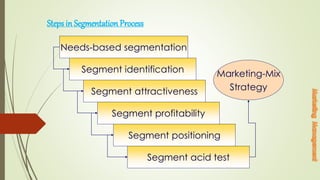
Steps in Segmentation Process
Needs-based segmentation
Segment identification
Segment attractiveness
Segment profitability
Segment positioning
Segment acid test
Marketing-Mix
Strategy
Five Patterns of Target Market Selection
Single-Segment Concentration
Selective Specialization
Product Specialization
Market Specialization
Full Market Coverage
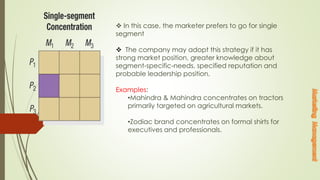
 In this case, the marketer prefers to go for single
segment
 The company may adopt this strategy if it has
strong market position, greater knowledge about
segment-specific-needs, specified reputation and
probable leadership position.
Examples:
•Mahindra & Mahindra concentrates on tractors
primarily targeted on agricultural markets.
•Zodiac brand concentrates on formal shirts for
executives and professionals.
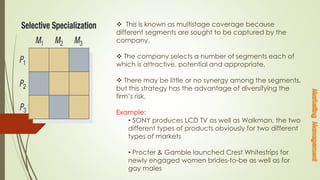
 This is known as multistage coverage because
different segments are sought to be captured by the
company.
 The company selects a number of segments each of
which is attractive, potential and appropriate.
 There may be little or no synergy among the segments,
but this strategy has the advantage of diversifying the
firm’s risk.
Example:
• SONY produces LCD TV as well as Walkman, the two
different types of products obviously for two different
types of markets
• Procter & Gamble launched Crest Whitestrips for
newly engaged women brides-to-be as well as for
gay males
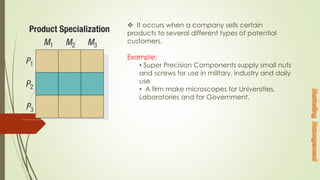
 It occurs when a company sells certain
products to several different types of potential
customers.
Example:
• Super Precision Components supply small nuts
and screws for use in military, industry and daily
use
• A firm make microscopes for Universities,
Laboratories and for Government.
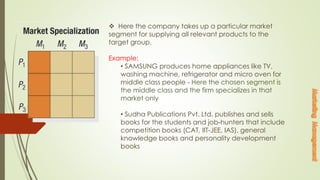
 Here the company takes up a particular market
segment for supplying all relevant products to the
target group.
Example:
• SAMSUNG produces home appliances like TV,
washing machine, refrigerator and micro oven for
middle class people - Here the chosen segment is
the middle class and the firm specializes in that
market only
• Sudha Publications Pvt. Ltd. publishes and sells
books for the students and job-hunters that include
competition books (CAT, IIT-JEE, IAS), general
knowledge books and personality development
books
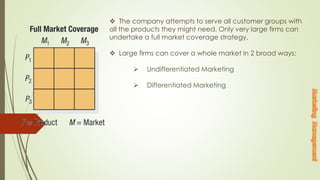
 The company attempts to serve all customer groups with
all the products they might need. Only very large firms can
undertake a full market coverage strategy.
 Large firms can cover a whole market in 2 broad ways:
 Undifferentiated Marketing
 Differentiated Marketing
 Undifferentiated Marketing
The company ignores market segment differences and goes after the whole market with
one market offer. It focuses on a basic buyer need rather than on differences among
buyers.
 Differentiated Marketing
The company operates in several market segments and designs different products for
each segment. It creates more total sales than Undifferentiated Marketing
Example:
• Microsoft
• Coca-Cola
• General Motors
Target Marketing
Target Marketing

Target Marketing

  • 1.
  • 2.
     Market targetingis the second of three steps in product promotion. The other two are segmentation and positioning.  Together, these stages are sometimes called STP Market Targeting:  Target marketing is about attracting customers who will buy what you’re selling  The process of evaluating each market segment’s attractiveness and selecting one or more segment to enter  A Target market is a set of buyers sharing common needs or characteristics that the company decides to serve.
  • 3.
    Defining your TargetMarketing o Target marketing can segmented into 5 categories Geography, Demographic, Psychographic, Behavioral and Product Relationship  Geography = Where they live  Demographic = Age, Income, Gender  Psychographic = Similar belief, Attitudes, Life styles  Behavioral = Loyalty, Buying Habits  Product Relationship = How the product is being used
  • 4.
    Effective SegmentationCriteria Characteristics ofEffective Segments Measurable Substantial Accessible Differentiable Actionable
  • 5.
    Steps in SegmentationProcess Needs-based segmentation Segment identification Segment attractiveness Segment profitability Segment positioning Segment acid test Marketing-Mix Strategy
  • 6.
    Five Patterns ofTarget Market Selection Single-Segment Concentration Selective Specialization Product Specialization Market Specialization Full Market Coverage
  • 7.
     In thiscase, the marketer prefers to go for single segment  The company may adopt this strategy if it has strong market position, greater knowledge about segment-specific-needs, specified reputation and probable leadership position. Examples: •Mahindra & Mahindra concentrates on tractors primarily targeted on agricultural markets. •Zodiac brand concentrates on formal shirts for executives and professionals.
  • 8.
     This isknown as multistage coverage because different segments are sought to be captured by the company.  The company selects a number of segments each of which is attractive, potential and appropriate.  There may be little or no synergy among the segments, but this strategy has the advantage of diversifying the firm’s risk. Example: • SONY produces LCD TV as well as Walkman, the two different types of products obviously for two different types of markets • Procter & Gamble launched Crest Whitestrips for newly engaged women brides-to-be as well as for gay males
  • 9.
     It occurswhen a company sells certain products to several different types of potential customers. Example: • Super Precision Components supply small nuts and screws for use in military, industry and daily use • A firm make microscopes for Universities, Laboratories and for Government.
  • 10.
     Here thecompany takes up a particular market segment for supplying all relevant products to the target group. Example: • SAMSUNG produces home appliances like TV, washing machine, refrigerator and micro oven for middle class people - Here the chosen segment is the middle class and the firm specializes in that market only • Sudha Publications Pvt. Ltd. publishes and sells books for the students and job-hunters that include competition books (CAT, IIT-JEE, IAS), general knowledge books and personality development books
  • 11.
     The companyattempts to serve all customer groups with all the products they might need. Only very large firms can undertake a full market coverage strategy.  Large firms can cover a whole market in 2 broad ways:  Undifferentiated Marketing  Differentiated Marketing
  • 12.
     Undifferentiated Marketing Thecompany ignores market segment differences and goes after the whole market with one market offer. It focuses on a basic buyer need rather than on differences among buyers.  Differentiated Marketing The company operates in several market segments and designs different products for each segment. It creates more total sales than Undifferentiated Marketing Example: • Microsoft • Coca-Cola • General Motors