Marketing Management
MARKET SEGMENTATION
TARGETING AND MARKET POSITIONING
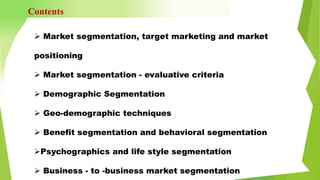
 Market segmentation, target marketing and market
positioning
 Market segmentation - evaluative criteria
 Demographic Segmentation
 Geo-demographic techniques
 Benefit segmentation and behavioral segmentation
Psychographics and life style segmentation
 Business - to -business market segmentation
Contents
Segmentation, Target Marketing & M. Positioning
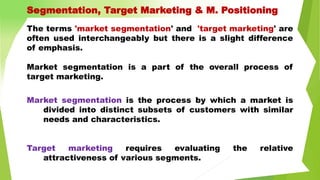
The terms 'market segmentation' and 'target marketing' are
often used interchangeably but there is a slight difference
of emphasis.
Market segmentation is a part of the overall process of
target marketing.
Market segmentation is the process by which a market is
divided into distinct subsets of customers with similar
needs and characteristics.
Target marketing requires evaluating the relative
attractiveness of various segments.
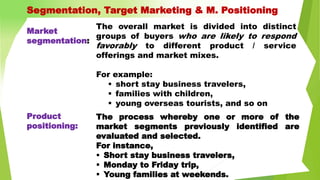
The overall market is divided into distinct
groups of buyers who are likely to respond
favorably to different product / service
offerings and market mixes.
For example:
 short stay business travelers,
 families with children,
 young overseas tourists, and so on
The process whereby one or more of the
market segments previously identified are
evaluated and selected.
For instance,
 Short stay business travelers,
 Monday to Friday trip,
 Young families at weekends.
Market
segmentation:
Product
positioning:
Segmentation, Target Marketing & M. Positioning
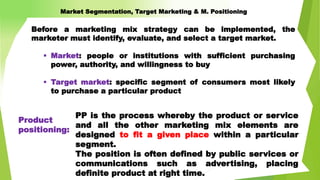
PP is the process whereby the product or service
and all the other marketing mix elements are
designed to fit a given place within a particular
segment.
The position is often defined by public services or
communications such as advertising, placing
definite product at right time.
Before a marketing mix strategy can be implemented, the
marketer must identify, evaluate, and select a target market.
 Market: people or institutions with sufficient purchasing
power, authority, and willingness to buy
 Target market: specific segment of consumers most likely
to purchase a particular product
Product
positioning:
Market Segmentation, Target Marketing & M. Positioning
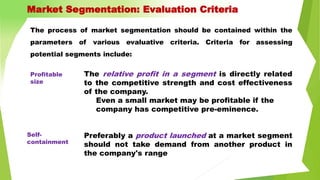
The process of market segmentation should be contained within the
parameters of various evaluative criteria. Criteria for assessing
potential segments include:
The relative profit in a segment is directly related
to the competitive strength and cost effectiveness
of the company.
Even a small market may be profitable if the
company has competitive pre-eminence.
Preferably a product launched at a market segment
should not take demand from another product in
the company's range
Market Segmentation: Evaluation Criteria
Profitable
size
Self-
containment
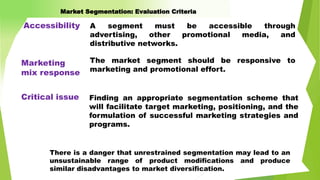
A segment must be accessible through
advertising, other promotional media, and
distributive networks.
There is a danger that unrestrained segmentation may lead to an
unsustainable range of product modifications and produce
similar disadvantages to market diversification.
Accessibility
Marketing
mix response
The market segment should be responsive to
marketing and promotional effort.
Finding an appropriate segmentation scheme that
will facilitate target marketing, positioning, and the
formulation of successful marketing strategies and
programs.
Critical issue
Market Segmentation: Evaluation Criteria
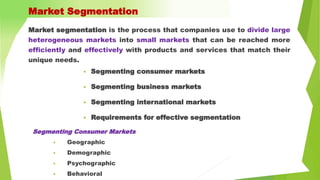
Market segmentation is the process that companies use to divide large
heterogeneous markets into small markets that can be reached more
efficiently and effectively with products and services that match their
unique needs.
Market Segmentation
 Segmenting consumer markets
 Segmenting business markets
 Segmenting international markets
 Requirements for effective segmentation
Segmenting Consumer Markets
• Geographic
• Demographic
• Psychographic
• Behavioral
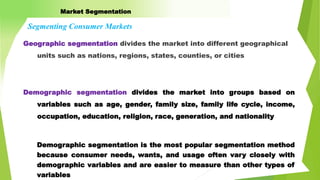
Geographic segmentation divides the market into different geographical
units such as nations, regions, states, counties, or cities
Market Segmentation
Segmenting Consumer Markets
Demographic segmentation divides the market into groups based on
variables such as age, gender, family size, family life cycle, income,
occupation, education, religion, race, generation, and nationality
Demographic segmentation is the most popular segmentation method
because consumer needs, wants, and usage often vary closely with
demographic variables and are easier to measure than other types of
variables
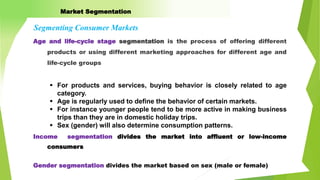
Age and life-cycle stage segmentation is the process of offering different
products or using different marketing approaches for different age and
life-cycle groups
Segmenting Consumer Markets
Income segmentation divides the market into affluent or low-income
consumers
 For products and services, buying behavior is closely related to age
category.
 Age is regularly used to define the behavior of certain markets.
 For instance younger people tend to be more active in making business
trips than they are in domestic holiday trips.
 Sex (gender) will also determine consumption patterns.
Gender segmentation divides the market based on sex (male or female)
Market Segmentation
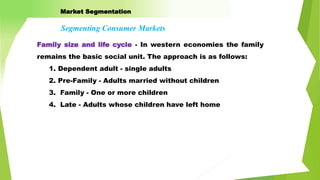
Family size and life cycle - In western economies the family
remains the basic social unit. The approach is as follows:
1. Dependent adult - single adults
2. Pre-Family - Adults married without children
3. Family - One or more children
4. Late - Adults whose children have left home
Segmenting Consumer Markets
Market Segmentation
Market Segmentation
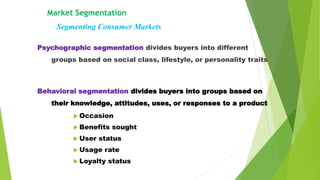
Psychographic segmentation divides buyers into different
groups based on social class, lifestyle, or personality traits
Segmenting Consumer Markets
Behavioral segmentation divides buyers into groups based on
their knowledge, attitudes, uses, or responses to a product
 Occasion
 Benefits sought
 User status
 Usage rate
 Loyalty status
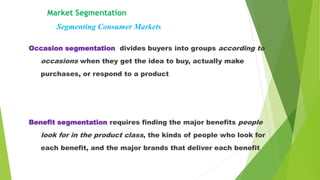
Occasion segmentation divides buyers into groups according to
occasions when they get the idea to buy, actually make
purchases, or respond to a product
Benefit segmentation requires finding the major benefits people
look for in the product class, the kinds of people who look for
each benefit, and the major brands that deliver each benefit
Market Segmentation
Segmenting Consumer Markets
Market Segmentation
Segmenting Consumer Markets
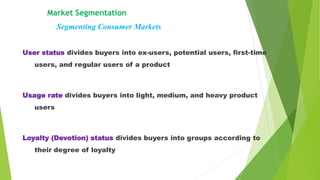
User status divides buyers into ex-users, potential users, first-time
users, and regular users of a product
Usage rate divides buyers into light, medium, and heavy product
users
Loyalty (Devotion) status divides buyers into groups according to
their degree of loyalty
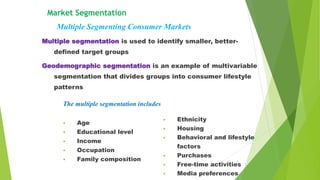
Multiple segmentation is used to identify smaller, better-
defined target groups
Geodemographic segmentation is an example of multivariable
segmentation that divides groups into consumer lifestyle
patterns
Market Segmentation
Multiple Segmenting Consumer Markets
The multiple segmentation includes
• Age
• Educational level
• Income
• Occupation
• Family composition
• Ethnicity
• Housing
• Behavioral and lifestyle
factors
• Purchases
• Free-time activities
• Media preferences
Market Segmentation
Segmenting Business Markets
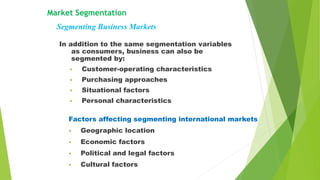
In addition to the same segmentation variables
as consumers, business can also be
segmented by:
• Customer-operating characteristics
• Purchasing approaches
• Situational factors
• Personal characteristics
Factors affecting segmenting international markets
• Geographic location
• Economic factors
• Political and legal factors
• Cultural factors
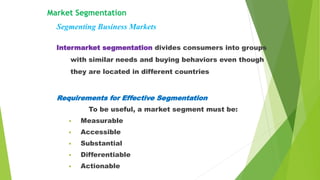
Intermarket segmentation divides consumers into groups
with similar needs and buying behaviors even though
they are located in different countries
Market Segmentation
Segmenting Business Markets
Requirements for Effective Segmentation
To be useful, a market segment must be:
• Measurable
• Accessible
• Substantial
• Differentiable
• Actionable
Requirements for Effective Segmentation
Measurable examples include the size, purchasing
power, and profiles of the segments
Accessible refers to the fact that the market can be
effectively reached and served
Market Segmentation
Segmenting Business Markets
Substantial refers to the fact that the markets are
large and profitable enough to serve
Differentiable refers to the fact that the markets are
conceptually distinguishable and respond
differently to marketing mix elements and
programs
Actionable refers to the fact that effective
programs can be designed for attracting and
serving the segments
Market Targeting
Evaluating Market Segments
• Segment size and growth
• Segment structural attractiveness
• Company objectives and resources
Market Targeting
Evaluating Market Segments
• Segment size and growth
• Smaller versus larger segments
• Growth potential
Market Targeting
Evaluating Market Segments
• Segment structural attractiveness
• Competition
• Substitute products
• Power of buyers
• Power of suppliers
Market Targeting
Evaluating Market Segments
• Company objectives and resources
• Competitive advantage
• Availability of resources
• Consistent with company objectives
Market Targeting
Selecting Target Market Segments
• Undifferentiated marketing
• Differentiated marketing
• Concentrated marketing
• Micromarketing
Market Targeting
Target Marketing Strategies
Undifferentiated marketing targets the whole
market with one offer
• Mass marketing
• Focuses on common needs rather than what’s
different
Market Targeting
Selecting Target Market Segments
Differentiated marketing targets several different
market segments and designs separate offers for
each
• Goal is to achieve higher sales and stronger position
• More expensive than undifferentiated marketing
7-34
Market Targeting
Selecting Target Market Segments
Concentrated marketing targets a small share of a
large market
• Limited company resources
• Knowledge of the market
• More effective and efficient
Market Targeting
Selecting Target Market Segments
Micromarketing is the practice of tailoring products
and marketing programs to suit the tastes of
specific individuals and locations
• Local marketing
• Individual marketing
Market Targeting
Selecting Target Market Segments
Local marketing involves tailoring brands and promotion to the needs and wants
of local customer groups
• Cities
• Neighborhoods
• Stores
Market Targeting
Selecting Target Market Segments
Local Marketing
• Benefits:
• Increased marketing effectiveness in competitive
markets
• More customer-specific offerings
Market Targeting
Selecting Target Market Segments
Local marketing
• Challenges:
• Increased manufacturing and marketing costs
• Less economy of scale
• Logistics
• Dilution of company image
Marketing Targeting
Individual marketing involves tailoring
products and marketing programs to the
needs and preferences of individual
customers
• Also known as:
• One-to-one marketing
• Mass customization
• Markets-of-one marketing
Selecting Target Market Segments
Market Targeting
Selecting Target Market Segments
Mass customization is the process through which firms
interact one-to-one with masses of customers to design
products and services tailor-made to meet individual
needs. Has made relationships with customers important
in the new economy.
• Provides a way to distinguish the company against
competitors
Market Targeting
Choosing a Targeting Strategy
Depends on:
• Company resources
• Product variability
• Product life-cycle stage
• Market variability
• Competitor’s marketing strategies
Market Targeting
Socially Responsible Target Marketing
Benefits customers with specific needs
Concern for vulnerable segments
• Children
• Alcohol
• Cigarettes
Differentiation and Positioning
Product position is the way the product is defined
by consumers on important attributes—the place
the product occupies in consumers’ minds
relative to competing products
• Perceptions
• Impressions
• Feelings
Differentiation and Positioning
Positioning maps show consumer perceptions of
their brands versus competing products on
important buying dimensions
• Price and orientation
Differentiation and Positioning
Choosing a Differentiation and Positioning Strategy
• Identifying a set of possible competitive
advantages to build a position
• Choosing the right competitive advantages
• Selecting an overall positioning strategy
Differentiation and Positioning
Choosing a Differentiation and Positioning Strategy
Identifying a set of possible competitive advantages to build
a position by providing superior value from:
• Product differentiation
• Service differentiation
• Channels
• People
• Image
Differentiation and Positioning
Identifying Possible Value Differences and
Competitive Advantage
Competitive Advantage is the advantage over competitors
gained by offering greater value either through lower
prices or by providing more benefits that justify higher
prices
Differentiation and Positioning
Choosing the Right Competitive Advantages
A difference is worth establishing to the extent that it
satisfies the following criteria:
• Important
• Distinctive
• Superior
• Communicable
• Preemptive
• Affordable
Differentiation and Positioning
Selecting an Overall Strategy
Value proposition is the full mix of benefits upon which a
brand is positioned
• More for more
• More for the same
• Same for less
• Less for much less
• More for less
Positioning for Competitive Advantage
Developing a Positioning Statement
Positioning statement states the product’s
membership in a category and then shows
its point-of-difference from other members
of the category.

Market Segmentation

  • 1.
  • 2.
     Market segmentation,target marketing and market positioning  Market segmentation - evaluative criteria  Demographic Segmentation  Geo-demographic techniques  Benefit segmentation and behavioral segmentation Psychographics and life style segmentation  Business - to -business market segmentation Contents
  • 3.
    Segmentation, Target Marketing& M. Positioning The terms 'market segmentation' and 'target marketing' are often used interchangeably but there is a slight difference of emphasis. Market segmentation is a part of the overall process of target marketing. Market segmentation is the process by which a market is divided into distinct subsets of customers with similar needs and characteristics. Target marketing requires evaluating the relative attractiveness of various segments.
  • 4.
    The overall marketis divided into distinct groups of buyers who are likely to respond favorably to different product / service offerings and market mixes. For example:  short stay business travelers,  families with children,  young overseas tourists, and so on The process whereby one or more of the market segments previously identified are evaluated and selected. For instance,  Short stay business travelers,  Monday to Friday trip,  Young families at weekends. Market segmentation: Product positioning: Segmentation, Target Marketing & M. Positioning
  • 5.
    PP is theprocess whereby the product or service and all the other marketing mix elements are designed to fit a given place within a particular segment. The position is often defined by public services or communications such as advertising, placing definite product at right time. Before a marketing mix strategy can be implemented, the marketer must identify, evaluate, and select a target market.  Market: people or institutions with sufficient purchasing power, authority, and willingness to buy  Target market: specific segment of consumers most likely to purchase a particular product Product positioning: Market Segmentation, Target Marketing & M. Positioning
  • 6.
    The process ofmarket segmentation should be contained within the parameters of various evaluative criteria. Criteria for assessing potential segments include: The relative profit in a segment is directly related to the competitive strength and cost effectiveness of the company. Even a small market may be profitable if the company has competitive pre-eminence. Preferably a product launched at a market segment should not take demand from another product in the company's range Market Segmentation: Evaluation Criteria Profitable size Self- containment
  • 7.
    A segment mustbe accessible through advertising, other promotional media, and distributive networks. There is a danger that unrestrained segmentation may lead to an unsustainable range of product modifications and produce similar disadvantages to market diversification. Accessibility Marketing mix response The market segment should be responsive to marketing and promotional effort. Finding an appropriate segmentation scheme that will facilitate target marketing, positioning, and the formulation of successful marketing strategies and programs. Critical issue Market Segmentation: Evaluation Criteria
  • 8.
    Market segmentation isthe process that companies use to divide large heterogeneous markets into small markets that can be reached more efficiently and effectively with products and services that match their unique needs. Market Segmentation  Segmenting consumer markets  Segmenting business markets  Segmenting international markets  Requirements for effective segmentation Segmenting Consumer Markets • Geographic • Demographic • Psychographic • Behavioral
  • 9.
    Geographic segmentation dividesthe market into different geographical units such as nations, regions, states, counties, or cities Market Segmentation Segmenting Consumer Markets Demographic segmentation divides the market into groups based on variables such as age, gender, family size, family life cycle, income, occupation, education, religion, race, generation, and nationality Demographic segmentation is the most popular segmentation method because consumer needs, wants, and usage often vary closely with demographic variables and are easier to measure than other types of variables
  • 10.
    Age and life-cyclestage segmentation is the process of offering different products or using different marketing approaches for different age and life-cycle groups Segmenting Consumer Markets Income segmentation divides the market into affluent or low-income consumers  For products and services, buying behavior is closely related to age category.  Age is regularly used to define the behavior of certain markets.  For instance younger people tend to be more active in making business trips than they are in domestic holiday trips.  Sex (gender) will also determine consumption patterns. Gender segmentation divides the market based on sex (male or female) Market Segmentation
  • 11.
    Family size andlife cycle - In western economies the family remains the basic social unit. The approach is as follows: 1. Dependent adult - single adults 2. Pre-Family - Adults married without children 3. Family - One or more children 4. Late - Adults whose children have left home Segmenting Consumer Markets Market Segmentation
  • 12.
    Market Segmentation Psychographic segmentationdivides buyers into different groups based on social class, lifestyle, or personality traits Segmenting Consumer Markets Behavioral segmentation divides buyers into groups based on their knowledge, attitudes, uses, or responses to a product  Occasion  Benefits sought  User status  Usage rate  Loyalty status
  • 13.
    Occasion segmentation dividesbuyers into groups according to occasions when they get the idea to buy, actually make purchases, or respond to a product Benefit segmentation requires finding the major benefits people look for in the product class, the kinds of people who look for each benefit, and the major brands that deliver each benefit Market Segmentation Segmenting Consumer Markets
  • 14.
    Market Segmentation Segmenting ConsumerMarkets User status divides buyers into ex-users, potential users, first-time users, and regular users of a product Usage rate divides buyers into light, medium, and heavy product users Loyalty (Devotion) status divides buyers into groups according to their degree of loyalty
  • 15.
    Multiple segmentation isused to identify smaller, better- defined target groups Geodemographic segmentation is an example of multivariable segmentation that divides groups into consumer lifestyle patterns Market Segmentation Multiple Segmenting Consumer Markets The multiple segmentation includes • Age • Educational level • Income • Occupation • Family composition • Ethnicity • Housing • Behavioral and lifestyle factors • Purchases • Free-time activities • Media preferences
  • 16.
    Market Segmentation Segmenting BusinessMarkets In addition to the same segmentation variables as consumers, business can also be segmented by: • Customer-operating characteristics • Purchasing approaches • Situational factors • Personal characteristics Factors affecting segmenting international markets • Geographic location • Economic factors • Political and legal factors • Cultural factors
  • 17.
    Intermarket segmentation dividesconsumers into groups with similar needs and buying behaviors even though they are located in different countries Market Segmentation Segmenting Business Markets Requirements for Effective Segmentation To be useful, a market segment must be: • Measurable • Accessible • Substantial • Differentiable • Actionable
  • 18.
    Requirements for EffectiveSegmentation Measurable examples include the size, purchasing power, and profiles of the segments Accessible refers to the fact that the market can be effectively reached and served Market Segmentation Segmenting Business Markets Substantial refers to the fact that the markets are large and profitable enough to serve Differentiable refers to the fact that the markets are conceptually distinguishable and respond differently to marketing mix elements and programs Actionable refers to the fact that effective programs can be designed for attracting and serving the segments
  • 19.
    Market Targeting Evaluating MarketSegments • Segment size and growth • Segment structural attractiveness • Company objectives and resources
  • 20.
    Market Targeting Evaluating MarketSegments • Segment size and growth • Smaller versus larger segments • Growth potential
  • 21.
    Market Targeting Evaluating MarketSegments • Segment structural attractiveness • Competition • Substitute products • Power of buyers • Power of suppliers
  • 22.
    Market Targeting Evaluating MarketSegments • Company objectives and resources • Competitive advantage • Availability of resources • Consistent with company objectives
  • 23.
    Market Targeting Selecting TargetMarket Segments • Undifferentiated marketing • Differentiated marketing • Concentrated marketing • Micromarketing
  • 24.
    Market Targeting Target MarketingStrategies Undifferentiated marketing targets the whole market with one offer • Mass marketing • Focuses on common needs rather than what’s different
  • 25.
    Market Targeting Selecting TargetMarket Segments Differentiated marketing targets several different market segments and designs separate offers for each • Goal is to achieve higher sales and stronger position • More expensive than undifferentiated marketing 7-34
  • 26.
    Market Targeting Selecting TargetMarket Segments Concentrated marketing targets a small share of a large market • Limited company resources • Knowledge of the market • More effective and efficient
  • 27.
    Market Targeting Selecting TargetMarket Segments Micromarketing is the practice of tailoring products and marketing programs to suit the tastes of specific individuals and locations • Local marketing • Individual marketing
  • 28.
    Market Targeting Selecting TargetMarket Segments Local marketing involves tailoring brands and promotion to the needs and wants of local customer groups • Cities • Neighborhoods • Stores
  • 29.
    Market Targeting Selecting TargetMarket Segments Local Marketing • Benefits: • Increased marketing effectiveness in competitive markets • More customer-specific offerings
  • 30.
    Market Targeting Selecting TargetMarket Segments Local marketing • Challenges: • Increased manufacturing and marketing costs • Less economy of scale • Logistics • Dilution of company image
  • 31.
    Marketing Targeting Individual marketinginvolves tailoring products and marketing programs to the needs and preferences of individual customers • Also known as: • One-to-one marketing • Mass customization • Markets-of-one marketing Selecting Target Market Segments
  • 32.
    Market Targeting Selecting TargetMarket Segments Mass customization is the process through which firms interact one-to-one with masses of customers to design products and services tailor-made to meet individual needs. Has made relationships with customers important in the new economy. • Provides a way to distinguish the company against competitors
  • 33.
    Market Targeting Choosing aTargeting Strategy Depends on: • Company resources • Product variability • Product life-cycle stage • Market variability • Competitor’s marketing strategies
  • 34.
    Market Targeting Socially ResponsibleTarget Marketing Benefits customers with specific needs Concern for vulnerable segments • Children • Alcohol • Cigarettes
  • 35.
    Differentiation and Positioning Productposition is the way the product is defined by consumers on important attributes—the place the product occupies in consumers’ minds relative to competing products • Perceptions • Impressions • Feelings
  • 36.
    Differentiation and Positioning Positioningmaps show consumer perceptions of their brands versus competing products on important buying dimensions • Price and orientation
  • 37.
    Differentiation and Positioning Choosinga Differentiation and Positioning Strategy • Identifying a set of possible competitive advantages to build a position • Choosing the right competitive advantages • Selecting an overall positioning strategy
  • 38.
    Differentiation and Positioning Choosinga Differentiation and Positioning Strategy Identifying a set of possible competitive advantages to build a position by providing superior value from: • Product differentiation • Service differentiation • Channels • People • Image
  • 39.
    Differentiation and Positioning IdentifyingPossible Value Differences and Competitive Advantage Competitive Advantage is the advantage over competitors gained by offering greater value either through lower prices or by providing more benefits that justify higher prices
  • 40.
    Differentiation and Positioning Choosingthe Right Competitive Advantages A difference is worth establishing to the extent that it satisfies the following criteria: • Important • Distinctive • Superior • Communicable • Preemptive • Affordable
  • 41.
    Differentiation and Positioning Selectingan Overall Strategy Value proposition is the full mix of benefits upon which a brand is positioned • More for more • More for the same • Same for less • Less for much less • More for less
  • 42.
    Positioning for CompetitiveAdvantage Developing a Positioning Statement Positioning statement states the product’s membership in a category and then shows its point-of-difference from other members of the category.