Branding and Brand
Positioning
Lecture Outline
 What is a Brand/Branding?
 Brand Role and Advantages
 Brand Elements/Brand Element Choice Criteria
 Brand Equity
◦ Measuring Brand Equity/The Brand Value Chain
◦ Managing Brand Equity
 Devising a Branding Strategy
 Brand Portfolios
 Brand Positioning /Requirements
 PODs & POPs
What is a Brand?
A name, term, sign, symbol or design, or a
combination of them, intended to identify the goods or
services of one seller or group of sellers and to
differentiate them from those of competitors.
What is Branding?
Providing goods and services with the power of the brand. It’s all
about creating differences between products.
The Role of Brands
Advantages of Strong Brands
 Improved perceptions of
product performance
 Greater loyalty
 Less vulnerability to
competitive marketing
actions
 Less vulnerability to crises
 Larger margins
 Greater financial market
returns
 More inelastic consumer
response to price increases
 Greater trade cooperation
 Increased marketing
communications effectiveness
 Possible licensing opportunities
 Additional brand extension
opportunities
 Improved employee recruiting
and retention
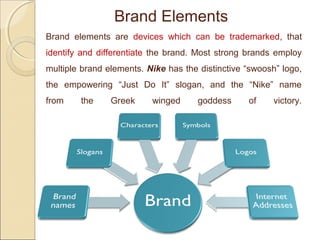
Brand elements are devices which can be trademarked, that
identify and differentiate the brand. Most strong brands employ
multiple brand elements. Nike has the distinctive “swoosh” logo,
the empowering “Just Do It” slogan, and the “Nike” name
from the Greek winged goddess of victory.
Brand Elements
Brand Element Choice Criteria
 Memorable—How easily do consumers recall and
recognize the brand element both at purchase and
consumption such as Tide, Crest, etc
 Meaningful—Is the brand element credible? Does it
suggest the corresponding category and a product
ingredient or the type of person who might use the
brand? Examples are Die Hard auto batteries, Mop & Glo
floor wax
 Likable—How aesthetically appealing is the brand
element? Examples are Flickr photo sharing, Wikipedia
and Motorola’s ROKR, etc
Brand Element Choice Criteria
 Transferable—Can the brand element introduce new
products in the same or different categories? The Amazon
is famous as the world’s biggest river, and the name
suggests the wide variety of goods that could be shipped
 Adaptable—How adaptable and updatable is the brand
element?
 Protectable—How legally protectable is the brand
element? How competitively protectable?
Brand Naming
 Individual names
 Blanket family names
 Separate family names
 Corporate name/individual name combo
What is Brand Equity?
 Brand equity is the added value endowed on
products and services. It may be reflected in the
way consumers think, feel, and act with respect to
the brand, as well as in the prices, market share,
and profitability the brand commands.
Measuring Brand Equity
 An indirect approach assesses potential sources of
brand equity by identifying and tracking consumer
brand knowledge structures.
 A direct approach assesses the actual impact of
brand knowledge on consumer response to different
aspects of the marketing.
 The “Brand Value Chain” links the two approaches
 The brand value chain is a structured approach to
assessing the sources and outcomes of brand equity and
the way marketing activities create brand value.It is based
on following assumptions:
◦ First, brand value creation begins when the firm targets
actual or potential customers by investing in a marketing
program to develop the brand, including product
research, development, and design; trade or
intermediary support; and marketing communications.
◦ Next, we assume customers’ mind-sets, buying
behavior, and response to price will change as a result
of the marketing program; the question is how.
◦ Finally, the investment community will consider market
performance, replacement cost, and purchase price in
acquisitions (among other factors) to assess shareholder
value in general and the value of a brand in particular.
The Brand Value Chain
Managing Brand Equity
 Brand Valuation
Determining total financial value of the brand (Brand
Value is the net present value(NPV) of the
forecasted Brand Earnings).
Managing Brand Equity
 Brand Valuation
Determining total financial value of the brand (Brand
Value is the net present value(NPV) of the
forecasted Brand Earnings).
 Brand Reinforcement
Continuous product improvement. Innovation and
marketing support.
 Brand Revitalization
◦Change in Positioning (The place in the consumers mind
that you want your brand to own. It is the benefit you want your
consumer to perceive when they think of your brand)
◦Overhaul the Brand Image (The impression in the
consumers' mind of a brand's total personality (real and
imaginary qualities and shortcomings).
A firm’s branding strategy—often called the brand
architecture—reflects the number and nature of both
common and distinctive brand elements. A firm has
three main choices:
It can develop new brand elements for the new
product.
It can apply some of its existing brand elements.
It can use a combination of new and existing brand
elements.
Devising a Branding Strategy
 Brand Extension. When a firm uses an established brand
to introduce a new product, the product is called a brand
extension.When marketers combine a new brand with an
existing brand, the brand extension can also be called a
sub-brand, such as Hershey Kisses candy, Adobe
Acrobat software, Toyota Camry atomobiles.
 In a Line Extension, the parent brand covers a new
product within a product category it currently serves, such
as with new flavors, forms, colors, ingredients, and
package sizes.
Devising a Branding Strategy
 In a Category Extension, marketers use the parent brand
to enter a different product Honda has used its company
name to cover such different products as automobiles,
motorcycles ,etc
 A Brand Line consists of all products—original as well as
line and category extensions—sold under a particular
brand.
 A Brand Mix (or brand assortment) is the set of all brand
lines that a particular seller makes.
Devising a Branding Strategy
Brand Portfolios
 The brand portfolio is the set of all brands and
brand lines a particular firm offers for sale in a
particular category or market segment.
 Advantages
◦ Increasing shelf presence and retailer
dependence in the store
◦ Attracting consumers seeking variety
◦ Increasing internal competition within the firm
◦ Yielding economies of scale in advertising, sales,
merchandising, and distribution
Brand Positioning
 The act of designing the company’s offering and
image to occupy a distinctive place in the mind of the
target market. The result of positioning is the
successful creation of a customer-focused value
proposition, a logical reason why the target market
should buy the product.
Value Proposition
A good hot pizza, delivered to your
door within 30 minutes of ordering, at
a moderate price
Requirements of Positioning
Positioning requires that marketers define and
communicate similarities and differences between their
brand and its competitors. Deciding on a positioning
requires:
Determining a competitive frame of reference by
identifying the target market and relevant competition
Identifying the optimal points of parity and points of
difference brand associations given that frame of reference,
and
Creating a brand mantra/slogan to summarize the
positioning and essence of the brand
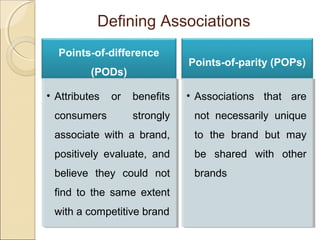
Defining Associations
Points-of-difference
(PODs)
• Attributes or benefits
consumers strongly
associate with a brand,
positively evaluate, and
believe they could not
find to the same extent
with a competitive brand
• Attributes or benefits
consumers strongly
associate with a brand,
positively evaluate, and
believe they could not
find to the same extent
with a competitive brand
Points-of-parity (POPs)
• Associations that are
not necessarily unique
to the brand but may
be shared with other
brands
• Associations that are
not necessarily unique
to the brand but may
be shared with other
brands
PODs Success Criteria
Three criteria determine whether a brand association
can truly function as a point-of-difference—desirability,
deliverability, and differentiability.
•Desirable to consumer. Consumers must see the brand
association as personally relevant to them. Consumers
must also be given a compelling reason to believe and
an understandable rationale for why the brand can
deliver the desired benefit.
• Deliverable by the company. The company must have
the internal resources and commitment to feasibly and
profitably create and maintain the brand association in
the minds of consumers.The product design and
marketing offering must support the desired
association
• Differentiating from competitors. Consumers must see
the brand association as distinctive and superior to
relevant competitors
PODs Success Criteria
Forms of POPs
• Category points-of-parity are attributes or benefits
that consumers view as essential to a legitimate and
credible offering within a certain product or service
category.
• Competitive points-of-parity are associations
designed to overcome perceived weaknesses of the
brand. A competitive point-of-parity may be required
to either
• negate competitors’ perceived points-of-difference
or
• negate a perceived vulnerability of the brand as a
Any Queries ?