Market Segmentation, Targeting for Competitive Advantage
What is Market Segmentation? Market segmentation : The act of dividing a market into smaller groups of buyers with distinct needs, characteristics, or behaviors who might require separate products and/or marketing mixes. How does market segmentation differ form product differentiation?
The Steps in Segmenting a Market Goal: Identify marketing opportunities 6 steps  Choose a basis or bases for segmenting the market Develop Segment Profiles
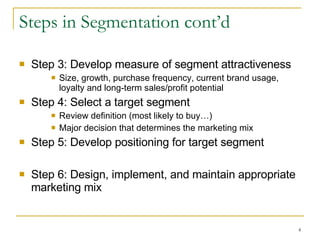
Steps in Segmentation cont’d Step 3: Develop measure of segment attractiveness Size, growth, purchase frequency, current brand usage, loyalty and long-term sales/profit potential Step 4: Select a target segment Review definition (most likely to buy…) Major decision that determines the marketing mix Step 5: Develop positioning for target segment Step 6: Design, implement, and maintain appropriate marketing mix
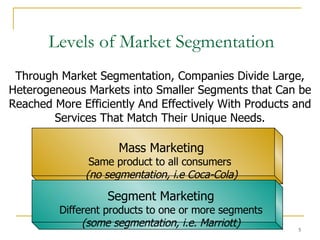
Levels of Market Segmentation Through Market Segmentation, Companies Divide Large, Heterogeneous Markets into Smaller Segments that Can be Reached More Efficiently And Effectively With Products and Services That Match Their Unique Needs. Mass Marketing Same product to all consumers  (no segmentation, i.e Coca-Cola) Segment Marketing Different products to one or more segments (some segmentation, i.e. Marriott)
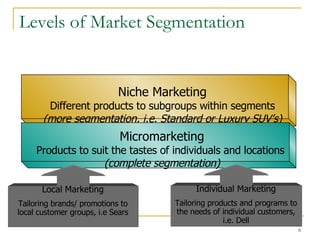
Levels of Market Segmentation Niche Marketing Different products to subgroups within segments (more segmentation, i.e. Standard or Luxury SUV’s) Micromarketing Products to suit the tastes of individuals and locations   (complete segmentation) Local Marketing Tailoring brands/ promotions to local customer groups, i.e Sears Individual Marketing Tailoring products and programs to the needs of individual customers, i.e. Dell
Basic Market-Preference Patterns (a) Homogeneous preferences Sweetness Creaminess (c) Clustered preferences Creaminess Sweetness (b) Diffused preferences Creaminess Sweetness
The Segmentation Variables Geographic Segmentation Define– Market is divided into geographical units like nations, counties, states, cities, regions etc. Four good reasons to use region: Adapt better to sluggish or competitive markets Data (via scanners, etc.) tells us what sells in a region Regional brand preference data Faster to react to competition in a given region
Demographic Segmentation Define– Market is divided into groups on the basis of variables such as age, gender, income, ethnic background, education, occupation, religion,race etc. Age segmentation (know key characteristics) Importance of 38 million children < 9 Teens- have allowances, specific preferences Young adults Baby Boomers Seniors
Demographic Segmentation cont’d Gender segmentation Clothing, cosmetics, personal care items, magazines and footwear make heavy use of gender segmentation Income segmentation Housing, clothing, cars, and food
Psychographic Segmentation Buyers are divided into groups based on  the following variables Personality – habits, traits and attitudes Motives- economy, reliability, dependability– status-related vs. rational motives Lifestyles- how do you spend your time and what things do you have (i.e. H-D segments)
Behavioral Segmentation Dividing the market into groups based on variables such as: Occasions Benefits User status Usage rate Loyalty status Readiness stage Attitude toward product
Usage Rate  Dividing the market by the amount of product bought or consumed Heavy users, former, potential, first-time, light or irregular, or medium Heavy users account for large % of product sales, so the marketing mix… 80/20 principle– 20 % of all customers generate 80% of the demand Goal: create a heavy user (frequency/loyalty programs) Reward and retain heavy users
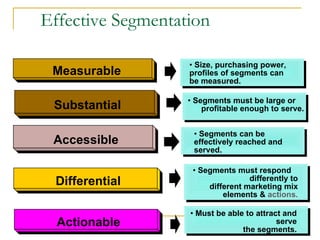
Effective Segmentation Measurable Accessible Substantial Differential Actionable Segments must be large or  profitable enough to serve. Segments can be effectively reached and served. Size, purchasing power, profiles of segments can be measured.  Segments must respond  differently to different marketing mix elements & actions. Must be able to attract and  serve the segments.
Segmenting Business Markets Demographics Operating Variables Purchasing Approaches Situational Factors Personal Characteristics Business Marketers Use Many of the Same Consumer  Variables, Plus:
Table 10-3:  Major Segmentation Variables for Business Markets Demographic Industry: Which industries should we serve? Company size: What size companies should we serve? Location: What geographical areas should we serve? Operating Variables Technology: What customer technologies should we focus on? User or nonuser status: Should we serve heavy users, medium users, light users, or nonusers? Customer capabilities: Should we serve customers needing many or few services? Purchasing Approaches Purchasing-function organization: Should we serve companies with highly centralized or decentralized purchasing organizations? Power structure: Should we serve companies that are engineering dominated, financially dominated, and so on?
Segmenting Consumer and Business Markets Business buyers seek different benefit bundles based on their stage in  the purchase decision process. First-time prospects Novices Sophisticates
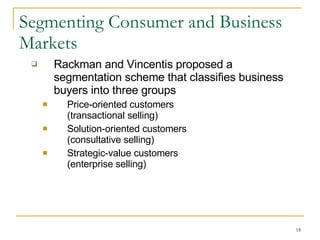
Segmenting Consumer and Business Markets Rackman and Vincentis proposed a segmentation scheme that classifies business buyers into three groups Price-oriented customers  (transactional selling) Solution-oriented customers  (consultative selling) Strategic-value customers  (enterprise selling)
Segmenting International Markets Factors Used  to Segment International Markets Geographic  Location Economic Factors Political and Legal Factors Cultural  Factors
Target Market:  Target market: the group of people for whom your company is designing, implementing and maintaining a marketing mix in order to meet the needs of that group (who is most likely to buy your product)
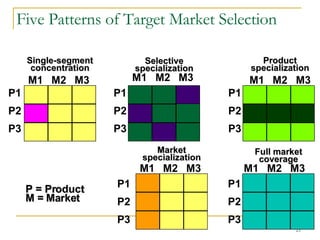
Five Patterns of Target Market Selection Single-segment concentration Product specialization M1  M2  M3  P1 P2 P3 Selective specialization M1  M2  M3  P1 P2 P3 M1  M2  M3  Full market coverage P1 P2 P3 Market specialization M1  M2  M3  P1 P2 P3 P1 P2 P3 M1  M2  M3   P = Product M =   Market
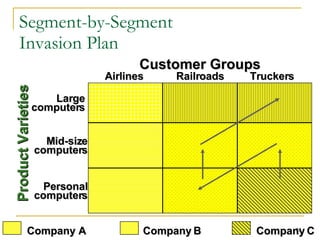
Segment-by-Segment Invasion Plan Customer Groups Truckers Railroads Airlines Large computers Product Varieties Personal computers Mid-size computers Company B Company C Company A
Evaluating Market Segments Segment Size and Growth Analyze current sales, growth rates and expected profitability for various segments. Segment Structural Attractiveness Consider effects of:  competitors, availability of substitute products and, the power of buyers & suppliers. Company Objectives and Resources Company skills & resources needed to succeed in that segment(s). Look for Competitive Advantages.
Socially Responsible Target Marketing Smart targeting helps companies and consumers alike. Target marketing sometimes generates controversy and concern. Disadvantaged and vulnerable can be targeted. Cigarette, beer, and fast-food marketers have received criticism in the past.  Internet has come under attack because of the loose boundaries and lack of control in marketing practices.
THANK YOU

Segmentation

  • 1.
    Market Segmentation, Targetingfor Competitive Advantage
  • 2.
    What is MarketSegmentation? Market segmentation : The act of dividing a market into smaller groups of buyers with distinct needs, characteristics, or behaviors who might require separate products and/or marketing mixes. How does market segmentation differ form product differentiation?
  • 3.
    The Steps inSegmenting a Market Goal: Identify marketing opportunities 6 steps Choose a basis or bases for segmenting the market Develop Segment Profiles
  • 4.
    Steps in Segmentationcont’d Step 3: Develop measure of segment attractiveness Size, growth, purchase frequency, current brand usage, loyalty and long-term sales/profit potential Step 4: Select a target segment Review definition (most likely to buy…) Major decision that determines the marketing mix Step 5: Develop positioning for target segment Step 6: Design, implement, and maintain appropriate marketing mix
  • 5.
    Levels of MarketSegmentation Through Market Segmentation, Companies Divide Large, Heterogeneous Markets into Smaller Segments that Can be Reached More Efficiently And Effectively With Products and Services That Match Their Unique Needs. Mass Marketing Same product to all consumers (no segmentation, i.e Coca-Cola) Segment Marketing Different products to one or more segments (some segmentation, i.e. Marriott)
  • 6.
    Levels of MarketSegmentation Niche Marketing Different products to subgroups within segments (more segmentation, i.e. Standard or Luxury SUV’s) Micromarketing Products to suit the tastes of individuals and locations (complete segmentation) Local Marketing Tailoring brands/ promotions to local customer groups, i.e Sears Individual Marketing Tailoring products and programs to the needs of individual customers, i.e. Dell
  • 7.
    Basic Market-Preference Patterns(a) Homogeneous preferences Sweetness Creaminess (c) Clustered preferences Creaminess Sweetness (b) Diffused preferences Creaminess Sweetness
  • 8.
    The Segmentation VariablesGeographic Segmentation Define– Market is divided into geographical units like nations, counties, states, cities, regions etc. Four good reasons to use region: Adapt better to sluggish or competitive markets Data (via scanners, etc.) tells us what sells in a region Regional brand preference data Faster to react to competition in a given region
  • 9.
    Demographic Segmentation Define–Market is divided into groups on the basis of variables such as age, gender, income, ethnic background, education, occupation, religion,race etc. Age segmentation (know key characteristics) Importance of 38 million children < 9 Teens- have allowances, specific preferences Young adults Baby Boomers Seniors
  • 10.
    Demographic Segmentation cont’dGender segmentation Clothing, cosmetics, personal care items, magazines and footwear make heavy use of gender segmentation Income segmentation Housing, clothing, cars, and food
  • 11.
    Psychographic Segmentation Buyersare divided into groups based on the following variables Personality – habits, traits and attitudes Motives- economy, reliability, dependability– status-related vs. rational motives Lifestyles- how do you spend your time and what things do you have (i.e. H-D segments)
  • 12.
    Behavioral Segmentation Dividingthe market into groups based on variables such as: Occasions Benefits User status Usage rate Loyalty status Readiness stage Attitude toward product
  • 13.
    Usage Rate Dividing the market by the amount of product bought or consumed Heavy users, former, potential, first-time, light or irregular, or medium Heavy users account for large % of product sales, so the marketing mix… 80/20 principle– 20 % of all customers generate 80% of the demand Goal: create a heavy user (frequency/loyalty programs) Reward and retain heavy users
  • 14.
    Effective Segmentation MeasurableAccessible Substantial Differential Actionable Segments must be large or profitable enough to serve. Segments can be effectively reached and served. Size, purchasing power, profiles of segments can be measured. Segments must respond differently to different marketing mix elements & actions. Must be able to attract and serve the segments.
  • 15.
    Segmenting Business MarketsDemographics Operating Variables Purchasing Approaches Situational Factors Personal Characteristics Business Marketers Use Many of the Same Consumer Variables, Plus:
  • 16.
    Table 10-3: Major Segmentation Variables for Business Markets Demographic Industry: Which industries should we serve? Company size: What size companies should we serve? Location: What geographical areas should we serve? Operating Variables Technology: What customer technologies should we focus on? User or nonuser status: Should we serve heavy users, medium users, light users, or nonusers? Customer capabilities: Should we serve customers needing many or few services? Purchasing Approaches Purchasing-function organization: Should we serve companies with highly centralized or decentralized purchasing organizations? Power structure: Should we serve companies that are engineering dominated, financially dominated, and so on?
  • 17.
    Segmenting Consumer andBusiness Markets Business buyers seek different benefit bundles based on their stage in the purchase decision process. First-time prospects Novices Sophisticates
  • 18.
    Segmenting Consumer andBusiness Markets Rackman and Vincentis proposed a segmentation scheme that classifies business buyers into three groups Price-oriented customers (transactional selling) Solution-oriented customers (consultative selling) Strategic-value customers (enterprise selling)
  • 19.
    Segmenting International MarketsFactors Used to Segment International Markets Geographic Location Economic Factors Political and Legal Factors Cultural Factors
  • 20.
    Target Market: Target market: the group of people for whom your company is designing, implementing and maintaining a marketing mix in order to meet the needs of that group (who is most likely to buy your product)
  • 21.
    Five Patterns ofTarget Market Selection Single-segment concentration Product specialization M1 M2 M3 P1 P2 P3 Selective specialization M1 M2 M3 P1 P2 P3 M1 M2 M3 Full market coverage P1 P2 P3 Market specialization M1 M2 M3 P1 P2 P3 P1 P2 P3 M1 M2 M3 P = Product M = Market
  • 22.
    Segment-by-Segment Invasion PlanCustomer Groups Truckers Railroads Airlines Large computers Product Varieties Personal computers Mid-size computers Company B Company C Company A
  • 23.
    Evaluating Market SegmentsSegment Size and Growth Analyze current sales, growth rates and expected profitability for various segments. Segment Structural Attractiveness Consider effects of: competitors, availability of substitute products and, the power of buyers & suppliers. Company Objectives and Resources Company skills & resources needed to succeed in that segment(s). Look for Competitive Advantages.
  • 24.
    Socially Responsible TargetMarketing Smart targeting helps companies and consumers alike. Target marketing sometimes generates controversy and concern. Disadvantaged and vulnerable can be targeted. Cigarette, beer, and fast-food marketers have received criticism in the past. Internet has come under attack because of the loose boundaries and lack of control in marketing practices.
  • 25.