






Crafting the Brand Positioning
Learning Objectives How are brands differentiated? How can a firm choose and communicate an effective positioning in the market?
Positioning Designing the company’s offering and image for a distinctive place in the mind of the target market.
Positioning Positioning: The place the product occupies in consumers’ minds relative to competing products. Typically defined by consumers on the basis of important attributes. Involves implanting the brand’s unique benefits and differentiation in the customer’s mind. Positioning maps that plot perceptions of brands are commonly used.
Why is Positioning Important? A Product cannot be ‘Everything to Everyone’ Positioning Connects Product Offering with Target Market Through Positioning, the Brand Seeks a Locus in the Consumer’s Mind
The Tasks Involved in Positioning Deciding the Locus: Where to Lodge Your Brand in Consumers’ Mind? Analysing Competitors’ Positioning: Is there a Gap Somewhere? Fixing the Positioning Plank Ensuring the Infrastructure/Competitive Advantages for Delivering the Promise Developing the Value Proposition
Competitive Frame of Reference The competitive frame of reference defines the associations that consumers use to evaluate points of parity and points of difference.  The frame of reference often includes other brands in the same category, but could also include brands in other related categories.
Defining Associations Points-of-difference (PODs)- are attributes consumers strongly associated with a brand, positively evaluate, and believe they could not find to the same extent with a competitive brand. Points-of-parity (POPs)-are associations that are not necessarily unique to the brand but may in fact be shared with other brands. Category points-of-parity Competitive points-of-parity Points of parity can be leveraged to negate competitors’ points of difference
POD (Point of Difference) POD (Point of Difference)  Strong, favorable, unique brand associations  May be any kind of attribute or benefit  Two types of  PODs   Attribute Based  Functional, performance related differences  Image Based  Affective, experiential, brand image related differences
POP (Point of Parity) For an offering to achieve a POP on a particular attribute or benefit, a sufficient number of consumers must believe the brand is ‘good enough’ on that dimension. There is a zone or range of tolerance or acceptance with POP. The brand does not literally need to be seen as equal to competitors, but consumers must feel that the brand does well enough on that particular attribute or benefit.    
 
                               
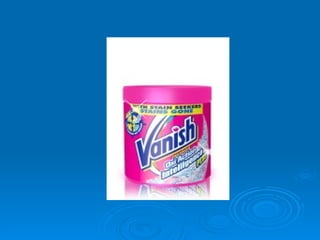
Stains                                                 
Perk                                                                        
questions regarding the basic logic of this strategy.                                
market.                             
UK and Europe.                             
variants. Sugar Free has been trying exactly that.                                
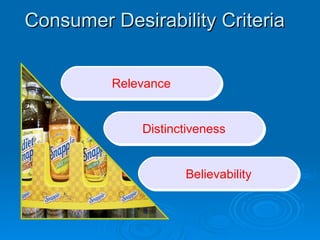
Consumer Desirability Criteria Relevance Distinctiveness Believability
Deliverability Criteria for PODs Feasibility Communicability Sustainability
Important considerations in choosing Points of Difference (PODs) (1)  PODs are desirable by the customer - Relevant and important to the customer  –  e.g. price of HP Laptop - Distinctiveness – Service backup is not a common feature of all foreign made laptops in India - Believable – HP has been in the electronic business for decades
(2) PODs are deliverable to the customer - Feasibility – HP has the required organization to make the service deliverable and the required technology to offer a value for money product - Communicability - HPs products are not known as very expensive - Sustainable - HP has the required R&D to continue making state-of –art upgrades In this case PODs are anchored at the benefit level, sometimes they could be Anchored at the attribute or value level
Handling Conflicting POPs and PODs Sometimes attributes and benefits are negatively correlated or move in the opposite direction. Ideally consumers want to maximize their benefit package. Examples of such cases are  Low Price vs High Quality  Taste vs Low Calories Nutritious vs Good Tasting.
Methods to overcome such situations Go for straddle positioning – do both simultaneously.  BMW designed its car for both luxury and performance Present the communication messages for each attribute / benefit separately Leverage equity of another entity e.g. Intel Inside Redefine the relationship – Teach customers that the relation between attributes is redefined and now stands positive
A Positioning Statement To young, active soft-drink consumers  with little time for sleep,  Mountain Dew is the soft drink that gives you energy because it has the most caffeine.
Product Lends the Maximum Scope for Differentiation Differentiation on Tangible Product Attributes Ingredients/Formula Functional Features Differentiation Based on Additional Features Size as a differentiator Suitcase with wheels Mobile phone with added functions Differentiation based on Packaging Kurkure engaging consumers through packaging Differentiation Through Product Design/Styling
Product Lends the Maximum Scope for Differentiation Differentiation on Product Quality/Technology Differentiation on Customer Care and Service Differentiation on Intangible Attributes Prestige/Status Sentiments Beliefs Ray Ban on lifestyle/aesthetics One can Combine the Attributes and Create the Differentiation The Task is to Locate and Provide Attributes that will Render the Product Distinct
POSITIONING STRATEGIES Identifying possible competitive advantages Differentiation can be based on  Products Services Channels People  Image
Product Differentiation Form-  size, shape or physical structure Features-  supplement to basic function. Performance Quality- the   level at which the product’s primary characteristics operates. Conformance Quality-  the degree to which all the produced units are identical and meet the promised specifications. Durability-  a measure of the product’s expected operating life under natural or stressful conditions. Reliability-  a measure of the probability that a product will not malfunction within a specified time period. Reparability-  a measure of the ease of fixing a product when it fails Style Quality can be communicated by choosing physical signs and cues
Services Differentiation Ordering ease Delivery Installation Customer training Customer consulting Maintenance and repair
Personnel Differentiation Competence Courtesy Credibility Reliability Responsiveness Communication
Channel Differentiation Coverage Expertise Performance
Image Differentiation Image is the way the public perceives the company or its products. Identity is the way a company aims to identify or position itself or its products. Symbols, colours, slogans, atmosphere, Events and employee behaviour
Choosing the right competitive advantage How many differences to   promote? Unique selling proposition Several benefits Which differences to promote?  Criteria include: Important Distinctive Superior Communicable Preemptive Affordable Profitable
Developing and communicating a positioning strategy All products can be differentiated to some extent. But not all differences are meaningful or worthwhile. A difference is worth establishing to the extent that it satisfies the following criteria : Important : The difference delivers a highly valued benefit to a sufficient numbers of buyers. Distinctive : The difference is delivered in a distinctive way.
Developing and communicating a positioning strategy Superior : The difference is superior to other ways of obtaining the benefit. Preemptive : The difference cannot be easily copied by competitors. Affordable : The buyer can afford to pay for the difference. Profitable : The company will find it profitable to introduce the difference.
Choosing a positioning strategy Value propositions ( the whole cluster of benefits the company promises to deliver )represent the  full  positioning of the brand Possible value propositions: More for More  More for the Same  More for Less The Same for Less  Less for Much Less

Crafting the brand positioning

  • 1.
    Crafting the BrandPositioning
  • 2.
    Learning Objectives Howare brands differentiated? How can a firm choose and communicate an effective positioning in the market?
  • 3.
    Positioning Designing thecompany’s offering and image for a distinctive place in the mind of the target market.
  • 4.
    Positioning Positioning: Theplace the product occupies in consumers’ minds relative to competing products. Typically defined by consumers on the basis of important attributes. Involves implanting the brand’s unique benefits and differentiation in the customer’s mind. Positioning maps that plot perceptions of brands are commonly used.
  • 5.
    Why is PositioningImportant? A Product cannot be ‘Everything to Everyone’ Positioning Connects Product Offering with Target Market Through Positioning, the Brand Seeks a Locus in the Consumer’s Mind
  • 6.
    The Tasks Involvedin Positioning Deciding the Locus: Where to Lodge Your Brand in Consumers’ Mind? Analysing Competitors’ Positioning: Is there a Gap Somewhere? Fixing the Positioning Plank Ensuring the Infrastructure/Competitive Advantages for Delivering the Promise Developing the Value Proposition
  • 7.
    Competitive Frame ofReference The competitive frame of reference defines the associations that consumers use to evaluate points of parity and points of difference. The frame of reference often includes other brands in the same category, but could also include brands in other related categories.
  • 8.
    Defining Associations Points-of-difference(PODs)- are attributes consumers strongly associated with a brand, positively evaluate, and believe they could not find to the same extent with a competitive brand. Points-of-parity (POPs)-are associations that are not necessarily unique to the brand but may in fact be shared with other brands. Category points-of-parity Competitive points-of-parity Points of parity can be leveraged to negate competitors’ points of difference
  • 9.
    POD (Point ofDifference) POD (Point of Difference) Strong, favorable, unique brand associations May be any kind of attribute or benefit Two types of PODs Attribute Based Functional, performance related differences Image Based Affective, experiential, brand image related differences
  • 10.
    POP (Point ofParity) For an offering to achieve a POP on a particular attribute or benefit, a sufficient number of consumers must believe the brand is ‘good enough’ on that dimension. There is a zone or range of tolerance or acceptance with POP. The brand does not literally need to be seen as equal to competitors, but consumers must feel that the brand does well enough on that particular attribute or benefit.    
  • 11.
  • 12.
  • 13.
    Stains                                             
  • 14.
    Perk                                                                    
  • 15.
    questions regarding thebasic logic of this strategy.                                
  • 16.
  • 17.
    UK and Europe.                            
  • 18.
    variants. Sugar Freehas been trying exactly that.                                
  • 19.
    Consumer Desirability CriteriaRelevance Distinctiveness Believability
  • 20.
    Deliverability Criteria forPODs Feasibility Communicability Sustainability
  • 21.
    Important considerations inchoosing Points of Difference (PODs) (1) PODs are desirable by the customer - Relevant and important to the customer – e.g. price of HP Laptop - Distinctiveness – Service backup is not a common feature of all foreign made laptops in India - Believable – HP has been in the electronic business for decades
  • 22.
    (2) PODs aredeliverable to the customer - Feasibility – HP has the required organization to make the service deliverable and the required technology to offer a value for money product - Communicability - HPs products are not known as very expensive - Sustainable - HP has the required R&D to continue making state-of –art upgrades In this case PODs are anchored at the benefit level, sometimes they could be Anchored at the attribute or value level
  • 23.
    Handling Conflicting POPsand PODs Sometimes attributes and benefits are negatively correlated or move in the opposite direction. Ideally consumers want to maximize their benefit package. Examples of such cases are Low Price vs High Quality Taste vs Low Calories Nutritious vs Good Tasting.
  • 24.
    Methods to overcomesuch situations Go for straddle positioning – do both simultaneously. BMW designed its car for both luxury and performance Present the communication messages for each attribute / benefit separately Leverage equity of another entity e.g. Intel Inside Redefine the relationship – Teach customers that the relation between attributes is redefined and now stands positive
  • 25.
    A Positioning StatementTo young, active soft-drink consumers with little time for sleep, Mountain Dew is the soft drink that gives you energy because it has the most caffeine.
  • 26.
    Product Lends theMaximum Scope for Differentiation Differentiation on Tangible Product Attributes Ingredients/Formula Functional Features Differentiation Based on Additional Features Size as a differentiator Suitcase with wheels Mobile phone with added functions Differentiation based on Packaging Kurkure engaging consumers through packaging Differentiation Through Product Design/Styling
  • 27.
    Product Lends theMaximum Scope for Differentiation Differentiation on Product Quality/Technology Differentiation on Customer Care and Service Differentiation on Intangible Attributes Prestige/Status Sentiments Beliefs Ray Ban on lifestyle/aesthetics One can Combine the Attributes and Create the Differentiation The Task is to Locate and Provide Attributes that will Render the Product Distinct
  • 28.
    POSITIONING STRATEGIES Identifyingpossible competitive advantages Differentiation can be based on Products Services Channels People Image
  • 29.
    Product Differentiation Form- size, shape or physical structure Features- supplement to basic function. Performance Quality- the level at which the product’s primary characteristics operates. Conformance Quality- the degree to which all the produced units are identical and meet the promised specifications. Durability- a measure of the product’s expected operating life under natural or stressful conditions. Reliability- a measure of the probability that a product will not malfunction within a specified time period. Reparability- a measure of the ease of fixing a product when it fails Style Quality can be communicated by choosing physical signs and cues
  • 30.
    Services Differentiation Orderingease Delivery Installation Customer training Customer consulting Maintenance and repair
  • 31.
    Personnel Differentiation CompetenceCourtesy Credibility Reliability Responsiveness Communication
  • 32.
    Channel Differentiation CoverageExpertise Performance
  • 33.
    Image Differentiation Imageis the way the public perceives the company or its products. Identity is the way a company aims to identify or position itself or its products. Symbols, colours, slogans, atmosphere, Events and employee behaviour
  • 34.
    Choosing the rightcompetitive advantage How many differences to promote? Unique selling proposition Several benefits Which differences to promote? Criteria include: Important Distinctive Superior Communicable Preemptive Affordable Profitable
  • 35.
    Developing and communicatinga positioning strategy All products can be differentiated to some extent. But not all differences are meaningful or worthwhile. A difference is worth establishing to the extent that it satisfies the following criteria : Important : The difference delivers a highly valued benefit to a sufficient numbers of buyers. Distinctive : The difference is delivered in a distinctive way.
  • 36.
    Developing and communicatinga positioning strategy Superior : The difference is superior to other ways of obtaining the benefit. Preemptive : The difference cannot be easily copied by competitors. Affordable : The buyer can afford to pay for the difference. Profitable : The company will find it profitable to introduce the difference.
  • 37.
    Choosing a positioningstrategy Value propositions ( the whole cluster of benefits the company promises to deliver )represent the full positioning of the brand Possible value propositions: More for More More for the Same More for Less The Same for Less Less for Much Less