MARKET SEGMENTATION
Presented by: Kulwinder Kaur
CONTENTS
• Concept and definition.
• Approaches to Market segmentation.
• Bases of Market segmentation.
• Procedure for Market segmentation.
• Market segment selection.
• Market segmentation strategies
• Benefits and limitations of Market segmentation.
• Conclusion.
CONCEPT AND DEFINITION
• The concept of market segment is based on the fact that
the market of commodities are not homogeneous but
they are heterogeneous. Market represent a group of
customer having common characteristics but two
customer are never common in their nature, habits,
hobbies income and purchasing techniques.
• Market segmentation is the process of dividing a potential
market into distinct sub-markets of consumers with
common needs and characteristics.
• According to Philip kotler , “ Market segmentation is sub-
dividing a market into distinct and homogeneous
subgroups of customers, where any group can conceivably
be selected as a target market to be met with distinct
marketing mix.”
APPROACHES TO MARKET SEGMENTATION
1.Mass Marketing :
The term mass market refers to a large, undifferentiated market
of consumers with widely varied backgrounds. Products and
services needed by almost every member of society are suited for
the mass market. Such items as electric and gas utilities, soap,
paper towels and gasoline, for example, can be advertised and
sold to almost anyone, making them mass market goods
Mass Marketing –
An attempt to appeal to an entire market with one basic
marketing strategy utilizing mass distribution and mass media.
Also called undifferentiated marketing.
The appeal of mass marketing is in the potential for higher total
profits. Companies that employ the system expect the larger
profit to result from (1) expanded volume through lower prices
and (2) reduced costs through economies of scale made possible
by the increased volume.
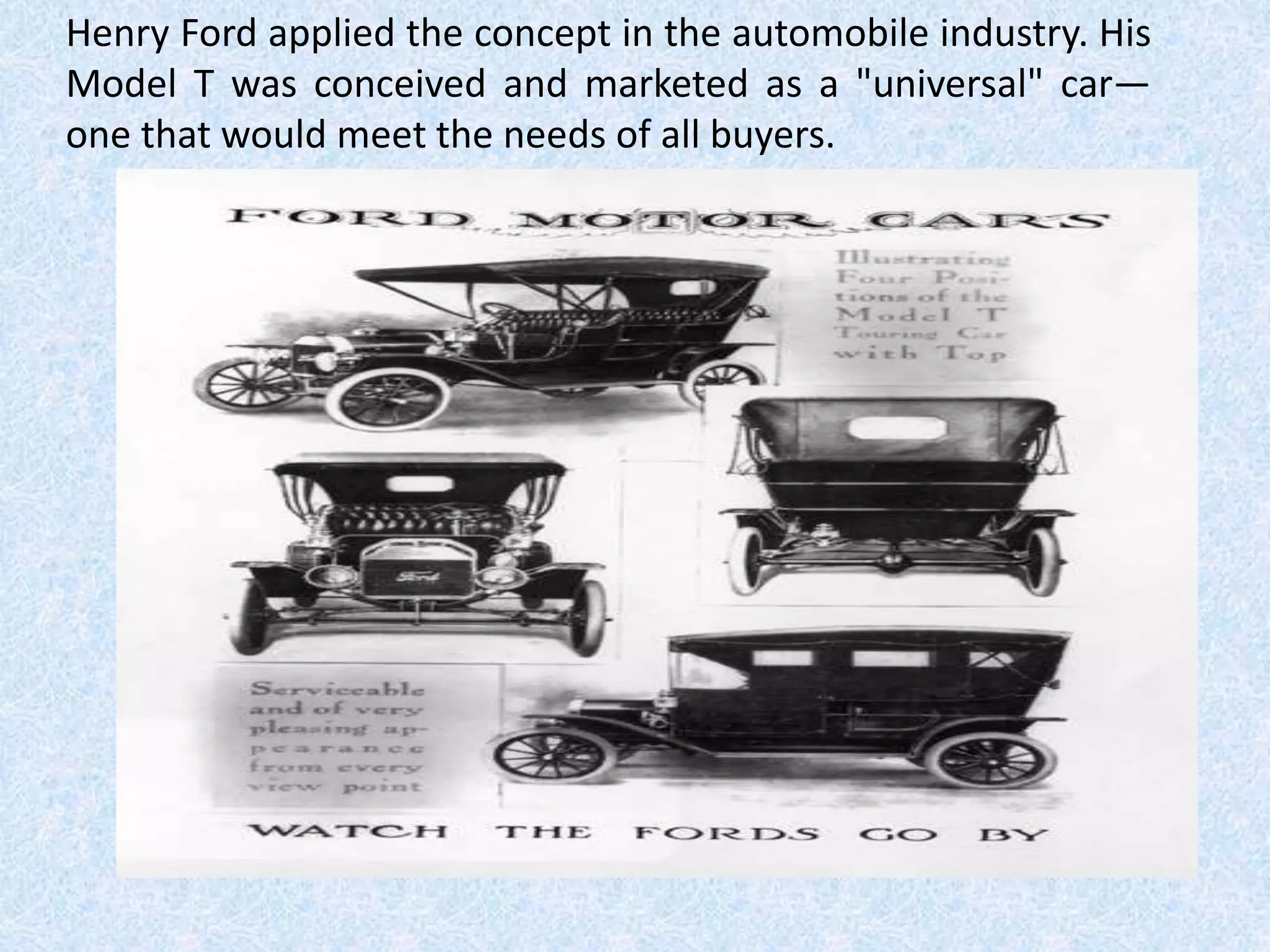
Henry Ford applied the concept in the automobile industry. His
Model T was conceived and marketed as a "universal" car—
one that would meet the needs of all buyers.
2.Product Variety
After the mass marketing strategy another strategy
with similar characteristics but overcoming its
predecessor’s shortcomings came into existence. That
is product variety strategy.
An attempt to appeal to the entire market with a huge
variety of products produced in mass is made.
However, like Mass marketing in this case also the
customers needs & wants are not taken into account
while developing the product.
E.g. when Maruti 800 was introduced into Indian roads,
it was a variety product because it used two version
Standard and Deluxe with different colours.
3.TargetMarketing:
Target marketing is a market segmentation and
market coverage strategy whereby a product is
developed and marketed for a very well-defined,
specific segment of the consumer population.
Target marketing is particularly effective for
small companies with limited resources because
it enables the company to achieve a strong
market position in the specific market segment it
serves without mass production, mass
distribution, or mass advertising. It enables firms
to capitalize on the respective serve market
share
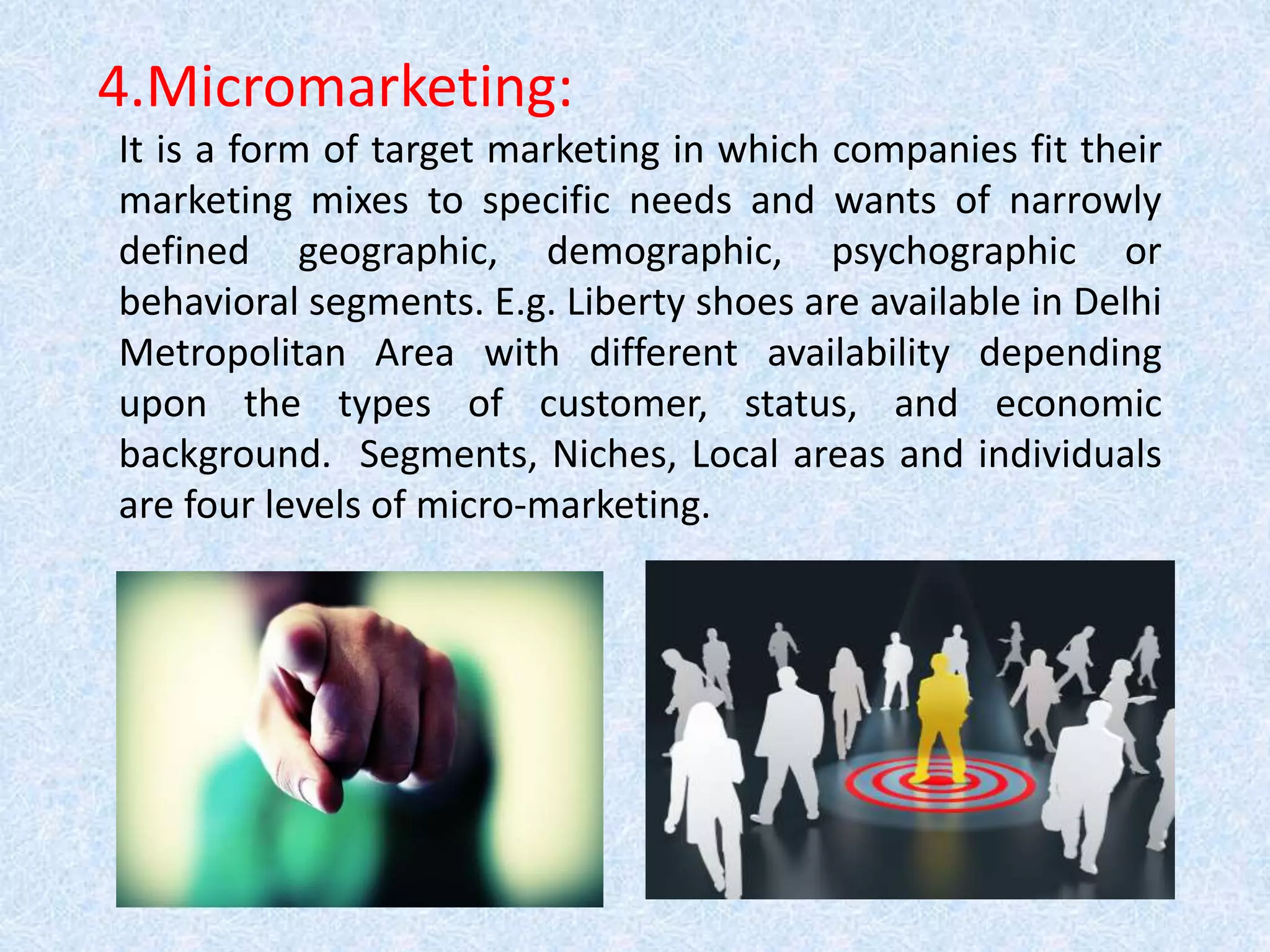
4.Micromarketing:
It is a form of target marketing in which companies fit their
marketing mixes to specific needs and wants of narrowly
defined geographic, demographic, psychographic or
behavioral segments. E.g. Liberty shoes are available in Delhi
Metropolitan Area with different availability depending
upon the types of customer, status, and economic
background. Segments, Niches, Local areas and individuals
are four levels of micro-marketing.
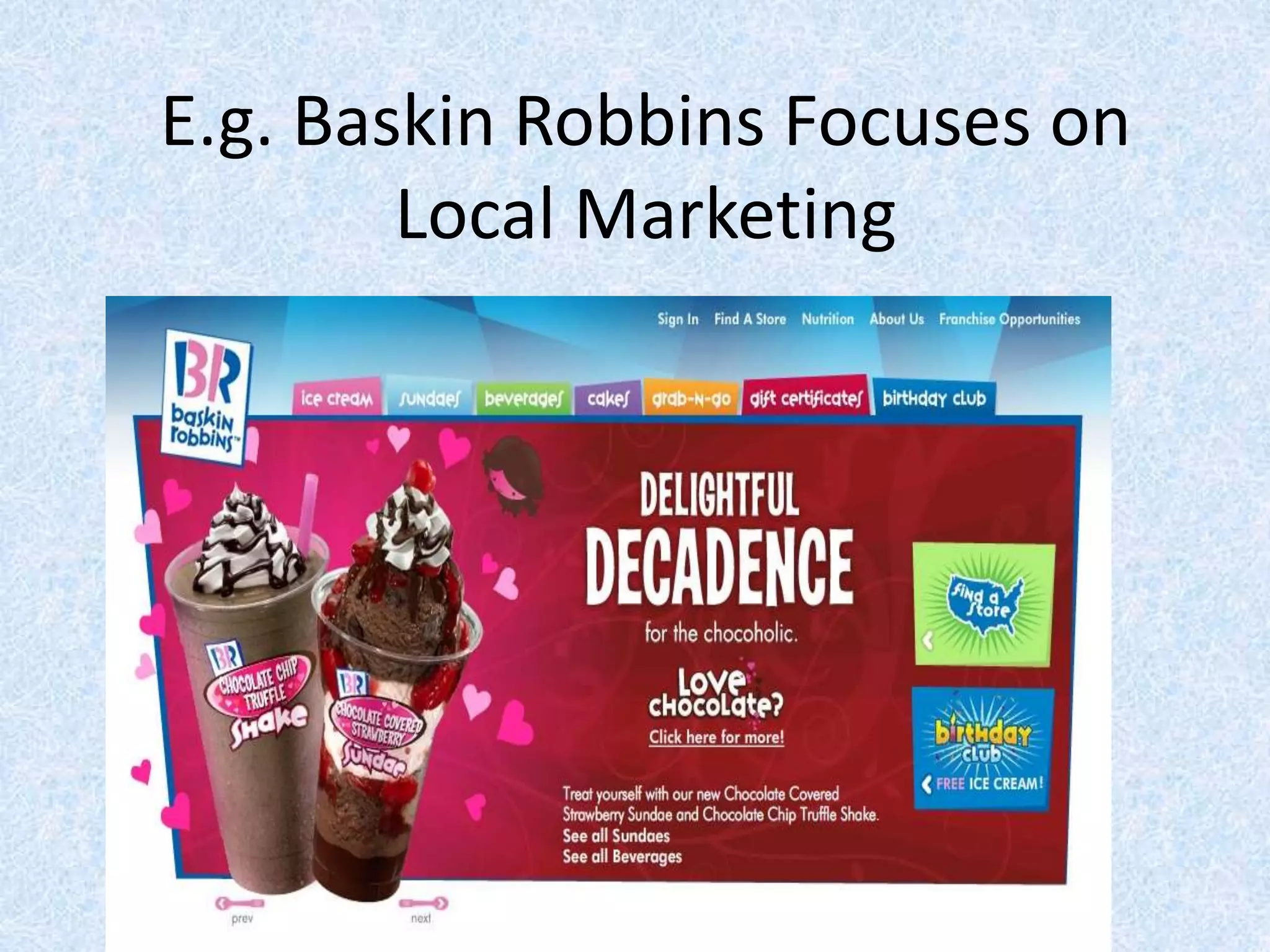
E.g. Baskin Robbins Focuses on
Local Marketing
5.Customised Marketing
• With the advancement in manufacturing
because of breakthrough in information
technology, for example, use of computer-
aided designs and manufacturing, it has now
become possible to manufacture a product as
per the individual customer needs or of a
buying organisation.
• E.g. boutiques for females and childs.
6. Personalised Marketing
Mass production with product varieties, and target
marketing for segments, which are further divided into
customers on a local basis or on individual customer
needs, the focus of the company is shifting more
minutely. Personalised marketing is to retain customer
loyalty with the company. It serves the person-
customer need.
Customerization – empower the consumers to design
the product or service offering of their choice.
E.g. For years, Dell Computers has invited customers to
“build” their computers by selecting the various
specifications for their machine.
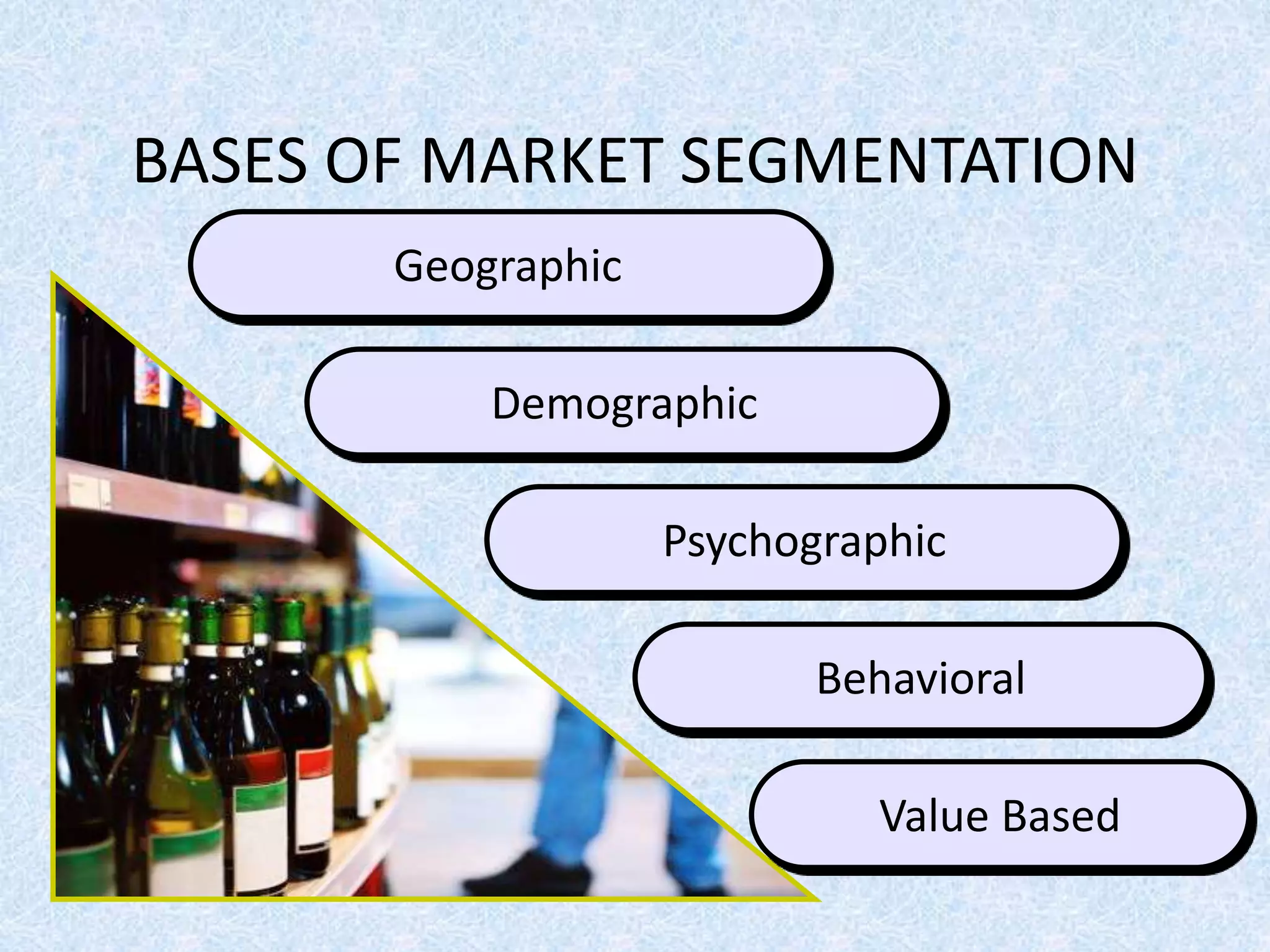
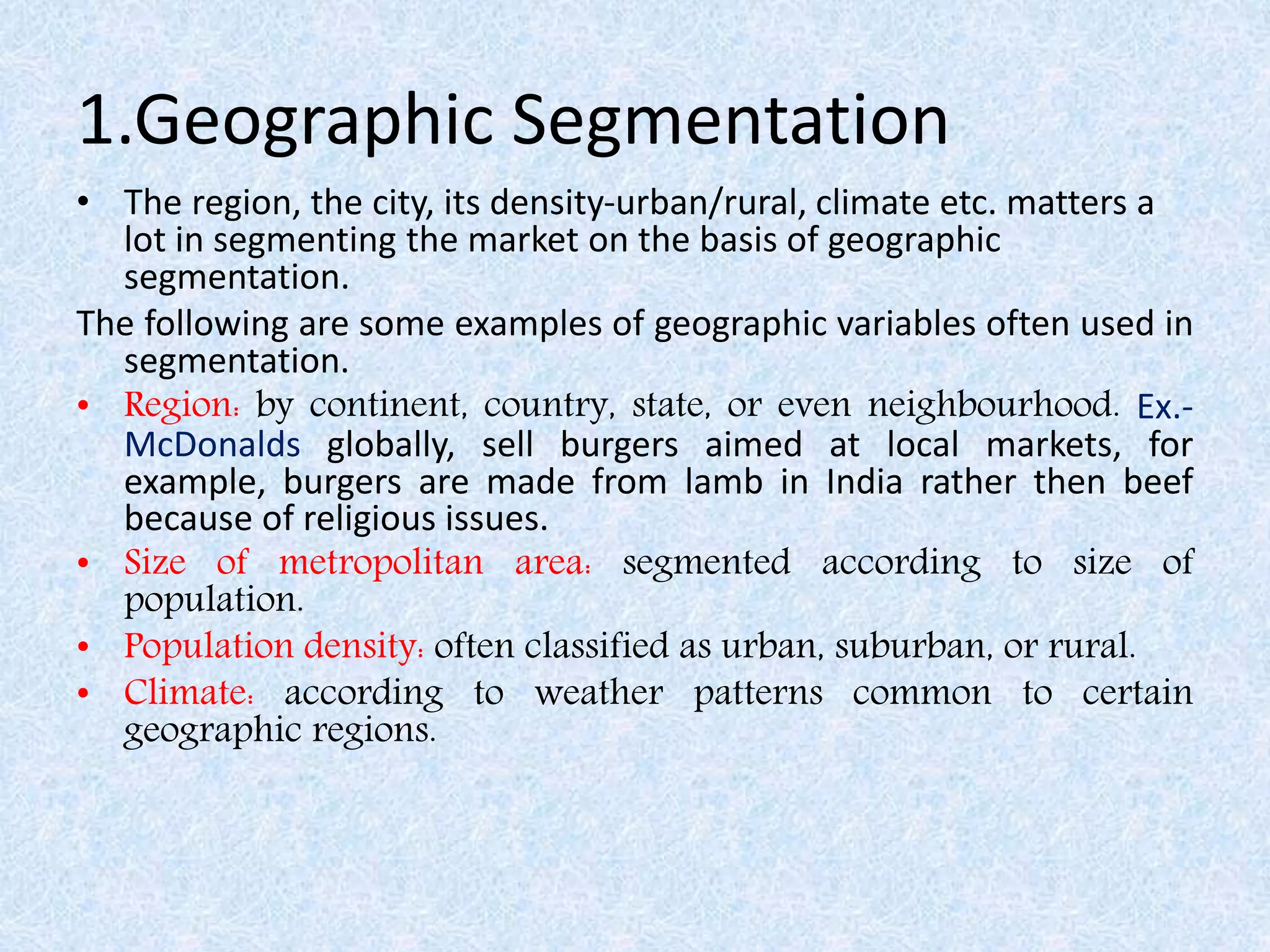
BASES OF MARKET SEGMENTATION
Geographic
Demographic
Psychographic
Behavioral
Value Based
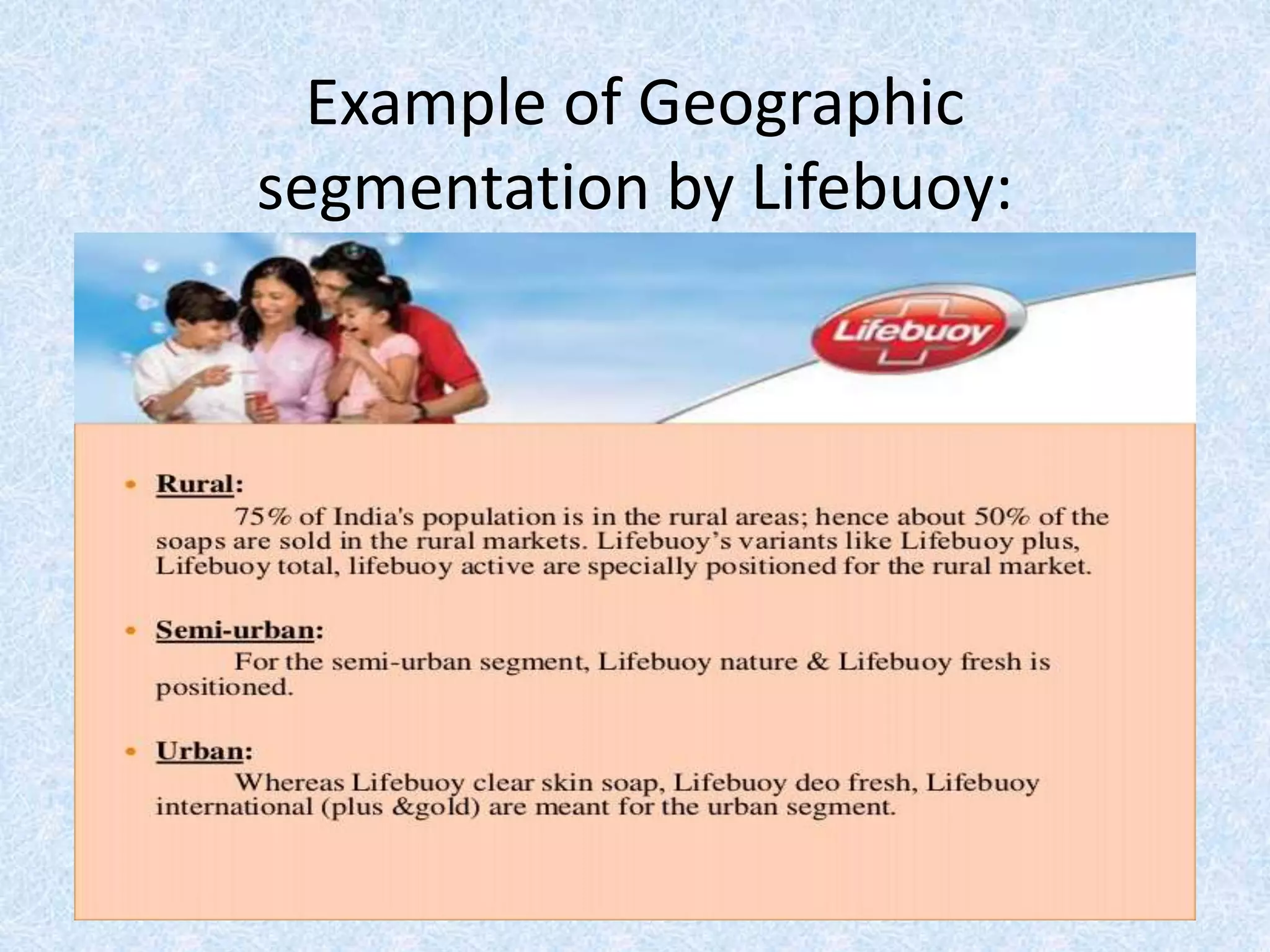
1.Geographic Segmentation
• The region, the city, its density-urban/rural, climate etc. matters a
lot in segmenting the market on the basis of geographic
segmentation.
The following are some examples of geographic variables often used in
segmentation.
• Region: by continent, country, state, or even neighbourhood. Ex.-
McDonalds globally, sell burgers aimed at local markets, for
example, burgers are made from lamb in India rather then beef
because of religious issues.
• Size of metropolitan area: segmented according to size of
population.
• Population density: often classified as urban, suburban, or rural.
• Climate: according to weather patterns common to certain
geographic regions.
Example of Geographic
segmentation by Lifebuoy:
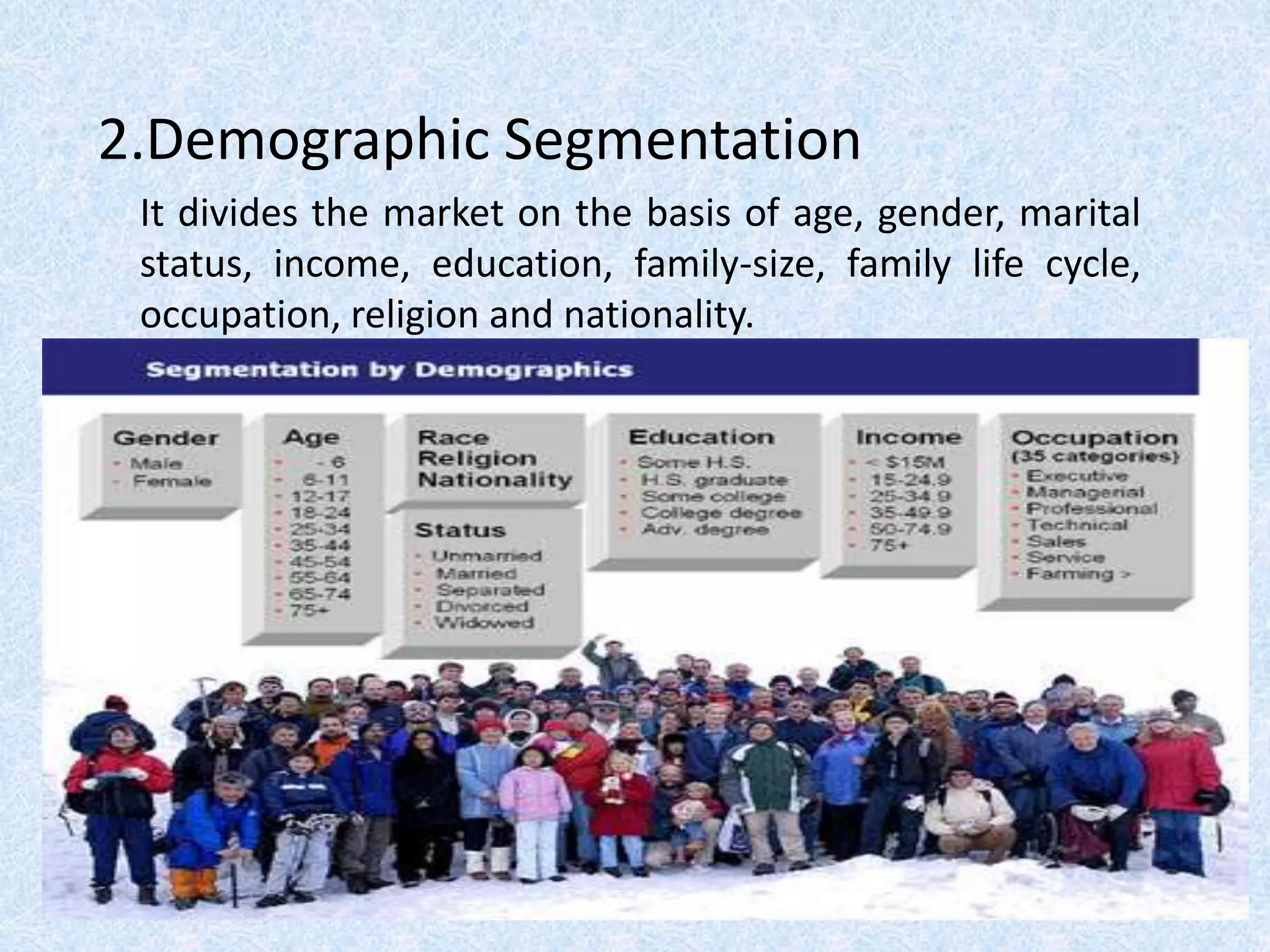
2.Demographic Segmentation
It divides the market on the basis of age, gender, marital
status, income, education, family-size, family life cycle,
occupation, religion and nationality.
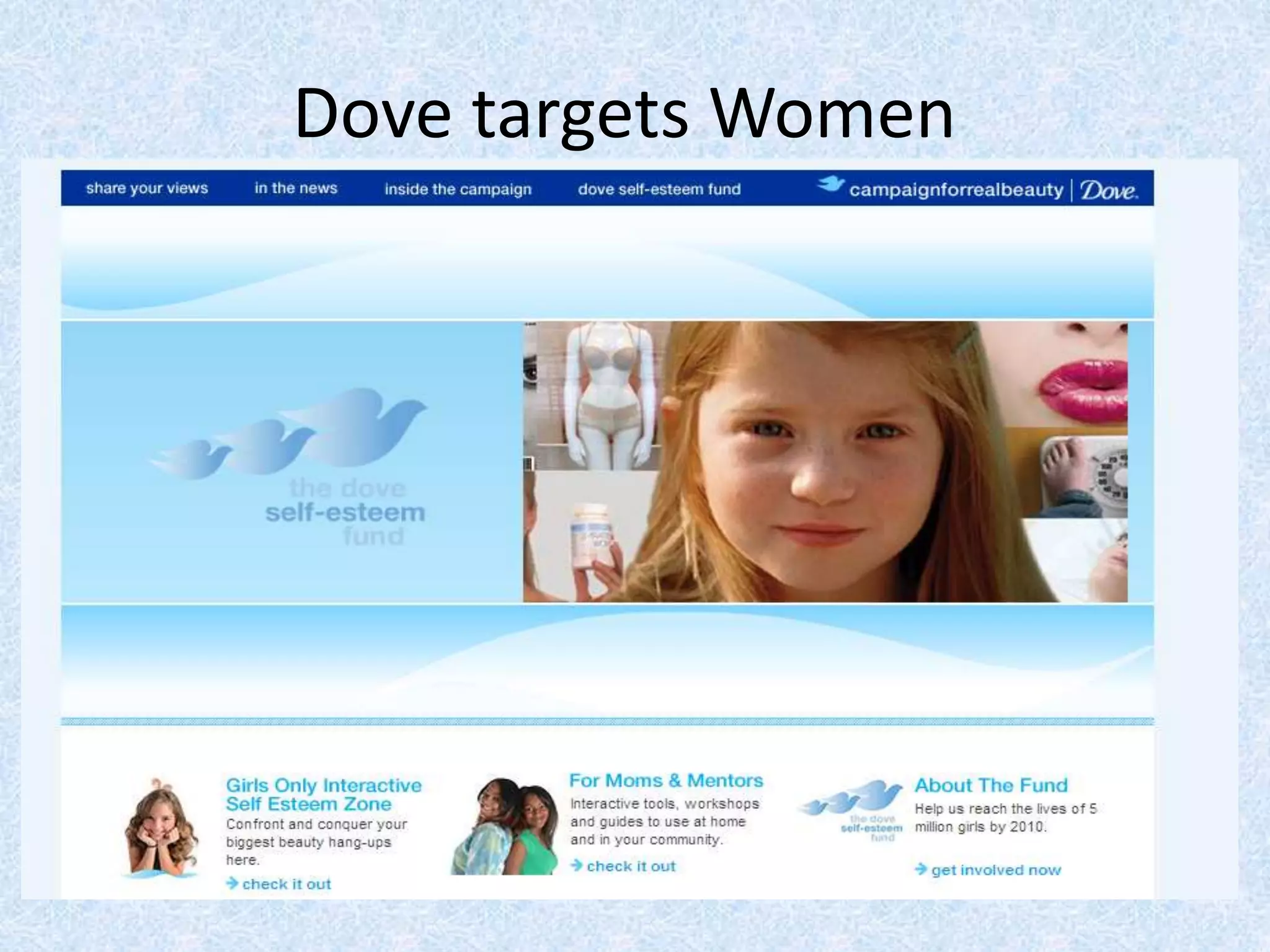
Dove targets Women
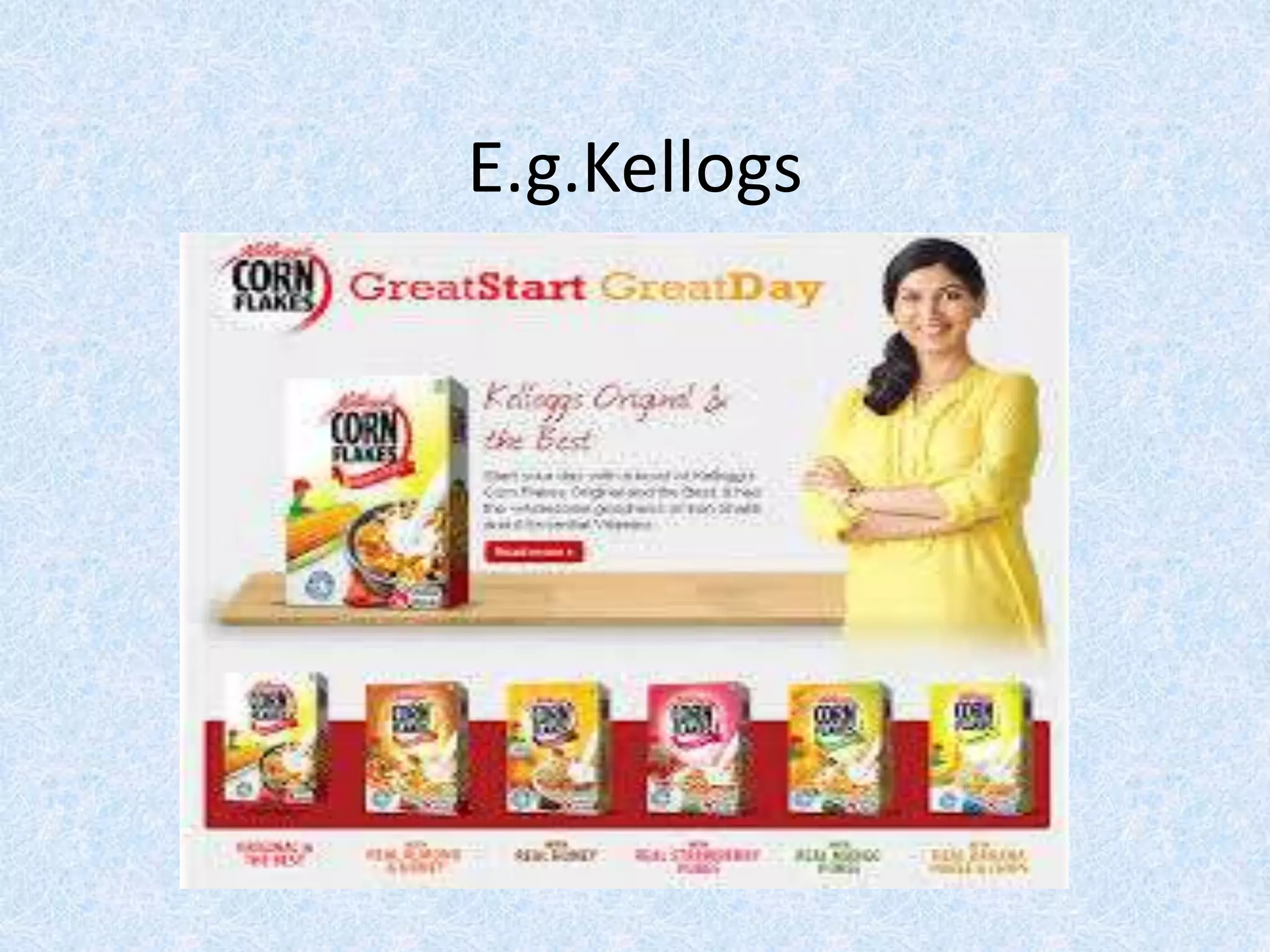
E.g.Kellogs
3.Psychographic Segmentation
This basis of segmentation is widely used by
marketers. The important aspects of psychographic
segmentation include:
• Life- style: Conservative, liberal, health and fitness
conscious, adventuresome, status-seekers.
• Social- Class: Lower class, lower-middle class, middle
class, rich class.
• Cultural: Continental, Mughlai, Chinese, Indian,
Royal, South Indian, Hindu Culture.
• Personality: Extroverts, Introverts, Aggressive,
Complaints.
4.Behavioural segmentation
The consumers are segmented on the
basis of their behavior through need
motivation,perception,learning-
involvement, attitude, occasions,
benefits, user-status, usage-rate, loyalty
status, and buyer readiness stage. This is
based on consumer response to their
requirements.
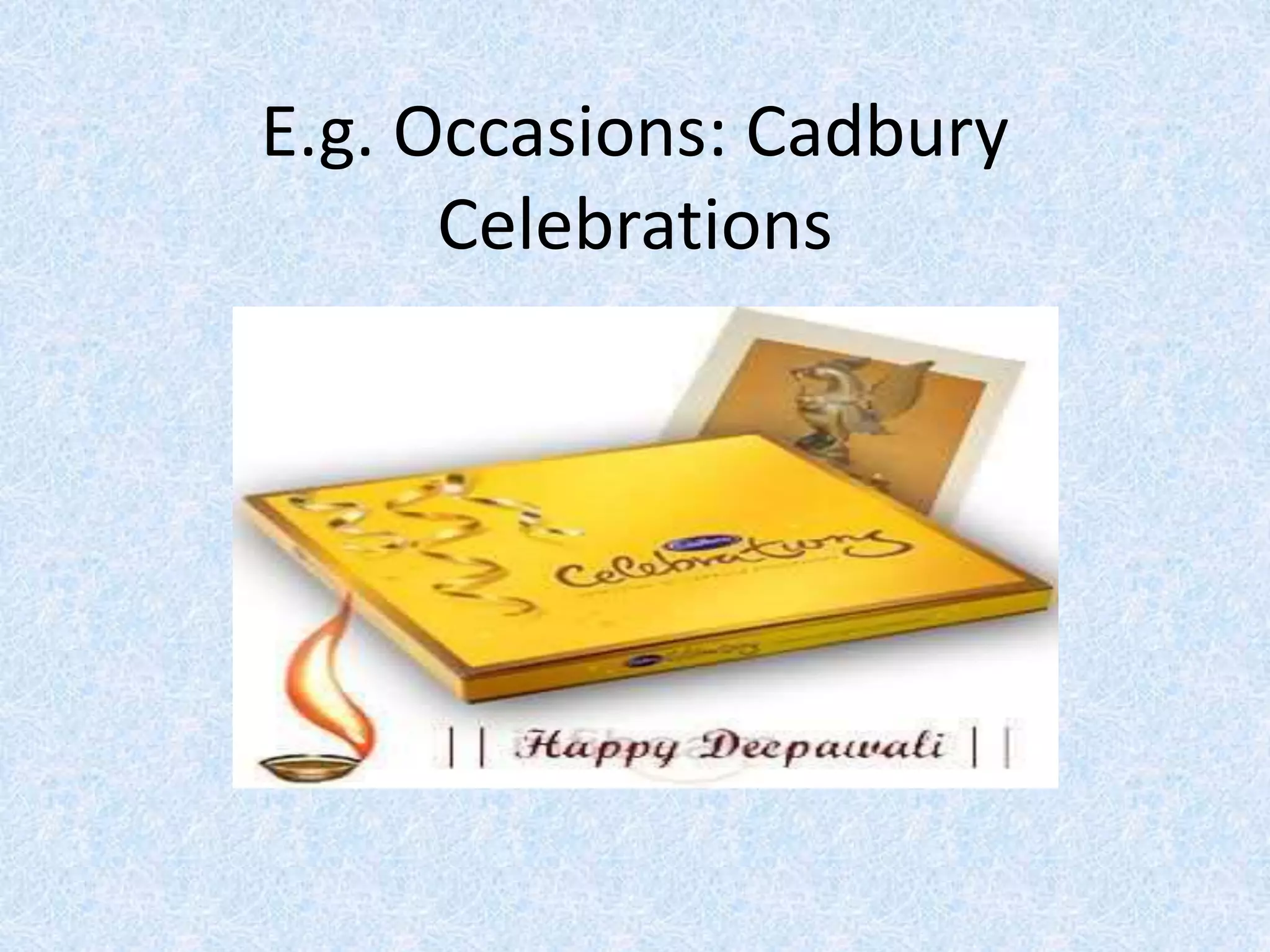
E.g. Occasions: Cadbury
Celebrations
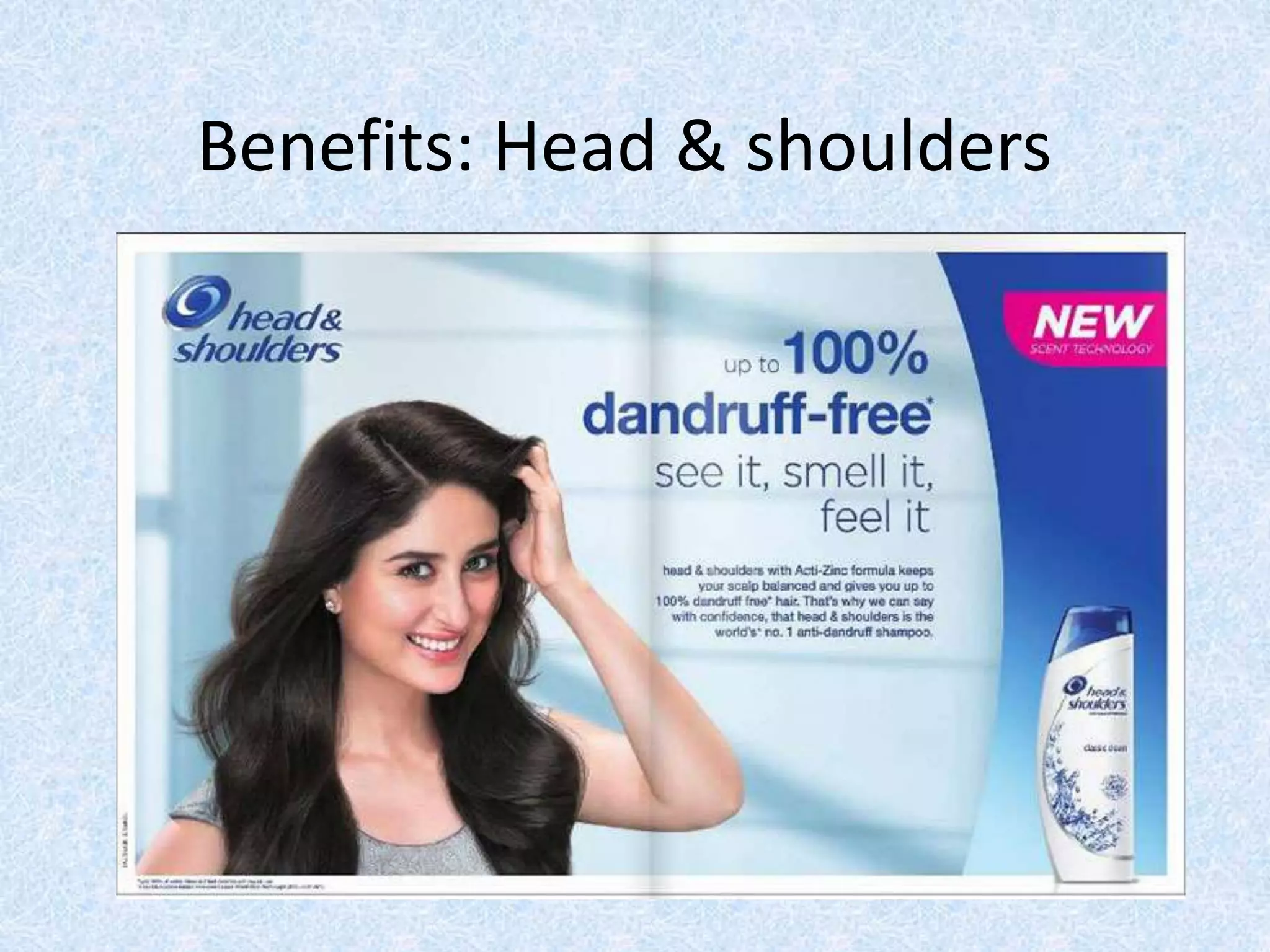
Benefits: Head & shoulders
5.Value-Based Segmentation
This concept prescribes that segmentation
should be the outcome of a match
between the product feature’s and
customer’s needs. The marketers must arm
themselves with a new parameter for
partioning their customers profitability.
PROCEDURE FOR MARKET SEGMENTATION:
There are two methods by which market segments
can be achieved:
1. Segmentation based on consumer
characteristics and responses:
Some of the bases of segmentation are taken up
as a starting point then the customers are divided
with those segmentation bases: gender, age,
lifestyles, family lifecycle, benefits sought etc. The
differences amongst the resulting groups are
statistically tested and mutually exclusive market
segments are formed.
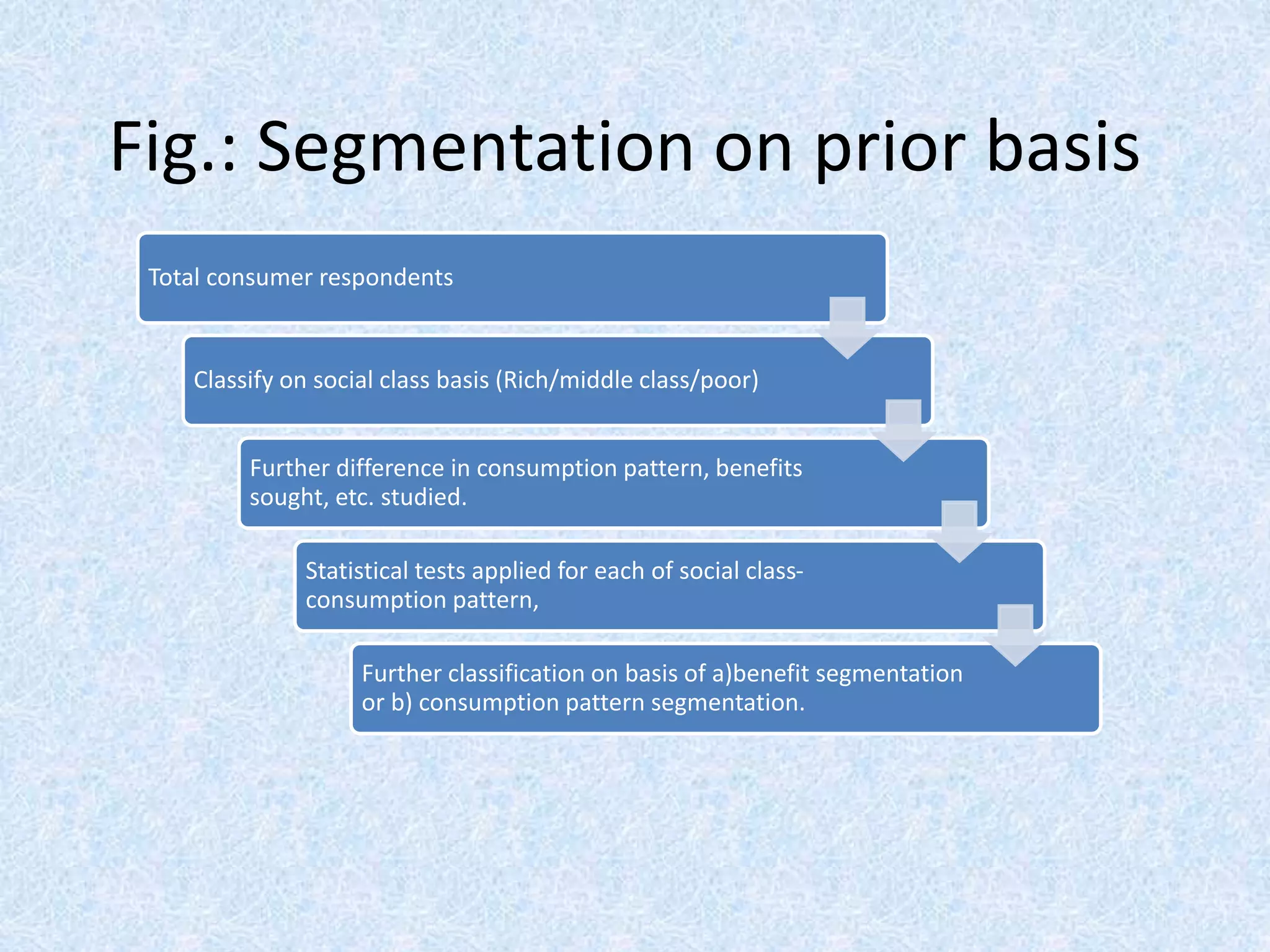
Fig.: Segmentation on prior basis
Total consumer respondents
Classify on social class basis (Rich/middle class/poor)
Further difference in consumption pattern, benefits
sought, etc. studied.
Statistical tests applied for each of social class-
consumption pattern,
Further classification on basis of a)benefit segmentation
or b) consumption pattern segmentation.
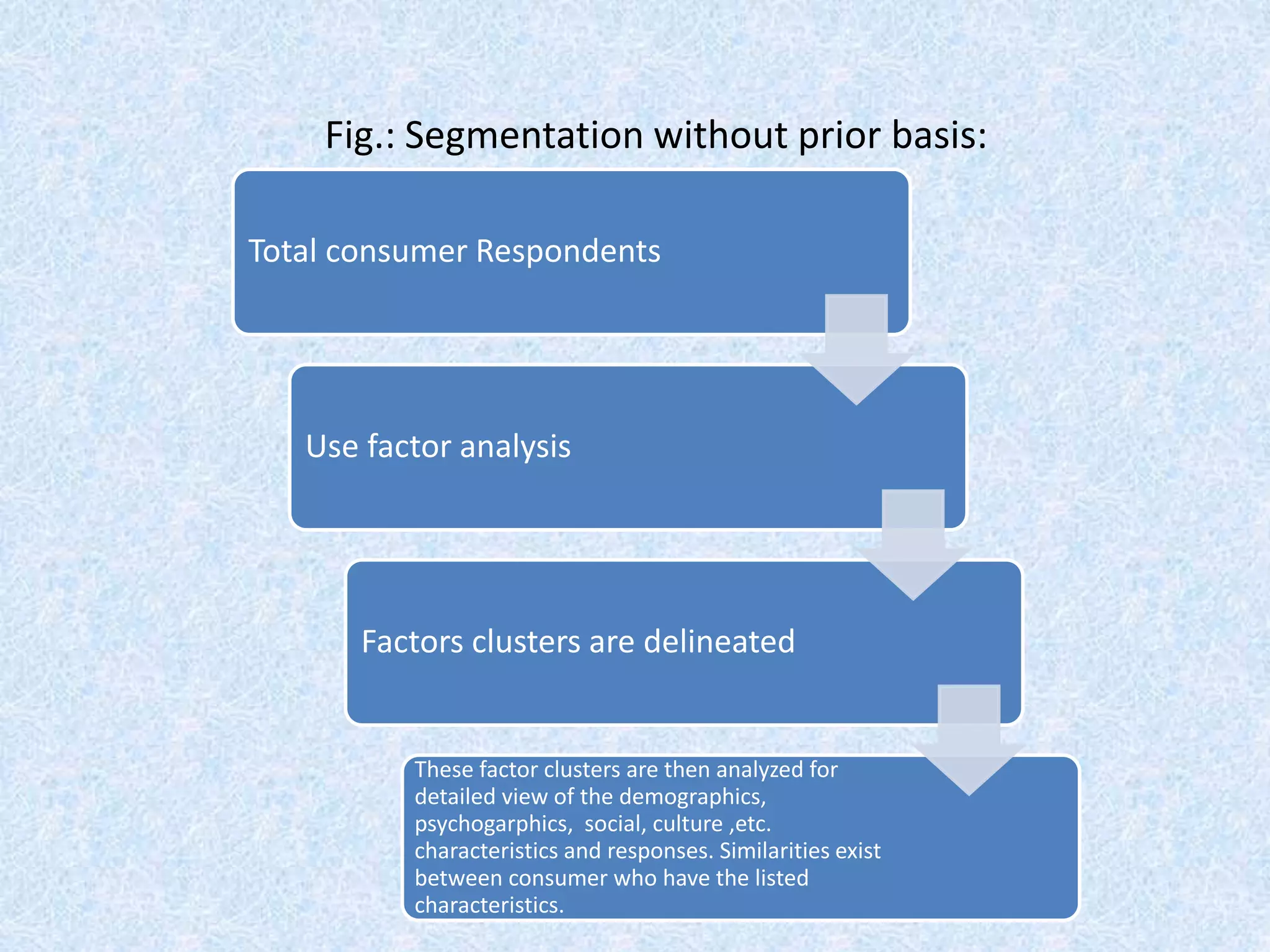
2. Segmentation without a prior basis:
The marketers take a large sample based
on their demographics, psychographics,
social, cultural,etc. differences. Then the
sample is put to Factor analysis for
finding out factors that have common
characteristics or responses. The factor
cluster become the market segments.
Fig.: Segmentation without prior basis:
Total consumer Respondents
Use factor analysis
Factors clusters are delineated
These factor clusters are then analyzed for
detailed view of the demographics,
psychogarphics, social, culture ,etc.
characteristics and responses. Similarities exist
between consumer who have the listed
characteristics.
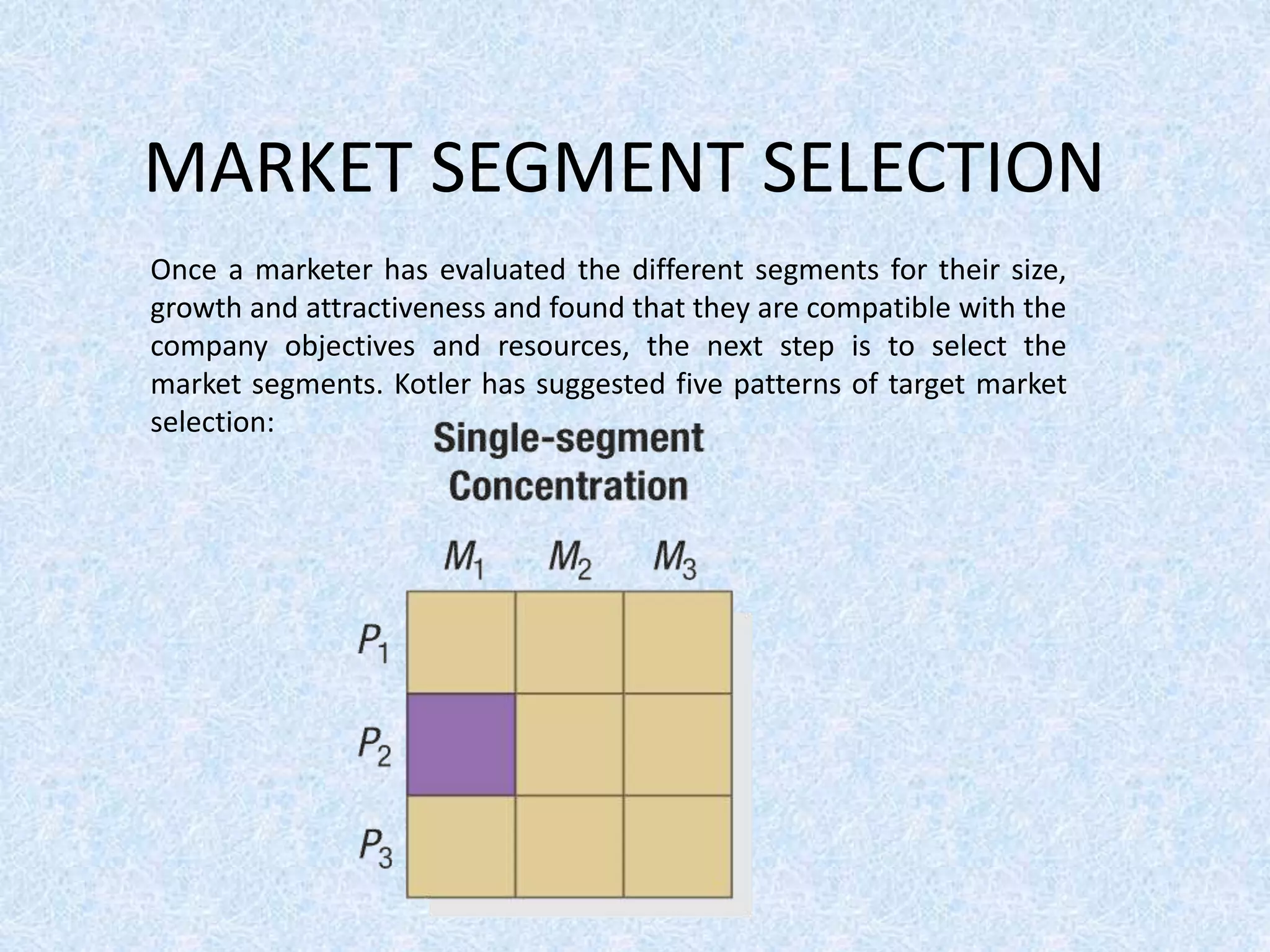
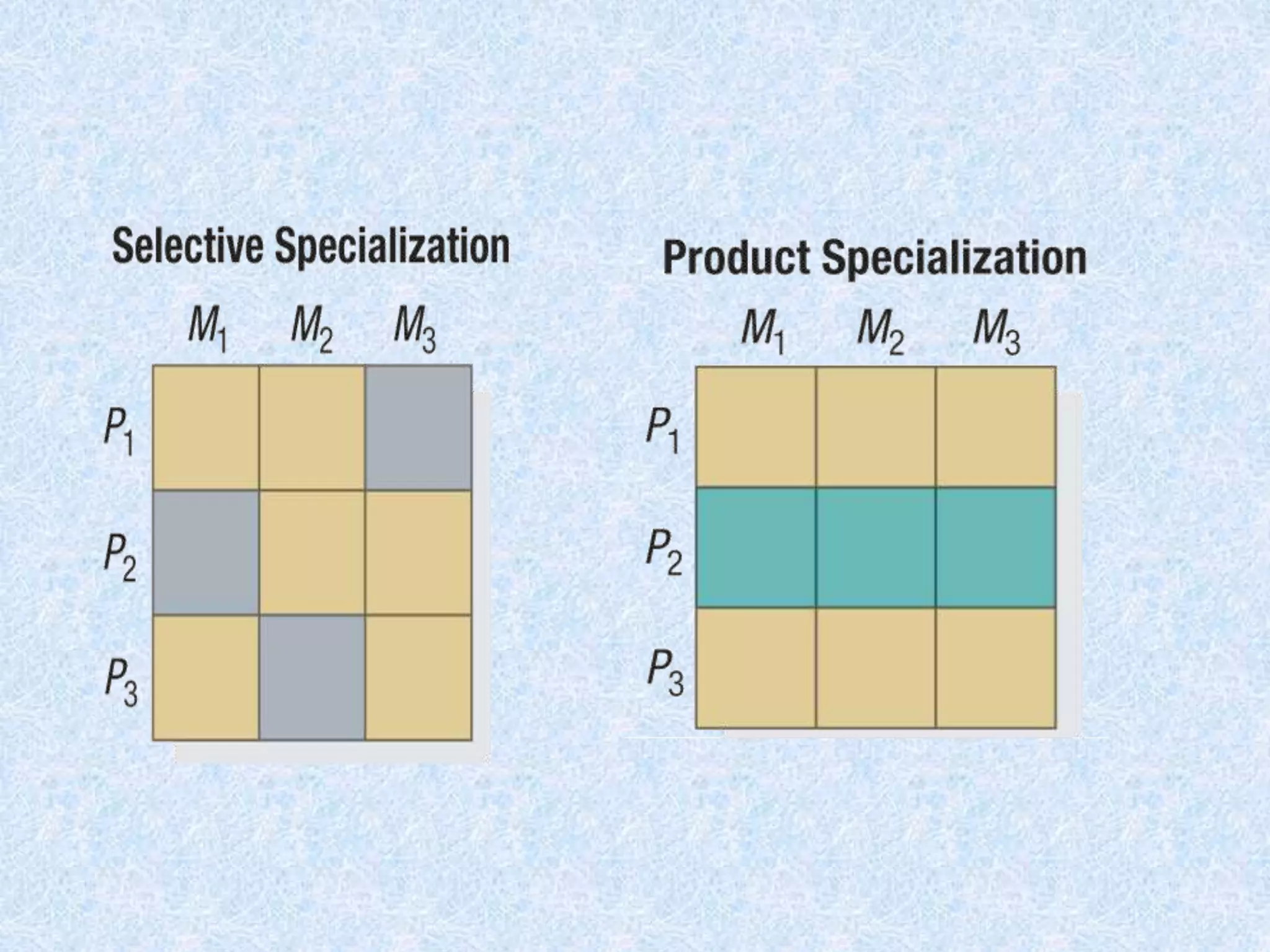
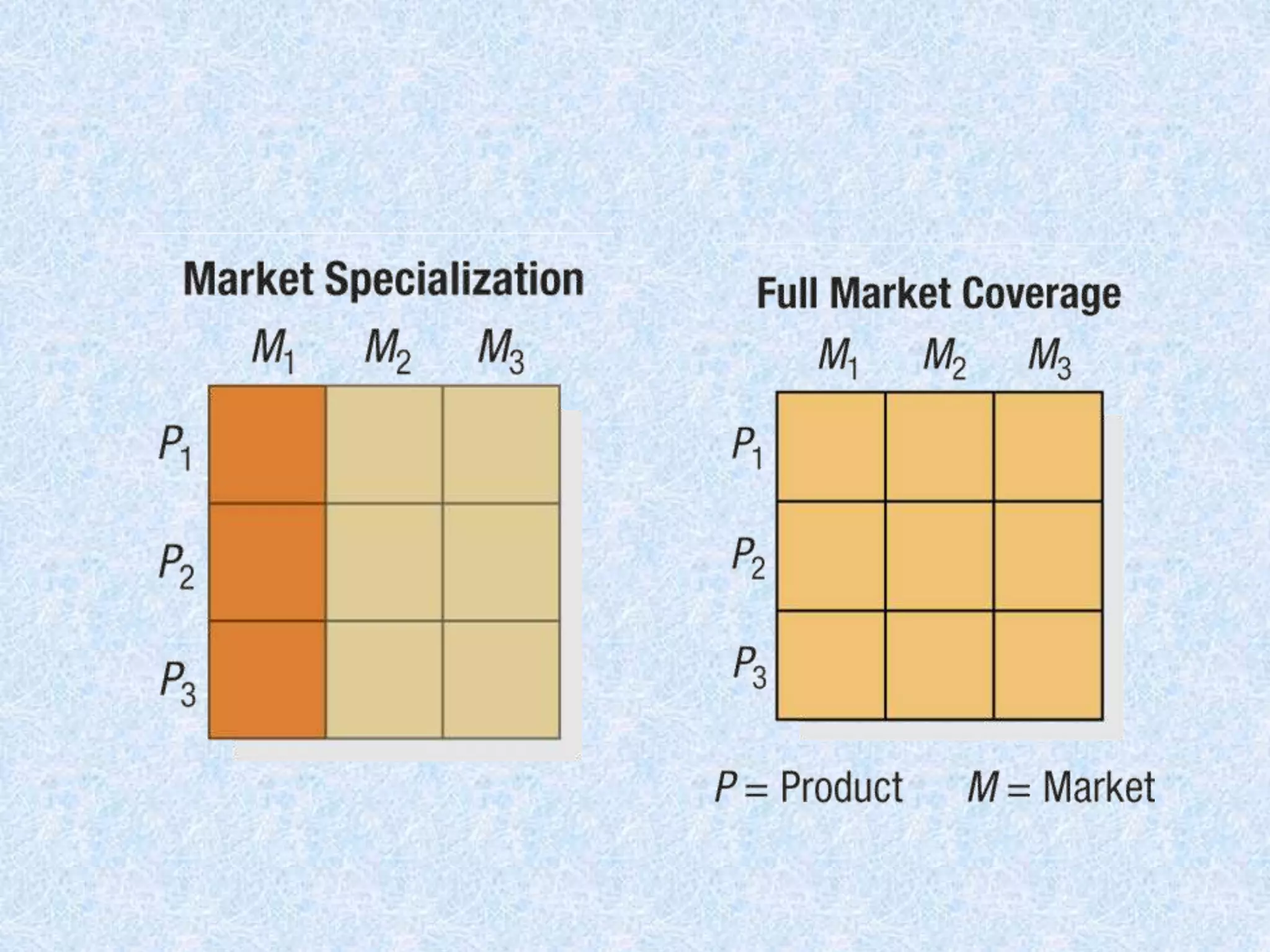
MARKET SEGMENT SELECTION
Once a marketer has evaluated the different segments for their size,
growth and attractiveness and found that they are compatible with the
company objectives and resources, the next step is to select the
market segments. Kotler has suggested five patterns of target market
selection:
MARKET SEGMENTATION STRATEGIES
Depending upon the emerging patterns of market segmentation-
Homogenous preference, diffused preferences and clustered
preference, a company chooses its market segmentation strategy:
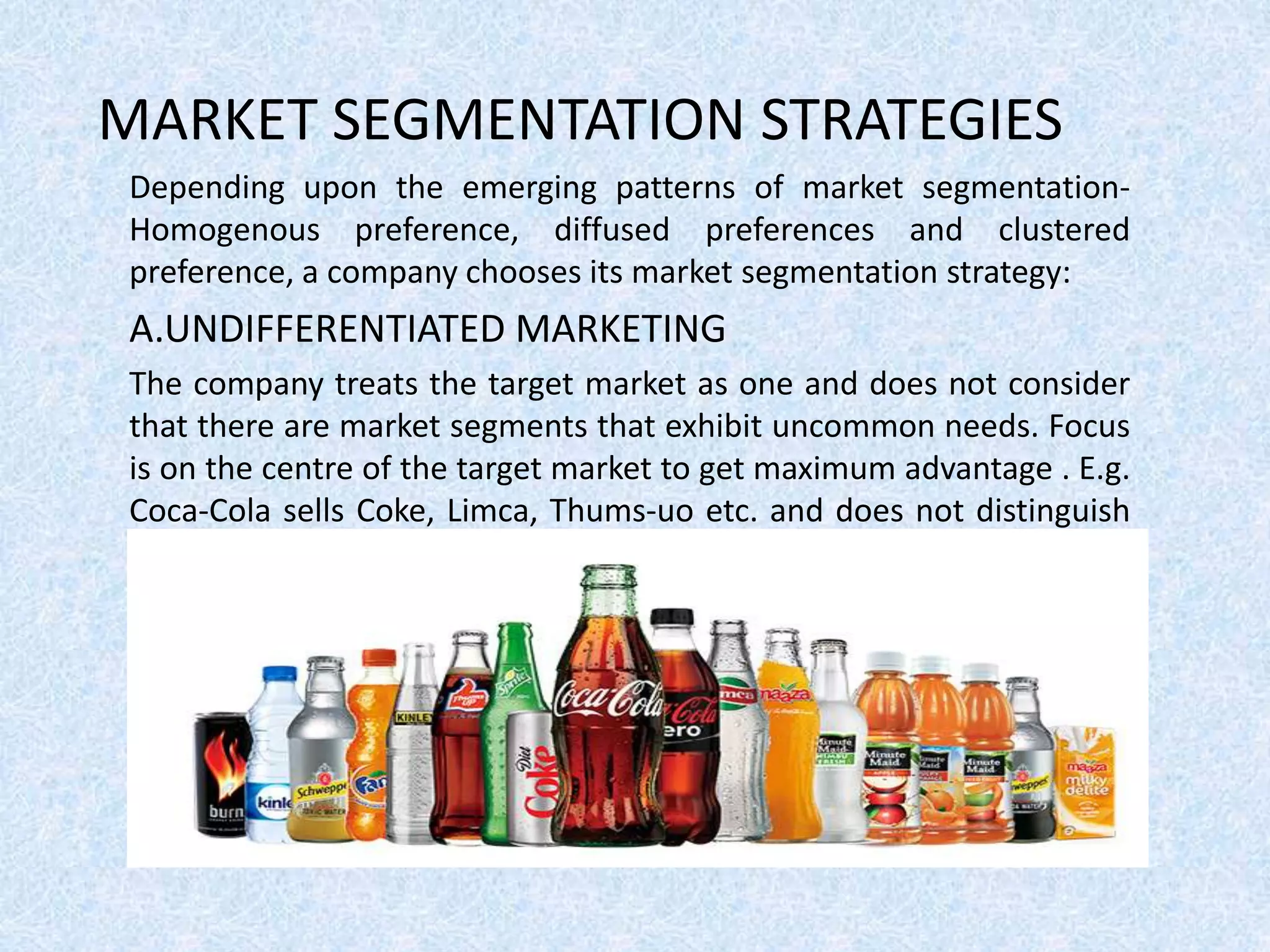
A.UNDIFFERENTIATED MARKETING
The company treats the target market as one and does not consider
that there are market segments that exhibit uncommon needs. Focus
is on the centre of the target market to get maximum advantage . E.g.
Coca-Cola sells Coke, Limca, Thums-uo etc. and does not distinguish
the target audience.
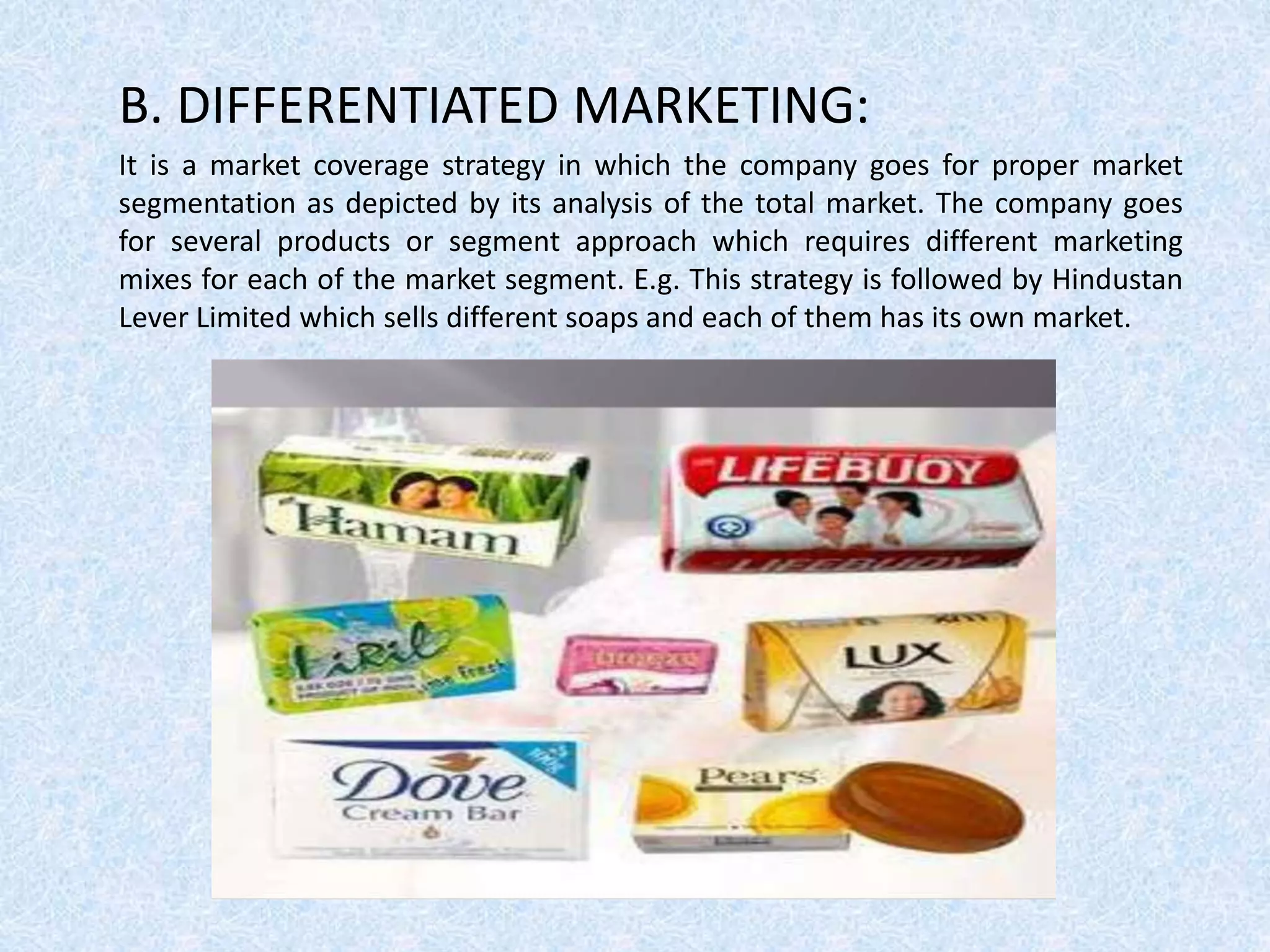
B. DIFFERENTIATED MARKETING:
It is a market coverage strategy in which the company goes for proper market
segmentation as depicted by its analysis of the total market. The company goes
for several products or segment approach which requires different marketing
mixes for each of the market segment. E.g. This strategy is followed by Hindustan
Lever Limited which sells different soaps and each of them has its own market.
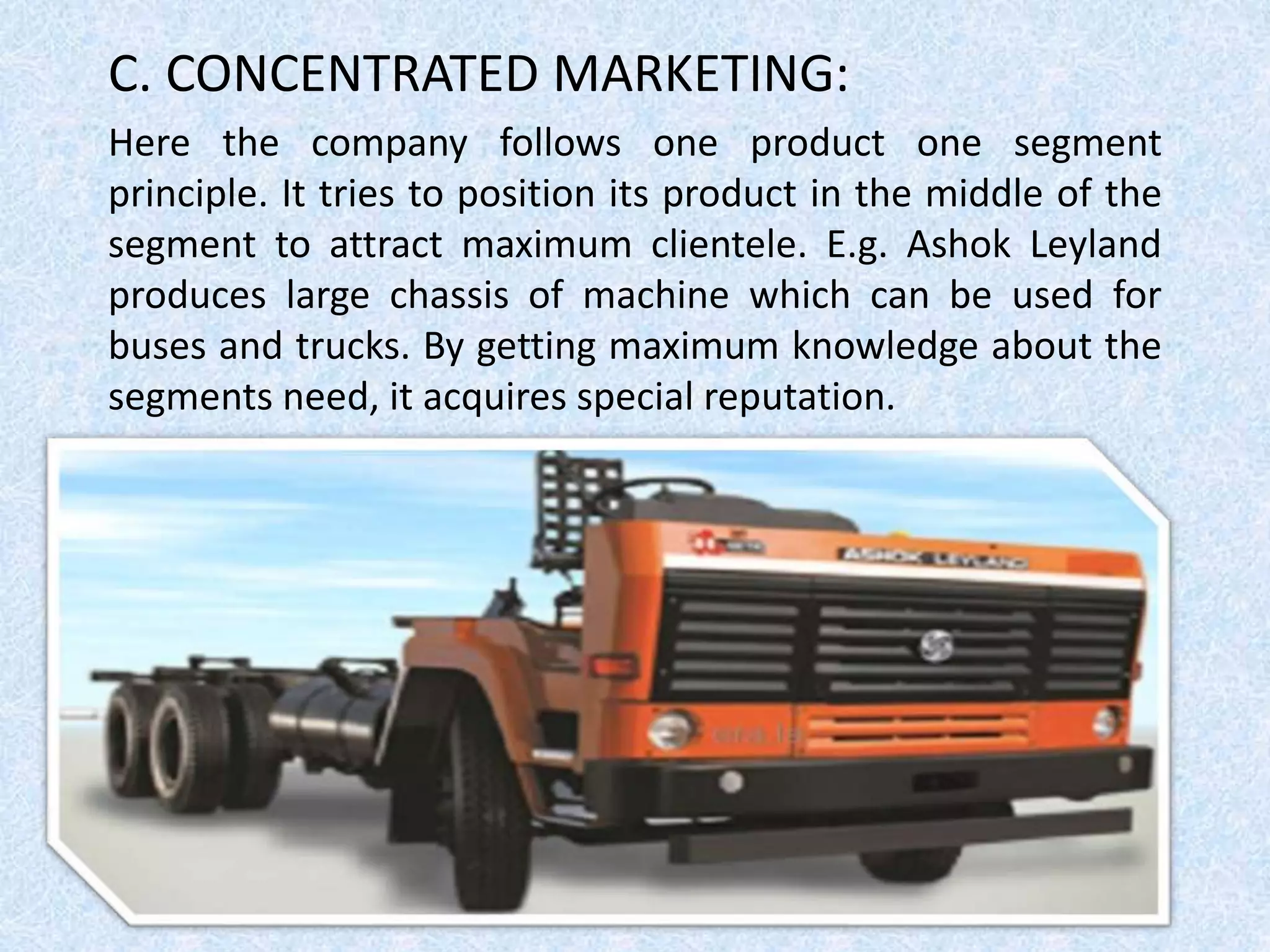
C. CONCENTRATED MARKETING:
Here the company follows one product one segment
principle. It tries to position its product in the middle of the
segment to attract maximum clientele. E.g. Ashok Leyland
produces large chassis of machine which can be used for
buses and trucks. By getting maximum knowledge about the
segments need, it acquires special reputation.
BENEFITS AND LIMITATIONS OF
MARKET SEGMENTATION:
Benefits:
The Organisation gets to know its customers better.
Provides guidelines for resource allocation.
It helps focus the strategy of the organisation.
Minimises aggregation of risk.
Provides opportunities to expand market.
Helps create innovation.
Limitations:
Targeting multiple segments increases marketing costs.
Segmentation can lead to proliferation of products.
Narrowly segmenting a market can hamper the development of
broad-brand equity.
CONCLUSION
The two main goals that any segmentation methodology should be able to
address are:
1) At a strategic level, segmentation should be able to help an organization rapidly
evaluate new business opportunities
Geographical expansion: Should the retail chain expand to north east?
Product expansion: Should the electronic manufacturer launch a smartphone?
2) At an operational level segmentation should yield information to help craft
successful marketing offers for specific prospects.
Product: What product features are must haves vs. nice to haves?
Price: What is the price point that customers are willing to pay?
Communication: How to message to the target customers?
Distribution: Where do the target customers live?

Market segmentation

  • 1.
  • 2.
    CONTENTS • Concept anddefinition. • Approaches to Market segmentation. • Bases of Market segmentation. • Procedure for Market segmentation. • Market segment selection. • Market segmentation strategies • Benefits and limitations of Market segmentation. • Conclusion.
  • 3.
    CONCEPT AND DEFINITION •The concept of market segment is based on the fact that the market of commodities are not homogeneous but they are heterogeneous. Market represent a group of customer having common characteristics but two customer are never common in their nature, habits, hobbies income and purchasing techniques. • Market segmentation is the process of dividing a potential market into distinct sub-markets of consumers with common needs and characteristics. • According to Philip kotler , “ Market segmentation is sub- dividing a market into distinct and homogeneous subgroups of customers, where any group can conceivably be selected as a target market to be met with distinct marketing mix.”
  • 4.
    APPROACHES TO MARKETSEGMENTATION 1.Mass Marketing : The term mass market refers to a large, undifferentiated market of consumers with widely varied backgrounds. Products and services needed by almost every member of society are suited for the mass market. Such items as electric and gas utilities, soap, paper towels and gasoline, for example, can be advertised and sold to almost anyone, making them mass market goods Mass Marketing – An attempt to appeal to an entire market with one basic marketing strategy utilizing mass distribution and mass media. Also called undifferentiated marketing. The appeal of mass marketing is in the potential for higher total profits. Companies that employ the system expect the larger profit to result from (1) expanded volume through lower prices and (2) reduced costs through economies of scale made possible by the increased volume.
  • 5.
    Henry Ford appliedthe concept in the automobile industry. His Model T was conceived and marketed as a "universal" car— one that would meet the needs of all buyers.
  • 6.
    2.Product Variety After themass marketing strategy another strategy with similar characteristics but overcoming its predecessor’s shortcomings came into existence. That is product variety strategy. An attempt to appeal to the entire market with a huge variety of products produced in mass is made. However, like Mass marketing in this case also the customers needs & wants are not taken into account while developing the product. E.g. when Maruti 800 was introduced into Indian roads, it was a variety product because it used two version Standard and Deluxe with different colours.
  • 7.
    3.TargetMarketing: Target marketing isa market segmentation and market coverage strategy whereby a product is developed and marketed for a very well-defined, specific segment of the consumer population. Target marketing is particularly effective for small companies with limited resources because it enables the company to achieve a strong market position in the specific market segment it serves without mass production, mass distribution, or mass advertising. It enables firms to capitalize on the respective serve market share
  • 8.
    4.Micromarketing: It is aform of target marketing in which companies fit their marketing mixes to specific needs and wants of narrowly defined geographic, demographic, psychographic or behavioral segments. E.g. Liberty shoes are available in Delhi Metropolitan Area with different availability depending upon the types of customer, status, and economic background. Segments, Niches, Local areas and individuals are four levels of micro-marketing.
  • 9.
    E.g. Baskin RobbinsFocuses on Local Marketing
  • 10.
    5.Customised Marketing • Withthe advancement in manufacturing because of breakthrough in information technology, for example, use of computer- aided designs and manufacturing, it has now become possible to manufacture a product as per the individual customer needs or of a buying organisation. • E.g. boutiques for females and childs.
  • 11.
    6. Personalised Marketing Massproduction with product varieties, and target marketing for segments, which are further divided into customers on a local basis or on individual customer needs, the focus of the company is shifting more minutely. Personalised marketing is to retain customer loyalty with the company. It serves the person- customer need. Customerization – empower the consumers to design the product or service offering of their choice. E.g. For years, Dell Computers has invited customers to “build” their computers by selecting the various specifications for their machine.
  • 12.
    BASES OF MARKETSEGMENTATION Geographic Demographic Psychographic Behavioral Value Based
  • 13.
    1.Geographic Segmentation • Theregion, the city, its density-urban/rural, climate etc. matters a lot in segmenting the market on the basis of geographic segmentation. The following are some examples of geographic variables often used in segmentation. • Region: by continent, country, state, or even neighbourhood. Ex.- McDonalds globally, sell burgers aimed at local markets, for example, burgers are made from lamb in India rather then beef because of religious issues. • Size of metropolitan area: segmented according to size of population. • Population density: often classified as urban, suburban, or rural. • Climate: according to weather patterns common to certain geographic regions.
  • 14.
  • 15.
    2.Demographic Segmentation It dividesthe market on the basis of age, gender, marital status, income, education, family-size, family life cycle, occupation, religion and nationality.
  • 16.
  • 17.
  • 18.
    3.Psychographic Segmentation This basisof segmentation is widely used by marketers. The important aspects of psychographic segmentation include: • Life- style: Conservative, liberal, health and fitness conscious, adventuresome, status-seekers. • Social- Class: Lower class, lower-middle class, middle class, rich class. • Cultural: Continental, Mughlai, Chinese, Indian, Royal, South Indian, Hindu Culture. • Personality: Extroverts, Introverts, Aggressive, Complaints.
  • 19.
    4.Behavioural segmentation The consumersare segmented on the basis of their behavior through need motivation,perception,learning- involvement, attitude, occasions, benefits, user-status, usage-rate, loyalty status, and buyer readiness stage. This is based on consumer response to their requirements.
  • 20.
  • 21.
  • 22.
    5.Value-Based Segmentation This conceptprescribes that segmentation should be the outcome of a match between the product feature’s and customer’s needs. The marketers must arm themselves with a new parameter for partioning their customers profitability.
  • 23.
    PROCEDURE FOR MARKETSEGMENTATION: There are two methods by which market segments can be achieved: 1. Segmentation based on consumer characteristics and responses: Some of the bases of segmentation are taken up as a starting point then the customers are divided with those segmentation bases: gender, age, lifestyles, family lifecycle, benefits sought etc. The differences amongst the resulting groups are statistically tested and mutually exclusive market segments are formed.
  • 24.
    Fig.: Segmentation onprior basis Total consumer respondents Classify on social class basis (Rich/middle class/poor) Further difference in consumption pattern, benefits sought, etc. studied. Statistical tests applied for each of social class- consumption pattern, Further classification on basis of a)benefit segmentation or b) consumption pattern segmentation.
  • 25.
    2. Segmentation withouta prior basis: The marketers take a large sample based on their demographics, psychographics, social, cultural,etc. differences. Then the sample is put to Factor analysis for finding out factors that have common characteristics or responses. The factor cluster become the market segments.
  • 26.
    Fig.: Segmentation withoutprior basis: Total consumer Respondents Use factor analysis Factors clusters are delineated These factor clusters are then analyzed for detailed view of the demographics, psychogarphics, social, culture ,etc. characteristics and responses. Similarities exist between consumer who have the listed characteristics.
  • 27.
    MARKET SEGMENT SELECTION Oncea marketer has evaluated the different segments for their size, growth and attractiveness and found that they are compatible with the company objectives and resources, the next step is to select the market segments. Kotler has suggested five patterns of target market selection:
  • 30.
    MARKET SEGMENTATION STRATEGIES Dependingupon the emerging patterns of market segmentation- Homogenous preference, diffused preferences and clustered preference, a company chooses its market segmentation strategy: A.UNDIFFERENTIATED MARKETING The company treats the target market as one and does not consider that there are market segments that exhibit uncommon needs. Focus is on the centre of the target market to get maximum advantage . E.g. Coca-Cola sells Coke, Limca, Thums-uo etc. and does not distinguish the target audience.
  • 31.
    B. DIFFERENTIATED MARKETING: Itis a market coverage strategy in which the company goes for proper market segmentation as depicted by its analysis of the total market. The company goes for several products or segment approach which requires different marketing mixes for each of the market segment. E.g. This strategy is followed by Hindustan Lever Limited which sells different soaps and each of them has its own market.
  • 32.
    C. CONCENTRATED MARKETING: Herethe company follows one product one segment principle. It tries to position its product in the middle of the segment to attract maximum clientele. E.g. Ashok Leyland produces large chassis of machine which can be used for buses and trucks. By getting maximum knowledge about the segments need, it acquires special reputation.
  • 33.
    BENEFITS AND LIMITATIONSOF MARKET SEGMENTATION: Benefits: The Organisation gets to know its customers better. Provides guidelines for resource allocation. It helps focus the strategy of the organisation. Minimises aggregation of risk. Provides opportunities to expand market. Helps create innovation. Limitations: Targeting multiple segments increases marketing costs. Segmentation can lead to proliferation of products. Narrowly segmenting a market can hamper the development of broad-brand equity.
  • 34.
    CONCLUSION The two maingoals that any segmentation methodology should be able to address are: 1) At a strategic level, segmentation should be able to help an organization rapidly evaluate new business opportunities Geographical expansion: Should the retail chain expand to north east? Product expansion: Should the electronic manufacturer launch a smartphone? 2) At an operational level segmentation should yield information to help craft successful marketing offers for specific prospects. Product: What product features are must haves vs. nice to haves? Price: What is the price point that customers are willing to pay? Communication: How to message to the target customers? Distribution: Where do the target customers live?