Matter 
And 
Measurement 
Chemistry, The Central Science, 10th edition 
Theodore L. Brown; H. Eugene LeMay, Jr.; 
and Bruce E. Bursten 
Chapter 1 
Introduction: 
Matter and Measurement 
John D. Bookstaver 
St. Charles Community College 
St. Peters, MO 
ã 2006, Prentice Hall
Matter 
And 
Measurement 
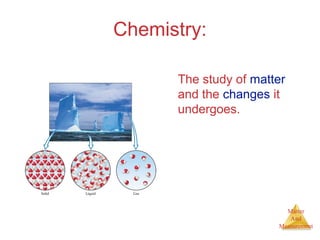
Chemistry: 
The study of matter 
and the changes it 
undergoes.
Matter 
And 
Measurement 
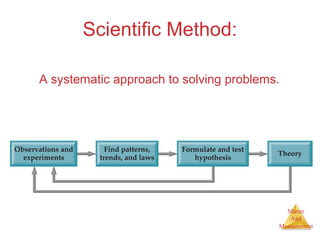
Scientific Method: 
A systematic approach to solving problems.
Matter 
And 
Measurement 
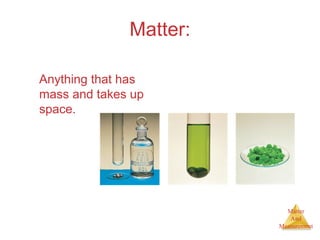
Matter: 
Anything that has 
mass and takes up 
space.
Matter 
And 
Measurement 
Matter 
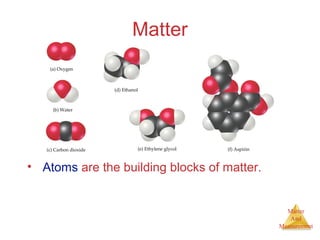
• Atoms are the building blocks of matter.
Matter 
And 
Measurement 
Matter 
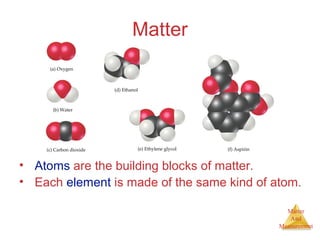
• Atoms are the building blocks of matter. 
• Each element is made of the same kind of atom.
Matter 
And 
Measurement 
Matter 
• Atoms are the building blocks of matter. 
• Each element is made of the same kind of atom. 
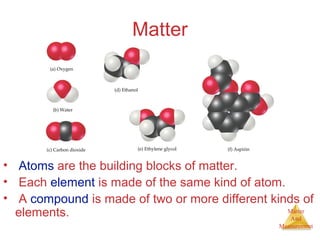
• A compound is made of two or more different kinds of 
elements.
Matter 
And 
Measurement 
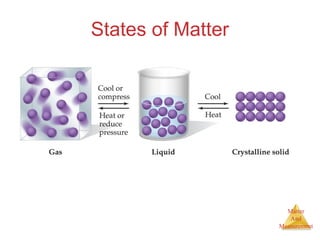
States of Matter
Matter 
And 
Measurement 
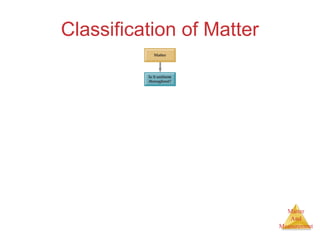
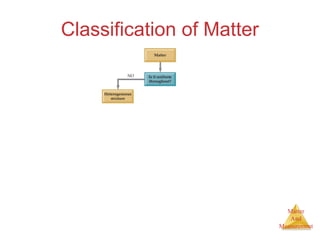
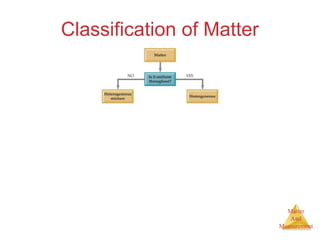
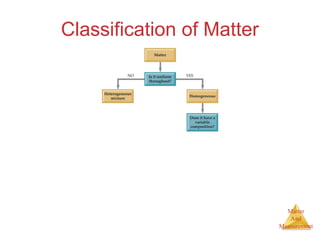
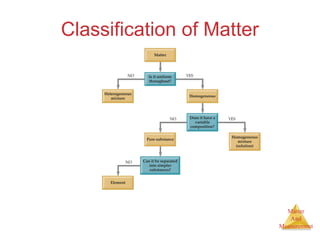
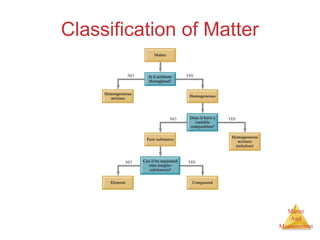
Classification of Matter
Matter 
And 
Measurement 
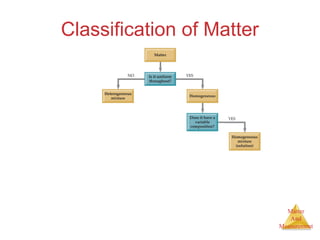
Classification of Matter
Matter 
And 
Measurement 
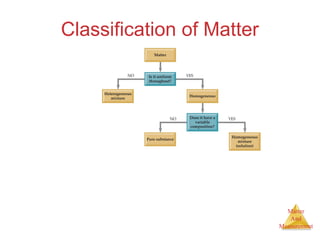
Classification of Matter
Matter 
And 
Measurement 
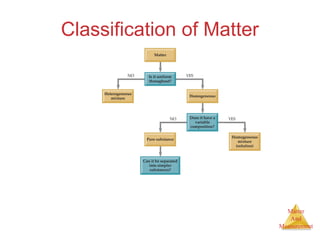
Classification of Matter
Matter 
And 
Measurement 
Classification of Matter
Matter 
And 
Measurement 
Classification of Matter
Matter 
And 
Measurement 
Classification of Matter
Matter 
And 
Measurement 
Classification of Matter
Matter 
And 
Measurement 
Classification of Matter
Matter 
And 
Measurement 
Classification of Matter
Matter 
And 
Measurement 
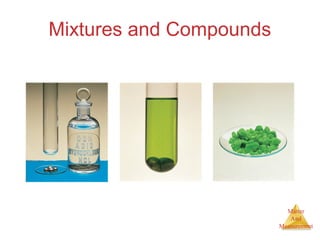
Mixtures and Compounds
Properties and 
Changes of 
Matter 
And 
Measurement 
Matter
Matter 
And 
Measurement 
Properties of Matter 
• Physical Properties: 
□ Can be observed without changing a 
substance into another substance. 
• Boiling point, density, mass, volume, etc. 
• Chemical Properties: 
□ Can only be observed when a substance is 
changed into another substance. 
• Flammability, corrosiveness, reactivity with 
acid, etc.
Matter 
And 
Measurement 
Properties of Matter 
• Intensive Properties: 
□ Independent of the amount of the 
substance that is present. 
• Density, boiling point, color, etc. 
• Extensive Properties: 
□ Dependent upon the amount of the 
substance present. 
• Mass, volume, energy, etc.
Matter 
And 
Measurement 
Changes of Matter 
• Physical Changes: 
□ Changes in matter that do not change the 
composition of a substance. 
• Changes of state, temperature, volume, etc. 
• Chemical Changes: 
□ Changes that result in new substances. 
• Combustion, oxidation, decomposition, etc.
Matter 
And 
Measurement 
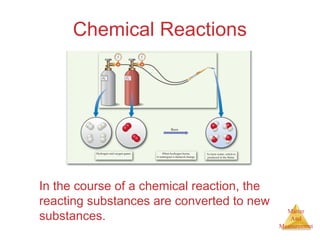
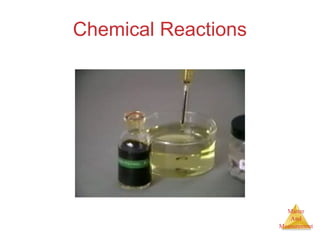
Chemical Reactions 
In the course of a chemical reaction, the 
reacting substances are converted to new 
substances.
Matter 
And 
Measurement 
Chemical Reactions
Matter 
And 
Measurement 
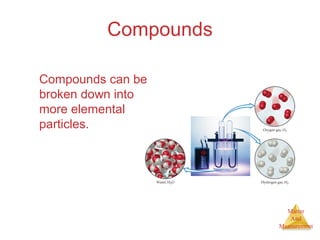
Compounds 
Compounds can be 
broken down into 
more elemental 
particles.
Matter 
And 
Measurement 
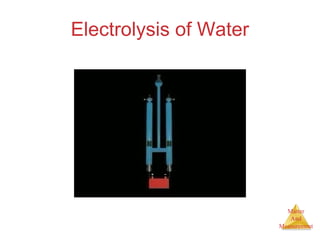
Electrolysis of Water
Matter 
And 
Separation of 
Mixtures 
Measurement
Matter 
And 
Measurement 
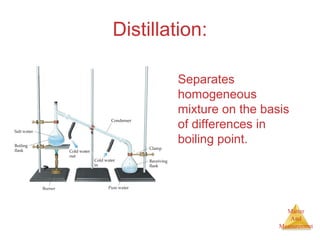
Distillation: 
Separates 
homogeneous 
mixture on the basis 
of differences in 
boiling point.
Matter 
And 
Measurement 
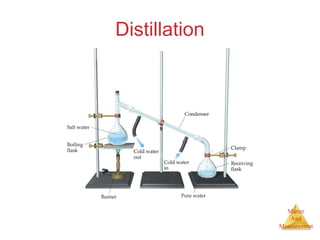
Distillation
Matter 
And 
Measurement 
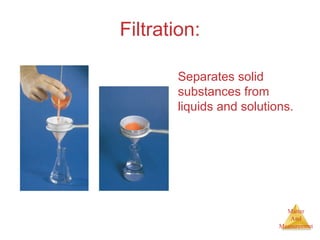
Filtration: 
Separates solid 
substances from 
liquids and solutions.
Matter 
And 
Measurement 
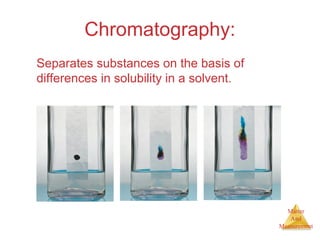
Chromatography: 
Separates substances on the basis of 
differences in solubility in a solvent.
Matter 
And 
Measurement 
Units of 
Measurement
Matter 
And 
Measurement 
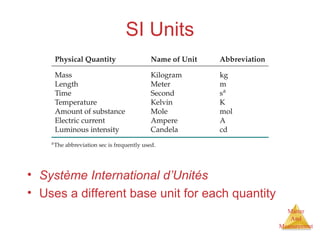
SI Units 
• Système International d’Unités 
• Uses a different base unit for each quantity
Matter 
And 
Measurement 
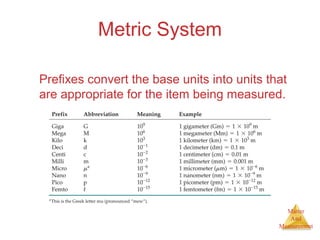
Metric System 
Prefixes convert the base units into units that 
are appropriate for the item being measured.
Matter 
And 
Measurement 
Volume 
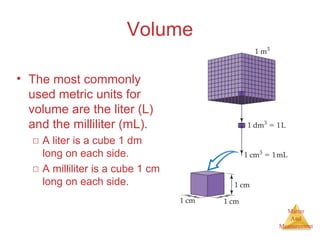
• The most commonly 
used metric units for 
volume are the liter (L) 
and the milliliter (mL). 
□ A liter is a cube 1 dm 
long on each side. 
□ A milliliter is a cube 1 cm 
long on each side.
Matter 
And 
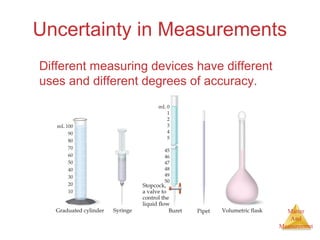
Uncertainty in Measurements 
Different measuring devices have different 
uses and different degrees of accuracy. 
Measurement
Matter 
And 
Measurement 
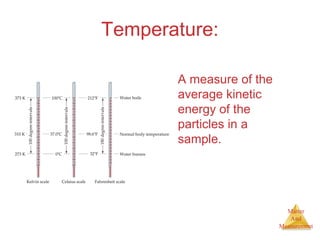
Temperature: 
A measure of the 
average kinetic 
energy of the 
particles in a 
sample.
Matter 
And 
Measurement 
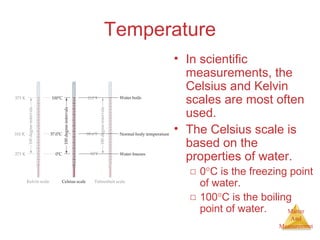
Temperature 
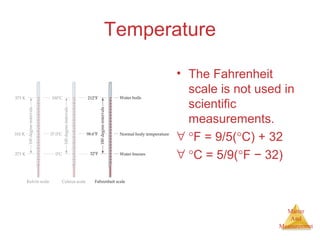
• In scientific 
measurements, the 
Celsius and Kelvin 
scales are most often 
used. 
• The Celsius scale is 
based on the 
properties of water. 
□ 0°C is the freezing point 
of water. 
□ 100°C is the boiling 
point of water.
Matter 
And 
Measurement 
Temperature 
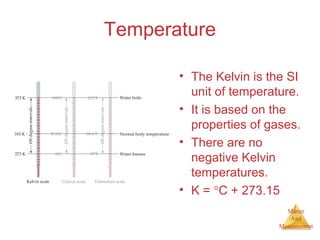
• The Kelvin is the SI 
unit of temperature. 
• It is based on the 
properties of gases. 
• There are no 
negative Kelvin 
temperatures. 
• K = °C + 273.15
Matter 
And 
Measurement 
Temperature 
• The Fahrenheit 
scale is not used in 
scientific 
measurements. 
" °F = 9/5(°C) + 32 
" °C = 5/9(°F − 32)
Matter 
And 
Measurement 
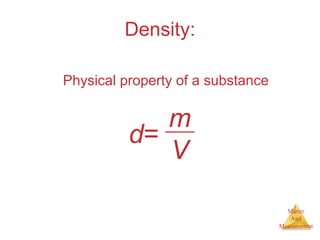
Density: 
Physical property of a substance 
d= mV
Uncertainty in 
Measurement 
Matter 
And 
Measurement
Matter 
And 
Measurement 
Significant Figures 
• The term significant figures refers to 
digits that were measured. 
• When rounding calculated numbers, we 
pay attention to significant figures so we 
do not overstate the accuracy of our 
answers.
Matter 
And 
Measurement 
Significant Figures 
1. All nonzero digits are significant. 
2. Zeroes between two significant figures 
are themselves significant. 
3. Zeroes at the beginning of a number 
are never significant. 
4. Zeroes at the end of a number are 
significant if a decimal point is written 
in the number.
Matter 
And 
Measurement 
Significant Figures 
• When addition or subtraction is 
performed, answers are rounded to the 
least significant decimal place. 
• When multiplication or division is 
performed, answers are rounded to the 
number of digits that corresponds to the 
least number of significant figures in 
any of the numbers used in the 
calculation.
Matter 
And 
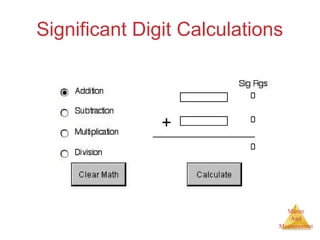
Significant Digit Calculations 
Measurement
Matter 
And 
Measurement 
Accuracy versus Precision 
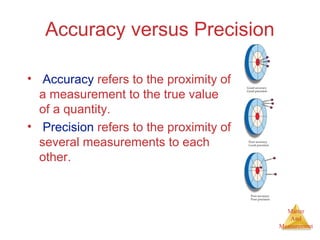
• Accuracy refers to the proximity of 
a measurement to the true value 
of a quantity. 
• Precision refers to the proximity of 
several measurements to each 
other.

Ch. 1 matter & meas.

  • 1.
    Matter And Measurement Chemistry, The Central Science, 10th edition Theodore L. Brown; H. Eugene LeMay, Jr.; and Bruce E. Bursten Chapter 1 Introduction: Matter and Measurement John D. Bookstaver St. Charles Community College St. Peters, MO ã 2006, Prentice Hall
  • 2.
    Matter And Measurement Chemistry: The study of matter and the changes it undergoes.
  • 3.
    Matter And Measurement Scientific Method: A systematic approach to solving problems.
  • 4.
    Matter And Measurement Matter: Anything that has mass and takes up space.
  • 5.
    Matter And Measurement Matter • Atoms are the building blocks of matter.
  • 6.
    Matter And Measurement Matter • Atoms are the building blocks of matter. • Each element is made of the same kind of atom.
  • 7.
    Matter And Measurement Matter • Atoms are the building blocks of matter. • Each element is made of the same kind of atom. • A compound is made of two or more different kinds of elements.
  • 8.
    Matter And Measurement States of Matter
  • 9.
    Matter And Measurement Classification of Matter
  • 10.
    Matter And Measurement Classification of Matter
  • 11.
    Matter And Measurement Classification of Matter
  • 12.
    Matter And Measurement Classification of Matter
  • 13.
    Matter And Measurement Classification of Matter
  • 14.
    Matter And Measurement Classification of Matter
  • 15.
    Matter And Measurement Classification of Matter
  • 16.
    Matter And Measurement Classification of Matter
  • 17.
    Matter And Measurement Classification of Matter
  • 18.
    Matter And Measurement Classification of Matter
  • 19.
    Matter And Measurement Mixtures and Compounds
  • 20.
    Properties and Changesof Matter And Measurement Matter
  • 21.
    Matter And Measurement Properties of Matter • Physical Properties: □ Can be observed without changing a substance into another substance. • Boiling point, density, mass, volume, etc. • Chemical Properties: □ Can only be observed when a substance is changed into another substance. • Flammability, corrosiveness, reactivity with acid, etc.
  • 22.
    Matter And Measurement Properties of Matter • Intensive Properties: □ Independent of the amount of the substance that is present. • Density, boiling point, color, etc. • Extensive Properties: □ Dependent upon the amount of the substance present. • Mass, volume, energy, etc.
  • 23.
    Matter And Measurement Changes of Matter • Physical Changes: □ Changes in matter that do not change the composition of a substance. • Changes of state, temperature, volume, etc. • Chemical Changes: □ Changes that result in new substances. • Combustion, oxidation, decomposition, etc.
  • 24.
    Matter And Measurement Chemical Reactions In the course of a chemical reaction, the reacting substances are converted to new substances.
  • 25.
    Matter And Measurement Chemical Reactions
  • 26.
    Matter And Measurement Compounds Compounds can be broken down into more elemental particles.
  • 27.
    Matter And Measurement Electrolysis of Water
  • 28.
    Matter And Separationof Mixtures Measurement
  • 29.
    Matter And Measurement Distillation: Separates homogeneous mixture on the basis of differences in boiling point.
  • 30.
  • 31.
    Matter And Measurement Filtration: Separates solid substances from liquids and solutions.
  • 32.
    Matter And Measurement Chromatography: Separates substances on the basis of differences in solubility in a solvent.
  • 33.
    Matter And Measurement Units of Measurement
  • 34.
    Matter And Measurement SI Units • Système International d’Unités • Uses a different base unit for each quantity
  • 35.
    Matter And Measurement Metric System Prefixes convert the base units into units that are appropriate for the item being measured.
  • 36.
    Matter And Measurement Volume • The most commonly used metric units for volume are the liter (L) and the milliliter (mL). □ A liter is a cube 1 dm long on each side. □ A milliliter is a cube 1 cm long on each side.
  • 37.
    Matter And Uncertaintyin Measurements Different measuring devices have different uses and different degrees of accuracy. Measurement
  • 38.
    Matter And Measurement Temperature: A measure of the average kinetic energy of the particles in a sample.
  • 39.
    Matter And Measurement Temperature • In scientific measurements, the Celsius and Kelvin scales are most often used. • The Celsius scale is based on the properties of water. □ 0°C is the freezing point of water. □ 100°C is the boiling point of water.
  • 40.
    Matter And Measurement Temperature • The Kelvin is the SI unit of temperature. • It is based on the properties of gases. • There are no negative Kelvin temperatures. • K = °C + 273.15
  • 41.
    Matter And Measurement Temperature • The Fahrenheit scale is not used in scientific measurements. " °F = 9/5(°C) + 32 " °C = 5/9(°F − 32)
  • 42.
    Matter And Measurement Density: Physical property of a substance d= mV
  • 43.
    Uncertainty in Measurement Matter And Measurement
  • 44.
    Matter And Measurement Significant Figures • The term significant figures refers to digits that were measured. • When rounding calculated numbers, we pay attention to significant figures so we do not overstate the accuracy of our answers.
  • 45.
    Matter And Measurement Significant Figures 1. All nonzero digits are significant. 2. Zeroes between two significant figures are themselves significant. 3. Zeroes at the beginning of a number are never significant. 4. Zeroes at the end of a number are significant if a decimal point is written in the number.
  • 46.
    Matter And Measurement Significant Figures • When addition or subtraction is performed, answers are rounded to the least significant decimal place. • When multiplication or division is performed, answers are rounded to the number of digits that corresponds to the least number of significant figures in any of the numbers used in the calculation.
  • 47.
    Matter And SignificantDigit Calculations Measurement
  • 48.
    Matter And Measurement Accuracy versus Precision • Accuracy refers to the proximity of a measurement to the true value of a quantity. • Precision refers to the proximity of several measurements to each other.