Solution Chemistry Notes
Solutions
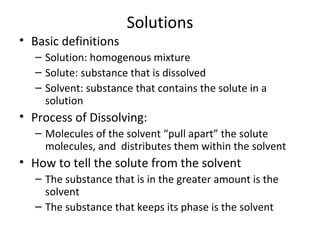
• Basic definitions
– Solution: homogenous mixture
– Solute: substance that is dissolved
– Solvent: substance that contains the solute in a
solution
• Process of Dissolving:
– Molecules of the solvent “pull apart” the solute
molecules, and distributes them within the solvent
• How to tell the solute from the solvent
– The substance that is in the greater amount is the
solvent
– The substance that keeps its phase is the solvent
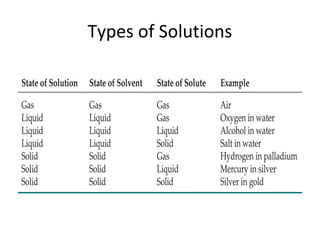
Types of Solutions
• Saturated solutions are at dynamic equilibrium – the solute
is dissolving and crystallizing at an equal rate.
• The solubility of a chemical determines how much can be
dissolved. Some chemicals are highly soluble (much can
dissolve), some are not soluble (cannot be dissolved at all).
• Supersaturate solutions hold more solute than the typical
solubility allows. These solutions can crystallize easily, by
adding a seed crystal or even by simply disturbing the
solution (bumping or shaking).
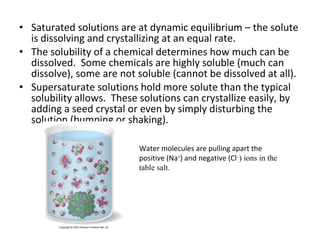
Water molecules are pulling apart the
positive (Na+
) and negative (Cl–
) ions in the
table salt.
What can dissolve??
• In order for a solute to dissolve, it must have
similar intermolecular forces
• Water is polar (has a positive and negative
charge) so it can dissolve polar and ionic
compounds.
– Salt (NaCl) is ionic, the positive and negative ions
dissolve in water
– Sugar (C12H22O11) is polar, so water will dissolve it.
– Oil is non-polar, and the molecules are extremely
large. This is why oil cannot dissolve in water.
• “Like dissolves Like”
Dissolution in Water
• When an ionic solid is placed in water, the
water pulls the solid apart into its individual
ions
• Below is the dissolution of sodium chloride
reaction:
• NaCl(s)  Na+
(aq) + Cl-
(aq)
How to Increase Solubility
• You can dissolve more of a solute in a set
amount of solvent by doing the following:
– 1. increase the temperature – the space between
the solvent particles expands, allowing more room
for more solute
– 2. Increase pressure (for gases only) – this forces
the solute into the solvent
– 3. Nature of solute – some chemicals cannot
dissolve under any circumstances. You may need
to find a different solute
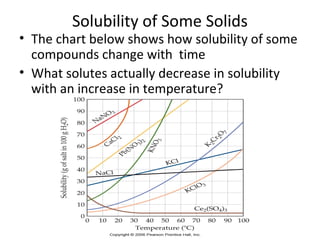
Solubility of Some Solids
• The chart below shows how solubility of some
compounds change with time
• What solutes actually decrease in solubility
with an increase in temperature?
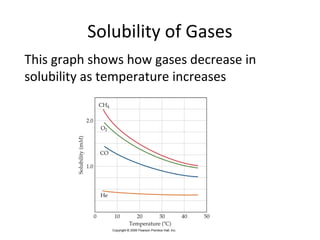
Solubility of Gases
This graph shows how gases decrease in
solubility as temperature increases
How to Increase the Rate of Dissolving
• In order to speed up the solute mixing with
the solvent, you can do the following:
– Stir/shake the mixture of course this doesn’t work
for gases
– Heat the mixture
Calculating Concentration
• General Terms
– Concentrated – much solute dissolved in solvent
– Dilute – very little solute dissolved in solvent
• More specific
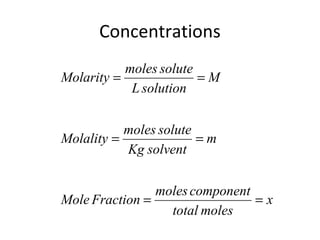
– Molarity – moles of solute per Liter of solution
– Molality – moles of solute per kilogram of solvent
– Mole fraction – moles of component per moles of
all components
Concentrations
x
molestotal
componentmoles
FractionMole
m
solventKg
solutemoles
Molality
M
solutionL
solutemoles
Molarity
==
==
==
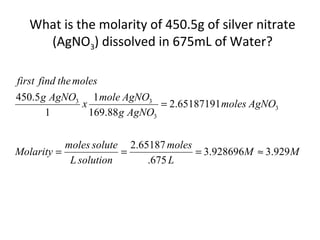
What is the molarity of 450.5g of silver nitrate
(AgNO3) dissolved in 675mL of Water?
MM
L
moles
solutionL
solutemoles
Molarity
AgNOmoles
AgNOg
AgNOmole
x
AgNOg
molesthefindfirst
929.3928696.3
675.
65187.2
65187191.2
88.169
1
1
5.450
3
3
33
≈===
=
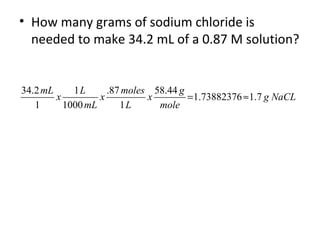
• How many grams of sodium chloride is
needed to make 34.2 mL of a 0.87 M solution?
NaCLg
mole
g
x
L
moles
x
mL
L
x
mL
7.173882376.1
44.58
1
87.
1000
1
1
2.34
≈=
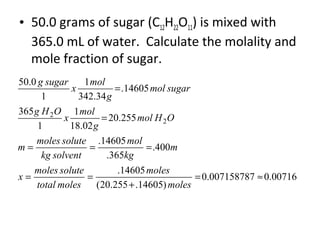
• 50.0 grams of sugar (C12H22O11) is mixed with
365.0 mL of water. Calculate the molality and
mole fraction of sugar.
00716.0007158787.0
)14605.255.20(
14605.
400.
365.
14605.
255.20
02.18
1
1
365
14605.
34.342
1
1
0.50
2
2
≈=
+
==
===
=
=
moles
moles
molestotal
solutemoles
x
m
kg
mol
solventkg
solutemoles
m
OHmol
g
mol
x
OHg
sugarmol
g
mol
x
sugarg
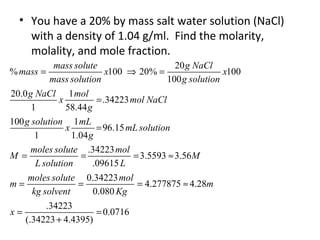
• You have a 20% by mass salt water solution (NaCl)
with a density of 1.04 g/ml. Find the molarity,
molality, and mole fraction.
0716.0
)4395.434223(.
34223.
28.4277875.4
080.0
34223.0
56.35593.3
09615.
34223.
15.96
04.1
1
1
100
34223.
44.58
1
1
0.20
100
100
20
%20100%
=
+
=
≈===
≈===
=
=
=⇒=
x
m
Kg
mol
solventkg
solutemoles
m
M
L
mol
solutionL
solutemoles
M
solutionmL
g
mL
x
solutiong
NaClmol
g
mol
x
NaClg
x
solutiong
NaClg
x
solutionmass
solutemass
mass
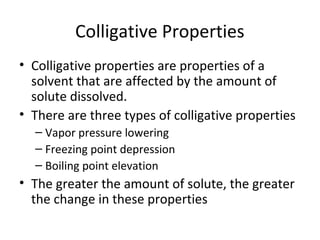
Colligative Properties
• Colligative properties are properties of a
solvent that are affected by the amount of
solute dissolved.
• There are three types of colligative properties
– Vapor pressure lowering
– Freezing point depression
– Boiling point elevation
• The greater the amount of solute, the greater
the change in these properties
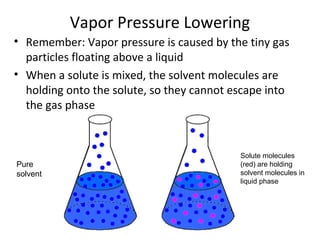
Vapor Pressure Lowering
• Remember: Vapor pressure is caused by the tiny gas
particles floating above a liquid
• When a solute is mixed, the solvent molecules are
holding onto the solute, so they cannot escape into
the gas phase
Pure
solvent
Solute molecules
(red) are holding
solvent molecules in
liquid phase
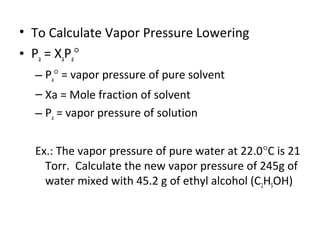
• To Calculate Vapor Pressure Lowering
• Pa = XaPa°
– Pa° = vapor pressure of pure solvent
– Xa = Mole fraction of solvent
– Pa = vapor pressure of solution
Ex.: The vapor pressure of pure water at 22.0°C is 21
Torr. Calculate the new vapor pressure of 245g of
water mixed with 45.2 g of ethyl alcohol (C2H5OH)
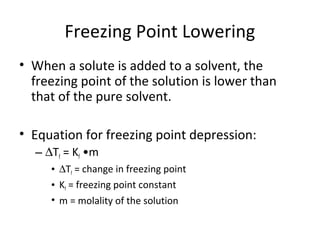
Freezing Point Lowering
• When a solute is added to a solvent, the
freezing point of the solution is lower than
that of the pure solvent.
• Equation for freezing point depression:
– ∆Tf = Kf •m
• ∆Tf = change in freezing point
• Kf = freezing point constant
• m = molality of the solution
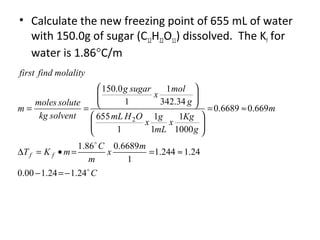
• Calculate the new freezing point of 655 mL of water
with 150.0g of sugar (C12H22O11) dissolved. The Kf for
water is 1.86°C/m
C
m
x
m
C
mKT
m
g
Kg
x
mL
g
x
OHmL
g
mol
x
sugarg
solventkg
solutemoles
m
molalityfindfirst
ff


24.124.100.0
24.1244.1
1
6689.086.1
669.06689.0
1000
1
1
1
1
655
34.342
1
1
0.150
2
−=−
≈==•=∆
≈=












==
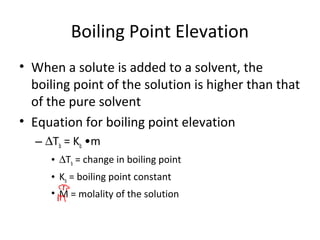
Boiling Point Elevation
• When a solute is added to a solvent, the
boiling point of the solution is higher than that
of the pure solvent
• Equation for boiling point elevation
– ∆Tb = Kb •m
• ∆Tb = change in boiling point
• Kb = boiling point constant
• M = molality of the solution
Calculating Molar Mass
• The molar mass of an unknown chemical can
be calculated by knowing how much it lowers
the freezing point of a solvent.
• Ex: 18.2g of an unknown compound is
dissolved in 995 mL of water. The compound
lowers the freezing point by 0.194°C.
Calculate the molar mass of this compound.
(Kf for water is 1.86 °C/m)

Solution chemistry notes

  • 1.
  • 2.
    Solutions • Basic definitions –Solution: homogenous mixture – Solute: substance that is dissolved – Solvent: substance that contains the solute in a solution • Process of Dissolving: – Molecules of the solvent “pull apart” the solute molecules, and distributes them within the solvent • How to tell the solute from the solvent – The substance that is in the greater amount is the solvent – The substance that keeps its phase is the solvent
  • 3.
  • 4.
    • Saturated solutionsare at dynamic equilibrium – the solute is dissolving and crystallizing at an equal rate. • The solubility of a chemical determines how much can be dissolved. Some chemicals are highly soluble (much can dissolve), some are not soluble (cannot be dissolved at all). • Supersaturate solutions hold more solute than the typical solubility allows. These solutions can crystallize easily, by adding a seed crystal or even by simply disturbing the solution (bumping or shaking). Water molecules are pulling apart the positive (Na+ ) and negative (Cl– ) ions in the table salt.
  • 5.
    What can dissolve?? •In order for a solute to dissolve, it must have similar intermolecular forces • Water is polar (has a positive and negative charge) so it can dissolve polar and ionic compounds. – Salt (NaCl) is ionic, the positive and negative ions dissolve in water – Sugar (C12H22O11) is polar, so water will dissolve it. – Oil is non-polar, and the molecules are extremely large. This is why oil cannot dissolve in water. • “Like dissolves Like”
  • 6.
    Dissolution in Water •When an ionic solid is placed in water, the water pulls the solid apart into its individual ions • Below is the dissolution of sodium chloride reaction: • NaCl(s)  Na+ (aq) + Cl- (aq)
  • 7.
    How to IncreaseSolubility • You can dissolve more of a solute in a set amount of solvent by doing the following: – 1. increase the temperature – the space between the solvent particles expands, allowing more room for more solute – 2. Increase pressure (for gases only) – this forces the solute into the solvent – 3. Nature of solute – some chemicals cannot dissolve under any circumstances. You may need to find a different solute
  • 8.
    Solubility of SomeSolids • The chart below shows how solubility of some compounds change with time • What solutes actually decrease in solubility with an increase in temperature?
  • 9.
    Solubility of Gases Thisgraph shows how gases decrease in solubility as temperature increases
  • 10.
    How to Increasethe Rate of Dissolving • In order to speed up the solute mixing with the solvent, you can do the following: – Stir/shake the mixture of course this doesn’t work for gases – Heat the mixture
  • 11.
    Calculating Concentration • GeneralTerms – Concentrated – much solute dissolved in solvent – Dilute – very little solute dissolved in solvent • More specific – Molarity – moles of solute per Liter of solution – Molality – moles of solute per kilogram of solvent – Mole fraction – moles of component per moles of all components
  • 12.
  • 13.
    What is themolarity of 450.5g of silver nitrate (AgNO3) dissolved in 675mL of Water? MM L moles solutionL solutemoles Molarity AgNOmoles AgNOg AgNOmole x AgNOg molesthefindfirst 929.3928696.3 675. 65187.2 65187191.2 88.169 1 1 5.450 3 3 33 ≈=== =
  • 14.
    • How manygrams of sodium chloride is needed to make 34.2 mL of a 0.87 M solution? NaCLg mole g x L moles x mL L x mL 7.173882376.1 44.58 1 87. 1000 1 1 2.34 ≈=
  • 15.
    • 50.0 gramsof sugar (C12H22O11) is mixed with 365.0 mL of water. Calculate the molality and mole fraction of sugar. 00716.0007158787.0 )14605.255.20( 14605. 400. 365. 14605. 255.20 02.18 1 1 365 14605. 34.342 1 1 0.50 2 2 ≈= + == === = = moles moles molestotal solutemoles x m kg mol solventkg solutemoles m OHmol g mol x OHg sugarmol g mol x sugarg
  • 16.
    • You havea 20% by mass salt water solution (NaCl) with a density of 1.04 g/ml. Find the molarity, molality, and mole fraction. 0716.0 )4395.434223(. 34223. 28.4277875.4 080.0 34223.0 56.35593.3 09615. 34223. 15.96 04.1 1 1 100 34223. 44.58 1 1 0.20 100 100 20 %20100% = + = ≈=== ≈=== = = =⇒= x m Kg mol solventkg solutemoles m M L mol solutionL solutemoles M solutionmL g mL x solutiong NaClmol g mol x NaClg x solutiong NaClg x solutionmass solutemass mass
  • 17.
    Colligative Properties • Colligativeproperties are properties of a solvent that are affected by the amount of solute dissolved. • There are three types of colligative properties – Vapor pressure lowering – Freezing point depression – Boiling point elevation • The greater the amount of solute, the greater the change in these properties
  • 18.
    Vapor Pressure Lowering •Remember: Vapor pressure is caused by the tiny gas particles floating above a liquid • When a solute is mixed, the solvent molecules are holding onto the solute, so they cannot escape into the gas phase Pure solvent Solute molecules (red) are holding solvent molecules in liquid phase
  • 19.
    • To CalculateVapor Pressure Lowering • Pa = XaPa° – Pa° = vapor pressure of pure solvent – Xa = Mole fraction of solvent – Pa = vapor pressure of solution Ex.: The vapor pressure of pure water at 22.0°C is 21 Torr. Calculate the new vapor pressure of 245g of water mixed with 45.2 g of ethyl alcohol (C2H5OH)
  • 20.
    Freezing Point Lowering •When a solute is added to a solvent, the freezing point of the solution is lower than that of the pure solvent. • Equation for freezing point depression: – ∆Tf = Kf •m • ∆Tf = change in freezing point • Kf = freezing point constant • m = molality of the solution
  • 21.
    • Calculate thenew freezing point of 655 mL of water with 150.0g of sugar (C12H22O11) dissolved. The Kf for water is 1.86°C/m C m x m C mKT m g Kg x mL g x OHmL g mol x sugarg solventkg solutemoles m molalityfindfirst ff   24.124.100.0 24.1244.1 1 6689.086.1 669.06689.0 1000 1 1 1 1 655 34.342 1 1 0.150 2 −=− ≈==•=∆ ≈=             ==
  • 22.
    Boiling Point Elevation •When a solute is added to a solvent, the boiling point of the solution is higher than that of the pure solvent • Equation for boiling point elevation – ∆Tb = Kb •m • ∆Tb = change in boiling point • Kb = boiling point constant • M = molality of the solution
  • 23.
    Calculating Molar Mass •The molar mass of an unknown chemical can be calculated by knowing how much it lowers the freezing point of a solvent. • Ex: 18.2g of an unknown compound is dissolved in 995 mL of water. The compound lowers the freezing point by 0.194°C. Calculate the molar mass of this compound. (Kf for water is 1.86 °C/m)