
Welcome to Chemistry! Unit 1
So, what is chemistry?
The study of  matter , its structure, properties and composition, and the changes that matter undergoes.
So, why do I need to learn about chemistry?
Almost everything we come in contact with is made of materials created or enhanced by chemistry!! Examples… Plastics Clothing Medicine Cosmetics Hygiene Products
Branches of Chemistry Organic Inorganic Physical Analytical Biochemistry Theoretical
So, what are some careers in chemistry? Law (Environmental or Patent) Pharmacy Space Exploration Forensics Engineering Industry (Paper, Plastics, Ceramics) Medicine Teaching Oceanography
Matter and Its Properties Matter is anything that has mass and takes up space. Mass is the measure of the amount of matter. All matter has volume and mass!!
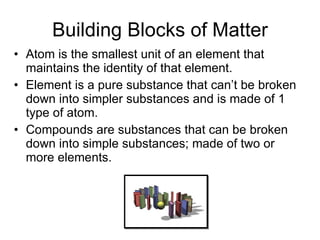
Building Blocks of Matter Atom is the smallest unit of an element that maintains the identity of that element. Element is a pure substance that can’t be broken down into simpler substances and is made of 1 type of atom. Compounds are substances that can be broken down into simple substances; made of two or more elements.
Properties of Matter Extensive properties Depend on the amount of matter that is present. Volume, mass, etc. Intensive properties Do not depend on the amount of matter that is present. Boiling point, melting point, etc.
Properties (con’t) Physical Properties Characteristic that can be observed or measured without changing the identity of the substance. Physical Changes do not involve changing the identity of the substance. Melting, boiling, etc. Chemical Properties Relates to a substance’s ability to undergo changes that transform it into different substances. Chemical Changes are when substances are converted into different substances.
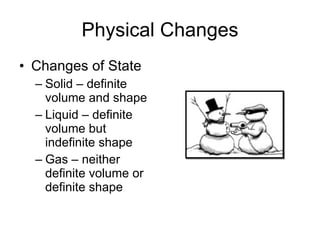
Physical Changes Changes of State Solid – definite volume and shape Liquid – definite volume but indefinite shape Gas – neither definite volume or definite shape
Chemical Changes Carbon plus oxygen forms carbon dioxide (Charcoal burning…) Reactants are the substances that react, and products are the substances formed by the chemical change.
Classification of Matter Mixtures Blend of 2 or more kinds of matter, each with its own identity and properties Can be uniform (homogeneous) or not uniform (hetergeneous) Pure Substances Has a fixed composition  Has the same characteristics throughout
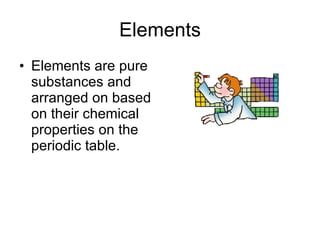
Elements Elements are pure substances and arranged on based on their chemical properties on the periodic table.
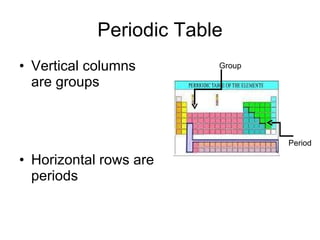
Periodic Table Vertical columns are groups Horizontal rows are periods Group Period
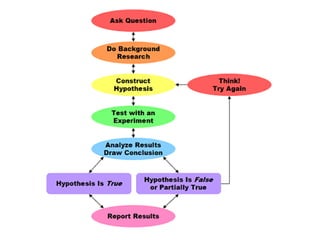
So, how does one use chemistry to make discoveries? The Scientific Method!!!
The Scientific Method A logical approach to solving problems by observing and collecting data, formulating hypotheses, testing hypotheses, and formulating theories that are supported by data.
Scientific Method State the problem clearly. Gather information. Form a hypothesis. Test the hypothesis. Evaluate the data to form a conclusion.   If the conclusion is valid, then it becomes a  theory .  If the theory is found to be true over along period of time (usually 20+ years) with no counter examples, it may be considered a  law . 6.  Share the results.
Important Things to Consider… Have a  control , which is used to show that the result of an experiment is really due to what you are testing. Know your  variables , which are the factors that change in an experiment Independent  variable – what the experimenter changes Dependent  variable – changes because of the experiment
 
Rules and Tools of the Trade
Safety Rules Don’t enter the lab without teacher! You MUST wear safety goggles when conducting experiments! Work in assigned place! Wear lab apron and tie back long hair. Keep lab table clear and clutter-free! Don’t perform unauthorized experiments! Don’t use flames without teacher’s permission!
Safety Rules (con’t) No horseplay in the lab! Don’t eat/drink in the lab! Don’t taste chemicals. Wash any chemical that comes in contact with your skin immediately and notify the teacher! Wash your hands well when exiting the lab! Check glassware for cracks!!
Safety Rules (con’t) Stay in assigned areas. Use proper techniques. Point test tubes away for self/others when heating. Don’t pour reagents back into bottles. Dispose of materials properly. Clean up spills and accidents.
Safety Rules (con’t) 16. Report all accidents and problems to the teacher!!! Complete the contract and return tomorrow for a homework grade!!!
Lab Equipment
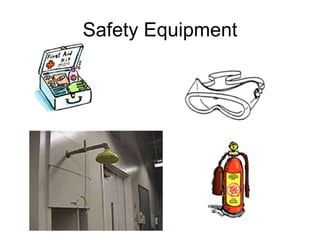
Safety Equipment
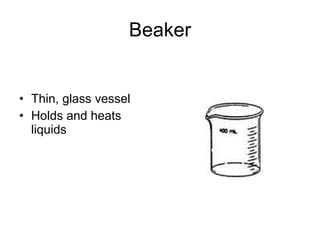
Beaker Thin, glass vessel Holds and heats liquids
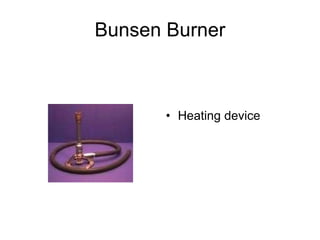
Bunsen Burner Heating device
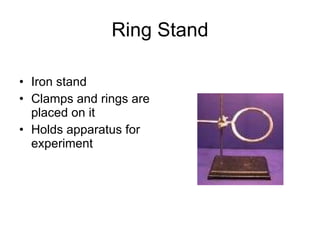
Ring Stand Iron stand Clamps and rings are placed on it Holds apparatus for experiment
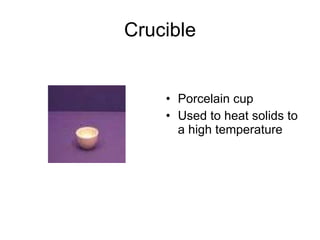
Crucible Porcelain cup Used to heat solids to a high temperature
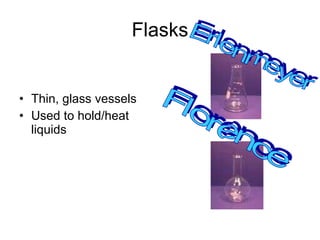
Flasks Thin, glass vessels Used to hold/heat liquids Erlenmeyer Florence
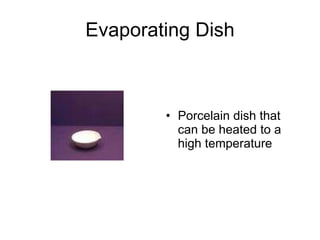
Evaporating Dish Porcelain dish that can be heated to a high temperature
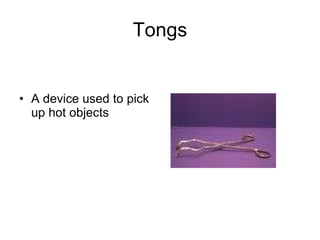
Tongs A device used to pick up hot objects
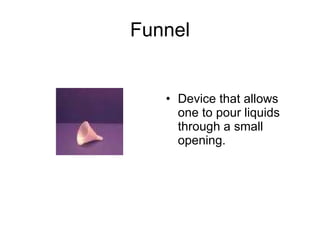
Funnel Device that allows one to pour liquids through a small opening.
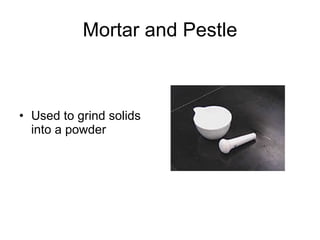
Mortar and Pestle Used to grind solids into a powder
Pipestem Triangle Device placed on a ring or tripod Used to hold a crucible when it is heated
Test Tube Small glass tube used in most chemical reactions
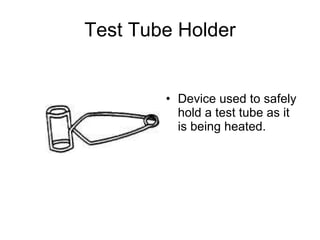
Test Tube Holder Device used to safely hold a test tube as it is being heated.
Widemouth Bottle Bottle used to collect gases Can’t be heated!!
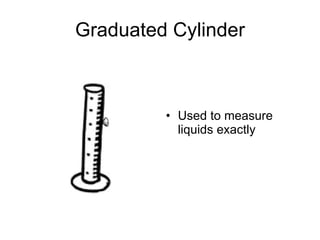
Graduated Cylinder Used to measure liquids exactly
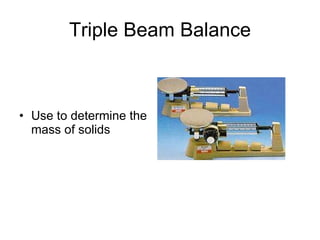
Triple Beam Balance Use to determine the mass of solids
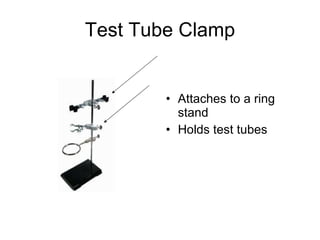
Test Tube Clamp Attaches to a ring stand Holds test tubes
How does one collect data or determine a result in chemistry?
Chemistry is a  QUANTITATIVE  science, meaning that we describe most things by using numbers!!!
Scientific Notation Scientists often work with very large and very small values. Example The mass of the Earth 6,000,000,000,000,000,000,000,000 kg
Scientific Notation (con’t) To make numbers more manageable, scientists place numbers in a shortened form. It is based on the exponential notation.  The numerical part of a measurement is expressed as a number between 1 and 10 multiplied by a whole-number power of 10. M x 10 n
Scientific Notation  (Examples) The mass of a softball is 180 grams or 1.8x10 2  g. 2,000 meters can be written as 2x10 3  m. 0.003 kilograms can be written as  3x10 -3  kg.
Negative vs. Positive Exponents To determine if the exponent is negative or positive, remember this… Whole numbers will have positive integers. Decimal numbers will have negative integers.
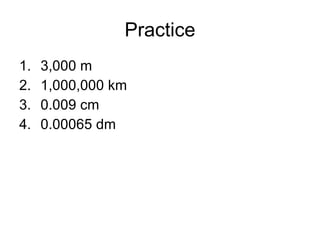
Practice 3,000 m 1,000,000 km 0.009 cm 0.00065 dm
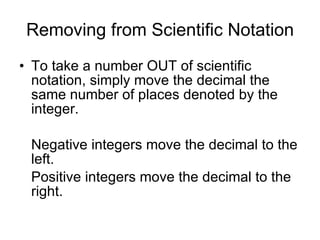
Removing from Scientific Notation To take a number OUT of scientific notation, simply move the decimal the same number of places denoted by the integer. Negative integers move the decimal to the left. Positive integers move the decimal to the right.
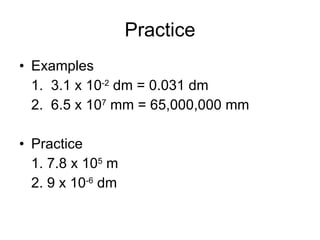
Practice Examples 1.  3.1 x 10 -2  dm = 0.031 dm 2.  6.5 x 10 7  mm = 65,000,000 mm Practice 1. 7.8 x 10 5  m 2. 9 x 10 -6  dm
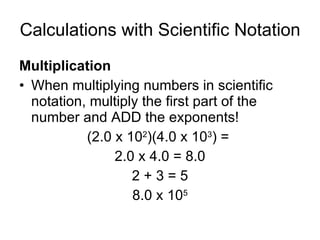
Calculations with Scientific Notation Multiplication When multiplying numbers in scientific notation, multiply the first part of the number and ADD the exponents! (2.0 x 10 2 )(4.0 x 10 3 ) =  2.0 x 4.0 = 8.0 2 + 3 = 5 8.0 x 10 5
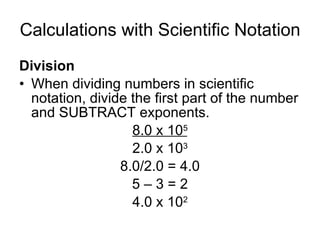
Calculations with Scientific Notation Division When dividing numbers in scientific notation, divide the first part of the number and SUBTRACT exponents. 8.0 x 10 5 2.0 x 10 3 8.0/2.0 = 4.0 5 – 3 = 2 4.0 x 10 2
Significant Figures/Digits Valid Digits/Figures
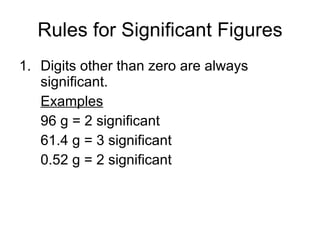
Rules for Significant Figures Digits other than zero are always significant. Examples 96 g = 2 significant 61.4 g = 3 significant 0.52 g = 2 significant
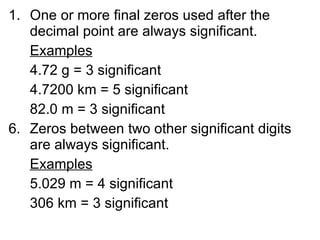
One or more final zeros used after the decimal point are always significant. Examples 4.72 g = 3 significant 4.7200 km = 5 significant 82.0 m = 3 significant Zeros between two other significant digits are always significant. Examples 5.029 m = 4 significant 306 km = 3 significant
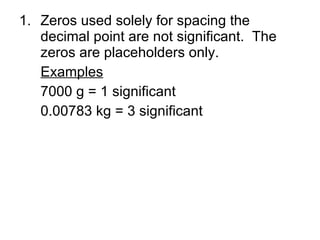
Zeros used solely for spacing the decimal point are not significant.  The zeros are placeholders only. Examples 7000 g = 1 significant 0.00783 kg = 3 significant
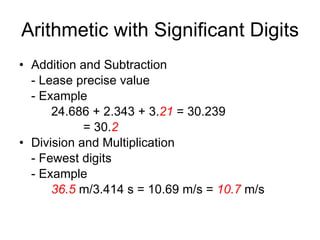
Arithmetic with Significant Digits Addition and Subtraction - Lease precise value - Example 24.686 + 2.343 + 3. 21  = 30.239  = 30. 2 Division and Multiplication - Fewest digits - Example 36.5  m/3.414 s = 10.69 m/s =  10.7  m/s
Learning Check   What are some U.S. units that are used to measure each of the following? A.  length  B.  volume  C.  weight D.  temperature
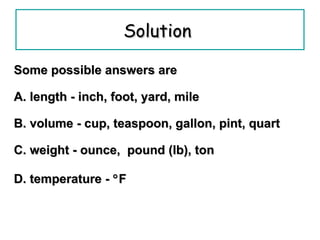
Solution   Some possible answers are A. length - inch, foot, yard, mile  B. volume - cup, teaspoon, gallon, pint, quart  C. weight - ounce,  pound (lb), ton D. temperature -   F
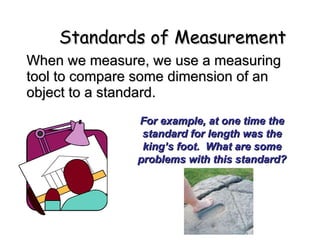
Standards of Measurement When we measure, we use a measuring tool to compare some dimension of an object to a standard. For example, at one time the standard for length was the king’s foot.  What are some problems with this standard?
SI measurement Le Système International d‘Unités   Among countries with non-metric usage, the U.S. is the  only country significantly holding out .   The U.S. officially adopted SI in 1966.
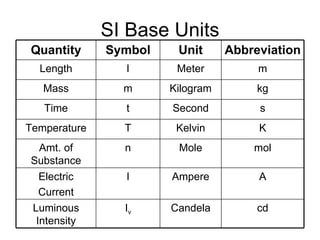
SI Base Units Quantity Symbol Unit Abbreviation Length l Meter m Mass m Kilogram kg Time t Second s Temperature T Kelvin K Amt. of Substance n Mole mol Electric Current I Ampere A Luminous Intensity I v Candela cd
Mass vs. Weight Mass:  Amount of matter (grams, measured with a BALANCE) Weight:  Force exerted by the mass, only present with gravity (pounds, measured with a SCALE) Can you hear me now?
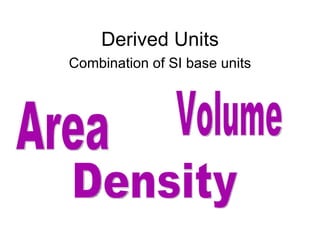
Derived Units Combination of SI base units Area Volume Density
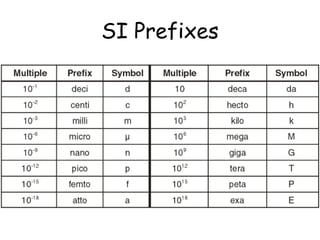
SI Prefixes Table 5.  SI prefixes   Factor
Converting Among Units There are two ways to convert among units: Moving the decimal Factor-label method
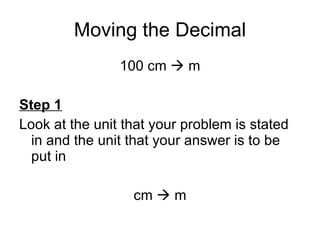
Moving the Decimal 100 cm    m Step 1 Look at the unit that your problem is stated in and the unit that your answer is to be put in cm    m
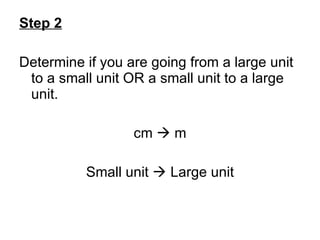
Step 2 Determine if you are going from a large unit to a small unit OR a small unit to a large unit. cm    m Small unit    Large unit
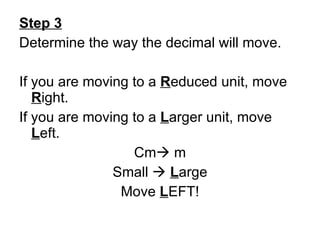
Step 3 Determine the way the decimal will move. If you are moving to a  R educed unit, move  R ight. If you are moving to a  L arger unit, move  L eft. Cm   m Small     L arge Move  L EFT!
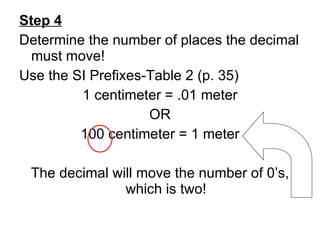
Step 4 Determine the number of places the decimal must move! Use the SI Prefixes-Table 2 (p. 35) 1 centimeter = .01 meter OR 100 centimeter = 1 meter The decimal will move the number of 0’s, which is two!
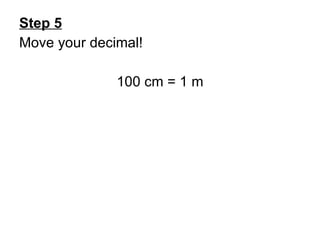
Step 5 Move your decimal! 100 cm = 1 m
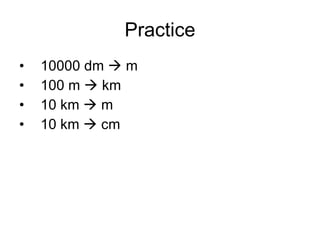
Practice 10000 dm    m 100 m    km 10 km    m 10 km    cm
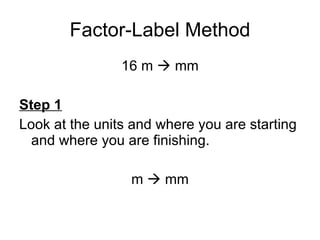
Factor-Label Method 16 m    mm Step 1 Look at the units and where you are starting and where you are finishing. m    mm
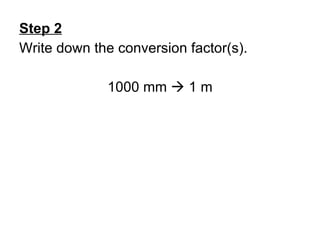
Step 2 Write down the conversion factor(s). 1000 mm    1 m
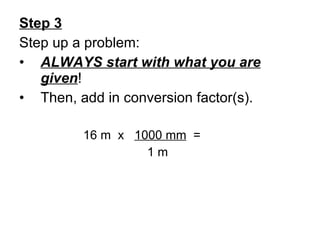
Step 3 Step up a problem: ALWAYS start with what you are given ! Then, add in conversion factor(s). 16 m  x  1000 mm   = 1 m
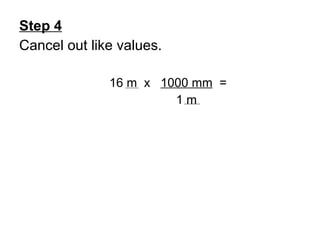
Step 4 Cancel out like values. 16 m  x  1000 mm   =   1 m
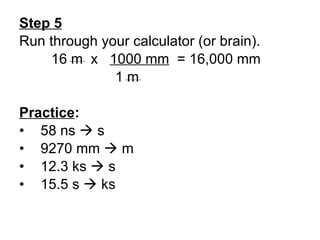
Step 5 Run through your calculator (or brain). 16 m  x  1000 mm   = 16,000 mm 1 m Practice : 58 ns    s 9270 mm    m 12.3 ks    s 15.5 s    ks
How do you measure up?
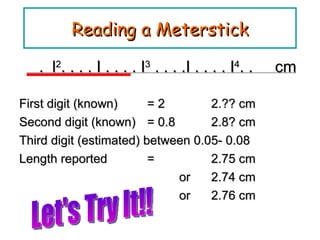
Reading a Meterstick .  l 2 . . . . I . . . . I 3  . . . .I . . . . I 4 . .  cm First digit (known) = 2    2.?? cm Second digit (known) = 0.8  2.8? cm Third digit (estimated) between 0.05- 0.08 Length reported = 2.75 cm    or 2.74 cm  or 2.76 cm Let's Try It!!
Stating a Measurement In every measurement there is a Number  followed by a  Unit from a measuring device The number should also be as precise as the measurement!
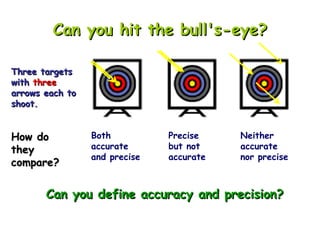
Three targets with  three  arrows each to shoot. Can you hit the bull's-eye? Both accurate and precise Precise but not accurate Neither accurate nor precise How do they compare? Can you define accuracy and precision?
Accuracy vs. Precision Accuracy How close a measurement is to the true correct value for the quantity Precision How close a set of measure-ments for a quantity are to one another, regardless of whether the measurements are correct

Chemistry_Unit 1

  • 1.
  • 2.
    So, what ischemistry?
  • 3.
    The study of matter , its structure, properties and composition, and the changes that matter undergoes.
  • 4.
    So, why doI need to learn about chemistry?
  • 5.
    Almost everything wecome in contact with is made of materials created or enhanced by chemistry!! Examples… Plastics Clothing Medicine Cosmetics Hygiene Products
  • 6.
    Branches of ChemistryOrganic Inorganic Physical Analytical Biochemistry Theoretical
  • 7.
    So, what aresome careers in chemistry? Law (Environmental or Patent) Pharmacy Space Exploration Forensics Engineering Industry (Paper, Plastics, Ceramics) Medicine Teaching Oceanography
  • 8.
    Matter and ItsProperties Matter is anything that has mass and takes up space. Mass is the measure of the amount of matter. All matter has volume and mass!!
  • 9.
    Building Blocks ofMatter Atom is the smallest unit of an element that maintains the identity of that element. Element is a pure substance that can’t be broken down into simpler substances and is made of 1 type of atom. Compounds are substances that can be broken down into simple substances; made of two or more elements.
  • 10.
    Properties of MatterExtensive properties Depend on the amount of matter that is present. Volume, mass, etc. Intensive properties Do not depend on the amount of matter that is present. Boiling point, melting point, etc.
  • 11.
    Properties (con’t) PhysicalProperties Characteristic that can be observed or measured without changing the identity of the substance. Physical Changes do not involve changing the identity of the substance. Melting, boiling, etc. Chemical Properties Relates to a substance’s ability to undergo changes that transform it into different substances. Chemical Changes are when substances are converted into different substances.
  • 12.
    Physical Changes Changesof State Solid – definite volume and shape Liquid – definite volume but indefinite shape Gas – neither definite volume or definite shape
  • 13.
    Chemical Changes Carbonplus oxygen forms carbon dioxide (Charcoal burning…) Reactants are the substances that react, and products are the substances formed by the chemical change.
  • 14.
    Classification of MatterMixtures Blend of 2 or more kinds of matter, each with its own identity and properties Can be uniform (homogeneous) or not uniform (hetergeneous) Pure Substances Has a fixed composition Has the same characteristics throughout
  • 15.
    Elements Elements arepure substances and arranged on based on their chemical properties on the periodic table.
  • 16.
    Periodic Table Verticalcolumns are groups Horizontal rows are periods Group Period
  • 17.
    So, how doesone use chemistry to make discoveries? The Scientific Method!!!
  • 18.
    The Scientific MethodA logical approach to solving problems by observing and collecting data, formulating hypotheses, testing hypotheses, and formulating theories that are supported by data.
  • 19.
    Scientific Method Statethe problem clearly. Gather information. Form a hypothesis. Test the hypothesis. Evaluate the data to form a conclusion. If the conclusion is valid, then it becomes a theory . If the theory is found to be true over along period of time (usually 20+ years) with no counter examples, it may be considered a law . 6. Share the results.
  • 20.
    Important Things toConsider… Have a control , which is used to show that the result of an experiment is really due to what you are testing. Know your variables , which are the factors that change in an experiment Independent variable – what the experimenter changes Dependent variable – changes because of the experiment
  • 21.
  • 22.
    Rules and Toolsof the Trade
  • 23.
    Safety Rules Don’tenter the lab without teacher! You MUST wear safety goggles when conducting experiments! Work in assigned place! Wear lab apron and tie back long hair. Keep lab table clear and clutter-free! Don’t perform unauthorized experiments! Don’t use flames without teacher’s permission!
  • 24.
    Safety Rules (con’t)No horseplay in the lab! Don’t eat/drink in the lab! Don’t taste chemicals. Wash any chemical that comes in contact with your skin immediately and notify the teacher! Wash your hands well when exiting the lab! Check glassware for cracks!!
  • 25.
    Safety Rules (con’t)Stay in assigned areas. Use proper techniques. Point test tubes away for self/others when heating. Don’t pour reagents back into bottles. Dispose of materials properly. Clean up spills and accidents.
  • 26.
    Safety Rules (con’t)16. Report all accidents and problems to the teacher!!! Complete the contract and return tomorrow for a homework grade!!!
  • 27.
  • 28.
  • 29.
    Beaker Thin, glassvessel Holds and heats liquids
  • 30.
  • 31.
    Ring Stand Ironstand Clamps and rings are placed on it Holds apparatus for experiment
  • 32.
    Crucible Porcelain cupUsed to heat solids to a high temperature
  • 33.
    Flasks Thin, glassvessels Used to hold/heat liquids Erlenmeyer Florence
  • 34.
    Evaporating Dish Porcelaindish that can be heated to a high temperature
  • 35.
    Tongs A deviceused to pick up hot objects
  • 36.
    Funnel Device thatallows one to pour liquids through a small opening.
  • 37.
    Mortar and PestleUsed to grind solids into a powder
  • 38.
    Pipestem Triangle Deviceplaced on a ring or tripod Used to hold a crucible when it is heated
  • 39.
    Test Tube Smallglass tube used in most chemical reactions
  • 40.
    Test Tube HolderDevice used to safely hold a test tube as it is being heated.
  • 41.
    Widemouth Bottle Bottleused to collect gases Can’t be heated!!
  • 42.
    Graduated Cylinder Usedto measure liquids exactly
  • 43.
    Triple Beam BalanceUse to determine the mass of solids
  • 44.
    Test Tube ClampAttaches to a ring stand Holds test tubes
  • 45.
    How does onecollect data or determine a result in chemistry?
  • 46.
    Chemistry is a QUANTITATIVE science, meaning that we describe most things by using numbers!!!
  • 47.
    Scientific Notation Scientistsoften work with very large and very small values. Example The mass of the Earth 6,000,000,000,000,000,000,000,000 kg
  • 48.
    Scientific Notation (con’t)To make numbers more manageable, scientists place numbers in a shortened form. It is based on the exponential notation. The numerical part of a measurement is expressed as a number between 1 and 10 multiplied by a whole-number power of 10. M x 10 n
  • 49.
    Scientific Notation (Examples) The mass of a softball is 180 grams or 1.8x10 2 g. 2,000 meters can be written as 2x10 3 m. 0.003 kilograms can be written as 3x10 -3 kg.
  • 50.
    Negative vs. PositiveExponents To determine if the exponent is negative or positive, remember this… Whole numbers will have positive integers. Decimal numbers will have negative integers.
  • 51.
    Practice 3,000 m1,000,000 km 0.009 cm 0.00065 dm
  • 52.
    Removing from ScientificNotation To take a number OUT of scientific notation, simply move the decimal the same number of places denoted by the integer. Negative integers move the decimal to the left. Positive integers move the decimal to the right.
  • 53.
    Practice Examples 1. 3.1 x 10 -2 dm = 0.031 dm 2. 6.5 x 10 7 mm = 65,000,000 mm Practice 1. 7.8 x 10 5 m 2. 9 x 10 -6 dm
  • 54.
    Calculations with ScientificNotation Multiplication When multiplying numbers in scientific notation, multiply the first part of the number and ADD the exponents! (2.0 x 10 2 )(4.0 x 10 3 ) = 2.0 x 4.0 = 8.0 2 + 3 = 5 8.0 x 10 5
  • 55.
    Calculations with ScientificNotation Division When dividing numbers in scientific notation, divide the first part of the number and SUBTRACT exponents. 8.0 x 10 5 2.0 x 10 3 8.0/2.0 = 4.0 5 – 3 = 2 4.0 x 10 2
  • 56.
  • 57.
    Rules for SignificantFigures Digits other than zero are always significant. Examples 96 g = 2 significant 61.4 g = 3 significant 0.52 g = 2 significant
  • 58.
    One or morefinal zeros used after the decimal point are always significant. Examples 4.72 g = 3 significant 4.7200 km = 5 significant 82.0 m = 3 significant Zeros between two other significant digits are always significant. Examples 5.029 m = 4 significant 306 km = 3 significant
  • 59.
    Zeros used solelyfor spacing the decimal point are not significant. The zeros are placeholders only. Examples 7000 g = 1 significant 0.00783 kg = 3 significant
  • 60.
    Arithmetic with SignificantDigits Addition and Subtraction - Lease precise value - Example 24.686 + 2.343 + 3. 21 = 30.239 = 30. 2 Division and Multiplication - Fewest digits - Example 36.5 m/3.414 s = 10.69 m/s = 10.7 m/s
  • 61.
    Learning Check What are some U.S. units that are used to measure each of the following? A. length B. volume C. weight D. temperature
  • 62.
    Solution Some possible answers are A. length - inch, foot, yard, mile B. volume - cup, teaspoon, gallon, pint, quart C. weight - ounce, pound (lb), ton D. temperature -  F
  • 63.
    Standards of MeasurementWhen we measure, we use a measuring tool to compare some dimension of an object to a standard. For example, at one time the standard for length was the king’s foot. What are some problems with this standard?
  • 64.
    SI measurement LeSystème International d‘Unités Among countries with non-metric usage, the U.S. is the only country significantly holding out . The U.S. officially adopted SI in 1966.
  • 65.
    SI Base UnitsQuantity Symbol Unit Abbreviation Length l Meter m Mass m Kilogram kg Time t Second s Temperature T Kelvin K Amt. of Substance n Mole mol Electric Current I Ampere A Luminous Intensity I v Candela cd
  • 66.
    Mass vs. WeightMass: Amount of matter (grams, measured with a BALANCE) Weight: Force exerted by the mass, only present with gravity (pounds, measured with a SCALE) Can you hear me now?
  • 67.
    Derived Units Combinationof SI base units Area Volume Density
  • 68.
    SI Prefixes Table5.  SI prefixes Factor
  • 69.
    Converting Among UnitsThere are two ways to convert among units: Moving the decimal Factor-label method
  • 70.
    Moving the Decimal100 cm  m Step 1 Look at the unit that your problem is stated in and the unit that your answer is to be put in cm  m
  • 71.
    Step 2 Determineif you are going from a large unit to a small unit OR a small unit to a large unit. cm  m Small unit  Large unit
  • 72.
    Step 3 Determinethe way the decimal will move. If you are moving to a R educed unit, move R ight. If you are moving to a L arger unit, move L eft. Cm  m Small  L arge Move L EFT!
  • 73.
    Step 4 Determinethe number of places the decimal must move! Use the SI Prefixes-Table 2 (p. 35) 1 centimeter = .01 meter OR 100 centimeter = 1 meter The decimal will move the number of 0’s, which is two!
  • 74.
    Step 5 Moveyour decimal! 100 cm = 1 m
  • 75.
    Practice 10000 dm  m 100 m  km 10 km  m 10 km  cm
  • 76.
    Factor-Label Method 16m  mm Step 1 Look at the units and where you are starting and where you are finishing. m  mm
  • 77.
    Step 2 Writedown the conversion factor(s). 1000 mm  1 m
  • 78.
    Step 3 Stepup a problem: ALWAYS start with what you are given ! Then, add in conversion factor(s). 16 m x 1000 mm = 1 m
  • 79.
    Step 4 Cancelout like values. 16 m x 1000 mm = 1 m
  • 80.
    Step 5 Runthrough your calculator (or brain). 16 m x 1000 mm = 16,000 mm 1 m Practice : 58 ns  s 9270 mm  m 12.3 ks  s 15.5 s  ks
  • 81.
    How do youmeasure up?
  • 82.
    Reading a Meterstick. l 2 . . . . I . . . . I 3 . . . .I . . . . I 4 . . cm First digit (known) = 2 2.?? cm Second digit (known) = 0.8 2.8? cm Third digit (estimated) between 0.05- 0.08 Length reported = 2.75 cm or 2.74 cm or 2.76 cm Let's Try It!!
  • 83.
    Stating a MeasurementIn every measurement there is a Number followed by a Unit from a measuring device The number should also be as precise as the measurement!
  • 84.
    Three targets with three arrows each to shoot. Can you hit the bull's-eye? Both accurate and precise Precise but not accurate Neither accurate nor precise How do they compare? Can you define accuracy and precision?
  • 85.
    Accuracy vs. PrecisionAccuracy How close a measurement is to the true correct value for the quantity Precision How close a set of measure-ments for a quantity are to one another, regardless of whether the measurements are correct