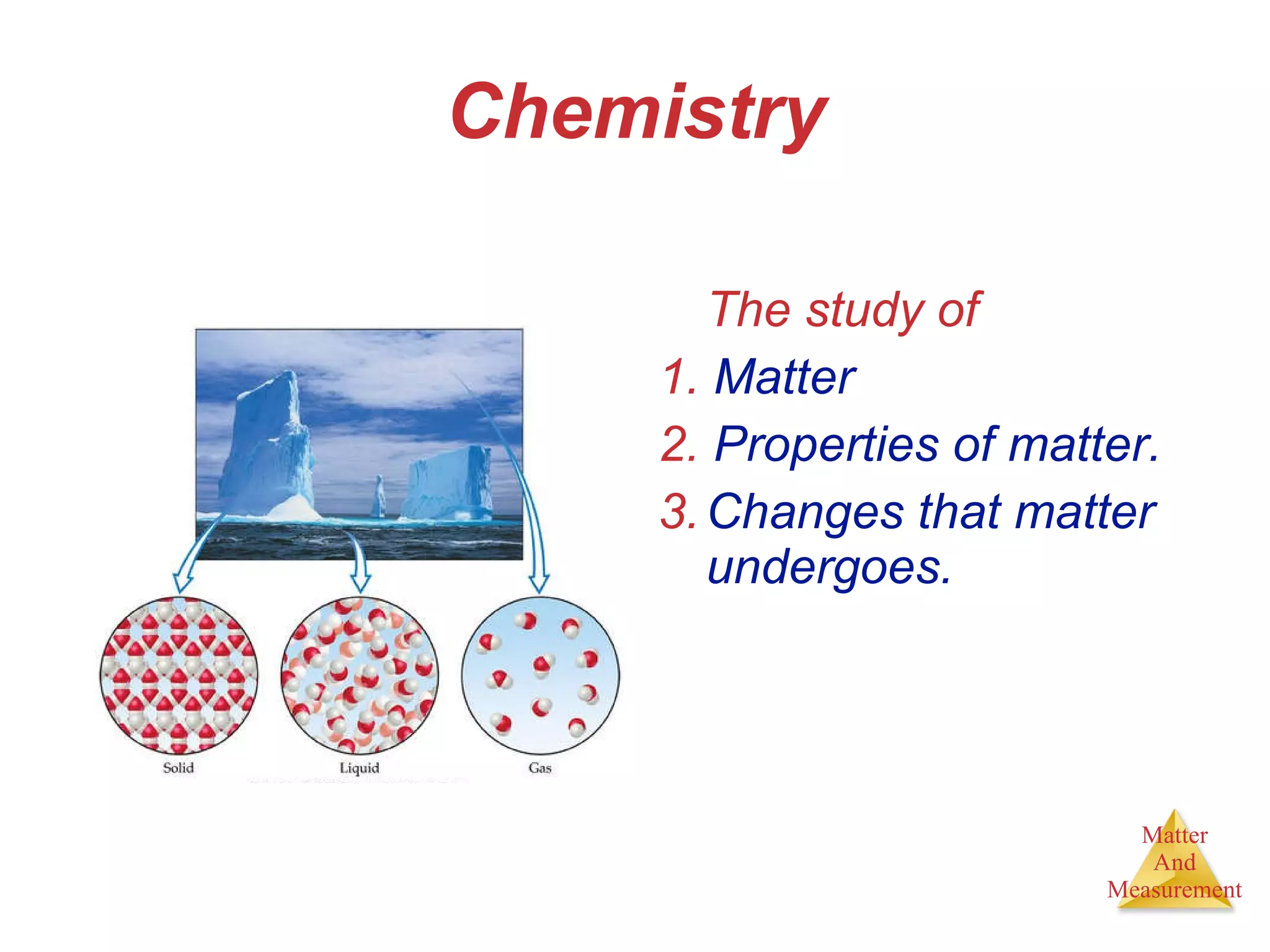
Chemistry The study of  1.  Matter   2.  Properties of matter. 3. Changes   that matter undergoes.
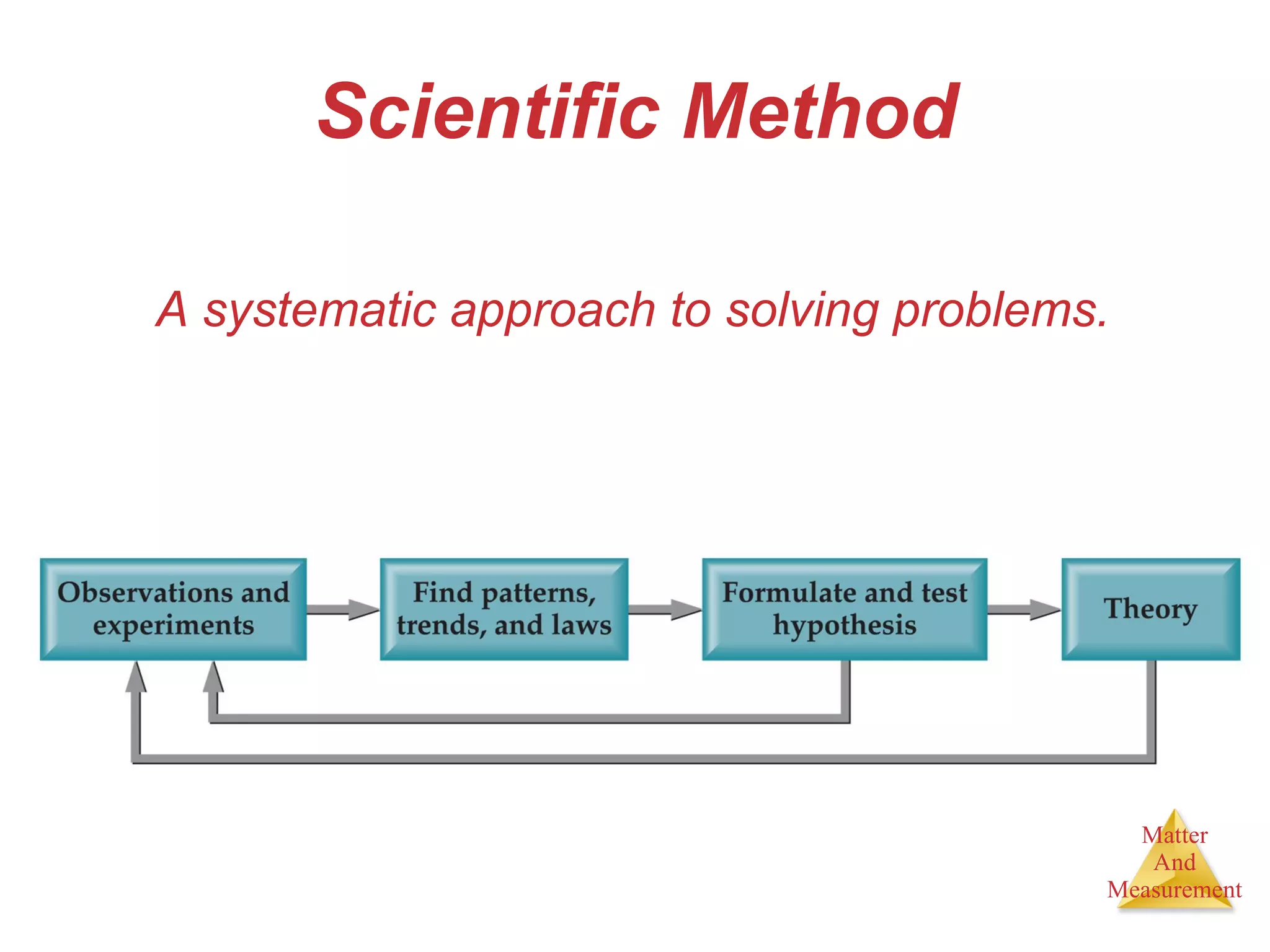
Scientific Method A systematic approach to solving problems.
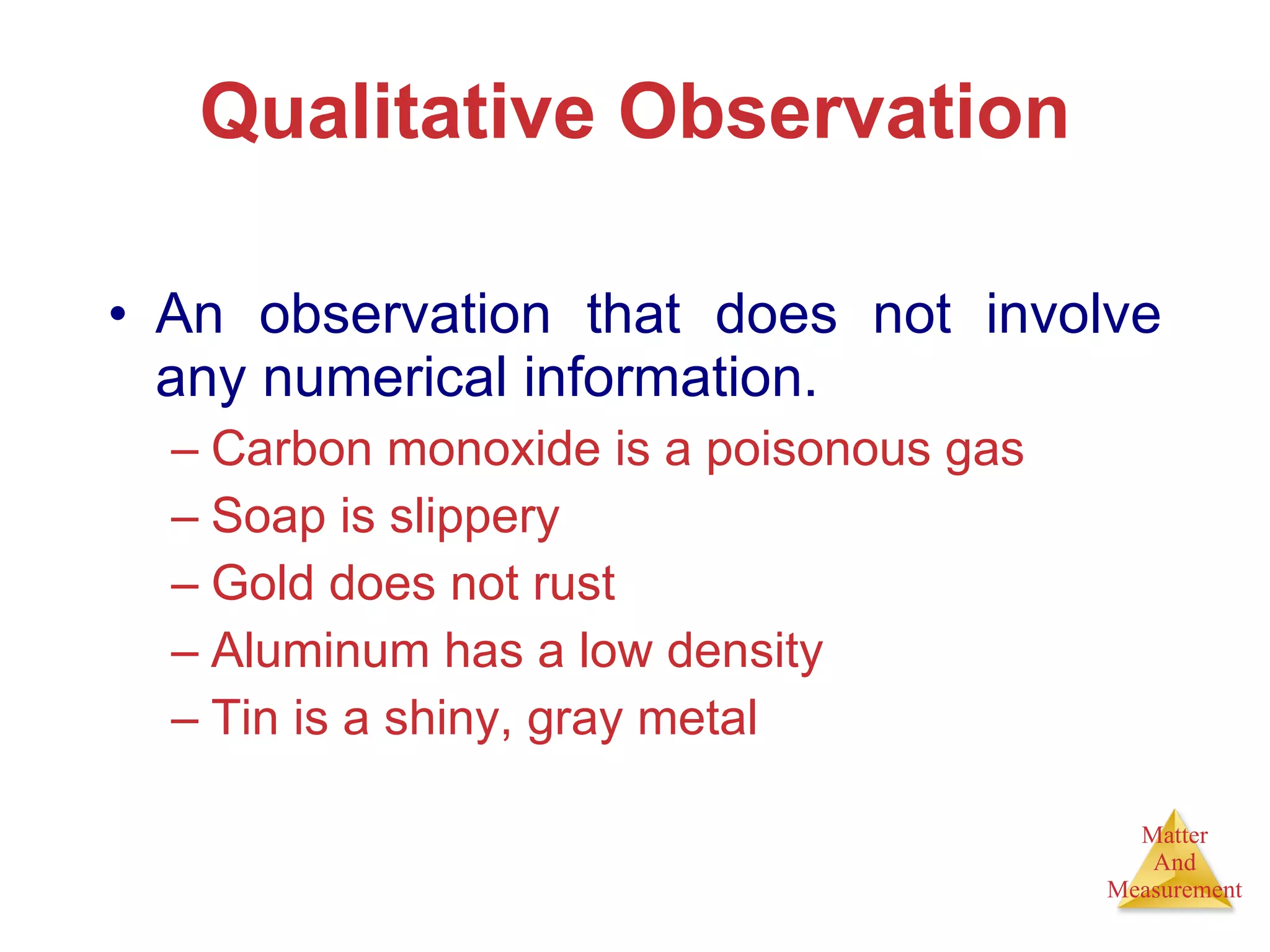
Qualitative Observation An observation that does not involve any numerical information. Carbon monoxide is a poisonous gas Soap is slippery Gold does not rust Aluminum has a low density Tin is a shiny, gray metal
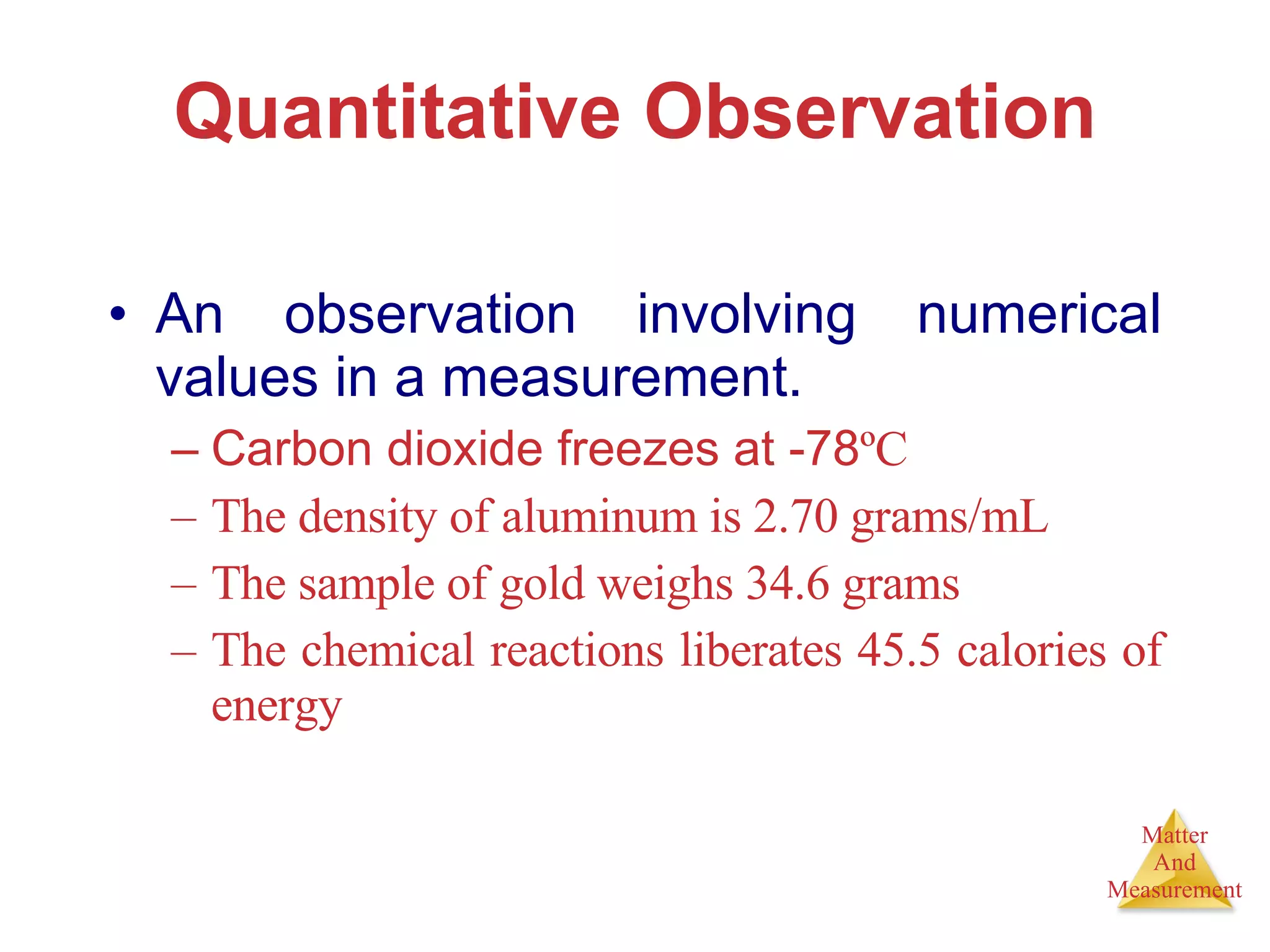
Quantitative Observation An observation involving numerical values in a measurement. Carbon dioxide freezes at -78 ºC The density of aluminum is 2.70 grams/mL The sample of gold weighs 34.6 grams The chemical reactions liberates 45.5 calories of energy
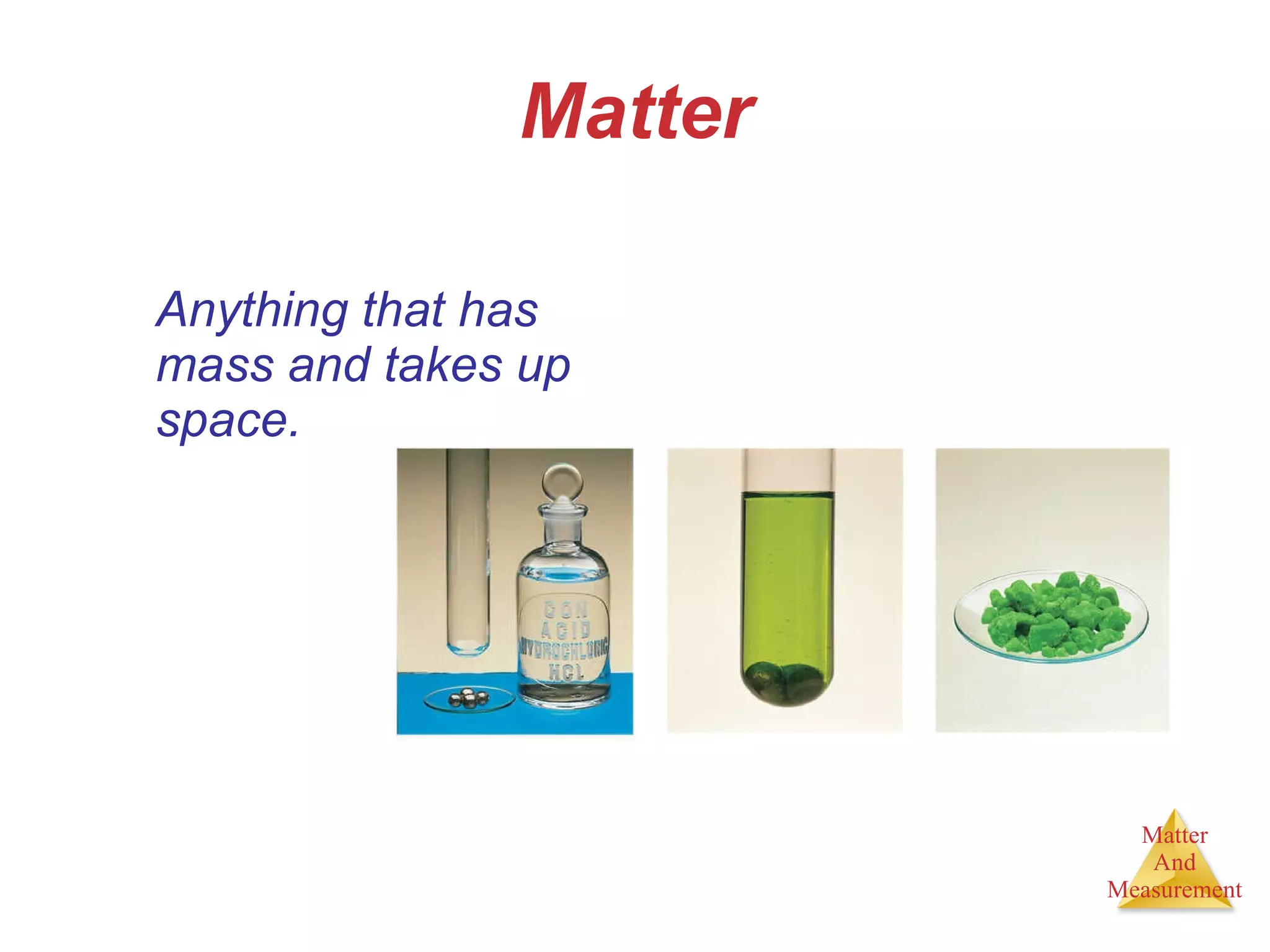
Matter Anything that has mass and takes up space.
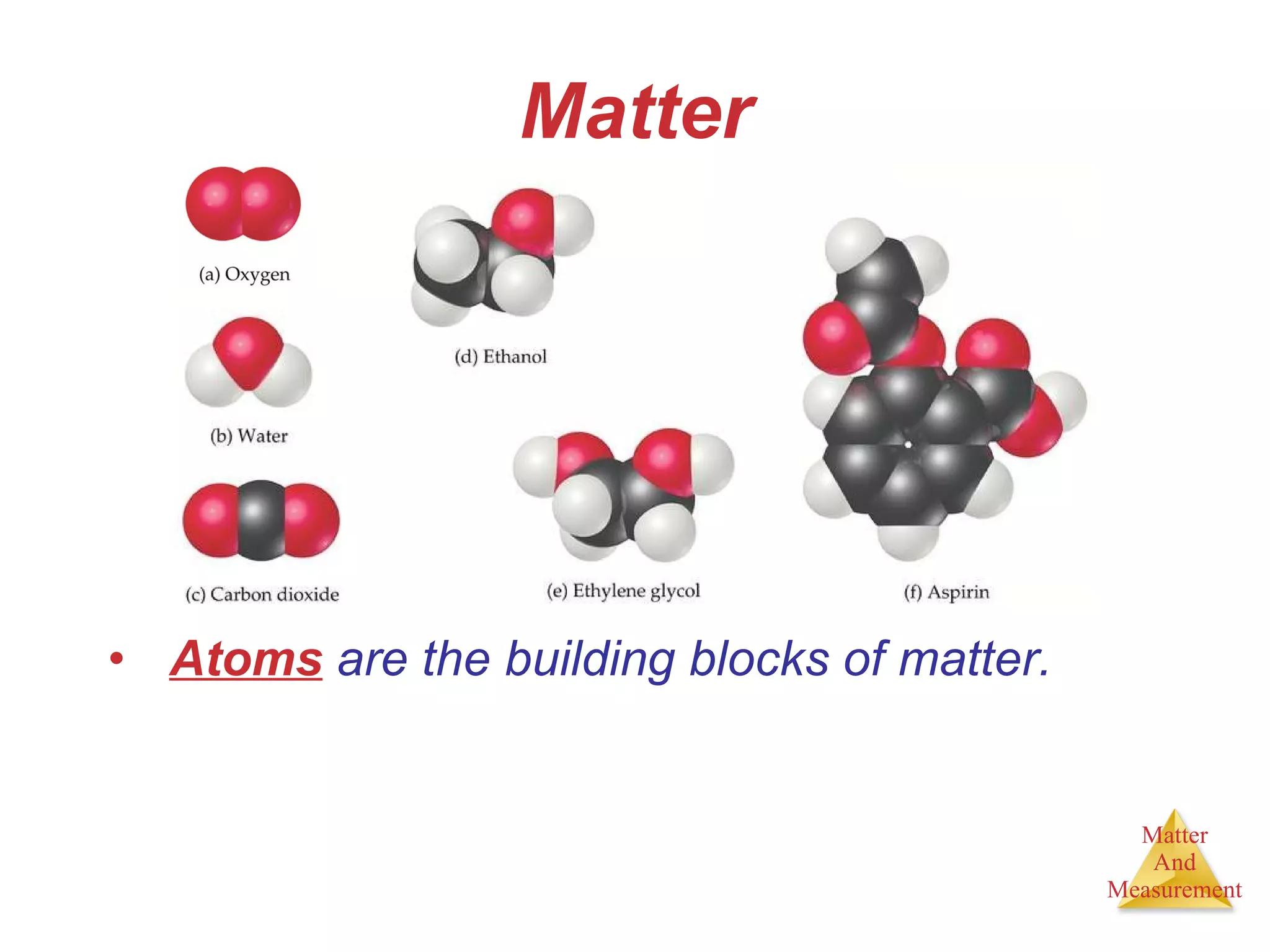
Matter Atoms  are the building blocks of matter.
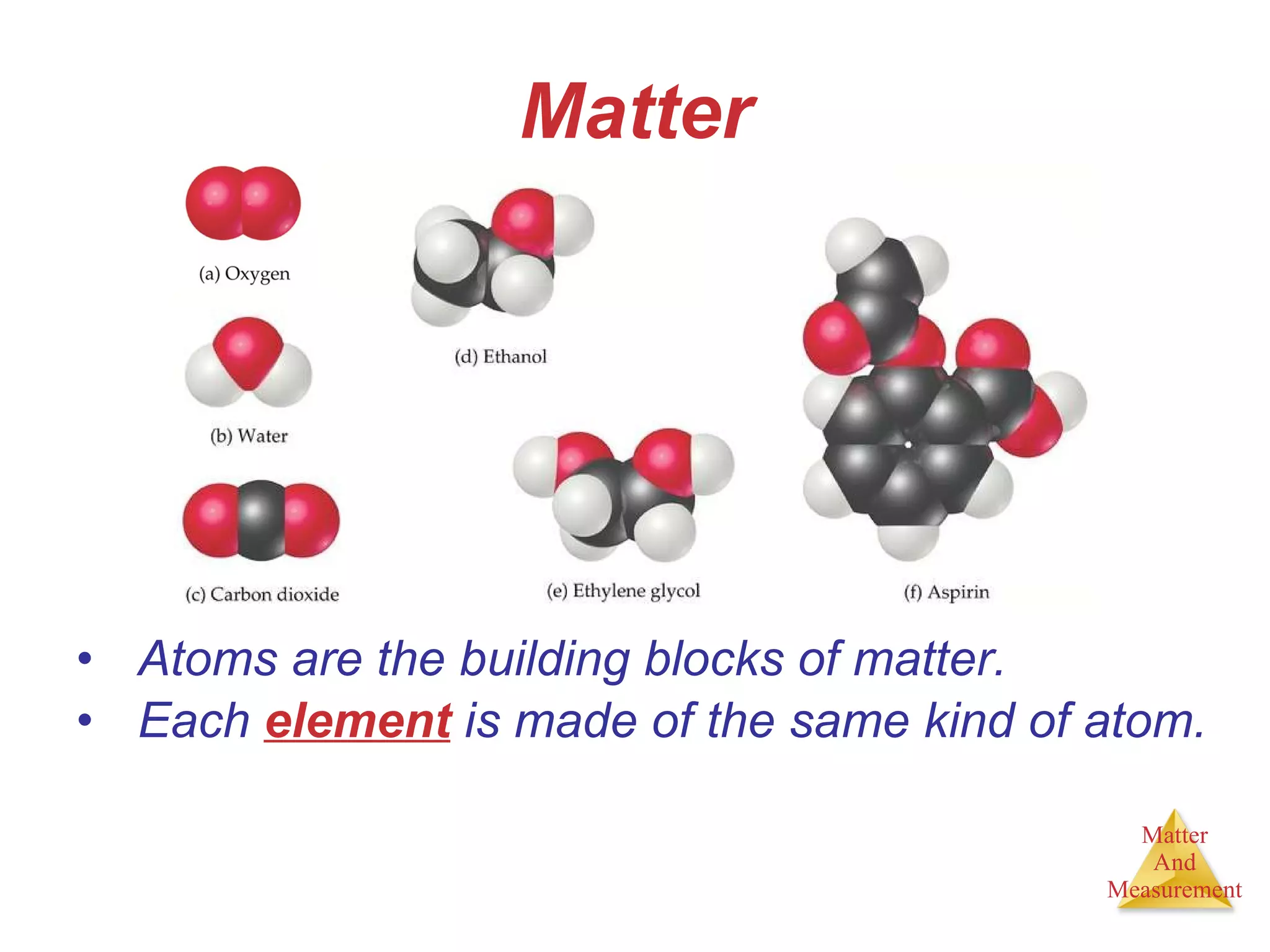
Matter Atoms are the building blocks of matter. Each  element  is made of the same kind of atom.
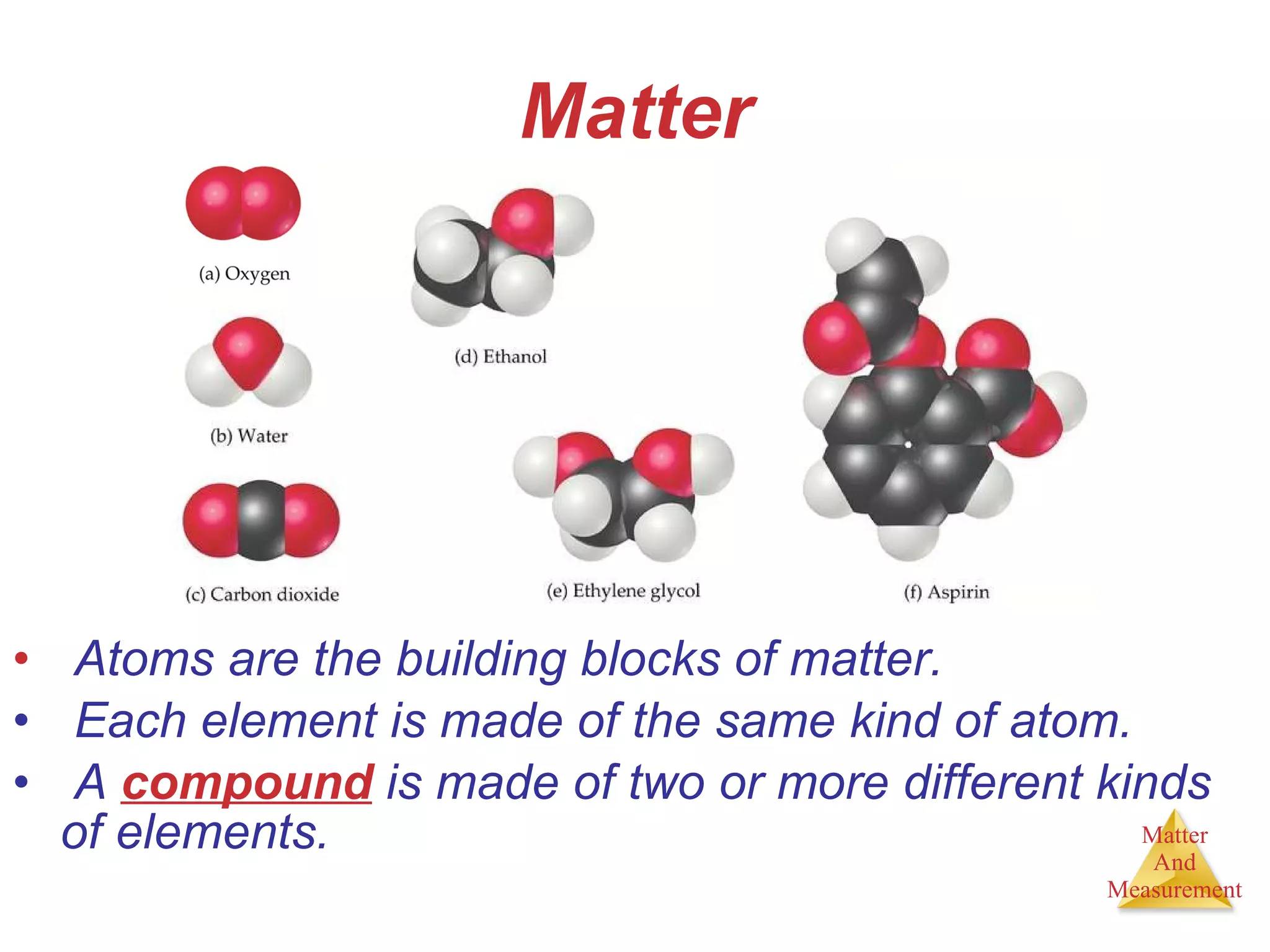
Matter Atoms are the building blocks of matter. Each element is made of the same kind of atom. A  compound  is made of two or more different kinds of elements.
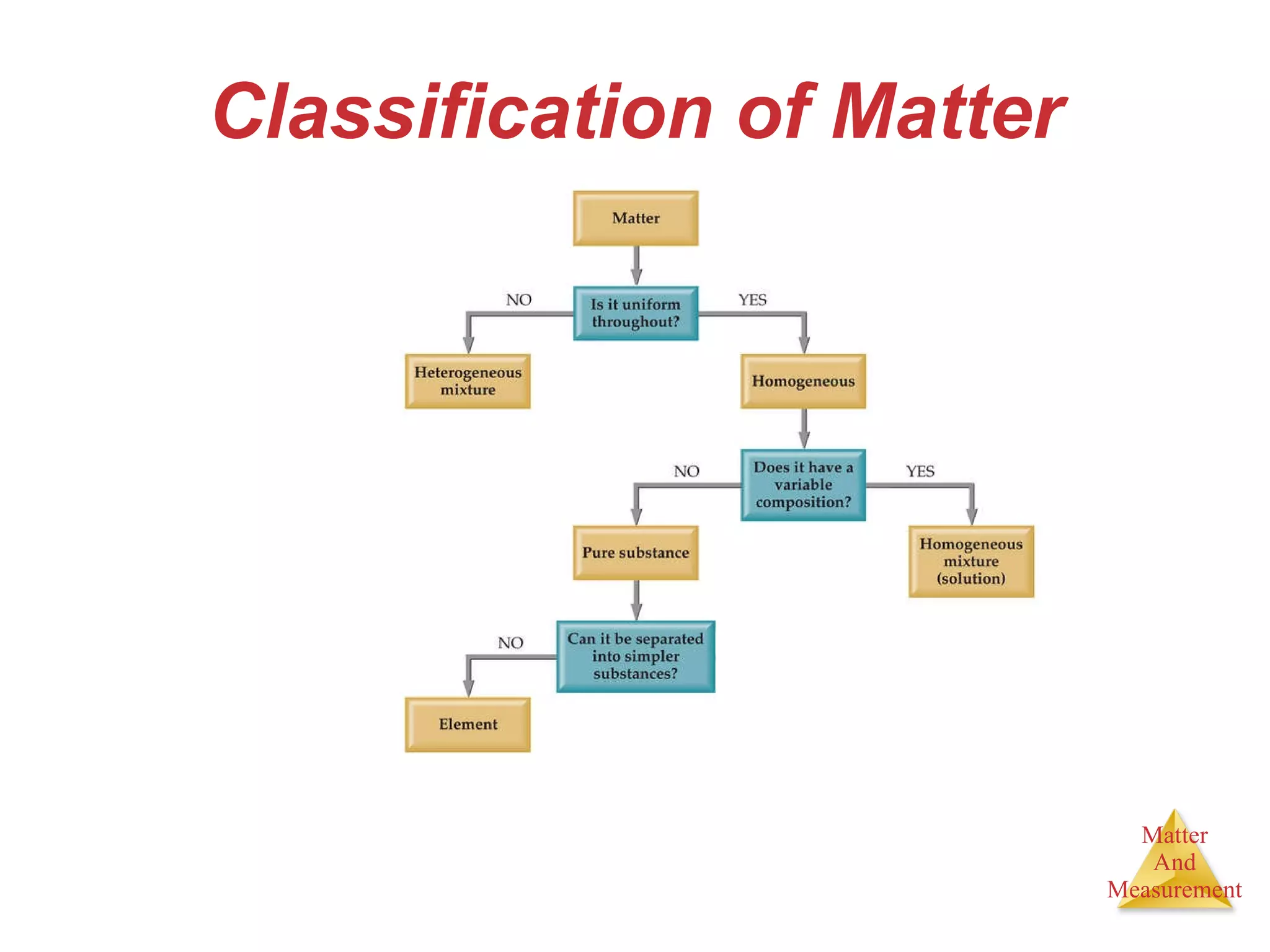
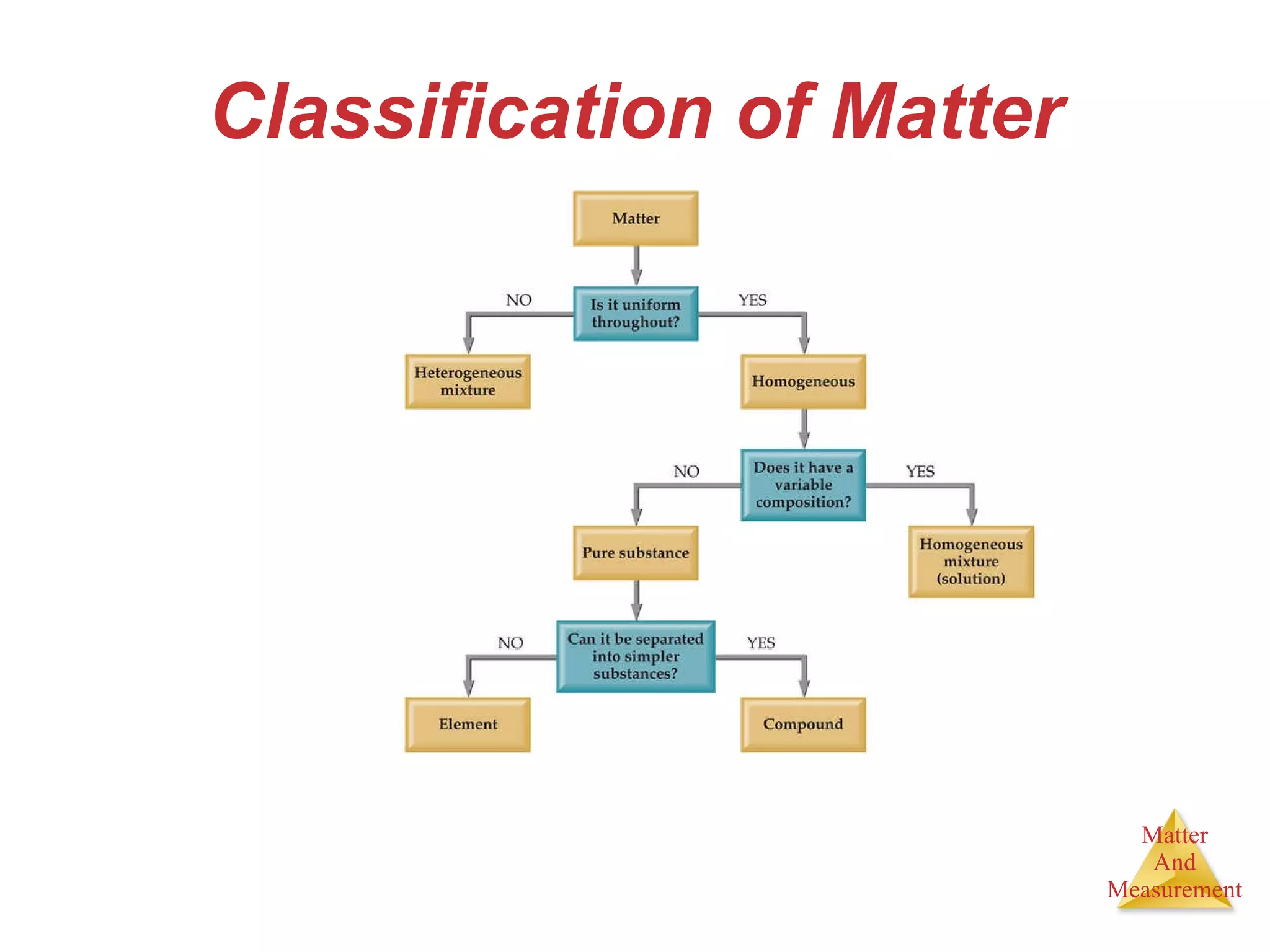
Classification of Matter Elements (Pure) Compounds (Pure) Mixtures (Impure)
Elements Elements are the  simplest form  of matter that can exist under conditions that we normally encounter in the laboratory An element is a substance that cannot be separated into simpler substances by  chemical methods .
Elements 113 Elements have been identified. 82 Elements  occur naturally  on Earth Gold, Aluminum, Lead, Oxygen, Carbon 31 Elements have been  created  by scientists. Technetium, americium, seaborgium
Elements Elements can exist in either the  atomic  or  molecular  forms. Neon Ne Hydrogen H 2 Bromine Br 2 Phosphorus P 4 Sulfur S 8
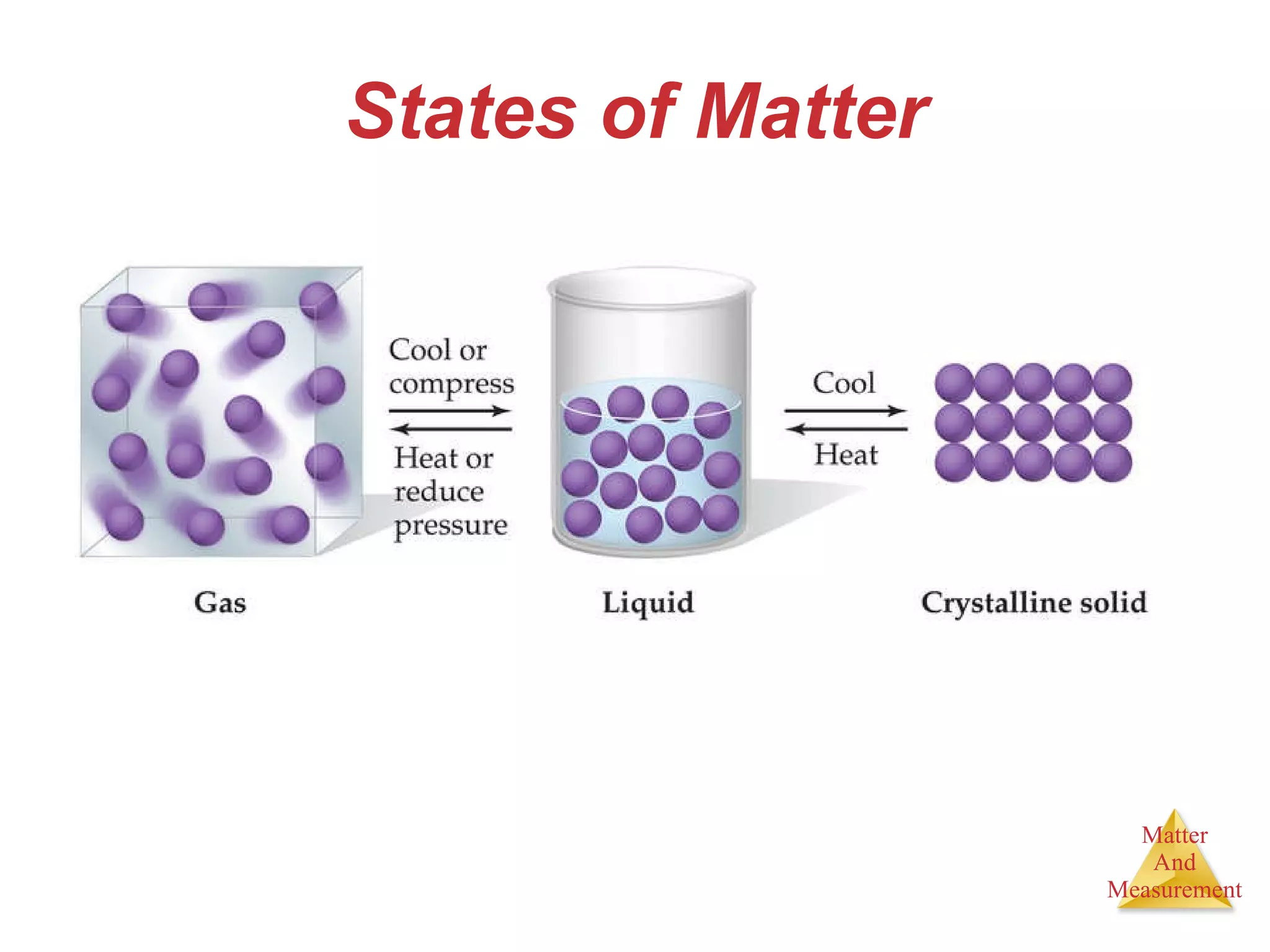
States of Matter
Compound A compound is a substance composed of atoms of two or more elements chemically combined in  fixed  proportions (by either mass or atoms).
Compounds A compound does not change its identify in physical changes but can be broken down into its  constituent elements by chemical methods . The simplest unit of a compoud is the  molecule  or  ion-pair .
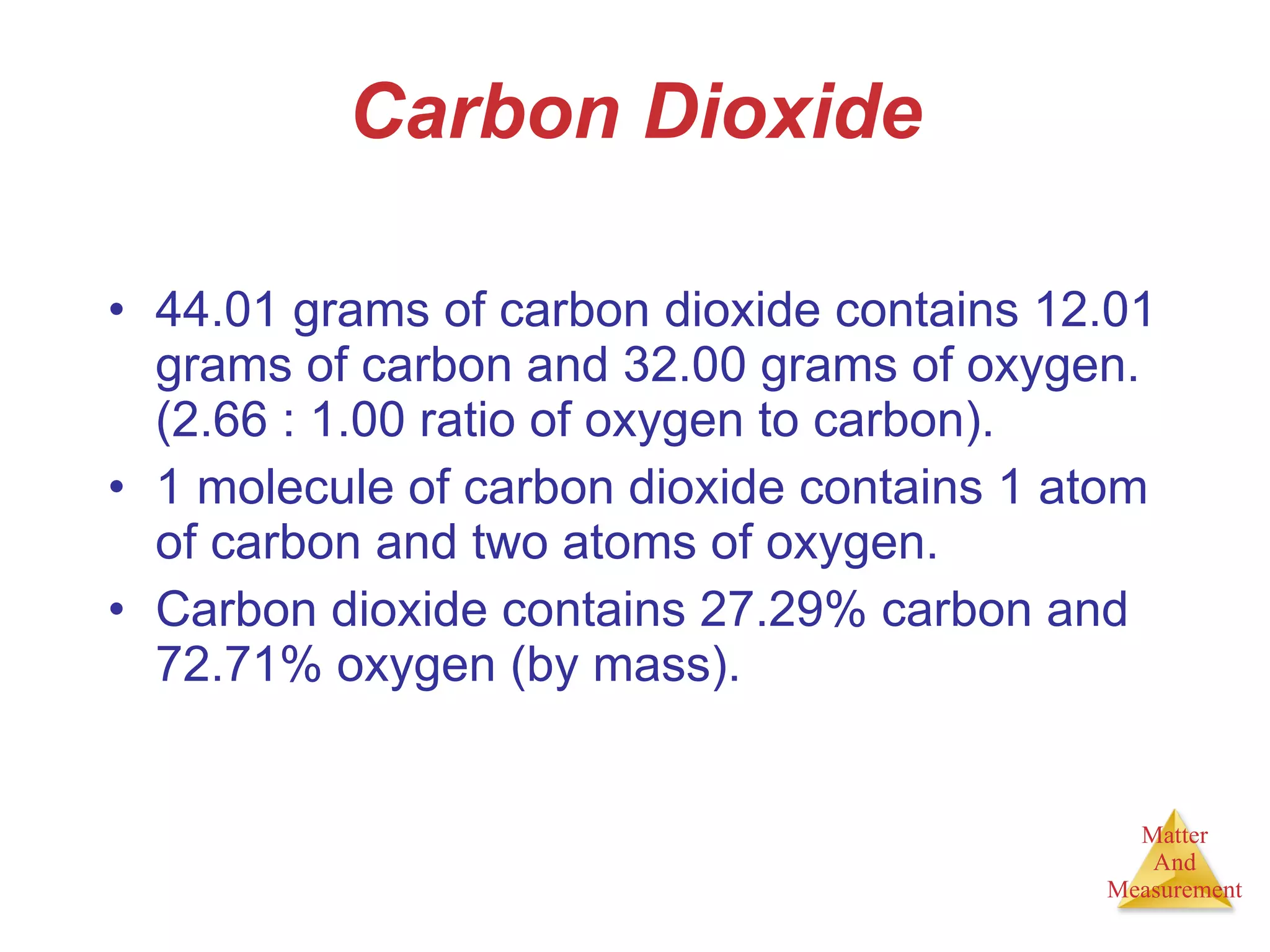
Carbon Dioxide 44.01 grams of carbon dioxide contains 12.01 grams of carbon and 32.00 grams of oxygen.  (2.66 : 1.00 ratio of oxygen to carbon). 1 molecule of carbon dioxide contains 1 atom of carbon and two atoms of oxygen. Carbon dioxide contains 27.29% carbon and 72.71% oxygen (by mass).
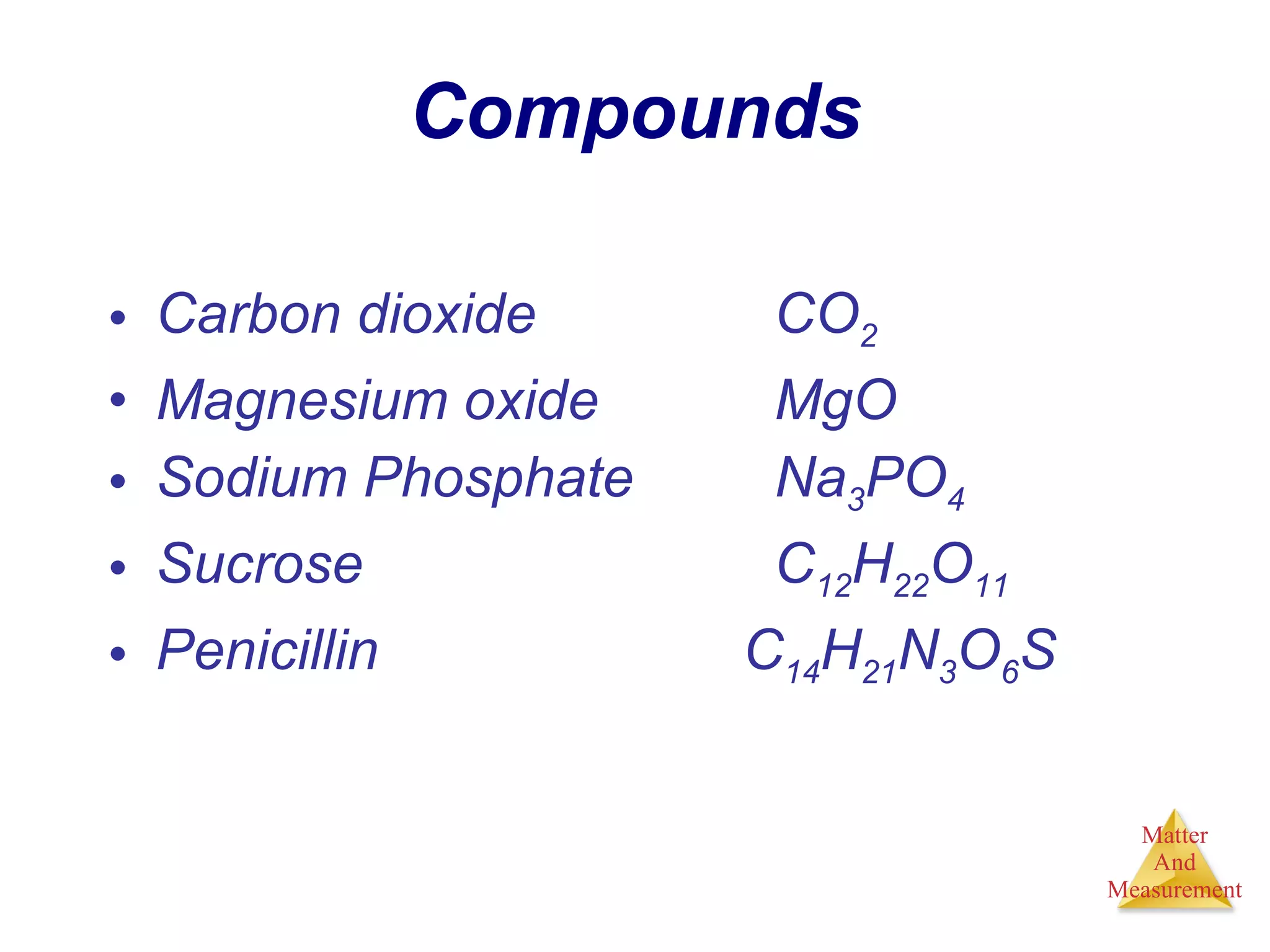
Compounds Carbon dioxide   CO 2 Magnesium oxide   MgO Sodium Phosphate   Na 3 PO 4 Sucrose   C 12 H 22 O 11 Penicillin C 14 H 21 N 3 O 6 S
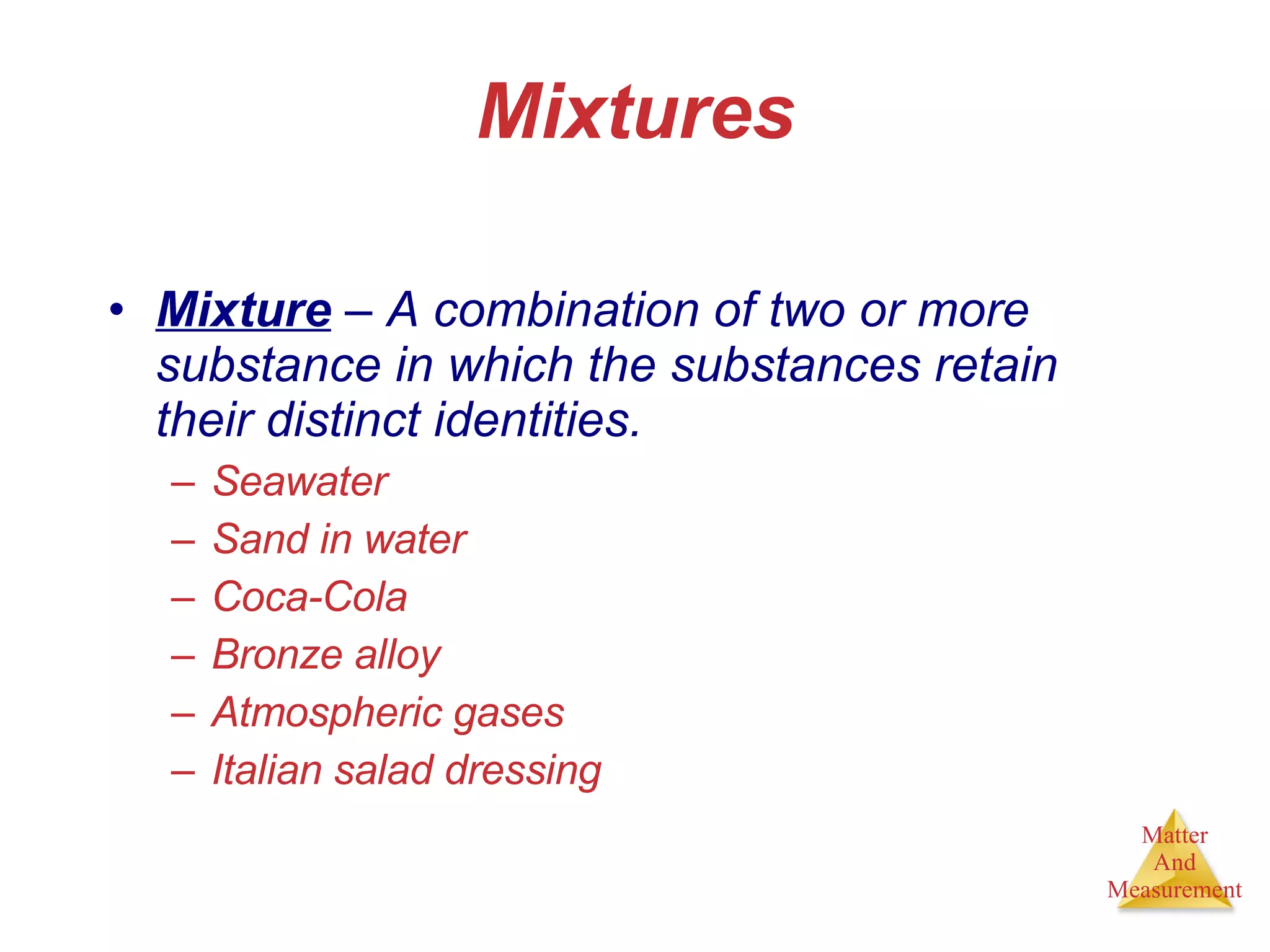
Mixtures Mixture  – A combination of two or more substance in which the substances retain their distinct identities. Seawater Sand in water Coca-Cola Bronze alloy Atmospheric gases Italian salad dressing
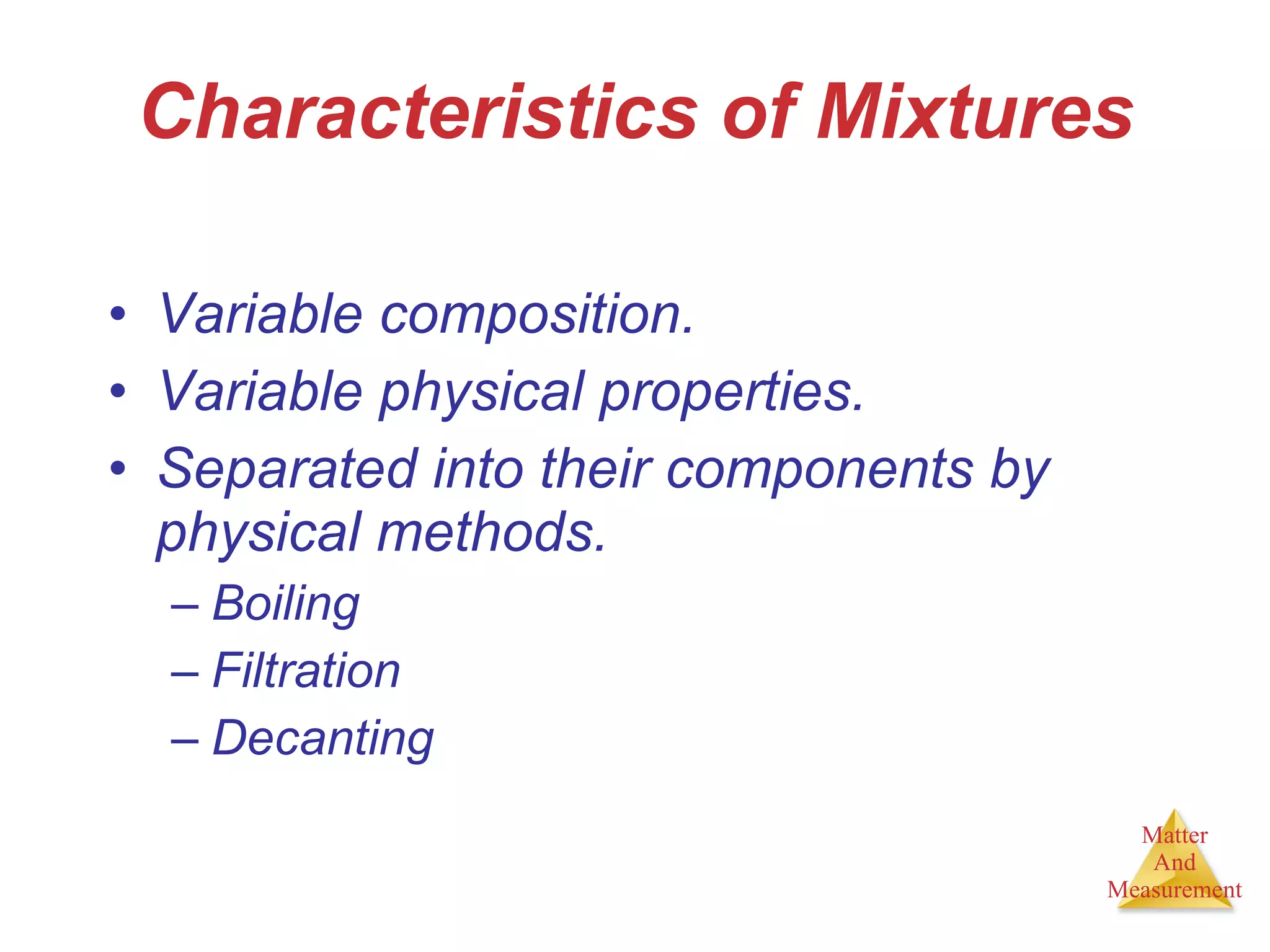
Characteristics of Mixtures Variable composition. Variable physical properties. Separated into their components by physical methods. Boiling Filtration Decanting
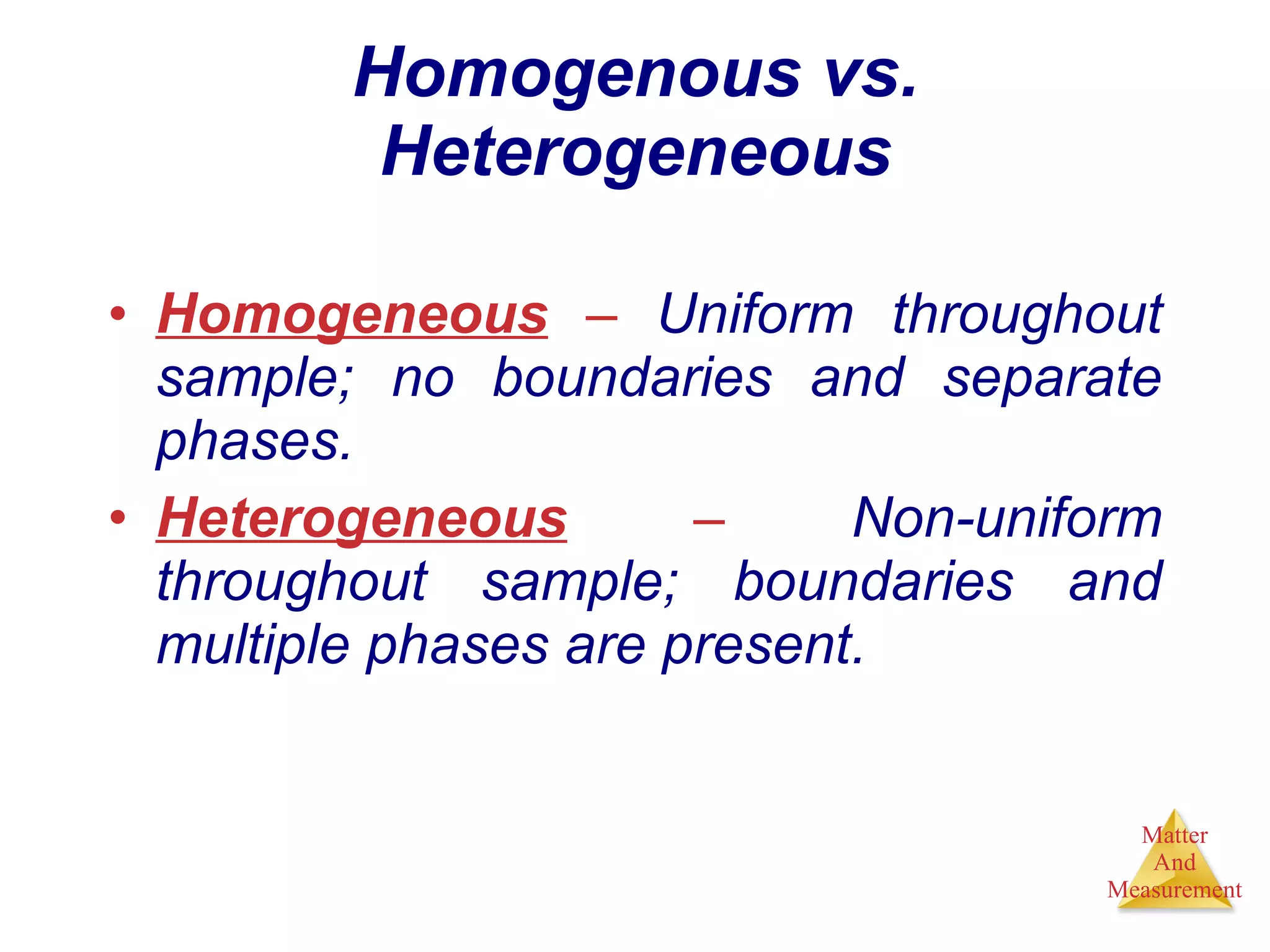
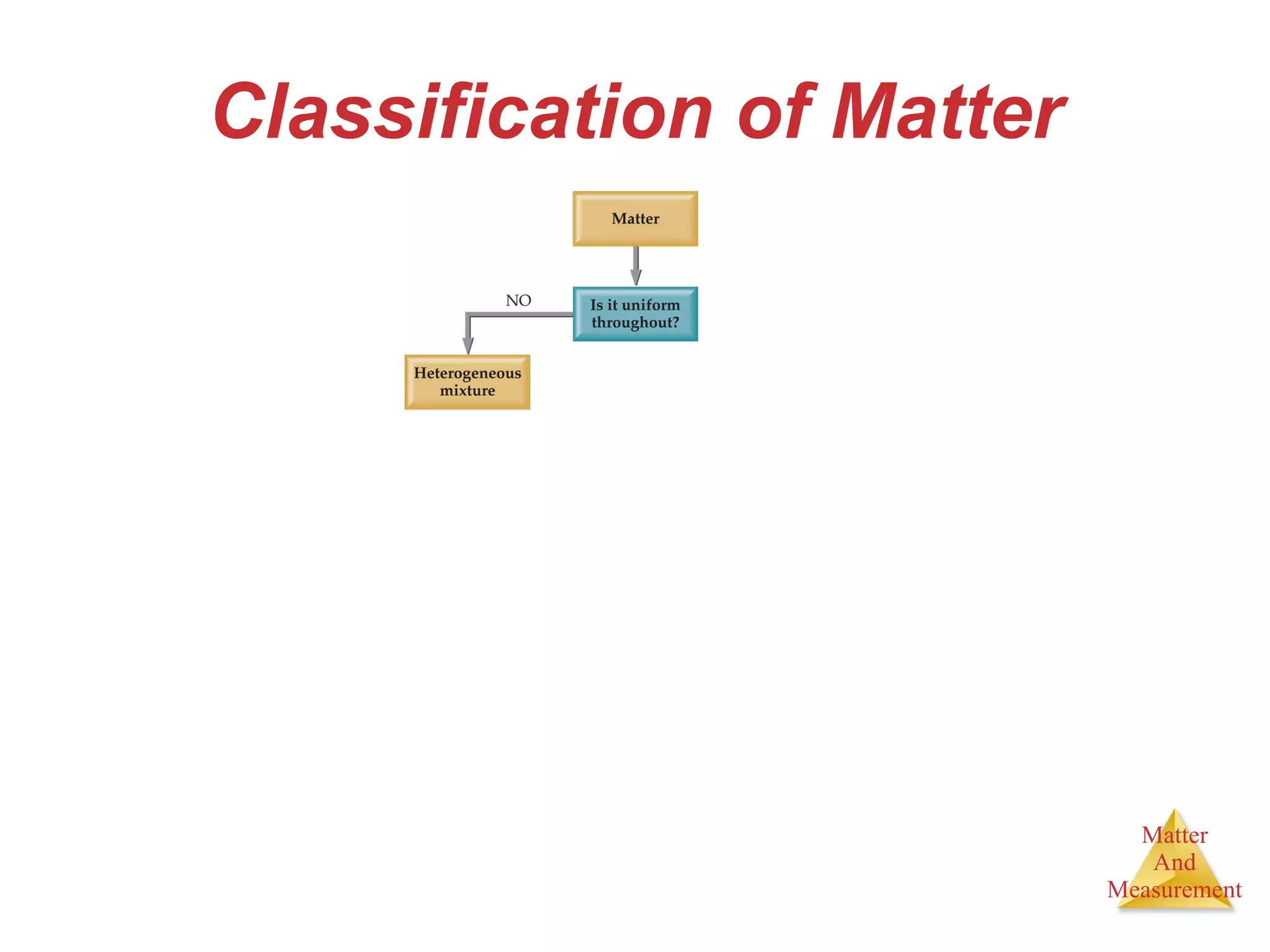
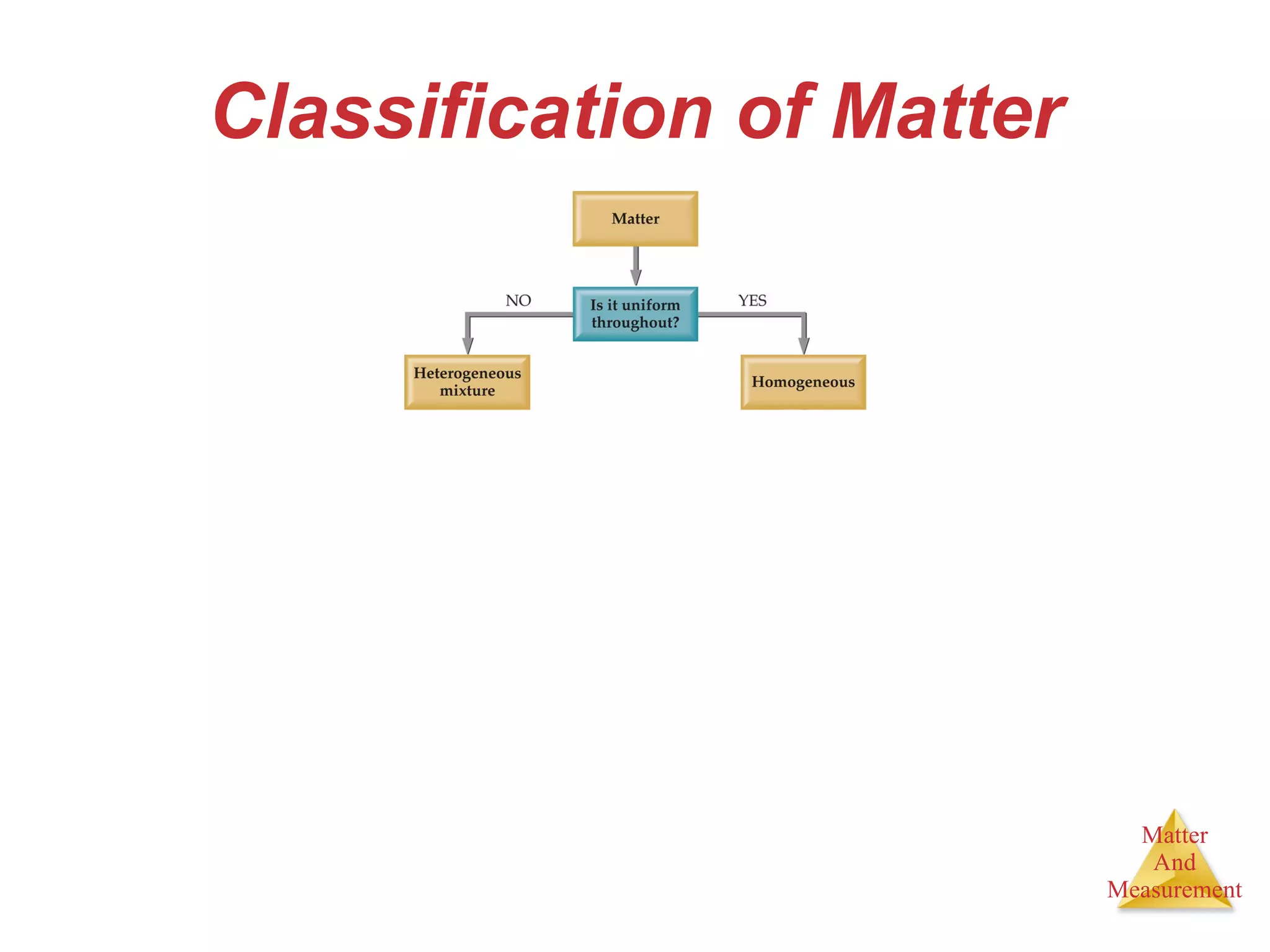
Homogenous vs. Heterogeneous Homogeneous  –  Uniform throughout sample; no boundaries and separate phases. Heterogeneous  –  Non-uniform throughout sample; boundaries and multiple phases are present.
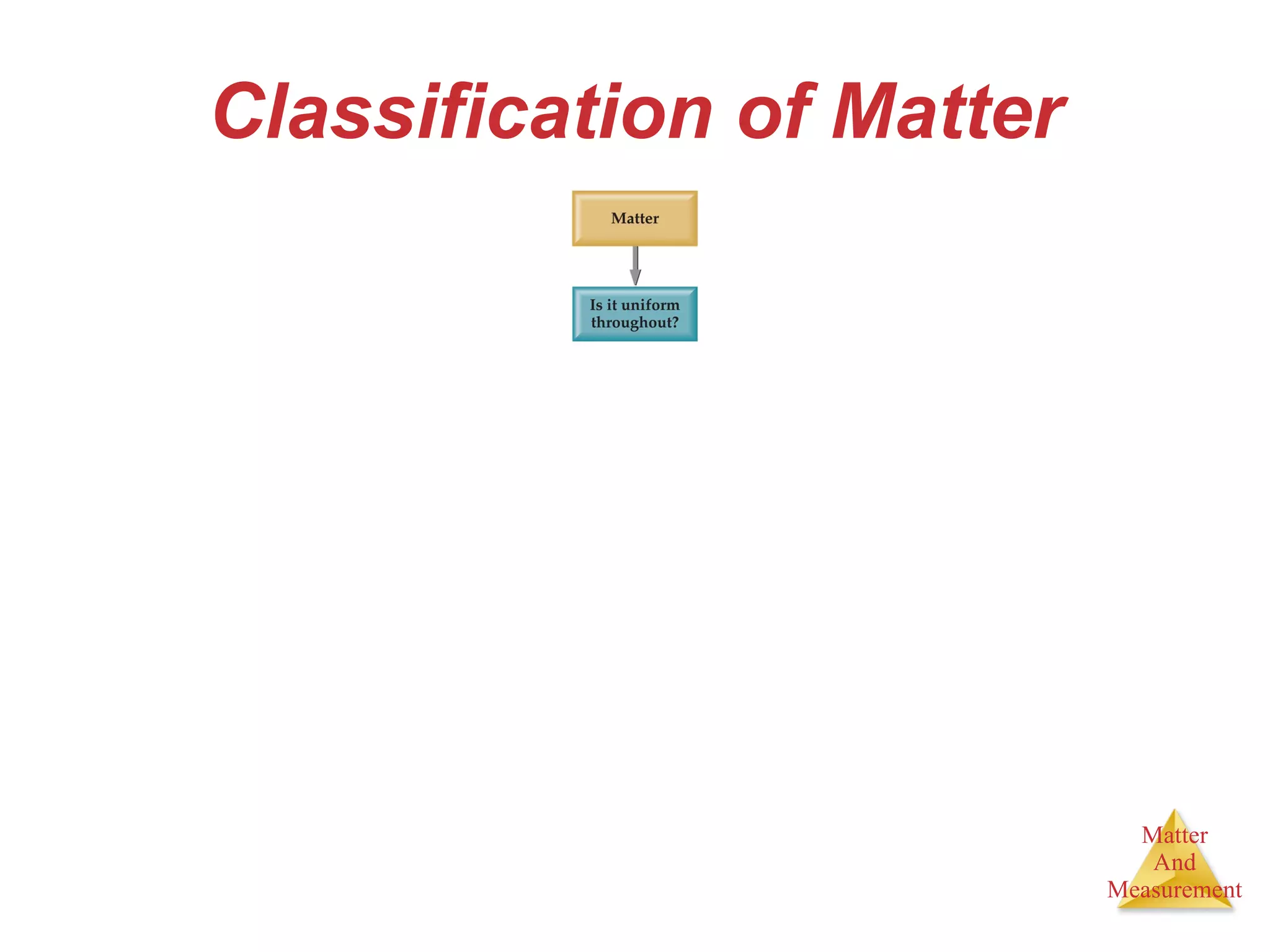
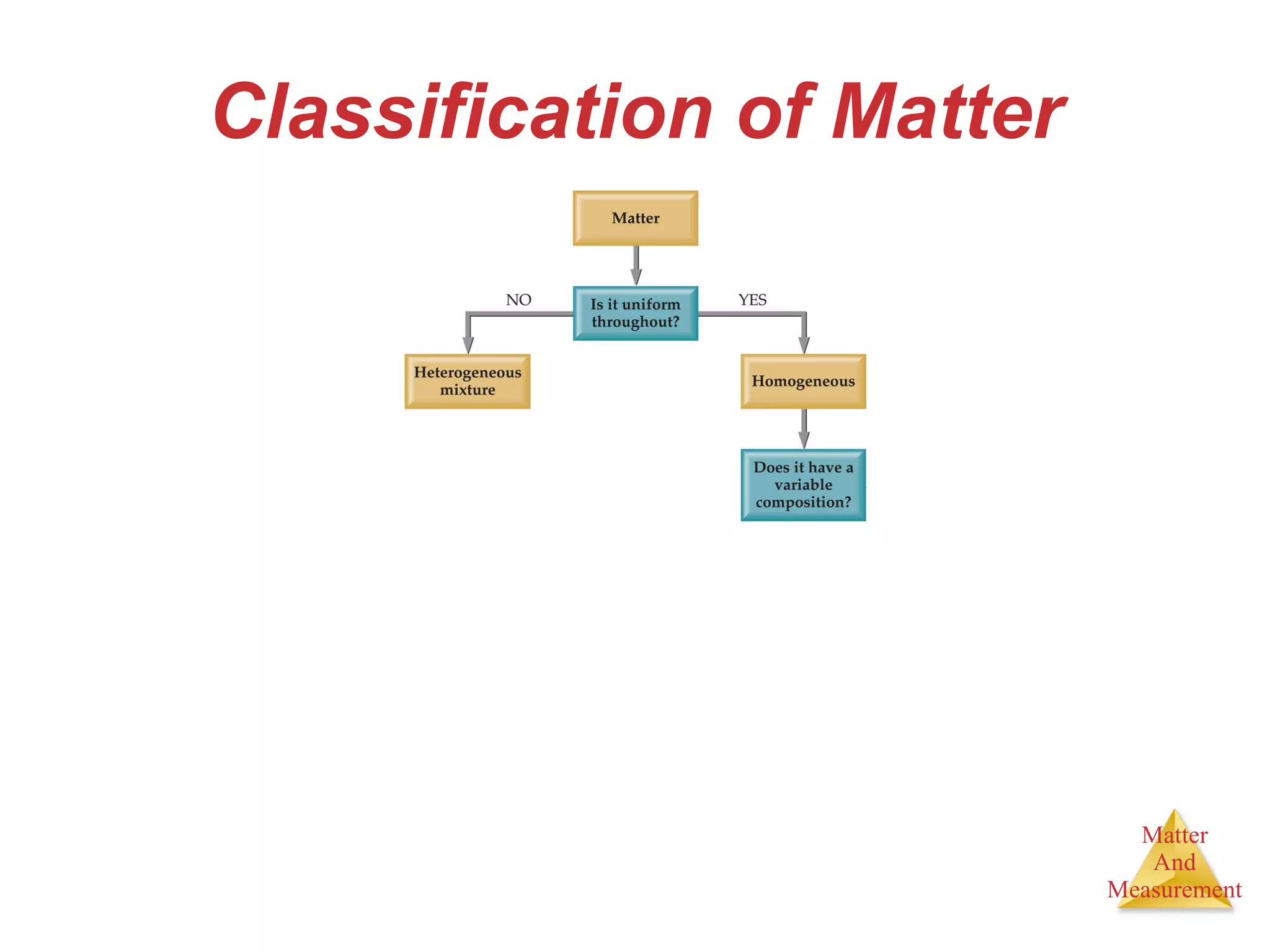
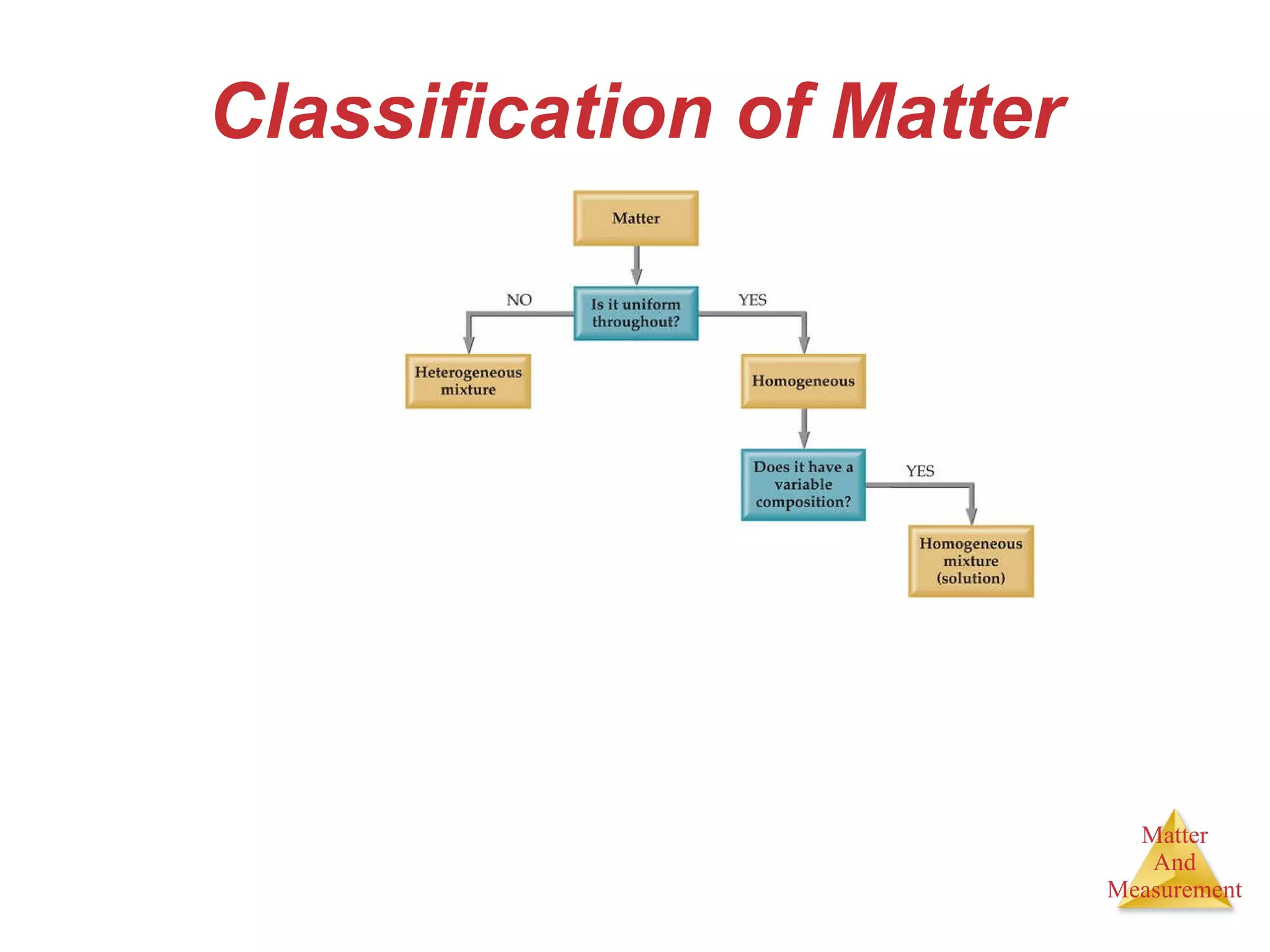
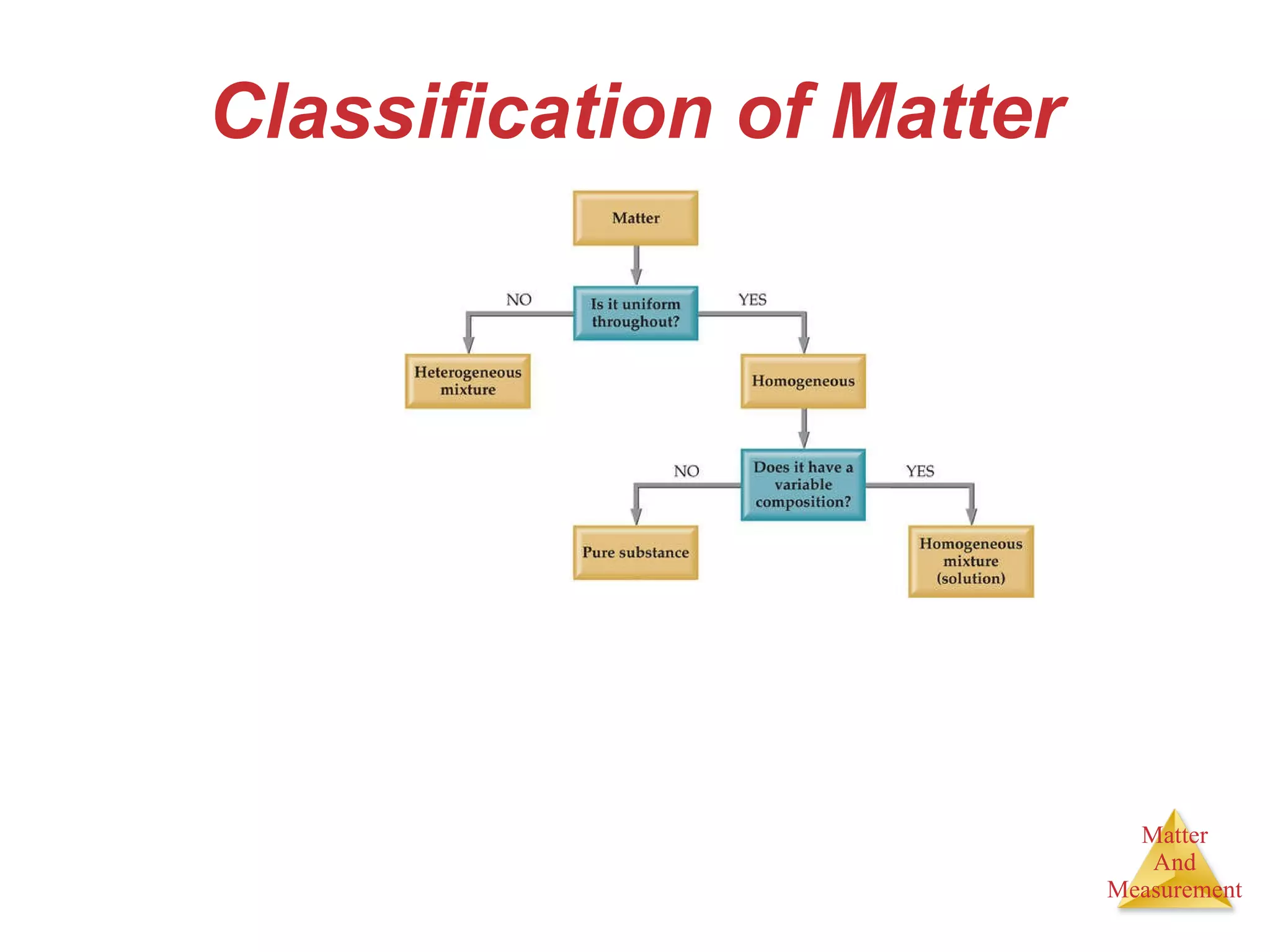
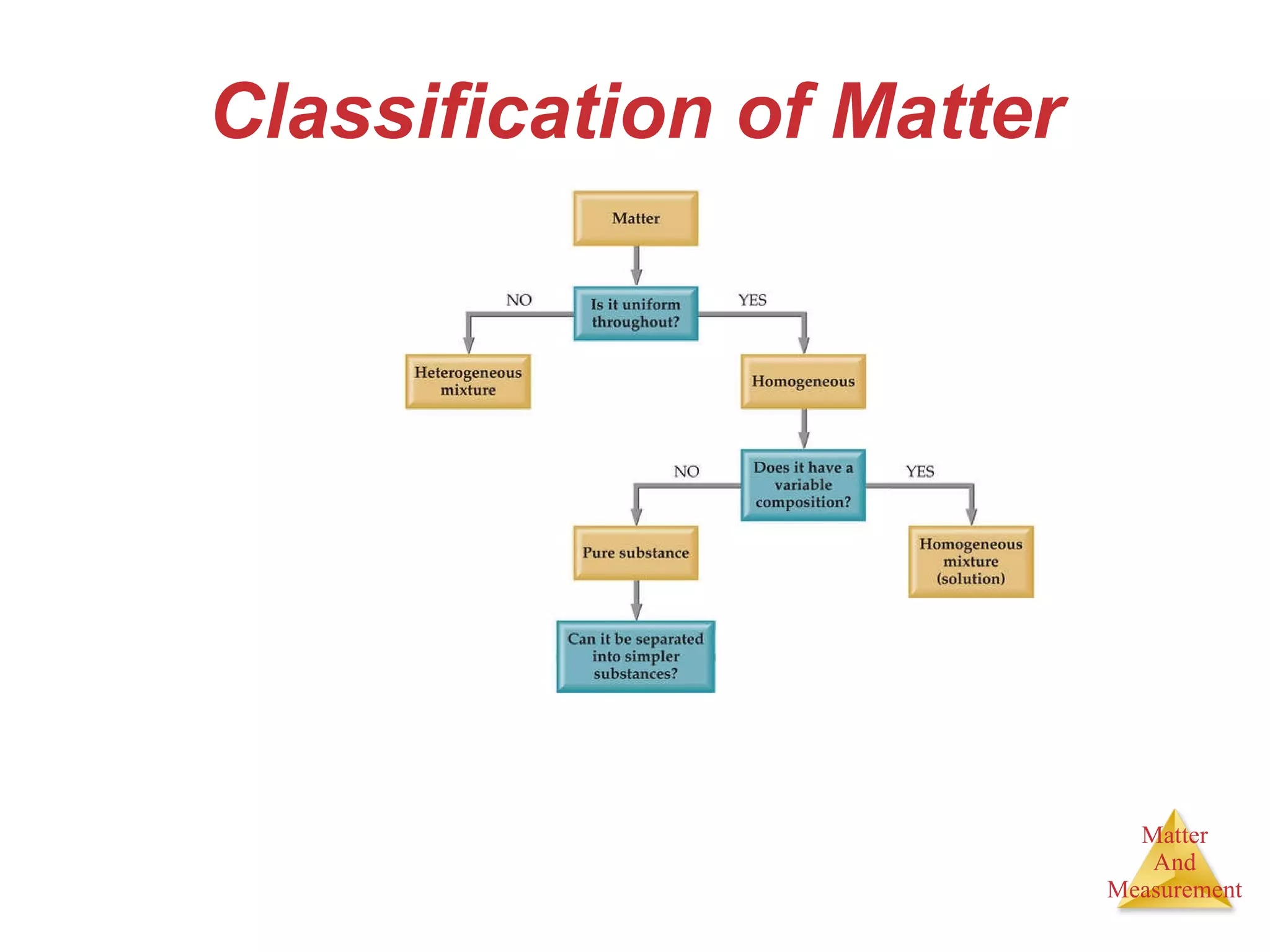
Classification of Matter
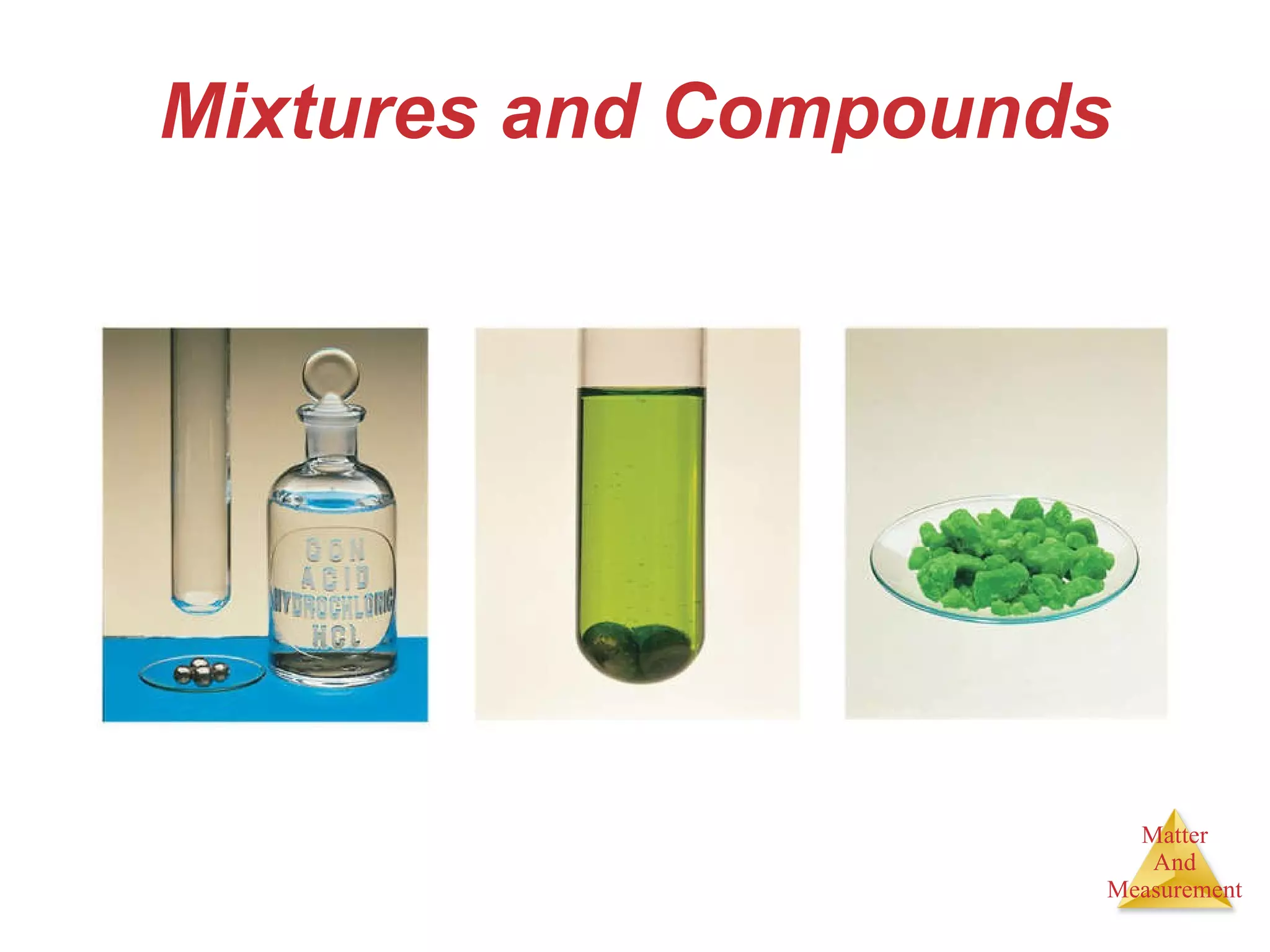
Mixtures and Compounds
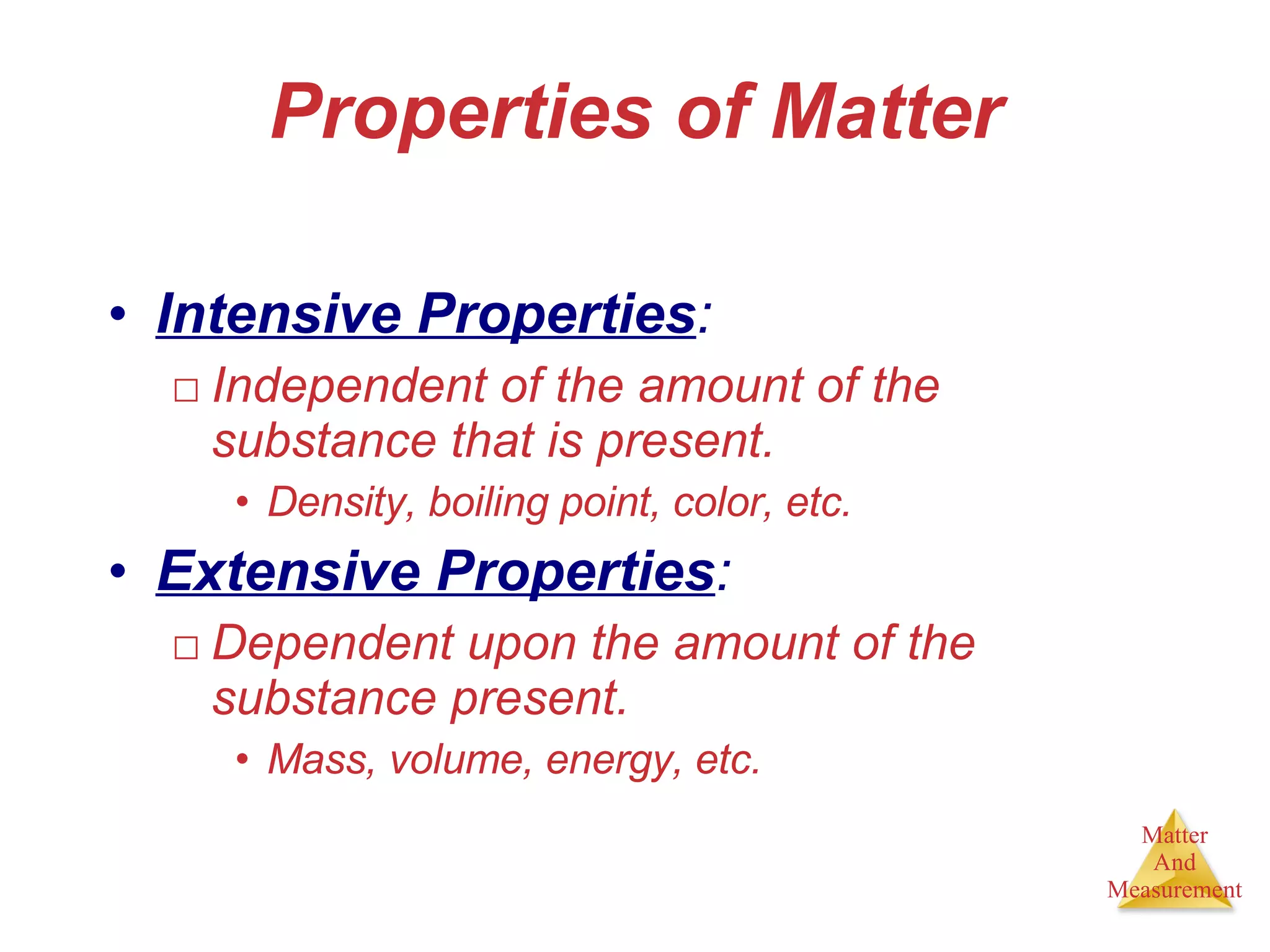
Properties of Matter Intensive Properties : Independent of the amount of the substance that is present. Density, boiling point, color, etc. Extensive Properties : Dependent upon the amount of the substance present. Mass, volume, energy, etc.
Properties of Matter Physical Properties Chemical Properties
Physical Properties Physical Properties: Can be observed without changing a substance into another substance. Physical state (gas, liquid, solid)  Mass Volume Color/Luster Hardness Boiling point  Melting point Density
Chemical Properties Chemical Properties : Can only be observed when a substance is changed into another substance. Flammability or combustibility  Corrosiveness Reactivity with acid, etc.
Changes of Matter Physical Changes : Changes in matter that do not change the composition of a substance. Changes of state, temperature, volume, etc. Freezing Boiling Melting Condensation Sublimation Dissolving sugar in water`
Chemical Changes Chemical Changes : A change in which one or more kinds of matter is transformed into a new kind of matter or several new kinds of matter.  Changes that result in  new substances . Chemical  composition is altered . Combustion  Oxidation  Decomposition etc.
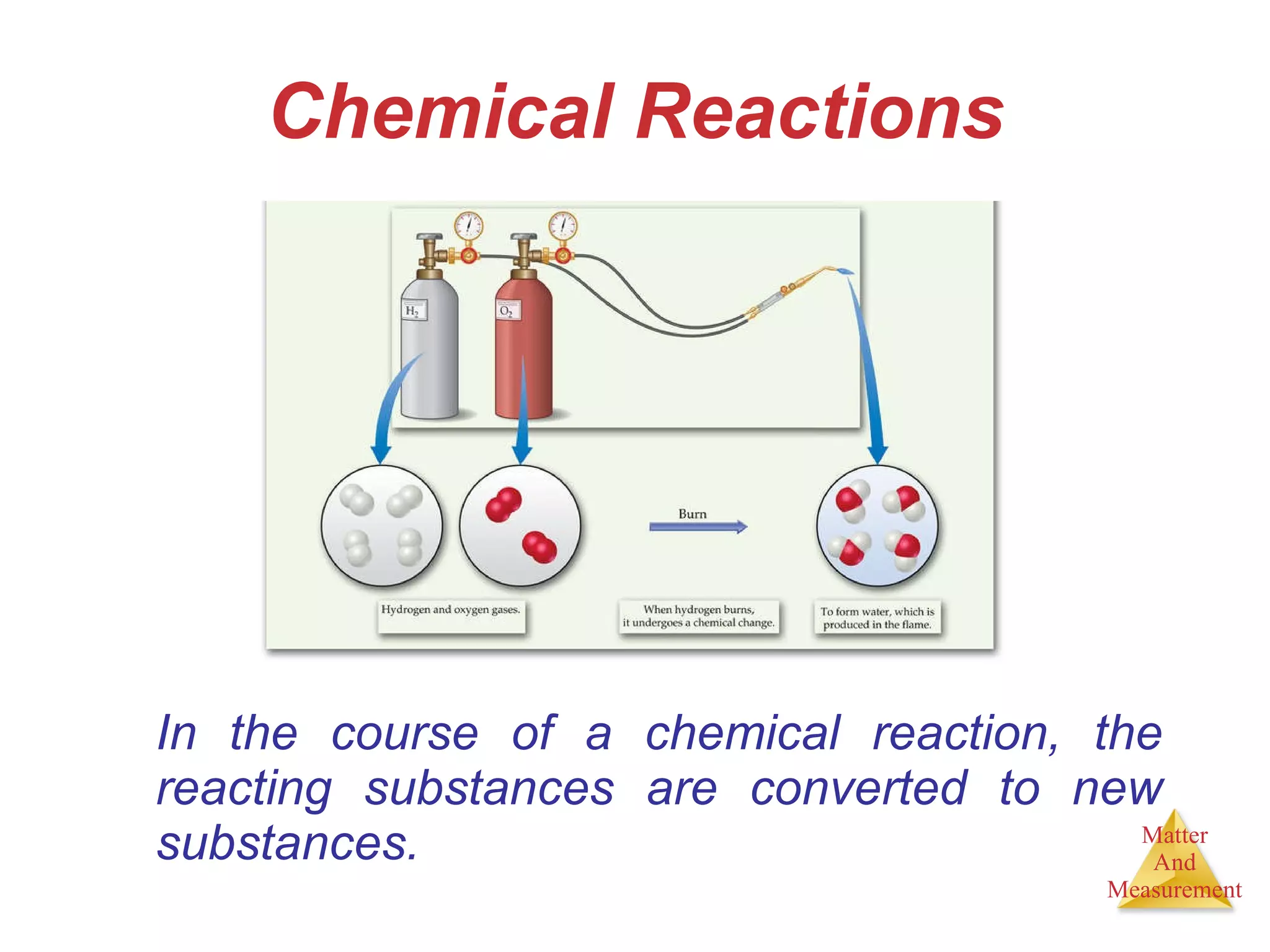
Chemical Reactions In the course of a chemical reaction, the reacting substances are converted to new substances.
Chemical Reactions
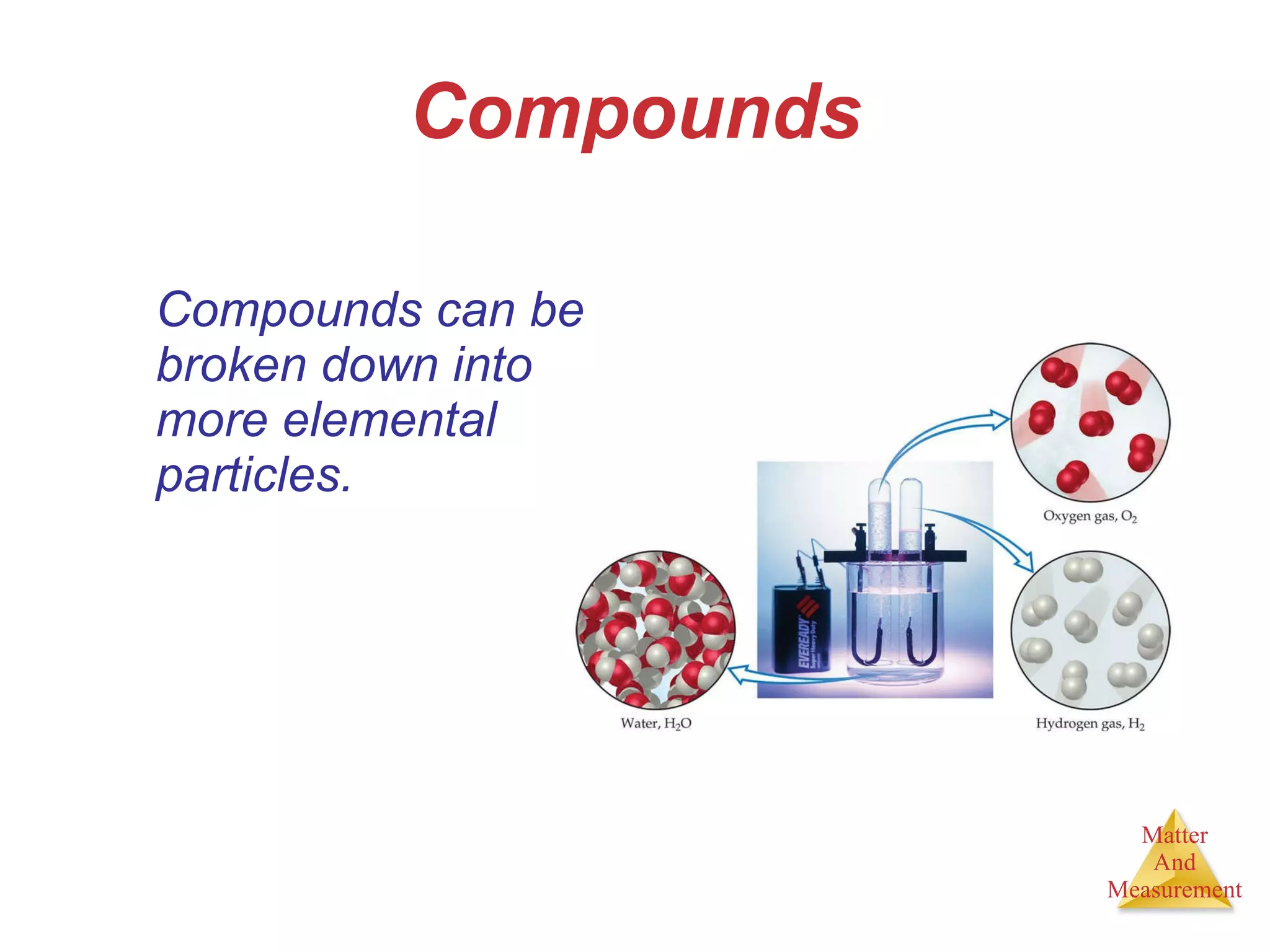
Compounds Compounds can be broken down into more elemental particles.
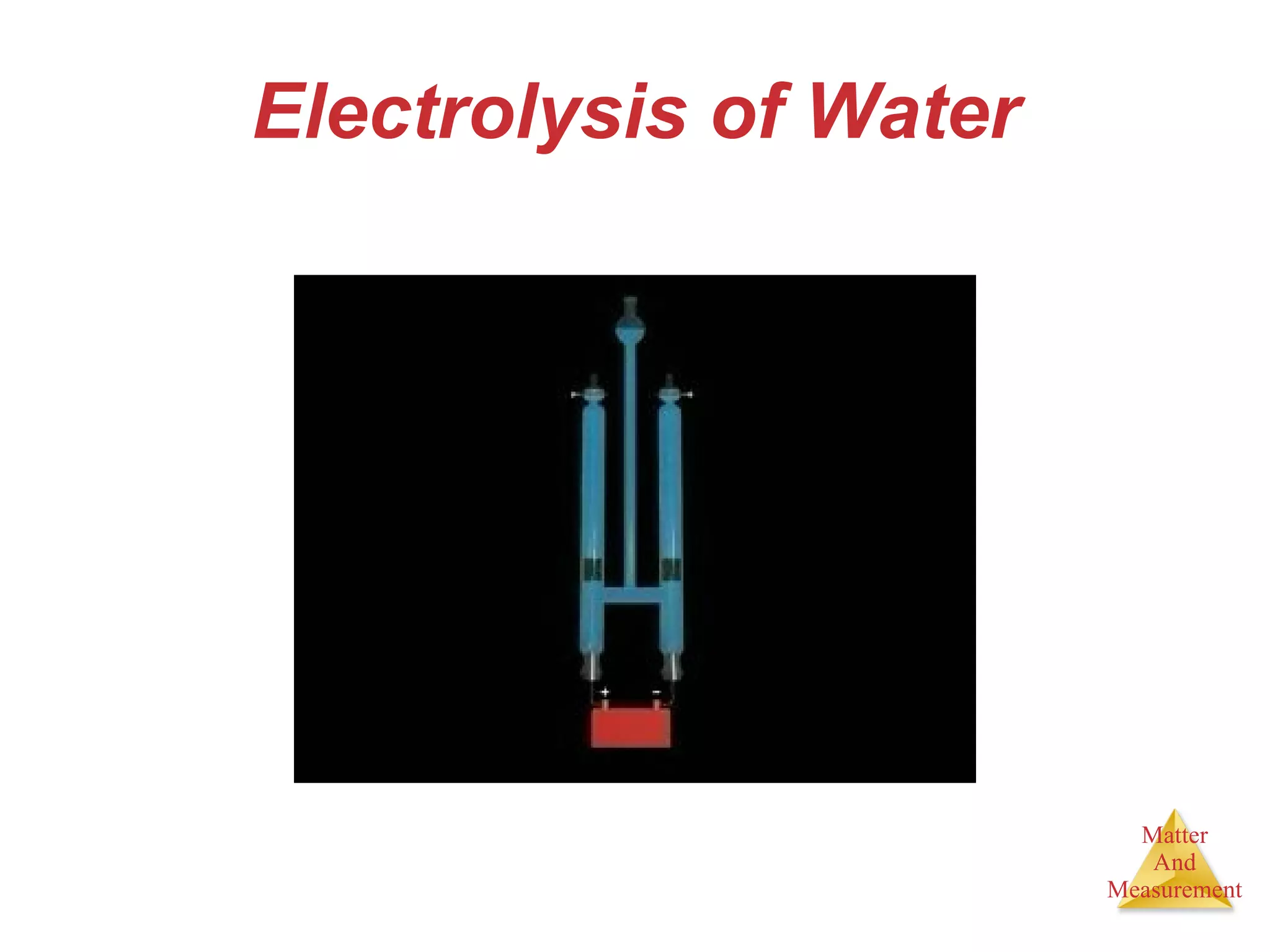
Electrolysis of Water
Example of Chemical Change Magnesium metal combusts to produce the white ash, magnesium oxide. 2 Mg(s)  +  O 2 (g)  ->  2 MgO(s)
Example of Chemical Change Sodium reacts vigorously with water to produce hydrogen gas and an aqueous solution of sodium hydroxide. 2 Na(s)  +  2 H 2 O(l)  ->  H 2 (g)  +  2 NaOH(aq)
Separation of Mixtures
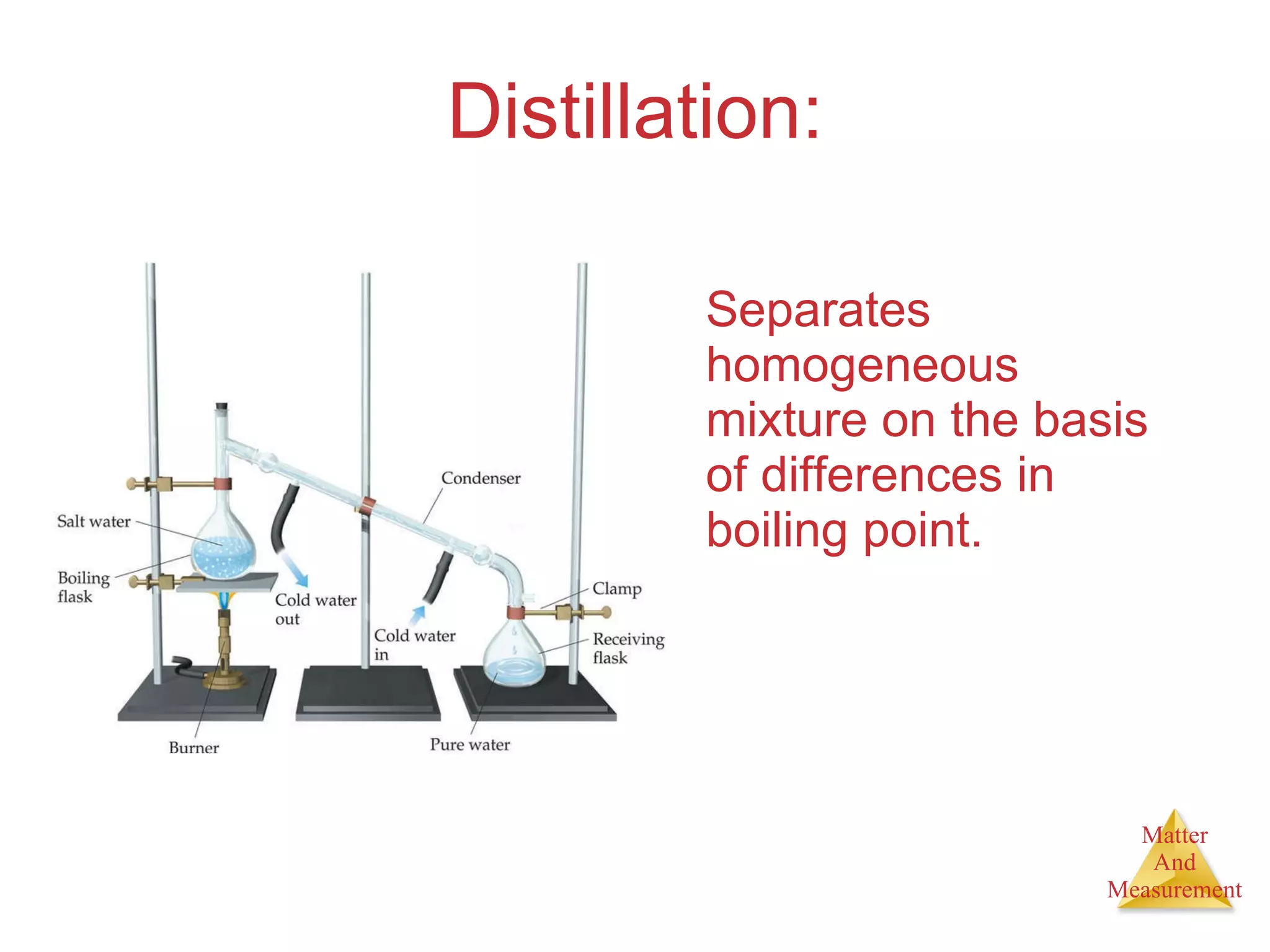
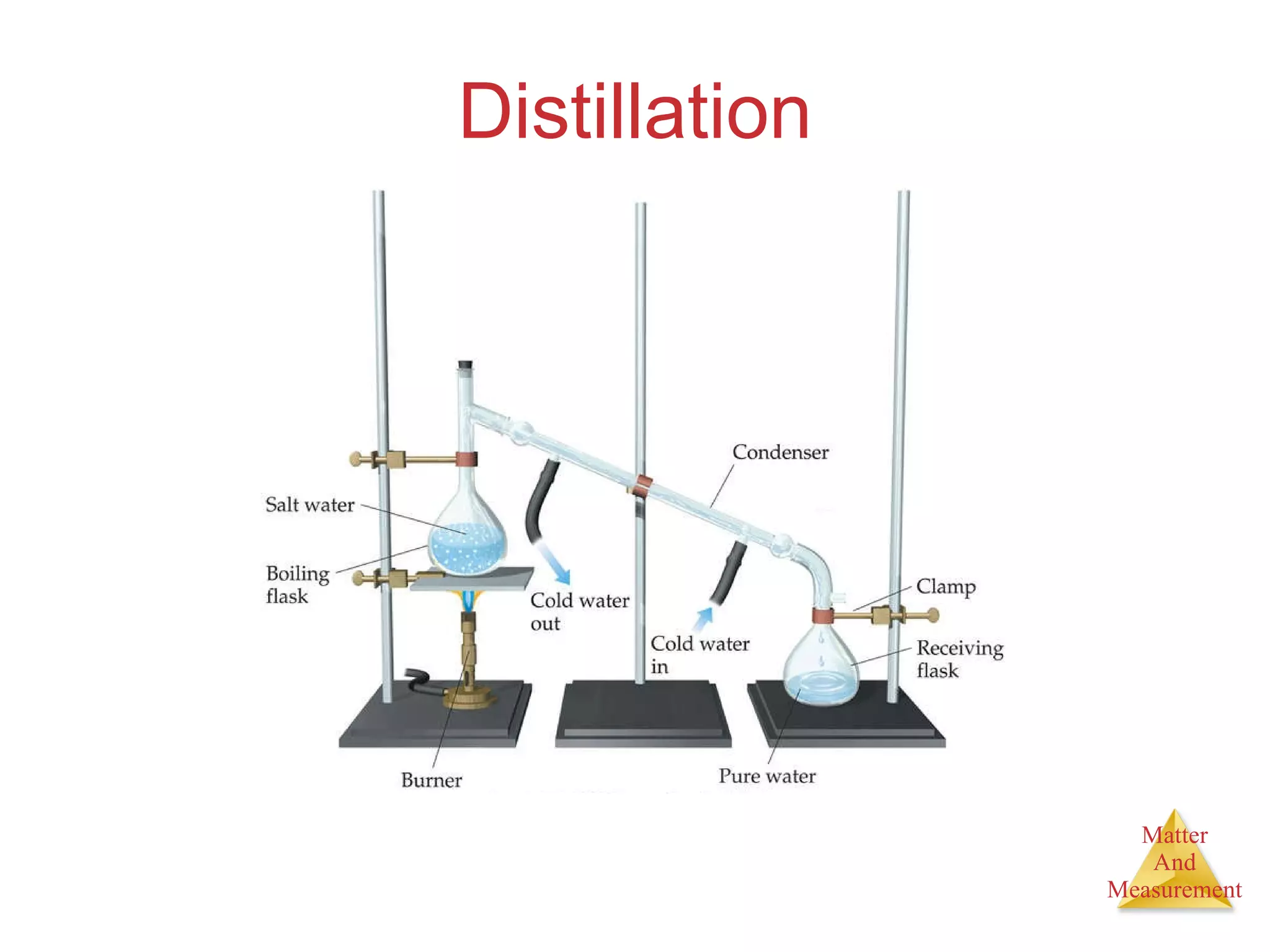
Distillation: Separates homogeneous mixture on the basis of differences in boiling point.
Distillation
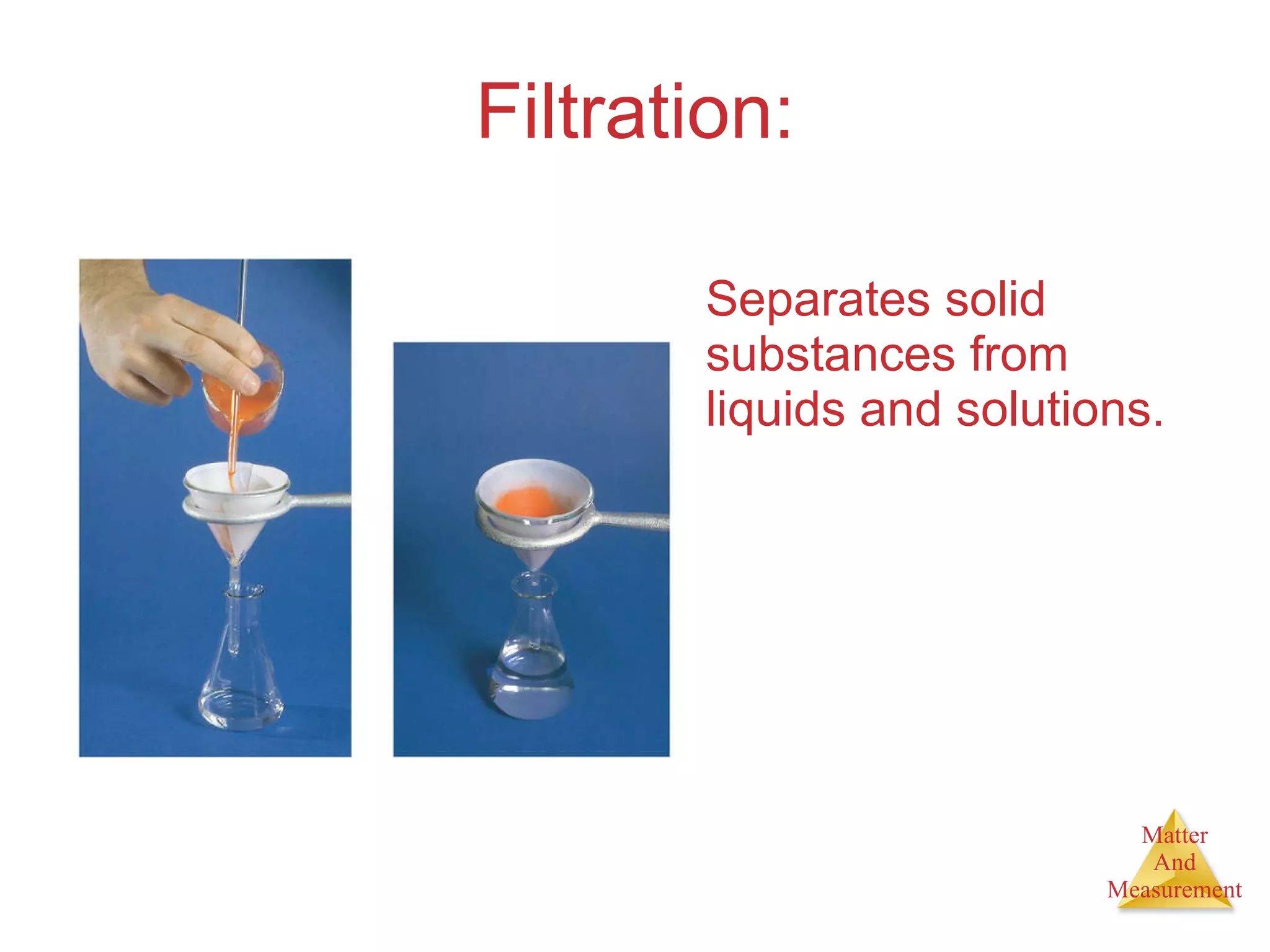
Filtration: Separates solid substances from liquids and solutions.
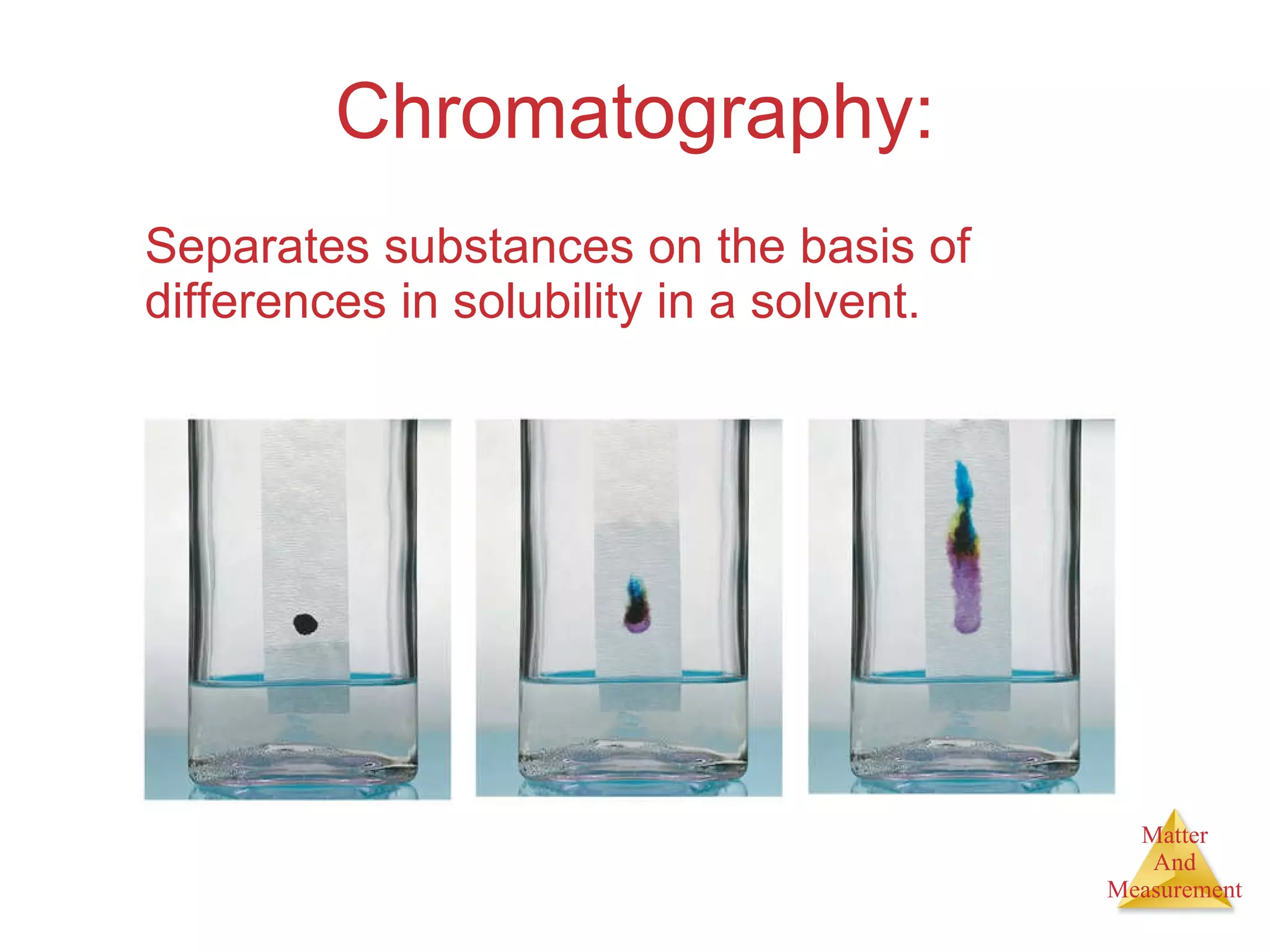
Chromatography: Separates substances on the basis of differences in solubility in a solvent.
Measurements Numerical Value Uncertainty Units
Significant Figures When physical quantities are used in arithmetic, it is important that the number of digits reported represents the uncertainty in the original measurements.
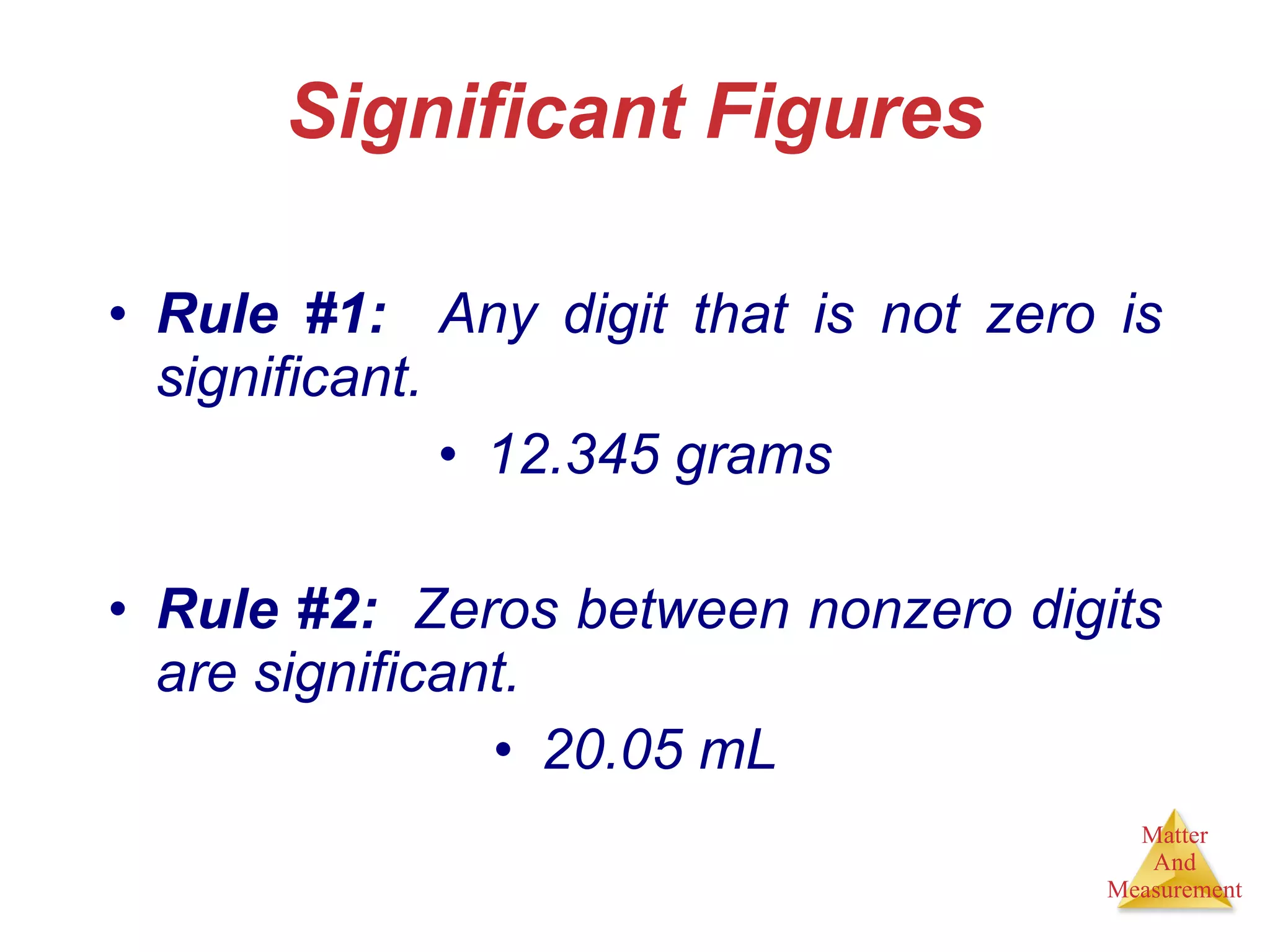
Significant Figures Rule #1:   Any digit that is not zero is significant. 12.345 grams Rule #2:   Zeros between nonzero digits are significant. 20.05 mL
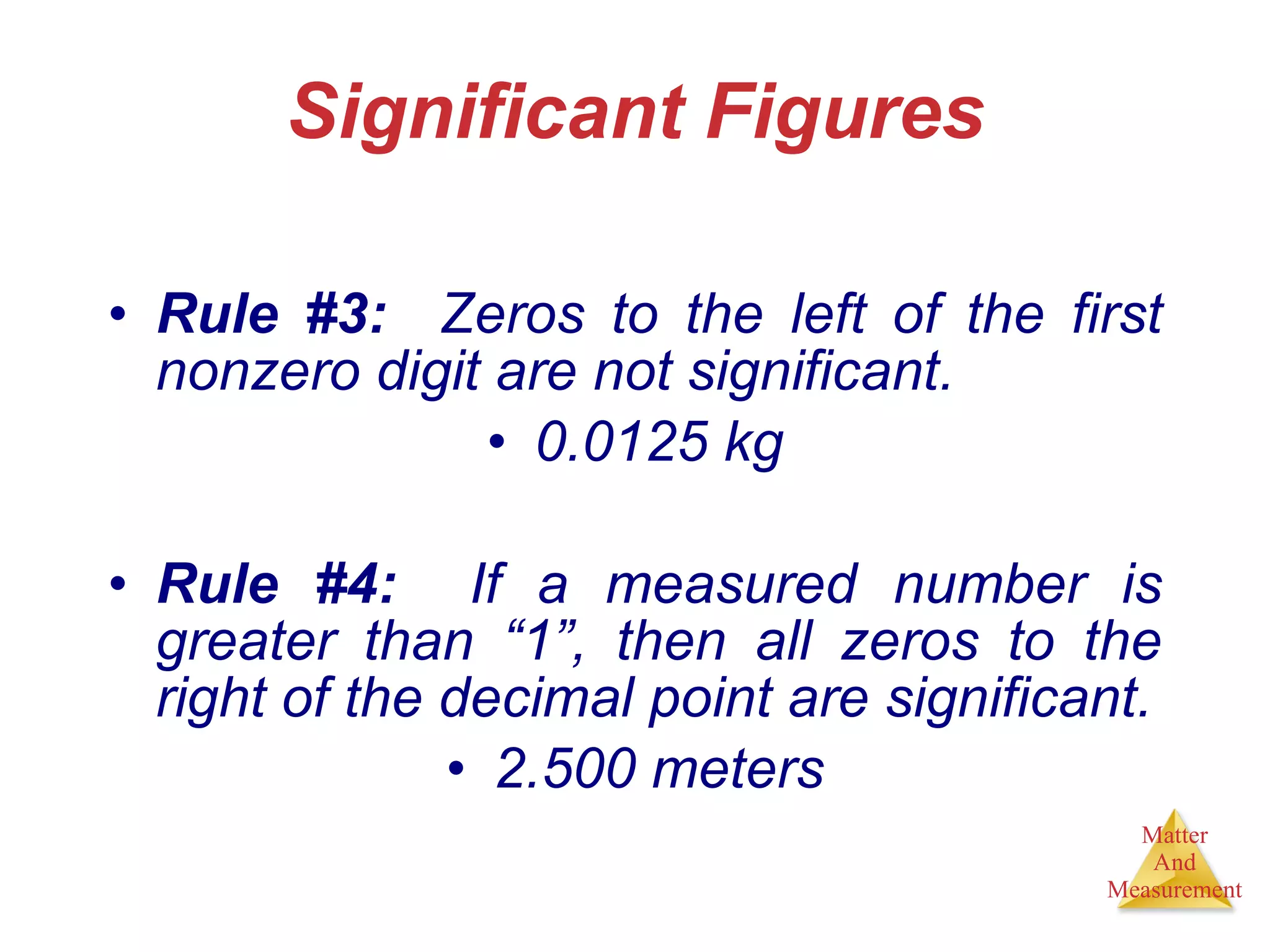
Significant Figures Rule #3:   Zeros to the left of the first nonzero digit are not significant. 0.0125 kg Rule #4:   If a measured number is greater than “1”, then all zeros to the right of the decimal point are significant. 2.500 meters
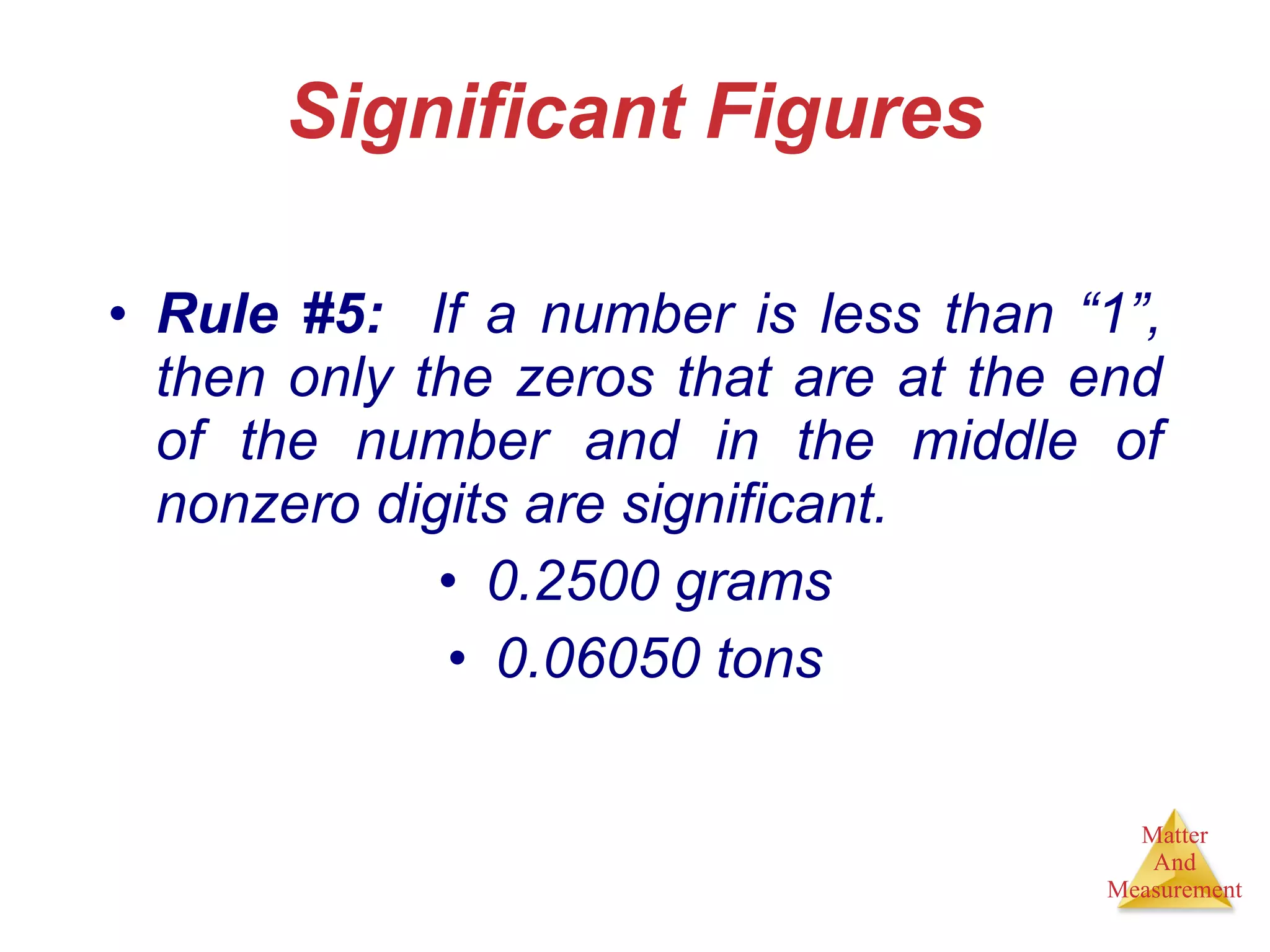
Significant Figures Rule #5:   If a number is less than “1”, then only the zeros that are at the end of the number and in the middle of nonzero digits are significant. 0.2500 grams 0.06050 tons
Significant Figures The term  significant figures  refers to digits that were measured. When rounding calculated numbers, we pay attention to significant figures so we do not overstate the accuracy of our answers.
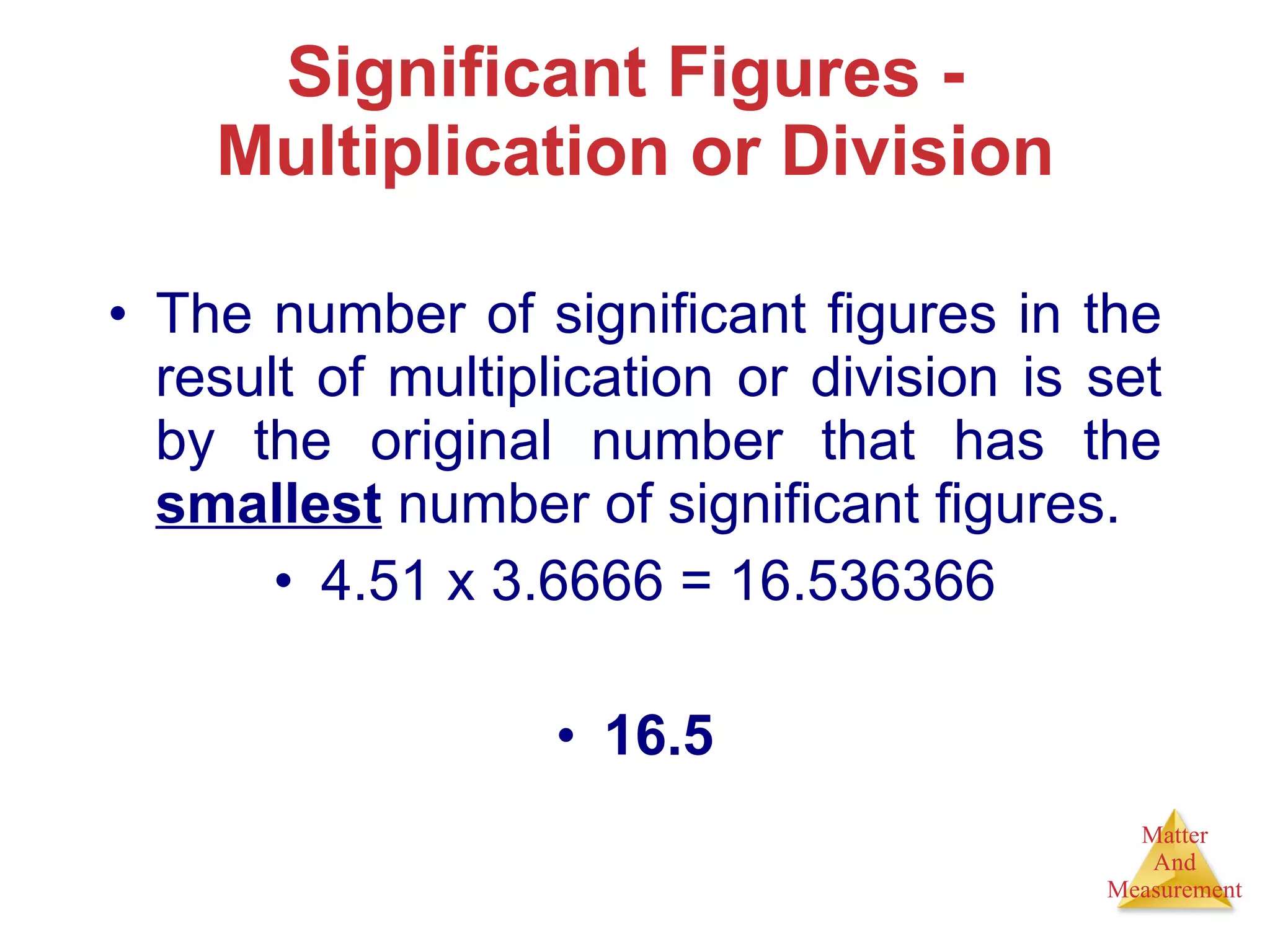
Significant Figures -  Multiplication or Division The number of significant figures in the result of multiplication or division is set by the original number that has the  smallest  number of significant figures. 4.51 x 3.6666 = 16.536366 16.5
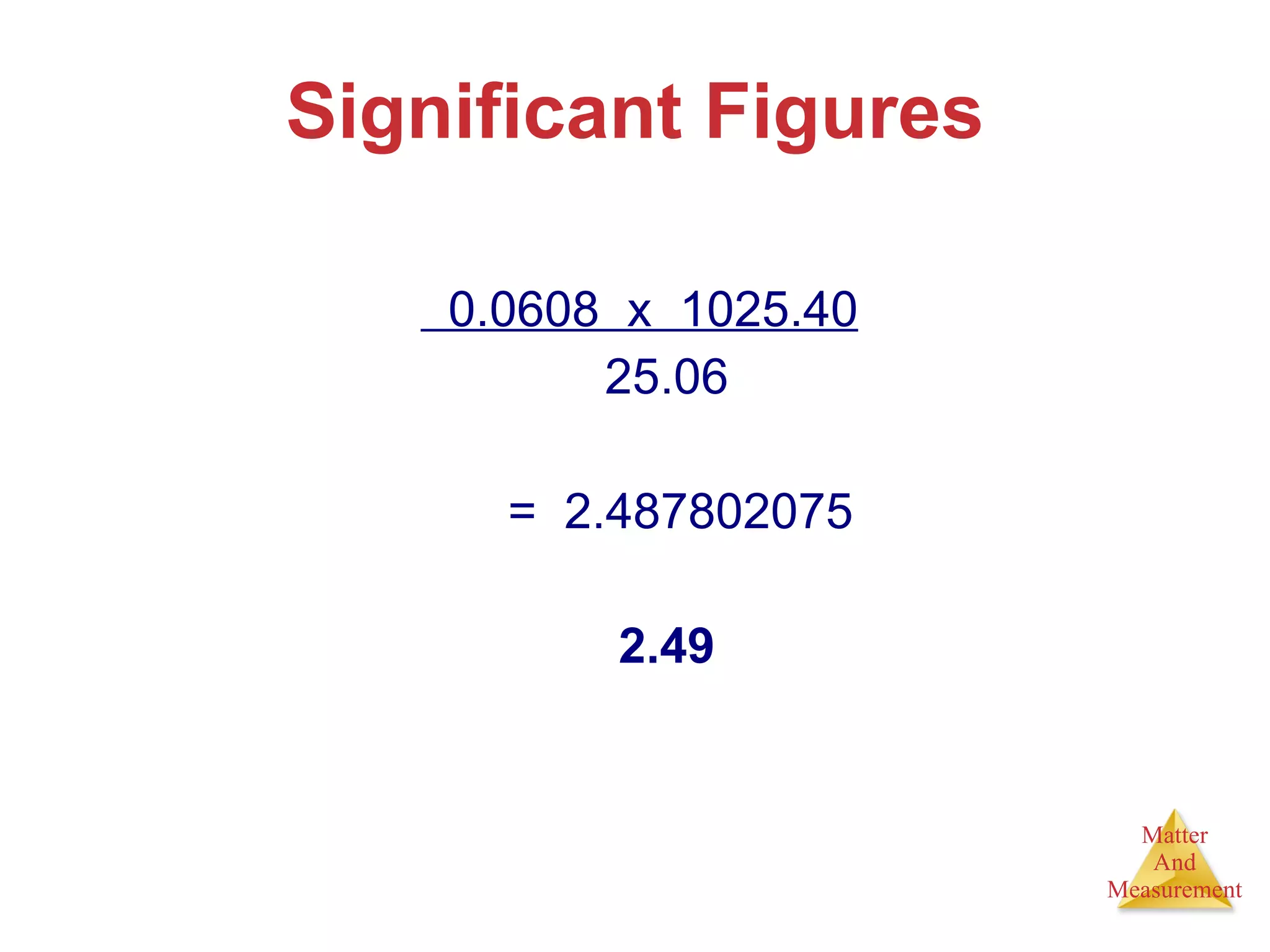
Significant Figures   0.0608  x  1025.40 25.06 =  2.487802075 2.49
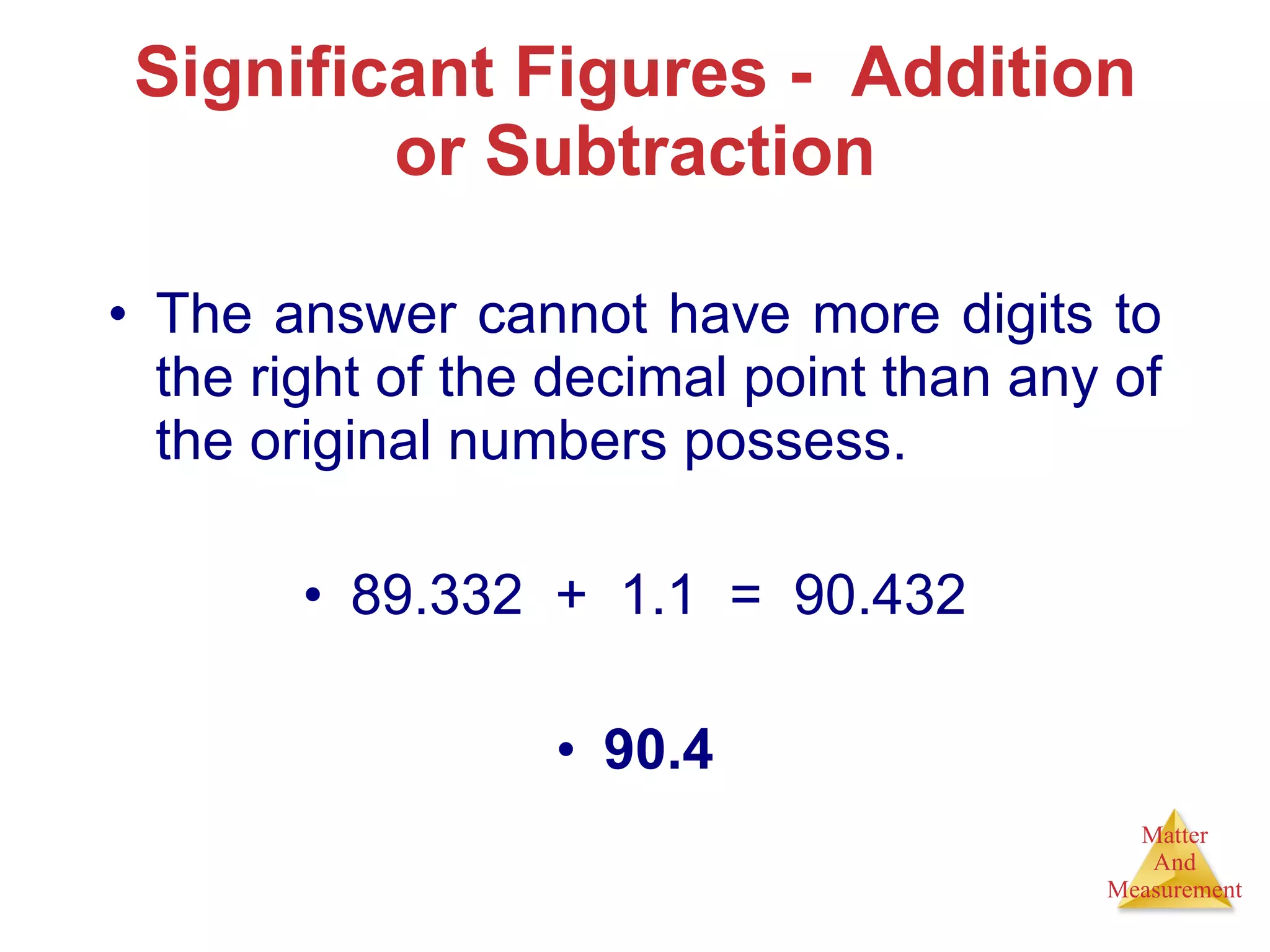
Significant Figures -  Addition or Subtraction The answer cannot have more digits to the right of the decimal point than any of the original numbers possess. 89.332  +  1.1  =  90.432 90.4
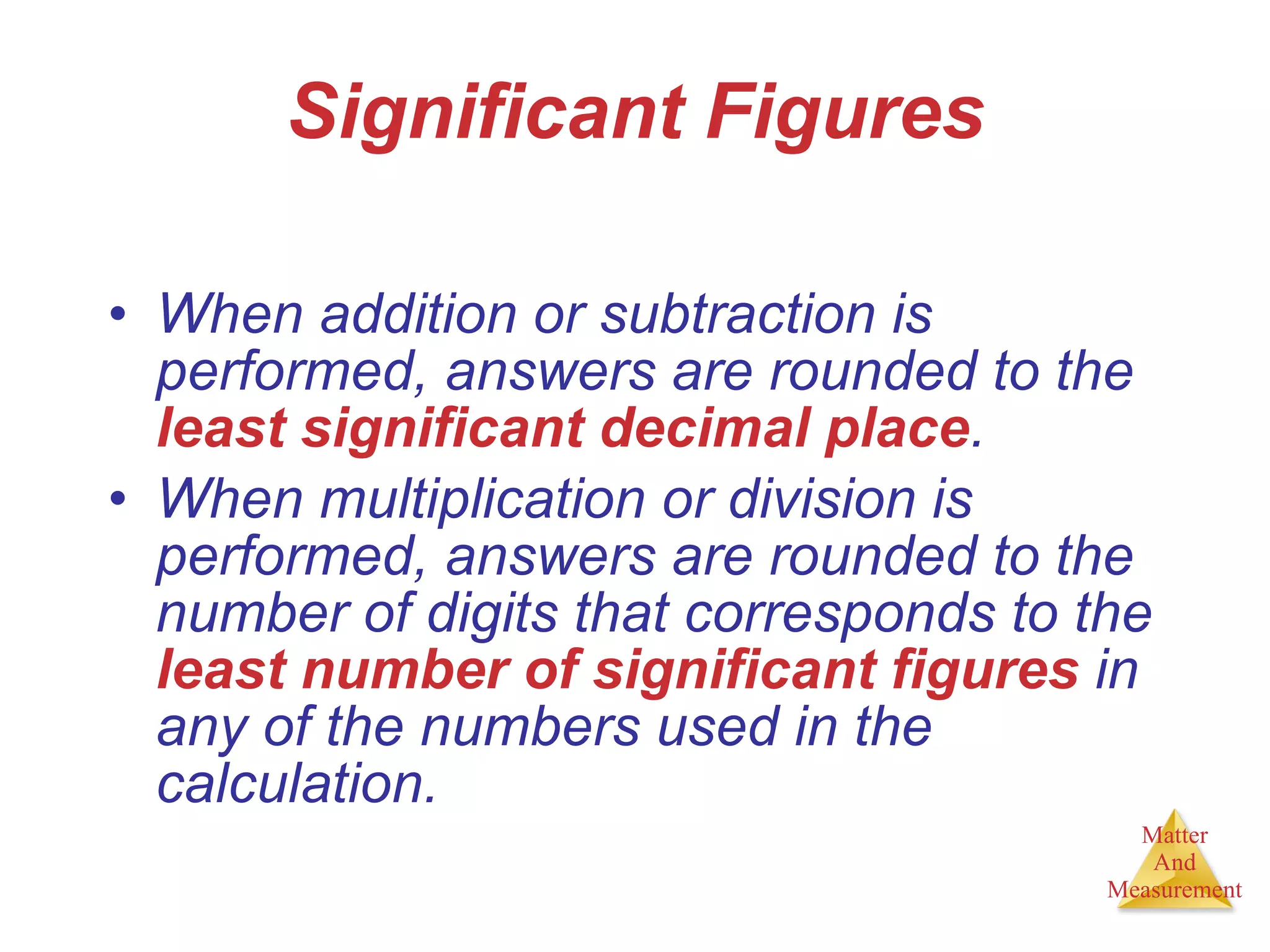
Significant Figures When addition or subtraction is performed, answers are rounded to the  least significant decimal place . When multiplication or division is performed, answers are rounded to the number of digits that corresponds to the  least number of significant figures  in any of the numbers used in the calculation.
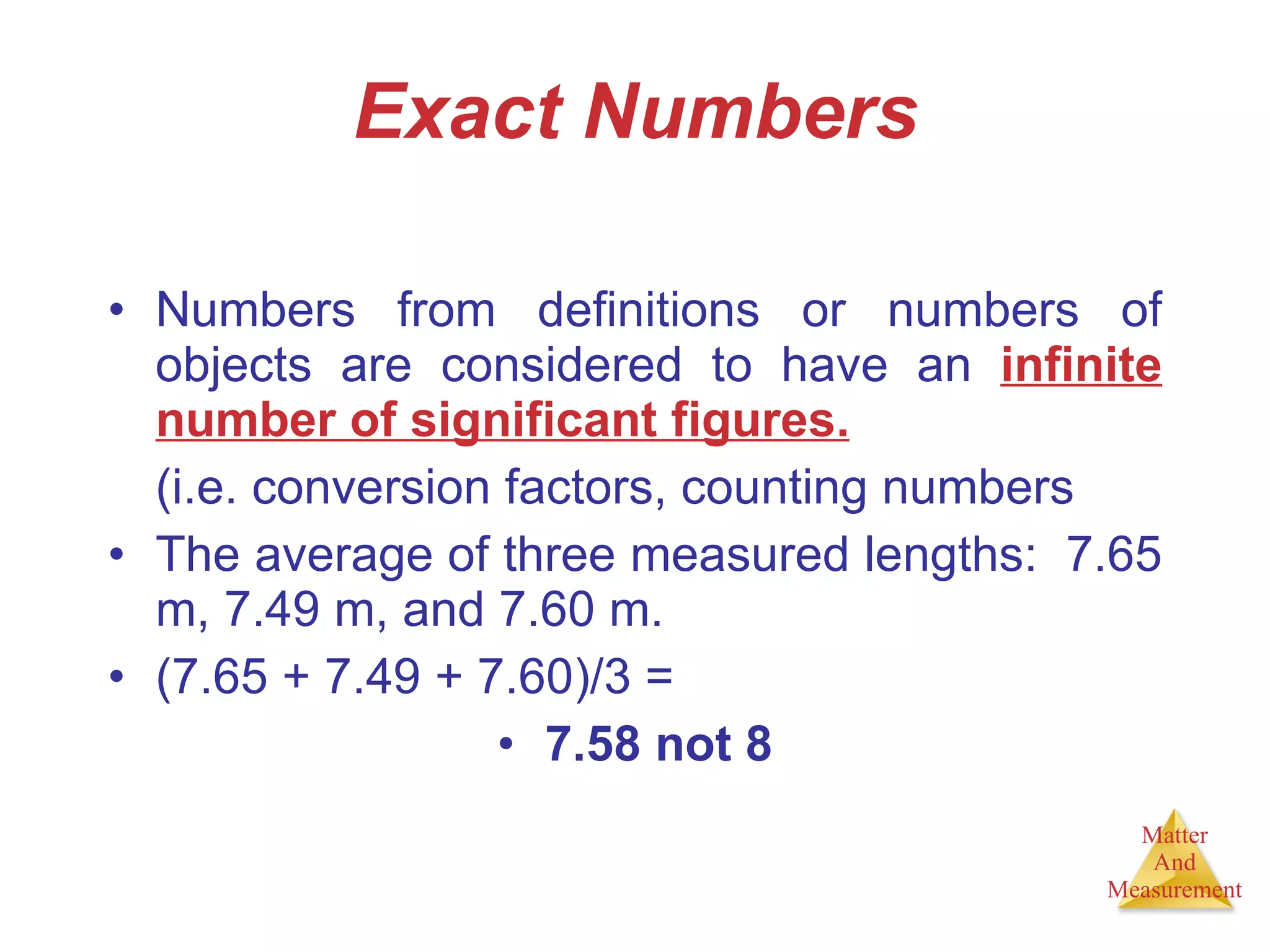
Exact Numbers Numbers from definitions or numbers of objects are considered to have an  infinite number of significant figures. (i.e. conversion factors, counting numbers The average of three measured lengths:  7.65 m, 7.49 m, and 7.60 m. (7.65 + 7.49 + 7.60)/3 =  7.58 not 8
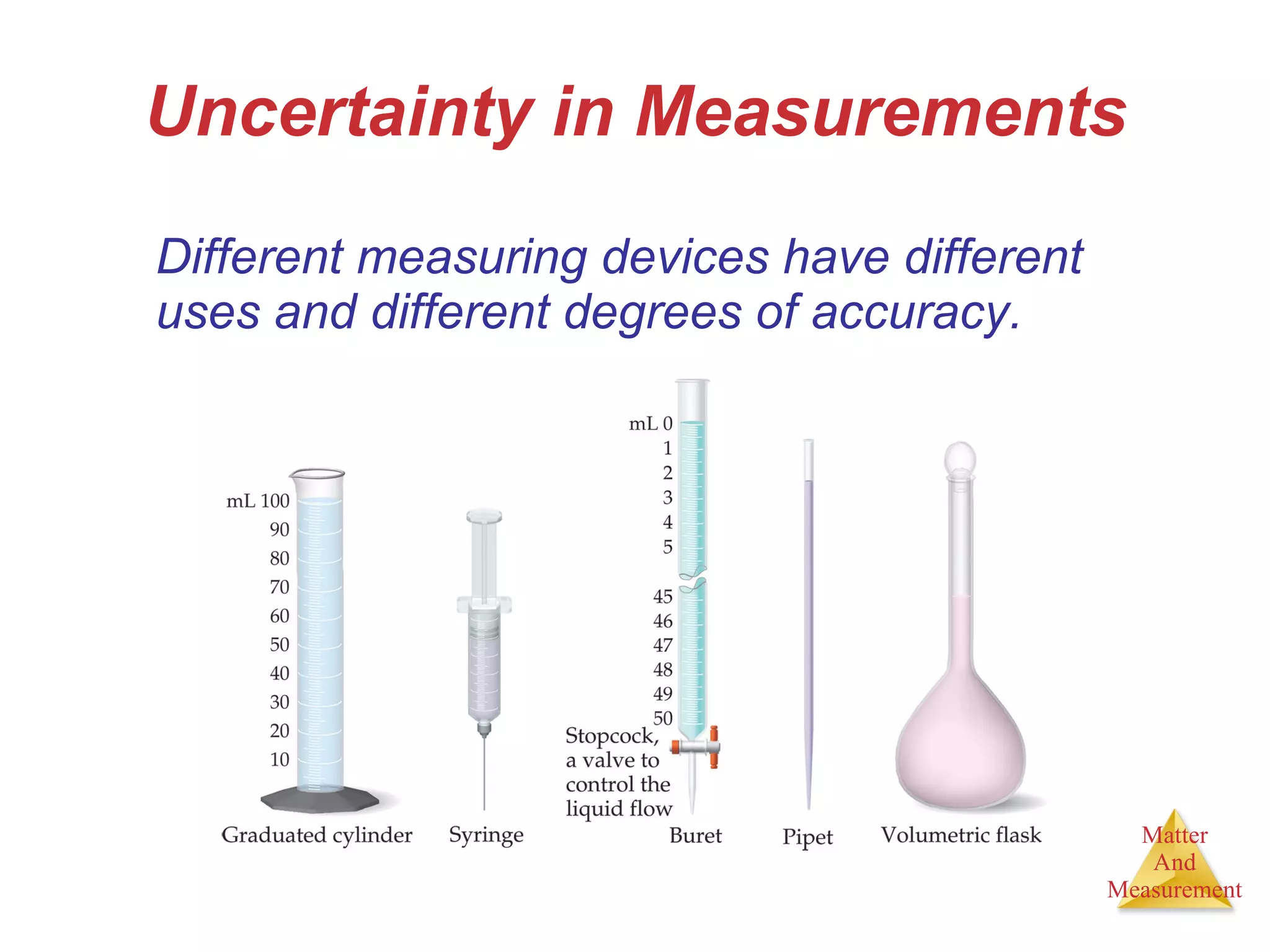
Uncertainty in Measurements Different measuring devices have different uses and different degrees of accuracy.
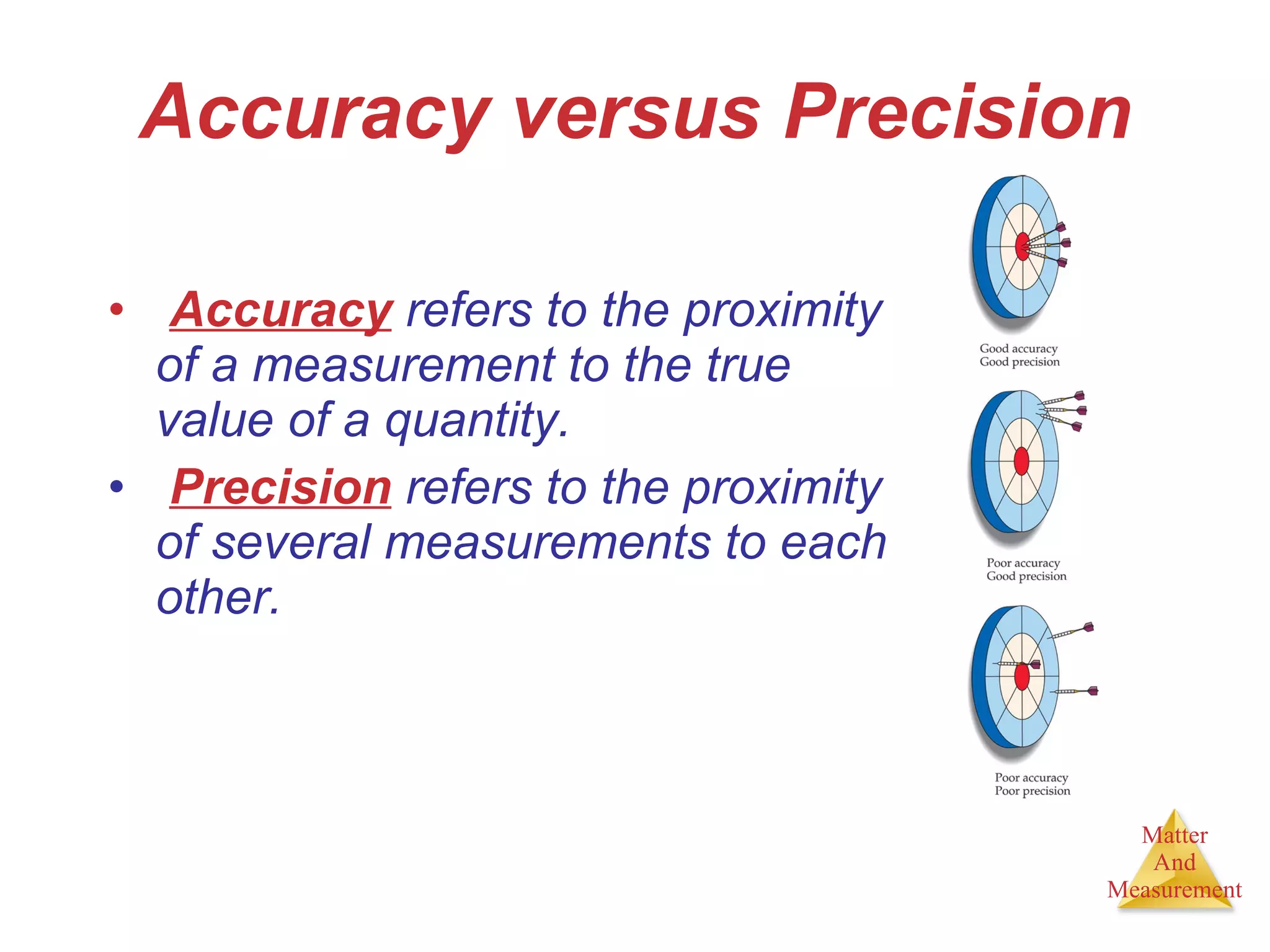
Accuracy versus Precision Accuracy  refers to the proximity of a measurement to the true value of a quantity. Precision  refers to the proximity of several measurements to each other.
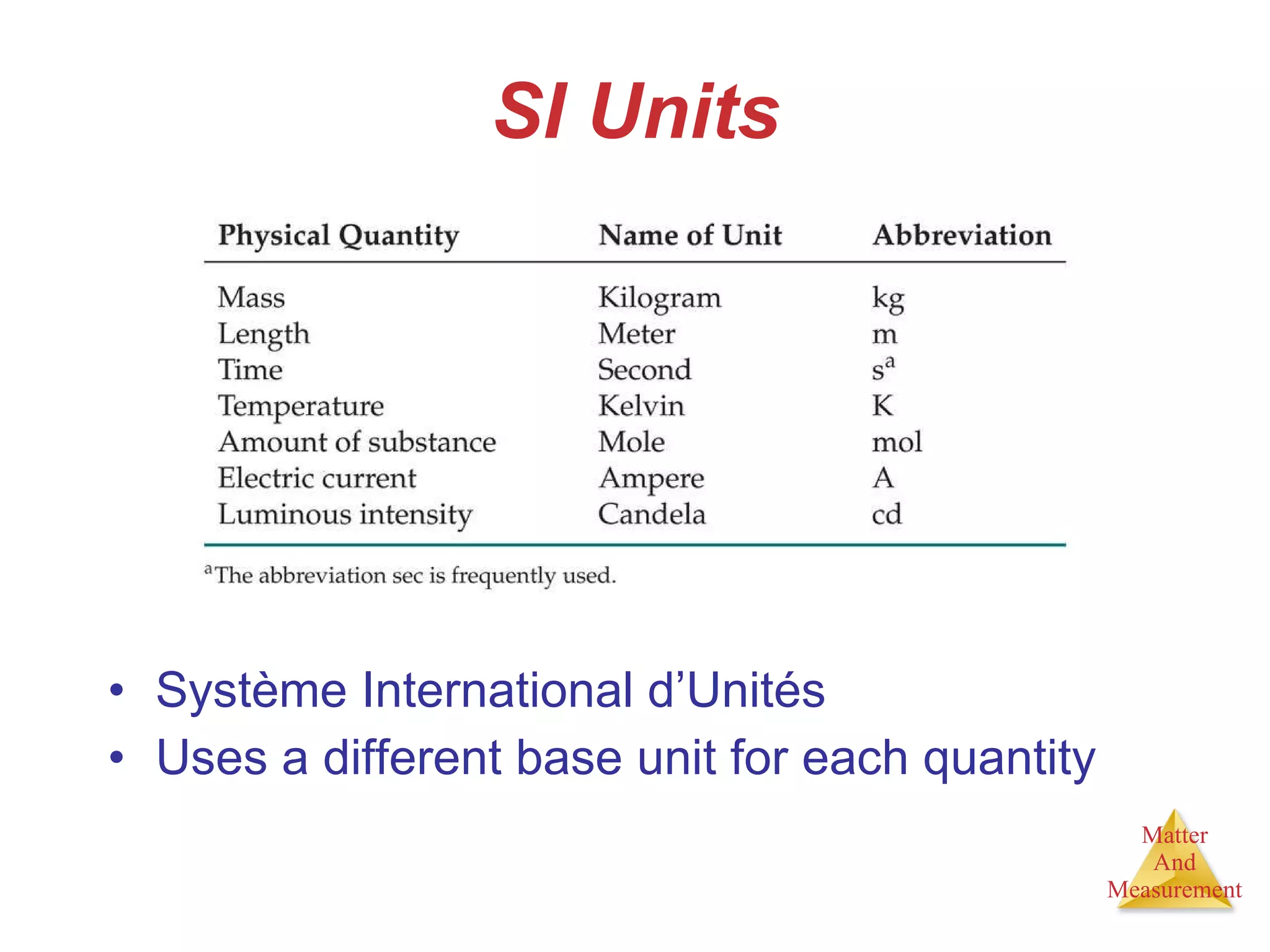
SI Units Système International d’Unités Uses a different base unit for each quantity
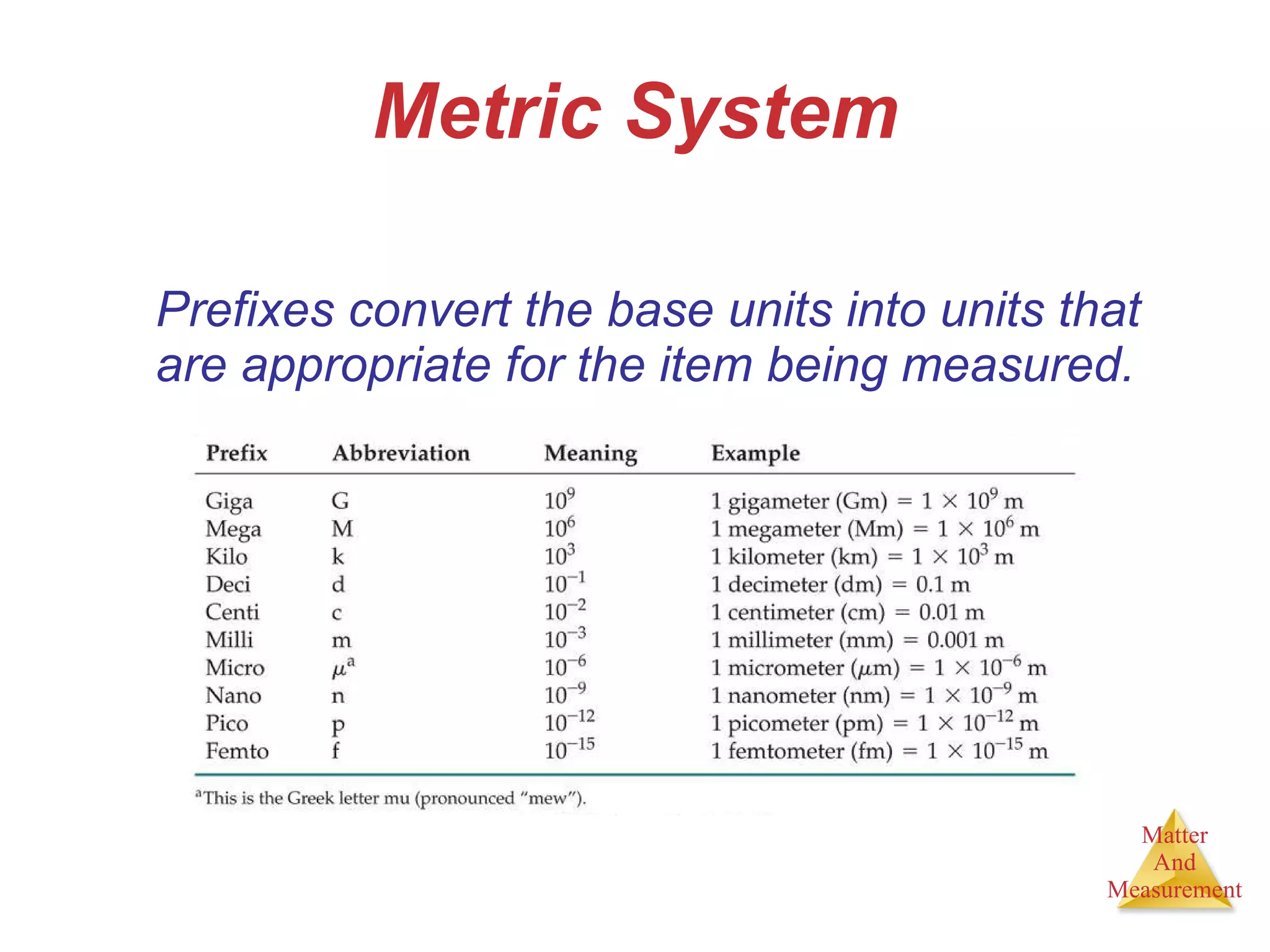
Metric System Prefixes convert the base units into units that are appropriate for the item being measured.
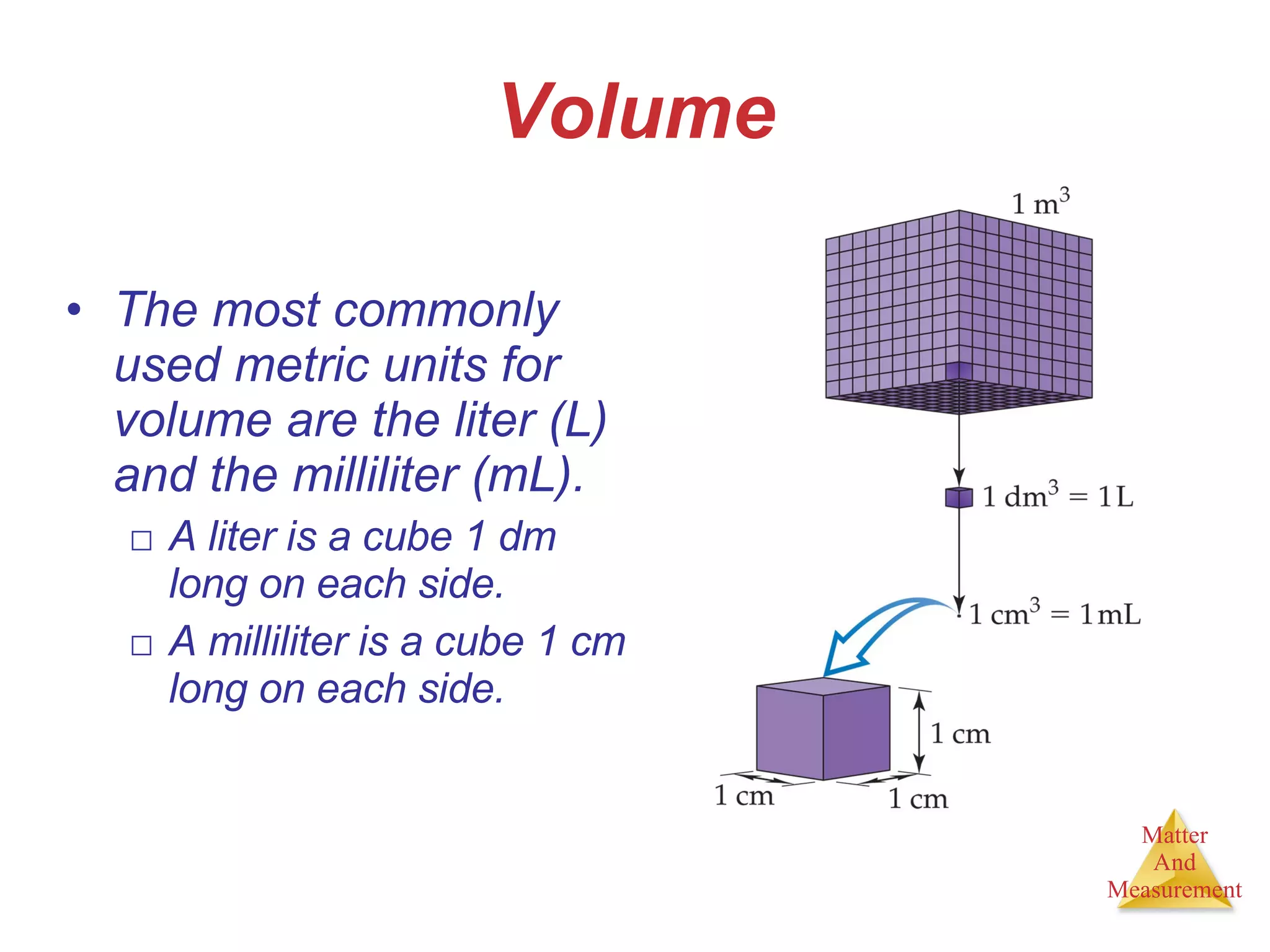
Volume The most commonly used metric units for volume are the liter (L) and the milliliter (mL). A liter is a cube 1 dm long on each side. A milliliter is a cube 1 cm long on each side.
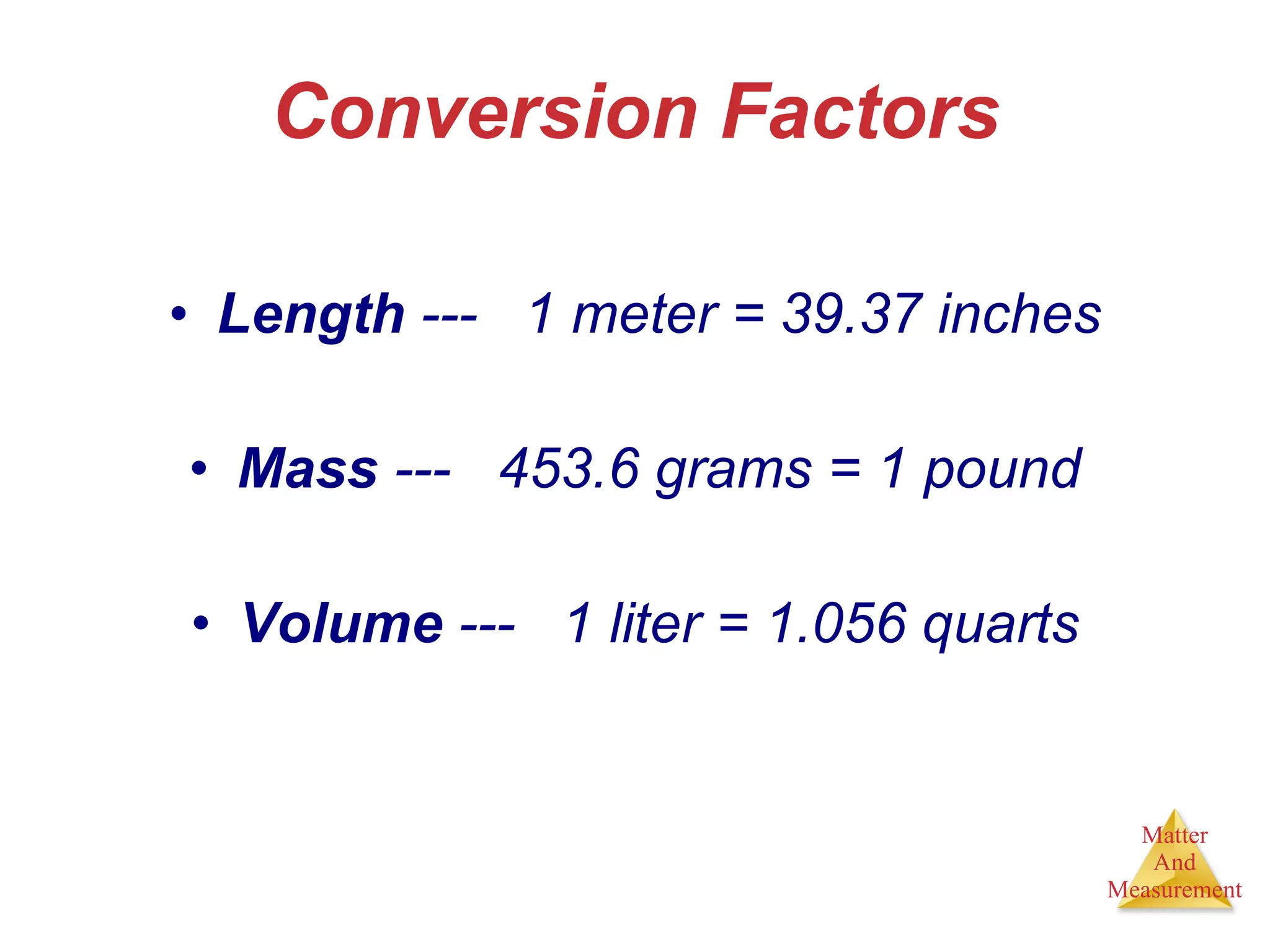
Conversion Factors Length  ---  1 meter = 39.37 inches Mass  ---  453.6 grams = 1 pound Volume  ---  1 liter = 1.056 quarts
Dimensional Analysis Method of Solving Problem Determine which unit conversion factor(s) are required. Carry units through calculation. If all units cancel except for the desired unit(s), then the problem was solved correctly.
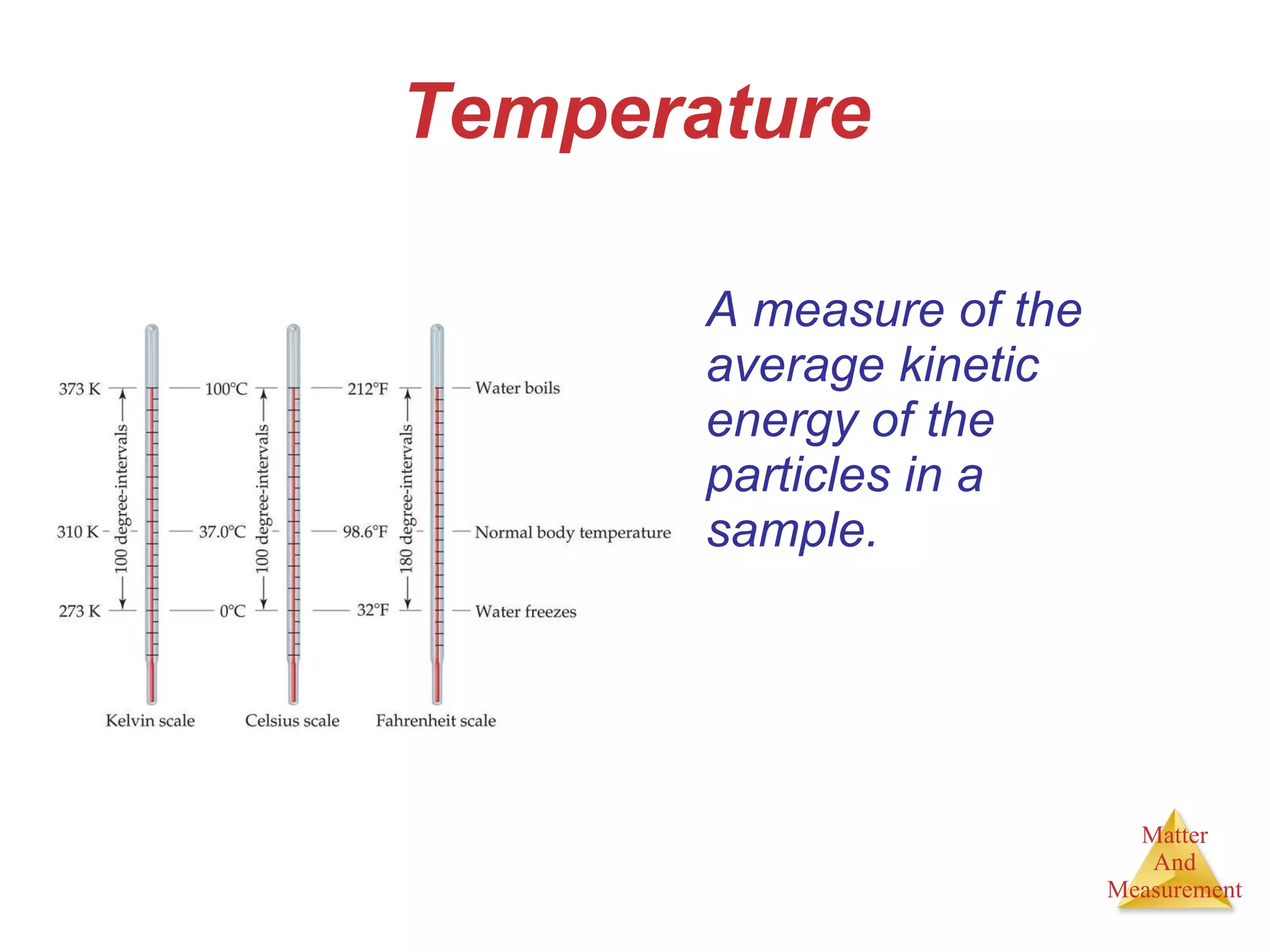
Temperature A measure of the average kinetic energy of the particles in a sample.
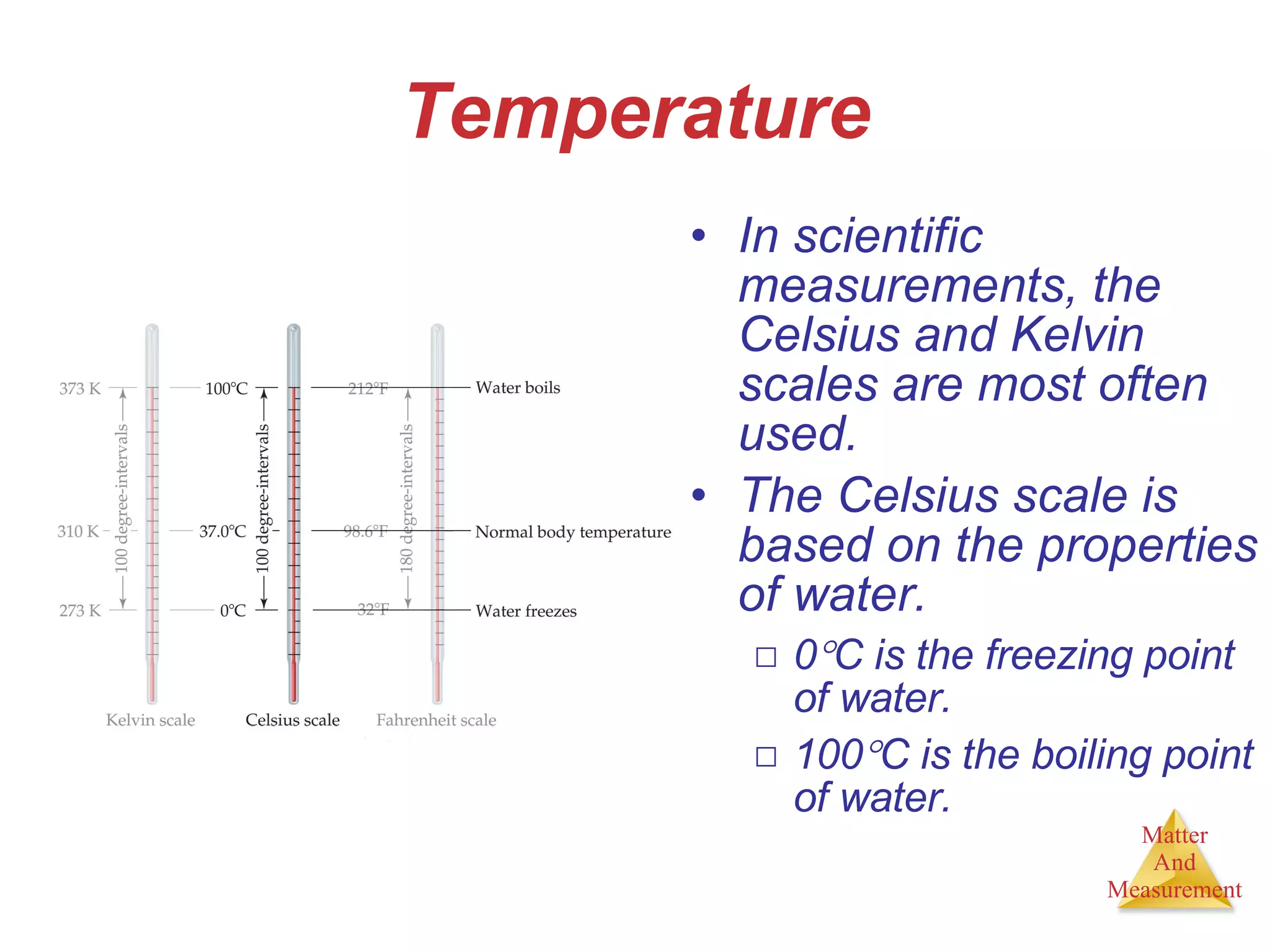
Temperature In scientific measurements, the Celsius and Kelvin scales are most often used. The Celsius scale is based on the properties of water. 0  C is the freezing point of water. 100  C is the boiling point of water.
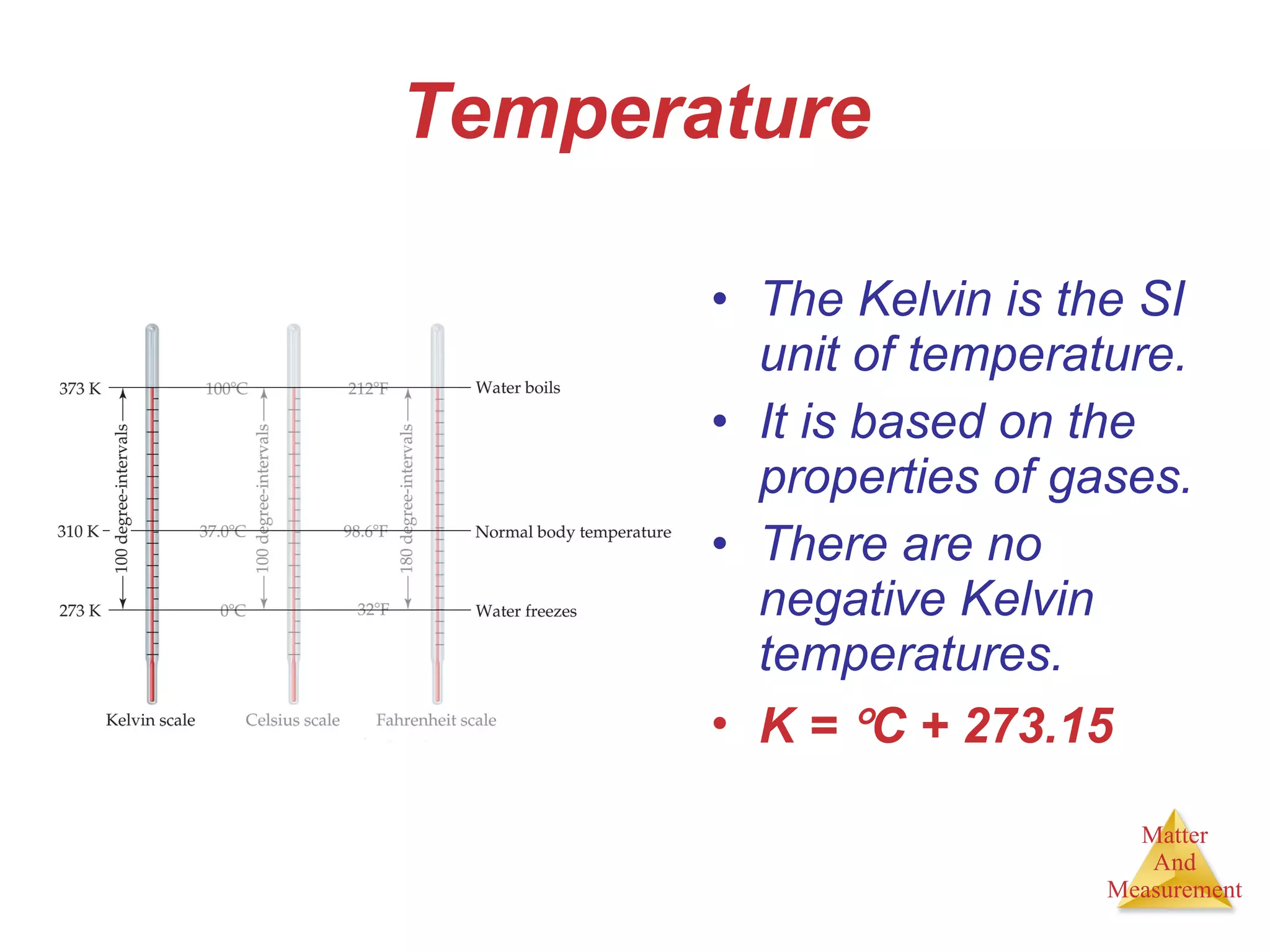
Temperature The Kelvin is the SI unit of temperature. It is based on the properties of gases. There are no negative Kelvin temperatures. K =   C + 273.15
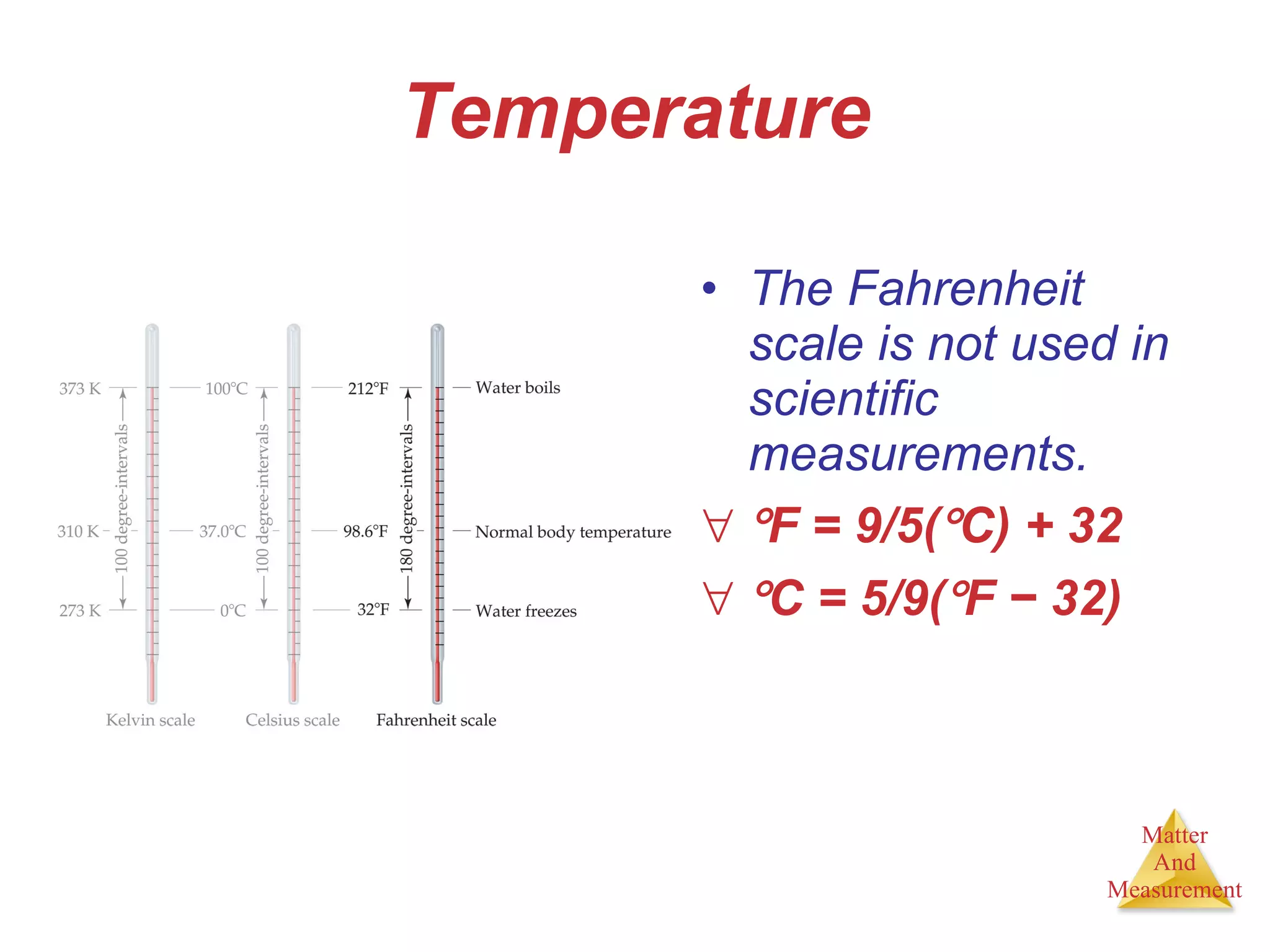
Temperature The Fahrenheit scale is not used in scientific measurements.  F = 9/5(  C) + 32  C = 5/9(  F  −  32)
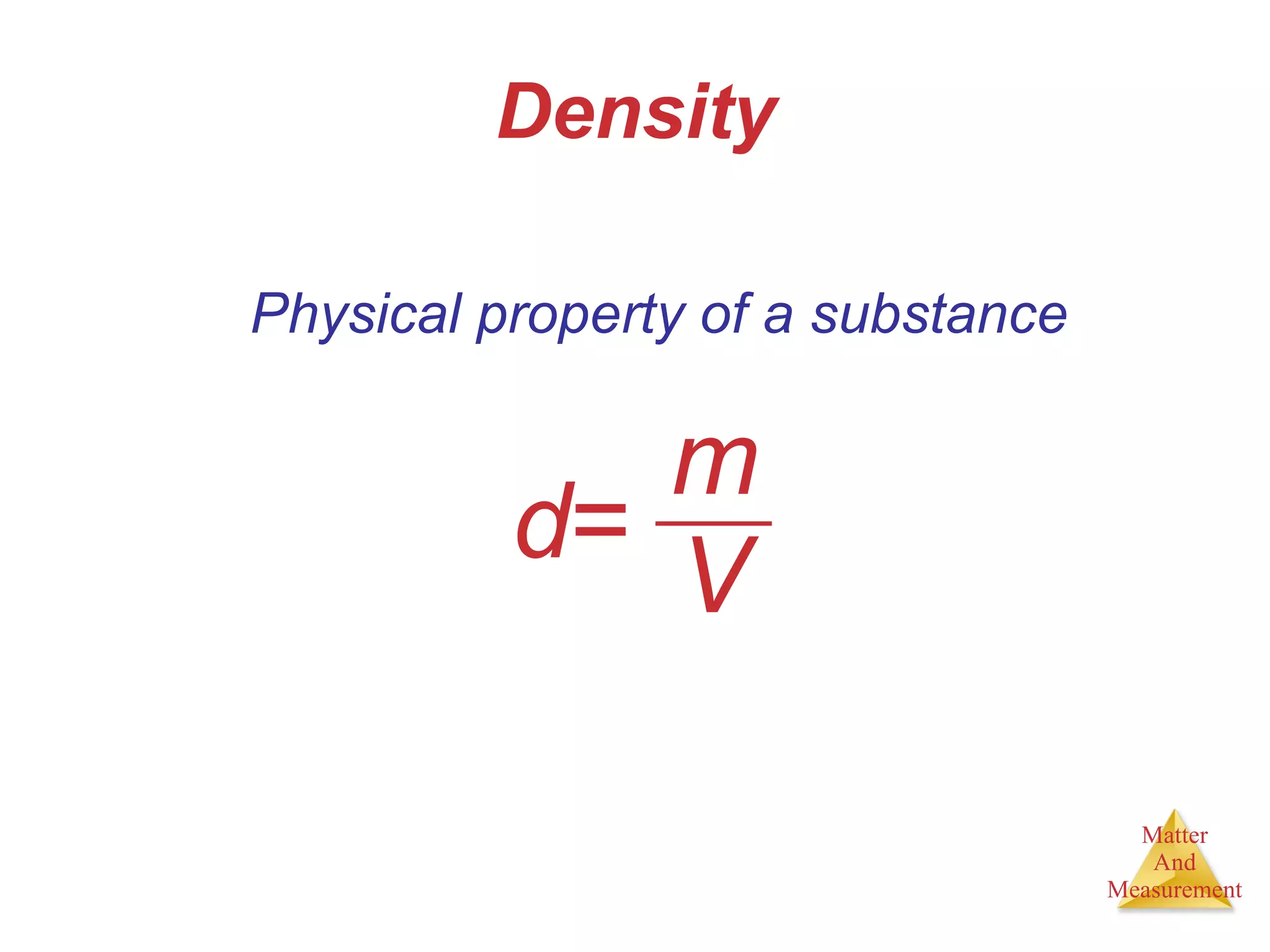
Density Physical property of a substance d = m V

Chapter #1 Spring 2008

  • 1.
    Chemistry The studyof 1. Matter 2. Properties of matter. 3. Changes that matter undergoes.
  • 2.
    Scientific Method Asystematic approach to solving problems.
  • 3.
    Qualitative Observation Anobservation that does not involve any numerical information. Carbon monoxide is a poisonous gas Soap is slippery Gold does not rust Aluminum has a low density Tin is a shiny, gray metal
  • 4.
    Quantitative Observation Anobservation involving numerical values in a measurement. Carbon dioxide freezes at -78 ºC The density of aluminum is 2.70 grams/mL The sample of gold weighs 34.6 grams The chemical reactions liberates 45.5 calories of energy
  • 5.
    Matter Anything thathas mass and takes up space.
  • 6.
    Matter Atoms are the building blocks of matter.
  • 7.
    Matter Atoms arethe building blocks of matter. Each element is made of the same kind of atom.
  • 8.
    Matter Atoms arethe building blocks of matter. Each element is made of the same kind of atom. A compound is made of two or more different kinds of elements.
  • 9.
    Classification of MatterElements (Pure) Compounds (Pure) Mixtures (Impure)
  • 10.
    Elements Elements arethe simplest form of matter that can exist under conditions that we normally encounter in the laboratory An element is a substance that cannot be separated into simpler substances by chemical methods .
  • 11.
    Elements 113 Elementshave been identified. 82 Elements occur naturally on Earth Gold, Aluminum, Lead, Oxygen, Carbon 31 Elements have been created by scientists. Technetium, americium, seaborgium
  • 12.
    Elements Elements canexist in either the atomic or molecular forms. Neon Ne Hydrogen H 2 Bromine Br 2 Phosphorus P 4 Sulfur S 8
  • 13.
  • 14.
    Compound A compoundis a substance composed of atoms of two or more elements chemically combined in fixed proportions (by either mass or atoms).
  • 15.
    Compounds A compounddoes not change its identify in physical changes but can be broken down into its constituent elements by chemical methods . The simplest unit of a compoud is the molecule or ion-pair .
  • 16.
    Carbon Dioxide 44.01grams of carbon dioxide contains 12.01 grams of carbon and 32.00 grams of oxygen. (2.66 : 1.00 ratio of oxygen to carbon). 1 molecule of carbon dioxide contains 1 atom of carbon and two atoms of oxygen. Carbon dioxide contains 27.29% carbon and 72.71% oxygen (by mass).
  • 17.
    Compounds Carbon dioxide CO 2 Magnesium oxide MgO Sodium Phosphate Na 3 PO 4 Sucrose C 12 H 22 O 11 Penicillin C 14 H 21 N 3 O 6 S
  • 18.
    Mixtures Mixture – A combination of two or more substance in which the substances retain their distinct identities. Seawater Sand in water Coca-Cola Bronze alloy Atmospheric gases Italian salad dressing
  • 19.
    Characteristics of MixturesVariable composition. Variable physical properties. Separated into their components by physical methods. Boiling Filtration Decanting
  • 20.
    Homogenous vs. HeterogeneousHomogeneous – Uniform throughout sample; no boundaries and separate phases. Heterogeneous – Non-uniform throughout sample; boundaries and multiple phases are present.
  • 21.
  • 22.
  • 23.
  • 24.
  • 25.
  • 26.
  • 27.
  • 28.
  • 29.
  • 30.
  • 31.
  • 32.
    Properties of MatterIntensive Properties : Independent of the amount of the substance that is present. Density, boiling point, color, etc. Extensive Properties : Dependent upon the amount of the substance present. Mass, volume, energy, etc.
  • 33.
    Properties of MatterPhysical Properties Chemical Properties
  • 34.
    Physical Properties PhysicalProperties: Can be observed without changing a substance into another substance. Physical state (gas, liquid, solid) Mass Volume Color/Luster Hardness Boiling point Melting point Density
  • 35.
    Chemical Properties ChemicalProperties : Can only be observed when a substance is changed into another substance. Flammability or combustibility Corrosiveness Reactivity with acid, etc.
  • 36.
    Changes of MatterPhysical Changes : Changes in matter that do not change the composition of a substance. Changes of state, temperature, volume, etc. Freezing Boiling Melting Condensation Sublimation Dissolving sugar in water`
  • 37.
    Chemical Changes ChemicalChanges : A change in which one or more kinds of matter is transformed into a new kind of matter or several new kinds of matter. Changes that result in new substances . Chemical composition is altered . Combustion Oxidation Decomposition etc.
  • 38.
    Chemical Reactions Inthe course of a chemical reaction, the reacting substances are converted to new substances.
  • 39.
  • 40.
    Compounds Compounds canbe broken down into more elemental particles.
  • 41.
  • 42.
    Example of ChemicalChange Magnesium metal combusts to produce the white ash, magnesium oxide. 2 Mg(s) + O 2 (g) -> 2 MgO(s)
  • 43.
    Example of ChemicalChange Sodium reacts vigorously with water to produce hydrogen gas and an aqueous solution of sodium hydroxide. 2 Na(s) + 2 H 2 O(l) -> H 2 (g) + 2 NaOH(aq)
  • 44.
  • 45.
    Distillation: Separates homogeneousmixture on the basis of differences in boiling point.
  • 46.
  • 47.
    Filtration: Separates solidsubstances from liquids and solutions.
  • 48.
    Chromatography: Separates substanceson the basis of differences in solubility in a solvent.
  • 49.
  • 50.
    Significant Figures Whenphysical quantities are used in arithmetic, it is important that the number of digits reported represents the uncertainty in the original measurements.
  • 51.
    Significant Figures Rule#1: Any digit that is not zero is significant. 12.345 grams Rule #2: Zeros between nonzero digits are significant. 20.05 mL
  • 52.
    Significant Figures Rule#3: Zeros to the left of the first nonzero digit are not significant. 0.0125 kg Rule #4: If a measured number is greater than “1”, then all zeros to the right of the decimal point are significant. 2.500 meters
  • 53.
    Significant Figures Rule#5: If a number is less than “1”, then only the zeros that are at the end of the number and in the middle of nonzero digits are significant. 0.2500 grams 0.06050 tons
  • 54.
    Significant Figures Theterm significant figures refers to digits that were measured. When rounding calculated numbers, we pay attention to significant figures so we do not overstate the accuracy of our answers.
  • 55.
    Significant Figures - Multiplication or Division The number of significant figures in the result of multiplication or division is set by the original number that has the smallest number of significant figures. 4.51 x 3.6666 = 16.536366 16.5
  • 56.
    Significant Figures 0.0608 x 1025.40 25.06 = 2.487802075 2.49
  • 57.
    Significant Figures - Addition or Subtraction The answer cannot have more digits to the right of the decimal point than any of the original numbers possess. 89.332 + 1.1 = 90.432 90.4
  • 58.
    Significant Figures Whenaddition or subtraction is performed, answers are rounded to the least significant decimal place . When multiplication or division is performed, answers are rounded to the number of digits that corresponds to the least number of significant figures in any of the numbers used in the calculation.
  • 59.
    Exact Numbers Numbersfrom definitions or numbers of objects are considered to have an infinite number of significant figures. (i.e. conversion factors, counting numbers The average of three measured lengths: 7.65 m, 7.49 m, and 7.60 m. (7.65 + 7.49 + 7.60)/3 = 7.58 not 8
  • 60.
    Uncertainty in MeasurementsDifferent measuring devices have different uses and different degrees of accuracy.
  • 61.
    Accuracy versus PrecisionAccuracy refers to the proximity of a measurement to the true value of a quantity. Precision refers to the proximity of several measurements to each other.
  • 62.
    SI Units SystèmeInternational d’Unités Uses a different base unit for each quantity
  • 63.
    Metric System Prefixesconvert the base units into units that are appropriate for the item being measured.
  • 64.
    Volume The mostcommonly used metric units for volume are the liter (L) and the milliliter (mL). A liter is a cube 1 dm long on each side. A milliliter is a cube 1 cm long on each side.
  • 65.
    Conversion Factors Length --- 1 meter = 39.37 inches Mass --- 453.6 grams = 1 pound Volume --- 1 liter = 1.056 quarts
  • 66.
    Dimensional Analysis Methodof Solving Problem Determine which unit conversion factor(s) are required. Carry units through calculation. If all units cancel except for the desired unit(s), then the problem was solved correctly.
  • 67.
    Temperature A measureof the average kinetic energy of the particles in a sample.
  • 68.
    Temperature In scientificmeasurements, the Celsius and Kelvin scales are most often used. The Celsius scale is based on the properties of water. 0  C is the freezing point of water. 100  C is the boiling point of water.
  • 69.
    Temperature The Kelvinis the SI unit of temperature. It is based on the properties of gases. There are no negative Kelvin temperatures. K =  C + 273.15
  • 70.
    Temperature The Fahrenheitscale is not used in scientific measurements.  F = 9/5(  C) + 32  C = 5/9(  F − 32)
  • 71.
    Density Physical propertyof a substance d = m V