Matter
And
Measurement
Chapter 1
Introduction:
Matter and Measurement
Chemistry, The Central Science, 10th edition
Theodore L. Brown; H. Eugene LeMay, Jr.;
and Bruce E. Bursten
Matter
And
Measurement
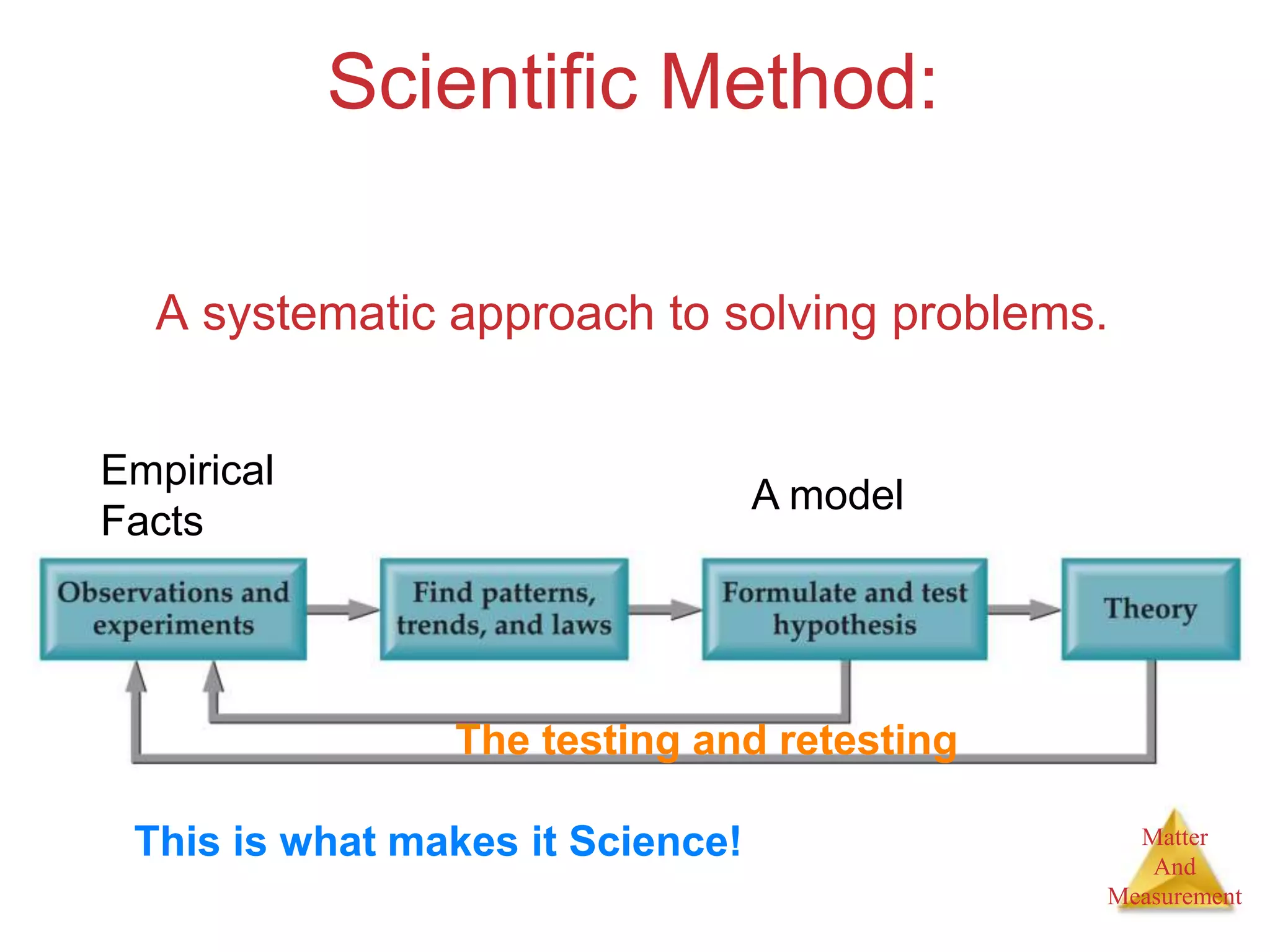
Scientific Method:
A systematic approach to solving problems.
A model
Empirical
Facts
This is what makes it Science!
The testing and retesting
Matter
And
Measurement
Facts and theories
*Fact: on June 30, 1908 in
Tunguska, Siberia, an explosion
equivalent to about 15 million
tons of TNT occurred.
* Hypothesis is that a comet
or meteor collided with the
Earth.
QuickTime™ and a
decompressor
are needed to see this picture.
Testing: look for elements and substances characteristic of
extraterrestrial objects, elements not found in the area.
Such elements (Nickel, Iridium) were found.
However, there is no crator.
Theory: Meteor exploded above the ground.
http://en.wikipedia.org/wiki/Tunguska_event
Matter
And
Measurement
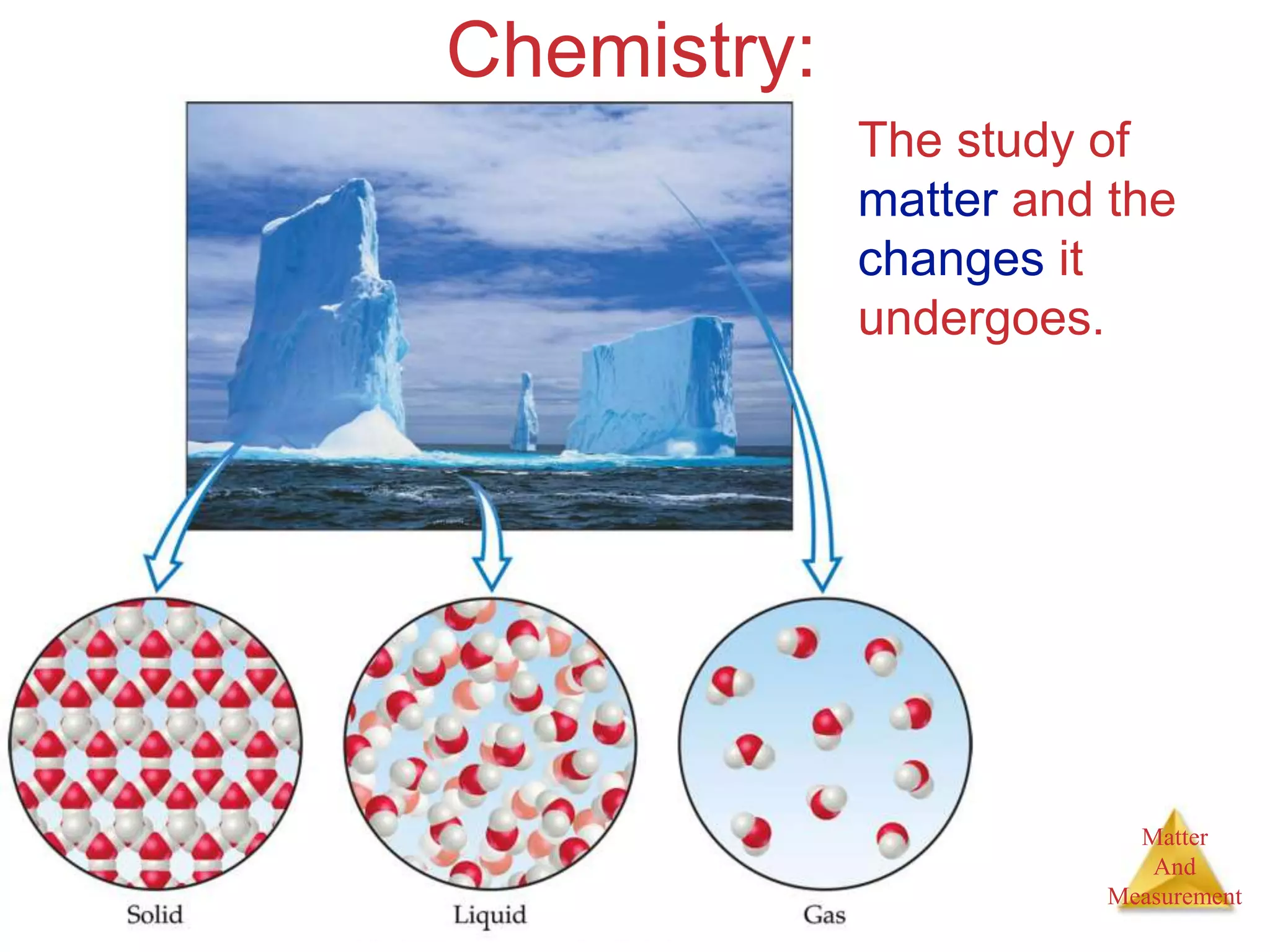
Chemistry:
The study of
matter and the
changes it
undergoes.
Matter
And
Measurement
Matter:
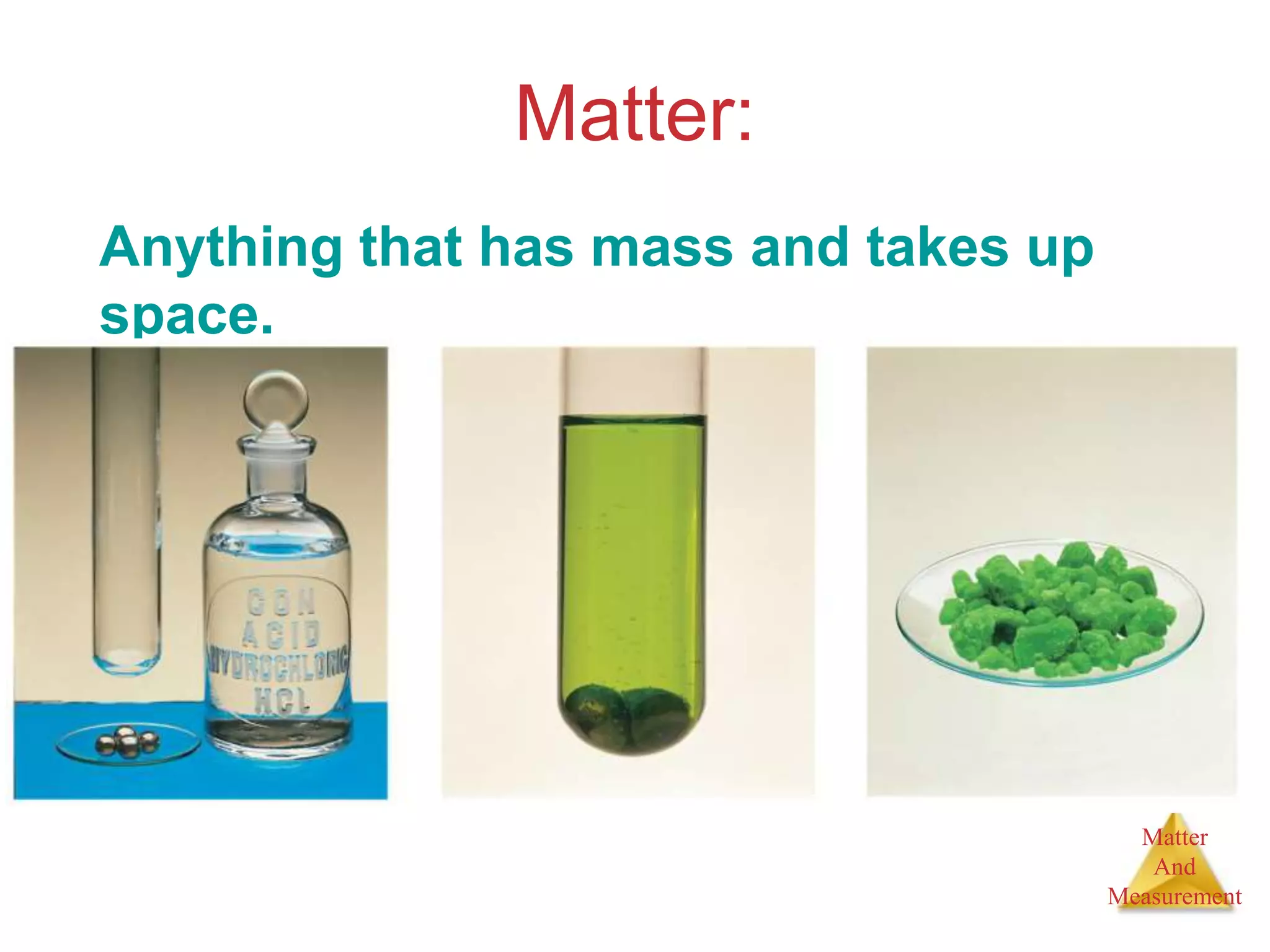
Anything that has mass and takes up
space.
Matter
And
Measurement
Matter
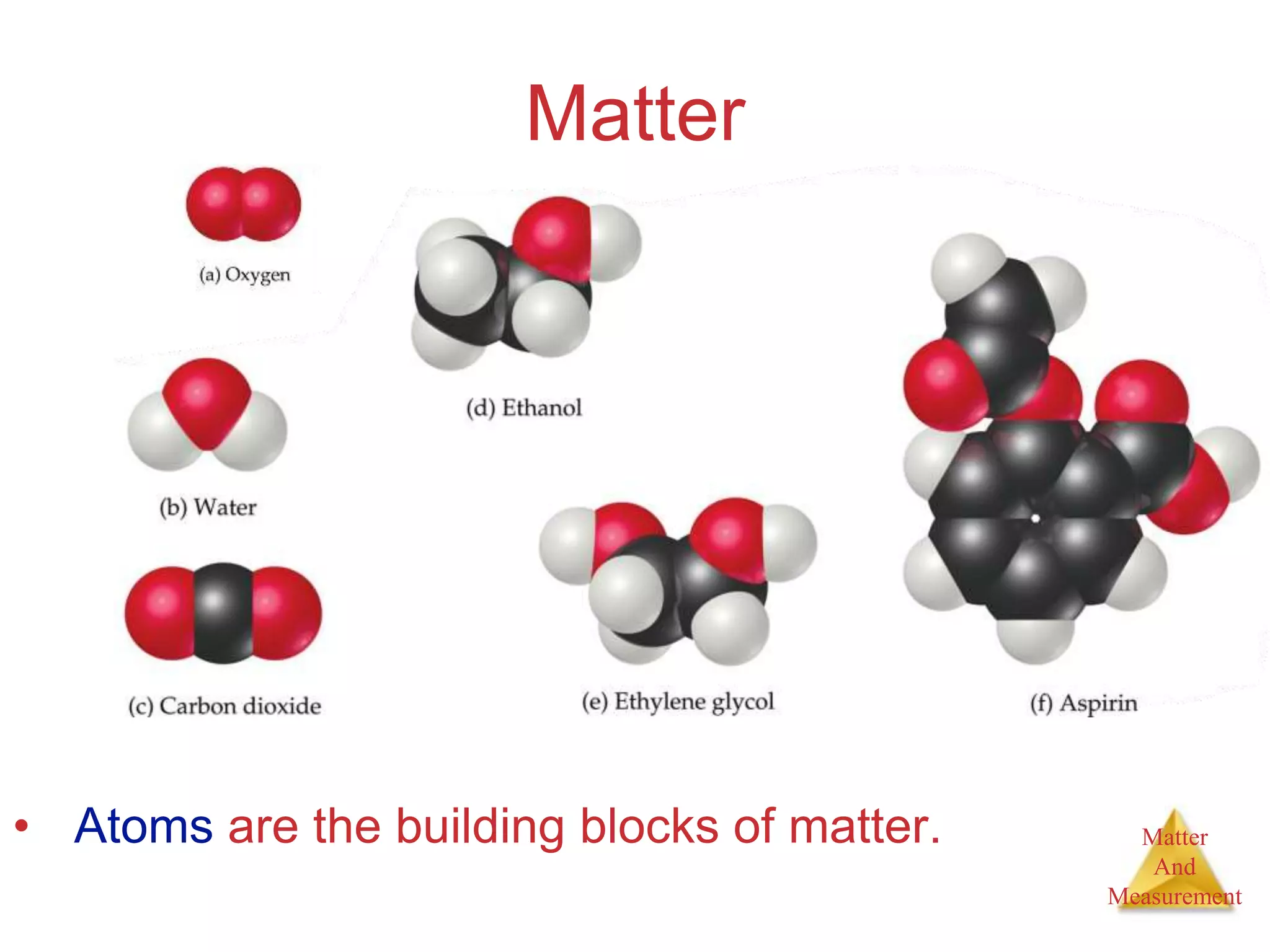
• Atoms are the building blocks of matter.
Matter
And
Measurement
Matter
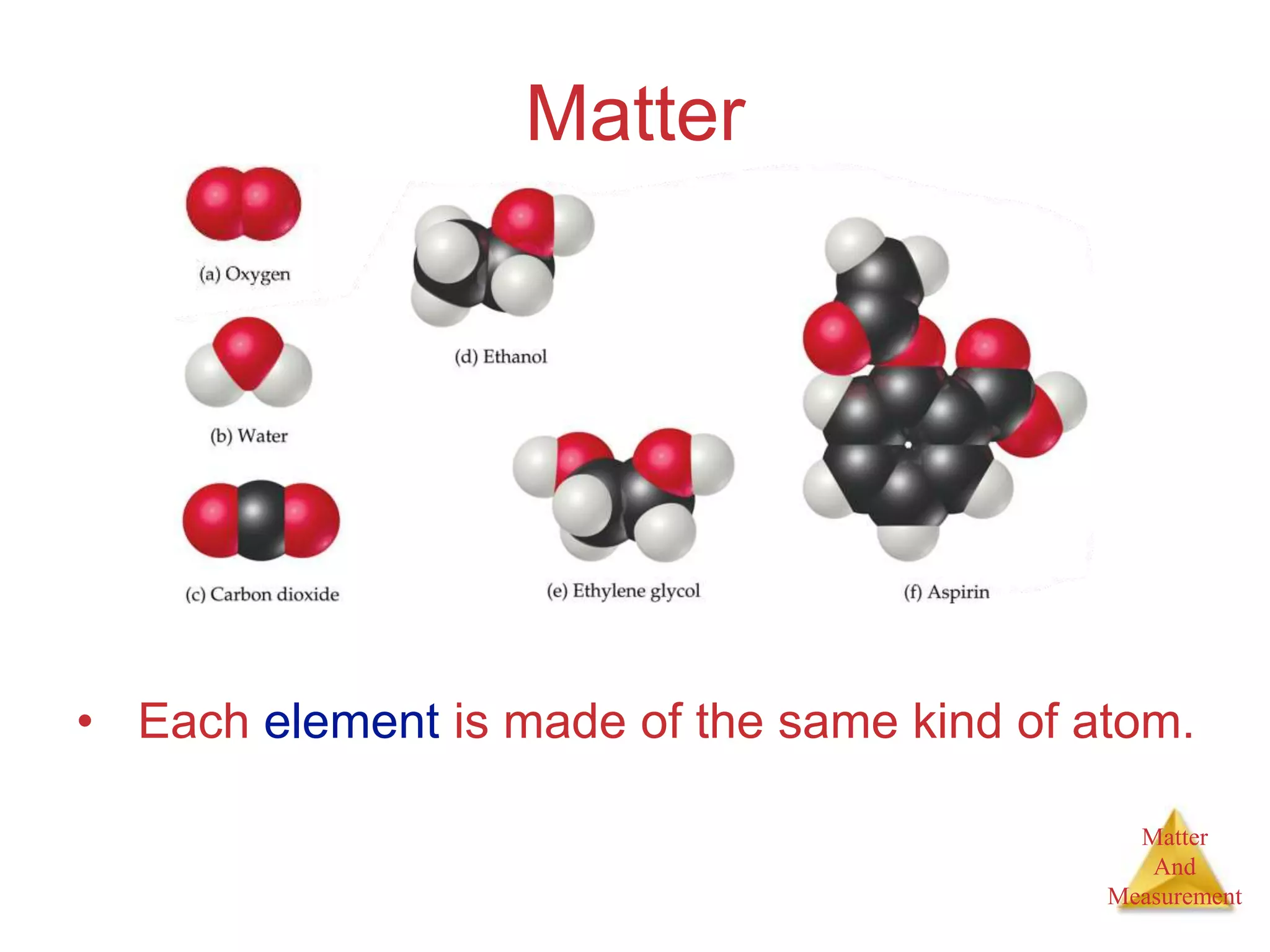
• Each element is made of the same kind of atom.
Matter
And
Measurement
Matter
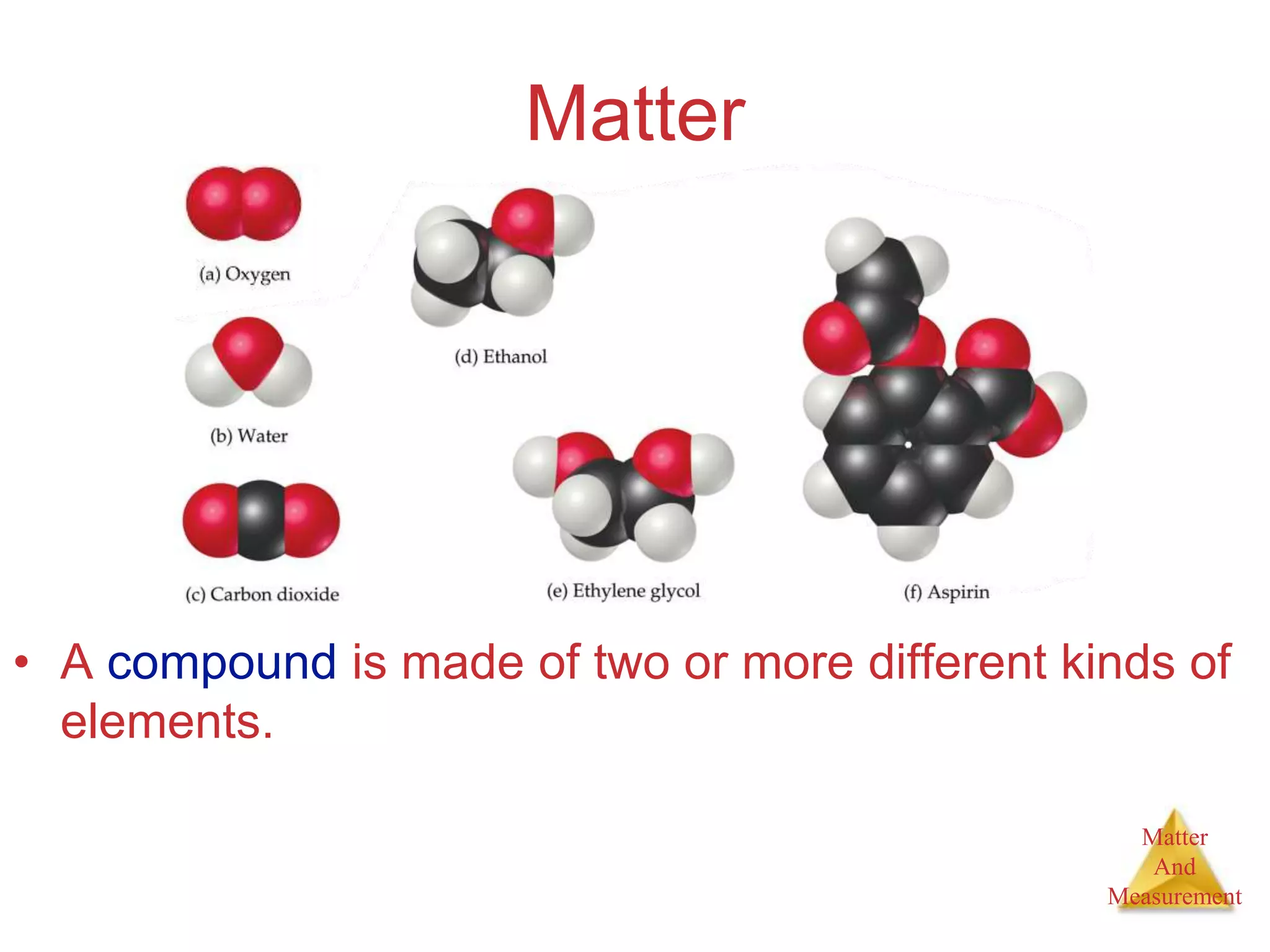
• A compound is made of two or more different kinds of
elements.
Matter
And
Measurement
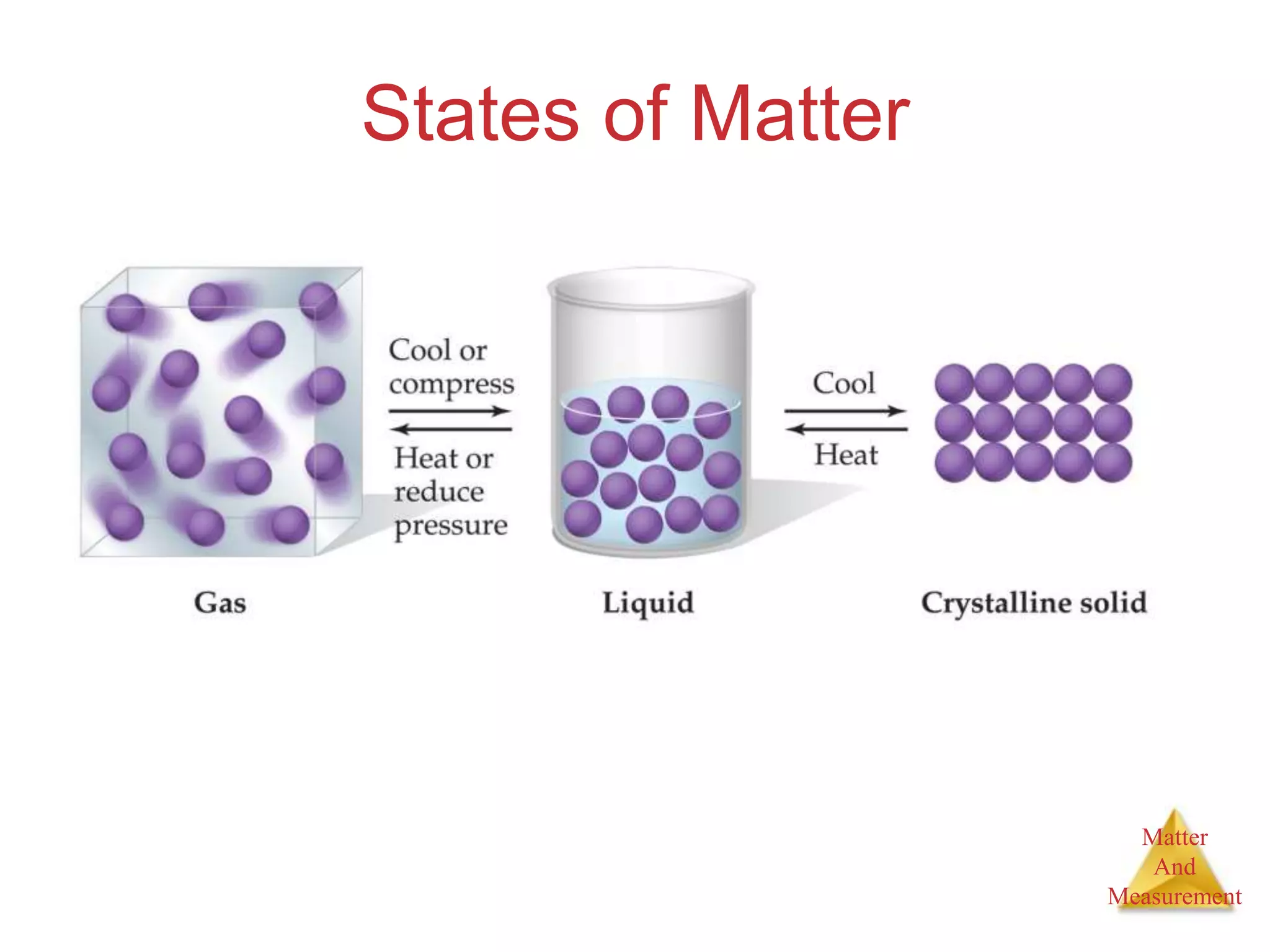
States of Matter
Matter
And
Measurement
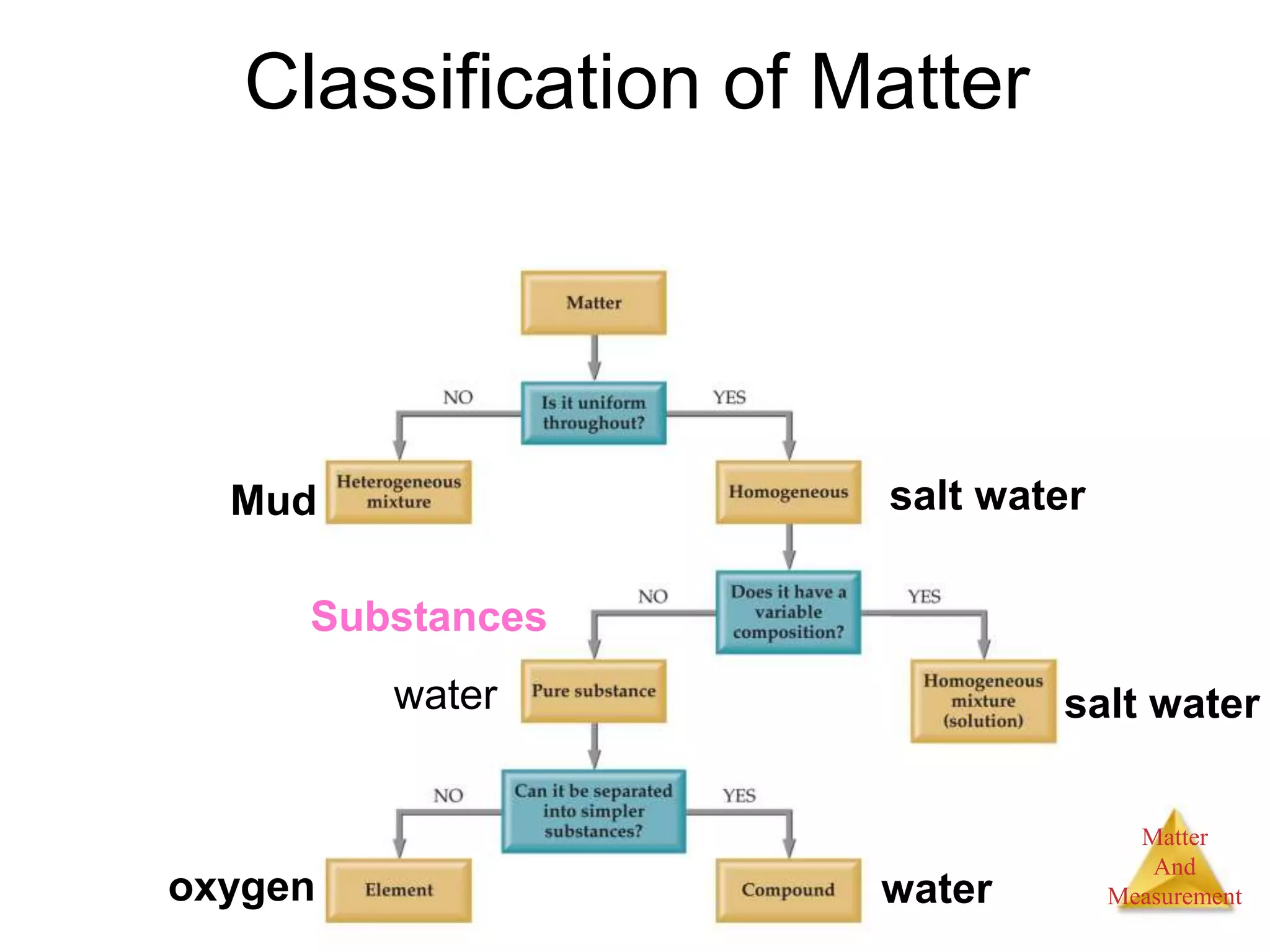
Classification of Matter
Mud salt water
salt water
water
water
oxygen
Substances
Matter
And
Measurement
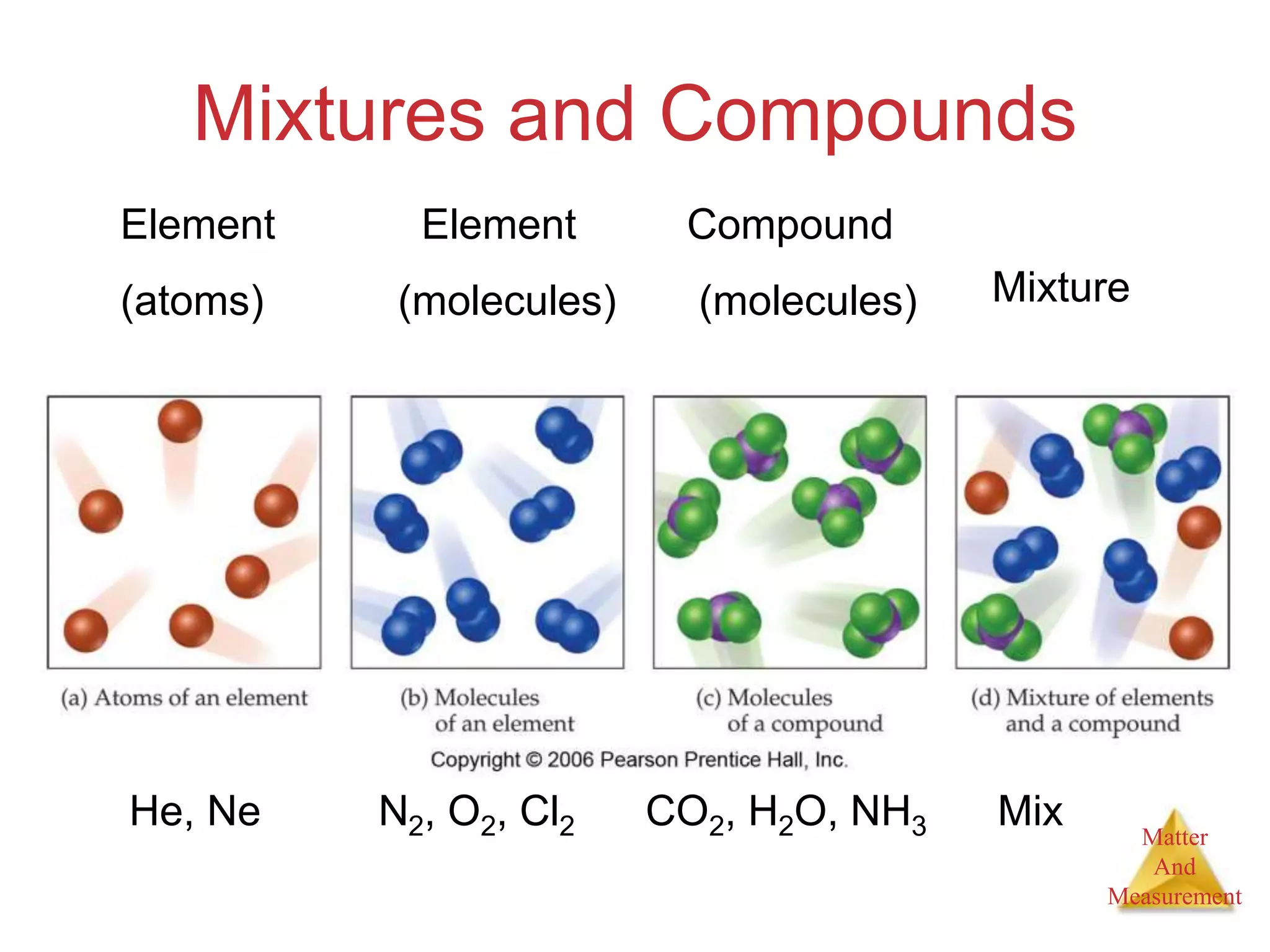
Mixtures and Compounds
Element Element Compound
(atoms) (molecules) (molecules) Mixture
He, Ne N2, O2, Cl2 CO2, H2O, NH3 Mix
Matter
And
Measurement
Properties and
Changes of
Matter
Matter
And
Measurement
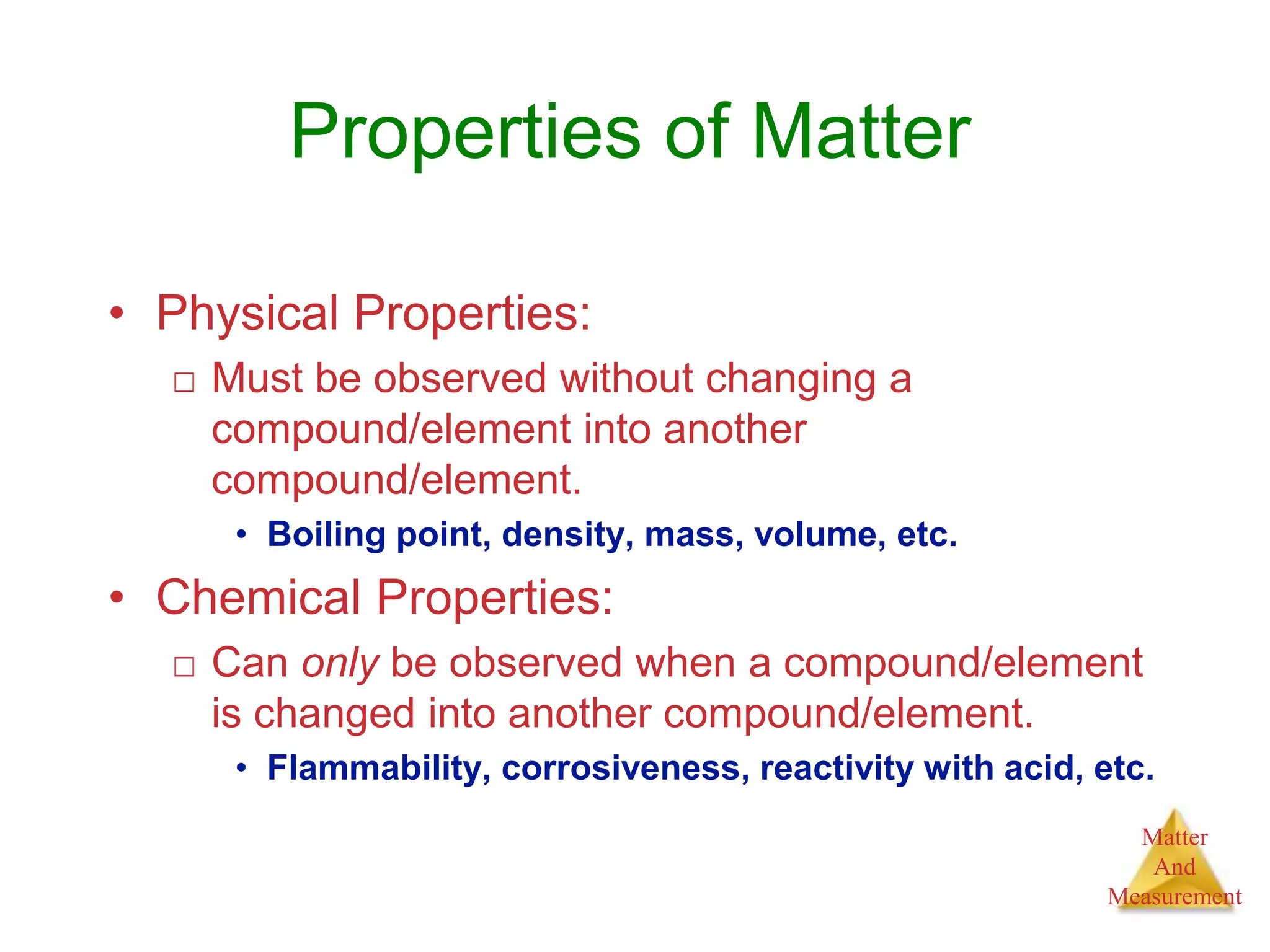
• Physical Properties:
□ Must be observed without changing a
compound/element into another
compound/element.
• Boiling point, density, mass, volume, etc.
• Chemical Properties:
□ Can only be observed when a compound/element
is changed into another compound/element.
• Flammability, corrosiveness, reactivity with acid, etc.
Properties of Matter
Matter
And
Measurement
Properties of Matter
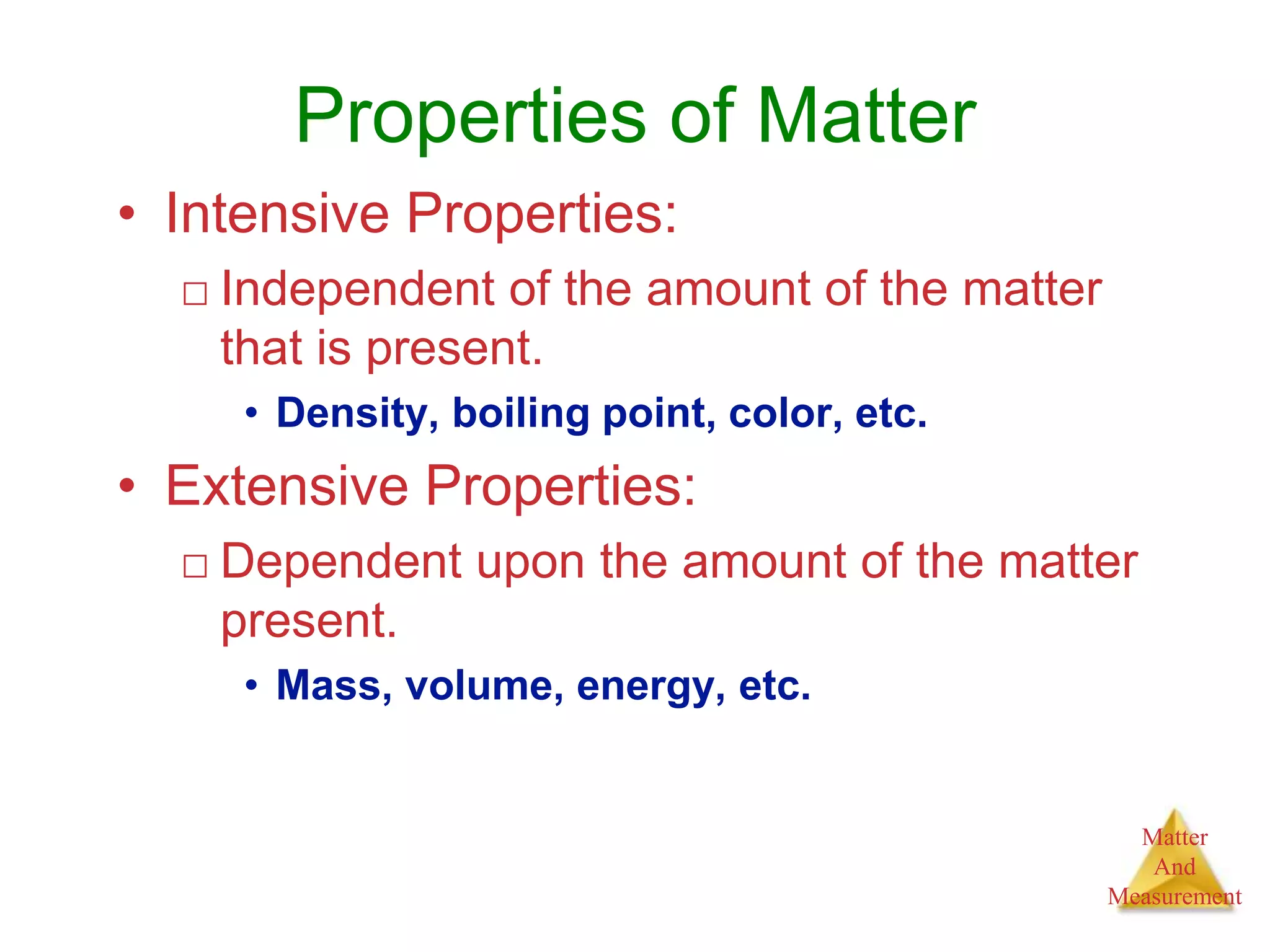
• Intensive Properties:
□ Independent of the amount of the matter
that is present.
• Density, boiling point, color, etc.
• Extensive Properties:
□ Dependent upon the amount of the matter
present.
• Mass, volume, energy, etc.
Matter
And
Measurement
Changes of Matter
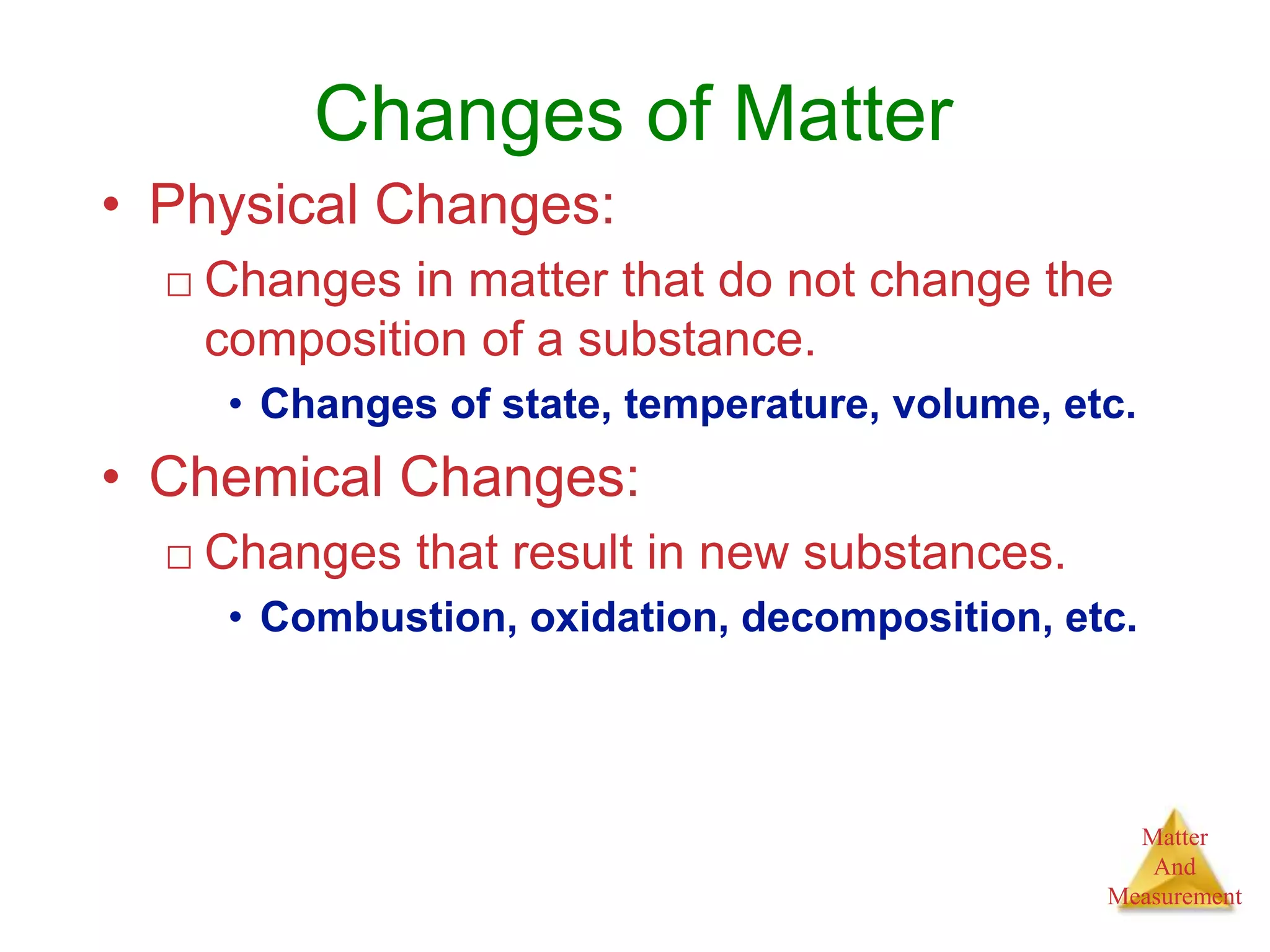
• Physical Changes:
□ Changes in matter that do not change the
composition of a substance.
• Changes of state, temperature, volume, etc.
• Chemical Changes:
□ Changes that result in new substances.
• Combustion, oxidation, decomposition, etc.
Matter
And
Measurement
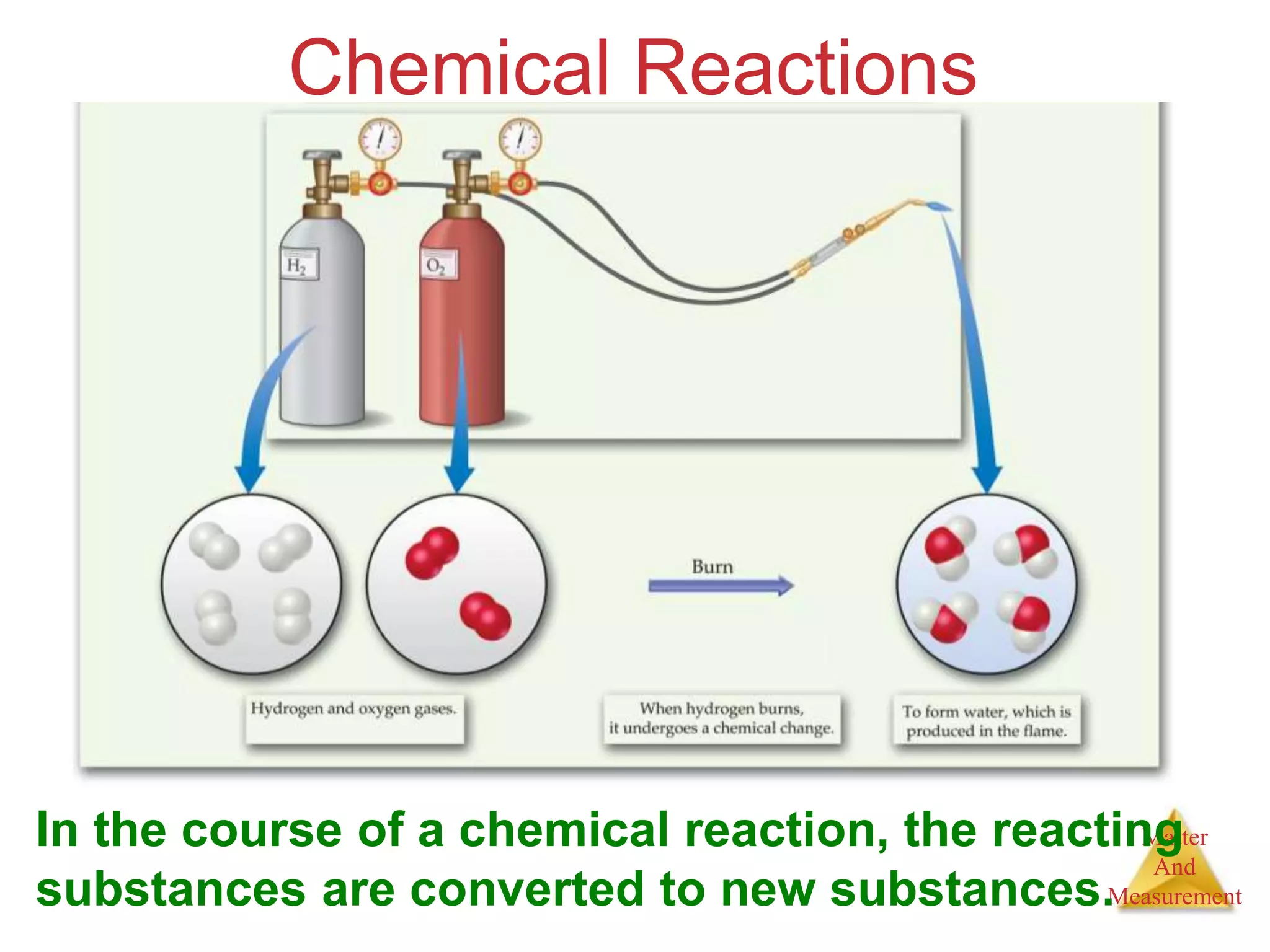
Chemical Reactions
In the course of a chemical reaction, the reacting
substances are converted to new substances.
Matter
And
Measurement
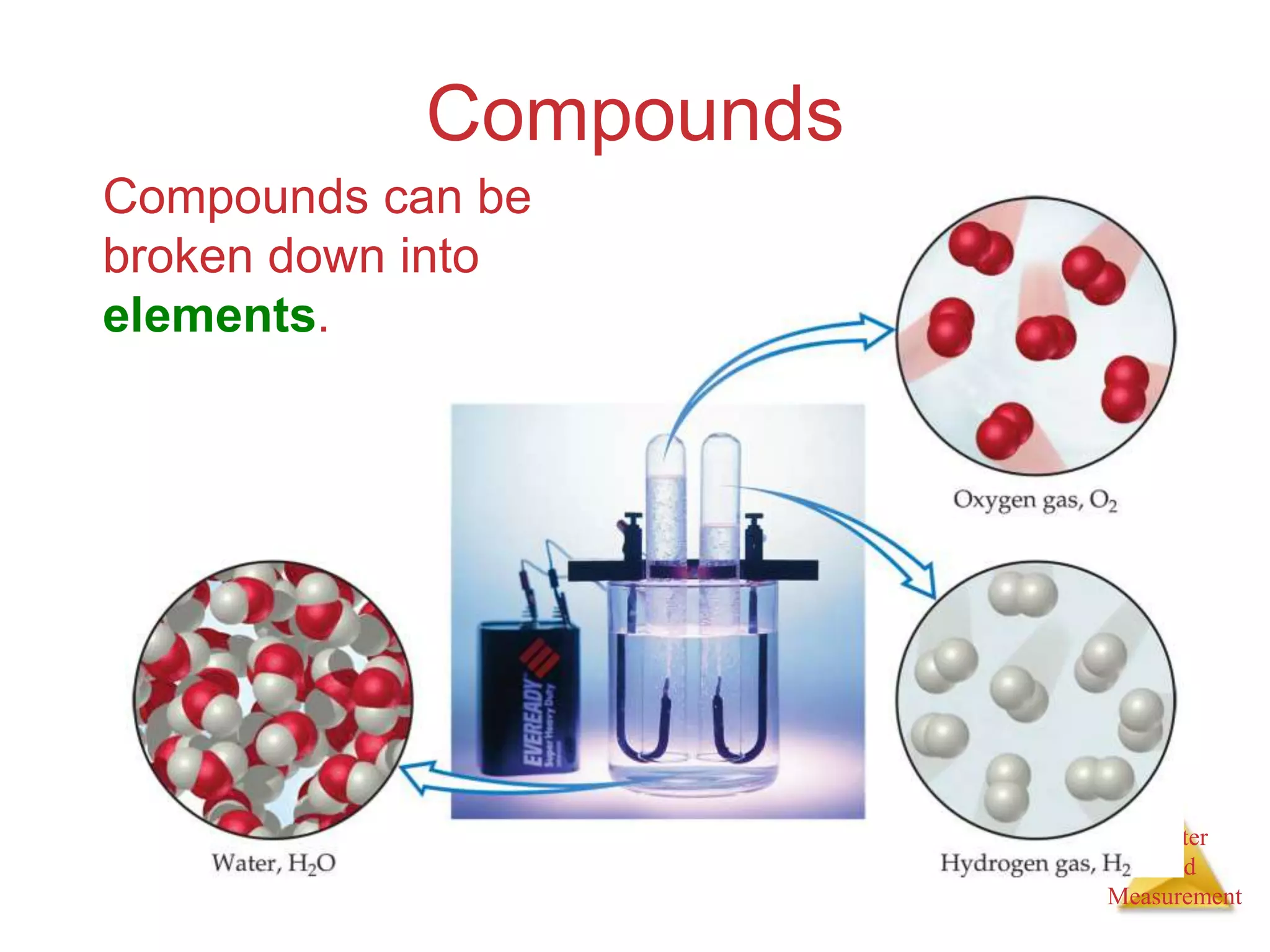
Compounds
Compounds can be
broken down into
elements.
Matter
And
Measurement
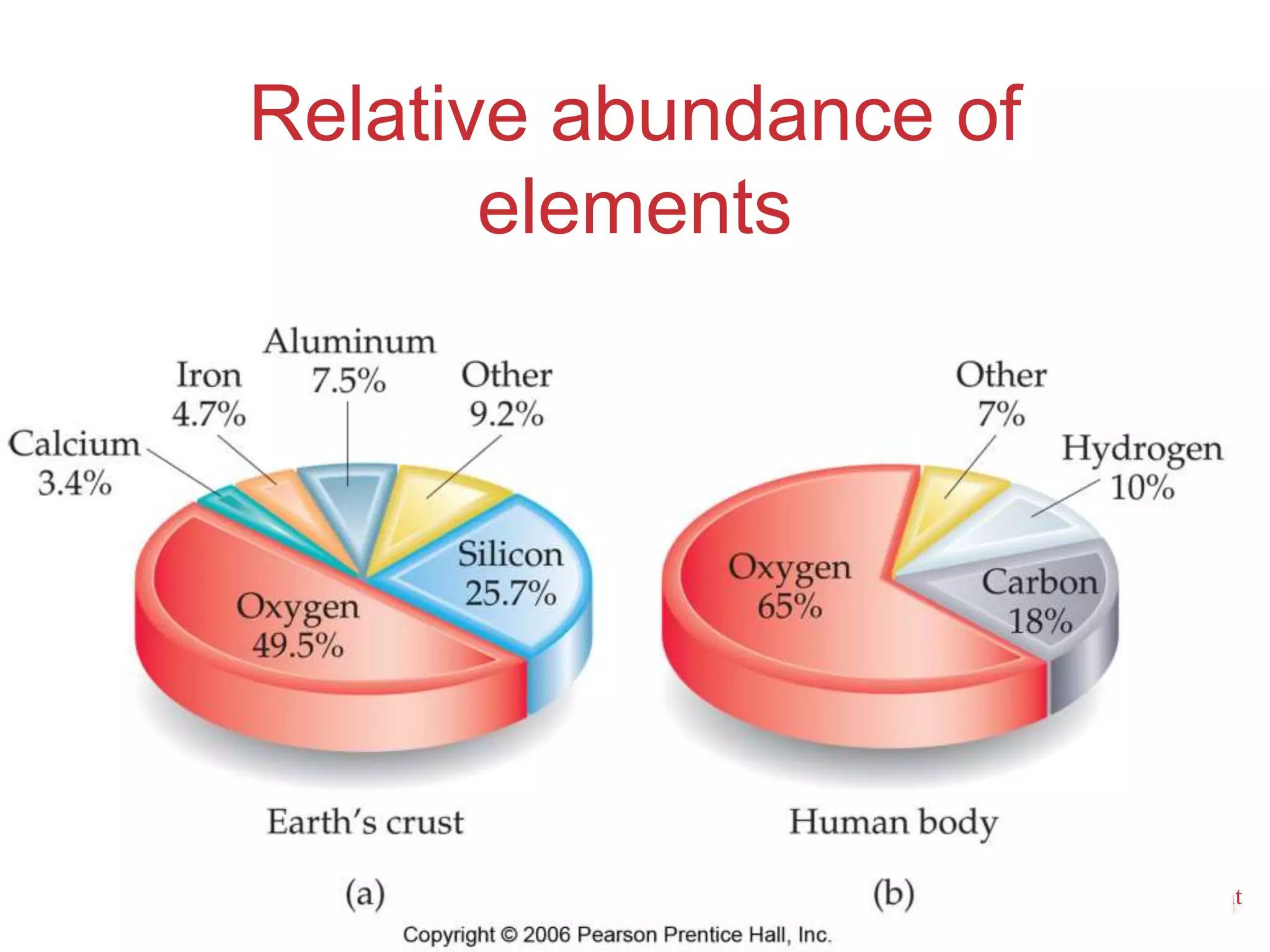
Relative abundance of
elements
Matter
And
Measurement
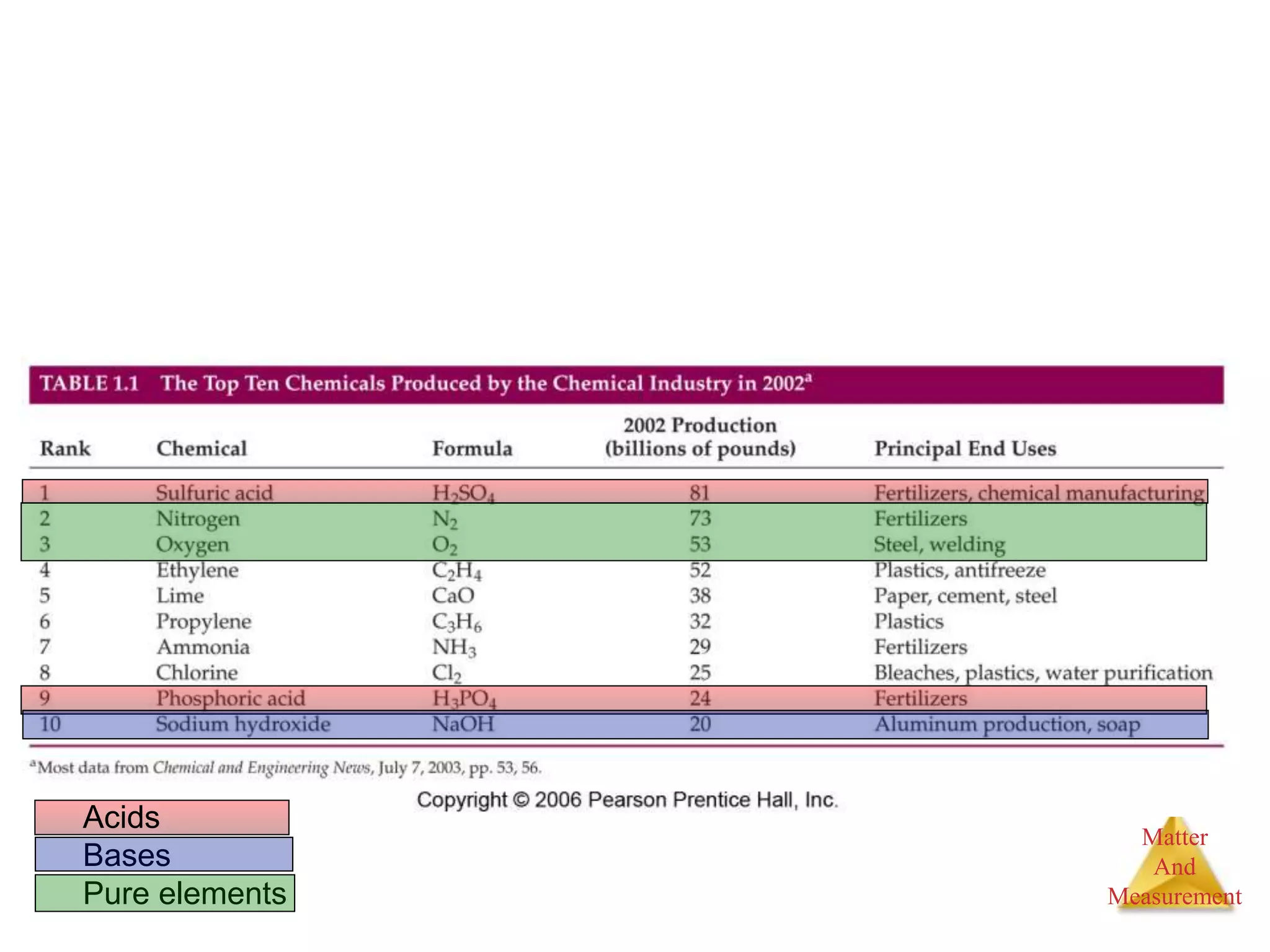
Acids
Bases
Pure elements
Matter
And
Measurement
Separation of
Mixtures
Matter
And
Measurement
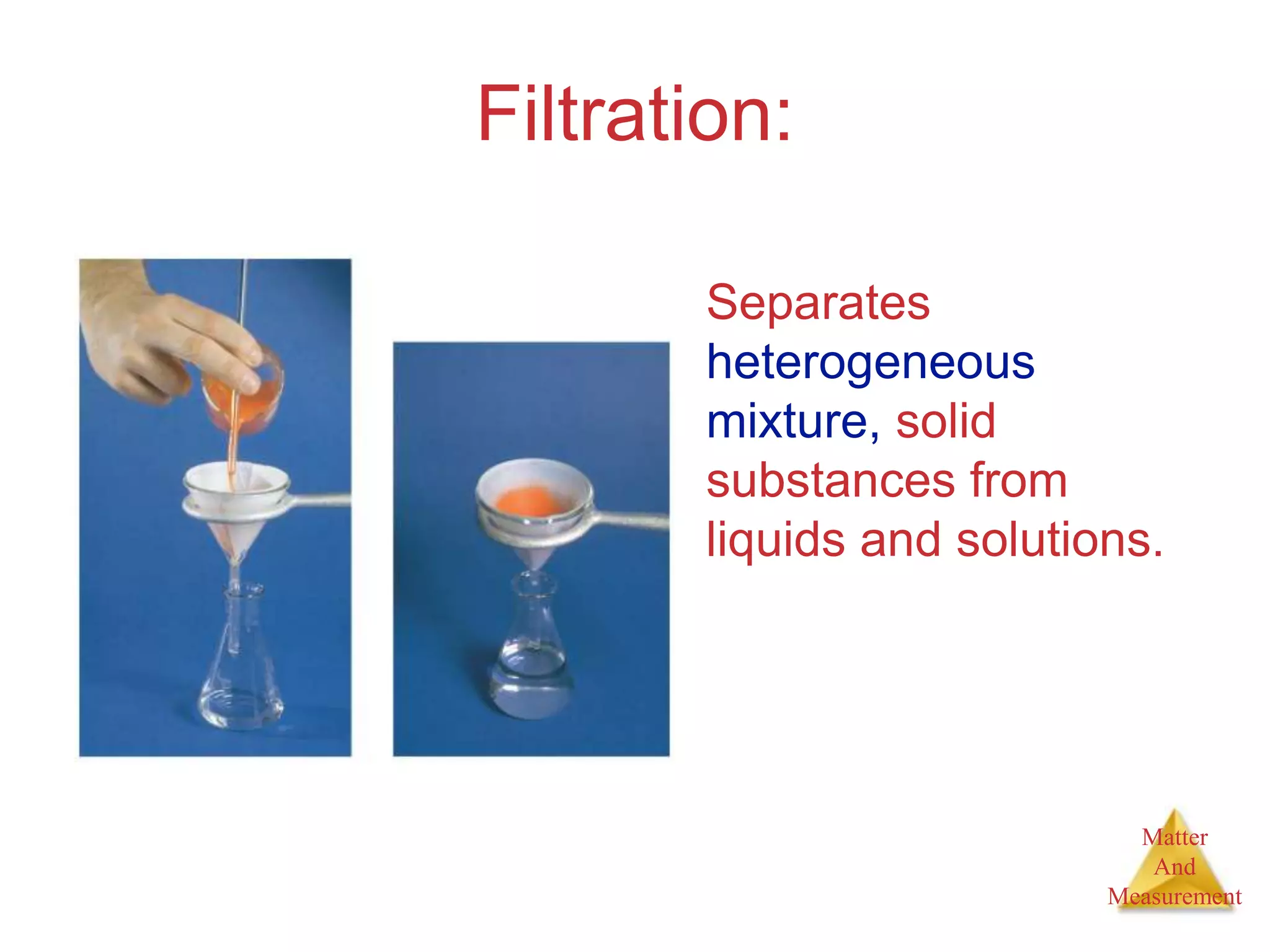
Filtration:
Separates
heterogeneous
mixture, solid
substances from
liquids and solutions.
Matter
And
Measurement
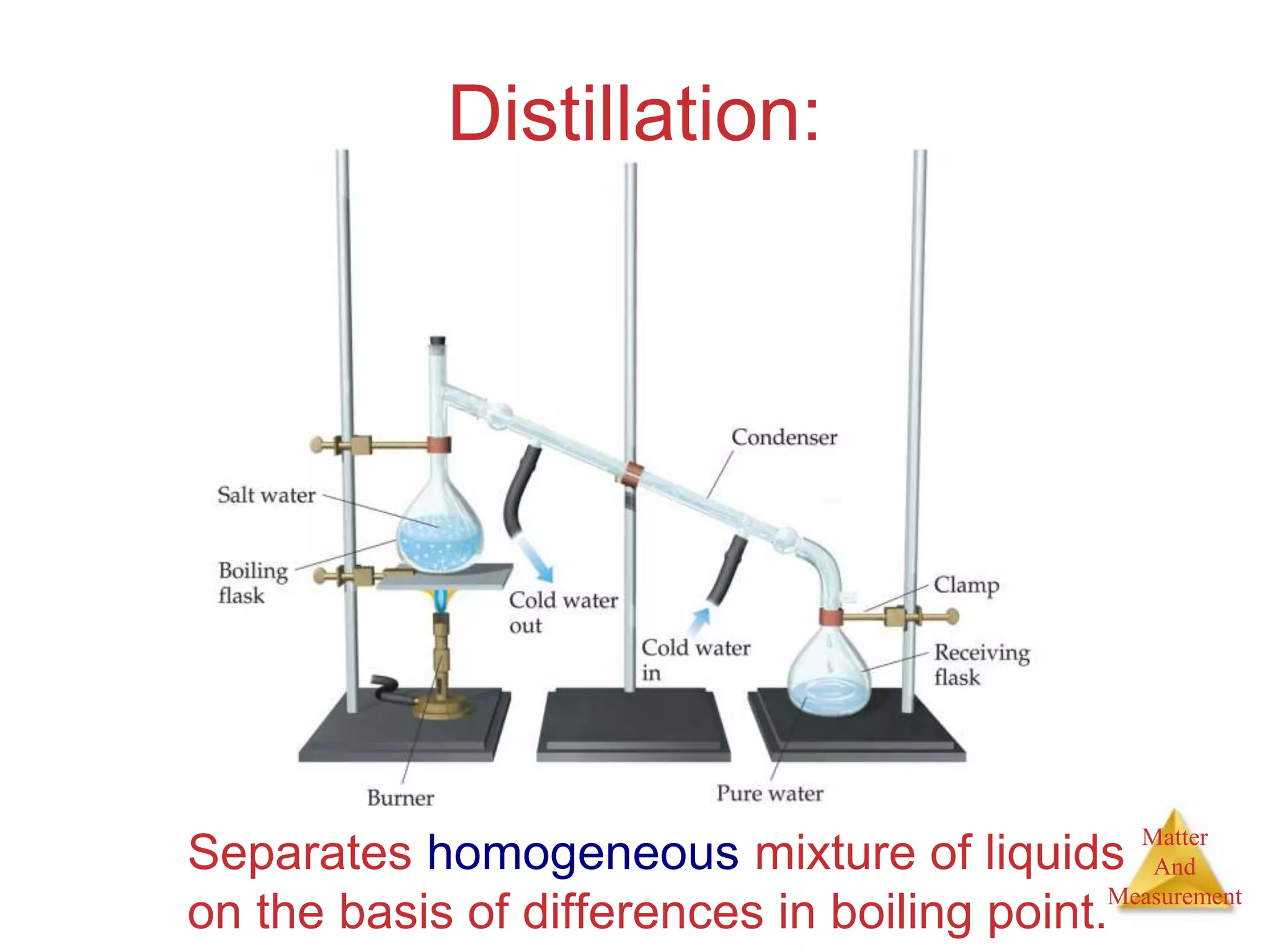
Distillation:
Separates homogeneous mixture of liquids
on the basis of differences in boiling point.
Matter
And
Measurement
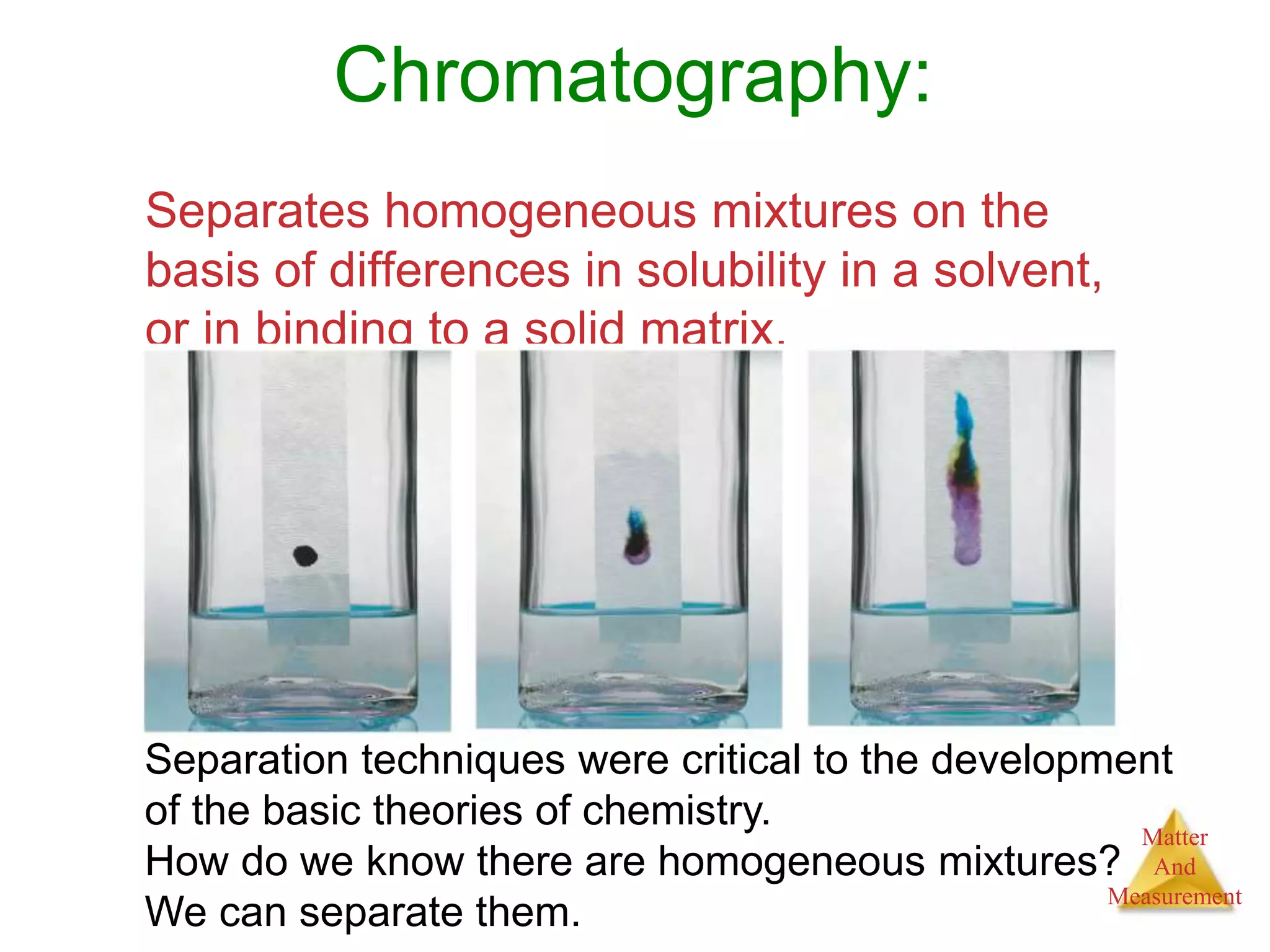
Chromatography:
Separates homogeneous mixtures on the
basis of differences in solubility in a solvent,
or in binding to a solid matrix.
Separation techniques were critical to the development
of the basic theories of chemistry.
How do we know there are homogeneous mixtures?
We can separate them.
Matter
And
Measurement
Units of
Measurement
Matter
And
Measurement
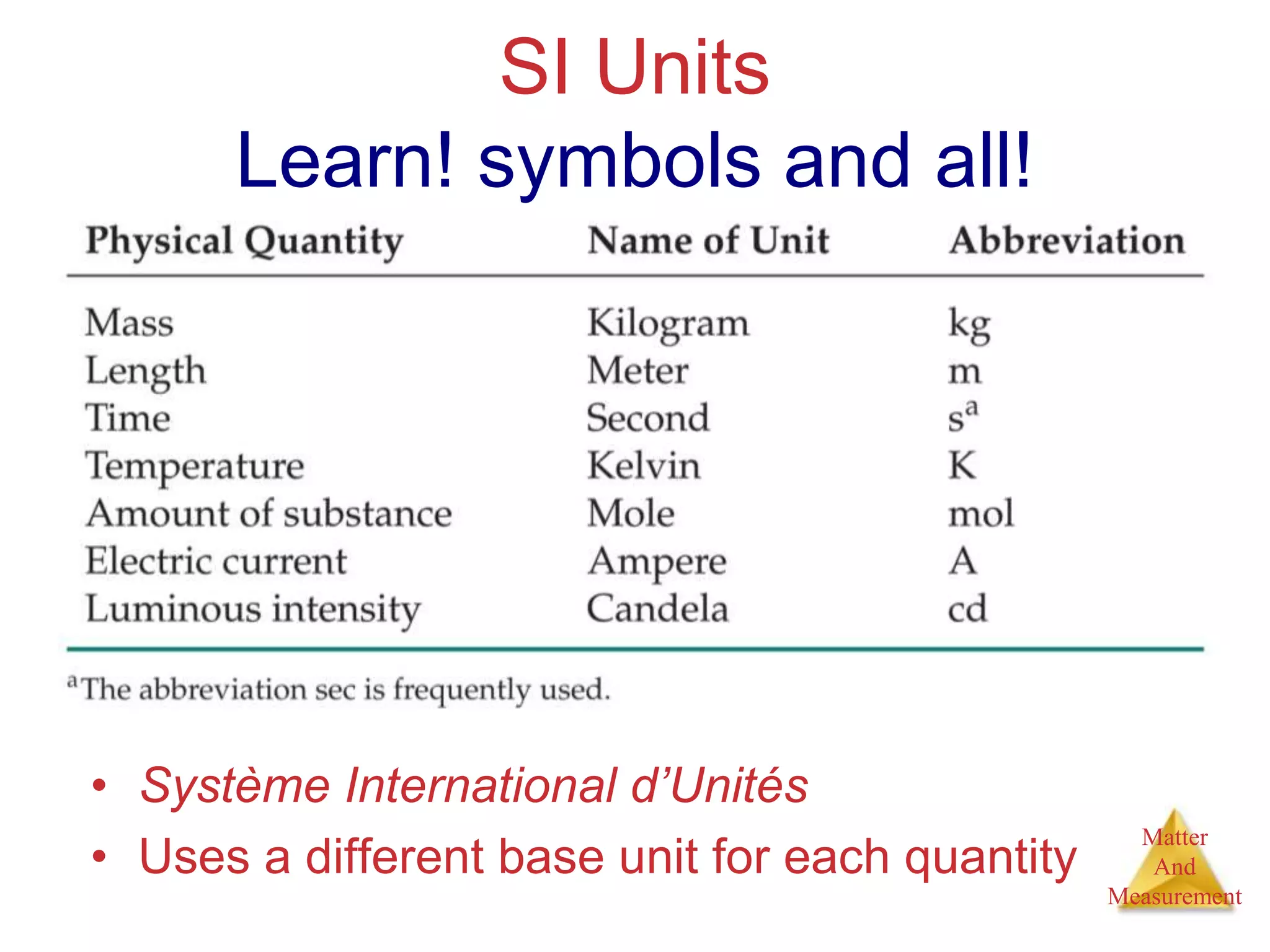
SI Units
Learn! symbols and all!
• Système International d’Unités
• Uses a different base unit for each quantity
Matter
And
Measurement
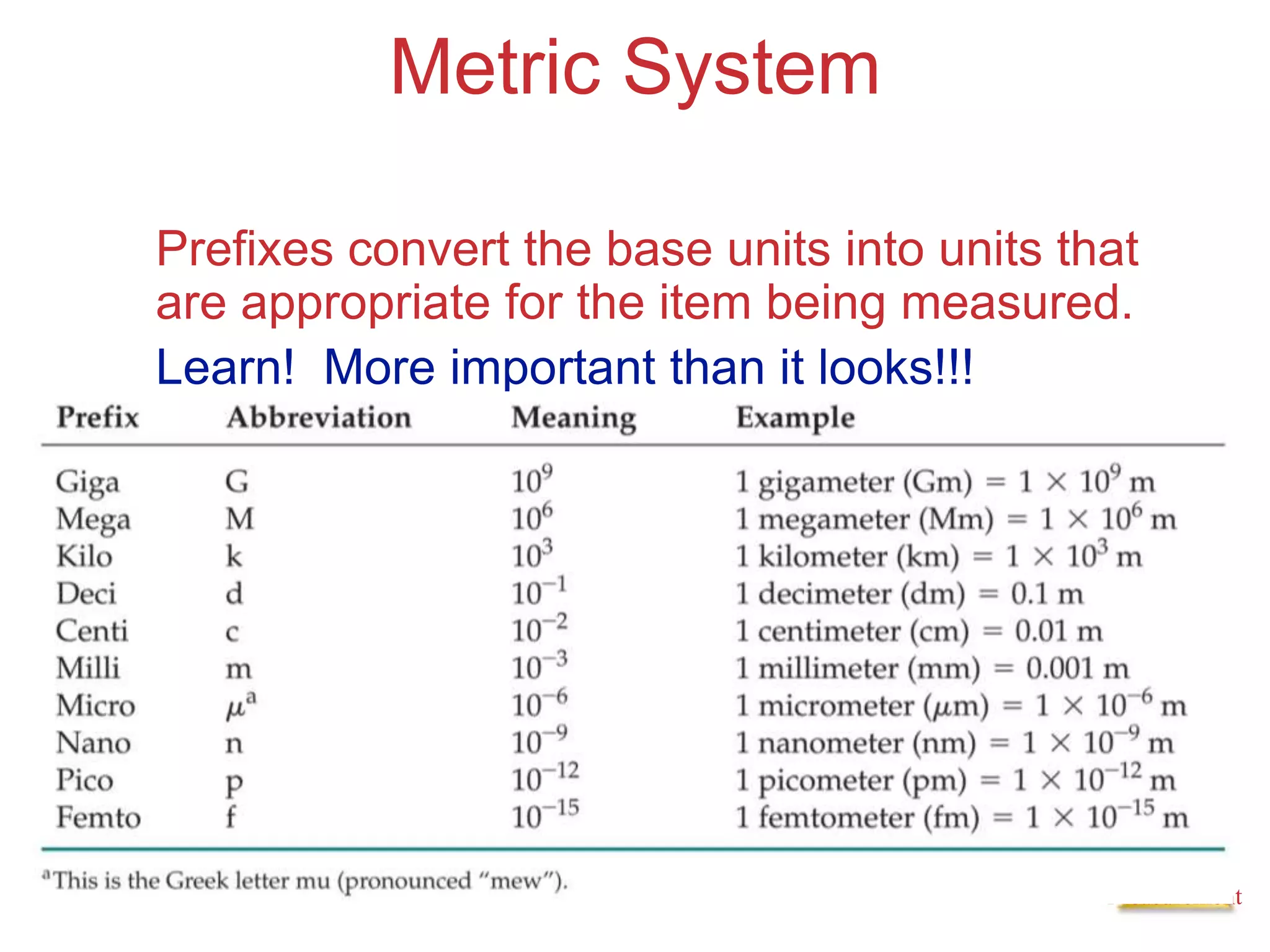
Metric System
Prefixes convert the base units into units that
are appropriate for the item being measured.
Learn! More important than it looks!!!
Matter
And
Measurement
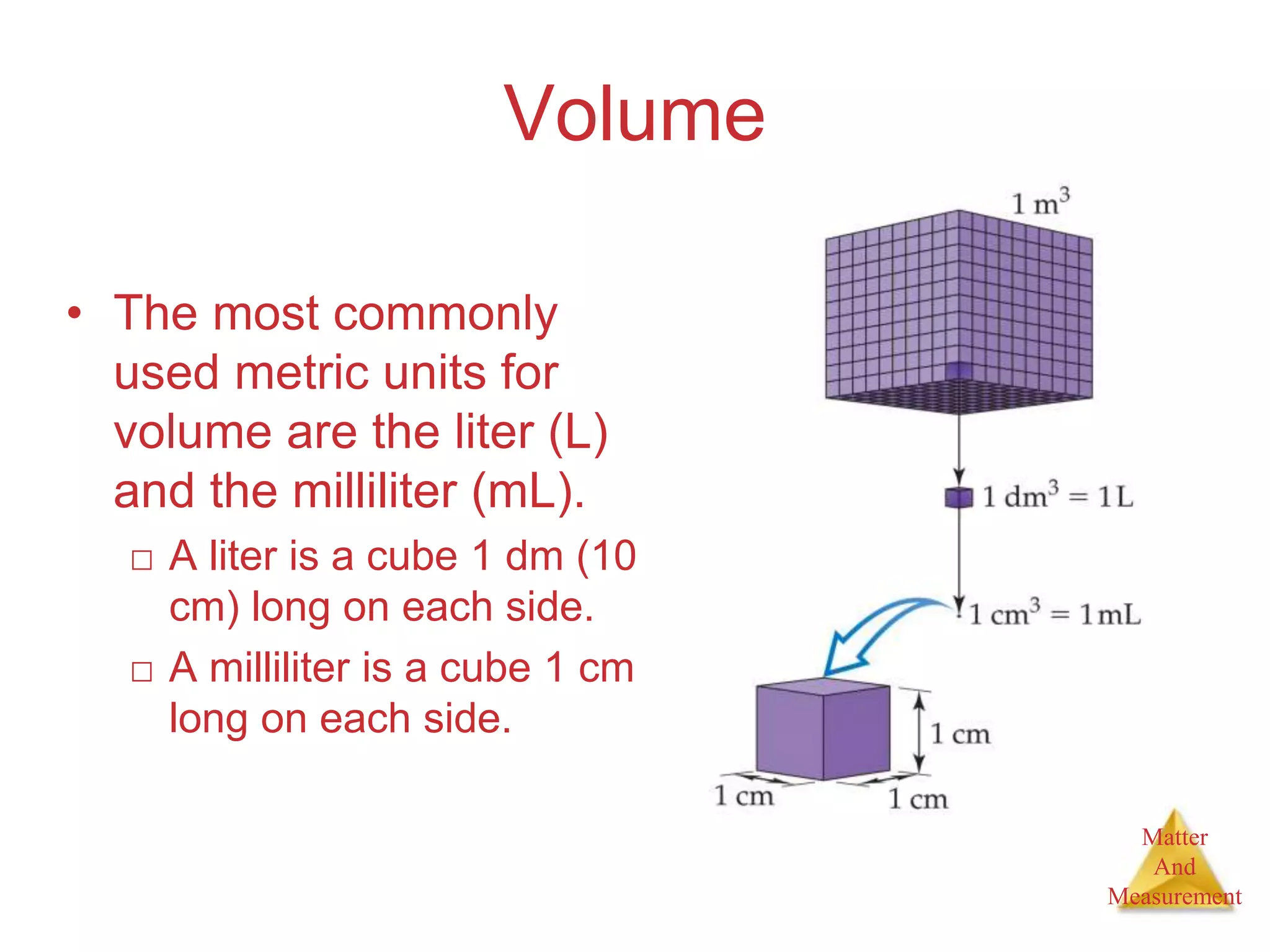
Volume
• The most commonly
used metric units for
volume are the liter (L)
and the milliliter (mL).
□ A liter is a cube 1 dm (10
cm) long on each side.
□ A milliliter is a cube 1 cm
long on each side.
Matter
And
Measurement
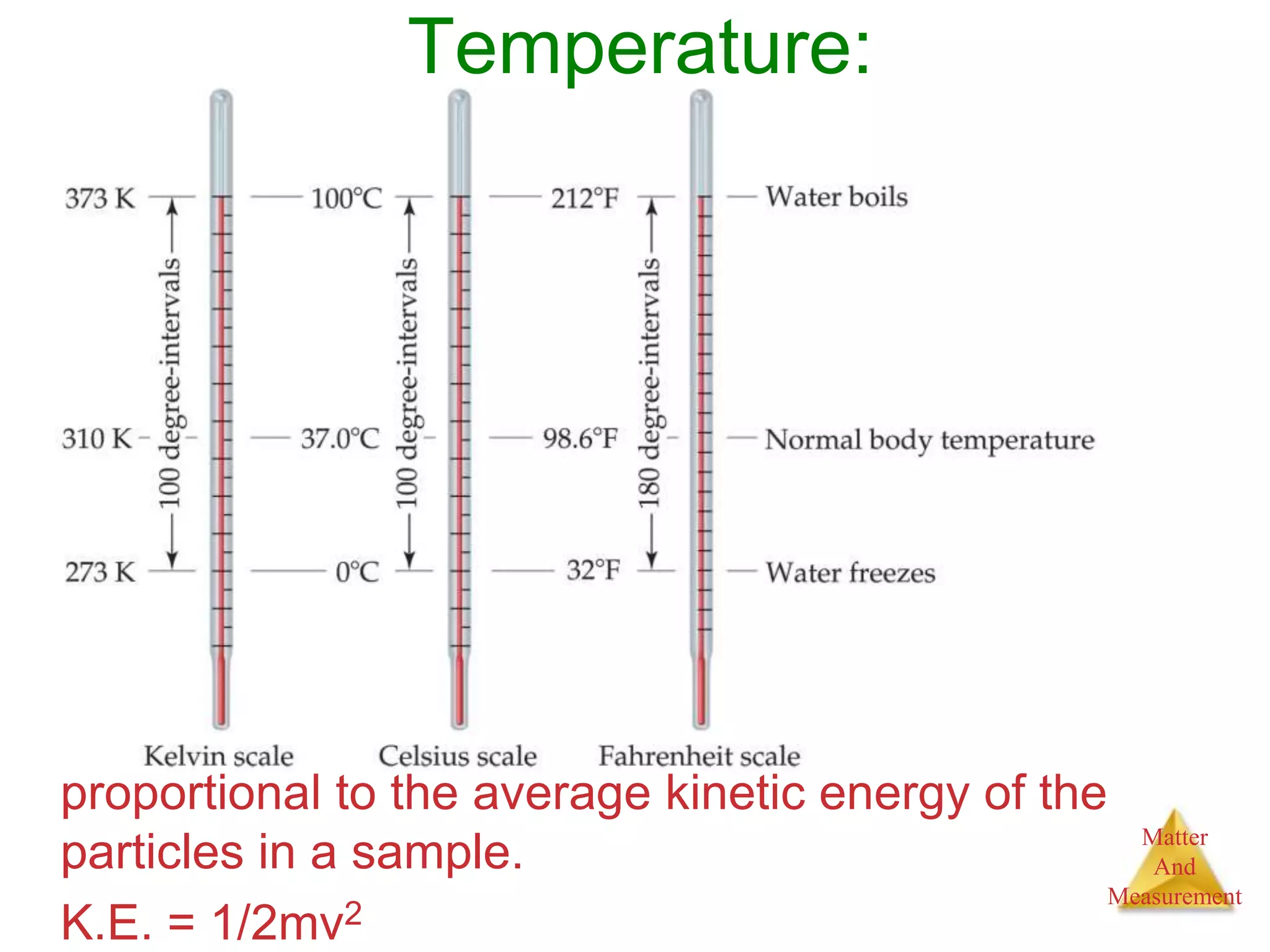
Temperature:
proportional to the average kinetic energy of the
particles in a sample.
K.E. = 1/2mv2
Matter
And
Measurement
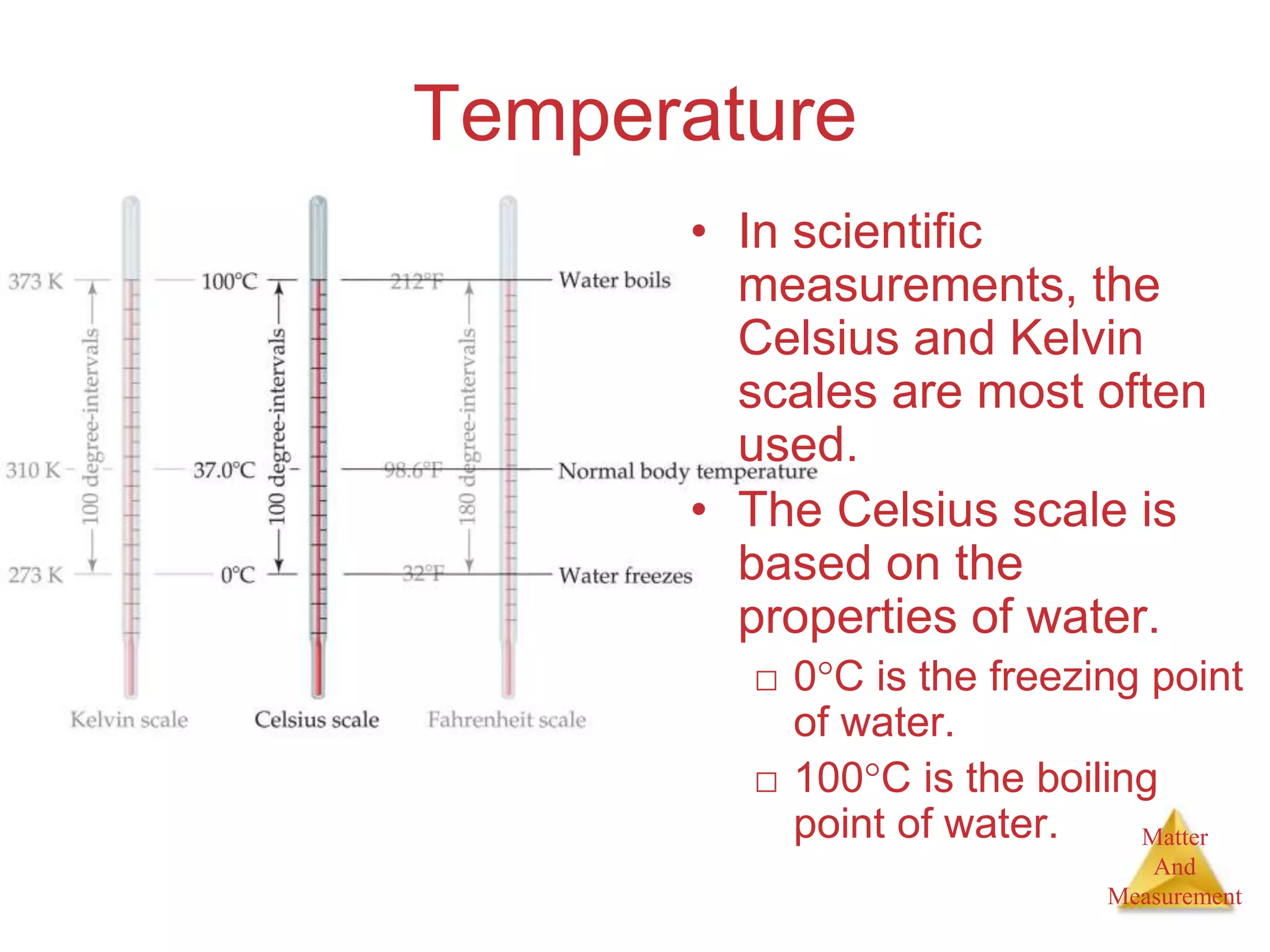
Temperature
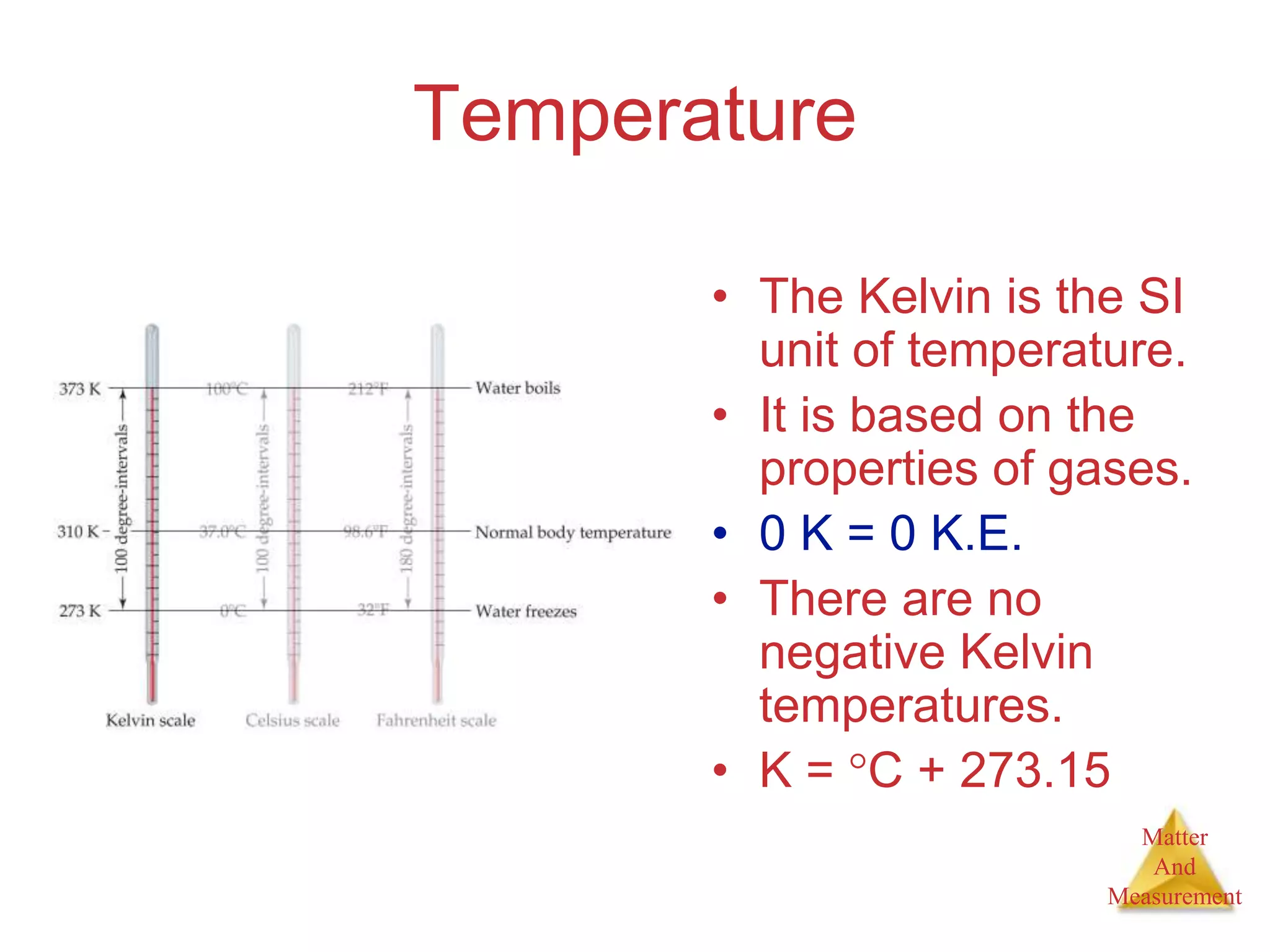
• In scientific
measurements, the
Celsius and Kelvin
scales are most often
used.
• The Celsius scale is
based on the
properties of water.
□ 0C is the freezing point
of water.
□ 100C is the boiling
point of water.
Matter
And
Measurement
Temperature
• The Kelvin is the SI
unit of temperature.
• It is based on the
properties of gases.
• 0 K = 0 K.E.
• There are no
negative Kelvin
temperatures.
• K = C + 273.15
Matter
And
Measurement
Temperature
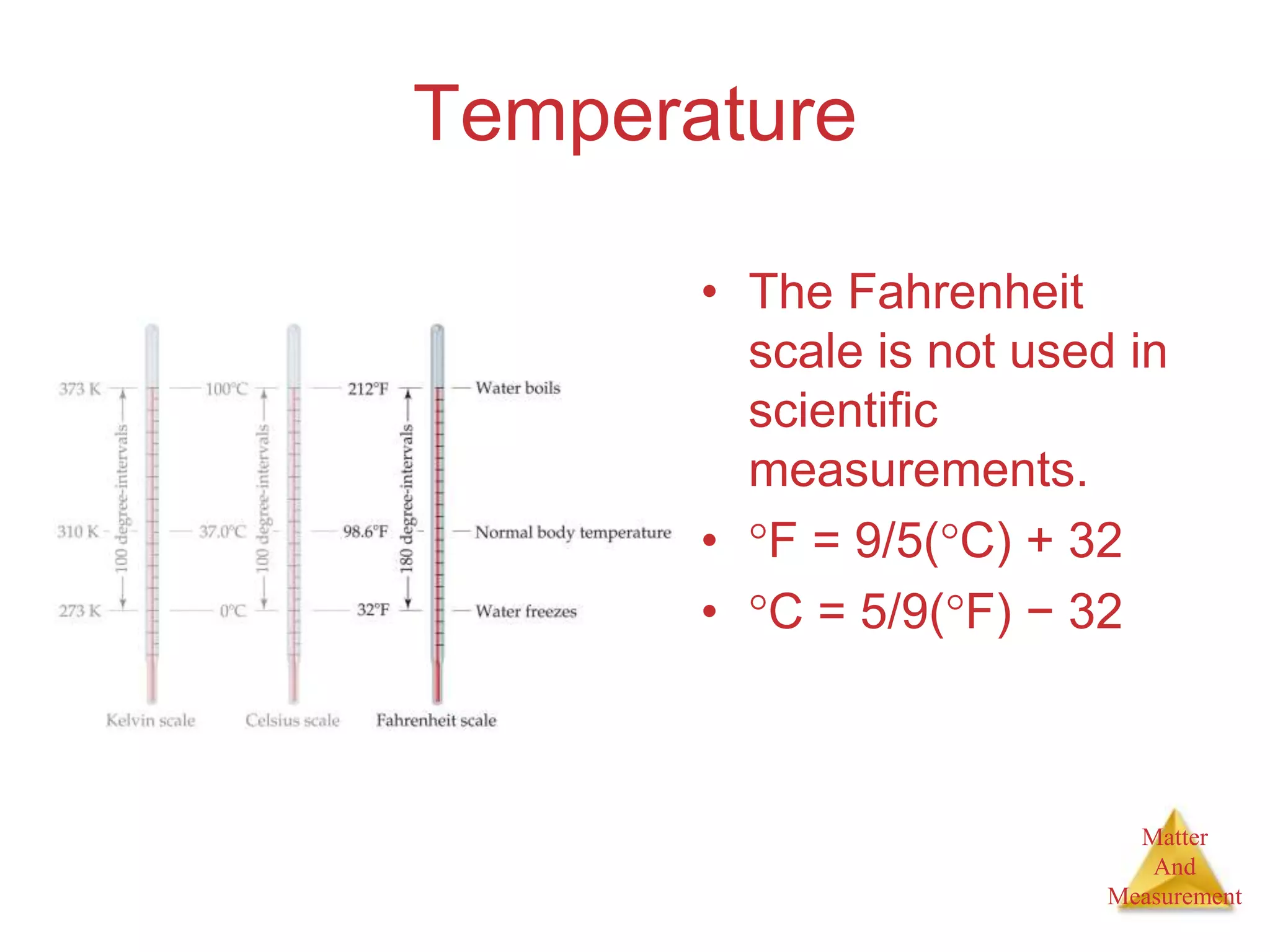
• The Fahrenheit
scale is not used in
scientific
measurements.
• F = 9/5(C) + 32
• C = 5/9(F) − 32
Matter
And
Measurement
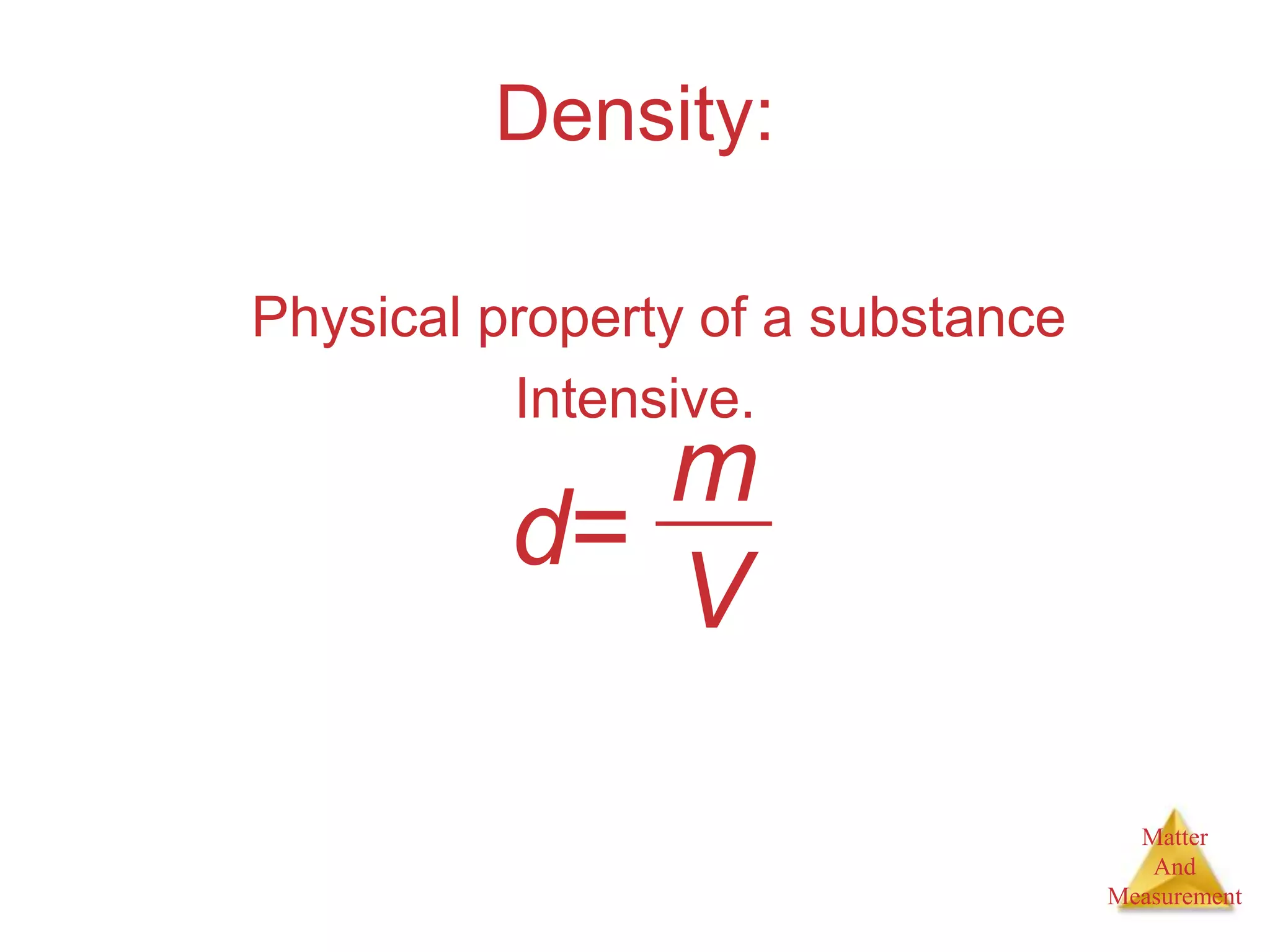
Density:
Physical property of a substance
Intensive.
d=
m
V
Matter
And
Measurement
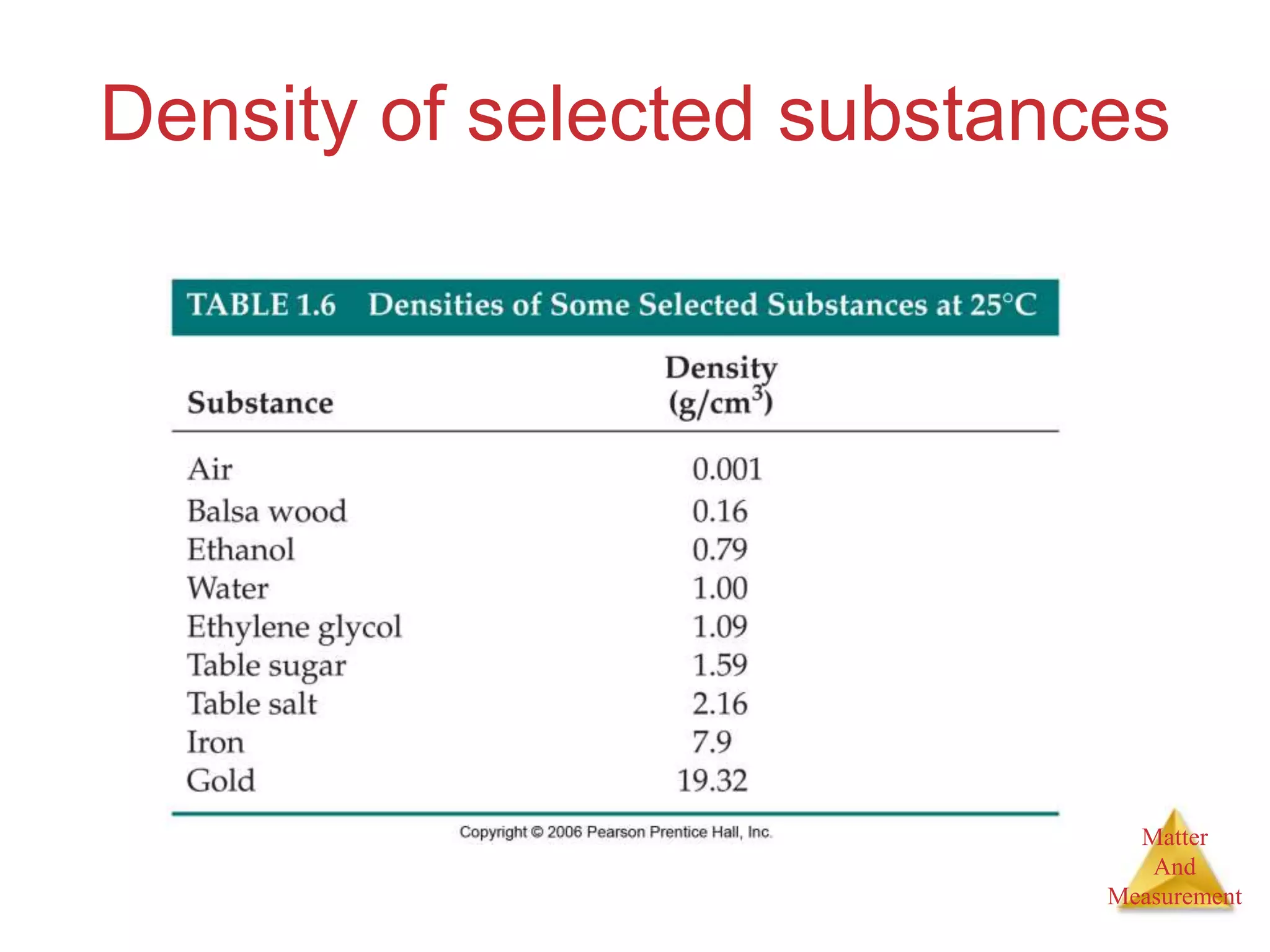
Density of selected substances
Matter
And
Measurement
Uncertainty in
Measurement
Matter
And
Measurement
Uncertainty in Measurements
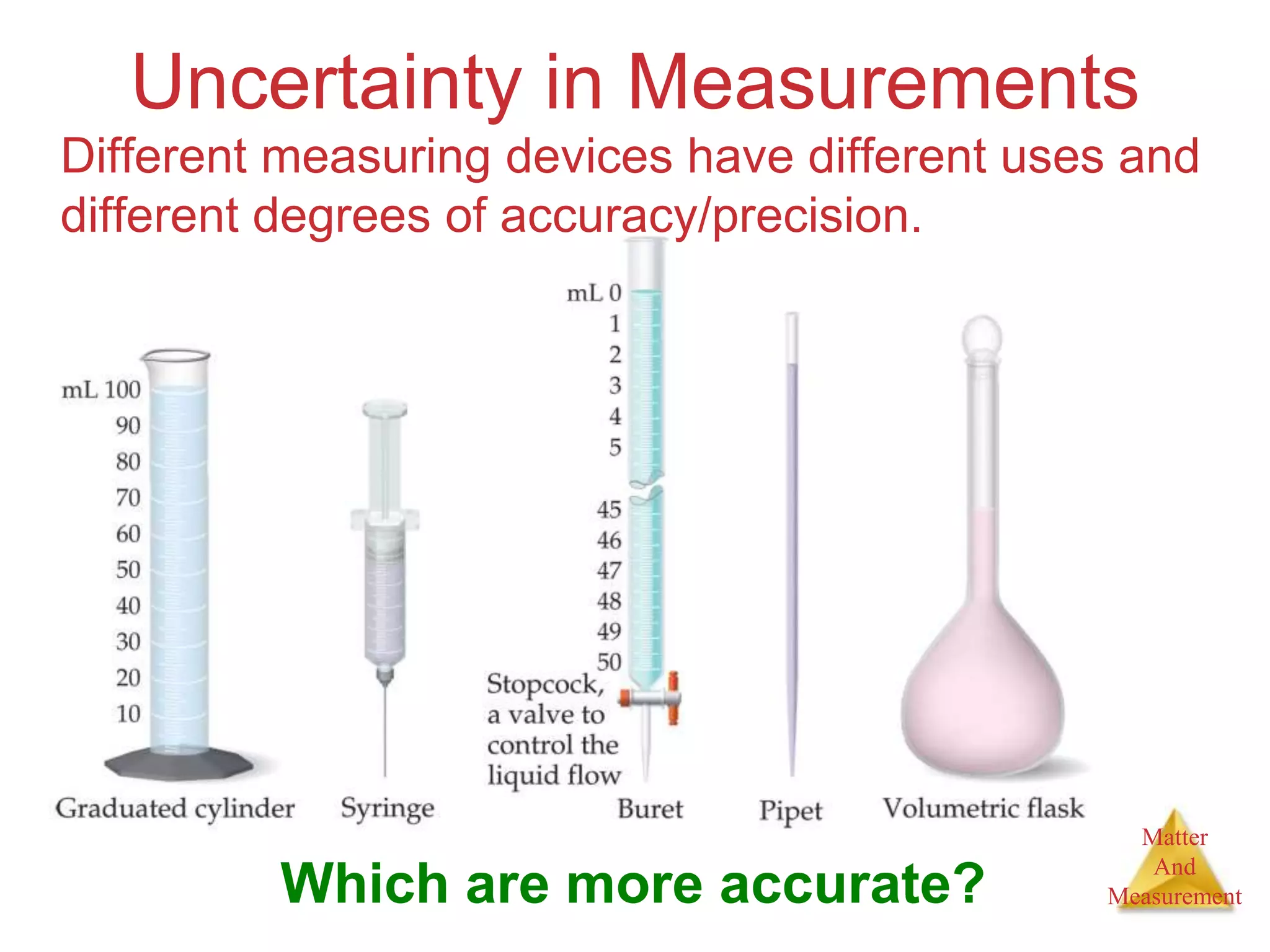
Which are more accurate?
Different measuring devices have different uses and
different degrees of accuracy/precision.
Matter
And
Measurement
Uncertainty in Measurements
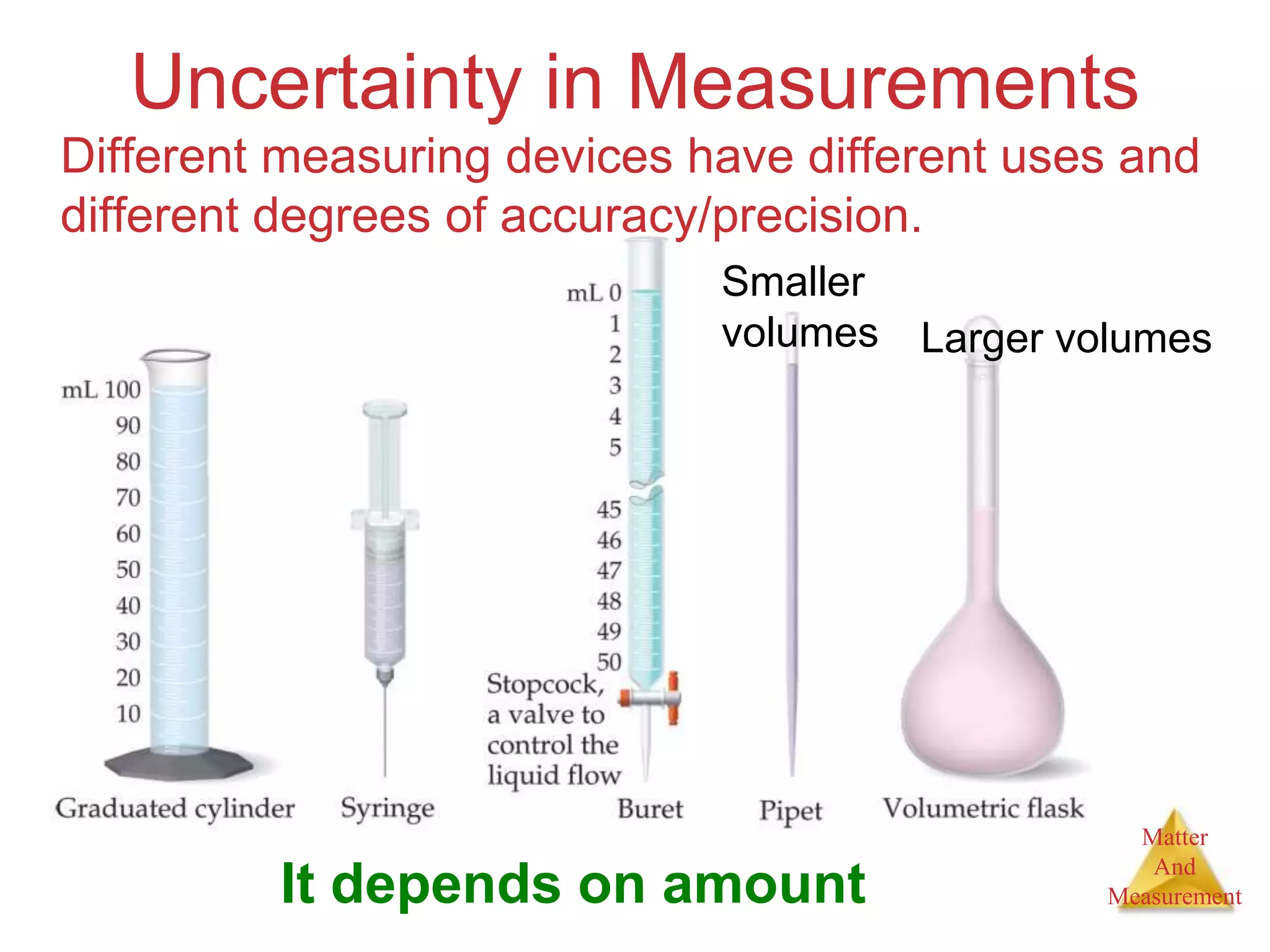
It depends on amount
Different measuring devices have different uses and
different degrees of accuracy/precision.
Larger volumes
Smaller
volumes
Matter
And
Measurement
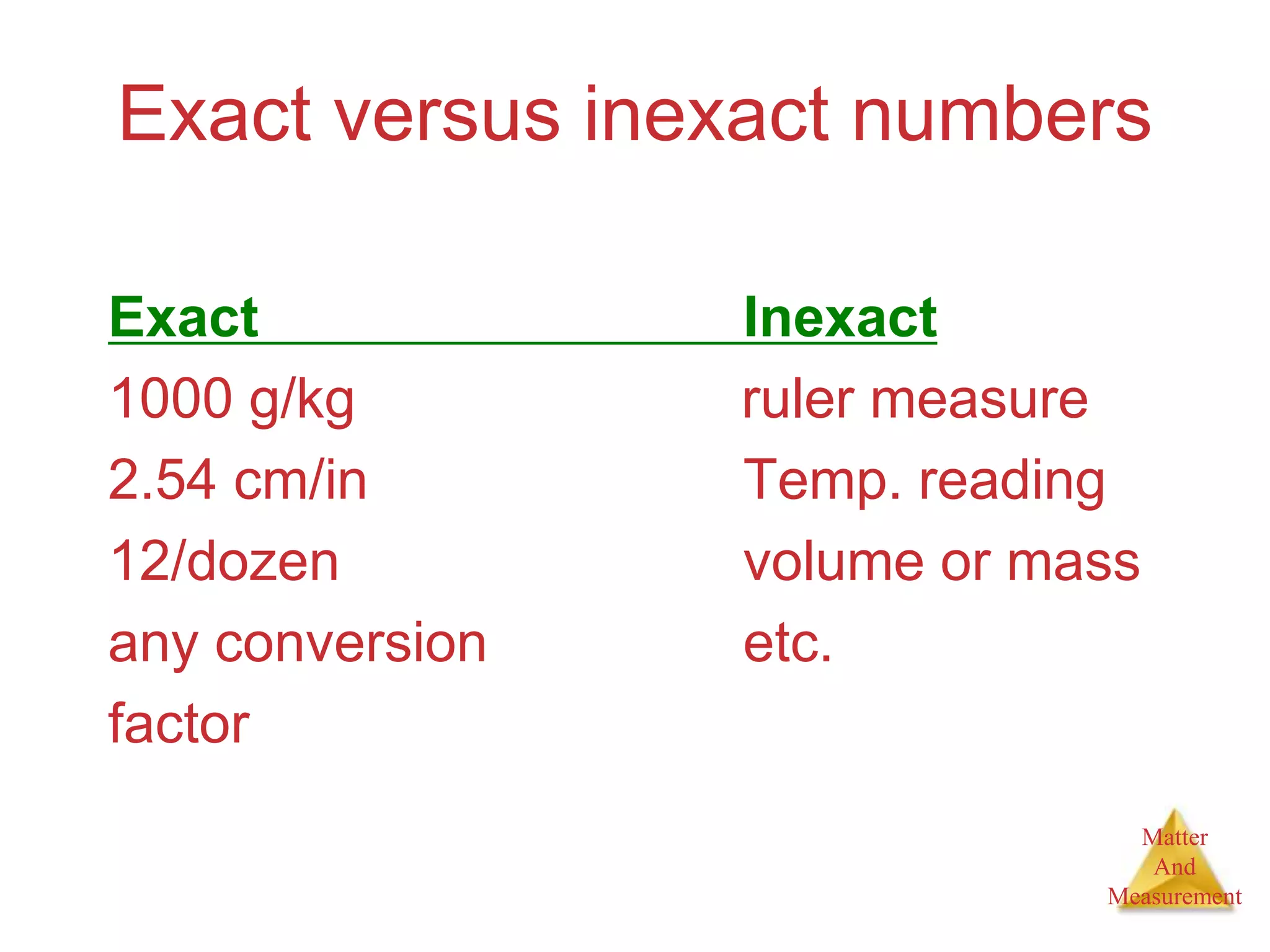
Exact versus inexact numbers
Exact Inexact
1000 g/kg ruler measure
2.54 cm/in Temp. reading
12/dozen volume or mass
any conversion etc.
factor
Matter
And
Measurement
Significant Figures
• The term significant figures refers to
digits that were measured.
• When rounding calculated numbers, we
pay attention to significant figures so we
do not overstate the precision of our
answers.
Matter
And
Measurement
Significant Figures
1. All nonzero digits are significant. (sig figs in
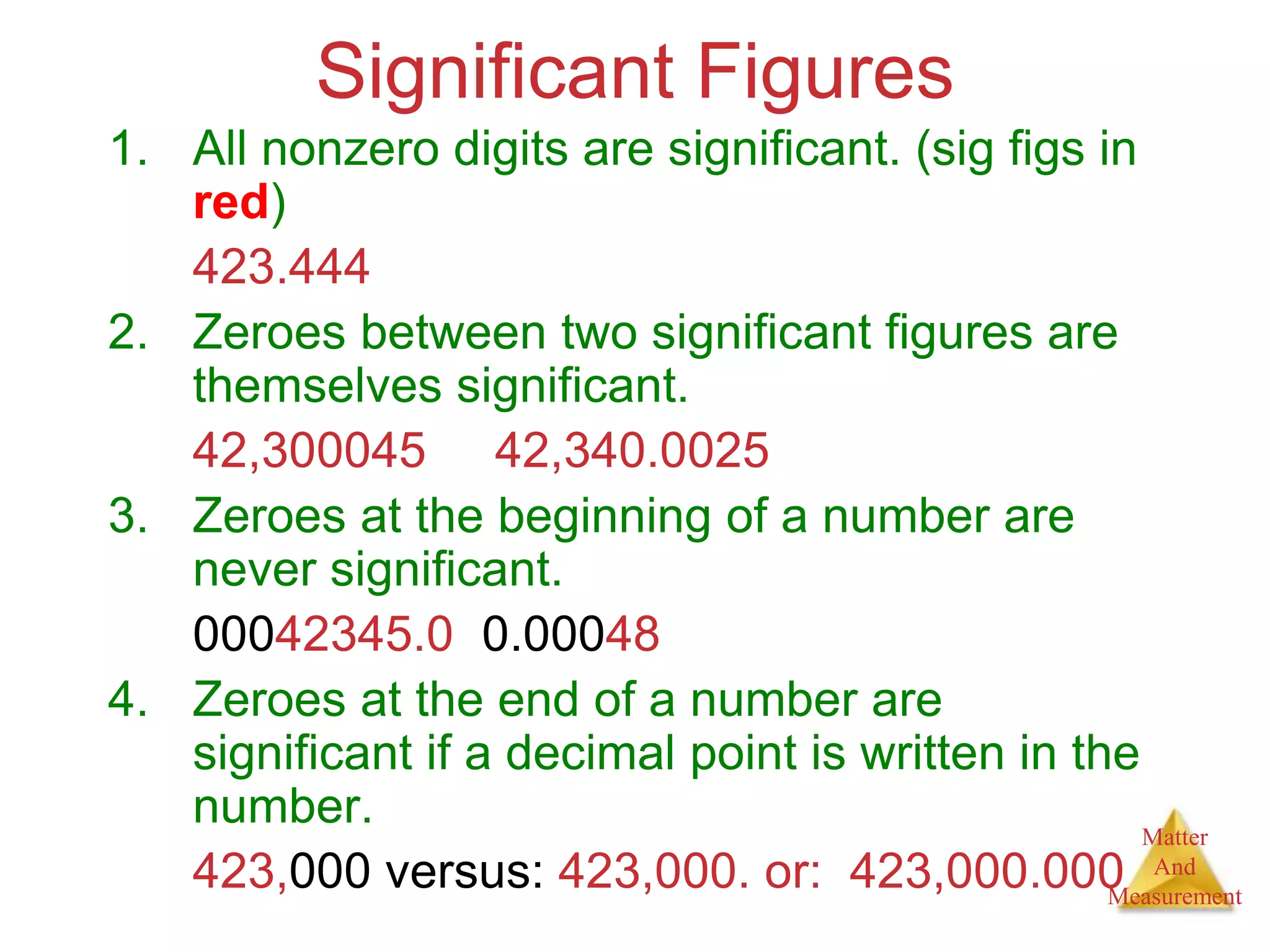
red)
423.444
2. Zeroes between two significant figures are
themselves significant.
42,300045 42,340.0025
3. Zeroes at the beginning of a number are
never significant.
00042345.0 0.00048
4. Zeroes at the end of a number are
significant if a decimal point is written in the
number.
423,000 versus: 423,000. or: 423,000.000
Matter
And
Measurement
Significant Figures
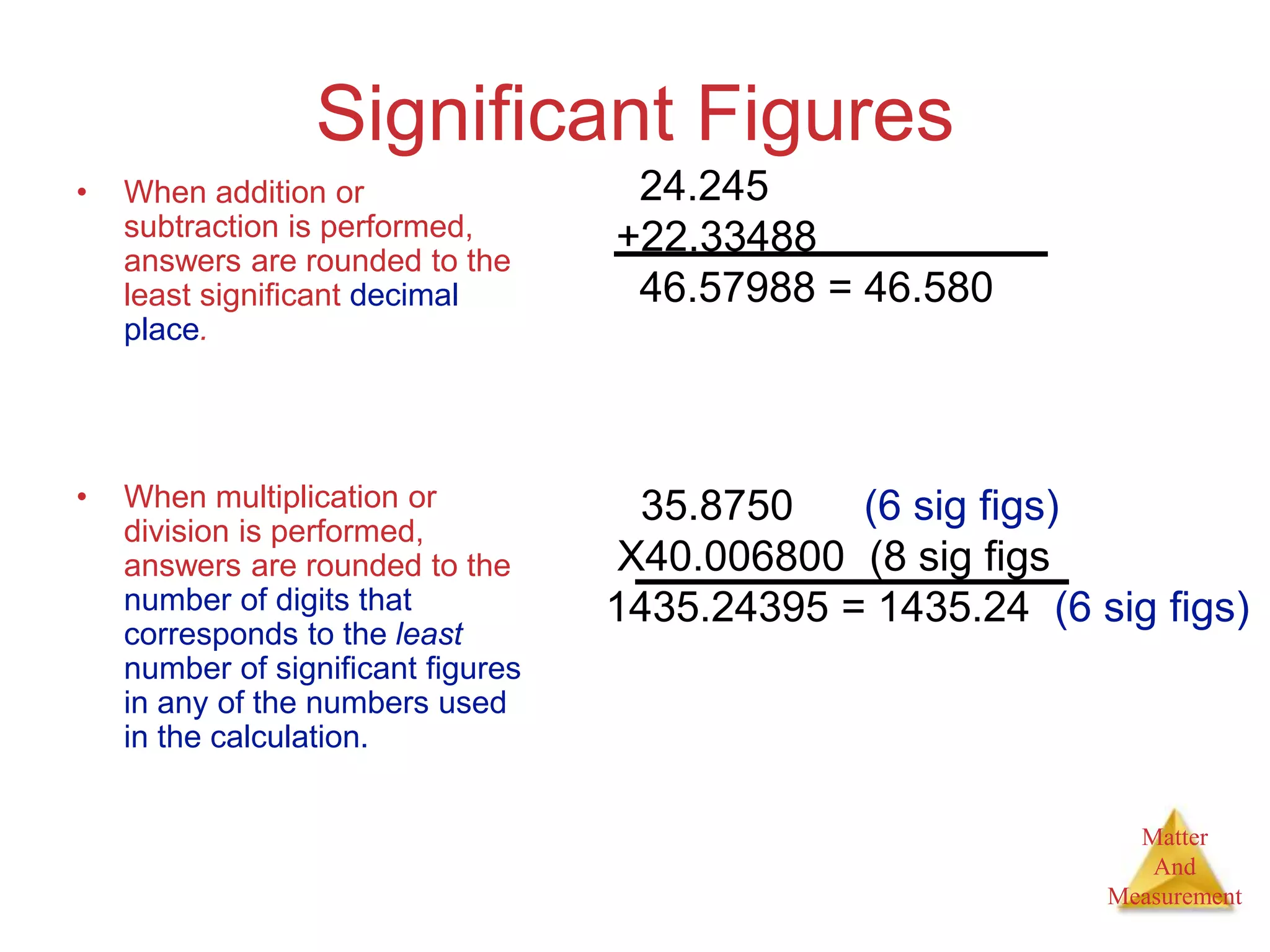
• When addition or
subtraction is performed,
answers are rounded to the
least significant decimal
place.
• When multiplication or
division is performed,
answers are rounded to the
number of digits that
corresponds to the least
number of significant figures
in any of the numbers used
in the calculation.
24.245
+22.33488
46.57988 = 46.580
35.8750 (6 sig figs)
X40.006800 (8 sig figs
1435.24395 = 1435.24 (6 sig figs)
Matter
And
Measurement
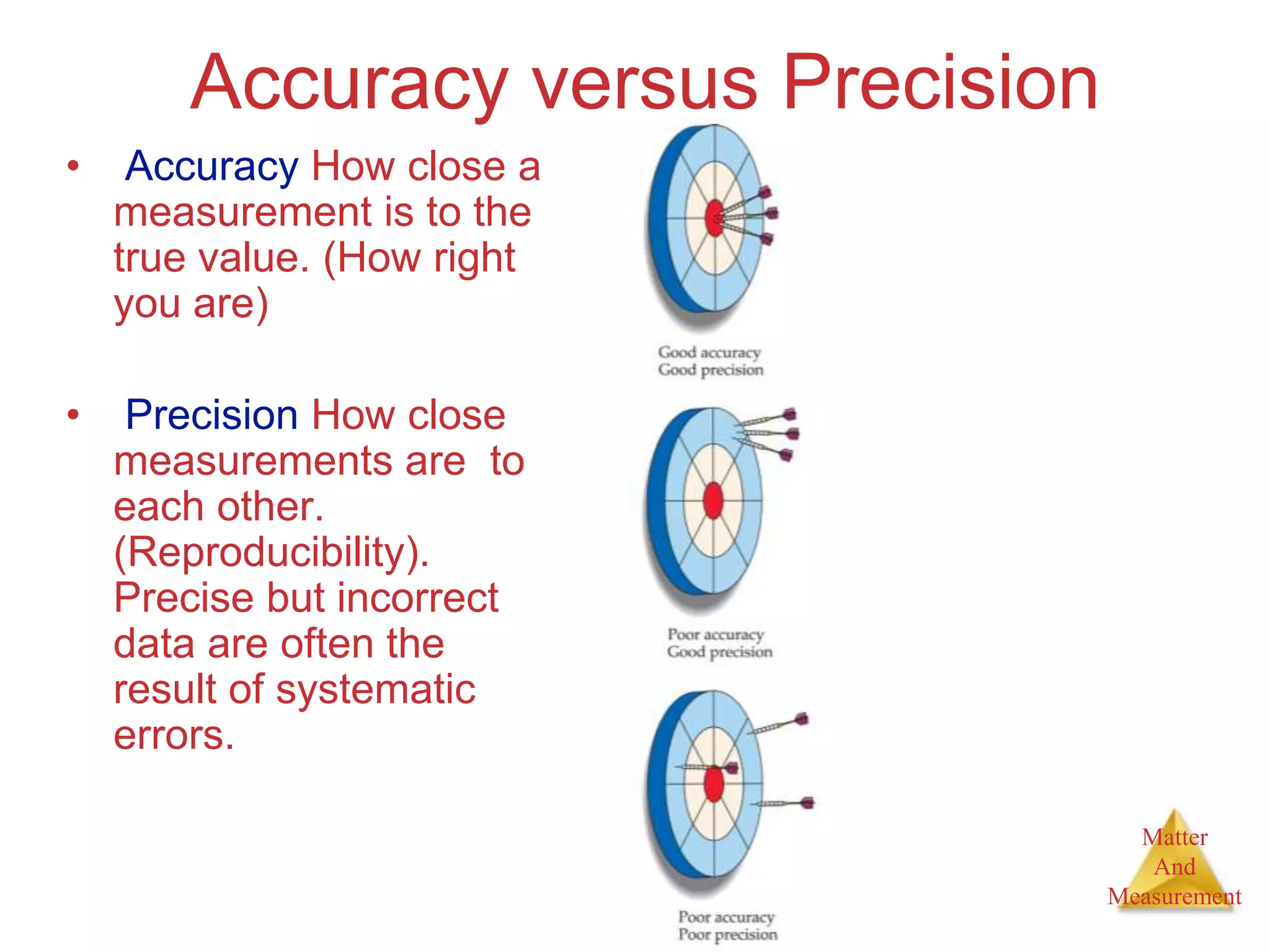
Accuracy versus Precision
• Accuracy How close a
measurement is to the
true value. (How right
you are)
• Precision How close
measurements are to
each other.
(Reproducibility).
Precise but incorrect
data are often the
result of systematic
errors.
Matter
And
Measurement
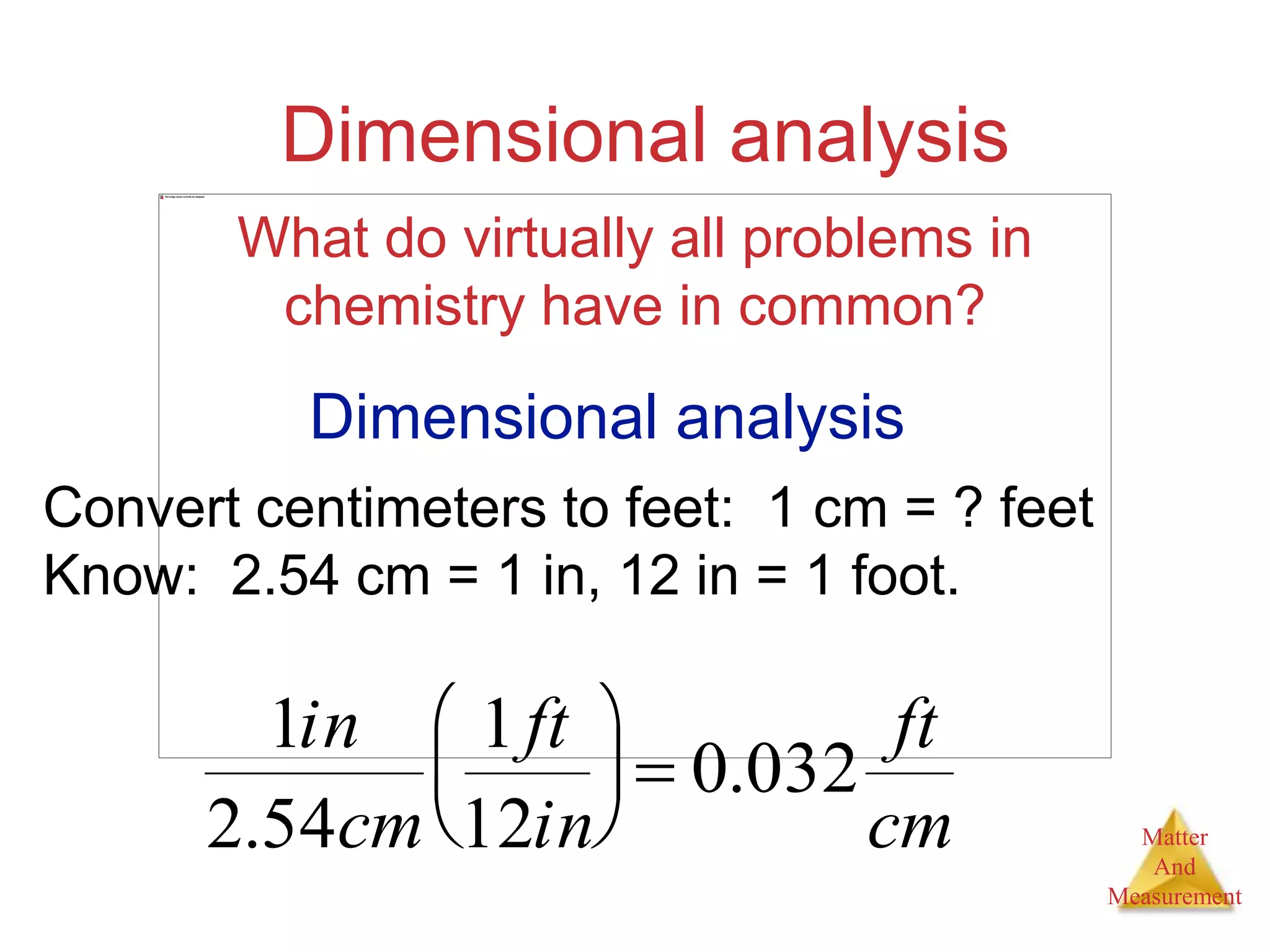
Dimensional analysis
What do virtually all problems in
chemistry have in common?
Dimensional analysis
Convert centimeters to feet: 1 cm = ? feet
Know: 2.54 cm = 1 in, 12 in = 1 foot.
1in
2.54cm
1ft
12in





 0.032
ft
cm
Matter
And
Measurement
Dimensional Analysis
• What do I need on top?
• What do I need on the bottom?
• What do I know?
• How do I get there?
• Note: You will always be given the
conversion factors you need, you don’t
have to memorize them.
Matter
And
Measurement
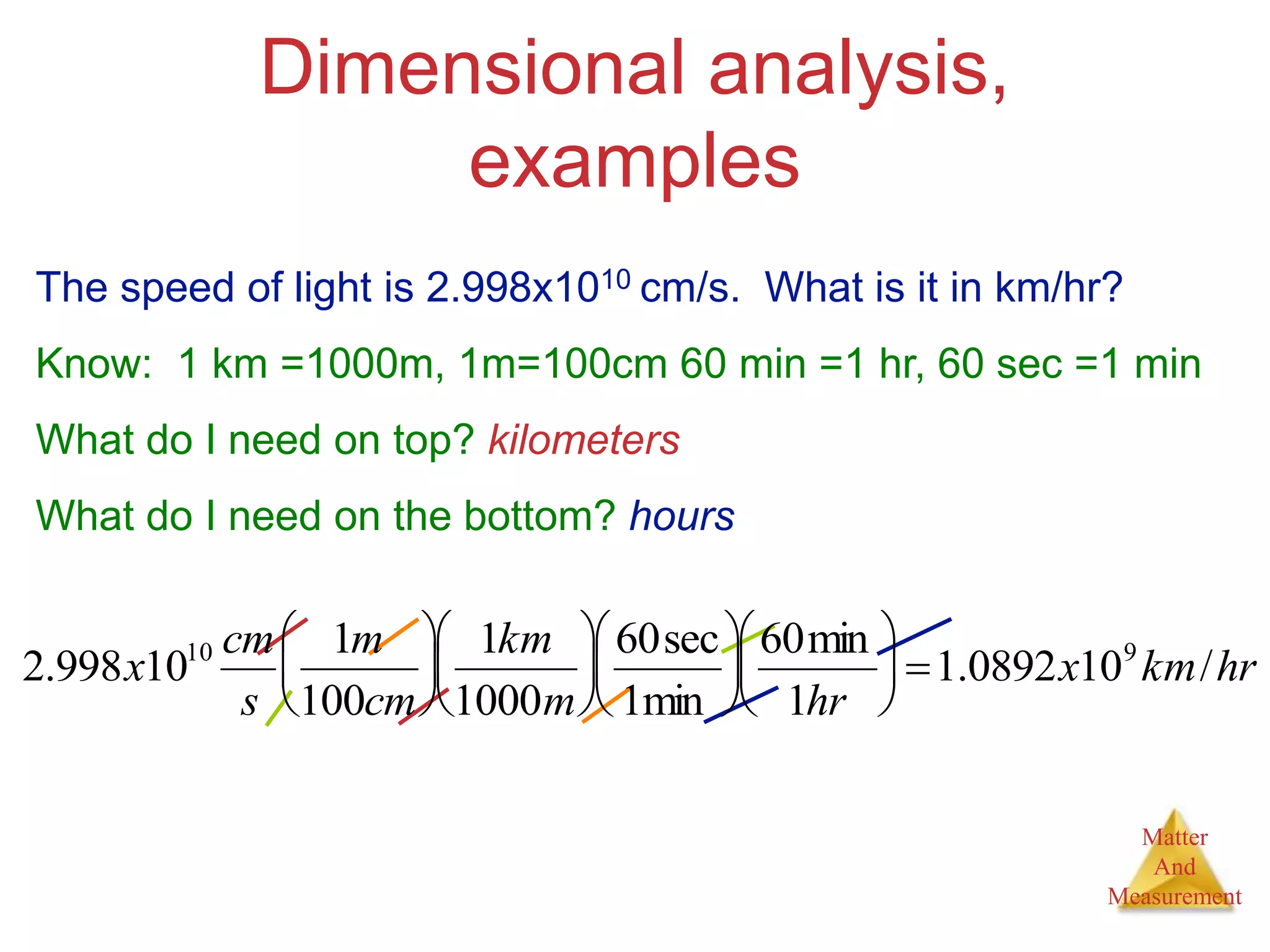
Dimensional analysis,
examples
The speed of light is 2.998x1010 cm/s. What is it in km/hr?
Know: 1 km =1000m, 1m=100cm 60 min =1 hr, 60 sec =1 min
What do I need on top? kilometers
What do I need on the bottom? hours
2.998x1010 cm
s
1m
100cm






1km
1000m






60sec
1min






60min
1hr





1.0892x10⁹
km/hr
Matter
And
Measurement
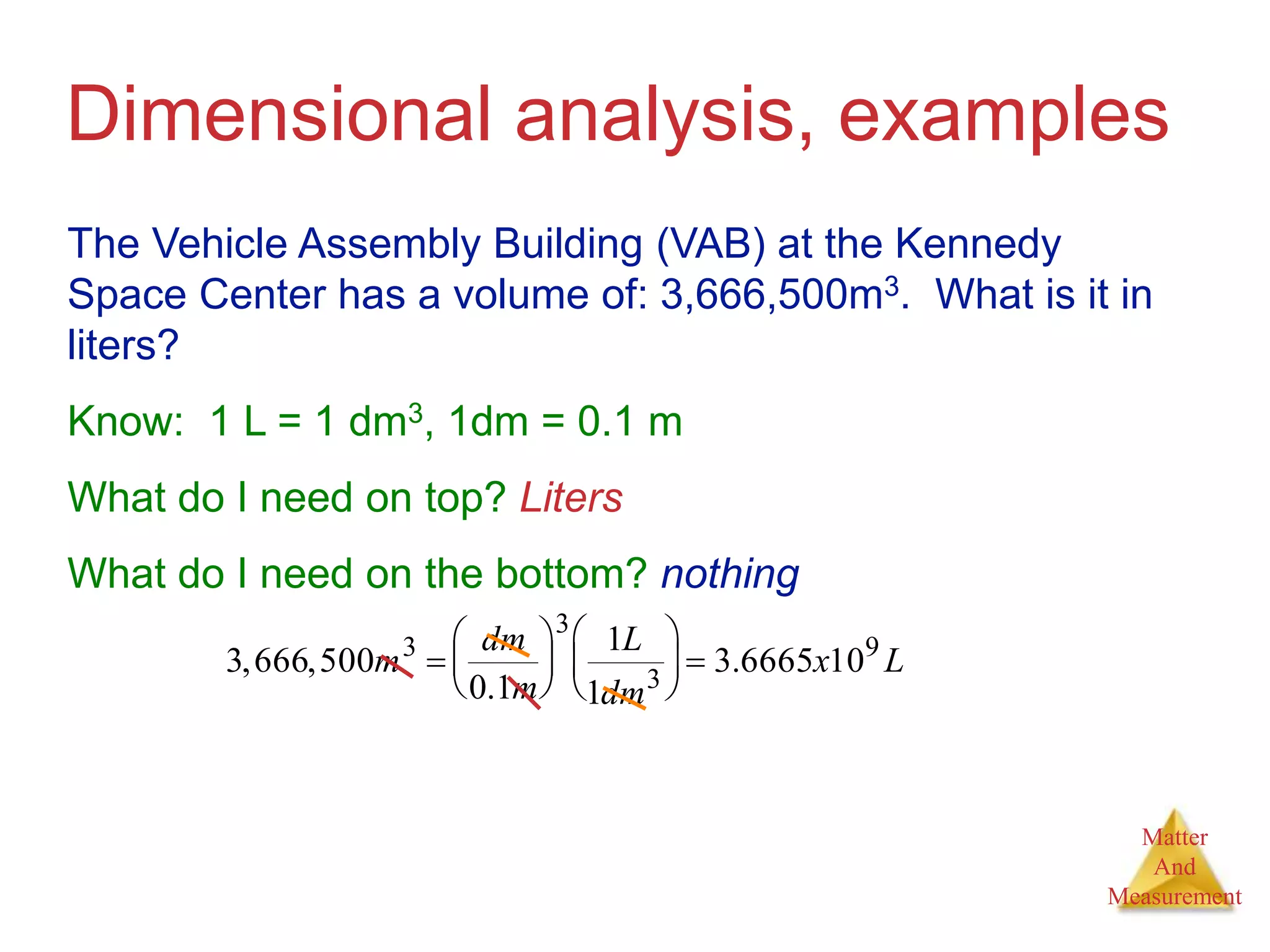
Dimensional analysis, examples
The Vehicle Assembly Building (VAB) at the Kennedy
Space Center has a volume of: 3,666,500m3. What is it in
liters?
Know: 1 L = 1 dm3, 1dm = 0.1 m
What do I need on top? Liters
What do I need on the bottom? nothing

3,666,500m3

dm
0.1m






3
1L
1dm3





 3.6665x10⁹
L
Matter
And
Measurement
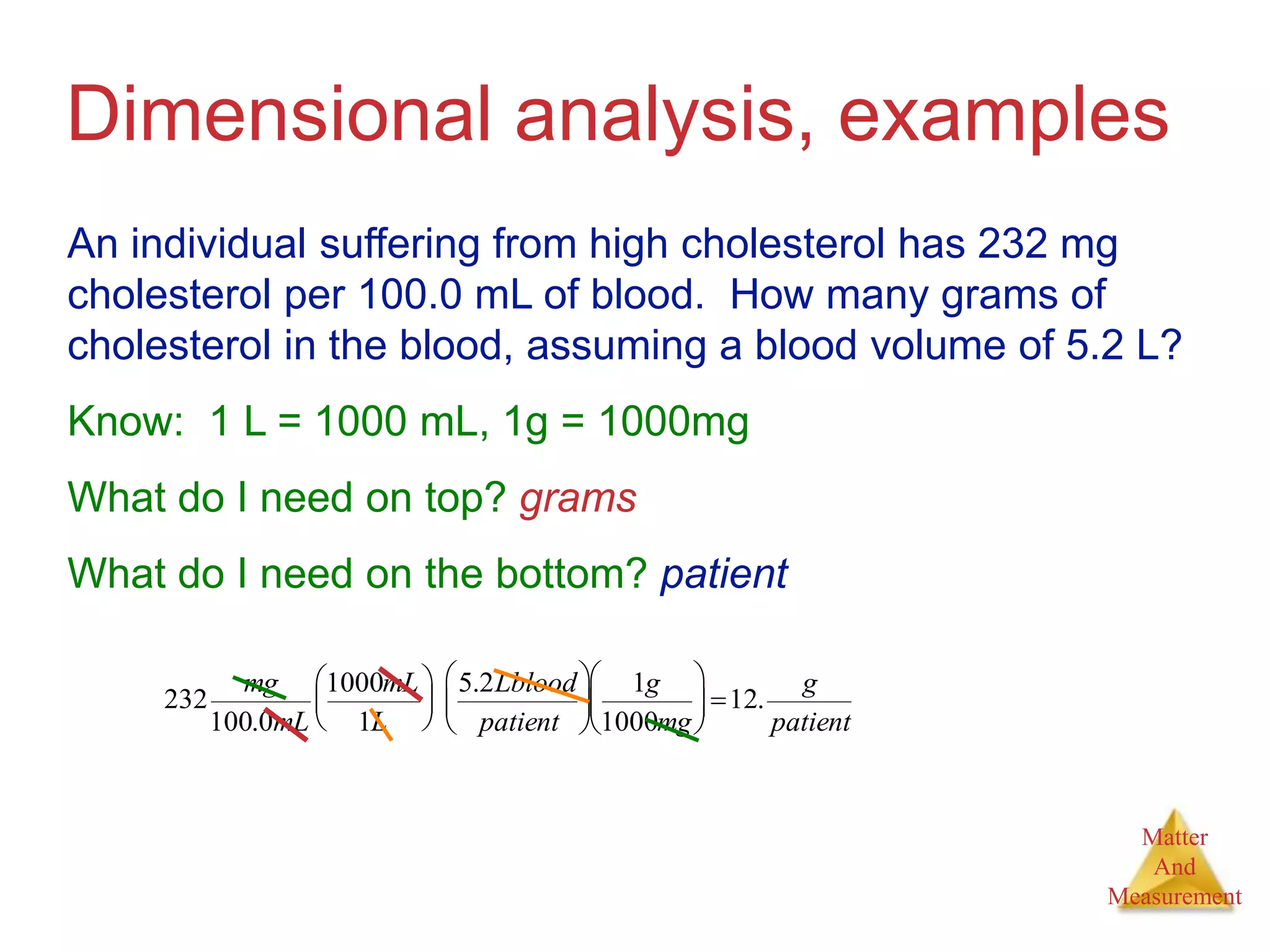
Dimensional analysis, examples
An individual suffering from high cholesterol has 232 mg
cholesterol per 100.0 mL of blood. How many grams of
cholesterol in the blood, assuming a blood volume of 5.2 L?
Know: 1 L = 1000 mL, 1g = 1000mg
What do I need on top? grams
What do I need on the bottom? patient

232
mg
100.0mL
1000mL
1L






5.2Lblood
patient






1g
1000mg





12.
g
patient

2 matter and mesurement and elements of uncertatinty.ppt