Unit 1 - Matter What you should know at the end of this unit. ____ Lab Safety  ____ States of Matter  ____ Lab Equipment  ____ Specific Heat ____ Properties of Matter  ____ Classification of  ____ SI Units and Prefixes  Matter ____ Significant Figures  ____ Physical Properties ____ Metric Conversions  and Changes ____ Density  ____ Chemical Properties ____ Density Calculations  and Changes ____ Percent Error ____ Dimensional Analysis
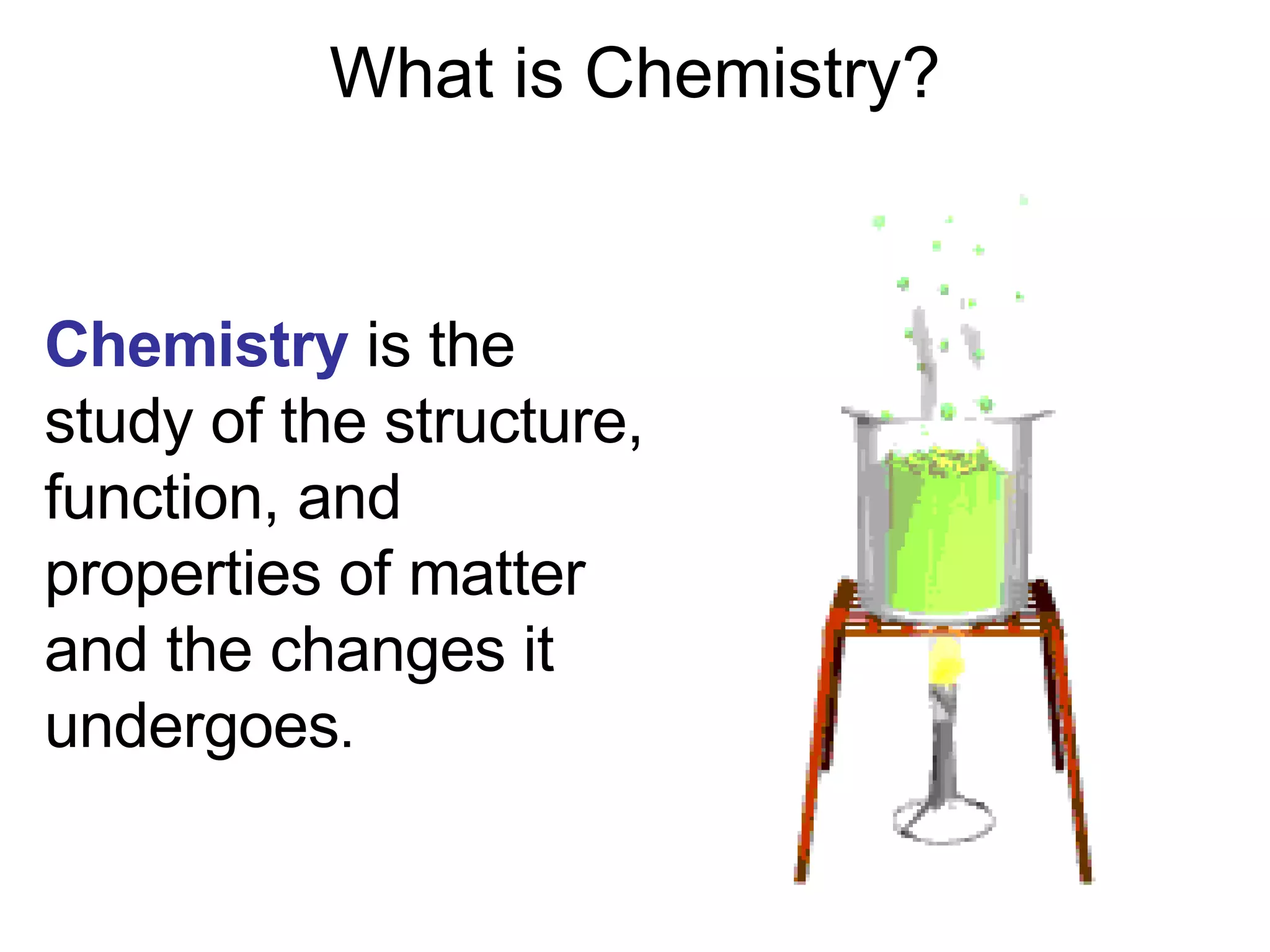
What is Chemistry? Chemistry  is the study of the structure, function, and properties of matter and the changes it undergoes .
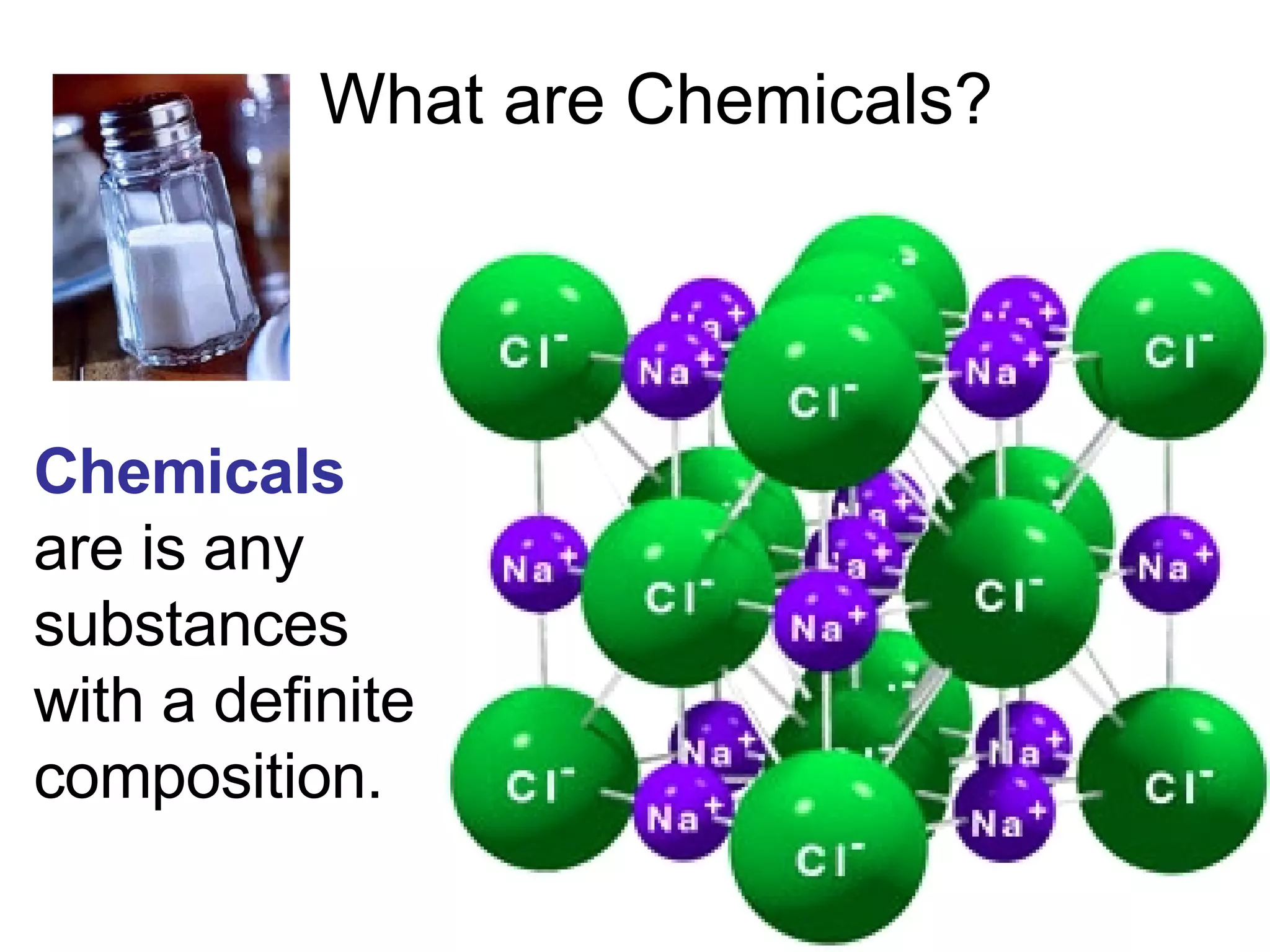
What are Chemicals? Chemicals  are is any substances with a definite composition.
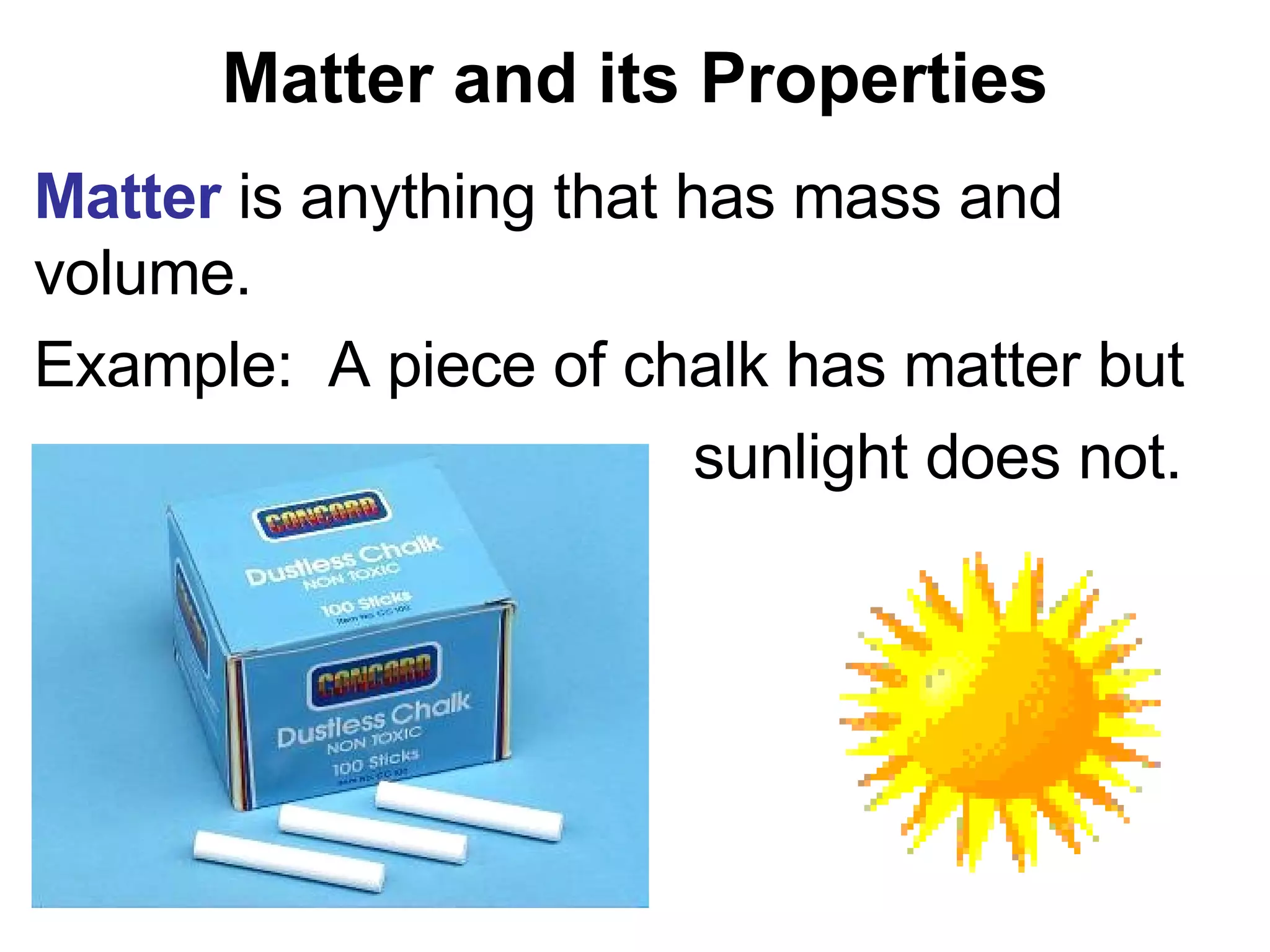
Matter and its Properties Matter  is anything that has mass and volume. Example:  A piece of chalk has matter but  sunlight does not.
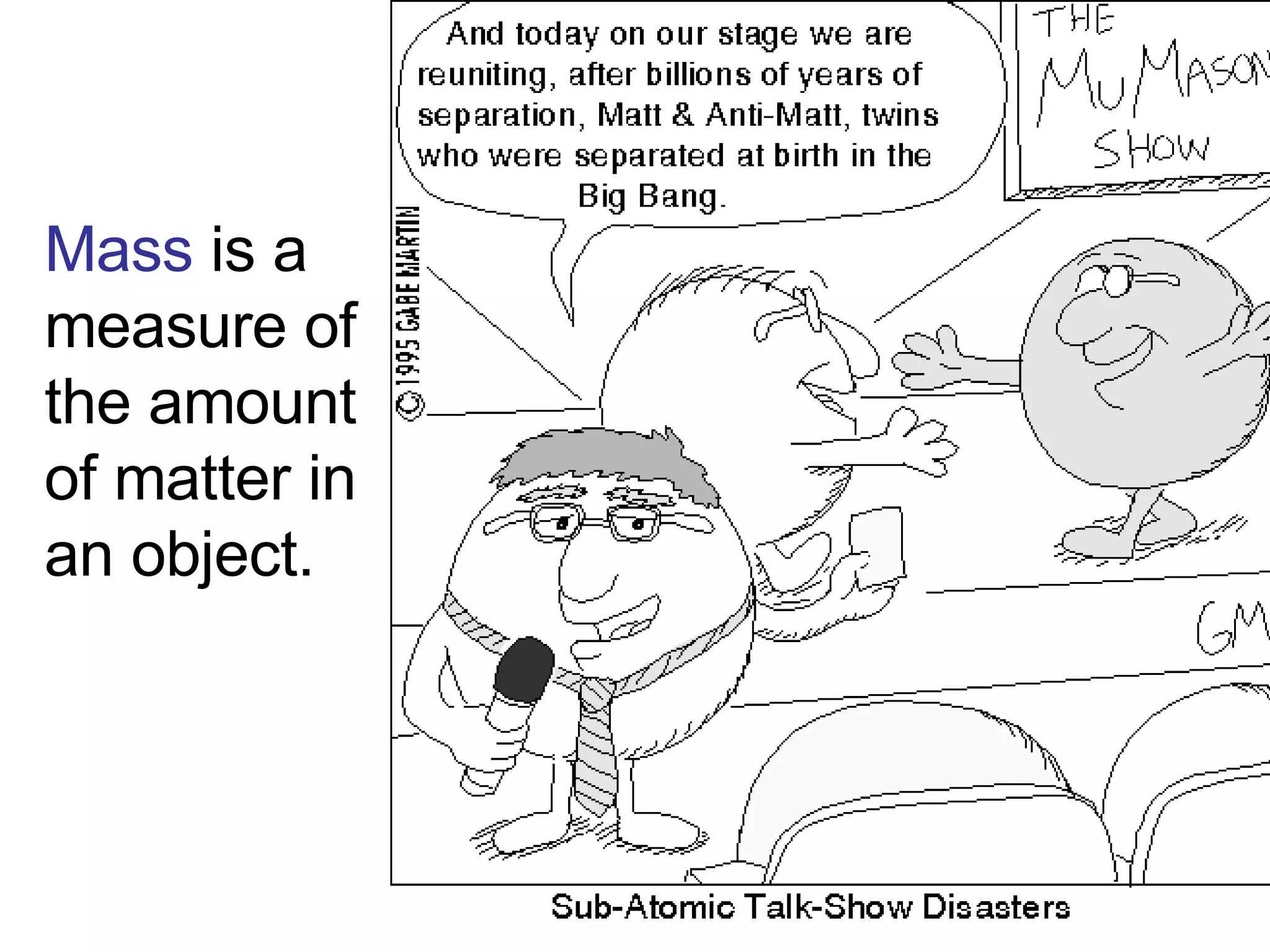
Mass  is a measure of the amount of matter in an object.
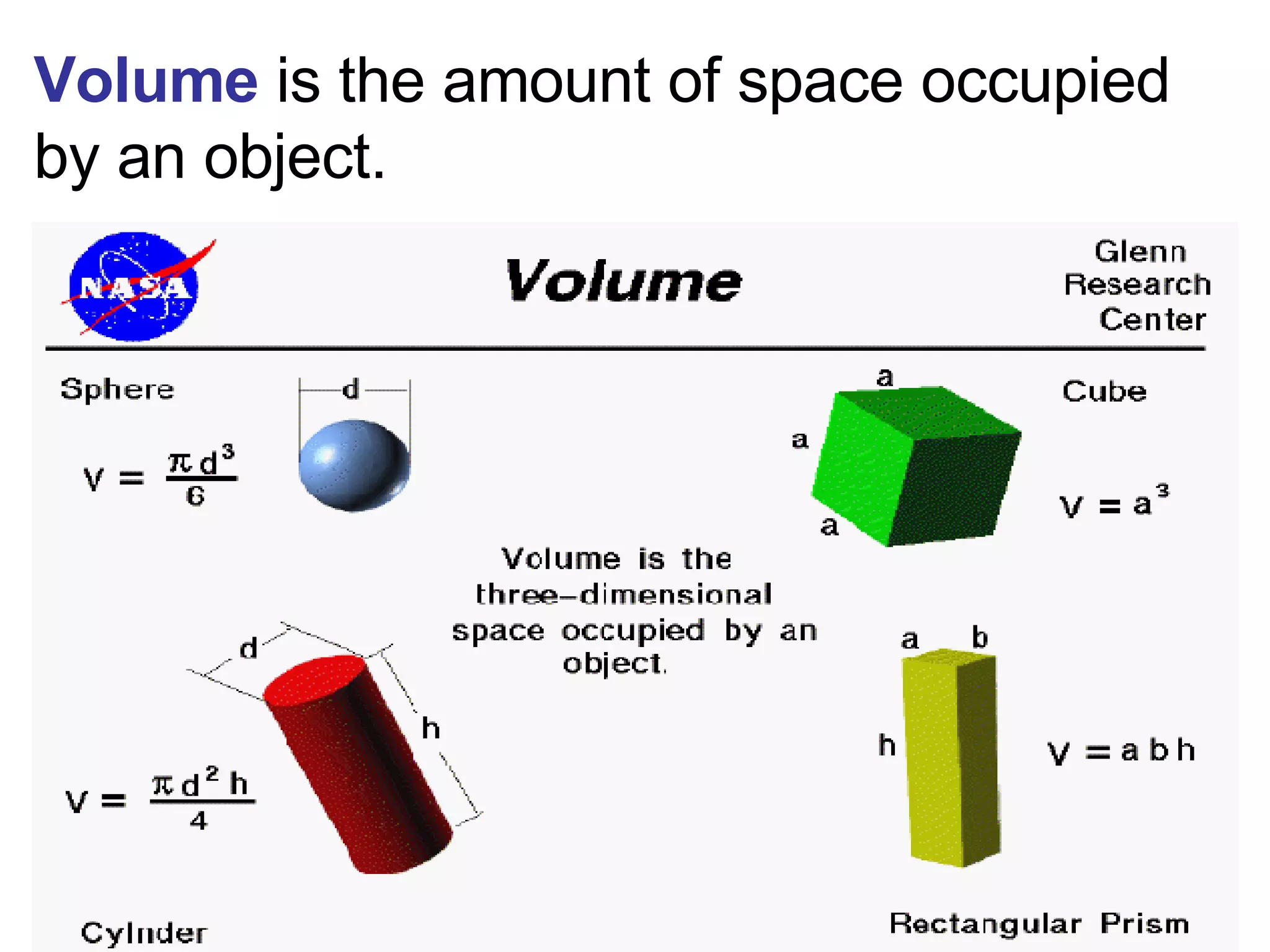
Volume  is the amount of space occupied by an object.
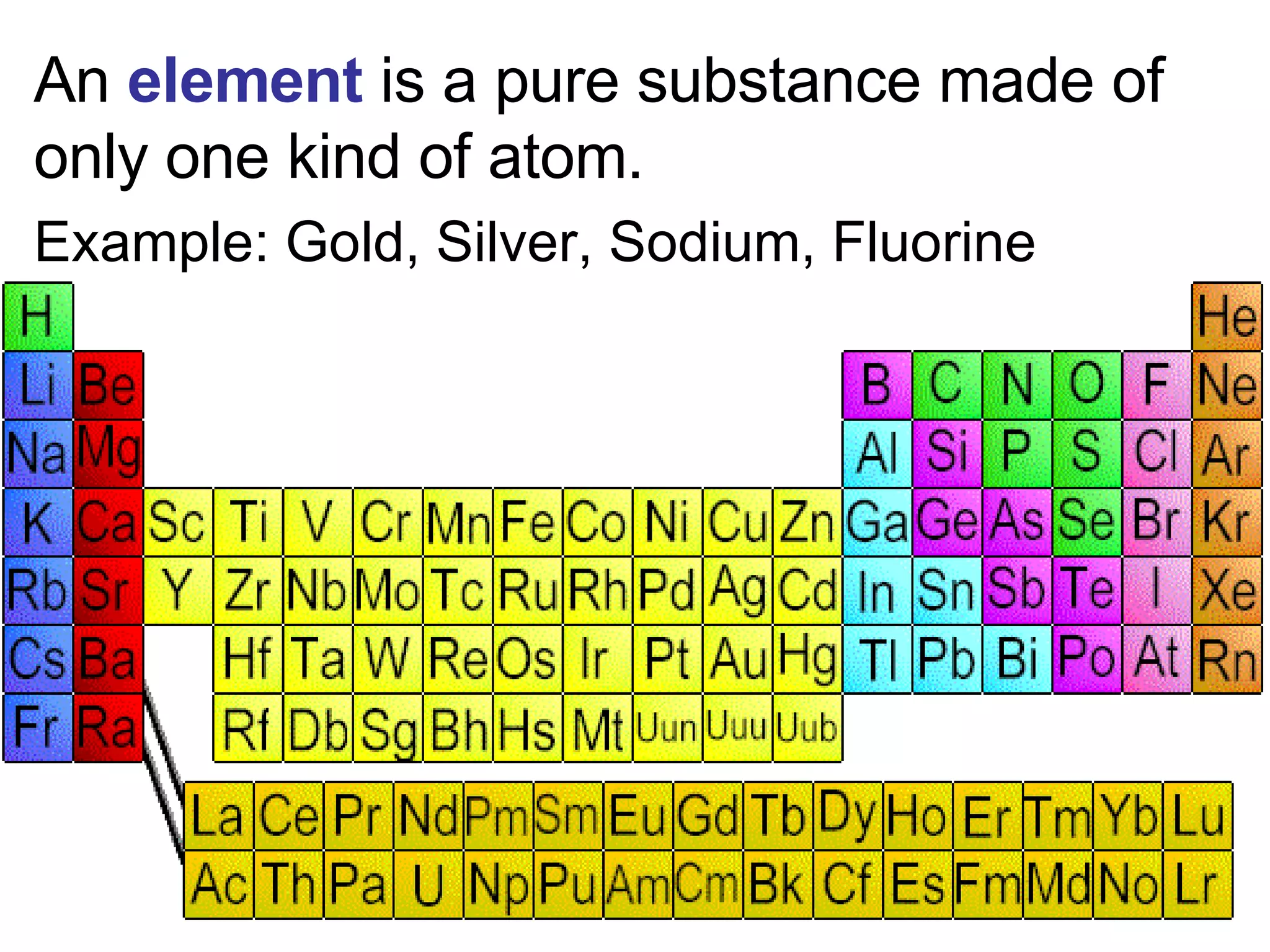
An  element  is a pure substance made of only one kind of atom. Example: Gold, Silver, Sodium, Fluorine
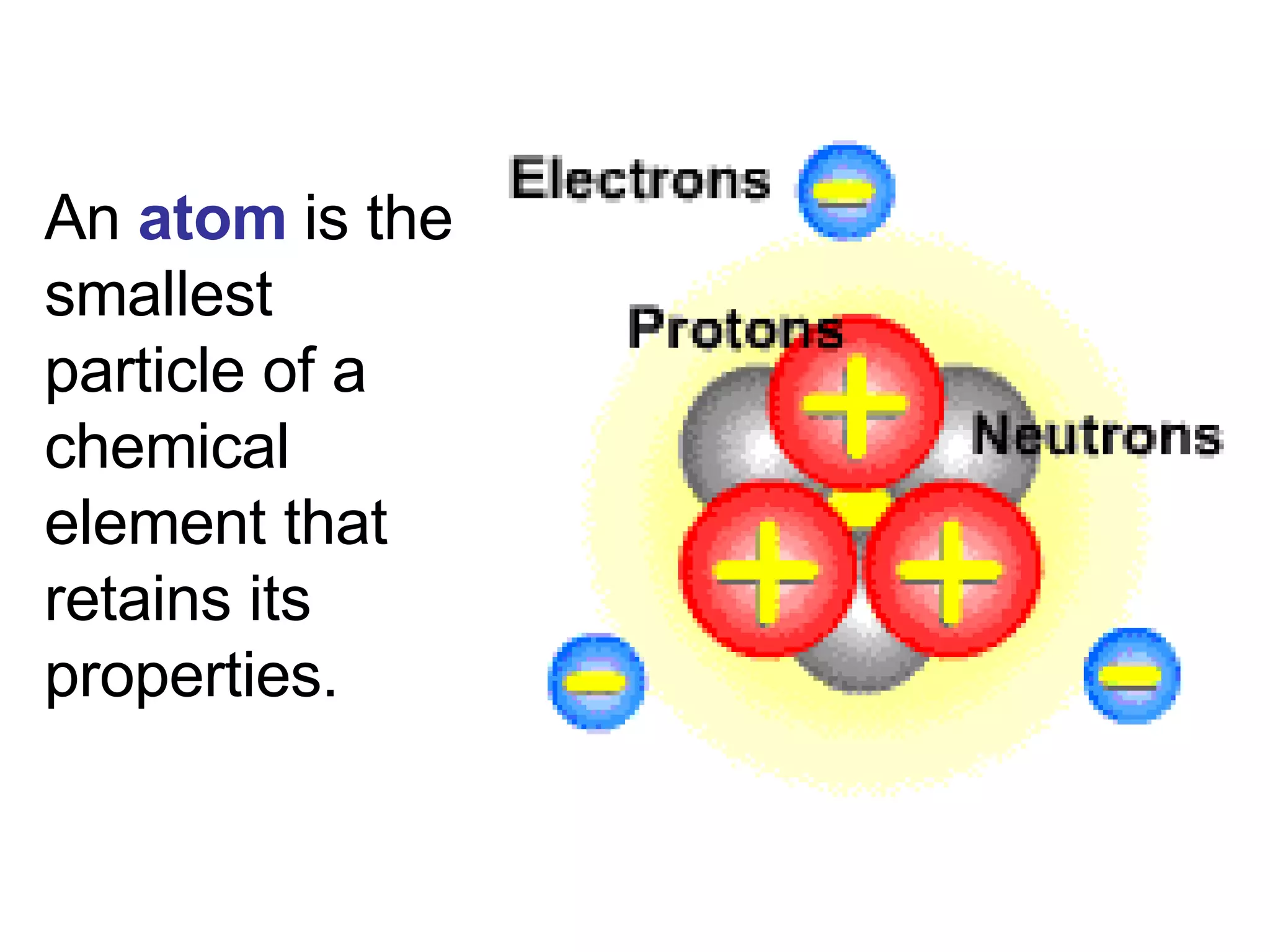
An  atom  is the smallest particle of a chemical element that retains its properties.
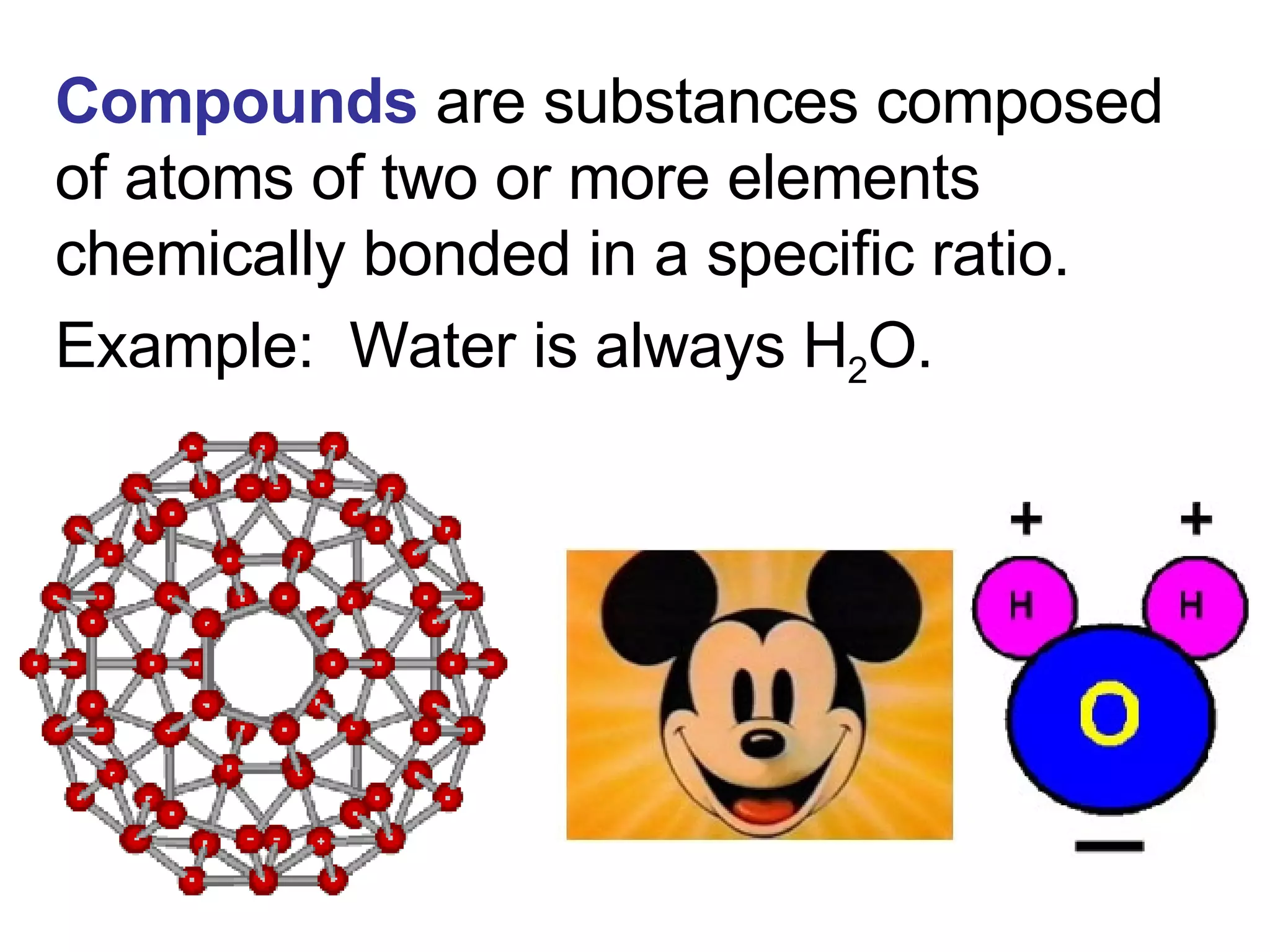
Compounds  are substances composed of atoms of two or more elements chemically bonded in a specific ratio. Example:  Water is always H 2 O.
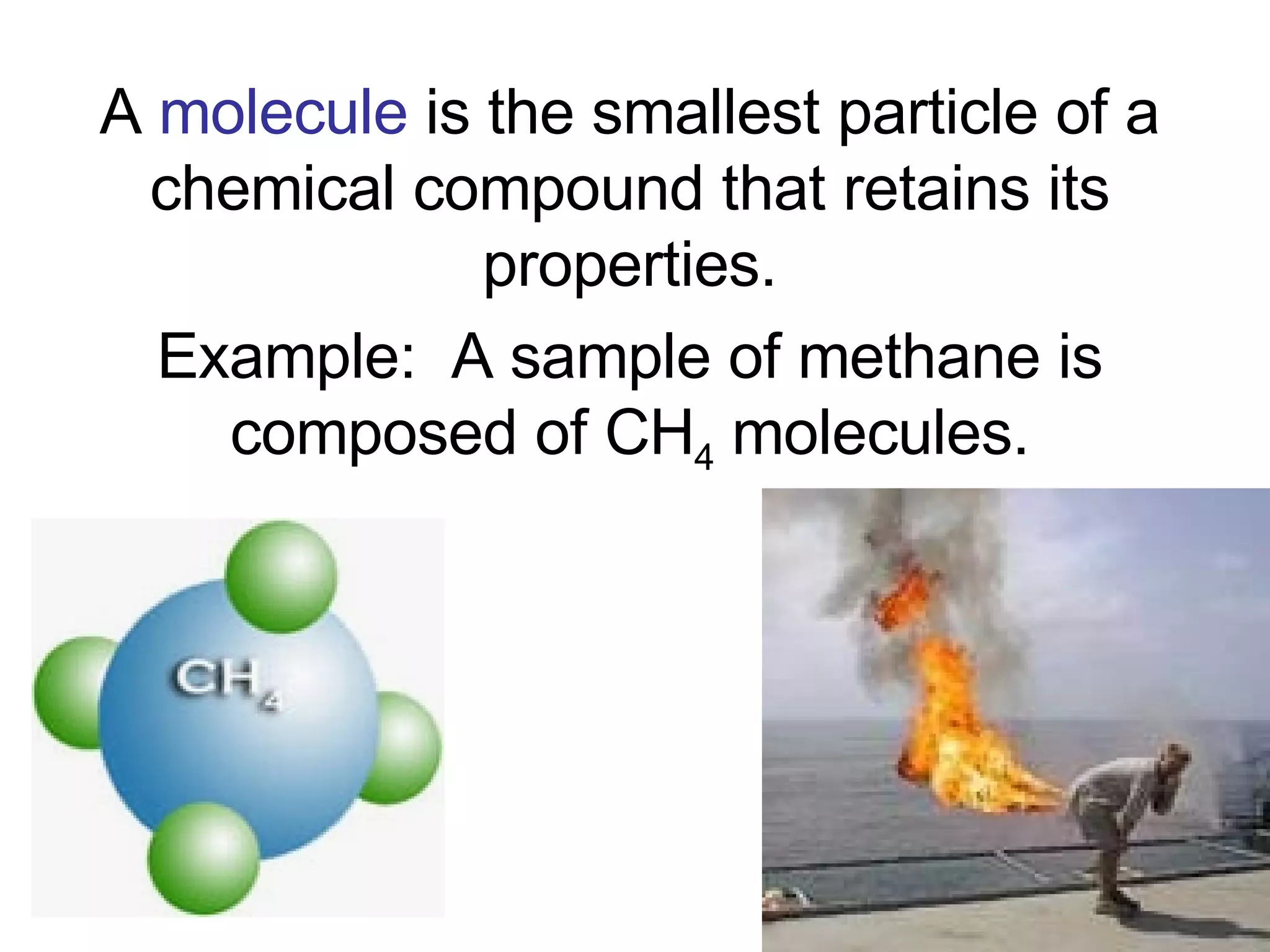
A  molecule  is the smallest particle of a chemical compound that retains its properties. Example:  A sample of methane is composed of CH 4  molecules.
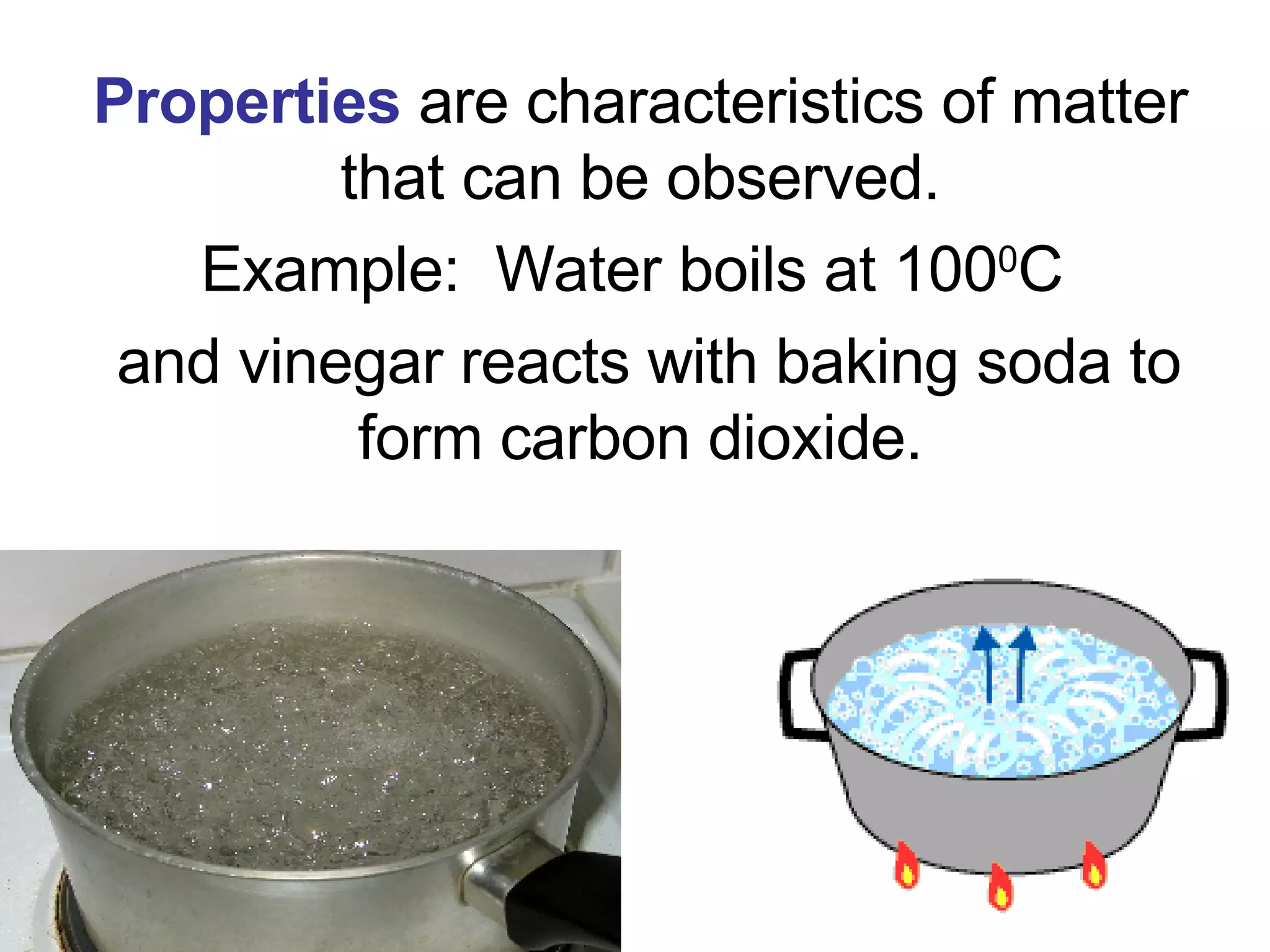
Properties  are characteristics of matter that can be observed. Example:  Water boils at 100 0 C  and vinegar reacts with baking soda to form carbon dioxide.
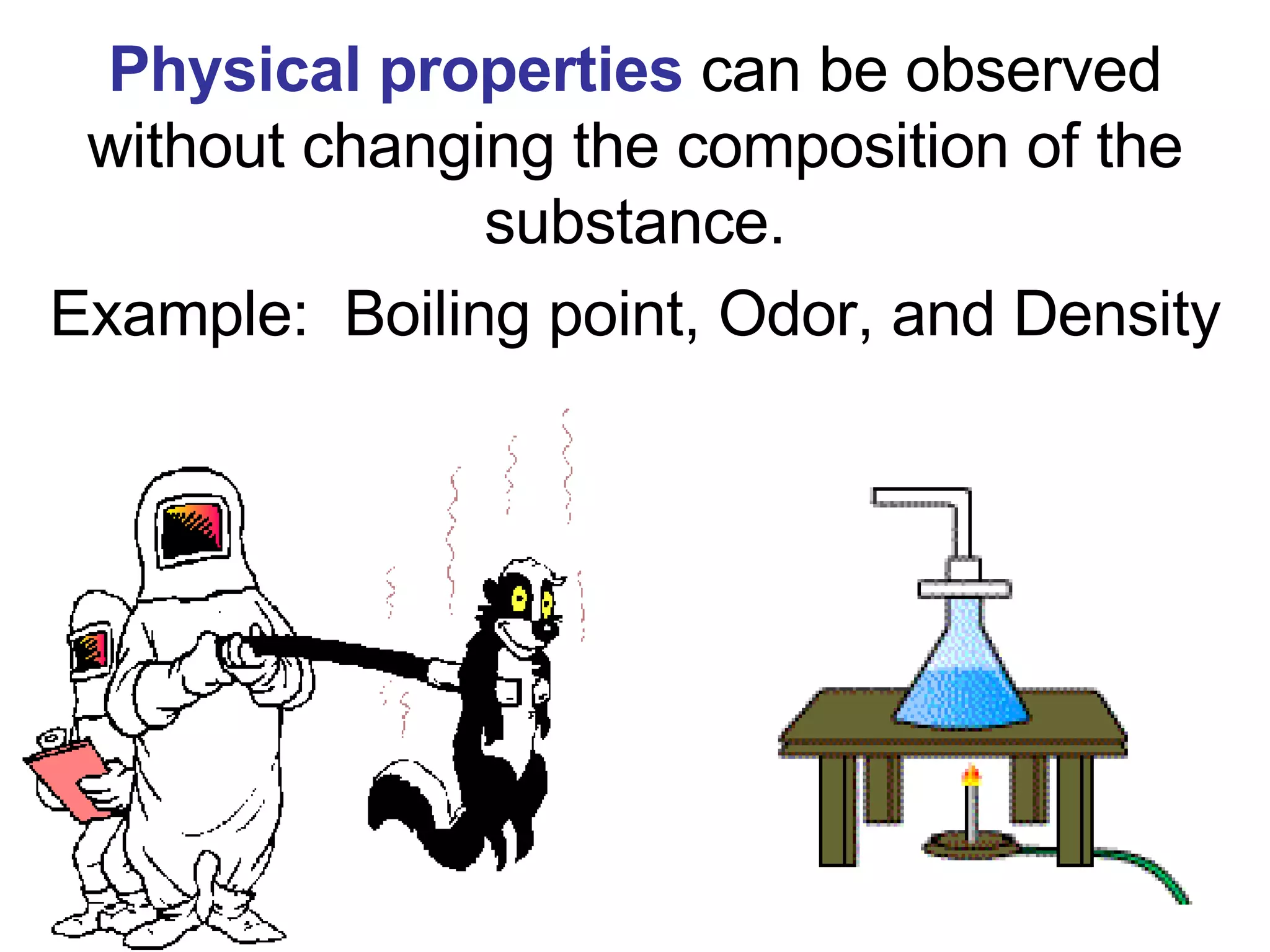
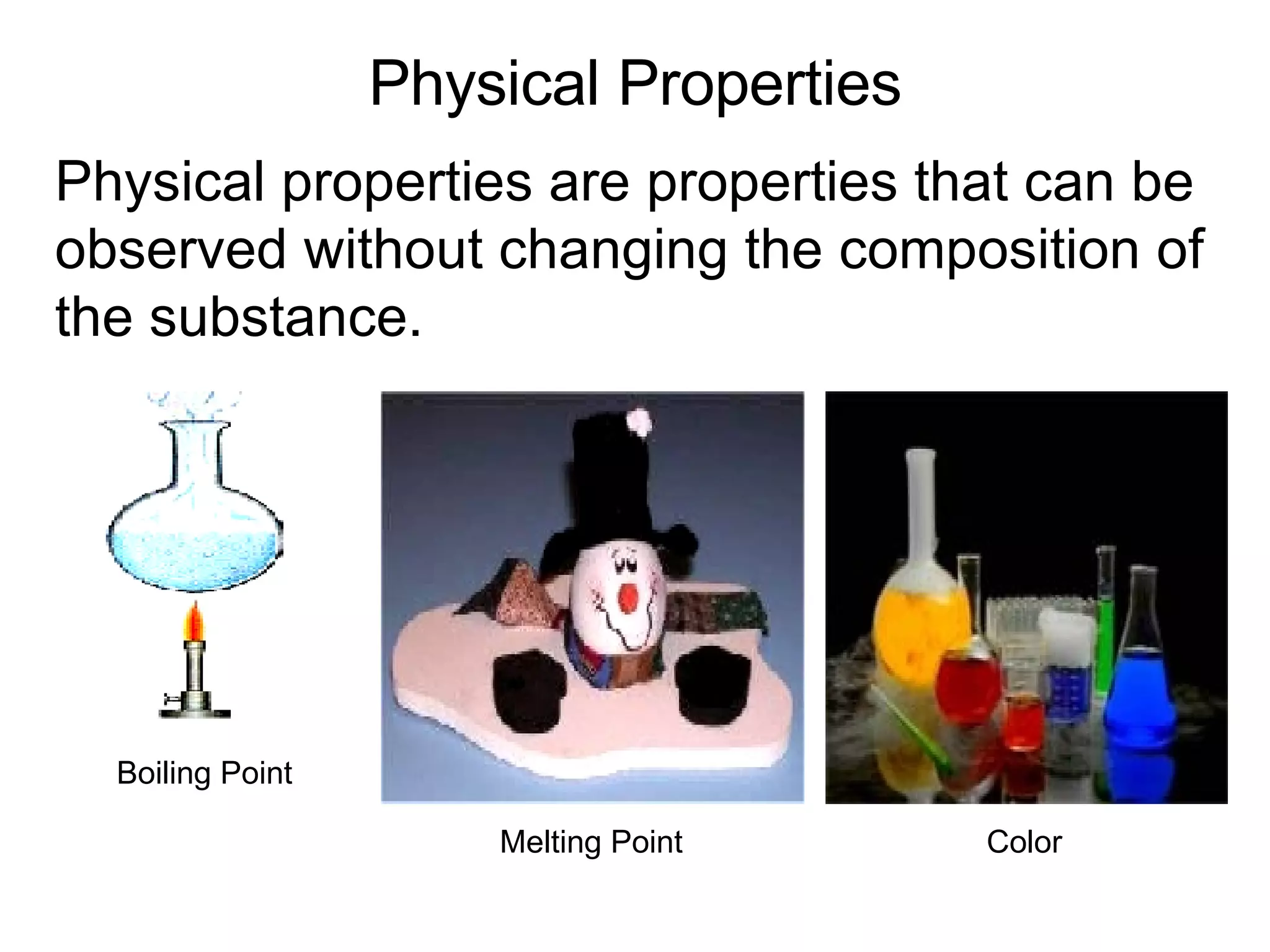
Physical properties   can be observed without changing the composition of the substance. Example:  Boiling point, Odor, and Density
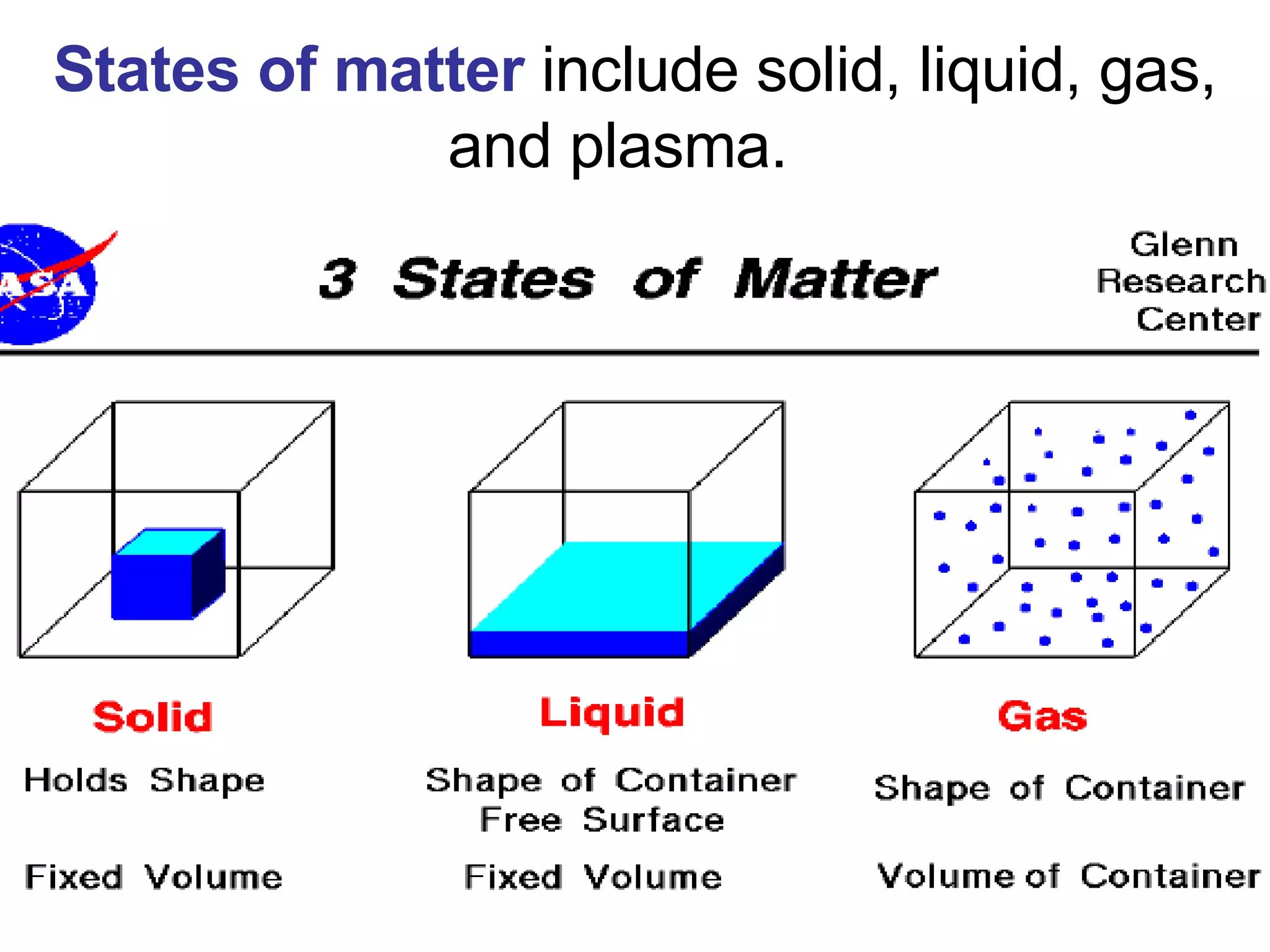
States of matter  include solid, liquid, gas, and plasma.
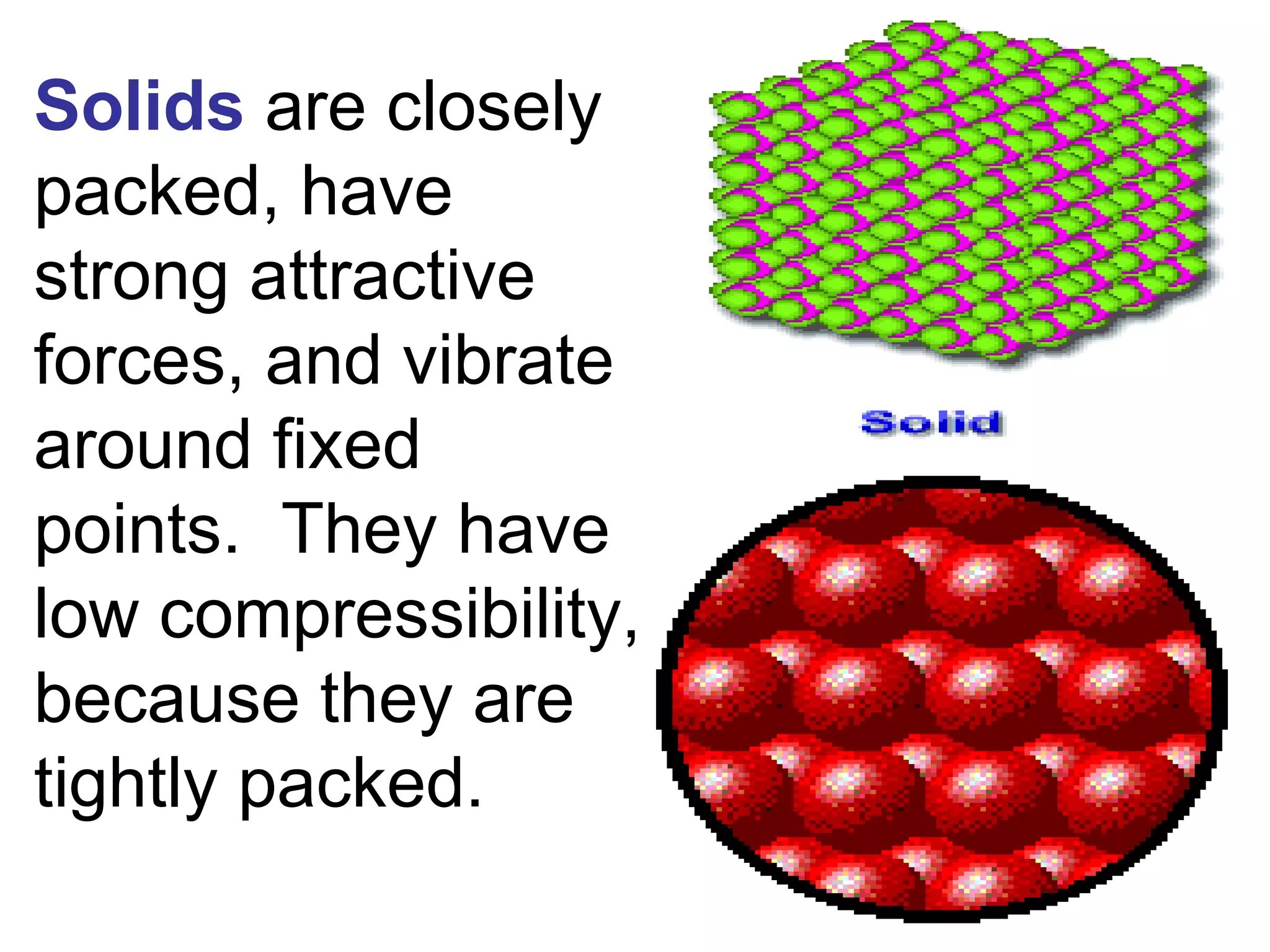
Solids   are closely packed, have strong attractive forces, and vibrate around fixed points.  They have low compressibility, because they are tightly packed.
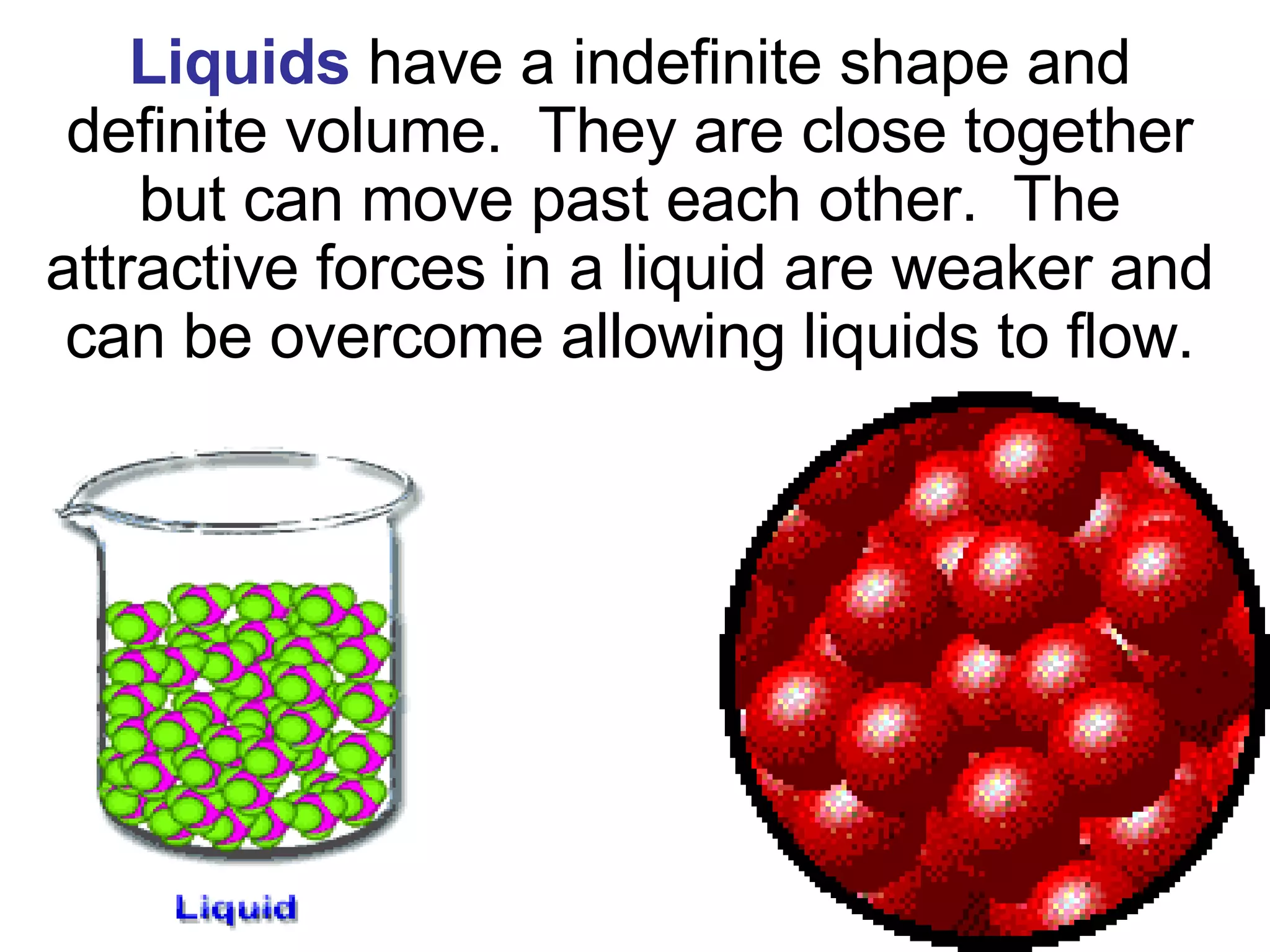
Liquids   have a indefinite shape and definite volume.  They are close together but can move past each other.  The attractive forces in a liquid are weaker and can be overcome allowing liquids to flow.
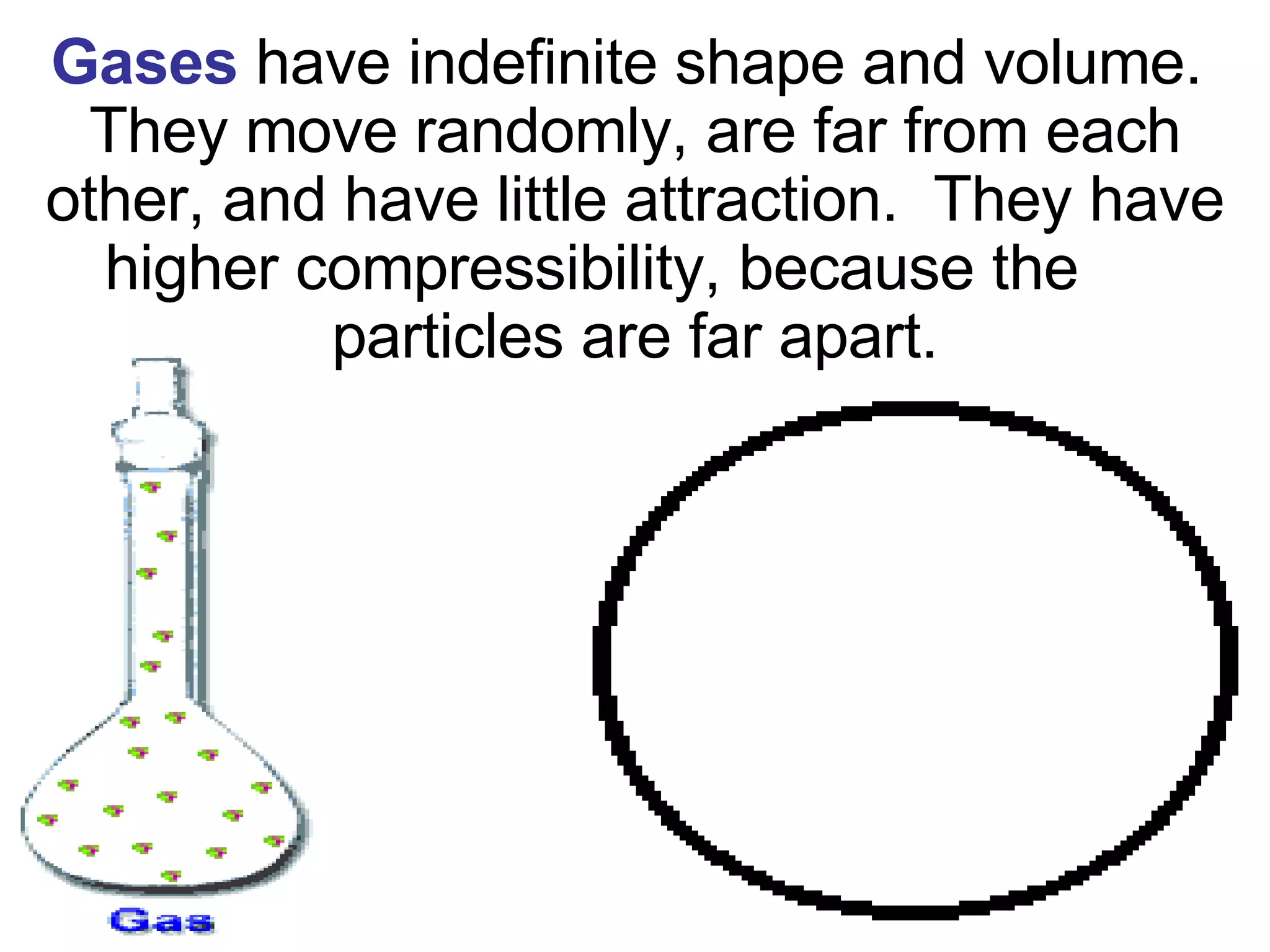
Gases   have indefinite shape and volume.  They move randomly, are far from each other, and have little attraction.  They have higher compressibility, because the  particles are far apart.
Plasma   is a high energy state in which electrons have been knocked off the atoms. Example:  Plasma is found in fluorescent light tubes and in the sun.
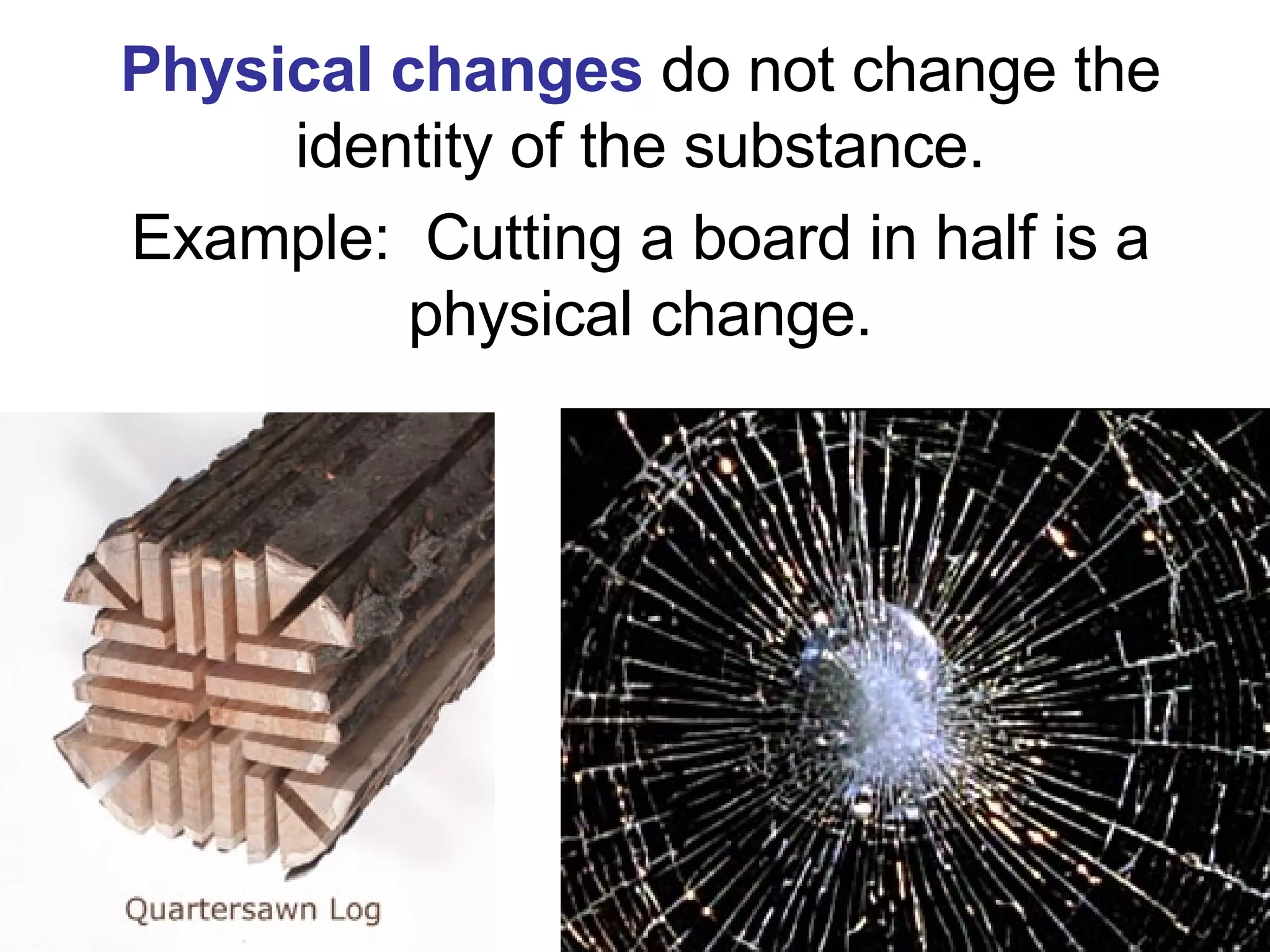
Physical changes   do not change the identity of the substance. Example:  Cutting a board in half is a physical change.
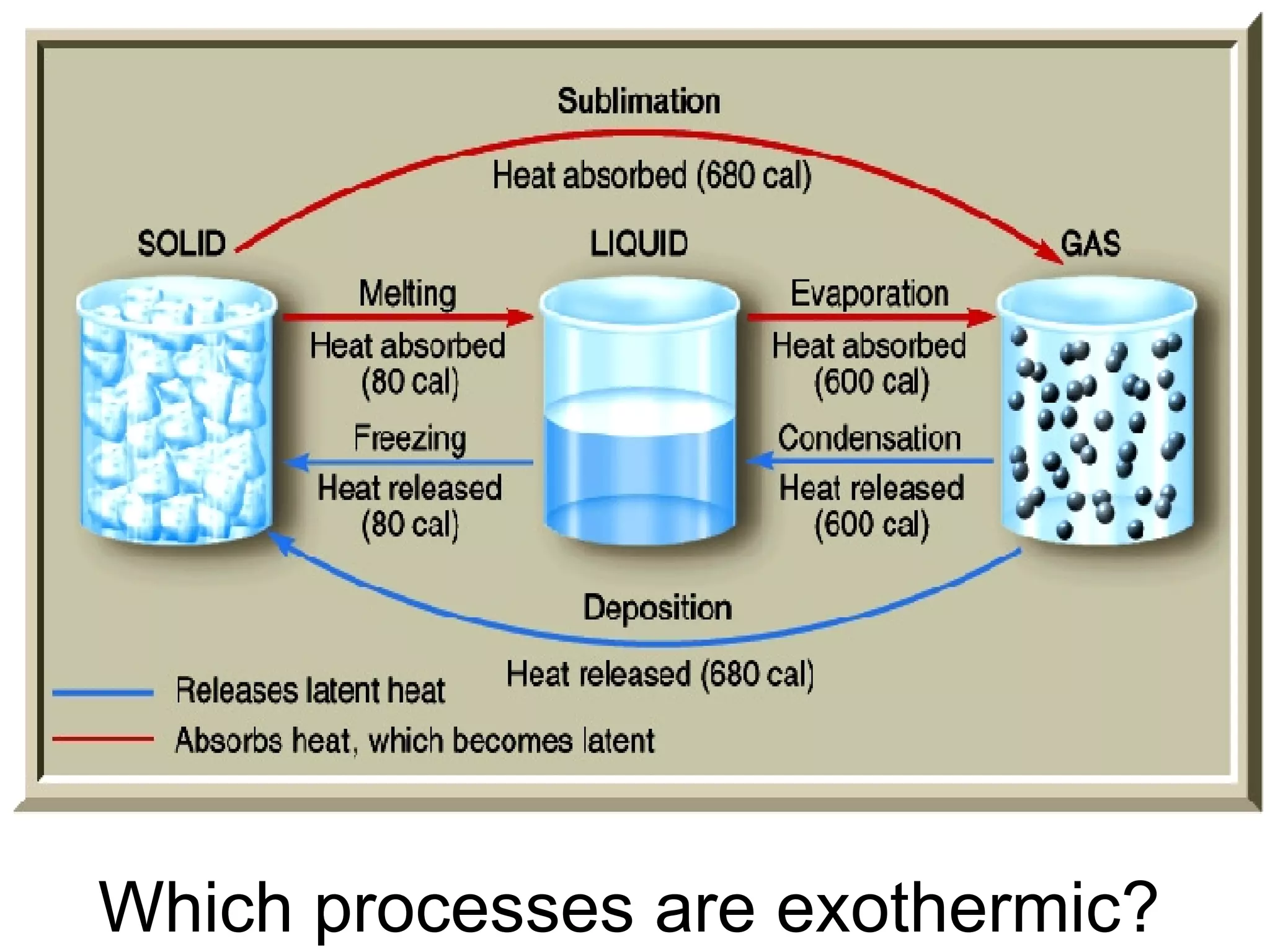
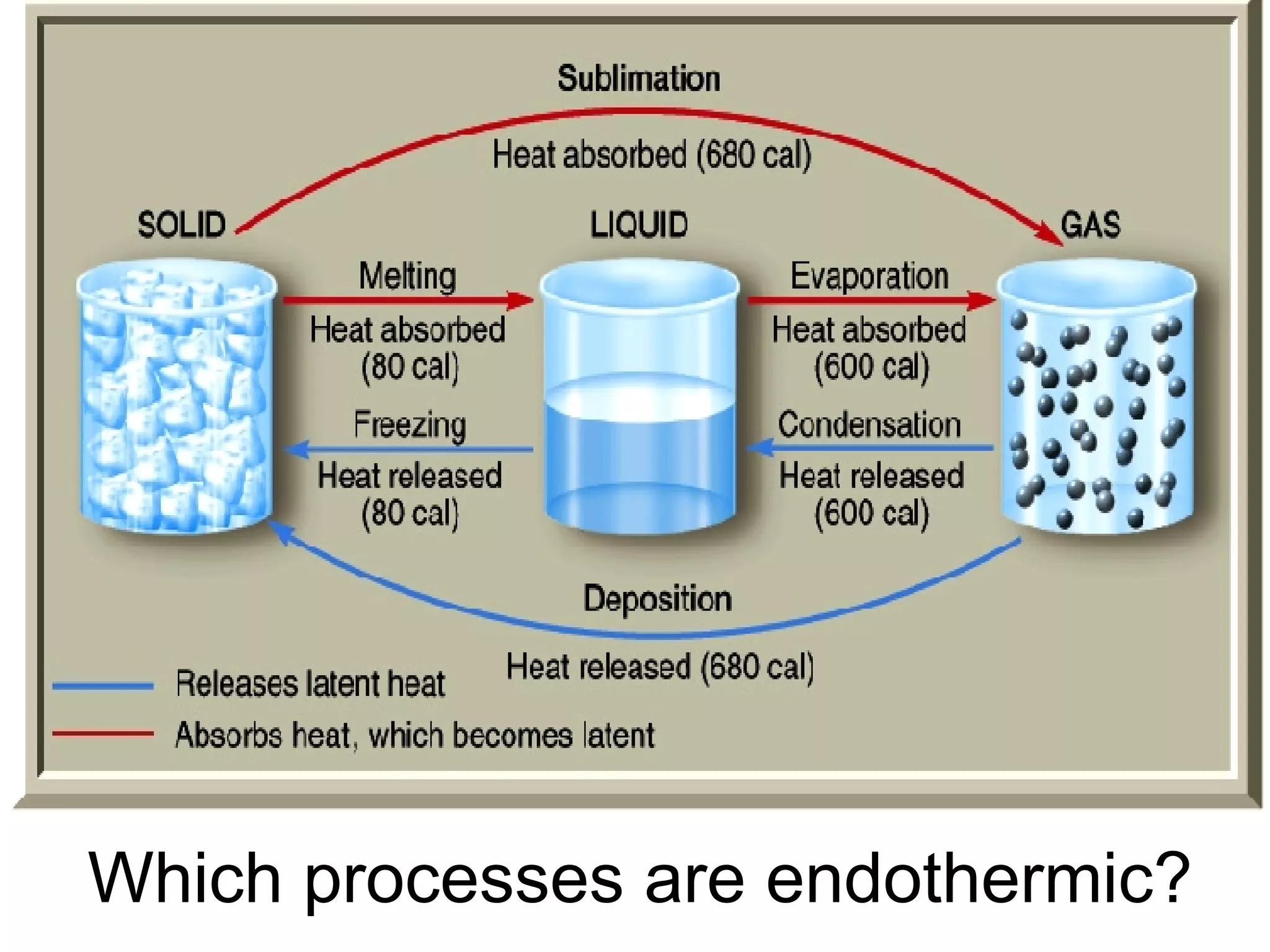
State (phase) changes   are physical changes from one state to another.  
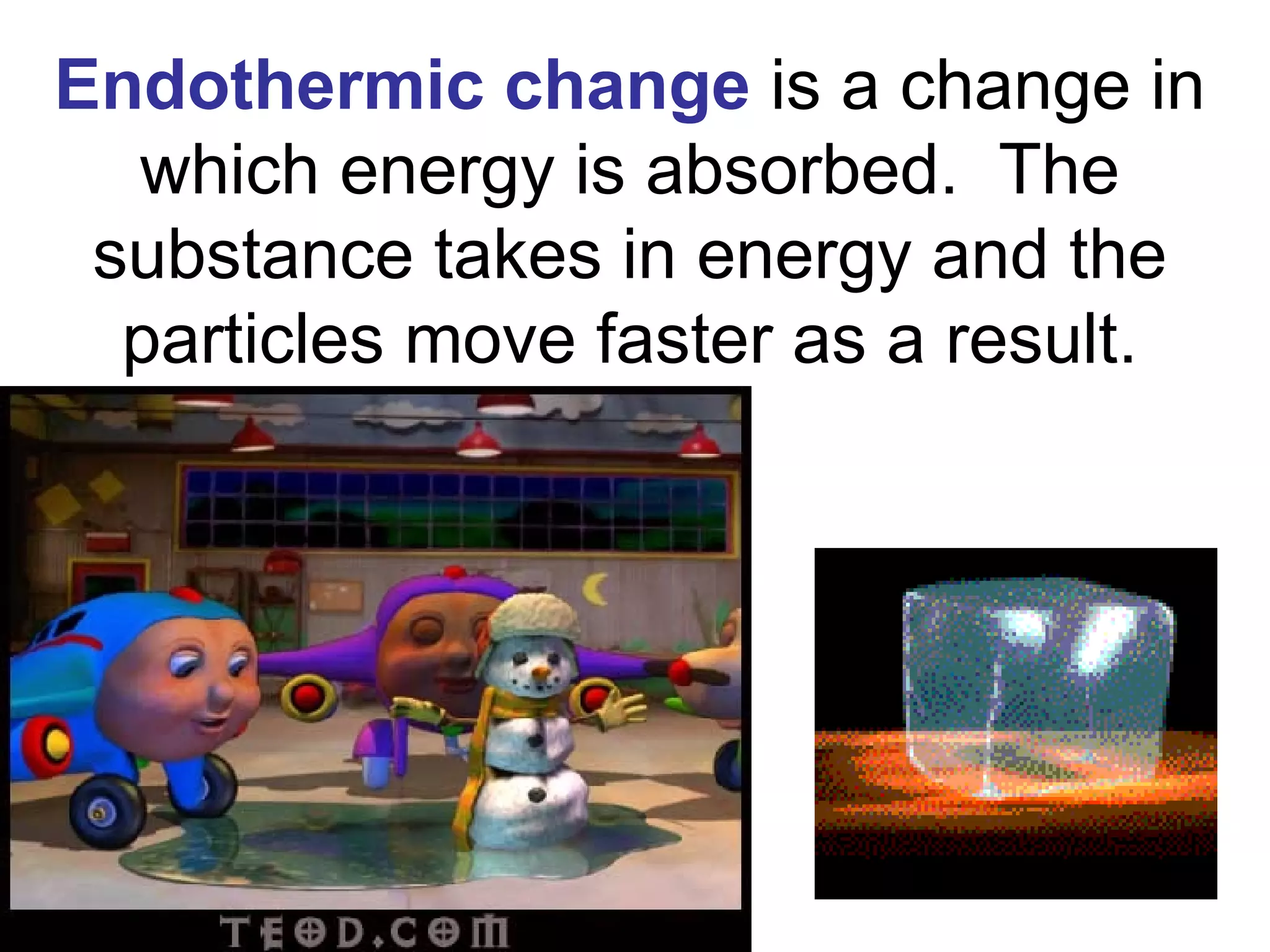
Endothermic change   is a change in which energy is absorbed.  The substance takes in energy and the particles move faster as a result.
Which processes are exothermic?
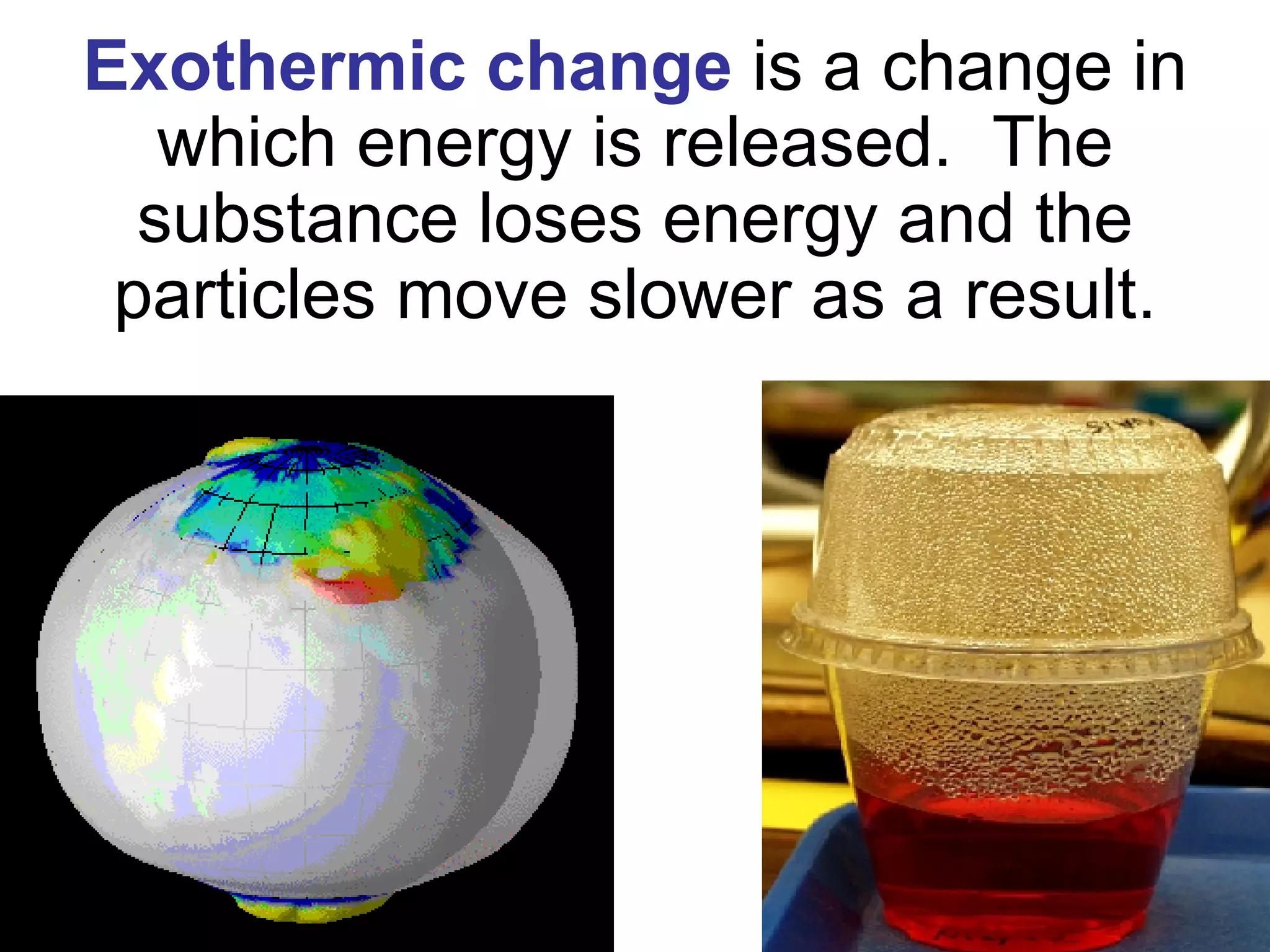
Exothermic change   is a change in which energy is released.  The substance loses energy and the particles move slower as a result.
Which processes are endothermic?
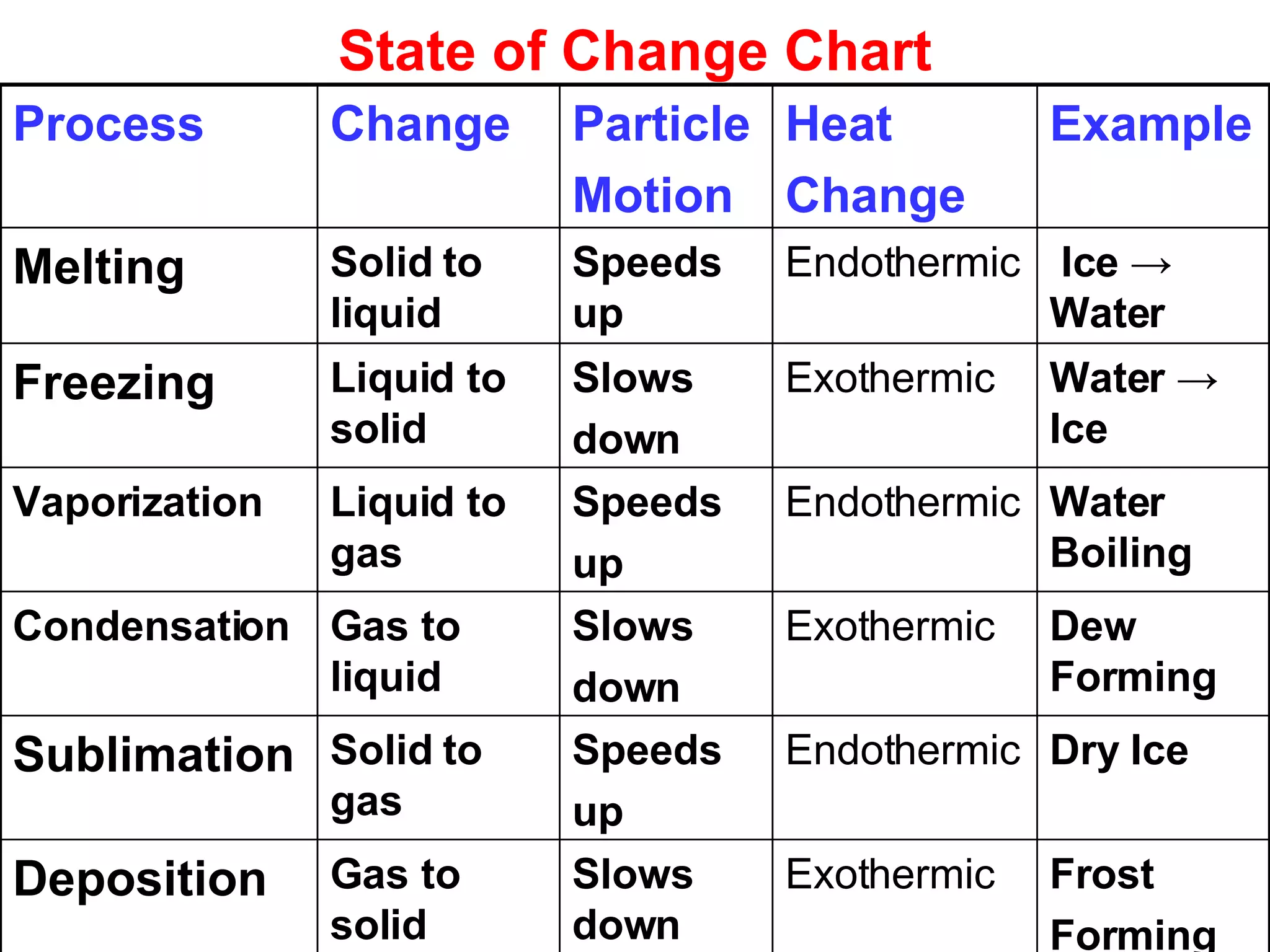
State of Change Chart Frost Forming Exothermic Slows down Gas to solid Deposition Dry Ice Endothermic Speeds  up Solid to gas Sublimation Dew Forming Exothermic Slows  down Gas to liquid Condensation Water Boiling Endothermic Speeds up Liquid to gas Vaporization Water  -> Ice Exothermic Slows  down Liquid to solid Freezing Ice  ->  Water Endothermic Speeds up Solid to liquid Melting Example Heat  Change Particle Motion Change Process
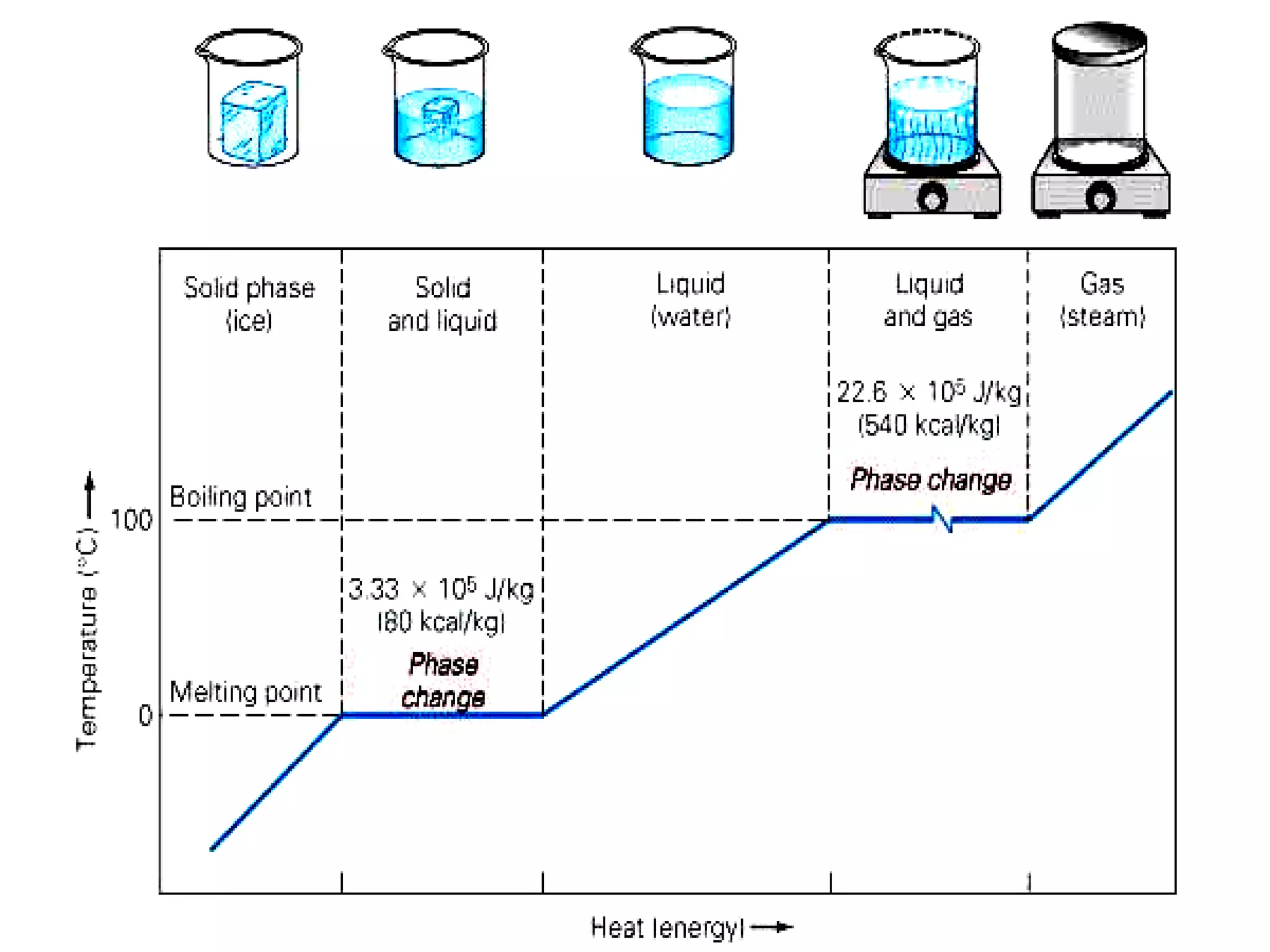
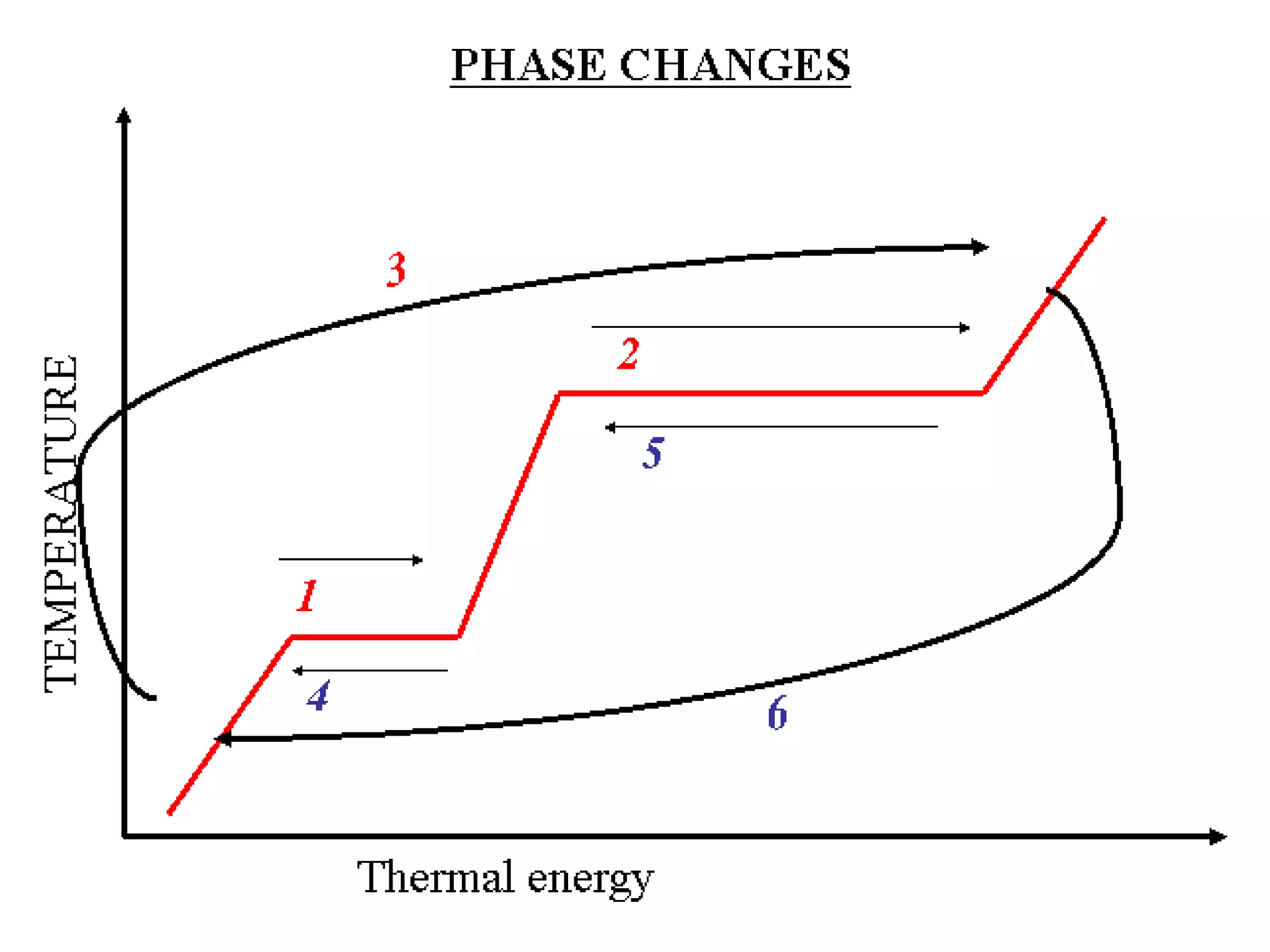
Phase Change Diagram   is a graph of temperature versus energy that shows how energy added or removed from a substance affects its state. During a state change, composition does not change.
 
 
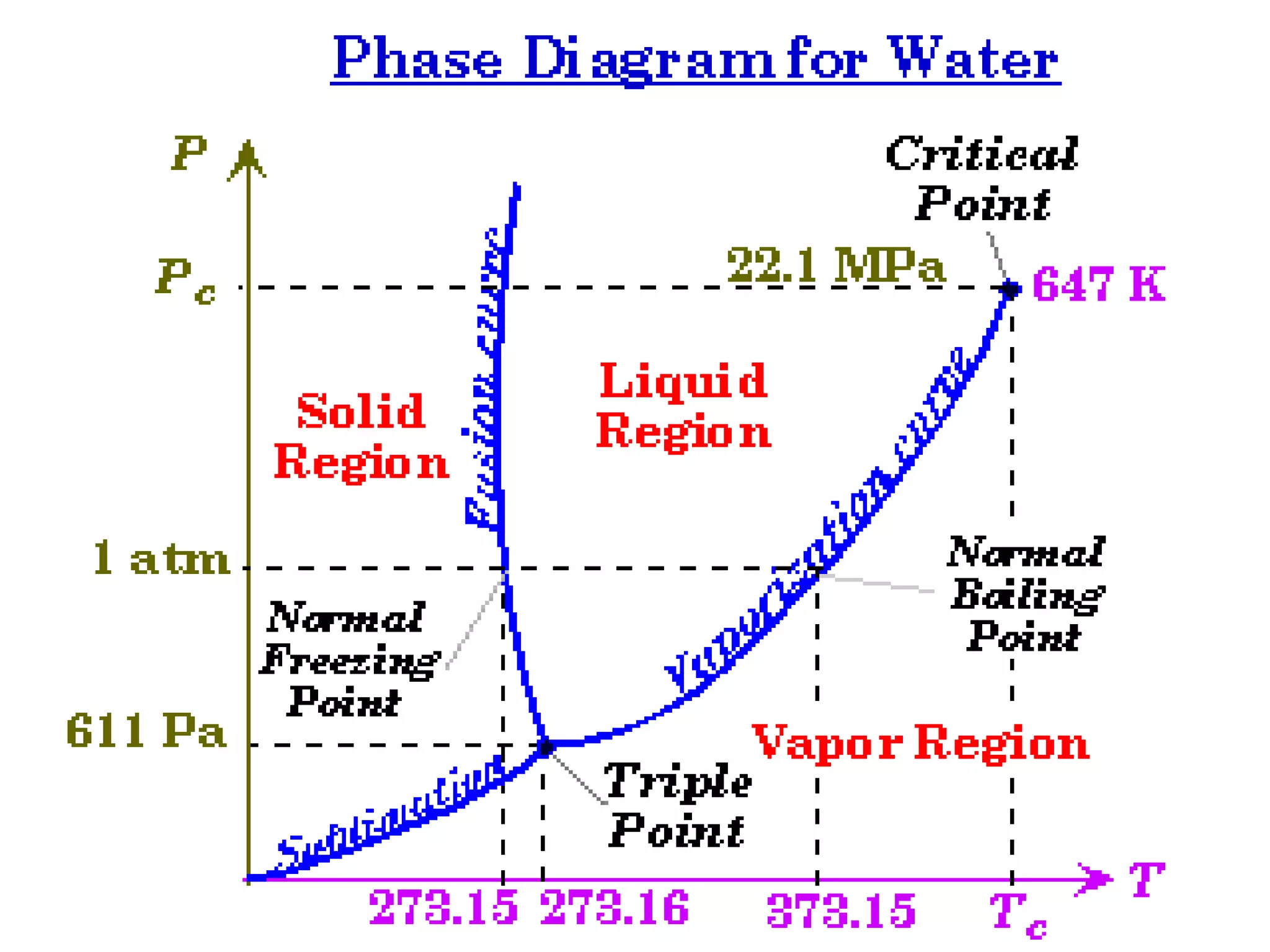
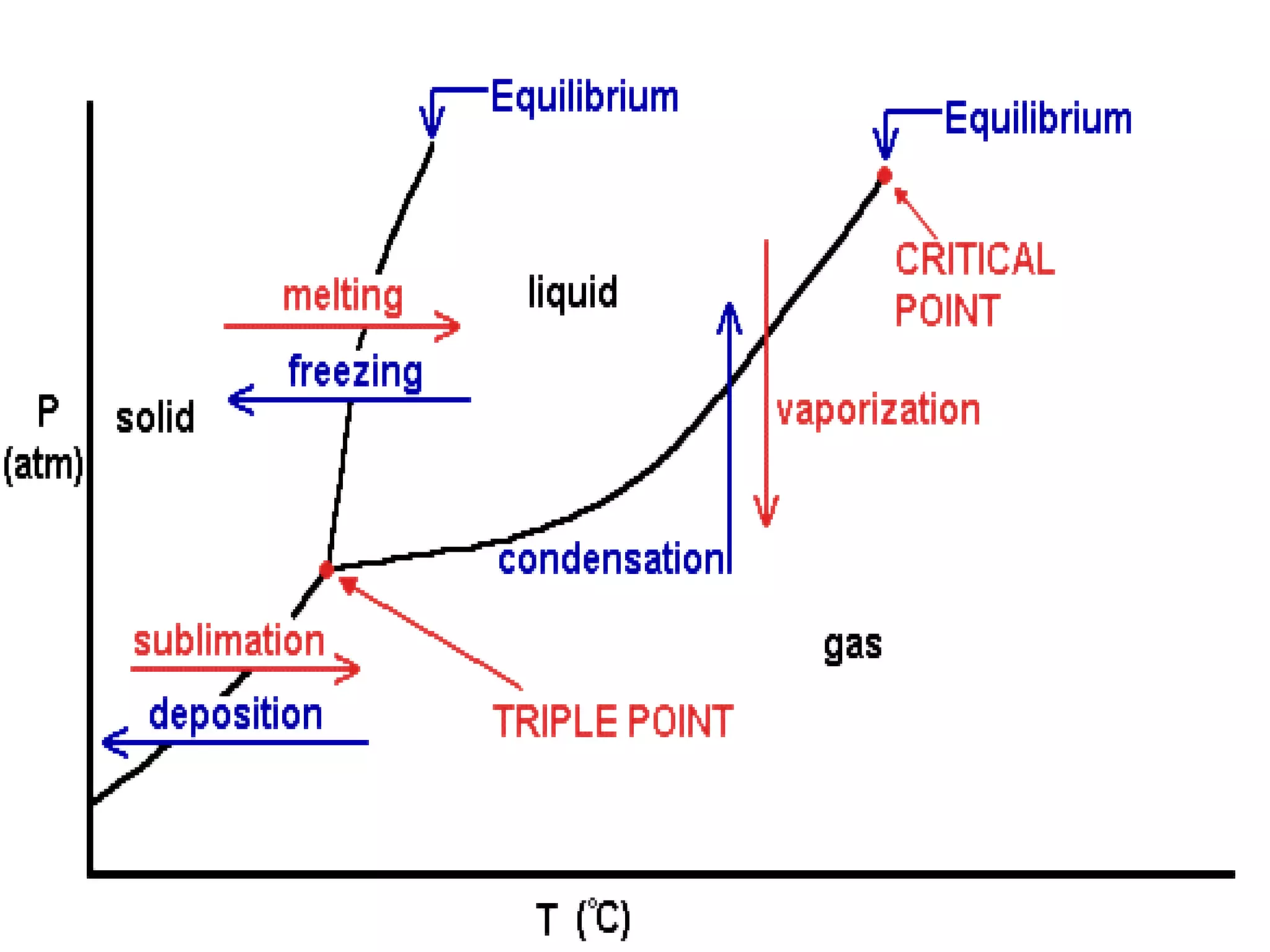
Another type of phase diagram is a graph of pressure versus temperature that shows the conditions under which the states of matter exist.
 
 
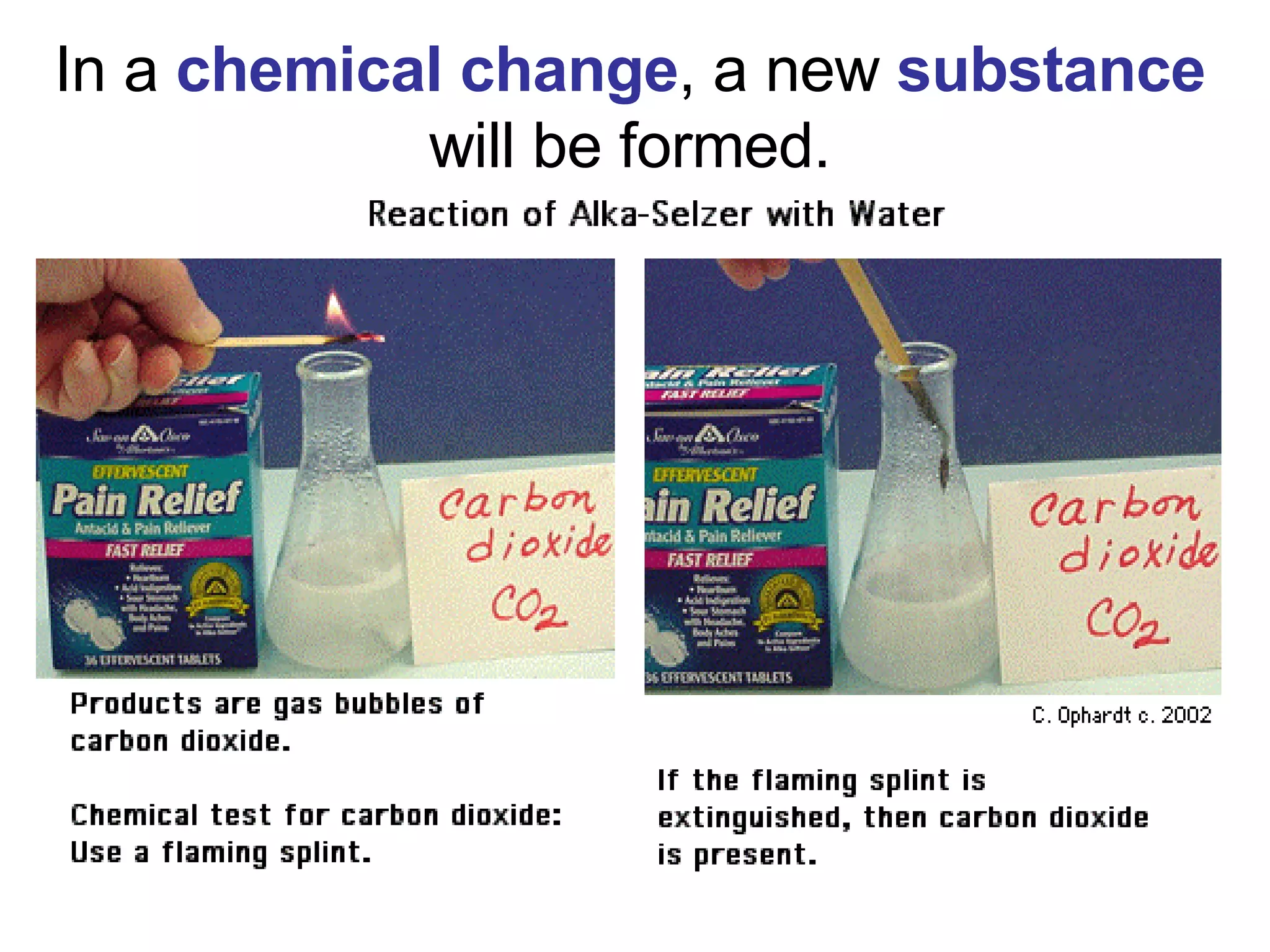
In a  chemical change , a new  substance  will be formed.
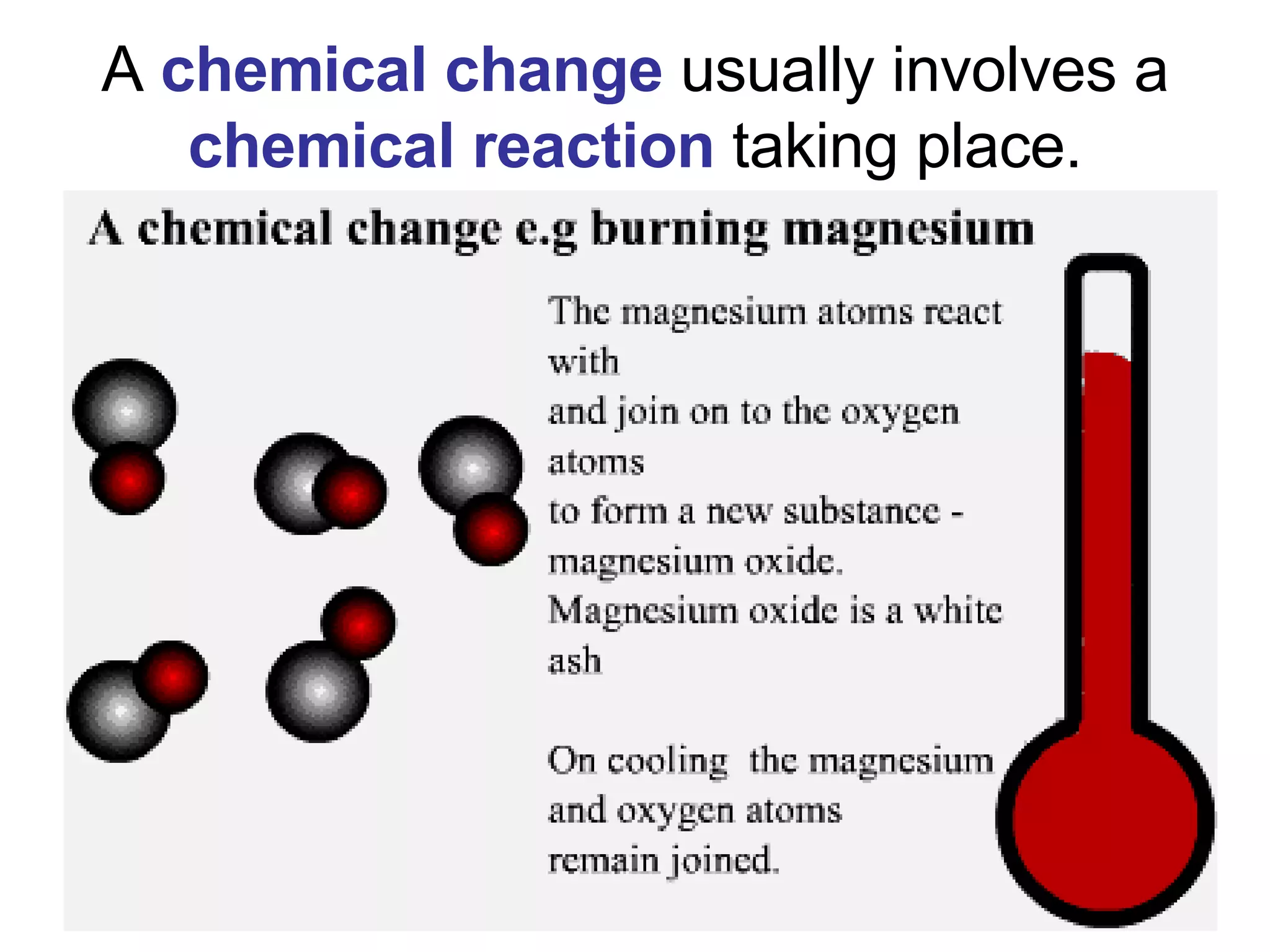
A  chemical change  usually involves a  chemical reaction  taking place.
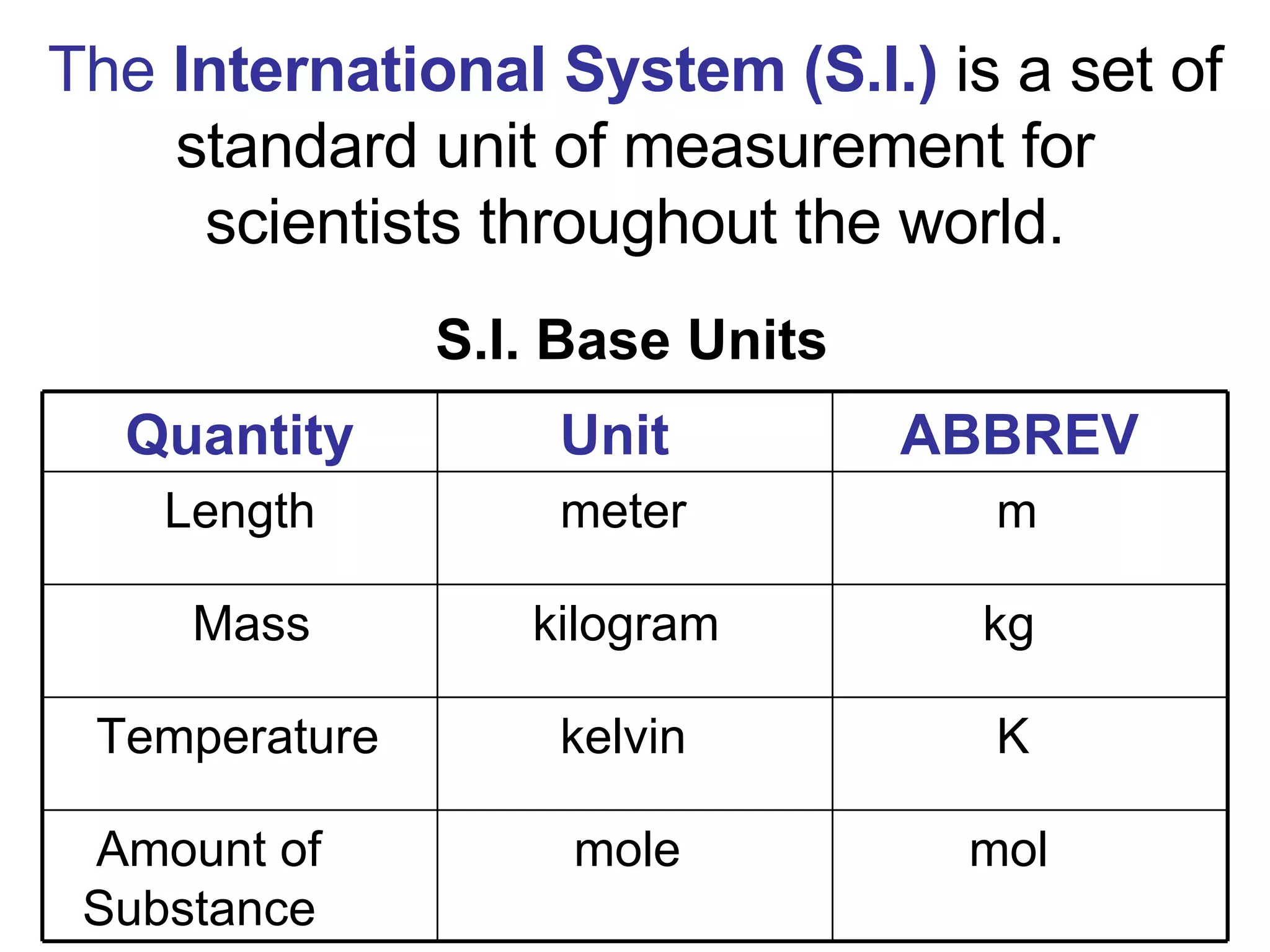
The  International System (S.I.)  is a set of standard unit of measurement for scientists throughout the world. S.I. Base Units mol mole Amount of  Substance K kelvin Temperature kg kilogram Mass m meter Length ABBREV Unit Quantity
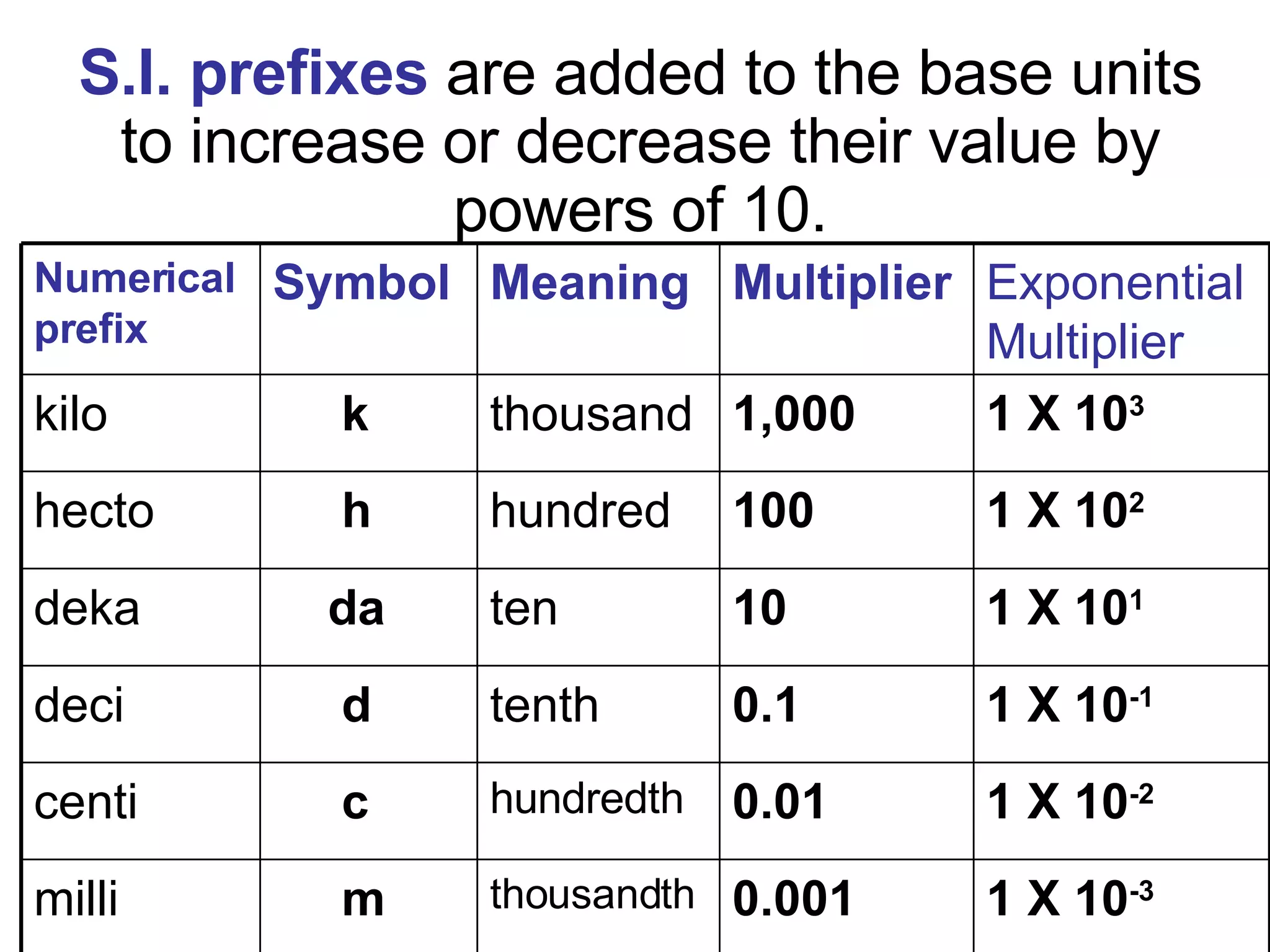
S.I. prefixes   are added to the base units to increase or decrease their value by powers of 10. 1 X 10 -3 0.001 thousandth m milli 1 X 10 -2 0.01 hundredth c centi 1 X 10 -1 0.1 tenth d deci 1 X 10 1 10 ten da deka 1 X 10 2 100 hundred h hecto 1 X 10 3 1,000 thousand k kilo Exponential Multiplier Multiplier Meaning Symbol Numerical prefix
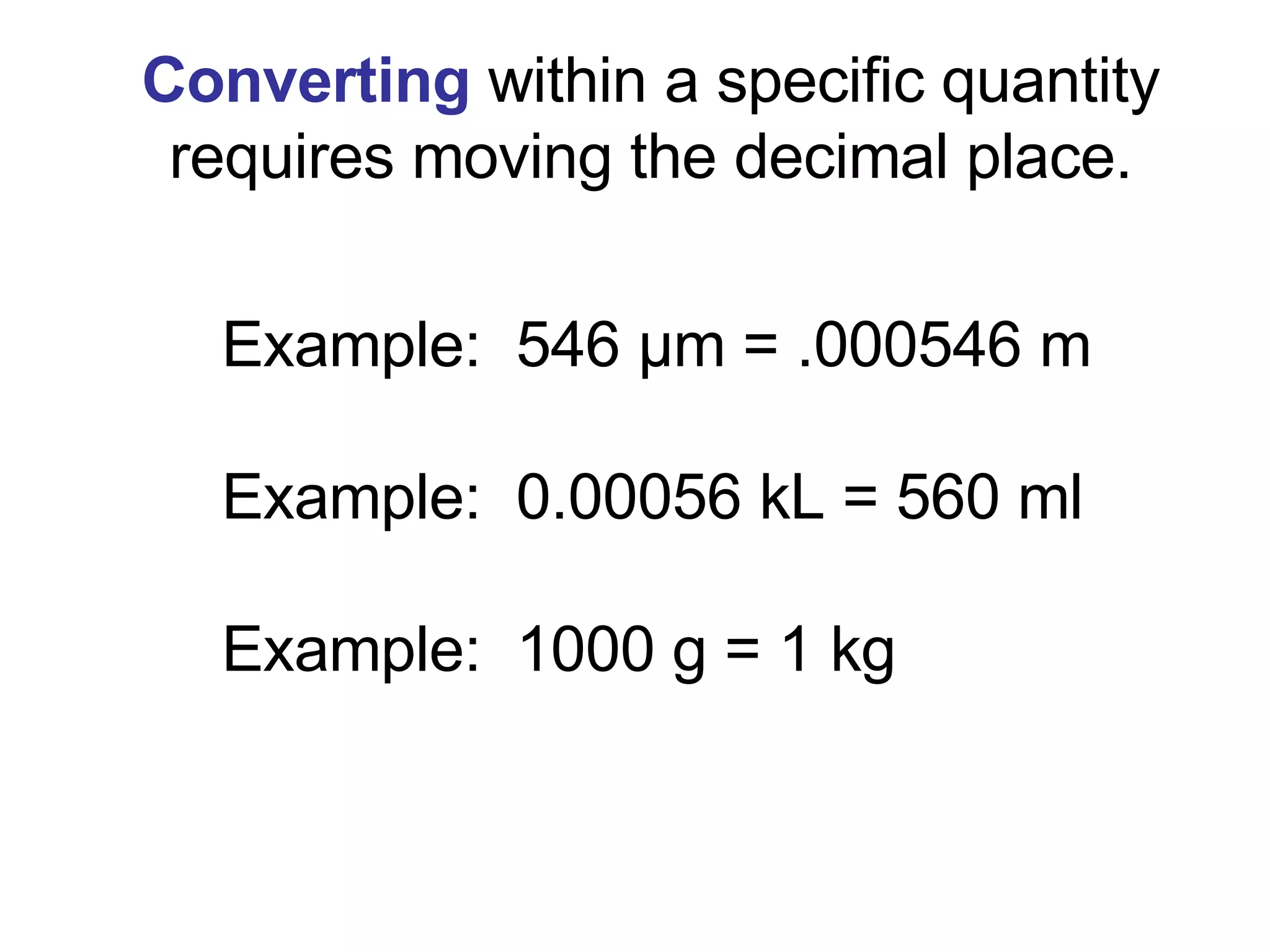
Converting  within a specific quantity requires moving the decimal place. Example:  546  µm = .000546 m Example:  0.00056 kL = 560 ml Example:  1000 g = 1 kg
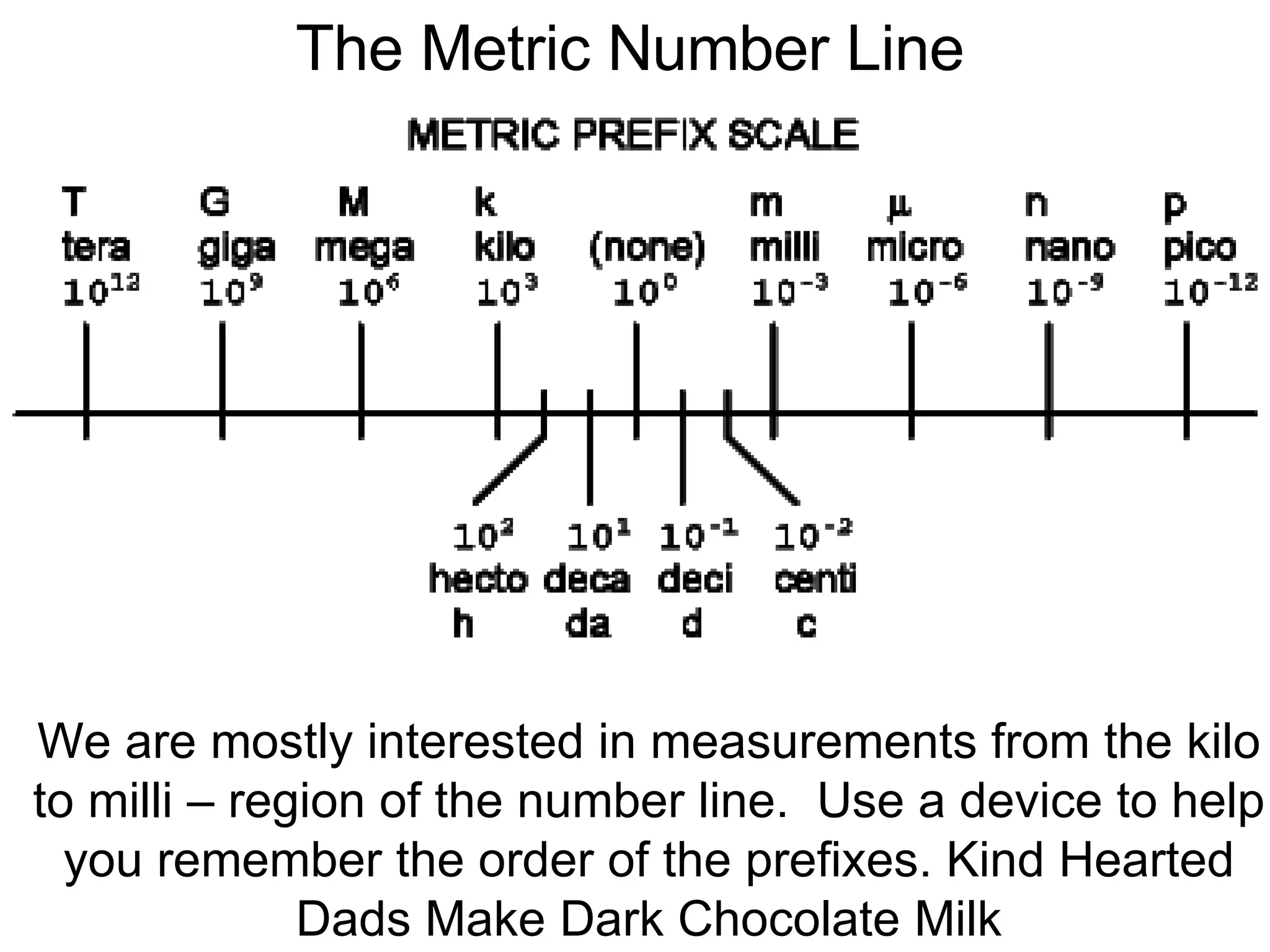
The Metric Number Line We are mostly interested in measurements from the kilo to milli – region of the number line.  Use a device to help you remember the order of the prefixes. Kind Hearted Dads Make Dark Chocolate Milk
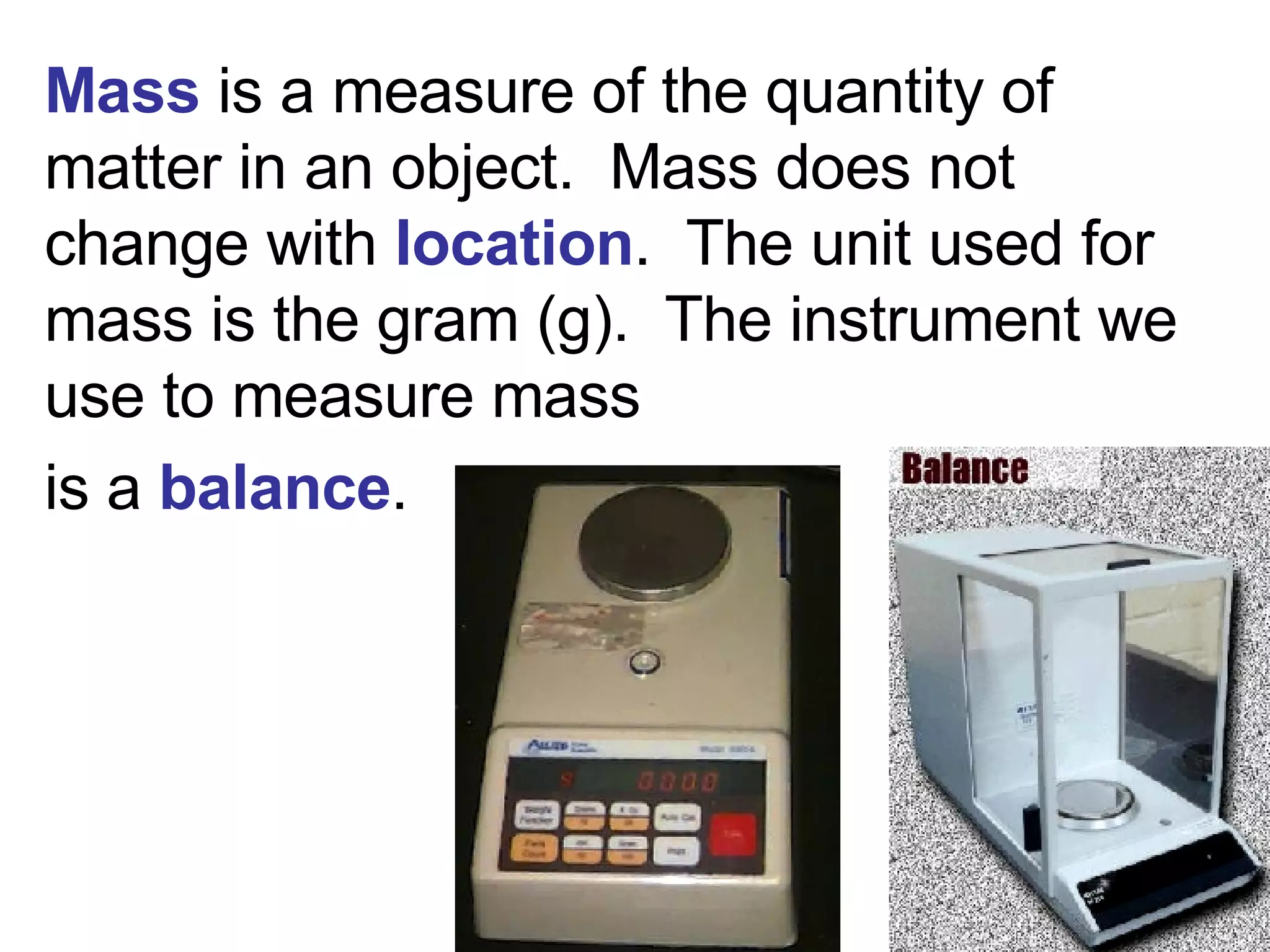
Mass  is a measure of the quantity of matter in an object.  Mass   does not change with  location .  The unit used for mass is the gram (g).  The instrument we use to measure mass is a  balance .
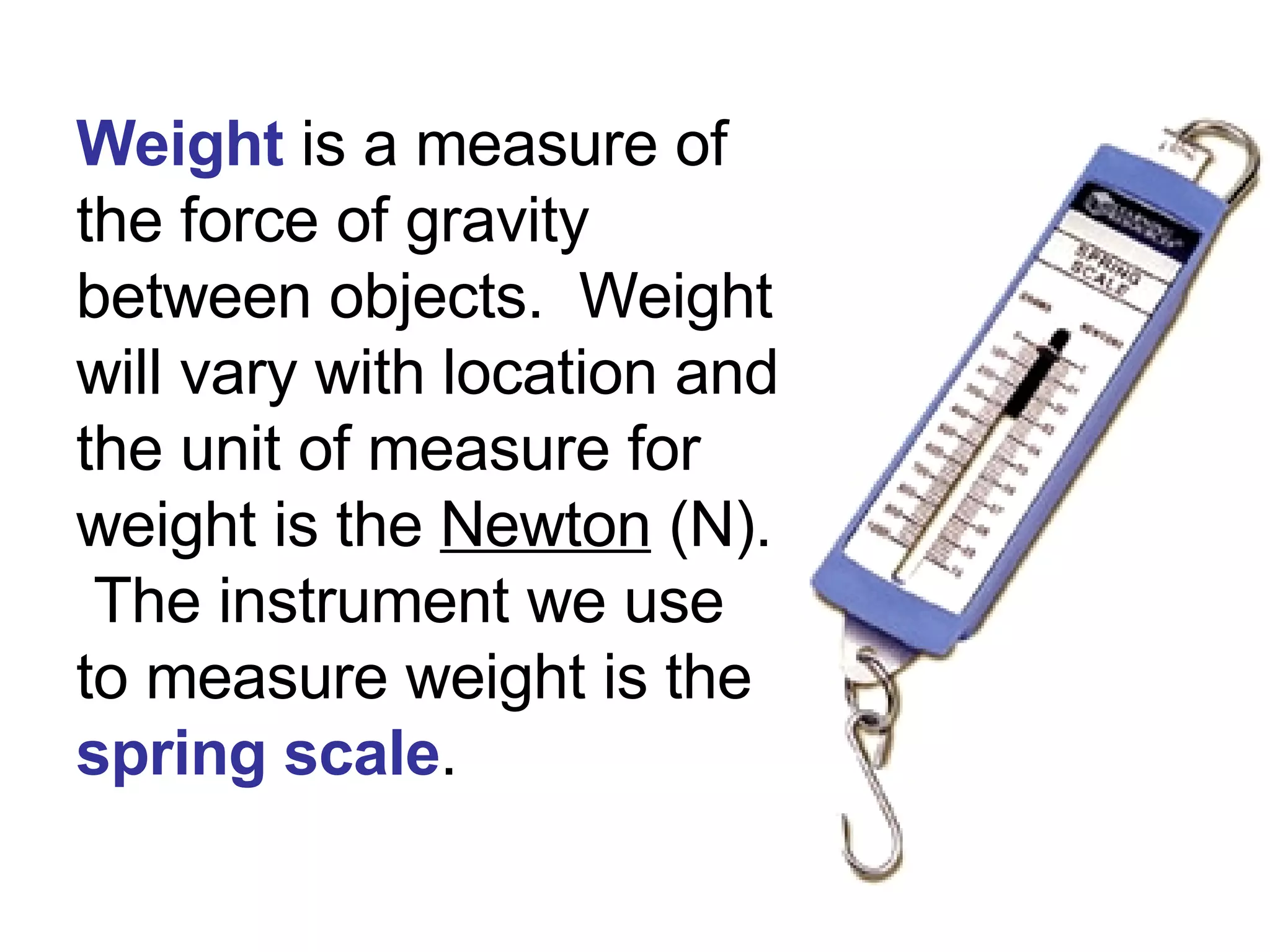
Weight  is a measure of the force of gravity between objects.  Weight will vary with location and the unit of measure for weight   is the  Newton  (N).  The instrument we use to measure weight is the  spring scale .
Length  is the distance covered by an object.  Unit of measure for length   is the  meter  (m).  The instrument used to measure length is a ruler,  meter stick , etc.
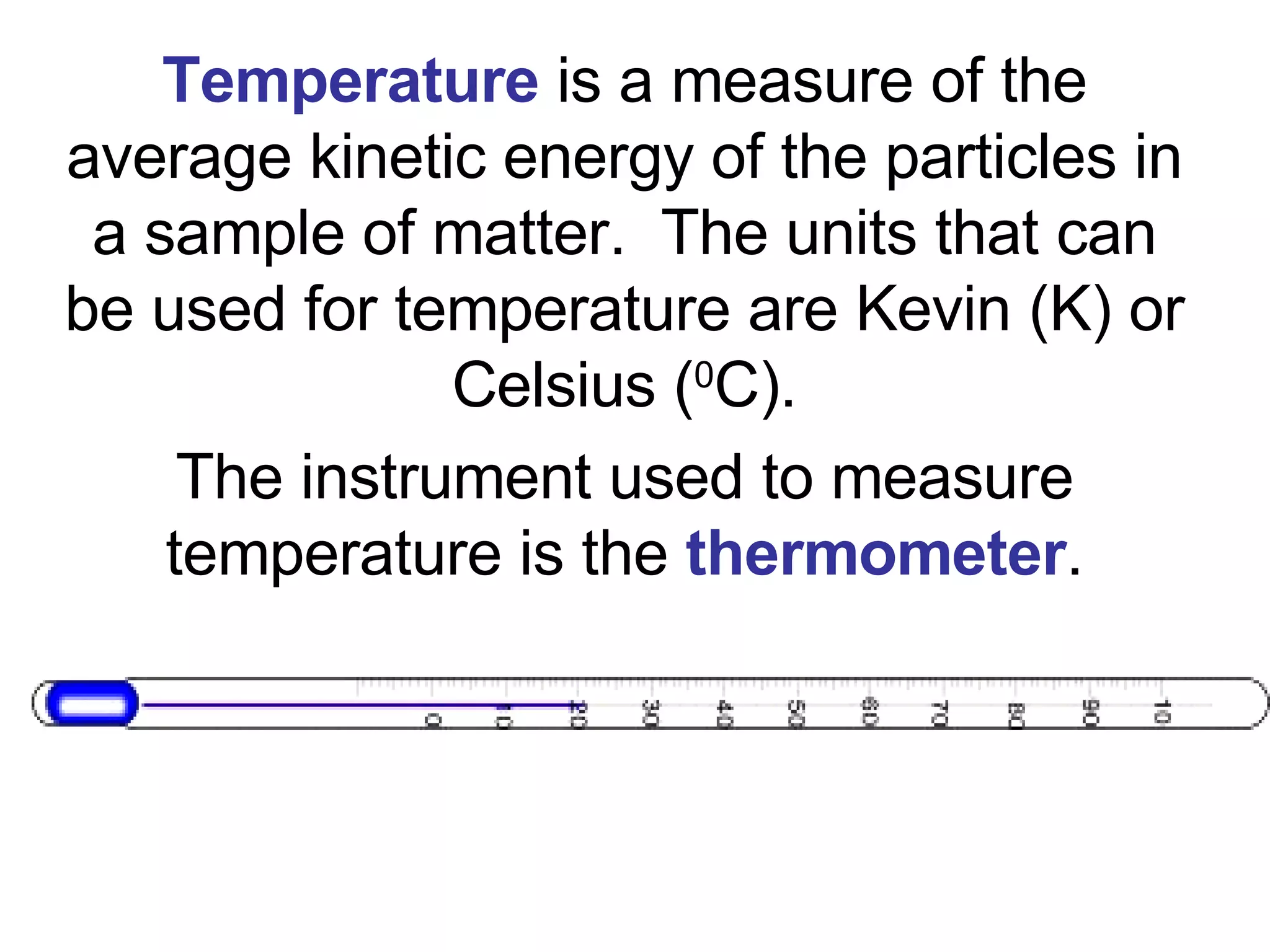
Temperature  is a measure of the average kinetic energy of the particles in a sample of matter.  The units that can be used for temperature are Kevin (K) or Celsius ( 0 C). The instrument used to measure temperature is the  thermometer .
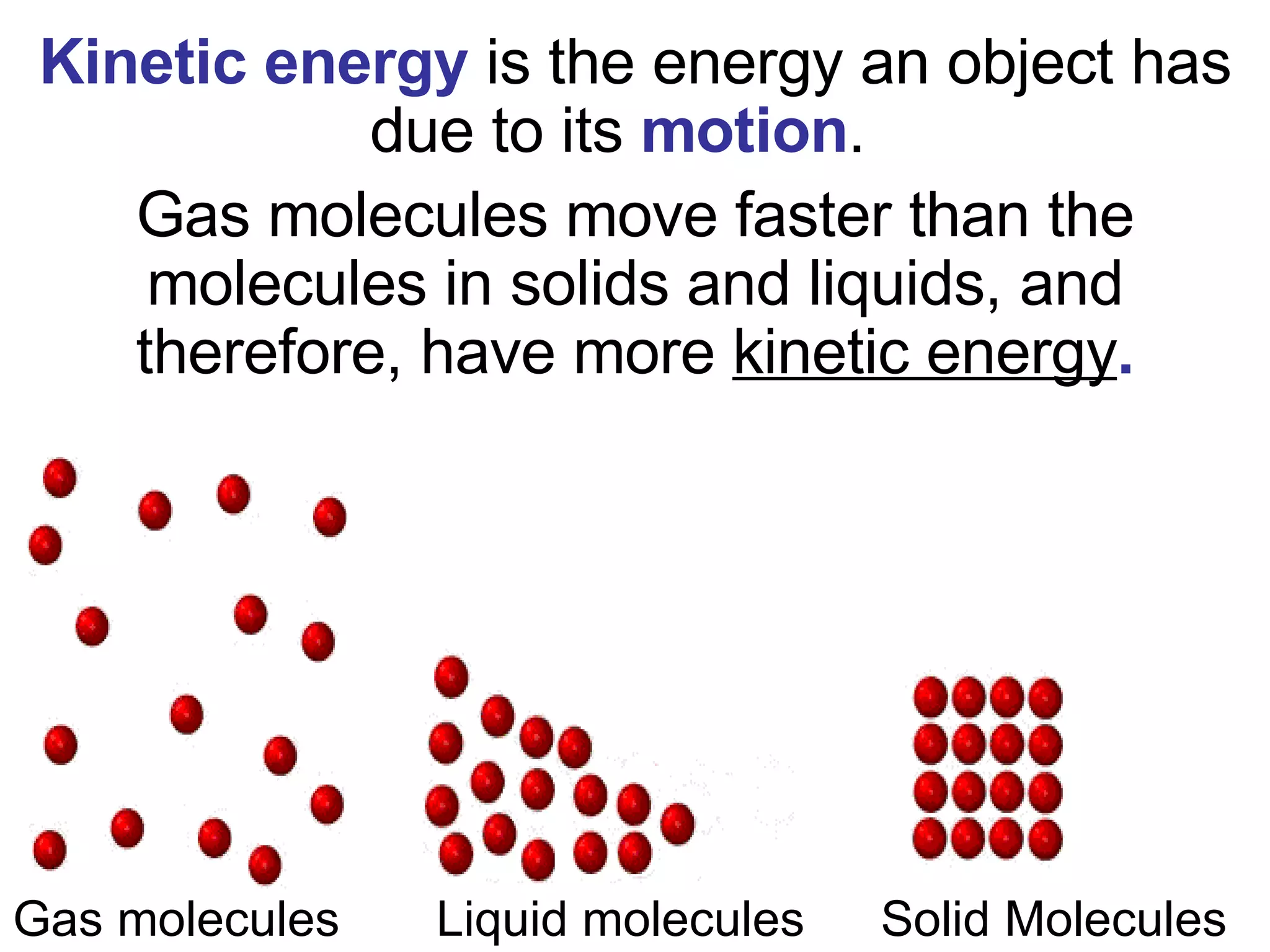
Kinetic energy  is the energy an object has due to its  motion .  Gas molecules move faster than the molecules in solids and liquids, and therefore, have more  kinetic energy . Gas molecules Liquid molecules Solid Molecules
Heat  is the energy transferred as a result of a temperature difference.  Left undisturbed, energy will flow from objects of  high  temperature to objects of  low  temperature until the objects have equal temperature. Unit – Joules (J) or Calories (cal) 1 cal – 4.184 J 1000 cal = 1 kcal also called 1 food Calorie
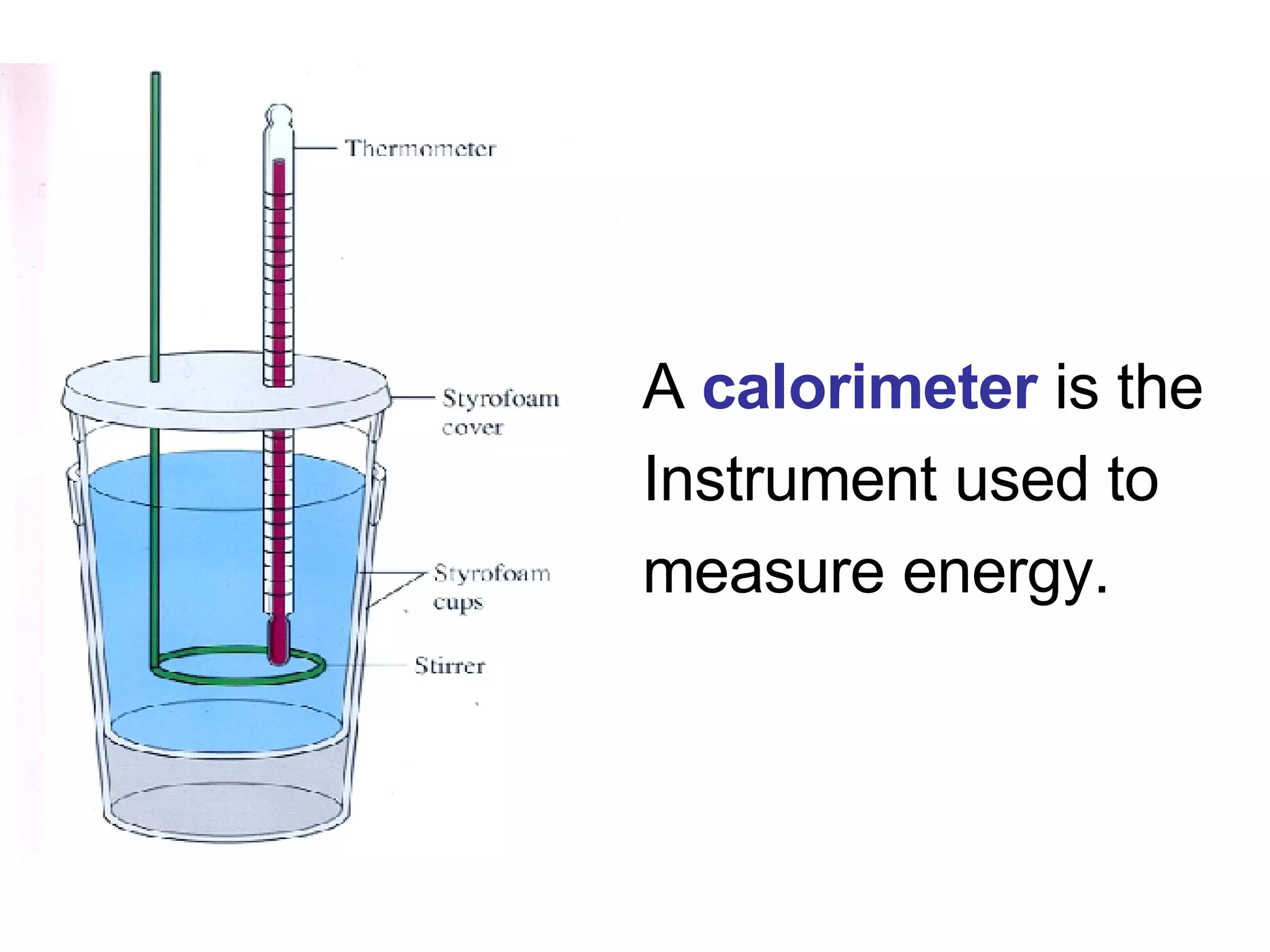
A  calorimeter  is the  Instrument used to  measure energy.
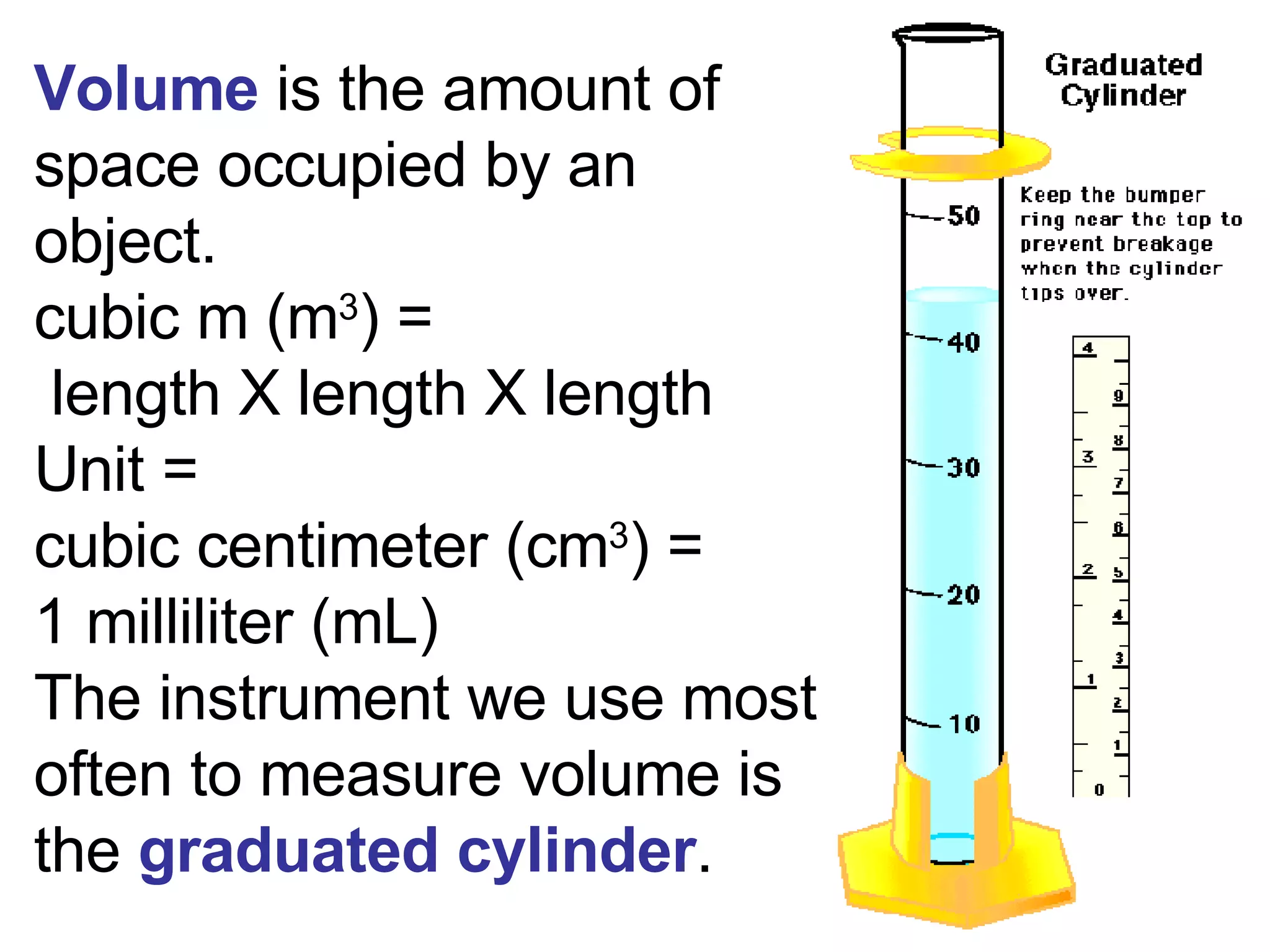
Volume  is the amount of space occupied by an object.  cubic m (m 3 ) =  length X length X length Unit =  cubic centimeter (cm 3 ) =  1 milliliter (mL) The instrument we use most often to measure volume is the  graduated cylinder .
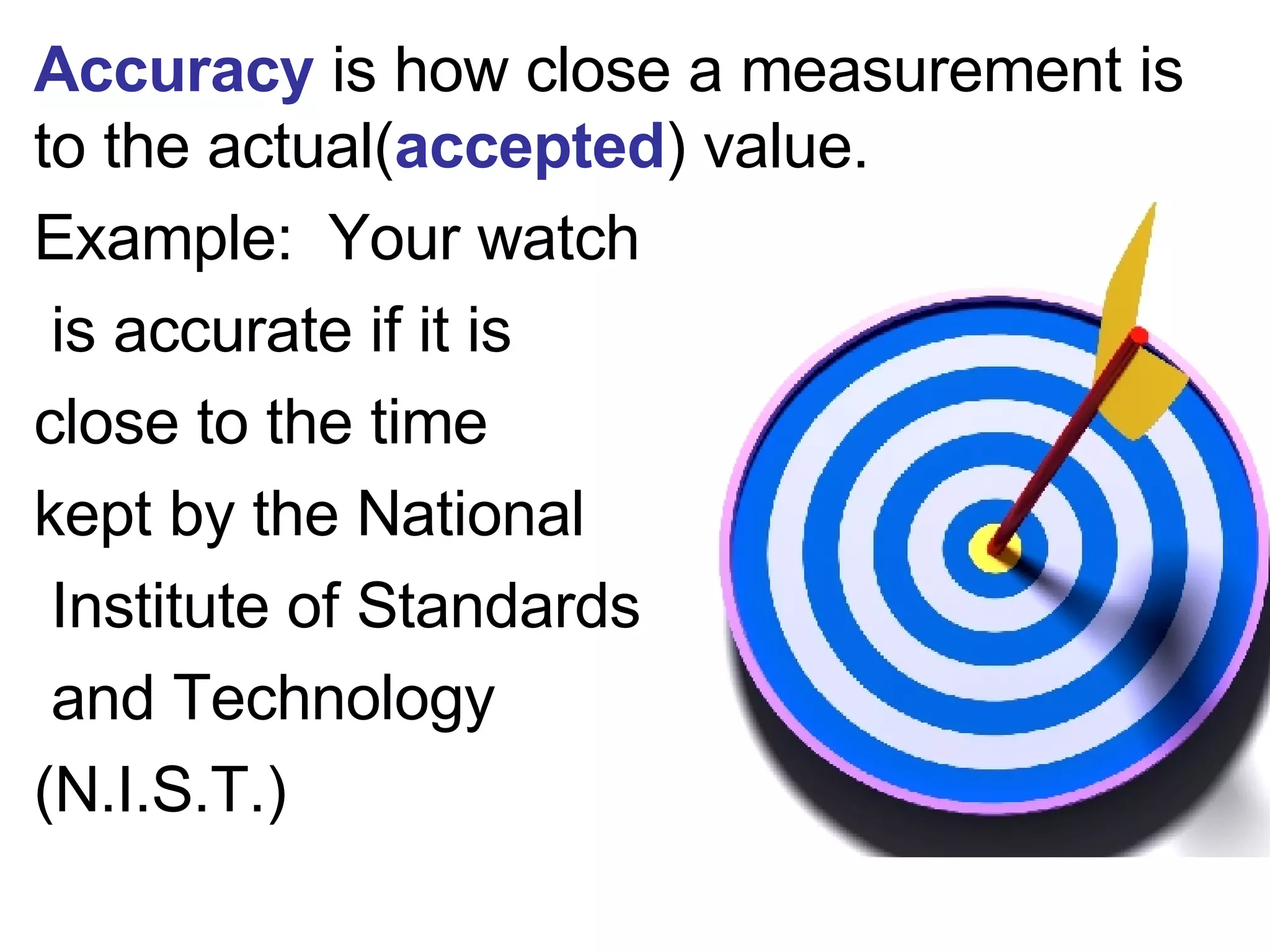
Accuracy  is how close a measurement is to the actual( accepted ) value. Example:  Your watch is accurate if it is  close to the time  kept by the National Institute of Standards and Technology  (N.I.S.T.)
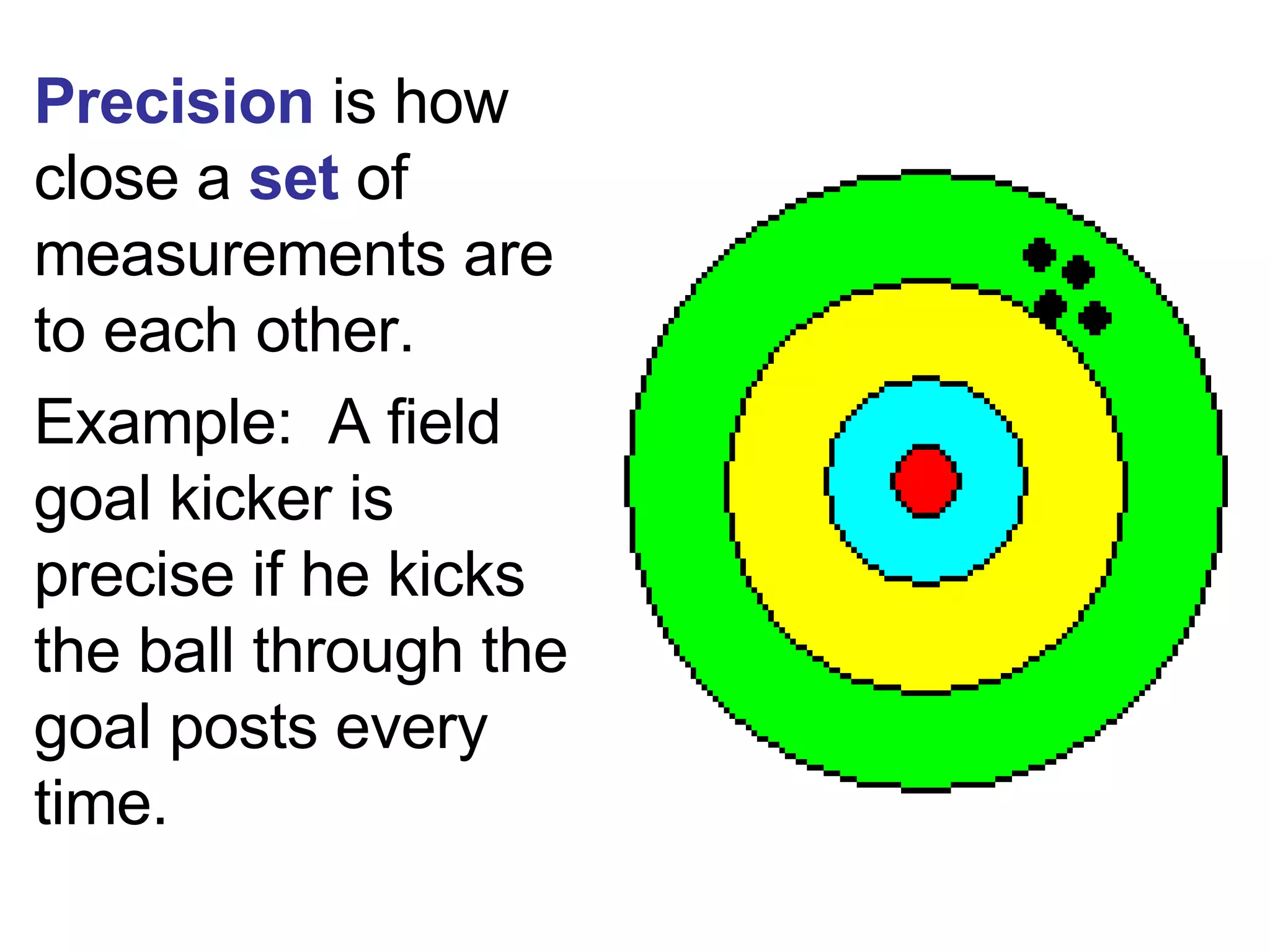
Precision  is how close a  set  of measurements are to each other. Example:  A field goal kicker is precise if he kicks the ball through the goal posts every time.
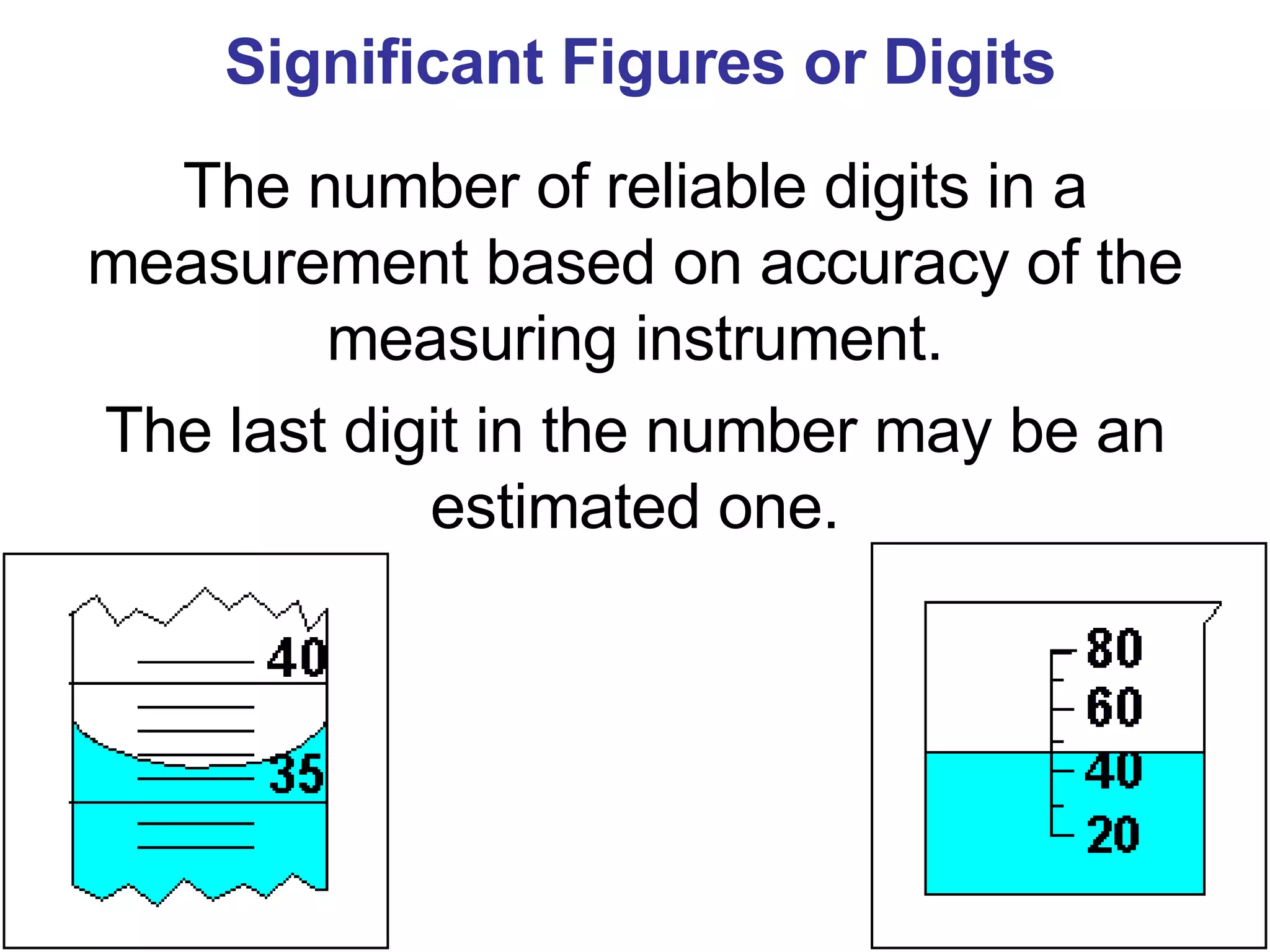
Significant Figures or Digits The number of reliable digits in a measurement based on accuracy of the measuring instrument. The last digit in the number may be an estimated one.
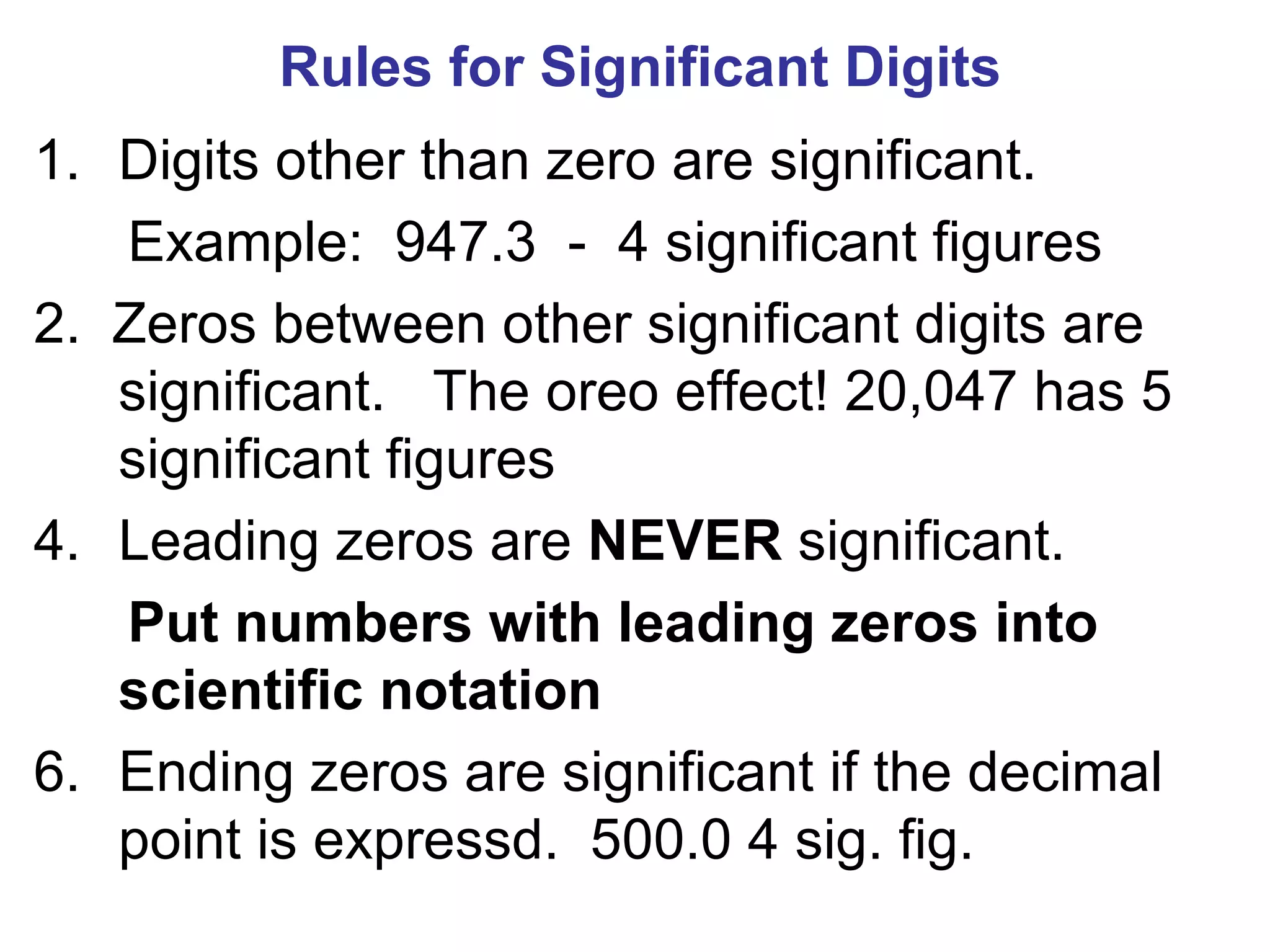
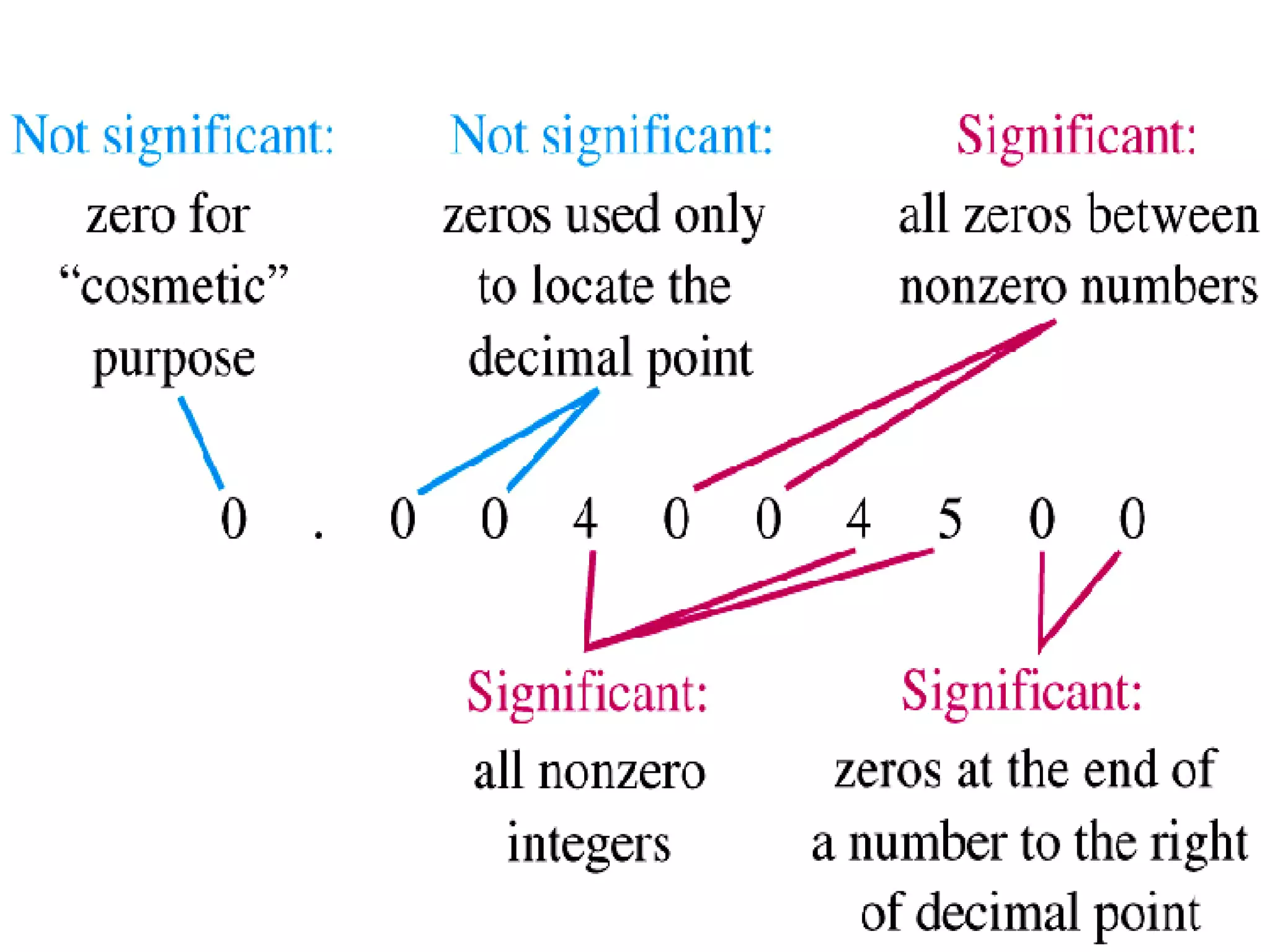
Rules for Significant Digits Digits other than zero are significant. Example:  947.3  -  4 significant figures 2.  Zeros between other significant digits are significant.  The oreo effect! 20,047 has 5 significant figures Leading zeros are  NEVER  significant. Put numbers with leading zeros into scientific notation Ending zeros are significant if the decimal point is expressd.  500.0 4 sig. fig.
 
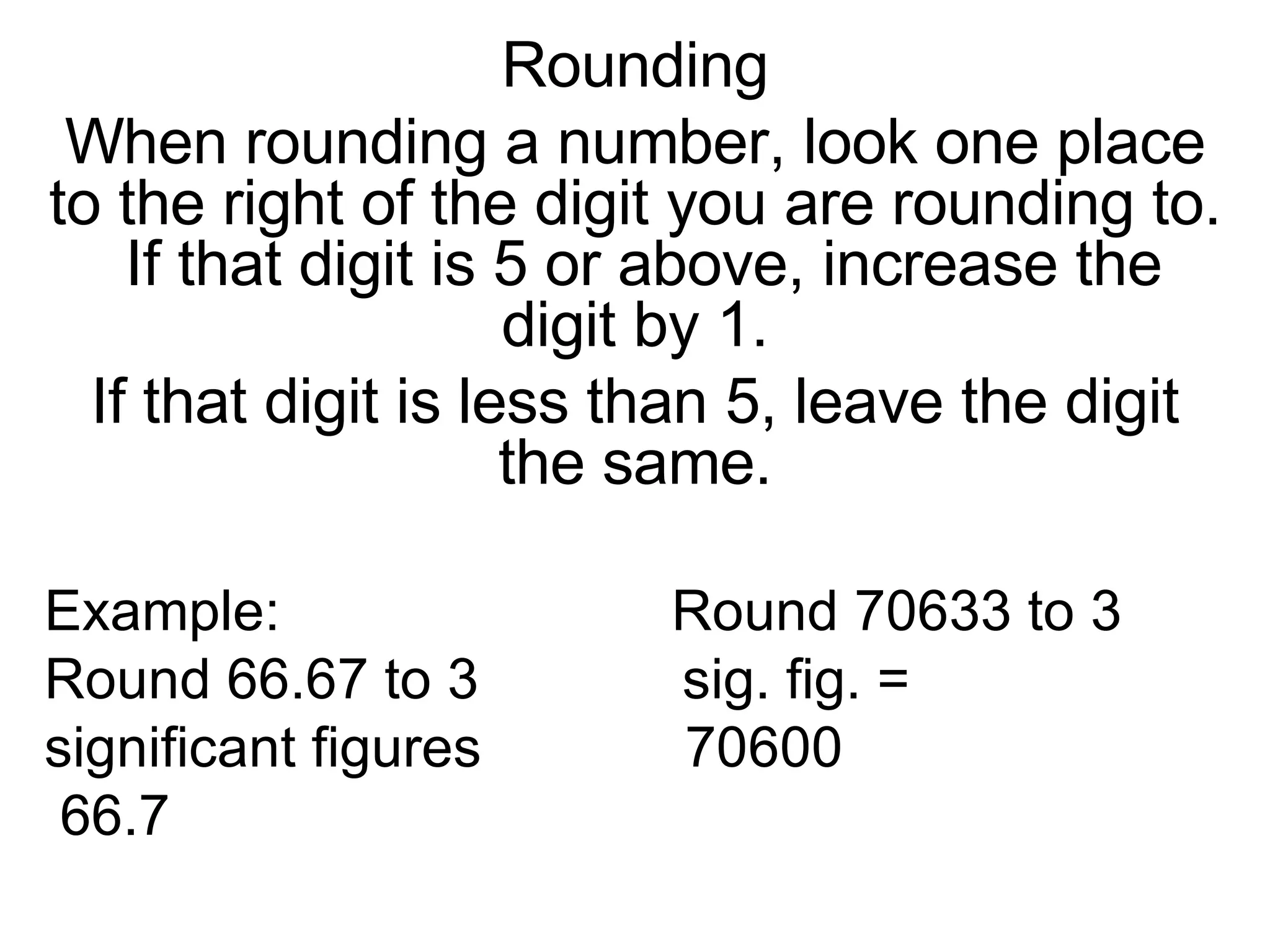
Rounding When rounding a number, look one place to the right of the digit you are rounding to.  If that digit is 5 or above, increase the digit by 1. If that digit is less than 5, leave the digit the same. Example:  Round 70633 to 3  Round 66.67 to 3  sig. fig. = significant figures  70600 66.7
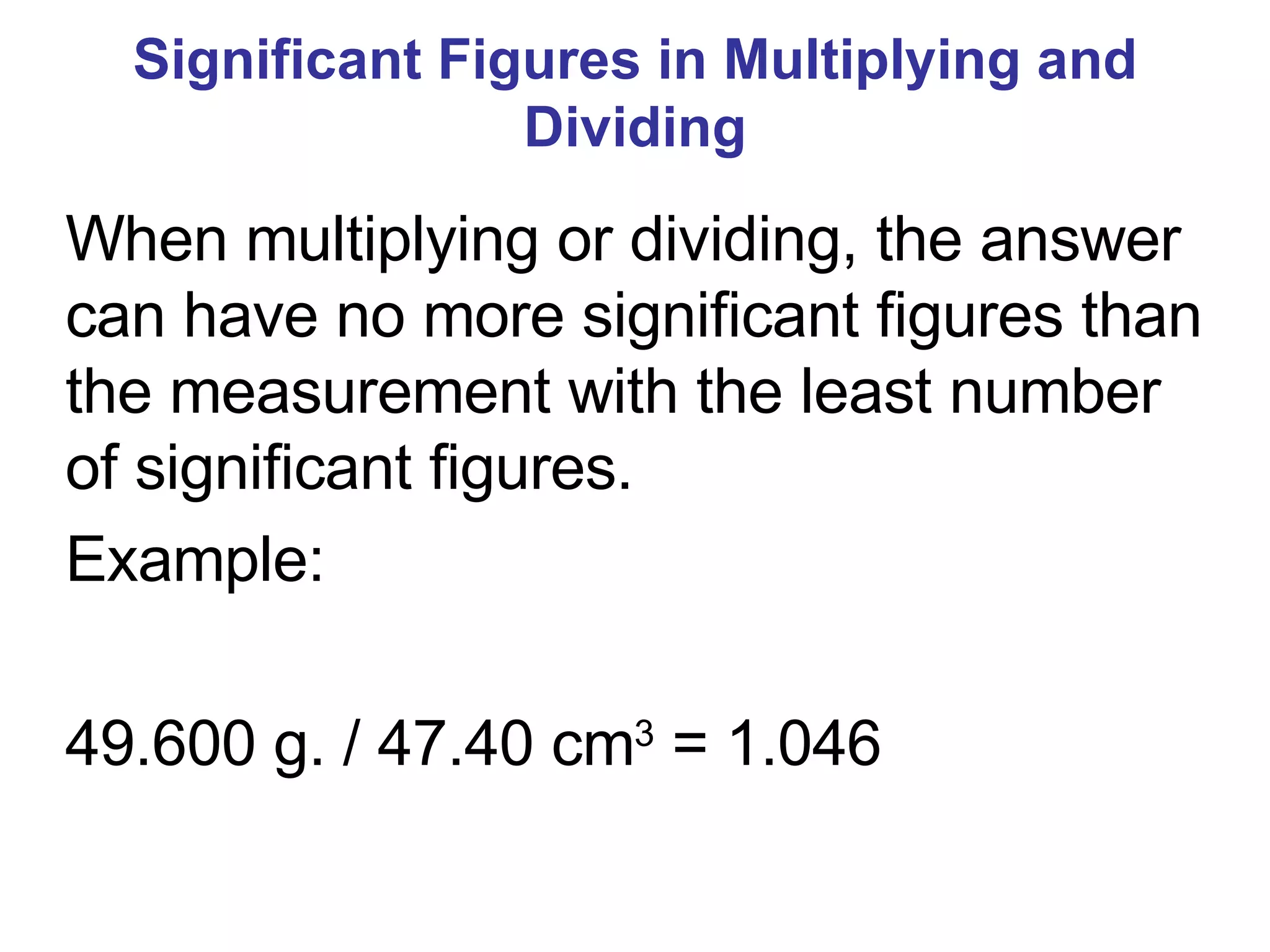
Significant Figures in Multiplying and Dividing When multiplying or dividing, the answer can have no more significant figures than the measurement with the least number of significant figures. Example: 49.600 g. / 47.40 cm 3  = 1.046
Dimensional Analysis A  conversion factor  is a fraction that I a ratio equivalent to 1. Example:  1000 m / 1 km 1 km / 1000 m  Factor – label method or dimensional analysis  is a problem – solving method that uses conversion factors to change unit.
Example 1:  60 km / hr = ? cm / s 1000 m = 1 km  100 cm = 1 m
Example 2:  Helen is driving her car at  60 km / s.  What is her speed  in m / h?
Example 3:  How many ml are in a 3 L  of saline solution?
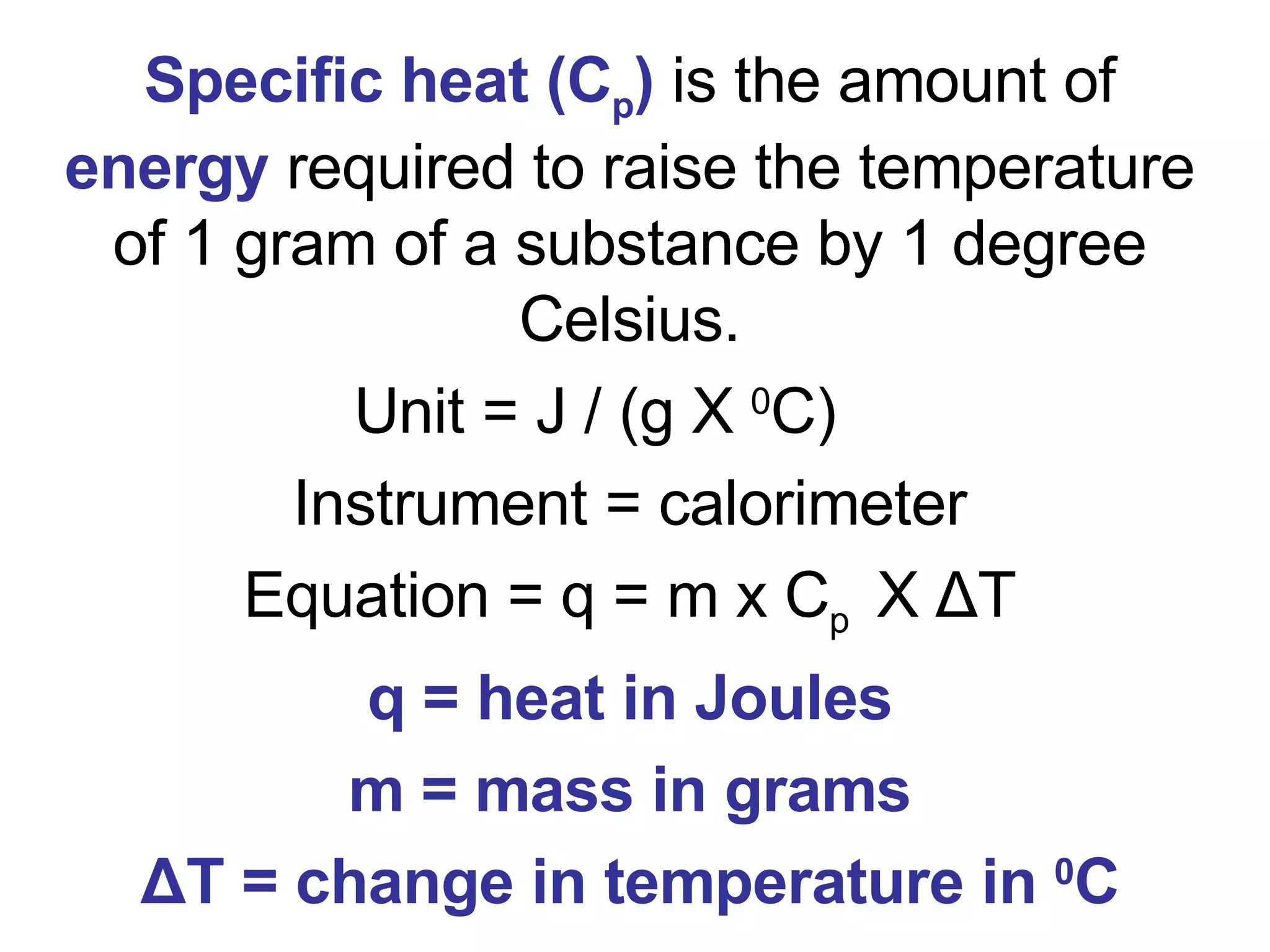
Specific heat (C p )  is the amount of  energy  required to raise the temperature of 1 gram of a substance by 1 degree Celsius. Unit = J / (g X  0 C)  Instrument = calorimeter Equation = q = m x C p  X  Δ T q = heat in Joules m = mass in grams Δ T = change in temperature in  0 C
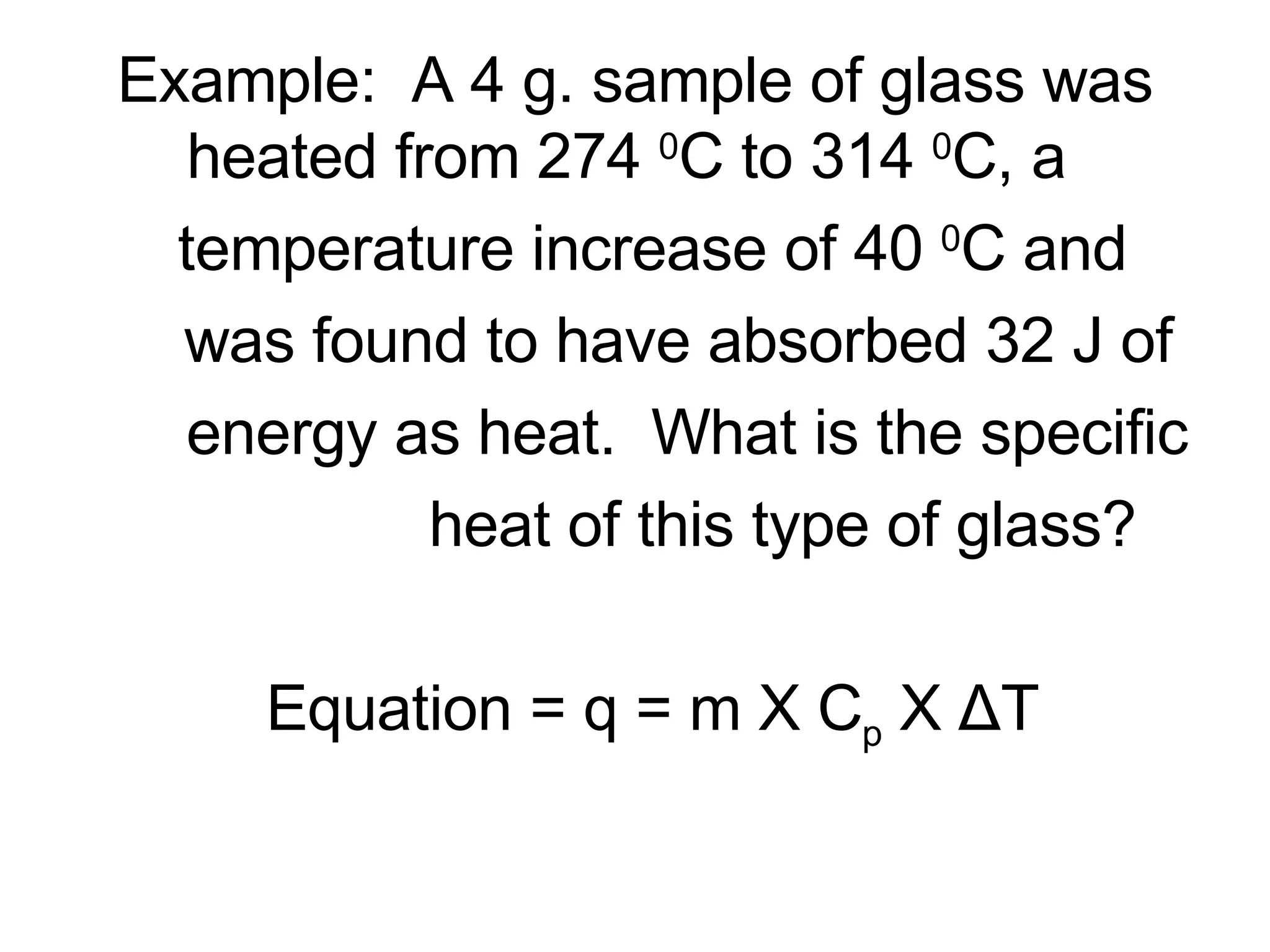
Example:  A 4 g. sample of glass was heated from 274  0 C to 314  0 C, a  temperature increase of 40  0 C and  was found to have absorbed 32 J of energy as heat.  What is the specific heat of this type of glass? Equation = q = m X C p  X  Δ T
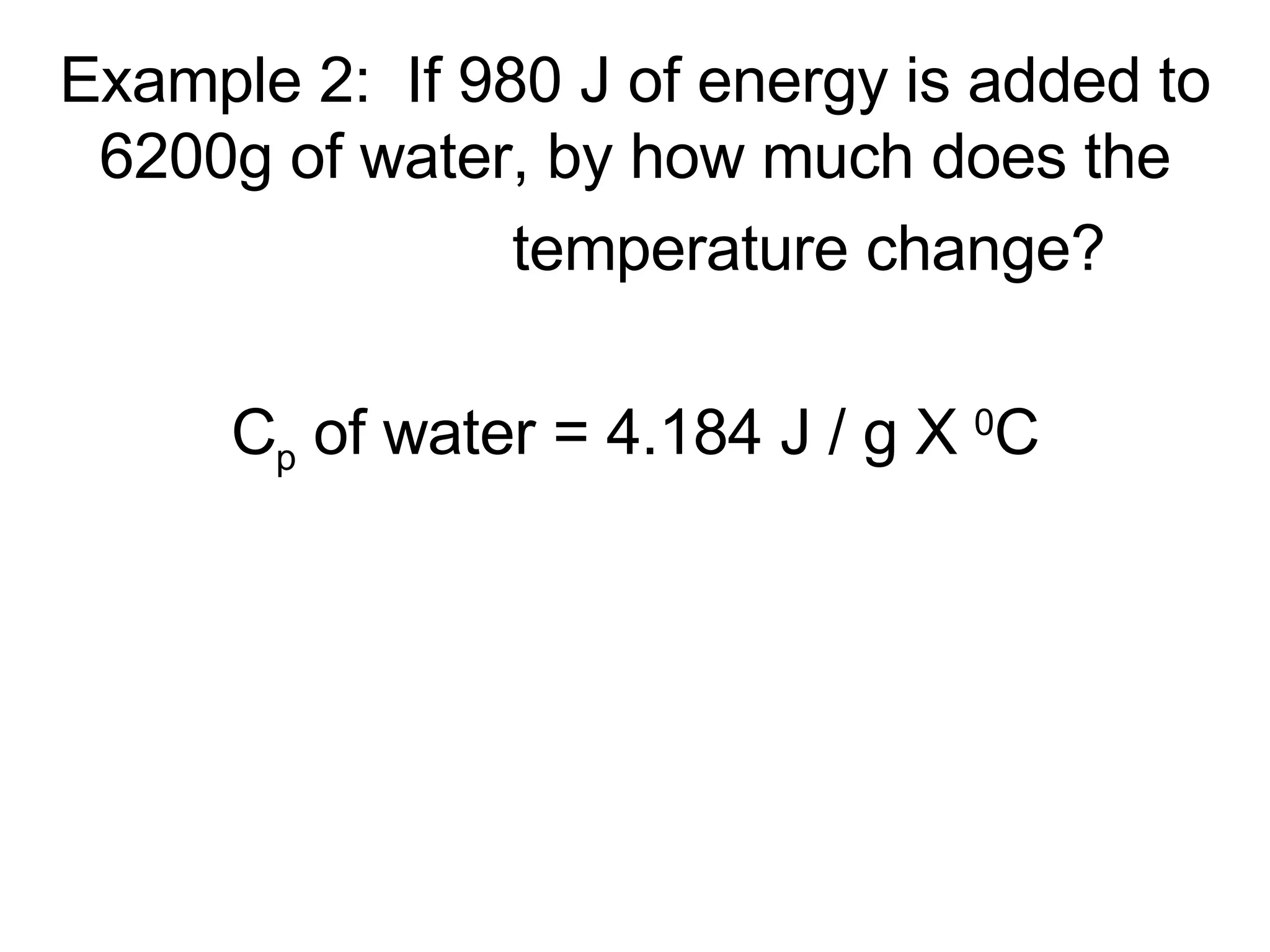
Example 2:  If 980 J of energy is added to 6200g of water, by how much does the temperature change? C p  of water = 4.184 J / g X  0 C
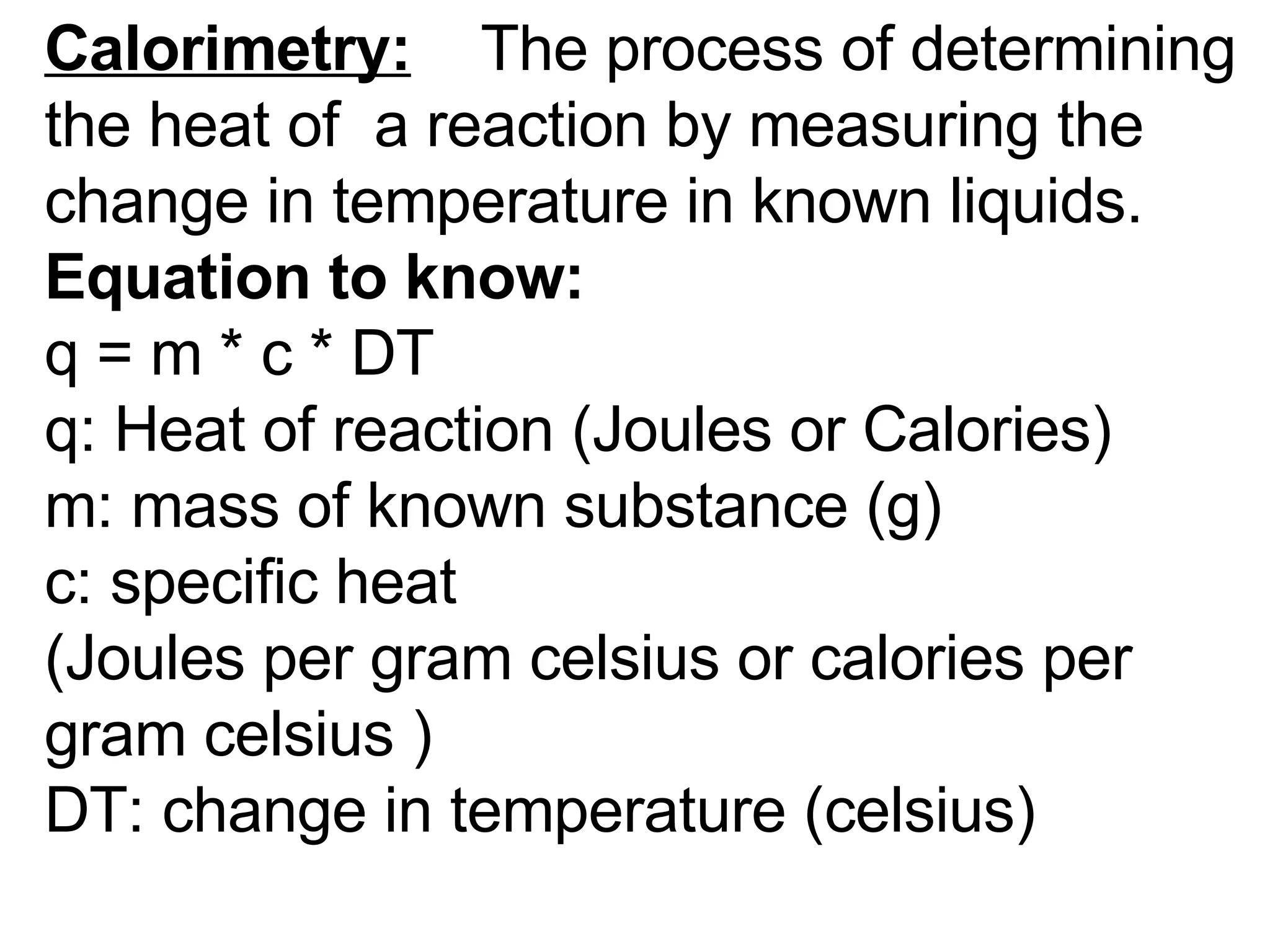
Calorimetry:     The process of determining the heat of  a reaction by measuring the change in temperature in known liquids.  Equation to know:                          q = m * c * DT                         q: Heat of reaction (Joules or Calories) m: mass of known substance (g) c: specific heat  (Joules per gram celsius or calories per gram celsius )                        DT: change in temperature (celsius) 
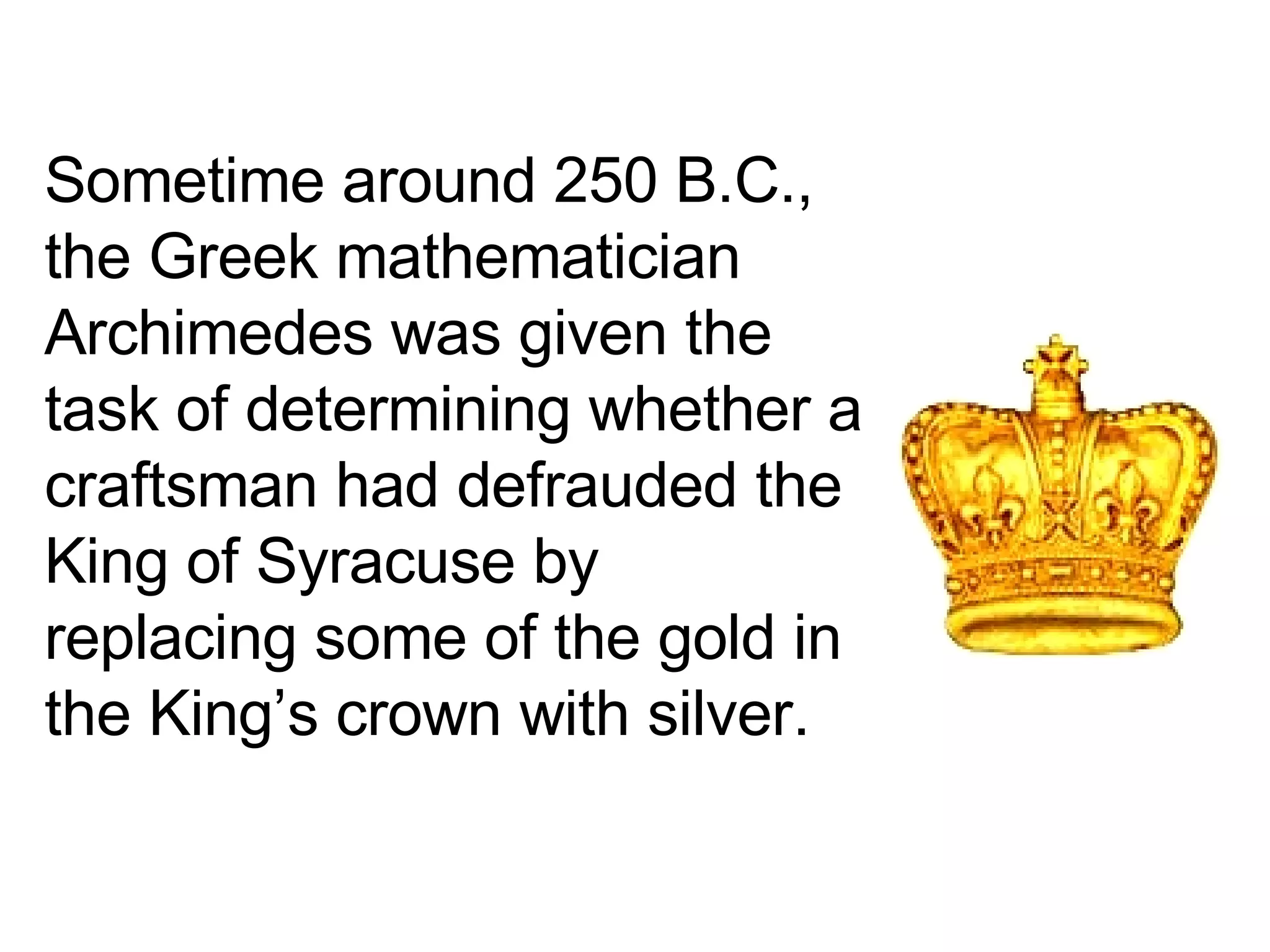
Sometime around 250 B.C., the Greek mathematician Archimedes was given the task of determining whether a craftsman had defrauded the King of Syracuse by replacing some of the gold in the King’s crown with silver.
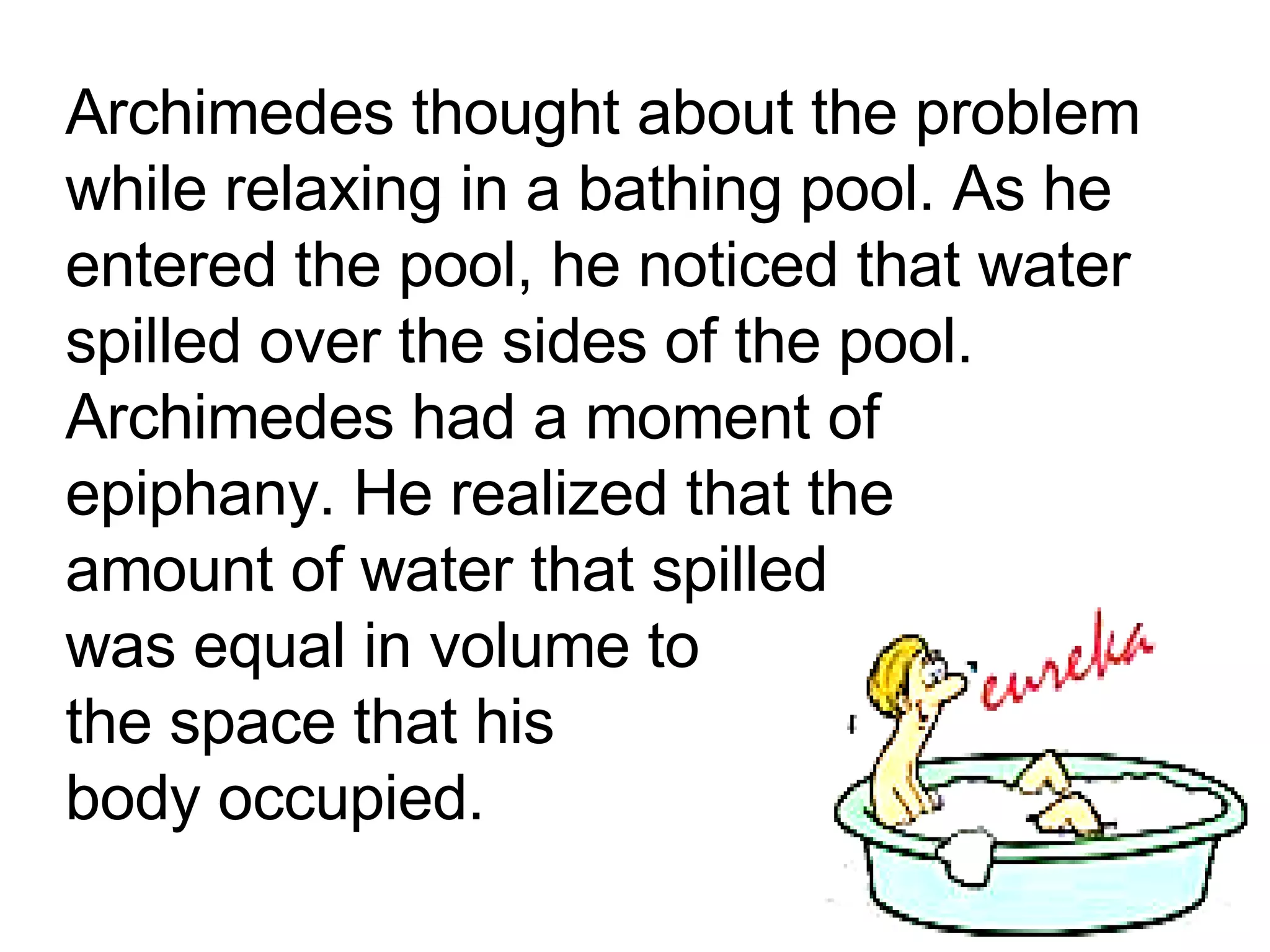
Archimedes thought about the problem while relaxing in a bathing pool. As he entered the pool, he noticed that water spilled over the sides of the pool. Archimedes had a moment of  epiphany. He realized that the  amount of water that spilled  was equal in volume to  the space that his  body occupied.
This fact suddenly provided him with a method for differentiating a mixed silver and gold crown from a pure gold crown. Because a measure of silver occupies more space than an equivalent measure of gold, Archimedes placed the craftsman’s crown and an equivalent pure gold crown in two tubs of water. He found that more water spilled over the sides of the tub when the craftsman’s crown was submerged. It turned out that the craftsman had been defrauding the King!
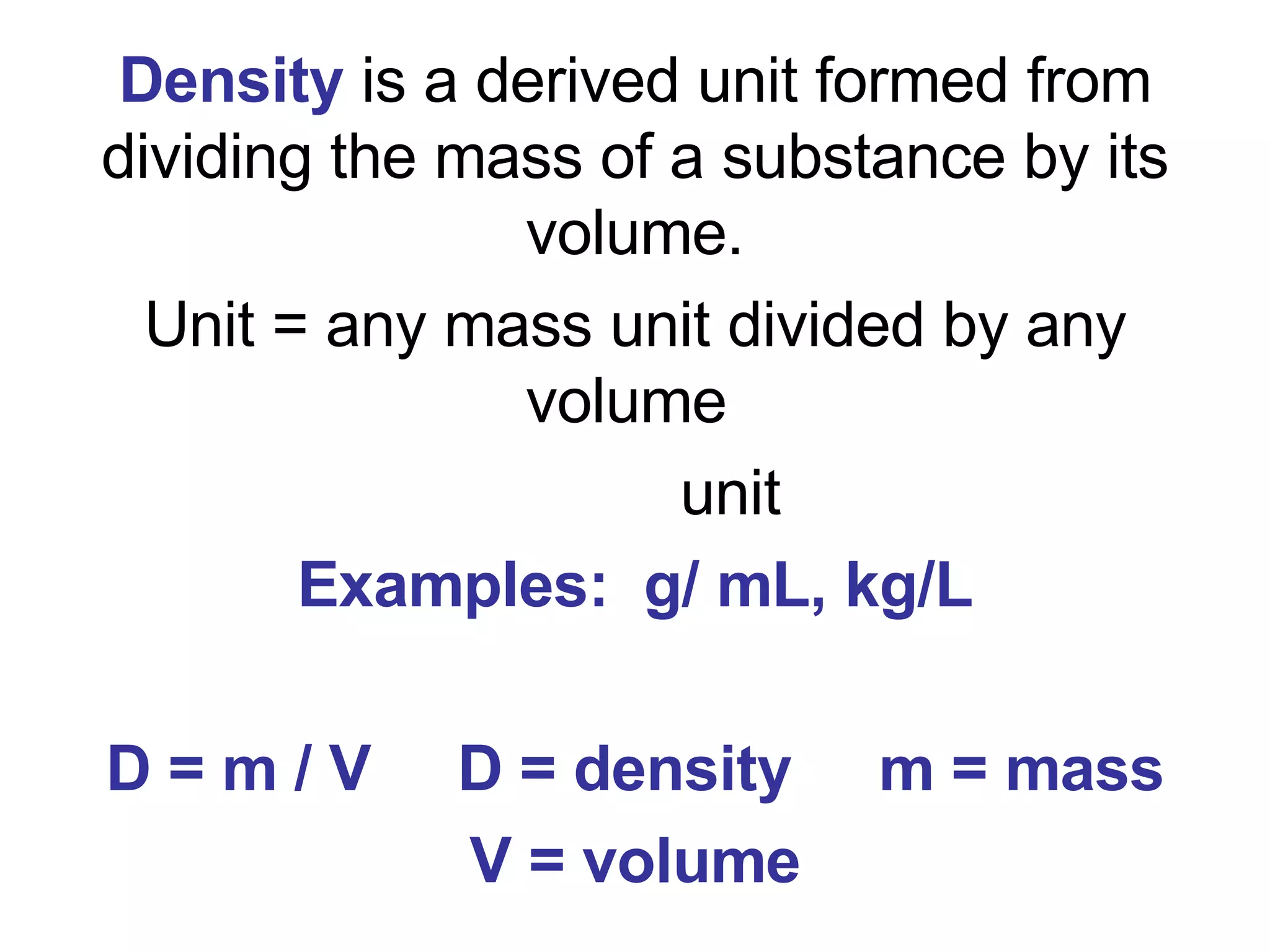
Archimedes had used the concept of  density  to expose the fraud.  Density  is a physical property of matter that describes the degree of compactness of a substance, in other words, closely packed together the  atoms  of an  element  or  molecules  of a  compound  are. The more closely packed together the individual particles of a substance are, the more dense that substance is.
Density   is a derived unit formed from dividing the mass of a substance by its volume. Unit = any mass unit divided by any volume  unit Examples:  g/ mL, kg/L D = m / V  D = density  m = mass V = volume
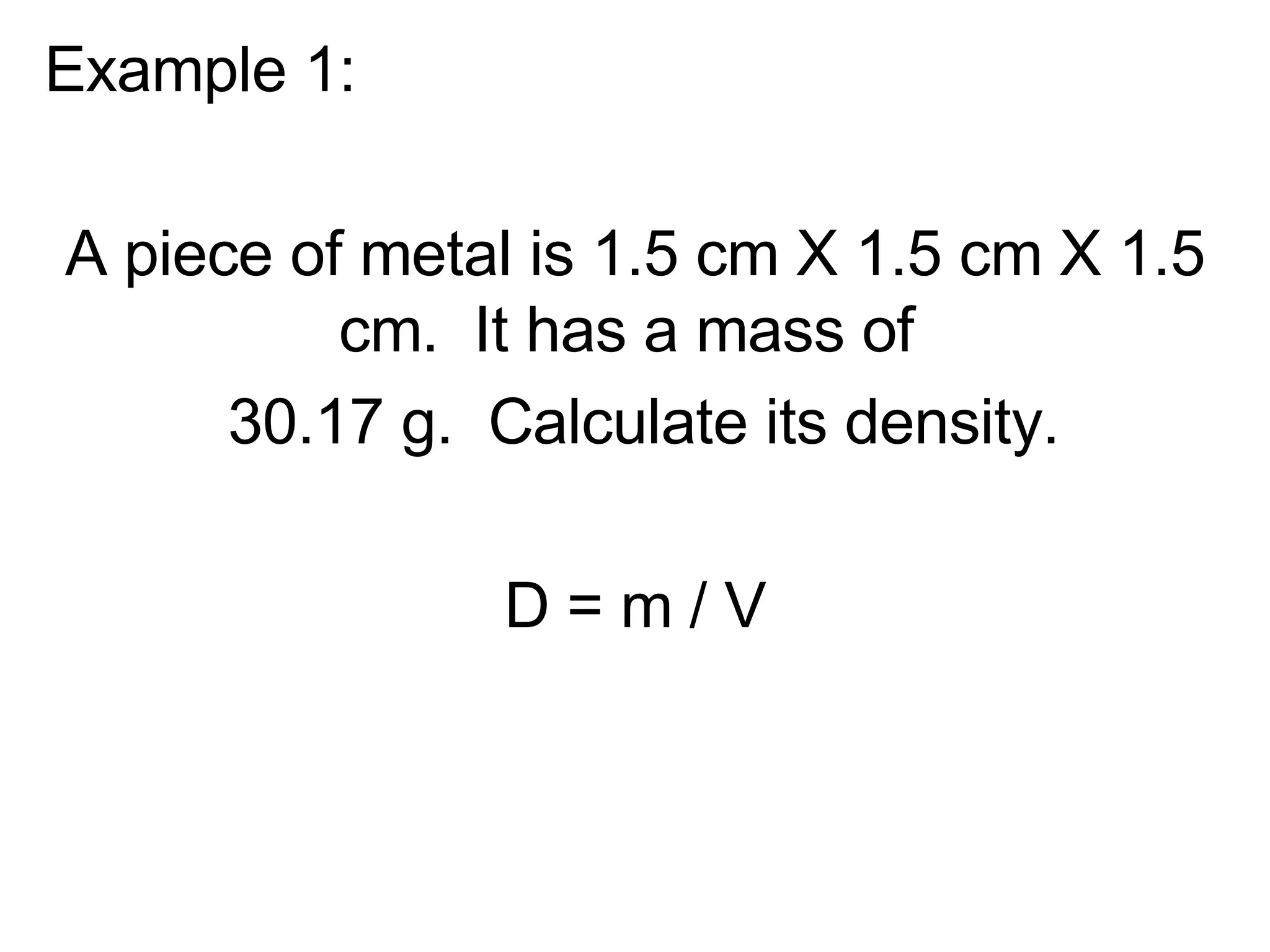
Example 1:  A piece of metal is 1.5 cm X 1.5 cm X 1.5 cm.  It has a mass of  30.17 g.  Calculate its density. D = m / V
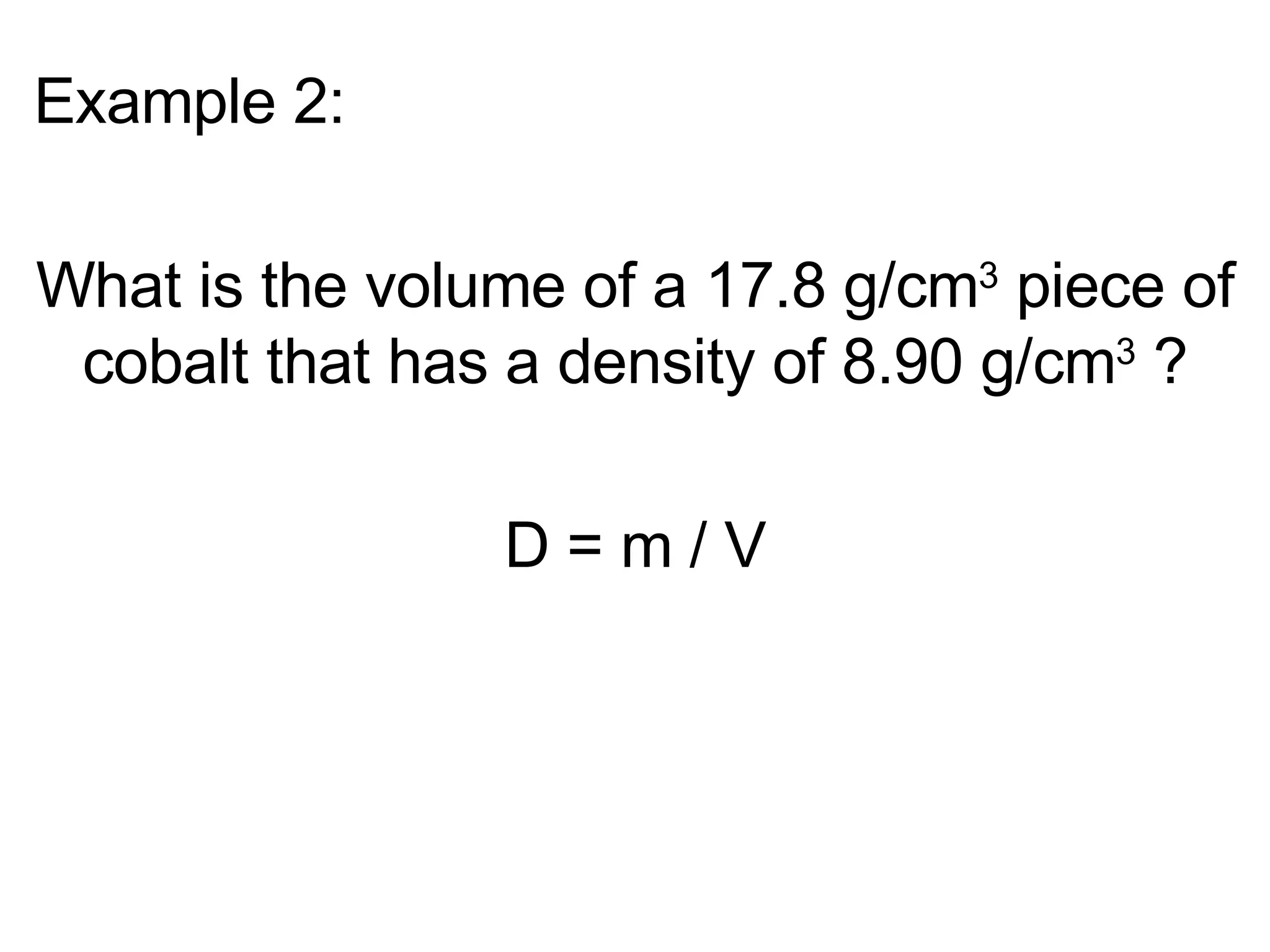
Example 2: What is the volume of a 17.8 g/cm 3  piece of cobalt that has a density of 8.90 g/cm 3  ? D = m / V
Physical Properties Physical properties are properties that can be observed without changing the composition of the substance. Boiling Point Melting Point Color
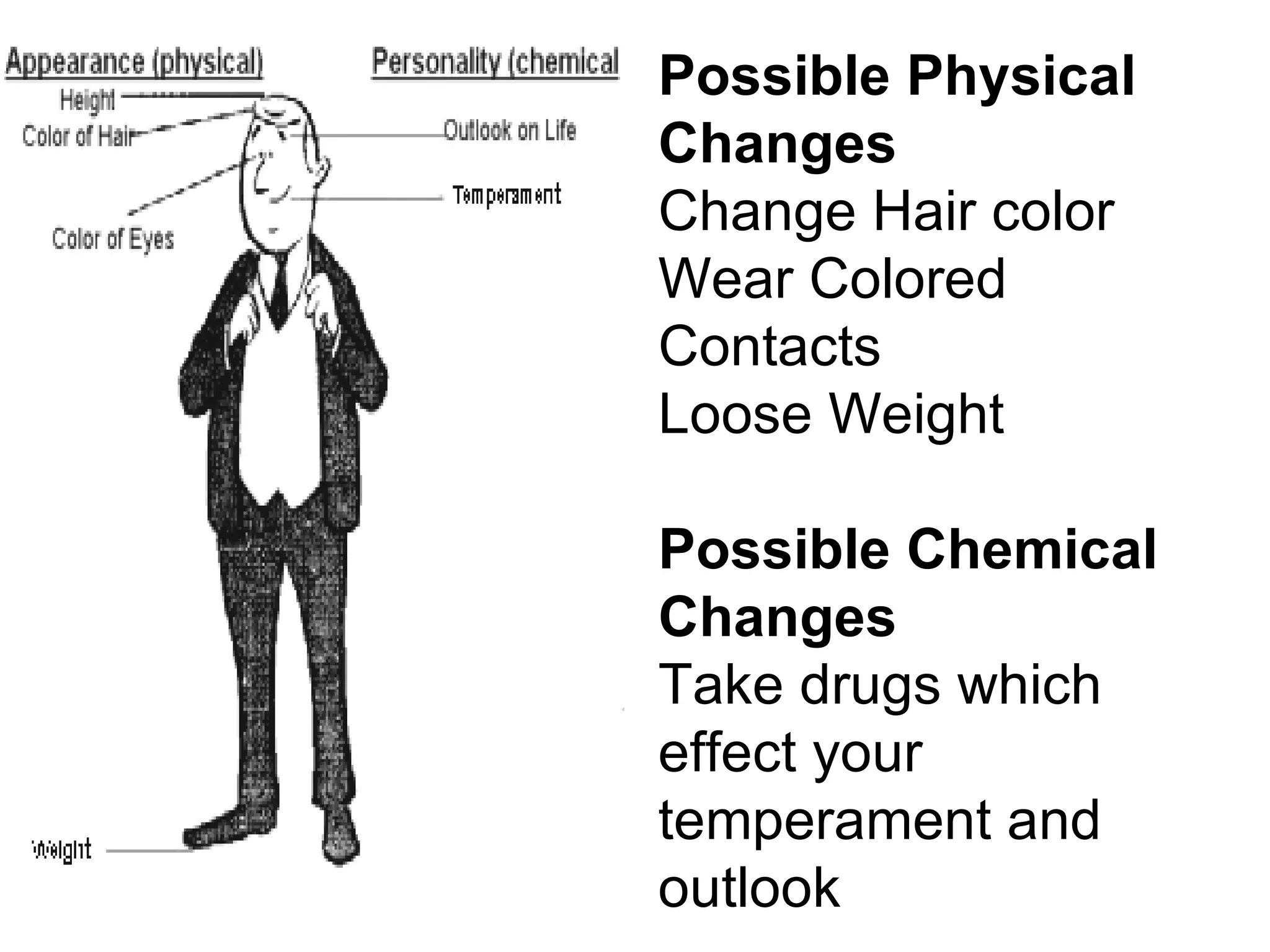
Possible Physical Changes Change Hair color Wear Colored Contacts Loose Weight Possible Chemical Changes Take drugs which effect your temperament and outlook
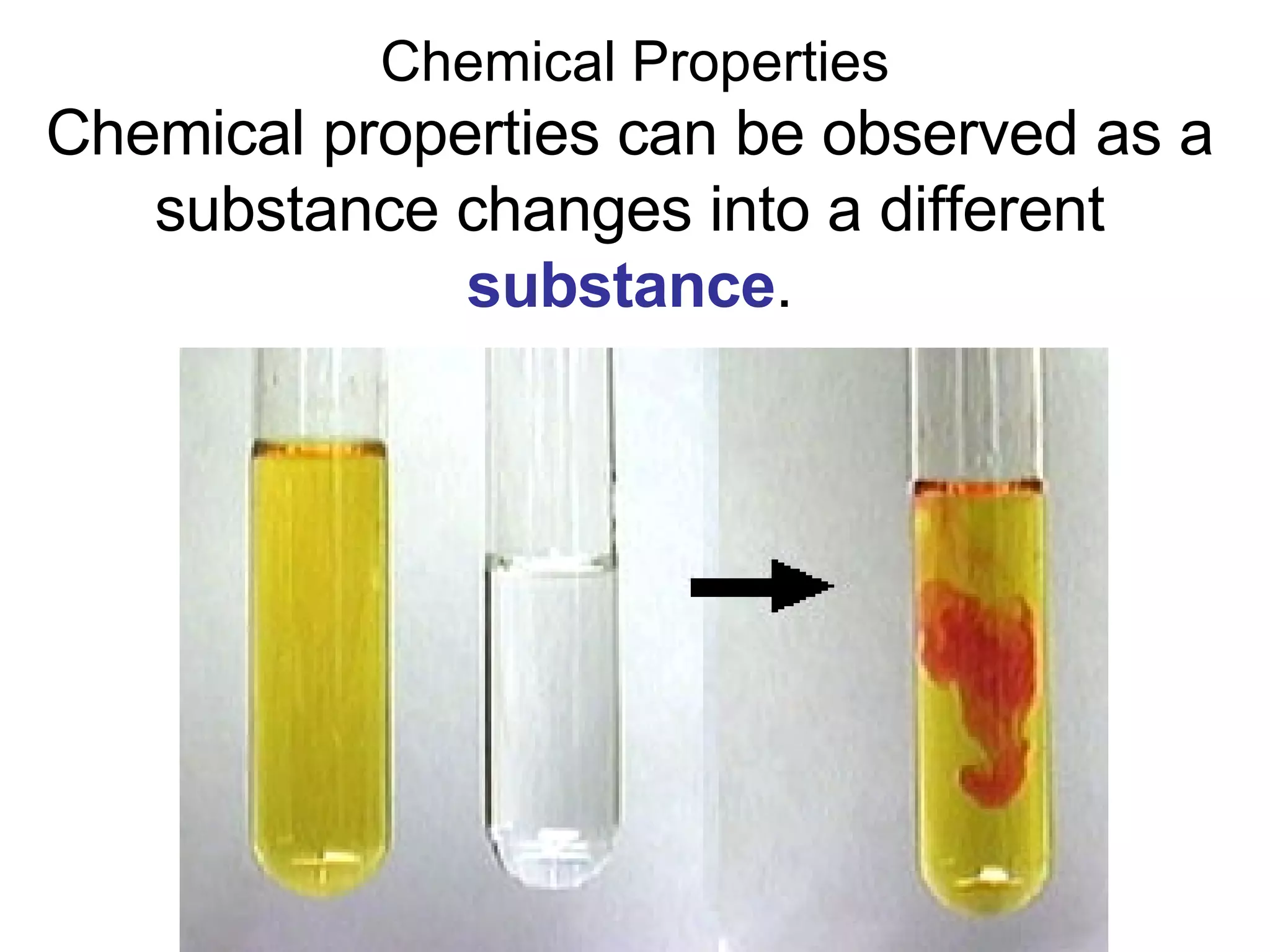
Chemical Properties Chemical properties can be observed as a substance changes into a different  substance .
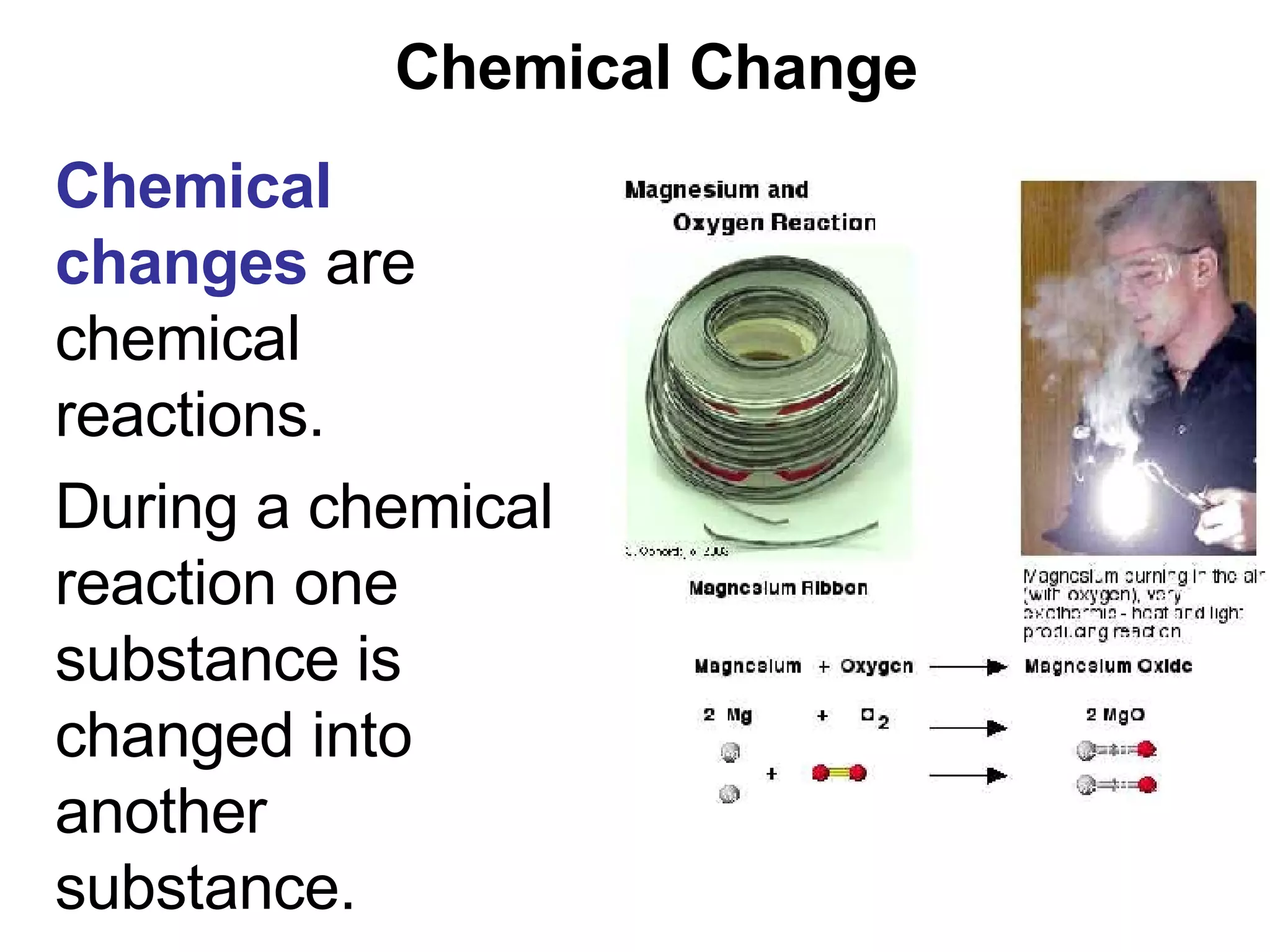
Chemical Change Chemical changes  are chemical reactions.  During a chemical reaction one substance is changed into another substance.
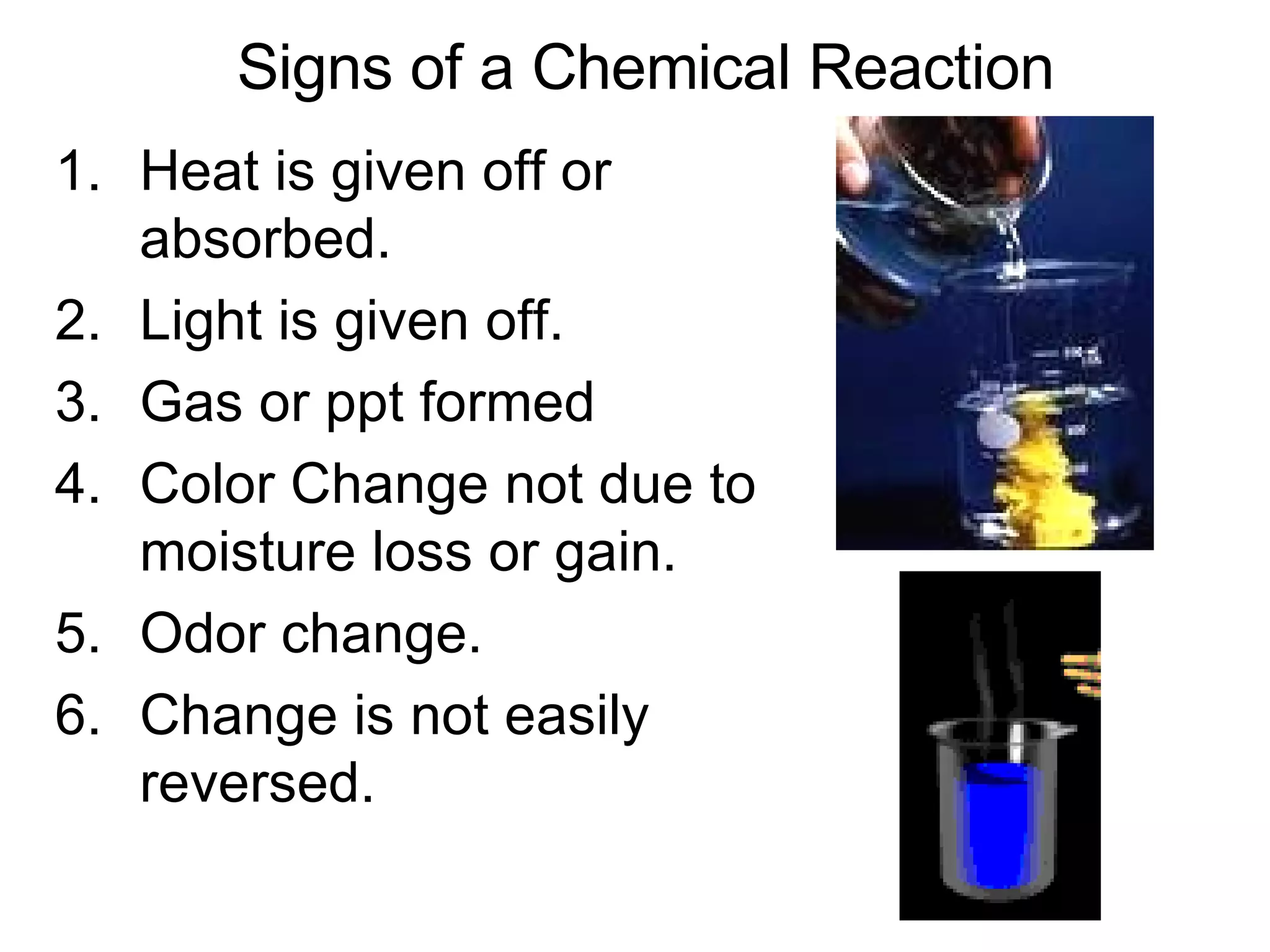
Signs of a Chemical Reaction Heat is given off or absorbed. Light is given off. Gas or ppt formed Color Change not due to moisture loss or gain. Odor change. Change is not easily reversed.
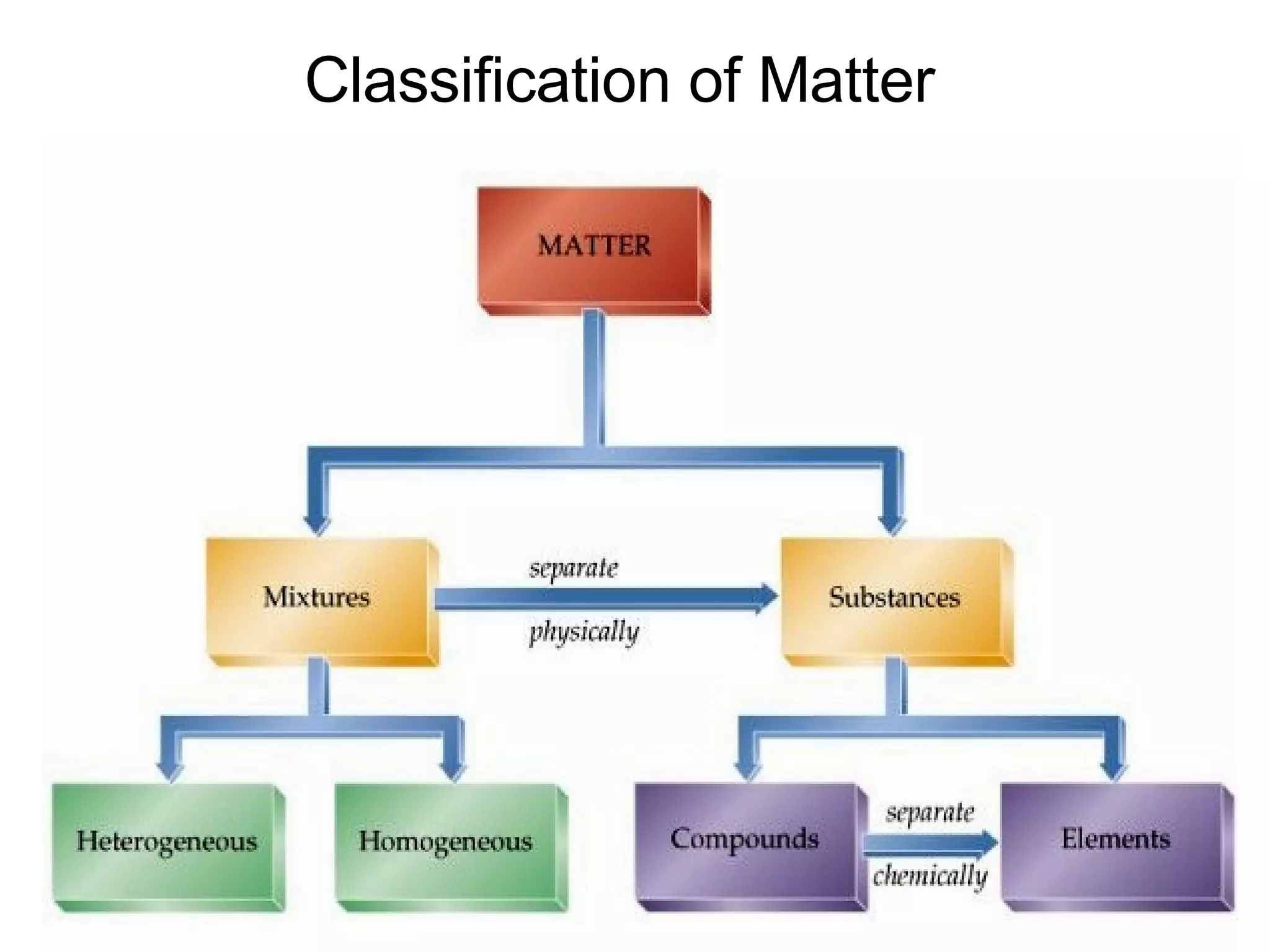
Classification of Matter Substances  are either elements or compounds. Elements  cannot be broken down by chemical reactions. Compounds  can be broken down to simpler compounds or elements by a  chemical change . Example: Water can be broken into hydrogen and oxygen gas with electrolysis.
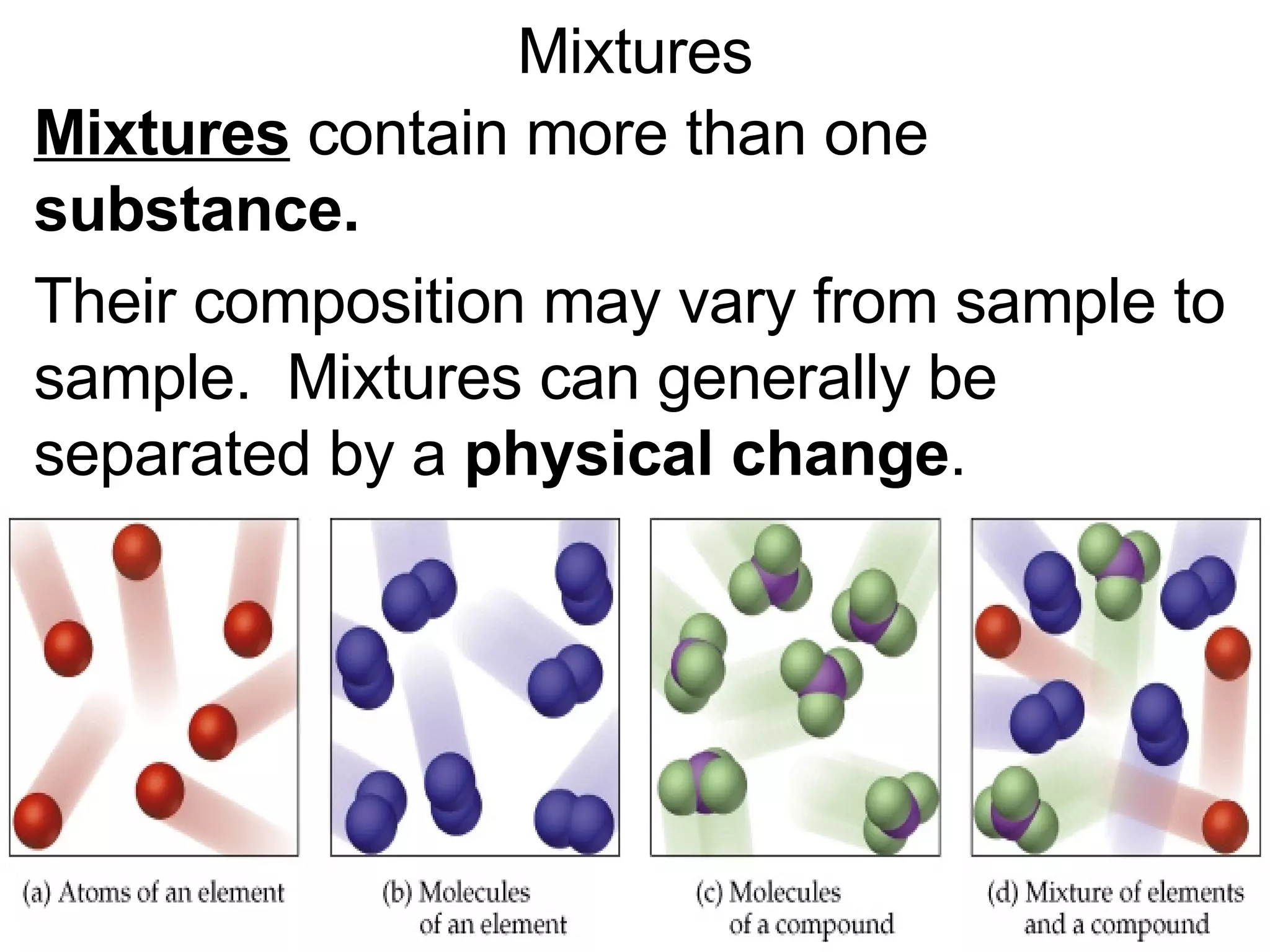
Mixtures Mixtures  contain more than one  substance. Their composition may vary from sample to sample.  Mixtures can generally be separated by a  physical change .
Methods for Classifying Matter If the substance is listed on the  periodic table, then it is an element. If you put an “and” in the substance’s  name, then it is a mixture. example:  peanut  butter and jelly If the substance has more than one  type of atom, then it is a compound.
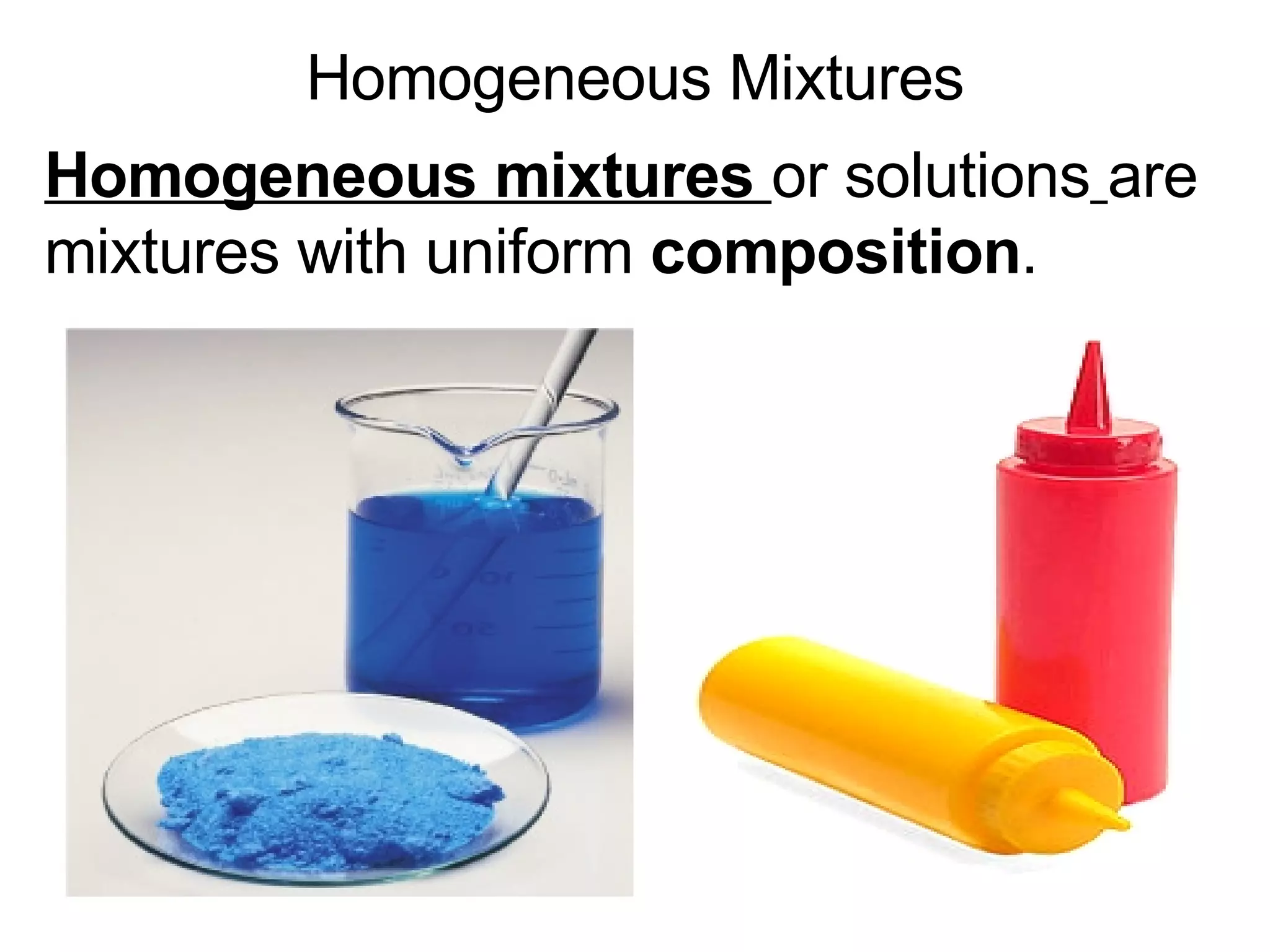
Homogeneous Mixtures Homogeneous mixtures  or solutions   are mixtures with uniform  composition .
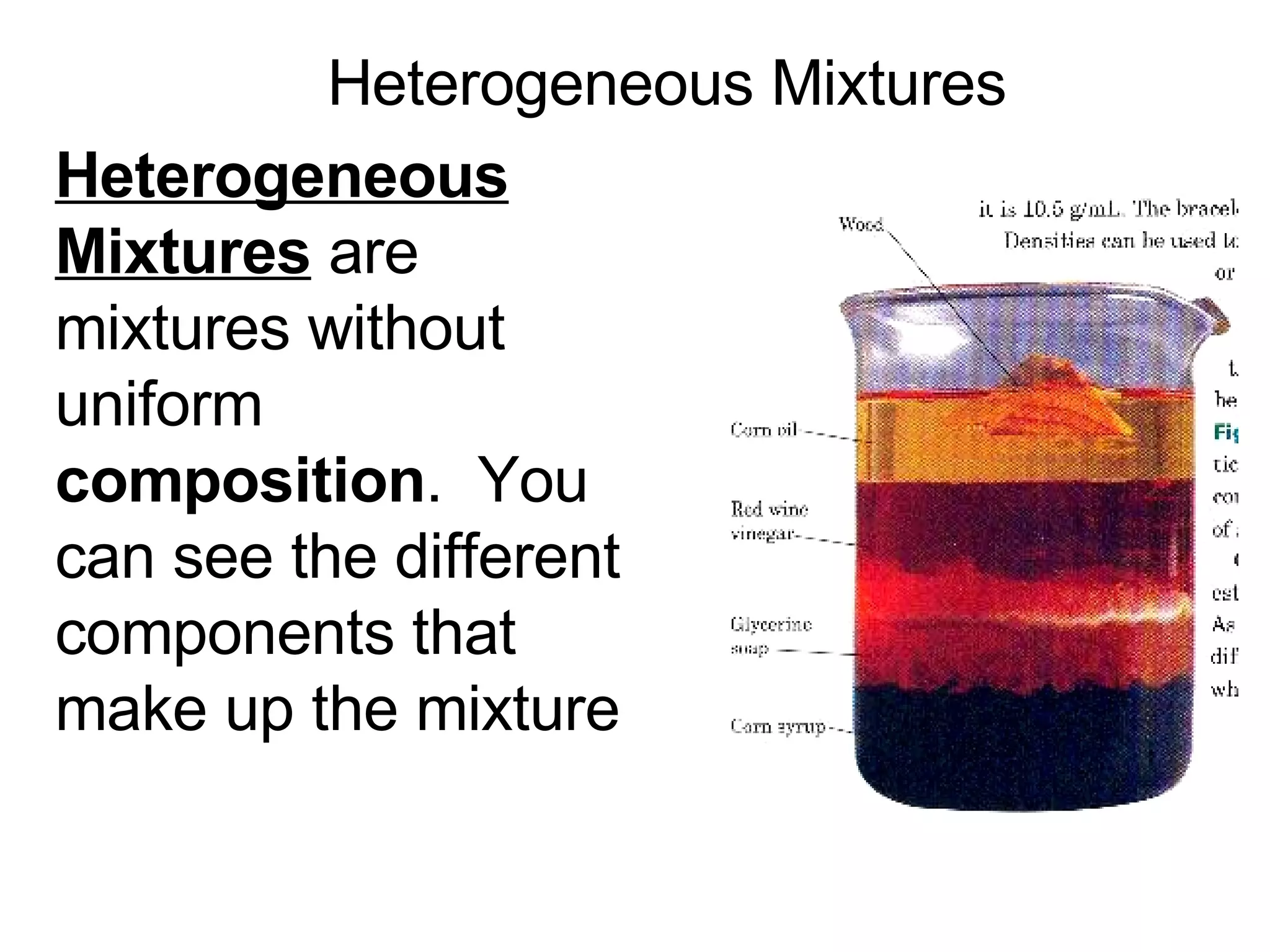
Heterogeneous Mixtures Heterogeneous Mixtures  are mixtures without uniform  composition .  You can see the different components that make up the mixture
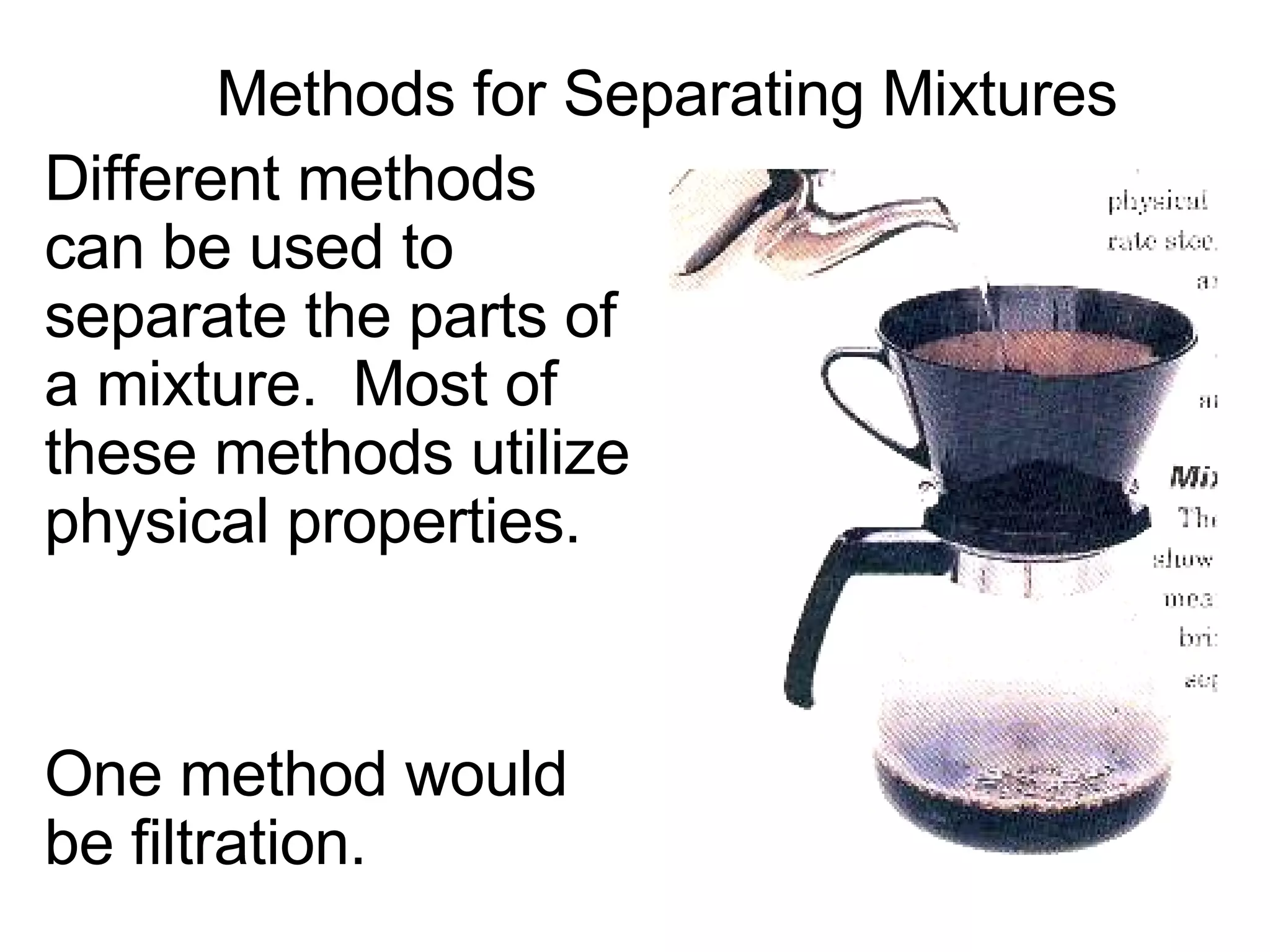
Methods for Separating Mixtures Different methods can be used to separate the parts of a mixture.  Most of these methods utilize physical properties. One method would be filtration.
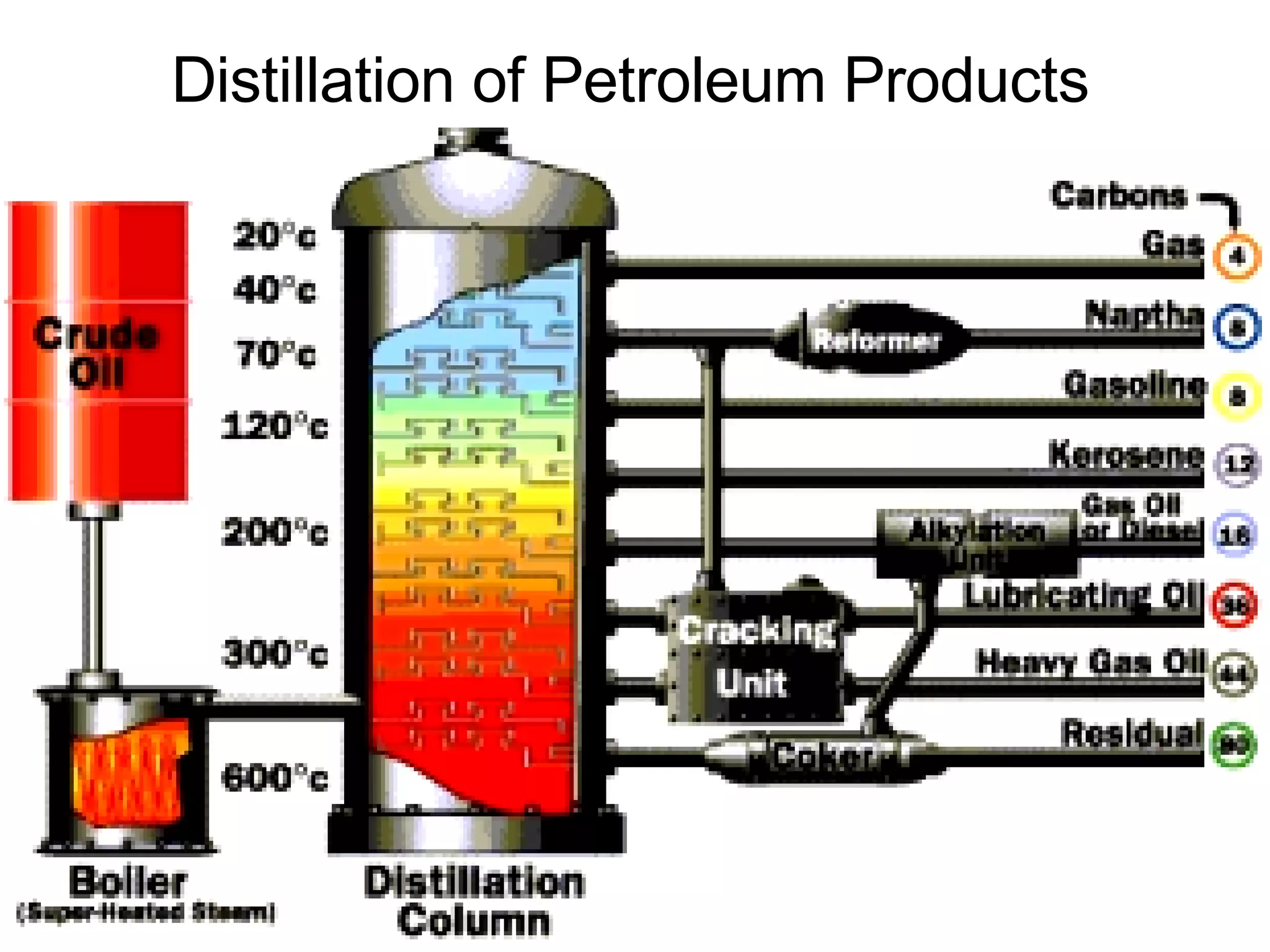
Distillation Crude oil goes through fractional distillation which utilizes differences in boiling points to separate the different petroleum products.
Distillation of Petroleum Products
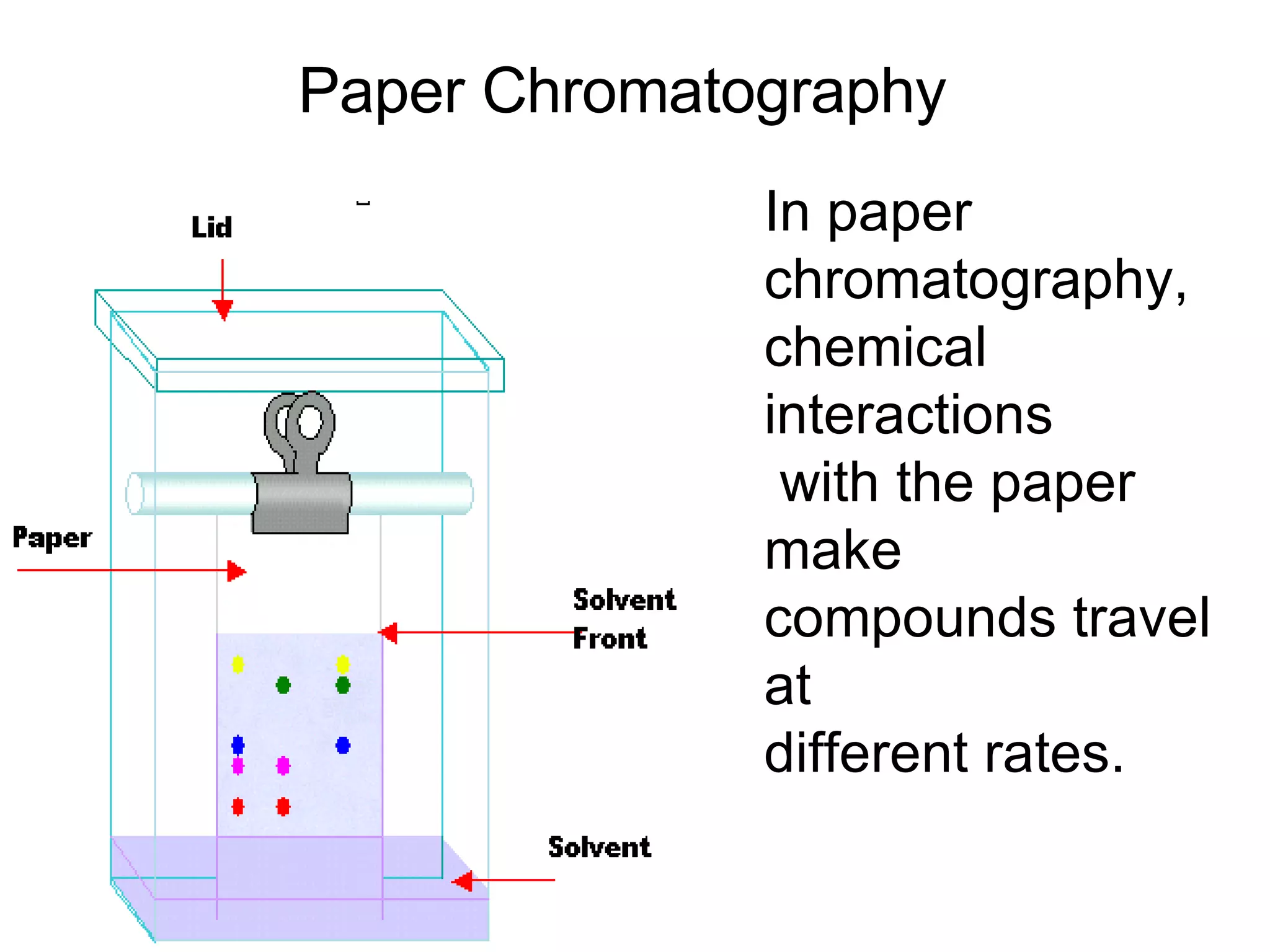
Paper Chromatography   In paper  chromatography,  chemical interactions with the paper make  compounds travel at  different rates.
Classification of Matter

Unit 1 Presentation

  • 1.
    Unit 1 -Matter What you should know at the end of this unit. ____ Lab Safety ____ States of Matter ____ Lab Equipment ____ Specific Heat ____ Properties of Matter ____ Classification of ____ SI Units and Prefixes Matter ____ Significant Figures ____ Physical Properties ____ Metric Conversions and Changes ____ Density ____ Chemical Properties ____ Density Calculations and Changes ____ Percent Error ____ Dimensional Analysis
  • 2.
    What is Chemistry?Chemistry is the study of the structure, function, and properties of matter and the changes it undergoes .
  • 3.
    What are Chemicals?Chemicals are is any substances with a definite composition.
  • 4.
    Matter and itsProperties Matter is anything that has mass and volume. Example: A piece of chalk has matter but sunlight does not.
  • 5.
    Mass isa measure of the amount of matter in an object.
  • 6.
    Volume isthe amount of space occupied by an object.
  • 7.
    An element is a pure substance made of only one kind of atom. Example: Gold, Silver, Sodium, Fluorine
  • 8.
    An atom is the smallest particle of a chemical element that retains its properties.
  • 9.
    Compounds aresubstances composed of atoms of two or more elements chemically bonded in a specific ratio. Example: Water is always H 2 O.
  • 10.
    A molecule is the smallest particle of a chemical compound that retains its properties. Example: A sample of methane is composed of CH 4 molecules.
  • 11.
    Properties arecharacteristics of matter that can be observed. Example: Water boils at 100 0 C and vinegar reacts with baking soda to form carbon dioxide.
  • 12.
    Physical properties can be observed without changing the composition of the substance. Example: Boiling point, Odor, and Density
  • 13.
    States of matter include solid, liquid, gas, and plasma.
  • 14.
    Solids are closely packed, have strong attractive forces, and vibrate around fixed points. They have low compressibility, because they are tightly packed.
  • 15.
    Liquids have a indefinite shape and definite volume. They are close together but can move past each other. The attractive forces in a liquid are weaker and can be overcome allowing liquids to flow.
  • 16.
    Gases have indefinite shape and volume. They move randomly, are far from each other, and have little attraction. They have higher compressibility, because the particles are far apart.
  • 17.
    Plasma is a high energy state in which electrons have been knocked off the atoms. Example: Plasma is found in fluorescent light tubes and in the sun.
  • 18.
    Physical changes do not change the identity of the substance. Example: Cutting a board in half is a physical change.
  • 19.
    State (phase) changes are physical changes from one state to another.  
  • 20.
    Endothermic change is a change in which energy is absorbed. The substance takes in energy and the particles move faster as a result.
  • 21.
  • 22.
    Exothermic change is a change in which energy is released. The substance loses energy and the particles move slower as a result.
  • 23.
    Which processes areendothermic?
  • 24.
    State of ChangeChart Frost Forming Exothermic Slows down Gas to solid Deposition Dry Ice Endothermic Speeds up Solid to gas Sublimation Dew Forming Exothermic Slows down Gas to liquid Condensation Water Boiling Endothermic Speeds up Liquid to gas Vaporization Water -> Ice Exothermic Slows down Liquid to solid Freezing Ice -> Water Endothermic Speeds up Solid to liquid Melting Example Heat Change Particle Motion Change Process
  • 25.
    Phase Change Diagram is a graph of temperature versus energy that shows how energy added or removed from a substance affects its state. During a state change, composition does not change.
  • 26.
  • 27.
  • 28.
    Another type ofphase diagram is a graph of pressure versus temperature that shows the conditions under which the states of matter exist.
  • 29.
  • 30.
  • 31.
    In a chemical change , a new substance will be formed.
  • 32.
    A chemicalchange usually involves a chemical reaction taking place.
  • 33.
    The InternationalSystem (S.I.) is a set of standard unit of measurement for scientists throughout the world. S.I. Base Units mol mole Amount of Substance K kelvin Temperature kg kilogram Mass m meter Length ABBREV Unit Quantity
  • 34.
    S.I. prefixes are added to the base units to increase or decrease their value by powers of 10. 1 X 10 -3 0.001 thousandth m milli 1 X 10 -2 0.01 hundredth c centi 1 X 10 -1 0.1 tenth d deci 1 X 10 1 10 ten da deka 1 X 10 2 100 hundred h hecto 1 X 10 3 1,000 thousand k kilo Exponential Multiplier Multiplier Meaning Symbol Numerical prefix
  • 35.
    Converting withina specific quantity requires moving the decimal place. Example: 546 µm = .000546 m Example: 0.00056 kL = 560 ml Example: 1000 g = 1 kg
  • 36.
    The Metric NumberLine We are mostly interested in measurements from the kilo to milli – region of the number line. Use a device to help you remember the order of the prefixes. Kind Hearted Dads Make Dark Chocolate Milk
  • 37.
    Mass isa measure of the quantity of matter in an object. Mass does not change with location . The unit used for mass is the gram (g). The instrument we use to measure mass is a balance .
  • 38.
    Weight isa measure of the force of gravity between objects. Weight will vary with location and the unit of measure for weight is the Newton (N). The instrument we use to measure weight is the spring scale .
  • 39.
    Length isthe distance covered by an object. Unit of measure for length is the meter (m). The instrument used to measure length is a ruler, meter stick , etc.
  • 40.
    Temperature isa measure of the average kinetic energy of the particles in a sample of matter. The units that can be used for temperature are Kevin (K) or Celsius ( 0 C). The instrument used to measure temperature is the thermometer .
  • 41.
    Kinetic energy is the energy an object has due to its motion . Gas molecules move faster than the molecules in solids and liquids, and therefore, have more kinetic energy . Gas molecules Liquid molecules Solid Molecules
  • 42.
    Heat isthe energy transferred as a result of a temperature difference. Left undisturbed, energy will flow from objects of high temperature to objects of low temperature until the objects have equal temperature. Unit – Joules (J) or Calories (cal) 1 cal – 4.184 J 1000 cal = 1 kcal also called 1 food Calorie
  • 43.
    A calorimeter is the Instrument used to measure energy.
  • 44.
    Volume isthe amount of space occupied by an object. cubic m (m 3 ) = length X length X length Unit = cubic centimeter (cm 3 ) = 1 milliliter (mL) The instrument we use most often to measure volume is the graduated cylinder .
  • 45.
    Accuracy ishow close a measurement is to the actual( accepted ) value. Example: Your watch is accurate if it is close to the time kept by the National Institute of Standards and Technology (N.I.S.T.)
  • 46.
    Precision ishow close a set of measurements are to each other. Example: A field goal kicker is precise if he kicks the ball through the goal posts every time.
  • 47.
    Significant Figures orDigits The number of reliable digits in a measurement based on accuracy of the measuring instrument. The last digit in the number may be an estimated one.
  • 48.
    Rules for SignificantDigits Digits other than zero are significant. Example: 947.3 - 4 significant figures 2. Zeros between other significant digits are significant. The oreo effect! 20,047 has 5 significant figures Leading zeros are NEVER significant. Put numbers with leading zeros into scientific notation Ending zeros are significant if the decimal point is expressd. 500.0 4 sig. fig.
  • 49.
  • 50.
    Rounding When roundinga number, look one place to the right of the digit you are rounding to. If that digit is 5 or above, increase the digit by 1. If that digit is less than 5, leave the digit the same. Example: Round 70633 to 3 Round 66.67 to 3 sig. fig. = significant figures 70600 66.7
  • 51.
    Significant Figures inMultiplying and Dividing When multiplying or dividing, the answer can have no more significant figures than the measurement with the least number of significant figures. Example: 49.600 g. / 47.40 cm 3 = 1.046
  • 52.
    Dimensional Analysis A conversion factor is a fraction that I a ratio equivalent to 1. Example: 1000 m / 1 km 1 km / 1000 m Factor – label method or dimensional analysis is a problem – solving method that uses conversion factors to change unit.
  • 53.
    Example 1: 60 km / hr = ? cm / s 1000 m = 1 km 100 cm = 1 m
  • 54.
    Example 2: Helen is driving her car at 60 km / s. What is her speed in m / h?
  • 55.
    Example 3: How many ml are in a 3 L of saline solution?
  • 56.
    Specific heat (Cp ) is the amount of energy required to raise the temperature of 1 gram of a substance by 1 degree Celsius. Unit = J / (g X 0 C) Instrument = calorimeter Equation = q = m x C p X Δ T q = heat in Joules m = mass in grams Δ T = change in temperature in 0 C
  • 57.
    Example: A4 g. sample of glass was heated from 274 0 C to 314 0 C, a temperature increase of 40 0 C and was found to have absorbed 32 J of energy as heat. What is the specific heat of this type of glass? Equation = q = m X C p X Δ T
  • 58.
    Example 2: If 980 J of energy is added to 6200g of water, by how much does the temperature change? C p of water = 4.184 J / g X 0 C
  • 59.
    Calorimetry:     Theprocess of determining the heat of  a reaction by measuring the change in temperature in known liquids.  Equation to know:                         q = m * c * DT                        q: Heat of reaction (Joules or Calories) m: mass of known substance (g) c: specific heat (Joules per gram celsius or calories per gram celsius )                        DT: change in temperature (celsius) 
  • 60.
    Sometime around 250B.C., the Greek mathematician Archimedes was given the task of determining whether a craftsman had defrauded the King of Syracuse by replacing some of the gold in the King’s crown with silver.
  • 61.
    Archimedes thought aboutthe problem while relaxing in a bathing pool. As he entered the pool, he noticed that water spilled over the sides of the pool. Archimedes had a moment of epiphany. He realized that the amount of water that spilled was equal in volume to the space that his body occupied.
  • 62.
    This fact suddenlyprovided him with a method for differentiating a mixed silver and gold crown from a pure gold crown. Because a measure of silver occupies more space than an equivalent measure of gold, Archimedes placed the craftsman’s crown and an equivalent pure gold crown in two tubs of water. He found that more water spilled over the sides of the tub when the craftsman’s crown was submerged. It turned out that the craftsman had been defrauding the King!
  • 63.
    Archimedes had usedthe concept of density to expose the fraud. Density is a physical property of matter that describes the degree of compactness of a substance, in other words, closely packed together the atoms of an element or molecules of a compound are. The more closely packed together the individual particles of a substance are, the more dense that substance is.
  • 64.
    Density is a derived unit formed from dividing the mass of a substance by its volume. Unit = any mass unit divided by any volume unit Examples: g/ mL, kg/L D = m / V D = density m = mass V = volume
  • 65.
    Example 1: A piece of metal is 1.5 cm X 1.5 cm X 1.5 cm. It has a mass of 30.17 g. Calculate its density. D = m / V
  • 66.
    Example 2: Whatis the volume of a 17.8 g/cm 3 piece of cobalt that has a density of 8.90 g/cm 3 ? D = m / V
  • 67.
    Physical Properties Physicalproperties are properties that can be observed without changing the composition of the substance. Boiling Point Melting Point Color
  • 68.
    Possible Physical ChangesChange Hair color Wear Colored Contacts Loose Weight Possible Chemical Changes Take drugs which effect your temperament and outlook
  • 69.
    Chemical Properties Chemicalproperties can be observed as a substance changes into a different substance .
  • 70.
    Chemical Change Chemicalchanges are chemical reactions. During a chemical reaction one substance is changed into another substance.
  • 71.
    Signs of aChemical Reaction Heat is given off or absorbed. Light is given off. Gas or ppt formed Color Change not due to moisture loss or gain. Odor change. Change is not easily reversed.
  • 72.
    Classification of MatterSubstances are either elements or compounds. Elements cannot be broken down by chemical reactions. Compounds can be broken down to simpler compounds or elements by a chemical change . Example: Water can be broken into hydrogen and oxygen gas with electrolysis.
  • 73.
    Mixtures Mixtures contain more than one substance. Their composition may vary from sample to sample. Mixtures can generally be separated by a physical change .
  • 74.
    Methods for ClassifyingMatter If the substance is listed on the periodic table, then it is an element. If you put an “and” in the substance’s name, then it is a mixture. example: peanut butter and jelly If the substance has more than one type of atom, then it is a compound.
  • 75.
    Homogeneous Mixtures Homogeneousmixtures or solutions are mixtures with uniform composition .
  • 76.
    Heterogeneous Mixtures HeterogeneousMixtures are mixtures without uniform composition . You can see the different components that make up the mixture
  • 77.
    Methods for SeparatingMixtures Different methods can be used to separate the parts of a mixture. Most of these methods utilize physical properties. One method would be filtration.
  • 78.
    Distillation Crude oilgoes through fractional distillation which utilizes differences in boiling points to separate the different petroleum products.
  • 79.
  • 80.
    Paper Chromatography In paper chromatography, chemical interactions with the paper make compounds travel at different rates.
  • 81.