Structure Of Large
Molecules & Food
Test
By Mansi Iyer & Priyal Mehta
Structure of large molecules
• Large molecules are made from smaller basic
units.
• Like simple sugars to starch and glycogen,
amino acids to proteins and fatty acids and
glycerol to fats and oils.
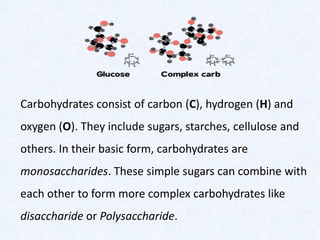
Carbohydrates consist of carbon (C), hydrogen (H) and
oxygen (O). They include sugars, starches, cellulose and
others. In their basic form, carbohydrates are
monosaccharides. These simple sugars can combine with
each other to form more complex carbohydrates like
disaccharide or Polysaccharide.
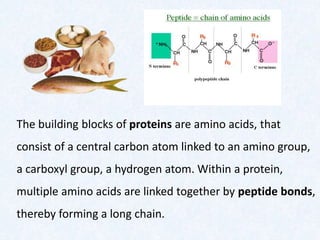
The building blocks of proteins are amino acids, that
consist of a central carbon atom linked to an amino group,
a carboxyl group, a hydrogen atom. Within a protein,
multiple amino acids are linked together by peptide bonds,
thereby forming a long chain.
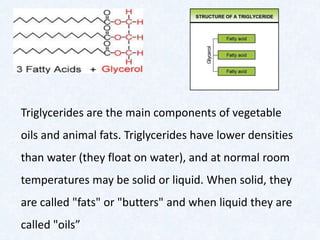
3 Fatty Acids 1 Glycerol
Molecule
Fats
Triglycerides are the main components of vegetable
oils and animal fats. Triglycerides have lower densities
than water (they float on water), and at normal room
temperatures may be solid or liquid. When solid, they
are called "fats" or "butters" and when liquid they are
called "oils”
What is a food test
A food test is a simple test
which can easily be
performed in the
laboratory to identify the
main classes of food.
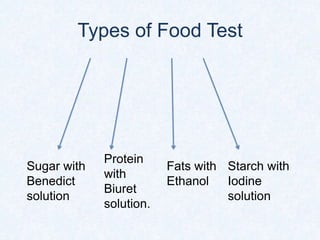
Types of Food Test
Sugar with
Benedict
solution
Protein
with
Biuret
solution.
Starch with
Iodine
solution
Fats with
Ethanol
Sugars
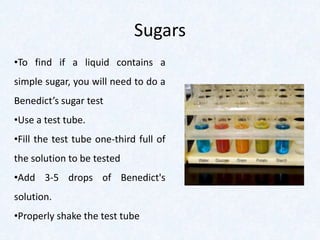
•To find if a liquid contains a
simple sugar, you will need to do a
Benedict’s sugar test
•Use a test tube.
•Fill the test tube one-third full of
the solution to be tested
•Add 3-5 drops of Benedict's
solution.
•Properly shake the test tube
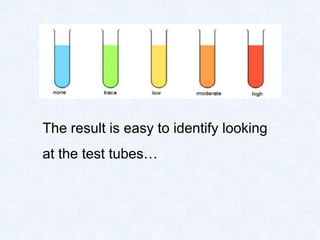
The result is easy to identify looking
at the test tubes…
Proteins
The Biuret Test is often used to determine the presence of peptide bonds in
protein. At this level you will be testing for the presence of protein in foods.
What to do-
•Add 2 cm3 of the liquid food sample to a clean, dry test tube
•Add 1 cm3 of sodium hydroxide solution and 1% copper (II) sulphate
solution.
• Shake well and allow the mixture to stand for 5 minutes.
•Observe any color change.
The Result
Blue = No proteins present
Violet = proteins are present
Pink = Peptides are present (
Peptides or peptones are short
chains of amino acid residues)
Starch
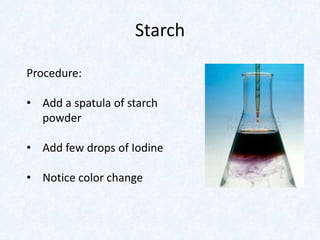
Procedure:
• Add a spatula of starch
powder
• Add few drops of Iodine
• Notice color change
The Result
If it turns dark blue or black it contains
starch…
Fats
Process:
• Add the food sample to 2 cm3 of ethanol, shake well.
• Allow to settle in a test tube rack for 2 minutes for
food to dissolve in ethanol.
• Empty any clear liquid into a test tube containing 2
cm3 of distilled H2O.
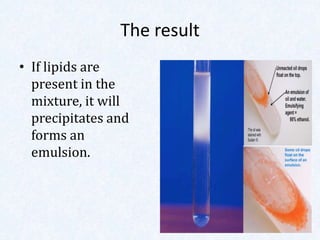
• A milky white emulsion is a positive result: lipid is
present.
• If the mixture remains clear, there are no fats
present in the sample
The result
• If lipids are
present in the
mixture, it will
precipitates and
forms an
emulsion.
A Resourceful Link
http://www.bbc.co.uk/bitesize/ks3/science/orga
nisms_behaviour_health/food_detective/activit
y
BIBLIOGRAPHY
• Available on- http://brilliantbiologystudent.weebly.com/ethanol-
emulsion-test-for-lipids.html [on-line] accessed on- 31st October
• Available on-
http://www.biosci.ohiou.edu/introbioslab/Bios170/170_2/biuret.ht
m [on-line] accessed on- 4th November
• Available on- http://dev.nsta.org/ssc/pdf/v4-TS_33.pdf [on-line]
accessed on- 8th November
• Available on- http://www.bayerpharma.com/en/research-and-
development/technologies/small-and-large-molecules/index.php
[on-line] accessed on- 8th November
• Google images accessed on 12th November.

Food test

  • 1.
    Structure Of Large Molecules& Food Test By Mansi Iyer & Priyal Mehta
  • 2.
    Structure of largemolecules • Large molecules are made from smaller basic units. • Like simple sugars to starch and glycogen, amino acids to proteins and fatty acids and glycerol to fats and oils.
  • 3.
    Carbohydrates consist ofcarbon (C), hydrogen (H) and oxygen (O). They include sugars, starches, cellulose and others. In their basic form, carbohydrates are monosaccharides. These simple sugars can combine with each other to form more complex carbohydrates like disaccharide or Polysaccharide.
  • 4.
    The building blocksof proteins are amino acids, that consist of a central carbon atom linked to an amino group, a carboxyl group, a hydrogen atom. Within a protein, multiple amino acids are linked together by peptide bonds, thereby forming a long chain.
  • 5.
    3 Fatty Acids1 Glycerol Molecule Fats
  • 6.
    Triglycerides are themain components of vegetable oils and animal fats. Triglycerides have lower densities than water (they float on water), and at normal room temperatures may be solid or liquid. When solid, they are called "fats" or "butters" and when liquid they are called "oils”
  • 7.
    What is afood test A food test is a simple test which can easily be performed in the laboratory to identify the main classes of food.
  • 8.
    Types of FoodTest Sugar with Benedict solution Protein with Biuret solution. Starch with Iodine solution Fats with Ethanol
  • 9.
    Sugars •To find ifa liquid contains a simple sugar, you will need to do a Benedict’s sugar test •Use a test tube. •Fill the test tube one-third full of the solution to be tested •Add 3-5 drops of Benedict's solution. •Properly shake the test tube
  • 10.
    The result iseasy to identify looking at the test tubes…
  • 11.
    Proteins The Biuret Testis often used to determine the presence of peptide bonds in protein. At this level you will be testing for the presence of protein in foods. What to do- •Add 2 cm3 of the liquid food sample to a clean, dry test tube •Add 1 cm3 of sodium hydroxide solution and 1% copper (II) sulphate solution. • Shake well and allow the mixture to stand for 5 minutes. •Observe any color change.
  • 12.
    The Result Blue =No proteins present Violet = proteins are present Pink = Peptides are present ( Peptides or peptones are short chains of amino acid residues)
  • 13.
    Starch Procedure: • Add aspatula of starch powder • Add few drops of Iodine • Notice color change
  • 14.
    The Result If itturns dark blue or black it contains starch…
  • 15.
    Fats Process: • Add thefood sample to 2 cm3 of ethanol, shake well. • Allow to settle in a test tube rack for 2 minutes for food to dissolve in ethanol. • Empty any clear liquid into a test tube containing 2 cm3 of distilled H2O. • A milky white emulsion is a positive result: lipid is present. • If the mixture remains clear, there are no fats present in the sample
  • 16.
    The result • Iflipids are present in the mixture, it will precipitates and forms an emulsion.
  • 17.
  • 18.
    BIBLIOGRAPHY • Available on-http://brilliantbiologystudent.weebly.com/ethanol- emulsion-test-for-lipids.html [on-line] accessed on- 31st October • Available on- http://www.biosci.ohiou.edu/introbioslab/Bios170/170_2/biuret.ht m [on-line] accessed on- 4th November • Available on- http://dev.nsta.org/ssc/pdf/v4-TS_33.pdf [on-line] accessed on- 8th November • Available on- http://www.bayerpharma.com/en/research-and- development/technologies/small-and-large-molecules/index.php [on-line] accessed on- 8th November • Google images accessed on 12th November.