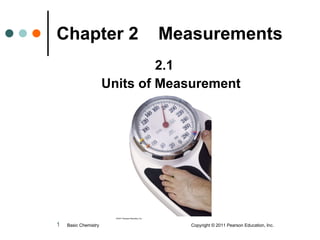
Chapter 2  Measurements 2.1  Units of Measurement Basic Chemistry  Copyright © 2011 Pearson Education, Inc.
Measurement You make a measurement every time you measure your height  read your watch take your temperature weigh a cantaloupe Basic Chemistry  Copyright © 2011 Pearson Education, Inc.
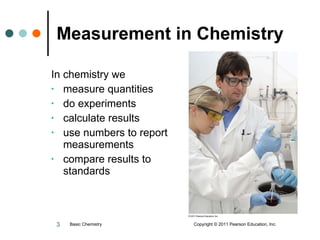
Measurement in Chemistry In chemistry we measure quantities do experiments calculate results  use numbers to report measurements compare results to standards Basic Chemistry  Copyright © 2011 Pearson Education, Inc.
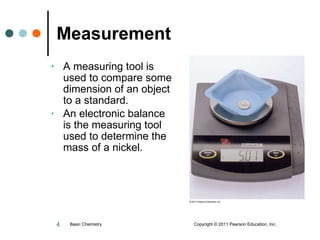
Measurement A measuring tool is used to compare some dimension of an object to a standard. An electronic balance is the measuring tool used to determine the mass of a nickel.  Basic Chemistry  Copyright © 2011 Pearson Education, Inc.
Stating a Measurement In every measurement, a  number  is  followed  by a  unit . Observe the following examples of measurements: Number  Unit   35  m   0.25  L   225  lb   3.4  h  Basic Chemistry  Copyright © 2011 Pearson Education, Inc.
The Metric System (SI) The  metric system  and  SI (international  system)  are decimal systems based on 10 used in most of the world used everywhere by scientists Basic Chemistry  Copyright © 2011 Pearson Education, Inc.
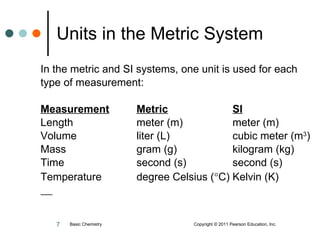
Units in the Metric System In the metric and SI systems, one unit is used for each  type of measurement: Measurement Metric SI Length meter (m) meter (m) Volume liter (L) cubic meter (m 3 ) Mass gram (g) kilogram (kg) Time second (s) second (s) Temperature degree Celsius (  C) Kelvin (K)  Basic Chemistry  Copyright © 2011 Pearson Education, Inc.
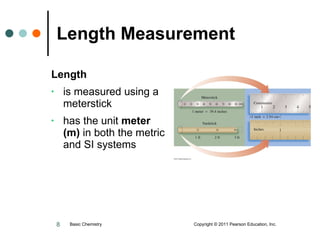
Length Measurement Length   is measured using a meterstick has the unit  meter (m)  in both the metric and SI systems Basic Chemistry  Copyright © 2011 Pearson Education, Inc.
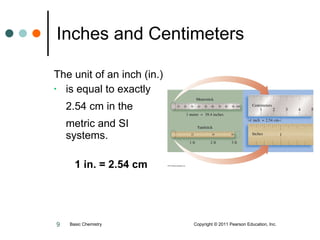
Inches and Centimeters The unit of an inch (in.) is equal to exactly 2.54 cm in the metric and SI systems. 1 in. = 2.54 cm Basic Chemistry  Copyright © 2011 Pearson Education, Inc.
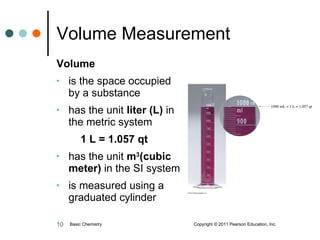
Volume Measurement Volume   is the space occupied by a substance has the unit  liter (L)  in the metric system 1 L = 1.057 qt has the unit  m 3 (cubic meter)  in the SI system is measured using a graduated cylinder Basic Chemistry  Copyright © 2011 Pearson Education, Inc.
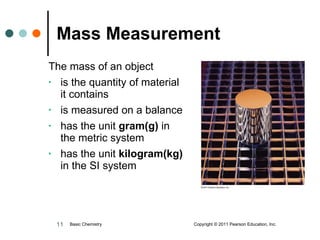
Mass Measurement The mass of an object  is the quantity of material it contains is measured on a balance has the unit  gram(g)  in the metric system has the unit  kilogram(kg)  in the SI system Basic Chemistry  Copyright © 2011 Pearson Education, Inc.
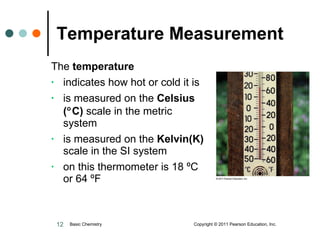
Temperature Measurement The   temperature indicates how hot or cold it is is measured on the  Celsius (  C)  scale in the metric system  is measured on the  Kelvin(K)  scale in the SI system  on this thermometer is 18  º C or 64  ºF Basic Chemistry  Copyright © 2011 Pearson Education, Inc.
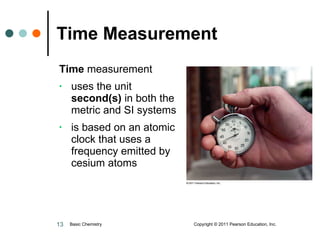
Time Measurement Time  measurement uses the unit  second(s)  in both the metric and SI systems is based on an atomic clock that uses a frequency emitted by cesium atoms Basic Chemistry  Copyright © 2011 Pearson Education, Inc.
For each of the following,  indicate whether the unit describes  1) length  2) mass or 3) volume.  ____ A.  A bag of onions has a mass of 2.6 kg. ____ B.  A person is 2.0 m tall. ____ C.  A medication contains 0.50 g of aspirin. ____ D.  A bottle contains 1.5 L of water . Learning Check Basic Chemistry  Copyright © 2011 Pearson Education, Inc.
For each of the following,  indicate whether the unit describes  1) length  2) mass  or 3) volume.    2  A.  A bag of onions has a mass of 2.6 kg.   1  B.  A person is 2.0 m tall.   2  C.  A medication contains 0.50 g of aspirin.   3  D.  A bottle contains 1.5 L of water . Solution Basic Chemistry  Copyright © 2011 Pearson Education, Inc.
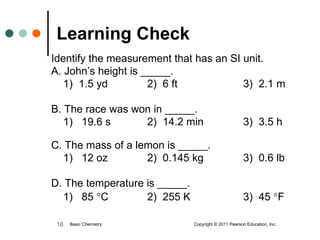
Learning Check   Identify the measurement that has an SI unit.  A. John’s height is _____. 1)  1.5 yd 2)  6 ft   3)  2.1 m B. The race was won in _____. 1)  19.6 s 2)  14.2 min 3)  3.5 h C. The mass of a lemon is _____. 1)  12 oz 2)  0.145 kg 3)  0.6 lb D. The temperature is _____. 1)  85   C 2)  255 K 3)  45   F Basic Chemistry  Copyright © 2011 Pearson Education, Inc.
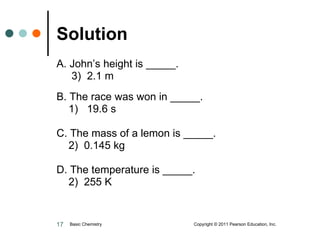
Solution  A. John’s height is _____.   3)  2.1 m B. The race was won in _____. 1)  19.6 s C. The mass of a lemon is _____. 2)  0.145 kg D. The temperature is _____. 2)  255 K Basic Chemistry  Copyright © 2011 Pearson Education, Inc.

2 1 units_of_measurement

  • 1.
    Chapter 2 Measurements 2.1 Units of Measurement Basic Chemistry Copyright © 2011 Pearson Education, Inc.
  • 2.
    Measurement You makea measurement every time you measure your height read your watch take your temperature weigh a cantaloupe Basic Chemistry Copyright © 2011 Pearson Education, Inc.
  • 3.
    Measurement in ChemistryIn chemistry we measure quantities do experiments calculate results use numbers to report measurements compare results to standards Basic Chemistry Copyright © 2011 Pearson Education, Inc.
  • 4.
    Measurement A measuringtool is used to compare some dimension of an object to a standard. An electronic balance is the measuring tool used to determine the mass of a nickel. Basic Chemistry Copyright © 2011 Pearson Education, Inc.
  • 5.
    Stating a MeasurementIn every measurement, a number is followed by a unit . Observe the following examples of measurements: Number Unit 35 m 0.25 L 225 lb 3.4 h Basic Chemistry Copyright © 2011 Pearson Education, Inc.
  • 6.
    The Metric System(SI) The metric system and SI (international system) are decimal systems based on 10 used in most of the world used everywhere by scientists Basic Chemistry Copyright © 2011 Pearson Education, Inc.
  • 7.
    Units in theMetric System In the metric and SI systems, one unit is used for each type of measurement: Measurement Metric SI Length meter (m) meter (m) Volume liter (L) cubic meter (m 3 ) Mass gram (g) kilogram (kg) Time second (s) second (s) Temperature degree Celsius (  C) Kelvin (K) Basic Chemistry Copyright © 2011 Pearson Education, Inc.
  • 8.
    Length Measurement Length is measured using a meterstick has the unit meter (m) in both the metric and SI systems Basic Chemistry Copyright © 2011 Pearson Education, Inc.
  • 9.
    Inches and CentimetersThe unit of an inch (in.) is equal to exactly 2.54 cm in the metric and SI systems. 1 in. = 2.54 cm Basic Chemistry Copyright © 2011 Pearson Education, Inc.
  • 10.
    Volume Measurement Volume is the space occupied by a substance has the unit liter (L) in the metric system 1 L = 1.057 qt has the unit m 3 (cubic meter) in the SI system is measured using a graduated cylinder Basic Chemistry Copyright © 2011 Pearson Education, Inc.
  • 11.
    Mass Measurement Themass of an object is the quantity of material it contains is measured on a balance has the unit gram(g) in the metric system has the unit kilogram(kg) in the SI system Basic Chemistry Copyright © 2011 Pearson Education, Inc.
  • 12.
    Temperature Measurement The temperature indicates how hot or cold it is is measured on the Celsius (  C) scale in the metric system is measured on the Kelvin(K) scale in the SI system on this thermometer is 18 º C or 64 ºF Basic Chemistry Copyright © 2011 Pearson Education, Inc.
  • 13.
    Time Measurement Time measurement uses the unit second(s) in both the metric and SI systems is based on an atomic clock that uses a frequency emitted by cesium atoms Basic Chemistry Copyright © 2011 Pearson Education, Inc.
  • 14.
    For each ofthe following, indicate whether the unit describes 1) length 2) mass or 3) volume. ____ A. A bag of onions has a mass of 2.6 kg. ____ B. A person is 2.0 m tall. ____ C. A medication contains 0.50 g of aspirin. ____ D. A bottle contains 1.5 L of water . Learning Check Basic Chemistry Copyright © 2011 Pearson Education, Inc.
  • 15.
    For each ofthe following, indicate whether the unit describes 1) length 2) mass or 3) volume. 2 A. A bag of onions has a mass of 2.6 kg. 1 B. A person is 2.0 m tall. 2 C. A medication contains 0.50 g of aspirin. 3 D. A bottle contains 1.5 L of water . Solution Basic Chemistry Copyright © 2011 Pearson Education, Inc.
  • 16.
    Learning Check Identify the measurement that has an SI unit. A. John’s height is _____. 1) 1.5 yd 2) 6 ft 3) 2.1 m B. The race was won in _____. 1) 19.6 s 2) 14.2 min 3) 3.5 h C. The mass of a lemon is _____. 1) 12 oz 2) 0.145 kg 3) 0.6 lb D. The temperature is _____. 1) 85  C 2) 255 K 3) 45  F Basic Chemistry Copyright © 2011 Pearson Education, Inc.
  • 17.
    Solution A.John’s height is _____. 3) 2.1 m B. The race was won in _____. 1) 19.6 s C. The mass of a lemon is _____. 2) 0.145 kg D. The temperature is _____. 2) 255 K Basic Chemistry Copyright © 2011 Pearson Education, Inc.