GENERAL CHEMISTRY
2
Chapter Outline
1.1 Matter and Energy
1.2 States of Matter
1.3 Chemical and Physical Properties
1.4 Chemical and Physical Changes
1.5 Measurements in Chemistry
International Unit System
1.6 Units of Measurement
1.7 Significant figures
1. 8 Density
1. 9 Temperature
3
Matter and Energy - Vocabulary
 Chemistry
 Science that describes matter – its properties, the
changes it undergoes, and the energy changes that
accompany those processes
 Matter
 Anything that has mass and occupies space.
 Energy
 The capacity to do work or transfer heat.
4
States of Matter
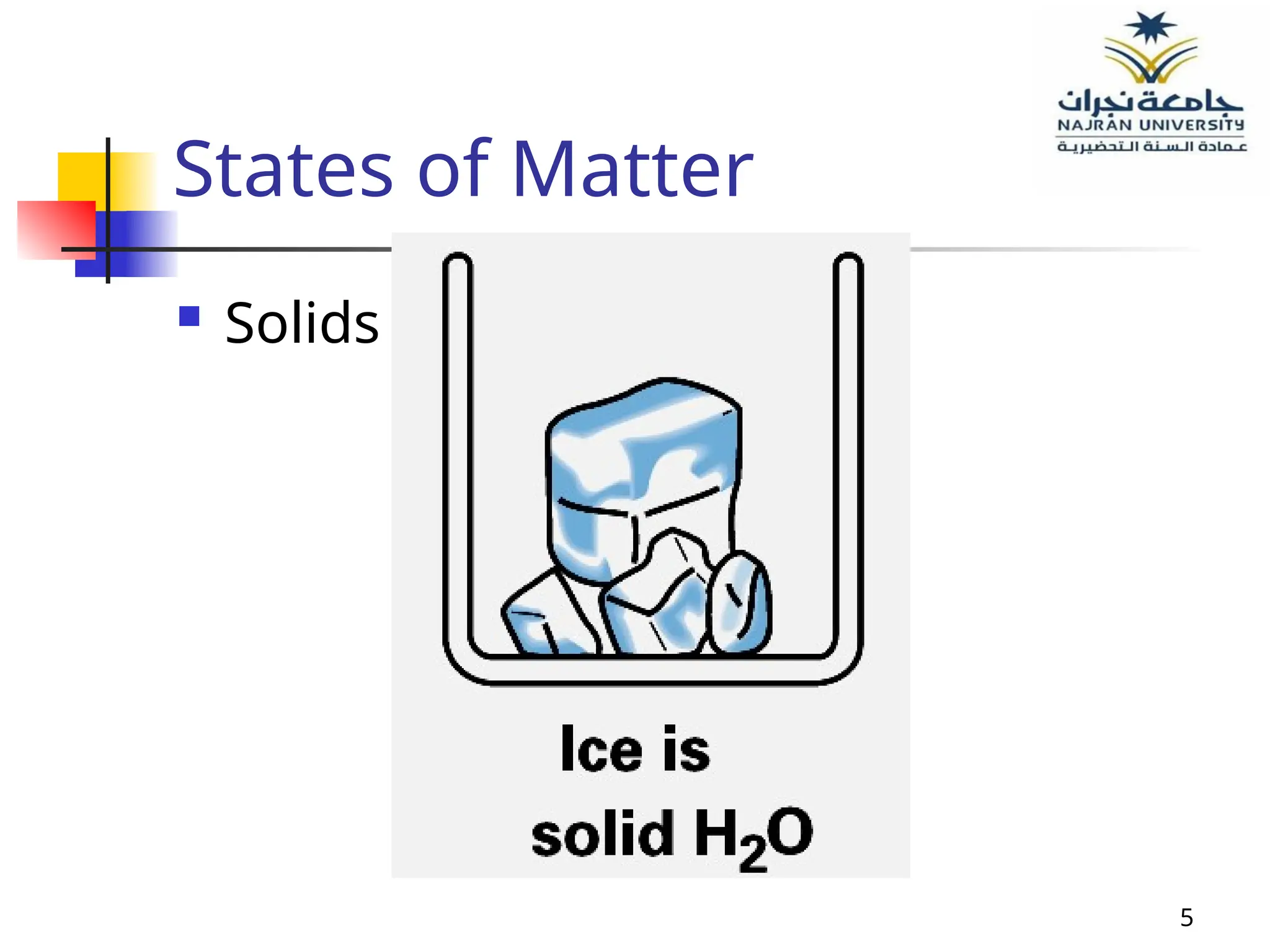
 Solids
are much more organized than the particles in a liquid or a. As
a result, a solid has both fixed volume and fixed shape.
Neighboring atoms or molecules in a solid may vibrate or
oscillate, but they do not move around each other.
Attractive forces, which exist between all particles, are very
pronounced in solids and much less so in gases.
Ice, diamond, quartz, and iron are examples of solid matter.
5
States of Matter
 Solids
6
States of Matter
 Liquid
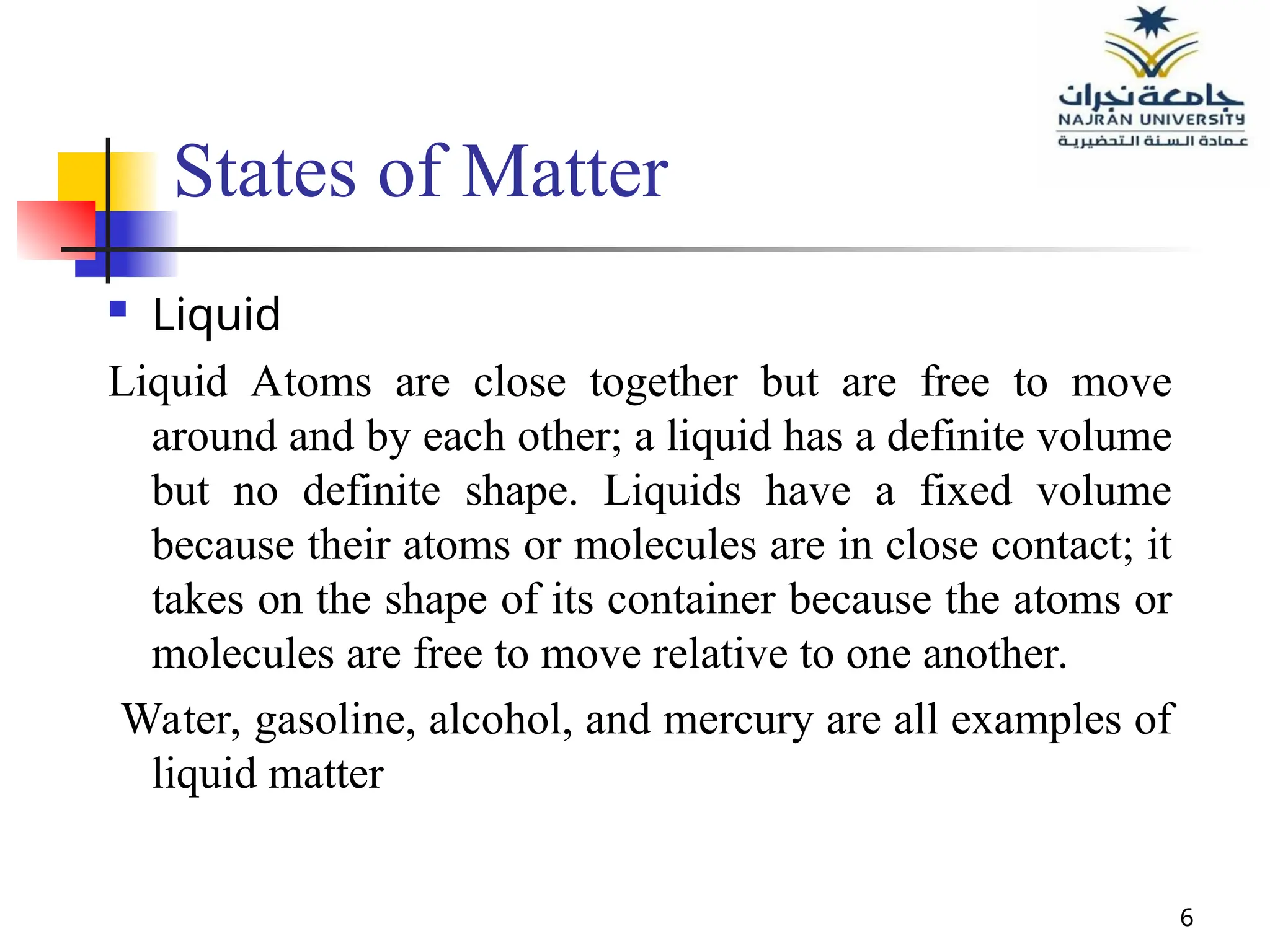
Liquid Atoms are close together but are free to move
around and by each other; a liquid has a definite volume
but no definite shape. Liquids have a fixed volume
because their atoms or molecules are in close contact; it
takes on the shape of its container because the atoms or
molecules are free to move relative to one another.
Water, gasoline, alcohol, and mercury are all examples of
liquid matter
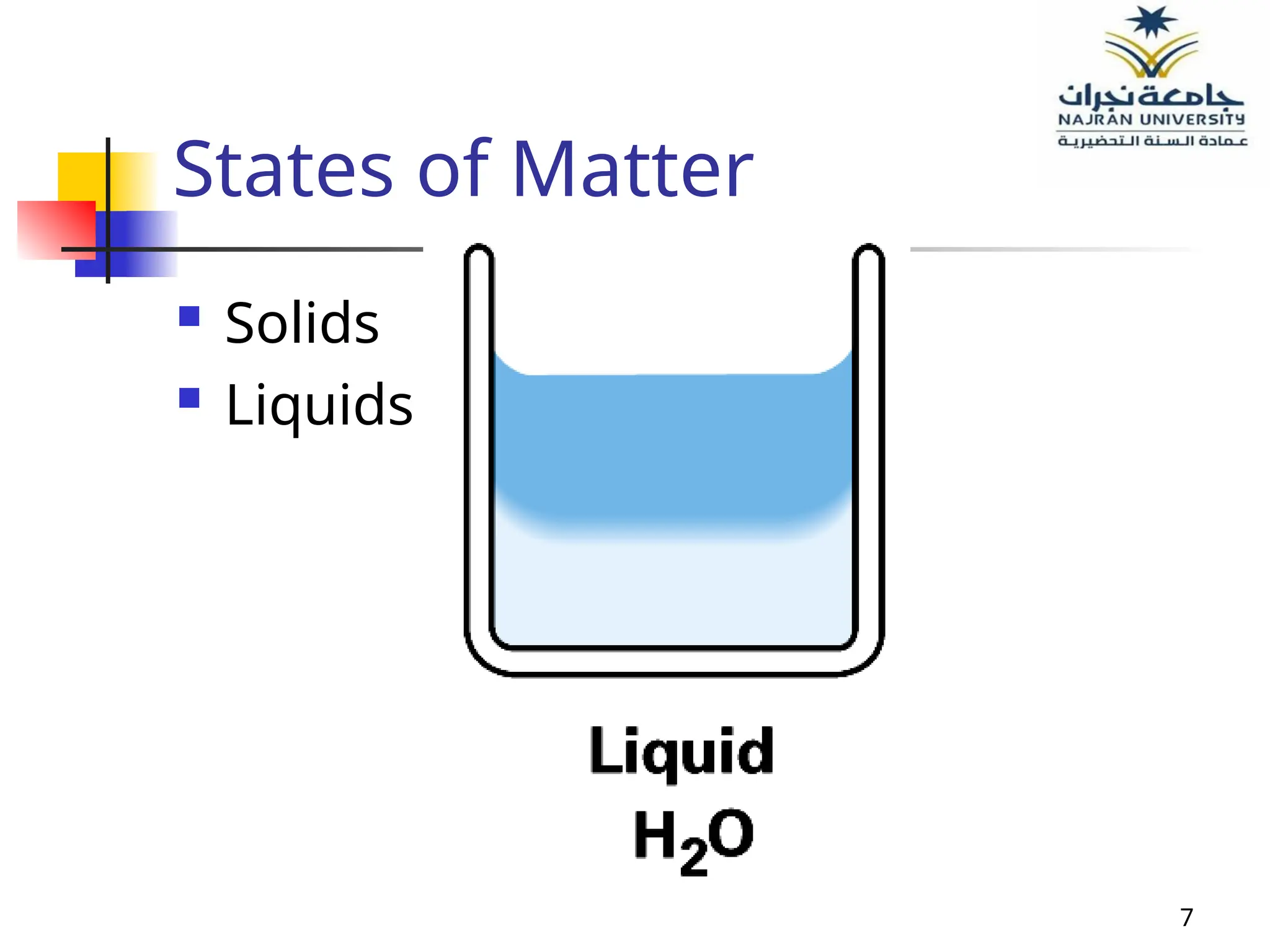
7
States of Matter
 Solids
 Liquids
8
States of Matter
 Gases
Are made up of particles that are widely separated and
are free to move relative to one another. Since the
atoms or molecules that compose gases are not in
contact with one another, gases are compressible. In
fact, a gas will expand to fill any container; it has no
definite shape or volume.
Oxygen, helium, and carbon dioxide are examples of
gases.
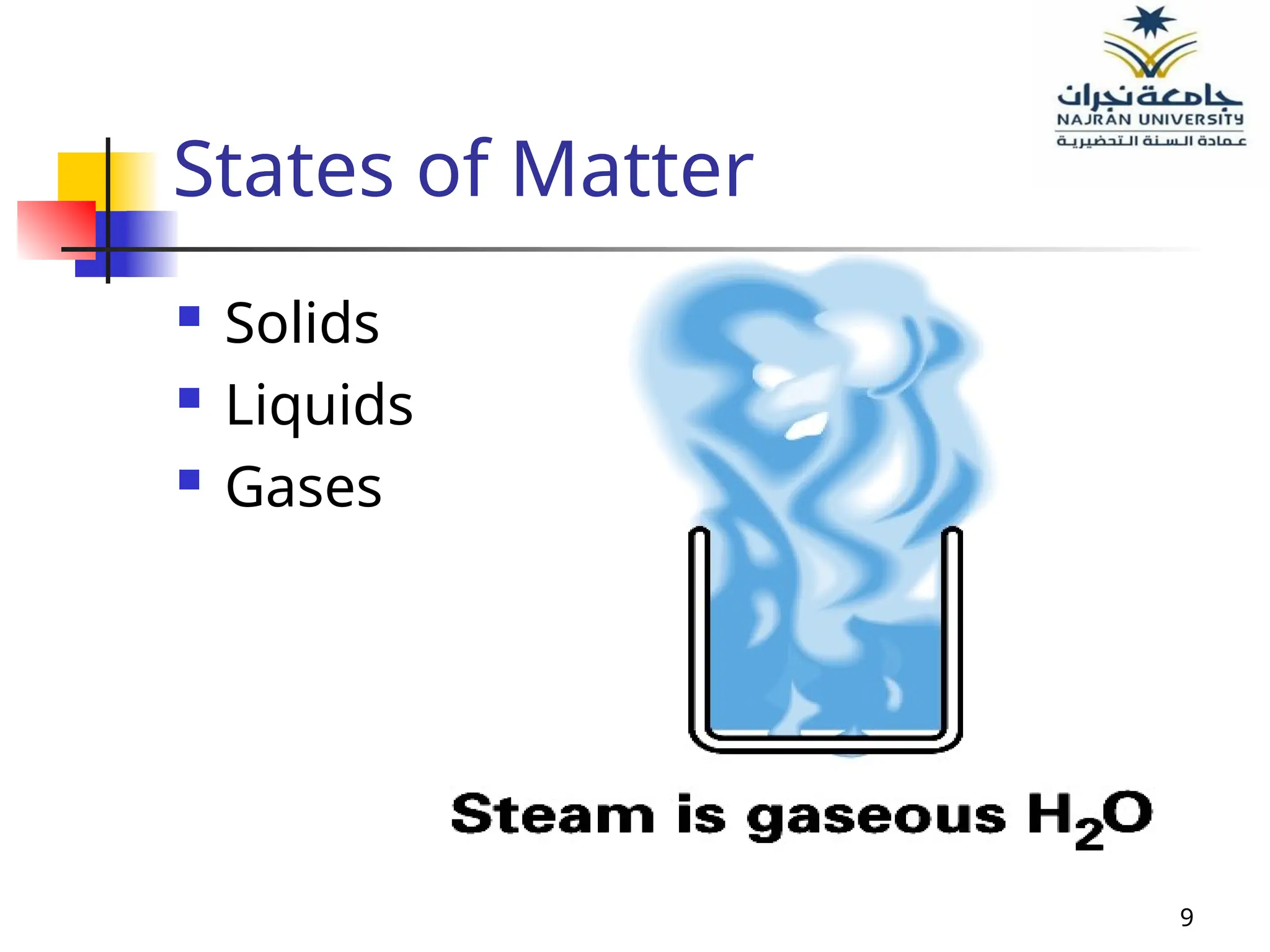
9
States of Matter
 Solids
 Liquids
 Gases
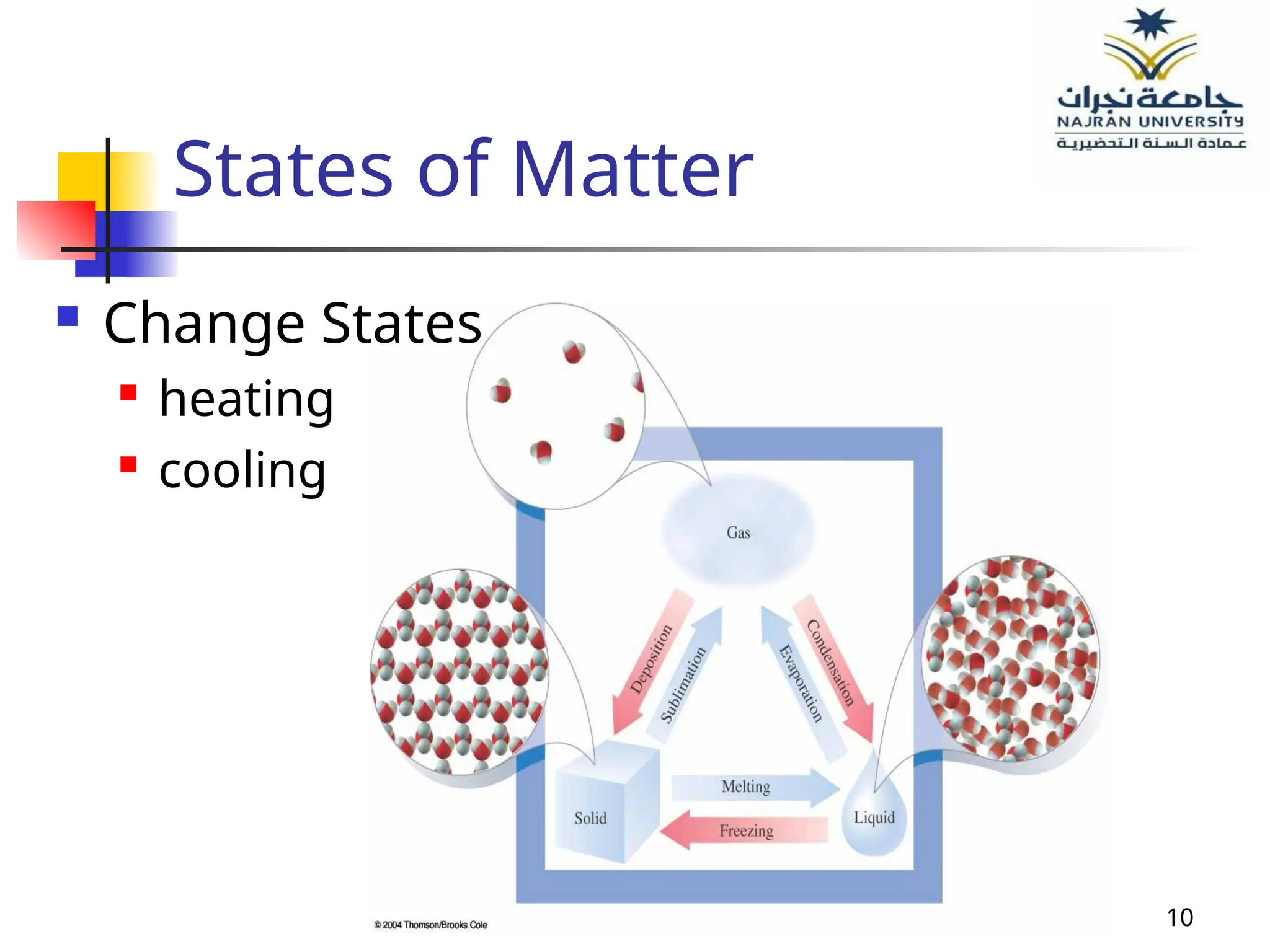
10
States of Matter
 Change States
 heating
 cooling
11
States of Matter
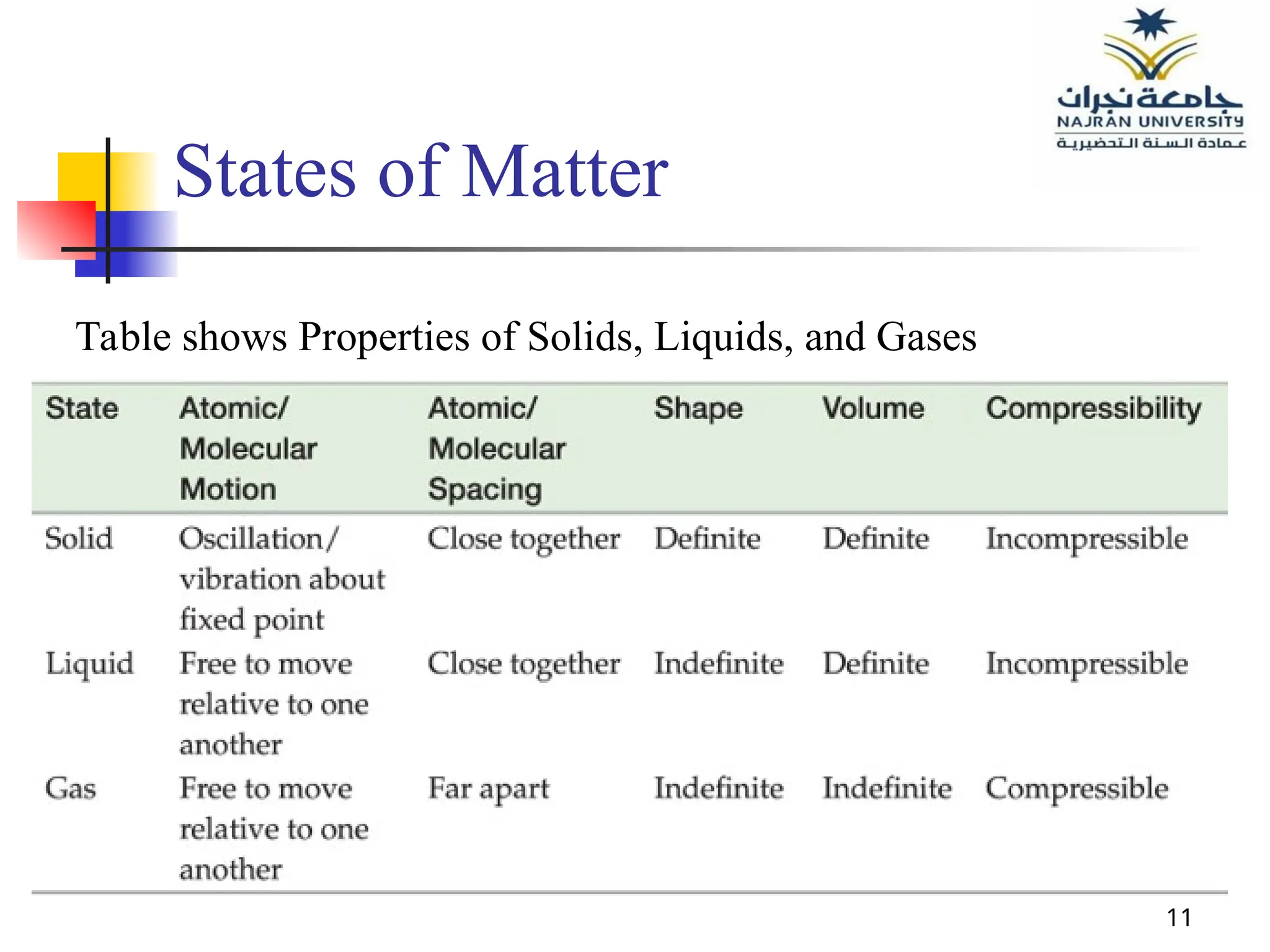
Table shows Properties of Solids, Liquids, and Gases
Classifying Matter According to Its Composition
12
13
14
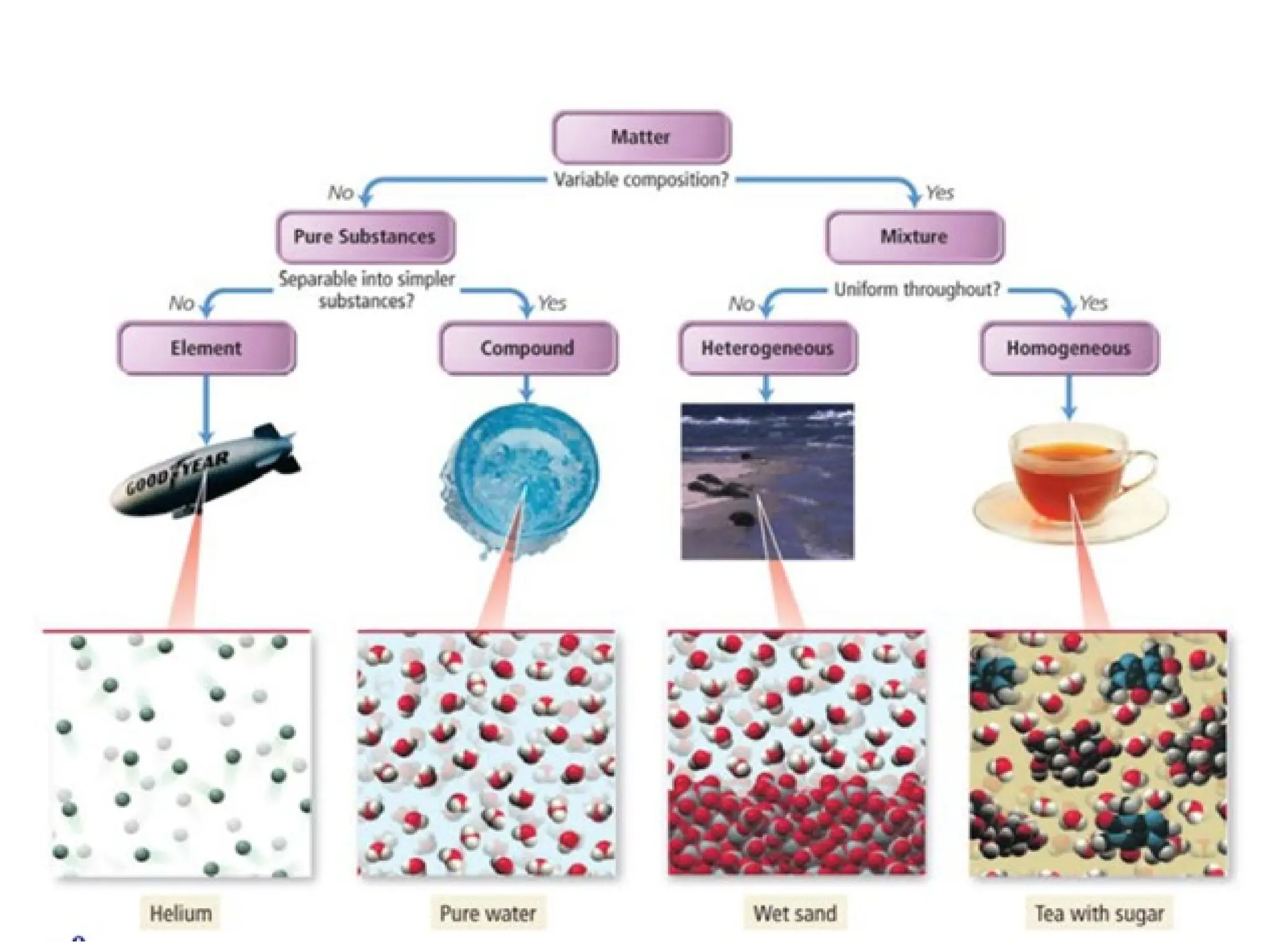
 matter may be a pure substance or a mixture.
A pure substance is composed of only one
type of atom or molecule, It may be either an
element (such as copper) or a compound
(such as sugar).
 Element: A pure substance that cannot be
broken down into simpler substances
Classifying Matter According to Its Composition
15
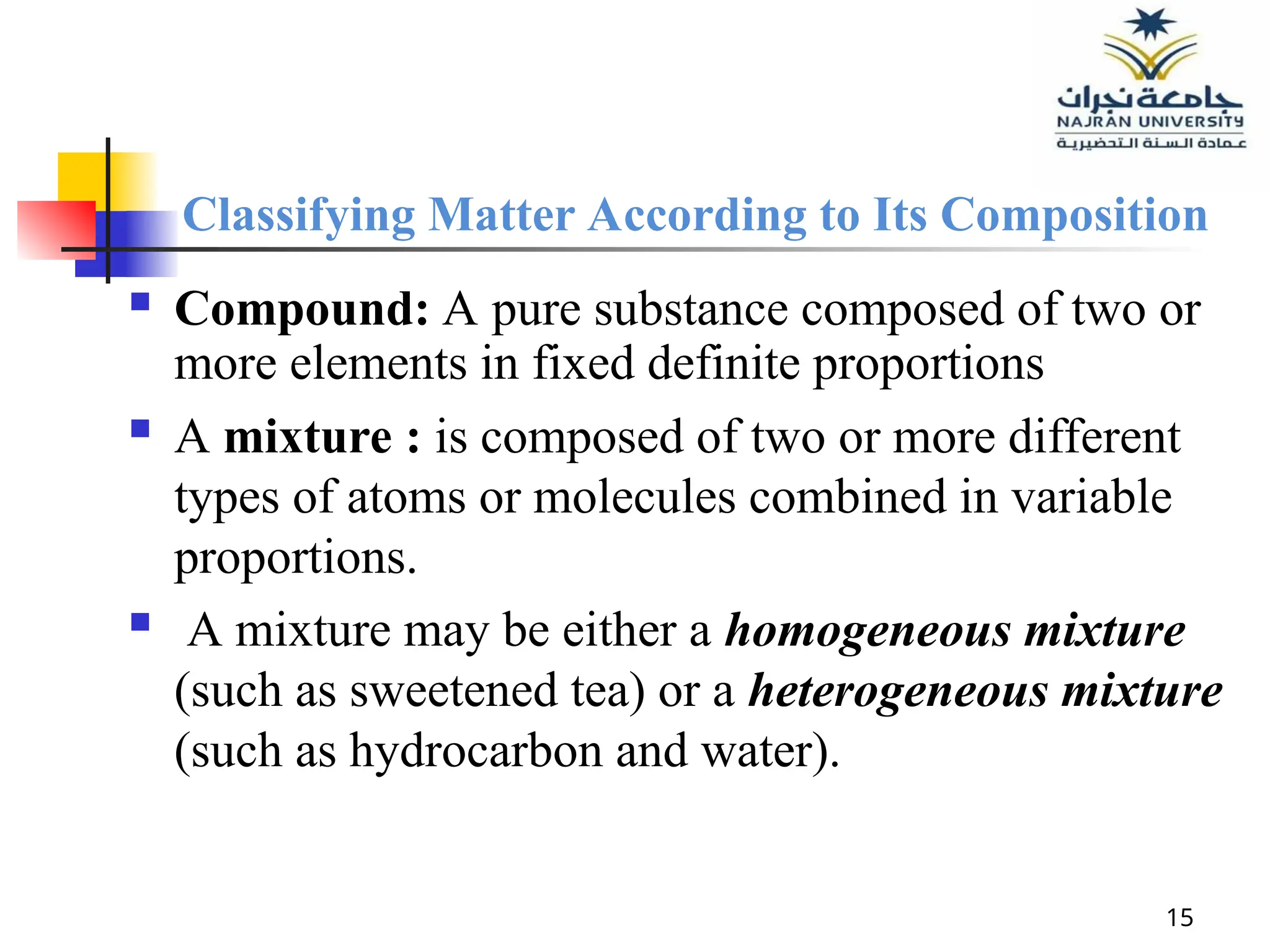
 Compound: A pure substance composed of two or
more elements in fixed definite proportions
 A mixture : is composed of two or more different
types of atoms or molecules combined in variable
proportions.
 A mixture may be either a homogeneous mixture
(such as sweetened tea) or a heterogeneous mixture
(such as hydrocarbon and water).
Classifying Matter According to Its Composition
16
Chemical and Physical Properties
 A physical property is one that a substance
displays without changing its composition.
 Such as odor of gasoline
 A chemical property is one that a substance
displays only through changing its
composition.
 Such as The flammability of gasoline
17
Chemical and Physical Properties
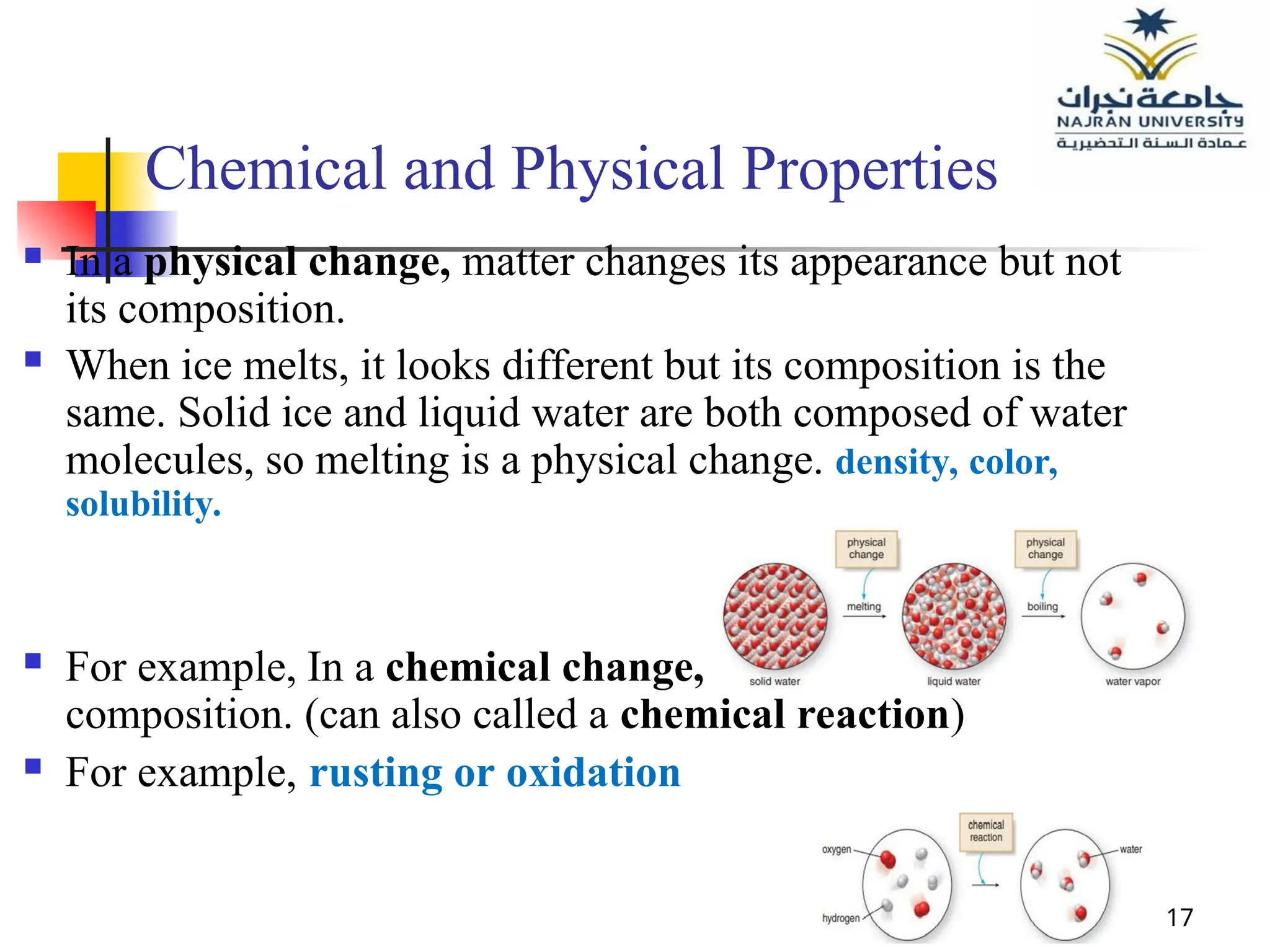
 In a physical change, matter changes its appearance but not
its composition.
 When ice melts, it looks different but its composition is the
same. Solid ice and liquid water are both composed of water
molecules, so melting is a physical change. density, color,
solubility.
 For example, In a chemical change, matter does change its
composition. (can also called a chemical reaction)
 For example, rusting or oxidation
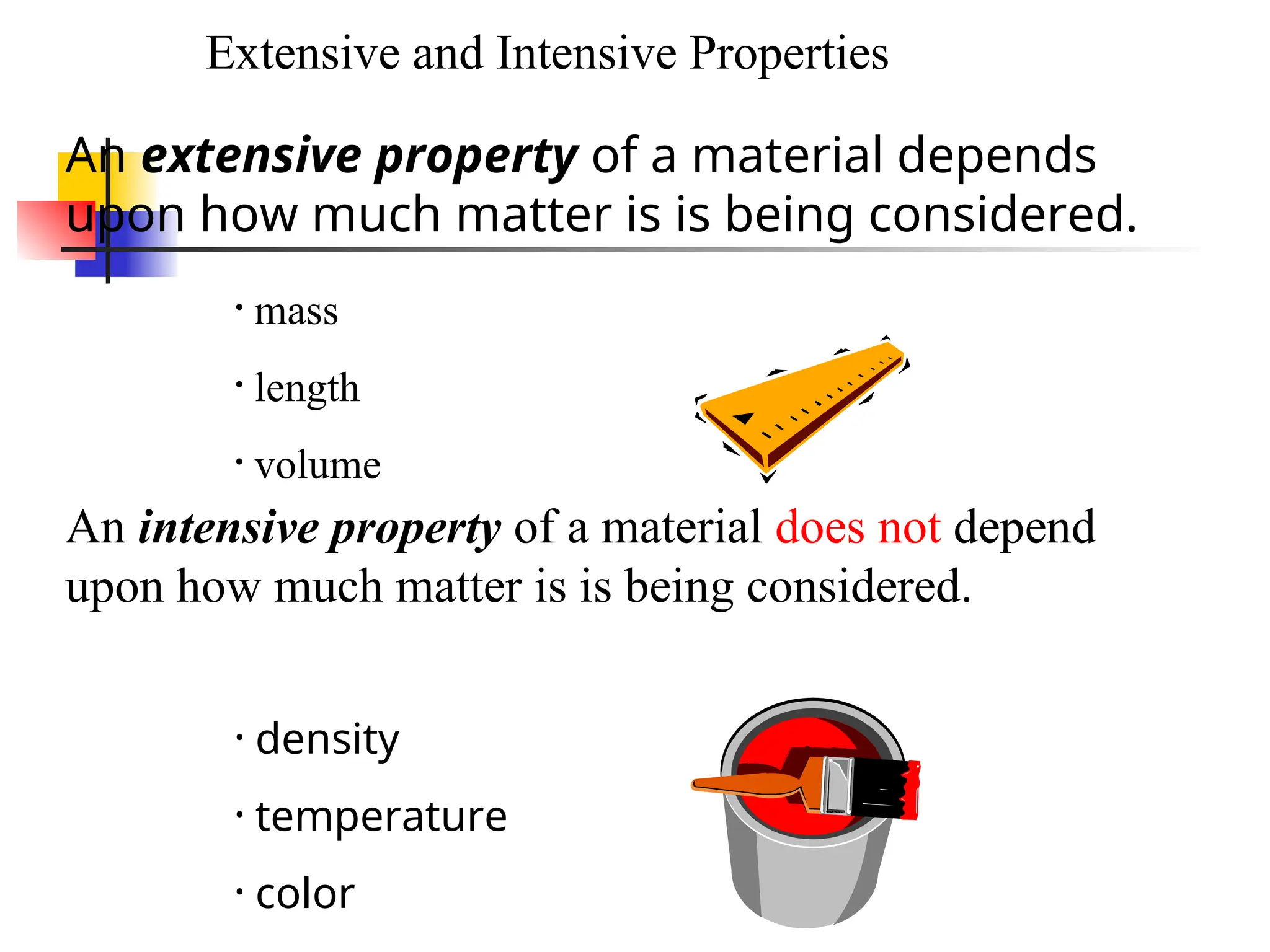
An extensive property of a material depends
upon how much matter is is being considered.
An intensive property of a material does not depend
upon how much matter is is being considered.
• mass
• length
• volume
• density
• temperature
• color
Extensive and Intensive Properties
19
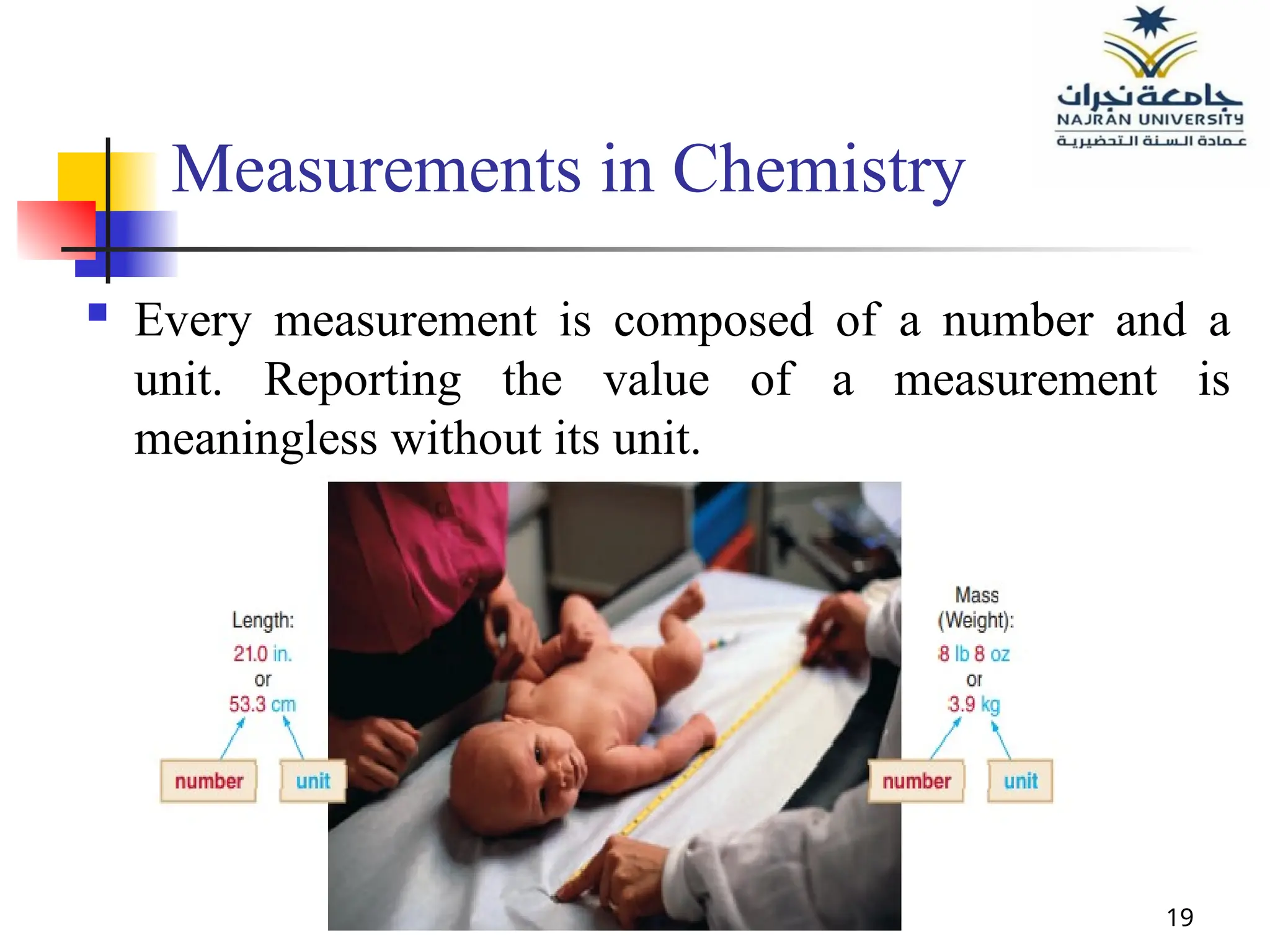
Measurements in Chemistry
 Every measurement is composed of a number and a
unit. Reporting the value of a measurement is
meaningless without its unit.
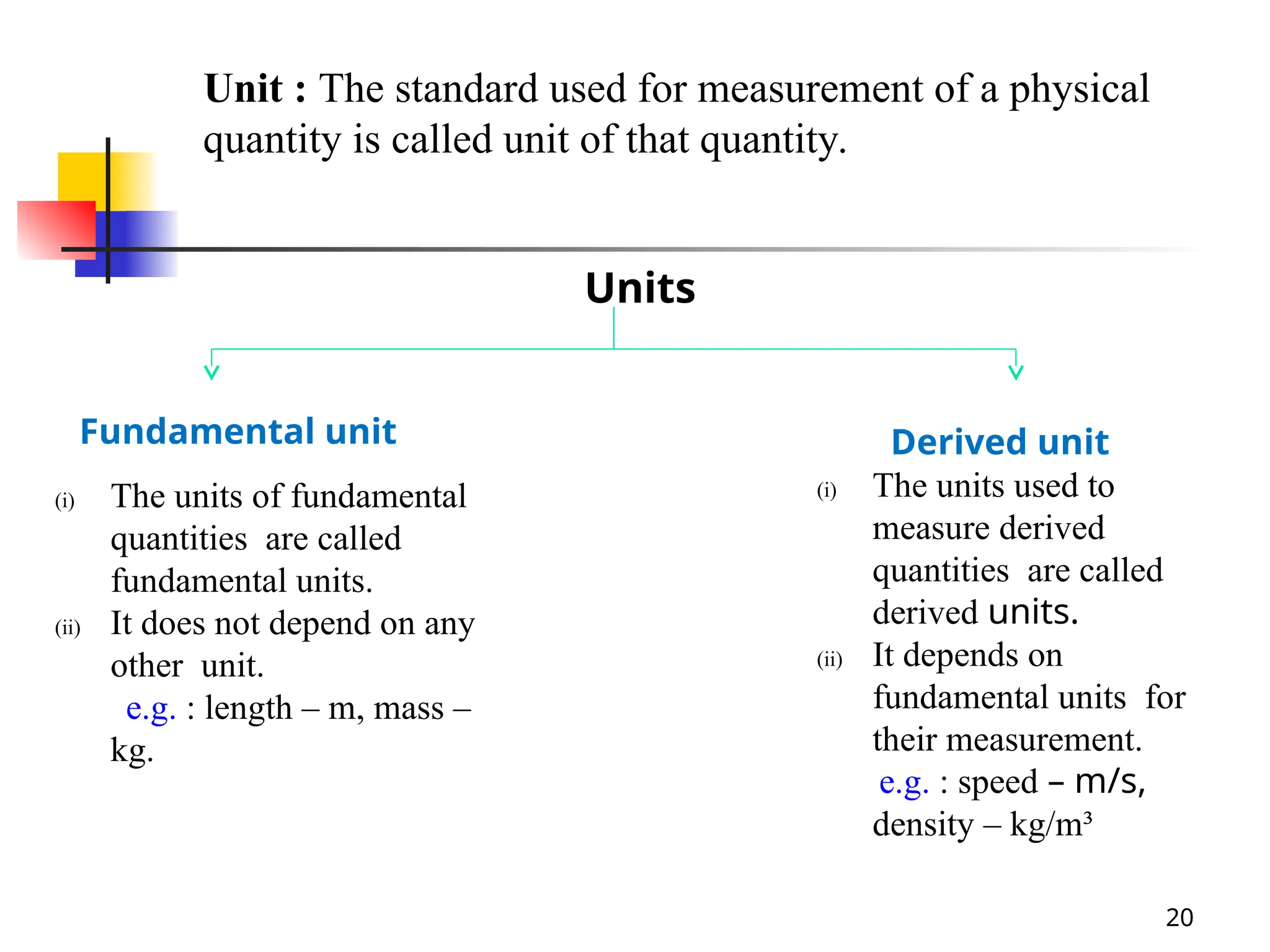
Fundamental unit Derived unit
(i) The units of fundamental
quantities are called
fundamental units.
(ii) It does not depend on any
other unit.
e.g. : length – m, mass –
kg.
(i) The units used to
measure derived
quantities are called
derived units.
(ii) It depends on
fundamental units for
their measurement.
e.g. : speed – m/s,
density – kg/m³
Units
Unit : The standard used for measurement of a physical
quantity is called unit of that quantity.
20
21
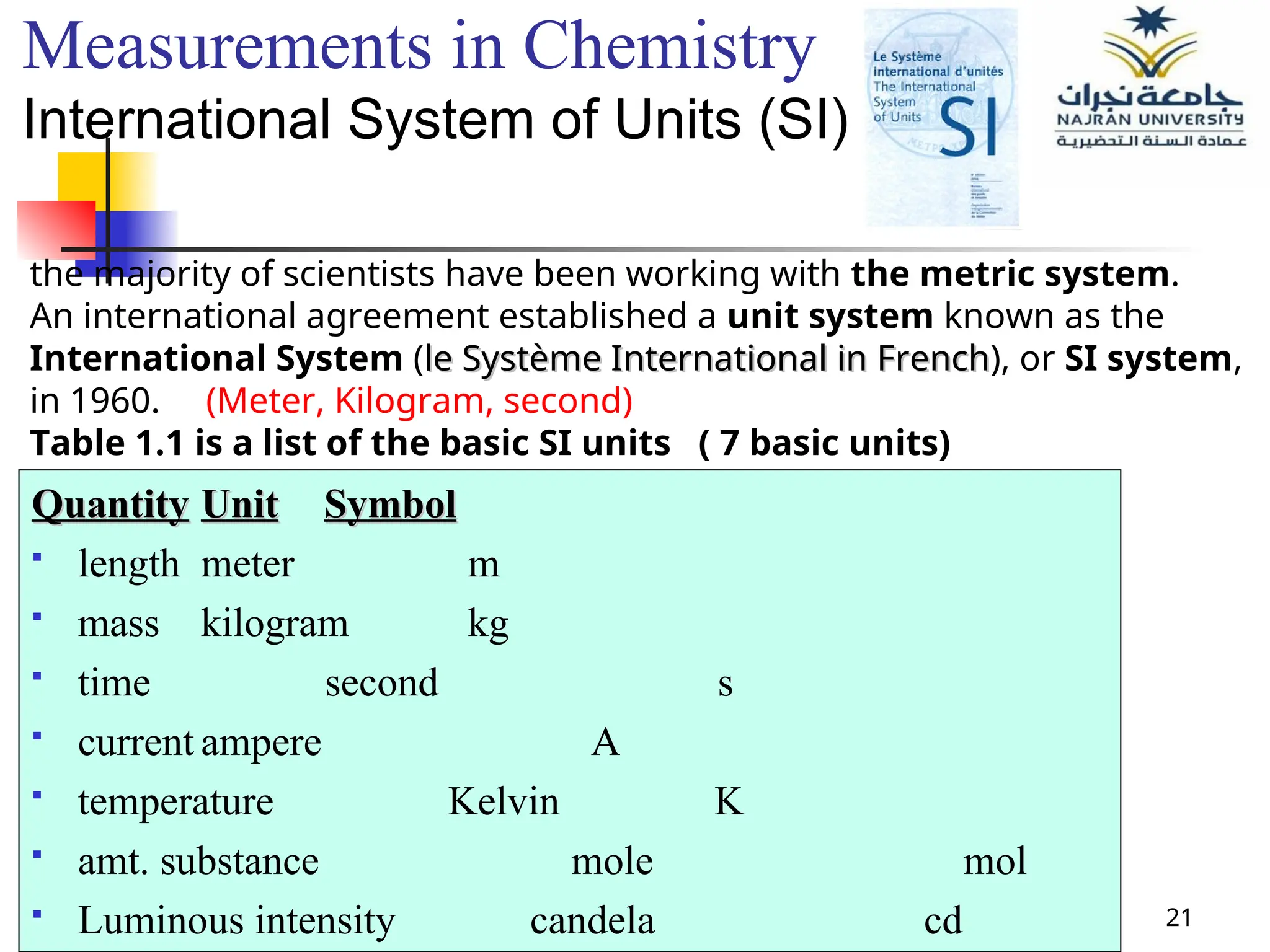
Measurements in Chemistry
International System of Units (SI)
Quantity
Quantity Unit
Unit Symbol
Symbol
 length meter m
 mass kilogram kg
 time second s
 current ampere A
 temperature Kelvin K
 amt. substance mole mol
 Luminous intensity candela cd
the majority of scientists have been working with the metric system.
An international agreement established a unit system known as the
International System (le Système International in French
le Système International in French), or SI system,
in 1960. (Meter, Kilogram, second)
Table 1.1 is a list of the basic SI units ( 7 basic units)
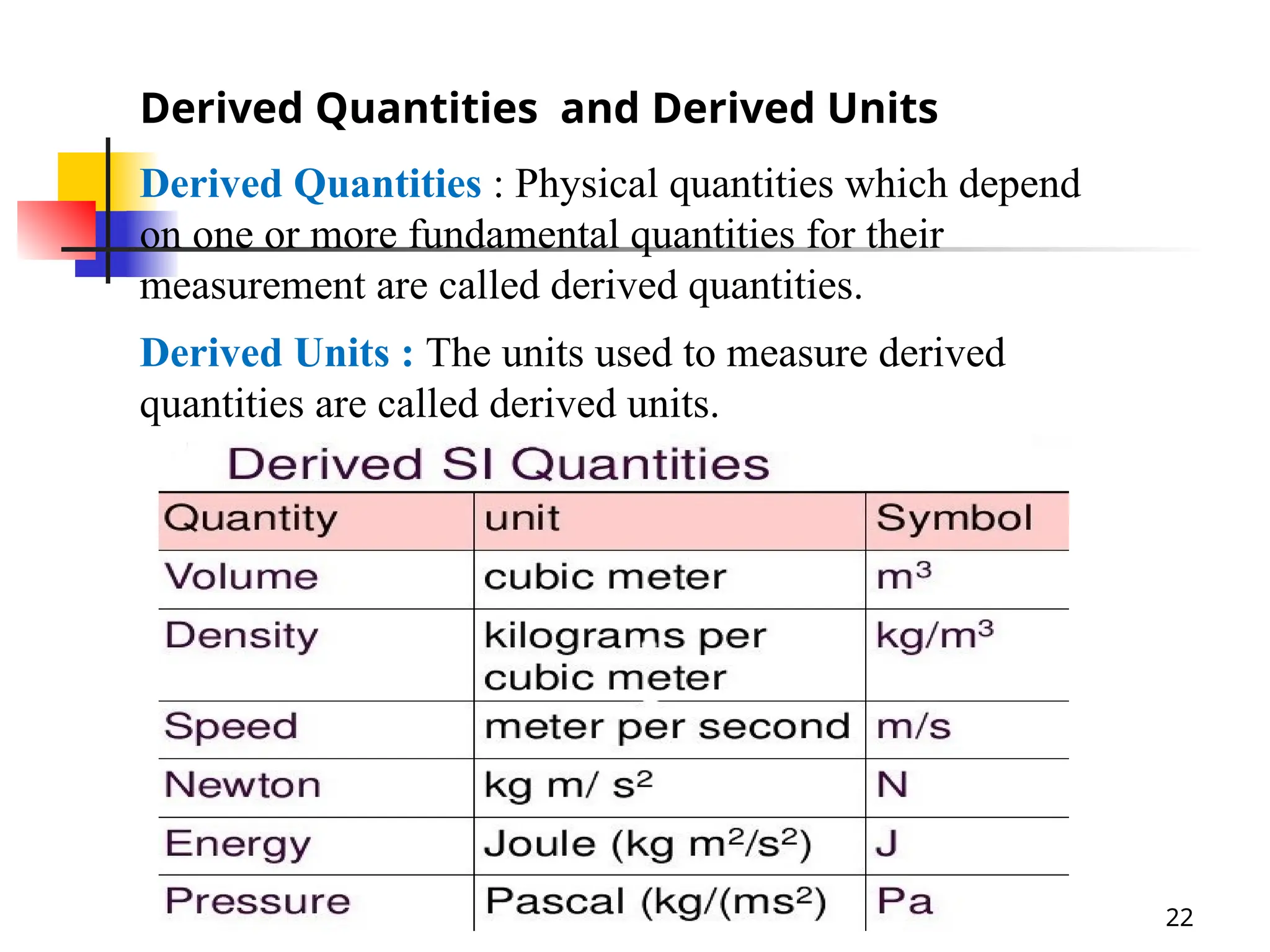
Derived Quantities and Derived Units
Derived Quantities : Physical quantities which depend
on one or more fundamental quantities for their
measurement are called derived quantities.
Derived Units : The units used to measure derived
quantities are called derived units.
22
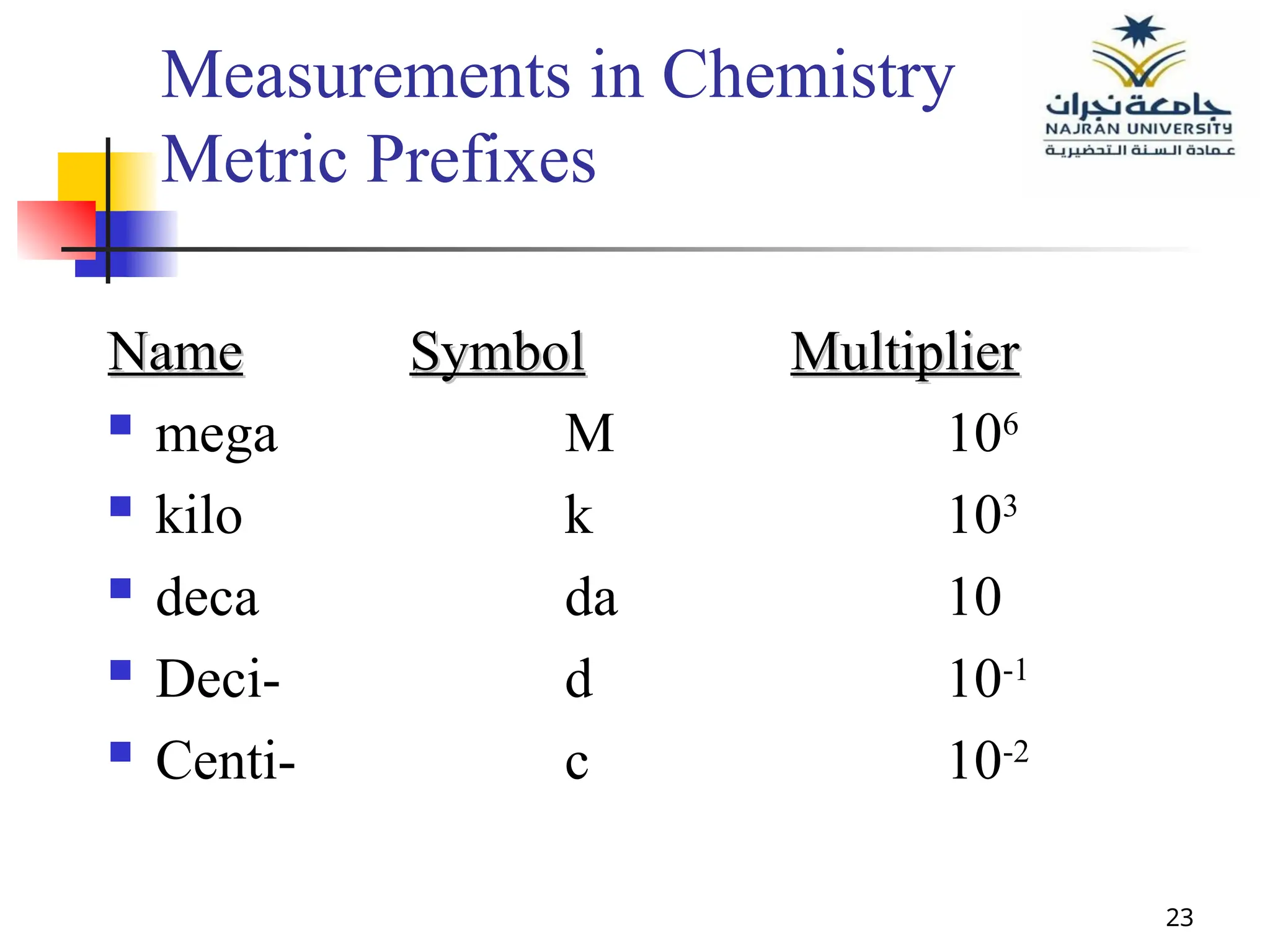
23
Measurements in Chemistry
Metric Prefixes
Name
Name Symbol
Symbol Multiplier
Multiplier
 mega M 106
 kilo k 103
 deca da 10
 Deci- d 10-1
 Centi- c 10-2
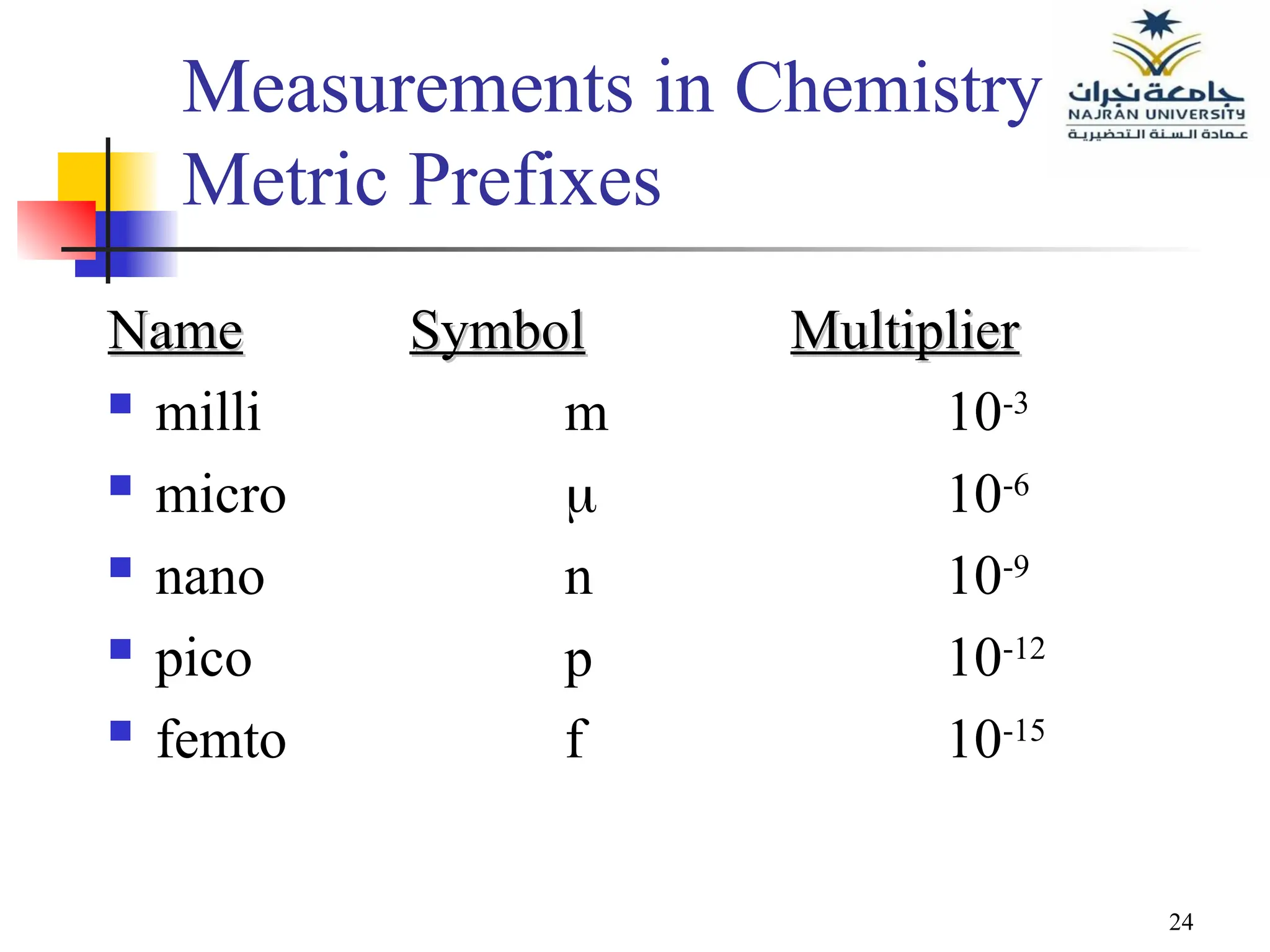
24
Measurements in Chemistry
Metric Prefixes
Name
Name Symbol
Symbol Multiplier
Multiplier
 milli m 10-3
 micro  10-6
 nano n 10-9
 pico p 10-12
 femto f 10-15
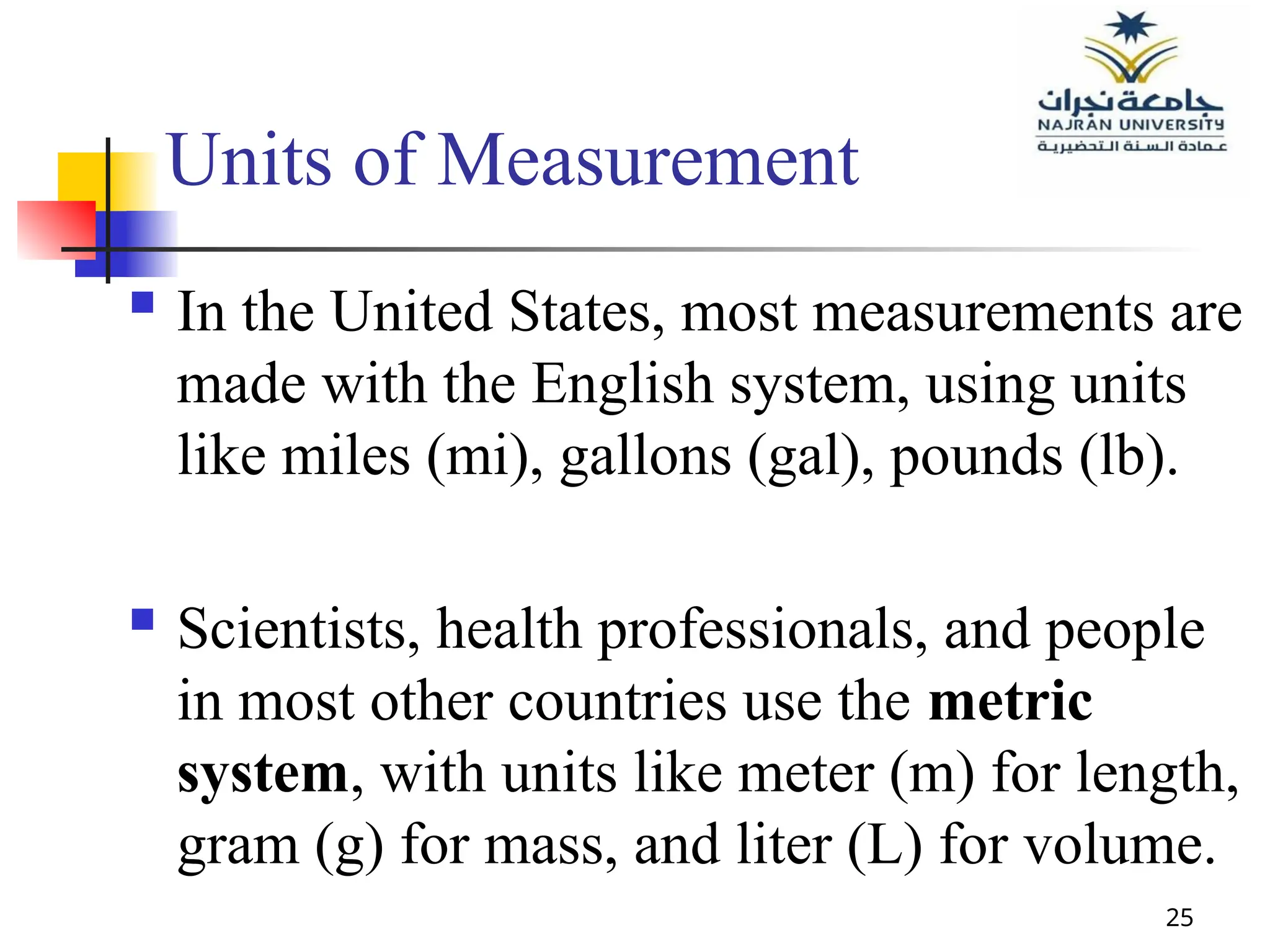
25
Units of Measurement
 In the United States, most measurements are
made with the English system, using units
like miles (mi), gallons (gal), pounds (lb).
 Scientists, health professionals, and people
in most other countries use the metric
system, with units like meter (m) for length,
gram (g) for mass, and liter (L) for volume.
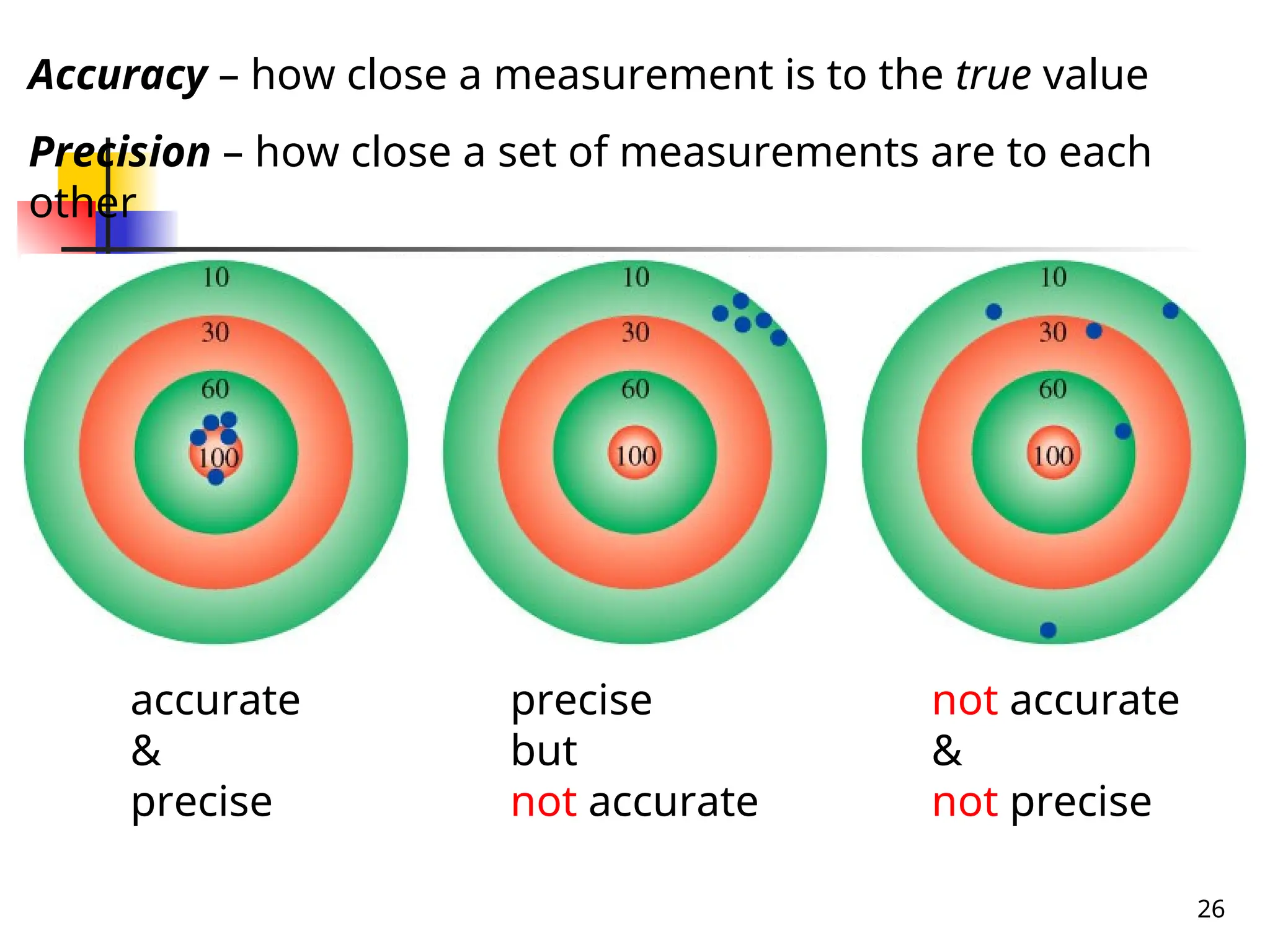
Accuracy – how close a measurement is to the true value
Precision – how close a set of measurements are to each
other
accurate
&
precise
precise
but
not accurate
not accurate
&
not precise
26
27
Use of Numbers
 Significant figures
 digits believed to be correct by the person making the measurement
 Counting the significant figures in each number in the final result:
it is crucial to know the exact amount of uncertainty in the result.
 Measure a mile with a 6-inch ruler vs. surveying equipment
Use of Numbers
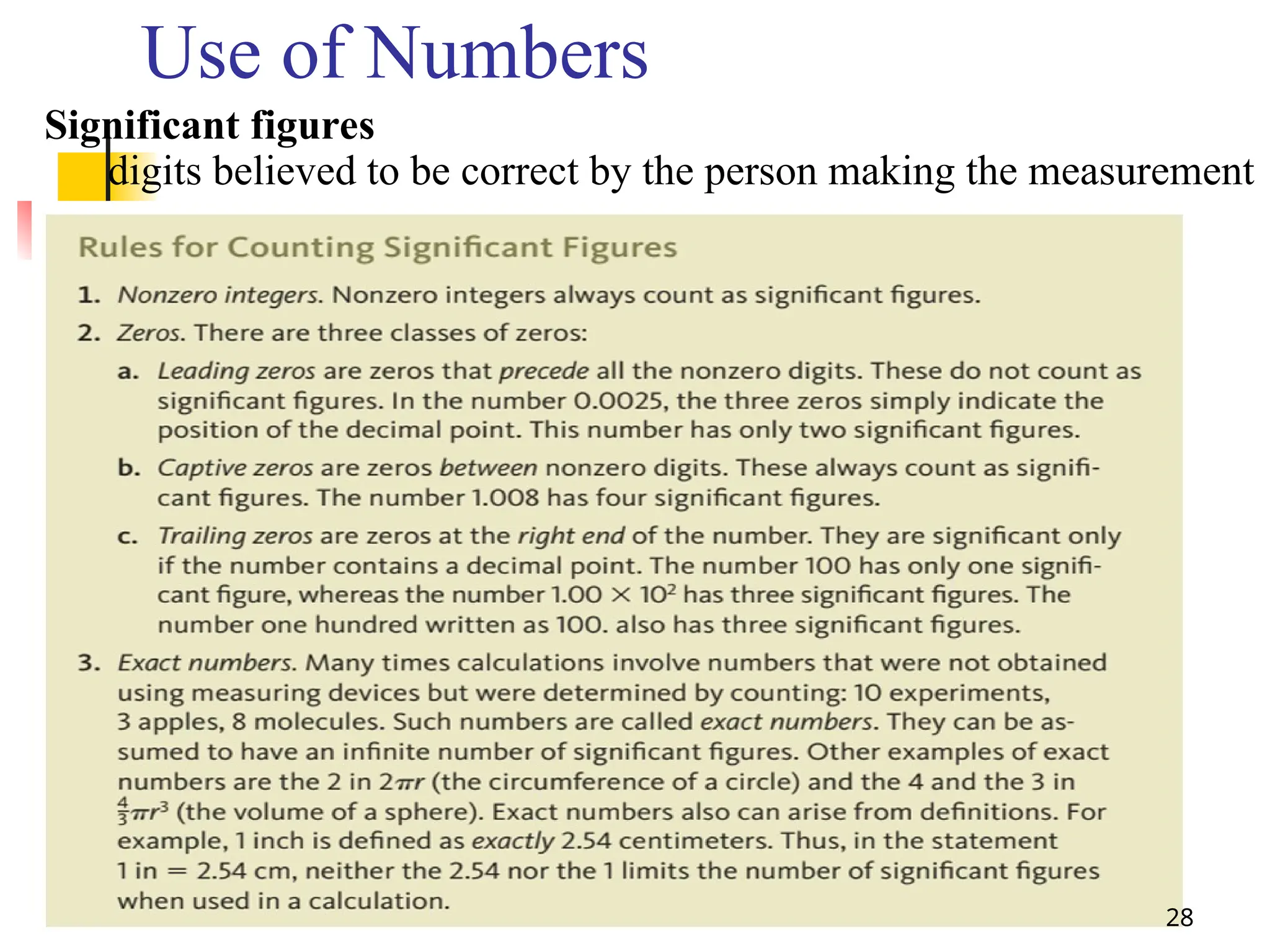
28
Significant figures
digits believed to be correct by the person making the measurement
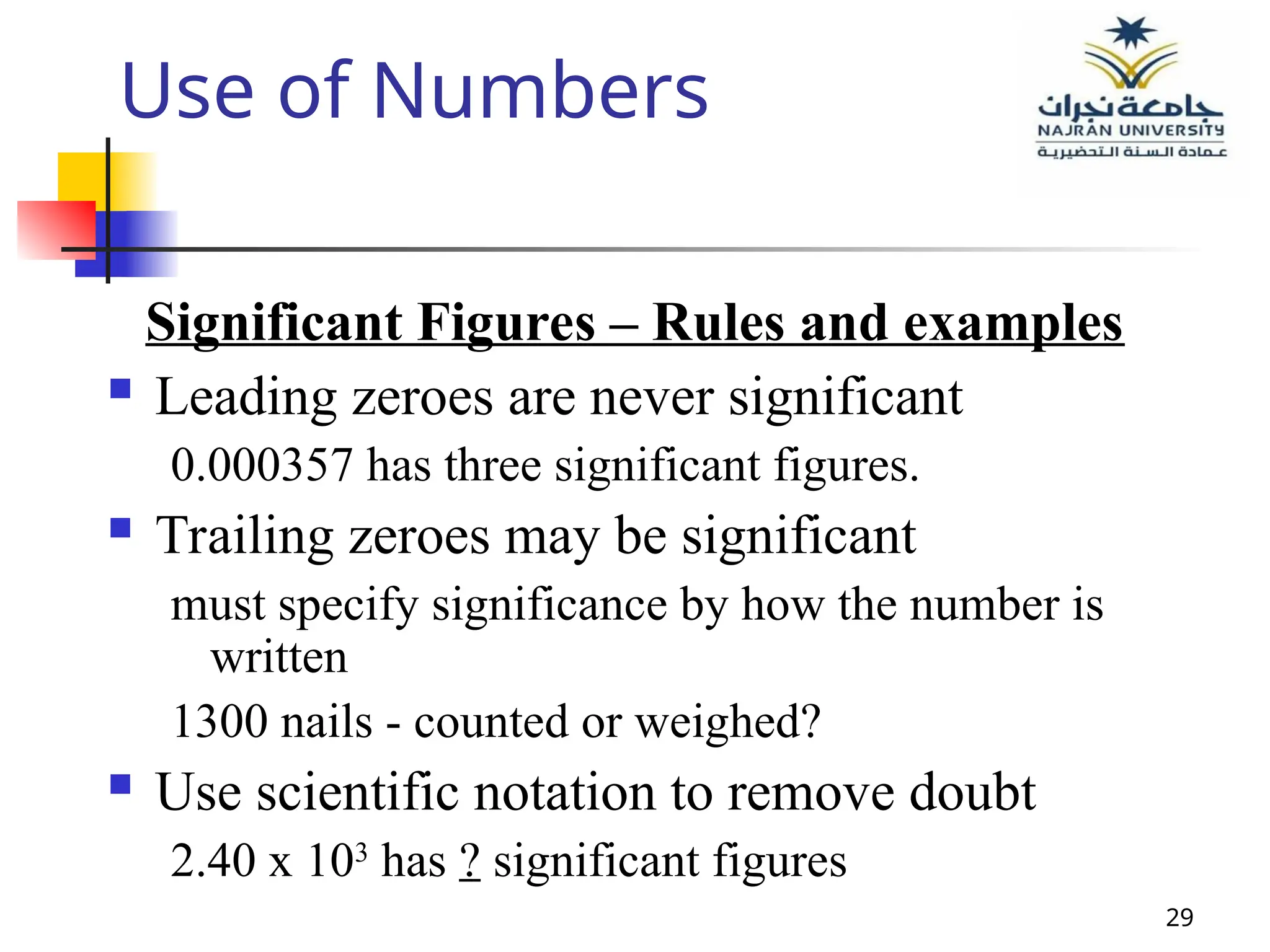
29
Use of Numbers
Significant Figures – Rules and examples
 Leading zeroes are never significant
0.000357 has three significant figures.
 Trailing zeroes may be significant
must specify significance by how the number is
written
1300 nails - counted or weighed?
 Use scientific notation to remove doubt
2.40 x 10³
has ? significant figures
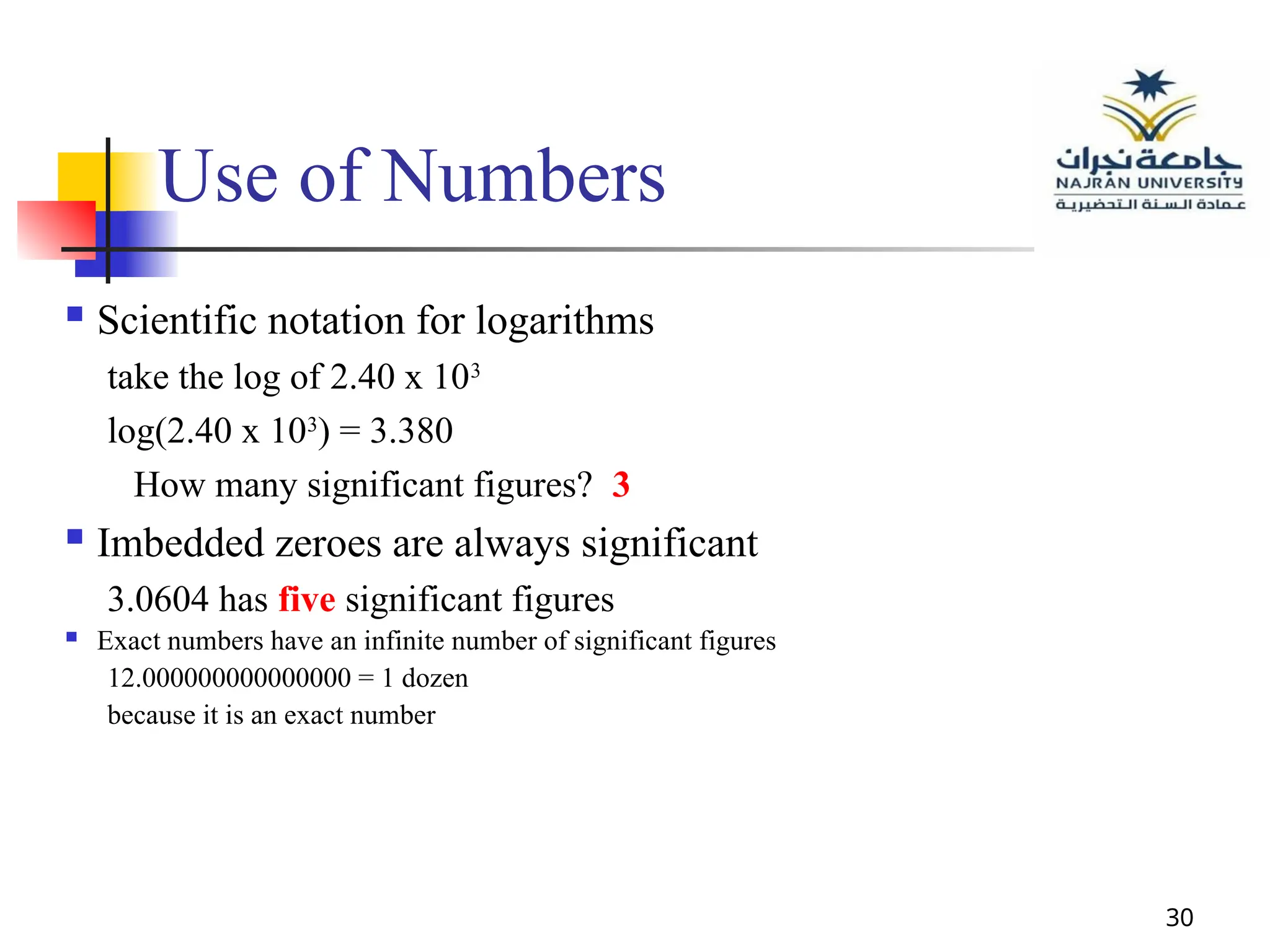
Use of Numbers
 Scientific notation for logarithms
take the log of 2.40 x 10³
log(2.40 x 10³
) = 3.380
How many significant figures? 3
 Imbedded zeroes are always significant
3.0604 has five significant figures
 Exact numbers have an infinite number of significant figures
12.000000000000000 = 1 dozen
because it is an exact number
30
Significant Figures
Summary
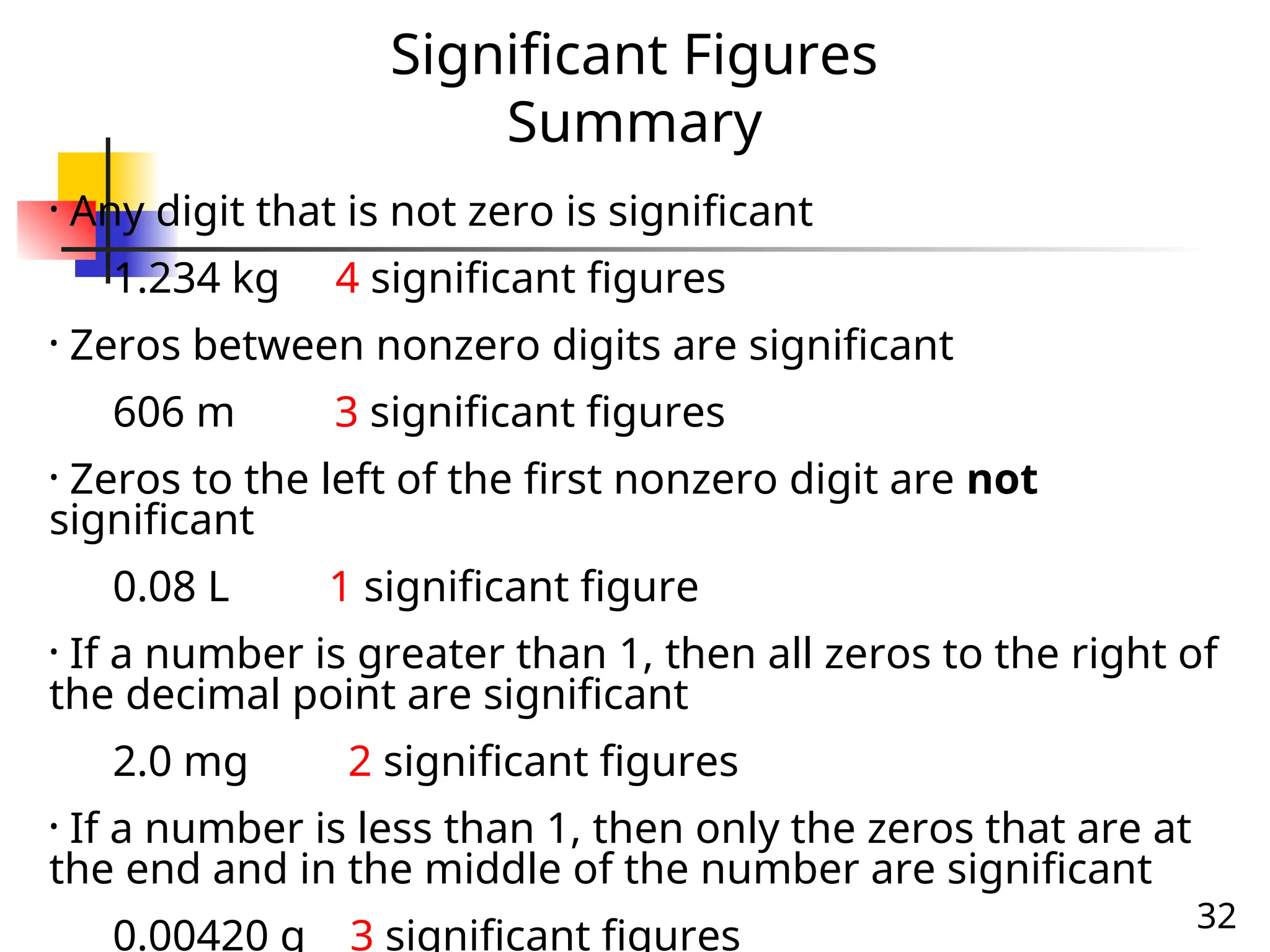
32
• Any digit that is not zero is significant
1.234 kg 4 significant figures
• Zeros between nonzero digits are significant
606 m 3 significant figures
• Zeros to the left of the first nonzero digit are not
significant
0.08 L 1 significant figure
• If a number is greater than 1, then all zeros to the right of
the decimal point are significant
2.0 mg 2 significant figures
• If a number is less than 1, then only the zeros that are at
the end and in the middle of the number are significant
0.00420 g 3 significant figures
32
Density
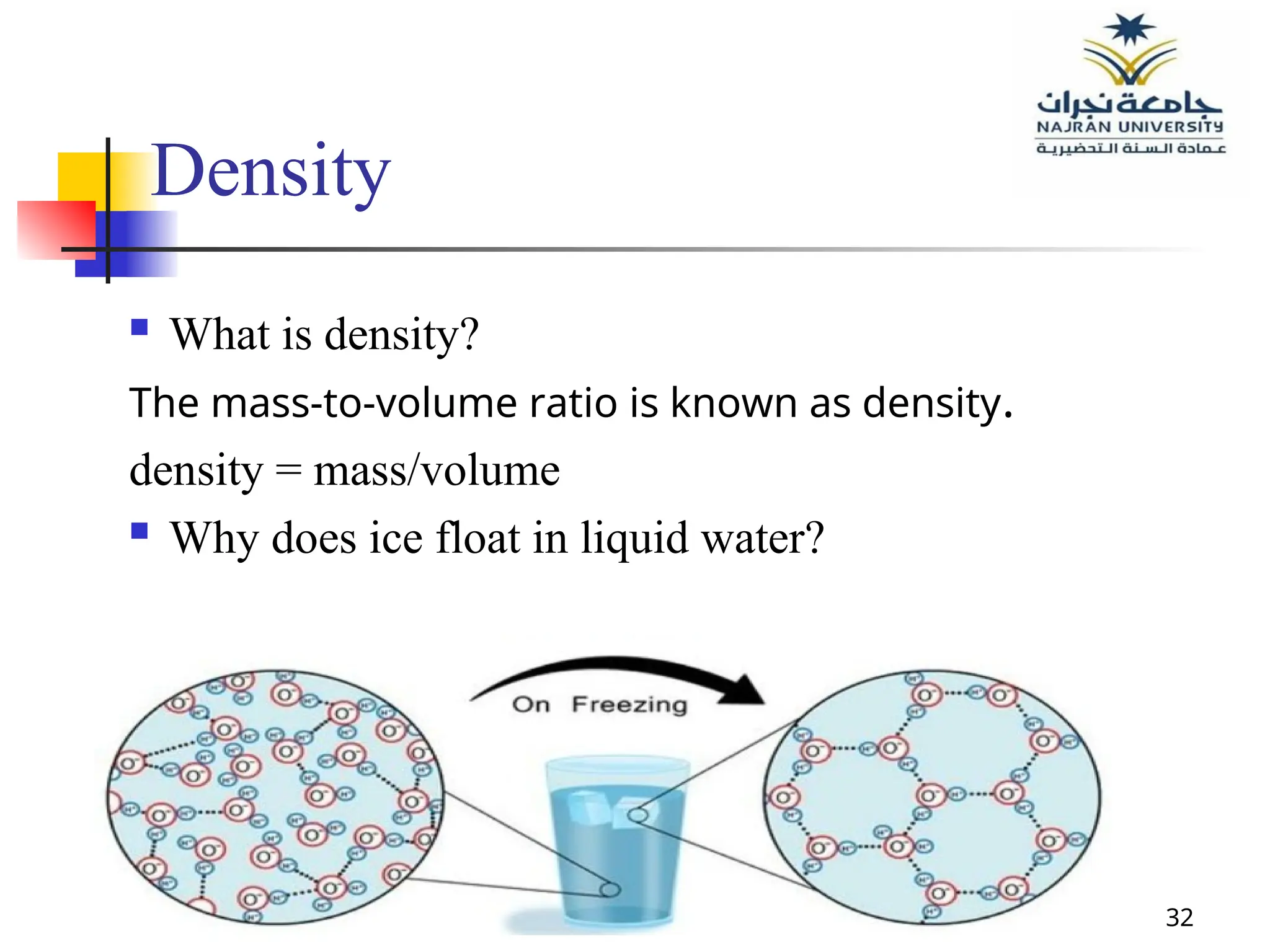
 What is density?
The mass-to-volume ratio is known as density.
density = mass/volume
 Why does ice float in liquid water?
33
Density
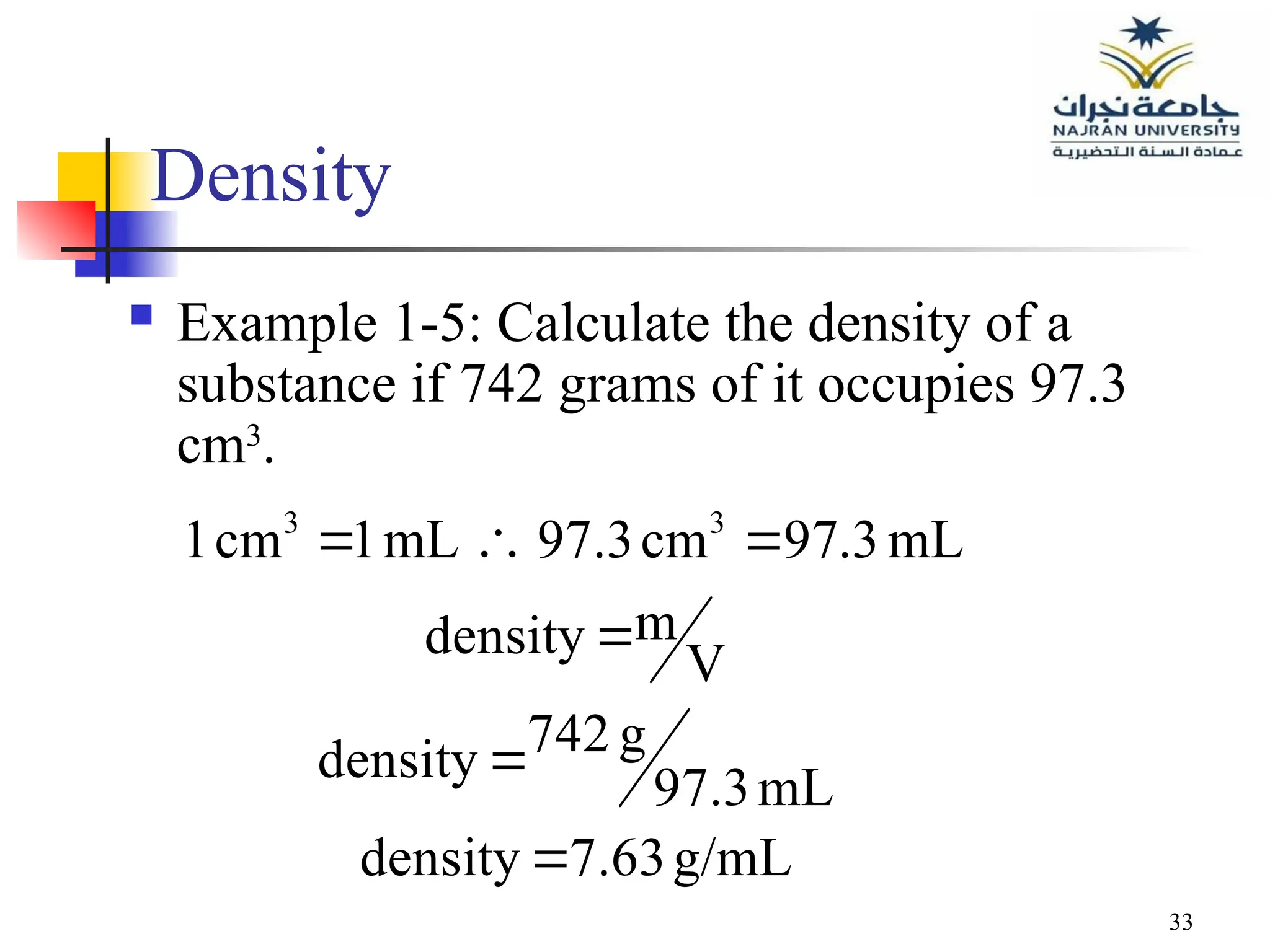
 Example 1-5: Calculate the density of a
substance if 742 grams of it occupies 97.3
cm3
.
g/mL
7.63
density
mL
97.3
g
742
density
V
m
density
mL
3
.
97
cm
97.3
mL
1
cm
1 3
3






34
Density
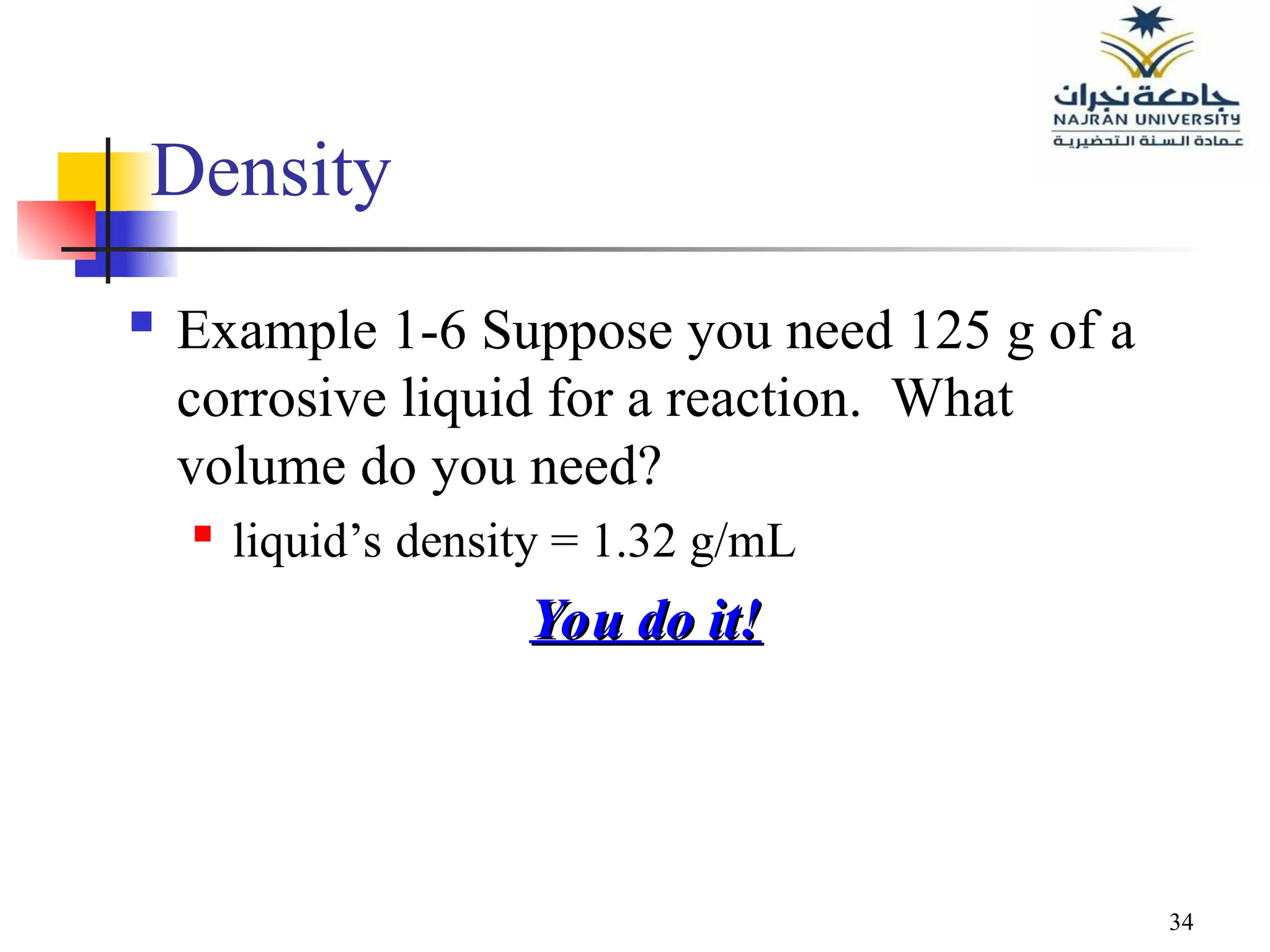
 Example 1-6 Suppose you need 125 g of a
corrosive liquid for a reaction. What
volume do you need?
 liquid’s density = 1.32 g/mL
You do it!
You do it!
35
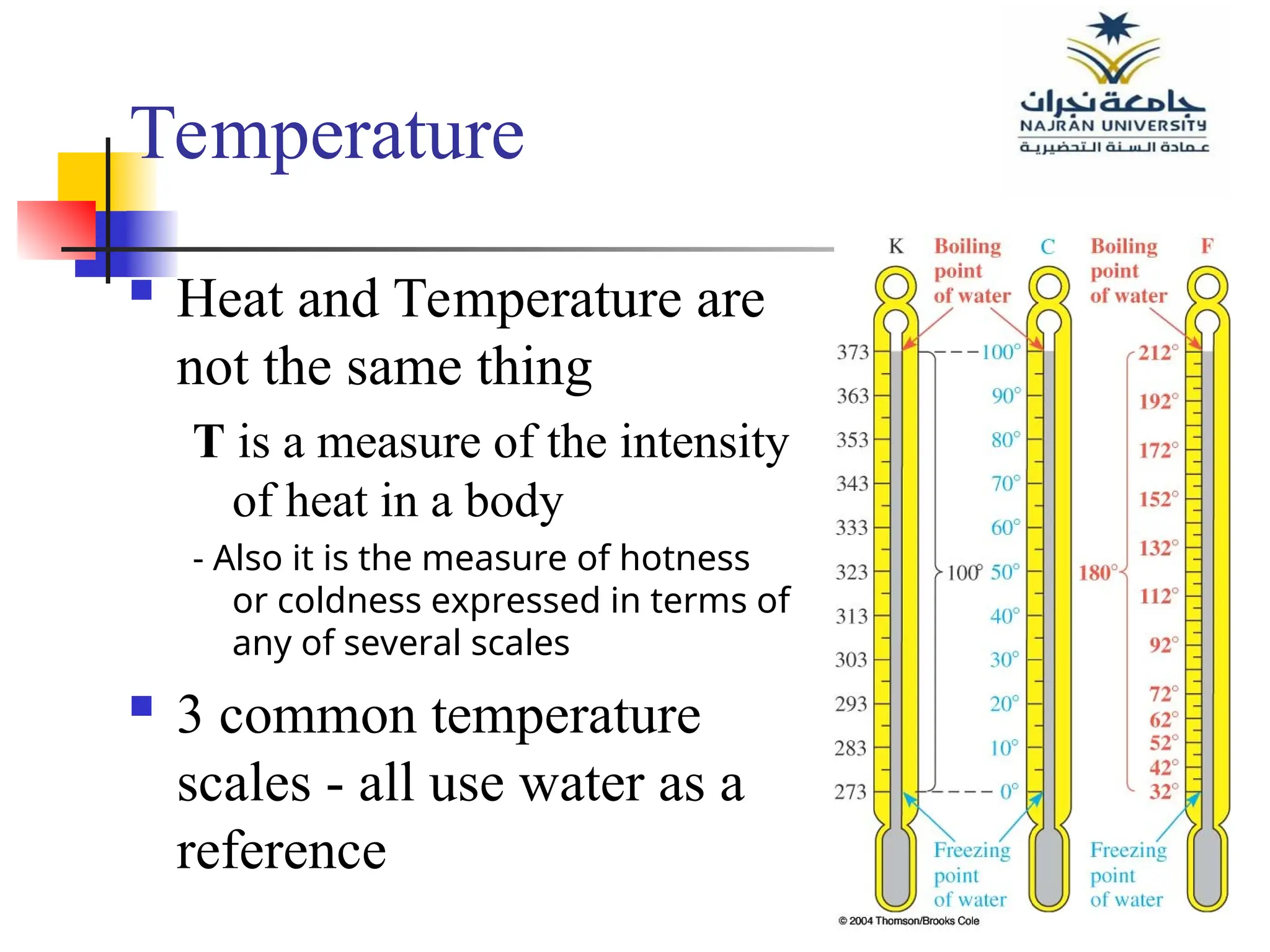
Temperature
 Heat and Temperature are
not the same thing
T is a measure of the intensity
of heat in a body
- Also it is the measure of hotness
or coldness expressed in terms of
any of several scales
 3 common temperature
scales - all use water as a
reference
36
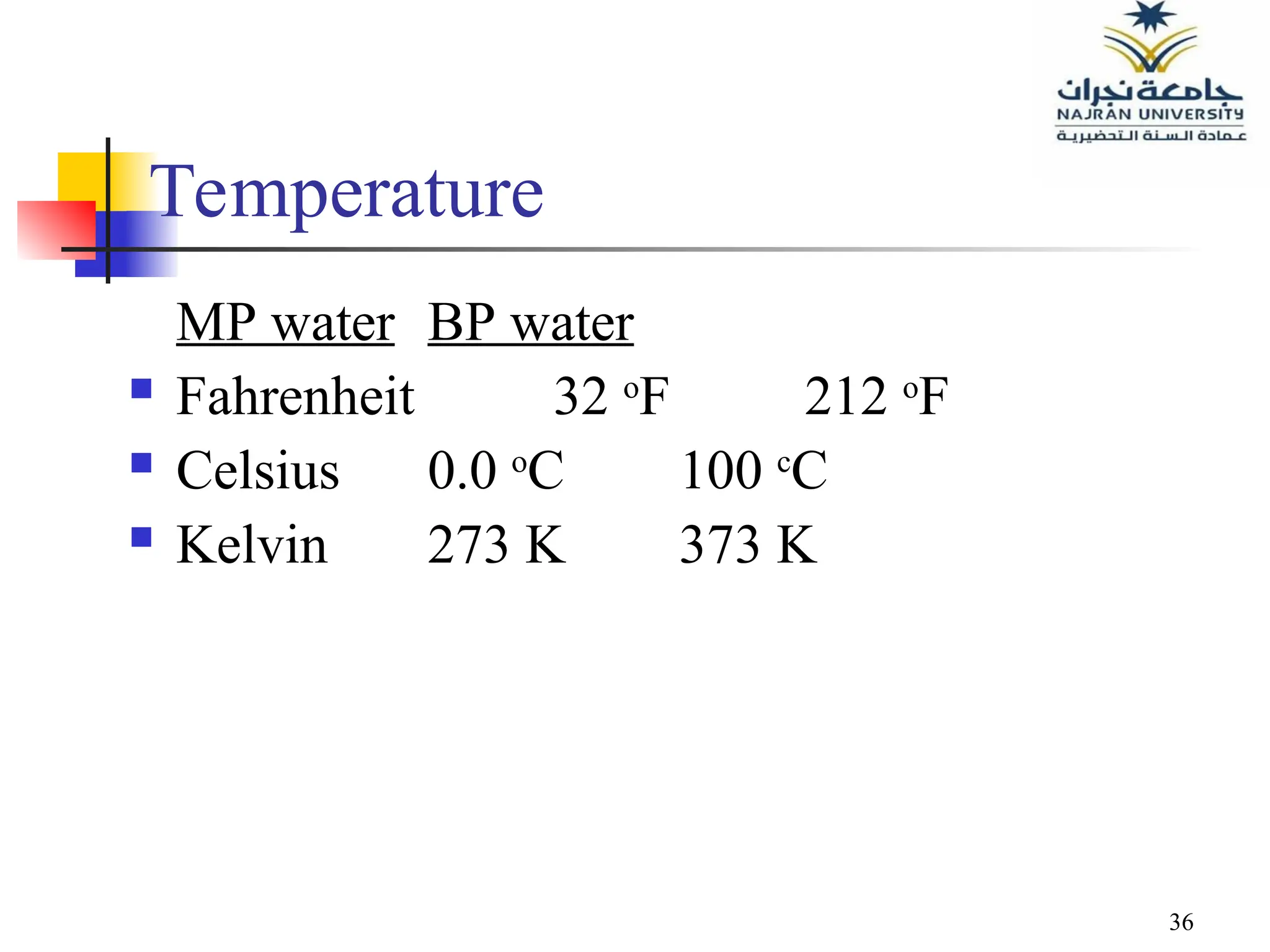
Temperature
MP water BP water
 Fahrenheit 32 o
F 212 o
F
 Celsius 0.0 o
C 100 c
C
 Kelvin 273 K 373 K
37
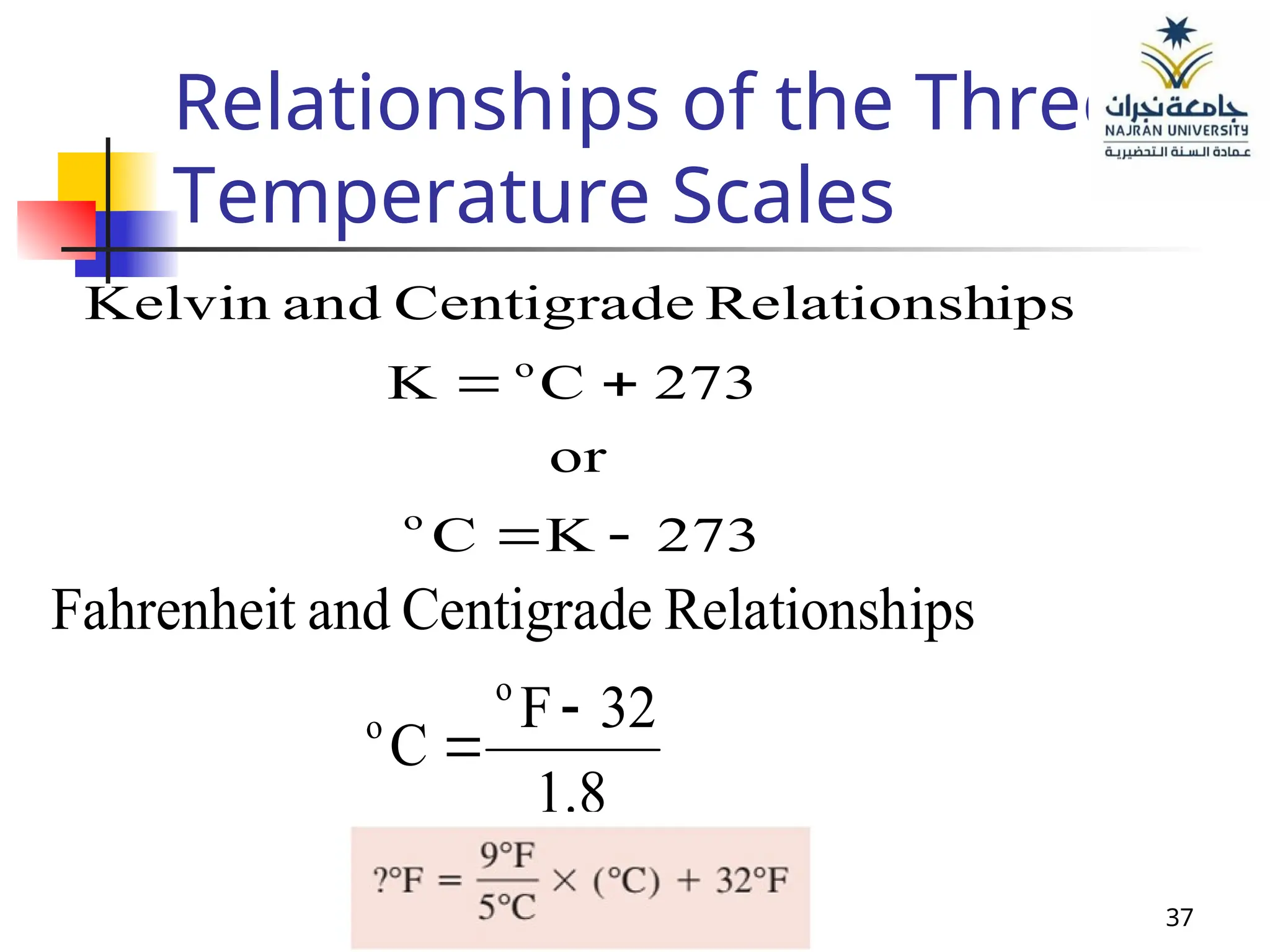
Relationships of the Three
Temperature Scales
273
K
C
or
273
C
K
ips
Relationsh
Centigrade
and
Kelvin
o
o




1.8
32
F
C
ips
Relationsh
Centigrade
and
Fahrenheit
o
o 

38
Heat and Temperature
 Example 1-7: Convert 211oF to degrees Celsius.
 Example 1-8: Express 548 K in Celsius degrees.
CHAPTER 1 atom, molecules, elements final.ppt

  • 1.
  • 2.
    2 Chapter Outline 1.1 Matterand Energy 1.2 States of Matter 1.3 Chemical and Physical Properties 1.4 Chemical and Physical Changes 1.5 Measurements in Chemistry International Unit System 1.6 Units of Measurement 1.7 Significant figures 1. 8 Density 1. 9 Temperature
  • 3.
    3 Matter and Energy- Vocabulary  Chemistry  Science that describes matter – its properties, the changes it undergoes, and the energy changes that accompany those processes  Matter  Anything that has mass and occupies space.  Energy  The capacity to do work or transfer heat.
  • 4.
    4 States of Matter Solids are much more organized than the particles in a liquid or a. As a result, a solid has both fixed volume and fixed shape. Neighboring atoms or molecules in a solid may vibrate or oscillate, but they do not move around each other. Attractive forces, which exist between all particles, are very pronounced in solids and much less so in gases. Ice, diamond, quartz, and iron are examples of solid matter.
  • 5.
  • 6.
    6 States of Matter Liquid Liquid Atoms are close together but are free to move around and by each other; a liquid has a definite volume but no definite shape. Liquids have a fixed volume because their atoms or molecules are in close contact; it takes on the shape of its container because the atoms or molecules are free to move relative to one another. Water, gasoline, alcohol, and mercury are all examples of liquid matter
  • 7.
    7 States of Matter Solids  Liquids
  • 8.
    8 States of Matter Gases Are made up of particles that are widely separated and are free to move relative to one another. Since the atoms or molecules that compose gases are not in contact with one another, gases are compressible. In fact, a gas will expand to fill any container; it has no definite shape or volume. Oxygen, helium, and carbon dioxide are examples of gases.
  • 9.
    9 States of Matter Solids  Liquids  Gases
  • 10.
    10 States of Matter Change States  heating  cooling
  • 11.
    11 States of Matter Tableshows Properties of Solids, Liquids, and Gases
  • 12.
    Classifying Matter Accordingto Its Composition 12
  • 13.
  • 14.
    14  matter maybe a pure substance or a mixture. A pure substance is composed of only one type of atom or molecule, It may be either an element (such as copper) or a compound (such as sugar).  Element: A pure substance that cannot be broken down into simpler substances Classifying Matter According to Its Composition
  • 15.
    15  Compound: Apure substance composed of two or more elements in fixed definite proportions  A mixture : is composed of two or more different types of atoms or molecules combined in variable proportions.  A mixture may be either a homogeneous mixture (such as sweetened tea) or a heterogeneous mixture (such as hydrocarbon and water). Classifying Matter According to Its Composition
  • 16.
    16 Chemical and PhysicalProperties  A physical property is one that a substance displays without changing its composition.  Such as odor of gasoline  A chemical property is one that a substance displays only through changing its composition.  Such as The flammability of gasoline
  • 17.
    17 Chemical and PhysicalProperties  In a physical change, matter changes its appearance but not its composition.  When ice melts, it looks different but its composition is the same. Solid ice and liquid water are both composed of water molecules, so melting is a physical change. density, color, solubility.  For example, In a chemical change, matter does change its composition. (can also called a chemical reaction)  For example, rusting or oxidation
  • 18.
    An extensive propertyof a material depends upon how much matter is is being considered. An intensive property of a material does not depend upon how much matter is is being considered. • mass • length • volume • density • temperature • color Extensive and Intensive Properties
  • 19.
    19 Measurements in Chemistry Every measurement is composed of a number and a unit. Reporting the value of a measurement is meaningless without its unit.
  • 20.
    Fundamental unit Derivedunit (i) The units of fundamental quantities are called fundamental units. (ii) It does not depend on any other unit. e.g. : length – m, mass – kg. (i) The units used to measure derived quantities are called derived units. (ii) It depends on fundamental units for their measurement. e.g. : speed – m/s, density – kg/m³ Units Unit : The standard used for measurement of a physical quantity is called unit of that quantity. 20
  • 21.
    21 Measurements in Chemistry InternationalSystem of Units (SI) Quantity Quantity Unit Unit Symbol Symbol  length meter m  mass kilogram kg  time second s  current ampere A  temperature Kelvin K  amt. substance mole mol  Luminous intensity candela cd the majority of scientists have been working with the metric system. An international agreement established a unit system known as the International System (le Système International in French le Système International in French), or SI system, in 1960. (Meter, Kilogram, second) Table 1.1 is a list of the basic SI units ( 7 basic units)
  • 22.
    Derived Quantities andDerived Units Derived Quantities : Physical quantities which depend on one or more fundamental quantities for their measurement are called derived quantities. Derived Units : The units used to measure derived quantities are called derived units. 22
  • 23.
    23 Measurements in Chemistry MetricPrefixes Name Name Symbol Symbol Multiplier Multiplier  mega M 106  kilo k 103  deca da 10  Deci- d 10-1  Centi- c 10-2
  • 24.
    24 Measurements in Chemistry MetricPrefixes Name Name Symbol Symbol Multiplier Multiplier  milli m 10-3  micro  10-6  nano n 10-9  pico p 10-12  femto f 10-15
  • 25.
    25 Units of Measurement In the United States, most measurements are made with the English system, using units like miles (mi), gallons (gal), pounds (lb).  Scientists, health professionals, and people in most other countries use the metric system, with units like meter (m) for length, gram (g) for mass, and liter (L) for volume.
  • 26.
    Accuracy – howclose a measurement is to the true value Precision – how close a set of measurements are to each other accurate & precise precise but not accurate not accurate & not precise 26
  • 27.
    27 Use of Numbers Significant figures  digits believed to be correct by the person making the measurement  Counting the significant figures in each number in the final result: it is crucial to know the exact amount of uncertainty in the result.  Measure a mile with a 6-inch ruler vs. surveying equipment
  • 28.
    Use of Numbers 28 Significantfigures digits believed to be correct by the person making the measurement
  • 29.
    29 Use of Numbers SignificantFigures – Rules and examples  Leading zeroes are never significant 0.000357 has three significant figures.  Trailing zeroes may be significant must specify significance by how the number is written 1300 nails - counted or weighed?  Use scientific notation to remove doubt 2.40 x 10³ has ? significant figures
  • 30.
    Use of Numbers Scientific notation for logarithms take the log of 2.40 x 10³ log(2.40 x 10³ ) = 3.380 How many significant figures? 3  Imbedded zeroes are always significant 3.0604 has five significant figures  Exact numbers have an infinite number of significant figures 12.000000000000000 = 1 dozen because it is an exact number 30
  • 31.
    Significant Figures Summary 32 • Anydigit that is not zero is significant 1.234 kg 4 significant figures • Zeros between nonzero digits are significant 606 m 3 significant figures • Zeros to the left of the first nonzero digit are not significant 0.08 L 1 significant figure • If a number is greater than 1, then all zeros to the right of the decimal point are significant 2.0 mg 2 significant figures • If a number is less than 1, then only the zeros that are at the end and in the middle of the number are significant 0.00420 g 3 significant figures
  • 32.
    32 Density  What isdensity? The mass-to-volume ratio is known as density. density = mass/volume  Why does ice float in liquid water?
  • 33.
    33 Density  Example 1-5:Calculate the density of a substance if 742 grams of it occupies 97.3 cm3 . g/mL 7.63 density mL 97.3 g 742 density V m density mL 3 . 97 cm 97.3 mL 1 cm 1 3 3      
  • 34.
    34 Density  Example 1-6Suppose you need 125 g of a corrosive liquid for a reaction. What volume do you need?  liquid’s density = 1.32 g/mL You do it! You do it!
  • 35.
    35 Temperature  Heat andTemperature are not the same thing T is a measure of the intensity of heat in a body - Also it is the measure of hotness or coldness expressed in terms of any of several scales  3 common temperature scales - all use water as a reference
  • 36.
    36 Temperature MP water BPwater  Fahrenheit 32 o F 212 o F  Celsius 0.0 o C 100 c C  Kelvin 273 K 373 K
  • 37.
    37 Relationships of theThree Temperature Scales 273 K C or 273 C K ips Relationsh Centigrade and Kelvin o o     1.8 32 F C ips Relationsh Centigrade and Fahrenheit o o  
  • 38.
    38 Heat and Temperature Example 1-7: Convert 211oF to degrees Celsius.  Example 1-8: Express 548 K in Celsius degrees.