Matter Classification of Matter Matter Flowchart Pure Substances Mixtures
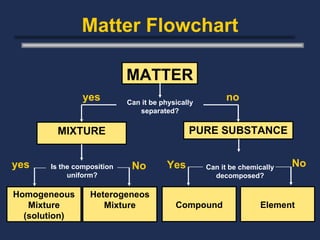
Matter Flowchart MATTER Can it be physically separated? Homogeneous Mixture (solution) Heterogeneos Mixture Compound Element yes no Is the composition uniform? yes Can   it be chemically decomposed? Yes No No MIXTURE PURE SUBSTANCE
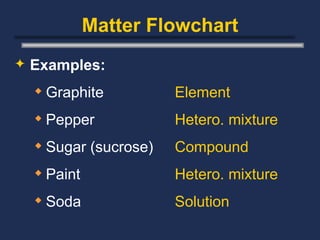
Matter Flowchart Examples: Graphite Pepper Sugar (sucrose) Paint Soda Element Hetero. mixture Compound Hetero. mixture Solution
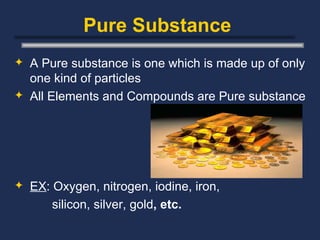
Pure Substance  A Pure substance is one which is made up of only one kind of particles All Elements and Compounds are Pure substance EX : Oxygen, nitrogen, iodine, iron, silicon, silver, gold , etc.
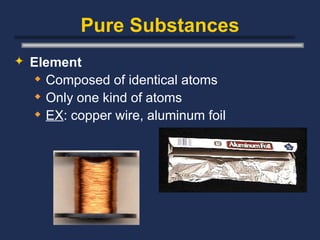
Pure Substances Element Composed of identical atoms Only one kind of atoms  EX : copper wire, aluminum foil
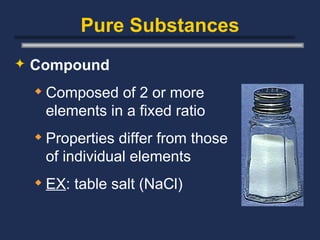
Pure Substances Compound Composed of 2 or more elements in a fixed ratio Properties differ from those of individual elements EX : table salt (NaCl)
Pure Substances Law of Definite Composition A given compound always contains the same, fixed ratio of elements. Law of Multiple Proportions Elements can combine in different ratios to form different compounds.
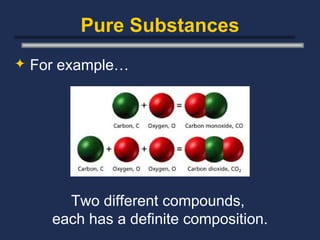
Pure Substances For example… Two different compounds,  each has a definite composition.
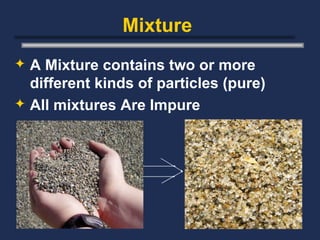
Mixture  A Mixture contains two or more different kinds of particles (pure) All mixtures Are Impure
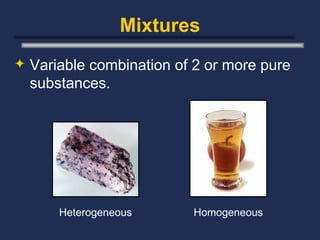
Mixtures Variable combination of 2 or more pure substances. Heterogeneous Homogeneous
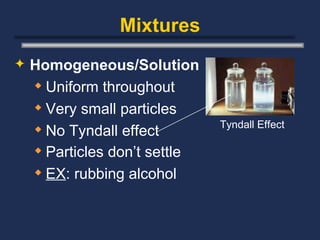
Mixtures Homogeneous/Solution Uniform throughout Very small particles No Tyndall effect Particles don’t settle EX : rubbing alcohol Tyndall Effect
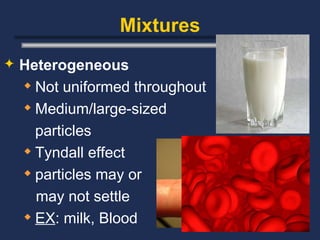
Mixtures Heterogeneous Not uniformed throughout Medium/large-sized  particles Tyndall effect particles may or  may not settle EX : milk, Blood
C. Mixtures Examples: Muddy water Saltwater Salad Dressing Blood Water + Milk Heterogeneous Homogeneous Heterogeneous Heterogeneous Homogenous

Classification of matter

  • 1.
    Matter Classification ofMatter Matter Flowchart Pure Substances Mixtures
  • 2.
    Matter Flowchart MATTERCan it be physically separated? Homogeneous Mixture (solution) Heterogeneos Mixture Compound Element yes no Is the composition uniform? yes Can it be chemically decomposed? Yes No No MIXTURE PURE SUBSTANCE
  • 3.
    Matter Flowchart Examples:Graphite Pepper Sugar (sucrose) Paint Soda Element Hetero. mixture Compound Hetero. mixture Solution
  • 4.
    Pure Substance A Pure substance is one which is made up of only one kind of particles All Elements and Compounds are Pure substance EX : Oxygen, nitrogen, iodine, iron, silicon, silver, gold , etc.
  • 5.
    Pure Substances ElementComposed of identical atoms Only one kind of atoms EX : copper wire, aluminum foil
  • 6.
    Pure Substances CompoundComposed of 2 or more elements in a fixed ratio Properties differ from those of individual elements EX : table salt (NaCl)
  • 7.
    Pure Substances Lawof Definite Composition A given compound always contains the same, fixed ratio of elements. Law of Multiple Proportions Elements can combine in different ratios to form different compounds.
  • 8.
    Pure Substances Forexample… Two different compounds, each has a definite composition.
  • 9.
    Mixture AMixture contains two or more different kinds of particles (pure) All mixtures Are Impure
  • 10.
    Mixtures Variable combinationof 2 or more pure substances. Heterogeneous Homogeneous
  • 11.
    Mixtures Homogeneous/Solution Uniformthroughout Very small particles No Tyndall effect Particles don’t settle EX : rubbing alcohol Tyndall Effect
  • 12.
    Mixtures Heterogeneous Notuniformed throughout Medium/large-sized particles Tyndall effect particles may or may not settle EX : milk, Blood
  • 13.
    C. Mixtures Examples:Muddy water Saltwater Salad Dressing Blood Water + Milk Heterogeneous Homogeneous Heterogeneous Heterogeneous Homogenous