Cerebral Palsy
By
Dr. Rima Jani (PT)
MPT Pediatric Science
1
What is Cerebral Palsy?
 Group of disorders affecting body
movement and muscular disorders.
2
Cerebral Palsy
INTRODUCTION
 Cerebral palsy(CP) is a disorder of muscle
movement & coordination, caused by an
injury to child’s brain that occurs before
birth or during infancy
 It affects the part of the brain that controls
body movement.
 People with cerebral palsy can have other
problems such as seizures, decreased
ability to learn, problems in hearing, vision
& thought processing.
3
Cerebral Palsy
What are the symptoms of CP?
 CP interferes with messages b/n
brain and body
 Effects vary with individual
 Mildest: slight awkwardness
 Severest: Virtually no muscle
control
4
Cerebral Palsy
Brain Damage
 Depending on which areas of the
brain have been damaged, one or
more of the following may occur:
1. Muscle tightness or spasms
2. Involuntary movement
3. Difficulty with "gross motor skills" such
as walking or running
4. Difficulty with "fine motor skills" such as
writing or doing up buttons
5. Difficulty in perception and sensation
5
Cerebral Palsy
Associated Problems
 The above effects may cause
associated problems such as:
1. Feeding
2. Poor bladder control
3. Breathing problems
4. Pressure sores
6
Cerebral Palsy
Associated Problems cont.
 The brain damage may lead to:
1. Seizures
2. Learning Disabilities
3. Developmental Delays
7
Cerebral Palsy
Important to Remember that…
 Affected limbs are not paralyzed
and can feel pain, heat, cold and
pressure
 Physical disability is no indication of
intellectual disability.
 C.P. is not a degenerative condition,
damage to the brain is a one time
occurrence so it will not get worse.
8
Cerebral Palsy
Important to remember that…
 People with C.P. have a normal life
span.
 Is not progressive, the effects of CP
may change over time:
 Some may improve
 Some may get worse
9
Cerebral Palsy
Medically it is important to remember…
1. Is not contagious
2. Is not hereditary
3. Is not life threatening
10
Cerebral Palsy
Types of C.P.
Topographical classification
 Classified by the number of limbs
involved:
1. Quadriplegia
2. Diplegia
3. Hemiplegia
4. Triplegia
5. Monoplegia
11
Cerebral Palsy
Classification by Movement Disorders
 Spastic: Muscles are tight and stiff
 Athetoid: Involuntary movements,
constantly in motion
 Ataxic: Least common form.
Disturbed sense of balance.
12
Cerebral Palsy
SPASTIC CP:
 Most common type, occurs 70-80% of all
cases.
 Reflexes are exaggerated & muscle
movement is stiff.
 In this type, muscles are very tight &
may get worse with time.
 Spastic Hemiplegia
 Spastic Diplegia
 Spastic Quadriplegia
 Abnormal gait. 13
Cerebral Palsy
Spastic Hemiplegia
 One side is affected
 Injury to left side of brain affects
right side of body and vice versa.
14
Cerebral Palsy
Spastic Diplegia
 Lower extremities are affected
 Most people with Spastic Diplegia
eventually walk.
 Toe walking and flexed knees are
common.
 Hip dislocations and crossed eyes
are common
 Often nearsighted
 Intelligence is unaffected
15
Cerebral Palsy
Spastic Quadriplegia
 Whole body affected
 Often have hemiparetic tremors
(shaking that affects the limbs on
one side of the body)
 Often have fluid buildup
 Tubes are usually inserted into body
to drain excess fluids
16
Cerebral Palsy
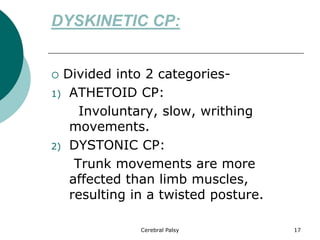
DYSKINETIC CP:
 Divided into 2 categories-
1) ATHETOID CP:
Involuntary, slow, writhing
movements.
2) DYSTONIC CP:
Trunk movements are more
affected than limb muscles,
resulting in a twisted posture.
Cerebral Palsy 17
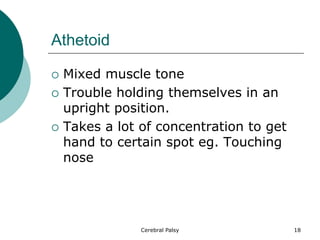
Athetoid
 Mixed muscle tone
 Trouble holding themselves in an
upright position.
 Takes a lot of concentration to get
hand to certain spot eg. Touching
nose
18
Cerebral Palsy
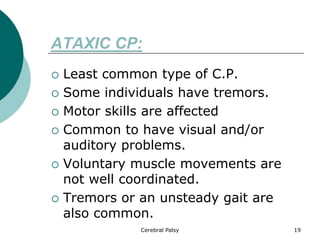
ATAXIC CP:
 Least common type of C.P.
 Some individuals have tremors.
 Motor skills are affected
 Common to have visual and/or
auditory problems.
 Voluntary muscle movements are
not well coordinated.
 Tremors or an unsteady gait are
also common.
19
Cerebral Palsy
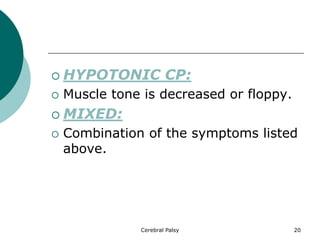
 HYPOTONIC CP:
 Muscle tone is decreased or floppy.
 MIXED:
 Combination of the symptoms listed
above.
Cerebral Palsy 20
Living with Cerebral Palsy
 Coping with Disabilities and
Handicaps
 Is not life threatening
21
Cerebral Palsy
Treatment of C.P.
 No cure
 The earlier the treatment the better
 Treatments may include one or
more of the following:
 Physical therapy, occupational therapy,
speech therapy, drugs to control
seizures, alleviate pain, or relax muscle
spasms, braces on feet, standing frame
22
Cerebral Palsy
Physical Therapy Treatment
 Designed to encourage the patient
to build strength.
 Life long physical therapy is
necessary to build muscle tone
23
Cerebral Palsy
Occupational Therapy
 Helps adults maximize their function
in an attempt to live as
independently as possible
 Orthotic are often prescribed
24
Cerebral Palsy
Speech Therapy
 Helps to control the muscles of the
mouth and the jaw
 This affects not only speech but also
breathing, biting, chew and swallowing.
 Starts before child begins school
25
Cerebral Palsy
Chord Therapy
26
Cerebral Palsy

Cerebral Palsy

  • 1.
    Cerebral Palsy By Dr. RimaJani (PT) MPT Pediatric Science 1
  • 2.
    What is CerebralPalsy?  Group of disorders affecting body movement and muscular disorders. 2 Cerebral Palsy
  • 3.
    INTRODUCTION  Cerebral palsy(CP)is a disorder of muscle movement & coordination, caused by an injury to child’s brain that occurs before birth or during infancy  It affects the part of the brain that controls body movement.  People with cerebral palsy can have other problems such as seizures, decreased ability to learn, problems in hearing, vision & thought processing. 3 Cerebral Palsy
  • 4.
    What are thesymptoms of CP?  CP interferes with messages b/n brain and body  Effects vary with individual  Mildest: slight awkwardness  Severest: Virtually no muscle control 4 Cerebral Palsy
  • 5.
    Brain Damage  Dependingon which areas of the brain have been damaged, one or more of the following may occur: 1. Muscle tightness or spasms 2. Involuntary movement 3. Difficulty with "gross motor skills" such as walking or running 4. Difficulty with "fine motor skills" such as writing or doing up buttons 5. Difficulty in perception and sensation 5 Cerebral Palsy
  • 6.
    Associated Problems  Theabove effects may cause associated problems such as: 1. Feeding 2. Poor bladder control 3. Breathing problems 4. Pressure sores 6 Cerebral Palsy
  • 7.
    Associated Problems cont. The brain damage may lead to: 1. Seizures 2. Learning Disabilities 3. Developmental Delays 7 Cerebral Palsy
  • 8.
    Important to Rememberthat…  Affected limbs are not paralyzed and can feel pain, heat, cold and pressure  Physical disability is no indication of intellectual disability.  C.P. is not a degenerative condition, damage to the brain is a one time occurrence so it will not get worse. 8 Cerebral Palsy
  • 9.
    Important to rememberthat…  People with C.P. have a normal life span.  Is not progressive, the effects of CP may change over time:  Some may improve  Some may get worse 9 Cerebral Palsy
  • 10.
    Medically it isimportant to remember… 1. Is not contagious 2. Is not hereditary 3. Is not life threatening 10 Cerebral Palsy
  • 11.
    Types of C.P. Topographicalclassification  Classified by the number of limbs involved: 1. Quadriplegia 2. Diplegia 3. Hemiplegia 4. Triplegia 5. Monoplegia 11 Cerebral Palsy
  • 12.
    Classification by MovementDisorders  Spastic: Muscles are tight and stiff  Athetoid: Involuntary movements, constantly in motion  Ataxic: Least common form. Disturbed sense of balance. 12 Cerebral Palsy
  • 13.
    SPASTIC CP:  Mostcommon type, occurs 70-80% of all cases.  Reflexes are exaggerated & muscle movement is stiff.  In this type, muscles are very tight & may get worse with time.  Spastic Hemiplegia  Spastic Diplegia  Spastic Quadriplegia  Abnormal gait. 13 Cerebral Palsy
  • 14.
    Spastic Hemiplegia  Oneside is affected  Injury to left side of brain affects right side of body and vice versa. 14 Cerebral Palsy
  • 15.
    Spastic Diplegia  Lowerextremities are affected  Most people with Spastic Diplegia eventually walk.  Toe walking and flexed knees are common.  Hip dislocations and crossed eyes are common  Often nearsighted  Intelligence is unaffected 15 Cerebral Palsy
  • 16.
    Spastic Quadriplegia  Wholebody affected  Often have hemiparetic tremors (shaking that affects the limbs on one side of the body)  Often have fluid buildup  Tubes are usually inserted into body to drain excess fluids 16 Cerebral Palsy
  • 17.
    DYSKINETIC CP:  Dividedinto 2 categories- 1) ATHETOID CP: Involuntary, slow, writhing movements. 2) DYSTONIC CP: Trunk movements are more affected than limb muscles, resulting in a twisted posture. Cerebral Palsy 17
  • 18.
    Athetoid  Mixed muscletone  Trouble holding themselves in an upright position.  Takes a lot of concentration to get hand to certain spot eg. Touching nose 18 Cerebral Palsy
  • 19.
    ATAXIC CP:  Leastcommon type of C.P.  Some individuals have tremors.  Motor skills are affected  Common to have visual and/or auditory problems.  Voluntary muscle movements are not well coordinated.  Tremors or an unsteady gait are also common. 19 Cerebral Palsy
  • 20.
     HYPOTONIC CP: Muscle tone is decreased or floppy.  MIXED:  Combination of the symptoms listed above. Cerebral Palsy 20
  • 21.
    Living with CerebralPalsy  Coping with Disabilities and Handicaps  Is not life threatening 21 Cerebral Palsy
  • 22.
    Treatment of C.P. No cure  The earlier the treatment the better  Treatments may include one or more of the following:  Physical therapy, occupational therapy, speech therapy, drugs to control seizures, alleviate pain, or relax muscle spasms, braces on feet, standing frame 22 Cerebral Palsy
  • 23.
    Physical Therapy Treatment Designed to encourage the patient to build strength.  Life long physical therapy is necessary to build muscle tone 23 Cerebral Palsy
  • 24.
    Occupational Therapy  Helpsadults maximize their function in an attempt to live as independently as possible  Orthotic are often prescribed 24 Cerebral Palsy
  • 25.
    Speech Therapy  Helpsto control the muscles of the mouth and the jaw  This affects not only speech but also breathing, biting, chew and swallowing.  Starts before child begins school 25 Cerebral Palsy
  • 26.