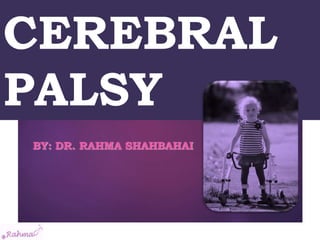
CEREBRAL
PALSY
BY: DR. RAHMA SHAHBAHAI
William John Little (1810-1894
 In 1860s, known as
"Cerebral Paralysis” or
“Little’s Disease”
 After an English surgeon
wrote the 1st medical
descriptions
Introduction
 Cerebral“- Latin Cerebrum;
Affected part of brain
 “Palsy " -Gr. para- beyond,
lysis – loosening
Lack of muscle control
Introduction
A motor function disorder
 caused by permanent, non-progressive brain lesion
 present at birth or shortly thereafter. (Mosby, 2006)
 Non-curable, life-long condition
 Damage doesn’t worsen
 May be congenital or acquired
Definition
A Heterogeneous Group
of Movement Disorders
–An umbrella term
–Not a single diagnosis
Muscle Strength
Movements
Balance
Coordination
Posture
CP affects
In CP
 Muscles are unaffected
 Brain is unable to send the
appropriate signals
necessary to instruct muscles
when to contract and relax
CAUSES
OF CEREBRAL PALSY
An insult or injury to the brain
–Fixed, static lesion(s)
–In single or multiple
areas of the motor
centers of the brain
–Early in CNS dev’t
CAUSES
Development Malformations
 The brain fails to develop correctly.
Neurological damage
 Can occur before, during or after delivery
 Rh incompatibility, illness, severe lack of oxygen
* Unknown in many instances
CHIEF CAUSE
Severe deprivation of oxygen or
blood flow to the brain
–Hypoxic-ischemic
encephalopathy
or intrapartum
asphyxia
CHIEF CAUSE
RISK FACTORS
Prenatal factors
 Before birth
 Maternal characteristics
Perinatal factors
 at the time of birth to 1mo
Postnatal factors
 In the first 5 mos of life
Prenatal factors
 Hemorrhage/bleeding
 Abruptio placenta
 Infections
 Rubella, cytomegalovirus,
toxoplasmosis,
 Environmental factors
 Maternal Characteristics
Maternal Characteristics
 Age
 Difficulty in conceiving or
holding a baby to term
 Multiple births
 History of fetal
deaths/miscarriages
 Cigarette smoking >30 sticks per day
 Alcoholism and drug addiction
 Mother’s medical condition
Perinatal Factors
 High or low BP
 Umbilical cord coil
 Breech delivery
 Over sedation of drugs
 Trauma i.e. forceps or vacuum
delivery
 Complications of birth
Postnatal Causes
Trauma, head injury
Infections
Lack of oxygen
Stroke in the young
Tumor, cyst
Before
Birth
75%
During
Birth,
5-15%
After
Birth,
10-20%
*Several causes are preventable or treatable
CP Cases
TYPES
OF CEREBRAL PALSY
Classification of CP
According to:
1. Neurologic deficits
2. Type of movement
involved
3. Area of affected
limbs
1. Accdg. to Neurologic Deficits
Based on the
- extent of the damage
- area of brain damage
 Each type involves the way a person
moves
3 MAIN TYPES
1. PYRAMIDAL
- originates from the motor
areas of the cerebral cortex
2. EXTAPYRAMIDAL
- basal ganglia and
cerebellum
3. MIXED
2. Accdg. to Type of Movement
Photo from: Saunders, Elsvier.
4 MAIN TYPES
PYRAMIDAL 1. Spastic CP
EXTAPYRAMIDAL 2. Athetoid CP
3. Ataxic CP
MIXED 4. Spastic &
Athetoid CP
Spastic CP
 Increased muscle tone,
tense and contracted muscles
 Have stiff and jerky or
awkward movements.
 limbs are usually underdeveloped
 increased deep tendon reflexes
 most common form
 70-80% of all affected
Types of Spastic CP
According to affected limbs:
* plegia or paresis - meaning paralyzed or weak:
 Paraplegia
 Diplegia
 Hemiplegia
 Quadriplegia
 Monoplegia –one limb (extremely rare)
 Triplegia –three limbs (extremely rare)
Diplegia/ Paraplegia Hemiplegia Quadriplegia

Athetoid/ Dyskinetic CP
 involves abnormal involuntary movements
 that disappear during sleep and increase with stress.
 Athetoid-Wormlike movements
 Slow, uncontrolled motion, twisting in character, in the face, extremities, and
torso.
 Dyskinesia -Dyskinetic movement of mouth
 drooling and dysarthria.
 Dystonia - when held as a prolonged posture
 20% of the CP cases,
Ataxic CP
 Poor balance and lack of coordination
 Wide-based gait
 Depth perception usually affected.
 Tendency to fall and stumble
 Inability to walk straight line.
 Least common 5-10% of cases
MIXED CP
 A common combination is
spastic and athetoid
 Spastic muscle tone and involuntary movements.
 25% of CP cases, fairly common
Signs and
Symptoms
OF CEREBRAL PALSY
a.
b.
c.
d.
e.
f.
g.
h.
Early Signs
• Stiff or floppy posture
• Weak suck/ tongue thrust/
tonic bite/ feeding difficulties
• Poor head control
• Excessive lethargy or
irritability/ High pitched cry
Infancy (0-3 Months)
CHILD with CP
Behavioral Symptoms
Poor ability to
concentrate ,
unusual tenseness,
 Irritability
ASSOCIATED
PROBLEMS
OF CEREBRAL PALSY
 Hearing and visual problems
 Sensory integration problems
 Failure-to-thrive, Feeding
problems
 Behavioral/emotional
difficulties,
 Communication disorders
• Bladder and bowel control
problems, digestive
problems
gastroesophageal reflux
• Skeletal deformities, dental
problems
• Mental retardation and
learning disabilities
• Seizures
Diagnosis
OF CEREBRAL PALSY
1. SUBJECTIVE
-HISTORY
2. OBJECTIVE
- PHYSICAL EXAMINATION
CRITERIA
P osturing / Poor muscle control and strength
O ropharyngeal problems
S trabismus/ Squint
T onia: hyper- hypo
E volutional maldevelopment
R eflexes e.g Increased deep tendon
*Abnormalities 4/6 strongly point to CP
DIAGNOSIS
Laboratory studies
 clinical diagnosis.
 There are no definitive laboratory studies
To rule out other causes:
 Thyroid function studies: Abnormal thyroid function may be
related to abnormalities in muscle tone or deep tendon reflexes
or to movement disorders
 Lactate and pyruvate levels: Abnormalities may indicate an
abnormality of energy metabolism (ie, mitochondrial cytopathy)
 Ammonia levels: Elevated ammonia levels may indicate liver
dysfunction or urea cycle defect
 Organic and amino acids: may reveal inherited metabolic
disorders
 Chromosomal analysis: if dysmorphic features or abnormalities
 Cerebrospinal protein: levels may assist in determining asphyxia in
the neonatal period
Imaging studies
 Cranial ultrasonography: evidence of
hemorrhage or hypoxic-ischemic injury
 CT of brain: congenital malformations,
intracranial hemorrhage, and periventricular
leukomalacia or early craniosynostosis.
 MRI of the brain: The diagnostic neuroimaging
study of choice
 defines cortical and white matter structures and
abnormalities more clearly than does any other
method
 determination of whether appropriate myelination is
present for a given age
Others:
 Electroencephalography: Important in the diagnosis
of seizure disorders
 Electromyography and nerve conduction studies:
Helpful when a muscle or nerve disorder is
suspected
Treatment
OF CEREBRAL PALSY
- No treatment to cure cerebral palsy.
- Brain damage cannot be corrected.
Crucial for children with CP:
Early Identification;
Multidisciplinary Care; and
Support
“The earlier we start,
the more improvement can be made”
-Health worker
I. NONPHYSICAL THERAPY
A. General management
- Proper nutrition and personal care
B. Pharmacologic
 Botulinum toxin : for children with cerebral palsy with spasticity
 antiparkinsonian drugs (eg, anticholinergic and dopaminergic drugs)
 antispasticity agents (eg, baclofen) have primarily been used in the
management of dystonia, anticonvulsants,
 antidopaminergic drugs, and antidepressants have also been tried
C. Surgery
-Intrathecal baclofen pump
insertion: To treat spasticity and/or
dystonia
-Selective dorsal rhizotomy: To treat
velocity-dependent spasticity
- Orthopedic surgical intervention: To
treat scoliosis, joint contractures or
dislocation
Selective posterior Rhizotomy
In some cases nerves need to be severed to decrease muscle
tension of inappropriate contractions.
D. Physical Aids
 Orthosis, braces and splints
 Positioning devices
 Walkers, special scooters, wheelchairs
E. Special Education
F. Rehabilitation Services- Speech and
occupational therapies
G. Family Services -Professional support
H. Other Treatment
- Therapeutic electrical stimulation,
- Acupuncture,
- Hyperbaric therapy
- Massage Therapymight help
'The ultimate long-term goal is realistic independence.
To get there we have to have some short-term goals.
Those being a working communication system, education to his potential,
computer skills and, above all, friends'.
- Parent of boy with CP
II. PHYSICAL THERAPY
A. Sitting
-Vertical head control and
control of head and trunk .
B. Standing and walking
-Establish an equal distribution of
weight on each foot, train to
use steps or inclines
C. Prone Development
D. Supine Development
Head control on supine and positions
Thank you for lessening.
References

An overview of cerebral palsy = الشلل الدماغي

  • 1.
  • 2.
    William John Little(1810-1894  In 1860s, known as "Cerebral Paralysis” or “Little’s Disease”  After an English surgeon wrote the 1st medical descriptions Introduction
  • 3.
     Cerebral“- LatinCerebrum; Affected part of brain  “Palsy " -Gr. para- beyond, lysis – loosening Lack of muscle control Introduction
  • 4.
    A motor functiondisorder  caused by permanent, non-progressive brain lesion  present at birth or shortly thereafter. (Mosby, 2006)  Non-curable, life-long condition  Damage doesn’t worsen  May be congenital or acquired Definition
  • 5.
    A Heterogeneous Group ofMovement Disorders –An umbrella term –Not a single diagnosis
  • 6.
  • 7.
    In CP  Musclesare unaffected  Brain is unable to send the appropriate signals necessary to instruct muscles when to contract and relax
  • 8.
  • 9.
    An insult orinjury to the brain –Fixed, static lesion(s) –In single or multiple areas of the motor centers of the brain –Early in CNS dev’t
  • 10.
    CAUSES Development Malformations  Thebrain fails to develop correctly. Neurological damage  Can occur before, during or after delivery  Rh incompatibility, illness, severe lack of oxygen * Unknown in many instances
  • 11.
    CHIEF CAUSE Severe deprivationof oxygen or blood flow to the brain –Hypoxic-ischemic encephalopathy or intrapartum asphyxia CHIEF CAUSE
  • 12.
    RISK FACTORS Prenatal factors Before birth  Maternal characteristics Perinatal factors  at the time of birth to 1mo Postnatal factors  In the first 5 mos of life
  • 13.
    Prenatal factors  Hemorrhage/bleeding Abruptio placenta  Infections  Rubella, cytomegalovirus, toxoplasmosis,  Environmental factors  Maternal Characteristics
  • 14.
    Maternal Characteristics  Age Difficulty in conceiving or holding a baby to term  Multiple births  History of fetal deaths/miscarriages  Cigarette smoking >30 sticks per day  Alcoholism and drug addiction  Mother’s medical condition
  • 15.
    Perinatal Factors  Highor low BP  Umbilical cord coil  Breech delivery  Over sedation of drugs  Trauma i.e. forceps or vacuum delivery  Complications of birth
  • 16.
    Postnatal Causes Trauma, headinjury Infections Lack of oxygen Stroke in the young Tumor, cyst
  • 17.
  • 18.
  • 19.
    Classification of CP Accordingto: 1. Neurologic deficits 2. Type of movement involved 3. Area of affected limbs
  • 20.
    1. Accdg. toNeurologic Deficits Based on the - extent of the damage - area of brain damage  Each type involves the way a person moves
  • 21.
    3 MAIN TYPES 1.PYRAMIDAL - originates from the motor areas of the cerebral cortex 2. EXTAPYRAMIDAL - basal ganglia and cerebellum 3. MIXED
  • 22.
    2. Accdg. toType of Movement Photo from: Saunders, Elsvier.
  • 23.
    4 MAIN TYPES PYRAMIDAL1. Spastic CP EXTAPYRAMIDAL 2. Athetoid CP 3. Ataxic CP MIXED 4. Spastic & Athetoid CP
  • 25.
    Spastic CP  Increasedmuscle tone, tense and contracted muscles  Have stiff and jerky or awkward movements.  limbs are usually underdeveloped  increased deep tendon reflexes  most common form  70-80% of all affected
  • 26.
    Types of SpasticCP According to affected limbs: * plegia or paresis - meaning paralyzed or weak:  Paraplegia  Diplegia  Hemiplegia  Quadriplegia  Monoplegia –one limb (extremely rare)  Triplegia –three limbs (extremely rare)
  • 27.
  • 28.
    Athetoid/ Dyskinetic CP involves abnormal involuntary movements  that disappear during sleep and increase with stress.  Athetoid-Wormlike movements  Slow, uncontrolled motion, twisting in character, in the face, extremities, and torso.  Dyskinesia -Dyskinetic movement of mouth  drooling and dysarthria.  Dystonia - when held as a prolonged posture  20% of the CP cases,
  • 29.
    Ataxic CP  Poorbalance and lack of coordination  Wide-based gait  Depth perception usually affected.  Tendency to fall and stumble  Inability to walk straight line.  Least common 5-10% of cases
  • 30.
    MIXED CP  Acommon combination is spastic and athetoid  Spastic muscle tone and involuntary movements.  25% of CP cases, fairly common
  • 32.
  • 33.
  • 34.
    Early Signs • Stiffor floppy posture • Weak suck/ tongue thrust/ tonic bite/ feeding difficulties • Poor head control • Excessive lethargy or irritability/ High pitched cry Infancy (0-3 Months)
  • 35.
  • 36.
    Behavioral Symptoms Poor abilityto concentrate , unusual tenseness,  Irritability
  • 37.
  • 38.
     Hearing andvisual problems  Sensory integration problems  Failure-to-thrive, Feeding problems  Behavioral/emotional difficulties,  Communication disorders • Bladder and bowel control problems, digestive problems gastroesophageal reflux • Skeletal deformities, dental problems • Mental retardation and learning disabilities • Seizures
  • 39.
  • 40.
  • 41.
  • 42.
    CRITERIA P osturing /Poor muscle control and strength O ropharyngeal problems S trabismus/ Squint T onia: hyper- hypo E volutional maldevelopment R eflexes e.g Increased deep tendon *Abnormalities 4/6 strongly point to CP
  • 43.
    DIAGNOSIS Laboratory studies  clinicaldiagnosis.  There are no definitive laboratory studies
  • 44.
    To rule outother causes:  Thyroid function studies: Abnormal thyroid function may be related to abnormalities in muscle tone or deep tendon reflexes or to movement disorders  Lactate and pyruvate levels: Abnormalities may indicate an abnormality of energy metabolism (ie, mitochondrial cytopathy)  Ammonia levels: Elevated ammonia levels may indicate liver dysfunction or urea cycle defect  Organic and amino acids: may reveal inherited metabolic disorders  Chromosomal analysis: if dysmorphic features or abnormalities  Cerebrospinal protein: levels may assist in determining asphyxia in the neonatal period
  • 45.
    Imaging studies  Cranialultrasonography: evidence of hemorrhage or hypoxic-ischemic injury  CT of brain: congenital malformations, intracranial hemorrhage, and periventricular leukomalacia or early craniosynostosis.  MRI of the brain: The diagnostic neuroimaging study of choice  defines cortical and white matter structures and abnormalities more clearly than does any other method  determination of whether appropriate myelination is present for a given age
  • 46.
    Others:  Electroencephalography: Importantin the diagnosis of seizure disorders  Electromyography and nerve conduction studies: Helpful when a muscle or nerve disorder is suspected
  • 47.
  • 48.
    - No treatmentto cure cerebral palsy. - Brain damage cannot be corrected. Crucial for children with CP: Early Identification; Multidisciplinary Care; and Support
  • 49.
    “The earlier westart, the more improvement can be made” -Health worker I. NONPHYSICAL THERAPY
  • 50.
    A. General management -Proper nutrition and personal care B. Pharmacologic  Botulinum toxin : for children with cerebral palsy with spasticity  antiparkinsonian drugs (eg, anticholinergic and dopaminergic drugs)  antispasticity agents (eg, baclofen) have primarily been used in the management of dystonia, anticonvulsants,  antidopaminergic drugs, and antidepressants have also been tried
  • 51.
    C. Surgery -Intrathecal baclofenpump insertion: To treat spasticity and/or dystonia -Selective dorsal rhizotomy: To treat velocity-dependent spasticity - Orthopedic surgical intervention: To treat scoliosis, joint contractures or dislocation
  • 52.
    Selective posterior Rhizotomy Insome cases nerves need to be severed to decrease muscle tension of inappropriate contractions.
  • 53.
    D. Physical Aids Orthosis, braces and splints  Positioning devices  Walkers, special scooters, wheelchairs E. Special Education F. Rehabilitation Services- Speech and occupational therapies G. Family Services -Professional support
  • 54.
    H. Other Treatment -Therapeutic electrical stimulation, - Acupuncture, - Hyperbaric therapy - Massage Therapymight help
  • 55.
    'The ultimate long-termgoal is realistic independence. To get there we have to have some short-term goals. Those being a working communication system, education to his potential, computer skills and, above all, friends'. - Parent of boy with CP II. PHYSICAL THERAPY
  • 56.
    A. Sitting -Vertical headcontrol and control of head and trunk . B. Standing and walking -Establish an equal distribution of weight on each foot, train to use steps or inclines
  • 57.
    C. Prone Development D.Supine Development Head control on supine and positions
  • 58.
    Thank you forlessening.
  • 59.