TABES DORSALIS
Muthuukaruppan M.
Introduction:
 Slow degeneration (demyelination) of the
sensory neurons in the dorsal columns of SC.
 Tabes dorsalis is caused by demyelination
secondary to an untreated syphilis infection.
 Syphilitic myelopathy is a complication of
untreated syphilis that involves muscle
weakness and abnormal sensations.
The disease is more frequent in males
than in females.
Onset is commonly during mid-life.
The incidence of tabes dorsalis is rising, in
part due to co-associated HIV infection.
Epidemiology:
Clinical Features:
Weakness
Diminished reflexes
Paresthesias (shooting and burning pains,
pricking sensations)
Hypoesthesias (abnormally diminished
cutaneous, especially tactile)
Progressive degeneration of the joints
Loss of coordination
Personality changes
Urinary incontinence
Dementia
Visual impairment
PositiveRomberg's test
Impaired response to light (Argyll
Robertson pupil).
Muscles are hypotonic due to destruction
of the sensory limb of the spindle reflex.
DTR are diminished or absent
"Tabes dorsalgia" related back pain.
"Tabetic gait" is a characteristic high-
stepping gait - Tabetic Ataxia
Deafness
Investigations:
CSF (cerebrospinal fluid) examination
CT or MRI of the brain and spinal cord to
rule out other diseases
Serum VDRL or serum RPR
Medical Treatment:
Antibiotics
Analgesics for pain
Preventive treatment for those who
come into sexual contact with an
individual with syphilis is important.
Problem List:
Impaired sensation
Weakness
Hypotonicity
Impaired coordination
Impaired gait
Impaired balance
Goals for Physiotherapy:
1. Educate about sensory loss and educate
on precautions to be taken
2. Strengthening of muscles
3. Improve balance
4. Improve mobility
5. Improve coordination
Physiotherapy Management:
1. Strengthening of muscles.
2. Use of assistive aids to improve mobility
3. Balance retraining
4. Frenkel’s Exercise
●Developed by Dr.H.S.Frenkel
●Tabes dorsalis
●Other conditions, all ataxias, PD, MS
etc
●Aimed at establishing the voluntary
control of movement by the use of any
part of sensory mechanism which
remains intact, notably sight, sound,
touch, to compensate for the loss of
kineasthetic sensation
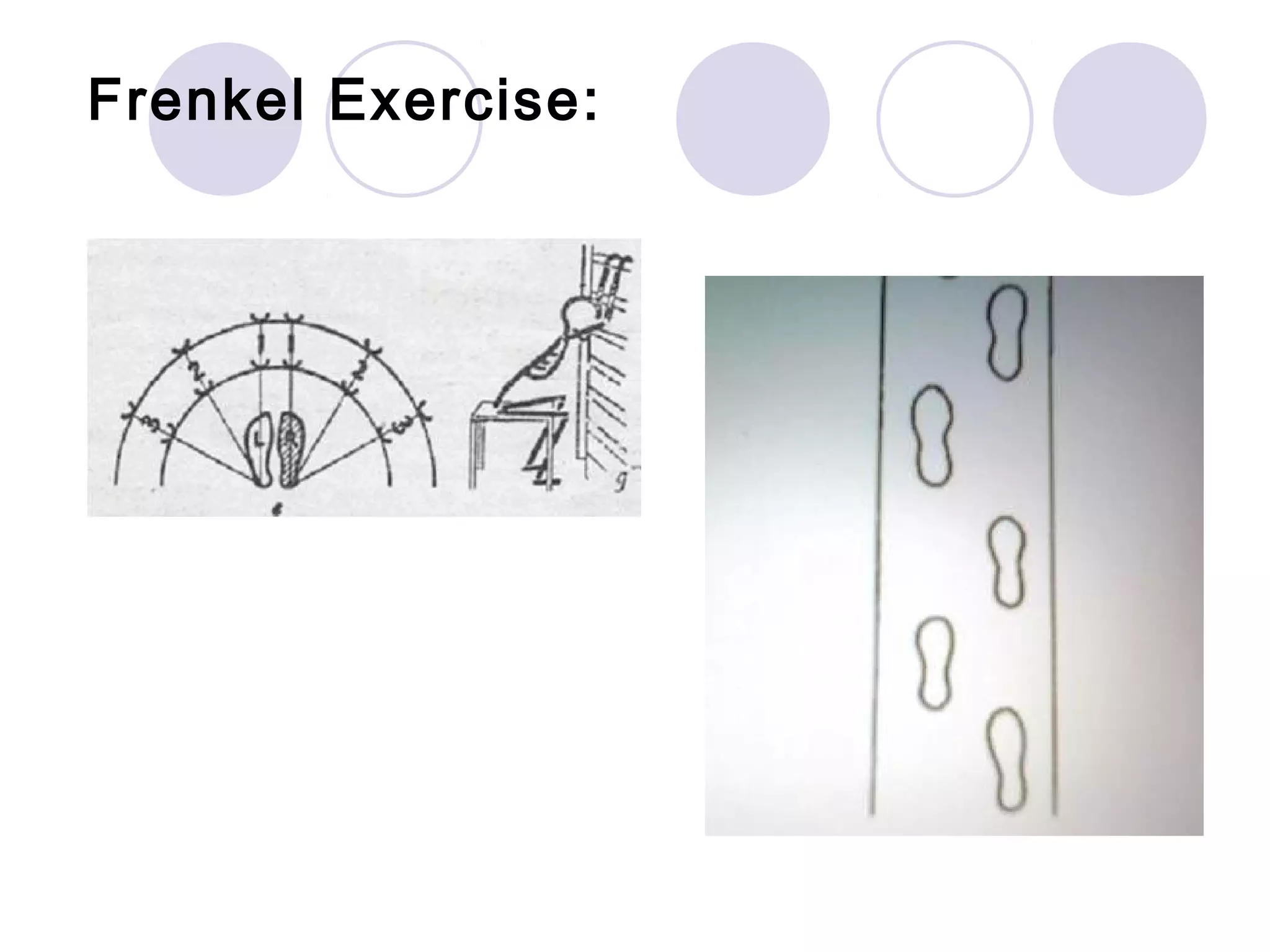
Frenkel Exercise:
●The essentials of Frenkel exercise being:
● Concentration of Attention
● Precision
● Repetition
●The ultimate aim is to establish the control of
movement so that patient is able and confident
in his ability to carry out these activities which
are essential for independence in every day
life.
Frenkel Exercise:
1. The patient is positioned and suitably clothed so that
he can see the limbs throughout.
2. A concise explanation and demonstration of exercise
is given before movement is attempted, to give
patient a clear mental picture of it.
3. The patient must give his full attention to the
performance of exercise to make movement smooth
and accurate.
4. The speed of movement is dictated by
physiotherapist by means of rhythmic counting,
movement of her hand or the use of suitable music.
Frenkel Exercise:
5. The range of movement is indicated by making the
spot on which the foot and hand is to be placed.
6. The exercise is repeated many times until it is
perfect and easy. It is then discarded and a more
difficult one is substituted.
7. All these exercises are very tiring at first, frequent
rest periods must be allowed. The patient retains
little of no ability to recognize fatigue, but it is
usually indicated by a deterioration in the quality
of movement, or by a rise in pulse rate.
Frenkel Exercise:
Frenkel Exercise:
THANK YOU

Tabes Dorsalis and Physiotherapy

  • 1.
  • 2.
    Introduction:  Slow degeneration(demyelination) of the sensory neurons in the dorsal columns of SC.  Tabes dorsalis is caused by demyelination secondary to an untreated syphilis infection.  Syphilitic myelopathy is a complication of untreated syphilis that involves muscle weakness and abnormal sensations.
  • 3.
    The disease ismore frequent in males than in females. Onset is commonly during mid-life. The incidence of tabes dorsalis is rising, in part due to co-associated HIV infection. Epidemiology:
  • 4.
    Clinical Features: Weakness Diminished reflexes Paresthesias(shooting and burning pains, pricking sensations) Hypoesthesias (abnormally diminished cutaneous, especially tactile) Progressive degeneration of the joints Loss of coordination Personality changes Urinary incontinence Dementia
  • 5.
    Visual impairment PositiveRomberg's test Impairedresponse to light (Argyll Robertson pupil). Muscles are hypotonic due to destruction of the sensory limb of the spindle reflex. DTR are diminished or absent "Tabes dorsalgia" related back pain. "Tabetic gait" is a characteristic high- stepping gait - Tabetic Ataxia Deafness
  • 6.
    Investigations: CSF (cerebrospinal fluid)examination CT or MRI of the brain and spinal cord to rule out other diseases Serum VDRL or serum RPR
  • 7.
    Medical Treatment: Antibiotics Analgesics forpain Preventive treatment for those who come into sexual contact with an individual with syphilis is important.
  • 8.
    Problem List: Impaired sensation Weakness Hypotonicity Impairedcoordination Impaired gait Impaired balance
  • 9.
    Goals for Physiotherapy: 1.Educate about sensory loss and educate on precautions to be taken 2. Strengthening of muscles 3. Improve balance 4. Improve mobility 5. Improve coordination
  • 10.
    Physiotherapy Management: 1. Strengtheningof muscles. 2. Use of assistive aids to improve mobility 3. Balance retraining 4. Frenkel’s Exercise
  • 11.
    ●Developed by Dr.H.S.Frenkel ●Tabesdorsalis ●Other conditions, all ataxias, PD, MS etc ●Aimed at establishing the voluntary control of movement by the use of any part of sensory mechanism which remains intact, notably sight, sound, touch, to compensate for the loss of kineasthetic sensation Frenkel Exercise:
  • 12.
    ●The essentials ofFrenkel exercise being: ● Concentration of Attention ● Precision ● Repetition ●The ultimate aim is to establish the control of movement so that patient is able and confident in his ability to carry out these activities which are essential for independence in every day life. Frenkel Exercise:
  • 13.
    1. The patientis positioned and suitably clothed so that he can see the limbs throughout. 2. A concise explanation and demonstration of exercise is given before movement is attempted, to give patient a clear mental picture of it. 3. The patient must give his full attention to the performance of exercise to make movement smooth and accurate. 4. The speed of movement is dictated by physiotherapist by means of rhythmic counting, movement of her hand or the use of suitable music. Frenkel Exercise:
  • 14.
    5. The rangeof movement is indicated by making the spot on which the foot and hand is to be placed. 6. The exercise is repeated many times until it is perfect and easy. It is then discarded and a more difficult one is substituted. 7. All these exercises are very tiring at first, frequent rest periods must be allowed. The patient retains little of no ability to recognize fatigue, but it is usually indicated by a deterioration in the quality of movement, or by a rise in pulse rate. Frenkel Exercise:
  • 16.
  • 17.