TOPIC:- CEREBRAL PALSY(CP)
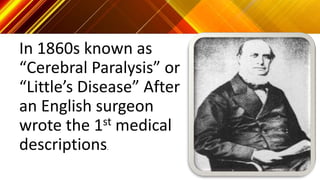
In 1860s known as
“Cerebral Paralysis” or
“Little’s Disease” After
an English surgeon
wrote the 1st medical
descriptions.
Definition Of CP
• Cerebral Palsy(CP) is a group of permanent disorder of
the development of movement and posture, causing
activity limitation.
(Hockenberry and Wilson)
• Cerebral Palsy(CP) is a motor disorder, the condition
involves disturbances of sensation, perception,
communication, cognition and behaviour, secondary
musculoskeletal problems and epilepsy.
(Hockenberry and Wilson)
• CP is term used for a group of non progressive
disorder of movement and posture caused by
abnormal development of damage to motor control
centres of the brain.
(medicaldictionary.com)
• CP is a disorder of the movement, muscle tone,
posture that is caused by an insult to the immature,
developing brain, most often before birth.
(myoclinic.com)
EPIDEMIOLOGY
• The incidence of CP is about 2 per 1000 live births.
• The incidence is higher in males than in females.
• CP incidence is higher in premature and twin birth.
• Due to the increased survival of very low birth
weight preemies, the incidence of spastic diplegia
has increased.
• The overall prevalence of CP has remained stable
since the 1960’s.
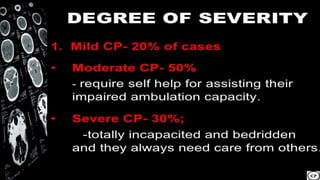
Degree Of Severity Of CP
CLASSIFICATION OF CP
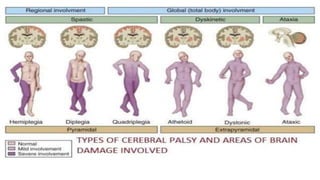
Based On Motor:-
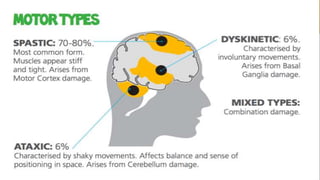
Spastic:-
Increased muscle tone, tense and contracted
muscles. Have stiff and jerky movements, limbs are
usually underdeveloped and also increased deep
tendon reflexes. It is the most common type of CP.
Seen in 70-80% of cases.
Dyskinetic/Athetoit :-
Characterised by slow wormlike,
writhing movements that usually involve the
extremities of trunck, neck, facial muscle and tongue.
Involvement of the pharyngeal and oral muscle
causing drooling and dysarthria. It arises from Basal
ganglia damage.
Ataxic:-
Rapid, repetitive movement performed poorly.
Disintegration of movements of the upper
extremities when the child reaches for objects.
Characterised by shaky movements. Affects balance
and sense of positioning in space. It arises from
cerebellum damage.
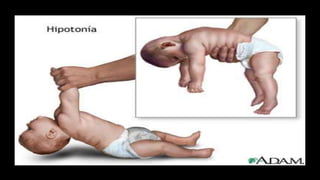
Hypotonic:-
Hypotonic CP have musculature that is limp
and can move only a little or not at all(Floppy child).
The location of damage is wide spread in the CNS.
Although physical therapy is usually attempted to
strengthen muscles it is not always fundamentally
effective.
Mixed CP:-
A common type of combination is spastic and
athetoid. Spastic muscle tone and involuntary
movement. Seen in 10-15% of cases.
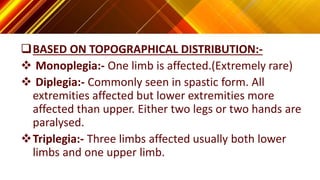
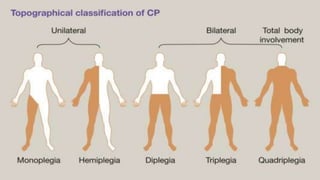
BASED ON TOPOGRAPHICAL DISTRIBUTION:-
 Monoplegia:- One limb is affected.(Extremely rare)
 Diplegia:- Commonly seen in spastic form. All
extremities affected but lower extremities more
affected than upper. Either two legs or two hands are
paralysed.
Triplegia:- Three limbs affected usually both lower
limbs and one upper limb.
 Tetraplegia/Quadriplegia:- All four limbs more or
less equally affected. Least likely to be able to work.
 Hemiplegia:- Motor dysfunction on one side of the
body, upper extremities more affected than lower.
 Paraplegia:- Two limbs are affected ,only two legs
are paralysed(no other body parts are affected).
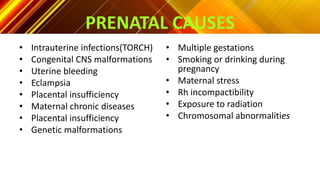
PRENATAL CAUSES
• Intrauterine infections(TORCH)
• Congenital CNS malformations
• Uterine bleeding
• Eclampsia
• Placental insufficiency
• Maternal chronic diseases
• Placental insufficiency
• Genetic malformations
• Multiple gestations
• Smoking or drinking during
pregnancy
• Maternal stress
• Rh incompactibility
• Exposure to radiation
• Chromosomal abnormalities
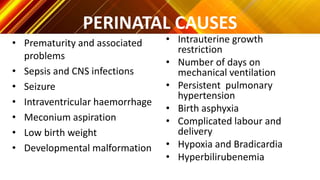
PERINATAL CAUSES
• Prematurity and associated
problems
• Sepsis and CNS infections
• Seizure
• Intraventricular haemorrhage
• Meconium aspiration
• Low birth weight
• Developmental malformation
• Intrauterine growth
restriction
• Number of days on
mechanical ventilation
• Persistent pulmonary
hypertension
• Birth asphyxia
• Complicated labour and
delivery
• Hypoxia and Bradicardia
• Hyperbilirubenemia
POSTNATAL CAUSES
• Traumatic brain injury
• Meningitis or
encephalitis
• CNS Infections
• Strokes
• Brain injuries
• Cardio-pulmonary
arrest
• Hydrocephalus
• Symptomatic
hypoglycaemia
• Cerebro-vascular
accidents
Characteristics Of CP
 Delayed developmental milestones.
 Posture and balance problem.
 Loss of control or co-ordination.
 Persistent motor delay.
 Cognitive deficit.
 Lack of control of facial muscles.
 Weakened muscle i.e. muscles move with shakes and jerks.
 Impairment of sight, hearing and speech.
 Involuntary movement.
 Disturbance in gait or mobility.
 Exaggerated drooling.
 Low fine motor skills.
 Lack of sucking reflexes.
 Diminished tongue control.
 Inability to sit upright comfortably.
 Low muscle tone.
 Abnormal sensation and perception.
 Muscle tightness or spasms.
 Moro’s reflex, Landau reflex, placing reflex, tonic neck reflex.
 Seizures.
DIAGNOSIS/ASSESSMENT
• Case history.(Family history, medical history)
• Ultrasound:- uses sound waves to detect certain type
of structural and anatomical abnormalities.
• MRI and CT scan.
• EEG if seizure or epilepsy is present.
• Assessment tools that is Peabody Development Motor
Skills, Denver Test II, Bayley scale.
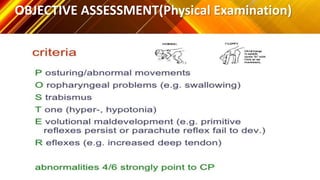
OBJECTIVE ASSESSMENT(Physical Examination)
Treatment
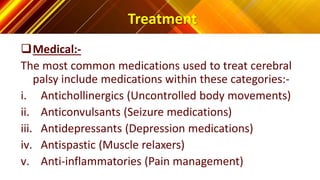
Medical:-
The most common medications used to treat cerebral
palsy include medications within these categories:-
i. Antichollinergics (Uncontrolled body movements)
ii. Anticonvulsants (Seizure medications)
iii. Antidepressants (Depression medications)
iv. Antispastic (Muscle relaxers)
v. Anti-inflammatories (Pain management)
Surgical:-
• To loosen joints.
• Relieve muscle tightness.
• Straightening of different twists or unusual
curvatures of leg muscles.
• Improve the ability to sit, stand and walk.
Rehabilitative:-
The therapy treatment include:-
1.Physical Therapy:-
Physical therapy is directed toward good
skeletal alignment for child with spasticity, training,
face involuntary motion and gait training. Physical
therapy can help the child’s strength, flexibility,
balance, motor development and mobility.
2.Occupational Therapy:-
Using alternative strategies and adaptive
equipment, occupational therapists work to promote
the child’s independent participation in daily
activities and routines in the home, school and
community. Adaptive equipment may include
walkers, quadrupedal canes, seating system or
electric wheelchairs.
4. Speech and language Therapy:-
Speech language pathologists can help
improve the child’s ability to speak clearly or to
communicate using sign language.
5. Recreation Therapy:-
This therapy can help improve your child’s
motor skills, speech and emotional well-being.
Cerebral Palsy presentation

Cerebral Palsy presentation

  • 1.
  • 2.
    In 1860s knownas “Cerebral Paralysis” or “Little’s Disease” After an English surgeon wrote the 1st medical descriptions.
  • 3.
    Definition Of CP •Cerebral Palsy(CP) is a group of permanent disorder of the development of movement and posture, causing activity limitation. (Hockenberry and Wilson) • Cerebral Palsy(CP) is a motor disorder, the condition involves disturbances of sensation, perception, communication, cognition and behaviour, secondary musculoskeletal problems and epilepsy. (Hockenberry and Wilson)
  • 4.
    • CP isterm used for a group of non progressive disorder of movement and posture caused by abnormal development of damage to motor control centres of the brain. (medicaldictionary.com) • CP is a disorder of the movement, muscle tone, posture that is caused by an insult to the immature, developing brain, most often before birth. (myoclinic.com)
  • 5.
    EPIDEMIOLOGY • The incidenceof CP is about 2 per 1000 live births. • The incidence is higher in males than in females. • CP incidence is higher in premature and twin birth. • Due to the increased survival of very low birth weight preemies, the incidence of spastic diplegia has increased. • The overall prevalence of CP has remained stable since the 1960’s.
  • 6.
  • 7.
    CLASSIFICATION OF CP BasedOn Motor:- Spastic:- Increased muscle tone, tense and contracted muscles. Have stiff and jerky movements, limbs are usually underdeveloped and also increased deep tendon reflexes. It is the most common type of CP. Seen in 70-80% of cases.
  • 8.
    Dyskinetic/Athetoit :- Characterised byslow wormlike, writhing movements that usually involve the extremities of trunck, neck, facial muscle and tongue. Involvement of the pharyngeal and oral muscle causing drooling and dysarthria. It arises from Basal ganglia damage.
  • 9.
    Ataxic:- Rapid, repetitive movementperformed poorly. Disintegration of movements of the upper extremities when the child reaches for objects. Characterised by shaky movements. Affects balance and sense of positioning in space. It arises from cerebellum damage.
  • 10.
    Hypotonic:- Hypotonic CP havemusculature that is limp and can move only a little or not at all(Floppy child). The location of damage is wide spread in the CNS. Although physical therapy is usually attempted to strengthen muscles it is not always fundamentally effective.
  • 11.
    Mixed CP:- A commontype of combination is spastic and athetoid. Spastic muscle tone and involuntary movement. Seen in 10-15% of cases.
  • 14.
    BASED ON TOPOGRAPHICALDISTRIBUTION:-  Monoplegia:- One limb is affected.(Extremely rare)  Diplegia:- Commonly seen in spastic form. All extremities affected but lower extremities more affected than upper. Either two legs or two hands are paralysed. Triplegia:- Three limbs affected usually both lower limbs and one upper limb.
  • 15.
     Tetraplegia/Quadriplegia:- Allfour limbs more or less equally affected. Least likely to be able to work.  Hemiplegia:- Motor dysfunction on one side of the body, upper extremities more affected than lower.  Paraplegia:- Two limbs are affected ,only two legs are paralysed(no other body parts are affected).
  • 18.
    PRENATAL CAUSES • Intrauterineinfections(TORCH) • Congenital CNS malformations • Uterine bleeding • Eclampsia • Placental insufficiency • Maternal chronic diseases • Placental insufficiency • Genetic malformations • Multiple gestations • Smoking or drinking during pregnancy • Maternal stress • Rh incompactibility • Exposure to radiation • Chromosomal abnormalities
  • 19.
    PERINATAL CAUSES • Prematurityand associated problems • Sepsis and CNS infections • Seizure • Intraventricular haemorrhage • Meconium aspiration • Low birth weight • Developmental malformation • Intrauterine growth restriction • Number of days on mechanical ventilation • Persistent pulmonary hypertension • Birth asphyxia • Complicated labour and delivery • Hypoxia and Bradicardia • Hyperbilirubenemia
  • 20.
    POSTNATAL CAUSES • Traumaticbrain injury • Meningitis or encephalitis • CNS Infections • Strokes • Brain injuries • Cardio-pulmonary arrest • Hydrocephalus • Symptomatic hypoglycaemia • Cerebro-vascular accidents
  • 21.
    Characteristics Of CP Delayed developmental milestones.  Posture and balance problem.  Loss of control or co-ordination.  Persistent motor delay.  Cognitive deficit.  Lack of control of facial muscles.  Weakened muscle i.e. muscles move with shakes and jerks.  Impairment of sight, hearing and speech.  Involuntary movement.  Disturbance in gait or mobility.
  • 22.
     Exaggerated drooling. Low fine motor skills.  Lack of sucking reflexes.  Diminished tongue control.  Inability to sit upright comfortably.  Low muscle tone.  Abnormal sensation and perception.  Muscle tightness or spasms.  Moro’s reflex, Landau reflex, placing reflex, tonic neck reflex.  Seizures.
  • 23.
    DIAGNOSIS/ASSESSMENT • Case history.(Familyhistory, medical history) • Ultrasound:- uses sound waves to detect certain type of structural and anatomical abnormalities. • MRI and CT scan. • EEG if seizure or epilepsy is present. • Assessment tools that is Peabody Development Motor Skills, Denver Test II, Bayley scale.
  • 24.
  • 25.
    Treatment Medical:- The most commonmedications used to treat cerebral palsy include medications within these categories:- i. Antichollinergics (Uncontrolled body movements) ii. Anticonvulsants (Seizure medications) iii. Antidepressants (Depression medications) iv. Antispastic (Muscle relaxers) v. Anti-inflammatories (Pain management)
  • 26.
    Surgical:- • To loosenjoints. • Relieve muscle tightness. • Straightening of different twists or unusual curvatures of leg muscles. • Improve the ability to sit, stand and walk.
  • 27.
    Rehabilitative:- The therapy treatmentinclude:- 1.Physical Therapy:- Physical therapy is directed toward good skeletal alignment for child with spasticity, training, face involuntary motion and gait training. Physical therapy can help the child’s strength, flexibility, balance, motor development and mobility.
  • 28.
    2.Occupational Therapy:- Using alternativestrategies and adaptive equipment, occupational therapists work to promote the child’s independent participation in daily activities and routines in the home, school and community. Adaptive equipment may include walkers, quadrupedal canes, seating system or electric wheelchairs.
  • 29.
    4. Speech andlanguage Therapy:- Speech language pathologists can help improve the child’s ability to speak clearly or to communicate using sign language. 5. Recreation Therapy:- This therapy can help improve your child’s motor skills, speech and emotional well-being.