

POLIOMYELITIS
INTRODUCTION
• It is an endemic and epidemic infectious viral disease,
mainly affecting children under the age of 5 years.
• The disease is transmitted by droplet infection and by
oral ingestion
• The period of incubation varies from 3 to 30 days
VIROLOGY
Three types:
• Type I: Brunchilde
• Type II: Lansing
• Type III: Leon
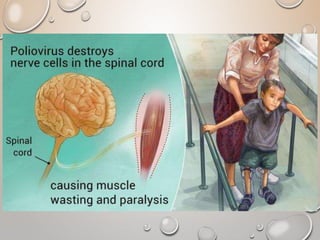
• Acute poliomyelitis is a disease of the anterior horn
motor neurons of the spinal cord and brain stem
caused by poliovirus.
• Symptoms following infection is due to the
destruction of anterior horn cells of spinal cord and
brain stem for which the virus has selective affinity
• The result is the flaccid paralysis without sensory
loss due to loss of motor neurons and denervation
of their associated skeletal muscles.
PATHOPHYSIOLOGY
• Route of entry into tonsillopharyngeal
lymphoid tissue
• Virus multiplies and disseminates throughout
the body
• The antibody, when present, inactivates the
virus while it is in circulation in blood
• This is the stage of minor illness
PATHOPHYSIOLOGY
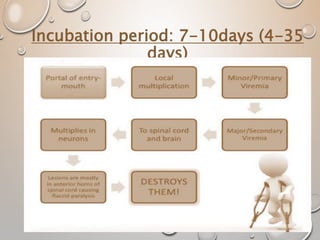
Incubation period: 7-10days (4-35
days)
PHASE OF DISEASE
• Incubation period
• Non-paralytic stage
• Paralytic phase
• During this phase, symptoms like sore throat, GI
upset and transient fever, these may go unnoticed
• Pain and tenderness in the spine, trunk and limbs
• During the phase of major illness, there is entry of
virus into neurons throughout the CNS giving rise
to inflammatory reaction of nervous tissue and
meninges, a classical manifestation of
poliomyelitis
• Degeneration of anterior horn cells with loss of
nissle granules and the nucleus, which complete
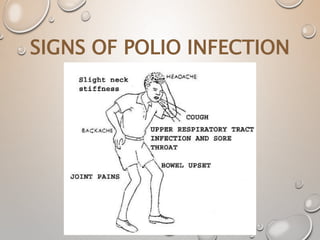
SIGNS OF POLIO INFECTION
• Localised pain
• Tenderness
• Awkward limb positioning due to acute muscle
spasm
• Lower extremities predominate
• Bulbar palsy
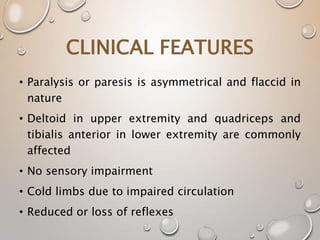
CLINICAL FEATURES
• Paralysis or paresis is asymmetrical and flaccid in
nature
• Deltoid in upper extremity and quadriceps and
tibialis anterior in lower extremity are commonly
affected
• No sensory impairment
• Cold limbs due to impaired circulation
• Reduced or loss of reflexes
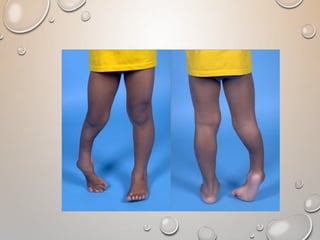
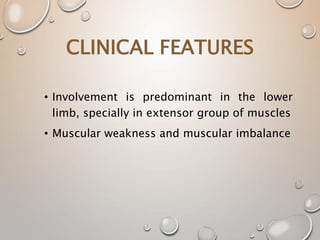
CLINICAL FEATURES
CLINICAL FEATURES
• Involvement is predominant in the lower
limb, specially in extensor group of muscles
• Muscular weakness and muscular imbalance
STAGES OF DISEASE
1. ACUTE PHASE
2. CONVALESCENT OR RECOVERY PHASE
3. CHRONIC OR RESIDUAL PHASE
ACUTE PHASE
• Child is restless and irritable due to pain and
muscular tenderness, with spasm in muscle
group.
• Joints of the affected limb may be painful
because of stretching of muscles that are in
spasm as result of neuronal irritation.
• General malaise, headache and bowel upsets
may be present with low-grade fever and sore
throat
• In rare case there may be involvement of brain
giving rise to polio-encephalitis
CONVALESCENT/RECOVERY
PHASE
• As soon as acute symptoms subside the phase
of recovery begins.
• Either spontaneous recovery of affected muscles
or various grades of paralysis may develop
CHRONIC/RESIDUAL PHASE
• No further neuronal recovery
• Pattern of paralysis is organized in affected
muscles.
• The degree of paralysis depends on extent of
neuronal damage and efficacy of
physiotherapeutic management during
convalescent phase
PHYSICAL
EXAMINATION/ASSESSMENT
• General observation of posture to detect the areas
of involvement
• A degree of consciousness, choking, squint,
spontaneous nystagmus, facial paralysis, difficulty
in moving or change in position, feeble cry or
cough, diminished respiratory excursion and
accumulation of secretion
• Inability to move on particular limb indicates
the involvement of that limb
• Spinal rigidity: neck and whole spine should
examined for rigidity
• Strength of intercostal, diaphragm and
abdominal muscles needs to be assessed
PHYSICAL
EXAMINATION/ASSESSMENT
• Muscle weakness is examined by MMT
• Elicitation of Deep Tendon Reflexes
• Sensory examination
• Degree of contracture and deformities
PHYSICAL
EXAMINATION/ASSESSMENT
DEFORMITIES
• Contracture, which gets organized into a
deformity, complicates the recovery in the
following ways:
It prevents the surviving motor units to participate
in process of recovery as they remain inactive
It cause disuse of active muscles and makes them
weak
It produce angulations, stiffness and even
displacement of the joints
The causative factors are:
• Muscle spasm
• Influence of gravity
• Muscular imbalance
DEFORMITIES
CAUSES OF DEFORMITY
• During acute phase of the disease, muscle
spasm of involved muscle groups results in
contracture which may lead to deformity
• Weight of limbs, habitual postures and
malpositioning compounded by the influence
of gravity and muscle weakness may also result
in deformity
• During subacute phase, the deformity results
from the muscular imbalance due to
asymmetrical paresis or paralysis of muscle
groups controlling a particular joints.
• If the deformity is not properly controlled at
this stage of the disease by appropriate
physiotherapeutic measure and appliances, it
deteriorates further, when the concerned joint
is exposed to stresses of weight bearing.
CAUSES OF DEFORMITY
MANAGEMENT OF
DEFORMITY
• Prescribing correct appliance,
checking its proper fit and educating
patient on its correct use, as well as
its maintenance is responsibility of a
treating physiotherapist at this
stage.
• During chronic phase, there is always a
tendency of discarding the appliances.
• This not only results in deterioration of
deformity but also causes secondary
complication by exposing joints to imbalanced
stresses
CAUSES OF DEFORMITY
• Prevention of deformity forms the basis of
treatment not only during all phase of disease
but even in later phases of life
MANAGEMENT OF
DEFORMITY
TREATMENT PROGRAMME
A. Acute phase [first 3-5 weeks]
B. Recovery phase [4-18 weeks]
C. Chronic or residual phase [ after 1
year to 18 months]
ACUTE PHASE
Also called pre-paralytic stage or prodromal phase
Aim:
• Relief of pain
• Supportive medication for relief of pain and relaxation
• Relaxation of painful spasm by hydro collateral packs
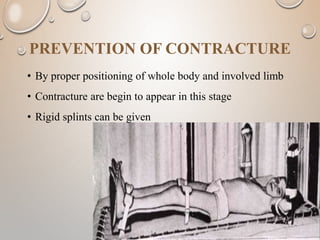
PREVENTION OF CONTRACTURE
• By proper positioning of whole body and involved limb
• Contracture are begin to appear in this stage
• Rigid splints can be given
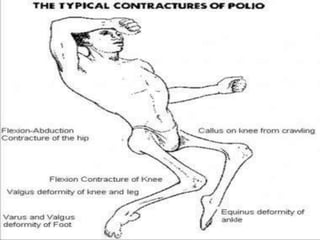
• Common sites of early contracture:
Hip- flexion abduction
Knee- flexion
Ankle and foot- plantar flexion, Varus or valgus
Shoulder- abduction
 Elbow- flexion
PREVENTION OF CONTRACTURE
Whenever muscular pain or spasm permits, relaxed
passive movements to be initiated at least once in a day.
Contracture later on organized into deformity
PREVENTION OF CONTRACTURE
MANAGEMENT
Avoidance of activity:
• Unnecessary activity is contraindicated
Prevent invasive technique:
• Avoid local trauma, inoculation, injection and any
surgical procedure
Least exerting transfers:
• Transfer of the patient should be carried out carefully
Special care of the severely affected patients:
• Patient having involvement of the whole body or bulbar
palsy with respiratory paralysis, need intensive care.
MANAGEMENT
• Lead to inability to swallow
• Patient chokes the liquid food and unable to swallow
saliva
• Can cause death if not prevented
• Difficulty in coughing or speaking
• Bulbar paralysis is associated with polio encephalitis
Bulbar paralysis / Pharyngeal
paralysis
• This may result of involvement of:
Respiratory centers
Intercostal muscles
Diaphragm
Respiratory paralysis
• Tracheostomy or intermittent
positive pressure respiration
• Postural drainage
MANAGEMENT
RECOVERY PHASE (4-8WEEKS)
2. This is divided in to two phases:
• Early convalescence (3 week to 6 months)
• Late convalescence
EARLY CONVALESCENCE
• The treatment Programme should be on basis of MMT
• It should be individualized for the paretic or paralyzed
muscle group
TREATMENT AT
PHYSIOTHERAPY CENTER:
• Planned exercise to specific individual muscles to attain
maximum physiological hypertrophy of the intact muscle
group.
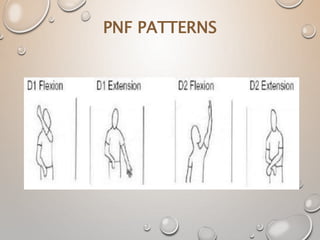
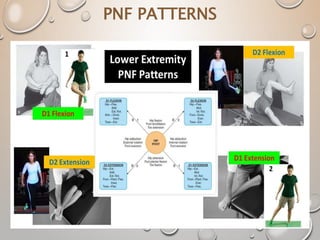
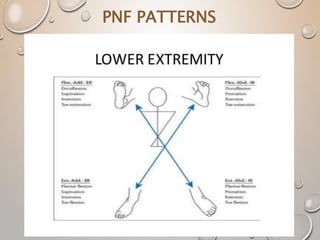
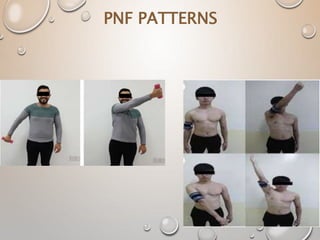
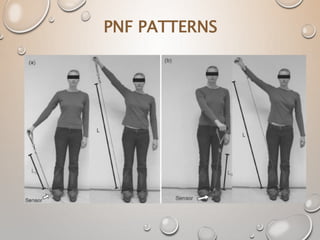
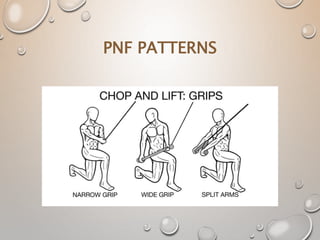
• PNF
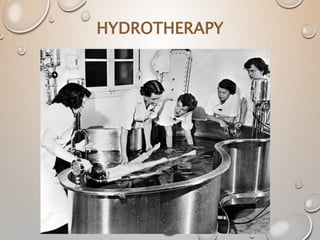
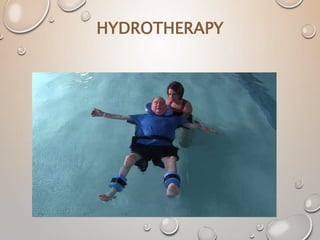
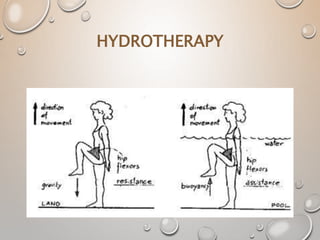
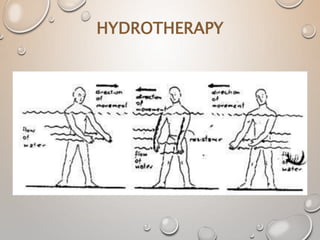
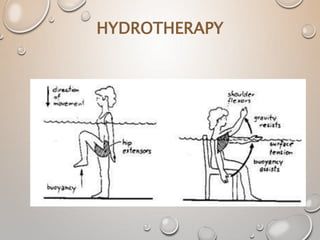
• Hydrotherapy therapy
• Assisted exercises
PHYSIOTHERAPY
MANAGEMENT
• Unnecessary splinting should be avoided to
reduce the effect of immobilization
• If at all splint given, they should be used to
provide graduated exercise
• Children who attempt to stand with support
and take steps on their own should
immediately be given necessary appliances
PNF PATTERNS
PNF PATTERNS
PNF PATTERNS
PNF PATTERNS
PNF PATTERNS
PNF PATTERNS
HYDROTHERAPY
HYDROTHERAPY
HYDROTHERAPY
HYDROTHERAPY
HYDROTHERAPY
HOME PLAN
• Initially only important muscles group should
be included for exercises
• Only one or two exercise should be taught in
one session
• Method of prevention and or management of
contracture and deformities should be checked
regularly
• Parents should be warned against any weight-
bearing activities on the affected limb at this
stage
HOME PLAN
LATE CONVALESCENCE
[6 MONTH TO 1 YEAR]
• Phase of recovery that is due to hypertrophy of
residual muscle fibers that needs adequate
Programme of graded resistance to the
concerned muscles
• Resistance become more acceptable when
given during the performance of daily activities
• Aerobic Programme like swimming, running
and sports can be initiated
• LLD is commonly seen in children with
unilateral lower limb involvement
CHRONIC OR RESIDUAL
PHASE [AFTER 1 YEAR TO 18
MONTHS]
• More emphasis on strengthening
• Functional exercise than specific muscle training
• Movement should be made stronger by graduated
resistances
• Any additional guidance aids or supports to
facilitate functional as well as physical work
requirements given
• Prevent posture, position and activities that put
compressive forces on the involved muscles and
• Correct use of braces, canes, crutches,
wheelchair or any orthosis is to be assured
• Prevention of contractures and deformities
FUNCTIONAL ASSESSMENT
• ABILITY TO TURN
• ABILITY TO SIT UP
• ASSISTANCE TO SIT
• ABILITY TO SIT WITHOUT ASSISTANCE- POSTURE AND
BALANCE
• ABILITY TO STAND
• WALKING
• BRACES
• MANAGING CURBS, STAIRS
• ABILITY TO DO FLOOR SITTING, SQUATTING, CROSS
LEG SITTING
COMMON DEFORMITIES AND
CAUSATIVE FACTORS
Early, extensively paralyzed patient:
• Flattening of all spinal curves: gravity, supine
• Shoulder adduction-internal rotation: adductor
spasm, deltoid failure, malpositioning
• Elbow flexion: flexor spasm, wrong positioning
• Palmer flexion at wrist: gravity, supine
• Hip flexion-abduction-external rotation:
abductor spasm, gravity in supine
• Flexion at knee: flexor spasm
• Ankle equinus: calf spasm, gravity
• Forefoot equinovarus: gravity, tibialis posterior
and toe flexor spasm
Axial weakness:
• Neck flexion: gravity, erect posture
• Rib droop: intercostal weakness, gravity
• Scoliosis: gravity, intercostal, paraspinal
and abdominal weakness
• Pot belly: abdominal weakness, gravity
and sitting
Upper limb:
• Vertical subluxation of shoulder: gravity,
severe paralysis
• Elbow extension: gravity, flexor failure
• Forearm supination and ulnar deviation
of wrist: gravity, pronator and radial
extensor failure
• Flat non opposable thumb: thenar
muscle failure
Hip and knee:
• Trendelenburg dip at hip: abductor
failure, early weight bearing
• Subluxation of hip: abductor, extensor,
internal rotator failure
• Genu recurvatum: quadriceps failure
or hamstring failure, early weight
bearing
• External rotation of tibia:
gastrosoleus spasticity, weight
bearing on valgus foot, medial
hamstring paralysis
Ankle and foot:
• Valgus foot: invertor failure, weight
bearing
• First metatarsal head depression: a
component of tibialis anterior
paralysis
• Inversion: evertor failure, weight
bearing
• Equinovarus with inversion of heel:
failure of all but planter flexors,
intrinsic muscles and invertors
• Calcaneovalgus: failure of planter
flexors and evertor and weight
bearing
SURGERY
Common surgical procedures are:
Correction of soft tissue contracture,
Correction/ prevention of deformity by tendon
transfer or bony stabilization procedure,
Tendon transfer to improve function and
Correction of limb length disparity
UPPER LIMB
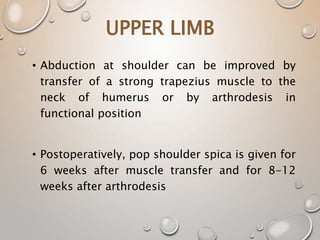
• Abduction at shoulder can be improved by
transfer of a strong trapezius muscle to the
neck of humerus or by arthrodesis in
functional position
• Postoperatively, pop shoulder spica is given for
6 weeks after muscle transfer and for 8-12
weeks after arthrodesis
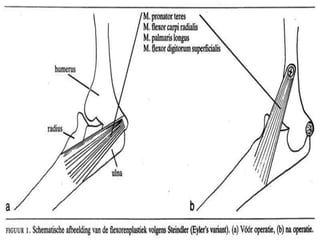
• Paralysis of flexor of elbow results in loss of active
flexion at the elbow
• However, if the forearm and fingers are strong, the
common origin of flexor group of muscles, at the
medial epicondyle of humerus is transferred to the
front of lower end of humerus [steindler’s
flexoroplasty]
• An above elbow POP slab is given for 4-6
weeks postoperatively
• Training of muscles after removal of slab
improves elbow flexion to a functional range
• Function at the wrist can be improved by
tendon transfer or by fusion of wrist
• Wrist flexors are transferred to the finger
extensors to improve extension of the fingers
• In the hand, loss of opposition is a disabiling
problem and may require a tendon transfer
[opponensplasty]
• Usually the sublimis tendon is detached from
its insertion on the middle phalanx and is
transplanted into the abductor pollicis brevis to
improve opposition of the thumb
• Plaster immobilisation with thumb in
opposition is given for 3-5 weeks
SPINE
• Paralysis of trunk muscles result in
scoliosis
• It usually causes a long dorsolumbar
curve that is largely correctable
• It needs surgical treatment in the form
of spinal fusion with or without
anterior or posterior instrumentation
LOWERLIMB
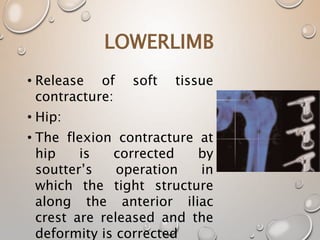
• Release of soft tissue
contracture:
• Hip:
• The flexion contracture at
hip is corrected by
soutter’s operation in
which the tight structure
along the anterior iliac
crest are released and the
deformity is corrected
• The abduction contracture is corrected by
release of abductor, fascia lata and iliotibial
band
• Postoperatively, the patient is given a POP
hip Spica, in the corrected position, for
about 4-6 weeks
• The joints are then mobilised but the
correction is maintained in a caliper
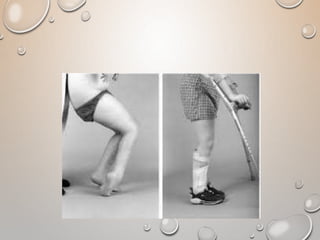
KNEE
• Mild flexion contracture are generally
due to tight iliotibial band that is
divided
• Moderate degrees of flexion contracture
can be treated by lengthening of
hamstrings
• Severe flexion contracture require
lengthening of hamstring and posterior
• Postoperatively, an above knee
plaster cast for 4-6 weeks followed
by mobilization is the usual regime
• Correction is maintained in a caliper
ANKLE
• Commonest deformity is equinus,
which results from contracture of
tendoachilles
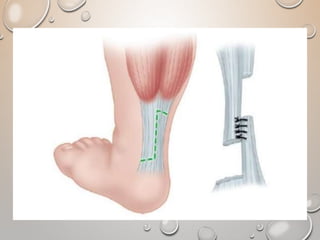
• Lengthening of tendo-achilles by z-
plasty is undertaken
• An above knee plaster cast for 3-6
months, to prevent recurrence
FOOT
• Contracture of planter
fascia produces a
cavus deformity of foot
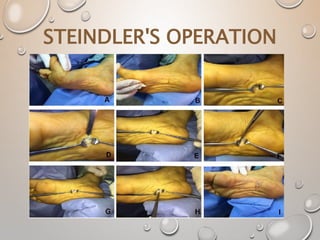
• Tight planter fascia is
striped from its
attachment to the
calcaneus [Steindler's
operation]
STEINDLER'S OPERATION
• In postoperative period, a below-
knee plaster is given for 2-4 weeks,
after which a night splint is used for
2-4 months
TENDON TRANSFER
Hip:
• Paralysis of glutei can result in serious
disabilities including paralytic dislocation
of hip
• Gluteus maximus paralysis causes
exaggerated lumbar lordosis and a
backward lurch during walking
• Paralysis of gluteus medius produce a
• Ilio-psoas or erector spinae muscles
are transferred into gluteus
maximus for paralysis of the latter,
while tensor fascia lata is transferred
posteriorly for gluteus medius
paralysis
Knee:
• Quadriceps paralysis is common
• It may strengthened by transfer of
hamstring into patella
• Post-operatively knee is immobilized
in an above-knee plaster cast in full
extension for 4-6 weeks, followed by a
night splint for another 4 weeks
Foot:
• Tendon transfer for correction of
paralytic foot deformities in
conjunction with stabilization
operation on foot
• Basic principle of tendon transfer in
paralytic foot is to remove the
deforming force and to use an active
muscle to replace the paralyzed muscle
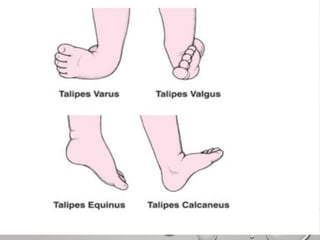
THE DEFORMITIES OF FOOT
CAN BE:
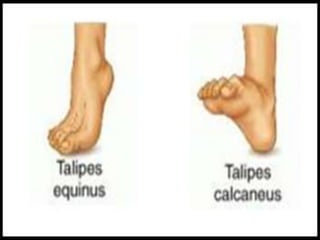
1. TALIPES EQUINUS
2. TALIPES CALCANEUS
3. TALIPES VARUS
4. TALIPES VALGUS
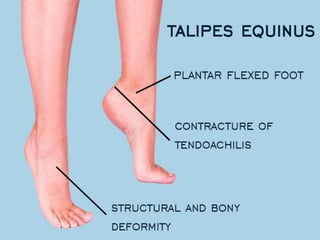
TALIPES EQUINUS
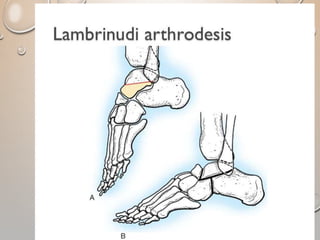
• Can be corrected by lambrinudi triple
arthrodesis
• This operation is performed after 12
years of age
• Paralytic equinus deformity can be
corrected by caliper in the early years
of life
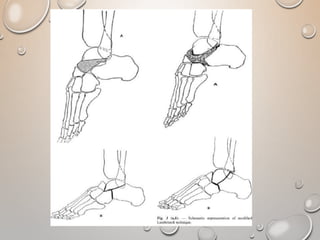
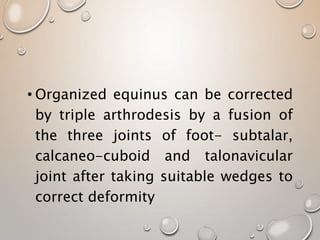
• Organized equinus can be corrected
by triple arthrodesis by a fusion of
the three joints of foot- subtalar,
calcaneo-cuboid and talonavicular
joint after taking suitable wedges to
correct deformity
TALIPES CALCANEUS
• Progressive deformity caused by the
paralysis of gastrocnemius
• In addition to calcaneus, a cavus
deformity of foot may develop
subsequently
• In younger children, the deformity is
corrected by a two-staged surgical
procedure.
• In first stage, cavus deformity is corrected
by fusion of talonavicular joint and
release of tight planter fascia [steindler’s
operation]
• A below knee plaster cast is maintained
• In the second-stage, the active tendon of
tibialis posterior, peronei and long toe
flexors are transferred into the tendo-
achilles, in association with fusion of
subtalar joint
• Postoperatively, a plaster cast is
maintained for 8-10 weeks
TALIPES VARUS
• Paralytic varus deformity of foot result
from paralysis of peronie muscles and
overaction of tibialis anterior and
posterior muscles
• Corrected by transfer of tibialis anterior
tendon into cuboid bone
• post-operatively, a below-knee plaster
cast is given in the corrected position for
a period of 3-6 weeks, after which the
foot is immobilized
TALIPES VALGUS
• Caused by paralysis of tibialis muscle
• Overaction of peronei result in valgus
deformity and also cause drop of first
metatarsal
• Since, TA is paralysed , long toe extensor
act as dorsiflexor of ankle and further
aggravate the clawing of big toe
• Valgus deformity is corrected by transfer
of perneous brevis into medial cunieform
bone.
• Bony stabilization of talocalcaneal joint,
with the help of a strut can correct this
deformity in children above 4 years of age
• The 1st metatarsal drop is corrected by an
operation [modifies jones’ operation]
consisting of transfer of extensor hallucis
longus tendon into neck of first
metatarsal and fusion of IP joint of big-
toe
• A below-knee plaster cast is given for 6-8
weeks after the operation
• In case untreated up to the age of 13
years, triple arthrodesis is indicated to
correct the deformity
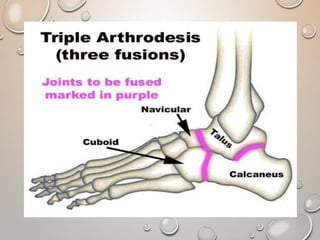
Triple arthrodesis
• Commonly performed bony stabilization
in paralytic foot
• Performed after 13 years of age
• If performed earlier, fusion may not be
solid due to abundance of cartilage and
may also result in a short foot due to
growth disturbance
• In this operation, the subtalar,
talonavicular and calcaneocuboid joints
are fused
• A below-knee plaster cast is applied for 3
month after operation
• Moderate to severe paralysis of lower
extremity result in shortening of
affected limb
• Methods:
Shortening of normal [or longer] limb
Lengthening of affected [short] limb
SHORTENING OF NORMAL [OR
LONGER] LIMB
• Normal limb may be shortened by
arrest of the epiphyseal growth or by
resection of bone from the femur or
tibia
• Rarely performed
LENGTHENING OF AFFECTED
[SHORT] LIMB
• Its undertaken in femur or tibia
depending on the site of shortening
• Degree of real shortening of limb is
measured both clinically and by
scanogram
• Amount of lengthening to be achieved
is then calculated accurately and
surgery is planned
• If shortening is in both femur and tibia,
both the bones can be lengthened
simultaneously or in stage
• Lengthening of femur or tibia can be
undertaken by any of the following
methods:
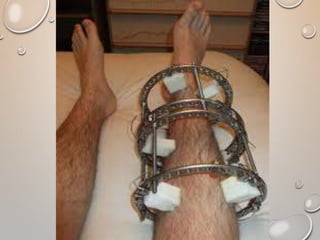
• Tubular fixators [wagener’s technique]
• Ring fixator [ilizarov technique]
TUBULAR FIXATORS [WAGENER’S
TECHNIQUE]
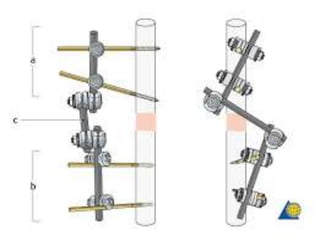
• Femur is osteotomized [cut] through the
shaft and an external fixator [with
distractor] is applied
• The femur is then gradually distracted every
day, achieving the desired amount of
lengthening over a period of time [usually
in weeks]
• The lengthened portion of bone gets
filled up spontaneously with bone or
alternatively, bone grafting and
plating is done hasten the process of
consolidation
• In former situation, the external fixator is
maintained for a period of 3-6 months, till
the bone forms adequately; while in latter
case, the fixator can be removed at time of
plating operation
• Mobilization of adjacent joints may be started
early, in consultation with the surgeon, while
weight bearing is delayed till the bone
consolidates
TIBIAL LENGTHENING
• Carried out in two stages
• In first stage, the lower fourth fibula is
fixed to tibia so that the ankle mortise
remains stable during the second stage
of leg lengthening
• The rest of procedure is same as that for
femur, i.E. Osteotomy of tibia followed by
gradual distraction.
• It can also be continued either in the
external fixator or fixed internally with a
plate
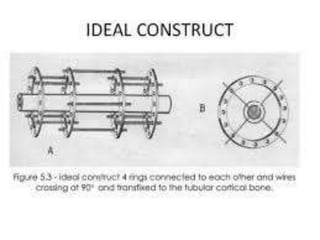
RING FIXATOR [ILIZAROV
TECHNIQUE]
• In this method, thin wires are passed
into the bone under tension and
connected to half-or full circle signs
• The most commonly used ring fixator
is called ilizaov fixator, after its
innovator
• The bone is cut [by corticotomy] in the
area of metaphysis [either the proximal
or distal] and gradual distraction is
done to increase the length of the
bone to increase the length of bone
• New bone, called regenerate forms into
the gap, thus created by distraction
COMPLICATION
• NERVE COMPLICATION
• VASCULAR COMPLICATION
• DEFORMITIES OF FOOT
• PIN TRACT INFECTION
• ARTHRITIS OF ADJACENT JOINTS
• FRACTURE THROUGH THE LENGTHENED
PART
PHYSIOTHERAPY FOLLOWING
SURGERY
• After release of soft-tissue contracture,
measures should be taken to avoid
recurrence of contracture
• Following joint arthrodesis, the emphasis
is on educating the functional use of limb
in which the joint is arthrodesed
RELEASE OF SOFT TISSUE
CONTRACTURE
• Preoperatively, the joint over which the
contracted soft tissue passes is kept in
a state of maximum mobility by
passive stretching and passive
movements
• Postoperatively, during immobilization
vigorous exercises are given to the
joints that are free from
Positioning: it should not facilitate
recurrence of contracture
• Long period of prone lying are
importatant to prevent recurrence of
hip flexion contracture following
soutter’s release
• Maintaining optimal extension at the knee
after release of the iliotibial band and
hamstring release
• Maintaining neutral dorsiflexion is
mandatory in release of tendo-achiles
• Many a times it is necessary to retain the
posterior shell of pop or suitable orthoses
till the position of correction is maintained
with active efforts by the patient
Mobilization:
• Graded mobilisation procedures are
used to regain early full ROM at the
joint related to the soft tissue release
• Relaxed passive movement following
soothing heat are ideal
MUSCLE STRENGTHENING &
ENDURANCE EXERCISE
• To achieve active maintenance of
corrected position of joints
concerned, exercise are given to
improve strength and endurance of
muscle groups antagonistic to one
that were released surgically
• Therefore, gluteus maximus in
release of hip flexion contracture
and quadriceps in the release of
knee flexion contracture
• Agonistic control as well as overall
strengthening of the other muscle
group of limb should not be neglected.
• Surgical scar should be mobilized by
friction massage or ultrasound, to
avoid it getting adherent
RE-EDUCATION
• Re-education in proper use of joint,
weight bearing and gait is done to
avoid recurrence of soft tissue
contracture
HOME TREATMENT PROGRAMME
• Simple regular regime of correct
positioning and exercises need to be
continued at home
TENDON TRANSFER
Preoperative management training:
Preoperatively, four factors need special
consideration:
• Concerned joint due to imbalanced
muscular action is most likely to get stiff
in the direction of weaker muscle, eg.
Limitation of inversion in dorsiflexion
when anterior tibial group is paralysed
• Transplant can never be effective
unless full ROM is achieved at the
concerned joint in the direction of
proposed action of transplant
• Muscle to be transplanted is bound to
get weak after the transposition and
therefore, it should be stronger before
surgery
• Therefore, concentrated sessions of
strengthening and isometric holding of
muscle to be transplanted is a must
preoperatively
• There is tendency for transplanted muscle
to continue its previous action even after
transposition
• This is avoided by adequate training of
patient of contralateral limb.
• E.g. Correct groove of dorsifexion with
inversion is repeatedly practiced on the
contralateral limb before undertaking
peroneal transplant for the paralyzed
anterior tibial group
• Specific strengthening procedures are
given to the associated muscle groups of
movement for which the transplant is
planned
• These muscle groups are instrumental in
assisting the performance of transplanted
muscle
• For e.g. Extensor digitorum and hallucis
longus are strengthened when the
POST OPERATIVELY, RE-EDUCATION
OF TRANSPLANTED MUSCLE IS
EQUALLY IMPORTANT
• Begin with guided passive full-range
movement in exact groove of expected
arc of movement
• Gradually progress to assisted
movement by encouraging the patient
to actively contract the transplanted
muscle
• Electrical stimulation synchronized
with patient’s effort is extremely
useful in re-education
• Biofeedback also provides an
excellence means of re-education
• The session of muscle re-education
and strengthening should be
continued and progressed till strong
and controlled movement by
transplanted muscle are achieved
• Guided functional training hastens the
recovery
• Dynamic orthosis may sometimes
become necessary to provide
assistance and to avoid unwanted
movement
• Arthrodesis: this is joint stabilizing
procedure where immobilization is
usually done for a long period
PRE-OPERATIVE TRAINING
• Patient is taught the procedures of
functionally using the limb effectively,
e.G. Non weight bearing crutch
walking.
• Exercises are given to strengthen the
movements of the joint adjacent the
joint to be arthrodesed
• Mobilisation of the shoulder girdle and
pelvic girdle are given when the
arthrodesis is planned for shoulder and
hip, respectively
• It helps in the functional use of the
limb following stabilization
During immobilization:
• Vigorous exercises are given to the
joints free from immobilization
• Gait training is started as soon as
the pain recedes
Mobilization:
• Exercise programme is made vigorous
emphasizing endurance training
• As the initial weight bearing is painful,
weight transfer to the limb; single leg
balance and ambulation are done in a
graduated manner
• Adequate walking aid may be
necessary initially, but it should waned
gradually
• Functional use of operated joint is
emphasized teaching compensatory
mechanism by using adjacent joints
CORRECTION OF LIMB LENGTH
DISPARITY
• Like arthrodesis, the period of
immobilization is long and therefore
strengthening and endurance exercises
are emphasized to all the free joints
• Proper positioning of limb is ensured in
the external fixator
• Isometrics to the glutei and quadriceps
are given on removal of external
fixator or POP
• Gradual training in weight bearing,
weight transfer, balance and gait is
initiated and progressed to normal use.
Poliomyelitis

Poliomyelitis

  • 1.
  • 2.
    INTRODUCTION • It isan endemic and epidemic infectious viral disease, mainly affecting children under the age of 5 years. • The disease is transmitted by droplet infection and by oral ingestion • The period of incubation varies from 3 to 30 days
  • 3.
    VIROLOGY Three types: • TypeI: Brunchilde • Type II: Lansing • Type III: Leon
  • 4.
    • Acute poliomyelitisis a disease of the anterior horn motor neurons of the spinal cord and brain stem caused by poliovirus. • Symptoms following infection is due to the destruction of anterior horn cells of spinal cord and brain stem for which the virus has selective affinity • The result is the flaccid paralysis without sensory loss due to loss of motor neurons and denervation of their associated skeletal muscles. PATHOPHYSIOLOGY
  • 5.
    • Route ofentry into tonsillopharyngeal lymphoid tissue • Virus multiplies and disseminates throughout the body • The antibody, when present, inactivates the virus while it is in circulation in blood • This is the stage of minor illness PATHOPHYSIOLOGY
  • 6.
  • 7.
    PHASE OF DISEASE •Incubation period • Non-paralytic stage • Paralytic phase
  • 8.
    • During thisphase, symptoms like sore throat, GI upset and transient fever, these may go unnoticed • Pain and tenderness in the spine, trunk and limbs • During the phase of major illness, there is entry of virus into neurons throughout the CNS giving rise to inflammatory reaction of nervous tissue and meninges, a classical manifestation of poliomyelitis • Degeneration of anterior horn cells with loss of nissle granules and the nucleus, which complete SIGNS OF POLIO INFECTION
  • 9.
    SIGNS OF POLIOINFECTION
  • 11.
    • Localised pain •Tenderness • Awkward limb positioning due to acute muscle spasm • Lower extremities predominate • Bulbar palsy CLINICAL FEATURES
  • 12.
    • Paralysis orparesis is asymmetrical and flaccid in nature • Deltoid in upper extremity and quadriceps and tibialis anterior in lower extremity are commonly affected • No sensory impairment • Cold limbs due to impaired circulation • Reduced or loss of reflexes CLINICAL FEATURES
  • 13.
    CLINICAL FEATURES • Involvementis predominant in the lower limb, specially in extensor group of muscles • Muscular weakness and muscular imbalance
  • 15.
    STAGES OF DISEASE 1.ACUTE PHASE 2. CONVALESCENT OR RECOVERY PHASE 3. CHRONIC OR RESIDUAL PHASE
  • 16.
    ACUTE PHASE • Childis restless and irritable due to pain and muscular tenderness, with spasm in muscle group. • Joints of the affected limb may be painful because of stretching of muscles that are in spasm as result of neuronal irritation. • General malaise, headache and bowel upsets may be present with low-grade fever and sore throat • In rare case there may be involvement of brain giving rise to polio-encephalitis
  • 17.
    CONVALESCENT/RECOVERY PHASE • As soonas acute symptoms subside the phase of recovery begins. • Either spontaneous recovery of affected muscles or various grades of paralysis may develop
  • 18.
    CHRONIC/RESIDUAL PHASE • Nofurther neuronal recovery • Pattern of paralysis is organized in affected muscles. • The degree of paralysis depends on extent of neuronal damage and efficacy of physiotherapeutic management during convalescent phase
  • 19.
    PHYSICAL EXAMINATION/ASSESSMENT • General observationof posture to detect the areas of involvement • A degree of consciousness, choking, squint, spontaneous nystagmus, facial paralysis, difficulty in moving or change in position, feeble cry or cough, diminished respiratory excursion and accumulation of secretion
  • 20.
    • Inability tomove on particular limb indicates the involvement of that limb • Spinal rigidity: neck and whole spine should examined for rigidity • Strength of intercostal, diaphragm and abdominal muscles needs to be assessed PHYSICAL EXAMINATION/ASSESSMENT
  • 21.
    • Muscle weaknessis examined by MMT • Elicitation of Deep Tendon Reflexes • Sensory examination • Degree of contracture and deformities PHYSICAL EXAMINATION/ASSESSMENT
  • 22.
    DEFORMITIES • Contracture, whichgets organized into a deformity, complicates the recovery in the following ways: It prevents the surviving motor units to participate in process of recovery as they remain inactive It cause disuse of active muscles and makes them weak It produce angulations, stiffness and even displacement of the joints
  • 23.
    The causative factorsare: • Muscle spasm • Influence of gravity • Muscular imbalance DEFORMITIES
  • 24.
    CAUSES OF DEFORMITY •During acute phase of the disease, muscle spasm of involved muscle groups results in contracture which may lead to deformity • Weight of limbs, habitual postures and malpositioning compounded by the influence of gravity and muscle weakness may also result in deformity
  • 25.
    • During subacutephase, the deformity results from the muscular imbalance due to asymmetrical paresis or paralysis of muscle groups controlling a particular joints. • If the deformity is not properly controlled at this stage of the disease by appropriate physiotherapeutic measure and appliances, it deteriorates further, when the concerned joint is exposed to stresses of weight bearing. CAUSES OF DEFORMITY
  • 26.
    MANAGEMENT OF DEFORMITY • Prescribingcorrect appliance, checking its proper fit and educating patient on its correct use, as well as its maintenance is responsibility of a treating physiotherapist at this stage.
  • 27.
    • During chronicphase, there is always a tendency of discarding the appliances. • This not only results in deterioration of deformity but also causes secondary complication by exposing joints to imbalanced stresses CAUSES OF DEFORMITY
  • 28.
    • Prevention ofdeformity forms the basis of treatment not only during all phase of disease but even in later phases of life MANAGEMENT OF DEFORMITY
  • 29.
    TREATMENT PROGRAMME A. Acutephase [first 3-5 weeks] B. Recovery phase [4-18 weeks] C. Chronic or residual phase [ after 1 year to 18 months]
  • 30.
    ACUTE PHASE Also calledpre-paralytic stage or prodromal phase Aim: • Relief of pain • Supportive medication for relief of pain and relaxation • Relaxation of painful spasm by hydro collateral packs
  • 31.
    PREVENTION OF CONTRACTURE •By proper positioning of whole body and involved limb • Contracture are begin to appear in this stage • Rigid splints can be given
  • 32.
    • Common sitesof early contracture: Hip- flexion abduction Knee- flexion Ankle and foot- plantar flexion, Varus or valgus Shoulder- abduction  Elbow- flexion PREVENTION OF CONTRACTURE
  • 33.
    Whenever muscular painor spasm permits, relaxed passive movements to be initiated at least once in a day. Contracture later on organized into deformity PREVENTION OF CONTRACTURE
  • 34.
    MANAGEMENT Avoidance of activity: •Unnecessary activity is contraindicated Prevent invasive technique: • Avoid local trauma, inoculation, injection and any surgical procedure
  • 35.
    Least exerting transfers: •Transfer of the patient should be carried out carefully Special care of the severely affected patients: • Patient having involvement of the whole body or bulbar palsy with respiratory paralysis, need intensive care. MANAGEMENT
  • 36.
    • Lead toinability to swallow • Patient chokes the liquid food and unable to swallow saliva • Can cause death if not prevented • Difficulty in coughing or speaking • Bulbar paralysis is associated with polio encephalitis Bulbar paralysis / Pharyngeal paralysis
  • 37.
    • This mayresult of involvement of: Respiratory centers Intercostal muscles Diaphragm Respiratory paralysis
  • 38.
    • Tracheostomy orintermittent positive pressure respiration • Postural drainage MANAGEMENT
  • 39.
    RECOVERY PHASE (4-8WEEKS) 2.This is divided in to two phases: • Early convalescence (3 week to 6 months) • Late convalescence
  • 40.
    EARLY CONVALESCENCE • Thetreatment Programme should be on basis of MMT • It should be individualized for the paretic or paralyzed muscle group
  • 41.
    TREATMENT AT PHYSIOTHERAPY CENTER: •Planned exercise to specific individual muscles to attain maximum physiological hypertrophy of the intact muscle group. • PNF • Hydrotherapy therapy • Assisted exercises
  • 42.
    PHYSIOTHERAPY MANAGEMENT • Unnecessary splintingshould be avoided to reduce the effect of immobilization • If at all splint given, they should be used to provide graduated exercise • Children who attempt to stand with support and take steps on their own should immediately be given necessary appliances
  • 43.
  • 44.
  • 45.
  • 46.
  • 47.
  • 48.
  • 49.
  • 50.
  • 51.
  • 52.
  • 53.
  • 54.
    HOME PLAN • Initiallyonly important muscles group should be included for exercises • Only one or two exercise should be taught in one session
  • 55.
    • Method ofprevention and or management of contracture and deformities should be checked regularly • Parents should be warned against any weight- bearing activities on the affected limb at this stage HOME PLAN
  • 56.
    LATE CONVALESCENCE [6 MONTHTO 1 YEAR] • Phase of recovery that is due to hypertrophy of residual muscle fibers that needs adequate Programme of graded resistance to the concerned muscles • Resistance become more acceptable when given during the performance of daily activities
  • 57.
    • Aerobic Programmelike swimming, running and sports can be initiated • LLD is commonly seen in children with unilateral lower limb involvement
  • 58.
    CHRONIC OR RESIDUAL PHASE[AFTER 1 YEAR TO 18 MONTHS] • More emphasis on strengthening • Functional exercise than specific muscle training • Movement should be made stronger by graduated resistances • Any additional guidance aids or supports to facilitate functional as well as physical work requirements given • Prevent posture, position and activities that put compressive forces on the involved muscles and
  • 59.
    • Correct useof braces, canes, crutches, wheelchair or any orthosis is to be assured • Prevention of contractures and deformities
  • 60.
    FUNCTIONAL ASSESSMENT • ABILITYTO TURN • ABILITY TO SIT UP • ASSISTANCE TO SIT • ABILITY TO SIT WITHOUT ASSISTANCE- POSTURE AND BALANCE • ABILITY TO STAND • WALKING • BRACES • MANAGING CURBS, STAIRS • ABILITY TO DO FLOOR SITTING, SQUATTING, CROSS LEG SITTING
  • 62.
    COMMON DEFORMITIES AND CAUSATIVEFACTORS Early, extensively paralyzed patient: • Flattening of all spinal curves: gravity, supine • Shoulder adduction-internal rotation: adductor spasm, deltoid failure, malpositioning • Elbow flexion: flexor spasm, wrong positioning
  • 63.
    • Palmer flexionat wrist: gravity, supine • Hip flexion-abduction-external rotation: abductor spasm, gravity in supine • Flexion at knee: flexor spasm • Ankle equinus: calf spasm, gravity • Forefoot equinovarus: gravity, tibialis posterior and toe flexor spasm
  • 64.
    Axial weakness: • Neckflexion: gravity, erect posture • Rib droop: intercostal weakness, gravity • Scoliosis: gravity, intercostal, paraspinal and abdominal weakness • Pot belly: abdominal weakness, gravity and sitting
  • 65.
    Upper limb: • Verticalsubluxation of shoulder: gravity, severe paralysis • Elbow extension: gravity, flexor failure • Forearm supination and ulnar deviation of wrist: gravity, pronator and radial extensor failure • Flat non opposable thumb: thenar muscle failure
  • 66.
    Hip and knee: •Trendelenburg dip at hip: abductor failure, early weight bearing • Subluxation of hip: abductor, extensor, internal rotator failure
  • 67.
    • Genu recurvatum:quadriceps failure or hamstring failure, early weight bearing • External rotation of tibia: gastrosoleus spasticity, weight bearing on valgus foot, medial hamstring paralysis
  • 68.
    Ankle and foot: •Valgus foot: invertor failure, weight bearing • First metatarsal head depression: a component of tibialis anterior paralysis • Inversion: evertor failure, weight bearing
  • 69.
    • Equinovarus withinversion of heel: failure of all but planter flexors, intrinsic muscles and invertors • Calcaneovalgus: failure of planter flexors and evertor and weight bearing
  • 70.
    SURGERY Common surgical proceduresare: Correction of soft tissue contracture, Correction/ prevention of deformity by tendon transfer or bony stabilization procedure, Tendon transfer to improve function and Correction of limb length disparity
  • 71.
    UPPER LIMB • Abductionat shoulder can be improved by transfer of a strong trapezius muscle to the neck of humerus or by arthrodesis in functional position • Postoperatively, pop shoulder spica is given for 6 weeks after muscle transfer and for 8-12 weeks after arthrodesis
  • 72.
    • Paralysis offlexor of elbow results in loss of active flexion at the elbow • However, if the forearm and fingers are strong, the common origin of flexor group of muscles, at the medial epicondyle of humerus is transferred to the front of lower end of humerus [steindler’s flexoroplasty]
  • 74.
    • An aboveelbow POP slab is given for 4-6 weeks postoperatively • Training of muscles after removal of slab improves elbow flexion to a functional range
  • 75.
    • Function atthe wrist can be improved by tendon transfer or by fusion of wrist • Wrist flexors are transferred to the finger extensors to improve extension of the fingers • In the hand, loss of opposition is a disabiling problem and may require a tendon transfer [opponensplasty]
  • 76.
    • Usually thesublimis tendon is detached from its insertion on the middle phalanx and is transplanted into the abductor pollicis brevis to improve opposition of the thumb • Plaster immobilisation with thumb in opposition is given for 3-5 weeks
  • 77.
    SPINE • Paralysis oftrunk muscles result in scoliosis • It usually causes a long dorsolumbar curve that is largely correctable • It needs surgical treatment in the form of spinal fusion with or without anterior or posterior instrumentation
  • 78.
    LOWERLIMB • Release ofsoft tissue contracture: • Hip: • The flexion contracture at hip is corrected by soutter’s operation in which the tight structure along the anterior iliac crest are released and the deformity is corrected
  • 79.
    • The abductioncontracture is corrected by release of abductor, fascia lata and iliotibial band • Postoperatively, the patient is given a POP hip Spica, in the corrected position, for about 4-6 weeks • The joints are then mobilised but the correction is maintained in a caliper
  • 80.
    KNEE • Mild flexioncontracture are generally due to tight iliotibial band that is divided • Moderate degrees of flexion contracture can be treated by lengthening of hamstrings • Severe flexion contracture require lengthening of hamstring and posterior
  • 81.
    • Postoperatively, anabove knee plaster cast for 4-6 weeks followed by mobilization is the usual regime • Correction is maintained in a caliper
  • 83.
    ANKLE • Commonest deformityis equinus, which results from contracture of tendoachilles • Lengthening of tendo-achilles by z- plasty is undertaken • An above knee plaster cast for 3-6 months, to prevent recurrence
  • 86.
    FOOT • Contracture ofplanter fascia produces a cavus deformity of foot • Tight planter fascia is striped from its attachment to the calcaneus [Steindler's operation]
  • 87.
  • 88.
    • In postoperativeperiod, a below- knee plaster is given for 2-4 weeks, after which a night splint is used for 2-4 months
  • 89.
    TENDON TRANSFER Hip: • Paralysisof glutei can result in serious disabilities including paralytic dislocation of hip • Gluteus maximus paralysis causes exaggerated lumbar lordosis and a backward lurch during walking • Paralysis of gluteus medius produce a
  • 90.
    • Ilio-psoas orerector spinae muscles are transferred into gluteus maximus for paralysis of the latter, while tensor fascia lata is transferred posteriorly for gluteus medius paralysis
  • 91.
    Knee: • Quadriceps paralysisis common • It may strengthened by transfer of hamstring into patella • Post-operatively knee is immobilized in an above-knee plaster cast in full extension for 4-6 weeks, followed by a night splint for another 4 weeks
  • 92.
    Foot: • Tendon transferfor correction of paralytic foot deformities in conjunction with stabilization operation on foot • Basic principle of tendon transfer in paralytic foot is to remove the deforming force and to use an active muscle to replace the paralyzed muscle
  • 93.
    THE DEFORMITIES OFFOOT CAN BE: 1. TALIPES EQUINUS 2. TALIPES CALCANEUS 3. TALIPES VARUS 4. TALIPES VALGUS
  • 95.
    TALIPES EQUINUS • Canbe corrected by lambrinudi triple arthrodesis • This operation is performed after 12 years of age • Paralytic equinus deformity can be corrected by caliper in the early years of life
  • 98.
    • Organized equinuscan be corrected by triple arthrodesis by a fusion of the three joints of foot- subtalar, calcaneo-cuboid and talonavicular joint after taking suitable wedges to correct deformity
  • 99.
    TALIPES CALCANEUS • Progressivedeformity caused by the paralysis of gastrocnemius • In addition to calcaneus, a cavus deformity of foot may develop subsequently
  • 101.
    • In youngerchildren, the deformity is corrected by a two-staged surgical procedure. • In first stage, cavus deformity is corrected by fusion of talonavicular joint and release of tight planter fascia [steindler’s operation] • A below knee plaster cast is maintained
  • 102.
    • In thesecond-stage, the active tendon of tibialis posterior, peronei and long toe flexors are transferred into the tendo- achilles, in association with fusion of subtalar joint • Postoperatively, a plaster cast is maintained for 8-10 weeks
  • 103.
    TALIPES VARUS • Paralyticvarus deformity of foot result from paralysis of peronie muscles and overaction of tibialis anterior and posterior muscles • Corrected by transfer of tibialis anterior tendon into cuboid bone
  • 105.
    • post-operatively, abelow-knee plaster cast is given in the corrected position for a period of 3-6 weeks, after which the foot is immobilized
  • 106.
    TALIPES VALGUS • Causedby paralysis of tibialis muscle • Overaction of peronei result in valgus deformity and also cause drop of first metatarsal • Since, TA is paralysed , long toe extensor act as dorsiflexor of ankle and further aggravate the clawing of big toe
  • 107.
    • Valgus deformityis corrected by transfer of perneous brevis into medial cunieform bone. • Bony stabilization of talocalcaneal joint, with the help of a strut can correct this deformity in children above 4 years of age
  • 108.
    • The 1stmetatarsal drop is corrected by an operation [modifies jones’ operation] consisting of transfer of extensor hallucis longus tendon into neck of first metatarsal and fusion of IP joint of big- toe
  • 109.
    • A below-kneeplaster cast is given for 6-8 weeks after the operation • In case untreated up to the age of 13 years, triple arthrodesis is indicated to correct the deformity
  • 110.
    Triple arthrodesis • Commonlyperformed bony stabilization in paralytic foot • Performed after 13 years of age • If performed earlier, fusion may not be solid due to abundance of cartilage and may also result in a short foot due to growth disturbance
  • 111.
    • In thisoperation, the subtalar, talonavicular and calcaneocuboid joints are fused • A below-knee plaster cast is applied for 3 month after operation
  • 114.
    • Moderate tosevere paralysis of lower extremity result in shortening of affected limb • Methods: Shortening of normal [or longer] limb Lengthening of affected [short] limb
  • 115.
    SHORTENING OF NORMAL[OR LONGER] LIMB • Normal limb may be shortened by arrest of the epiphyseal growth or by resection of bone from the femur or tibia • Rarely performed
  • 116.
    LENGTHENING OF AFFECTED [SHORT]LIMB • Its undertaken in femur or tibia depending on the site of shortening • Degree of real shortening of limb is measured both clinically and by scanogram
  • 117.
    • Amount oflengthening to be achieved is then calculated accurately and surgery is planned • If shortening is in both femur and tibia, both the bones can be lengthened simultaneously or in stage
  • 118.
    • Lengthening offemur or tibia can be undertaken by any of the following methods: • Tubular fixators [wagener’s technique] • Ring fixator [ilizarov technique]
  • 119.
    TUBULAR FIXATORS [WAGENER’S TECHNIQUE] •Femur is osteotomized [cut] through the shaft and an external fixator [with distractor] is applied • The femur is then gradually distracted every day, achieving the desired amount of lengthening over a period of time [usually in weeks]
  • 120.
    • The lengthenedportion of bone gets filled up spontaneously with bone or alternatively, bone grafting and plating is done hasten the process of consolidation
  • 122.
    • In formersituation, the external fixator is maintained for a period of 3-6 months, till the bone forms adequately; while in latter case, the fixator can be removed at time of plating operation • Mobilization of adjacent joints may be started early, in consultation with the surgeon, while weight bearing is delayed till the bone consolidates
  • 123.
    TIBIAL LENGTHENING • Carriedout in two stages • In first stage, the lower fourth fibula is fixed to tibia so that the ankle mortise remains stable during the second stage of leg lengthening
  • 124.
    • The restof procedure is same as that for femur, i.E. Osteotomy of tibia followed by gradual distraction. • It can also be continued either in the external fixator or fixed internally with a plate
  • 125.
    RING FIXATOR [ILIZAROV TECHNIQUE] •In this method, thin wires are passed into the bone under tension and connected to half-or full circle signs • The most commonly used ring fixator is called ilizaov fixator, after its innovator
  • 126.
    • The boneis cut [by corticotomy] in the area of metaphysis [either the proximal or distal] and gradual distraction is done to increase the length of the bone to increase the length of bone • New bone, called regenerate forms into the gap, thus created by distraction
  • 129.
    COMPLICATION • NERVE COMPLICATION •VASCULAR COMPLICATION • DEFORMITIES OF FOOT • PIN TRACT INFECTION • ARTHRITIS OF ADJACENT JOINTS • FRACTURE THROUGH THE LENGTHENED PART
  • 130.
    PHYSIOTHERAPY FOLLOWING SURGERY • Afterrelease of soft-tissue contracture, measures should be taken to avoid recurrence of contracture • Following joint arthrodesis, the emphasis is on educating the functional use of limb in which the joint is arthrodesed
  • 131.
    RELEASE OF SOFTTISSUE CONTRACTURE • Preoperatively, the joint over which the contracted soft tissue passes is kept in a state of maximum mobility by passive stretching and passive movements • Postoperatively, during immobilization vigorous exercises are given to the joints that are free from
  • 132.
    Positioning: it shouldnot facilitate recurrence of contracture • Long period of prone lying are importatant to prevent recurrence of hip flexion contracture following soutter’s release
  • 133.
    • Maintaining optimalextension at the knee after release of the iliotibial band and hamstring release • Maintaining neutral dorsiflexion is mandatory in release of tendo-achiles • Many a times it is necessary to retain the posterior shell of pop or suitable orthoses till the position of correction is maintained with active efforts by the patient
  • 134.
    Mobilization: • Graded mobilisationprocedures are used to regain early full ROM at the joint related to the soft tissue release • Relaxed passive movement following soothing heat are ideal
  • 135.
    MUSCLE STRENGTHENING & ENDURANCEEXERCISE • To achieve active maintenance of corrected position of joints concerned, exercise are given to improve strength and endurance of muscle groups antagonistic to one that were released surgically
  • 136.
    • Therefore, gluteusmaximus in release of hip flexion contracture and quadriceps in the release of knee flexion contracture
  • 137.
    • Agonistic controlas well as overall strengthening of the other muscle group of limb should not be neglected. • Surgical scar should be mobilized by friction massage or ultrasound, to avoid it getting adherent
  • 138.
    RE-EDUCATION • Re-education inproper use of joint, weight bearing and gait is done to avoid recurrence of soft tissue contracture
  • 139.
    HOME TREATMENT PROGRAMME •Simple regular regime of correct positioning and exercises need to be continued at home
  • 140.
    TENDON TRANSFER Preoperative managementtraining: Preoperatively, four factors need special consideration: • Concerned joint due to imbalanced muscular action is most likely to get stiff in the direction of weaker muscle, eg. Limitation of inversion in dorsiflexion when anterior tibial group is paralysed
  • 141.
    • Transplant cannever be effective unless full ROM is achieved at the concerned joint in the direction of proposed action of transplant • Muscle to be transplanted is bound to get weak after the transposition and therefore, it should be stronger before surgery
  • 142.
    • Therefore, concentratedsessions of strengthening and isometric holding of muscle to be transplanted is a must preoperatively • There is tendency for transplanted muscle to continue its previous action even after transposition
  • 143.
    • This isavoided by adequate training of patient of contralateral limb. • E.g. Correct groove of dorsifexion with inversion is repeatedly practiced on the contralateral limb before undertaking peroneal transplant for the paralyzed anterior tibial group
  • 144.
    • Specific strengtheningprocedures are given to the associated muscle groups of movement for which the transplant is planned • These muscle groups are instrumental in assisting the performance of transplanted muscle • For e.g. Extensor digitorum and hallucis longus are strengthened when the
  • 145.
    POST OPERATIVELY, RE-EDUCATION OFTRANSPLANTED MUSCLE IS EQUALLY IMPORTANT • Begin with guided passive full-range movement in exact groove of expected arc of movement • Gradually progress to assisted movement by encouraging the patient to actively contract the transplanted muscle
  • 146.
    • Electrical stimulationsynchronized with patient’s effort is extremely useful in re-education • Biofeedback also provides an excellence means of re-education
  • 147.
    • The sessionof muscle re-education and strengthening should be continued and progressed till strong and controlled movement by transplanted muscle are achieved • Guided functional training hastens the recovery
  • 148.
    • Dynamic orthosismay sometimes become necessary to provide assistance and to avoid unwanted movement • Arthrodesis: this is joint stabilizing procedure where immobilization is usually done for a long period
  • 149.
    PRE-OPERATIVE TRAINING • Patientis taught the procedures of functionally using the limb effectively, e.G. Non weight bearing crutch walking. • Exercises are given to strengthen the movements of the joint adjacent the joint to be arthrodesed
  • 150.
    • Mobilisation ofthe shoulder girdle and pelvic girdle are given when the arthrodesis is planned for shoulder and hip, respectively • It helps in the functional use of the limb following stabilization
  • 151.
    During immobilization: • Vigorousexercises are given to the joints free from immobilization • Gait training is started as soon as the pain recedes
  • 152.
    Mobilization: • Exercise programmeis made vigorous emphasizing endurance training • As the initial weight bearing is painful, weight transfer to the limb; single leg balance and ambulation are done in a graduated manner
  • 153.
    • Adequate walkingaid may be necessary initially, but it should waned gradually • Functional use of operated joint is emphasized teaching compensatory mechanism by using adjacent joints
  • 154.
    CORRECTION OF LIMBLENGTH DISPARITY • Like arthrodesis, the period of immobilization is long and therefore strengthening and endurance exercises are emphasized to all the free joints • Proper positioning of limb is ensured in the external fixator
  • 155.
    • Isometrics tothe glutei and quadriceps are given on removal of external fixator or POP • Gradual training in weight bearing, weight transfer, balance and gait is initiated and progressed to normal use.