Joint Hyper
mobility Syndromes
-By Dr. Rima Jani (PT)
(B.P.T., M.P.T. Pediatric Science)
INTRODUCTION
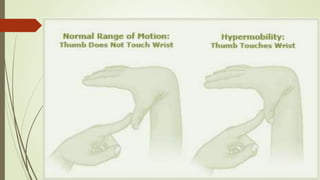
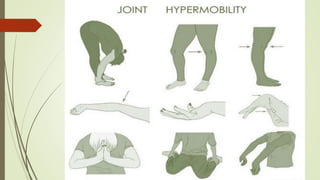
The joint hypermobility syndrome is a condition that
features joints that easily move beyond the normal
range expected for that particular joint.
Hypermobile joints tend to be inherited.
Symptoms of the joint hypermobility
syndrome include : pain in the knees, fingers, hips,
and elbows.
Ehler Danlos Syndrome
EDS [Ehler Danlos Syndrome] is a disorder of collagen
synthesis, primarily type V collagen.
Incidence of 1:10,000.
It’s a group of inherited disorders that mostly affect
the skin, joints and blood vessels.
It is characterized by joint hypermobility, skin hyper
extensibility, and tissue fragility.
INTRODUCTION
Classification
Formerly divided into 14 distinct variations, there are
now 7 accepted general classification types of EDS.
However, the Classic and Hypermobility type
account for 90% of all cases and involve mostly
orthopedic complaints.
Clinical Features
Overly flexible joints that can dislocate,
Skin that's translucent, elastic and bruises easily.
In some cases : dilation and even rupture of major
blood vessels.
Management
Treatment helps manage symptoms and monitor for
complications.
It includes:
 Medications,
 Physiotherapy &
 Surgery
Benign joint hypermobility syndrome
(BJHS)
It is also characterized by generalized joint laxity
with musculoskeletal complaints.
It is called “benign” owing to the absence of a
specific genetic, musculoskeletal or rheumatic
disorder.
Often, joint hypermobility causes no symptoms
and requires no treatment.
Management
Intervention focus and strategies will depend on the
patient’s age and severity of joint involvement.
Most programs should include a combination of the
following four areas:
Targeted Therapeutic Exercise,
Self-care & Home Management,
Functional Training for recreation, school, or work &
Orthoses or Adaptive Equipment.
Marfan Syndrome
Marfan syndrome is an inherited disorder that affects
connective tissue — the fibers that support and anchor
your organs and other structures in your body.
It affects the heart, eyes, blood vessels and bones.
People with Marfan syndrome are tall and thin with
long arms, legs, fingers and toes.
Incidence : Fewer than 1 million cases per year
Clinical Features
Tall and slender build.
Disproportionately long arms, legs and fingers.
A breastbone that protrudes outward or dips inward.
A high, arched palate and crowded teeth.
Heart murmurs.
Extreme nearsightedness.
An abnormally curved spine.
Flat feet.
Management
Treatment includes medication to keep blood
pressure low,
Glasses or contact lenses and
Surgery
Physiotherapy for pain management and
stabilization exercises.
Management of Hypermobility Syndrome
Therapeutic exercises
Orthoses
Adaptive Equipment
Therapeutic Exercises
A combination of strengthening and stabilization
exercises.
Glenohumeral joint and scapular stabilization and
strengthening are important to combat recurrent
subluxations.
This reduction in subluxations also improves proximal
stability to facilitate functional use of the hand and
arm without recurrent pain.
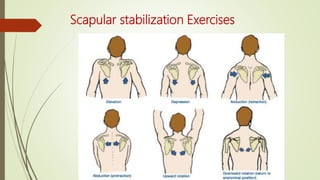
Scapular stabilization Exercises
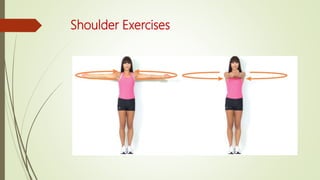
Shoulder Exercises
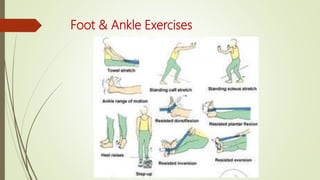
Foot & Ankle Strengthening Exercises
Foot and ankle strengthening will promote stability
and preserve foot function.
Full hind foot ROM should be achieved, as Achilles
tightness usually develops
Foot & Ankle Exercises
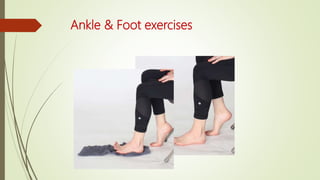
Ankle & Foot exercises
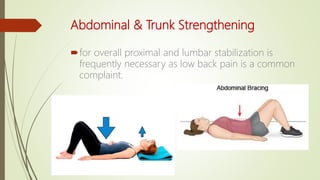
Abdominal & Trunk Strengthening
for overall proximal and lumbar stabilization is
frequently necessary as low back pain is a common
complaint.
Abdominal & Trunk Strengthening
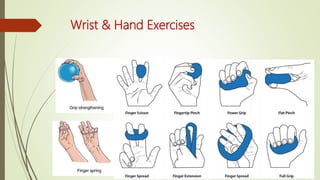
Wrist & Hand Exercises
Wrist and hand work
should focus on small
intrinsic muscle
strengthening without
joint hyperextension to
facilitate hand use in fine
motor tasks especially for
school and work.
Wrist & Hand Exercises
The foot and ankle should be protected as early as possible
to prevent structural deformity associated with excessive
pronation.
Children with EDS and BJHS do well with custom and semi-
customized shoe orthotics for mild-to-moderate foot
hypermobility and light weight supramalleolar orthoses in
severe cases.
Orthoses
Adaptive Equipment
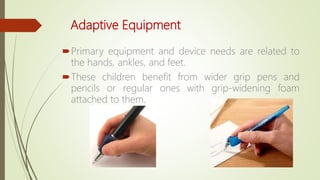
Primary equipment and device needs are related to
the hands, ankles, and feet.
These children benefit from wider grip pens and
pencils or regular ones with grip-widening foam
attached to them.
Adaptive Equipment
Some children benefit from early
use of computer or laptop use for
note taking.
More widespread academic use of
electronic tablets may provide
even more hand symptom relief.
THANK YOU…

Joint Hyper mobility Syndrome

  • 1.
    Joint Hyper mobility Syndromes -ByDr. Rima Jani (PT) (B.P.T., M.P.T. Pediatric Science)
  • 2.
    INTRODUCTION The joint hypermobilitysyndrome is a condition that features joints that easily move beyond the normal range expected for that particular joint. Hypermobile joints tend to be inherited. Symptoms of the joint hypermobility syndrome include : pain in the knees, fingers, hips, and elbows.
  • 5.
  • 6.
    EDS [Ehler DanlosSyndrome] is a disorder of collagen synthesis, primarily type V collagen. Incidence of 1:10,000. It’s a group of inherited disorders that mostly affect the skin, joints and blood vessels. It is characterized by joint hypermobility, skin hyper extensibility, and tissue fragility. INTRODUCTION
  • 7.
    Classification Formerly divided into14 distinct variations, there are now 7 accepted general classification types of EDS. However, the Classic and Hypermobility type account for 90% of all cases and involve mostly orthopedic complaints.
  • 8.
    Clinical Features Overly flexiblejoints that can dislocate, Skin that's translucent, elastic and bruises easily. In some cases : dilation and even rupture of major blood vessels.
  • 9.
    Management Treatment helps managesymptoms and monitor for complications. It includes:  Medications,  Physiotherapy &  Surgery
  • 10.
    Benign joint hypermobilitysyndrome (BJHS) It is also characterized by generalized joint laxity with musculoskeletal complaints. It is called “benign” owing to the absence of a specific genetic, musculoskeletal or rheumatic disorder. Often, joint hypermobility causes no symptoms and requires no treatment.
  • 11.
    Management Intervention focus andstrategies will depend on the patient’s age and severity of joint involvement. Most programs should include a combination of the following four areas: Targeted Therapeutic Exercise, Self-care & Home Management, Functional Training for recreation, school, or work & Orthoses or Adaptive Equipment.
  • 12.
    Marfan Syndrome Marfan syndromeis an inherited disorder that affects connective tissue — the fibers that support and anchor your organs and other structures in your body. It affects the heart, eyes, blood vessels and bones. People with Marfan syndrome are tall and thin with long arms, legs, fingers and toes. Incidence : Fewer than 1 million cases per year
  • 13.
    Clinical Features Tall andslender build. Disproportionately long arms, legs and fingers. A breastbone that protrudes outward or dips inward. A high, arched palate and crowded teeth. Heart murmurs. Extreme nearsightedness. An abnormally curved spine. Flat feet.
  • 15.
    Management Treatment includes medicationto keep blood pressure low, Glasses or contact lenses and Surgery Physiotherapy for pain management and stabilization exercises.
  • 16.
    Management of HypermobilitySyndrome Therapeutic exercises Orthoses Adaptive Equipment
  • 17.
    Therapeutic Exercises A combinationof strengthening and stabilization exercises. Glenohumeral joint and scapular stabilization and strengthening are important to combat recurrent subluxations. This reduction in subluxations also improves proximal stability to facilitate functional use of the hand and arm without recurrent pain.
  • 18.
  • 19.
  • 20.
  • 21.
    Foot & AnkleStrengthening Exercises Foot and ankle strengthening will promote stability and preserve foot function. Full hind foot ROM should be achieved, as Achilles tightness usually develops
  • 22.
    Foot & AnkleExercises
  • 23.
    Ankle & Footexercises
  • 24.
    Ankle & Footexercises
  • 25.
    Abdominal & TrunkStrengthening for overall proximal and lumbar stabilization is frequently necessary as low back pain is a common complaint.
  • 26.
    Abdominal & TrunkStrengthening
  • 27.
    Wrist & HandExercises Wrist and hand work should focus on small intrinsic muscle strengthening without joint hyperextension to facilitate hand use in fine motor tasks especially for school and work.
  • 28.
    Wrist & HandExercises
  • 29.
    The foot andankle should be protected as early as possible to prevent structural deformity associated with excessive pronation. Children with EDS and BJHS do well with custom and semi- customized shoe orthotics for mild-to-moderate foot hypermobility and light weight supramalleolar orthoses in severe cases. Orthoses
  • 30.
    Adaptive Equipment Primary equipmentand device needs are related to the hands, ankles, and feet. These children benefit from wider grip pens and pencils or regular ones with grip-widening foam attached to them.
  • 31.
    Adaptive Equipment Some childrenbenefit from early use of computer or laptop use for note taking. More widespread academic use of electronic tablets may provide even more hand symptom relief.
  • 32.