GIDEON ROBERT UNIVERSITY
SCHOOL OF MEDICINE AND NATURAL SCIENCES
GROUP THREE
PRESENTATION ON CEREBRAL PALSY
MEMBERS
LUCY NGOSA
MARGRET KATONGO
MIRRIAM TEBE
GLORIA KASHIKA
INTRODUCTION
• Cerebral palsy (CP) refer to the group of disorders that affect the
muscle movement and coordination
.In many cases cerebral palsy also affect vision hearing and
sensation
• The word cerebral means having to do with the brain. The word
palsy means weakness or problems with body movement
• Cerebral palsy is the most common cause of motor disabilities in
children
GENIRAL OBJECTIVES
• At the end of the presentation, students should gain knowledge
and understanding on cerebral palsy
• Student should be able to manage a patient with cerebral palsy
SPECIFIC OBJECTIVE
• Definition of cerebral palsy
• Signs and symptoms
• Pathophysiology
• Causes
• Risk factors
• Types of cerebral palsy
• Classifications
• Diagnosis
• Treatment
• Prevention
• Complications
Signs and symptoms
• The symptoms of cerebral palsy vary from person to person and
ranges from mild to sever.
• Some people with cerebral palsy may have difficulty walking and
sitting some trouble grasping objects
• The effect of the condition can become more or less obvious or
limiting as the child grows and develop motor skills.
• They also vary depending on the part of the brain affected.
Sign and symptoms
• Some of the most common symptoms includes;
• Delay in reaching motor, such us rolling over, sitting upright alone, or
crowling. skill milestons
• Difficulty walking
• Variation in muscles tone such as too floppy or too stiff
• Spasticity or stiff muscle and exaggerated reflexes
•
Signs and symptoms
• Ataxia or lack of muscle coordination
• Tremors or involuntary movements
• Delays in speech development and difficulty speaking
• Excessive drooling and problems with swallowing
• Favoring one side of the body the body such as reaching with one
hand
• Neurological issues such as seizures intellectual disabilities and
blindness
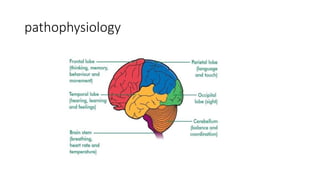
pathophysiology
• The brain is a complex organ that controls thoughts, memory,
emotion , touch, motor skills , breathing temperature hunger and
every process that regulates our body.
• The brain sends and receives electrical impulses or signals through
out the body
• Different signals control different processes and the brain interpret
them
• It consist of the lobes which have different functions.
pathophysiology
Causes of cerebral palsy
• In most cases the exactly cause is unknown
• Atypical brain development or injury to the developing brain can
cause cerebral palsy
• The damage affect the part of the brain that controls body
movements , coordination and posture
• This condition usually occurs before birth but it can also happen
during birth or the first year of life.
causes
• Some of the possible causes includes
• Head injuries as a result of car accidents , falls or child abuse
• Intracranial hemorrhage, or bleeding into the brain
• Brain infections such us encephalitis and meningitis
• Infections acquired in the womb, such us German measles (rubella)
and herpes simplex
causes
• Asphyxia neonatorum
• Gene mutations that result in atypical brain development
• Sever jaundice
Risk factors
• Premature birth
• Low birth weight
• A low APGAR score, which is used to assess a baby physical health at
birth.
• Breech birth . Which occur when the baby present with buttocks or
feet come out first
• Rh incompatibility, which occurs when the pregnant parent Rh type is
incompatible with their baby Rh blood type
• Exposure to toxic substances such us illegal drugs or medicines that
damage the fetus
• Being a twin or triplets.
Types of cerebral palsy
• SPASTIC CEREBRAL PALSE
• It causes stiff muscles and exaggerated reflexes, making it difficult to
walk.
• It is the most common type. Most people with this type have walking
abnormalities such us unintentionally crossing their knees or making
scissor like movements with their legs . Muscle weakness and
paralysis may be present. The symptoms can affect the entire body or
one side of the body.
Types of cerebral palsy
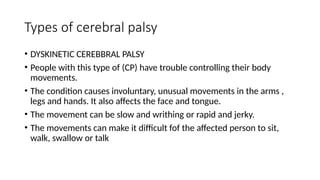
• DYSKINETIC CEREBBRAL PALSY
• People with this type of (CP) have trouble controlling their body
movements.
• The condition causes involuntary, unusual movements in the arms ,
legs and hands. It also affects the face and tongue.
• The movement can be slow and writhing or rapid and jerky.
• The movements can make it difficult fof the affected person to sit,
walk, swallow or talk
Types of cerebral palsy
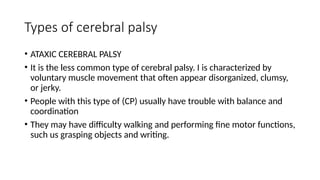
• ATAXIC CEREBRAL PALSY
• It is the less common type of cerebral palsy. I is characterized by
voluntary muscle movement that often appear disorganized, clumsy,
or jerky.
• People with this type of (CP) usually have trouble with balance and
coordination
• They may have difficulty walking and performing fine motor functions,
such us grasping objects and writing.
Types of cerebral palsy
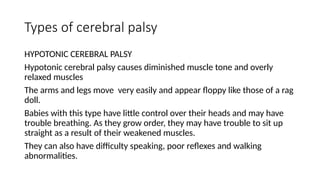
HYPOTONIC CEREBRAL PALSY
Hypotonic cerebral palsy causes diminished muscle tone and overly
relaxed muscles
The arms and legs move very easily and appear floppy like those of a rag
doll.
Babies with this type have little control over their heads and may have
trouble breathing. As they grow order, they may have trouble to sit up
straight as a result of their weakened muscles.
They can also have difficulty speaking, poor reflexes and walking
abnormalities.
Types of cerebral palsy
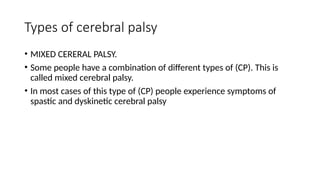
• MIXED CERERAL PALSY.
• Some people have a combination of different types of (CP). This is
called mixed cerebral palsy.
• In most cases of this type of (CP) people experience symptoms of
spastic and dyskinetic cerebral palsy
classifications
• LEVEL 1 CEREBRAL PALSY
• It is characterized by being able to talk without limitations
• LEVEL 2 CEREBRAL PALSY
• The person is able to walk long distance without limitations but
cannot run or jump.
• They may need assistive devices such as leg and arm braces, when
first learning to walk. They may also need a wheelchair to get around
outside of their home.
classification
• LEVEL 3 CEREBRAL PALSY
• The person can sit with little support and stand without any support
• They need handheld assistive devices such as, walker or can, while
walking indoors . They also need a wheelchair to get outside around
there home
• LEVEL 4 CEREBRAL PALSY
• A person with level 4 can walk with the use of assistive devices
• They are able to move independently in a wheelchair but need
assistance when sitting.
classifications
• LEVEL 5 CEREBRAL PALSY
• A person with level 5 cerebral palsy needs support to maintain their
head and neck position.
• They need support to sit and stand, and they may be able to control a
motorized wheelchair.
DIAGNOSIS
• Cerebral palsy is diagnosed by taking a complete medical history,
perform a physical examination that includes detailed neurological
exams, and evaluate the symptoms.
investigations
• The following additional tests may be done.
• ELECTROENCEPHALOGRAM (EEG) to evaluate electrical activity in the
brain
• This is done when someone is showing signs of epilepsy, a primary
cause of seizures.
• MAGNETIC RESONANCE IMAGES(MRI) to identify brain irregularities
or injury
• It takes detailed images of the brain using a powerful magnets and
radio waves.
investigations
• CT SCAN. To reveal brain damage
• It create a clear cross-section of the brain.
• ULTRASOUND. A cranial ultrasound is a method of using high
frequency sound waves to get basic images of the brain of the young
infant
• BLOOD TEST; in order to rule out other possible conditions such us
bleeding disorders.
investigations
• If a doctor confirms a cerebral palsy diagnosis , they may refer the
patient to a specialist who can test for neurological issues that are
often associated with the condition
• These tests may be, vision loss and impairment, deafness , speech
delay , intellectual disabilities
• Movement disorders.
treatment
• The goal of treatment is to improve limitations and prevent
complications
• Treatment may include assistive aid , medications and surgery.
treatment
• ASSISTIVE AIDS.
• Under assistive aids we can use the following
• Eyeglasses ,hearing aids, walking aids, body braces and wheelchairs.
• MEDICATIONS
• Muscle relaxants are commonly used to treat the symptoms of
spasticity. relaxing the muscle help reduce pain from muscle spasms.
treatment
• The drugs used are as follows
• Baclofen
• Dantrolene (dantrium)
• Diazepam (valium)
• Tizanidine (zanaflex)
• The doctor can also suggest either local injection of botulinum toxin
type A (Botox) or intrathecal baclofen therapy (gablofen lioresal),
where the drug is delivered through an implantable pump.
treatment
• SURGERY
• Orthopedic surgery may be used to relieve pain and improve mobility
• It may also be need to release tight muscles or correct bone
irregularities caused by spasticity.
• Selective dorsal rhizotomy might be recommended as the last resort
to reduce chronic pain or spasticity. It involves cutting nerves near the
base of the spinal column.
treatment
• Other treatment includes
• Speech therapy
• Occupational therapy
• Physical therapy
• Recreational therapy
• Counselling or psychosocial therapy
Prevention of cerebral palsy
• The majority of the condition that causes cerebral palsy can not be
prevented, however, pregnant women or those planning to become
pregnant can take preventive measures.
• Its important to get vaccinated against conditions that can cause fetal
brain damage such us German measles (rubella)
• Its also important to receive adequate anti nantal care, attending
regular appointments during pregnancy to prevent premature birth,
low birth weight and infections.
Complications of cerebral palsy
• People with cerebral palsy may have complication such us;
• Communicating difficulties , such as speech and language disorders
• Spinal issues, such as scoliosis, lordosis (swayback) and kyphosis
(hunchback)
• Osteoarthritis
• Contractures , which occur when the muscle get locked into painful
positions
• Osteopenia or poor bone density that can make bones easily break
• Dental problems and incontinence
Nursing managment
• ENVIROMENT
• I will nurse the patient in a quite friendly environment.
• I will nurse the patient in a deem light and void length exposure to television or
computer games to prevent precipitating a seizure .
• I will choice appropriate toys that match an individual child skills to play with to
play with since some individual children have difficult in gripping.
• I will institute seizure precautions such as keeping padded side rails up with the
bed in its lowest position to prevent falls incase seizure starts well on the bed.
• I will remove all tool or hazards to prevent injury
• I will put all resastetive equipment in place incase of emergency e.g O2
manegment
• POSITIONING
• I will position the patient in a recovery or confortable position to aid
in full lung expansion
• I will position my patient in upright position during feeding to
prevent Aspiration pneumonia since the child has poor swallowing.
management
NUTRITION
I will offer small frequent meals throughout the day, adequate time is
required between meals to allow natural swallowing.
I will offer soft blended foods by combining it with milk, juice, or both to
avoid aspirations.
I will thicken liquids to facilitate ease and safety swallowing
I will give adequate fluids and high fiber foods such as vegetables, cereals,
fruits to prevent constipation
I will offer high protein supplements based individual needs and capacities
so as to increase calories.
Exercise and rest
• I will perform range of motion exercises every 4 hours for the child
unable to move body parts to promote movements and prevent risks
of contractures
Promoting effective communication
• I will maintain a calm unhurried manner, so as to provide ample time
for the child to respond.
• I will keep distractions such as television , radio at a minimum volume
when talking to the child to promote focus and prevent stimuli going
to the brain for interpretations.
• I will provide alternative means of communication such has flash
cards, hand signs, or pictures boards to allow client to express oneself
speaking is difficulty
• I will learn patient needs and pay attention to non verbal cues to
promote effective communication
Effective communication
• I will involve family and significant others in planning of the care as
much as possible to gain cooperation thereby allaying axiety.
• I will coordinate the child with speech therapy for the child to learn
how to speak slowly and how to coordinate their lips and tongue o
form speech sound.
hygiene
• I will assess the patient current abilities and limitations related to
activities of daily living such as feeding , grooming, dressing and
toileting.
• I will assist the patient to perform grooming activities such as
brushing teeth, washing face of bathing, using the toilet to promote
hygiene
• I will allow the child to finish self care activities to promote there
confidence and a feeling of self worth.
medications
• I will administer Anticholinergic s e.g Benztropine mesylate as per
prescription to treat muscle stiffness. Uncontrolled body movements
such as tremors, and spasms
• Muscle relaxants such as banclofen lioresal
• Anticonvulsants such as gabapentin to reduce or prevent seizures.
Psychological care
• I will explain the disease process to the family to allay anxiety
• I will explain all the procedures and why doing them to allay anxiety
there by promoting cooperation
• I will explain the medical cruel to be involved to allay anxiety.
ICE
• I will explain the condition to the family to allay anxiety
• I will explain to the parent and child on the stimuli that can trigger a seizure
such as bright flashing light, exposure to television.
• I will educate the parent and child on the importance of adhering to
treatment .
• I will educate the parents on the causes of cerebral palsy and risk factors to
allay anxiety
• I will educate the parents, child on the diet to prevent malnutrition.
• I will educate the child and parent on how to use orthotic devices, to help
build stability while increasing strength, balance, comfort and independence.
TAKEWAY
• The onset of cerebral palsy is either before birth or in early child hood
• With proper diagnosis and treatment, many people with cerebral
palsy are able to live full independent lives.
THE END

CEREBRAL PAISY PRESENTATION nursing .pptx

  • 1.
    GIDEON ROBERT UNIVERSITY SCHOOLOF MEDICINE AND NATURAL SCIENCES GROUP THREE PRESENTATION ON CEREBRAL PALSY MEMBERS LUCY NGOSA MARGRET KATONGO MIRRIAM TEBE GLORIA KASHIKA
  • 2.
    INTRODUCTION • Cerebral palsy(CP) refer to the group of disorders that affect the muscle movement and coordination .In many cases cerebral palsy also affect vision hearing and sensation • The word cerebral means having to do with the brain. The word palsy means weakness or problems with body movement • Cerebral palsy is the most common cause of motor disabilities in children
  • 3.
    GENIRAL OBJECTIVES • Atthe end of the presentation, students should gain knowledge and understanding on cerebral palsy • Student should be able to manage a patient with cerebral palsy
  • 4.
    SPECIFIC OBJECTIVE • Definitionof cerebral palsy • Signs and symptoms • Pathophysiology • Causes • Risk factors • Types of cerebral palsy • Classifications • Diagnosis • Treatment • Prevention • Complications
  • 5.
    Signs and symptoms •The symptoms of cerebral palsy vary from person to person and ranges from mild to sever. • Some people with cerebral palsy may have difficulty walking and sitting some trouble grasping objects • The effect of the condition can become more or less obvious or limiting as the child grows and develop motor skills. • They also vary depending on the part of the brain affected.
  • 6.
    Sign and symptoms •Some of the most common symptoms includes; • Delay in reaching motor, such us rolling over, sitting upright alone, or crowling. skill milestons • Difficulty walking • Variation in muscles tone such as too floppy or too stiff • Spasticity or stiff muscle and exaggerated reflexes •
  • 7.
    Signs and symptoms •Ataxia or lack of muscle coordination • Tremors or involuntary movements • Delays in speech development and difficulty speaking • Excessive drooling and problems with swallowing • Favoring one side of the body the body such as reaching with one hand • Neurological issues such as seizures intellectual disabilities and blindness
  • 8.
    pathophysiology • The brainis a complex organ that controls thoughts, memory, emotion , touch, motor skills , breathing temperature hunger and every process that regulates our body. • The brain sends and receives electrical impulses or signals through out the body • Different signals control different processes and the brain interpret them • It consist of the lobes which have different functions.
  • 9.
  • 10.
    Causes of cerebralpalsy • In most cases the exactly cause is unknown • Atypical brain development or injury to the developing brain can cause cerebral palsy • The damage affect the part of the brain that controls body movements , coordination and posture • This condition usually occurs before birth but it can also happen during birth or the first year of life.
  • 11.
    causes • Some ofthe possible causes includes • Head injuries as a result of car accidents , falls or child abuse • Intracranial hemorrhage, or bleeding into the brain • Brain infections such us encephalitis and meningitis • Infections acquired in the womb, such us German measles (rubella) and herpes simplex
  • 12.
    causes • Asphyxia neonatorum •Gene mutations that result in atypical brain development • Sever jaundice
  • 13.
    Risk factors • Prematurebirth • Low birth weight • A low APGAR score, which is used to assess a baby physical health at birth. • Breech birth . Which occur when the baby present with buttocks or feet come out first • Rh incompatibility, which occurs when the pregnant parent Rh type is incompatible with their baby Rh blood type • Exposure to toxic substances such us illegal drugs or medicines that damage the fetus • Being a twin or triplets.
  • 14.
    Types of cerebralpalsy • SPASTIC CEREBRAL PALSE • It causes stiff muscles and exaggerated reflexes, making it difficult to walk. • It is the most common type. Most people with this type have walking abnormalities such us unintentionally crossing their knees or making scissor like movements with their legs . Muscle weakness and paralysis may be present. The symptoms can affect the entire body or one side of the body.
  • 15.
    Types of cerebralpalsy • DYSKINETIC CEREBBRAL PALSY • People with this type of (CP) have trouble controlling their body movements. • The condition causes involuntary, unusual movements in the arms , legs and hands. It also affects the face and tongue. • The movement can be slow and writhing or rapid and jerky. • The movements can make it difficult fof the affected person to sit, walk, swallow or talk
  • 16.
    Types of cerebralpalsy • ATAXIC CEREBRAL PALSY • It is the less common type of cerebral palsy. I is characterized by voluntary muscle movement that often appear disorganized, clumsy, or jerky. • People with this type of (CP) usually have trouble with balance and coordination • They may have difficulty walking and performing fine motor functions, such us grasping objects and writing.
  • 17.
    Types of cerebralpalsy HYPOTONIC CEREBRAL PALSY Hypotonic cerebral palsy causes diminished muscle tone and overly relaxed muscles The arms and legs move very easily and appear floppy like those of a rag doll. Babies with this type have little control over their heads and may have trouble breathing. As they grow order, they may have trouble to sit up straight as a result of their weakened muscles. They can also have difficulty speaking, poor reflexes and walking abnormalities.
  • 18.
    Types of cerebralpalsy • MIXED CERERAL PALSY. • Some people have a combination of different types of (CP). This is called mixed cerebral palsy. • In most cases of this type of (CP) people experience symptoms of spastic and dyskinetic cerebral palsy
  • 19.
    classifications • LEVEL 1CEREBRAL PALSY • It is characterized by being able to talk without limitations • LEVEL 2 CEREBRAL PALSY • The person is able to walk long distance without limitations but cannot run or jump. • They may need assistive devices such as leg and arm braces, when first learning to walk. They may also need a wheelchair to get around outside of their home.
  • 20.
    classification • LEVEL 3CEREBRAL PALSY • The person can sit with little support and stand without any support • They need handheld assistive devices such as, walker or can, while walking indoors . They also need a wheelchair to get outside around there home • LEVEL 4 CEREBRAL PALSY • A person with level 4 can walk with the use of assistive devices • They are able to move independently in a wheelchair but need assistance when sitting.
  • 21.
    classifications • LEVEL 5CEREBRAL PALSY • A person with level 5 cerebral palsy needs support to maintain their head and neck position. • They need support to sit and stand, and they may be able to control a motorized wheelchair.
  • 22.
    DIAGNOSIS • Cerebral palsyis diagnosed by taking a complete medical history, perform a physical examination that includes detailed neurological exams, and evaluate the symptoms.
  • 23.
    investigations • The followingadditional tests may be done. • ELECTROENCEPHALOGRAM (EEG) to evaluate electrical activity in the brain • This is done when someone is showing signs of epilepsy, a primary cause of seizures. • MAGNETIC RESONANCE IMAGES(MRI) to identify brain irregularities or injury • It takes detailed images of the brain using a powerful magnets and radio waves.
  • 24.
    investigations • CT SCAN.To reveal brain damage • It create a clear cross-section of the brain. • ULTRASOUND. A cranial ultrasound is a method of using high frequency sound waves to get basic images of the brain of the young infant • BLOOD TEST; in order to rule out other possible conditions such us bleeding disorders.
  • 25.
    investigations • If adoctor confirms a cerebral palsy diagnosis , they may refer the patient to a specialist who can test for neurological issues that are often associated with the condition • These tests may be, vision loss and impairment, deafness , speech delay , intellectual disabilities • Movement disorders.
  • 26.
    treatment • The goalof treatment is to improve limitations and prevent complications • Treatment may include assistive aid , medications and surgery.
  • 27.
    treatment • ASSISTIVE AIDS. •Under assistive aids we can use the following • Eyeglasses ,hearing aids, walking aids, body braces and wheelchairs. • MEDICATIONS • Muscle relaxants are commonly used to treat the symptoms of spasticity. relaxing the muscle help reduce pain from muscle spasms.
  • 28.
    treatment • The drugsused are as follows • Baclofen • Dantrolene (dantrium) • Diazepam (valium) • Tizanidine (zanaflex) • The doctor can also suggest either local injection of botulinum toxin type A (Botox) or intrathecal baclofen therapy (gablofen lioresal), where the drug is delivered through an implantable pump.
  • 29.
    treatment • SURGERY • Orthopedicsurgery may be used to relieve pain and improve mobility • It may also be need to release tight muscles or correct bone irregularities caused by spasticity. • Selective dorsal rhizotomy might be recommended as the last resort to reduce chronic pain or spasticity. It involves cutting nerves near the base of the spinal column.
  • 30.
    treatment • Other treatmentincludes • Speech therapy • Occupational therapy • Physical therapy • Recreational therapy • Counselling or psychosocial therapy
  • 31.
    Prevention of cerebralpalsy • The majority of the condition that causes cerebral palsy can not be prevented, however, pregnant women or those planning to become pregnant can take preventive measures. • Its important to get vaccinated against conditions that can cause fetal brain damage such us German measles (rubella) • Its also important to receive adequate anti nantal care, attending regular appointments during pregnancy to prevent premature birth, low birth weight and infections.
  • 32.
    Complications of cerebralpalsy • People with cerebral palsy may have complication such us; • Communicating difficulties , such as speech and language disorders • Spinal issues, such as scoliosis, lordosis (swayback) and kyphosis (hunchback) • Osteoarthritis • Contractures , which occur when the muscle get locked into painful positions • Osteopenia or poor bone density that can make bones easily break • Dental problems and incontinence
  • 33.
    Nursing managment • ENVIROMENT •I will nurse the patient in a quite friendly environment. • I will nurse the patient in a deem light and void length exposure to television or computer games to prevent precipitating a seizure . • I will choice appropriate toys that match an individual child skills to play with to play with since some individual children have difficult in gripping. • I will institute seizure precautions such as keeping padded side rails up with the bed in its lowest position to prevent falls incase seizure starts well on the bed. • I will remove all tool or hazards to prevent injury • I will put all resastetive equipment in place incase of emergency e.g O2
  • 34.
    manegment • POSITIONING • Iwill position the patient in a recovery or confortable position to aid in full lung expansion • I will position my patient in upright position during feeding to prevent Aspiration pneumonia since the child has poor swallowing.
  • 35.
    management NUTRITION I will offersmall frequent meals throughout the day, adequate time is required between meals to allow natural swallowing. I will offer soft blended foods by combining it with milk, juice, or both to avoid aspirations. I will thicken liquids to facilitate ease and safety swallowing I will give adequate fluids and high fiber foods such as vegetables, cereals, fruits to prevent constipation I will offer high protein supplements based individual needs and capacities so as to increase calories.
  • 36.
    Exercise and rest •I will perform range of motion exercises every 4 hours for the child unable to move body parts to promote movements and prevent risks of contractures
  • 37.
    Promoting effective communication •I will maintain a calm unhurried manner, so as to provide ample time for the child to respond. • I will keep distractions such as television , radio at a minimum volume when talking to the child to promote focus and prevent stimuli going to the brain for interpretations. • I will provide alternative means of communication such has flash cards, hand signs, or pictures boards to allow client to express oneself speaking is difficulty • I will learn patient needs and pay attention to non verbal cues to promote effective communication
  • 38.
    Effective communication • Iwill involve family and significant others in planning of the care as much as possible to gain cooperation thereby allaying axiety. • I will coordinate the child with speech therapy for the child to learn how to speak slowly and how to coordinate their lips and tongue o form speech sound.
  • 39.
    hygiene • I willassess the patient current abilities and limitations related to activities of daily living such as feeding , grooming, dressing and toileting. • I will assist the patient to perform grooming activities such as brushing teeth, washing face of bathing, using the toilet to promote hygiene • I will allow the child to finish self care activities to promote there confidence and a feeling of self worth.
  • 40.
    medications • I willadminister Anticholinergic s e.g Benztropine mesylate as per prescription to treat muscle stiffness. Uncontrolled body movements such as tremors, and spasms • Muscle relaxants such as banclofen lioresal • Anticonvulsants such as gabapentin to reduce or prevent seizures.
  • 41.
    Psychological care • Iwill explain the disease process to the family to allay anxiety • I will explain all the procedures and why doing them to allay anxiety there by promoting cooperation • I will explain the medical cruel to be involved to allay anxiety.
  • 42.
    ICE • I willexplain the condition to the family to allay anxiety • I will explain to the parent and child on the stimuli that can trigger a seizure such as bright flashing light, exposure to television. • I will educate the parent and child on the importance of adhering to treatment . • I will educate the parents on the causes of cerebral palsy and risk factors to allay anxiety • I will educate the parents, child on the diet to prevent malnutrition. • I will educate the child and parent on how to use orthotic devices, to help build stability while increasing strength, balance, comfort and independence.
  • 43.
    TAKEWAY • The onsetof cerebral palsy is either before birth or in early child hood • With proper diagnosis and treatment, many people with cerebral palsy are able to live full independent lives.

  • 44.