HEMIPLEGIC GAIT
REHABILITATION
-By Dr. Rima Jani PT (B.P.T., M.P.T.)
HEMIPLEGIC GAIT
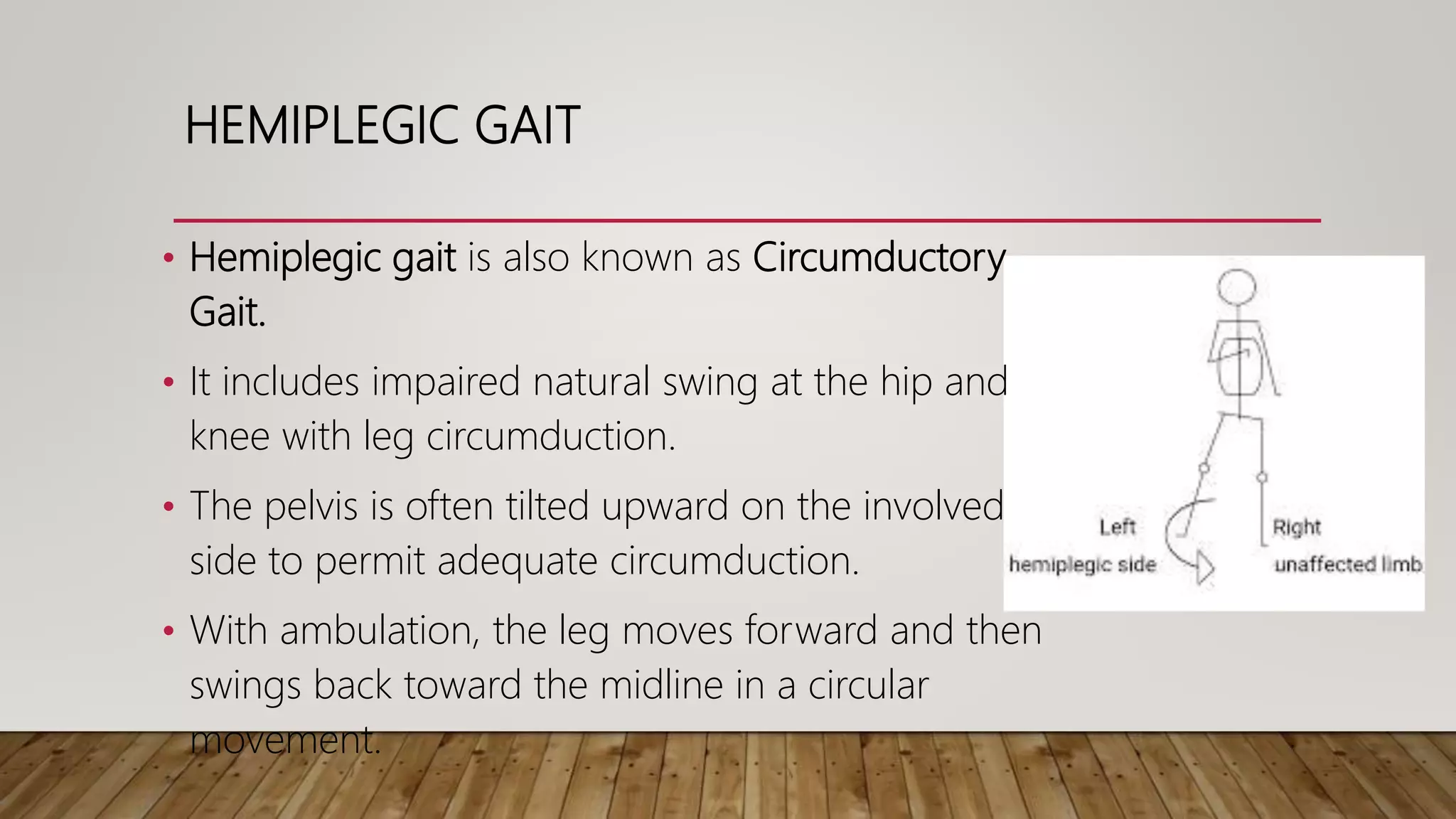
• Hemiplegic gait is also known as Circumductory
Gait.
• It includes impaired natural swing at the hip and
knee with leg circumduction.
• The pelvis is often tilted upward on the involved
side to permit adequate circumduction.
• With ambulation, the leg moves forward and then
swings back toward the midline in a circular
movement.
COMPONENTS OF
HEMIPLEGIC/CIRCUMDUCTORY GAIT
• Hip Hike
• Circumduction of the leg
• Reduced hip & knee flexion
• Decreased weight shift towards affected side
• Foot drop, poor dorsiflexion, toe first or flat foot placement
HEMIPLEGIC GAIT REHABILITATION
Traditional Gait Rehabilitation
High Tech Gait Rehabilitation
Additional Strength Training
Improving UE movement Pattern
TRADITIONAL GAIT REHABILITATION :
• Gait Training in parallel bar
• Gait Training exercises
• Balance and core training
• Use of Assistive devices &/or Orthotics
• Task-specific training.
• Treadmill Training
GAIT TRAINING IN PARALLEL BAR
• Parallel bars are used to assist individuals to re-learn to walk and
for gait training, as well as to regain balance, strength, range of
motion, and mobility.
GAIT TRAINING EXERCISES
• Seated Marching
• Knee Extension
Exercises
• Toe Taps
• Braiding Exercises
• Side Stepping
• Ankle Dorsiflexion
Exercises
• Assisted Toe Raise
• Heel Raises
SEATED MARCHING
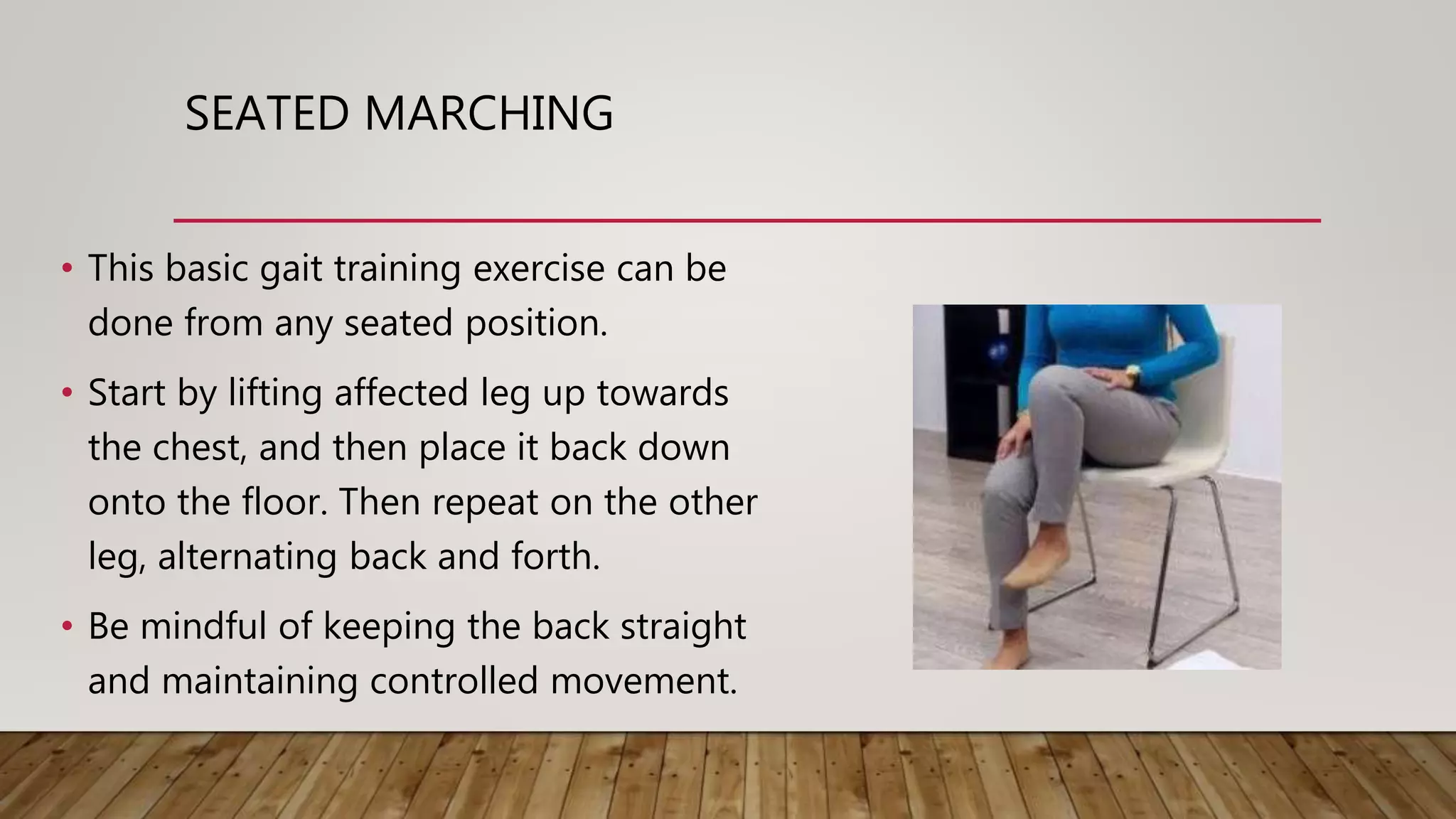
• This basic gait training exercise can be
done from any seated position.
• Start by lifting affected leg up towards
the chest, and then place it back down
onto the floor. Then repeat on the other
leg, alternating back and forth.
• Be mindful of keeping the back straight
and maintaining controlled movement.
KNEE EXTENSION EXERCISES
• Knee extensions are a classic gait training
exercise because knees are constantly bending
during walking.
• To perform this exercise, start from a seated
position. Then extend one leg out in front
parallel to the floor. Do it on both side in
alternate pattern.
• Try to avoid locking the knee completely and
keep a soft bend.
TOE TAPS
• While lying on back, lift legs up and bend the knees
at a 90 degree angle. Shins should be parallel to
the floor and core should be fully engaged.
• From there, bring the left leg down and gently tap
the floor with left foot. Then, bring leg back up.
• Focus on using core muscles instead of just legs.
Maintain a 90 degree bend in the knee the entire
time.
• Repeat on the other leg and alternate between each
leg.
BRAIDING EXERCISE
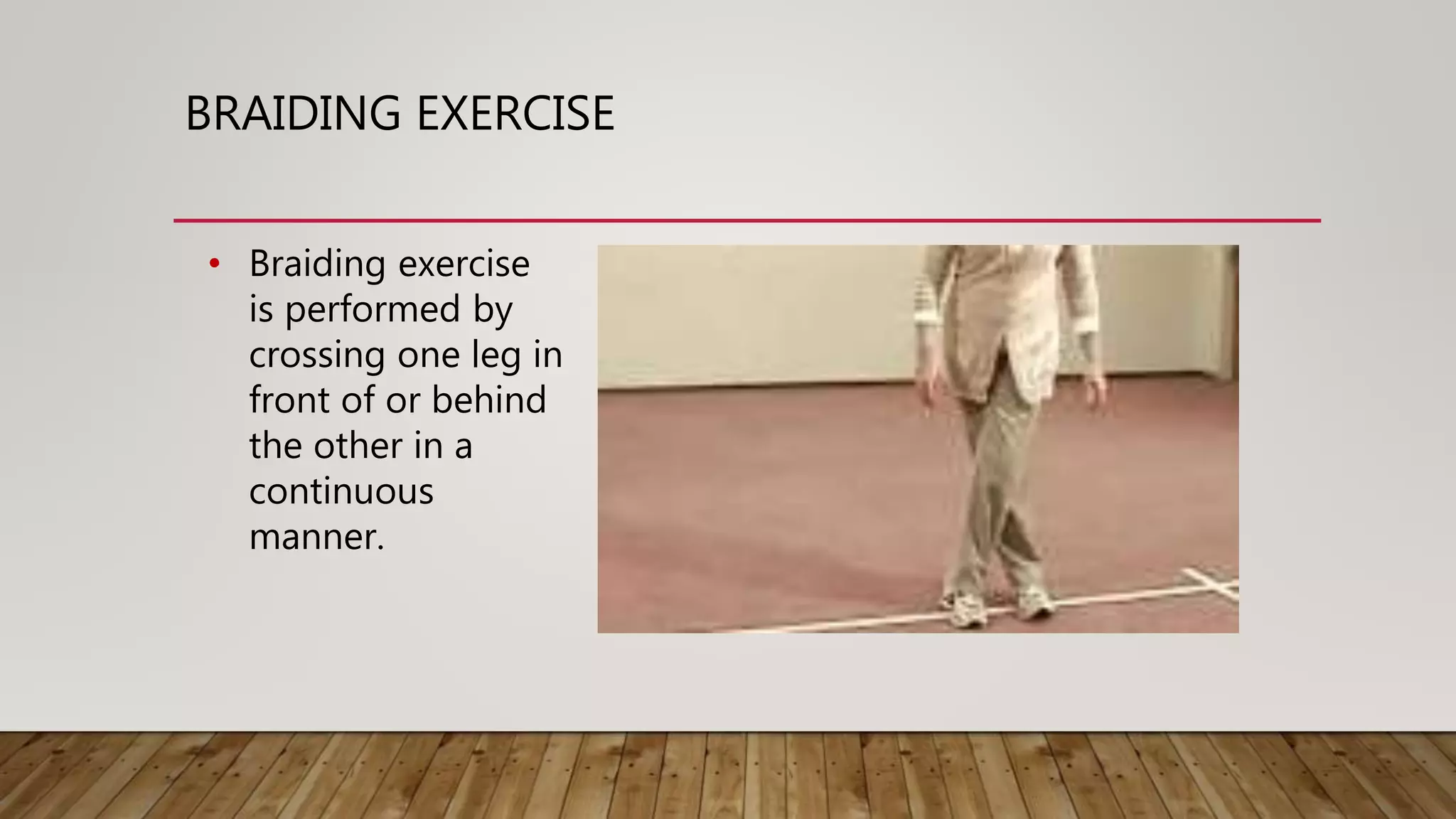
• Braiding exercise
is performed by
crossing one leg in
front of or behind
the other in a
continuous
manner.
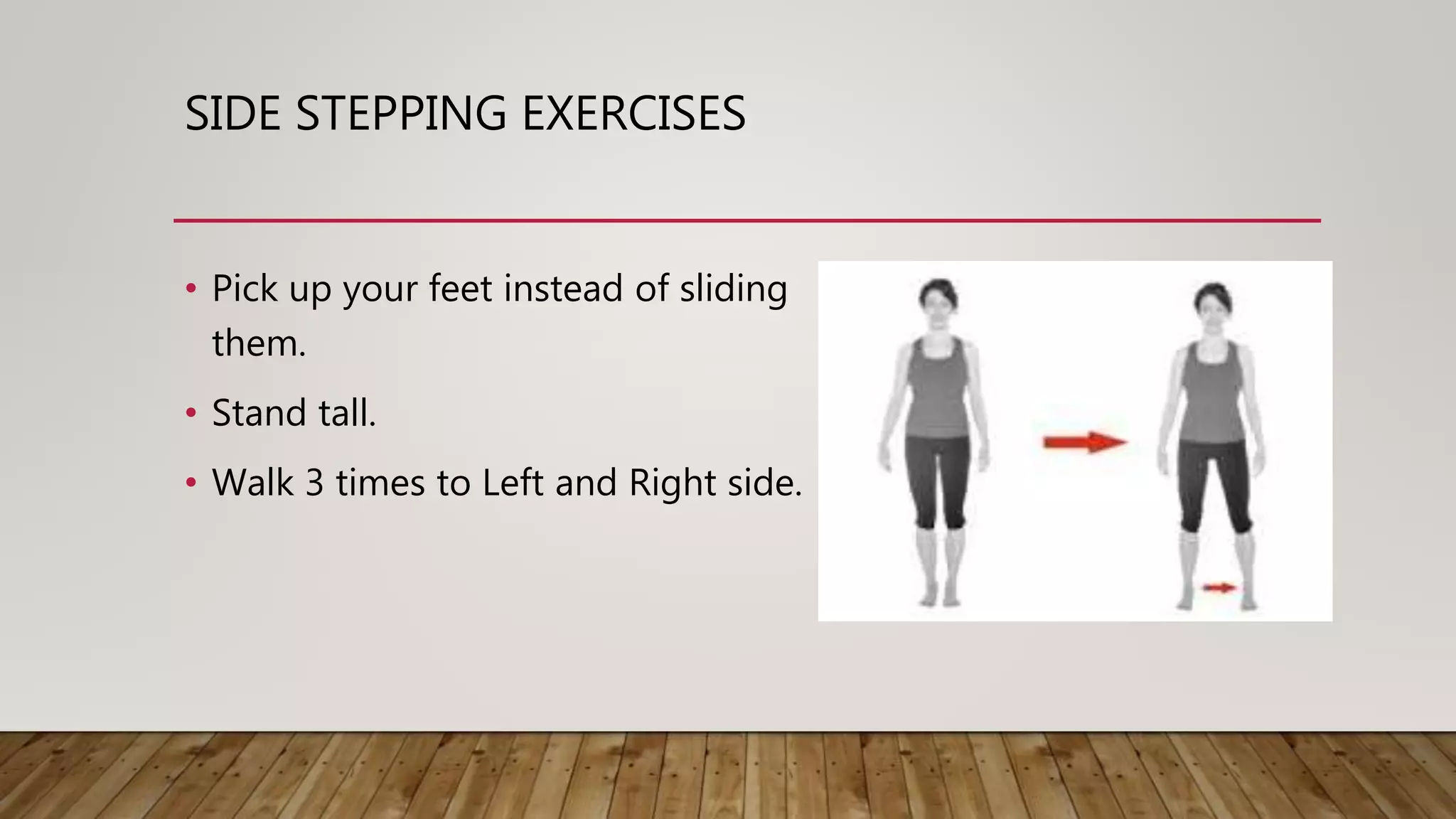
SIDE STEPPING EXERCISES
• Pick up your feet instead of sliding
them.
• Stand tall.
• Walk 3 times to Left and Right side.
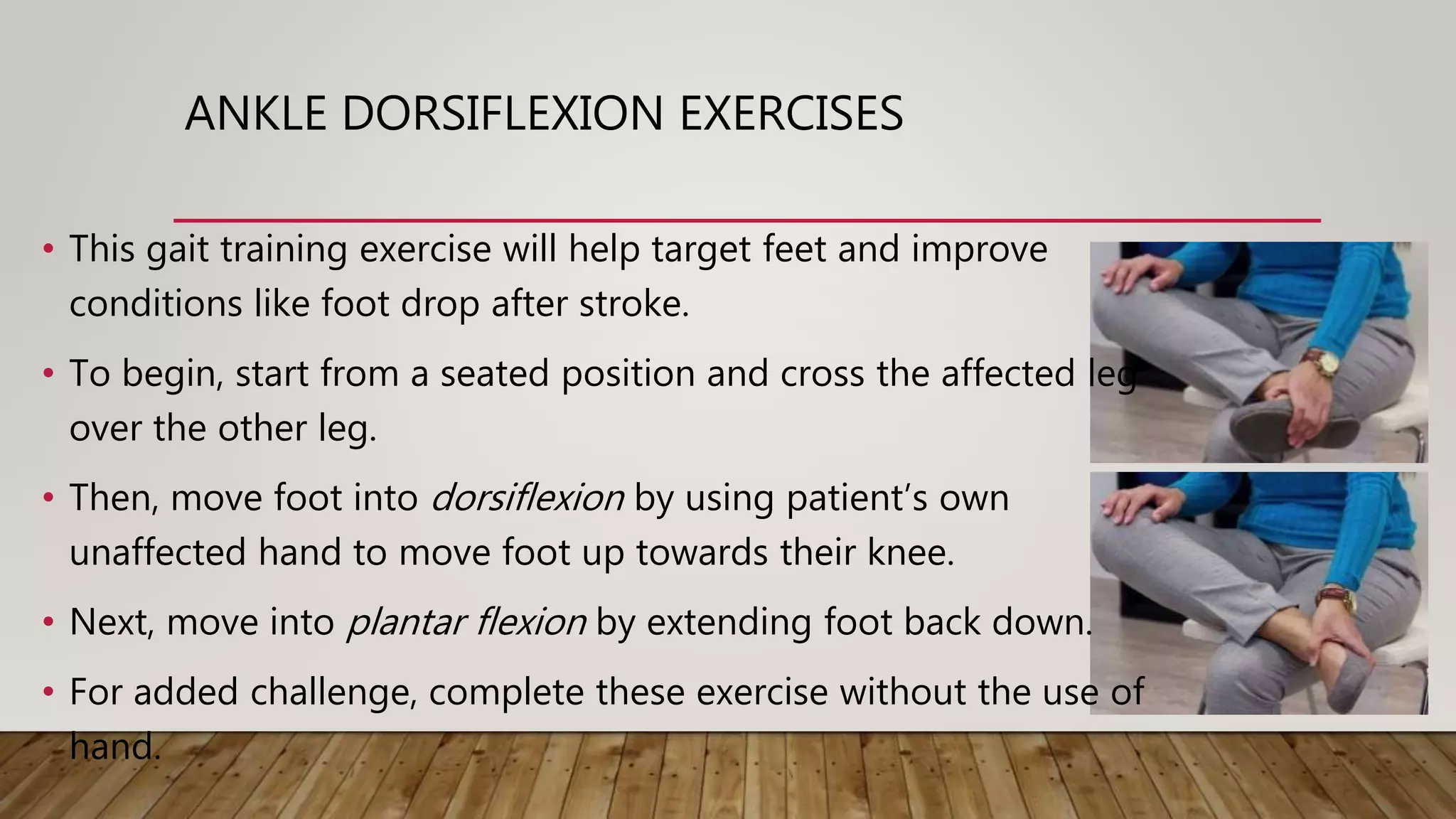
ANKLE DORSIFLEXION EXERCISES
• This gait training exercise will help target feet and improve
conditions like foot drop after stroke.
• To begin, start from a seated position and cross the affected leg
over the other leg.
• Then, move foot into dorsiflexion by using patient’s own
unaffected hand to move foot up towards their knee.
• Next, move into plantar flexion by extending foot back down.
• For added challenge, complete these exercise without the use of
hand.
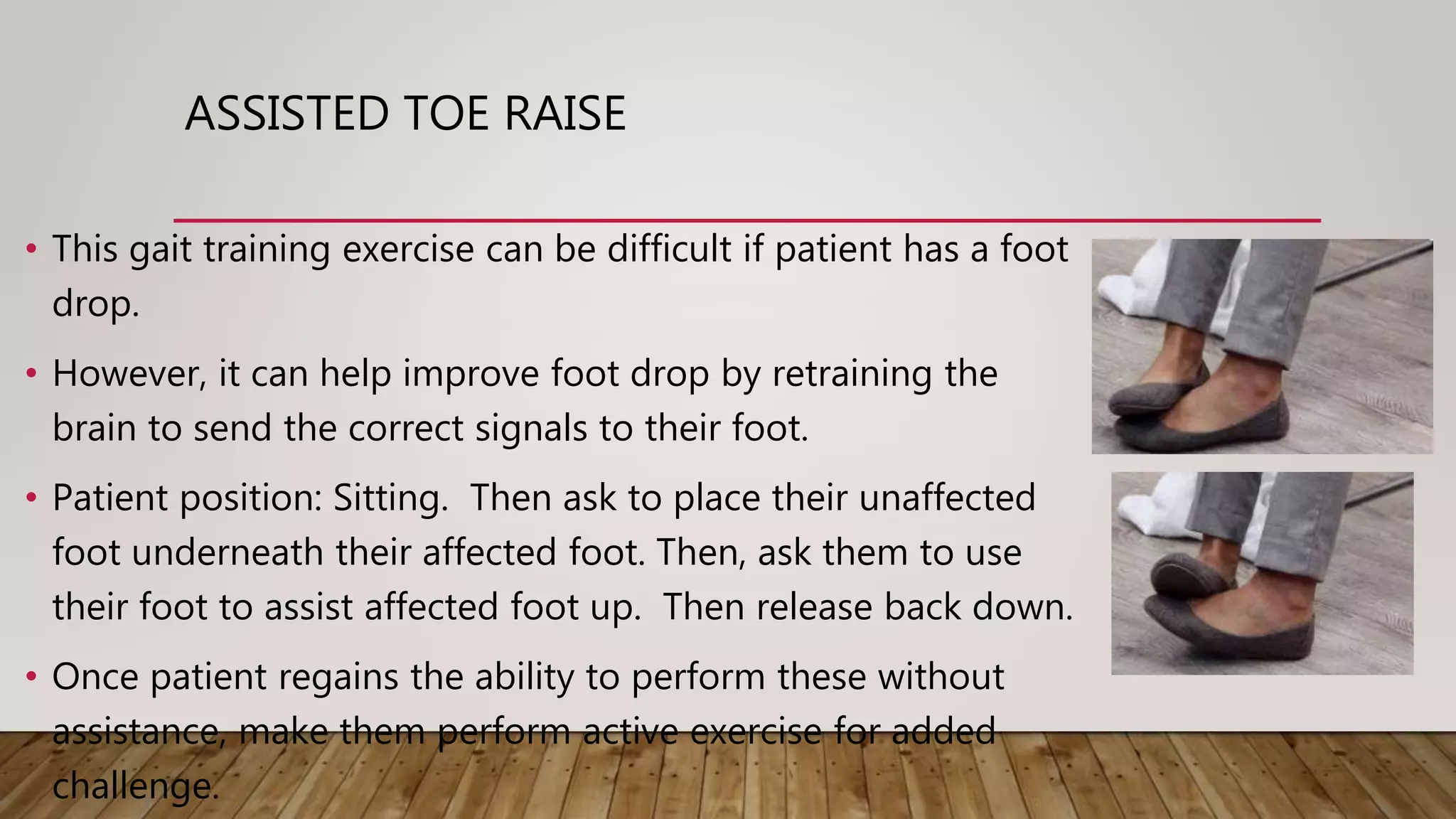
ASSISTED TOE RAISE
• This gait training exercise can be difficult if patient has a foot
drop.
• However, it can help improve foot drop by retraining the
brain to send the correct signals to their foot.
• Patient position: Sitting. Then ask to place their unaffected
foot underneath their affected foot. Then, ask them to use
their foot to assist affected foot up. Then release back down.
• Once patient regains the ability to perform these without
assistance, make them perform active exercise for added
challenge.
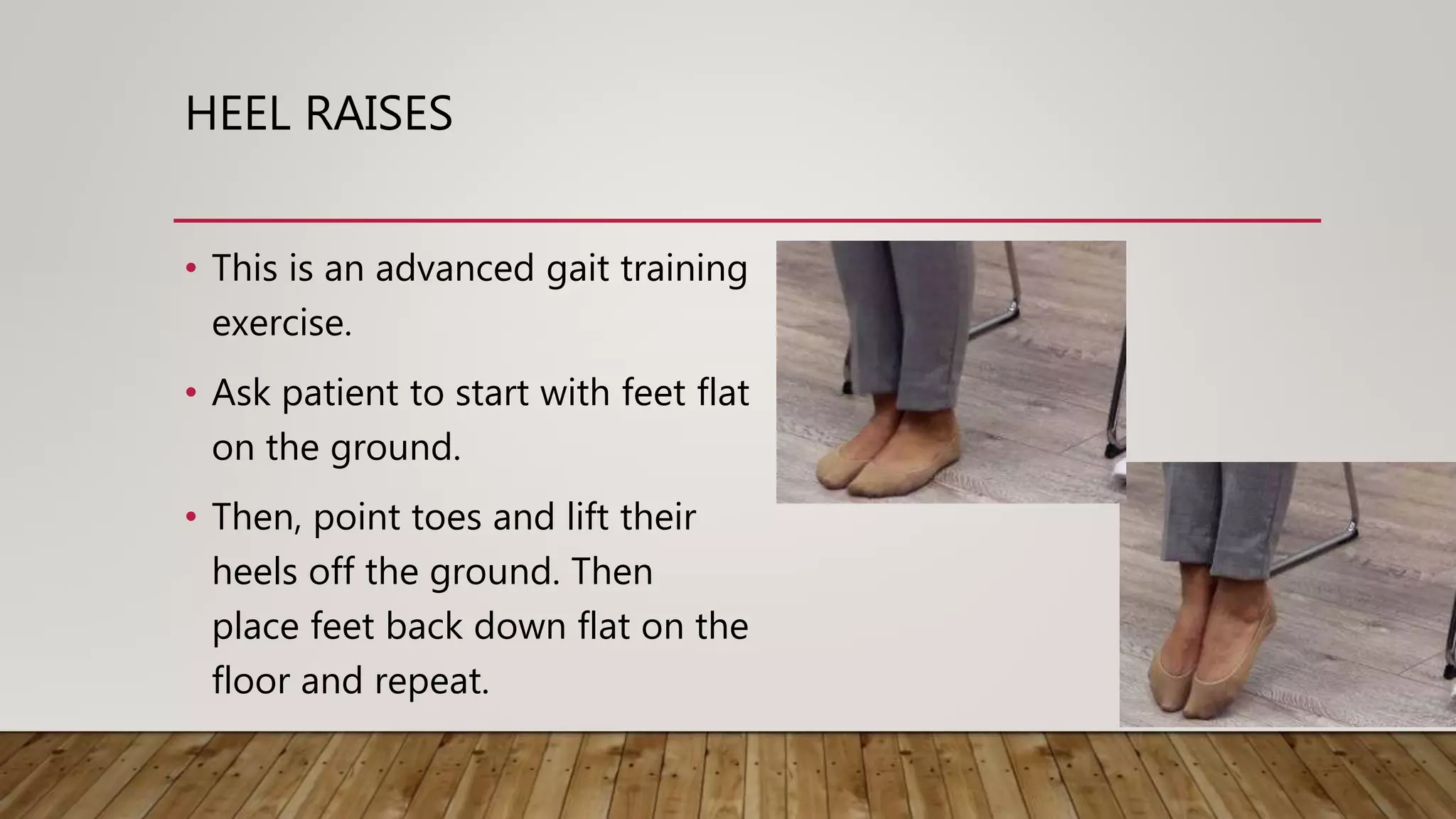
HEEL RAISES
• This is an advanced gait training
exercise.
• Ask patient to start with feet flat
on the ground.
• Then, point toes and lift their
heels off the ground. Then
place feet back down flat on the
floor and repeat.
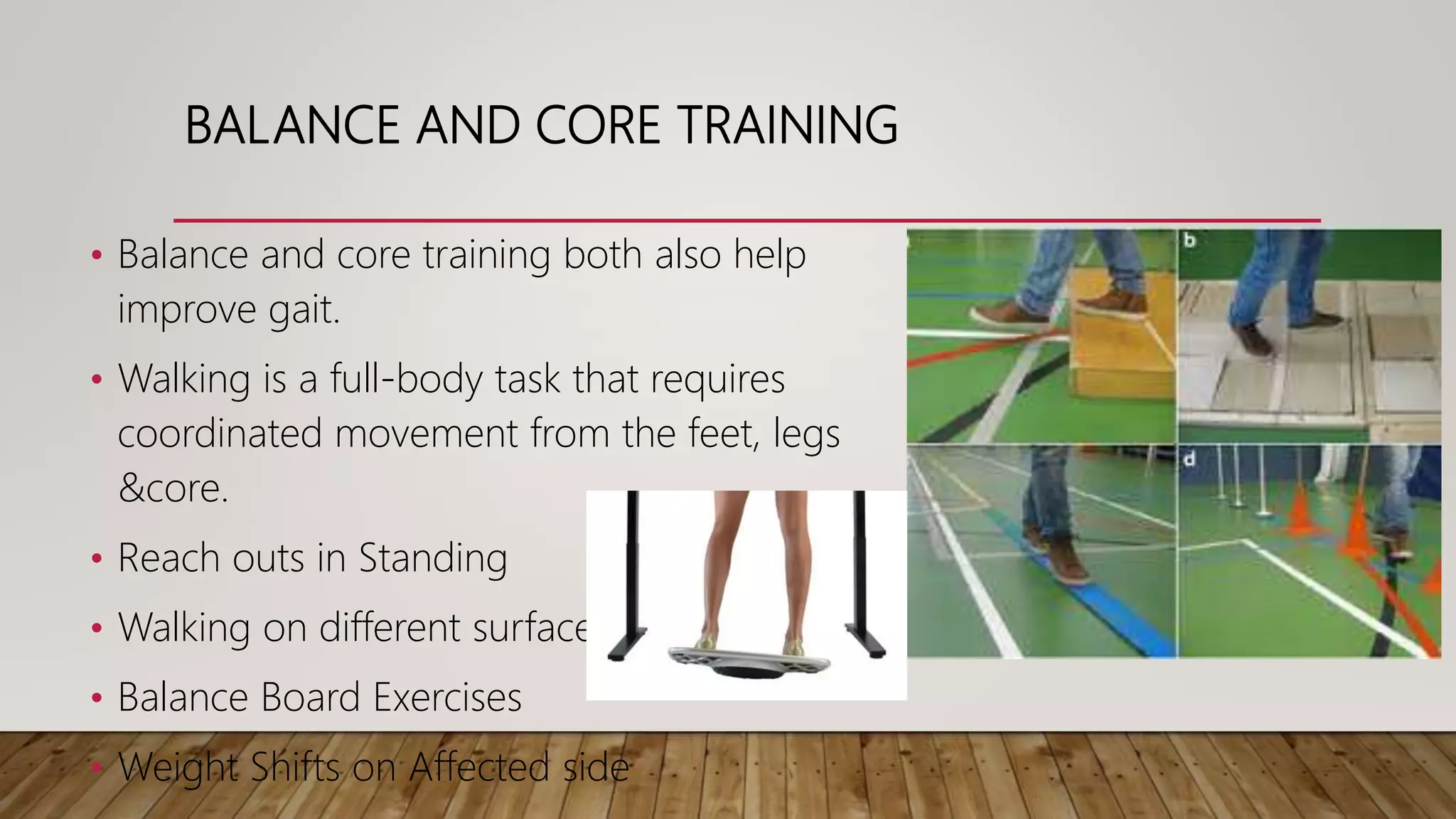
BALANCE AND CORE TRAINING
• Balance and core training both also help
improve gait.
• Walking is a full-body task that requires
coordinated movement from the feet, legs
&core.
• Reach outs in Standing
• Walking on different surfaces
• Balance Board Exercises
• Weight Shifts on Affected side
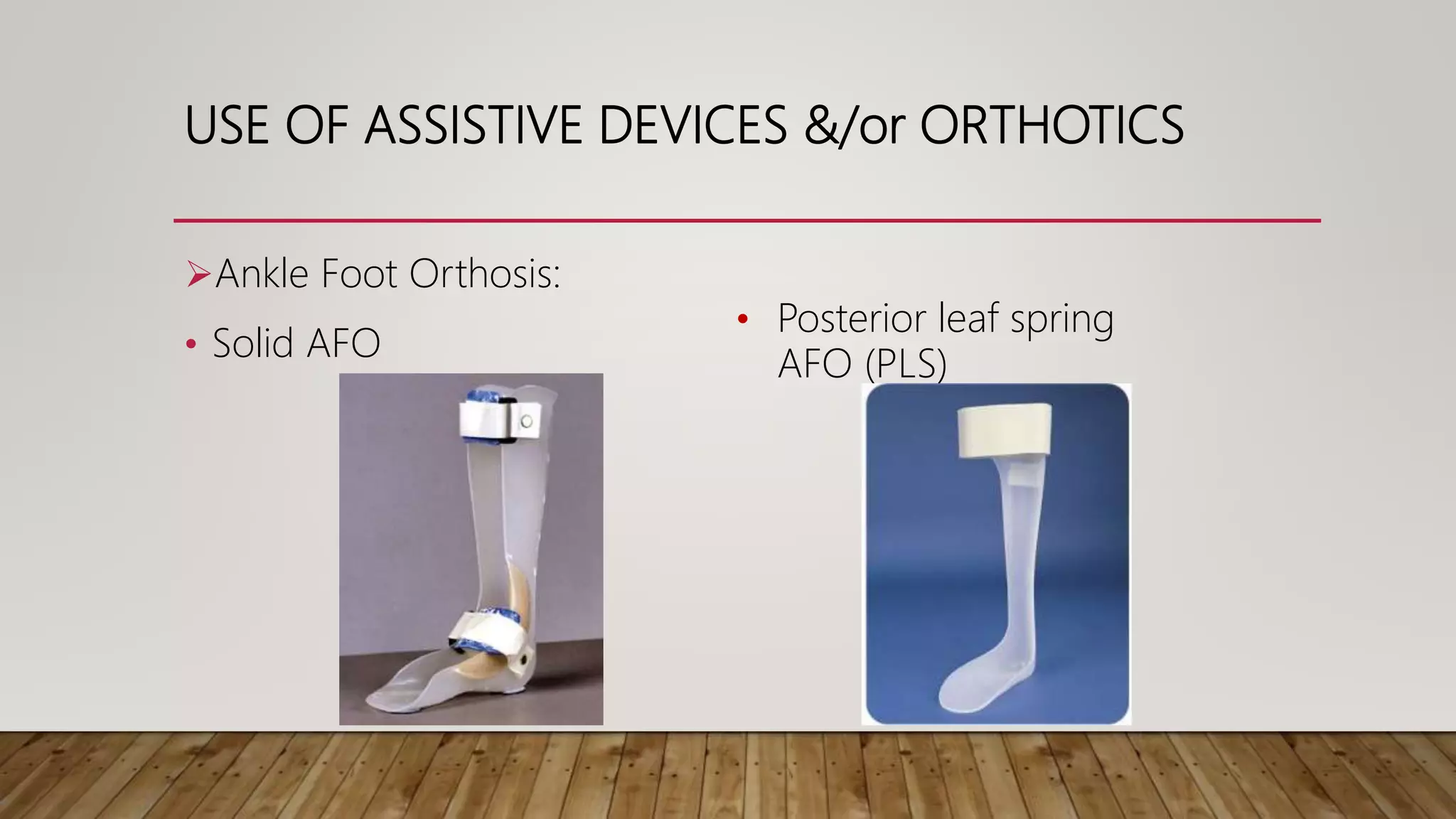
USE OF ASSISTIVE DEVICES &/or ORTHOTICS
Ankle Foot Orthosis:
• Solid AFO
• Posterior leaf spring
AFO (PLS)
TREADMILL TRAINING
• Once patient gains postural stability
than treadmill training without BWS
can be started.
• Initially treadmill speeds are slow
(0.23 m/sec)
• Over a period of few weeks it is
gradually increased up to (0.98
m/sec)
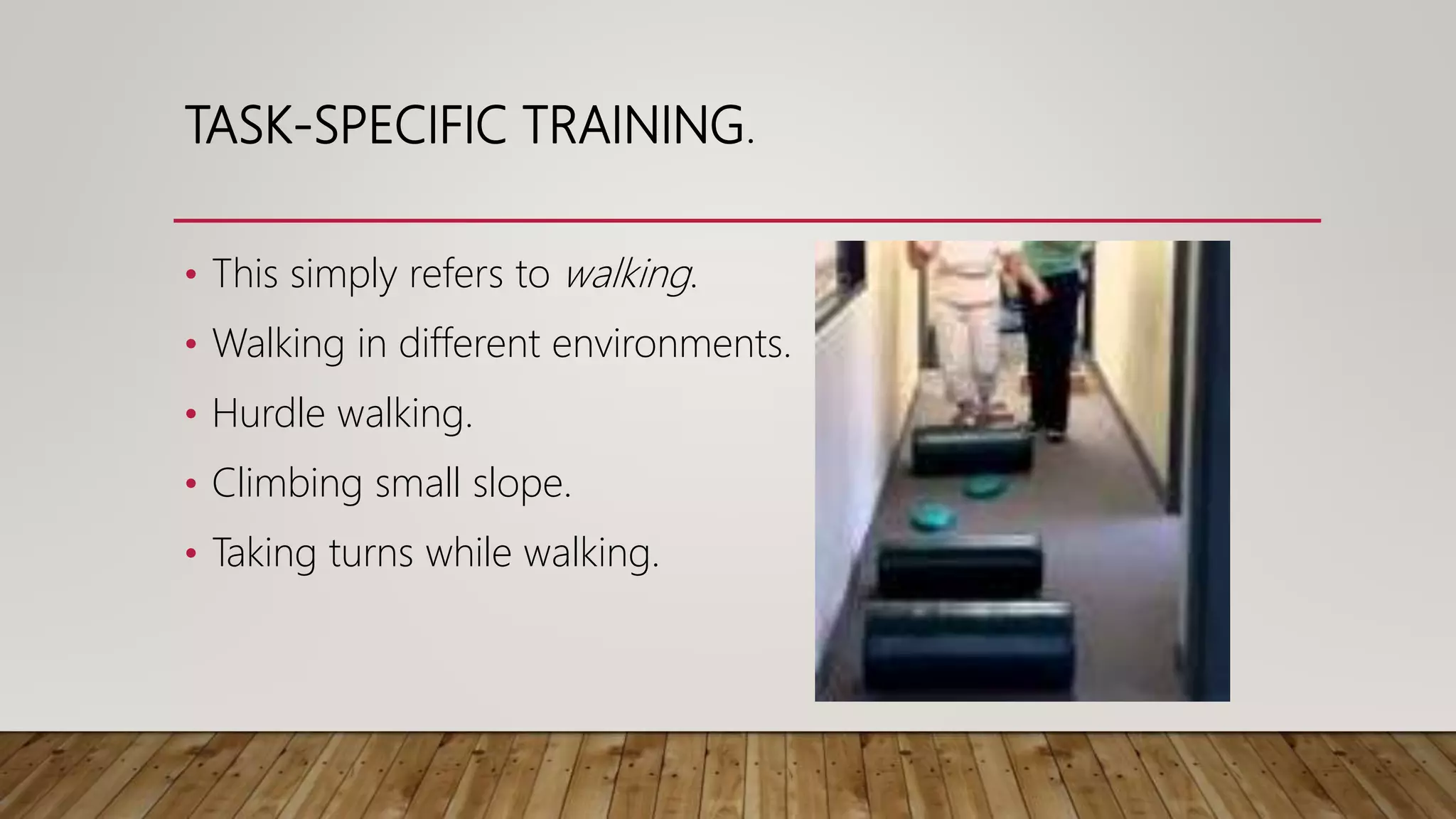
TASK-SPECIFIC TRAINING.
• This simply refers to walking.
• Walking in different environments.
• Hurdle walking.
• Climbing small slope.
• Taking turns while walking.
HIGH TECH GAIT REHABILITATION :
• Partial Body Weight Supported Treadmill Training
• Functional Electrical Stimulation
• Virtual Gait Training
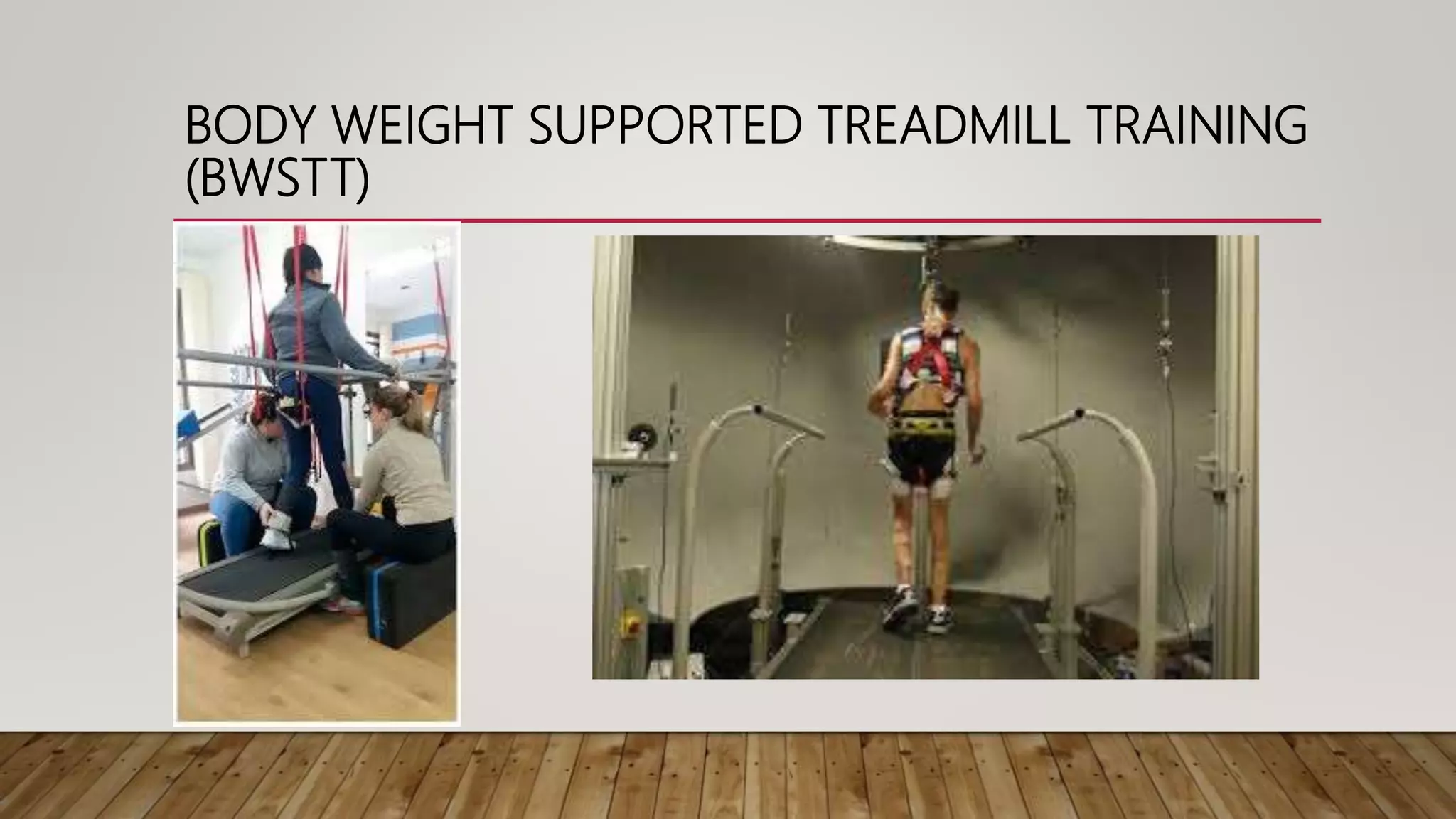
BODY WEIGHT SUPPORTED TREADMILL TRAINING
(BWSTT)
• An overhead harness is used to support a portion of the patient’s
body weight.
• The harness controls the upright position of the patient in the
absence of good postural stability & reduces fear of falling.
• The use of harness also eliminates the need for adaptive UE
support to compensate for LE weakness.
BODY WEIGHT SUPPORTED TREADMILL
TRAINING (BWSTT)
FUNCTIONAL ELECTRICAL STIMULATION.
• Adding electrical stimulation to the affected
muscles during gait training exercises can
help boost results, according to studies.
• NMES improves dorsiflexion and prevents
foot drop
• Significant improvement in gait is proven
with use of FES.
VIRTUAL REALITY GAIT TRAINING
• Studies suggest that VR
training is more
effective than balance
or gait training without
VR for improving
balance or gait ability in
patients with stroke.
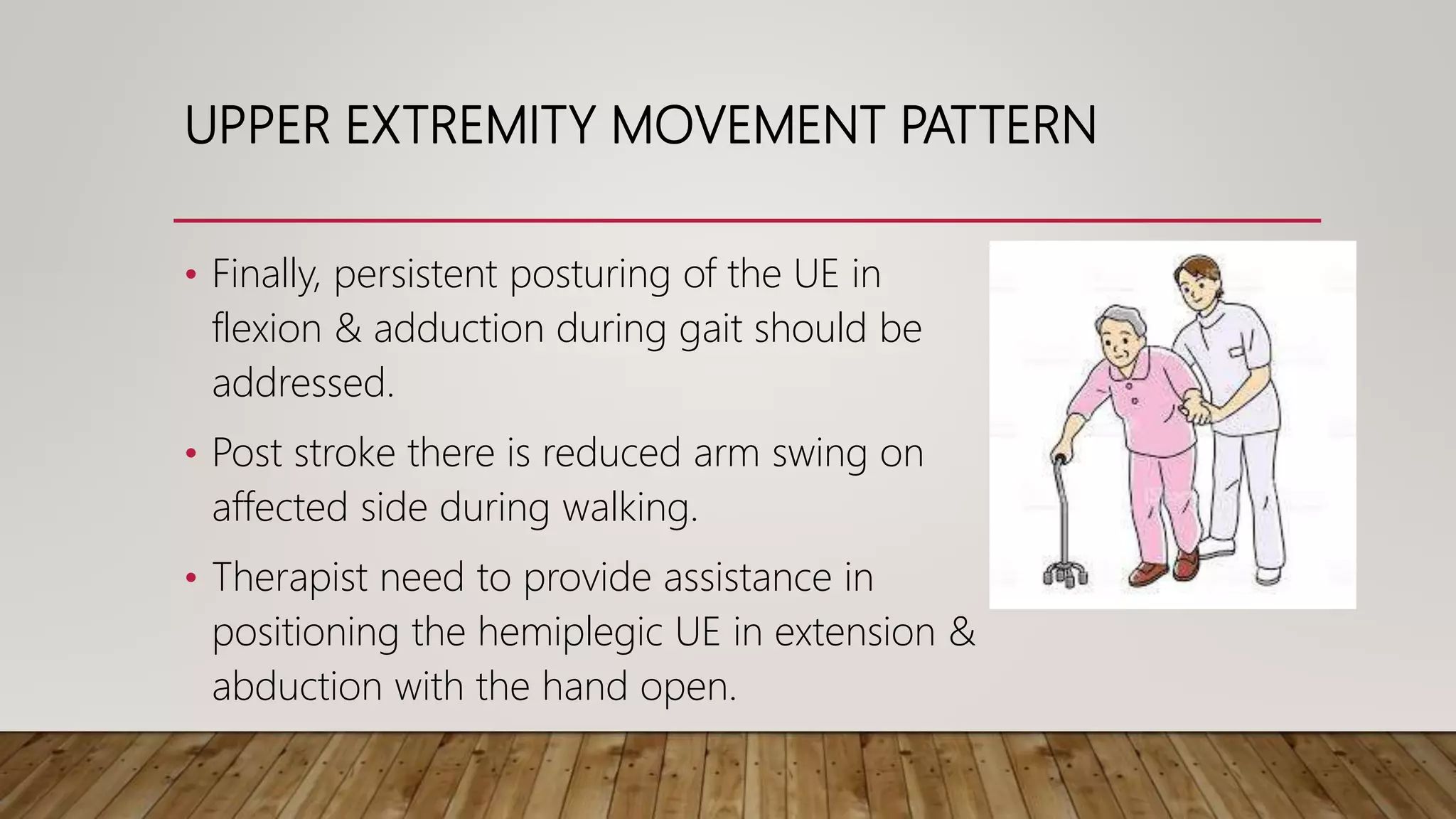
UPPER EXTREMITY MOVEMENT PATTERN
• Finally, persistent posturing of the UE in
flexion & adduction during gait should be
addressed.
• Post stroke there is reduced arm swing on
affected side during walking.
• Therapist need to provide assistance in
positioning the hemiplegic UE in extension &
abduction with the hand open.
ADDITIONAL STRENGTH TRAINING
• Some muscle atrophy is common after a stroke.
• Therefore, adding some strength training can help improve
overall health and gait.
• Keep in mind that this addresses the secondary complication of
muscle atrophy, while rehab exercise addresses the primary
concern
BENEFITS OF GAIT TRAINING AFTER STROKE
• Gait training exercises can help prevent falling after stroke,
because strong legs can help with stabilization if patient loses
balance.
• Ultimately, a consistent rehab exercise program can help patient
get back onto their feet and back to the activities that they
enjoy.
• Focus on high repetition of exercises to help rewire the brain.
• Be sure to target core and feet along with legs to improve
overall coordination and balance.
Hemiplegic Gait Rehabilitation

Hemiplegic Gait Rehabilitation

  • 1.
    HEMIPLEGIC GAIT REHABILITATION -By Dr.Rima Jani PT (B.P.T., M.P.T.)
  • 2.
    HEMIPLEGIC GAIT • Hemiplegicgait is also known as Circumductory Gait. • It includes impaired natural swing at the hip and knee with leg circumduction. • The pelvis is often tilted upward on the involved side to permit adequate circumduction. • With ambulation, the leg moves forward and then swings back toward the midline in a circular movement.
  • 3.
    COMPONENTS OF HEMIPLEGIC/CIRCUMDUCTORY GAIT •Hip Hike • Circumduction of the leg • Reduced hip & knee flexion • Decreased weight shift towards affected side • Foot drop, poor dorsiflexion, toe first or flat foot placement
  • 4.
    HEMIPLEGIC GAIT REHABILITATION TraditionalGait Rehabilitation High Tech Gait Rehabilitation Additional Strength Training Improving UE movement Pattern
  • 5.
    TRADITIONAL GAIT REHABILITATION: • Gait Training in parallel bar • Gait Training exercises • Balance and core training • Use of Assistive devices &/or Orthotics • Task-specific training. • Treadmill Training
  • 6.
    GAIT TRAINING INPARALLEL BAR • Parallel bars are used to assist individuals to re-learn to walk and for gait training, as well as to regain balance, strength, range of motion, and mobility.
  • 7.
    GAIT TRAINING EXERCISES •Seated Marching • Knee Extension Exercises • Toe Taps • Braiding Exercises • Side Stepping • Ankle Dorsiflexion Exercises • Assisted Toe Raise • Heel Raises
  • 8.
    SEATED MARCHING • Thisbasic gait training exercise can be done from any seated position. • Start by lifting affected leg up towards the chest, and then place it back down onto the floor. Then repeat on the other leg, alternating back and forth. • Be mindful of keeping the back straight and maintaining controlled movement.
  • 9.
    KNEE EXTENSION EXERCISES •Knee extensions are a classic gait training exercise because knees are constantly bending during walking. • To perform this exercise, start from a seated position. Then extend one leg out in front parallel to the floor. Do it on both side in alternate pattern. • Try to avoid locking the knee completely and keep a soft bend.
  • 10.
    TOE TAPS • Whilelying on back, lift legs up and bend the knees at a 90 degree angle. Shins should be parallel to the floor and core should be fully engaged. • From there, bring the left leg down and gently tap the floor with left foot. Then, bring leg back up. • Focus on using core muscles instead of just legs. Maintain a 90 degree bend in the knee the entire time. • Repeat on the other leg and alternate between each leg.
  • 11.
    BRAIDING EXERCISE • Braidingexercise is performed by crossing one leg in front of or behind the other in a continuous manner.
  • 12.
    SIDE STEPPING EXERCISES •Pick up your feet instead of sliding them. • Stand tall. • Walk 3 times to Left and Right side.
  • 13.
    ANKLE DORSIFLEXION EXERCISES •This gait training exercise will help target feet and improve conditions like foot drop after stroke. • To begin, start from a seated position and cross the affected leg over the other leg. • Then, move foot into dorsiflexion by using patient’s own unaffected hand to move foot up towards their knee. • Next, move into plantar flexion by extending foot back down. • For added challenge, complete these exercise without the use of hand.
  • 14.
    ASSISTED TOE RAISE •This gait training exercise can be difficult if patient has a foot drop. • However, it can help improve foot drop by retraining the brain to send the correct signals to their foot. • Patient position: Sitting. Then ask to place their unaffected foot underneath their affected foot. Then, ask them to use their foot to assist affected foot up. Then release back down. • Once patient regains the ability to perform these without assistance, make them perform active exercise for added challenge.
  • 15.
    HEEL RAISES • Thisis an advanced gait training exercise. • Ask patient to start with feet flat on the ground. • Then, point toes and lift their heels off the ground. Then place feet back down flat on the floor and repeat.
  • 16.
    BALANCE AND CORETRAINING • Balance and core training both also help improve gait. • Walking is a full-body task that requires coordinated movement from the feet, legs &core. • Reach outs in Standing • Walking on different surfaces • Balance Board Exercises • Weight Shifts on Affected side
  • 17.
    USE OF ASSISTIVEDEVICES &/or ORTHOTICS Ankle Foot Orthosis: • Solid AFO • Posterior leaf spring AFO (PLS)
  • 18.
    TREADMILL TRAINING • Oncepatient gains postural stability than treadmill training without BWS can be started. • Initially treadmill speeds are slow (0.23 m/sec) • Over a period of few weeks it is gradually increased up to (0.98 m/sec)
  • 19.
    TASK-SPECIFIC TRAINING. • Thissimply refers to walking. • Walking in different environments. • Hurdle walking. • Climbing small slope. • Taking turns while walking.
  • 20.
    HIGH TECH GAITREHABILITATION : • Partial Body Weight Supported Treadmill Training • Functional Electrical Stimulation • Virtual Gait Training
  • 21.
    BODY WEIGHT SUPPORTEDTREADMILL TRAINING (BWSTT)
  • 22.
    • An overheadharness is used to support a portion of the patient’s body weight. • The harness controls the upright position of the patient in the absence of good postural stability & reduces fear of falling. • The use of harness also eliminates the need for adaptive UE support to compensate for LE weakness. BODY WEIGHT SUPPORTED TREADMILL TRAINING (BWSTT)
  • 23.
    FUNCTIONAL ELECTRICAL STIMULATION. •Adding electrical stimulation to the affected muscles during gait training exercises can help boost results, according to studies. • NMES improves dorsiflexion and prevents foot drop • Significant improvement in gait is proven with use of FES.
  • 24.
    VIRTUAL REALITY GAITTRAINING • Studies suggest that VR training is more effective than balance or gait training without VR for improving balance or gait ability in patients with stroke.
  • 25.
    UPPER EXTREMITY MOVEMENTPATTERN • Finally, persistent posturing of the UE in flexion & adduction during gait should be addressed. • Post stroke there is reduced arm swing on affected side during walking. • Therapist need to provide assistance in positioning the hemiplegic UE in extension & abduction with the hand open.
  • 26.
    ADDITIONAL STRENGTH TRAINING •Some muscle atrophy is common after a stroke. • Therefore, adding some strength training can help improve overall health and gait. • Keep in mind that this addresses the secondary complication of muscle atrophy, while rehab exercise addresses the primary concern
  • 27.
    BENEFITS OF GAITTRAINING AFTER STROKE • Gait training exercises can help prevent falling after stroke, because strong legs can help with stabilization if patient loses balance. • Ultimately, a consistent rehab exercise program can help patient get back onto their feet and back to the activities that they enjoy. • Focus on high repetition of exercises to help rewire the brain. • Be sure to target core and feet along with legs to improve overall coordination and balance.

Editor's Notes

  • #11 Building a strong core is essential for improving gait. This exercise will help with that.
  • #14 (That would turn this into an active exercise