DEFINITION
•refers to dysfunction of the urinary bladder
due to disease of the central nervous
system or peripheral nerves involved in the
control of micturition (urination).
FLACCID BLADDER
•A flaccid, or hypotonic, bladder ceases to contract
fully, causing urine to dribble out of the body. Besides
the complications that stem from urine dripping,
rashes can occur in the area where urine pools. This
type of bladder disorder occurs when the volume of
urine is large but the pressure is low.
Spastic Bladder:
•A spastic, or reflex, bladder occurs when
the volume of urine is normal or small, but
there are involuntary contractions, causing
a person to feel the need to urinate even
when he doesn't need to release urine
Causes of Neurogenic
Bladder
•Stroke
•Parkinson’s disease
•Multiple sclerosis
•Alzheimer’s disease
•Spina bifida and neural
disorders resulting from diabetes
or alcoholism
Nerve damage may
result from:
•Child birth
•Pelvic injury
•Brain or spinal cord injury
•Herniated disc
•Heavy metal poisoning, or tumors of the
brain, spinal cord or pelvis
Symptoms of Neurogenic Bladder
•Overactive bladder .
•Frequent urination, in the daytime and at night
(nocturia)
•Stress incontinence
•Urge incontinence
•Inability to urinate (urinary retention)
•Underactive bladder – bladder is unable to signal
when full
Etiology And Risk Factors
•Tumors
•Neurologic disorders
•Trauma to the nervous system
Clinical Manifestation
•Retention with or without incontinence
•The client may or may not feel a need to
void or feel a sense of bladder distension.
NURSING DIAGNOSIS
•Overflow Incontinence related to chronically overfilled bladder with
loss of sensation of bladder distention.
•Overflow Incontinence related to detrusor-sphincter dyssynergy
(DSD)
•Reflex Incontinence related to absence of sensation to void and loss
of ability to inhibit bladder contraction.
•High Risk for Infection related to retention of urine or introduction of
urinary catheter.
•Urge Incontinence related to inability to inhibit urination after urge is
perceived.
•High risk for Loneliness related to embarrassment from incontinence
in front of others and fear of odor from urine
Treatment
•Medicines that relax the bladder (oxybutynin,
tolterodine, or propantheline)
•Medicines that make certain nerves more active
(bethanechol)
•Botulinum toxin (Botox)
•GABA supplements
•Antiepileptic durgs
Your doctor may refer you someone who has been trained to
help people manage bladder problems. Skills or techniques you
may learn include:
•Exercises to strengthen your pelvic floor muscles (Kegel
exercises)
•Keeping a diary of when you urinate, the amount you urinated,
and if you leaked urine. This may help you learn when you
should empty your bladder and when it may be best to be near
a bathroom.
Sometimes surgery is needed. Surgeries for neurogenic
bladder include:
•Artificial sphincter
•Electrical device implanted near the bladder nerves, to
stimulate the bladder muscles
•Sling surgery
•Creation of an opening (stoma) in which urine flows into a
special pouch (this is called urinary diversion
SPASTIC NEUROGENIC
BLADDER
LESIONS AT ABOVE T12
INTERRUPTED AFFERENT SIGNALS
EXCITATION OF NEURONS BELOW T12
SPONTANEOUS CONTRACTION
OF DM
URINARY SPHINCTER SPASMS
INTRAVESICAL VOIDING
PRESSURE
BLADDER WALL HYPERTROPHY
WITH TRABECULATION
REDUCED URINE-VOLUME
CAPACITY
UNCONTROLLED URINATION
FREQUENT URINATION
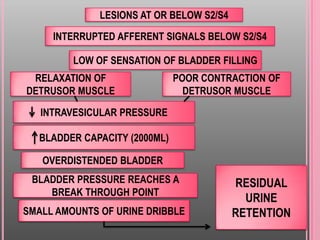
FLACCID NEUROGENIC
BLADDER
LESIONS AT OR BELOW S2/S4
INTERRUPTED AFFERENT SIGNALS BELOW S2/S4
LOW OF SENSATION OF BLADDER FILLING
RELAXATION OF
DETRUSOR MUSCLE
POOR CONTRACTION OF
DETRUSOR MUSCLE
INTRAVESICULAR PRESSURE
BLADDER CAPACITY (2000ML)
OVERDISTENDED BLADDER
BLADDER PRESSURE REACHES A
BREAK THROUGH POINT
SMALL AMOUNTS OF URINE DRIBBLE
RESIDUAL
URINE
RETENTION
Neurogenic bladder

Neurogenic bladder

  • 2.
    DEFINITION •refers to dysfunctionof the urinary bladder due to disease of the central nervous system or peripheral nerves involved in the control of micturition (urination).
  • 4.
    FLACCID BLADDER •A flaccid,or hypotonic, bladder ceases to contract fully, causing urine to dribble out of the body. Besides the complications that stem from urine dripping, rashes can occur in the area where urine pools. This type of bladder disorder occurs when the volume of urine is large but the pressure is low.
  • 5.
    Spastic Bladder: •A spastic,or reflex, bladder occurs when the volume of urine is normal or small, but there are involuntary contractions, causing a person to feel the need to urinate even when he doesn't need to release urine
  • 6.
    Causes of Neurogenic Bladder •Stroke •Parkinson’sdisease •Multiple sclerosis •Alzheimer’s disease •Spina bifida and neural disorders resulting from diabetes or alcoholism
  • 7.
    Nerve damage may resultfrom: •Child birth •Pelvic injury •Brain or spinal cord injury •Herniated disc •Heavy metal poisoning, or tumors of the brain, spinal cord or pelvis
  • 8.
    Symptoms of NeurogenicBladder •Overactive bladder . •Frequent urination, in the daytime and at night (nocturia) •Stress incontinence •Urge incontinence •Inability to urinate (urinary retention) •Underactive bladder – bladder is unable to signal when full
  • 9.
    Etiology And RiskFactors •Tumors •Neurologic disorders •Trauma to the nervous system Clinical Manifestation •Retention with or without incontinence •The client may or may not feel a need to void or feel a sense of bladder distension.
  • 10.
    NURSING DIAGNOSIS •Overflow Incontinencerelated to chronically overfilled bladder with loss of sensation of bladder distention. •Overflow Incontinence related to detrusor-sphincter dyssynergy (DSD) •Reflex Incontinence related to absence of sensation to void and loss of ability to inhibit bladder contraction. •High Risk for Infection related to retention of urine or introduction of urinary catheter. •Urge Incontinence related to inability to inhibit urination after urge is perceived. •High risk for Loneliness related to embarrassment from incontinence in front of others and fear of odor from urine
  • 11.
    Treatment •Medicines that relaxthe bladder (oxybutynin, tolterodine, or propantheline) •Medicines that make certain nerves more active (bethanechol) •Botulinum toxin (Botox) •GABA supplements •Antiepileptic durgs
  • 12.
    Your doctor mayrefer you someone who has been trained to help people manage bladder problems. Skills or techniques you may learn include: •Exercises to strengthen your pelvic floor muscles (Kegel exercises) •Keeping a diary of when you urinate, the amount you urinated, and if you leaked urine. This may help you learn when you should empty your bladder and when it may be best to be near a bathroom.
  • 13.
    Sometimes surgery isneeded. Surgeries for neurogenic bladder include: •Artificial sphincter •Electrical device implanted near the bladder nerves, to stimulate the bladder muscles •Sling surgery •Creation of an opening (stoma) in which urine flows into a special pouch (this is called urinary diversion
  • 15.
  • 16.
    LESIONS AT ABOVET12 INTERRUPTED AFFERENT SIGNALS EXCITATION OF NEURONS BELOW T12 SPONTANEOUS CONTRACTION OF DM URINARY SPHINCTER SPASMS INTRAVESICAL VOIDING PRESSURE BLADDER WALL HYPERTROPHY WITH TRABECULATION REDUCED URINE-VOLUME CAPACITY UNCONTROLLED URINATION FREQUENT URINATION
  • 17.
  • 18.
    LESIONS AT ORBELOW S2/S4 INTERRUPTED AFFERENT SIGNALS BELOW S2/S4 LOW OF SENSATION OF BLADDER FILLING RELAXATION OF DETRUSOR MUSCLE POOR CONTRACTION OF DETRUSOR MUSCLE INTRAVESICULAR PRESSURE BLADDER CAPACITY (2000ML) OVERDISTENDED BLADDER BLADDER PRESSURE REACHES A BREAK THROUGH POINT SMALL AMOUNTS OF URINE DRIBBLE RESIDUAL URINE RETENTION