INTRODUCTION
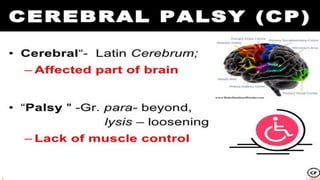
Cerebral palsy is actually an umbrella term for several
different types of physical disabilities. The term ‘‘cerebral’’
refers to the area of the brain that is affected by the disease.
The disease often includes other connections in the brain
involving the cortex and parts of the cerebellum as well. The
term ‘palsy’ refers to the disorder of movement.
DEFINITION
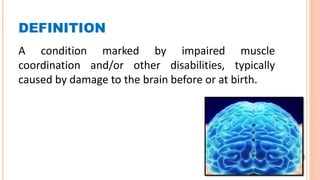
A condition marked by impaired muscle
coordination and/or other disabilities, typically
caused by damage to the brain before or at birth.
INCIDENCE
Prevalence rate is about 4% per 1000 live birth
10% of infants born 1000gm or less at birth
5%-10% incidence in preterm
Birth asphyxia as a cause only in 3-21%
TYPES/CLASSIFICATION
BASED ON MOTOR DEFICIT (MOVEMENT
DISORDER)
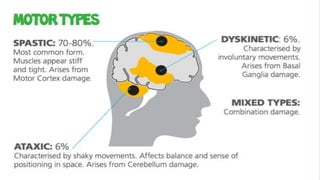
A. SPASTIC CEREBRAL PALSY
 The most common form of cerebral palsy
 65-70-% of all people with the condition are affected by this type
 Have stiff and awkward movement
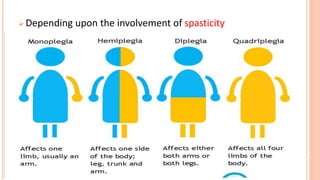
 Depending upon the involvement of spasticity
B. EXTRAPYRAMIDAL CEREBRAL PALSY (DYSKINETIC CP)
 It is found in about 30 percent of patients of all cerebral palsy.
 Uncontrolled interfere with speaking, feeding, grabbing,
reaching and others skills that require motor skills.
 Caused by cerebral damage due to kernicterus.
C. ATONIC CEREBRAL PALSY
 Found in about 5% of all cerebral palsy patient
 Poor balance and lack of coordination
 Results in stumbles and falls
 Ataxia and tremors appears by the age of 2 years
D. MIXED FORM
 Spastic muscle tone and involuntary movement
 Have damage to the motor cortex and cerebellum
ACCORDING TO SEVERITY
A. MILD CEREBRAL PALSY (20%)
Patients are ambulatory, fine movement are impaired only.
B. MODERATE CP (50%)
These children achieve ambulation by self-help. There is impaired
gross motor, fine motor and speech development.
C. SEVERE CP (30%)
The children present with multiple defects and unable to perform
usual activities of daily living.
CLINICAL MANIFESTATIONS
EARLY SIGNS OF CP
 Asymmetric movement
 Restlessness
 Irritability
 Feeding or swallowing or poor sucking
 Poor head control
 Tongue thrust
 Excessive high pitch cry
 Slow weight gain
LATE SIGNS OF CP
 Delayed gross motor development
 Persistent infantile reflexes
 Weakness
 Abnormal postures
 Drooling
 Recurrent infections
 Malocclusion of teeth
 Constipation
 Caries teeth
 Delayed or defective speech
 Evidence of mental retardation
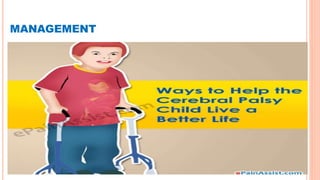
MANAGEMENT
Medical management
Correction or alleviation of specific neuro-motor deficits or
associated disabilities. Symptomatic management is done.
Pharmacotherapy
 Diazepam- for spasticity
 Strychnine- for hypotonic
 Levodopa- for athetosis
 Carbamazepine- for dystonia
 Anticonvulsants- for epilepsy
 Tranquilizers- for behavioral problems
 Muscle relaxants- to improve muscular functions
Physiotherapy.
Development enrichment experiences.
Development of vocational and socialization.
Emotional behavioral and social adjustment.
SURGICAL MANAGEMENT
Orthopedic correction of:
 Scoliosis
 Contractures
 Dislocations
 Rhizotomy is an attempt to decrease spasticity.
BIBLIOGRAPHY
1. Dutta P. pediatric nursing. 2nd ed. New Delhi: Jaypee brothers, 2009. P. 374-
76
2. Jacob A. Pediatric Nursing. 1st ed. Indore: NR Brothers; 1997.P. 358-65
3. Marlow DR, Redding BA. Text book of pediatric nursing. 6th ed. New Delhi:
Elsevier. 2011; P.947-56
4. 5. Ghai P.O, Paul K.V, Bagg. A essential pediatrics. 7th ed. New Delhi: CBS
publishers; 2010.P. 559-91

Cerebral palsy

  • 2.
    INTRODUCTION Cerebral palsy isactually an umbrella term for several different types of physical disabilities. The term ‘‘cerebral’’ refers to the area of the brain that is affected by the disease. The disease often includes other connections in the brain involving the cortex and parts of the cerebellum as well. The term ‘palsy’ refers to the disorder of movement.
  • 4.
    DEFINITION A condition markedby impaired muscle coordination and/or other disabilities, typically caused by damage to the brain before or at birth.
  • 5.
    INCIDENCE Prevalence rate isabout 4% per 1000 live birth 10% of infants born 1000gm or less at birth 5%-10% incidence in preterm Birth asphyxia as a cause only in 3-21%
  • 6.
    TYPES/CLASSIFICATION BASED ON MOTORDEFICIT (MOVEMENT DISORDER) A. SPASTIC CEREBRAL PALSY  The most common form of cerebral palsy  65-70-% of all people with the condition are affected by this type  Have stiff and awkward movement
  • 7.
     Depending uponthe involvement of spasticity
  • 8.
    B. EXTRAPYRAMIDAL CEREBRALPALSY (DYSKINETIC CP)  It is found in about 30 percent of patients of all cerebral palsy.  Uncontrolled interfere with speaking, feeding, grabbing, reaching and others skills that require motor skills.  Caused by cerebral damage due to kernicterus.
  • 9.
    C. ATONIC CEREBRALPALSY  Found in about 5% of all cerebral palsy patient  Poor balance and lack of coordination  Results in stumbles and falls  Ataxia and tremors appears by the age of 2 years D. MIXED FORM  Spastic muscle tone and involuntary movement  Have damage to the motor cortex and cerebellum
  • 11.
    ACCORDING TO SEVERITY A.MILD CEREBRAL PALSY (20%) Patients are ambulatory, fine movement are impaired only. B. MODERATE CP (50%) These children achieve ambulation by self-help. There is impaired gross motor, fine motor and speech development. C. SEVERE CP (30%) The children present with multiple defects and unable to perform usual activities of daily living.
  • 12.
    CLINICAL MANIFESTATIONS EARLY SIGNSOF CP  Asymmetric movement  Restlessness  Irritability  Feeding or swallowing or poor sucking  Poor head control  Tongue thrust  Excessive high pitch cry  Slow weight gain
  • 13.
    LATE SIGNS OFCP  Delayed gross motor development  Persistent infantile reflexes  Weakness  Abnormal postures  Drooling  Recurrent infections  Malocclusion of teeth  Constipation  Caries teeth  Delayed or defective speech  Evidence of mental retardation
  • 14.
  • 15.
    Medical management Correction oralleviation of specific neuro-motor deficits or associated disabilities. Symptomatic management is done. Pharmacotherapy  Diazepam- for spasticity  Strychnine- for hypotonic  Levodopa- for athetosis  Carbamazepine- for dystonia  Anticonvulsants- for epilepsy  Tranquilizers- for behavioral problems  Muscle relaxants- to improve muscular functions
  • 16.
    Physiotherapy. Development enrichment experiences. Developmentof vocational and socialization. Emotional behavioral and social adjustment.
  • 17.
    SURGICAL MANAGEMENT Orthopedic correctionof:  Scoliosis  Contractures  Dislocations  Rhizotomy is an attempt to decrease spasticity.
  • 18.
    BIBLIOGRAPHY 1. Dutta P.pediatric nursing. 2nd ed. New Delhi: Jaypee brothers, 2009. P. 374- 76 2. Jacob A. Pediatric Nursing. 1st ed. Indore: NR Brothers; 1997.P. 358-65 3. Marlow DR, Redding BA. Text book of pediatric nursing. 6th ed. New Delhi: Elsevier. 2011; P.947-56 4. 5. Ghai P.O, Paul K.V, Bagg. A essential pediatrics. 7th ed. New Delhi: CBS publishers; 2010.P. 559-91